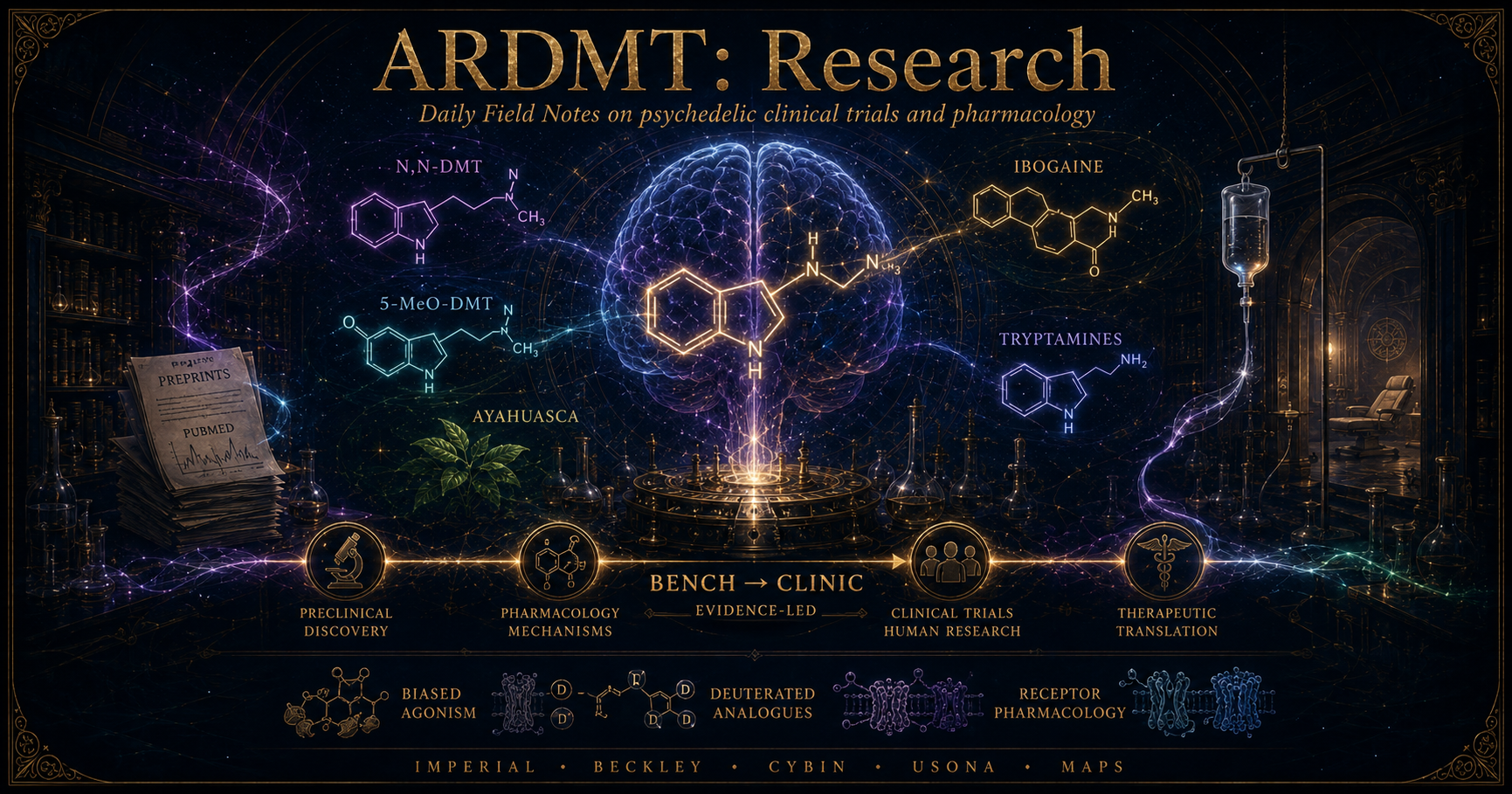
Research
Daily Field Notes on emerging psychedelic clinical trials and pharmacology — N,N-DMT, 5-MeO-DMT, ayahuasca, ibogaine, and related tryptamines. Coverage of preprints, peer-reviewed papers from PubMed, and the major research centres (Imperial, MAPS, Beckley, Cybin, Usona). Receptor pharmacology, biased agonism, deuterated analogues, and the translation of psychedelic compounds from bench to clinic. Independent, evidence-led, primary sources cited.
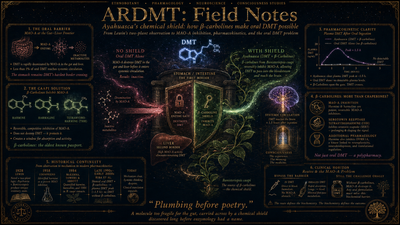
β-Carbolines and the MAO-A barrier: how ayahuasca makes oral DMT possible
In 1928, when Lewin catalogued mescaline among his Phantastica, he noted something curious about ayahuasca: the brew required two plants, not one. A single plant supplied the visions,
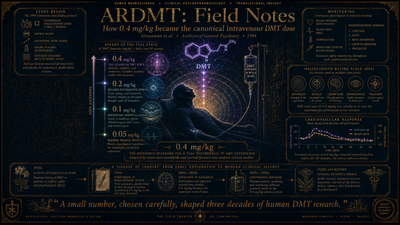
Why 0.4 mg/kg: Strassman's dose-finding logic and its thirty-year hold
Strassman's dose-finding study, published in Archives of General Psychiatry in 1994, employed a double-blind design with four intravenous dose levels — 0.05, 0.1, 0.2, and 0.4 mg/kg of DMT fumarate
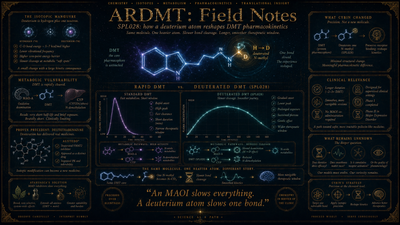
Deuterating DMT: how two neutrons reshape a pharmacokinetic profile
When Cybin Inc. filed its patent family around CYB003 — later redesignated SPL028 — the core chemical manoeuvre was, on its face, almost comically modest.
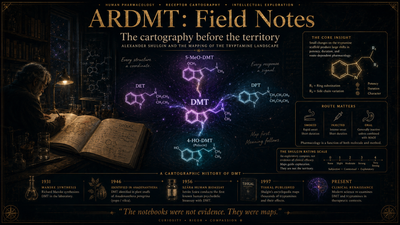
Shulgin's tryptamine notebooks: the cartography DMT research still navigates by
The relevance of Shulgin's tryptamine work to present-day DMT research is not merely historical. Several active lines of enquiry trace their intellectual ancestry directly to his structure-activity observations.
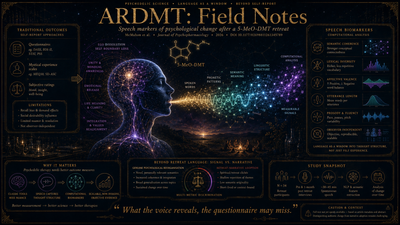
Speech biomarkers after 5-MeO-DMT: can how you talk reveal what changed?
Kuc, McAlpine, Sellers, Blackburne, Lametti, and Skipper, writing in the Journal of Psychopharmacology, report on what they term "speech markers of psychological change"
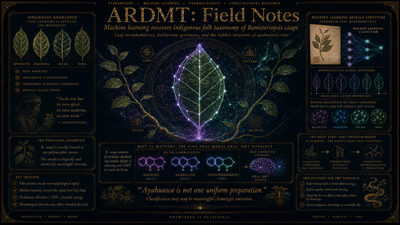
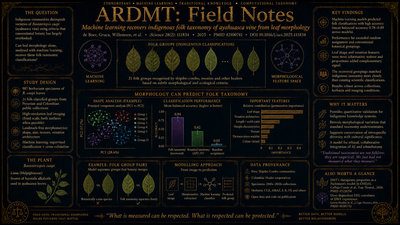
Machine learning validates indigenous folk taxonomy of the ayahuasca vine
A machine learning study quietly validates indigenous taxonomy of Banisteriopsis caapi — and raises a harder question about what counts as scientific knowledge.
Endogenous DMT from Axelrod to Borjigin: what sixty years have settled and what they have not
The story begins, as so many stories in psychedelic pharmacology do, with Julius Axelrod. In 1961, working at the National Institute of Mental Health, Axelrod demonstrated that rabbit lung tissue contained an enzyme capable of methylating tryptamine to form DMT.
Extended-state DMT infusion: three decades almost-but-not-quite attempted
There is something faintly poignant about the extended-state protocol's career: pharmacokinetically straightforward, clinically demanding, ethically complex, and philosophically loaded, all at once.
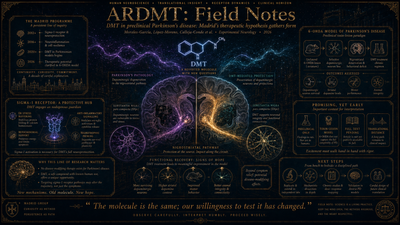
DMT in a Parkinson's model: Madrid group returns with fuller claims
The Madrid group — Morales-García, López-Moreno, Calleja-Conde, and colleagues — return to Experimental Neurology with what appears to be their most developed account yet of DMT's neuroprotective potential in a preclinical model of Parkinson's disease.
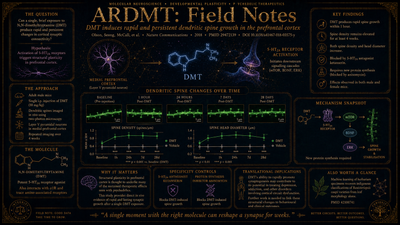
Strassman's IV DMT protocol: the dataset that still sets the dose
Rick Strassman's DMT studies were not the first to administer the compound to humans; that distinction belongs to the Hungarian chemist and psychiatrist Stephen Szára, who injected himself with it in 1956.
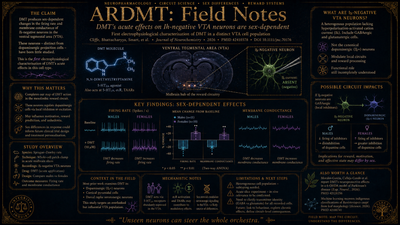
DMT on VTA Ih-negative neurons: sex-dependent firing changes in reward circuitry
A group at the University of Exeter has turned its electrodes on a rather specific neuronal population: the Ih-negative cells of the ventral tegmental area.
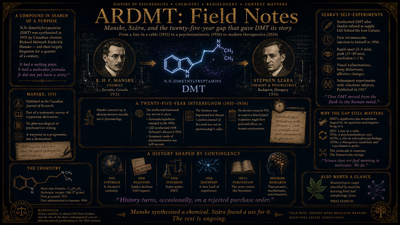
Manske to Szára: DMT's twenty-five years as a compound without a question
Manske's synthesis appeared in 1931, published in the Canadian Journal of Research, as part of a broader programme of work on tryptamine derivatives.