ARDMT Field Notes
Manske to Szára: DMT's twenty-five years as a compound without a question
A Compound in Search of a Purpose
On quiet days in the literature, one is permitted — encouraged, even — to look backwards. Today's subject is a small historical puzzle: how does a molecule get synthesised, catalogued, and then essentially forgotten for a quarter of a century? The molecule in question is N,N-dimethyltryptamine, and the man who first prepared it in a flask was the Canadian chemist Richard Helmuth Frederick Manske.
Manske, 1931
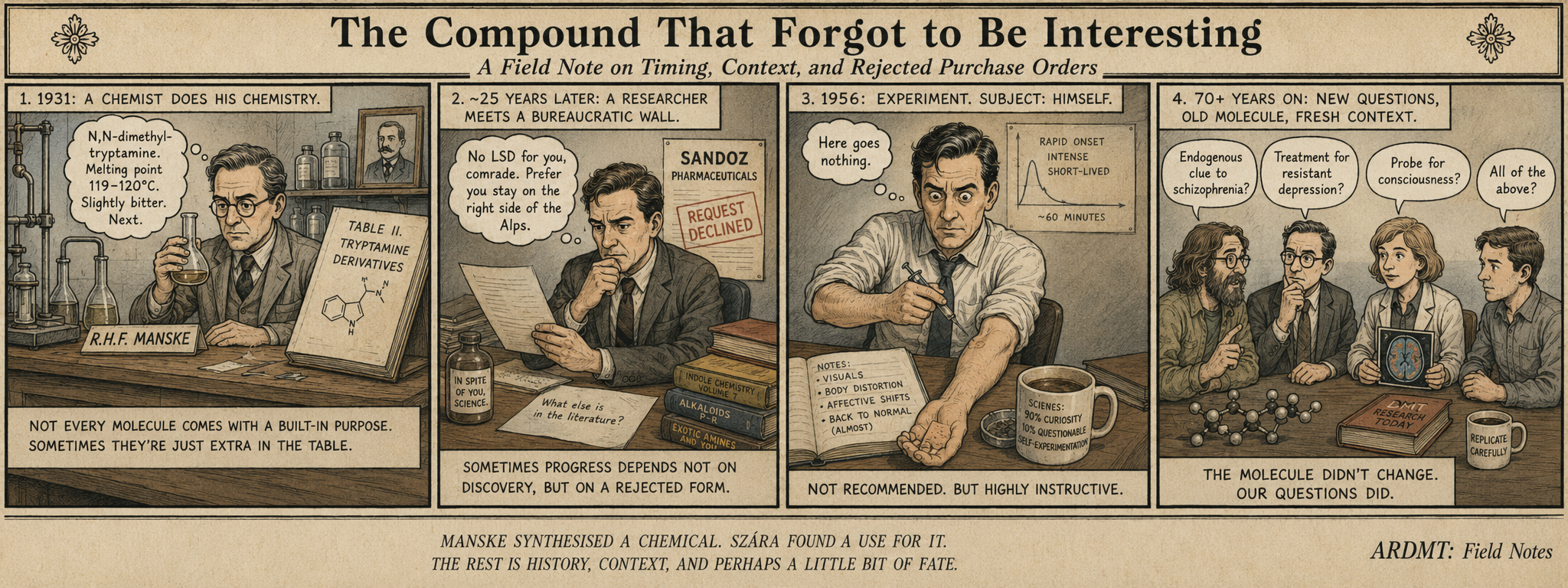
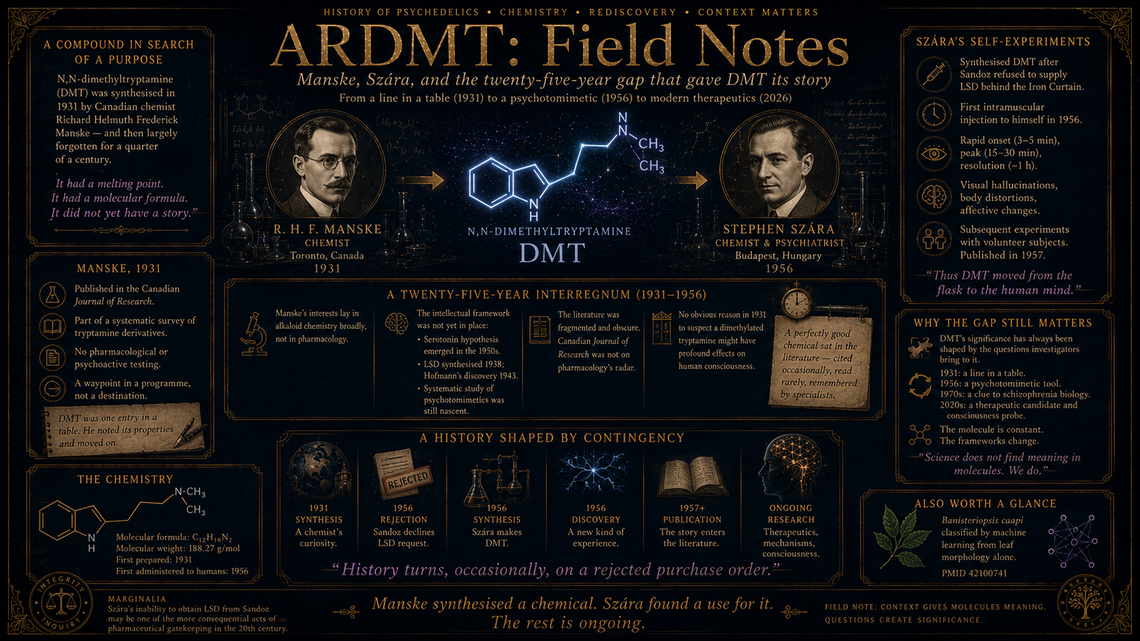
Manske's synthesis appeared in 1931, published in the Canadian Journal of Research, as part of a broader programme of work on tryptamine derivatives. The paper was not about psychoactivity. It was not about consciousness, therapeutics, or the pineal gland. It was, in the manner of interwar organic chemistry, a systematic survey: take a known scaffold, attach various substituents, characterise the products. DMT was one entry in a table. Manske prepared it, noted its properties, and moved on. There is no indication he or anyone in his circle ever administered it to a living organism, let alone a human being.
This is worth dwelling on. The compound that would later become the subject of ayahuasca tourism, machine-elf discourse, and — more recently — serious clinical investigation into treatment-resistant depression, sat in the chemical literature for over two decades as an unremarkable synthetic product. It had a melting point. It had a molecular formula. It did not yet have a story.
The Interregnum
Why the long silence? Several factors conspired. First, Manske's interests lay in alkaloid chemistry broadly, not in pharmacology. He was a prodigious synthesist — his later career included major contributions to the chemistry of isoquinoline alkaloids — and DMT was, for him, a waypoint rather than a destination.
Second, the intellectual framework that would make DMT interesting did not yet exist. The serotonin hypothesis of brain function was a product of the 1950s. LSD was not synthesised until 1938, and Hofmann's accidental discovery of its psychoactive effects did not occur until 1943. Mescaline had been known since Heffter's 1897 self-experiments, but the systematic study of psychotomimetics — the word itself tells you the prevailing clinical attitude — was still nascent. There was, in 1931, no obvious reason to wonder whether a dimethylated tryptamine might do anything peculiar to a human mind.
Third, and more prosaically: the Canadian Journal of Research was not where the pharmacological world looked for leads. Manske's synthesis was accessible but not prominent. It sat in the literature the way many perfectly competent pieces of chemistry sit — cited occasionally, read rarely, remembered by specialists.
Szára and the Rediscovery
The man who gave DMT its second life was Stephen Szára, a Hungarian chemist and psychiatrist working in Budapest in the mid-1950s. The story, as Szára himself later recounted it, has an almost comic bureaucratic dimension: he had written to Sandoz requesting a supply of LSD for research purposes, and the Swiss firm, cautious about sending a controlled psychoactive substance behind the Iron Curtain, declined. Szára, undeterred, decided to synthesise his own psychedelic. He settled on DMT — findable in the literature, relatively straightforward to prepare, and structurally adjacent to compounds of known interest.
In 1956, Szára administered DMT to himself by intramuscular injection. The effects were rapid, intense, and short-lived: visual hallucinations, distortions of body image, and affective changes, resolving within roughly an hour. He subsequently conducted a small series of experiments with volunteer subjects, publishing his findings in 1957. This was, in effect, the birth of DMT as a pharmacological entity rather than a mere chemical one.
Why This Gap Still Matters
The twenty-five-year hiatus between Manske and Szára is not merely a curiosity for historians of chemistry. It illustrates something that remains relevant to contemporary DMT research: the compound's significance has always been context-dependent, shaped less by any intrinsic property that demands attention than by the questions investigators bring to it.
In 1931, DMT was a line in a table. In 1956, it became a psychotomimetic — a tool for modelling psychosis. In the 1970s, following the discovery of endogenous DMT in human tissues, it became a potential clue to the biochemistry of schizophrenia. Today, it is investigated as a candidate therapeutic for depression and as a probe for studying consciousness under controlled conditions. The molecule has not changed. The frameworks have.
Current researchers working on extended-state DMT infusion protocols, or on the neuroplastogenic properties of tryptamines, are — whether they always acknowledge it or not — the latest in a succession of communities that have picked up Manske's compound and decided it answers a question they happen to be asking. This is not a criticism. It is how science works. But it is a useful corrective to any narrative that treats DMT as a substance whose importance was always self-evident, merely awaiting discovery.
Manske synthesised a chemical. Szára found a use for it. The rest is ongoing.
Marginalia
One notes that Szára's inability to obtain LSD from Sandoz was, in its way, one of the more consequential acts of pharmaceutical gatekeeping in the twentieth century. Had the paperwork gone through, he might never have turned to DMT at all. The history of psychedelic science turns, occasionally, on a rejected purchase order.