ARDMT Field Notes
Long-Term Ayahuasca: Personality Shifts, Cognition Intact (Bouso)
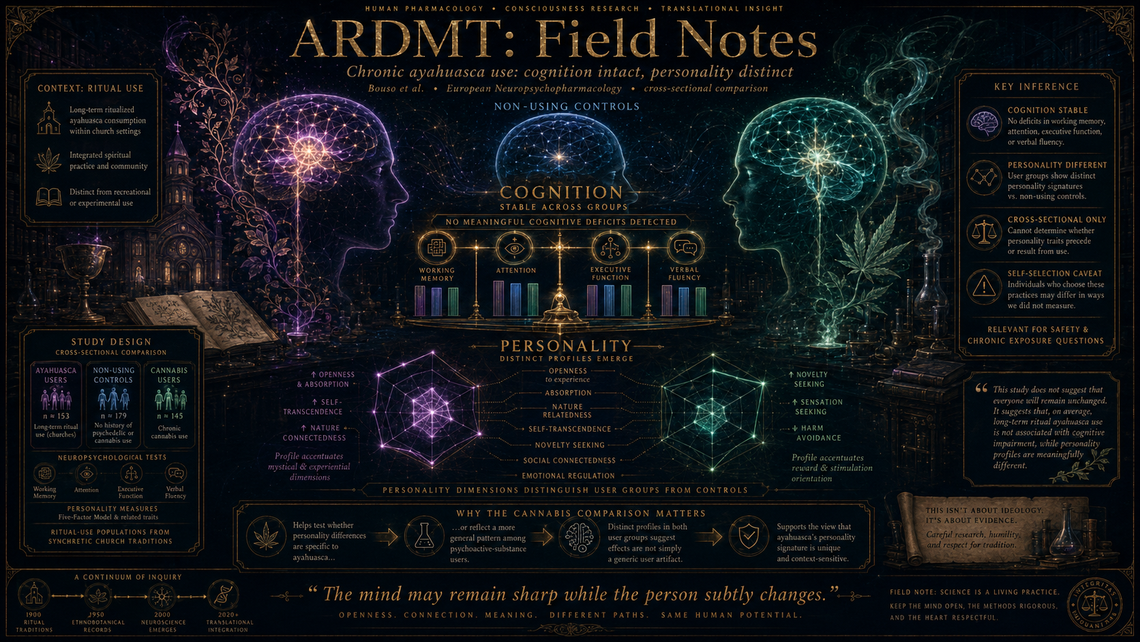
José Carlos Bouso and colleagues have been quietly assembling one of the more careful pictures of what chronic ayahuasca use does — and does not do — to the human brain, and their latest contribution, now indexed in European Neuropsychopharmacology, lands a result that is at once unsurprising to those who have followed this thread and usefully clarifying for those who have not: long-term, ritualised ayahuasca consumption does not appear to erode cognitive function, but it does leave a detectable signature in personality (PMID 41687467). The twist, and the reason the paper earns its title, is the inclusion of a chronic cannabis comparison group — a design choice that lets one ask whether any observed differences are peculiar to ayahuasca or merely artefacts of being the sort of person who regularly consumes psychoactive plants in a structured social context.
What was done
The study is cross-sectional, which is worth stating early because it governs everything that can and cannot be concluded. Bouso's group recruited three cohorts — chronic ayahuasca users, chronic cannabis users, and non-using controls — and administered a battery of neuropsychological tests alongside standardised personality measures. The senior author is Jordi Riba, a pharmacologist whose earlier work with ayahuasca neuroimaging and acute dosing studies is well known. The collaboration with Brazilian co-authors (Rafael G. dos Santos, Jaime Hallak) situates the ayahuasca arm within the ritual-use populations — members of syncretic churches such as the Santo Daime and União do Vegetal traditions — that have been studied since the mid-1990s. This is a not-insignificant methodological advantage: these are not naïve participants dabbling in retreat-centre tourism but individuals with years, sometimes decades, of regular exposure.
Key findings
On cognition — working memory, attention, executive function, verbal fluency, and the usual suspects of a neuropsychological screening — the three groups did not meaningfully differ. This is consistent with the accumulating evidence base, including Bouso's own earlier work and the broader reviews by dos Santos and Hallak, which have repeatedly failed to find ayahuasca-associated cognitive deficits in church-member populations. That the cannabis group also showed no clear impairment relative to controls on these measures will raise eyebrows among those familiar with the cannabis-cognition literature; one suspects that careful matching on education and socioeconomic status may account for some of the discrepancy with studies reporting cannabis-related executive function decrements.
Personality is where the groups diverge. The title promises that personality "distinguishes" both user groups from controls, and the paper appears to find that ayahuasca and cannabis users each differ from non-users on personality dimensions, though presumably along different profiles. The critical interpretive question — one the authors are certainly aware of — is whether chronic use shifts personality or whether pre-existing traits predispose individuals toward seeking out these substances in the first place. A cross-sectional design cannot adjudicate. It can only note the association and gesture at prospective work that might settle the matter.
Where this sits
The safety profile of long-term ritual ayahuasca use has been examined for nearly three decades, beginning with the Hoasca Project in the mid-1990s and continuing through a series of Brazilian and Spanish studies. The general picture is decidedly benign: no evidence of neurotoxicity, no persistent psychopathology attributable to use, and — now reiterated here — no cognitive decline. This matters not merely as a curiosity of ethnopharmacology but because DMT-containing ayahuasca is being actively developed as a therapeutic intervention for depression and other conditions; regulators will want to know whether chronic exposure carries hidden costs. The personality findings, meanwhile, echo the broader psychedelic literature, where increased openness and related traits are among the most replicated psychological sequelae of serotonergic psychedelic use, whether acute or repeated.
The limitations are standard but real. Self-selection bias is the elephant. Church members who thrive under regular ayahuasca use and remain in the community for years may simply be temperamentally different from those who try it once and leave, let alone from the general population. The cannabis comparison partially mitigates this, but only partially. And cross-sectional personality data, absent a pre-use baseline, can only ever suggest rather than demonstrate causation.
Also worth a glance
A paper on the serotonergic polypharmacology of 2-halogenated tryptamines (PMID 42079221) maps functional selectivity across the tryptamine scaffold at multiple serotonin receptor subtypes — directly relevant to understanding DMT's receptor pharmacology, though the work is in vitro only and awaits behavioural validation. Separately, a systematic review examines ayahuasca therapy and possible reduction of suicidal ideation in treatment-resistant depression (PMID 42023657), a clinically urgent question hampered by the still-modest size of the evidence base it draws upon.
Marginalia
It is a peculiar feature of psychedelic research that we spend enormous effort asking whether these substances damage cognition and comparatively little asking whether the personality changes they appear to foster are, on balance, welcome. One can imagine a substance that leaves your IQ untouched while rendering you insufferably transcendent. Whether that counts as a side effect or a benefit probably depends on whom you ask — and, perhaps more to the point, on whom you live with.