About ARDMT
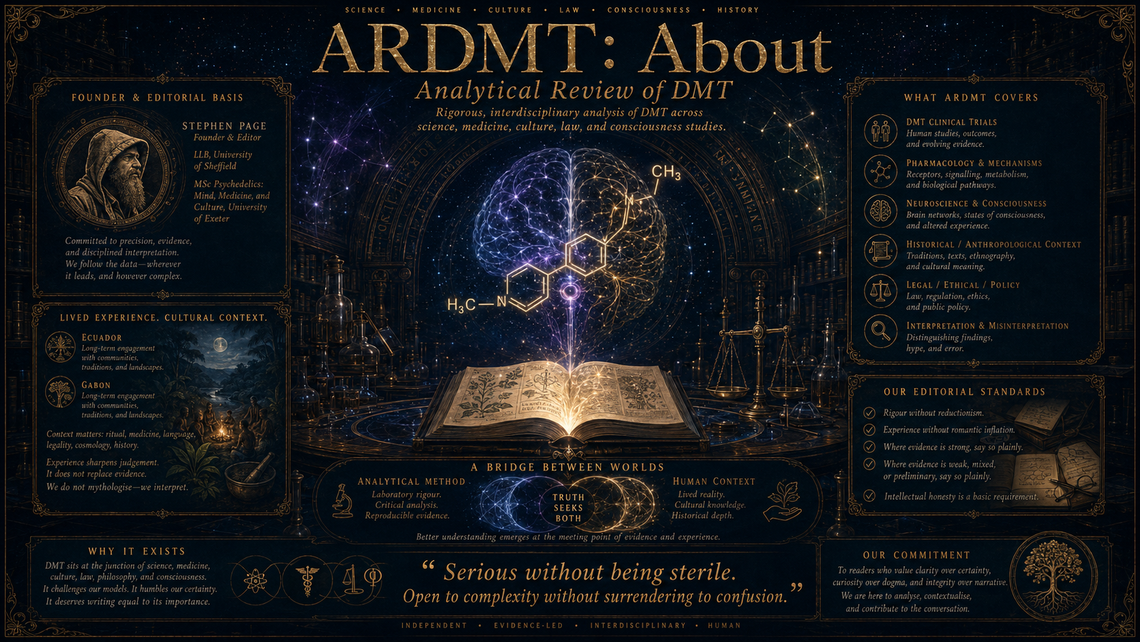
ARDMT — the Analytical Review of DMT — is an independent publication devoted to rigorous, interdisciplinary analysis of DMT research, DMT studies, and the wider questions DMT raises across science, medicine, culture, law, and consciousness studies.
It was founded on a simple conviction: that DMT is too important a subject to be handled either sensationally or superficially.
Few compounds sit at so unusual a junction of disciplines. DMT is at once a matter for pharmacology, psychiatry, neuroscience, anthropology, religious studies, philosophy of mind, and public policy. Yet discussion of DMT research is often degraded by familiar failures of method and tone: romantic inflation, reflex scepticism, cultural illiteracy, second-hand mystique, or an overly narrow clinical vocabulary that strips the subject of its wider human significance. ARDMT was established as a corrective to those habits.
Its purpose is to offer writing that is analytically serious, historically informed, and intellectually disciplined, while remaining fully alert to the fact that DMT is not merely a laboratory object, but part of a much larger human story.
I am Stephen Page, founder and editor of ARDMT.
My academic background is in law. I hold an LLB from the University of Sheffield and am undertaking the MSc in Psychedelics: Mind, Medicine, and Culture at the University of Exeter on a part-time basis. That trajectory reflects the dual commitments that shape this publication: close analytical method on the one hand, and sustained engagement with the broader human realities surrounding psychedelic experience on the other.
Legal training furnished me with habits of reading and argument that are central to ARDMT’s editorial approach: precision in language, careful treatment of evidence, sensitivity to ambiguity, and a constant concern with the difference between what is striking, what is plausible, and what is genuinely well supported. The study of psychedelics extends those concerns into an area where psychedelic science, lived experience, cultural inheritance, and emerging medical research frequently overlap — and frequently become confused.
But ARDMT does not arise from academic interest alone.

It is also grounded in substantial lived experience accumulated over many years, most importantly through deep and sustained engagement in Ecuador and Gabon. These were not brief encounters, nor the sort of passing contact that is later inflated into authority. They involved long-term integration with native tribal communities, direct familiarity with ceremonial and cultural contexts, and a continuing relationship with those worlds that remains part of my life. That background includes not only observation and study, but a significant degree of actual first-hand experience.
This matters for a straightforward reason: no serious account of substances such as DMT can be built from clinical trials and laboratory findings alone, however valuable those findings may be. Nor can it be built solely from personal narrative, ceremonial reverence, or countercultural enthusiasm. The subject demands a more exacting balance than that. It requires attention to evidence, certainly, but also to context: to history, cosmology, ritual, medicine, language, legality, and the social worlds in which these substances have been understood, feared, regulated, or revered.
The perspective informing ARDMT is therefore neither narrowly clinical nor romantically experiential. It is an attempt to think seriously across those domains without collapsing one into another.
In addition to this core background, my understanding has been shaped by broader first-hand familiarity with related altered-state and plant-medicine contexts in other settings. Those experiences are relevant, but ARDMT is not intended as a vehicle for personal myth-making. Experience is valuable here not because it confers unchallengeable authority, but because it sharpens judgement: it improves one’s sense of what is being trivialised, overstated, mistranslated, commodified, or misunderstood.
That combination — formal analytical training and long-form lived familiarity — defines the editorial basis of this publication.
What ARDMT covers
ARDMT is concerned with DMT in the fullest serious sense. Its coverage includes:
- emerging and completed DMT clinical trials
- DMT pharmacology and proposed mechanisms of action
- neuroscience and contemporary consciousness research
- historical, anthropological, and cross-cultural context
- legal, ethical, and policy developments
- the interpretation and misinterpretation of findings in public discourse
The intention is not merely to aggregate developments, but to interpret them with care.
That requires a disciplined resistance to hype. It requires equal resistance to dismissive reductionism. It requires a willingness to separate strong findings from weak claims, serious ambiguity from pseudo-depth, and genuine intellectual difficulty from fashionable obscurity. It also requires recognising that DMT research remains a developing field in which some of the most important questions are still open.
ARDMT is written for readers who want more than headlines, more than borrowed language, and more than the familiar polarities of clinical flattening versus mystical overstatement. It is for those seeking work that is serious without being sterile, informed without being derivative, and open to complexity without surrendering to confusion.
Editorial position
ARDMT does not pretend to a false neutrality. The subject matters to me, and this publication is animated by that conviction. But conviction is not licence. The standard here is not enthusiasm masquerading as analysis, nor scepticism masquerading as rigour.
Where evidence is strong, that should be said plainly.
Where it is preliminary, mixed, weak, or overstated, that should also be said plainly.
Where a matter belongs to interpretation rather than settled knowledge, that distinction must be preserved.
In a field crowded with projection, simplification, and rhetorical excess, intellectual honesty is not a decorative virtue. It is a basic requirement.
Why ARDMT exists
DMT is one of the rare subjects that compels serious thought across multiple orders of inquiry at once. It raises questions not only about therapeutic potential or receptor binding, but about consciousness, symbolic experience, cultural transmission, and the limits of prevailing explanatory frameworks. It is bound up with some of the most difficult issues in medicine, philosophy, and human self-understanding.
It therefore deserves a standard of writing equal to its importance.
ARDMT was created to meet that standard.