ARDMT Field Notes
Can Halogenated DMT Analogues Be Non-Hallucinogenic? G-Protein Bias
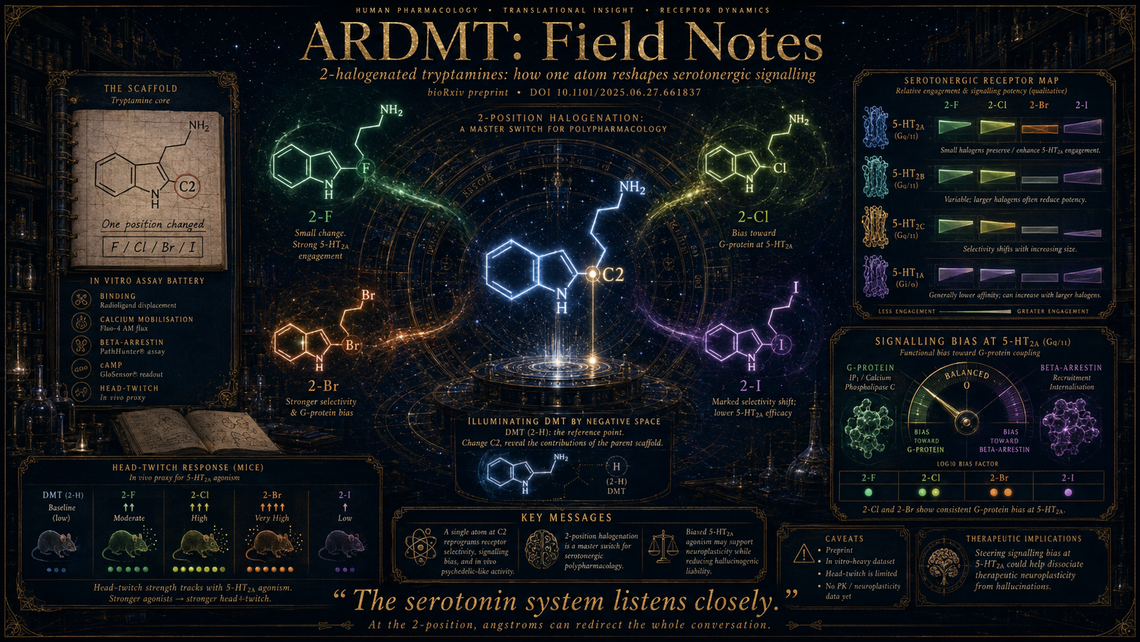
One of the more elegant games in medicinal chemistry is the strategic placement of a single atom and the observation of what it does to everything downstream. Today's centrepiece, a preprint from bioRxiv (DOI 10.1101/2025.06.27.661837), plays precisely this game with the tryptamine scaffold — the molecular backbone shared by DMT, psilocin, serotonin itself, and a great many compounds of pharmacological interest — by introducing halogen atoms at the 2-position of the indole ring and cataloguing the consequences across a panel of serotonin receptors.
What was done
The authors synthesised a series of 2-halogenated tryptamine analogues — fluorine, chlorine, bromine, and iodine substituents at the C2 position — and profiled their activity at multiple serotonergic targets, with particular attention to 5-HT2A, 5-HT2B, 5-HT2C, and 5-HT1A receptors. The methodology appears to combine radioligand binding assays for affinity measurements with functional assays — calcium mobilisation, β-arrestin recruitment, and in some cases cAMP accumulation — to build a picture not merely of where these compounds bind but of what they do once bound. This is the right approach: binding affinity alone has long been an insufficient predictor of behavioural or therapeutic outcome, and the field has rightly moved towards characterising functional selectivity, or signalling bias, as a more informative descriptor. Several of the analogues were also assessed using head-twitch response assays in mice, the standard (if imperfect) rodent proxy for psychedelic activity mediated via 5-HT2A agonism.
Key findings
The central observation is that 2-halogenation produces a notably orderly modulation of receptor selectivity and functional activity, tracking, at least partially, with the size and electronic character of the halogen. The smaller halogens — fluorine and chlorine — appear to have preserved or enhanced 5-HT2A binding affinity relative to unsubstituted parent compounds, while the bulkier bromine and iodine substituents introduced more pronounced shifts in selectivity, in some cases steering activity away from 5-HT2A and towards other receptor subtypes or altering the balance between G-protein and β-arrestin signalling pathways. This is precisely the sort of structure-activity relationship data that lets one begin to tease apart which features of the tryptamine scaffold are doing which pharmacological work.
Particularly worth attention is the reported observation that certain 2-chloro and 2-bromo analogues displayed significant signalling bias at 5-HT2A, favouring G-protein coupling over β-arrestin recruitment. This matters because there is an active and increasingly well-supported hypothesis — originating in part from work by Olson, Bhatt, and others — that the therapeutic effects of psychedelics may be dissociable from their hallucinogenic properties, and that signalling bias is one lever by which such dissociation might be achieved. A biased 5-HT2A agonist that promotes neuroplasticity without producing a full psychedelic experience would be, to put it mildly, of considerable clinical interest. Whether these particular analogues achieve that remains to be demonstrated in more sophisticated behavioural and neuroplasticity assays, but the SAR logic is sound.
The head-twitch data, where reported, appear broadly consistent with the in vitro pharmacology: analogues retaining strong 5-HT2A agonism produced robust head-twitch responses, while those with shifted selectivity or reduced efficacy did not. A reassuring internal consistency, though one should note that the head-twitch response captures only one dimension of a compound's psychopharmacological profile.
What this tells us about DMT
DMT itself is, of course, unsubstituted at the 2-position. Its pharmacology is famously promiscuous — acting at not only 5-HT2A but also 5-HT2C, 5-HT1A, sigma-1, and trace amine-associated receptors, among others — and this polypharmacology is increasingly thought to be not a messy side-effect but a central feature of its action. What the present study offers is a kind of negative-space portrait of DMT's pharmacology: by showing what changes when you place a halogen at C2, it illuminates what the unsubstituted state is doing. The fact that even a fluorine — the smallest halogen, often considered a near-isosteric replacement for hydrogen — appears to produce measurable shifts in receptor selectivity suggests that the electronic environment around the 2-position is rather sensitively read by the binding pockets of serotonin receptors. This is a useful constraint for computational modelling efforts and for future medicinal chemistry campaigns aiming to dial specific receptor interactions up or down.
Caveats
This is a preprint, not yet peer-reviewed, and the usual cautions apply. The in vivo data appear limited to the head-twitch response; there are no neuroplasticity measurements, no assessments of subjective-like states via more nuanced behavioural paradigms, and no pharmacokinetic data that would indicate whether these compounds are viable beyond the bench. The signalling bias observations, while intriguing, depend heavily on the specific assay platform and reference agonist used — quantified bias can shift meaningfully between systems, and the field has been burned by this before. Still, as a piece of systematic SAR work at the tryptamine 2-position, it is thorough, clearly presented, and fills a genuine gap.
Also worth a glance
A validated dispersive liquid-liquid microextraction method for detecting DMT and β-carbolines in human hair (PMID 41628561) — niche but genuinely useful for forensic applications and for any longitudinal study wanting to verify ayahuasca exposure without relying on participant recall. Separately, a rather charming paper (PMID 42100741) demonstrates that machine learning classifiers can recover indigenous folk classifications of Banisteriopsis caapi varieties from digitised herbarium leaf morphology, suggesting that traditional taxonomic knowledge encodes real and measurable botanical distinctions. A small vindication for ethnobotanical epistemology.
Marginalia
There is something philosophically pleasing about the idea that a single halogen atom, dropped onto the edge of the indole ring, can redirect a molecule's entire pharmacological conversation with the brain — a reminder that the tryptamine scaffold, for all its apparent simplicity, is an exquisitely tuned antenna. The serotonin system listens closely.