ARDMT Field Notes
DMT on VTA Ih-negative neurons: sex-dependent firing changes in reward circuitry
=
The claim and the context
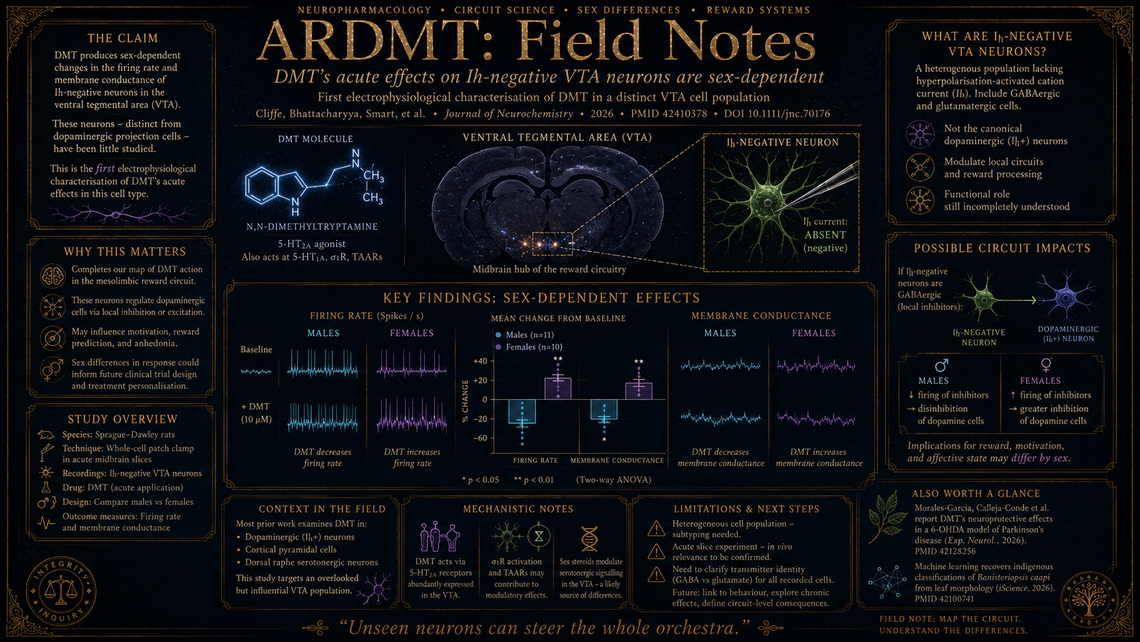
A group at the University of Exeter has turned its electrodes on a rather specific neuronal population: the Ih-negative cells of the ventral tegmental area. These neurons — sometimes called "secondary" or "tertiary" VTA cells, depending on one's preferred taxonomy — are distinct from the canonical dopaminergic projection neurons that dominate most discussions of reward circuitry. They lack the hyperpolarisation-activated cation current (Ih) that serves as a rough electrophysiological fingerprint for dopamine neurons, and their functional role remains comparatively murky. The new paper, published in the Journal of Neurochemistry, appears to offer the first electrophysiological characterisation of DMT's acute effects on this cell type, reporting sex-dependent changes in firing rate and membrane conductance.
Where this fits in the field
Most psychedelic electrophysiology in the VTA has, understandably, concentrated on the dopamine neurons themselves — those Ih-positive cells whose tonic and phasic firing patterns underwrite reward prediction, motivation, and much of the dysfunction observed in major depression and substance use disorders. The serotonergic pharmacology of DMT (principally 5-HT2A agonism, with meaningful affinity at 5-HT1A, sigma-1, and trace amine-associated receptors) has been studied extensively at the level of cortical pyramidal cells and dorsal raphe neurons. Its actions within mesolimbic circuitry are far less well mapped.
The Ih-negative population adds a layer of difficulty. These cells are heterogeneous: some are GABAergic interneurons that exert local inhibitory control over dopamine cells; others may be glutamatergic. Identifying what DMT does to them — and whether it does different things depending on the sex of the animal — matters for anyone trying to build a circuit-level account of how DMT modulates reward processing. If, for instance, DMT suppresses firing in local GABAergic interneurons, the net effect could be disinhibition of dopamine neurons, with implications for both therapeutic potential and abuse liability. Conversely, if firing rates increase, the picture reverses. The sex-dependence is itself worth attention: oestrogen and progesterone modulate both serotonergic and dopaminergic signalling in the VTA, and a growing literature suggests that male and female rodents may respond to serotonergic psychedelics in meaningfully different ways at the circuit level, even when behavioural endpoints appear similar.
This line of inquiry also intersects with the broader question of whether DMT's therapeutic effects — particularly those now being explored in depression and substance use disorders — are mediated purely through cortical 5-HT2A mechanisms or also involve subcortical reward circuitry. The cortical-plasticity narrative (Olson's "psychoplastogens," Bhatt and colleagues' dendritic spine work) has dominated recent years, but it would be premature to assume the VTA is a passive bystander.
Why this line matters
Three reasons, in ascending order of ambition. First, mechanistic completeness: one cannot claim to understand a drug's pharmacology while ignoring an entire node of the circuit it acts upon. Second, sex differences in psychedelic response are chronically under-reported and under-studied; any data here are welcome, particularly as clinical trials begin to grapple with the reality that their early cohorts were often predominantly male. Third, and most speculatively, the VTA sits at the nexus of motivation and hedonic processing — precisely the domains most disrupted in anhedonic depression and compulsive drug-seeking. If DMT modulates VTA microcircuitry in a sex-dependent fashion, this has direct implications for how clinical trials should stratify their analyses and, eventually, how treatment protocols might need to be tailored.
Note on access
The full text of this paper is not yet openly available to ARDMT. The above discussion is framed around the triage summary and the broader literature; a proper methods-and-results analysis — including the specific recording protocols, doses, sample sizes, and the precise nature and direction of the reported sex differences — will follow when the paper can be read in full.
Also worth a glance
Morales-García, Calleja-Conde and colleagues return in Experimental Neurology with what appears to be an expanded treatment of their DMT-in-Parkinson's work using the 6-OHDA model (PubMed 42128256). The Madrid group's sigma-1-mediated neuroprotection thesis has been noted in these pages before; this appears to be the full peer-reviewed publication rather than the preliminary data previously flagged. Worth tracking, though the sigma-1 story remains correlational until cleaner pharmacological dissection arrives.
In a charmingly orthogonal contribution, a team publishing in iScience has used machine learning on herbarium specimens to recover indigenous folk classifications of Banisteriopsis caapi — the ayahuasca vine — from leaf morphometrics alone (PubMed 42100741). A reminder that ethnobotanical knowledge, accumulated over centuries without a single convolutional neural network, can be validated rather than merely replaced by computational methods.
Marginalia
The Ih-negative neurons of the VTA are a bit like the stagehands in a West End production: everyone knows the leading players, but the show collapses without the crew one never sees. That someone has finally pointed an electrode at these cells while DMT is circulating is, in its quiet way, exactly the sort of unglamorous work that moves a field from narrative to mechanism.