ARDMT Field Notes
Ayahuasca Alkaloids in Hair: A New Long-Window Exposure Biomarker
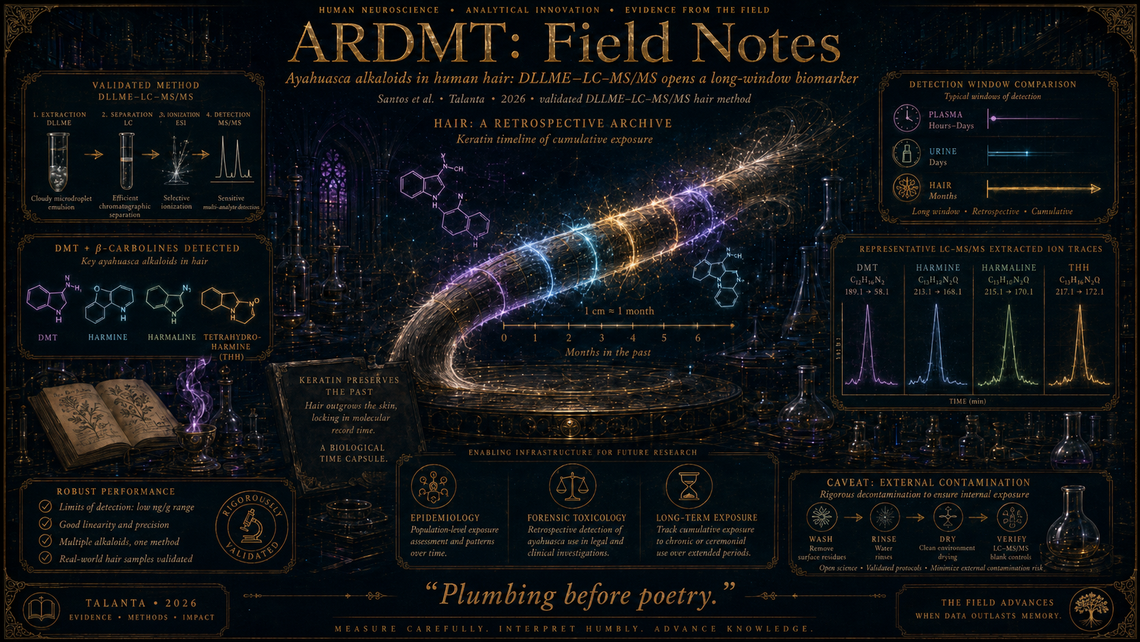
There is a particular kind of analytical chemistry paper that, at first blush, looks as though it might interest only a very narrow priesthood — people who spend their days optimising extraction solvents and worrying about limits of quantification. And then you read it a second time and realise it has quietly opened a door that the rest of the field will eventually want to walk through. The paper from Santos and colleagues, now indexed in Talanta (PMID 41628561), is one of those.
What they did
The group, based in São Paulo under the senior authorship of Yonamine — a name familiar to anyone who has followed Brazilian forensic toxicology over the past decade — set out to develop and validate a dispersive liquid-liquid microextraction (DLLME) method for detecting N,N-dimethyltryptamine and the principal β-carboline alkaloids in human hair. DLLME, for those who have not had the pleasure, is an elegantly parsimonious sample preparation technique: a ternary solvent system is injected into the aqueous sample, forming a cloudy emulsion of fine extraction-solvent droplets with an enormous surface-area-to-volume ratio, which is then separated by centrifugation. It uses vanishingly small solvent volumes, it is fast, and it is cheap — all virtues that matter rather a lot if one hopes to scale the method to population-level studies.
The analytes were quantified by liquid chromatography coupled with tandem mass spectrometry (LC-MS/MS), the current gold standard for this sort of work. The paper reports the usual validation gauntlet — linearity, precision, accuracy, matrix effects, limits of detection and quantification — in line with international bioanalytical guidelines.
Why hair, and why it matters
Most of the existing pharmacokinetic literature on ayahuasca alkaloids relies on plasma or urine, both of which offer a comparatively narrow detection window: hours for plasma, a day or two for urine. Hair is an altogether different proposition. Drugs and their metabolites are incorporated into the growing shaft via the follicular blood supply, and once there they stay put, archived in a keratinous timeline at roughly one centimetre per month. A single strand can, in principle, provide a retrospective record of exposure spanning months or even years, with segmental analysis offering crude temporal resolution.
This matters for at least three reasons. First, epidemiology. If one wishes to study the long-term health correlates of regular ayahuasca use — and there is growing interest in doing exactly that, particularly in Brazil, where several syncretic churches administer the brew as a sacrament — then a biomarker of cumulative exposure is immensely more useful than a spot measurement of last Tuesday's ceremony. Self-report is notoriously unreliable for dosing regularity and brew composition, and the alkaloid content of ayahuasca preparations varies wildly between batches. Hair offers a way to stratify participants by actual exposure rather than recalled intention.
Second, forensic toxicology. Cases involving ayahuasca do arise, both in South America and in the widening global diaspora of ceremonial use. A validated hair method allows retrospective assessment of chronic use in contexts where only postmortem or historical sampling is possible.
Third, and rather more speculatively, the method provides a tool for studying the relationship between the tryptamine and the β-carbolines as co-administered compounds in a naturalistic setting. The β-carbolines — potent monoamine oxidase inhibitors — are pharmacologically indispensable for oral DMT activity, but the ratios in which they appear in hair may or may not mirror the ratios ingested, depending on differential incorporation kinetics. Understanding this will require further work, but having the method is the necessary first step.
Caveats and context
One should not overstate the novelty of detecting drugs in hair; the forensic community has been doing it for decades with cocaine, opioids, and amphetamines. What is new here is the application of the DLLME approach to these particular analytes in this particular matrix, and the fact that prior methods for ayahuasca alkaloids in hair — there are very few — tended to rely on more cumbersome extraction procedures. The paper sits comfortably in a validated-method niche rather than making any clinical or pharmacological claims, and it is the better for that modesty. It was received in October 2025 and accepted in January 2026 after revision, suggesting a reasonably brisk but genuine peer-review process.
The principal limitation, as with all hair analysis, is the question of external contamination — passive exposure to smoke or liquid containing these alkaloids could, in theory, deposit them on the hair surface. Decontamination procedures are standard, but the spectre never entirely vanishes, particularly when one is dealing with compounds used in communal ceremonial settings where ambient smoke is not uncommon.
Also worth a glance
A rather charming interdisciplinary study has used machine learning to recover indigenous folk classifications of Banisteriopsis caapi — the ayahuasca vine — from digitised herbarium leaf images, suggesting that traditional taxonomic distinctions correspond to morphological features recoverable by algorithm (PMID 42100741). Separately, a systematic review examines ayahuasca therapy for treatment-resistant depression with a focus on suicidal ideation, though the authors' own title — "Possible Reduction" — rather candidly flags the thinness of the evidence base thus far (PMID 42023657).
Marginalia
It is a curious feature of the ayahuasca research landscape that some of the most enabling work — the kind that makes future studies possible — attracts the least attention, while the speculative clinical claims attract the most. Nobody will breathlessly share an LC-MS/MS validation paper on social media. But without it, the epidemiologists are flying blind, and the clinicians have no objective exposure metric to hang their outcomes on. Plumbing before poetry, as ever.