ARDMT Field Notes
Lempel–Ziv complexity is the weakest correlate: Exeter's dose-dependent DMT EEG study
The claim and the context
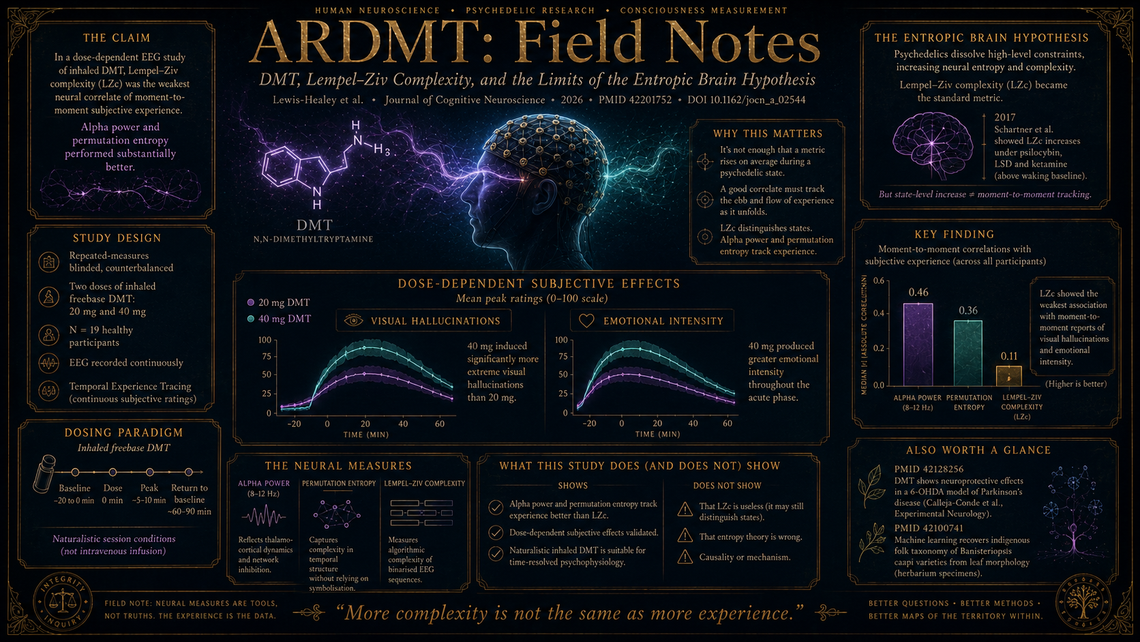
Lewis-Healey, Pallavicini, Cavanna and colleagues have now published, in the Journal of Cognitive Neuroscience, a dose-dependent EEG study of inhaled freebase DMT that carries a rather pointed conclusion: Lempel–Ziv complexity (LZc) — long treated as a reliable neural signature of psychedelic experience — turns out to be the weakest correlate of moment-to-moment subjective experience among the neural features they tested. Alpha oscillatory power and permutation entropy fared considerably better.
Regular readers will recall that an earlier Field Notes entry covered preliminary work from what appears to be this same research group, flagging concerns about LZc's moment-to-moment fidelity. The present publication represents the full peer-reviewed version: a repeated-measures, blinded, counterbalanced design with two doses (20 mg and 40 mg freebase DMT), nineteen participants, and a time-resolved phenomenological method — Temporal Experience Tracing — yoked to continuous EEG recording. It is a substantially more complete piece of work than its precursor, and merits fresh attention.
Where this fits in the field
The notion that psychedelics increase neural complexity has become one of the tidiest narratives in the field. The story runs roughly thus: psychedelics dissolve the brain's habitual constraints, entropy rises, and this rise tracks — indeed explains — the richness of psychedelic phenomenology. LZc, borrowed from anaesthesia research where it distinguishes waking from unconscious states, was the metric that made this story quantitatively tractable. Schartner and colleagues' 2017 work, measuring LZc under psilocybin, LSD and ketamine, showed increases above normal waking baseline — a finding that launched a thousand conference slides and propelled the phrase "the entropic brain" into common circulation.
But there has always been a quiet gap between showing that LZc is higher on average during a psychedelic state and showing that its fluctuations track the texture of experience as it unfolds. The former is a between-condition comparison; the latter is a within-session, moment-to-moment question. The Exeter group's study addresses precisely this gap. By collecting continuous subjective ratings alongside continuous EEG, they could ask not merely whether DMT increases complexity overall, but whether the ebb and flow of complexity mirrors the ebb and flow of, say, visual hallucinations or emotional intensity.
The answer, at least for LZc, appears to be: not particularly. Alpha power and permutation entropy did a better job. This does not invalidate LZc as a state-level discriminator — it may still distinguish "on DMT" from "not on DMT" quite well — but it does complicate the claim that LZc captures something meaningful about the moment-to-moment structure of psychedelic consciousness.
Why this line matters
The distinction is not merely methodological pedantry. If the field wishes to move from "psychedelics increase brain entropy" to "this particular change in brain dynamics supports this particular change in experience," then the neural measures chosen must be sensitive to temporal variation in phenomenology, not merely to the gross presence or absence of a drug. A metric that rises when DMT is on board and falls when it wears off tells us something about pharmacokinetics. A metric that co-varies with the waxing of visual hallucinations and the waning of emotional intensity tells us something about consciousness.
The dose-dependent element adds further texture. The 40-mg dose induced more extreme visual hallucinations and greater emotional intensity than the 20-mg dose — unsurprising, perhaps, but essential for establishing that the subjective measures are capturing real variance rather than ceiling effects. Whether the neural correlates scale correspondingly is a question the full text will illuminate more precisely.
There is also a methodological note worth flagging: the use of what the authors describe as "naturalistic conditions" rather than an intravenous infusion protocol. This contrasts with the Imperial College approach (Timmermann and colleagues) and carries its own trade-offs — less pharmacokinetic control, arguably greater ecological validity.
Note on access
The full text is not yet openly available to us. When it is, ARDMT will return with a proper methods analysis — the dose-response curves, the specific time-series associations, and whatever the authors themselves flag as limitations deserve rather more than abstract-level treatment.
Also worth a glance
Morales-García, Calleja-Conde and colleagues report on DMT's therapeutic properties in a preclinical Parkinson's model, now published in Experimental Neurology (PMID: 42128256). The Madrid group's sigma-1 receptor work has featured in these pages before; this appears to be a distinct publication, though the degree of methodological novelty over their earlier 6-OHDA findings will require inspection of the full text.
A machine-learning study (PMID: 42100741) applies image classification to herbarium specimens of Banisteriopsis caapi, attempting to recover indigenous folk taxonomy of ayahuasca vine varieties from leaf morphology alone. Tangential to pharmacology, but rather charming as an exercise in computational ethnobotany.
Marginalia
One wonders whether the field's attachment to Lempel–Ziv complexity owes something to the satisfying crispness of the narrative it supports: more disorder, more consciousness, full stop. The present findings suggest consciousness may be less obliging than the metric. Alpha power — that old, somewhat unfashionable workhorse of EEG research — quietly outperforming the newer, more theoretically glamorous measure is the sort of result that ought to give pause.