ARDMT Field Notes
DMT in a Parkinson's model: Madrid group returns with fuller claims
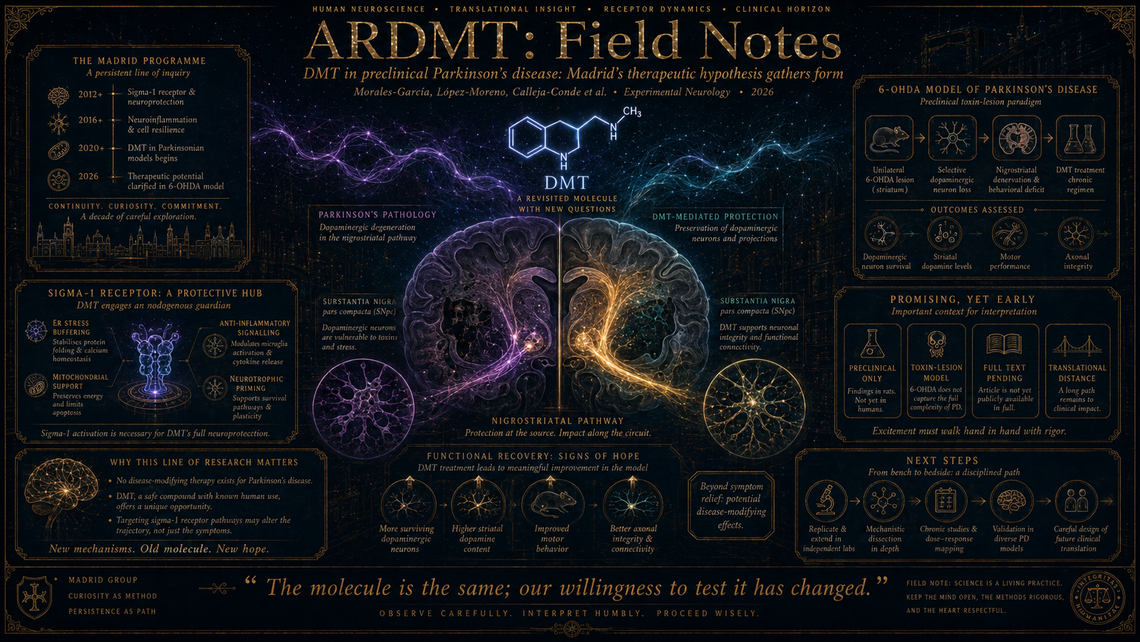
The claim and the context
The Madrid group — Morales-García, López-Moreno, Calleja-Conde, and colleagues — return to Experimental Neurology with what appears to be their most developed account yet of DMT's neuroprotective potential in a preclinical model of Parkinson's disease. The paper, published on 12 May 2026, carries a title that is notably direct: "Therapeutic properties of ayahuasca component N,N-Dimethyltryptamine in a pre-clinical model of Parkinson's disease." Not "neuroprotective effects." Not "potential role." Therapeutic properties. For a group whose earlier publications exercised somewhat greater caution in their framing, the shift in register is worth noting — though one should not read too much into titles, which are, after all, partly the province of editors and marketing departments.
The triage team flagged that this paper may overlap with the group's earlier work on DMT and the 6-OHDA lesion model, which ARDMT covered previously in the context of sigma-1 receptor-mediated neuroprotection. There is genuine reason to suppose this is a distinct and more complete study: the journal differs, the revision history shows the manuscript was received in October 2025 and revised as recently as 7 May 2026, and the framing has shifted from mechanistic neuroprotection towards a broader therapeutic characterisation. Whether it represents new experiments, an expanded dataset, or a substantially reanalysed version of earlier work is something the full text will have to settle.
Where this fits in the field
The Madrid group has been, for several years now, the most persistent laboratory investigating DMT's effects in classical neurodegenerative disease models. Their earlier work established that DMT, administered in a 6-OHDA (6-hydroxydopamine) rodent model of Parkinson's disease, appeared to protect dopaminergic neurons in the substantia nigra — an effect they attributed principally to agonism at the sigma-1 receptor, with downstream anti-inflammatory and anti-apoptotic consequences. This placed them at the intersection of two literatures: the growing body of work on psychedelic-associated neuroplasticity (largely focused on cortical circuits and psychiatric indications) and the rather older pharmacology of sigma-1 receptor ligands as candidate neuroprotectants.
It remains a somewhat lonely intersection. Most DMT research in the preclinical space has gravitated towards models of depression, anxiety, or addiction — conditions where serotonergic mechanisms and cortical plasticity offer a plausible therapeutic narrative. Parkinson's disease, by contrast, is fundamentally a disorder of subcortical dopaminergic cell death, and the rationale for DMT's involvement rests on a different set of receptors entirely. The sigma-1 receptor is an intracellular chaperone protein involved in endoplasmic reticulum stress responses, calcium signalling, and mitochondrial function — all of which are implicated in the progressive neuronal loss that characterises Parkinson's. DMT's affinity for sigma-1 is well established; what remains uncertain is whether doses achievable in vivo produce sigma-1 occupancy sufficient for meaningful neuroprotection, and whether such protection translates to functional recovery.
Why this line matters
Parkinson's disease affects roughly 10 million people worldwide and has no disease-modifying therapy. Every approved treatment manages symptoms — typically by replacing or mimicking dopamine — without slowing the underlying neurodegeneration. The field has seen a long procession of candidate neuroprotectants that looked persuasive in rodent 6-OHDA or MPTP models and then failed in human trials. This is not a reason to dismiss preclinical work, but it is a reason to scrutinise it with particular care. The 6-OHDA model, in particular, produces acute toxin-induced cell death rather than the slow, protein-aggregation-driven degeneration seen in idiopathic Parkinson's, and results obtained in it have a decidedly chequered translational record.
If the Madrid group's work holds up — and especially if this paper extends the evidence to behavioural endpoints, dose-response relationships, or longer time courses — it would strengthen the case for DMT as a sigma-1-acting neuroprotectant worth pursuing through the arduous path towards clinical testing. But "strengthening the case" in a preclinical context is quite different from establishing therapeutic efficacy. The distance between a rodent nigral lesion and a human clinic remains, as ever, vast.
Note on access
The full text is not yet openly available. ARDMT will return to this paper with a proper methods-and-results analysis — doses, time courses, histological and behavioural endpoints, statistical treatment — once the complete manuscript is accessible. Until then, we note the publication and its place in the field without pretending to evaluate claims we cannot yet read in detail.
Also worth a glance
Machine learning meets the liana. A cross-disciplinary team has applied machine learning to classify varieties of Banisteriopsis caapi — the MAO-inhibiting vine in ayahuasca — from herbarium leaf specimens (PMID 42100741). The paper reports recovering indigenous folk classifications of caapi varieties using image analysis alone, which, if validated, would be a genuinely useful tool for ethnobotanical fieldwork. One notes, with some pleasure, that the oldest analytical technology (pressing a leaf between sheets of paper) has found a use in the newest.
Marginalia
The Madrid group's persistence is itself a datum. In a funding landscape that overwhelmingly favours psychedelics-for-psychiatry, maintaining a programme on DMT-for-neurodegeneration over multiple years requires either unusual conviction or unusual results — possibly both. The field will be better served when other laboratories attempt independent replication; that, more than any single publication, will determine whether this line of enquiry has legs.