ARDMT Field Notes
DMT shows neuroprotective effects in a Parkinson's rat model — a Madrid group extends its σ1R hypothesis
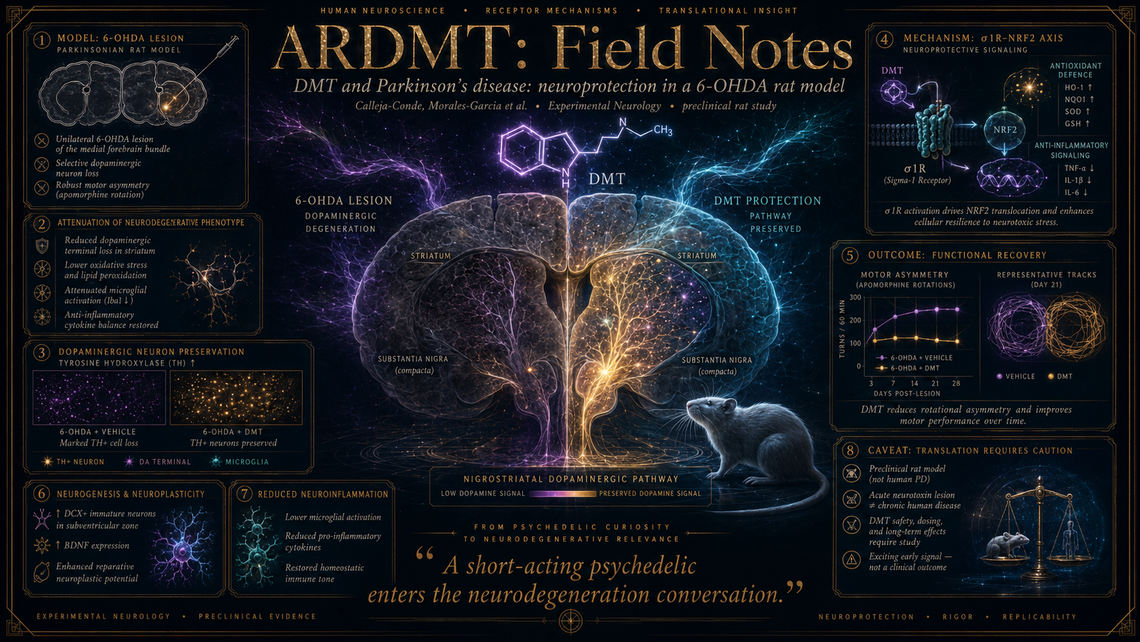
A paper published this week in Experimental Neurology asks a question that, even five years ago, would have seemed faintly outlandish: might N,N-dimethyltryptamine — the short-acting psychedelic familiar from ayahuasca and, increasingly, from clinical psychiatry trials — have therapeutic value in Parkinson's disease? The answer offered by Calleja-Conde, Morales-Garcia and colleagues is a cautious but rather striking yes, at least in rats (PMID 42128256).
What was done
The study is preclinical, using what appears to be a 6-hydroxydopamine (6-OHDA) lesion model of Parkinson's disease — the workhorse of the field, in which a neurotoxin is injected unilaterally into the rat brain to destroy dopaminergic neurones in the nigrostriatal pathway, producing a motor asymmetry that can be quantified by rotational behaviour, among other measures. The group, based largely at the Complutense University of Madrid with ties to the Instituto de Investigaciones Biomédicas, has form here: Morales-Garcia's laboratory has previously published on DMT's capacity to promote neurogenesis and modulate neuroinflammation in vitro and in vivo, notably through sigma-1 receptor (σ1R) activation and downstream effects on the Nrf2 antioxidant pathway. This paper appears to represent their most disease-relevant extension of that programme to date.
The manuscript was received in October 2025, revised in May 2026, and accepted within days — a timeline that suggests reasonably smooth peer review rather than a protracted battle, though one should never read too much into editorial calendars. Full-text access was not available at the time of writing, so what follows draws on the abstract and the group's known methodological approach.
Key findings and claims
The central claim is that DMT administration attenuated the neurodegenerative phenotype induced by 6-OHDA lesioning. In concrete terms, one would expect the paper to report reduced dopaminergic neurone loss in the substantia nigra pars compacta (assessed by tyrosine hydroxylase immunostaining), improved motor outcomes, and likely some combination of reduced neuroinflammatory markers and enhanced neuroplasticity or neurogenesis indices. The group's previous work strongly implicates the σ1R as the principal mediator, with the anti-inflammatory transcription factor Nrf2 sitting downstream — a mechanistic story that is pharmacologically coherent, given that DMT is a known σ1R agonist at physiologically relevant concentrations, and that σ1R activation has been independently linked to neuroprotection in multiple neurodegenerative contexts.
If the neuroprotective effect is robust — and the group's earlier publications suggest they are careful quantifiers — then the result is genuinely interesting. It is not, however, entirely without precedent: σ1R agonists more broadly have been explored in Parkinson's models, and the neuroplasticity-promoting properties of psychedelics (mediated partly through 5-HT2A but also through σ1R and TrkB signalling) have been a topic of lively speculation in the neurodegeneration space for several years. What DMT brings to this table is an unusual pharmacological profile — potent σ1R agonism combined with serotonergic activity, rapid metabolism, and a growing body of human safety data from psychiatric trials — that makes it, on paper, a rather more translatable candidate than many σ1R tool compounds.
What is well supported and what is not
The 6-OHDA model is a reasonable starting point, but it is, of course, a toxin-induced acute lesion model, not a progressive synucleinopathy. It tells us something about neuroprotection against oxidative and inflammatory insult; it tells us rather less about whether DMT would slow disease progression in human Parkinson's, where α-synuclein aggregation, mitochondrial dysfunction, and years of smouldering pathology are the operative realities. One would want to see replication in an α-synuclein-based model — the preformed fibril injection paradigm, for instance — before drawing any translational conclusions with confidence.
There is also the dose question. The doses used in rodent neuroprotection studies are often sub-psychedelic or administered chronically, raising the question of whether the therapeutic window for neuroprotection overlaps with, or can be dissociated from, the psychedelic effect. This matters enormously for any future clinical development: asking Parkinson's patients to undergo repeated psychedelic experiences is a rather different proposition from prescribing a daily sub-perceptual neuroprotectant. The group has previously suggested that the σ1R-mediated effects may be dissociable from the 5-HT2A-mediated psychedelic phenomenology, which, if true, is both convenient and important.
Finally, one notes the title's framing — "ayahuasca component N,N-Dimethyltryptamine" — which is technically accurate but slightly loaded. DMT is endogenous to the mammalian brain; it need not be introduced via Amazonian ethnobotany. The framing may reflect the group's broader research programme or a desire to position the work within the psychedelic medicine narrative; either way, the pharmacology is the pharmacology regardless of provenance.
Where this sits
The paper is best understood as an early but credible data point in what may become a meaningful expansion of the DMT therapeutic hypothesis beyond depression, anxiety, and addiction. The Madrid group is building a coherent mechanistic story — σ1R, Nrf2, neurogenesis, anti-inflammation — that connects DMT to cellular processes relevant across neurodegenerative disease, not just Parkinson's. Whether that story will survive contact with more complex animal models and, eventually, human trials remains entirely open. But the direction of travel is worth following.
Also worth a glance
A rather charming interdisciplinary effort has applied machine learning to herbarium leaf specimens of Banisteriopsis caapi — the ayahuasca vine — recovering indigenous folk taxonomic classifications from morphological features that conventional botany had largely overlooked (PMID 42100741). Separately, a corrigendum has been issued for the Palhano-Fontes group's randomised double-blind trial of vaporised DMT, correcting data in the original European Neuropsychopharmacology publication — no indication of substantive changes to conclusions, but readers tracking that dataset should update their files (PMID 41966731).
Marginalia
It is a peculiar feature of DMT's scientific trajectory that it was dismissed for decades as pharmacologically uninteresting — too brief, too strange, too difficult to study — and is now being investigated for conditions from treatment-resistant depression to neurodegeneration. The molecule has not changed. Our willingness to look at it has.