ARDMT Field Notes
DMT for Parkinson's: Sigma-1 Neuroprotection in a 6-OHDA Model
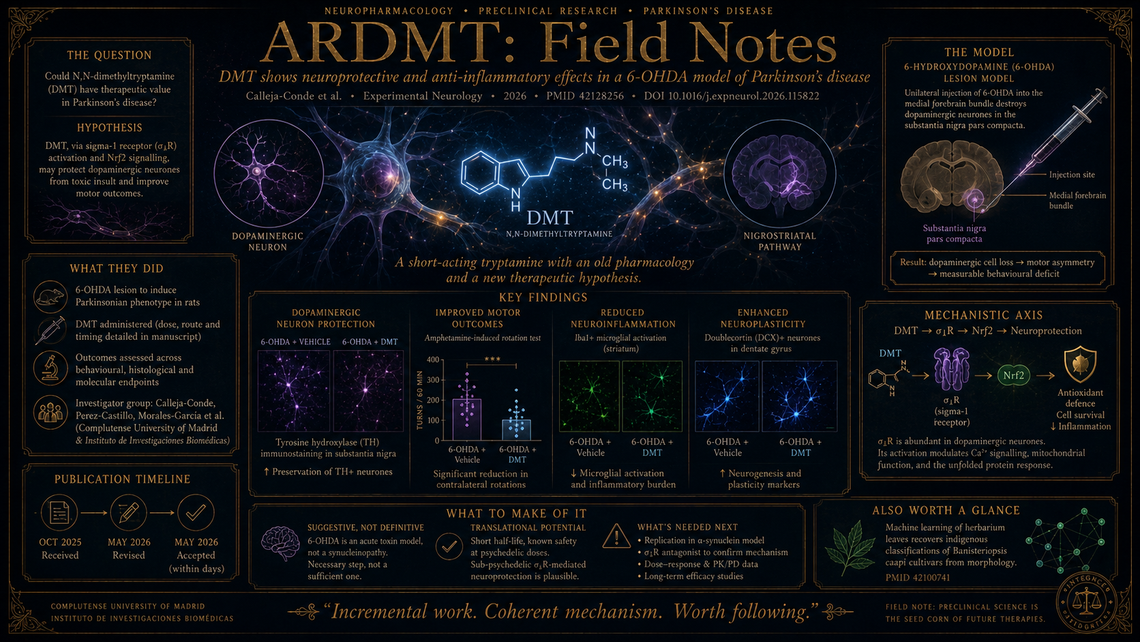
The idea that N,N-dimethyltryptamine might do something useful for neurodegeneration has been circulating in the literature for the better part of a decade now, gathering evidence in the manner of a slow accretion rather than any single dramatic finding. The latest deposit comes from a Spanish group led by Calleja-Conde and Morales-García, whose paper in Experimental Neurology (PMID 42128256; DOI: 10.1016/j.expneurol.2026.115822) examines DMT's therapeutic properties in a preclinical model of Parkinson's disease. The work arrives in a journal with a solid reputation in the neuroscience of movement disorders, and it has the feel of a group consolidating a line of inquiry rather than firing an opening shot.
What was done
The study employs the 6-hydroxydopamine (6-OHDA) lesion model, which remains the workhorse of preclinical Parkinson's research despite its well-known limitations — chief among them that it produces an acute, toxin-driven neuronal death rather than the slow, multifactorial degeneration one sees in human patients. The model works by injecting 6-OHDA into the nigrostriatal pathway, selectively destroying dopaminergic neurons and thereby producing motor deficits that can be quantified behaviourally. DMT is then administered — the full paper should clarify the dosing regimen, route, and timing relative to the lesion — and outcomes are assessed across behavioural, histological, and presumably molecular endpoints. The author list includes Perez-Castillo and Morales-García, both of whom have previously published on DMT's neuroprotective and neurogenic properties, including work on sigma-1 receptor mediation. The manuscript was received in October 2025, revised in May 2026, and accepted within days of revision — a timeline that suggests the reviewers' concerns were satisfactorily addressed rather than fundamentally structural.
The sigma-1 thread
Readers of these notes will recall earlier coverage of work from overlapping investigators exploring DMT's activation of the sigma-1 receptor (σ1R), an intracellular chaperone protein resident on the endoplasmic reticulum membrane that modulates calcium signalling, mitochondrial function, and the unfolded protein response. The σ1R has become something of a darling in neuroprotection research: it is expressed abundantly in dopaminergic neurons, and its agonism has been shown, in various models, to reduce oxidative stress, attenuate neuroinflammation, and promote cell survival. DMT's affinity for σ1R is well established, and Morales-García's earlier publications have made the case that this interaction — rather than the 5-HT2A receptor agonism responsible for DMT's more famous psychedelic effects — is the relevant pharmacological axis for neurodegeneration.
The present paper, published in a different journal and with a distinct publication date from the group's earlier work, appears to represent either an expansion of the experimental scope or a more comprehensive treatment of the Parkinson's model data. Experimental Neurology is a peer-reviewed venue with reasonably stringent standards for preclinical motor neuroscience, which provides at least some assurance that the behavioural and histological data have been scrutinised with appropriate rigour.
What to make of it
The honest assessment is that this is suggestive but early. The 6-OHDA model, for all its utility, does not recapitulate the proteinopathy (Lewy body pathology, α-synuclein aggregation) that characterises idiopathic Parkinson's disease in humans, nor the years-long prodromal period during which therapeutic intervention might realistically occur. Showing neuroprotection in this model is a necessary step but not a sufficient one; plenty of compounds have looked splendid against 6-OHDA and then failed to translate. The field has been burned often enough to be cautious.
That said, several features of the DMT–σ1R axis are genuinely interesting from a translational perspective. DMT has a short half-life and a reasonably well-characterised safety profile at psychedelic doses in controlled settings. If the neuroprotective mechanism is indeed σ1R-mediated rather than 5-HT2A-mediated, it opens the possibility of sub-psychedelic dosing regimens that retain neuroprotective efficacy without the perceptual fireworks that make chronic administration impractical. Whether anyone has the appetite to fund a clinical trial of DMT for Parkinson's disease remains another matter entirely, though one notes that the regulatory landscape for psychedelic-derived therapeutics is somewhat less frigid than it was five years ago.
What would strengthen the case considerably is replication in an α-synuclein-based model (such as the preformed fibril model), dose-response data with a selective σ1R antagonist to confirm mechanism, and pharmacokinetic work establishing whether the doses used achieve plausible CNS concentrations in a sustained fashion. One hopes the full paper addresses at least some of these.
Also worth a glance
A rather charming paper applies machine learning to herbarium specimens of Banisteriopsis caapi — the ayahuasca vine — attempting to recover traditional folk classifications of cultivar varieties from leaf morphology alone (PMID 42100741). It is tangential to pharmacology but represents a genuinely novel intersection of ethnobotany and computational image analysis that is worth knowing about.
Marginalia
One is struck by the quiet persistence of the Madrid group. They have been building the DMT–σ1R–neuroprotection case paper by paper, model by model, without the fanfare that tends to accompany psychedelic research in the anglophone press. It is the sort of incremental, slightly unglamorous work that actually moves a field forward — assuming the biology cooperates.