Author

Stephen Page
Writer on DMT, ayahuasca, iboga and tryptamine research. LLB; incoming MSc in Psychedelics: Mind, Medicine and Culture, University of Exeter (2026)

ARDMT Field Notes
Be Careful Not to Colonise Hyperspace
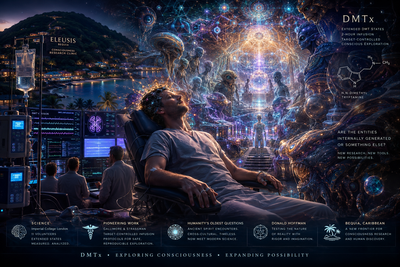
The phrase surfaces, briefly, on a slide. Be careful not to colonise hyperspace. It is meant, I think, as a caution about attitude — about arriving in the DMT state with the postures of the conqueror rather than the
Foundations
Holding the Door Open
DMT is not exotic in the sense of being rare. It is one of the most widely distributed psychedelics in nature, produced by a great many plants and animals — and, importantly, by mammals, including, in trace amounts, us. (We will come back to that startling fact in Part VII.)

Cabinet of Marginalia
The Trained Bystander Paradox
Should Voluntarily-Acquired Rescue Capability Generate a Limited Positive Duty in English Negligence Law?
ARDMT Field Notes
The Toadstool Everyone Knows
Fly agaric is the most recognisable mushroom on Earth — Santa's colours, Alice's mushroom, Mario's power-up, the sacrament of the Vedas. Strip away the stories that aren't true and what remains is stranger than any of them:
ARDMT Field Notes
The Net That Holds the Brake: How One Dose of Psilocybin Quiets the Brain's Drive Toward Reward
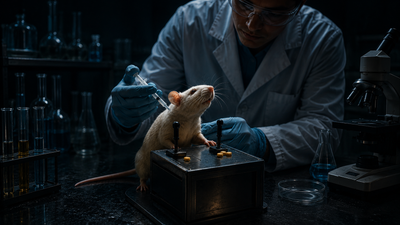
A single injection, two days of silence, and then a measurable change in how much rats wanted what they used to want most — traced down to one inhibitory cell type wrapped in structural netting in the prefrontal cortex.
ARDMT Field Notes
Who Owns a Molecule That Has Never Existed in Nature?
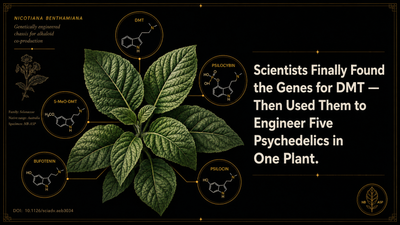
In April 2026, a team at the Weizmann Institute of Science announced they had engineered a single, unglamorous relative of tobacco to produce five different natural psychedelics at once: psilocybin and psilocin, the mushroom compounds; DMT,

Cabinet of Marginalia
The Habit of the Universe
On morphic resonance, decapitated worms, lions that remember Rome, and what we might be doing when we take psychedelics
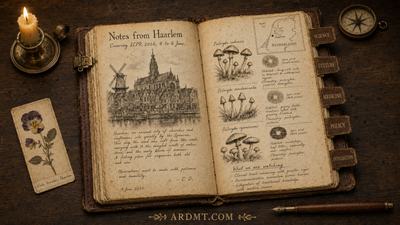
ICPR 2026
Notes from Haarlem
The question now is harder, and more interesting: how, exactly, are they to be used? What role does the subjective experience play? Are the non-hallucinogenic alternatives now in development the future of the field or a category error?
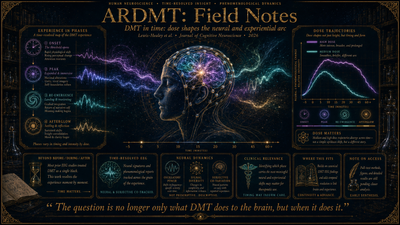
ARDMT Field Notes
Tracking DMT's neural arc: time-resolved EEG at two doses
Lewis-Healey E, Pallavicini C, Cavanna F, D'Amelio T, De La Fuente LA, Copa D, Müller S, Bruno N, Tagliazucchi E & Bekinschtein T. Journal of Cognitive Neuroscience
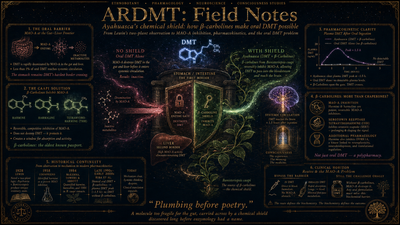
ARDMT Field Notes
β-Carbolines and the MAO-A barrier: how ayahuasca makes oral DMT possible
In 1928, when Lewin catalogued mescaline among his Phantastica, he noted something curious about ayahuasca: the brew required two plants, not one. A single plant supplied the visions,
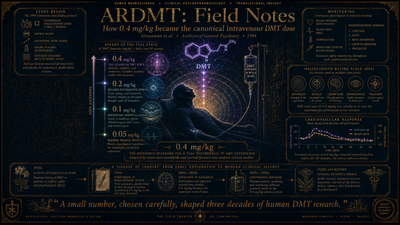
ARDMT Field Notes
Why 0.4 mg/kg: Strassman's dose-finding logic and its thirty-year hold
Strassman's dose-finding study, published in Archives of General Psychiatry in 1994, employed a double-blind design with four intravenous dose levels — 0.05, 0.1, 0.2, and 0.4 mg/kg of DMT fumarate
ARDMT Field Notes
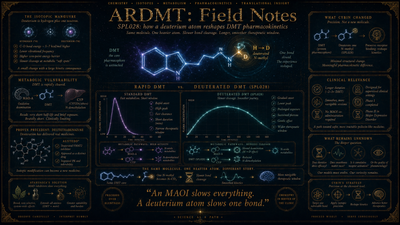
Deuterating DMT: how two neutrons reshape a pharmacokinetic profile
When Cybin Inc. filed its patent family around CYB003 — later redesignated SPL028 — the core chemical manoeuvre was, on its face, almost comically modest.