ARDMT Field Notes
Endogenous DMT from Axelrod to Borjigin: what sixty years have settled and what they have not
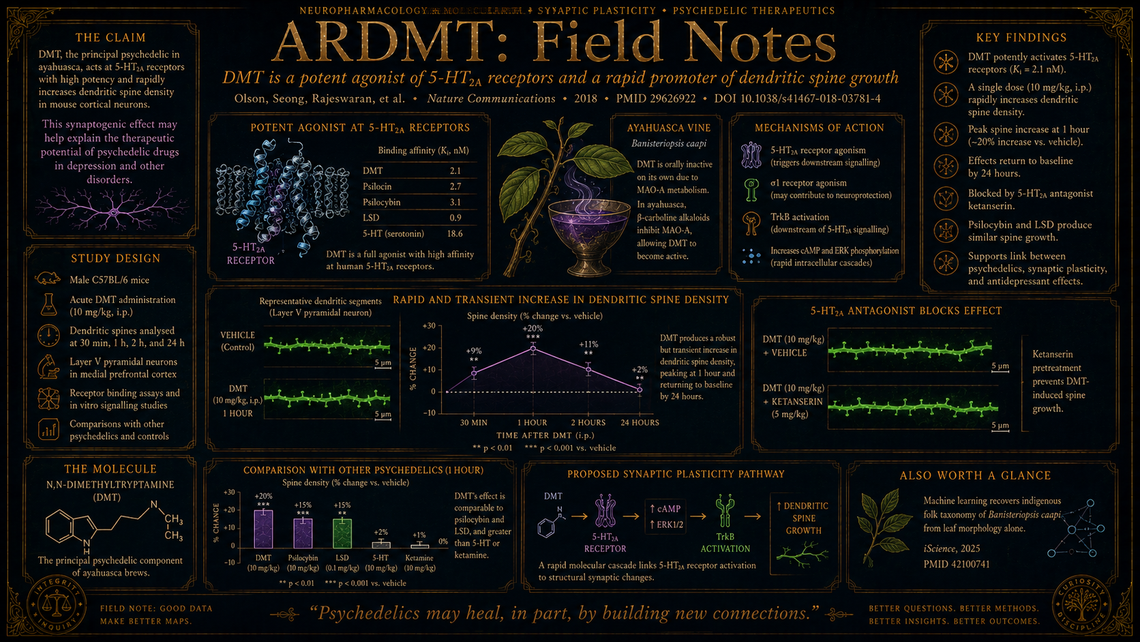
On days when the preprint servers and journals offer nothing sufficiently substantial to dissect, one does well to revisit the questions that underpin the entire field. Few are more persistent — or more contested — than whether N,N-dimethyltryptamine is produced in the human body, and if so, what on earth it is doing there.
The story begins, as so many stories in psychedelic pharmacology do, with Julius Axelrod. In 1961, working at the National Institute of Mental Health, Axelrod demonstrated that rabbit lung tissue contained an enzyme capable of methylating tryptamine to form DMT. The enzyme was indolethylamine N-methyltransferase (INMT), and its discovery was quiet, almost incidental — a single finding in a broader programme of work on amine metabolism that would eventually contribute to Axelrod's 1970 Nobel Prize. Yet the implications were immediately provocative. If mammalian tissue could synthesise DMT, then DMT was not merely an exotic plant alkaloid but a potential endogenous compound. The transmethylation hypothesis of schizophrenia, already circulating in various forms since Osmond and Smythies's 1952 proposal, suddenly had a candidate molecule and an enzymatic pathway.
The transmethylation era
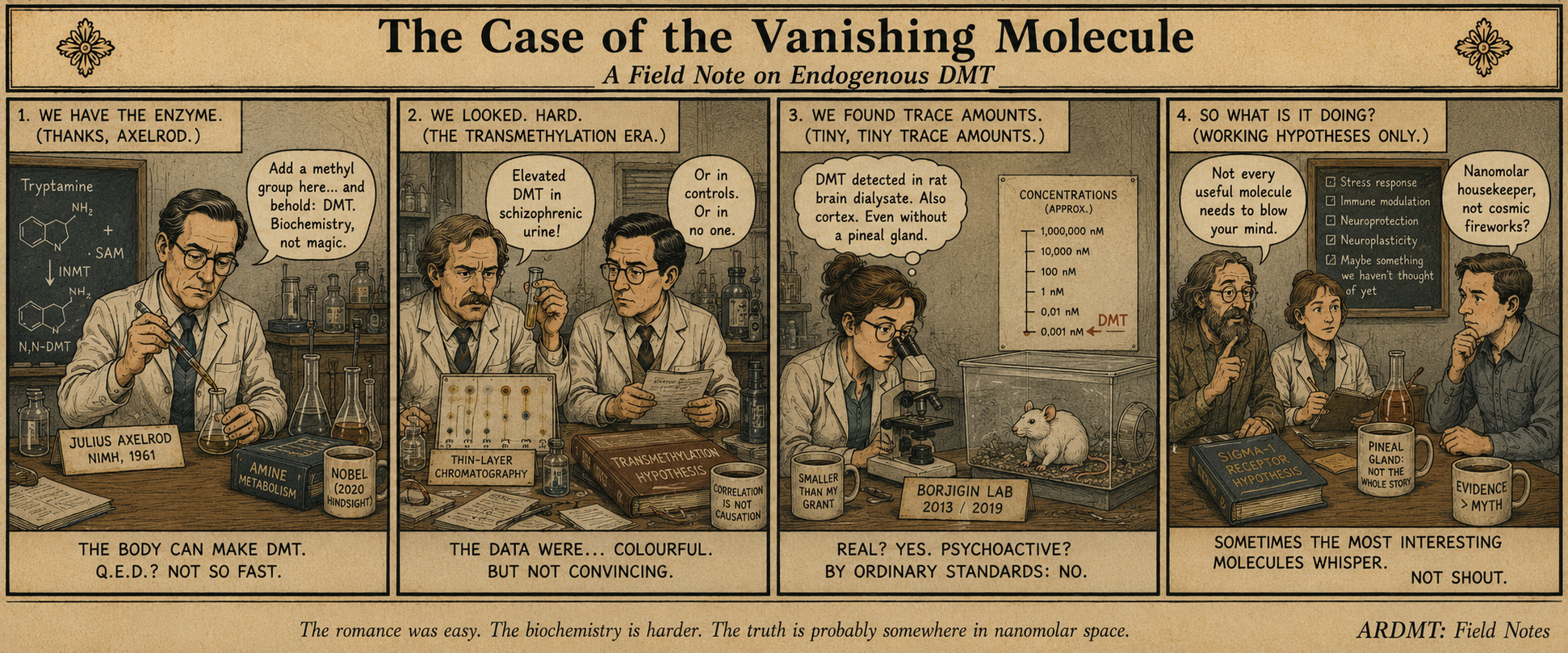
Through the 1960s and into the 1970s, the idea that aberrant methylation might produce psychotomimetic compounds in the brains of schizophrenic patients drove a small but energetic research programme. Investigators searched for DMT and its relatives — bufotenine, 5-MeO-DMT — in the blood and urine of psychiatric patients and controls. The results were, to put it charitably, inconsistent. Some groups reported elevated DMT in the urine of schizophrenic patients; others found it in controls as well, or failed to find it at all. Analytical methods of the period — thin-layer chromatography, early gas chromatography — were not always equal to the task of identifying trace quantities of a rapidly metabolised indolealkylamine in complex biological matrices. The transmethylation hypothesis gradually fell from favour, not so much refuted as exhausted by equivocal data and the rising dominance of the dopamine hypothesis.
INMT and the tissue question
Interest never entirely disappeared. The enzymatic machinery kept turning up. INMT was identified in human lung, liver, brain, and other tissues. The substrate requirements were characterised: tryptamine could be sequentially methylated, first to N-methyltryptamine, then to DMT. The question shifted from can the body make DMT to does it, in physiologically meaningful quantities, in the right places?
Survey work through the 1970s and 1980s confirmed the enzyme's presence across a wide distribution of mammalian organs, reinforcing the notion that DMT biosynthesis was not confined to a single tissue but was, at least enzymatically, a widespread capability. What remained unclear — and remains so — was whether INMT activity in vitro translated to meaningful DMT production in vivo. Enzyme presence does not guarantee substrate availability, cofactor sufficiency, or freedom from competing metabolic pathways. The gap between demonstrating that a tissue can make DMT in a homogenate and showing that it does make DMT in a living organism is not small.
The modern revival
The endogenous DMT hypothesis received its most significant modern impetus from the work of Jimo Borjigin and colleagues at the University of Michigan. In 2013, their group reported detecting DMT in the pineal microdialysate of living rats — the first direct evidence of DMT in extracellular fluid within the brain of a living mammal. A subsequent 2019 paper extended this, demonstrating DMT in the cerebral cortex of rats, including in pinealectomised animals, which effectively ruled out the pineal gland as the sole or necessary source. INMT mRNA was detected in cortical neurons, suggesting local synthesis.
These findings revived interest but did not settle the central question: concentration. The amounts detected were vanishingly small — well below what would be needed, by conventional pharmacological reckoning, to activate 5-HT2A receptors at levels sufficient to produce psychedelic effects. Whether endogenous DMT acts at such receptors at all, or whether it operates through sigma-1 receptors, trace amine-associated receptors, or some other mechanism entirely, remains an open problem. The sigma-1 receptor hypothesis is intriguing precisely because sigma-1 ligands can exert effects at low concentrations and are implicated in cellular stress responses, neuroprotection, and neuroplasticity — none of which require the molecule to induce visions.
What we still do not know
The honest summary, more than sixty years after Axelrod's initial observation, is roughly this: mammals possess the enzymatic machinery to synthesise DMT; DMT has been detected in mammalian brain tissue and extracellular fluid at trace concentrations; the physiological function of endogenous DMT, if any, is unknown. The romantic notion — popularised most energetically by Rick Strassman — that a surge of pineal DMT mediates near-death experiences or other extraordinary states of consciousness has no direct experimental support, though it has proved decidedly durable as a cultural artefact.
What current research wrestles with is less dramatic but rather more interesting: whether endogenous DMT at nanomolar concentrations participates in ordinary cellular housekeeping — stress response, immune modulation, neuroprotection — rather than in the production of extraordinary subjective states. The distinction matters. A molecule need not be psychedelic at physiological concentrations to be biologically important. Serotonin itself is a useful reminder: it is both an unremarkable gut motility regulator and, via the same receptor family, the key to some of the most profound alterations in consciousness that pharmacology can produce. Context, concentration, and compartmentalisation are everything.
The arc from Axelrod's rabbit lung homogenate to Borjigin's rat cortex microdialysate is long, uneven, and littered with false starts. It is also, in its patient accumulation of enzymatic, analytical, and now molecular-genetic evidence, a rather good example of how a field sustains a difficult question across decades without either resolving it or abandoning it. One suspects the next chapter will be written not by those searching for DMT's role in mystical experience, but by those content to ask what a trace amine does in a neuron on an ordinary Tuesday afternoon.
Marginalia
Axelrod himself appears to have regarded the DMT finding as a minor observation in a larger programme on methyltransferases. The mythology that has since accrued around endogenous DMT is almost entirely a construction of later decades — the molecule's cultural significance having, for most of its history, run well ahead of its demonstrated biology. A pattern not, in fairness, unique to DMT.
For a deeper dive into endogenous DMT check out this link...