Author

Stephen Page
Writer on DMT, ayahuasca, iboga and tryptamine research. LLB; incoming MSc in Psychedelics: Mind, Medicine and Culture, University of Exeter (2026)
Books
The Bell, the Clog, and the Gallows
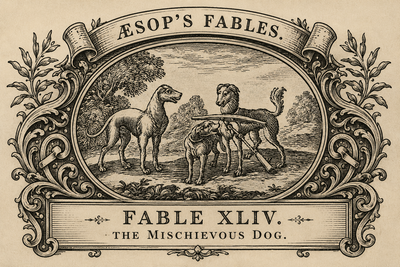
The Mischievous Dog, taken across its full transmission, turns out to be less a stable moral tale than a record of successive interpretive needs. Each translator alters the object around the dog's neck
Cabinet of Marginalia
Which Ayahuasca?
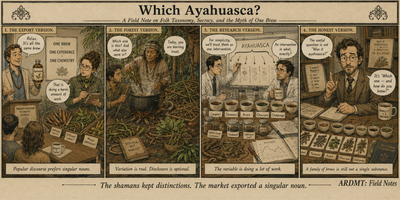
Ayahuasca is not one thing: one name, many brews, hidden variables, and a global habit of flattening complexity into a single word.
ARDMT Field Notes
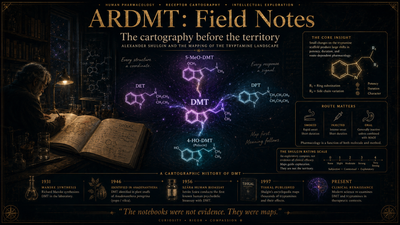
Shulgin's tryptamine notebooks: the cartography DMT research still navigates by
The relevance of Shulgin's tryptamine work to present-day DMT research is not merely historical. Several active lines of enquiry trace their intellectual ancestry directly to his structure-activity observations.
ARDMT Field Notes
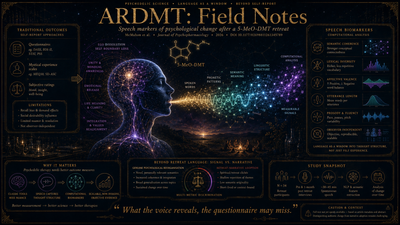
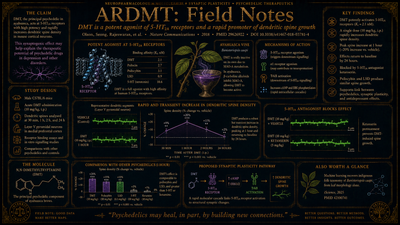
Speech biomarkers after 5-MeO-DMT: can how you talk reveal what changed?
Kuc, McAlpine, Sellers, Blackburne, Lametti, and Skipper, writing in the Journal of Psychopharmacology, report on what they term "speech markers of psychological change"
Pillar
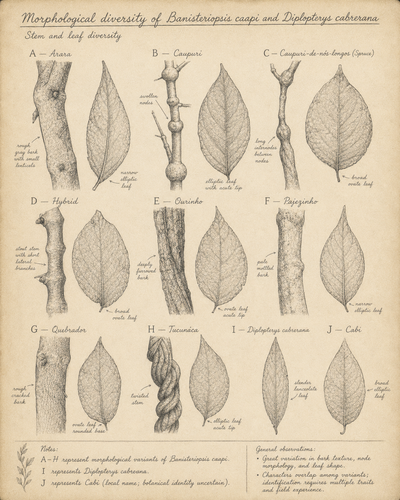
Ayahuasca is not one thing
yahuasca' denotes a variable ethnobotanical category, not a single brew. The variation matters for ceremony, chemistry, consent, and clinical research.
ARDMT Field Notes
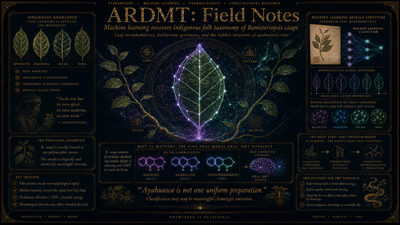
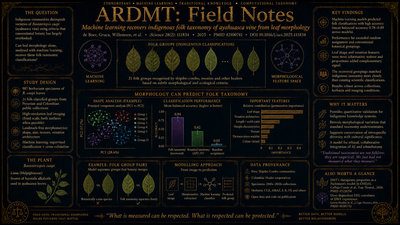
Machine learning validates indigenous folk taxonomy of the ayahuasca vine
A machine learning study quietly validates indigenous taxonomy of Banisteriopsis caapi — and raises a harder question about what counts as scientific knowledge.
Cabinet of Marginalia
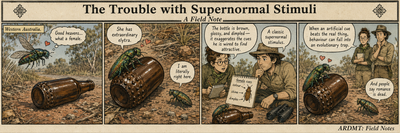
The Trouble with Supernormal Stimuli.
Wide vintage-style ARDMT Field Notes comic strip titled “The Trouble with Supernormal Stimuli,” showing male Australian jewel beetles mistaking glossy brown beer bottles for females, illustrating how exaggerated artificial cues can override natural mating signals and create an evolutionary trap.
Cabinet of Marginalia
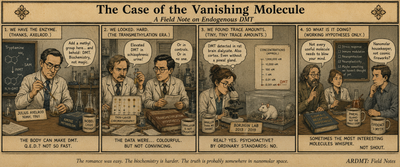
The Case of the Vanishing Molecule
Wide vintage-style ARDMT Field Notes comic strip titled “The Case of the Vanishing Molecule,” showing the scientific history of endogenous DMT from Julius Axelrod’s 1961 INMT enzyme discovery through inconsistent transmethylation-era findings, Borjigin’s rat brain studies, and modern
Cabinet of Marginalia
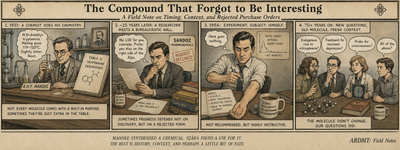
The Compound That Forgot to be Interesting.
The Compound That Forgot to Be Interesting — a field note on timing, context, and rejected purchase orders. In 1931 the Canadian chemist Richard H. F. Manske first synthesised N,N-dimethyltryptamine and entered it into a table of tryptamine derivatives without ever suspecting what it would become.
ARDMT Field Notes
Endogenous DMT from Axelrod to Borjigin: what sixty years have settled and what they have not
The story begins, as so many stories in psychedelic pharmacology do, with Julius Axelrod. In 1961, working at the National Institute of Mental Health, Axelrod demonstrated that rabbit lung tissue contained an enzyme capable of methylating tryptamine to form DMT.
ARDMT Field Notes
Extended-state DMT infusion: three decades almost-but-not-quite attempted
There is something faintly poignant about the extended-state protocol's career: pharmacokinetically straightforward, clinically demanding, ethically complex, and philosophically loaded, all at once.
ARDMT Field Notes
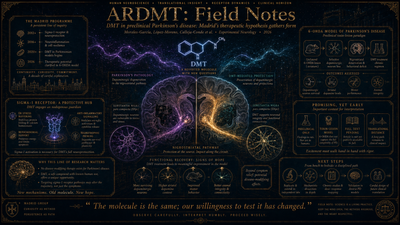
DMT in a Parkinson's model: Madrid group returns with fuller claims
The Madrid group — Morales-García, López-Moreno, Calleja-Conde, and colleagues — return to Experimental Neurology with what appears to be their most developed account yet of DMT's neuroprotective potential in a preclinical model of Parkinson's disease.