Section
ARDMT Field Notes
23 of 25
A deep dive into the magnesium-ibogaine treatment. So What Does a 12-Month Ibogaine Study Actually Show?

When Motherhood Feels Like a Trip: A Compelling Parallel That Hasn't Been Tested
A mother says psilocybin made her calmer, more patient, better at the job. A Harvard thesis says her brain and the mushroom may be working on the same territory. The parallel is real. What it means is not yet known.
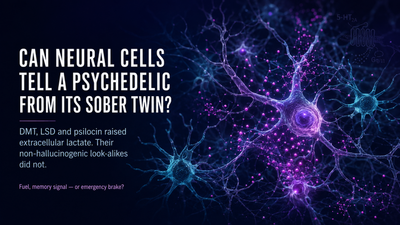
Can Neural Cells Tell a Psychedelic from Its Sober Twin?
DMT, LSD and psilocin made neural cells accumulate lactate. Their non-hallucinogenic look-alikes did not. Fuel, memory signal — or emergency brake?
Tonnage quantities
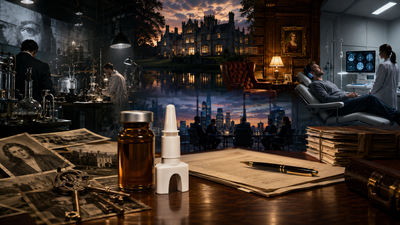
Eli Lilly's 3.8 billion dollar move into psychedelic medicine is being described as an arrival. Its own history makes it look more like a return, and the drug it is buying carries a contested history of its own

Can a therapist guide you somewhere they've never been?
The medicine opens the door. Whether the person sitting beside you can actually help you walk through it — and how you'd even know — is the question the field hasn't reckoned with yet.
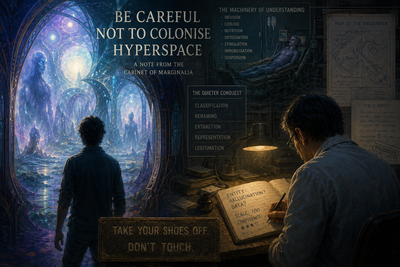
Be Careful Not to Colonise Hyperspace
The phrase surfaces, briefly, on a slide. Be careful not to colonise hyperspace. It is meant, I think, as a caution about attitude — about arriving in the DMT state with the postures of the conqueror rather than the
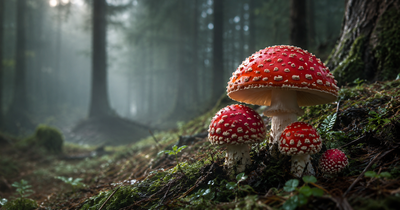
The Toadstool Everyone Knows
Fly agaric is the most recognisable mushroom on Earth — Santa's colours, Alice's mushroom, Mario's power-up, the sacrament of the Vedas. Strip away the stories that aren't true and what remains is stranger than any of them:
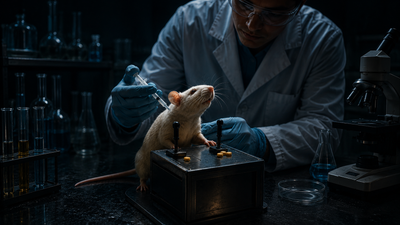
The Net That Holds the Brake: How One Dose of Psilocybin Quiets the Brain's Drive Toward Reward
A single injection, two days of silence, and then a measurable change in how much rats wanted what they used to want most — traced down to one inhibitory cell type wrapped in structural netting in the prefrontal cortex.
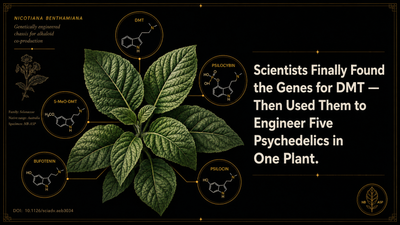
Who Owns a Molecule That Has Never Existed in Nature?
In April 2026, a team at the Weizmann Institute of Science announced they had engineered a single, unglamorous relative of tobacco to produce five different natural psychedelics at once: psilocybin and psilocin, the mushroom compounds; DMT,
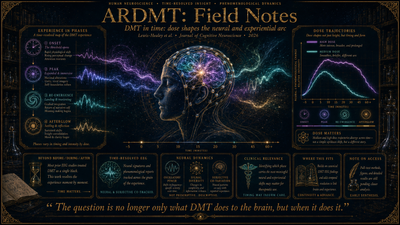
Tracking DMT's neural arc: time-resolved EEG at two doses
Lewis-Healey E, Pallavicini C, Cavanna F, D'Amelio T, De La Fuente LA, Copa D, Müller S, Bruno N, Tagliazucchi E & Bekinschtein T. Journal of Cognitive Neuroscience
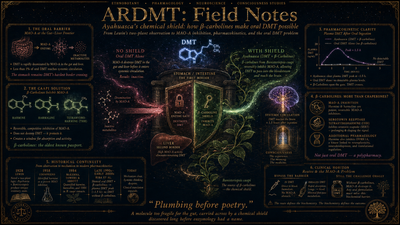
β-Carbolines and the MAO-A barrier: how ayahuasca makes oral DMT possible
In 1928, when Lewin catalogued mescaline among his Phantastica, he noted something curious about ayahuasca: the brew required two plants, not one. A single plant supplied the visions,
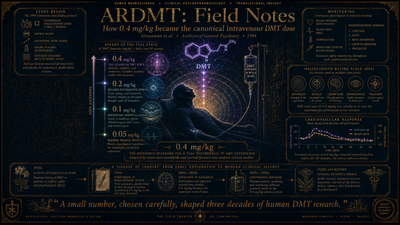
Why 0.4 mg/kg: Strassman's dose-finding logic and its thirty-year hold
Strassman's dose-finding study, published in Archives of General Psychiatry in 1994, employed a double-blind design with four intravenous dose levels — 0.05, 0.1, 0.2, and 0.4 mg/kg of DMT fumarate