ARDMT Field Notes
The Toadstool Everyone Knows
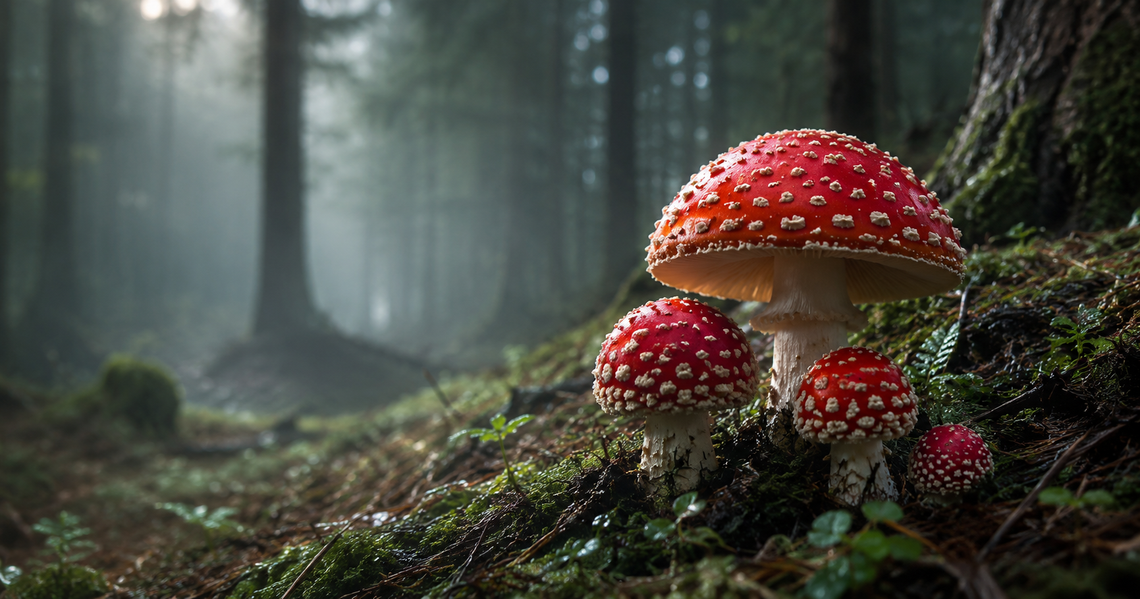
Fly agaric is the most recognisable mushroom on Earth — Santa's colours, Alice's mushroom, Mario's power-up, the sacrament of the Vedas. Strip away the stories that aren't true and what remains is stranger than any of them: a dream-drug from the edge of the boreal world that named a receptor it barely contains, that carried real ritual for real centuries, and that is now sold as legal candy on a technicality nobody expects to last.
You already know this mushroom. That is the first strange thing about it.
You have met the fly agaric — Amanita muscaria — a thousand times without walking into a wood. It is the red cap flecked with white that grows in the corner of every fairy-tale illustration, the toadstool a cartoon fairy sits under, the object that appears when you type 🍄 on your phone. It is the "Super Mushroom" that makes Mario grow, the mushroom Alice nibbles to change her size, the ceramic ornament nailed to a thousand garden fences, the thing the Smurfs live in. No other fungus on the planet is this famous. Most people who could pick it out of a line-up have never knowingly seen a real one.
And almost everything the culture has told you about it is wrong.
It was not what the Vikings ate to go berserk. It probably has nothing to do with Father Christmas. It is not, in any useful sense, a "magic mushroom" — it shares neither its chemistry nor its family with psilocybin. It even lent its name to a compound, and to an entire class of receptors in your own body, that turn out to have almost nothing to do with how it actually works.
This is a piece about the gap between the mushroom's fame and its facts — because that gap is where all the interesting things live. What follows is the fun stuff and the true stuff, and the surprising discovery that once you clear away the myths, the honest account is the more astonishing of the two.
A note before we start: this is a history and a natural history, not a manual. Fly agaric is genuinely toxic, its potency swings wildly from cap to cap, and the products currently sold under its name are, as we'll see, frequently something else entirely. Read it for what it is — a story about one of humanity's oldest and oddest relationships with an altered mind.
Was Santa a mushroom?
Let's begin with the myth that resurfaces every December like clockwork, because it is the most seductive and the most instructive to take apart.
The story runs like this. Long before Coca-Cola, Santa Claus was a Siberian shaman. He wore red and white because he gathered a red-and-white mushroom. He entered through the roof because Siberian dwellings were snowed shut in winter and people passed gifts through the smoke-hole. His reindeer flew because reindeer eat fly agaric and the mushroom produces sensations of flight. He left presents to dry in stockings by the fire because that is how you prepared the mushroom — hung up to dry over the hearth. The evergreen tree is there because fly agaric grows in symbiosis with conifers and birch. Every element of Christmas, the theory says, is a coded memory of a shamanic mushroom rite.
It is a beautiful piece of pattern-matching, and it has serious names attached to it. The ethnobotanist Jonathan Ott first drew the connection in 1976; the Boston University classicist Carl Ruck (who, with Wasson, coined the word entheogen) elaborated it; the anthropologist John Rush built it out further still. Repeated often enough, it has hardened, for a lot of people, into something they believe is history.
It isn't. And the way it falls apart is a small masterclass in how folklore gets manufactured.
Start with the red-and-white suit, the linchpin of the whole thing. Santa's modern costume is a nineteenth-century invention. The cartoonist Thomas Nast fixed the visual template in the pages of Harper's Weekly through the 1860s; the red and white were, in Nast's early drawings, the stars and stripes of a Civil War-era patriotic Santa, not the livery of a mushroom. The colours were popularised and standardised decades later, well into the twentieth century, by advertising. There is no thread connecting them back to a fungus.
Worse for the theory: Siberian shamanism and fly agaric were both intensely fashionable topics in nineteenth-century Europe. They appeared in travelogues, novels, plays and learned papers — the talk of the drawing room. And in all of that period literature, at the height of Western fascination with bemushroomed Siberian shamans, not one source connects any of it to Saint Nicholas. The chimney, the stockings and the gift-giving trace cleanly and boringly to the actual Saint Nicholas of Myra, a fourth-century bishop with his own well-documented legends. The mushroom arrives in the story late, and from outside.
The people whose culture is being borrowed reject the borrowing outright. Tim Frandy, a scholar of Nordic studies and a member of the Sámi descendant community, has called the psychedelic-Santa idea a romanticised misreading of Sámi life — an exotic fantasy projected onto a real people who never asked to be cast as elves. That objection matters. A charming theory that requires flattening a living culture into set-dressing has a cost, and honesty about the evidence and honesty about the people are, here, the same act.
So the verdict is clear: appealing, influential, and false. But here is what makes it sticky, and worth the trouble of debunking. Every ingredient the myth is built from is real. Siberian peoples genuinely did use this mushroom. Reindeer genuinely do seek it out and get visibly intoxicated. The mushroom genuinely can produce a sensation of flight. The myth is a real jigsaw assembled into a picture that was never on the box. Keep those genuine pieces in mind — we'll be handling each of them properly before we're done.
The berserkers and the caterpillar
Two more famous claims, one that collapses and one that mostly holds — and together they open the door to the real question of what this mushroom does to a mind.
The berserker story is the collapse. Everyone has heard that Norse warriors ate fly agaric to work themselves into their battle-frenzy — the berserksgangr, the trance of rage that made them fearless and, supposedly, impervious to pain. The claim is old: it was floated by the Swedish theologian Samuel Ödmann in 1784, who had never seen a berserker or a battle and was reasoning by analogy from those same fashionable reports of Siberian shamans. It has been repeated as fact ever since.
The trouble is pharmacological. Fly agaric is, above all, a sedative. Its dominant effect is drowsiness, heaviness, a sinking toward dream and sleep. That is close to the last thing you want coursing through a man swinging an axe. If any plant lay behind the berserker rage, the better candidates are the true deliriants of the northern European flora — henbane, Hyoscyamus niger, chief among them, which produces genuine agitation and aggression. Modern scholarship treats the fly-agaric-berserker link as a persistent piece of romantic guesswork, not evidence.
Alice is the one that mostly survives. When Alice eats the mushroom that makes one side of her body shoot up and the other shrink away, Lewis Carroll — Charles Dodgson — was very likely drawing on a real and specific source. The Victorian mycologist Mordecai Cubitt Cooke had described exactly this effect of fly agaric in his popular books The Seven Sisters of Sleep (1860) and A Plain and Easy Account of British Fungi (1862): the way the drug makes objects loom enormous or dwindle away, a genuine perceptual disturbance clinicians call macropsia and micropsia. And, as the Sheffield naturalist Patrick Harding has pointed out, Cooke and Dodgson moved in the same circles. The size-changing mushroom of Wonderland is, on this reading, not a whimsy but a report — a novelist transcribing a pharmacology he had read about.
That is worth pausing on, because it is our first true thing about the mushroom's effect on consciousness, and it is a strange one. This is a substance that reaches into the machinery of perception and rescales the world. Not "the walls breathed" in the psilocybin sense, but a specific, uncanny warping of size and distance — the room grown vast, your own hand a mile away or pressed against your face. Alice's Wonderland, all wrong proportions and dream-logic and sudden transformations, turns out to be a fairly good description of the territory. Which raises the obvious question.
What it actually does
Here is the fact that reorganises everything: fly agaric is not a classic psychedelic.
The word "psychedelic," used precisely, points to a family of drugs — psilocybin, LSD, mescaline, DMT — that work by switching on a particular serotonin receptor in the brain, the 5-HT2A. That is the mechanism behind the visionary, boundary-dissolving, meaning-saturated states people mean when they say "a trip." Fly agaric does not touch that receptor. Its chemistry works on an entirely different circuit, and the door it opens leads somewhere else.
What the mushroom actually produces is best described as oneiric — dreamlike. Users report a heavy, sinking sedation; waves of drowsiness that wash in and recede; a slide toward a twilight state that is neither waking nor sleep, populated by vivid, often lucid dreams. There is dissociation, a sense of the self coming loose from the body. There is the size-distortion Cooke and Carroll caught. There are the reported sensations of floating and flight that fed the Santa myth. At higher doses it tips into genuine delirium — confusion, disorientation, repetitive "thought loops" where the mind circles the same action or idea, and sometimes an amnesia that swallows the whole experience. Nausea is common. Many people simply find it unpleasant, and say so.
This is a fundamentally different kind of altered state from the serotonergic psychedelics — and the difference is the most interesting thing about the drug. Where psilocybin tends toward expansion — the world made luminous and connected, the ego thinned to transparency — fly agaric tends toward dissolution into dream. It is closer to the physiology of sleep and delirium than to the physiology of vision. If the classic psychedelics are a light turned up, fly agaric is a light turned strange: dimmed, doubled, the room slipping its dimensions. Humanity, it turns out, found more than one door out of ordinary consciousness, and this mushroom opens one of the oldest and least understood of them. To see why, you have to look at the chemistry — where the mushroom's single best joke is waiting.
The molecule that named a mushroom, and lied
Three compounds do the work, and their story is a comedy of misattribution.
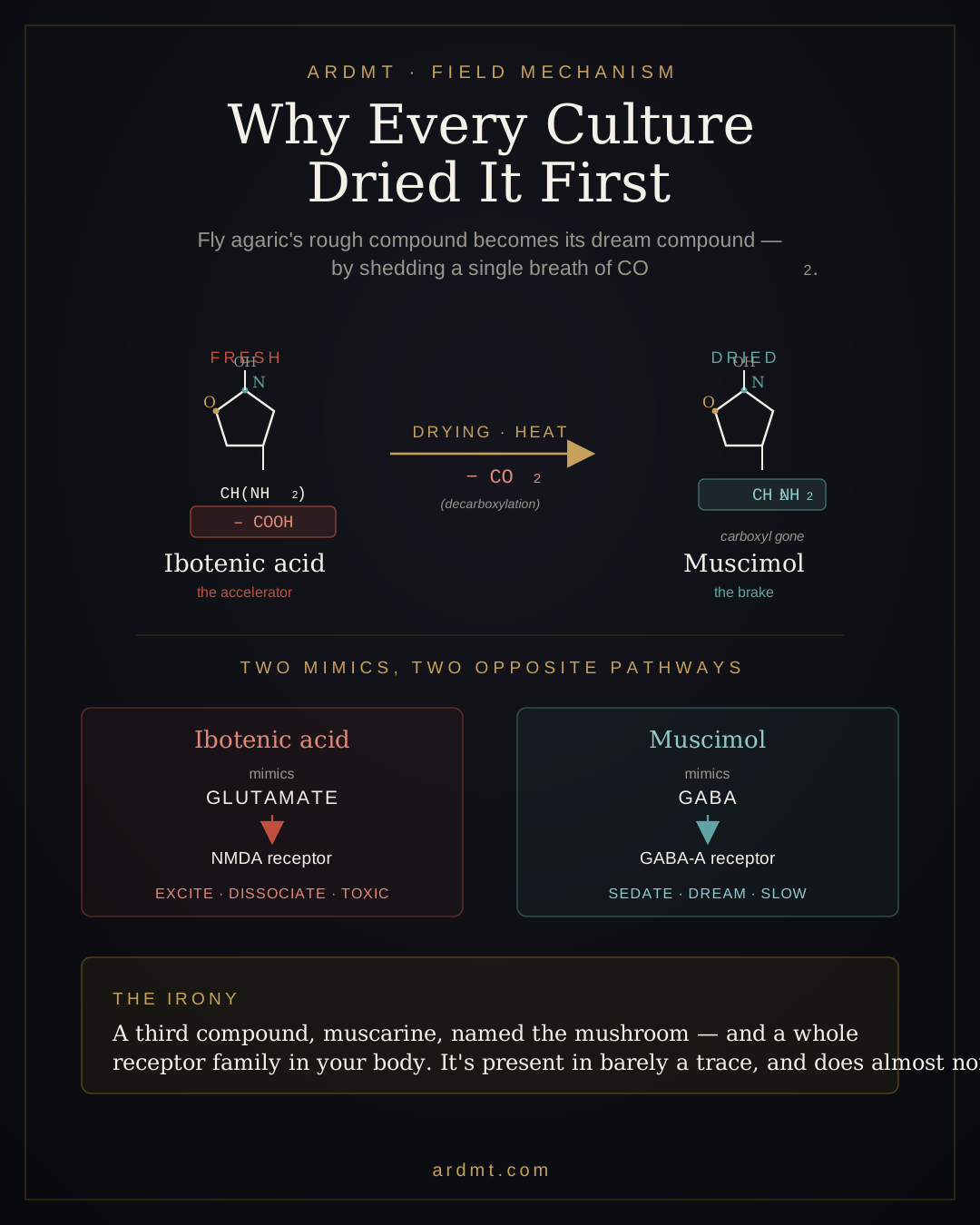
The first is muscimol. This is the star — the compound most responsible for the dreamlike, sedative core of the experience. Muscimol is a near-perfect chemical mimic of GABA, the brain's primary inhibitory neurotransmitter — the molecule your nervous system uses to say slow down, quiet, enough. Muscimol slots into the GABA-A receptor and turns that dial hard. That is the sedation, the twilight, the heaviness: the brain's brakes, pressed by an impostor. (The same receptor family, incidentally, is where alcohol, benzodiazepines like Valium, and sleeping pills like zolpidem all do their business — which is why the fly-agaric state reminds some people less of a psychedelic and more of a very peculiar drunkenness.)
The second is ibotenic acid. Where muscimol mimics the brake, ibotenic acid mimics the accelerator: it is a structural double of glutamate, the brain's main excitatory neurotransmitter, and it activates glutamate's NMDA receptors. It is the source of the more chaotic, excitable, dissociative edge of the experience — and it is also frankly neurotoxic, a compound that can damage the very neurons it overstimulates.
And here is the crucial mechanical fact, the one that turns out to explain nearly every human tradition around the mushroom. Ibotenic acid is a prodrug: when the mushroom is dried, or heated, or simply digested, ibotenic acid sheds a molecule of carbon dioxide — it decarboxylates — and converts into muscimol. Drying the mushroom, in other words, does two things at once: it burns off the harsher, more toxic, more nauseating compound and enriches the gentler, dreamier one. Every culture that used fly agaric arrived, by trial and error, at the same practice — dry it first — because the fresh mushroom is a rougher and more dangerous thing than the dried one. They had worked out the chemistry centuries before there was a word for it.
Which brings us to the third compound, and the joke. The mushroom is called muscaria, and the compound is called muscarine, and muscarine, when it was isolated in 1869, was confidently declared to be the active hallucinogenic agent. It gave its name to an entire class of receptors in the human body — the muscarinic acetylcholine receptors, a phrase every pharmacology student learns, a category woven through the workings of your heart, your gut, your glands, your brain.
Muscarine is barely in the mushroom. It is present in the merest trace — so little that it plays essentially no part in either the intoxication or the poisoning. There is far more muscarine in various drab, unglamorous Inocybe and Clitocybe mushrooms than in the famous red one that lent it its name. So the situation is this: the most iconic mushroom on Earth named a compound, and that compound named a receptor family fundamental to human physiology — and the mushroom scarcely contains the compound, and the compound has almost nothing to do with what the mushroom does. A whole branch of the pharmacology textbook is named, at two removes, after a red toadstool, on the strength of a nineteenth-century mistake.
There is one more twist worth having, because it closes the loop on the mushroom's own English name. "Fly agaric" comes from its old use as an insecticide: broken into a saucer of milk, it stupefies and kills flies. For a long time nobody knew which compound did the killing. It is ibotenic acid — the same neurotoxic accelerator that half-poisons the human who eats it fresh. The mushroom's common name, its Latin name, its most famous compound and an entire receptor class all turn out to be tangled misnomers pointing at each other. Even the science had to work hard to stop being folklore.
And yet those same compounds are, quietly, among the most useful tools in modern neuroscience. Because muscimol reliably silences a patch of neurons and ibotenic acid reliably destroys one, researchers have used them for decades to switch brain regions off — temporarily with muscimol, permanently with ibotenic acid — and watch what breaks, mapping function by controlled subtraction. A great deal of what we know about what different parts of the brain do was learned with two molecules first found in a fairy-tale mushroom. The toadstool everyone knows is, in the lab, everywhere.
The real deep history: Siberia
Peel away Santa and the berserkers, and a genuine, ancient, well-documented human relationship with this mushroom remains — and it is far stranger than the myths that grew over it.
The reliable record begins with an unlucky Swede. Filip Johann von Strahlenberg was a colonel captured at the Battle of Poltava and held as a prisoner of war in Siberia for a dozen years; his account, published in the early eighteenth century and translated into English by 1736, gave Europe its first detailed description of the mukhomor — the Russian word for fly agaric, itself meaning roughly "fly-killer." What Strahlenberg described, and what a long line of later ethnographers confirmed, was a mushroom woven deep into the life of peoples across the Siberian north — the Koryak, the Chukchi, the Kamchadal (Itelmen), and, in scattered reports, the Sámi far to the west.
They dried the caps — performing, without knowing it, that decarboxylation that softened the toxin into the dream. They ate them alone, or soaked in the juice of berries; in some accounts women would chew the dried mushroom to soften it into a pellet for others to swallow. And they built cosmology around it. The Koryak told of wapaq, the fly agaric: the great deity Vahiyinin — the name means "Existence" — spat upon the earth, and where the spittle fell the mushroom grew, its white flecks the flecks of divine saliva. It was wapaq that gave Big Raven the strength to carry a whale home, and Big Raven who begged that the mushroom grow on earth forever so that people could learn from it. This is not set-dressing borrowed for a Christmas theory. It is a real people's real account of where knowledge comes from, with the mushroom at its centre.
Then there is the detail every account fixes on, the one that shocked eighteenth-century Europeans and still stops readers cold: they drank the urine.
It sounds like a grotesque curiosity, and it functioned as one in the retelling. But it is, in fact, a piece of applied pharmacology as elegant as anything in the mushroom's story. Recall that muscimol is the good compound and ibotenic acid the rough one. When a person eats fly agaric, the body largely metabolises the toxic ibotenic acid but excretes the muscimol substantially intact — passed out in the urine still active. The urine of a person who has taken the mushroom is therefore a purified dose: rich in the dreamy, sedative compound, stripped of much of what causes the nausea and toxicity. It is, pharmacologically, a better drug than the mushroom. The naturalist Georg von Langsdorff, whose account Wasson would later lean on heavily, described how a Koryak man could stay intoxicated for the better part of a week on only five or six mushrooms by recycling his own urine — each passing still potent, the effect handed down through the body several times over.
It carried a social logic, too. Fly agaric was scarce and valuable, and in the reports the wealthy ate the mushrooms while the poor waited to drink what they passed — an entheogen with a class structure, the sacrament trickling literally downhill. And around all of it moved the reindeer, who crave the mushroom, seek out the intoxicating urine in the snow, and grow visibly drunk — so that herders could exploit the stupefied animals, and, according to some accounts, become intoxicated in turn by eating their meat. Here at last are the real reindeer of the Santa myth: not flying, but staggering; not pulling a sleigh, but nosing through snow for a yellow stain, driven half-mad by the same compound driving the humans who kept them.
One honest caveat, because ARDMT does not sell romance as fact. Even this well-attested history has been over-told. The idea that fly agaric was the universal engine of Siberian shamanic trance was heavily popularised in the twentieth century — the Swedish scholar Åke Ohlmarks pushed it hard from 1939 — and later historians have pushed back. Ronald Hutton, among others, argues that Siberian shamans in fact rarely used the mushroom to reach their trances, which were more often drummed and danced and starved into being. The mushroom was real, ancient and important. It was not, on the current evidence, the single key to the shaman's mind that a century of enthusiastic writing has implied. The truth is more local, more particular, and more interesting than the grand version.
Soma: the banker and the mushroom of immortality
If the Siberian story is the mushroom's deep past, its most ambitious claim reaches deeper still — into the founding scriptures of Hinduism, and into one of the great unsolved puzzles of religious history.
Somewhere in the second millennium BCE, the Indo-Aryan peoples who composed the Rig Veda worshipped a plant-god called Soma — and drank it. Soma is a substance and a deity at once, the pressed and filtered juice of some plant, celebrated in more than a thousand hymns as a bringer of ecstasy, insight, courage and a taste of immortality. The priests drank it and touched the divine. And then, at some point, the identity of the plant was simply lost. For centuries scholars have argued over what Soma actually was — one of the longest-running detective stories in the study of religion.
In 1968 an unlikely detective published his answer. Robert Gordon Wasson was not an academic; he was an American banker, a vice-president at J.P. Morgan, who had fallen in obsessive love with mushrooms and effectively invented the discipline of ethnomycology in his spare time. (It was Wasson who, a decade earlier, had brought the Mazatec mushroom ceremonies of Mexico — and psilocybin — to a mass Western audience through a famous 1957 magazine article, an act with consequences that echo through the whole psychedelic story.) In Soma: Divine Mushroom of Immortality, Wasson argued that Soma was fly agaric.
His case was genuinely clever. The Vedic hymns describe Soma as a plant without leaves, roots, blossom or seed — a description that fits a mushroom far better than any flowering herb — and locate it in the mountains, which fits fly agaric's habitat. They dwell on its ruddy, glowing colour. And, most strikingly, the Rig Veda contains passages in which the gods urinate Soma, and Soma passes onward still potent — which Wasson read as a direct textual echo of the Siberian urine rite. The clincher, for him, was that same startling piece of pharmacology: a sacrament that survives its own excretion is a very specific kind of drug, and he knew of only one.
The academy was not wholly convinced, and the objections were real. The Vedic scholar Daniel Ingalls argued in 1971 that the "urinating Soma" passages are far rarer and more ambiguous than Wasson's reading needs, and that Vedic priests did not, as a rule, impersonate their gods. Others pointed to the elaborate pressing and filtering the hymns describe — why go to such trouble with a mushroom you could simply eat? And rival candidates crowded in: ephedra, the stimulant shrub, whose remains have been read into Bronze Age ritual sites of Central Asia alongside cannabis and poppy; Syrian rue; cannabis itself; and, from Terence McKenna, the psilocybin mushroom. Soma remains, officially, unidentified.
But the fly-agaric theory has had a quiet second life, and it comes from exactly the direction you'd hope. The anthropologist Kevin Feeney — who has edited a scholarly compendium on the mushroom, and whom we are about to meet again in a very different setting — took up the strongest objection, the pointless-seeming filtering, and tested it. He and a collaborator gathered more than six hundred first-hand accounts of fly-agaric intoxication and found that the specific preparations the Rig Veda describes would, in fact, have reduced the mushroom's nausea and toxicity. The elaborate filtering wasn't decorative. It was purification — the same instinct that produced drying in Siberia and urine-recycling among the Koryak, dressed in Vedic ritual. It doesn't prove Wasson right. But it takes his best evidence off the "obviously flawed" pile and puts it back in play.
Whatever Soma was, Wasson's obsession did something lasting: it made the West take seriously the idea that altered consciousness sat at the root of religion itself. The banker with the mushroom fixation reframed the question. That is a large legacy for a theory that may well be wrong.
The gummy paradox: fly agaric now
Which brings us, by a road nobody could have predicted, to the smoke shop.
Walk into a vape store or a wellness boutique across most of the United States today and you may find, on a shelf near the CBD and the delta-8, brightly packaged gummies promising a "legal mushroom" experience. A great many of them are branded, one way or another, around Amanita muscaria. This is the mushroom's strangest chapter yet, and it turns on a genuine paradox.
Psilocybin — the compound in the mushrooms people actually associate with "tripping" — is a Schedule I controlled substance in the United States, as illegal as heroin in the eyes of federal law. Fly agaric's compounds, muscimol and ibotenic acid, are on no federal schedule at all. The mushroom that fairy tales flag as the dangerous one, the storybook poison toadstool, is the one you can legally buy; the mushroom quietly used in Indigenous ceremony for generations is the felony. Part of the reason is almost comic: regulators have historically not bothered to ban fly agaric precisely because so many people find its effects unpleasant, which keeps its "abuse potential" low. It is legal, in part, for being a bad time.
Onto that loophole an industry has been built — and it is here that the whole essay's theme of misattribution reaches its sharpest, most consequential point. Because a startling proportion of these products are not what they claim.
In 2024 the problem announced itself catastrophically. A brand of mushroom edibles called Diamond Shruumz, sold nationwide, was linked to dozens of hospitalisations across the country and to several deaths. When investigators tested the products, they found a chemical mess: a synthetic psilocybin-like compound, the prescription anticonvulsant pregabalin, the sedative herb kava, and — yes — muscimol and ibotenic acid, among other things. Federal analysis concluded that the fly-agaric compounds could not even account for all the harm; the danger was in the adulterants, the undisclosed pharmacological grab-bag hiding behind a cartoon label. It was not, in the end, a fly-agaric poisoning. It was a labelling catastrophe wearing a mushroom's face.
That is the recurring finding whenever anyone tests this market rather than trusting it. In early 2025 California's public health department tested products from one of the largest brands in the space and found undisclosed synthetic psychoactives. Toxicologists studying these edibles describe mislabelling as routine — products that name fly agaric but contain other things, products that claim to be nothing but harmless "functional" mushrooms yet promise a high they could only deliver with an ingredient they aren't listing. The old lesson of the mushroom returns in a modern key: the name on the object is the least reliable thing about it.
Regulators have started to move, though slowly and unevenly. In December 2024 the U.S. Food and Drug Administration issued a formal alert declaring that fly agaric and its constituents — muscimol, ibotenic acid and muscarine — are not authorised as ingredients in ordinary food, do not meet the safety standard, and may be harmful; it advised the public to avoid them. That ruling is why so many products now carry the surreal fine print "not for human consumption," or dress themselves as "sacramental" or "botanical" items — legal costumes designed to slip past a food rule. At the state level Louisiana stands out as the clearest prohibition, both through a long-standing hallucinogenic-plants law and a 2025 statute specifically targeting muscimol and ibotenic acid products meant for human consumption. Most other states, for now, permit sale. The consensus among people who follow this closely is that the loophole is temporary — that fly agaric is living out a brief, chaotic window between fashion and regulation, much as delta-8 THC did before it.
Running underneath the retail boom is a quieter trend: microdosing. A growing number of people take very small, sub-intoxicating amounts of muscimol as a claimed aid for anxiety and sleep, and even as an alternative to benzodiazepines or alcohol — which, given that muscimol works on the same GABA system those substances target, is at least a coherent hypothesis rather than pure wishful thinking. But it is a hypothesis. The clinical evidence in humans is thin to the point of near-absence; the preclinical hints of anti-inflammatory, antioxidant or anti-anxiety effects are interesting and unproven; and none of it is happening under anything resembling medical supervision or reliable dosing. Kevin Feeney — the same anthropologist who rehabilitated Wasson's filtering argument — has put the sharpest question to the regulators from the other side: in going after the mushroom, are they even addressing the additives that were doing the real damage? The mushroom, once again, is being mistaken for the story around it.
The honest version
Step back and a single shape emerges from all of it. The history of Amanita muscaria is a history of being mistaken for something else.
It was mistaken for a serotonergic psychedelic; it is a GABA-driven dream-drug that works nothing like one. It was mistaken, via muscarine, for the source of a whole receptor system it barely touches. It was mistaken for the battle-drug of the Vikings, and the origin of Santa Claus, and the secret behind the world's oldest surviving myths — sometimes by cranks, sometimes by serious scholars, and always because the real ingredients underneath were genuine enough to build a false picture on. And it is being mistaken right now, on shelves across a continent, for a safe and predictable candy, when the honest label would read toxic, wildly variable, and frequently not even what it says it is.
But notice what's left once you clear the mistakes away. A mushroom that grows in ring and scatter under the birch and the pine across the whole cold top of the world. A dream-chemistry that early peoples decoded by hand — drying it, filtering it, passing it through the living body to purify it — millennia before anyone could name a receptor. A genuine, particular altered state, closer to dream and delirium than to vision, that humanity has been walking into deliberately for a very long time and still barely understands. Two molecules that quietly built a corner of modern neuroscience. And a red cap flecked with white that became, across every culture that ever met it, the single most recognisable mushroom on Earth — the one children draw before they can spell, sitting at the exact seam where the natural world tips over into the enchanted.
The myths were trying to say something true and getting the details wrong. The mushroom really is a doorway; people really did use it to change their minds; it really is bound up, at the root, with how our species imagines flight, transformation and the sacred. It just never needed Santa. The facts were always the better story. You only had to strip the costume off the toadstool everyone knows.
This piece is a cultural and scientific history, not a how-to. Fly agaric is a toxic mushroom of highly variable potency, easily confused with dangerous relatives, and the commercial products sold under its name are frequently adulterated or mislabelled. Nothing here is a recommendation to consume it.