ARDMT Field Notes
Be Careful Not to Colonise Hyperspace
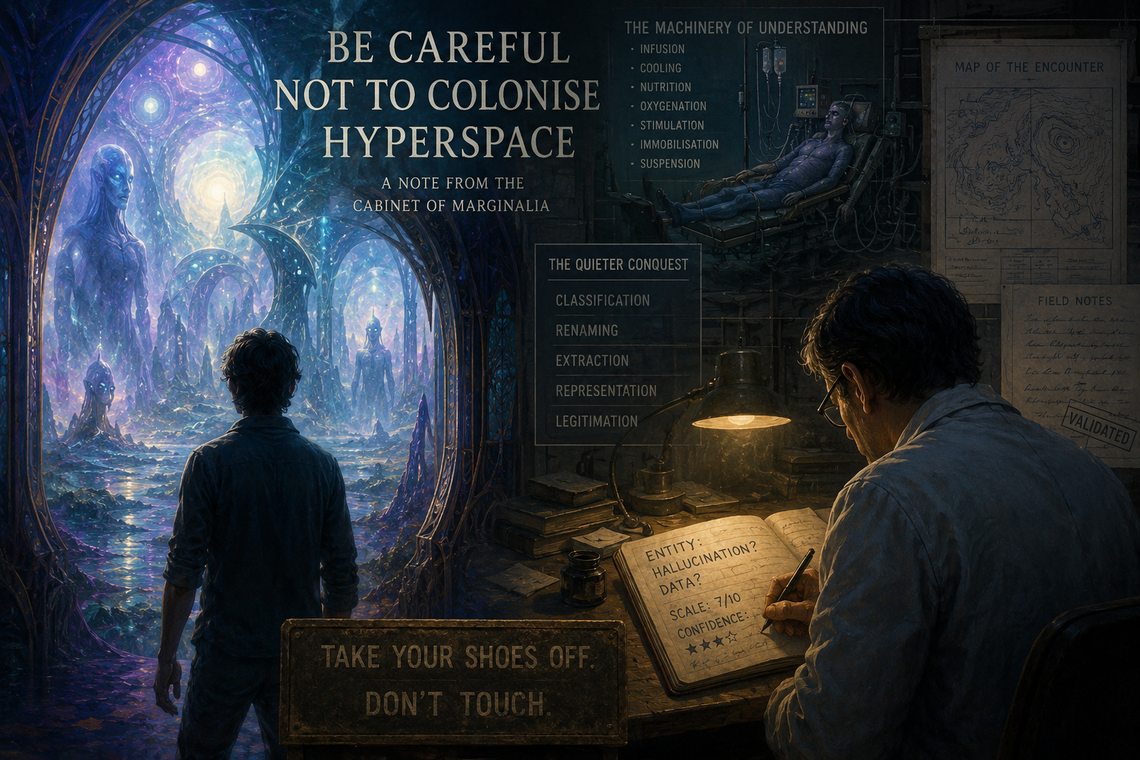
A note from the Cabinet of Marginalia
The phrase surfaces, briefly, on a slide. Be careful not to colonise hyperspace. It is meant, I think, as a caution about attitude — about arriving in the DMT state with the postures of the conqueror rather than the guest, treating the encountered world as terrain to be claimed and its inhabitants as curiosities to be catalogued. A gentle admonition. Take your shoes off. Don't touch.
But the phrase is doing more work than its authors may intend. A few slides earlier there was a diagram of a machine, and once you have seen the machine you cannot un-see what the warning is really warning against. Though — and this is the turn I want to arrive at slowly — the machine is the least of it.
The machine
The extended-state DMT proposal — DMTx, in the field's shorthand — begins from a chemical inconvenience. Smoked or injected, DMT delivers an experience of astonishing intensity and almost comic brevity: five minutes, ten at most, and you are returned. Andrew Gallimore and Rick Strassman's answer, first modelled in a 2016 paper, was to borrow the target-controlled intravenous infusion used to hold a patient at a steady depth of anaesthesia, and repurpose it to hold a brain at a steady concentration of DMT. Not a trip, then, but a residency. Not a glimpse of the country but a tenancy in it, extendable — in principle — without limit.
The pharmacology is only half the engineering. A body left inert for hours becomes its own problem, and so the fuller vision includes a specification for keeping that body alive and unbothered while its occupant is elsewhere. Cooling to induce a hibernation-like torpor. Electrical stimulation to keep the muscles from wasting. Nutrition by drip. Oxygen delivered not through the lungs but directly into the blood. Waste plumbed away. And, to complete the severance, dry immersion — the body suspended so that it loses track of itself, all proprioception dissolved, until there is nothing to feel and nowhere obviously to be but there.
Read that list once as a life-support system for exploration and it is thrilling. Read it a second time with the human's consent quietly removed and it is a specification for keeping a conscious person indefinitely immobilised, fed by tube, cooled into stillness, cut off from their own body, and held inside an experience they cannot leave. The apparatus does not change between the two readings. Only the sign changes. The technology of maximising an experience and the technology of imprisoning someone within one are, at the level of hardware, indistinguishable, and what separates them lives entirely in the unengineered stuff: consent, an exit, honesty about what you believe is on the other side.
This is the version of the argument that is easy to make, and I have now made it. It is also the shallow one. It depends on a machine nobody has built, and it lets us locate the danger reassuringly in the future, in a catheter not yet threaded. I want to put the machine down now, because the more serious colonisation needs none of it. It is already underway, and it requires no pod at all.
What colonisation actually is
We flatter ourselves that colonisation is chiefly a matter of ships and soldiers — arrival plus machinery. But the ships were only the overture. The lasting work was quieter and came after: the survey that renamed the rivers, the taxonomy that sorted the inhabitants into kinds, the ledger that decided what could be extracted and what was worthless, the report sent home that became the official account, and — beneath all of it — the seizure of the single authority that mattered most, the authority to say what the place meant. You do not fully own a territory when you land on it. You own it when your description of it is the one that counts, and the people who were already there find that their own account of their own home has been reclassified as folklore.
Notice that not one of those acts requires conquering anybody. You need never fire a shot to colonise an encounter. You need only own the categories. And once you hold the categories, the territory follows, because everyone — including the inhabitants — must now speak about the place in your terms or not be heard at all.
Hold that up against the science of the DMT encounter and watch how much of it is already there, in embryo, with no machine in sight.
Classification. The first and most consequential act. A person returns from the state insisting they met someone — an intelligence, a presence, a being with intentions of its own. The researcher must now decide what that report is, and the available boxes are: agent, hallucination, or data. Gallimore, unusually, reaches for the first; most of the field reaches for the second or third. But look at what is shared across the disagreement — the authority to adjudicate rests, in every case, with the person holding the clipboard, not the person who had the encounter. The verdict is theirs to render. The experiencer merely supplies the raw material on which the verdict is passed. It does not matter, for the colonial structure, which box gets ticked. What matters is who holds the pen.
Renaming. The encounter arrives clothed in the language of the person who had it — a spirit, an ancestor, a teacher, a machine-elf, God. It leaves the lab renamed: entity, then percept, then a code on a rating scale. Each translation is presented as neutral tidying, and each quietly strips the phenomenon of the meaning its owner gave it. To rename is not to describe more precisely. It is to assert the right to say what a thing shall be called, which is the right to say what it is.
Extraction. The encounter is mined for what is legible and publishable, and the rest is tailings. What can be scored, timed, correlated with a brain region, and charted is kept; the ineffable remainder — the part the experiencer would say was the whole point — is set aside as noise. We call this operationalisation. It is also a decision about what is valuable, made by the party who profits from the yield.
Representation. The experience becomes a scale. The Mystical Experience Questionnaire, the Ego-Dissolution Inventory, the taxonomies of entity type and encounter phenomenology — each a genuine attempt to make the plural legible, and each also an act of compression, folding a first-person infinity into a form a committee can read. The map is not the territory; but the map is what gets cited, funded, and believed, and in time the territory is expected to answer to the map.
Legitimation. And over all of it sits the institution, which decides not what happened but which account of what happened is admissible. A peer-reviewed interpretation is knowledge; the experiencer's own is anecdote. The community of the encounter — the one that has been meeting these presences for as long as there have been humans and plants — is admitted as colour, as provenance, as atmosphere, while final interpretive authority is reserved, quietly and completely, for the laboratory. The cosmology is borrowed for the introduction. The verdict is kept for the discussion section.
The quieter conquest
Put those five together and the shape is unmistakable, and it is the shape ARDMT keeps finding wherever it looks. It is the same move we have objected to before, when we insisted that ayahuasca is not one thing — the compression of a living plurality into a single legible object that the West can then claim to have understood. Here it operates one level deeper, on the encounter rather than the brew: the compression of a plural, first-person, meaning-drenched phenomenon into a category, a code, a legitimate reading. Owning the categories is owning the territory. You need never conquer an entity to colonise the encounter with it.
I want to be careful, because this argument has a failure mode, and it is a colonising one. Taken a step too far, it indicts all classification as conquest and all science as theft — which is false, self-defeating, and flattens a great many careful and humble people into a single accusing category, the very sin it claims to expose. That is not the charge. Classification is not the crime; describing a place is not the same as declaring yourself its only legitimate cartographer. The crime is narrower and more specific: it is classification that claims finality, that treats the experiencer's testimony as ore rather than evidence, that borrows a cosmology for atmosphere while reserving the right to say what it all really meant. A science that held its categories lightly — that said this is our current map, offered without the claim that it is the country — would not be colonising anything. It would be keeping a guest's manners in a house it did not build.
Which is, I think, what the slide was reaching for all along. Be careful not to colonise hyperspace is not, in the end, a warning about the pod, though the pod makes a vivid overture. It is a warning about the pen. The machine could hold a body in that country for a hundred hours and colonise nothing, if the person chose to go and could freely come back. And a fifteen-minute session with no machine at all can colonise completely, if the only account of it that survives is the one written by the person who was never there — who took the encounter, sorted it, renamed it, scored it, and filed it under a heading of their own choosing, and called the result knowledge.
Be careful not to colonise hyperspace. And be careful, most of all, about who is holding the pen — because the map of a new world has always been drawn, in the end, not by whoever owned the ships, but by whoever was believed when they came home and said here is what it was.