ARDMT Field Notes
Tracking DMT's neural arc: time-resolved EEG at two doses
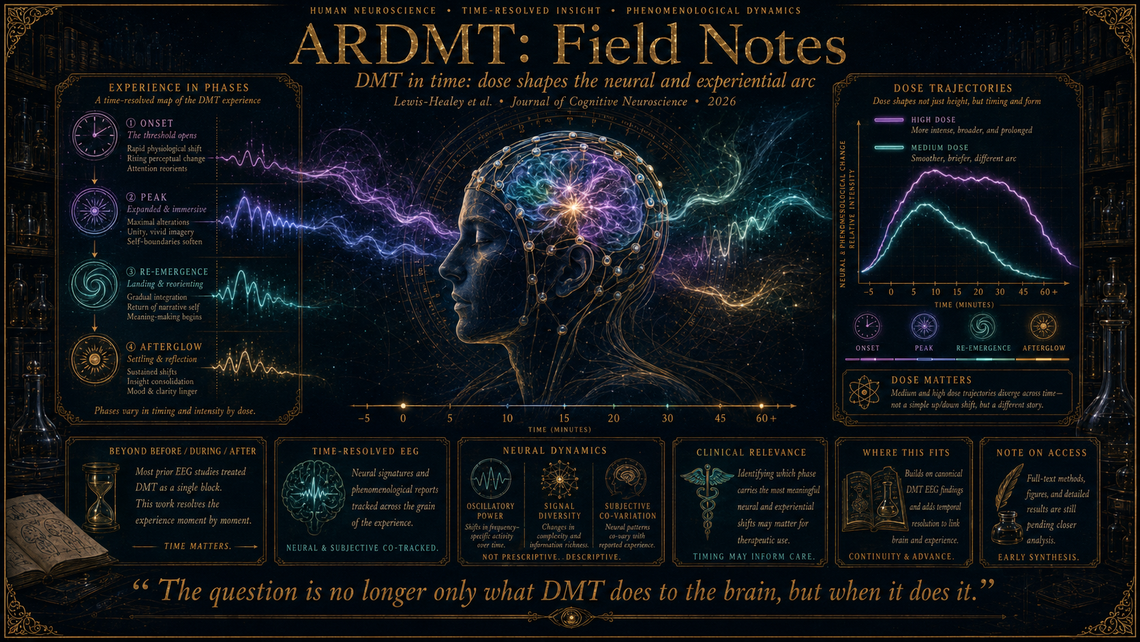
Lewis-Healey E, Pallavicini C, Cavanna F, D'Amelio T, De La Fuente LA, Copa D, Müller S, Bruno N, Tagliazucchi E & Bekinschtein T. Journal of Cognitive Neuroscience 38(6): 1244–1263 (2026). doi: 10.1162/JOCN.a.2423
The claim and the context
Most EEG studies of DMT have treated the experience as a single temporal block — a before, a during, and an after. The drug is administered, the cap records, and the resulting epochs are averaged into a composite neural signature. This is not unreasonable; intravenous DMT's brevity invites it. But anyone who has spoken to a participant emerging from a DMT session — or, for that matter, read Strassman's transcripts — knows that the phenomenology is anything but uniform across the arc of the experience. There is typically a rapid onset, a peak phase often described as dissociative or entity-laden, a gradual re-emergence, and a reflective afterglow, each with its own texture. The question of whether distinct neural dynamics correspond to these experiential phases, and whether dose modulates their temporal unfolding, is one the field has been circling for some time.
Lewis-Healey, Pallavicini, Cavanna and colleagues — a collaboration spanning Cambridge and Buenos Aires, with Tagliazucchi and Bekinschtein as co-senior authors — now address this directly. Their paper offers a time-resolved account of both neural and subjective dynamics at two dose levels, medium and high, of DMT (the available metadata do not specify the route of administration). The key analytical move is to track how EEG signatures and phenomenological reports co-vary across the temporal grain of the experience, rather than collapsing them into a single summary measure.
Where this fits in the field
The Cambridge–Buenos Aires axis has been productive in this space. Timmermann et al. (2019) established the canonical EEG findings for intravenous DMT — broadband decreases in oscillatory power, increases in signal diversity — using Lempel–Ziv complexity and related measures. Pallavicini and Tagliazucchi have contributed work on the entropic brain framework under ayahuasca, and Bekinschtein's lab has long expertise in awareness paradigms and EEG methodology. The present paper sits at the intersection of these threads.
What has been largely missing is the temporal dimension. A handful of studies — notably the Imperial group's continuous-infusion work — have attempted to hold the DMT state steady long enough for finer temporal parsing. But the more common approach has been a bolus injection and a recording window of fifteen to twenty minutes, with the entire post-injection period treated as a single condition. If Lewis-Healey et al. have genuinely resolved the neural and experiential trajectories into meaningful temporal bins and shown dose-dependent divergence in those trajectories, that would fill a genuine gap. The twenty-page length (pp. 1244–1263) suggests a substantial dataset and, one hopes, a suitably granular analysis.
Why this line matters
The clinical relevance is not abstract. If DMT is to be used therapeutically — and several trials are now running or planned — understanding the temporal architecture of the experience becomes operationally important. Which phase correlates with the subjective features most associated with therapeutic outcomes? Does a higher dose simply amplify the same trajectory, or does it produce qualitatively distinct neural dynamics at certain timepoints? These are precisely the questions a time-resolved, dose-comparison design can begin to answer.
Note on access
The full text is not yet openly available to us. Given what the title and metadata indicate — twenty pages of time-resolved, multi-dose analysis — ARDMT will return to this paper with a proper methods-and-results treatment once we can read the figures and the statistical approach in full.
Also worth a glance
Morales-García and colleagues continue their preclinical programme on DMT in Parkinson's disease models, with a new paper in Experimental Neurology (PMID 42128256). The Madrid group has previously reported neuroprotective effects via sigma-1 receptor mechanisms in 6-OHDA-lesioned rodents. Readers who have followed their earlier output should note that the present paper may represent an expanded dataset rather than an entirely new line; the group's findings have been consistent enough to warrant attention, but independent replication from another laboratory remains the missing piece.
Marginalia
It is a pleasing irony that a molecule whose subjective effects are often described as timeless should prove so methodologically challenging to study in time. The field has spent several years establishing what DMT does to the brain; the question of when it does it, moment by moment, may prove rather more interesting.