ARDMT Field Notes
Who Owns a Molecule That Has Never Existed in Nature?
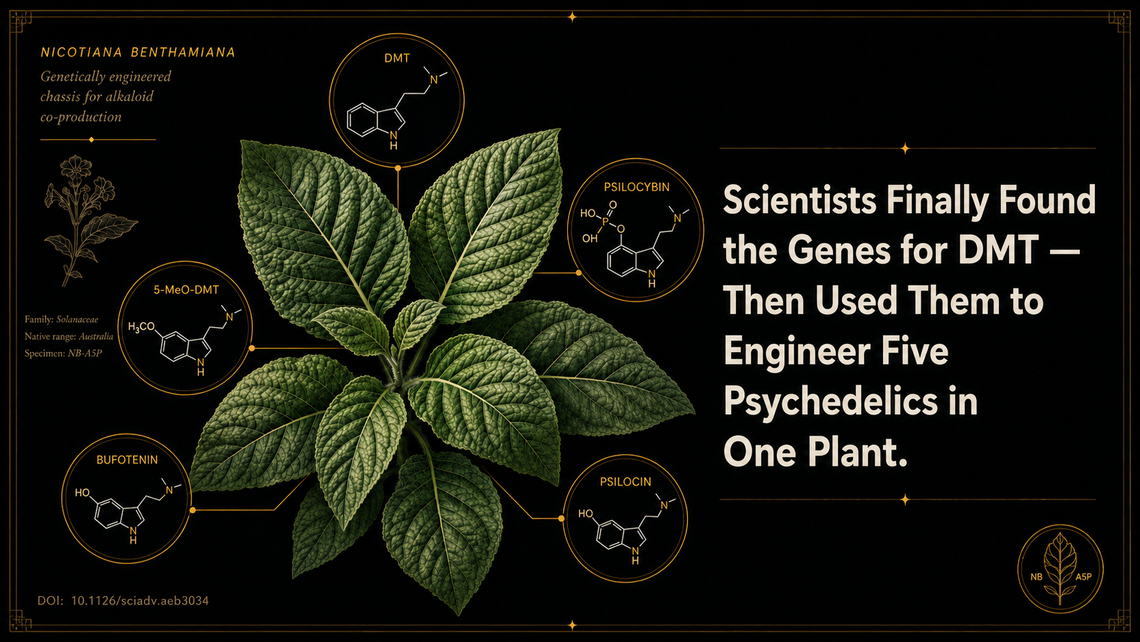
Five psychedelics, one engineered tobacco plant, and the regulatory frontier a Weizmann Institute paper just opened
Berman et al., Science Advances 2026 · DOI 10.1126/sciadv.aeb3034
I. THE QUESTION BEFORE THE BIOLOGY
In April 2026, a team at the Weizmann Institute of Science announced they had engineered a single, unglamorous relative of tobacco to produce five different natural psychedelics at once: psilocybin and psilocin, the mushroom compounds; DMT, the molecule at the heart of ayahuasca; and bufotenin and 5-MeO-DMT, both associated with the skin secretions of toads.[1] That result alone made for an easy headline, and it has travelled fast across exactly the audience this publication spends most of its time talking to.
But the more interesting result is sitting quietly a few pages into the same paper, and almost nobody covering it has mentioned it. The same team also built molecules that have never existed anywhere in nature — brominated and chlorinated cousins of these five compounds, assembled using bacterial genes that have nothing whatsoever to do with psychedelics. Nobody owns those molecules yet. Nobody has fully worked out whether they are legal, whether they can be patented, or whose genetic heritage they were even built from. That is the actual story here, and it will outlast the “one plant, five drugs” version by a wide margin.
II. FINDING THE GENES NOBODY HAD FOUND
The idea that DMT comes from tryptophan, in two simple chemical steps, has been textbook knowledge for decades. What nobody had actually done, until now, was find the real genes responsible in a real plant.
The team went looking in the species where DMT is best documented: Psychotria viridis, the shrub that supplies DMT to traditional ayahuasca brews, and several species of Australian Acacia.[2] They sequenced RNA from different tissues of each plant, then hunted through thousands of resulting gene transcripts for two enzyme families: one to strip a carboxyl group off tryptophan and turn it into tryptamine, and a second to bolt two methyl groups onto that tryptamine, one at a time, to arrive at DMT. After testing dozens of candidates, two enzymes did the job: a tryptophan decarboxylase from P. viridis, and a methyltransferase that turned out to do both methylations on its own. Express the two together in a plant leaf, and DMT starts accumulating within days, entirely from the plant’s own internal tryptophan supply.
III. BORROWING FROM THREE KINGDOMS
Here is the elegant part. Once you have DMT, the four other target compounds are just tryptamine wearing different accessories, in different positions on the same molecular ring — a hydroxyl group here, a phosphate there, a methoxy group somewhere else. If the newly discovered methylating enzyme could be persuaded to work on those decorated tryptamines too, the same basic machinery might build all five compounds from a common starting point. It could — the enzyme turned out to be remarkably unfussy about what it would methylate.
So the team went shopping across three kingdoms of life. A rice gene supplied the hydroxylation step that starts the bufotenin and 5-MeO-DMT branch. A previously characterized toad enzyme closed it out.[3] Three enzymes already known from magic mushroom research were transplanted wholesale to build the psilocybin branch. An Arabidopsis gene, borrowed from general plant metabolism and never previously associated with any psychedelic at all, was pressed into service for the final methylation step toward 5-MeO-DMT. Wire all of it into the same tobacco relative, and — with some real inefficiencies discussed below — you get five psychedelics from one plant.
One detail worth being precise about, since this publication tries not to blur distinctions other coverage happily blurs: the toad enzyme came from the cane toad, Rhinella marina — an invasive, ecologically unthreatened species — not from Incilius alvarius, the Sonoran Desert toad whose secretions are the actual ceremonial and pharmacological source of bufotenin and 5-MeO-DMT, and which is under real conservation pressure from over-collection.[4] The paper’s toad-derived component required no contact whatsoever with the animal indigenous communities in northern Mexico have traditionally worked with.
|
DMT plant |
Psilocybin mushroom |
Psilocin mushroom |
Bufotenin toad |
5-MeO-DMT toad |


The five natural compounds this system produces — structures verified against PubChem records, not AI-generated.
· · ·
IV. ASKING ALPHAFOLD WHY
The 5-MeO-DMT branch worked, technically, but barely. The borrowed Arabidopsis enzyme was sluggish with its new, unfamiliar substrate, and yields stayed stubbornly low no matter how the researchers rebalanced the pathway around it.
So they asked an AI system why. Using AlphaFold3 — the protein-structure prediction system that shared in a Nobel Prize the year before this paper was submitted — they modelled the enzyme sitting in complex with its intended substrate and cofactor, and found the problem immediately: a single amino acid side chain, sitting right where the substrate needed to fit, was sterically clashing with an extra methyl group the natural version of the molecule doesn’t have.[5] Swap that one amino acid for glycine, the smallest possible substitute, and the clash disappears. Production of 5-MeO-DMT jumped roughly forty-fold.
That is a genuinely good example of what “AI-accelerated biology” is supposed to mean, as distinct from what the phrase usually gets used to sell: not a black box generating answers, but a structural hypothesis a human could check, understand, and act on with a single, deliberate, targeted edit.
V. THE FIVE COMPOUNDS ARE NOT ONE THING
It is tempting, reading a headline like “one plant, five psychedelics,” to file all five under a single mental category — different flavours of the same basic trip. Resist that. It is exactly the kind of flattening this publication exists to push back against, and the chemistry itself argues against it.
DMT and psilocybin (via its active metabolite, psilocin) are the best-characterized members of this family, with reasonably predictable receptor pharmacology and most of the current clinical trial literature built around them. Bufotenin is a different animal entirely. Despite differing from a close relative by a single hydroxyl group in a different ring position, it produces pronounced peripheral effects — cardiovascular changes, flushing, nausea — and its central, subjective psychedelic effects in humans have been described across the scientific literature as inconsistent, sometimes muted, sometimes barely present at all.[6] 5-MeO-DMT, meanwhile, is widely reported to produce a markedly different, often more formless and ego-dissolving state than classic DMT, despite the two compounds differing by a single methoxy group.
None of that changes because a lab found a way to manufacture all five in the same leaf. If anything, it is the argument for taking set and setting more seriously, not less: a large body of clinical and anecdotal evidence holds that a person’s state of mind going in, and the physical and relational context they are held in during the experience, materially shapes both the quality of a psychedelic experience and what a person is left with afterward.[7] Cheap, reliable synthesis solves a supply problem. It does not solve, or even touch, that one.
VI. THE MOLECULES THAT WERE NEVER REAL
The more genuinely novel result comes next, and it is where the ownership question actually starts. The team introduced three bacterial halogenase genes — enzymes bacteria normally use to make antibiotics, borrowed from species with no prior connection to psychedelics whatsoever — into the same plant system, each targeting a different position on the tryptamine ring.[8] The result: chlorinated and brominated versions of DMT at three different ring positions, plus two new chlorinated versions of psilocybin. None of these molecules have ever been detected in any living organism, anywhere, at any point in natural history.
|
5-Cl-DMT never existed in nature |
7-Br-DMT never existed in nature |


Two of the paper’s novel halogenated tryptamines, rendered from verified SMILES — copper marks the atoms nature never put there.
This is not a gimmick. Related halogenated tryptamines, tested elsewhere, have shown measurably different behaviour from their natural counterparts — altered receptor binding, different potency, in some cases distinct effects entirely, like sedation where the parent compound produces stimulation.[9] Small structural edits, on this molecular scaffold, can produce a genuinely different drug, not just a legal fiction of one.
· · ·
VII. TWO FRONTIERS OF OWNERSHIP
That last sentence is doing more work than it looks like, because it sits at the exact centre of two separate, unresolved legal questions — one about whether these new molecules are legal to make and possess at all, and one about who, if anyone, is owed anything for the biological knowledge that made them possible.
Take the legality question first, because the intuitive answer — “make it different enough and you dodge the law” — turns out to be shakier than it sounds. In the United States, a newly synthesised compound this close to a controlled substance falls to be assessed under the Federal Analogue Act, which extends Schedule I treatment to anything “substantially similar” in structure and effect to a scheduled drug.[10] The Act has a real history with exactly this molecular family: in a 1992 case, a federal court ruled that alpha-ethyltryptamine was not “substantially similar” to DMT, but the reasoning is instructive — the court leaned heavily on the fact that the two compounds belonged to different classes of amine entirely.[11] The halogenated compounds in this paper share DMT’s exact amine chemistry; the only change is a single halogen atom on the ring. That is a far smaller structural step than the one that got AET off the hook, which suggests these new molecules sit closer to the Act’s reach than a “clever workaround” narrative would imply, not further from it.
The United Kingdom’s approach removes the ambiguity in the other direction entirely. The Psychoactive Substances Act 2016 does not test chemical structure at all — it bans anything capable of producing a psychoactive effect by stimulating or depressing the central nervous system, with a short, specific list of exemptions covering things like alcohol, caffeine, and medicines.[12] A structurally novel tryptamine that plainly affects the mind would fall inside that blanket ban regardless of how far its structure had drifted from DMT. Whatever strategic value halogenation might have under a structure-based test like the American one, it has none at all under an effects-based test like the British one — worth knowing before anyone gets excited about a regulatory loophole that only exists in one of the two systems, and arguably not even there.
Patentability is a separate, calmer question again — novelty, utility, and non-obviousness, not legality — and it is worth not collapsing the two. A molecule can be perfectly patentable and still be a controlled substance; plenty of scheduled pharmaceuticals are.
The second frontier concerns the five natural compounds, not the novel ones, and it is a question I have spent a fair amount of time on in a different context. The Nagoya Protocol exists so that a country supplying a genetic resource — a plant, an animal, a microorganism — shares in whatever benefit is later built from it, through documented prior consent and agreed terms.[13] It is the exact framework governing my own iboga cultivation between Ecuador and Gabon, where every seed I hold carries prior informed consent from the Gabonese Bwiti community I received them from, and terms of use agreed with the same people.
This paper did nothing comparable, for a structurally interesting reason that is not the same thing as a compliance failure. Nobody needed to import a cutting of the Central American shrub, a sample of Australian Acacia bark, or a scrap of toad tissue. Once the toad enzyme’s genetic sequence had been published in the literature by a separate research group, a commercial gene-synthesis company simply built the corresponding DNA from scratch, base by base, with no biological material from any country of origin ever changing hands.[14] Whether that counts as “using a genetic resource” under the Nagoya Protocol is one of the most contested open questions in international biodiversity law, known as the digital sequence information debate, and it has been argued over for more than a decade without a clean resolution.[15] Its first concrete institutional answer only arrived very recently — the Cali Fund, launched in February 2025, which asks large commercial users of genetic sequence data to contribute a small share of profits to a global biodiversity fund, half of it earmarked for indigenous and local communities.[16] But the Fund is aimed at large-scale industrial users, not university labs, and it settles a funding mechanism without settling the underlying legal question of whether sequence-only use is covered by Nagoya’s core obligations at all.
Worth adding, without implying any wrongdoing whatsoever by this particular team: Israel, where the work was carried out, has never ratified the Nagoya Protocol.[17] There was no domestic legal mechanism pushing toward this kind of accounting even if the digital sequence information question were settled tomorrow. That is not a criticism of these researchers — it is a fair illustration of how patchy the international framework still is, fifteen years after Nagoya was signed, for exactly the kind of cross-kingdom, sequence-only research this paper represents.
· · ·
VIII. SET, SETTING, AND THE LIMITS OF A GREENHOUSE
None of this is an argument against the science. Being able to manufacture these compounds without harvesting a slow-growing Amazonian shrub, collecting stressed wild toads, or drying out mushroom farms at scale is an unambiguous good for conservation, and probably eventually for consistent, quality-controlled clinical supply.
But it is worth being honest about what a greenhouse cannot manufacture. Traditional ayahuasca is not simply “plant-based DMT” — it is specifically the combination of a DMT-bearing plant with Banisteriopsis caapi, whose beta-carbolines are the only reason the DMT survives digestion at all, refined over generations by particular people in a particular place into a particular brew.[18] The Bwiti tradition surrounding iboga is not reducible to the alkaloid ibogaine in a bottle, either. Set and setting were never marketing language borrowed from these traditions; they are the entire container that determines whether an experience gets integrated into a life or simply endured and forgotten.
A tobacco relative that produces five psychedelics simultaneously is a genuine feat of biosynthesis, and the halogenated molecules sitting alongside them are a genuinely open legal frontier. Neither one says anything about which of these compounds a person should take, in what state of mind, in what company, prepared in what way, and for what reason. The chemistry has gotten dramatically easier. Everything the chemistry was never going to solve is exactly as hard as it always was.
Who owns a molecule that has never existed in nature is a question regulators are only just starting to catch up with. Whether that molecule deserves anything like the care its natural relatives have earned through centuries of documented human relationship is a question no regulator will ever be equipped to answer at all.
ARDMT will keep tracking how the Analogue Act, the Psychoactive Substances Act, and the Nagoya DSI debate handle this class of molecule as it develops.
[1]Berman P, Höfer J, Mehlman H, et al. “Complete biosynthesis of psychedelic tryptamines from three kingdoms in plants.” Science Advances 12, no. 14 (2026): eaeb3034. https://doi.org/10.1126/sciadv.aeb3034.
[2]Ibid., “P. viridis and A. acuminata plants produce DMT.”
[3]Chen X, Li J, Yu L, et al. “A cane toad (Rhinella marina) N-methyltransferase converts primary indolethylamines to tertiary psychedelic amines.” Journal of Biological Chemistry 299 (2023): 105231.
[4]Weil AT, Davis W. “Bufo alvarius: a potent hallucinogen of animal origin.” Journal of Ethnopharmacology 41 (1994): 1–8; cited in Berman et al., 2026.
[5]Abramson J, Adler J, Dunger J, et al. “Accurate structure prediction of biomolecular interactions with AlphaFold 3.” Nature 630 (2024): 493–500; applied in Berman et al., 2026, Fig. 6C.
[6]See the pharmacological literature on bufotenin’s pronounced peripheral serotonergic effects and inconsistently reported central psychoactivity relative to its close structural relatives.
[7]See, generally, the psychedelic-assisted therapy literature on set and setting as a determinant of experience quality and post-experience outcomes.
[8]Berman et al., 2026, “De novo production of halogenated indolethylamines in N. benthamiana.”
[9]Ibid., citing prior behavioural studies of halogenated tryptamine derivatives in animal models.
[10]21 U.S.C. § 802(32); § 813 (Controlled Substance Analogue Enforcement Act of 1986).
[11]United States v. Forbes, 806 F. Supp. 232 (D. Colo. 1992).
[12]Psychoactive Substances Act 2016, c. 2, ss. 2–3 (UK).
[13]Nagoya Protocol on Access to Genetic Resources and the Fair and Equitable Sharing of Benefits Arising from Their Utilization, adopted 2010, in force 2014.
[14]Berman et al., 2026, Materials and Methods (gene synthesis by Twist Biosciences).
[15]Convention on Biological Diversity, Decisions 15/9 and 16/2, “Digital sequence information on genetic resources.”
[16]Cali Fund for the Fair and Equitable Sharing of Benefits from the Use of Digital Sequence Information on Genetic Resources, launched 25 February 2025, Rome.
[17]Secretariat of the Convention on Biological Diversity, Access and Benefit-Sharing Clearing-House: Parties to the Nagoya Protocol (Israel not listed as a Party).
[18]Riba J, Valle M, Urbano G, et al. “Human pharmacology of ayahuasca.” Journal of Pharmacology and Experimental Therapeutics 306 (2003): 73–83; cited in Berman et al., 2026.