Ethics
When Motherhood Feels Like a Trip: A Compelling Parallel That Hasn't Been Tested
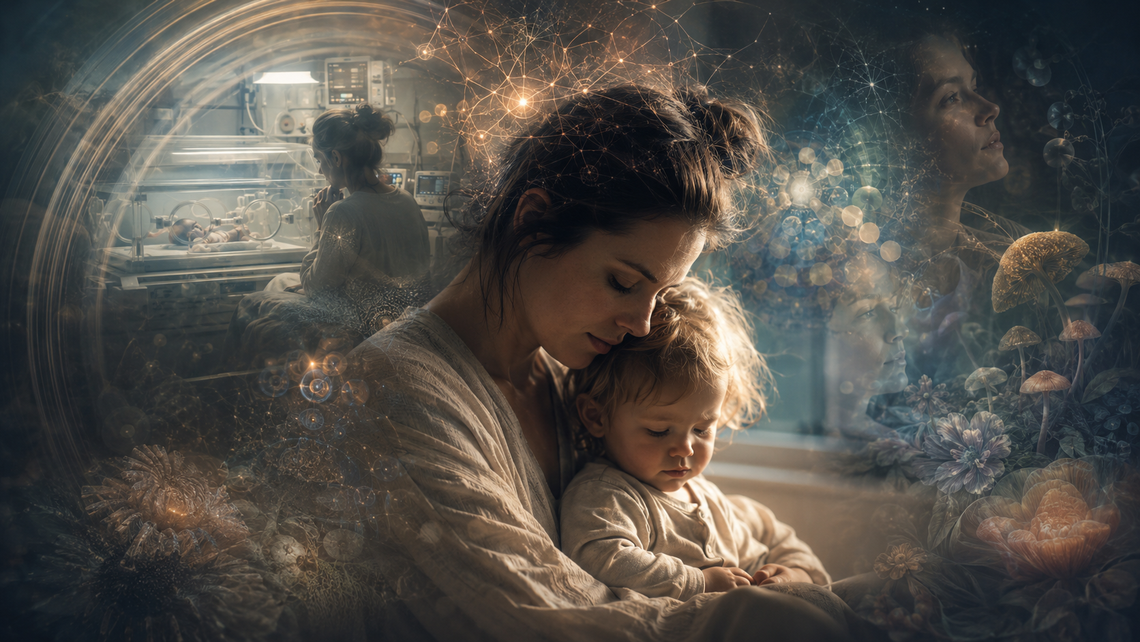
A mother says psilocybin made her calmer, more patient, better at the job. A Harvard thesis says her brain and the mushroom may be working on the same territory. The parallel is real. What it means is not yet known.
There is a moment Amanda Wilde keeps returning to. Her daughter Hazel had come early — twenty-eight weeks, three weeks in the NICU, the particular vigilance that follows a premature birth and doesn't switch off when the baby comes home. Wilde, thirty-seven, found herself anxious in a way that felt total, and also strangely familiar. The awe. The way time stopped behaving. The sense of being between two selves, the old one not quite gone and the new one not quite arrived. She had felt all of this before — not in a hospital, but on mushrooms, years earlier, when psilocybin was something a teenager tried and didn't think much about afterward.
The resemblance stayed with her. New motherhood, she began to think, felt like a trip. And so she did something most people wouldn't: she took the trip on purpose, to see whether the thing that had once shown her that feeling might help her live inside it. She says it worked — that psilocybin, taken occasionally and at full dose, made her calmer, more patient, more able to meet her daughter without the static of her own anxiety in the way. It became, in her telling, a piece of self-care sitting alongside the yoga and the long walks and the friends.
Then she went further than most personal stories go. Wilde enrolled in a master's in biology at Harvard, with a focus on neuroscience, and wrote her thesis on the parallel she'd felt in her own body: the correspondence between matrescence — the brain's transition into motherhood — and the psilocybin state. Her claim, stated plainly, is that the two reshape many of the same neural systems: the networks that hold identity, emotion, and perspective. "Psilocybin is working on the exact same parts of the brain that are undergoing changes during matrescence," she says. "The hard science shows that both postpartum and psilocybin experiences work along the same neural networks."
It's a striking claim, and the temptation is to receive it in one of two lazy ways — to wave it off as a nice story a mother tells herself, or to seize it as proof that mushrooms make better parents. Both would be wrong. The interesting thing about Wilde's parallel is that, at the level she's actually making it, it is largely correct. And that it still doesn't show what it appears to show.
What matrescence actually does to a brain
Matrescence is not a metaphor, and it is not "mom brain" in the dismissive sense. The word was coined in the 1970s by the anthropologist Dana Raphael to name a developmental passage that had gone strangely unstudied: the transition into motherhood, treated with the same seriousness we grant adolescence. And like adolescence, it turns out to have a neural signature you can photograph.
When researchers scan women before conception and again after birth, they find pregnancy drives a robust remodelling of brain architecture. Grey matter volume follows a U-shaped trajectory — dipping through late pregnancy, partially recovering in the postpartum months — and the changes are not scattered randomly across the cortex. They concentrate, most pronouncedly, in the Default Mode Network and the frontoparietal network: the systems associated with self-referential thought, social cognition, theory of mind, the felt sense of being a continuous self. The shifts correlate with pregnancy hormones, third-trimester oestradiol chief among them. And — this is the part that matters for Wilde's argument — the magnitude of the change tracks something behavioural. Women whose brains change more show stronger maternal-fetal bonding, more responsiveness to infant cues, and the pattern predicts mother-infant attachment months later. Some of these changes persist for at least two years. Some may be permanent.
In other words, becoming a mother is, neurologically, a reorganisation of the self — routed largely through the same network that governs where you end and the world begins.
What psilocybin actually does to a brain
Now hold that beside the psychedelic.
Psilocybin's best-characterised mechanism is not stimulation but desynchronisation. In a 2024 study in Nature, researchers found the drug's largest effect on brain connectivity fell precisely on the Default Mode Network — dissolving the ordinary distinctions between networks, flattening the correlations that hold the DMN together as a coherent unit. More strikingly, it left a mark that outlasted the trip: a persistent decoupling of the anterior hippocampus from the DMN that endured for weeks. The authors proposed this lingering change as a candidate mechanism for psilocybin's therapeutic and plasticity-promoting effects.
This is the same network, and the same vocabulary, that the psychedelic literature has circled for a decade. Reduced DMN integrity is the leading neural account of "ego dissolution" — the loosening of the boundary between self and world that people describe on high doses. The therapeutic logic runs through the same door: in depression and anxiety, the self becomes narrow, rigid, locked in rumination; psilocybin briefly dissolves the network that sustains that rigidity, and the loosening is thought to create a window in which entrenched patterns can shift.
So Wilde is right. Matrescence remodels the Default Mode Network. Psilocybin desynchronises the Default Mode Network. The two processes really do act on the same neural real estate — the machinery of identity, emotion, and perspective, exactly as she says. The parallel isn't wishful. It's anatomical.
Why "the same network" is not the same as "the same effect"
And here is where a careful reader has to slow down, because the parallel is seductive in a specific and dangerous way. Acting on the same network is not the same as acting on it in the same direction, for the same duration, toward the same end.
Consider how differently the two processes are shaped. Matrescence unfolds over months. It is hormonally scaffolded — oestradiol and progesterone and oxytocin arriving in a timed cascade — and it is, by every indication, adaptive: the brain is being tuned toward caregiving, and the changes predict better bonding. Psilocybin's effect is acute, pharmacological, over in hours, with a plasticity tail measured in days to weeks. It is "therapeutic" in the narrow sense of disrupting stuck patterns, not in the sense of gently tuning a brain toward parenthood.
Two interventions can share a stage and play entirely different scenes on it. The fact that both processes converge on the DMN tells you they might interact — that psilocybin lands somewhere relevant to the maternal brain rather than somewhere irrelevant. It tells you nothing, on its own, about whether one improves the other. The move from "these share a network" to "therefore this one helps with that one" is a leap across open water, and it is exactly the leap a thesis can frame but cannot close. Wilde's work identifies a hypothesis worth taking seriously. It does not, and cannot by its nature, demonstrate an outcome.
The clinical picture is moving — but not toward this claim
It would be easy to say there's simply no research here and leave it there. That's no longer quite true, and the truth is more interesting.
Psilocybin's signal in depression and anxiety is, at this point, well established across multiple trials. And a maternal-specific pipeline has begun to take shape: a psilocybin analogue, luvesilocin, received FDA breakthrough therapy status for postpartum depression in February 2026, with a Phase 3 trial recruiting two hundred participants slated to begin by the end of the year. There is real institutional momentum behind the idea that psychedelics might help mothers in genuine distress.
But notice precisely what those trials are built to measure: depression scores in women diagnosed with postpartum depression. That is not the same claim Wilde is making. Her account is about an otherwise-functioning parent — anxious, yes, carrying birth trauma, yes, but not describing a clinical depression — using psilocybin to become more patient, more present, better bonded. "Parenting stress" and "maternal connection" in a non-depressed mother are not endpoints in the luvesilocin trial or any other. The thing being tested and the thing being claimed overlap only partly. The evidence that's coming will speak to postpartum illness. It will be largely silent on whether a psychedelic can make an ordinary hard season of parenting go better.
The caution the enthusiasm skips
There is one more piece of evidence, and it is the one that should give any honest advocate pause — because it is the only controlled study so far that looks directly at psilocybin in the peripartum period, and it points the wrong way.
In September 2025, a study in Nature Communications dosed postpartum mice under social stress with psilocybin. The drug did not rescue the stress-related behaviours the model was built to induce. Worse, weeks later, the treated mothers were more anxious than they had been — regardless of whether they'd been stressed at all — and the effects extended to their offspring. Animal models don't settle human questions; a stressed mouse is not a grieving new mother, and the doses and contexts don't map cleanly. But this is not nothing. It is a direct, if preliminary, signal that the peripartum brain — awash in oxytocin and prolactin at levels seen nowhere else in life — may respond to psilocybin differently, and not always benignly. The higher oxytocin of birth and lactation could plausibly amplify benefit or amplify harm. We don't yet know which, and that uncertainty is the whole point.
Where this leaves us
None of this makes Wilde wrong, and it would be a mean reading of her story to treat it as debunked. Her parallel is intellectually serious. At the level of neural anatomy it is, as far as the current science goes, accurate — the two processes really do work the same territory. Her lived experience is real, and the recognition that started it — I have felt this before, just never while holding my daughter — is a genuinely arresting observation about the strangeness of becoming a parent.
But a felt parallel and a striking thesis are not a finding, and the gap between them is not a technicality — it is the entire distance that clinical science exists to cross. Same network is not same effect. A pipeline for postpartum depression is not evidence for better bonding in a well parent. And the one controlled peripartum study we have so far suggests the answer may not be the comfortable one.
Wilde herself, to her credit, lands in roughly the right place: the value of any of this, she allows, can be established only through rigorous, blinded clinical trials. Until those trials exist and report, this remains what it honestly is — a compelling hypothesis, a moving personal story, and an open question that deserves to be answered carefully rather than assumed. The mushroom and the mother may be working on the same network. Whether they are working toward the same thing is a question the science has only just begun to ask.
Sources referenced in this piece include: longitudinal neuroimaging of pregnancy and the maternal brain (Hoekzema et al. and subsequent Nature Communications cohort studies, 2016–2025); Siegel et al., "Psilocybin desynchronizes the human brain," Nature (2024); the September 2025 Nature Communications study on psilocybin in the postpartum period; and 2026 reporting on the luvesilocin postpartum-depression trial and its FDA breakthrough therapy designation. The originating feature on Amanda Wilde was distributed by Talker News, July 2026.