ARDMT Field Notes
The Net That Holds the Brake: How One Dose of Psilocybin Quiets the Brain's Drive Toward Reward
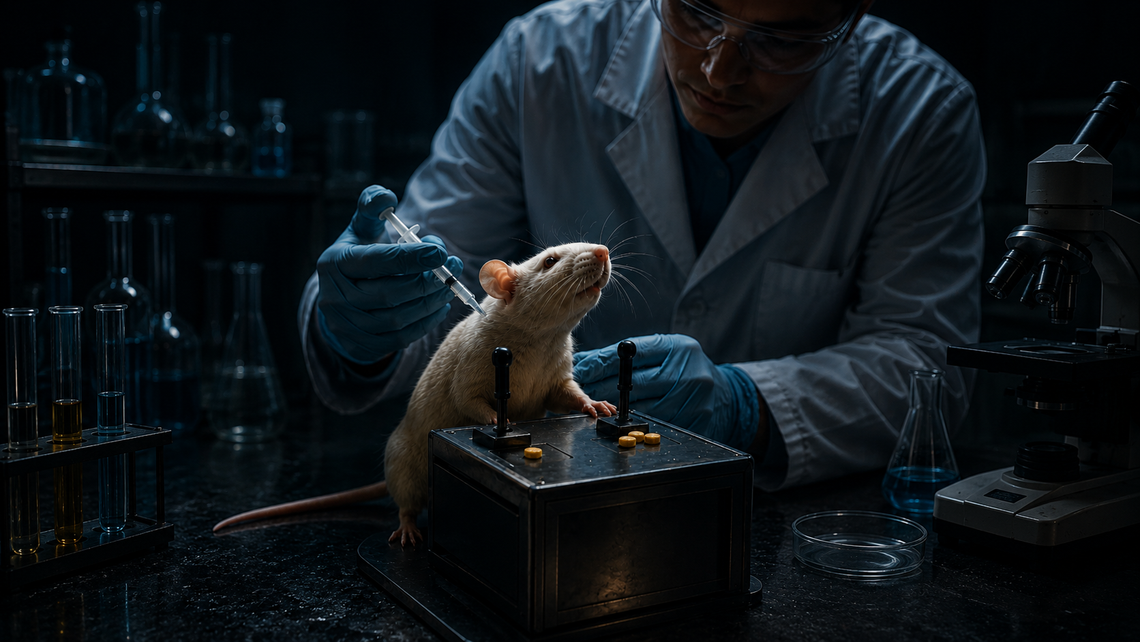
A single injection, two days of silence, and then a measurable change in how much rats wanted what they used to want most — traced down to one inhibitory cell type wrapped in structural netting in the prefrontal cortex.
Correcting the record before we start
A version of this study has already circulated widely in the wrong shape: a human brain PET scan, a headline about "the addicted brain," a mushroom in a yellow circle. None of that is what happened here. The animals in this study were not an addiction model — they were healthy, food-motivated Long Evans rats trained on a decision-making task. The tissue images are rodent immunohistochemistry, not a human scan. And the finding isn't really about addiction directly; it's about motivation — the value an animal assigns to a reward cue — which is one of the mechanisms addiction researchers care about, not a diagnosis of addiction itself.
That distinction matters, and it's the reason this piece exists. The underlying paper is careful, methodologically explicit, and appropriately hedged by its own authors. The version that travels on social media rarely is. What follows is the paper as it was actually built.
The paper
Houff, J., Williams, A., Allen, O. IV, Gisabella, B., Pantazopoulos, H., & Del Arco, A. (2026). Psilocybin Decreases Preference for Large Rewards Accompanied by Increased Activity of Parvalbumin Neurons With Perineuronal Nets in the Medial Prefrontal Cortex. European Journal of Neuroscience, 63(11), e70574. https://doi.org/10.1111/ejn.70574
The senior author, Alberto Del Arco, directs the Neurophysiology and Behavior Laboratory at the University of Mississippi. The study is basic neuroscience — rodent behavior plus post-mortem immunohistochemistry — not a clinical trial, and it doesn't claim to be one.
What they actually did
Eighteen adult male Long Evans rats were trained for around two weeks on a delay-discounting task: two retractable levers, one delivering a single sugar pellet almost immediately, the other delivering three pellets after a delay of 1, 10, or 20 seconds. Once the animals showed stable, matched baseline performance, two were dropped for not performing the task reliably and two others were excluded because they hadn't been injected — leaving a final Vehicle group of eight and a Psilocybin group of six. One of those six had actually received 0.33 mg/kg rather than the intended 1 mg/kg; the authors kept the animal in the group after checking it wasn't an outlier on any outcome measure (head-twitch count, cell density, or large-reward choice), and flagged its data points for transparency in their figures.
Immediately after injection, the animals were filmed for an hour and scored for head-twitches, a well-established rodent proxy for 5-HT2A receptor activation. The psilocybin group twitched far more than controls — 5.33 ± 0.54 twitches versus 0.5 ± 0.2 in vehicle animals (t(12) = 10.14, p < 0.001) — with the effect peaking around 10 minutes post-injection and returning to baseline within the hour, confirming the drug had done what psilocybin is supposed to do at the receptor level.
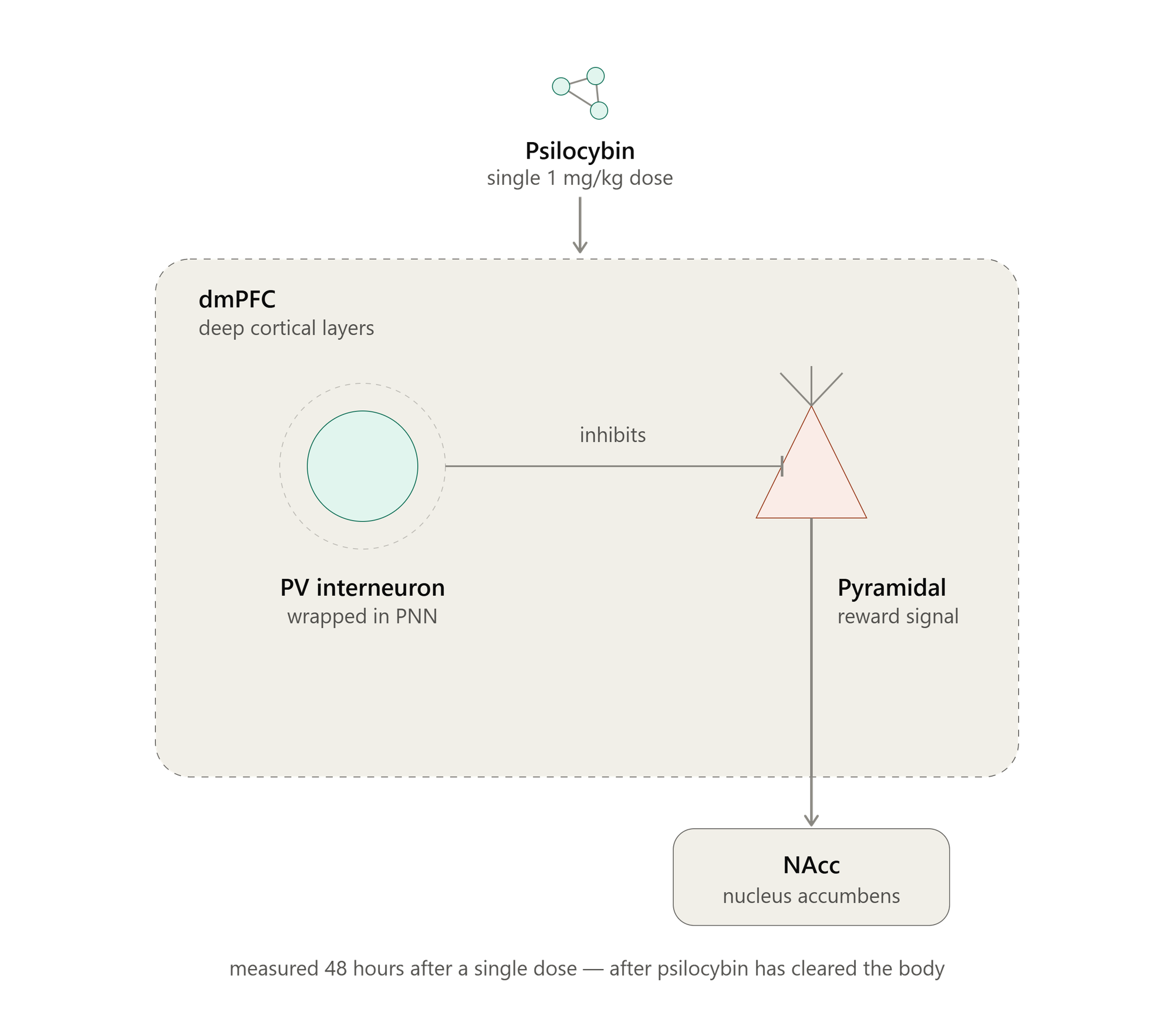
Then came the part that makes this study unusual: the animals weren't tested again for a full day. They were tested at 24 hours, and again at 48 hours, specifically so the drug would already be fully metabolized and cleared from the body by the time any behavioral difference showed up. Most prior work on psilocybin and reward behavior looked at effects within the first 24 hours — this study was designed to catch what happens after the drug is gone.
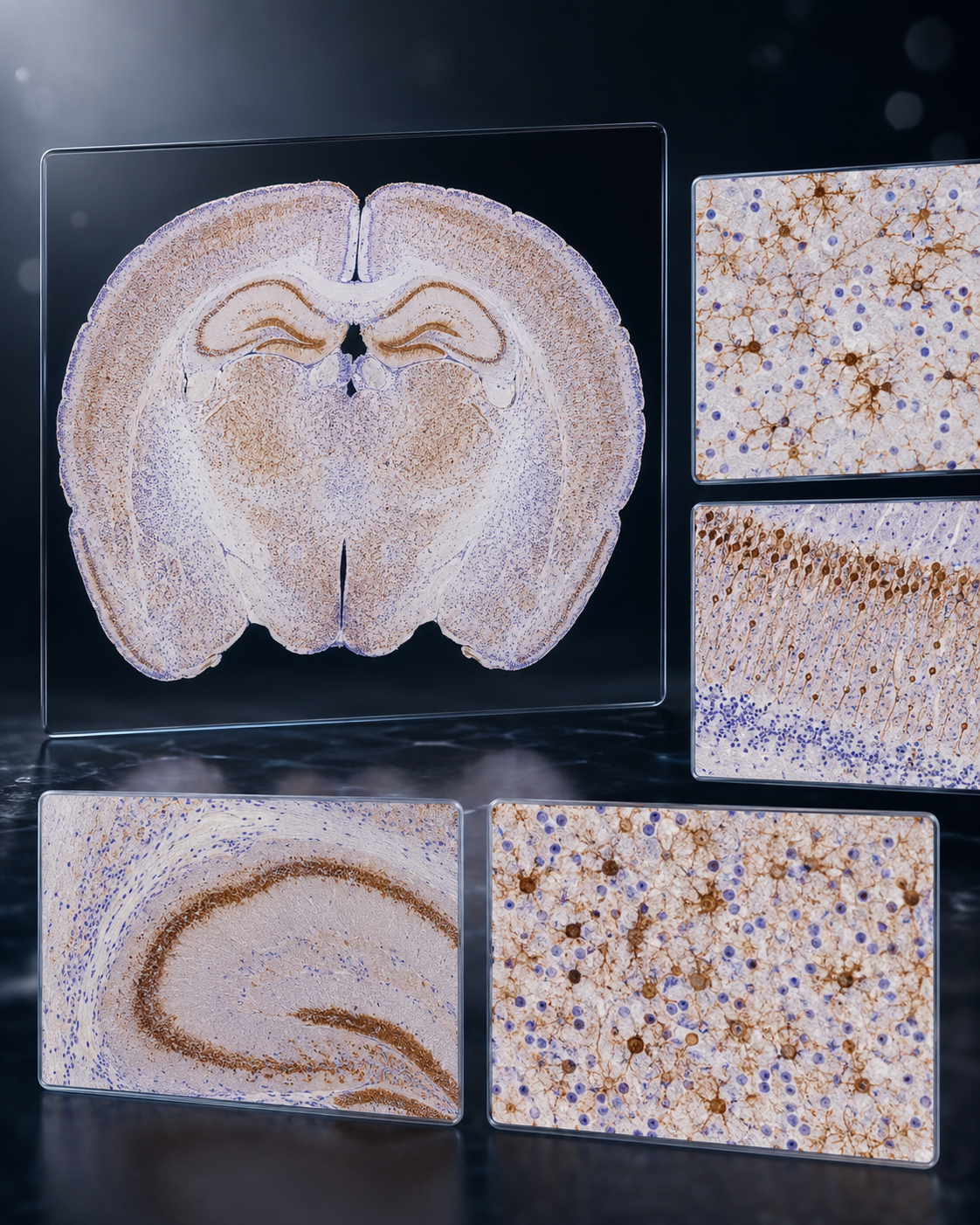
Immediately after the final behavioral session, the animals were euthanized and their brains processed for three overlapping markers in the medial prefrontal cortex: parvalbumin (a protein marking a specific class of fast-firing inhibitory interneuron), Wisteria floribunda agglutinin (a lectin that binds the sugar residues on perineuronal nets), and c-Fos (a marker of recent neuronal activity).
What changed — and what didn't
At 24 hours, the two groups looked the same. At 48 hours, they didn't.
The psilocybin group pressed the large-reward lever less often — a difference that approached but didn't quite clear conventional statistical significance across all delays (p = 0.054), but reached significance specifically at the 10-second delay (p = 0.026). They also took longer to commit to the large-reward choice when they did make it, an effect that was significant at the 20-second delay (p = 0.006) and, notably, depended on which session (24h vs. 48h) they were tested in — the effect was a 48-hour phenomenon, not a 24-hour one.
Here's the detail that changes the interpretation: none of this depended on how long the delay was. If psilocybin were making the rats more impulsive or less impulsive, you'd expect the effect to grow or shrink as the wait got longer. It didn't. The rats weren't recalculating whether the wait was worth it — they simply seemed to want the large reward less, across the board. The authors are explicit about this: the effects were "not consistent with changes in choice impulsivity."
Equally important is what mostly stayed normal. Across forced-choice trials as a whole, psilocybin didn't change accuracy — the animals could still tell the levers apart and press the right one. There's one wrinkle worth naming rather than smoothing over: when the analysis accounted for both session and delay together, there was a specific drop in accuracy at the hardest condition — the 20-second delay, 48 hours post-injection (p = 0.026). The authors don't read this as a general attention or motor problem, partly because latency to press on forced-choice trials didn't budge at all (p = 0.68) — if psilocybin were slowing the animals down or fogging their attention, you'd expect that to show up there too. The number of small-reward choices didn't change, and omissions (not responding at all) didn't change either. So the overall picture still points away from sedation or confusion, but the isolated dip at the longest delay is a genuine loose end, not a fully closed one.
The cellular story
Forty-eight hours after psilocybin, the deep layers of the dorsomedial prefrontal cortex (dmPFC, the prelimbic area) showed a higher density of neurons triple-labeled for parvalbumin, perineuronal nets, and c-Fos — meaning parvalbumin interneurons wrapped in nets that had recently been active (F = 6.30, p = 0.027). The same triple-labeling increase also showed up in the adjacent ventromedial prefrontal cortex (vmPFC, infralimbic area; F = 5.68, p = 0.034) — so the cellular change itself isn't unique to one region. What is unique to the dmPFC is what that change means behaviorally: only there did the density of these active, net-wrapped cells correlate with the drop in large-reward choices (Pearson's r = 0.61, p = 0.025). In the vmPFC, the same relationship wasn't there (r = 0.32, not significant).
The dmPFC also showed two more specific changes that sharpen the picture: an increase in PV interneurons active without their nets highlighted separately (PV+cFos, F = 5.13, p = 0.042) in the deep layers, and a decrease in the density of PV cells generally in the superficial layers (F = 5.95, p = 0.031) — a shift that, together, looks like activity concentrating specifically in the deep-layer, net-wrapped population rather than in parvalbumin cells generally. Tellingly, when the researchers ran the same correlation against PV+cFos cells without nets (r = 0.38) or PNN+cFos cells without the parvalbumin marker (r = 0.29), neither reached significance. Only the fully triple-labeled population — parvalbumin, net, and recent activity, all three together — tracked with how much the animals wanted the reward. That specificity is what makes this more than a general "psilocybin activates stuff in the cortex" finding.
Why parvalbumin cells specifically? They're fast-firing inhibitory interneurons, meaning their job is to suppress the activity of other neurons around them — in this case, the pyramidal neurons in deep cortical layers that project out to the nucleus accumbens, a hub of the brain's reward circuitry. Prior work has shown these projections help drive cue-guided reward-seeking. Turn up the inhibitory brake on that pathway, and the signal telling the animal "that cue means something worth pursuing" gets quieter.
Why perineuronal nets? These are lattice-like structures made of proteins and sugars that wrap around certain neurons — parvalbumin interneurons prominently among them — and physically stabilize how those neurons fire and how their connections can change. They're not passive packaging; they regulate the excitability of the cells they surround, and they've separately been shown to remodel after both drug exposure and psychedelic administration. This paper's own senior author previously found, in a 2024 study, that increased perineuronal nets in the medial prefrontal cortex tracked with increased choice impulsivity after repeated social stress — the same structure, pointing the opposite direction, under a different kind of pressure. The working model here is that psilocybin's known 5-HT2A receptor activity — a receptor these parvalbumin cells are rich in — drives increased activity in this already-primed, net-wrapped population, and that increased inhibitory tone is what dampens the reward-seeking signal downstream.
What this doesn't show
Del Arco's own caveats, given directly to PsyPost, are worth repeating rather than smoothing over:
- Basic research, not treatment evidence. "Our study does not demonstrate that psilocybin is a good treatment for substance abuse. At this point we are just looking at potential mechanisms of action of the drug in the brain."
- Male rats only. Psychedelic effects are increasingly documented to vary by sex — a 2025 study on psilocybin and opioid reward extinction found sex-specific dependence on the 5-HT2A receptor. Whether this mechanism holds in female animals is untested here.
- The task measures choice behavior more than motivation per se. Delay discounting is built to probe impulsivity; the authors argue decreased lever presses and increased latency are still reasonable proxies for motivation, but acknowledge the task wasn't purpose-built for it.
- Small sample, two time points. Eight vehicle and six psilocybin animals, tested at 24 and 48 hours only. This tells you nothing about whether the effect holds — or fades, or grows — at one week or one month, and the paper is explicit that 24-hour performance could itself be shaping what shows up at 48 hours.
- Correlation, not manipulation. The relationship between triple-labeled cell density and behavior is a regression across animals, not a causal intervention. Nobody selectively silenced these interneurons to confirm they're necessary for the effect.
- The nets might not even be doing the causal work. A separate 2025 study the authors cite found that psychedelics can produce lasting behavioral and functional changes through mechanisms that don't depend on structural plastic remodeling at all — so the perineuronal-net story here is the authors' working hypothesis (illustrated as such in their own Figure 6b), not a demonstrated causal chain.
- The circuit might not be the only explanation. Pyramidal cells and the mediodorsal thalamic inputs that reach the dmPFC are also rich in 5-HT2A receptors, so psilocybin could be shaping this behavior indirectly through those pathways rather than by acting on the parvalbumin cells directly. Separately, human studies have found that psilocybin can alter attention, executive function, and time perception acutely — the authors can't fully rule out that some perceptual or cognitive shift, rather than a pure motivational one, contributes to the 48-hour change.
- Effects are "significant but moderate," in Del Arco's own words — this is a research direction, not a settled mechanism.
Where it sits in the wider field
This finding doesn't stand alone. Clinical trials have already shown that a single session of psilocybin-assisted therapy reduces heavy drinking days in alcohol use disorder and produces long-term smoking cessation outcomes in nicotine-dependent adults. Animal work has shown psilocybin reduces alcohol self-administration via accumbens activation, reduces heroin-seeking behavior alongside inflammatory gene changes in the prefrontal cortex and accumbens, and — in a sex-dependent manner — extinguishes opioid reward via the 5-HT2A receptor. What's been largely missing from that literature is a specific, testable answer to how a drug that's metabolized within hours produces behavioral change that shows up, and in this case only shows up, two days later.
This paper offers one candidate answer: not a lingering pharmacological trace, but a shift in the activity of a structurally stabilized population of inhibitory neurons — cells wrapped in a matrix that is, by design, built to hold a change in place. Whether that candidate mechanism generalizes beyond a delay-discounting task in male rats, and whether it maps onto the clinical picture in human substance use disorders, is exactly what the follow-up work Del Arco describes — a different behavioral paradigm aimed at incentive motivation specifically — is set up to test.
The honest summary
A single dose of psilocybin, given to healthy trained rats and tested only after the drug had fully cleared their systems, reduced how much they pursued a reward they'd previously worked hard for — not because they became less patient, but because the reward itself seemed to matter less to them. That change tracked, specifically in the dorsomedial prefrontal cortex, with increased activity in a class of inhibitory neuron wrapped in a stabilizing extracellular structure. It is a mechanism, carefully caveated by the people who found it, and it is one more piece — not a proof — of how a drug that leaves the body in hours might still be doing something to behavior two days later.
Sources
Houff, J., Williams, A., Allen, O. IV, Gisabella, B., Pantazopoulos, H., & Del Arco, A. (2026). Psilocybin decreases preference for large rewards accompanied by increased activity of parvalbumin neurons with perineuronal nets in the medial prefrontal cortex. European Journal of Neuroscience, 63(11), e70574. https://doi.org/10.1111/ejn.70574
Houff et al. (2025, preprint). Psilocybin decreases reward-seeking behavior accompanied by increased activity of parvalbumin neurons with perineuronal nets in the medial prefrontal cortex. bioRxiv. https://doi.org/10.64898/2025.12.22.696123
Dolan, E. W. (2026, July 3). A single dose of psilocybin reduces reward-seeking behavior by altering inhibitory brain cells. PsyPost. https://www.psypost.org/a-single-dose-of-psilocybin-reduces-reward-seeking-behavior-by-altering-inhibitory-brain-cells/
Bogenschutz, M. P., et al. (2022). Percentage of heavy drinking days following psilocybin-assisted psychotherapy vs placebo in the treatment of adult patients with alcohol use disorder. JAMA Psychiatry, 79(10), 953–962.
Johnson, M. W., Garcia-Romeu, A., & Griffiths, R. R. (2017). Long-term follow-up of psilocybin-facilitated smoking cessation. American Journal of Drug and Alcohol Abuse, 43(1), 55–60.
Jeanblanc, J., Bordy, R., Fouquet, G., Jeanblanc, V., & Naassila, M. (2024). Psilocybin reduces alcohol self-administration via selective left nucleus accumbens activation in rats. Brain, 147(11), 3780–3788.
Floris, G., Dabrowski, K. R., Zanda, M. T., & Daws, S. E. (2025). Psilocybin reduces heroin seeking behavior and modulates inflammatory gene expression in the nucleus accumbens and prefrontal cortex of male rats. Molecular Psychiatry, 30, 1801–1816.
Jaster, A. M., et al. (2025). Sex-specific role of the 5-HT2A receptor in psilocybin-induced extinction of opioid reward. Nature Communications, 16, 10206.
Slaker, M. L., Jorgensen, E. T., Hegarty, D. M., et al. (2018). Cocaine exposure modulates perineuronal nets and synaptic excitability of fast-spiking interneurons in the medial prefrontal cortex. eNeuro, 5, e0221-18.2018.
Martinez, C. A., Pantazopoulos, H., Gisabella, B., Stephens, E. T., Garteiser, J., & Del Arco, A. (2024). Choice impulsivity after repeated social stress is associated with increased perineuronal nets in the medial prefrontal cortex. Scientific Reports, 14, 7093.
Kramer, H. M., Hibicke, M., Middleton, J., Jaster, A. M., Kristensen, J. L., & Nichols, C. D. (2025). Psychedelics produce enduring behavioral effects and functional plasticity through mechanisms independent of structural plasticity. Neuropsychopharmacology, 51, 641–649.
Yousefi, P., Lietz, M. P., O'Higgins, F. J., et al. (2025). Acute effects of psilocybin on attention and executive functioning in healthy volunteers: A systematic review and multilevel meta-analysis. Psychopharmacology, 242, 1171–1196.
Scholle, P., Wenke, S., Nekovářová, T., et al. (2026). The effects of psilocybin on time perception in humans: A comparative analysis of subjective and objective measures. Journal of Psychopharmacology.