Author

Stephen Page
Writer on DMT, ayahuasca, iboga and tryptamine research. LLB; incoming MSc in Psychedelics: Mind, Medicine and Culture, University of Exeter (2026)

Cabinet of Marginalia
The Rocks That Are People
The English have never stopped treating some places as if they were somebody. Whether that makes those places persons is a harder question.

Cabinet of Marginalia
What If Consciousness Isn't the Fundamental Thing Either?
For a long time the mind–body problem seemed fairly straightforward to me. Not straightforward to solve — straightforward in the sense that the menu looked short.

MSc Notes
Everything I'm About to Tell You Is True.
The standard history of psychedelics is accurate, complete-sounding, and quietly doing work. Week one of the Exeter MSc, worked through as an argument rather than a syllabus.

Exploration
When the Molecule Escapes the Plant: Iboga, Gabon and Who Benefits from Psychedelic Medicine
Gabon has spent years trying to protect iboga from extraction. But ibogaine can already be produced from other African plants, while modern drug development can move further still — into synthetic analogues and digital information.

Research
The Study That Became a Statute
How a 30-person ibogaine study moved through veteran philanthropy, Stanford, Silicon Valley biotech and US state legislatures — and why the money is only part of the story.
Nichols Named the Experiment.
Eight Years Later, Someone Ran It. A follow-up to Endogenous DMT in Humans: A Critical Review of the State of the Evidence. That piece surveys the evidential

ARDMT Field Notes
23 of 25
A deep dive into the magnesium-ibogaine treatment. So What Does a 12-Month Ibogaine Study Actually Show?
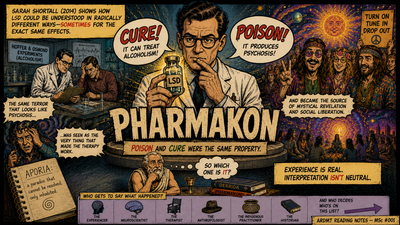
“You haven't taken psychedelics, so you can't understand.”
There's something obviously true about that. Someone who has taken DMT knows something about the experience that someone who hasn't simply doesn't.
Cabinet of Marginalia
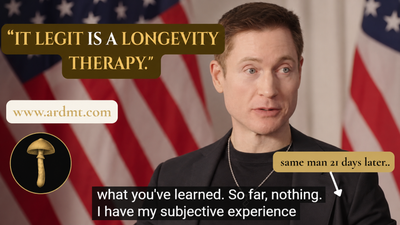
The Same Evidence, Different Bryan Johnson
Bryan Johnson’s psychedelic claims seem to change depending on who is asking the question. On Theo Von’s podcast, psilocybin “legit is a longevity therapy.” In Johnson’s own more formal Blueprint write-up, the same experiment is described much more carefully: a high-dose p

Ethics
Before the Molecule
The field's own meta-analysis found that therapy hours predict nothing in psychedelic trials. That is not a finding about therapy. It is a finding about the record.

Cabinet of Marginalia
When the Shit Hits the Bridge
Or Southern Water can burst three sewage mains in a week, deploy a fleet of tankers to manage the flows, and drive one of them ...

Ethics
The Sensitive Period
Two studies of psychedelics and new motherhood are underway. One raised $103 million. The other raised $3,200. They are not asking the same question.