ICPR 2026
Notes from Haarlem
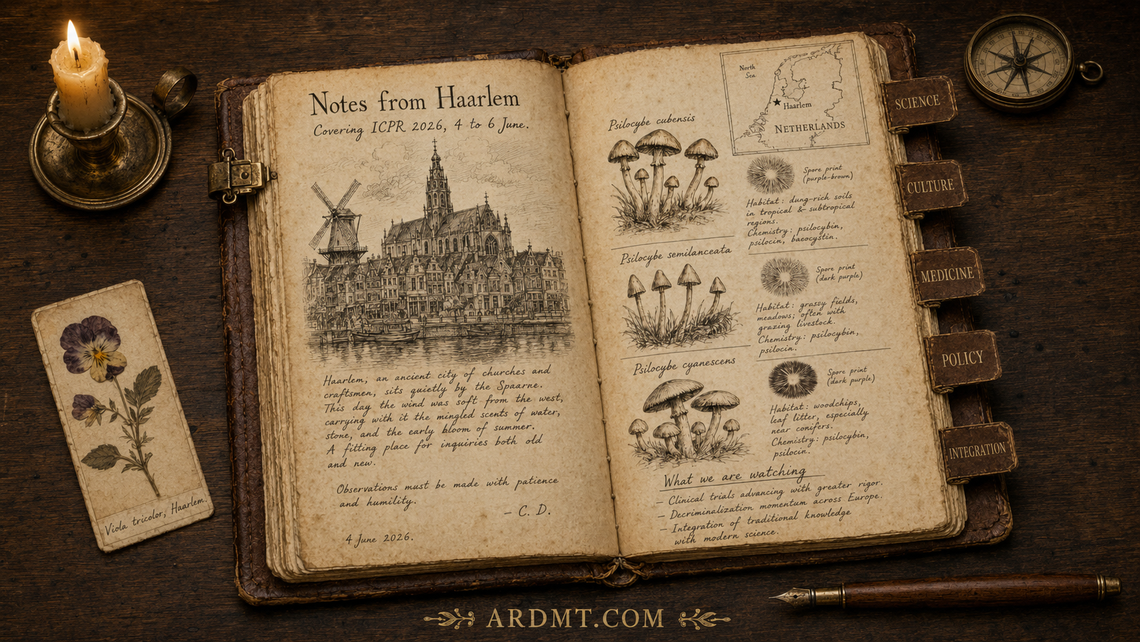
Covering ICPR 2026, 4 to 6 June
In the first week of June, the largest scientific conference on psychedelic research in Europe convenes in Haarlem. Roughly ninety talks across three days, three rooms running in parallel, six hundred researchers and clinicians and policy people in one building. The Interdisciplinary Conference on Psychedelic Research is held every two years by the OPEN Foundation in the Netherlands, and the 2026 edition is the one to pay attention to.
The reason is not the scale. It is what the scale is now being used for. The question at the centre of psychedelic research has shifted in the last few years. It used to be do these compounds work? That question has been answered enough to move the centre of gravity. The question now is harder, and more interesting: how, exactly, are they to be used? What role does the subjective experience play? Are the non-hallucinogenic alternatives now in development the future of the field or a category error? What does ethical engagement with Indigenous knowledge look like when biotech enters the picture? Who is the regulatory framework actually protecting, and from what? The ICPR 2026 programme reads as a field that has stopped justifying its existence and started doing the harder downstream work.
The thread running through everything I write about it will be the question the field is currently wrestling with most openly. Whether the subjective experience, the trip, is essential to psychedelic therapy, or whether the non-hallucinogenic alternatives can deliver the benefit without it. My own view, declared up front: the trip matters. But the people arguing otherwise are doing serious work, and the case against them has to be made honestly. The 2026 programme has several talks bearing directly on this question. The coverage is built to track them.
Who is doing this
I'm Stephen Page, and ARDMT is the long-form publication you are reading. I am finishing an LLB in law at Sheffield this year, and starting Exeter's part-time MSc in Psychedelics: Mind, Medicine and Culture this autumn. The legal background shapes a great deal of what I do here, and the Nagoya Protocol is a particular focus. It governs how genetic resources, and the traditional knowledge attached to them, move out of the countries and communities that hold them, and it sits beneath almost every commercial psychedelic medicine pipeline without often getting named.
Beyond the academic side, I was initiated into the Bwiti tradition in Gabon by Tatayo, who gave me my Bwiti name, and I stay in contact with people I met through the initiation. I keep mature iboga plants of my own in Ecuador, where I lived in Shuar territory for 7 years.
Outside all of it, there is a young son and a Landseer ect puppy. They are most of the reason I do not write more than I already do.
You can read more on the about page. If you want a sense of the writing before going further, the Endogenous DMT essay and the Shulgin tryptamine notebooks are probably the two pieces that say most about what this publication is.
What the coverage will look like
Notes from Haarlem is the series. Each piece is one published view of one talk, written close to when the talk lands, with the goal of being useful to someone who was not in the room.
Each Notes from Haarlem piece will follow the same shape. A hook that someone with no background in psychedelic science can follow from the first sentence. The actual claim of the talk, in plain English. What the evidence does and does not support. The legal or ethical angle where there is one. A short reading list at the end pointing you to the underlying papers, in case you want to go deeper than the piece itself.
Some talks will get one piece and nothing more. The most consequential will get a longer reflective piece in the days that follow. One or two might earn full essays in the weeks after. The keystone question runs through all of it.
The series will be paired with short video on Instagram and TikTok, translating the same talks into a register accessible to anyone curious about the field, not only the people already reading at this level. Different formats, same source, same standards.
Beyond the conference
Notes from Haarlem ends when the conference's afterlife does, sometime in the fortnight following. Outside it, ARDMT carries on with what it normally does: long-form essays on the science and its surrounding questions, and the Field Notes, a daily piece I publish to keep the writing close to the field. If Notes from Haarlem is the reason you arrived, the Field Notes are the reason to stay.
Where to find it
Everything in the Notes from Haarlem series will appear here on this page and in the main feed, throughout the conference and the fortnight after. The reels will go up as each talk is covered.
If you want it in your inbox rather than having to come back, the free subscription sends every piece directly. No paywall, no upsell, no spam. Just the work, as it lands.
The conference opens on Thursday 4 June. The first Notes from Haarlem will arrive that afternoon.