Ethics
The Room and the Record
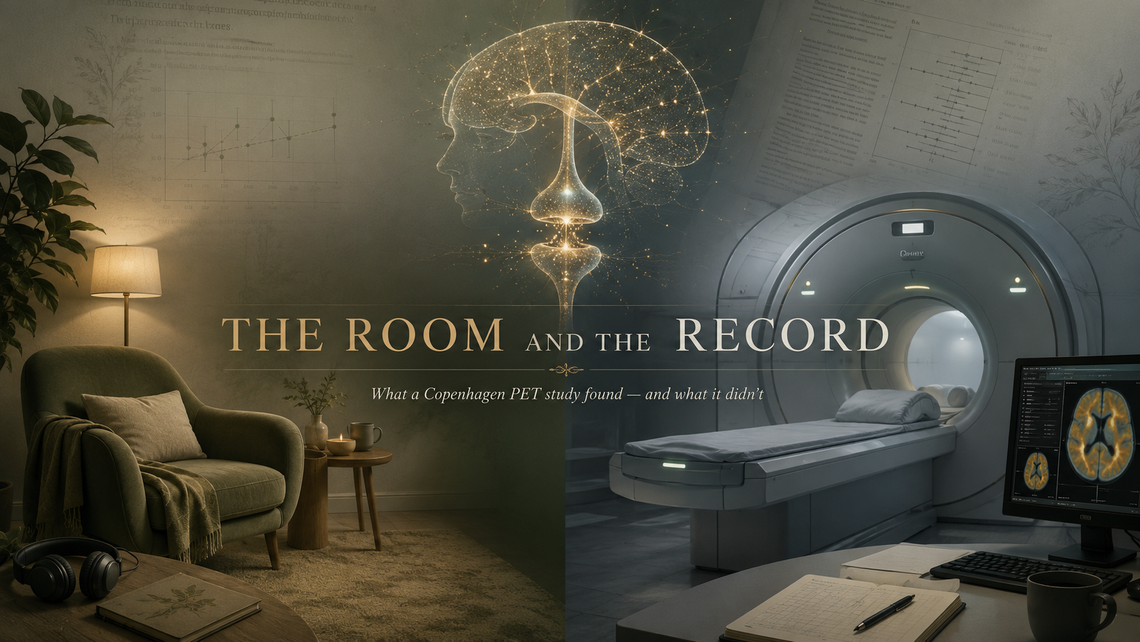
What a Copenhagen PET study found, what it didn't, and what the difference tells us about how psychedelic science gets written
There is a claim in psychedelic research that has been repeated for sixty years without being tied convincingly to a lasting biological measurement. It goes like this: the drug is not the whole story. The room matters. The music matters. Who is sitting with you matters. Timothy Leary gave it a name, set and setting, and the name stuck so thoroughly that it now appears in clinical trial protocols, in regulatory submissions, in the design of purpose-built dosing suites with soft furnishings and curated playlists. An entire therapeutic apparatus rests on it.
Plenty of it has been measured. Questionnaires capture the quality of the experience; trials track therapeutic alliance, expectancy, music-evoked response, and outcomes at three and six and twelve months. What has not been shown is that any of it leaves a mark on the brain that outlasts the day. The evidence for set and setting has been psychological and behavioural, supported by anecdote and by the accumulated conviction of people who have watched a great many psychedelic sessions and formed a strong sense of what helps. That is not nothing. It has also never been connected to a durable biological signal.
In July 2026, a team at Copenhagen University Hospital published something that looks, at first glance, like the missing connection.
The study is small. Fifteen healthy volunteers received a single strong dose of psilocybin, 0.3 mg/kg, roughly the dose used in the depression trials. Each had a PET scan before and one week after, using a tracer called [¹¹C]UCB-J that binds to a protein found in synaptic vesicles. The question was whether psilocybin leaves the brain measurably different a week later.
Five of the fifteen took the drug inside an MRI scanner, running experimental tasks. The other ten took it in a room designed for the purpose, with a music playlist built to accompany the phases of the experience. Both groups had the same psychological support: two trained facilitators, a preparation session beforehand, presence throughout, an integration session the next day.
The ten in the room reported more intense mystical-type experiences. Three months later, they reported greater lasting benefit. And their synaptic markers had moved upward by five to six percent, while the scanner group's had not.
The authors' conclusion states that this is the first evidence that synaptic plasticity may be enhanced when the intervention takes place in a setting that facilitates mystical-type experiences.
That is a genuinely interesting claim, and if it holds it is important. But the more interesting story is in how the paper arrived at it, because the study's primary result was that it detected no overall change in its pre-specified PET outcome.
The null
Before any data were analysed, the team filed a pre-registration. It is public, it is numbered 93092 on the AsPredicted registry at Wharton, and it is worth reading, because it is a careful document.
It asks one question: does SV2A binding increase one week after psilocybin in healthy volunteers? It specifies the outcome measures, the two brain regions, the statistical test, the significance threshold, the rule for handling outliers, and the sample size justification. It even discloses, candidly, that data collection had already begun, and explains why the authors consider the pre-registration valid regardless: the image processing was automated and blinded to whether a scan was taken before or after the session, so nothing in the pipeline could bend toward a preferred answer.
This is good practice. It is better practice than most of the field manages.
The pre-registration also specified a stopping rule. An interim analysis at twelve participants, with a futility test: if at twelve the probability of ever reaching significance at fifteen fell below fifty percent, recruitment would stop.
It fell to twenty-four percent. Under the effect size actually observed, two percent.
The study stopped. The mean change in the frontal cortex was 0.3 mL/cm³, a 2.3 percent shift, with a one-sided p of 0.29. The hippocampus, 3.0 percent, p of 0.33. The alternative outcome measure, calculated for all fifteen participants, showed essentially nothing: 0.03 percent in the frontal cortex.
A single strong dose of psilocybin, in fifteen healthy people, produced no detectable change in synaptic density one week later.
That is a real finding. It was properly obtained, it was honestly reported, and it deserves to be known. Whether it is what anyone remembers about this paper is another question.
What SV2A measures
Before going further, a caveat that the paper's own authors have stated in print elsewhere, and which does not appear in this one.
SV2A is a synaptic vesicle glycoprotein. It sits in the membrane of the little sacs that hold neurotransmitter at the presynaptic terminal. It is abundant, it is distributed throughout the brain, and because a PET tracer exists for it, it can be counted in a living person without opening the skull. This is a real technical achievement and the tracer is a genuinely useful instrument.
It is an indirect index of presynaptic terminals, not a literal count of individual synapses.
In their 2023 paper on escitalopram, the same lab wrote that changes in SV2A binding could have several different causes, such as the number of vesicles per synapse or differential effects on excitatory and inhibitory synapses. That sentence is doing important work. More binding might mean more synapses. It might mean the same number of synapses each holding more vesicles. It might mean a shift in the balance between excitatory and inhibitory connections, which could go either way in functional terms. The measurement cannot distinguish these.
So when a headline says psilocybin rewires the brain, or grows new connections, it has travelled a considerable distance from what the instrument reports. What the instrument reports is: more of a vesicle protein, in a region, at a timepoint.
The 2026 paper drops this caveat. It is not in the limitations section. Nothing was falsified by its absence, but a reader coming to this paper cold would not learn that the central measure is a proxy whose interpretation is genuinely uncertain.
The instrument is the setting
Here is where the study becomes, unintentionally, a demonstration of its own problem.
To find out what the brain is doing during a psychedelic experience, you must put the person inside a machine that can watch. The machine is a tube. It is loud. It requires you to keep your head still for long periods. It has tasks to perform: in this study, looking at emotional faces, lying at rest, listening to music while being scanned.
The five participants who were dosed in the scanner were, by the study's own account, having a measurably different experience. Their mysticality scores were twenty-eight points lower on a hundred-point latent scale. Three months later their reported persisting benefit was thirty-three points lower.
This is the observer problem in its most literal form. The apparatus that would let you see the effect is also an apparatus that degrades the effect. You cannot watch the thing you want to watch without changing it into something else.
That is not a criticism of the Copenhagen team. It is a structural feature of the question. And to their credit, it is the thing they noticed, and the thing they built the paper around.
But notice what had to happen for them to notice it. The scanner subgroup was not a control condition. It was not an experimental manipulation. It was five people who happened to be recruited first.
What the registrations do not contain
Read the pre-registration again, question four: how many and which conditions will participants be assigned to?
The answer: all participants will be assigned to one condition.
There is no setting variable. There is no mention of a scanner group and a room group. There is no plan to compare them. The document was filed in April 2022, after data collection had begun, by authors who already knew that participants one through five were being dosed inside a scanner and participants six through fifteen were not.
Setting, the finding that titles the paper and will generate every headline it earns, is the one thing the pre-registration does not anticipate.
Nor does the other one. The study sits inside a larger trial registered at ClinicalTrials.gov as NCT03289949, an umbrella project on serotonin 2A receptor modulation running since 2017. The SV2A study is subproject 2b, and its entry reads: after baseline MRI and UCB-J PET imaging, participants receive one oral dose of psilocybin, and one week later they return for a post-intervention scan. Its registered primary outcome is the effect of psilocybin on UCB-J binding at baseline and one week. Search the whole record for setting, environment, context, or scanner-as-variable and you find nothing. Two registries, filed five years apart, and neither contains the comparison the paper is named after.
Which might read as an omission, until you look at what else is in that trial.
Subproject 2c is a study called PsiloZonic, and it is designed to test context. It registers seven separate outcome measures, each explicitly comparing psilocybin with music against psilocybin without music: challenging experiences, altered-states anxiety, subjective intensity, mystical-type experience, psychological insight, emotional breakthrough, persisting effects. Every one of them pre-specified, in advance, as a between-group contrast on a contextual manipulation.
So this lab knows exactly how to register a question about setting. They have done it, in the subproject next door, with the rigour the question deserves.
Subproject 2b is not that study. It never was. The scanner-versus-room division was not a manipulation the authors chose and declined to declare; it was a by-product of running a PET study, five people scanned during dosing because that is what the imaging required, and the difference noticed afterwards. That is a more forgivable story than concealment. It is also a more troubling one, because it means the paper's central claim arrived by accident and was promoted to the title anyway.
And the allocation was not randomised. Participants one to five got the scanner. Participants six to fifteen got the room. That is allocation by recruitment order, and the trial registry says so in its own terms: allocation non-randomised, intervention model sequential. Anything that drifted across the recruitment window is riding along with it: the season, the staff's accumulating experience, the referral pipeline, the team's own confidence in their protocol. The sex ratio differs between the groups, four men and one woman in the scanner, six and four in the room. On five versus ten, that is noise, but it is one more thing tangled up in the comparison.
There is no placebo arm at all.
So the finding is: a comparison absent from both registrations, non-randomised, unblinded, five people against ten, inside a trial that had already met its pre-specified threshold for futility.
The analysis they did pre-register
Now the part that deserves more attention than it will get.
Question eight of the pre-registration, the section for secondary and exploratory analyses, anticipates exactly the hypothesis that matters. The authors write that they may want to test whether there is a positive linear association between a psilocybin-induced increase in SV2A binding and MEQ scores.
MEQ is the Mystical Experience Questionnaire. This is the operationalisation of the whole set-and-setting claim: if the experience does the therapeutic work, then a more intense experience should produce more of whatever biological change underlies the benefit. It is the right test. The authors specified it in advance. They ran it.
It found nothing.
The association between mysticality scores and SV2A change was 0.5 mL/cm³ per ten units in the frontal cortex, p of 0.16. In the hippocampus, 0.3 mL/cm³, p of 0.28. The paper reports these as a numerical increase and moves on. The association with positive persisting effects came out at p greater than 0.37.
So the pre-registered exploratory hypothesis, the one that tests whether the experience does the work, came back null. The paper's title and conclusion rest instead on the subgroup comparison that was never registered at all.
This is not fraud. Everything is reported. The exploratory analyses are labelled exploratory, exactly as promised. The published version adds a sentence, absent from the preprint, calling the setting difference preliminary and hypothesis-generating rather than conclusive. Someone in peer review appears to have pushed, and the authors moved. That is the system working.
But the shape of the paper is: the confirmatory test failed, the pre-registered exploratory test failed, and the finding that survives is the one nobody wrote down beforehand.
The same play, twice
If this were a single paper, it would be an unremarkable story about an underpowered study reaching for something publishable. It isn't a single paper.
In 2023, the same lab published a study of escitalopram in Molecular Psychiatry. Thirty-two healthy volunteers, randomised, placebo-controlled, double-blind, adherence verified by serum assay. Same tracer. Same regions. Same kinetic model. Same software. Same primary outcome measure.
The primary hypothesis was that three to five weeks of escitalopram would raise SV2A binding relative to placebo.
It didn't. Hippocampus, p of 0.26. Neocortex, p of 0.41.
The paper then reports a secondary analysis: within the escitalopram group, participants who had been on the drug longer had higher binding. Neocortex, p of 0.020, surviving correction at 0.039. And the paper's abstract concludes that this is the first in vivo evidence to support the hypothesis of neuroplasticity as a mechanism of action for SSRIs in humans.
The structure is identical. Pre-registered primary hypothesis about SV2A. Null. Rescue from an analysis that wasn't the pre-specified test. Title and abstract built on the rescue.
To be clear about the difference: the escitalopram study is a good study. It is randomised, placebo-controlled, double-blind, and multiple-comparison corrected. Its secondary finding is plausible and its reasoning about it is careful. The psilocybin study has none of those design features. The point is not that the escitalopram paper is bad. The point is that the same rhetorical move gets made from a very much weaker base, and passes without comment, because a move made often enough stops looking like a move at all.
Down the chain
Put the three papers in order and something becomes visible that no single paper shows.
Raval and colleagues, 2021. Twenty-four pigs, randomised to psilocybin or saline, six per group per timepoint. Autoradiography on brain sections after euthanasia. Hippocampal SV2A up 4.42 percent at one day, up 9.24 percent at seven days, with prefrontal cortex up 6.10 percent at seven days. Plasma psilocin below detection at both timepoints, meaning the drug was long gone while the signal persisted. A clean, controlled result.
Johansen and colleagues, 2023. Thirty-two humans, randomised, placebo-controlled, double-blind. Escitalopram, not psilocybin. Primary null, secondary rescue.
Johansen and colleagues, 2026. Fifteen humans, no placebo, no randomisation to the variable that titles the paper, no blinding. Primary null, unregistered subgroup rescue.
Every step toward the human clinical question loses a design feature. The pigs had a control group. The humans do not. The pig study could say psilocybin versus saline at matched timepoints; the human study can only say before versus after, in the same people, with nothing to compare against.
This matters more than it might seem, because the 2026 paper's most sympathetic defence depends on it. The authors note that two previous studies using this tracer found lower readings on rescan, somewhere between minus one and minus eight percent, for reasons nobody has explained. If that drift is real, a before-and-after design would understate any true effect. That is a fair point and it cuts in their favour.
But the same lab, in 2023, made the opposite argument. The escitalopram paper explicitly claims that its single-scan design eliminates issues of long-term test-retest bias which has been reported to occur with this tracer in some instances, citing the same source. Same lab, same tracer, same phenomenon: cited as a design strength when their design avoided it, cited as a reason their effect may be understated when their design didn't.
Both statements are individually defensible. Together they show a literature in which the drift is available as an argument in whichever direction the paper needs.
And the whole timing rationale, the choice of one week as the moment to look, rests on twelve pigs per timepoint, measured by a method that requires killing the animal, given 0.08 mg/kg intravenously rather than 0.3 mg/kg orally, with no allometric scaling offered. The human paper presents this as settled: aligned with our lab's previous preclinical study. It is not a scandal. It is ordinary translational practice. But it is a thin thread to hang a design on, and the paper does not say so.
The homeostatic ceiling
There is one more argument in the paper that deserves to be taken seriously, because it is probably right, and because it points at where this research should go next.
Healthy brains may have nowhere to move. The authors invoke homeostatic plasticity: a healthy nervous system actively resists changes to its own synaptic set point. If psilocybin's therapeutic action involves restoring something that has been lost, then testing it in people who have lost nothing is testing it where the effect cannot appear.
There is evidence for this. Patients with major depression show lower SV2A binding, and the deficit tracks with symptom severity. If psilocybin restores synapses, that is where you would see it.
Which raises an uncomfortable question about the whole enterprise. Fifteen healthy volunteers, an invasive protocol with an arterial line in the wrist, a radioactive tracer, two 120-minute PET scans, a strong dose of a controlled compound requiring approval from the Danish Medicines Agency and a national ethics committee. And a hypothesis that the authors' eventual interpretation suggests may have been least detectable in precisely this population.
The escitalopram paper reached the same conclusion three years earlier, about the same population, using the same tracer. It, too, suggested that effects might be different in patients.
What this is worth
I want to be careful not to overclaim in the other direction.
The setting finding might be true. Set and setting might be real, and might leave a biological mark, and this might be the first faint indication of it. Nothing here shows otherwise. The Copenhagen team did not do anything dishonest. They pre-registered, they disclosed, they stopped when their own rule said stop, they labelled their exploratory work as exploratory, and when peer review pushed they made the paper more cautious rather than less.
The problem is structural, and it is not theirs alone.
A null result can be published. This one was, and the abstract of the final version says so plainly. What a null struggles to become is the title, the press release, and the reason anybody outside the specialty reads the paper at all. A study called "A Single Dose of Psilocybin Did Not Change Synaptic Density in Fifteen Healthy Volunteers" would be a genuine contribution to knowledge and would be read by almost nobody. So the finding gets rescued from wherever it can be rescued from, and the rescue goes in the title, and the null goes in the fourth paragraph of the results.
That is what the room turns out to demonstrate. Not just that the MRI scanner shapes the experience it is measuring, though it does. But that the publication apparatus shapes the finding it is reporting. The scanner is one instrument that alters what it observes. The journal is another.
The most valuable thing this study produced is not the setting result. It is a properly conducted, properly reported null, arrived at by a team that specified its stopping rule in advance and honoured it. And a specification for the study that should be done next: patients rather than healthy volunteers, randomisation to setting rather than allocation by recruitment order, a placebo arm to control the drift, and enough people that a five percent effect is not a coin flip.
The pre-registration for that study has, in effect, already been written. It is question eight of AsPredicted 93092, and it is a good question. Somebody should answer it properly.
Johansen, A., Plavén-Sigray, P., Madsen, M.K. et al. "Psilocybin's effect on human brain synaptic plasticity." Translational Psychiatry (2026). doi: 10.1038/s41398-026-04285-y. Published online 15 July 2026; article in press, unedited version.
Johansen, A., Armand, S., Plavén-Sigray, P. et al. "Effects of escitalopram on synaptic density in the healthy human brain: a randomized controlled trial." Molecular Psychiatry 28, 4272-4279 (2023). doi: 10.1038/s41380-023-02285-8.
Raval, N.R., Johansen, A., Donovan, L.L. et al. "A Single Dose of Psilocybin Increases Synaptic Density and Decreases 5-HT2A Receptor Density in the Pig Brain." International Journal of Molecular Sciences 22, 835 (2021).
Pre-registration: AsPredicted #93092, "Does psilocybin induce synaptic plasticity in the human brain?", registered 4 April 2022. Trial registration: ClinicalTrials.gov NCT03289949, "The Neurobiological Effect of 5-HT2AR Modulation", first posted 21 September 2017, record last updated 16 December 2024. The SV2A study is Project 2, Subproject B. The music-versus-no-music contextual study referred to above is Project 2, Subproject C (PsiloZonic).