Cabinet of Marginalia
The Habit of the Universe
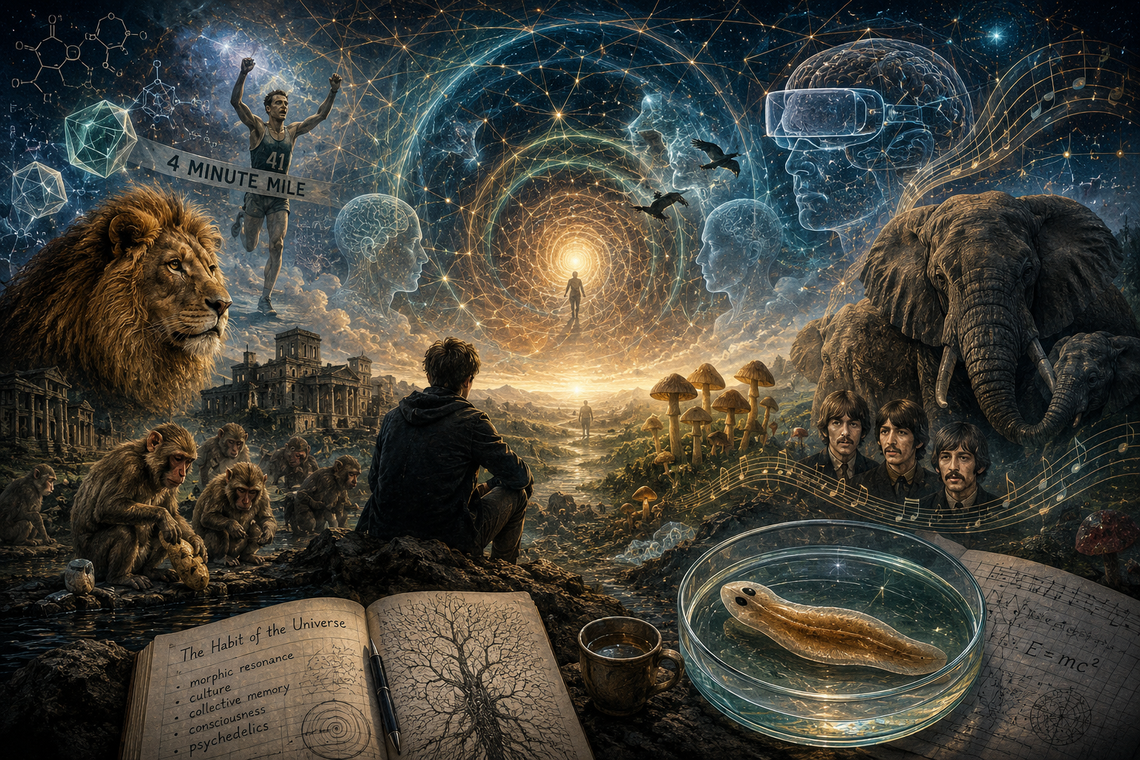
On morphic resonance, decapitated worms, lions that remember Rome, and what we might be doing when we take psychedelics
There is a particular kind of idea that refuses to die no matter how often it is killed. Rupert Sheldrake's morphic resonance is one of them. The thesis, stripped to its bones, is this: nature has memory. Once a thing has happened, it becomes easier for it to happen again. Crystallise a brand-new compound for the first time and it is reluctant, slow, almost coy; do it in a thousand labs across a thousand months and it forms readily, as though the molecule has learned the trick. Sheldrake proposes that this is not metaphor. He proposes a real field, a morphic field, across which form and behaviour are transmitted not through space and time in the ordinary causal way but through a kind of resonance with everything of that type that has gone before. Learn a skill in London and a rat in Edinburgh finds the same skill marginally easier. The past is not gone. It is a groove, and the groove pulls.
The respectable position is that the evidence is thin and the mechanism is missing, and that is true, and it is also not the most interesting thing about the idea. The most interesting thing is that it will not lie down. Ideas that will not lie down are usually pointing at something, even when they have the wrong address for it, and the pleasure of an idea like this one is not in deciding whether it is right. It is in what it does to the walls of the room. Morphic resonance, like Donald Hoffman's headset, like the strangest things the great animals do, is an idea whose real function is to get you to think outside the box, outside the skull, outside the assumption that the obvious account of the world is the whole of it. That is a thing worth doing whether or not the idea survives. So let it pull for a while, and see where it goes.
The question underneath it is simple and large. If things really do get easier the more they exist, then what, exactly, are we doing right now with psychedelics?
The monkey that never was
Start with the famous version, because the famous version is wrong in an instructive way. The hundredth monkey story goes like this: a troop of macaques on a Japanese island is taught to wash sweet potatoes, the habit spreads slowly from animal to animal, and then at some critical number, the hundredth monkey, the behaviour suddenly leaps the sea and appears all at once in monkeys on other islands who never saw it done. A threshold crossed. A field saturated. A tipping point in the shared mind of the species.
It didn't happen, not like that. The real observations, made by Japanese primatologists watching macaques on Koshima in the 1950s, recorded potato-washing spreading the ordinary way, young animals copying their mothers, the habit moving at a perfectly explicable pace. The miracle, the sudden jump across water, was added afterward by writers who wanted the data to mean more than it did. Lyall Watson, who put the story into wide circulation, later more or less conceded he had built the dramatic version out of inference and atmosphere.
And yet the story is more interesting once you know it's a fable, not less, because then you can see what it really is. It is not a discovery about monkeys. It is a portrait of a longing, and the longing is ours: that knowledge has weight, that enough minds holding the same understanding might change the medium that holds them, that learning is not just private hoarding but a contribution to some rising shared tide. The fable survives because the longing survives. And longings that strong usually have something real at the bottom of them, even if it isn't the thing on the label.
What is actually getting easier
Here is the part of the intuition that needs no field at all, and is marvellous anyway. Things genuinely do get easier the more they exist.
A proof, once found, becomes almost trivial for the next person, because it is written down, taught, folded into the notation everyone now learns before breakfast. Roger Bannister's four-minute mile was broken by dozens of runners within a few years of his breaking it, and it is tempting to say a barrier in some collective field dissolved. The plainer story is that he proved it possible, and proof of possibility quietly rewires everyone's training and expectation and nerve. The first ascent of a hard route is a near-death experience; the hundredth is a pleasant afternoon with bolts in the rock. There is a real field across which all this transmits, and it has a name. The name is culture: language, instruction, infrastructure, the worn handrail of everything anyone has already said.
That is the floor of the whole thing, and it is solid. The past really is a groove, and the groove really does pull, and most of the pull is no stranger than a library. But a floor is only interesting because of what stands on it, and what stands on this one is a set of phenomena that the tidy cultural account does not quite cover, that poke through it, that keep the matter open. The honest move is not to decide in advance whether they break the floor. It is to walk out onto the thin parts and look down.
The Beatles and the song that arrives by itself
Songs arrive in more than one head at once. The history of music is full of near-simultaneous inventions, riffs surfacing on two continents in a single season, chord shapes that everyone suddenly reaches for as if a memo went round. And it is not only music. Calculus arrived with Newton and Leibniz within a decade of each other. Natural selection arrived with Darwin and Wallace so simultaneously that they published together to avoid a brawl. Oxygen, the telephone, the precursors of relativity: the history of discovery is studded with things found by several people at the same moment, as though they had become, suddenly, findable.
The romantic reading is that the idea was in the air, circling in some collective mind, settling on whoever was tuned to catch it. The sober reading is that simultaneous discovery is exactly what you'd expect when many prepared minds work the same problem with the same materials to hand: Newton and Leibniz both stood on Fermat and Descartes, and a year's worth of songwriters are all soaked in the same records, the same gear, the same harmonic weather. Convergence isn't telepathy. It's what happens when a landscape has only a few low passes and a great many people trying to cross.
But notice what the sober reading does not touch. It does not touch the feeling. Every songwriter who has had a melody arrive whole and unbidden, as if dictated rather than composed, knows the experience from the inside, and from the inside it is reception, not invention. The sober account says the dictation is just the medium, internalised so deeply it has dropped below the waterline and come back up wearing the robes of revelation. That is probably true. It is also worth saying that "the past, internalised so completely you mistake it for a voice from outside" is itself a fairly astonishing description of what a mind is, and that the line between a deep groove pulling and a field calling is thinner, phenomenologically, than the debunk likes to admit. The song still feels like it came from somewhere. Keep that feeling in your pocket. It comes up again.
Hoffman, and the suggestion that we have the address wrong
Donald Hoffman, the cognitive scientist, not Albert Hofmann the chemist who first tasted LSD, has spent a career on a claim that sounds insane until you sit with it and then merely sounds hard. Space and time, he argues, are not the fundamental fabric of reality. They are a species-specific user interface, an evolved headset. We see a world of objects laid out in space and unfolding in time for the same reason a computer shows folders and a little trash can: not because that is what is really there among the voltages, but because it is a compression that lets us act without drowning in the truth. The desktop is useful precisely because it hides the machine. His phrase for the task ahead is that we have to learn to think outside of space and time. The mainstream does not follow him all the way, and the leap from "our perception is not the raw truth," which is hard to argue with, to "consciousness is the ground of everything," which is an enormous bet, is his and not the field's.
But you do not have to take the whole bet to feel what even the first step does to an idea like morphic resonance. Sheldrake's perennial embarrassment was always the mechanism: how does form travel without a carrier, without crossing space the ordinary way? The objection that buries him is "there is nowhere for it to live and no way for it to move," and that objection quietly assumes spacetime is the final stage on which everything real must appear. The modest, useful thing Hoffman lets you say is just this: if spacetime may not be fundamental, then dismissing every kind of non-local strangeness purely because it does not fit ordinary spacetime might be too quick. That is a much smaller claim than "Hoffman proves Sheldrake," which he does not, and nobody should pretend the two ideas rescue each other. It does not make Sheldrake right. It makes the easiest way of being sure he is wrong a little too easy, and it cracks a window.
And it lands exactly where the psychedelic report has been sitting all along, because the one thing the high-dose tryptamine state says, again and again across traditions, is that the box came off. That space and time stopped being the container and became one option among others. People who have never heard of Hoffman come back from DMT describing his thesis as something they lived: that the everyday world is an interface, that they were briefly behind it, that the place they went was somehow more real than the room they left. This is not cosmology, and a brain on a 5-HT2A agonist is not a calibrated instrument for reading the foundations of physics. But the phenomenology and the heresy are pointing the same way, and the interesting response to that is not to explain it away. It is to notice it, and to let the noticing sit there unresolved, which is where the good ideas live.
Levin's flatworm, and the memory that should not be where it is
Now the one that is not metaphysics at all. It is a clean experiment with a result that still resists any simple brain-only explanation, and it is, quietly, one of the strangest things in modern biology.
Michael Levin and Tal Shomrat, at Tufts, trained planarian flatworms, those small comma-shaped creatures from the bottom of ponds. The training was modest and carefully controlled: the worms learned that a particular rough-textured floor was a safe place to feed, overcoming their natural fear of open, lit, exposed ground. Ordinary associative learning, the kind flatworms have been suspected of and doubted at for a century. Then the researchers cut the worms' heads off. The planarian is the rare animal that lets you do this and then ask a follow-up question, because it grows the head back, brain and all, from the tail, in about two weeks. The headless, brainless tail built itself a complete new brain. And the worms wearing those new brains, given a single refresher, recovered the trained behaviour faster than worms that had never learned it at all.
Sit with the shape of that. The brain was thrown away. The lesson was not in the thrown-away brain, or not only there, because it came back into a brain that did not exist when the lesson was taught, built fresh from tissue that had never had a thought in its life. Levin's own careful reading, and he is careful, is that the memory was stored somewhere outside the brain, distributed through the body, very likely in the bioelectric patterns his lab has spent years showing can carry the instructions for an animal's very shape, and that this stored pattern retrained the new brain as it grew. Not a spell. Not a cosmic broadcast. A physical, in-principle-decodable signal, living in the cells of the body rather than the neurons of the head, and reaching forward in time to teach a brain that had not been born yet.
This is the thread to hold longest, because it does the one thing the tidy account cannot survive: it gives us controlled evidence that memory is not as neatly housed in the brain as we had assumed. Learned information persisted through the total destruction of the organ that is supposed to hold it, and then reassembled itself. There is an older, more disreputable cousin to this work, James McConnell's mid-century claim that you could grind up trained worms, feed them to untrained ones, and pass the memory along with the meal. It was laughed out of the room for decades, and recent molecular work has nudged it back from pure myth toward open question. The whole history here is a standing rebuke to the confidence with which we announce where a memory can and cannot live.
Now, the careful caveat, which is also Levin's: nothing in any of this leaves the animal. The memory living outside the brain is still inside the worm, in its tissues, its electrical state, its molecular machinery. The result destroys the idea that memory is just synaptic wiring; it does not, by itself, send the groove out into the cosmos. But here is the thing the caveat cannot take back. We had been treating two options as the only two: the dull truth that memory is local, in the brain, full stop, and the wild heresy that memory rides a field beyond the body. The worm says the dull truth was already wrong, and it was wrong in the direction of strangeness, in the direction of distribution, in the direction of the groove being carried in more places and more forms than anyone licensed. If a worm's lesson can live in its flank and leap forward into an unborn brain, then the smug certainty about where the edges of a memory are has just been handed a counterexample by a creature with no head. That should not make anyone a believer. It should make everyone a great deal less sure where the walls are.
John Aspinall, and the lion that remembers the Colosseum
John Aspinall was, by every account including the ones from people who could not stand him, an extraordinary man: gambler, zoo-builder, friend to tigers, a person who walked into enclosures with gorillas as though kinship were a thing you could simply decide to claim and then live out. Howletts and Port Lympne were not ordinary zoos. They were the working-out of a conviction that the wall between us and the great animals was a failure of nerve and respect, a matter of manners, rather than a fact of nature. People who met him tended to come away marked.
And he believed something that belongs at the heart of this essay because it is the romantic reading taken to its limit and then lived without a flinch. His hunger to find or rebuild a hundred-percent pure Barbary lion was not, in his own telling, a breeder's fuss about bloodlines. It was the conviction that a species carries a collective memory, that a true Barbary lion would carry in it the inheritance of the lions of the arena, the ones loosed against men in Rome, and that this carried memory was real, weighty, a wound and a grandeur at once, something that could be honoured and perhaps in some way healed by being restored to the world intact. The shame and the magnificence of that history, in his frame, lived on in the animal as surely as morphic resonance says the past lives on in the present, and bringing back the real lion was a way of taking responsibility for what we had done.
There is no accepted mechanism for this. Genes carry the statistical residue of what helped ancestors breed, not the episodic memory of what was done to them, and no biologist will tell you the specific terror of a particular lion in a particular arena is written into a cub born two thousand years later. That is the textbook answer and it is worth knowing. But it is a mistake to think the textbook answer closes the matter, because the textbook is a map of what we have managed to explain, not a census of what is real, and the gap between those two things, where the great animals are concerned, is enormous. We are nowhere near the bottom of what these creatures are. We do not know how deep their consciousness runs, because it is not our kind of consciousness and we have no instrument calibrated for it. We cannot even agree on how an elephant does some of the things an elephant plainly does. To stand in that ocean of not-knowing and pronounce Aspinall's idea ridiculous is to mistake the edge of our current understanding for the edge of the possible, which is the exact habit of mind these ideas exist to break.
So take it seriously, and then be precise about what "carries Rome" can honestly mean, because the precise version is haunting enough without the magic. It does not mean a cub born today holds the episodic memory of a particular lion in a particular arena; there is no known route for that. It means something quieter and, in its way, heavier: that a Barbary lion carries the morphological and behavioural inheritance of a lineage shaped, in part, by ten thousand years of collision with us, with our spears and arenas and rifles and our slow theft of its world. The particular wariness in the presence of a human, the architecture of a predator that evolved alongside the one predator that hunted it back, the genetic narrowing left by our near-extermination of it: all of that is real, all of it is carried, all of it is a recording of the human-animal war written in the only ink evolution uses. Aspinall pointed at a true and heavy thing, the deep entanglement of our history with theirs and the moral weight of what we have done, and gave it the most vivid mechanism he could imagine. Maybe the vivid mechanism is wrong. Maybe it is only mostly wrong. Either way the thing he was pointing at is there, and it is closer to haunted than the careful version likes to admit.
Elephants, crocodiles, hippos, and the minds we are at war with
Some animals are not simply clever. They are other, in a way that feels like a different category rather than a higher score on the same test, and the strangeness deepens the closer you look.
The elephant is the clearest non-human culture we know of, and it is also where the easy summaries fall apart. It is tempting to say, briskly, that an elephant matriarch is a living library and that when she dies the knowledge dies with her, and there is truth in the first half. Matriarchs hold decades of route memory, the location of water in a drought year, the social map of a whole region, and herds that lose them are measurably poorer for it. But the second half, the clean little verdict that the knowledge simply dies, is exactly the kind of confidence this subject does not earn. Elephants do things for which we have no settled account. They return to the bones of their dead and turn them over with what looks unmistakably like attention. And then there is the story that gets told whenever this subject comes up, the one about Lawrence Anthony, the South African conservationist known as the Elephant Whisperer, who in the late 1990s took in a herd of traumatised, dangerous elephants that were otherwise going to be shot, and spent weeks living beside their enclosure until they came to trust him. When he died of a heart attack in 2012, his family reported that two herds walked roughly twelve hours through the bush to reach his house, where they had not been in over a year, and stood there for two days before dispersing. His son told the press about it; his wife has said the elephants returned on the anniversary. It is an anecdote, not an experiment, and it should be held as one. How they could have known is genuinely unexplained, and "unexplained" is the honest word, not "telepathic," because there are candidate ordinary answers, infrasound, scent on the wind, behavioural cues passed between herds, routes nobody had mapped, and no way at present to test which, if any, was at work. But the right response to a story like that is neither to swallow it whole nor to wave it away. It is to sit in the size of what we do not yet understand about these animals, and to notice that "we do not know" is not a hole to be papered over with a tidy sentence about libraries. It is the actual state of the evidence, and it is far more interesting than any premature closing of it.
The crocodile and the hippopotamus are a different order of otherness again. The crocodile, if it is a consciousness at all, is one built on an architecture that split from ours before the dinosaurs, a deep-time mind, patient on a scale we cannot inhabit, lethal to us across the whole span of our existence in Africa in a way that has surely shaped where we dare to drink. The hippo is reckoned among the deadliest large animals to humans in Africa and carries none of the charm that buys an animal our sympathy. These are not cuddly minds inviting us to project ourselves into them. They are genuinely other timelines, and the relationship is not a metaphor of war but the literal daily fact of sharing a river. There is something at the heart of our bond with these animals that is older than affection and harder than fascination, and it is precisely the long, lethal, intimate entanglement, the war, that makes them feel sacred and dangerous at once.
Now bring in the psychedelic, because this is where the threads gather. People come back from high-dose DMT and from ayahuasca reporting contact with animal intelligences, serpents above all in the ayahuasca traditions, presences that feel reptilian or elephantine or insectile, vast and ancient and regarding them with attention. The Bwiti have their own version of these meetings, and anyone who has sat long enough with iboga knows the encounters do not feel like scenery; they feel like being met. The literal reading is that the molecule opens a channel and the mind of the serpent, or the elephant, comes through.
There is a humbler reading that is, if anything, stranger, because it puts the marvel inside us rather than out in the ether. The human brain is built, by deep inheritance, to model other minds, and above all the minds of the great animals we evolved beside as predator, prey, and rival. The serpent-detection circuitry, the predator-vigilance machinery, the ancient apparatus for reading the intent of a large dangerous animal, all of that is in us, graven by the very human-animal war that makes elephants and crocodiles feel sacred, and it normally runs silent and automatic beneath everything we notice. Turn down the filter, and that machinery can run free, can generate the felt presence of the very minds it was shaped to track. On this reading the serpent in the vision is not a visitor. It is the animal in you, the sediment of a hundred thousand years of hunting and being hunted, surfacing and presenting itself the way the dictated melody does: as something vast and ancient and not-you, because in the most literal sense it is. You are not meeting the elephant. You are meeting the part of yourself the elephant made.
And here is the part worth leaving genuinely open, because the humbler reading is satisfying and it may not be the whole of it. We do not know how deep animal consciousness runs. We do not know what, if anything, is shared across minds, or carried in a lineage, or transmitted by means we have not learned to measure. Everything in this essay, the worm's impossible memory, the song that arrives by itself, the lion that might carry Rome, the elephant that knows a death across miles, sits in the same wide territory of the not-yet-explained, and the territory is real even where the maps are wrong. The point of standing in it is not to plant a flag. It is to feel how much room there still is.
The thread, pulled loose
Lay the pieces side by side and a shape appears, though it is better thought of as a rhyme than a proof. The song that arrives whole. Sheldrake's disputed compound that is said to crystallise more easily the more it has been made. The worm that keeps its lesson through the loss of its brain and hands it to a brain not yet born. The headset that turns out not to be the world. The lion that carries, in its very build, the weight of ten thousand years of us. The elephant that registers a death across an impossible distance. The serpent that rises, vast and ancient, when the filter drops.
In every case the obvious account, the local one, the one that keeps the marvel small and safe and inside the skull, explains a great deal and not quite everything. There is always a remainder, a place where the tidy story thins and something shows through, and the something is always older and deeper and less personal than the self that came looking. The romantic instinct is to throw that remainder outward, onto cosmos and field and external mind. The reductive instinct is to deny there is any remainder at all. Both are too quick. The remainder is real, and where it actually lives is the most interesting question in the room, and the honest answer, for now, is that we do not yet know, and that not-knowing is not a failure but an open door.
Which is, at last, a way of answering what we are doing right now with psychedelics. Perhaps we are not tapping a cosmic library, and perhaps we are not merely soaking in culture either, and perhaps the truth is some third thing we are not yet equipped to name. What these substances can do, at their strangest, when you line up the worm and the song and the headset and the lion and the serpent, is lift the filter that keeps the deep inheritance invisible, and let us look straight at the groove, at the accumulated, carried, graven past, biological and cultural and possibly stranger still, that we normally experience only as the plain transparent fact of being ourselves. They do not obviously show us what is outside. They show us, with the lights briefly off, the architecture of what is inside, and the architecture is so much older and deeper and less personal than the person who walked in that it reads, again and again across traditions, as contact with something vast and other.
A few questions to carry out the door, since the pleasure of this kind of thinking is in the hooks and not the verdicts. If a flatworm can carry a memory through the loss of its brain in patterns of bioelectricity, and psychedelics dramatically reorganise the brain's electrical life, are the regeneration people and the psychedelic neuroscience people perhaps describing the same deep layer from opposite ends, without yet knowing it? If spacetime really is an evolved interface, then the psychedelic dissolution of space and time is not a malfunction but the momentary lifting of an adaptation, and evolution does not build expensive filters for nothing, so what is the filter for, and what does it cost to take it off? And if the great animals carry the long human-animal war graven into their lineage, and we carry the very same war graven into ours as the deep architecture the serpent vision surfaces, then the psychedelic meeting with the animal mind is, in some real sense, the two sides of that ancient war coming face to face inside a single human skull. Aspinall wanted to heal the wound by restoring the lion. Perhaps the wound is also in us, and perhaps the nearest thing to his impossible, magnificent project is this: to be made, for a few hours, to feel exactly what we have been carrying all along.
We are not waiting for the hundredth monkey. We are the monkey, sitting with the potato, beginning at last to look at our own hands.
Sources, for anyone who wants to chase the threads. The hundredth-monkey story is a documented later embellishment of genuine but unremarkable primatology on Koshima, with Lyall Watson's role in dramatising it on record. Morphic resonance is Sheldrake's, set out across A New Science of Life and after, and remains outside the scientific mainstream. Donald Hoffman's interface theory of perception and conscious-agent framework are seriously argued and seriously contested in equal measure. The planarian results are Shomrat and Levin, "An automated training paradigm reveals long-term memory in planarians and its persistence through head regeneration," Journal of Experimental Biology* 216 (2013): 3799–3810; James McConnell's cannibal-worm memory-transfer work of the 1960s is the disreputable precursor, largely discredited at the time and lately, tentatively, revisited through RNA-interference studies. John Aspinall's collective-species-memory beliefs are his own, eccentric and unproven and, in the view of this piece, a long way from ridiculous. The claims about elephants, cetaceans, octopuses, and crocodilians gesture toward areas of the animal-cognition literature that remain contested and developing; the Lawrence Anthony episode is a family-reported anecdote, carried in the New York Times and elsewhere in 2012, and is offered as exactly that, a striking story without a tested explanation, not as evidence of anything.*