Pillar
Ayahuasca is not one thing
Botany, secrecy, chemistry, and the problem of knowing what was in the cup.
By Stephen Page · [24/05/2026]
The popular conversation has flattened a botanical and cultural complex into a single substance. The flattening is recent, foreign, and it serves several interests at once.
The claim, stated plainly
Much of the popular writing on ayahuasca over the last decade — from high-profile works such as Michael Pollan's How to Change Your Mind to many clinical trial press releases and wellness features — treats it as a single substance. One brew, one experience, one chemistry, one set of clinical implications. The retail mythology that has built up around the brew, particularly in its translation into European and North American therapeutic and ceremonial contexts, depends on that simplification.
This essay argues that the simplification is wrong, and that recognising why it is wrong has consequences. Ayahuasca should be understood not as a single psychoactive substance but as a variable ethnobotanical category. Variation enters through the vine, the DMT-bearing plant, regional admixtures, preparation methods, serving practices, and undisclosed practitioner choices. Once that is recognised, many public, clinical, and commercial claims about "ayahuasca" become too imprecise to stand without further specification. The vine is the only constant across the family — and even the vine, on closer inspection, is not one thing. Recent chemistry suggests the analytical literature has been quietly misreading the brew for decades. And the layer of operational secrecy that surrounds traditional preparation does several jobs at once: some legitimate ritual and pedagogical work, some less defensible authority-protection that the export retreat economy has inherited and put to commercial use.
What this looks like in practice
Some context for what follows. From 2014 to 2021 I lived in southeastern Ecuador, in the Gualaquiza region — Shuar territory at the foothills of the Andes, where indigenous, mestizo vegetalismo, and various syncretic and modern ceremonial traditions all overlap. Over those seven years I watched perhaps twenty different individuals and groups prepare and serve ayahuasca, helped prepare brews myself, and drank in a wide range of settings — from genuinely traditional Shuar contexts to Western practitioners playing the role with varying degrees of seriousness.
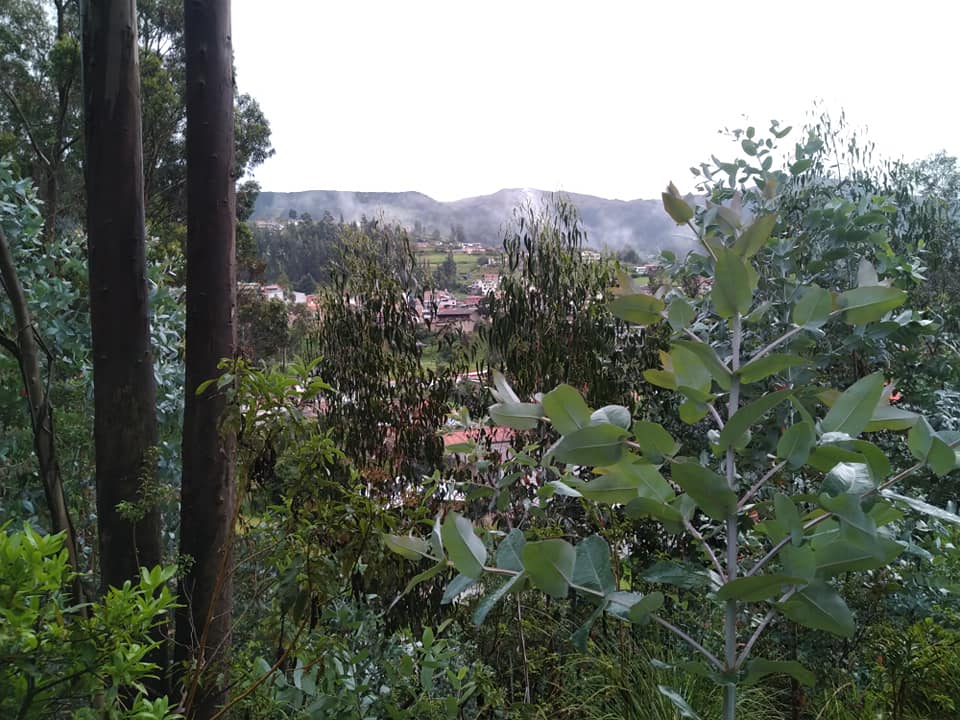
I can report two things from that experience that bear directly on what follows. The first is that no two preparations were the same. Different vine sources, different DMT-bearing plants where any were used at all, different admixtures, different cooking times, different concentrations, different ritual frames, different effects.
The second is that I could not tell you, in detail, what was different. The composition of the brew is shrouded on purpose. This was true across the entire spectrum of practitioners — Dutch operators, mestizo curanderos, Shuar shamans living traditionally in the forest. You go to gather the vine. You spend hours pounding it because there is always a large pile of it to deal with. You watch. Plants are added that you cannot identify because no one names them. You participate as a disciple, not an analyst. The structure of the practice forbids the question "what's in the cup." When the experience does very little — and for non-native participants it often did very little — the cultural frame provides the answer before you can finish asking: bad juju, you didn't do it right, you must have made a mistake, the brew was working on something else for you. The practitioner is never wrong. The brew is never weak. Any failure is yours.
I will return to that closed epistemic loop later, because it matters. For now: the variation is real, it is large, and it is deliberately obscured. The ethnobotanical literature on regional variation and undisclosed admixtures, surveyed below, is consistent with that field picture. The literature is catching up to what the practitioners have always known and selectively withheld: there is no recipe.
The vine that is also a category
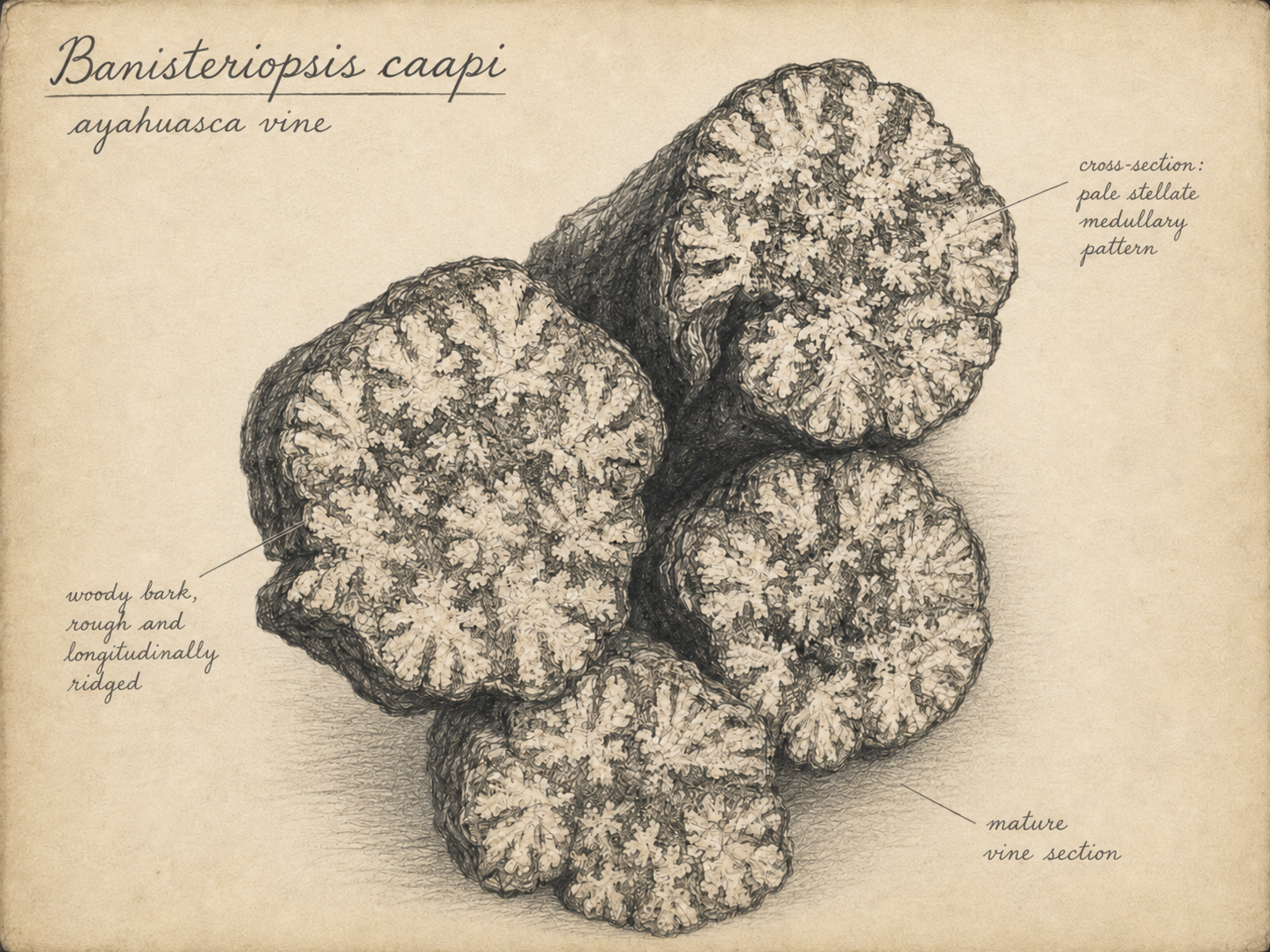
Start with what almost every account agrees on. The active brew called ayahuasca, yagé, daime, hoasca, caapi, natema, mihi, kahí, pindé, or any of perhaps thirty other regional names contains, as its load-bearing botanical component, a woody Amazonian liana of the family Malpighiaceae. The liana provides the β-carboline alkaloids — chiefly harmine, harmaline, and tetrahydroharmine — that inhibit gut monoamine oxidase and thereby permit orally administered DMT to reach the bloodstream and cross the blood-brain barrier intact. Without the vine, the rest of the brew is pharmacologically inert by the oral route. With the vine alone, no DMT-bearing admixture, the brew still has psychoactive effect through the β-carbolines themselves, particularly tetrahydroharmine, which is a serotonin reuptake inhibitor in its own right.
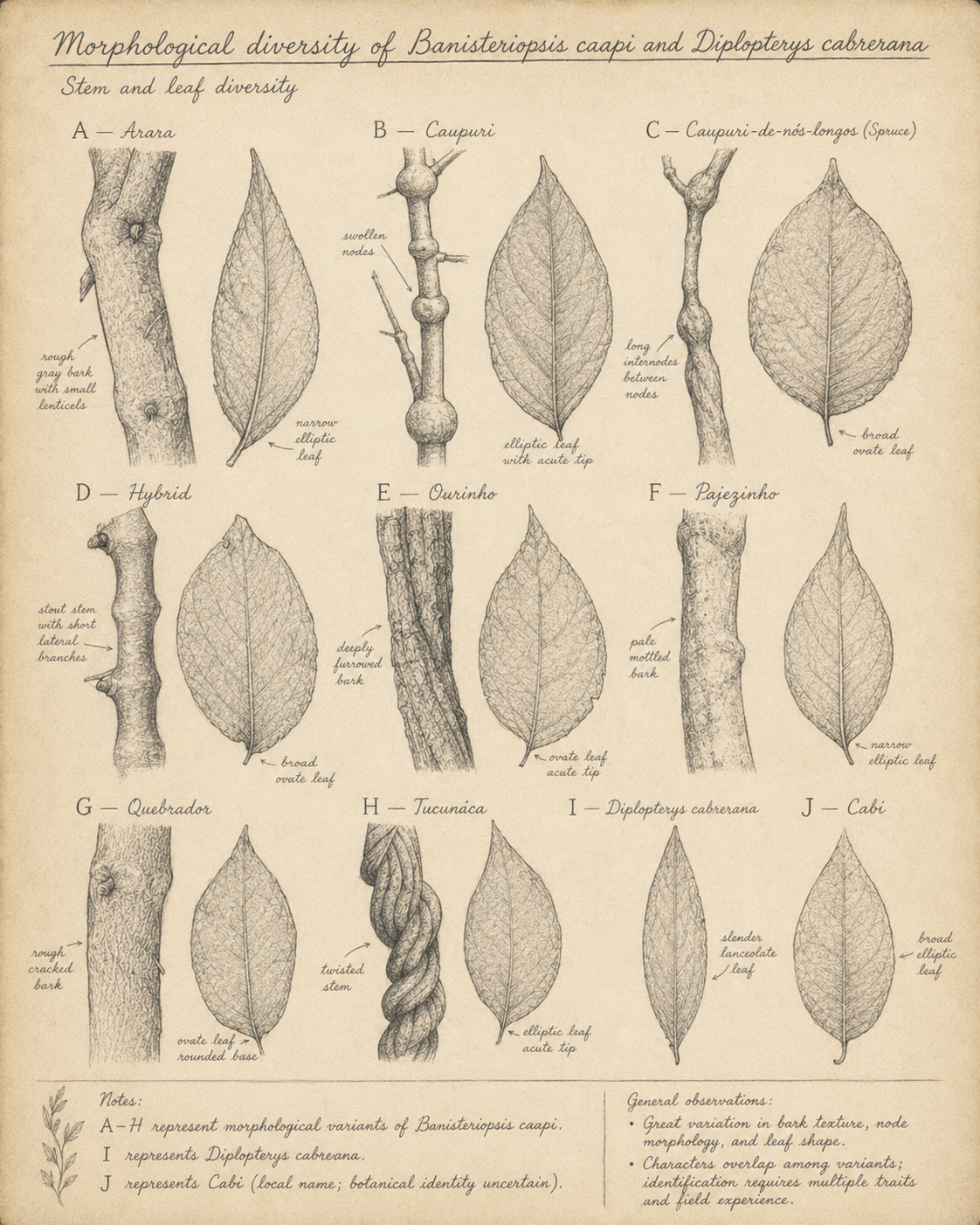
The liana is conventionally identified as Banisteriopsis caapi (Spruce ex Griseb.) C.V. Morton. That binomial, settled by Spruce in 1852 and stabilised by Morton in the early twentieth century, conceals more than it reveals. The botanist Richard Evans Schultes, who spent seventeen years from the late 1930s into the 1950s among the ayahuasca-using peoples of the northwest Amazon and remains the most thorough Western observer of these traditions ever to have lived, recorded that indigenous specialists routinely distinguished between named varieties of the vine. Schultes himself, writing in 1986, called the problem of resolving these varieties botanically "fascinating" and lamented that so little research had been dedicated to it, calling it "botanically impossible" to discern morphological differences between the varieties on the available evidence.
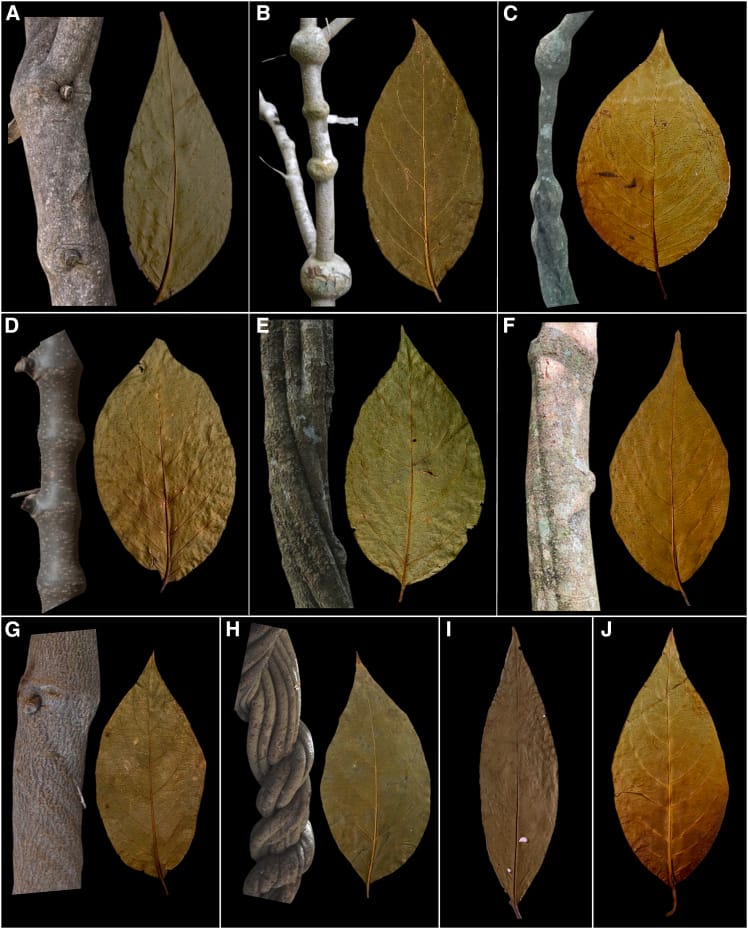
Seventy years after his fieldwork began, the question is no longer entirely open. Brazilian religious groups (Santo Daime, União do Vegetal, Barquinha) and the Amazonian peoples whose practices fed into them recognise at least nine named B. caapi folk types in routine circulation — Caupuri, Tucunaca, Arara, Pajezinho, Ourinho, Hybrid, Quebrador, Caupuri-de-nós-longos, and the contested Cabi — distinguished by stem morphology, brew taste and density, and reported effect. A recent machine-learning study by Biazatti and colleagues demonstrated that these folk categories carry detectable morphological signal even in dried leaves, which the folk taxonomists themselves never used as diagnostic. The categories are tracking real biology. They are not arbitrary cultural labels.
That number — nine — is the conservative count, based on what was consistently represented in one well-documented Brazilian herbarium collection. The fuller picture is larger. Luna's work in Peruvian vegetalismo records additional named varieties under different regional vocabularies. Langdon (1986) documented Siona varietal classifications among the Colombian peoples that have no clean correspondence to the Brazilian set. The Luz et al. 2023 DNA barcoding study identified eight distinct genetic lineages within Brazilian Banisteriopsis samples used for ayahuasca, and noted that the morphological evidence for whether all of them actually belong to B. caapi sensu stricto remains incomplete. Some of what gets called "ayahuasca vine" in practice may turn out to be different Banisteriopsis species — or, in places, related Malpighiaceae genera — that the folk system has correctly grouped functionally but the Western system has not yet resolved taxonomically.
Beyond B. caapi itself, the broader genus Banisteriopsis contains at least sixty species, and a non-trivial subset have been documented as occasional ayahuasca constituents in regional preparations. Friedberg (1965), cited by Dobkin de Rios in her 1970 Iquitos fieldwork, identified the vines used in Amazonian healing as B. caapi, B. inebrians, B. quitensis, and B. rusbyana — four species, not one. Santos et al. (2020) in their large β-carboline profiling study included samples of B. laevifolia, B. megaphylla, B. muricata, B. oxyclada, B. variabilis, B. gardneriana, and Diplopterys pubipetala alongside the dominant B. caapi, all collected from practitioners who use them for ayahuasca preparation. Erowid's compilation of source-plant records lists many more Banisteriopsis species reported as ayahuasca components by at least one source.
Some traditions substitute the vine entirely. Tetrapterys mucronata, also Malpighiaceae, was observed by Schultes among the Maku of the Brazilian Rio Tikié being used as the sole ingredient in an ayahuasca-like brew, because that species apparently contains both the β-carbolines and the tryptamines needed for an orally active preparation in a single plant. Schultes recorded having tried the preparation himself in the 1940s. Lophanthera lactescens, Mascagnia species, Callaeum antifebrile (which contains harmine in its stems and leaves), and other suspected source plants drift in and out of the literature on regional preparations.
So: even before we get to the admixtures, the "ayahuasca vine" is already a category of perhaps twenty named botanical entities used variously across the Amazon basin, of which one species in nine named cultivated varieties accounts for the majority of contemporary use. The popular framing of "ayahuasca is B. caapi plus Psychotria viridis" is a description of one particular configuration that has become dominant in the export form, not a description of what ayahuasca historically and currently is across its range.
The DMT plant, and its substitutes
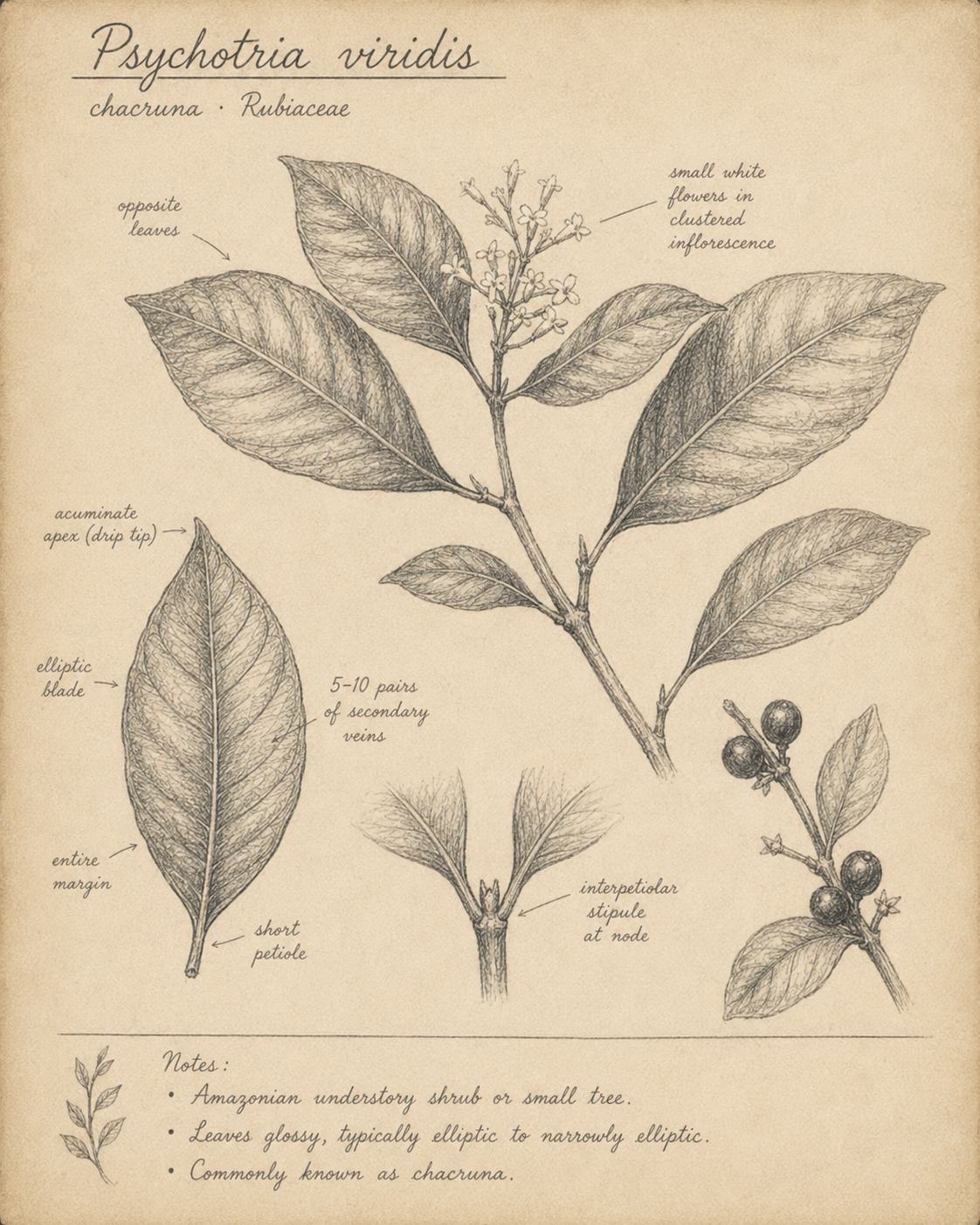
The second standard component, the plant providing the DMT, shows similar variation. The dominant pairing in contemporary Brazilian, Peruvian, and Ecuadorian preparations is Psychotria viridis Ruiz & Pav. (Rubiaceae), known locally as chacruna — a name derived from a Quechua word meaning "mix." William S. Burroughs, who in 1953 went looking for yagé in Colombia and Peru and corresponded with Allen Ginsberg about it in what became The Yage Letters, collected the first known specimen of the plant in 1954 and sent it to Schultes for identification. Schultes initially misidentified it. He did not formally describe P. viridis as an ayahuasca admixture until 1967, more than a century after Spruce had named the vine. The fact that the DMT-bearing component of the dominant export brew was only formally placed in the Western botanical record in the late 1960s is worth holding onto. The plant taxonomy of the brew, even at the level of its main ingredients, is younger than most of the people drinking it.
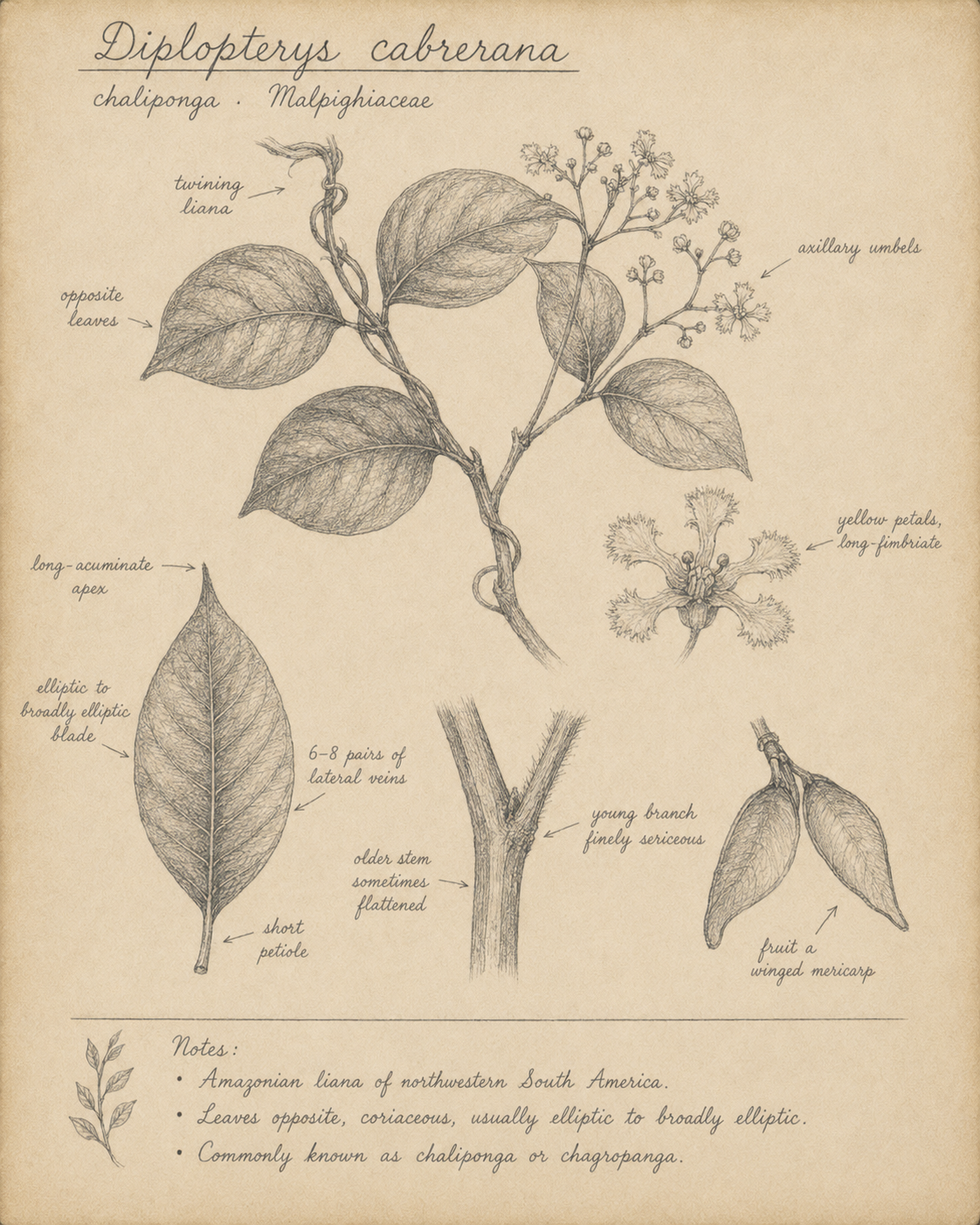
Outside Peru and Brazil, particularly in the northwest Amazon — Colombia, Ecuador, parts of southern Venezuela — the standard DMT plant is Diplopterys cabrerana (Cuatrec.) B. Gates, called chaliponga, chagropanga, or oco yagé. Diplopterys is, importantly, also Malpighiaceae — the same family as the vine, not Rubiaceae like Psychotria — and Bianchi and Samorini (1993), drawing on Poisson's 1965 analysis, report that the leaves contain DMT at around 0.64% by dry weight. Beyond DMT, D. cabrerana also contains 5-MeO-DMT and N-methyltetrahydro-β-carboline. The chemistry is therefore not identical to a P. viridis brew. Practitioners and researchers who have used both report qualitative differences in onset, character, and visual content of the experience. Colombian yagé made with Diplopterys is recognisably a different brew from Brazilian ayahuasca made with chacruna, even when the underlying B. caapi preparation is similar.
Psychotria carthaginensis, a closely related species, substitutes for P. viridis in some preparations. Among the Sharanahua, Psychotria leaves of two different unidentified species are distinguished and used differently: batsikawa is added "to give the impression of coldness and produce fewer visions," while pishikawa (or kawakui) is "considered stronger." Beyond the Psychotria / Diplopterys pairing, regional brews have at various times used Justicia pectoralis, Brugmansia species, Mimosa species, and others as either the DMT-bearing component or as substantive admixtures with their own active chemistry. Older literature suggests Prestonia amazonica was used as a DMT source — Spruce reported it in 1908, Reinberg followed in 1921 — though Bianchi and Samorini consider the original analyses likely confused with B. caapi material itself and suggest the Prestonia report is unreliable.
It is worth pausing on the Brugmansia category. Brugmansia suaveolens, B. insignis, and other species — closely related to Datura and similarly tropane-alkaloid-bearing — are routinely added to ayahuasca preparations by some traditional practitioners, particularly in Peruvian vegetalismo and in some Colombian traditions. McKenna, Luna and Towers (1995) note that as few as two or three Brugmansia leaves added to ayahuasca are reported by practitioners to be sufficient to "see the witch that caused the illness." The pharmacology is not subtle. Tropane alkaloids (scopolamine, hyoscyamine, atropine) are powerful anticholinergic deliriants. A brew containing Brugmansia is not a "stronger version of ayahuasca"; it is a meaningfully different psychoactive preparation that happens to share two ingredients with the standard formulation. The fact that some traditions consider this enhancement and others consider it dangerous adulteration is itself part of the variation the global conversation has flattened. A participant who is not informed that Brugmansia has been added — and traditional practitioners as a rule do not list their additions — has not consented to the actual pharmacological intervention they have received.
The pharmacopoeia underneath
So variation enters at the first two levels: the vine and the DMT source. Different Banisteriopsis varieties produce different β-carboline profiles; different DMT plants produce different tryptamine profiles. The next level is harder still, because the admixture pharmacopoeia is much larger, far less disclosed, and conceptually structured in ways that resist Western-academic extraction.
The historical literature on Amazonian ayahuasca shamanism documents an astonishing range of "ally plants" added to brews depending on intention, region, season, patient, and ceremony. Bianchi and Samorini's 1993 catalogue compiles primary sources from Pinkley (1969), Rivier and Lindgren (1972), McKenna, Luna and Towers (1986), Luna (1984), Schultes and Raffauf (1990), and others — over seventy-five named species with associated ethnobotanical and pharmacological data. McKenna, Luna and Towers' 1995 chapter "Biodynamic Constituents in Ayahuasca Admixture Plants: An Uninvestigated Folk Pharmacopoeia" remains the most thorough single treatment and is worth lingering on, because it sets out the conceptual structure that the rest of this section depends on.
That conceptual structure is the plantas maestras, or plant-teachers framework. In mestizo vegetalismo and in the indigenous traditions it draws on, certain biodynamic plants are understood to be teachers rather than tools. Each plant has its own madre (mother) spirit, its own icaro (magic song) revealed to the apprentice under proper conditions, its own specific knowledge to transmit. The knowledge is transmitted not by an elder ayahuasquero to a junior one through verbal instruction, but directly by the plant to the apprentice through ingestion, dreaming, and dietary observance. The training period for a vegetalista — six months minimum, often years — consists largely of consuming these plants under a strict dieta (no salt, sugar, fat, alcohol, sexual abstinence) and waiting for the plant-spirits to disclose themselves. The pharmacopoeia is not a fixed inventory. Ayahuasqueros continually expand it by introducing new plants to the brew and observing what they teach. Bristol (1966) documented similar practice among the Sibundoy of Colombia, Chaumeil (1983) among the Yagua, Siskind (1973) among the Sharanahua. The system is generative by design.
McKenna, Luna and Towers' Table 1 catalogues approximately fifty genera used as admixtures and assigns each a brief summary of known biodynamic constituents. The headline finding from that table is methodological: for roughly half the genera listed, the chemical literature has identified active constituents (alkaloids, terpenoids, indoles, neolignans, ergolines, tropanes); for the other half, "virtually nothing is known about the pharmacologically active constituents." Thirty years on, the picture has barely moved. The "uninvestigated folk pharmacopoeia" of the title remains uninvestigated.
The plants that have been characterised hint at the scope of what is in these brews. Maytenus ebenifolia (chuchuhuasa) contains sesquiterpene and nicotinoyl alkaloids, triterpenes, maytensine, and ansa macrolides. Brunfelsia chiricsanango contains scopoletin and CNS depressants. Erythrina poeppigiana contains Erythrina alkaloids that produce narcotic effects at low doses and curare-like effects at higher doses. Uncaria guianensis (garabata) contains spiro-oxindoles, bis-indoles, and hetero-yohimbine alkaloids. Virola species contain diaryl propanoids, tryptamines, β-carbolines, and neolignans — making Virola a meaningful source of additional DMT and additional β-carbolines when added to a brew. Hura crepitans (catahua) contains tigliane diterpenes, piscicidal compounds, and lectins; Don Manuel Pacherras, an informant quoted in the McKenna chapter footnotes, describes it as "a strong and dangerous doctore" requiring a 30-day diet, used together with Dieffenbachia for destroying "lakes inhabited by dangerous animals."
There is a particularly clean example in the McKenna chapter of folk vocabulary tracking real pharmacology. Practitioners report that when ingesting chuchuhuasa (a Maytenus ebenifolia preparation with alcohol), eating peccary will produce "an intermittent high fever, similar to malaria." The explanation given is that the spirits of the plant and the animal are in conflict. The chemistry says: peccary meat is high in tyramine, Maytenus alkaloids may include MAO-inhibitory activity, and the combination of an MAOI with a tyramine-rich food produces hypertensive crisis presenting as fever. The shamanic explanation and the pharmacological explanation describe the same phenomenon in different vocabularies, and both are correct within their frames. The folk model encoded an accurate pharmacological observation centuries before the pharmacology was available to describe it.
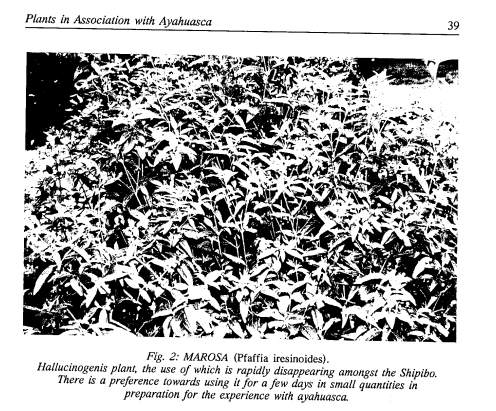
Bianchi and Samorini distinguish three kinds of plant-brew association: plants cooked together with ayahuasca (the largest group, perhaps fifty in their catalogue), plants consumed during the session (mapacho tobacco being the canonical example, with Nicotiana rustica containing both nicotine and small amounts of β-carbolines), and plants taken before or after the session to prepare or integrate the body — the latter often emetic, often part of strict dietary observances lasting weeks or months. The Shipibo marosa (Pfaffia iresinoides) is taken for six days in small doses before ayahuasca to intensify the subsequent experience. The full inventory across all three categories is conservatively over a hundred plants. The actual inventory in current practice is unknowably larger, for reasons addressed in the next section.
The mystery is not incidental
The ethnobotanical literature on ayahuasca admixtures, including everything cited above, is a record of disclosed knowledge. Luna got Don Emilio Andrade and Don Manuel Pacherras to name specific plants and uses through years of relationship-building and properly committed apprenticeship. McKenna built on that relationship and added his own. Pinkley, Schultes, Chaumeil, and the others did the same. What they produced is genuinely valuable and represents some of the most careful ethnobotany ever conducted in the Amazon basin. It is also unrepresentative.
The default state of admixture knowledge across the Amazon basin is not disclosed. It is held back. The composition of the brew is a working secret of the practitioner, disclosed selectively or not at all, often especially withheld from disciples who are expected to learn through participation rather than instruction. You bash the vine. You watch what is added. You do not ask. You participate. The structure of the apprenticeship forbids the question.
This pattern is consistent across the entire spectrum of practitioners, from genuinely traditional indigenous shamans to mestizo curanderos to Western operators playing the role for retreat clients. The operational secrecy is structurally identical regardless of authenticity. That uniformity is itself informative. It suggests the secrecy is not primarily a defensive posture against outsider extraction. It is a feature of the practice, and it is doing several jobs at once.
Some of those jobs are legitimate. The unknowing of the participant is part of the ritual structure. You drink something you did not make, prepared by someone who knows what you do not, and the asymmetry is doing real work in the experience. The participant's state of receptive trust is partly produced by the practitioner's possession of withheld knowledge. Strip the mystery away — print the recipe on the cup — and you have made a different kind of event. This may be the version of the argument the more sympathetic ethnographers want to advance, and within the traditional ritual context it has some validity.
Other jobs the secrecy does are less legitimate, and the wellness industry has imported all of them. The withheld recipe protects the practitioner against feedback. If the participant does not know what was in the cup, the participant cannot evaluate whether the brew was made well, whether it contained what it should have, whether the dose was appropriate, whether anything went wrong. The participant cannot say "this was a weak brew" because the participant has no reference for what a strong brew would be. Critically, when the experience underperforms — when nothing much happens — the cultural frame is already in place to attribute the failure to the participant. Bad juju. You weren't ready. You're resisting. You must have eaten something during the dieta. The practitioner is not falsifiable, because the participant has no instrument with which to falsify.
This matters because the chemistry, as the next section shows, is genuinely highly variable, and a non-trivial fraction of brews administered in the global ceremonial economy contain little or no active material. Callaway (2005) found two samples in his survey of twenty-nine with no detectable DMT at all. They were administered with the same reverence as fully active samples. The participants who drank them and felt nothing visionary were told, presumably, that the brew was working on a deeper level, that they were resisting, that the medicine was teaching them something else. Within the cultural frame, those interpretations are coherent. Outside the cultural frame, they are unfalsifiable post-hoc rationalisations of a brew that didn't work because there was no DMT in it.
The export ceremonial economy has imported this structural feature wholesale, often without the legitimate ritual context that originally housed it. In the export setting the pattern typically looks like this: an operator declines to specify what is in the brew, frames any participant disappointment as the participant's own spiritual failure, and maintains an aura of withheld knowledge as part of their professional positioning. The structure of authority being deployed has its origins in genuine indigenous practice. In the export context it is increasingly hard to distinguish from straightforward commercial protection of an unaudited product. The participant pays. The participant drinks. The participant is told they have received an authentic Amazonian medicine. The participant cannot verify any of that, by design.
None of this is incompatible with the observation that the practice can be genuinely valuable, that the brew often does produce profound and lasting effects, that traditional practitioners frequently know an enormous amount about plants and people. The two claims can coexist: the practice contains real knowledge and the operational secrecy provides cover for inconsistency and unaccountability. Most defenders of the practice acknowledge only the first claim. The second claim is awkward and tends to get sidestepped. This article will not sidestep it.
It is also the strongest argument for taking the chemistry seriously. The participant cannot evaluate the brew; the cultural frame forbids it; the practitioner does not disclose. The only available check on the system is external analysis. Without it, the practice operates in a closed epistemic loop in which the practitioner's authority is self-reinforcing and the brew's effects, or non-effects, are always interpretable as confirmation of whatever the practitioner says they should be.
The chemistry of the actual brew
When the brew is analysed externally, the variation is large enough to settle the question on its own. Callaway (2005) surveyed twenty-nine ayahuasca samples from four distinct traditions — União do Vegetal (UDV), Santo Daime, Barquinha, and Shuar — plus one Shuar paste preparation, and quantified harmine, harmaline, tetrahydroharmine, and DMT in each. The results are difficult to read as anything other than evidence that "ayahuasca" denotes a chemically heterogeneous category.
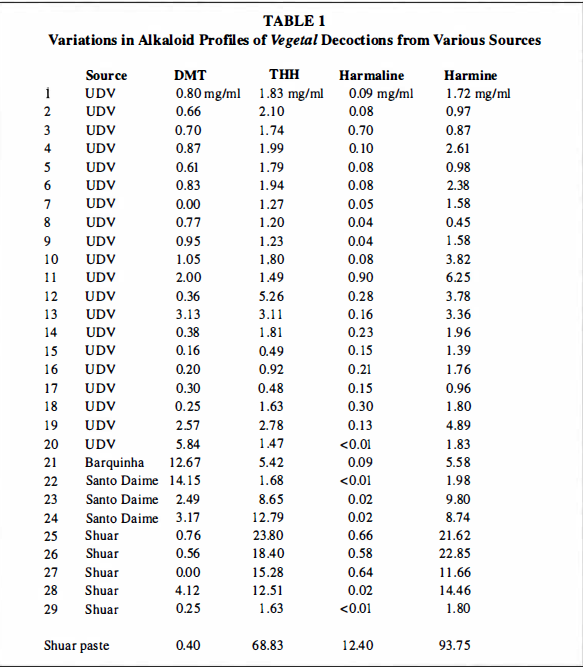
DMT content ranged from undetectable to 14.15 mg/ml — a range that includes zero. Tetrahydroharmine ranged from 0.45 to 23.80 mg/ml, a roughly fifty-fold range. Harmine ranged from 0.45 to 22.85 mg/ml. The Shuar paste, prepared for licking rather than drinking, sat at 68.83 mg/ml THH and 93.75 mg/ml harmine — an order of magnitude above any liquid sample. Two samples — one UDV, one Shuar — contained no detectable DMT at all. Callaway notes, in a sentence worth quoting because of how thoroughly it undercuts the standard pharmacological framing of the brew, that both DMT-free samples "were considered with the same reverence as DMT-containing samples for their utility as a sacrament."
The between-tradition averages are equally striking. UDV brews averaged 1.12 mg/ml DMT and 1.82 mg/ml THH, typically administered in doses of 100–200 ml. Shuar brews averaged 1.14 mg/ml DMT but 14.32 mg/ml THH, typically administered in doses of 20–30 ml. The total β-carboline dose delivered by a typical Shuar serving is therefore roughly comparable to a typical UDV serving despite the brews being chemically very different — concentrated and small versus dilute and large. The Santo Daime samples averaged higher DMT (6.60 mg/ml, with one outlier at 14.15 mg/ml) and very low harmaline. Different traditions are producing chemically distinct brews administered at different doses, all called ayahuasca, all producing what their practitioners describe as the same sacred experience.
Callaway also observed something the analytical literature would later have to explain. In his data, the ratio of tetrahydroharmine to harmine in finished brews averaged close to 1:1 — but the ratio in raw B. caapi vine material is closer to 1:5. Callaway proposed that the apparent shift was due to chemical reduction of harmine and harmaline to THH during the acidic boiling of the brew. He sketched a mechanism in his Figure 1: harmine to harmaline to THH, driven by acidic conditions over time.
That mechanism, Rodriguez and colleagues argued seventeen years later, is chemically implausible. Harmine is fully aromatic; reducing it to THH requires borohydride or equivalent reductant, conditions not present in a boiling pot of plant material. Rodriguez et al. (2022), analysing ayahuasca samples by NMR and LC-MS/MS, proposed an alternative: harmine partitions into the suspended solids of the brew rather than fully dissolving in the liquid. Analytical protocols routinely centrifuge or filter samples before alkaloid quantification, discarding the solids. The published harmine values, on this account, have been systematically biased downward for decades — not because harmine is being chemically destroyed during preparation, but because chemists have been throwing away the part of the brew where it lives. The apparent 1:1 ratio is an artefact of analytical method. The true ratio in the brew as actually consumed is closer to the 1:5 ratio of the raw vine, because the harmine in the suspended solids is delivered to the participant when the brew is served suspended rather than settled.
This is a genuinely live scientific dispute. Callaway's mechanism implies that the brew chemistry shifts in informative ways during preparation. Rodriguez's mechanism implies that the published chemistry is wrong and the brew has always contained more harmine than reported. Both have implications for pharmacology, dose-response modelling, and clinical interpretation. Neither is fully resolved. Santos et al. (2020) reported supporting evidence for Rodriguez's interpretation in independently analysed samples. The harmine-partitioning question is the kind of methodological-foundations issue that, if Rodriguez is right, requires retrospective adjustment of a substantial body of analytical literature.
Rodriguez et al. also found that fructose is the major component of ayahuasca by mass. Their samples ranged from 3.07 to 33.67 grams of fructose per 50 ml of brew — meaning some preparations are roughly two-thirds sugar by weight. This had not been previously reported. The sugars probably derive from glycosides in B. caapi and P. viridis, hydrolysed during the long boiling. The dark brown colour characteristic of ayahuasca probably reflects melanoidins formed by Maillard reactions between this fructose and proteins in the brew during cooking. The high sugar content has practical implications: it may contribute to the gastrointestinal effects of the brew through osmotic mechanisms rather than purely through serotonergic action, and individuals with fructose malabsorption may experience worse gastrointestinal effects than the pharmacology of the β-carbolines alone would predict.
Rodriguez also found qualitative differences across their seven samples that correlated with social-religious context. Religious samples showed lower β-carboline-to-DMT ratios than therapeutic and neoshamanic samples. Some samples contained bufotenine (5-hydroxy-DMT), indicating that Diplopterys cabrerana had been used as the DMT source despite the samples not being labelled as yagé. Trace alkaloids including N-methyltryptamine, tetrahydronorharmine, harmol, and harmalol appeared variably across samples. Kaasik et al. (2021), in a parallel study of European samples, found pharmaceutical adulterants in some brews represented as authentic ayahuasca — moclobemide (a synthetic MAO inhibitor), psilocin, and yuremamine. Some of what is being served in the global ceremonial economy is not what it is sold as.
Callaway's stored-sample observation is also worth noting. He left one UDV brew at room temperature for eighty days. The alkaloid composition did not change significantly. The pH dropped from 4.5 to 3.5 over the first twenty days as the brew acidified, then rose to roughly 6.7 by day sixty as natural fermentation set in. The sweet smell of ethanol in older brews, which is sometimes treated as a sign of spoilage or sacred maturation depending on the practitioner's framing, is straightforwardly fermentation. The brew is a living chemical system that continues to change in storage.
The regional registers
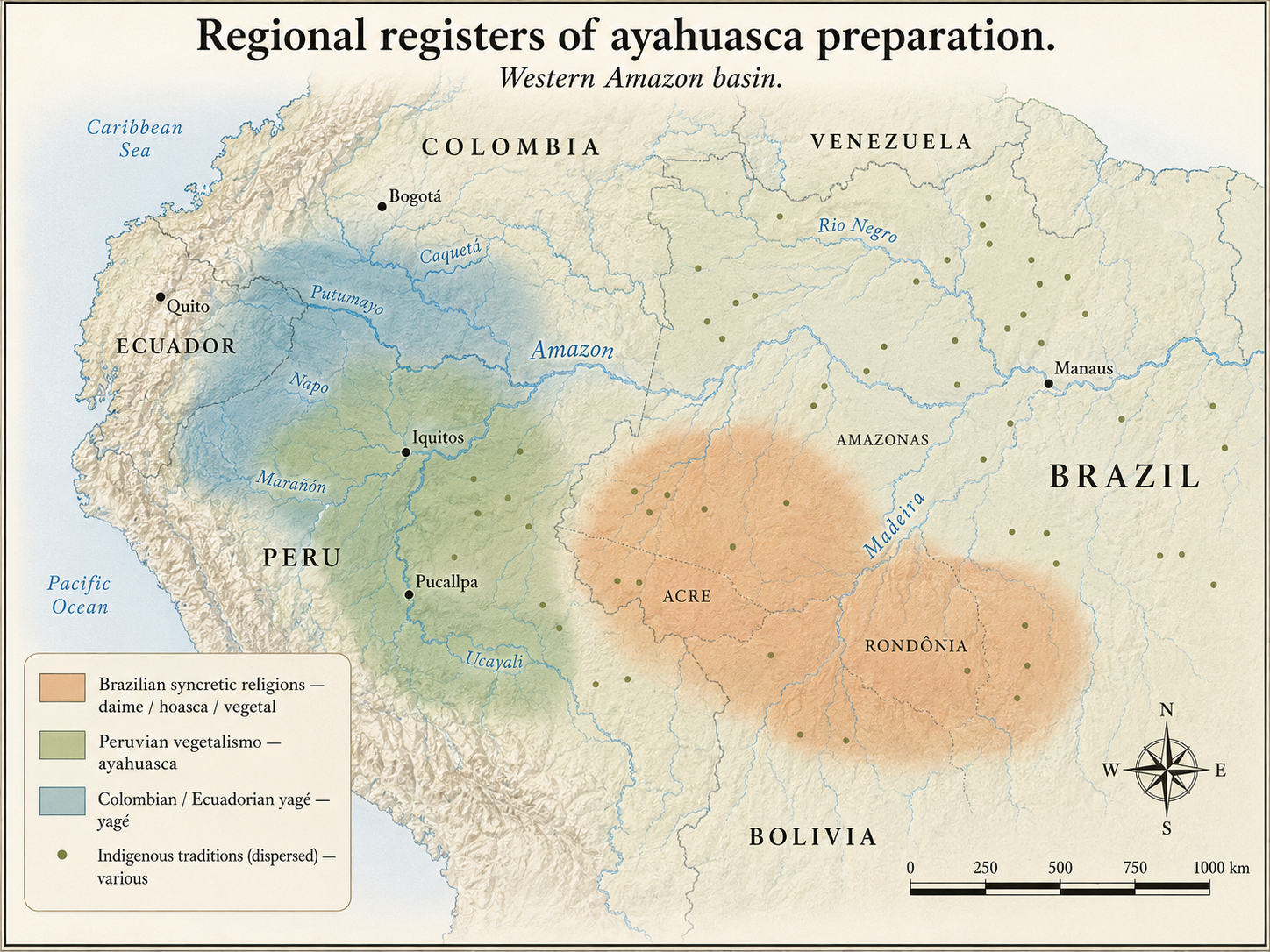
Even at the coarsest level — what plants the brew is made from, before considering varieties of those plants, the chemistry of the resulting decoction, or what was added off-record — the regional picture is more varied than the Brazilian-syncretic standardisation suggests.
Brazilian syncretic religions (Santo Daime, União do Vegetal, Barquinha) typically use B. caapi + P. viridis, often with no other admixtures, and have driven much of the standardisation visible in the global form. The brew is called daime, hoasca, or vegetal depending on the specific tradition. These traditions are also, partly because of their sacramental structure, more transparent than most about brew composition.
Peruvian vegetalismo, the mestizo shamanic tradition centred on Iquitos and the Pucallpa region, also typically uses B. caapi + P. viridis, but with much wider routine use of additional plants — mapacho, Brugmansia, ayahuma, chuchuhuasi, and the broader pharmacopoeia Bianchi and Samorini catalogue — selected by the curandero according to ceremonial intent. The brew is called ayahuasca. Dobkin de Rios's 1968–69 Iquitos fieldwork documented tohé (Datura/Brugmansia), chacruna, and narcoticised tobacco being added to brews prepared by ayahuasqueros serving the urban poor of Iquitos.
Colombian and Ecuadorian traditions, particularly among the Siona, Cofán, Secoya, Kofán, and northwestern Amazon peoples, more commonly use B. caapi + Diplopterys cabrerana. The brew is called yagé. The chemistry differs because of the 5-MeO-DMT content of Diplopterys. Burroughs, who travelled this region in 1953 looking for the brew, recorded experiences that varied enormously from one practitioner to the next — sometimes overwhelming, sometimes producing little effect, often impossible for him to interpret because he was given no information about what he had drunk. His letters to Ginsberg are an early Western record of what every subsequent foreign visitor to the practice has encountered: high variability, no disclosure, and a cultural frame that absorbs any disappointment back into the participant.
Indigenous Brazilian traditions outside the syncretic religions show much greater variation. Some Maku groups have used Tetrapterys mucronata as a single-plant brew. The Sharanahua add varying Psychotria species, Lygodium venustum leaves, Lomariopsis japurensis stems, Clusia sp., Phrygilanthus eugenioides, and others depending on the curandero. The Tikuna incorporate Petiveria alliacea, Sabicea amazonensis, and other plants. Practices vary not only across ethnic groups but across individual practitioners within them.
Modern analogue preparations outside South America frequently substitute Syrian rue (Peganum harmala) seeds for the vine as a source of β-carbolines and Mimosa hostilis root bark or Acacia species for the DMT. These are not ayahuasca in any traditional sense — the plants are different, the cultural context is different, the ceremonial framework is absent — but they are sometimes marketed as such and increasingly contribute to the global confusion about what "ayahuasca" denotes.
Why this matters for the science
The clinical and pharmacological research on ayahuasca, particularly the recent wave of trials investigating its antidepressant and broader therapeutic potential, has largely treated it as a single intervention. Trial protocols typically source brew from a single supplier — often a Brazilian religious institution that prepares to consistent specifications, which is sensible from a clinical research-design standpoint but problematic from an ethnobotanical one.
The β-carboline profile work by Callaway (2005), Santos et al. (2020), and Rodriguez et al. (2022) has documented substantial variation in harmine, harmaline, and tetrahydroharmine ratios across both B. caapi accessions and finished brews. The Biazatti folk-taxonomy work suggests that variation is not random but tracks the named varieties practitioners distinguish. The Luz et al. DNA barcoding work indicates underlying genetic structure consistent with that pattern. The harmine-partitioning finding from Rodriguez et al. suggests that even within a single brew, the chemistry consumed depends on whether and how the suspended solids are mixed back in before serving.
The implication is straightforward and largely ignored. If the brew administered in one clinical trial has a different β-carboline ratio from the brew in another, the studies are not measuring the same thing. If the Psychotria viridis used in one preparation has a different DMT concentration from another, the studies are not measuring the same thing. If a trial substitutes Diplopterys cabrerana for Psychotria viridis — as some Colombian-tradition-influenced research would — the studies are definitely not measuring the same thing, because the addition of 5-MeO-DMT to the brew is a substantive pharmacological change. If the brew has been filtered or settled before administration, the harmine exposure differs from a brew served suspended. If the brew contains no detectable DMT at all — and Callaway's data show this is not a hypothetical scenario — the trial is administering a β-carboline-only intervention misclassified as ayahuasca.
Much of the clinical research published over the last fifteen years has been collapsing variation that is real, traceable, and quantifiable. The collapse is not a small methodological footnote. It is plausibly part of the explanation for why effect sizes differ across studies, why participants describe qualitatively different experiences in ostensibly similar trials, and why the dose-response relationships in published ayahuasca research are harder to characterise cleanly than for most psychoactive interventions. Some of what looks like noise in the data may be signal — signal about variation in the underlying brew composition that no one has been controlling for.
The serious version of ayahuasca clinical research over the next decade will almost certainly need to specify brew composition the way pharmaceutical research specifies API content. Which Banisteriopsis variety, what β-carboline profile, what DMT source, what admixtures, what preparation method, served with or without suspended solids, what storage history. The folk taxonomies — Caupuri, Tucunaca, Arara — may turn out to be the simplest available shorthand for distinctions the chemistry confirms.
The cogitronomy angle
There is a particular kind of intellectual humility that this body of evidence demands and that the public conversation has not yet developed. The shamans, curanderos, feitores, taitas, and ayahuasqueros who have worked with these plants over centuries developed a taxonomy and a pharmacopoeia that contemporary methods — DNA barcoding, β-carboline profiling, machine-learning morphology, NMR analysis — are now finding tracks real biological structure. The traditional categories are not the picturesque cultural overlay on top of a scientifically resolved reality. They are, in this case, ahead of the scientific resolution. Western science is engaged in catching up.
The chuchuhuasa-and-peccary example from McKenna, Luna and Towers is the compressed illustration: practitioners encoded an accurate observation about MAOI-tyramine pharmacology in the vocabulary of plant-spirit and animal-spirit conflict, centuries before the pharmacology was available to describe it. The folk explanation and the pharmacological explanation describe the same phenomenon. Both are correct within their frames. The pharmacological frame is younger and more precise; the folk frame is older and more comprehensive. Neither is a better description than the other of the practice; they are descriptions of different layers of the same reality.
This is not a unique situation. The history of ethnobotany is full of cases where indigenous knowledge encoded distinctions that Western science took decades or centuries to formalise — Cinchona for malaria, Erythroxylum coca for stimulation, Artemisia annua for antimalarial activity, the curare alkaloids, Pilocarpus for glaucoma. The pattern is consistent enough to be a methodological lesson rather than a series of accidents. When traditional practitioners distinguish things that Western taxonomy lumps together, the practitioners are usually onto something.
But the cogitronomy point cuts both ways. Taking traditional knowledge seriously also means taking it as it actually is, not as a romanticised version of itself. The operational secrecy described above is part of the traditional practice. It is doing work, some of it legitimate ritual work and some of it less defensible. The same epistemic humility that says "the shamans got there first" should also say "the shamans, like every group of human experts, have professional incentives to protect their authority, manage their reputation, and immunise their practice against feedback." Both observations are accurate. Holding only the first is romantic. Holding only the second is dismissive. Holding both is honest.
For ayahuasca specifically, this means a few things. It means the export form of the brew, which has flattened the traditions to fit the requirements of global consumption while inheriting the operational secrecy that the traditional context originally housed, is not the most informative version. It means the practitioners who maintained the distinctions are the right consultants for any serious research programme — but research programmes need to negotiate the secrecy explicitly rather than working around it. It means the substantial pharmacopoeia of admixture plants is a research agenda waiting to be picked up by anyone willing to do the unglamorous work of characterising what is actually in the things people have been drinking for centuries. And it means, urgently, that this work needs to happen before the acculturation pressures Bianchi and Samorini already noted in 1993 finish doing their slow work of erasing the knowledge.
It also means — and this is the part the global wellness conversation will resist hardest — that "ayahuasca" as a term needs to be used with care. The word does not denote a substance. It denotes a family of substances, prepared by different peoples, in different places, with different intentions, served under different terms of disclosure, producing different effects. The most informative thing one can say about an ayahuasca experience is which version of ayahuasca produced it. The most useful question to ask of any research, retreat, ceremony, or claim is the same: which one. And the most awkward but necessary follow-up: how do you know?
What this means for ARDMT
This deep-dive is partly an argument and partly a positioning statement for what ARDMT will and will not do. We will not treat ayahuasca as a single substance. When discussing clinical research, we will note the source and composition of the brew under study where it is recoverable. When discussing traditional use, we will be specific about which tradition, which region, which practitioner lineage. When discussing the regulatory landscape, we will resist the term "ayahuasca" as a unit of regulatory analysis where it obscures more than it clarifies. When discussing the retreat economy, we will not extend its operational secrecy the courtesy of treating it as authentic ritual practice.
This is a higher epistemic standard than the field generally maintains and it will sometimes make our coverage more cautious — and more pointed — than the surrounding conversation. That is the point. The field is expanding globally and rapidly, and that expansion benefits from precision it is not currently being given. Closing some of that gap is part of what this publication exists for.
The shamans got there first. We are catching up. And we are watching what gets imported under their authority.
Filed: [24/05/2026]. Companion piece to the Biazatti et al. machine-learning folk-taxonomy review. Field observation from Gualaquiza, southeastern Ecuador, 2014–2021. Future deep-dives in this series will cover the β-carboline pharmacology in detail, the Diplopterys cabrerana tradition, the admixture pharmacopoeia plant-by-plant, the harmine-partitioning question and its implications for clinical trial design, and the regulatory implications of brew variation for the next generation of psychedelic research.
Selected references
Bianchi, A. & Samorini, G. (1993). Plants in Association with Ayahuasca. Jahrbuch für Ethnomedizin und Bewußtseinsforschung / Yearbook for Ethnomedicine and the Study of Consciousness, Issue 2, 21–42.
Biazatti, S.C., Bambil, D., Môra, R., de Alencar Figueiredo, L.F. & de Oliveira, R.C. (2026). Machine learning recovers folk classification of Banisteriopsis caapi from herbarium leaves of an ayahuasca liana. iScience 29, 115753. doi.org/10.1016/j.isci.2026.115753
Burroughs, W.S. & Ginsberg, A. (1963/2006). The Yage Letters Redux. San Francisco: City Lights.
Callaway, J.C. (2005). Various Alkaloid Profiles in Decoctions of Banisteriopsis caapi. Journal of Psychoactive Drugs 37(2), 151–155. doi.org/10.1080/02791072.2005.10399796
Dobkin de Rios, M. (1970). A Note on the Use of Ayahuasca among Urban Mestizo Populations in the Peruvian Amazon. American Anthropologist 72(6), 1419–1422. jstor.org/stable/672859
Kaasik, H., Souza, R.C.Z., Zandonadi, F.S., Tófoli, L.F. & Sussulini, A. (2021). Chemical Composition of Traditional and Analog Ayahuasca. Journal of Psychoactive Drugs 53(1), 65–75. doi.org/10.1080/02791072.2020.1815911
Luna, L.E. (1986). Vegetalismo: Shamanism among the Mestizo Population of the Peruvian Amazon. Stockholm: Almqvist & Wiksell International.
Luz, T.Z., Cunha-Machado, A.S. & da Silva Batista, J. (2023). First DNA barcode efficiency assessment for an important ingredient in the Amazonian ayahuasca tea: mariri/jagube, Banisteriopsis (Malpighiaceae). Genetic Resources and Crop Evolution 70, 1605–1616. doi.org/10.1007/s10722-022-01522-3
McKenna, D.J., Luna, L.E. & Towers, G.H.N. (1995). Biodynamic Constituents in Ayahuasca Admixture Plants: An Uninvestigated Folk Pharmacopoeia. In R.E. Schultes & S. von Reis (eds.), Ethnobotany: Evolution of a Discipline. Portland: Dioscorides Press, 349–361.
Oliveira, R.C. et al. (2023). Ethnobotany and wood anatomy of Banisteriopsis caapi ethnotaxa and Diplopterys cf. pubipetala, components of ayahuasca in Brazilian rituals. Economic Botany 77, 18–47.
Pollan, M. (2018). How to Change Your Mind: The New Science of Psychedelics. New York: Penguin Press.
Rodriguez, L., López, A., Moyna, G., Seoane, G.A., Davyt, D., Vázquez, Á., Hernández, G. & Carrera, I. (2022). New Insights into the Chemical Composition of Ayahuasca. ACS Omega 7, 12307–12317. doi.org/10.1021/acsomega.2c00795
Santos, B.W.L., Oliveira, R.C., Sonsin-Oliveira, J., Fagg, C.W., Barbosa, J.B.F. & Caldas, E.D. (2020). Biodiversity of β-carboline profiles of Banisteriopsis caapi and ayahuasca. Plants 9, 870. doi.org/10.3390/plants9070870
Schultes, R.E. (1986). Recognition of variability in wild plants by Indians of the Northwest Amazon. Journal of Ethnobiology 6, 229–238.
Schultes, R.E. & Hofmann, A. (1992). Plants of the Gods: Their Sacred, Healing, and Hallucinogenic Powers. Rochester, VT: Healing Arts Press.
Schultes, R.E. & Raffauf, R.F. (1990). The Healing Forest: Medicinal and Toxic Plants of the Northwest Amazonia. Portland: Dioscorides Press.
Biazatti, S.C., Bambil, D., Môra, R., de Alencar Figueiredo, L.F. & de Oliveira, R.C. (2026). Machine learning recovers folk classification of Banisteriopsis caapi from herbarium leaves of an ayahuasca liana. iScience 29, 115753. doi.org/10.1016/j.isci.2026.115753. Figure reproduced under CC BY 4.0.