Books
The Bell, the Clog, and the Gallows
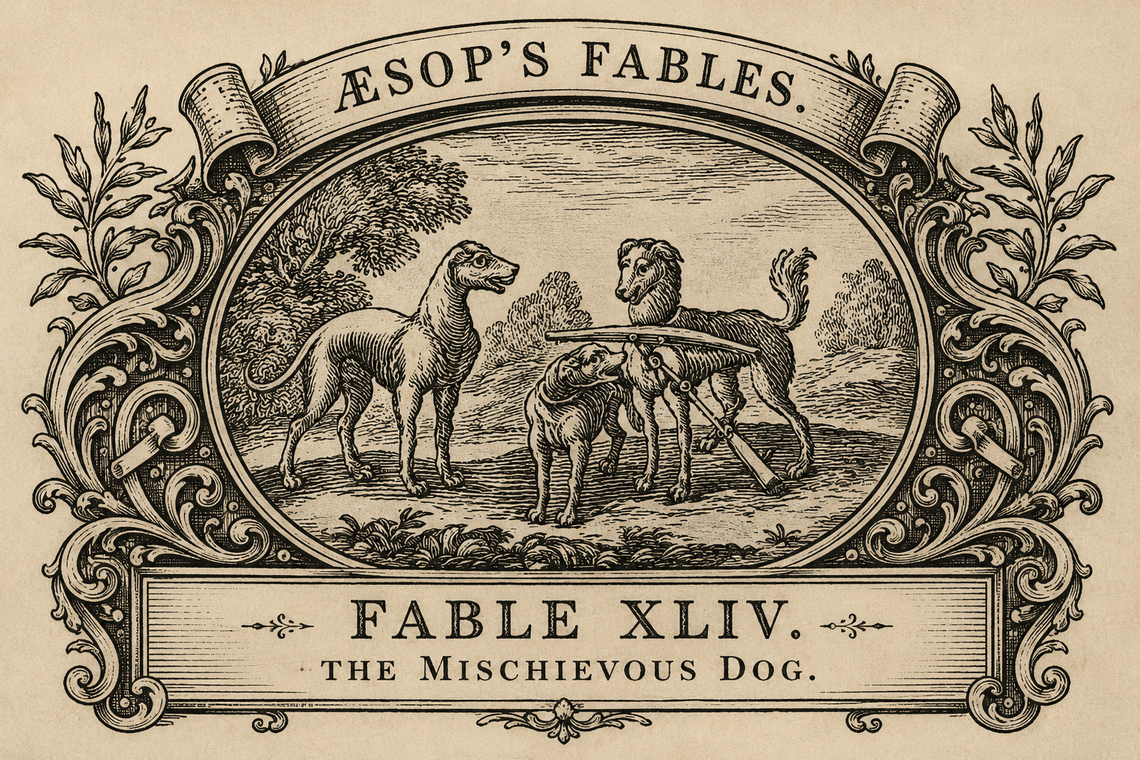
The Mischievous Dog from Babrius to Gibbs
In Caxton's 1484 Aesop — the first Aesop ever printed in English — the fable of the Mischievous Dog closes with an image that has no obvious business being there. A thief is led through the streets to the gallows. Around his neck, the rope is made of gold rather than the ordinary hemp. He rejoices, the text tells us, that his noose is so rich and fair. The image is meant to clarify the fable's moral: only a fool celebrates the ornament of his own disgrace.
The image is not classical.
Neither Avianus, who wrote the Latin verse version of the fable around the year 400, nor Babrius, who wrote the older Greek version some two centuries earlier, gives the fable an execution scene. Both end with the elder dog's verbal rebuke and then nothing — no thief, no gallows, no rope of gold. The hanged-thief image entered the fable somewhere in its medieval transmission, and reached English print with Caxton in the 1480s. It would remain in the English tradition for the next three centuries until Thomas Bewick, in 1818, found a use for it.
The name Aesop, in any case, functions less as an author than as a transmission field. Greek, Latin, medieval French, early printed English, eighteenth-century Whig English, Victorian schoolroom English, and modern scholarly English have all claimed the fable while quietly remaking it. No single authorial Aesop is recoverable; what survives is not an origin but a tradition — a sequence of editorial choices made by successive generations about what the form must be made to do.
The Mischievous Dog, taken across its full transmission, turns out to be less a stable moral tale than a record of successive interpretive needs. Each translator alters the object around the dog's neck — bell, bronze, clog, drum, golden noose, and, in Bewick's hands, even the badge of office — in order to change what disgrace, public shame, authority, and moral correction are made to mean. What shifts across the centuries is the moral technology fastened to the dog; the dog is recognisably the same offender throughout. What follows here traces that sequence from the second-century Greek to the early twenty-first-century English, attending closely to what each version chose to keep, what it added, what it suppressed, and why. It closes with a fresh English translation produced for the present edition, drawing on what the textual archaeology has uncovered.
The Greek and the Latin
The oldest version we have is Babrius 104, written in Greek choliambic verse in the second century CE (Rutherford 1883). It is the shortest, the sparest, and in several ways the strangest of the versions considered here.
Λάθρῃ κύων ἔδακνε· τῷ δὲ χαλκεύσας ὁ δεσπότης κώδωνα καὶ προσαρτήσας πρόδηλον εἶναι μακρόθεν πεποιήκει. ὁ κύων δὲ τὸν κώδωνα δι' ἀγορῆς σείων ἠλαζονεύετ'· ἀλλὰ δὴ κύων γραίη πρὸς αὐτὸν εἶπεν "ὦ τάλαν, τί σεμνύνῃ; οὐ κόσμον ἀρετῆς τοῦτον οὐδ' ἐπιεικείης, σαυτοῦ δ' ἔλεγχον τῆς πονηρίης κρούεις."
A dog used to bite by stealth. His master forged a bell and tied it to him, so he might be marked from a distance. The dog paraded through the marketplace, shaking the bell, full of his own importance. But an aged bitch said to him: "Wretch, what are you so proud of? This is no ornament of virtue or decency. What you sound is the proof of your own wickedness."
Three features of Babrius's version disappear in every later English version of the story.
First, the setting is specified. The dog parades δι' ἀγορῆς — through the marketplace, the agora, the heart of Greek civic life. The setting matters: in classical Greek thought, public self-display and arrogant injury belonged to the moral world of hybris — the assertion of self at others' expense, the kind of offence the Athenian city took seriously enough to legislate against (Fisher 1992; Rawlings 2011). The secret-biter who flaunts his bell is not merely foolish; he is making his offence public in the very space where communal judgement gathered, and the elder dog names it for what it is. The dog's display is staged at the centre of communal life; the bell is meant to be heard by everyone who matters. No later English version preserves this setting. The dog merely parades.
Second, the rebuker is female. The text says κύων γραίη — an aged dog, in the feminine. The grammar is explicit: κύων is a noun of common gender, taking either masculine or feminine articles and adjectives, and γραίη is unambiguously feminine in every grammatical parsing. The voice of moral correction in the oldest surviving version of the fable is an old female dog. The Latin tradition that follows masculinises her. So does every English version, from Caxton's moost auncyent through Croxall's "sly old poacher" to Townsend's "old hound." Two thousand years of transmission, and the female voice of the rebuke has quietly disappeared from the story.
Third, the elder's closing line contains a pun the English tradition will never recover. The Greek κρούεις means both "you strike" and "you sound" — used of bells, drums, and metaphorical proclamations alike. The line σαυτοῦ δ' ἔλεγχον τῆς πονηρίης κρούεις means simultaneously "you strike the proof of your own wickedness" (the dog literally hits the bell as he walks) and "you sound the proof of your own wickedness" (the bell makes audible his guilt). The bell-strike and the moral testimony are the same act. Laura Gibbs, translating from the Greek in 2002, reaches for "you are shamefully beating the drum of your own evil deeds" — a creative attempt, but the choice of "drum" is interpretive; the Greek has only the bell.
Avianus, writing in Latin elegiac couplets around the year 400 (Ellis 1887), is doing something a little different. He opens with an abstract framing — Haud facile est prauis innatum mentibus ut se / Muneribus dignas suppliciove putent — "It is not easy for those of wicked nature to think themselves deserving of reward rather than punishment." This couplet is missing in Babrius, and may itself be a later editorial addition to the Avianus text. After it, the story is recognisably the same: silent biter, master orders a bell, dog mistakes the bell for honour, elder rebukes him. Avianus's rebuke is more rhetorically elaborate than Babrius's — more lines, more questions, more decoration — but ends in the same place:
Non hoc virtutis decus ostentatur in aere, Nequitiae testem sed geris inde sonum.
This is no honour of virtue displayed in the bronze; what you bear from it is the sound that testifies to your wickedness.
And that is it. The Latin, too, ends on the rebuke. No execution. No hanged thief. No moral coda extending the image beyond the elder dog's spoken correction.
Both ancient versions, then, end on the elder's spoken rebuke. The medieval and English transmission that follows will systematically extend, transform, or compress that closing — adding visual material, adding moral images, restructuring the framing, eventually stripping the whole inheritance down to an aphorism. Before tracing that history, it is worth setting the full sequence out at a glance.
A summary of the transmission
| Version | Date | Object | Rebuker | Added image | Closing | Effect |
|---|---|---|---|---|---|---|
| Babrius 104 | c. 2nd c. CE | bell (κώδων) | aged female dog | none | verbal rebuke (κρούεις pun) | civic shame in the marketplace |
| Avianus VII | c. 400 | bronze / bell | elder dog | none | verbal rebuke | Latin moral abstraction |
| Caxton | 1484 | bell | ancient dog | thief led to gallows in golden noose | narrator commentary with hanged-thief image | medieval moral spectacle |
| Croxall | 1722 | clog | sly old poacher (human) | inherited from Caxton | extended prose Application | Whig social satire |
| Bewick | 1818 | clog | poacher (human) | "Wages of Cruelty" tailpiece engraving | Application plus paired engravings | punishment and public cruelty foregrounded |
| Townsend | 1867 | bell | old hound | none | single-line aphorism | schoolroom moral compression |
| Vernon Jones | 1912 | bell | old hound | none | inherited aphorism | popular nursery Aesop |
| Gibbs | 2002 | drum (figurative) | old dog | none | verbal rebuke (Greek recovered) | Greek return, but not full restoration |
| Present edition | 2026 | bell | aged bitch (κύων γραίη) | none | verbal rebuke (κρούεις partially recovered) | civic shame and feminine voice restored within the ancient animal frame |
The sequence above is not a stemma in the strict philological sense. It does not claim that every later English version descends mechanically from every earlier one. It traces instead a visible English reception history: the recurring choices by which translators, editors, and illustrators have made the fable legible to their own age.
How the medieval additions entered
Caxton's 1484 Aesop (Jacobs 1889) is at three translational removes from Avianus's Latin. He translated it from Julien Macho's French Esope (Lyon, c. 1480), which was translated from Heinrich Steinhöwel's Latin-and-German Aesop (Ulm, 1476-77), one of the first major European printed fable collections. At any point in that chain — Steinhöwel, Macho, or Caxton — material could be added.
Caxton's text has two clear additions to the Avianus framework.
The first is a curious framing device. Caxton's master does not own one dog; he owns two. A fader of famylle whiche had two dogges, of the whiche the one withoute ony barkyng bote the folke, and the other dyd barke and bote not. The master, observing the malice of the silent biter, fastens the bell to that dog rather than the noisy one. The two-dog opening turns the fable into a small parable about hidden versus visible danger — the silent biter, not the loud one, may be the real menace. This is structural, and it has no classical precedent in either the Greek or the Latin.
The second is the hanged thief. After the elder dog's rebuke, Caxton's narrator adds a commentary in his own voice: a moche fole were the theef whiche that men ledde for to be hanged, and that he had a cord of gold aboute his neck, yf he shold make Joye therof, how be hit that the corde were moche ryche and fayre. A medieval image — execution as public spectacle, the doomed man parading toward the gallows — has been grafted onto a Roman fable about a dog. It sits comfortably within a medieval Christian moral logic: the soul ornamented for sin is still bound for damnation, however gilded the rope.
These additions matter because they fix the fable's English shape for three centuries. Whatever later English translators do with the story, they are reacting to Caxton's framing, not to Avianus's.
The object around the neck
It is worth pausing here, before tracing the fable forward into the eighteenth century, to observe what is actually happening across the transmission. The moral burden of the story is carried less by the dog than by the object attached to him.
Babrius's bell is evidentiary: it makes secret harm publicly audible. Avianus's bronze is testimonial: the sound itself is the witness against the dog's character. Caxton's golden noose is eschatological: it turns ornament into damnation, the bell-as-shame inflated into the rope-as-judgement. Croxall's clog, when it arrives in 1722, is disciplinary: it restrains the offender while marking him as dangerous. Bewick, in 1818, will turn the same clog into something closer to an indictment of state authority — the badge of office and the badge of punishment treated as the same kind of mark. Townsend's bell, restored in 1867, is reputational: it becomes a warning against confusing notoriety with fame. Gibbs's drum, reached for through the Greek in 2002, is expressive: guilt becomes self-advertisement, the wrongdoer's own announcement of himself.
The object changes because the moral technology changes. Each generation reaches for the implement that does the moral work it needs done — auditory shame, public exposure, religious damnation, social discipline, political critique, aphoristic warning, expressive disclosure. The dog is recognisably the same offender throughout. What he has been made to wear has changed every century.
Croxall and the Whig poacher
Samuel Croxall's 1722 Fables of Aesop and Others — written as a Whig clergyman's deliberate answer to Sir Roger L'Estrange's Tory edition of 1692 (Patterson 1991) — preserves Caxton's two-dog structure and the moral inheritance of the hanged thief, but makes a small editorial change with disproportionate consequences. The bell becomes a clog: a heavy wooden weight, an actual restraint device, the kind of implement used to slow a chronic biter so it could not run at people. Croxall's dog is not a discreet warning to others; it is a creature being publicly disciplined.
A certain man had a Dog which was so curst and mischievous, that he was forced to fasten a heavy clog about his neck, to keep him from running at, and worrying people.
The bell-as-warning has become the clog-as-punishment. Within the line traced here, this is Croxall's decisive alteration; no earlier version preserves the clog.
The dog's antagonist also shifts, and the change is structural. He is no longer the medieval moost auncyent fellow-dog, nor Avianus's senior de plebe. He is a sly old poacher, who was one of the gang — a human character planted inside an animal fable, a socially disreputable outsider, a man from the criminal community delivering moral truth to a deluded social climber. This is the most consequential structural move in the fable's English history after Caxton: Croxall breaks the animal-only frame. From this point on, the rebuker in English versions will be either human (in Croxall and Bewick) or merely vestigially canine (Townsend's "old hound" delivering a one-line aphorism), but the matriarchal animal elder of the Greek will not return.
In a collection already shaped by party-political rivalry with L'Estrange, the fable's concern with false honours and public disgrace could hardly remain morally neutral. Croxall's Whig reader may be invited to recognise himself in the poacher rather than the dog — to read the fable as social satire from the perspective of the underclass moralist rather than the chastened upstart.
Bewick's reactivation
With Bewick, the fable ceases to be merely translated and becomes staged on the page.
In 1818, Thomas Bewick — engraver, Tyneside dissenter, one of the most quietly political figures in English popular print — published his own Fables of Aesop, and Others. His text of The Mischievous Dog reproduces Croxall almost exactly: the clog, the sly poacher, the structure, all preserved. But Bewick is also doing something Croxall could not, because he is doing it visually as well as in prose. He frames the fable between two engravings of his own design.
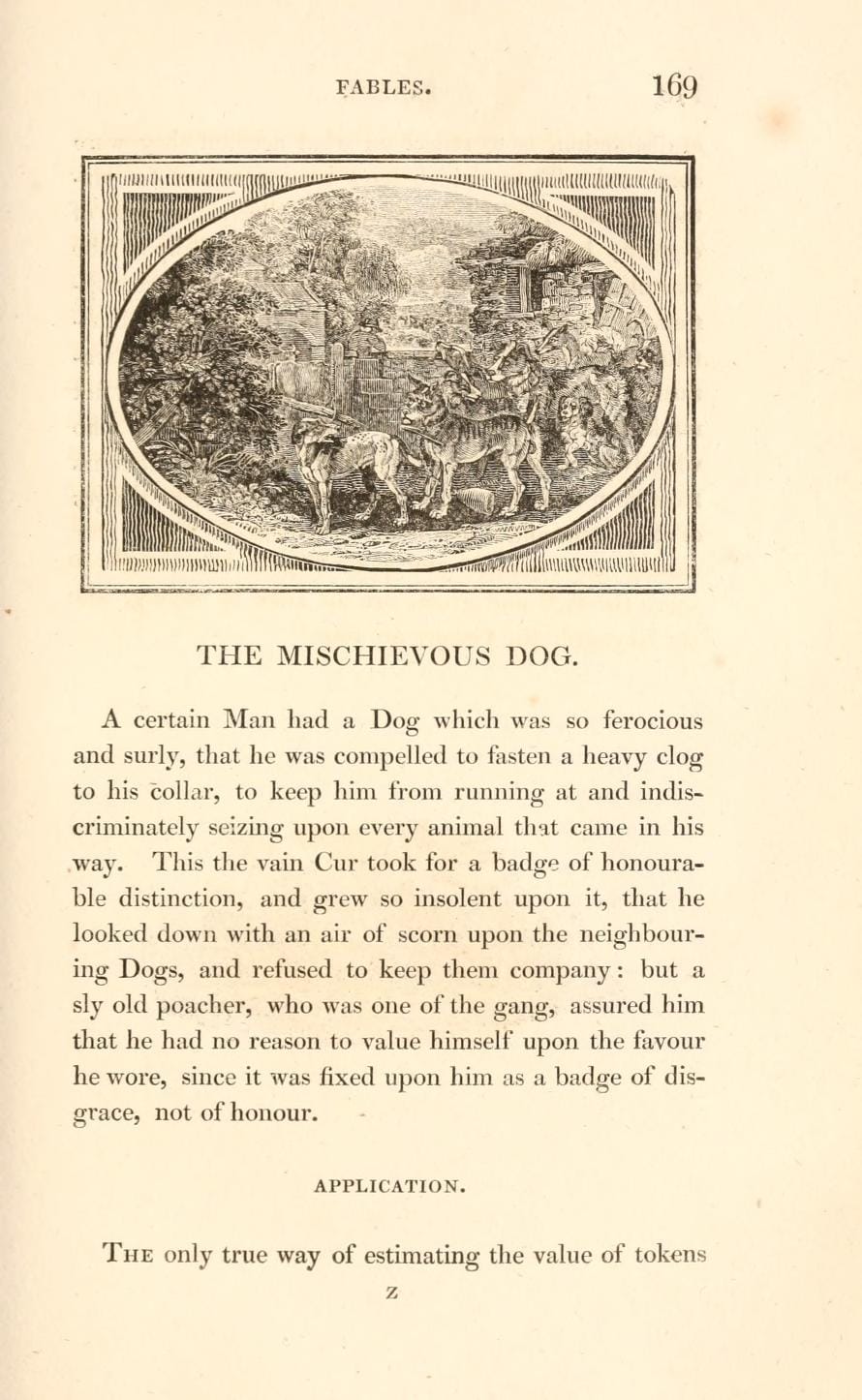
The headpiece, set at the top of the fable on page 169, shows the dog in a rural farmyard, the heavy clog clearly visible around its neck, with other dogs nearby. Bewick has visually committed to Croxall's clog rather than Caxton's bell or the ancient sources' bronze. The disciplinary object — the wooden restraint — has become the canonical image. The dog is no longer warned about; the dog is shown wearing the marks of his own correction.
Bewick's "Application" — the prose moral attached to each fable — goes somewhere Croxall did not:
The only true way of estimating the value of tokens of distinction, is to reflect on what account they were conferred. Those which have been acquired for virtuous actions, will be regarded as illustrious signs of dignity; but if they have been bestowed upon the worthless and base, as the reward of vice or corruption, all the stars and garters, and collars of an illustrious order, — all the tinsel glories in which such creatures may strut about in fancied superiority, will not mask them from the sight of men of discernment, who will always consider the means by which their honours have been obtained, and truly estimate them as badges of abasement and disgrace.
Directly beneath this Application, on page 170, Bewick has placed a tailpiece engraving. It shows a man bound at the wrists, led behind a horse-drawn cart through a jeering crowd, his back being whipped by an executioner. Above the cart, on a small banner, runs the legend THE WAGES OF CRUELTY. The next fable (The Bull and the Goat) begins on the following page with its own headpiece. The procession-to-punishment image is attached specifically to The Mischievous Dog, not to the volume's general visual programme.
What Bewick has done, by pairing the two engravings around Croxall's politicised text, is reactivate Caxton's medieval hanged-thief image at the precise moment in British history when capital punishment was one of the most violently contested moral questions of the day. Between 1810 and 1832, when the Punishment of Death Act began the dismantling of the so-called Bloody Code, public execution was being defended as moral pedagogy and attacked, by reformers and dissenters, as state cruelty dressed as justice (Gatrell 1994).
The visual argument is direct. The headpiece shows what is done to a dog: a wooden clog, a restraint device, a publicly displayed mark of correction. The tailpiece shows what is done to a man: a procession to public punishment, the body whipped by an executioner. Between the two engravings sits the Application about badges of abasement and disgrace, however much they may resemble all the stars and garters, and collars of an illustrious order. The clog the dog wears, the wounds the man receives, and the stars and garters of the powerful are placed in visual and rhetorical sequence as if they were the same kind of mark. The mischievous dog wears a clog as a sign of his viciousness; the executioner wears the badges of office of state justice. Both, Bewick may be implying, are wearing their wickedness in plain sight. The fable, in Bewick's hands, may be read as an indictment of the men who hang men.
Whether Bewick reached the hanged-thief image by deliberate reading of Caxton's 1484 Aesop or by some more diffuse channel of medieval moral imagery is unclear. What matters is that the image was available to him in the English tradition because Caxton had put it there three centuries before. Bewick did not invent the procession to the gallows; he recovered it, and gave it a tailpiece.
Townsend's epigram
By the second half of the nineteenth century, this complex medieval-political layer has been planed away.
George Townsend's 1867 translation — the version that became the standard English-language schoolroom Aesop for the next two generations — restores the bell (the clog vanishes again), removes the human poacher (the rebuke is delivered by "an old hound"), drops Croxall's long Application entirely, and reduces the moral to a single line:
Notoriety is often mistaken for fame.
It is a perfectly compressed epigram. It is also a near-total depoliticisation. The Victorian schoolroom did not need a hanged thief, a sly old poacher, or a clog-as-punishment; it needed an aphorism children could memorise. V. S. Vernon Jones's 1912 translation, illustrated by Arthur Rackham, inherits Townsend's epigram unchanged. Many popular English Aesops since have followed the same compressed moral pattern.
What is striking, two thousand years downstream from Babrius's marketplace and feminine elder, is how much has been compressed away. The marketplace setting is gone. The feminine voice is gone. The κρούεις pun is gone. The elaborated Avianus rhetoric is gone. The two-dog structure is gone. The clog is gone. The hanged thief is gone. The Whig poacher is gone. Bewick's executioner is gone. What remains: six words.
The Greek recovery
Laura Gibbs's 2002 Oxford World's Classics translation, going back to the Greek of Babrius rather than working through the English tradition, recovers a quite different fable. The elder tells the foolish one, "You are shamefully beating the drum of your own evil deeds." The drum, not the bell. The recovery is significant — it pulls the fable out of its English medieval-Victorian lineage and reconnects it to a Greek prosodic tradition where the moral is not a subtle ornament but loud public testimony.
But Gibbs, working at the scale of nearly six hundred fables for a single edition, does not capture everything in the Greek. The marketplace appears, but the female voice does not — Gibbs gives the rebuke to "an old dog," unsexed. The κρούεις pun becomes the "drum" metaphor, which is interpretive rather than literal. What Gibbs has done is real and valuable: she has recovered the Greek tradition for modern English readers. The translation that follows here is an attempt to recover what even Gibbs left behind.
What the fable tells us about fables
The Mischievous Dog helps explain why scholars disagree about Aesop's politics. Page DuBois has argued that the fables work reactionarily: by mapping human inequality onto biological hierarchies between species, they naturalise human inequities as if these too were facts of nature (DuBois 2003). Others, against this reductive reading, have argued that the fables work in both directions — read by underdogs as resistance and by the powerful as warnings against ambition, the form's political ambidexterity being precisely what has kept it in cultural use for two and a half millennia. Jeremy Lefkowitz has taken the question one step further: animal fables, he argues, are themselves self-aware about their own artifice, leaving the gap between symbolic animal and real animal deliberately open (Lefkowitz 2014).
This fable supports the latter two readings especially. Its politics are not fixed in the animal plot; they are activated by the object, the setting, the speaker, and the moral frame attached to it. Croxall pursued one reading, Bewick the opposite, and the fable accommodated both without contradiction. The form is not an argument for any one politics. It is a formal occasion for politics to happen.
A new English translation
What follows is the translation of The Mischievous Dog produced for the present edition. The setting is the marketplace, as in Babrius — recovered after two thousand years of unspecified parading. The object around the dog's neck is the bell, as in both ancient sources and as in Townsend's restoration — not Croxall's disciplinary clog and not Gibbs's interpretive drum. The rebuker is an aged bitch — animal, female, and aged, as the Greek κύων γραίη unambiguously says she is. The fable ends on her spoken rebuke, as both Babrius and Avianus end. The medieval hanged thief and Bewick's executioner — both fascinating as commentary — have no place in a translation that aspires to the ancient form.
The decision to preserve the rebuker as an animal, rather than humanising her in the manner Croxall introduced in 1722, is a deliberate editorial position. Croxall's "sly old poacher," and Bewick's preservation of the same human voice a century later, set a pattern that has not been seriously questioned since: every later English version either humanises the rebuker in some way or empties the animal interlocutor of any matriarchal weight. But the fable form's particular power — its accessibility, its imaginative reach, its capacity to make moral questions vivid through animals talking among themselves — depends on the animal-only frame the ancient sources maintained. This edition takes the position that the moral voice should remain where Babrius placed it: with an old female dog, in the marketplace, addressing the proud young dog who refuses to hear what his own bell is sounding.
On the English term for κύων γραίη: the literal Greek is preserved here as "an aged bitch." The word has accumulated pejorative weight in modern English that the Greek κύων (in its feminine sense) did not carry, but to soften it risks repeating the very move the chapter has documented — successive generations of translators choosing comfort over accuracy and burying the female voice in the process. The LSJ entry's primary translation of κύων is, after all, "dog, bitch," without hedging. The philological workings on these two words appear in the editorial notes for this fable.
There was a dog who used to bite people in secret. He gave no warning, but struck suddenly from below.
His owner, so that the dog's pretended decency could no longer deceive the neighbours, fastened a bell at its throat. The bronze would clatter and warn anyone it came near.
The dog mistook the bell for an honour. He paraded through the marketplace shaking it, head lifted, looking down on the other dogs as he passed.
An aged bitch, who had been watching, came forward and spoke.
"What is it you think you're advertising? You imagine this was given to you for your goodness, your decency, your worth? It is no such thing. What you are sounding is the proof of your own wickedness — and you ring it through the marketplace for all of us. It does not take long to learn what the sound means."
The English here aims for a register between Babrius's compression and Croxall's elaboration — modern but not slangy, deliberate but not archaic. The closing line attempts to carry as much of the Greek κρούεις pun as English will accommodate: what you are sounding / you ring it through the marketplace preserves both the bell-strike and the moral testimony as a single act, though neither rendering captures the Greek doubleness completely. The full force of the pun, like the full force of any classical text in any English, remains partly out of reach. What can be carried across has been carried across.
What the dog has worn
The dog is recognisably the same offender throughout. What he wears around his neck — the bronze, the bell, the clog, the drum, the noose — has changed shape every century. So has the question of who, exactly, is meant to read it.
Babrius staged the dog in the marketplace and gave the rebuke to an old female elder. The Latin tradition lost the marketplace and quietly masculinised the rebuker. Caxton's English added the two-dog frame and the hanged thief. Croxall added the disreputable poacher and replaced the bell with a clog, breaking the animal-only frame in the process. Bewick framed the clog visually with the procession to the gallows, at the moment the gallows themselves were under political attack. Townsend buried the whole inheritance under an aphorism. Vernon Jones repeated the aphorism. Gibbs went around the English tradition altogether and came back with a Greek drum, but left the female elder behind. The version offered in this edition restores the marketplace, restores the female elder's voice, returns the bell to its ancient role, and ends where Babrius and Avianus end — on the rebuke itself, within the animal frame the ancient sources maintained.
The history of this fable in English is the history of what each century has chosen to keep, what it has added, and what it has buried — from the sparer classical witness that already contained the seed of many later readings. The hanged thief, which English readers from Caxton onward took to be part of the ancient story, was a medieval invention. Bewick's executioner, which looks like a radical political move, may in fact be the recovery of a medieval Christian one. The "old hound" who delivers Townsend's epigram was a female dog in the Greek who has been quietly masculinised through successive stages of transmission.
There is no original Aesop to recover. There are only the choices each generation has made about which version of the fable it needed — and about what, in its own age, the dog should be made to wear.