ARDMT Field Notes
Speech biomarkers after 5-MeO-DMT: can how you talk reveal what changed?
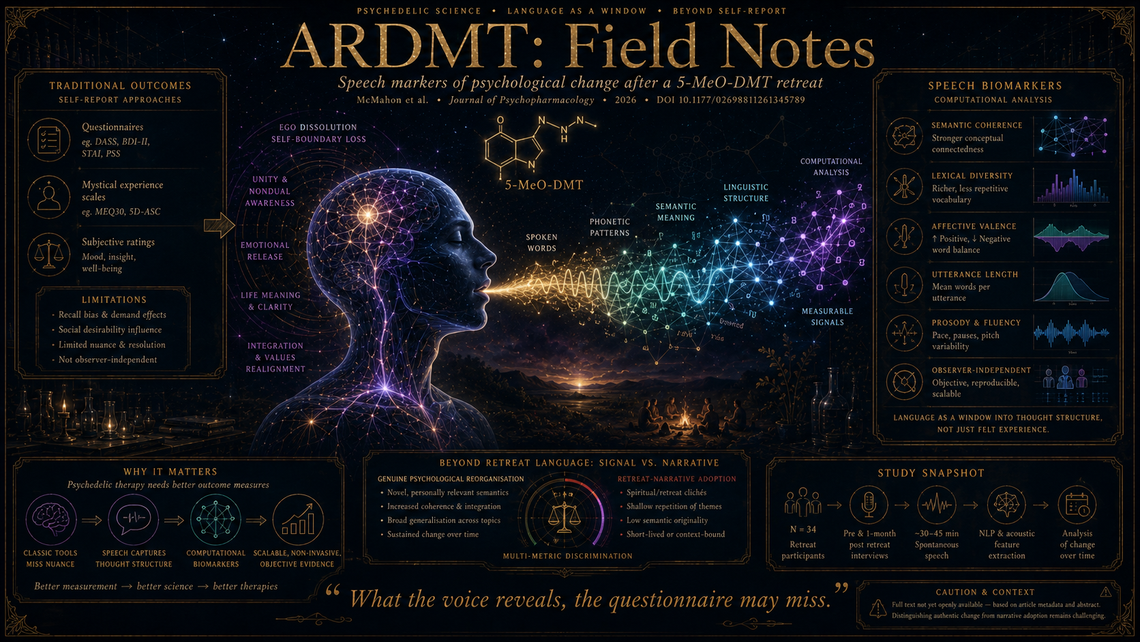
The claim and the context
Kuc, McAlpine, Sellers, Blackburne, Lametti, and Skipper, writing in the Journal of Psychopharmacology, report on what they term "speech markers of psychological change" following a 5-MeO-DMT retreat (PMID: 42175700; DOI: 10.1177/02698811261443690). The premise is straightforward, even if its execution is anything but: rather than relying solely on self-report questionnaires to capture the psychological aftermath of a psychedelic experience, the authors have turned to computational analysis of speech as an objective, or at least observer-independent, outcome measure.
The idea that how one speaks might betray how one has changed is not, of course, new. Clinical psychiatry has long noted that speech rate, prosody, semantic coherence, and lexical diversity shift with mood disorders, psychosis, and recovery. What is relatively new is the systematic application of computational linguistics to psychedelic science — a field that has, until recently, been almost wholly dependent on subjective rating scales (the Mystical Experience Questionnaire, the 5D-ASC, and their various cousins) to quantify states that participants themselves frequently describe as ineffable.
Where this fits in the field
5-MeO-DMT occupies a curious niche. It is the more potent, more ontologically disruptive cousin of N,N-DMT, producing experiences that tend towards ego dissolution and unitive states rather than the baroque visual narratives more typical of its dimethyl relative. The naturalistic retreat setting — which this study appears to employ — has become a common research paradigm for 5-MeO-DMT, partly because the compound's legal status varies by jurisdiction and partly because the ceremonial or semi-ceremonial context is how most participants actually encounter it. Several groups have published on retreat-based 5-MeO-DMT outcomes, documenting reductions in depression and anxiety scores alongside increases in measures of well-being and life satisfaction.
The limitation of that body of work, as its own authors have acknowledged, is its reliance on self-report. Expectancy effects, demand characteristics, and the sheer social desirability of reporting a meaningful experience after an intense ritual all conspire to inflate subjective measures. Speech analysis offers a partial remedy. It is not immune to context effects — one may speak differently when one knows one is being recorded — but it captures dimensions of psychological state that are difficult to consciously manipulate. Semantic coherence, the ratio of positive to negative affect words, mean utterance length: these are features that shift with genuine changes in cognitive and emotional processing, and they are hard to fake.
Prior work in the psychedelic speech-analysis space has been sparse. A handful of studies have examined linguistic features during or after psilocybin sessions, and there is a small literature on speech disorganisation during acute psychedelic states. Applying these methods specifically to 5-MeO-DMT, and specifically to the question of lasting psychological change rather than acute intoxication effects, appears to be a genuinely novel contribution.
Why this line matters
If psychedelic-assisted therapy is to move towards clinical integration — and several programmes are attempting exactly that — it will need outcome measures that go beyond asking patients whether they feel better. Speech biomarkers are attractive because they are non-invasive, scalable (a recorded interview is cheaper than an fMRI), and increasingly amenable to automated analysis. They also capture something that questionnaires miss: the structure of thought, not merely its self-reported content.
The question, naturally, is whether speech changes following a psychedelic retreat reflect genuine psychological reorganisation or simply a shift in narrative register — participants adopting the vocabulary and cadence of the retreat culture they have just inhabited. Disentangling these will require careful control conditions, and it will be worth seeing how the authors have addressed that problem.
Note on access
The full text of this paper is not yet openly available. ARDMT has worked from the published metadata and abstract. When the complete methods and results are accessible, we shall return with a proper analysis — sample sizes, specific speech features examined, effect sizes, and the authors' own discussion of limitations all merit close attention.
Marginalia
There is something pleasingly recursive about using language to study what a drug does to language — particularly a drug whose users so reliably insist that language is inadequate to the task. If the speech markers hold up, they may tell us rather more about what 5-MeO-DMT does to the narrator than any narration could.