ARDMT Field Notes
Shulgin's tryptamine notebooks: the cartography DMT research still navigates by
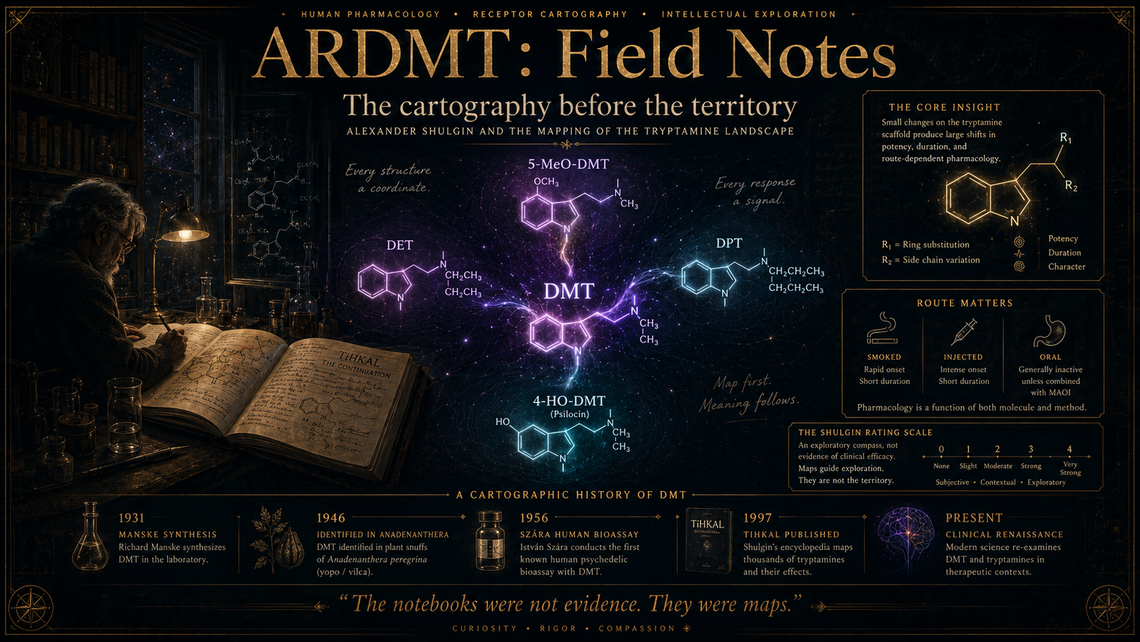
The Cartography Before the Territory
A good deal of contemporary DMT research proceeds as though the compound arrived fully formed from the pharmacological ether, a molecule of inherent fascination requiring no genealogy. This is, of course, nonsense. The systematic context in which DMT became a tractable research subject owes an enormous debt to the methodical, deeply eccentric work of Alexander Shulgin, whose tryptamine notebooks represent one of the more unusual contributions to twentieth-century pharmacology.
The Man and the Method
Shulgin's approach to psychoactive tryptamines was, in essence, that of a synthetic organic chemist who also happened to be his own principal test subject. This is an arrangement that modern ethics committees would regard with something between horror and incomprehension, but it produced a body of structure-activity relationship data that remains, in certain respects, unmatched. His laboratory notebooks — many of which informed the tryptamine half of TiHKAL (Tryptamines I Have Known and Loved), published in 1997 with Ann Shulgin — record the synthesis, dosing, qualitative effects, and duration data for dozens of tryptamine variants, DMT among them.
What distinguished Shulgin's work from mere psychonautic enthusiasm was its systematicity. He understood that altering a single substituent on the tryptamine scaffold — a methyl group here, a methoxy there, a shift from the 4- to the 5-position of the indole ring — produced compounds with markedly different pharmacological profiles. DMT itself (N,N-dimethyltryptamine) was one node in a vast combinatorial space that included 5-MeO-DMT, DET, DPT, 4-HO-DMT (psilocin), and scores of less familiar analogues. Shulgin mapped these nodes with the patience of a Victorian naturalist cataloguing beetles, recording onset times, effective doses, and qualitative character with a precision that belied the subjective nature of the observations.
DMT in the Tryptamine Landscape
Before Shulgin's systematic mapping, DMT occupied a somewhat orphaned position in psychopharmacology. It had been synthesised by Richard Manske in 1931, identified as a constituent of Anadenanthera peregrina snuffs by Oswaldo Gonçalves de Lima in 1946, and subjected to human bioassay by Stephen Szára in 1956, after Sandoz declined to supply him with LSD on account of his being Hungarian. Szára's intramuscular injections established the basic phenomenology — rapid onset, intense visual effects, short duration — but DMT remained something of a curiosity, a tryptamine too brief and too fierce to attract the clinical interest that psilocybin and LSD enjoyed.
Shulgin's contribution was to place DMT within a rational pharmacological framework. By systematically varying the N-alkyl substituents, the ring hydroxylation and methoxylation patterns, and the side-chain length, he showed that DMT's particular character — its potency, its brevity, its apparent dependence on route of administration — was not arbitrary but a predictable consequence of its molecular structure. The rapid metabolism by monoamine oxidase, which renders DMT orally inactive unless combined with an MAO inhibitor (the basis of ayahuasca), could be understood in terms of the unsubstituted indole nitrogen and the accessibility of the dimethylamine to oxidative deamination. Compounds with bulkier N-substituents, or with ring substitutions that altered electronic density, behaved differently — sometimes more potent, sometimes less, sometimes longer-acting, sometimes inactive altogether.
The Legacy for Contemporary Research
The relevance of Shulgin's tryptamine work to present-day DMT research is not merely historical. Several active lines of enquiry trace their intellectual ancestry directly to his structure-activity observations.
First, the current interest in DMT's sigma-1 receptor agonism and its potential neurotrophic effects rests on a pharmacological specificity that only makes sense against Shulgin's comparative backdrop. When researchers ask why DMT appears to promote neural plasticity in ways that, say, DPT does not — or does so differently — they are implicitly working within the structure-activity framework that Shulgin established. The selectivity profile of a given tryptamine at 5-HT2A, sigma-1, and trace amine-associated receptors is, in the end, a function of the molecular features Shulgin spent decades cataloguing.
Second, the development of non-hallucinogenic tryptamine analogues — the so-called "tabernanthologs" and related compounds being pursued by David Olson's laboratory at UC Davis and others — is essentially an extension of Shulgin's programme by more sophisticated means. The question "can we retain neuroplastic effects whilst eliminating subjective psychoactivity?" is a structure-activity question, and it is answerable only because Shulgin (and, to be fair, a handful of contemporaries) mapped enough of the tryptamine space to make rational modification feasible.
Third, Shulgin's observations on route-dependent pharmacology — the stark difference between smoked, injected, and oral DMT — anticipated what is now a significant clinical consideration. Trials of intravenous DMT, such as those conducted by Rick Strassman in the 1990s and those currently underway at Imperial College London and elsewhere, must grapple with pharmacokinetic questions that Shulgin's notebooks, in their idiosyncratic way, were among the first to document carefully.
The Uncomfortable Methodological Question
There is, of course, a tension in celebrating Shulgin's work. His methods — self-experimentation, small groups of trusted colleagues rated on a subjective scale of his own devising (the "Shulgin Rating Scale," running from minus to plus-four), no blinding, no placebo control, no institutional oversight — would not survive first contact with a contemporary peer reviewer. The data in TiHKAL are, by modern standards, anecdotal. N-of-one observations, however carefully recorded, do not constitute evidence in the sense that a randomised controlled trial does.
And yet. The field continues to rely on Shulgin's observations as a starting point for hypothesis generation, compound selection, and dose-ranging. This is a pragmatic acknowledgement that some knowledge can only be gathered by methods we have subsequently — and rightly — deemed insufficient. The notebooks are not evidence; they are something arguably more valuable at the exploratory stage: they are maps, drawn by someone who actually visited the territory, however unsystematically by our present lights.
One does not navigate by a hand-drawn map when GPS is available. But one is grateful that someone drew the map before the satellites went up.
Marginalia
It is a peculiar feature of DMT's research history that its most systematic early pharmacological context was provided by a man working from a private laboratory in Lafayette, California, largely outside institutional science. That this arrangement produced work of lasting utility says something either favourable about the power of individual curiosity or slightly damning about the pace of institutional pharmacology. Quite possibly both.