Understanding
Endogenous DMT in Humans: A Critical Review of the State of the Evidence
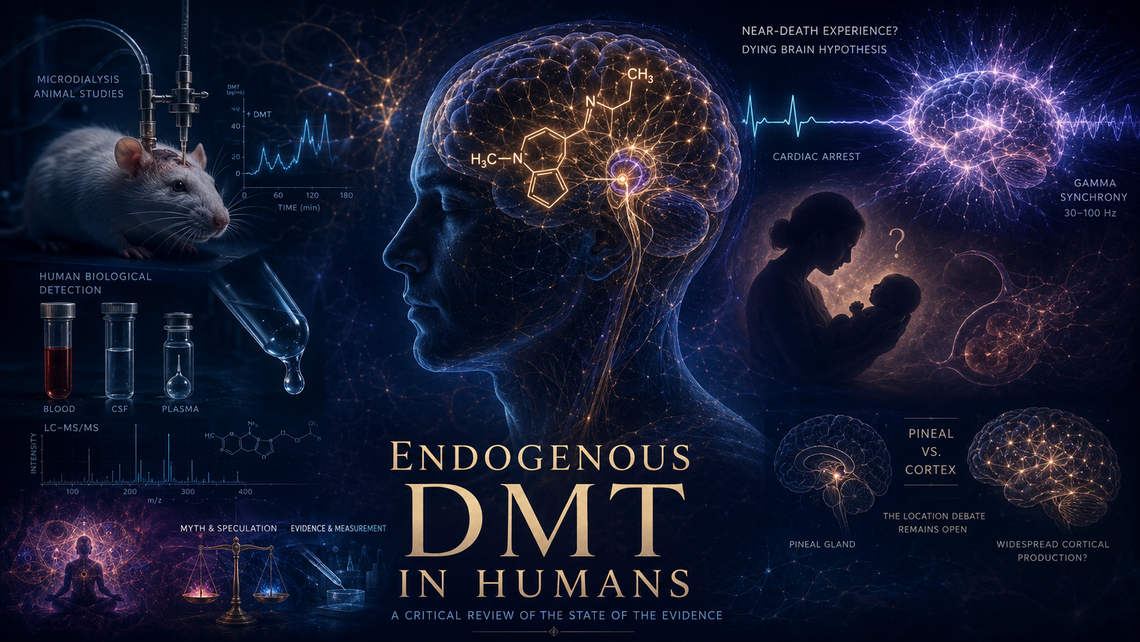
A critical review of the evidence, the inferences drawn from it, and the limits of cross-species extrapolation: detection, biosynthesis, function and psychoactive sufficiency across the rat literature, human detection studies, dreaming, near-death and birth hypotheses, sigma-1 and intracellular receptor work, and current trials
1. Framing the Question: Four Sub-Problems, Not One
The endogenous dimethyltryptamine debate is often presented as a single question – does the human brain make DMT? – but it is in fact at least four distinct questions, each with its own evidential standards and each capable of being settled, or unsettled, independently of the others. Conflation of these sub-problems is the principal source of confusion in both the scientific and popular literature.
The first sub-problem is detection: can DMT be measured at all in human biological materials, however briefly and however close to the limit of quantification? The second is biosynthesis: is DMT actively synthesised by human tissue, and through what enzymatic pathway? The third is functional role: whatever its quantity and provenance, does endogenous DMT do anything – does it modulate cellular physiology, signalling, immunity, development, or behaviour? The fourth, and the one that has dominated the popular imagination, is psychoactive sufficiency: are endogenous concentrations of DMT in human brain ever high enough to produce subjective effects of the sort exogenous DMT produces?
These four questions are not coextensive. It is entirely possible, for example, for the answer to the detection question to be affirmative while the answer to the psychoactive-sufficiency question is negative; this is, in fact, the position taken by David Nichols and colleagues. It is also possible for the answer to the functional-role question to be affirmative – through sigma-1 receptor activation or intracellular 5-HT2A signalling at low concentrations – without DMT ever reaching what would be required for a psychedelic state. The strongest version of the popular claim, that endogenous DMT explains near-death experiences, dreams and birth phenomenology, requires affirmative answers to all four questions. The weakest version, that DMT is detectable as a trace amine in human urine, has been adequately established for half a century. Most of the genuinely interesting debate lies between these two poles, in the unresolved middle ground of synthesis, function and pharmacological relevance.
A second clarifying point concerns scope. Almost all of the experimental evidence on endogenous DMT comes from rats. The direct human evidence is much thinner, consisting principally of peripheral fluid detection and mRNA expression in archived autopsy material (a state of affairs surveyed in detail in §7). Cross-species inference is therefore an unavoidable feature of this literature, and any conclusion must be qualified by the recognition that what is true of the laboratory rat may or may not be true of the conscious human being.
A third clarifying point, deeper than the four sub-problems but easily overlooked, concerns the distinction between presence and purpose. Even granting affirmative answers to detection and biosynthesis, a further question remains: is endogenous DMT a specifically selected, functionally important biological signal – an evolved component of mammalian physiology with a defined role – or is it a low-level by-product of broader amine metabolism, present because the enzymes that produce it have other substrates and other principal functions? The popular discourse tends to assume that DMT, because it is biochemically present and pharmacologically striking, must be there for something. The Glynos et al. (2023) findings that INMT is a multi-substrate enzyme with diverse cellular roles, and that DMT may not even be its principal product in rat tissue, point in the opposite direction: the enzymatic machinery responsible for DMT synthesis appears not to have been selected for DMT production specifically. This does not mean DMT plays no role; broader pharmacological promiscuity is consistent with a real, if subtle, functional contribution. But it does mean that simply demonstrating presence does not entail demonstrating purpose, and reviewers of this literature should be alert to the temptation to over-read a biochemical trace as evidence of adaptive design.
A final orientational note. The empirical literature reviewed below has, over the past decade and a half, settled into three live positions rather than the older binary of believers and sceptics. The strong experiential view, descending from Strassman, holds that endogenous DMT plays a substantive role in altered states of consciousness from dreaming through death. The strong sceptical view, descending from Nichols and reinforced by Palner, holds that endogenous DMT is at most a low-abundance trace amine – plausibly a by-product of broader amine metabolism – present in concentrations inadequate to support the experiential claims. The subtle-physiological view, developed by Frecska, Szabo, Vargas, Olson and others, holds that endogenous DMT may matter biologically through intracellular signalling and stress-protective pathways without ever reaching psychedelic concentrations. This three-position map replaces the older binary and organises much of what follows. The conclusion returns to it as the most useful framework for understanding where the field actually stands.
2. Historical Genealogy: Transmethylation, Schizophrenia and the Origin of the Programme
The serious scientific study of endogenous DMT in humans did not originate from interest in psychedelic experience as such. It originated from a heterodox theory of schizophrenia. The transmethylation hypothesis, advanced by Humphry Osmond and John Smythies in 1952, proposed that endogenous N-methylated metabolites of monoamine neurotransmitters might be the chemical basis of psychotic symptoms. Their starting observation was structural: mescaline, then the best-characterised hallucinogen, is itself an N-methylated phenethylamine that the body could in principle produce from naturally occurring substrates. If a slight perturbation of normal methylation chemistry could generate a hallucinogen in vivo, then schizophrenia might be a disorder of methyl-group balance.
Through the 1960s and 1970s the hypothesis drove a substantial empirical programme. Julius Axelrod, who would later win the Nobel Prize for his work on catecholamine metabolism, demonstrated enzymatic N-methylation of serotonin and other amines in vitro in the early 1960s (Axelrod, 1961), and his laboratory and others gradually identified the enzyme responsible, indolethylamine N-methyltransferase (INMT), in mammalian brain tissue (Morgan and Mandell, 1969; Mandell and Morgan, 1971). At the same time, analytical chemists began searching for the actual N-methylated metabolites in patient fluids. Franzen and Gross reported tryptamine, DMT and 5-methoxy-DMT in human blood and urine in Nature in 1965. Through the late 1960s and 1970s several groups, using progressively more sensitive techniques, reported detection of these compounds in urine, plasma and, by the late 1970s, cerebrospinal fluid (Corbett et al., 1978; Smythies et al., 1979). Schizophrenic patients were typically the comparison group of interest, on the hypothesis that their fluids would contain more of the suspect compounds.
The transmethylation programme collapsed for several reasons in the late 1970s and 1980s. The first was that elevated DMT levels in schizophrenic patients, even where detected, did not correlate cleanly with symptom severity, treatment response or symptom course. The second was that the analytical methods of the era – principally fluorimetry and early gas chromatography – were vulnerable to interference from structurally similar compounds, and several of the more striking reports could not be replicated with more specific mass-spectrometric techniques. The third, and decisively, was the rise of the dopamine hypothesis of schizophrenia, which provided a more tractable and pharmacologically actionable framework and absorbed the field's attention. By the mid-1980s, endogenous DMT had become a niche topic, of interest mainly to a small group of analytical chemists and clinical psychopharmacologists.
Two features of this older literature deserve emphasis because they bear on the present debate. First, the methodological problems Barker, McIlhenny and Strassman (2012) catalogued in their meta-review of sixty-nine studies were not merely technical limitations of a bygone era; they are structural problems of measuring a compound that is present in extraordinarily small quantities, has a plasma half-life of minutes, and is rapidly degraded by monoamine oxidase. The same problems shape the current debate. Second, the transmethylation programme bequeathed to its successors an important and underappreciated point: the question of endogenous DMT does not require, and never did require, a psychedelic answer. Osmond and Smythies were not interested in whether endogenous DMT made anyone trip; they were interested in whether it modulated cellular signalling in a way that produced or contributed to mental illness. The contemporary debate, particularly in its sigma-1 and intracellular-receptor forms, has in this sense returned to its origins after a four-decade detour through Strassman's Spirit Molecule.
3. Biosynthesis and Metabolism
The canonical biosynthetic pathway for DMT in mammals is straightforward in outline and increasingly contested in detail. Dietary tryptophan is decarboxylated by aromatic L-amino acid decarboxylase (AADC) to produce tryptamine. Tryptamine is then twice methylated, with S-adenosyl-L-methionine (SAM) as the methyl donor, to produce first N-methyltryptamine (NMT) and then DMT. The enzyme responsible for the methylation steps was, until very recently, universally identified as INMT. Catabolism is dominated by monoamine oxidase A (MAO-A), which oxidatively deaminates DMT to indole-3-acetaldehyde and subsequently 3-indoleacetic acid; this is why exogenous DMT must be combined with a MAO inhibitor (the role of harmine and harmaline in ayahuasca) to be orally active.
INMT was cloned and characterised in human and rabbit tissues in the late 1990s and early 2000s (Thompson et al., 1999; Thompson and Weinshilboum, 1998). The human gene maps to chromosome 7p15.2–p15.3, consists of three exons, and encodes a 263-amino-acid protein. INMT mRNA is widely expressed in peripheral tissues, with particularly high expression in lung, thyroid, adrenal gland and the gastrointestinal tract, and lower-level expression in brain. Crucially for the present debate, Dean et al. (2019) used in situ hybridisation to identify INMT mRNA in both rat and human cerebral cortex, pineal gland and choroid plexus, and showed that in rat brain INMT is co-localised with AADC – meaning that the same neurons that can produce tryptamine can also methylate it. In rat peripheral tissues, by contrast, INMT and AADC are largely expressed in different cell populations. This co-localisation was the principal piece of evidence that brain itself might be a site of endogenous DMT biosynthesis, rather than merely a site of DMT uptake from peripheral sources.
The most disruptive recent finding in the biosynthesis literature, however, is that this canonical picture may be wrong. Glynos and colleagues at the University of Michigan, in a 2023 Scientific Reports paper, generated a novel INMT-knockout rat and assayed for tryptamine-dependent methylation activity. Their findings were unexpected on two counts. First, brain and lung tissues from INMT-knockout rats showed essentially the same tryptamine-methylation activity as wild-type tissues, suggesting that INMT is not necessary for tryptamine methylation in rat. Second, the products of that methylation activity were neither NMT nor DMT; the enzymatic chemistry that proceeds in INMT-null rat tissue produces some other tryptamine derivative whose identity was not pursued in the paper. Recombinant rat INMT was also unable, in this study, to produce NMT or DMT from tryptamine, in contrast to recombinant rabbit and human INMT, both of which produced detectable DMT.
These findings have two important implications. First, the biosynthetic pathway for DMT in rats may not run through INMT at all; alternative enzymatic routes – perhaps involving other N-methyltransferases, perhaps involving non-canonical chemistry – must exist. Second, the rat–rabbit–human differences are real and pharmacologically substantial. Rabbit INMT produces DMT efficiently from tryptamine; rat INMT, in Glynos's hands, does not; human INMT does, but with low affinity (apparent Km in the millimolar range, well above physiological tryptamine concentrations) (Thompson et al., 1999). The widespread cross-species generalisations that pervade the popular literature on endogenous DMT – the assumption that what is true of the rat brain is straightforwardly true of the human brain – are, in light of these findings, premature.
Tissue distribution adds further complication. Lung tissue, particularly in rabbit, has long been known to contain extremely high INMT activity – orders of magnitude higher than brain – and it has been speculated since the 1970s that lung might be a primary site of peripheral DMT biosynthesis. The lung's strategic position in the circulation (it receives the entire cardiac output) and its high INMT expression have made it the most plausible candidate for a tissue that might supply DMT to the rest of the body. Adrenal gland and the gastrointestinal tract also express INMT at high levels. The choroid plexus, identified by Dean et al. (2019) as an INMT-positive structure within the brain, is particularly suggestive because it sits at the blood–cerebrospinal-fluid barrier and would be well placed to supply DMT to the CSF.
The metabolic side of the equation is also more complex than is often acknowledged. DMT is a substrate for monoamine oxidase A, but it is also taken up by the serotonin transporter (SERT) and by the vesicular monoamine transporter 2 (VMAT2), with which it has been shown to interact (Cozzi et al., 2009). Whether endogenous DMT is stored in synaptic vesicles in the way that canonical monoamine neurotransmitters are stored has been a recurring question. Palner et al. (2026), reviewed in detail below, tested precisely this hypothesis – that DMT might co-localise with serotonin in serotonergic terminals – and found no evidence for it. If endogenous DMT is biologically relevant in mammalian brain, it does not appear to act through the classical synaptic-vesicle release machinery, and its actions are more likely to be at intracellular sites where it accumulates by diffusion or active transport.
Beyond INMT, recent work has drawn attention to the broader physiological footprint of the enzyme. INMT expression is dysregulated in several cancers, and is markedly downregulated in prostate, lung and other tumours (Liu et al., 2022; reviewed in the comprehensive 2025 INMT review by Vasconcelos and colleagues). This implies that whatever INMT does in vivo, it does something more than DMT synthesis: it has substrate specificity for a range of endogenous and exogenous amines, and its loss has consequences for cellular proliferation, apoptosis and immune signalling that are not obviously explicable in terms of DMT alone. The simplest reading of this evidence is that INMT, like many methyltransferases, is a multi-substrate enzyme whose principal physiological role is not necessarily the production of any single compound, and that DMT synthesis is one among several outputs.
4. Methodological Hierarchy: What Would Count as Proof?
Before evaluating individual findings, it is useful to be explicit about the evidential hierarchy through which a claim of physiologically relevant endogenous DMT in humans would have to climb. The hierarchy below moves from the lowest evidential bar (detection) to the highest (real-time human measurement under defined physiological conditions), and is, in effect, the framework against which the rest of this essay assesses the literature.
The first rung is detection in peripheral fluids: the demonstration that DMT can be measured in human blood, plasma, urine or cerebrospinal fluid above the limit of quantification and above any plausible analytical false-positive rate. This was achieved repeatedly from 1965 onwards, although, as Barker et al. (2012) emphasised, individual older studies vary enormously in their analytical rigour. The cumulative weight of methodologically sound studies, particularly those using mass-spectrometric techniques after 1973, supports the conclusion that DMT is a real, if extremely low-abundance, constituent of human peripheral fluids.
The second rung is post-mortem detection in human tissue. Several studies have reported DMT in post-mortem human brain homogenate (reviewed in Hidalgo Jiménez and Bouso, 2022), but post-mortem sampling is confounded by the redistribution of compounds across membranes during agonal and post-agonal states, by enzymatic degradation, and by the impossibility of distinguishing endogenous brain-synthesised DMT from peripheral DMT that has crossed the blood–brain barrier ante-mortem. Post-mortem evidence is necessary but not sufficient.
The third rung is in vivo detection in animal brain by microdialysis. Barker, Borjigin, Lomnicka and Strassman (2013) did this for rat pineal gland; Dean et al. (2019) did it for rat cerebral cortex; Glynos et al. (2026) reported follow-up perfusion data; and Palner et al. (2026) attempted it in four rat brain regions with conflicting results. In vivo microdialysis in conscious animals is currently the gold standard for the question, and the disagreement between the Borjigin laboratory's and the Palner/Cumming laboratory's findings is therefore central to the present uncertainty.
The fourth rung is enzyme-expression evidence in human tissue. The demonstration that the relevant biosynthetic enzymes (INMT, AADC) are expressed, in the right cells, in the right anatomical locations, supports the inference that biosynthesis is at least possible. Dean et al. (2019) provided this for human cortex, pineal and choroid plexus, at the level of mRNA. Protein-level evidence in human brain is much sparser. Expression evidence is, however, only suggestive: an enzyme can be expressed without being kinetically active under physiological substrate concentrations, and the Glynos et al. (2023) INMT-knockout result reminds us that demonstrated enzyme expression is not the same as demonstrated function.
The fifth rung is inducibility: the demonstration that endogenous DMT levels change in response to defined physiological stimuli (stress, hypoxia, cardiac arrest, sleep stage, parturition). Dean et al. (2019) reported a rise in cortical DMT after experimental cardiac arrest in rats; Harrison (1981) reported a rise to approximately 500 nM after prolonged isolation stress, as discussed in Barker (2025). These inducibility findings are crucial because they distinguish endogenous DMT as a regulated signalling molecule from endogenous DMT as a constitutively low-abundance metabolic by-product.
The sixth rung is receptor-occupancy plausibility. Even if endogenous DMT is present and inducible, the question is whether the concentrations achieved are sufficient to produce detectable occupancy at relevant receptors – 5-HT2A, sigma-1, the trace amine-associated receptors, intracellular 5-HT2A pools – under physiologically realistic conditions. This is the central battleground of the Nichols versus Borjigin debate.
The seventh and highest rung is real-time human measurement under defined physiological conditions: continuous neurochemical sampling from a conscious or dying human brain during cardiac arrest, REM sleep, intense meditation, or parturition. To my knowledge no such study has ever been conducted. The practical and ethical obstacles are substantial. Until such measurements exist, the strongest claims in the popular endogenous-DMT literature – that DMT surges at death, that it generates dreams, that it is released at birth – remain unverified by direct human evidence and must be evaluated on the basis of inference from animal studies and from indirect human evidence.
A reader who internalises this hierarchy will find the rest of the literature considerably easier to navigate, because most disputes turn out, on inspection, to be disputes about which rung an investigator has actually reached and whether they have over-interpreted their data by claiming evidence for a higher rung than they have actually climbed.
It is also worth being explicit about what would falsify each of the major positions that follow, since a fair-minded review should define the conditions under which its own conclusions would have to be revised. The case that humans produce endogenous DMT at biologically meaningful concentrations would be substantially weakened by replication of the Palner et al. (2026) null result in a third independent laboratory using methodology pre-registered in advance, by failure to detect any DMT in plasma or cerebrospinal fluid from resuscitated cardiac-arrest survivors using validated nano-LC tandem mass spectrometry, or by demonstration that the positive findings of the Borjigin laboratory reflect analytical artefacts attributable to inadequate internal standards or insufficient chromatographic resolution. The case that endogenous DMT exerts functionally relevant intracellular effects through sigma-1 or intracellular 5-HT2A receptors would be substantially weakened by quantitative receptor-occupancy modelling showing that the picogram-to-nanogram concentrations measured in tissue produce occupancy of these targets at levels below those required for downstream signalling, or by demonstration that the in vitro neuroprotective effects of exogenous DMT do not generalise to in vivo conditions in animals with intact biosynthetic machinery, or by genetic disruption of endogenous DMT production producing no detectable cellular or behavioural phenotype. The case that rat findings on endogenous DMT generalise to humans would be substantially weakened by the demonstration that human INMT either is not active in vivo against physiological tryptamine concentrations, or that the human biosynthetic pathway differs in ways that produce qualitatively different cellular distributions or substantially lower concentrations than those reported in rat. None of these falsifying experiments has yet been conducted, and the willingness of investigators to commit to such experiments would be a useful test of the field's readiness to settle its own central questions.
5. Animal Evidence: From Pineal Microdialysis to the 2026 Null Result
The animal evidence on endogenous DMT has accumulated in successive waves, each producing both confirmatory and contradictory findings. The earliest reports, from the late 1960s and the 1970s, came from post-mortem homogenate studies and from in vitro enzyme assays. Saavedra and Axelrod (1972) demonstrated formation of N-methylated tryptamines by enzymes in rat brain extracts. Christian et al. (1977) reported detection of DMT in mammalian brain and characterised it tentatively as an endogenous neuroregulatory agent. Beaton and Morris (1984) measured DMT, 5-methoxy-DMT and related compounds in developing rat brain across the first month of postnatal life using gas chromatography–mass spectrometry with isotope dilution. Their finding – that DMT levels were detectable from birth, remained low during early development, peaked transiently around postnatal days 12 and 17, and subsequently returned to low baseline – is the closest the literature has come to demonstrating a developmental role for endogenous DMT and is regularly cited in support of the hypothesis that DMT might be functionally relevant to early brain maturation. The Beaton and Morris finding has, however, not been replicated with modern methodology, and the interpretation of these transient peaks is unclear.
Harrison (1981) reported that prolonged isolation housing stress elevates DMT concentrations in rat brain to levels in the range of 500 nM, an enormous increase from the low-to-undetectable baseline of unstressed group-housed animals. Barker (2025), in his recent rodent-brain review for Progress in Neuro-Psychopharmacology and Biological Psychiatry, draws particular attention to this stress-induced spike as evidence that endogenous DMT is regulated rather than constitutive. This figure, however, warrants substantial methodological caution and is cited here only with explicit reservations. The Harrison study pre-dates modern tandem mass spectrometry, relies on chromatographic and detection methods now considered inadequate for unambiguous identification of low-abundance tryptamines in complex biological matrices, has not been independently replicated in the more than four decades since its publication, and is known to this review only through Barker's (2025) summary rather than through direct inspection of the primary publication. The 500 nM figure is therefore best understood as a historically influential but methodologically fragile data point: interesting for the inducibility hypothesis it has been used to motivate, but not a quantitative claim that can be relied upon at face value. If true, the inducibility implication is significant; whether it is true with anything like that magnitude is, on present evidence, undetermined.
The modern era of in vivo measurement began with Barker, Borjigin, Lomnicka and Strassman (2013), who used LC/MS/MS analysis of microdialysate sampled directly from the pineal gland of living rats and reported the presence of DMT, its N-monomethyl precursor and its major metabolite. This was an important methodological advance because microdialysis avoids the artefacts of post-mortem homogenisation and allows neurochemical sampling in the conscious, behaving animal. The 2013 finding was that DMT is detectable in the rat pineal at low but real concentrations.
Dean et al. (2019) extended the methodology to the cerebral cortex of pineal-intact and pinealectomised rats. Three findings of this study are central to the present debate. First, extracellular DMT concentrations in the rat visual cortex were reported to be in the same range as those of canonical monoamine neurotransmitters, particularly serotonin. Second, pinealectomy did not eliminate cortical DMT, demonstrating that the pineal is not the principal source of brain DMT (a striking deviation from Strassman's earlier hypothesis, which had centred on the pineal). Third, experimental cardiac arrest produced a substantial rise in cortical DMT, comparable in magnitude to the rise in other neurotransmitters during the same event. The Dean paper has been the most-cited piece of evidence in support of the proposition that the mammalian brain produces neurotransmitter-relevant quantities of DMT.
Glynos et al. (2026), continuing the Borjigin laboratory's programme, reported further brain-perfusion data consistent with neurotransmitter-comparable DMT concentrations in rat brain. (This paper was initially circulated as a bioRxiv preprint in April 2024, was cited in that form by Barker's 2025 review, and was peer-reviewed and formally published in Journal of Neuroscience in February 2026; readers consulting the earlier review will encounter it cited as "Glynos et al. 2024".) Barker (2025) summarises these data, reporting frontal cortex concentrations of approximately 60 nM and cerebellar concentrations of approximately 30 nM in group-housed rats. The combined picture from the Borjigin-Pal-Barker laboratories through early 2026 is therefore one of detectable, regulated endogenous DMT in rat brain at concentrations approaching those of established neurotransmitters.
Against this picture, the 2026 paper by Palner, Kolesnik, Baun, Poetzsch and Cumming stands as a direct methodological challenge. The Palner group at the University of Southern Denmark and the Cumming group at Bern University Hospital had no prior public commitment to either side of the endogenous-DMT debate. Their methodology was specifically optimised to maximise the chances of detection: they administered pargyline (a monoamine oxidase inhibitor) to block enzymatic degradation of any DMT present, and probenecid to block transport-mediated clearance of the principal acidic metabolite 3-indoleacetic acid. They sampled four brain regions – frontal cortex, striatum, diencephalon and cerebellar vermis – in adult rats. They also tested whether exogenously administered DMT, delivered with harmine to slow metabolism, was retained in serotonergic terminals by pre-treating animals with the SSRI escitalopram and the VMAT2 inhibitor dihydrotetrabenazine.
The results were unambiguous. No endogenous DMT was detected in any of the four brain regions, even with metabolic breakdown inhibited. Exogenously administered DMT was not meaningfully retained in serotonergic neurons. The authors concluded, in language calculated to settle a debate rather than continue it, that DMT is neither formed nor retained in serotonin terminals in the adult rat brain, and that any natural levels must be extremely low or regulated by mechanisms outside the brain's serotonergic system.
How the Palner 2026 and Borjigin laboratory findings are to be reconciled is now the field's central methodological problem. Several possibilities exist. First, strain differences: rats are not biologically uniform, and the Sprague-Dawley and Wistar strains used in different laboratories can differ substantially in monoaminergic biology. Second, age and stress differences: Beaton and Morris (1984) suggest that DMT in rat brain is age-dependent, and Harrison (1981) suggests it is stress-dependent; if the Palner animals were adult and housed under low-stress conditions, low-to-undetectable concentrations would be expected. Third, methodological differences in sample handling, internal standards, and chromatographic separation: deuterated DMT is itself a controlled substance, which complicates analytical work, and laboratories may differ in the quality of their internal standards. Fourth, the possibility that the Borjigin laboratory's reported concentrations reflect analytical artefacts (this is implicit in Palner's conclusion, although not stated polemically). The decisive piece of work that the field now needs is independent replication by a third laboratory, with full methodological transparency on each side. Until such replication exists, the rat literature on endogenous DMT brain concentrations cannot be considered settled.
6. Assay and Measurement Limitations
The Borjigin–Palner disagreement is partly a substantive question about whether endogenous DMT exists in adult rat brain at neurotransmitter-comparable concentrations, and partly a question about how to measure it. Any reader attempting to weigh the conflicting findings needs at least a working understanding of why measuring endogenous DMT is technically difficult, why historically influential figures from older literature may be unreliable, and why two competently conducted modern studies can reach opposite conclusions about the same compound in the same species without either being plainly wrong.
The analytical problem starts with abundance. Endogenous DMT in mammalian biological materials is present at concentrations in the picogram to low-nanogram per millilitre or per gram range, often at or below the lower limit of quantification for the techniques used in older studies. This places DMT detection at the technical limit of routine mass spectrometry, and well below the working range of the fluorimetric, paper-chromatographic and early gas-chromatographic methods that dominated the literature before the introduction of mass-spectrometric techniques in the mid-1970s. The progressive evolution of analytical capability – from fluorimetry to GC–MS with single ion monitoring (Narasimhachari and Himwich, 1973), to liquid chromatography with tandem mass spectrometry (LC–MS/MS) from the late 1990s onwards, to current nano-flow LC–MS/MS – has steadily raised the methodological floor, and several findings that appeared striking under older methodology have not survived re-examination under newer methods.
A second class of problem concerns specificity. DMT is one of a family of structurally similar tryptamines, several of which are also endogenous and present at similar or higher concentrations in the same biological matrices. N-methyltryptamine (NMT, DMT's biosynthetic precursor), 5-methoxy-N,N-dimethyltryptamine (5-MeO-DMT, the other classical mammalian psychedelic tryptamine), bufotenine (5-hydroxy-DMT), and several melatonin metabolites can produce isobaric or chromatographically similar signals in mass spectrometry, and methods that do not separate them adequately can produce false positives or systematically over-estimate DMT concentrations. The choice of chromatographic column, mobile-phase composition, and mass-transition pairs used for monitoring all materially affect specificity, and the literature contains examples of methods that did not adequately resolve these structurally similar compounds.
A third class of problem concerns matrix effects. Biological samples – brain microdialysate, plasma, cerebrospinal fluid, tissue homogenate – contain large quantities of co-extracted material that can suppress or enhance ionisation in mass spectrometry, with the net effect varying across instruments, run conditions, and sample preparation methods. Robust quantification requires careful matrix-matched calibration, which is straightforward to describe in a methods section but in practice requires significant analytical experience.
A fourth and particular problem concerns internal standards. The gold standard for quantitative mass spectrometry is a stable-isotope-labelled (typically deuterated) internal standard that co-elutes with the analyte and corrects for ionisation variability and recovery losses. For DMT, this means deuterated DMT (d4-DMT or d6-DMT). Deuterated DMT is, however, itself a controlled substance in most jurisdictions – Schedule I in the United States, Class A in the United Kingdom – which complicates its synthesis, distribution and use. Different laboratories have used internal standards of differing purity, isotopic enrichment and chromatographic behaviour, and the published methodological detail in this regard is sometimes inadequate to assess reproducibility. A field-wide commitment to validated, openly accessible internal standards would substantially improve the quality of the literature.
A fifth problem is validation of methods for ultra-low-abundance analytes. Standard pharmaceutical-grade method validation (linearity, recovery, precision, accuracy, robustness) becomes substantially more difficult at concentrations close to the limit of quantification, because random noise dominates the analytical signal and small batch-to-batch variations in extraction efficiency or column performance produce proportionally large variations in reported concentrations. Inter-laboratory ring trials – in which the same blinded samples are analysed by multiple laboratories with their own methods, and the results compared – are the standard solution in clinical analytical chemistry but have not, to date, been conducted for endogenous DMT.
These considerations bear directly on the Dean–Palner disagreement. The two laboratories used different rat strains, different housing and stress conditions, different sampling techniques (microdialysate versus tissue), different chromatographic separation and mass-spectrometric conditions, and (very likely) different internal standards. Each of these factors can plausibly produce differences in reported DMT concentrations on the order of those observed. Neither study is obviously methodologically wrong; both may, in their own terms, be correctly reporting what they have measured. The substantive question of whether endogenous DMT is or is not present in adult rat cortex at neurotransmitter-comparable concentrations will not be settled by either paper alone, and is unlikely to be settled by further papers from either laboratory. What the field needs, and has not yet had, is a coordinated inter-laboratory comparison in which blinded standard samples (including authentic DMT spikes at biologically realistic concentrations, blank tissue extracts, and tissue from animals reared under defined stress and housing conditions) are analysed in parallel using each laboratory's standard methodology, with all parameters reported transparently. Until such a coordinated comparison is conducted, the rat literature on endogenous DMT brain concentrations will continue to present the appearance of substantive disagreement that may, in fact, be partly or wholly analytical.
For human studies the analytical problem is, if anything, more acute. Human plasma and cerebrospinal fluid sample volumes are typically smaller than tissue homogenate volumes from animal studies, and the analyte concentrations are lower; human brain tissue is, except in rare post-mortem or surgical contexts, simply unavailable. Any future human study purporting to measure endogenous DMT during sleep, cardiac arrest or parturition will need to be supported by analytical methodology pre-validated in synthetic matrices, pre-registered in advance, and ideally subjected to inter-laboratory replication. The history of the older transmethylation literature, which produced many reports of DMT in psychiatric patient fluids that did not survive methodological scrutiny, is a cautionary one. The field has had reason to be sceptical of striking endogenous-DMT findings from individual laboratories; that scepticism applies, in the present moment, to striking positive and striking negative results alike.
A related concern, which the methodological literature on endogenous DMT rarely makes explicit, is publication bias. The endogenous DMT debate is exactly the kind of field in which positive, surprising or culturally resonant findings travel substantially further than careful null results. A paper reporting that the mammalian brain produces a powerful psychedelic in concentrations comparable to canonical neurotransmitters attracts press coverage, popular interest, and citations across disciplines; a paper reporting that no such DMT could be detected under sensitive methodology attracts almost none of these things. The asymmetry of attention has predictable consequences for which findings enter the working literature and which remain in specialist journals. Palner et al. (2026) is important partly because it is a modern, methodologically rigorous null result, and the literature would benefit from more such results being conducted and published, including by laboratories whose prior published work has been positive. The standard countermeasures in other fields where this problem has been recognised – pre-registration of methodology, registered reports in which a study is accepted for publication on the basis of its design rather than its result, and meta-analyses that explicitly correct for small-study and publication-bias effects – have not yet been applied to the endogenous DMT literature. Until they are, any reader weighing the existing evidence should bear in mind that the published record probably overstates the case for positive findings and understates the case for nulls.
7. The State of Direct Human Evidence
Because the rest of this essay draws extensively on the rat literature for inference about human physiology, it is worth pausing to make the state of the direct human evidence as explicit as possible. The contrast is sobering: the human evidence is several orders of magnitude thinner than the animal evidence, and almost every important inference about human endogenous DMT is made by cross-species extrapolation rather than from primary human data.
Direct human evidence currently exists in four categories. The first is peripheral fluid detection. As discussed in §2, this is the oldest and best-established part of the literature: DMT has been measured in human blood, plasma, urine and cerebrospinal fluid in dozens of studies since 1965, with the methodological quality of these reports varying enormously across the half-century. The Barker, McIlhenny and Strassman (2012) meta-review concluded that the preponderance of mass-spectral evidence supports endogenous detection in human peripheral fluids at trace concentrations, while emphasising that the older immunoassay and fluorimetric literature is unreliable. The concentrations reported are typically in the picogram to low-nanogram per millilitre range. What this literature does not establish is the source of the detected DMT (peripheral biosynthesis or brain release or both), its temporal dynamics, or whether it varies in any physiologically meaningful way with state or condition. The Barker review explicitly notes that the predominant sampling methodology – single time-point or 24-hour pooled urine – cannot in principle distinguish between phasic and constitutive release.
The second category is human post-mortem tissue evidence. A small number of studies, particularly from the 1970s, have reported DMT in post-mortem human brain homogenate (reviewed in Barker, 2018; Hidalgo Jiménez and Bouso, 2022). These studies are seriously confounded for three reasons. First, post-mortem redistribution of compounds across membranes can produce artefactual concentrations that do not reflect ante-mortem state. Second, agonal and post-agonal changes in tissue biochemistry (the very moments at which the dying-brain hypothesis predicts a DMT surge) may produce systematically distorted measurements that cannot be straightforwardly interpreted. Third, post-mortem tissue cannot distinguish locally synthesised brain DMT from peripherally synthesised DMT that has crossed the blood–brain barrier ante-mortem. Post-mortem evidence is therefore corroborative at best and cannot, on its own, establish endogenous brain biosynthesis in humans.
The third category is human enzyme-expression evidence. Thompson and colleagues (1999) cloned and characterised the human INMT cDNA and gene, mapped it to chromosome 7p15.2–p15.3, and reported its tissue expression by Northern blot across thirty-five tissues. The enzyme is widely expressed in human peripheral tissue, with particularly high expression in lung, thyroid and adrenal gland. Dean et al. (2019), using in situ hybridisation on archived human autopsy material, identified INMT mRNA in human cerebral cortex, pineal gland and choroid plexus. These findings establish that the enzymatic machinery for DMT biosynthesis is present at the transcript level in human brain tissue. They do not establish that the enzyme is kinetically active under physiological substrate concentrations, that it actually produces DMT in vivo, or that the cellular populations expressing INMT also express AADC at levels sufficient to supply tryptamine. Crucially, no protein-level immunohistochemical study of INMT distribution in living or recently-deceased human brain has been published; the human expression data therefore remain at the mRNA level only. The Glynos et al. (2023) finding that rat INMT is not necessary for tryptamine methylation in rat brain raises the possibility that the human enzymology may diverge from the canonical pathway in ways that mRNA-level evidence cannot detect.
The fourth category is essentially empty. There are no published studies measuring real-time concentrations of endogenous DMT in living human brain by microdialysis, by intracerebral mass-spectrometric sampling, or by any other in vivo technique. There are no PET or SPECT radiotracers for endogenous DMT. There are no published measurements of DMT concentrations in maternal or cord blood during human parturition, in cerebrospinal fluid across sleep stages in humans, in plasma from resuscitated cardiac-arrest survivors, or in any context in which the major triadic hypotheses (dreaming, death, birth) would be put to a direct test. Every claim in the popular literature about what endogenous DMT does in the living human being depends, presently, on inference from the categories above plus extrapolation from rat data.
The asymmetry between the rat and human literatures is therefore considerably greater than is generally acknowledged. We have, for rats, in vivo microdialysis data (Barker et al., 2013; Dean et al., 2019; Glynos et al., 2026), conflicting data from the same techniques (Palner et al., 2026), enzyme knockouts (Glynos et al., 2023), developmental measurements (Beaton and Morris, 1984), and stress-induction reports (Harrison, 1981, with the caveats noted in §5). For humans, we have peripheral fluid detection at trace concentrations, mRNA expression in autopsy material, and a small handful of confounded post-mortem tissue measurements. The popular discourse about human endogenous DMT has, in effect, been operating on a vastly thinner evidential base than the confident claims of that discourse suggest. This is an important constraint to keep in mind when reading the rest of this essay, and when reading anything else in the popular endogenous-DMT literature.
8. Pharmacological Objections: The Nichols Critique
The most consistent critic of strong claims about endogenous DMT has been David Nichols, whose 2016 Pharmacological Reviews article on psychedelics is the standard reference in the pharmacology of the class. Nichols's 2018 paper N,N-dimethyltryptamine and the pineal gland: separating fact from myth, published in the Journal of Psychopharmacology, set out the central pharmacological objection in unsentimental terms. Detection is not the same as activity. The concentrations of DMT measured in any mammalian tissue to date are several orders of magnitude below those required to produce subjective effects when DMT is delivered exogenously. A behaviourally meaningful intravenous dose in humans is in the range of 0.2 to 0.4 milligrams per kilogram (Strassman and Qualls, 1994), producing peak plasma concentrations in the high nanomolar to low micromolar range. The endogenous quantities so far measured in human peripheral fluids are in the picogram to low-nanogram per millilitre range, several orders of magnitude lower. The pineal gland in particular, Nichols argued, produces about 30 micrograms of melatonin per day; the suggestion that it could produce milligram quantities of DMT, the rough threshold for psychoactivity, is biochemically implausible. The mathematics of the pineal's capacity simply does not support a psychedelic-dose endogenous release.
In a 2020 commentary in the open-access bulletin of the ALIUS research network, Charles Nichols and David Nichols extended the critique to Dean et al. (2019). This commentary, DMT in the mammalian brain: a critical appraisal, is peer-edited rather than journal-peer-reviewed, and is most accurately described as a substantive commentary rather than a primary research paper; the appropriate citation is Nichols and Nichols (2020) in ALIUS Bulletin, DOI 10.34700/a5hm-fs14. Three additional objections were raised. The first concerns receptor competition: DMT is a relatively weak agonist at the 5-HT2A receptor, which is widely accepted as the principal target for its psychedelic effects. Serotonin has higher affinity at most 5-HT receptor subtypes, and any rise in extracellular DMT during cardiac arrest is paralleled by a much larger rise in serotonin. Why DMT would outcompete serotonin for receptor binding under these conditions is unclear. The second concerns measurement: the techniques used to detect endogenous DMT can be confounded by structurally similar tryptamines, and reliable internal standards are difficult to construct because deuterated DMT is itself a controlled substance in many jurisdictions. The third concerns alternative explanations for near-death phenomenology: glutamate release (producing ketamine-like dissociation through NMDA receptor antagonism downstream) and stress-induced endorphin release (producing experiences phenomenologically similar to those induced by salvinorin A through kappa-opioid agonism) are at least as plausible as a DMT mechanism, and do not require any of DMT's pharmacological hurdles to be overcome.
The Nichols critique has been influential but is not unopposed. Hidalgo Jiménez and Bouso (2022), in their wide-ranging Journal of Psychopharmacology review titled "Significance of mammalian N,N-dimethyltryptamine (DMT): a 60-year-old debate," argue that most of the standard objections to endogenous DMT's relevance are based on obsolete data or misleading assumptions. They highlight, in particular, the assumption that DMT's pharmacological activity must be measured against extracellular synaptic concentrations and against canonical 5-HT2A receptor occupancy. If, as more recent work suggests, the functionally relevant DMT is intracellular and the relevant receptors are sigma-1 and intracellular 5-HT2A pools, then the calculation changes substantially. Picogram quantities that would be inadequate to produce a psychedelic state may be more than adequate to modulate intracellular signalling at sites that more-hydrophilic endogenous compounds such as serotonin cannot reach. This is the conceptual pivot that animates much of the most interesting recent literature, and to which we now turn.
9. The Intracellular Pivot: Sigma-1, Vargas 2023, and the Subtle Physiological Role
The principal way in which the pro-endogenous-DMT case has shifted over the past fifteen years has been the displacement of the question from "is endogenous DMT enough to trip you?" to "could endogenous DMT have subtler physiological roles?" The pivot began with Fontanilla et al. (2009), who demonstrated in Science that DMT is an endogenous agonist of the sigma-1 receptor (Sig-1R), an intracellular chaperone protein that sits at the interface between the endoplasmic reticulum and the mitochondrion. Sigma-1, which was originally and incorrectly classified as an opioid receptor in the 1970s, regulates calcium signalling between these two organelles, mediates cellular responses to endoplasmic reticulum stress, and is involved in the production of antistress and antioxidant proteins. Activation of Sig-1R produces neuroprotection in models of hypoxia, ischaemia, neurodegeneration and oxidative stress. The Fontanilla finding established, for the first time, that DMT has a high-affinity intracellular target whose physiological roles are entirely distinct from those mediated by the 5-HT2A receptor.
The implications were developed by Ede Frecska and Attila Szabo and their collaborators in a series of papers through the 2010s. Frecska et al. (2013), in Journal of Neural Transmission, proposed that severe physiological stress or trauma could trigger a protective endogenous release of DMT, which would drive the acute phenomenology of NDE while also contributing to neuroplastic and healing processes through Sig-1R activation. Szabo et al. (2016), in Frontiers in Neuroscience, tested the prediction directly in human induced pluripotent stem cell-derived cortical neurons and microglia-like immune cells. They reported that DMT robustly increases the survival of these cell types under severe hypoxia (0.5% oxygen), an effect that was abolished by Sig-1R antagonism, and that the protection was associated with decreased expression and function of hypoxia-inducible factor 1-alpha. Subsequent work from the Frecska group and collaborators extended this finding to rat models of focal cerebral ischaemia (Nardai et al., 2020) and to spreading depolarisation in the ischaemic rat cortex (Szabó et al., 2021).
If these findings are correct, they offer a coherent picture in which endogenous DMT functions not as a psychedelic neurotransmitter in the classical sense, but as a stress-protective intracellular signalling molecule that is upregulated specifically in conditions of metabolic distress. The picogram-to-nanogram concentrations measured in unstressed tissue would be irrelevant; what matters would be the inducible spike during hypoxia, ischaemia or trauma. This picture is consistent with the Borjigin laboratory's observation that DMT rises sharply at cardiac arrest, with Harrison's 1981 report of stress-induced elevation, and with the otherwise puzzling fact that the mammalian body has evolved and retained the enzymatic machinery for synthesising a compound whose only apparent function is to produce dramatic perceptual aberrations.
A second and more recent strand of the intracellular argument comes from the laboratory of David Olson at the University of California, Davis. Vargas, Dunlap, Dong et al. (2023), in Science, addressed the long-standing question of why some 5-HT2A agonists (psychedelics) promote dendritic spine growth and synaptic plasticity, while serotonin itself does not. Their answer is that the 5-HT2A receptor exists not only on the plasma membrane but also in intracellular compartments, particularly the Golgi apparatus, and that membrane-permeable psychedelics – including DMT – activate these intracellular receptor pools whereas the hydrophilic endogenous ligand serotonin cannot cross the membrane. They showed in a striking structure-activity series that the ability of a tryptamine to promote dendritogenesis tracks with its lipophilicity: as N-methylation increases (tryptamine → N-methyltryptamine → DMT), so does the capacity to access and activate intracellular 5-HT2A receptors. The implication is that DMT may be the natural ligand for intracellular 5-HT2A pools, with serotonin restricted to plasma-membrane receptor populations.
If this is correct, it transforms the endogenous-DMT debate in two ways. First, it provides a specific, identifiable receptor population at which endogenous DMT, even at very low concentrations, could exert physiologically relevant effects without ever producing a perceptual experience. Second, it locates these effects in the domain of structural plasticity – dendritic growth, synaptic remodelling, neuronal survival – rather than the domain of acute consciousness. Endogenous DMT might thus be best understood not as the chemical of mystical experience, but as a quietly operating endogenous neuroplastogen and stress-adapter, switched on under defined physiological conditions and acting at intracellular sites that more-conventional neurotransmitters cannot reach.
The intracellular pivot is the single most important conceptual development in the endogenous-DMT literature of the past decade, and it has substantially shifted the burden of proof. Nichols's objection that low extracellular concentrations are insufficient for 5-HT2A receptor occupancy and therefore for psychedelic effects remains essentially correct on its own terms. But the objection presupposes that psychedelic effects are the relevant endpoint. If the endpoint is instead intracellular receptor occupancy and downstream effects on cellular plasticity and stress responses, the picogram and nanogram measurements that have so far been recorded become considerably more interesting. This is why the contemporary debate cannot be neatly divided into pro and anti positions: the older pro position (Strassman's "Spirit Molecule") and the older anti position (Nichols's "insufficient concentrations") are increasingly both being superseded by a more nuanced middle picture in which endogenous DMT may matter biologically without ever mattering experientially.
It is worth noting, before leaving this section, that the receptor landscape sketched above is incomplete. DMT is a pharmacologically promiscuous molecule with documented activity well beyond the three target classes – extracellular 5-HT2A, sigma-1, and intracellular 5-HT2A – that have dominated the contemporary literature. DMT binds with measurable affinity to several other serotonin receptor subtypes including 5-HT1A, 5-HT2C, 5-HT5A, 5-HT6 and 5-HT7, has been reported to act at trace amine-associated receptor 1 (TAAR1), and has weaker activities at dopamine, adrenergic and imidazoline receptors (reviewed in Carbonaro and Gatch, 2016; Nichols, 2016; Hidalgo Jiménez and Bouso, 2022). This promiscuity cuts both ways analytically. On the one hand, it expands the range of possible biological roles for endogenous DMT, since trace concentrations that would be inadequate at any single target may produce coherent effects when summed across a portfolio of receptors. On the other hand, it makes simple one-receptor explanatory models less plausible, and any account that pins endogenous DMT's significance to a single privileged target – whether 5-HT2A, sigma-1, or intracellular 5-HT2A – is likely to be incomplete. Pharmacological promiscuity is the rule rather than the exception for trace amines, and the most defensible reading of the receptor evidence is that endogenous DMT, if it has any physiological role, probably functions as a low-affinity co-modulator across several target classes rather than as a high-affinity agent at any one of them. The contemporary three-receptor framing is therefore a convenient simplification of a more complex pharmacological reality, and a comprehensive review must at least acknowledge that the simplification is doing real work.
A second and more important qualification concerns the gap between mechanistic plausibility and physiological demonstration. The Vargas et al. (2023) experiments demonstrate that exogenously administered membrane-permeable tryptamines, at experimentally controlled concentrations, can activate intracellular 5-HT2A receptor pools and drive structural plasticity. The Frecska–Szabo experiments demonstrate that exogenously administered DMT, again at experimentally controlled concentrations, can protect cells from hypoxic and ischaemic stress through sigma-1 activation. Neither of these experimental traditions has established that endogenous DMT, at the picogram-to-low-nanogram concentrations actually measured in mammalian tissue, occupies these intracellular targets to a biologically meaningful extent under physiological conditions. The intracellular pivot, as it currently stands, is an attractive mechanistic hypothesis supported by clear pharmacology for exogenous DMT and circumstantial fit with the inducibility data, but unsupported by direct quantitative evidence that endogenous concentrations matter at the relevant intracellular sites. Mechanistic plausibility is not the same as physiological demonstration, and the field has, in some quarters, been too quick to elide that distinction. The quantitative receptor-occupancy work that would either confirm or refute the intracellular thesis at endogenous concentrations has not yet been conducted, and until it is, the new picture remains hypothesis rather than established mechanism. This caveat is not a dismissal of the intracellular framework, which is a substantial advance over the older psychedelic-signalling framing; it is a recognition that the framework has not yet been quantitatively validated for the endogenous case, and that the considerable scientific energy currently directed at the conceptual question of what endogenous DMT might do has not yet been matched by the experimental energy required to determine whether it actually does it.
10. The Triad: Dreaming, Death and Birth
10.1 Dreaming
The hypothesis that endogenous DMT mediates dreaming is the third leg of the classical Strassman triad and the least empirically tested of the three. The version that circulates in popular discourse holds that the pineal gland releases DMT during the rapid-eye-movement (REM) phase of sleep, that this release accounts for the vivid, often bizarre and sometimes mystical content of dreams, and that dreaming is, in effect, a nightly low-dose DMT experience.
The serious version of the dreaming hypothesis was first proposed not by Strassman but by J.C. Callaway in a 1988 paper in Medical Hypotheses titled "A proposed mechanism for the visions of dream sleep." Callaway suggested that a metabolic cycle involving melatonin, serotonin, DMT and beta-carbolines in the pineal gland might cycle the brain through sleep phases, with accumulation of DMT and beta-carbolines (which would inhibit DMT degradation by MAO) triggering REM. The proposal was admittedly speculative but proposed an experimental protocol for testing it that has, in the intervening thirty-seven years, never been carried out in humans. A preliminary investigation by Strahilevitz et al. (1977) reported elevated INMT activity in human plasma during non-REM sleep, but this work was never replicated.
The empirical status of the dreaming hypothesis is therefore unambiguous: no study has directly measured DMT concentrations in the brain or cerebrospinal fluid of a sleeping human during REM, and no study has demonstrated that DMT concentrations co-vary with sleep stage. The strongest available indirect support is structural rather than measurement-based: the enzymatic machinery for DMT biosynthesis is present in brain (although, as the Glynos data complicate, not necessarily functional through the canonical INMT pathway in rats); the raphe nucleus and serotonergic neurons become almost silent during REM, removing the principal pharmacological competitor for 5-HT2A receptor occupancy; and the phenomenology of dreams has some overlap with the phenomenology of low-dose psychedelic states. Nichols (2018), in his pineal-myth paper, explicitly identifies the dreaming claim as one of the popular pineal/DMT hypotheses that the evidence does not support: the pineal cannot produce DMT in psychedelic quantities, and even if it could, the absence of any direct measurement during human REM means that any link between DMT and dreaming remains conjecture.
There is, additionally, a substantial empirical literature on the neuropharmacology of dreaming which does not implicate DMT. Acetylcholine release in the basal forebrain and brainstem is the principal driver of REM, with concurrent down-regulation of monoaminergic systems (serotonergic, noradrenergic and histaminergic). Cholinergic agents reliably promote REM sleep, and cholinergic antagonists suppress it; pharmacological perturbations of the serotonin system shift REM timing and intensity in predictable ways. The cholinergic-aminergic interaction model of REM accounts for most of the phenomenology of dreaming without invoking endogenous DMT at any point. To dislodge it would require evidence that DMT concentrations rise during REM in humans, that they correlate with dream intensity, and that pharmacological manipulation of DMT levels alters dream phenomenology in predicted ways. None of this evidence exists.
The most fair-minded conclusion on the dreaming hypothesis is that it remains an attractive but unfalsified speculation. It is consistent with the broad structural facts about pineal anatomy and tryptamine metabolism, and it is not, on present evidence, refuted; but neither is it supported by anything that would persuade a methodologically careful reader. The first study that genuinely measured DMT concentrations in human cerebrospinal fluid across sleep stages would be a major contribution to the literature; until such a study exists, the popular invocation of DMT to explain dreams should be regarded as folk pharmacology.
10.2 Death and the Near-Death Experience
Two distinct empirical strands underlie the popular claim that DMT is released at the moment of death, and they are frequently conflated.
The first is neurophysiological. Borjigin, Lee, Liu and colleagues published a paper in Proceedings of the National Academy of Sciences in 2013 showing that rats undergoing experimentally induced cardiac arrest exhibit, within thirty seconds of cessation of cerebral blood flow, a striking surge of synchronous gamma oscillations that exceeds waking-state coherence and exhibits strong cross-frequency coupling to slower rhythms. The pattern is consistent, in its electrophysiological signature, with heightened conscious processing. A 2023 follow-up paper in the same journal (Xu et al., 2023) extended this analysis to four comatose human patients withdrawn from ventilatory support. Two of the four showed a comparable post-arrest surge of gamma power and increased functional connectivity in the temporo-parieto-occipital "hot zone" associated with conscious processing. The finding has been replicated in a single case study of an 87-year-old man whose EEG was incidentally being recorded at the moment of cardiac arrest (Vicente et al., 2022). None of these studies measure DMT in humans. The leap from "gamma surge during dying" to "DMT surge during dying" is conjectural.
The second strand is phenomenological. Timmermann and colleagues at the Centre for Psychedelic Research at Imperial College London administered intravenous DMT to volunteers and applied the Greyson Near-Death Experience Scale, the standard instrument in NDE research (Timmermann et al., 2018). All participants scored above the threshold conventionally used to identify a clinical near-death experience, and their item-level responses were highly similar to those of age- and sex-matched individuals who had actually had cardiac-arrest NDEs. A subsequent EEG study by the same group (Timmermann et al., 2019) characterised the neural correlates of the DMT state, finding a distinctive rise in delta and theta band power at peak experience that, intriguingly, does not closely resemble the post-arrest gamma surge identified by Borjigin – which is itself reason for caution about a unified mechanism.
The most important update to this picture is the 2024–2025 generation of finer-grained qualitative comparison studies. Martial et al. (2024), in a quantitative within-subject comparison, found that DMT and NDE narratives shared a basic phenomenological structure – time distortion, peace, love, ineffability, the experience of floating, immersion in a novel reality, mystical effects – but diverged on more specific features. Michael, Luke and Robinson (2025), in Frontiers in Psychology, conducted the most thorough comparative thematic and content analysis yet performed between naturalistic DMT experiences and NDEs. Their key finding is that the two experiences share basic phenomenological structure but diverge sharply at the level of qualitative content. DMT experiences are characterised by kaleidoscopic, extraterrestrial, transcultural, fluctuating and overwhelming elements, by frequent entity encounters of a stereotyped and rapidly-shifting kind, and by an absence of the temporal sequencing (entry, threshold, return) typical of NDEs. Five classical NDE features were entirely absent from DMT, while DMT exhibited an even broader array of experience features absent from NDEs. The authors' conclusion is that DMT should be considered NDE-mimetic but not NDE-identical, and that the weaker qualitative comparability is consistent with endogenous DMT, if it has any role in NDE phenomenology at all, playing only a small role within a complex neural cascade.
This is a substantial update to the stronger Timmermann 2018 framing and one that the field has been slow to absorb. The newer comparative work complicates the simple "DMT explains NDEs" line without refuting a DMT contribution outright. The more defensible position, on present evidence, is that DMT and NDEs draw on partially overlapping neurobiological substrates which produce overlapping but distinguishable phenomenological structures, and that endogenous DMT – if it plays any role in dying at all – is not by itself sufficient to generate the full content of an NDE. Other mechanisms – ketamine-like glutamatergic dynamics, kappa-opioid stress signalling, transient cortical reorganisation under hypoxia, and probably much else – must be co-operative. The phenomenology question is not resolved; it is more accurately characterised as in active flux, with the strongest contemporary work supporting overlap-with-divergence rather than identity, and with the strong identity claim being weakened rather than the question being closed.
The cleanest test of the endogenous-DMT-at-death hypothesis would require continuous microdialysis or comparable real-time neurochemical sampling from a human brain through cardiac arrest. This is ethically and practically forbidding. Closer-to-feasible alternatives include peripheral plasma sampling from resuscitated cardiac-arrest survivors – although DMT's extremely rapid metabolism (a plasma half-life of minutes when administered exogenously) makes detection after even brief resuscitation delays unlikely – and incidental sampling from patients already undergoing intracerebral microdialysis for clinical reasons such as severe brain injury or refractory epilepsy. To my knowledge no such study has yet been published. A multi-year EEG study of cardiac arrest survivors led by Charlotte Martial at Liège is currently underway and may, in time, address the phenomenological side of the question more rigorously, although it is not designed to measure DMT.
10.3 Childbirth
The claim that women release endogenous DMT during natural vaginal birth – and, in some versions, that women delivering by caesarean section, together with their infants, are denied this neurochemical event – is widely repeated in doula, midwifery and psychedelic communities. It is worth steelmanning the claim as carefully as possible before assessing it.
The strongest pro-side argument does not rest only on Strassman-style pineal speculation. Three converging lines of indirect evidence are worth taking seriously. First, Beaton and Morris (1984) demonstrated that DMT is detectable in neonatal rat brain from birth, with measurable concentrations in the first postnatal days; this implies that the perinatal mammalian brain has both the substrate and the enzymatic capacity to produce or accumulate DMT. Second, the developmental literature has documented a transient peak in tryptamine and indolealkylamine concentrations around postnatal days 12–17 in rat (Beaton and Morris, 1984), consistent with a developmental role for endogenous DMT or related tryptamines that might be expected to be even more pronounced around the time of birth itself. Third, more recent reviews including Barker (2025) treat the developmental and perinatal evidence as one of the strands of the broader endogenous-DMT case, on the grounds that a compound which is differentially produced across the lifespan is more likely to have a regulated biological role than one which is constitutively low-abundance.
None of this, however, proves a human birth surge. The relevant evidential gap is straightforward to state. To date, no peer-reviewed study has measured DMT concentrations in maternal blood, plasma, urine, cerebrospinal fluid or neonatal cord blood during human parturition. The inferential leap from "DMT is detectable in neonatal rat brain" to "women release DMT during vaginal birth" traverses two species, several anatomical compartments, and a substantial gap in physiological context that is not licensed by any direct human data. The further claim that caesarean section deprives mother and infant of a DMT experience is doubly speculative: it requires not only that DMT be released during vaginal birth (unverified) but also that the route of delivery be the relevant variable (untested).
A weaker version of the childbirth claim is empirically secure and should not be confused with the strong version. Vaginal birth is accompanied by substantial neurochemical events, including endogenous opioid release, oxytocin surge, and shifts in catecholamine balance, all of which can produce altered and sometimes ecstatic states. Beta-endorphin levels rise across labour and peak at delivery (Bacigalupo et al., 1990). Whether DMT is among the neurochemicals so released, however, is presently unknown. Until a properly controlled measurement study is conducted – and given the relative ease of obtaining cord blood and maternal plasma samples there is no obvious technical obstacle to such a study, only an unfortunate gap in the research agenda – the strong claim should be treated as folk science. The field would benefit from such a study, not least because the cultural appeal of the claim has, in some communities, begun to influence preferences about birth modality on the basis of inference from rodent developmental data rather than from any direct human measurement.
11. Myth, Legend and Cultural Amplification
A brief note on the function of this section is in order. What follows is a genealogy of claims, not evidence in itself. The purpose of the section is to disentangle three distinct historical strata of belief that tend to get conflated in popular discourse about endogenous DMT, so that the empirical assessment in the rest of this essay can be conducted on the actual scientific terrain rather than against the more inflated cultural version of the hypothesis. Cultural-genealogy sections in scientific reviews can be vulnerable to the suspicion of arguing by sociology rather than by data; the present section is offered strictly as terrain-clearing, and the evidential weight of any conclusion below rests on the empirical sections that precede and follow it, not on the genealogy itself.
The endogenous DMT debate is unusual among contemporary neuroscientific controversies in the extent to which its terms have been shaped by a layered cultural inheritance. Three distinct historical strata are worth disentangling, because conflation between them is the principal source of the gap between what the evidence supports and what the popular literature claims.
The first stratum is the older esoteric and religious symbolism of the pineal gland. The pineal's anatomically unusual position – single rather than paired, sitting on the midline at the back of the third ventricle – made it the object of speculative attention from antiquity through the early modern period. Descartes identified it as the seat of the soul, the locus where mind and body interact. Esoteric traditions, particularly those drawing on Hindu and Buddhist ideas of the ajna chakra or "third eye," associated the pineal with higher perception and spiritual awakening. None of this older symbolism was meant in any specifically biochemical sense; it was the position and morphology of the gland that attracted attention, not anything known about its secretory products.
The second stratum is Strassman's explicitly speculative modern proposal. Strassman's DMT: The Spirit Molecule, published in 2001, drew on the older pineal symbolism and on the still-tentative biochemical evidence available in the 1990s to advance the hypothesis that the pineal gland synthesises DMT and releases it at birth, during dreaming, and at death. Strassman was scrupulous about labelling these claims as hypotheses. The book is built around his 1990s clinical research administering DMT intravenously to volunteers at the University of New Mexico, which was the first formally approved psychedelic research in the United States in decades. Strassman's contribution was to take seriously the idea that endogenous DMT might explain altered states; his framing of the question was speculative but coherent, and it generated a productive empirical programme that includes the Borjigin laboratory's subsequent work.
The third stratum is the popular internet-era inflation of Strassman's hypothesis into something resembling pseudo-fact. In wellness, psychedelic-tourism, doula and certain New Age communities, the claim "the pineal gland releases DMT during birth, dreams, and death" is now commonly presented as established science. The hedges that Strassman included in his original formulation have been progressively stripped away in successive cultural transmissions. The pineal becomes "the DMT gland," fluoride is alleged to "calcify" it and block DMT release, and meditation is recommended on the grounds that it stimulates DMT release; none of these subsidiary claims has any empirical support. Nichols (2018) wrote his pineal-myth paper in explicit response to this inflation, arguing that the rational scientist must distinguish between the question of whether endogenous DMT exists (uncontroversially yes, at trace levels) and the question of whether the pineal gland is a substantial source of psychoactive-dose DMT release (no, on the simple mathematical grounds set out in his paper).
Disentangling these three strata is not merely a matter of intellectual hygiene; it bears directly on what counts as a fair test of the endogenous-DMT hypothesis. The strong popular claim – that the pineal floods the brain with DMT at peak life events – is a third-stratum cultural artefact, not a scientific hypothesis seriously held by Strassman, by Borjigin, by Barker or by anyone presently active in the literature. The serious contemporary scientific hypothesis is something like the second-stratum claim minus the pineal emphasis: endogenous DMT, produced primarily in cortical and other extra-pineal sites and probably through a partly non-canonical enzymatic pathway, may have a regulated and physiologically meaningful role, very possibly in intracellular signalling, neuroprotection and stress adaptation rather than in the generation of psychedelic experience. The first stratum, the older esoteric symbolism, has no scientific content and should not be weighted in the empirical assessment one way or the other.
A field-mapping review of this debate must therefore work explicitly to distinguish what is being claimed at each level. The empirical literature is much more circumscribed and much more interesting than the popular literature; equally, the popular literature has frequently overshot what the empirical literature can support. The most productive future scholarship will be that which addresses the substantive scientific questions on their own terms, without either inheriting the mystical inflation or reacting against it with the kind of categorical scepticism that the inflation tends to provoke in serious researchers.
12. A Research Agenda for the Next Decade
The state of the literature suggests a specific set of experiments that would, if conducted, decisively shift our understanding of endogenous DMT in humans. The list below moves from the most tractable to the most demanding.
First, and most importantly, independent replication of the Borjigin versus Palner disagreement. A third laboratory, with no prior commitment to either side, should attempt the central in vivo microdialysis measurement of cortical DMT in adult rat brain under defined housing and stress conditions, using methodology pre-registered in advance and using internal standards prepared transparently. Until such a replication is conducted, the rat literature on endogenous DMT brain concentrations will remain unsettled.
Second, peripheral measurement in resuscitated cardiac-arrest survivors. DMT has a plasma half-life of minutes, but with careful timing of the first post-resuscitation blood draw, and using modern nano-LC tandem mass spectrometry with appropriate internal standards, detection should be feasible at least in a fraction of cases. A negative result would not rule out the dying-brain DMT hypothesis (because DMT might surge only in the brain and never reach plasma), but a positive result – particularly one that scaled with severity or duration of arrest – would be among the strongest pieces of evidence the hypothesis could acquire.
Third, measurement in maternal and cord blood during human parturition. This is the experiment that the strong childbirth claim has needed for forty years and that no one has performed. The samples are easily obtained, the analytical methodology is well established, and the question is concrete: do DMT concentrations in maternal plasma or cord blood differ between vaginal and caesarean deliveries? If so, do they correlate with subjective maternal report of altered states during labour? Such a study would cost a fraction of a single Phase II clinical trial and would either substantiate or refute one of the most widely circulated claims about endogenous DMT.
Fourth, sleep-stage measurement in humans using CSF sampling. This is harder, both technically and ethically, but is plausible in clinical populations already undergoing lumbar drainage for medical reasons (for example, in management of normal-pressure hydrocephalus or following neurosurgery). Serial CSF sampling across consolidated sleep, with concurrent polysomnography, could in principle resolve the Callaway hypothesis. To my knowledge no such study has been proposed.
Fifth, identification of the alternative biosynthetic pathway implied by the Glynos et al. (2023) INMT-knockout findings. If INMT is not the principal enzyme for DMT biosynthesis in rat – and if rat and human enzymology differ in this regard – then the field needs to identify what enzymes are responsible. Candidate methyltransferases (phenylethanolamine N-methyltransferase, nicotinamide N-methyltransferase, other Class 1 methyltransferases) should be assessed. A clean delineation of the human biosynthetic pathway is a prerequisite for serious in vivo work.
Sixth, INMT regulation and inducibility. Whatever the principal biosynthetic enzyme turns out to be, its transcriptional and post-translational regulation needs systematic study. If the Frecska-Szabo hypothesis is correct and endogenous DMT functions as a stress-induced cytoprotective signal, then the regulatory machinery upstream of the biosynthetic enzyme is where the action is, and where pharmacological interventions might be developed.
Seventh, sigma-1 and intracellular 5-HT2A receptor occupancy at physiological DMT concentrations. The Vargas et al. (2023) intracellular 5-HT2A finding and the Fontanilla et al. (2009) sigma-1 finding both invite the question: what fraction of these receptor populations is occupied at the picogram-to-nanogram DMT concentrations actually measured in tissue, and what fractional occupancy is required to produce detectable downstream effects? Quantitative receptor-occupancy modelling, using improved binding affinity and intracellular distribution data, would either substantially strengthen or substantially weaken the intracellular pivot.
Eighth, the development of validated CSF and plasma DMT assays for clinical research use. Standardisation of analytical methodology across laboratories would resolve a great deal of the noise in the current literature, and a CLIA-equivalent assay for endogenous DMT and its principal metabolites would make systematic comparison of patient populations possible for the first time. Such an assay does not currently exist.
These eight lines of work, taken together, would resolve most of the open empirical questions in the endogenous DMT literature within a decade if the field chose to pursue them. None of them is methodologically heroic. Most of them have not been attempted, less because they are impossible than because the funding priorities of psychedelic neuroscience have, so far, lain elsewhere – principally with the clinical development of exogenous psychedelics as treatments for psychiatric disorders. The endogenous question has been left, by default, to a small number of laboratories operating with limited resources. That this is a missed opportunity is one of the principal conclusions of this review.
13. Conclusion
The state of the endogenous DMT debate, as of mid-2026, can be reduced to a ranked assessment of its five constituent claims. Human peripheral detection is likely real: DMT has been measured in blood, plasma, urine and cerebrospinal fluid in dozens of methodologically heterogeneous but cumulatively persuasive studies since 1965 (Barker et al., 2012). Human brain biosynthesis is plausible but unproven: INMT mRNA is present in human cortex, pineal and choroid plexus (Dean et al., 2019), but in vivo enzymatic activity at physiological substrate concentrations has not been demonstrated, and Glynos et al.'s (2023) INMT-knockout findings in rat open the possibility of non-canonical pathways that may differ across species. Subtle physiological function – through sigma-1 signalling (Fontanilla et al., 2009), intracellular 5-HT2A activation (Vargas et al., 2023), or stress-protective intracellular pathways (Frecska et al., 2013; Szabo et al., 2016) – is mechanistically plausible but empirically incomplete: the case rests on exogenous-DMT pharmacology at experimentally controlled concentrations and has not been validated at endogenous concentrations in vivo. Psychoactive sufficiency of endogenous concentrations is unsupported by any direct measurement and, on present pharmacological grounds, unlikely (Nichols, 2018; Nichols and Nichols, 2020). The three popular triadic claims – endogenous DMT in dreaming, in the phenomenology of near-death experience, and in childbirth – are culturally powerful but directly unverified in humans; the strongest indirect support, Timmermann et al.'s (2018) NDE phenomenology work, has been usefully tempered by Michael et al.'s (2025) finding that DMT is NDE-mimetic rather than NDE-identical.
As foreshadowed at the outset, the field has settled into three positions rather than two: a strong experiential view, a strong sceptical view, and a subtle-physiological view on which endogenous DMT may matter biologically without ever mattering experientially. The third position has accumulated the most empirical momentum over the past decade. None of the three has yet been demonstrated decisively, and each remains a live hypothesis. The interesting scientific work of the next decade is the work of sorting these layers properly.
The field's deepest unresolved problem is not the Borjigin–Palner dispute, important as that dispute is; it will be settled in time by methodological convergence. The deeper problem is the gap between an increasingly rich body of rat data and a still essentially undeveloped body of direct human evidence. Several productive decades of work on the rodent question have not yet produced the corresponding human studies that would tell us whether any of those findings translate. The experiments that would close that gap – peripheral measurement of DMT in resuscitated cardiac-arrest survivors, measurement of DMT in maternal and cord blood at human parturition, CSF sampling across human sleep stages, and independent third-laboratory replication of the rat-brain microdialysis disagreement – are individually modest, collectively transformative, and presently undone.
References
Axelrod, J. (1961) 'Enzymatic formation of psychotomimetic metabolites from normally occurring compounds', Science, 134(3475), p. 343.
Bacigalupo, G., Riese, S., Rosendahl, H. and Saling, E. (1990) 'Quantitative relationships between pain intensities during labor and beta-endorphin and cortisol concentrations in plasma', Journal of Perinatal Medicine, 18(4), pp. 289–296.
Barker, S.A. (2018) 'N,N-dimethyltryptamine (DMT), an endogenous hallucinogen: past, present, and future research to determine its role and function', Frontiers in Neuroscience, 12, p. 536.
Barker, S.A. (2025) 'N,N-dimethyltryptamine (DMT) in rodent brain: concentrations, distribution, and recent pharmacological data', Progress in Neuro-Psychopharmacology and Biological Psychiatry, 137, 111259.
Barker, S.A., Borjigin, J., Lomnicka, I. and Strassman, R. (2013) 'LC/MS/MS analysis of the endogenous dimethyltryptamine hallucinogens, their precursors, and major metabolites in rat pineal gland microdialysate', Biomedical Chromatography, 27(12), pp. 1690–1700.
Barker, S.A., McIlhenny, E.H. and Strassman, R. (2012) 'A critical review of reports of endogenous psychedelic N,N-dimethyltryptamines in humans: 1955–2010', Drug Testing and Analysis, 4(7–8), pp. 617–635.
Beaton, J.M. and Morris, P.E. (1984) 'Ontogeny of N,N-dimethyltryptamine and related indolealkylamine levels in neonatal rats', Mechanisms of Ageing and Development, 25(3), pp. 343–347.
Borjigin, J., Lee, U., Liu, T., Pal, D., Huff, S., Klarr, D., Sloboda, J., Hernandez, J., Wang, M.M. and Mashour, G.A. (2013) 'Surge of neurophysiological coherence and connectivity in the dying brain', Proceedings of the National Academy of Sciences, 110(35), pp. 14432–14437.
Callaway, J.C. (1988) 'A proposed mechanism for the visions of dream sleep', Medical Hypotheses, 26(2), pp. 119–124.
Carbonaro, T.M. and Gatch, M.B. (2016) 'Neuropharmacology of N,N-dimethyltryptamine', Brain Research Bulletin, 126(Pt 1), pp. 74–88.
Christian, S.T., Harrison, R., Quayle, E., Pagel, J. and Monti, J. (1977) 'The in vitro identification of dimethyltryptamine (DMT) in mammalian brain and its characterization as a possible endogenous neuroregulatory agent', Biochemical Medicine, 18(2), pp. 164–183.
Corbett, L., Christian, S.T., Morin, R.D., Benington, F. and Smythies, J.R. (1978) 'Hallucinogenic N-methylated indolealkylamines in the cerebrospinal fluid of psychiatric and control populations', British Journal of Psychiatry, 132, pp. 139–144.
Cozzi, N.V., Gopalakrishnan, A., Anderson, L.L., Feih, J.T., Shulgin, A.T., Daley, P.F. and Ruoho, A.E. (2009) 'Dimethyltryptamine and other hallucinogenic tryptamines exhibit substrate behavior at the serotonin uptake transporter and the vesicle monoamine transporter', Journal of Neural Transmission, 116(12), pp. 1591–1599.
Dean, J.G., Liu, T., Huff, S., Sheler, B., Barker, S.A., Strassman, R.J., Wang, M.M. and Borjigin, J. (2019) 'Biosynthesis and extracellular concentrations of N,N-dimethyltryptamine (DMT) in mammalian brain', Scientific Reports, 9, 9333.
Fontanilla, D., Johannessen, M., Hajipour, A.R., Cozzi, N.V., Jackson, M.B. and Ruoho, A.E. (2009) 'The hallucinogen N,N-dimethyltryptamine (DMT) is an endogenous sigma-1 receptor regulator', Science, 323(5916), pp. 934–937.
Franzen, F. and Gross, H. (1965) 'Tryptamine, N,N-dimethyltryptamine, N,N-dimethyl-5-hydroxytryptamine and 5-methoxytryptamine in human blood and urine', Nature, 206(987), p. 1052.
Frecska, E., Szabo, A., Winkelman, M.J., Luna, L.E. and McKenna, D.J. (2013) 'A possibly sigma-1 receptor mediated role of dimethyltryptamine in tissue protection, regeneration, and immunity', Journal of Neural Transmission, 120(9), pp. 1295–1303.
Gallimore, A.R. and Strassman, R.J. (2016) 'A model for the application of target-controlled intravenous infusion for a prolonged immersive DMT psychedelic experience', Frontiers in Pharmacology, 7, p. 211.
Glynos, N.G., Carter, L., Lee, S.J., Kim, Y., Kennedy, R.T., Mashour, G.A., Wang, M.M. and Borjigin, J. (2023) 'Indolethylamine N-methyltransferase (INMT) is not essential for endogenous tryptamine-dependent methylation activity in rats', Scientific Reports, 13, 280.
Glynos, N.G., Huels, E.R., Groenhout, T., Raghu, A., Nelson, A., Kim, Y., Zeid, A.M., Liu, T., Mashour, G.A., Kennedy, R.T. and Pal, D. (2026) 'Neurochemical and neurophysiological effects of intravenous administration of N,N-dimethyltryptamine in rats', Journal of Neuroscience, 46(5), e0742242025. [Initially posted as a bioRxiv preprint in April 2024 and cited as "Glynos et al., 2024" by Barker (2025); peer-reviewed publication in February 2026.]
Harrison, R. (1981) 'Effects of stress on DMT levels in rat brain' (cited in Barker, 2025).
Hidalgo Jiménez, J. and Bouso, J.C. (2022) 'Significance of mammalian N,N-dimethyltryptamine (DMT): a 60-year-old debate', Journal of Psychopharmacology, 36(8), pp. 905–919.
Kärkkäinen, J., Forsström, T., Tornaeus, J., Wähälä, K., Kiuru, P., Honkanen, A., Stenman, U.H., Turpeinen, U. and Hesso, A. (2005) 'Potentially hallucinogenic 5-hydroxytryptamine receptor ligands bufotenine and dimethyltryptamine in blood and tissues', Scandinavian Journal of Clinical and Laboratory Investigation, 65(3), pp. 189–199.
Luan, L.X., Eckernäs, E., Ashton, M., Rosas, F.E., Uthaug, M.V., Bartha, A., Jagger, S., Gascon-Perai, K., Gomes, L., Nutt, D.J., Erritzoe, D., Carhart-Harris, R.L. and Timmermann, C. (2024) 'Psychological and physiological effects of extended DMT', Journal of Psychopharmacology, 38(1), pp. 56–67.
Mandell, A.J. and Morgan, M. (1971) 'Indole(ethyl)amine N-methyltransferase in human brain', Nature New Biology, 230(11), pp. 85–87.
Martial, C., Cassol, H., Charland-Verville, V., Pallavicini, C., Sanz, C., Zamberlan, F., Vivot, R.M., Erowid, F., Erowid, E., Laureys, S., Greyson, B. and Tagliazucchi, E. (2019) 'Neurochemical models of near-death experiences: a large-scale study based on the semantic similarity of written reports', Consciousness and Cognition, 69, pp. 52–69.
Martial, C., Simon, J., Puttaert, N., Gosseries, O., Charland-Verville, V., Nyssen, A.S., Greyson, B., Laureys, S. and Cassol, H. (2024) 'Within-subject comparison of near-death and psychedelic experiences: acute and enduring effects', Neuroscience of Consciousness, 2024(1), niae033.
Michael, P., Luke, D. and Robinson, O. (2025) 'An encounter with death: a comparative thematic and content analysis of naturalistic DMT experiences and the near-death experience', Frontiers in Psychology, 16, 1532937.
Morgan, M. and Mandell, A.J. (1969) 'Indole(ethyl)amine N-methyltransferase in the brain', Science, 165(3893), pp. 492–493.
Nardai, S., László, M., Szabó, A., Alpár, A., Hanics, J., Zahola, P., Merkely, B., Frecska, E. and Nagy, Z. (2020) 'N,N-dimethyltryptamine reduces infarct size and improves functional recovery following transient focal brain ischemia in rats', Experimental Neurology, 327, 113245.
Narasimhachari, N. and Himwich, H.E. (1973) 'Gas chromatographic-mass spectrometric identification of N,N-dimethyltryptamine in urine samples from drug-free chronic schizophrenic patients and its quantitation by the technique of single (selective) ion monitoring', Biochemical and Biophysical Research Communications, 55(4), pp. 1064–1071.
Nichols, D.E. (2016) 'Psychedelics', Pharmacological Reviews, 68(2), pp. 264–355.
Nichols, D.E. (2018) 'N,N-dimethyltryptamine and the pineal gland: separating fact from myth', Journal of Psychopharmacology, 32(1), pp. 30–36.
Nichols, C.D. and Nichols, D.E. (2020) 'DMT in the mammalian brain: a critical appraisal', ALIUS Bulletin, 4, pp. 16–22. DOI: 10.34700/a5hm-fs14. [Peer-edited commentary on Dean et al., 2019.]
Osmond, H. and Smythies, J.R. (1952) 'Schizophrenia: a new approach', Journal of Mental Science, 98(411), pp. 309–315.
Palner, M., Kolesnik, E., Baun, C., Poetzsch, S.N. and Cumming, P. (2026) 'N,N-dimethyltryptamine (DMT) is neither formed nor retained in serotonin terminals in the rat brain', Neuropharmacology, 289, 110874.
Saavedra, J.M. and Axelrod, J. (1972) 'Psychotomimetic N-methylated tryptamines: formation in brain in vivo and in vitro', Science, 175(4028), pp. 1365–1366.
Smythies, J.R., Morin, R.D. and Brown, G.B. (1979) 'Identification of dimethyltryptamine and O-methyl-bufotenin in human cerebrospinal fluid by combined gas chromatography/mass spectrometry', Biological Psychiatry, 14(3), pp. 549–556.
Strahilevitz, M., Narasimhachari, N., Fischer, G.W., Meltzer, H.Y. and Himwich, H.E. (1977) 'Indolethylamine-N-methyltransferase activity in psychiatric patients and controls', Biological Psychiatry, 10(3), pp. 287–302.
Strassman, R.J. (2001) DMT: The Spirit Molecule. Rochester, VT: Park Street Press.
Strassman, R.J. and Qualls, C.R. (1994) 'Dose-response study of N,N-dimethyltryptamine in humans. I. Neuroendocrine, autonomic, and cardiovascular effects', Archives of General Psychiatry, 51(2), pp. 85–97.
Szabo, A., Kovacs, A., Riba, J., Djurovic, S., Rajnavolgyi, E. and Frecska, E. (2016) 'The endogenous hallucinogen and trace amine N,N-dimethyltryptamine (DMT) displays potent protective effects against hypoxia via sigma-1 receptor activation in human primary iPSC-derived cortical neurons and microglia-like immune cells', Frontiers in Neuroscience, 10, 423.
Szabó, Í., Varga, V.É., Dvorácskó, S., Farkas, A.E., Körmöczi, T., Berkecz, R., Kecskés, S., Menyhárt, Á., Frank, R., Hantosi, D., Cozzi, N.V., Frecska, E., Tömböly, C., Krizbai, I.A., Bari, F. and Farkas, E. (2021) 'N,N-dimethyltryptamine (DMT) attenuates spreading depolarization and restrains neurodegeneration by sigma-1 receptor activation in the ischemic rat brain', Neuropharmacology, 192, 108612.
Thompson, M.A. and Weinshilboum, R.M. (1998) 'Rabbit lung indolethylamine N-methyltransferase cDNA and gene cloning and characterization', Journal of Biological Chemistry, 273(51), pp. 34502–34510.
Thompson, M.A., Moon, E., Kim, U.J., Xu, J., Siciliano, M.J. and Weinshilboum, R.M. (1999) 'Human indolethylamine N-methyltransferase: cDNA cloning and expression, gene cloning, and chromosomal localization', Genomics, 61(3), pp. 285–297.
Timmermann, C., Roseman, L., Williams, L., Erritzoe, D., Martial, C., Cassol, H., Laureys, S., Nutt, D. and Carhart-Harris, R. (2018) 'DMT models the near-death experience', Frontiers in Psychology, 9, 1424.
Timmermann, C., Roseman, L., Schartner, M., Milliere, R., Williams, L.T.J., Erritzoe, D., Muthukumaraswamy, S., Ashton, M., Bendrioua, A., Kaur, O., Turton, S., Nour, M.M., Day, C.M., Leech, R., Nutt, D.J. and Carhart-Harris, R.L. (2019) 'Neural correlates of the DMT experience assessed with multivariate EEG', Scientific Reports, 9, 16324.
Vargas, M.V., Dunlap, L.E., Dong, C., Carter, S.J., Tombari, R.J., Jami, S.A., Cameron, L.P., Patel, S.D., Hennessey, J.J., Saeger, H.N., McCorvy, J.D., Gray, J.A., Tian, L. and Olson, D.E. (2023) 'Psychedelics promote neuroplasticity through the activation of intracellular 5-HT2A receptors', Science, 379(6633), pp. 700–706.
Vicente, R., Rizzuto, M., Sarica, C., Yamamoto, K., Sadr, M., Khajuria, T., Fatehi, M., Moien-Afshari, F., Haw, C.S., Llinas, R.R., Lozano, A.M., Neimat, J.S. and Zemmar, A. (2022) 'Enhanced interplay of neuronal coherence and coupling in the dying human brain', Frontiers in Aging Neuroscience, 14, 813531.
Xu, G., Mihaylova, T., Li, D., Tian, F., Farrehi, P.M., Parent, J.M., Mashour, G.A., Wang, M.M. and Borjigin, J. (2023) 'Surge of neurophysiological coupling and connectivity of gamma oscillations in the dying human brain', Proceedings of the National Academy of Sciences, 120(19), e2216268120.