Foundations
What is 5-MeO-DMT?
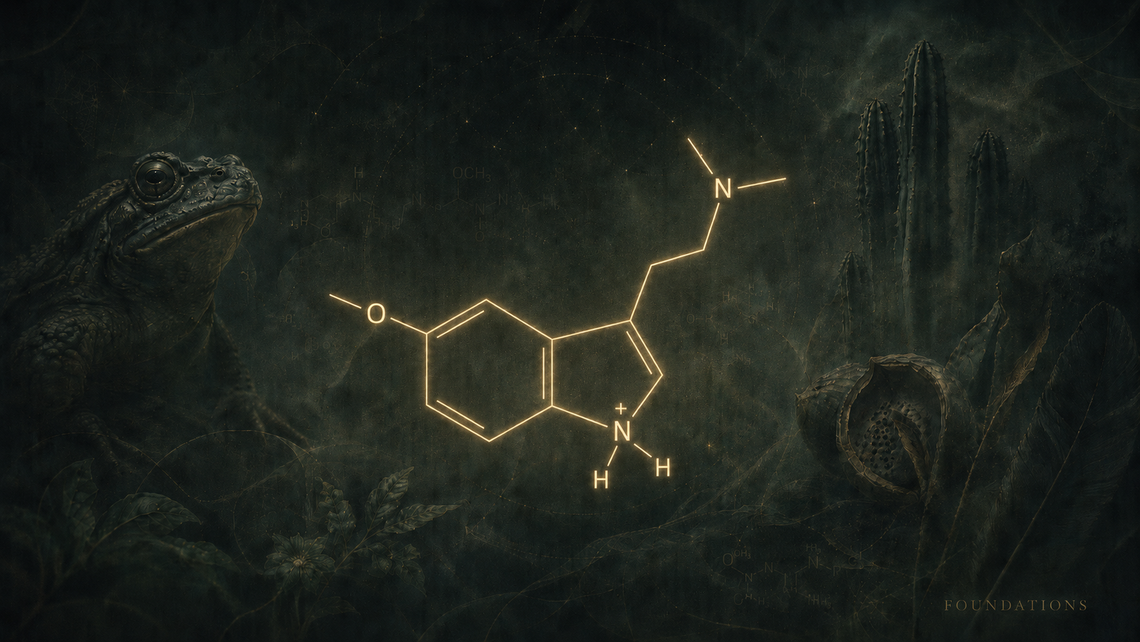
The close cousin: similar enough to be confused with N,N-DMT, different enough to be a different experience entirely
1. What this article is
This is the third Foundations primer on ARDMT. The first two — What is DMT? and What is Ayahuasca? — have together laid the groundwork: a molecule, a brew, and the cultural and pharmacological worlds each sits in. This essay continues that work by turning to the molecule's nearest important cousin.
The shorthand version of why 5-MeO-DMT warrants its own primer: it is the DMT-family compound most likely to be confused with N,N-DMT and the one most likely to surprise readers (or participants) who assume that confusion is harmless. Pharmacologically the two are recognisably related. Subjectively they are not. The clinical pipeline for 5-MeO-DMT is currently the most advanced of any DMT-family compound. The contemporary cultural scene around it is the most controversial. And the molecule has acquired, in the last fifteen years or so, a reputation that has outrun what the science actually supports.
A brief author note. I have spent the better part of two decades engaging with N,N-DMT in various forms — synthesised, smoked, grown — and the first two essays in this series drew on that direct experience where it served the writing. With 5-MeO-DMT, I have none. I have read the literature, followed the research, and listened to people who have considerable experience with the compound. The view that follows is therefore informed but external. The asymmetry is, I think, worth flagging openly: among people I respect with substantial N,N-DMT experience, 5-MeO has a reputation for being categorically different — more dissolving, more intense, less manageable — in ways that have produced some perfectly reasonable abstention. I count myself among those who have not yet found the right reason to cross that threshold. Readers will weigh the resulting essay accordingly.
This article walks through the molecule itself, where it comes from, what it appears to do, what science currently understands about its mechanism, its cultural and historical story, the contemporary controversies around its sources, the state of the clinical research, where it sits in law, and what is still being argued about. Like the previous two, it describes rather than instructs.
2. The molecule
5-MeO-DMT is 5-methoxy-N,N-dimethyltryptamine. The name describes the molecule precisely: it is N,N-dimethyltryptamine (the molecule covered in detail in What is DMT?) with one additional chemical group — a methoxy group, a small unit of one oxygen and one carbon with three hydrogens attached — bonded at the 5-position of the indole ring. If you took N,N-DMT and added a single methoxy group at that location, you would have 5-MeO-DMT.
This is structurally a very small change. On paper it looks like a footnote. In the body it is anything but.
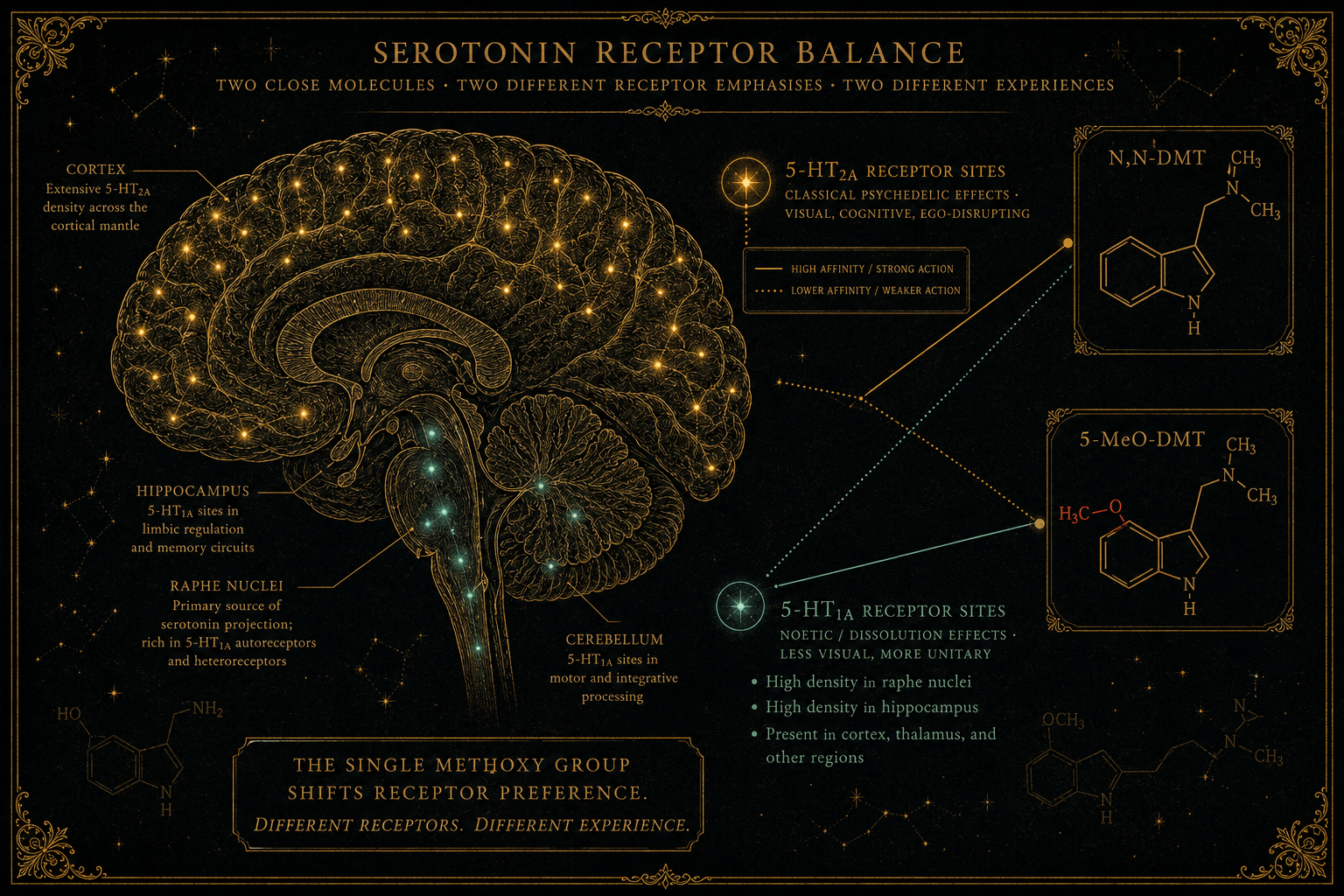
That structural detail matters because the 5-position decoration on the indole ring is one of the places where the body's receptors most sensitively distinguish between related compounds. Adding a methoxy group there changes which receptors the molecule binds to, in what proportions, and with what consequences downstream. The single substitution shifts the molecule's primary receptor preferences in ways the body experiences as a fundamentally different drug. Pharmacologists describe this kind of effect as a substituent-position-driven receptor switch, and 5-MeO-DMT is one of the cleanest examples in psychedelic pharmacology.
Practical consequences of the substitution: 5-MeO-DMT is roughly four to five times more potent by weight than N,N-DMT (a typical psychoactive dose of vapourised 5-MeO is in the 5–15 mg range, against 30–60 mg for vapourised N,N-DMT). The molecule is more lipid-soluble. It crosses biological barriers slightly faster. And — most importantly — it acts on a different primary target.
3. Where it comes from
5-MeO-DMT occurs naturally in a wider range of sources than N,N-DMT does, and the relative significance of those sources has shifted substantially over the last forty years.
The Sonoran Desert toad. Incilius alvarius, formerly classified as Bufo alvarius, secretes a milky venom from glands on its skin and limbs as a defensive response to threat. The venom contains a striking concentration of 5-MeO-DMT — sometimes 15% by weight when dried — along with a smaller amount of bufotenine (5-HO-DMT, structurally close to both 5-MeO and serotonin) and various other amphibian-skin compounds. The toad does not produce the venom for human use; it produces it to deter predators. People have, nonetheless, devised methods to collect, dry, and smoke the resulting material. This is the source most popularly associated with 5-MeO-DMT in contemporary culture, and the source most worth talking about candidly, which §7 will do.
Plants. Several South American plants contain 5-MeO-DMT, often alongside N,N-DMT and bufotenine. The most important are Anadenanthera peregrina and Anadenanthera colubrina, whose seeds have been used for at least four thousand years as ceremonial snuffs (variously called yopo, vilca, cohoba) by indigenous peoples across the Caribbean and South America. Several Virola species (notably Virola theiodora) produce a similar snuff used by groups in the upper Amazon. Some specimens of Diplopterys cabrerana — the chaliponga plant used in some ayahuasca brews — contain 5-MeO-DMT alongside N,N-DMT, which may partially account for the different experiences ayahuasca made with chaliponga produces compared with chacruna-based brews.
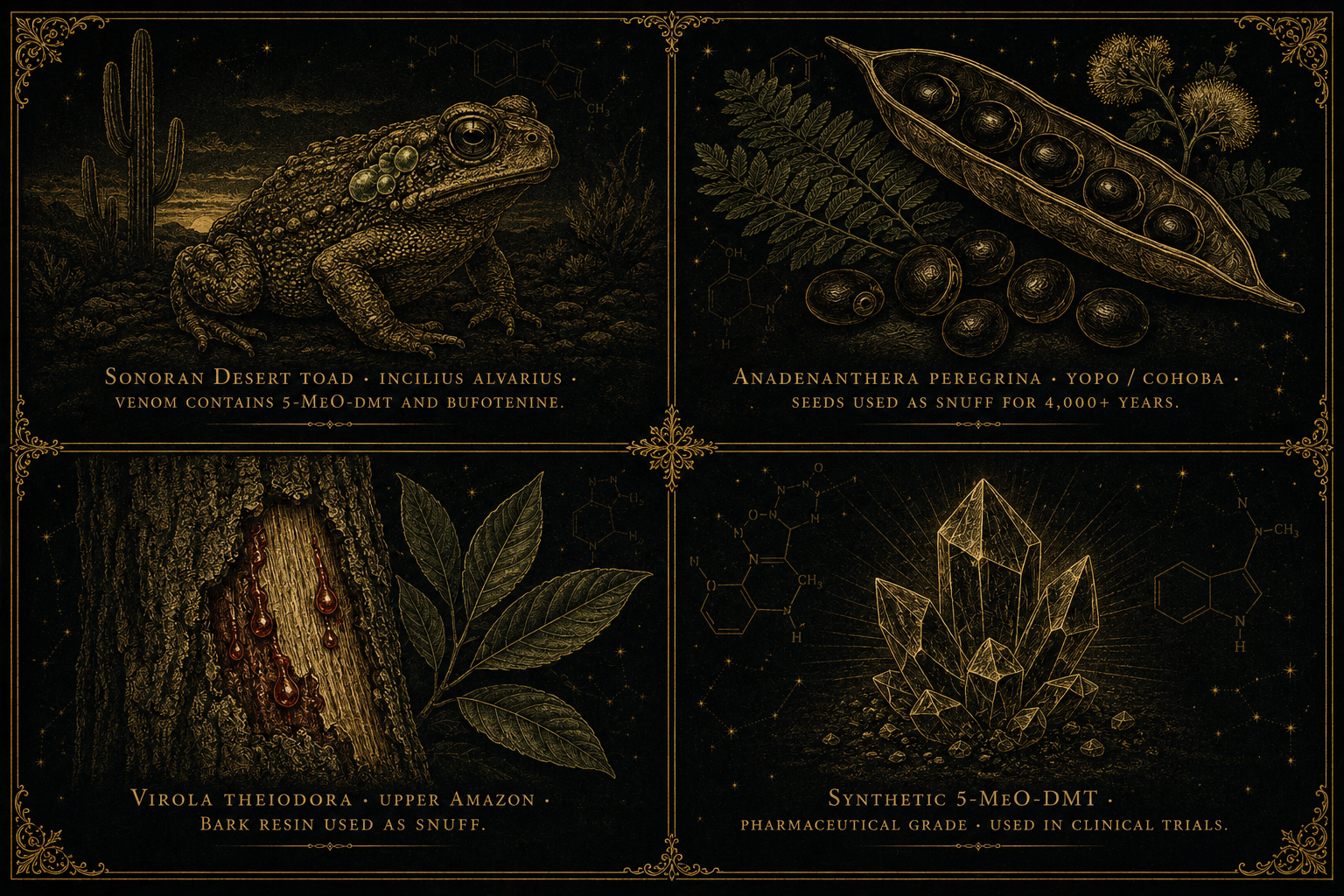
These plant sources have considerable historical depth. The earliest archaeological evidence for Anadenanthera snuff use comes from sites in northern Chile dated to around 2,000 BCE. The plant material was traded across long distances; ceremonial snuff equipment has been recovered from sites a thousand kilometres from where the trees grow. By any reasonable measure, humans have been encountering 5-MeO-DMT through these plant forms for thousands of years.
Synthetic. 5-MeO-DMT can also be produced synthetically, and most clinical and research material is. The synthesis is well-established (it was first achieved in 1936, twenty years before Stephen Szára's self-experiments with N,N-DMT) and produces pharmaceutical-grade material of known purity. All major clinical trials currently underway use synthetic 5-MeO-DMT; almost no clinical work uses toad-derived material, for reasons of consistency, dosing precision, and ethics that §7 will return to.
Endogenous. Trace amounts of 5-MeO-DMT have been detected in human biological fluids, similarly to N,N-DMT. The functional significance of this is unresolved and forms part of the broader endogenous-DMT question covered in detail in Endogenous DMT in Humans: A Critical Review.
4. What it does
Reports of the 5-MeO-DMT experience vary across individuals, doses, and settings — as they do for any compound — but the reports cohere around a recognisable composite that is meaningfully different from the N,N-DMT composite.
Onset is rapid. Smoked or vapourised 5-MeO-DMT produces effects within seconds; the peak arrives within one to two minutes; the experience is largely over within ten to twenty. Intravenous or intranasal routes produce slightly different time-courses but similar rapidity. The compound is short-acting in absolute terms — much shorter than ayahuasca, comparable to or slightly shorter than smoked N,N-DMT.
Subjectively, the experience is described very differently from N,N-DMT. The vivid visual phenomena, the geometric architectures, the sense of encounter with entities or intelligences — features that dominate N,N-DMT reports — are largely absent. What participants describe instead is something closer to total dissolution: a vanishing of the sense of being a self with a body and a position, often replaced by what some describe as a featureless luminosity, others as a void, others as a non-dual awareness in which the distinction between observer and observed disappears entirely. The language used to describe the experience is often closer to that of advanced meditative states or near-death experiences than to that of conventional psychedelic experience.
This subjective profile produces some characteristic features that are worth knowing about candidly. The experience is often extremely physically intense: shaking, crying, screaming, full-body muscular contractions, sometimes vomiting are widely reported. Many participants describe feeling that they have died, in a way that goes beyond the more familiar "ego death" reports from high-dose classical psychedelics. Some emerge from the experience profoundly altered in ways they describe as positive; some emerge confused, frightened, or destabilised in ways that require sustained integration to resolve.
The reputation that 5-MeO-DMT has acquired in the broader psychedelic community is worth registering plainly. Among people with considerable experience across the psychedelic spectrum — including extensive familiarity with N,N-DMT — 5-MeO is often described as a different kind of compound entirely, one that demands more preparation, more careful setting, and a greater willingness to encounter material the experienced participant did not expect to encounter. Hamilton Morris, the pharmacological journalist whose work has shaped much of the contemporary popular understanding of the compound, has repeatedly observed that 5-MeO-DMT is not "DMT plus a bit"; it is its own substance, and people who treat it casually because they have handled N,N-DMT casually are taking a different risk than they realise.
This is not a piece that recommends or warns against. But the disparity between popular perception (often: "5-MeO-DMT, like DMT but stronger") and the substance's actual experiential profile is significant enough to be one of the most important pieces of orientation in this article.
5. How it works in the brain
The pharmacology of 5-MeO-DMT is recognisably related to N,N-DMT's and recognisably different.
Both compounds bind to the serotonin 5-HT2A receptor — the receptor primarily responsible for the classical psychedelic effects of LSD, psilocybin, mescaline, and N,N-DMT itself. Activating 5-HT2A in the cortex disrupts the activity of large-scale brain networks (notably the default mode network, covered in a forthcoming primer) and is the leading neurobiological candidate for what produces the psychedelic experience generally.
5-MeO-DMT, however, has a different relative affinity profile. Its principal target is the 5-HT1A receptor — a different serotonin receptor with different distribution in the brain and different functional consequences when activated. 5-MeO-DMT also activates 5-HT2A, but considerably less selectively than N,N-DMT does. The relative weighting of 5-HT1A versus 5-HT2A activation is currently the leading explanation for why the two compounds produce such different experiences despite their structural similarity.
Beyond the primary serotonin-receptor activity, 5-MeO-DMT also acts at the sigma-1 receptor — the same intracellular target N,N-DMT engages — and at a small range of additional targets whose contributions to the overall experience remain incompletely characterised. The receptor model is currently the best available; like with N,N-DMT, the underlying picture is not closed, and active research continues into how psychedelics act at intracellular receptors rather than only on the surface of cells.
A note on metabolism. 5-MeO-DMT is broken down in the body by monoamine oxidase A (MAO-A), the same enzyme that destroys N,N-DMT. This means oral 5-MeO-DMT is largely inactive unless combined with an MAO inhibitor — the same arrangement that makes ayahuasca pharmacologically functional. Some traditional snuff preparations may have functioned via direct nasal absorption that bypassed first-pass metabolism; some contemporary preparations combine 5-MeO-DMT with MAOIs for an ayahuasca-analogue oral experience. Most current use is by routes (vapourisation, intranasal pharmaceutical, intravenous) that bypass the gut and avoid the need for MAO inhibition.
6. The cultural and historical story
5-MeO-DMT has two distinct histories that are worth keeping separate, because conflating them produces some of the most common confusions in the popular discourse around the compound.
The plant-snuff history is ancient. Anadenanthera snuff use has been continuous in parts of South America for at least four thousand years, and the molecule has been part of the human ceremonial pharmacopoeia, in plant form, throughout that time. Specific indigenous groups — the Yanomami in Venezuela, the Piaroa, various Tukanoan peoples — have developed sophisticated traditions around the use of these snuffs, with ceremonial structures, dietary preparations, and cosmological frameworks comparable in depth to those that grew up around ayahuasca. The 5-MeO-DMT in these snuffs occurs alongside N,N-DMT, bufotenine, and other alkaloids, producing a complex polypharmacology rather than a pure 5-MeO experience. The traditions are real, old, and continuous.
The toad-venom history is recent. The use of Incilius alvarius toad venom as a smoked or vapourised psychoactive is, as best the historical record can establish, almost entirely a phenomenon of the last forty years. The earliest documented self-administration dates to the late 1960s; the practice did not begin to spread until the 1970s; the "Albert Most" pamphlet Bufo Alvarius: The Psychedelic Toad of the Sonoran Desert was published in 1984 and is generally credited with popularising the practice in counterculture circles; commercial harvesting and ceremonial use grew steadily from the 1990s and exploded after about 2010.
Several indigenous Sonoran groups have historical familiarity with the toad — the Seri (Comcaac) people of the Mexican coast have a documented relationship with the animal — but the smoked venom as a psychedelic ceremonial substance is not part of their tradition. Claims of "ancient Sonoran toad-medicine tradition" that have circulated in retreat-circuit marketing are, by the historical evidence, substantially inflated. There is no archaeological record of toad-venom psychoactive use comparable to the Anadenanthera-snuff record.
This distinction matters more than it may sound. The popular framing of 5-MeO-DMT as an "ancient sacred medicine" lifts the antiquity from the plant snuffs and attaches it to a practice that is, in fact, a recent invention — largely Western or Western-adjacent in origin and dissemination. The plant traditions are deep; the toad scene is new. Both can be defensible practices; conflating them produces dishonest marketing.
7. The modern story: from the toad to the clinic
The current state of 5-MeO-DMT in 2026 reflects two parallel developments that exist in considerable tension with each other: an explosion of toad-medicine retreats and ceremonial practice, and a major clinical-development pipeline using synthetic material. Both are growing. Each is, in different ways, the subject of significant controversy. They are worth thinking about together.
The toad-medicine scene
By the early 2000s, ceremonial use of vapourised toad venom had become a recognisable category of psychedelic practice. By the 2010s, retreat centres were operating openly in Mexico, the United States, and across the international circuit catering to clients flying in for what was often presented as a transformative or sacred experience. By 2026, "doing the toad" is a known category among the same demographics that consider ayahuasca retreats — sometimes attended by the same individuals — and the global infrastructure is substantial.
Several issues with this scene are worth registering candidly, because the popular framing has generally underemphasised them.
The ecological problem. Incilius alvarius is a species with a limited range, primarily across parts of the Sonoran Desert in northern Mexico and the southwestern United States. The toads breed slowly, depend on specific seasonal conditions, and produce limited quantities of venom even when handled humanely. The growth of demand has produced a documented decline in wild populations across parts of their range. Several conservation organisations and herpetologists have called for harvesting moratoria. The Mexican government in 2020 listed the species under protective regulations. Whether the practice as currently conducted is ecologically sustainable is contested, but the burden of proof falls on those who claim it is.
The animal-welfare problem. Even when "milked" by practitioners who claim to handle the toads humanely, the process involves stressing the animal to provoke venom release. Critics argue that no method of repeated harvesting from wild amphibians can be honestly described as harmless to the animal. Some practitioners breed captive populations to address this; the practice remains controversial within the herpetological community.
The authenticity problem. As §6 discussed, the framing of toad-medicine as ancient indigenous practice is historically inaccurate. The practice is recent and largely Western in origin and continuation, regardless of what the marketing implies. Participants are entitled to make informed choices; informed choices require accurate framing.
The safety problem. Toad-venom material has variable composition — the alkaloid profile shifts seasonally, by individual toad, by drying method. Dosing is harder than with pharmaceutical-grade synthetic. Several deaths have been documented at toad ceremonies; the risk profile is not negligible.
The clinical-development pipeline
In parallel with the toad-medicine scene, a substantial body of clinical research has emerged using synthetic 5-MeO-DMT. The leading programmes are Beckley Psytech's BPL-003 — an intranasal benzoate salt formulation of 5-MeO-DMT for treatment-resistant depression — and GH Research's GH001, a similar intranasal preparation. Phase 2 results from BPL-003 in 2024 and 2025 showed rapid and durable antidepressant effects in treatment-resistant patients, including (notably) in patients who continued their existing SSRI medication — a result that, if it survives larger trials, would address one of the more difficult clinical translation problems for psychedelic-assisted therapy. Other programmes are at earlier stages.
The clinical pipeline uses synthetic material exclusively, for several reasons that are worth listing because they bear on the synthetic-versus-natural debate that follows. Synthetic 5-MeO-DMT can be manufactured to consistent purity, allowing reliable dosing. It contains only the target compound, without bufotenine or other amphibian-skin alkaloids, allowing the clinical effect to be attributed to 5-MeO specifically. It poses no ecological or animal-welfare issues. And it can be produced in pharmaceutical quantities sufficient for regulated medicine.
The trial designs are familiar from psychedelic-therapy research generally: a single supervised dosing session, preceded by preparatory sessions and followed by integration support. The duration of the active experience is short enough — twenty minutes or so — that the entire protocol can fit within a clinical day, which is operationally significant for the medicalisation question.
The synthetic-versus-natural question
The relationship between these two strands — the toad-medicine scene and the clinical-development pipeline — has become one of the more interesting fault lines in contemporary psychedelic culture, and it is worth thinking through carefully.
A position commonly held within toad-medicine circles is that toad-derived 5-MeO produces a qualitatively different — often described as more "spiritual" or "complete" — experience than synthetic 5-MeO. The argument tends to combine a pharmacological claim (the bufotenine and other co-occurring compounds modulate the experience) with a metaphysical one (the animal-origin material carries a quality that the synthesised material lacks).
The pharmacological claim is empirically testable and partly defensible. Bufotenine itself is psychoactive at sufficient doses and probably contributes something to the toad-venom experience, though the amounts present in dried venom are usually small relative to the 5-MeO. Other minor amphibian alkaloids may also contribute. Whether the net effect of these admixtures is meaningfully different in clinical outcomes is unresolved; there is no head-to-head trial of synthetic versus toad-derived material.
The metaphysical claim is not empirically testable in the same way. Participants are entitled to find the experience of an animal-origin substance more meaningful than the experience of a synthesised one; that is a legitimate phenomenological position. But "more meaningful to me" and "produces a categorically different effect" are different claims, and the latter has not been demonstrated.
The reverse position — that synthetic 5-MeO is in every important respect equivalent to toad-derived material, and that the toad-medicine framing is essentially a layer of marketing — is also defensible. The pharmacological active ingredient is the same molecule. The clinical results emerging from synthetic-only trials suggest that the therapeutic effect does not require the toad. The ecological and ethical costs of toad-derived material are not zero, while the costs of synthetic are essentially negligible.
A middle position, and probably the most honest one, is that the two forms are pharmacologically similar but contextually different — and that the contextual difference (animal-origin material versus pharmaceutical, ceremonial setting versus clinical, framing of "ancient medicine" versus framing of "investigational compound") produces different experiences in practice, even when the molecule is largely the same. This is set and setting again, in a new register. Which setting a participant chooses to encounter the compound in is a legitimate personal question; whether one of those choices is provably superior to the other is, currently, unanswered.
The trajectory of the field is reasonably clear regardless. Clinical research will continue to use synthetic material, because the regulatory and operational reasons for doing so are decisive. Toad-medicine retreats will continue to use animal-derived material, because that is what their cultural framework is built around. The two will coexist, increasingly under regulatory pressure on the toad side. Whether toad-medicine survives the ecological and ethical scrutiny in its current form is, in my view, genuinely uncertain.
Going deeper on the molecule at the heart of all this: What is DMT?.
8. Is it legal?
5-MeO-DMT's legal status mirrors N,N-DMT's in most jurisdictions, with some specific complications.
United Kingdom. 5-MeO-DMT is a Class A controlled drug under the Misuse of Drugs Act 1971, scheduled identically to N,N-DMT. Possession is punishable by up to seven years; supply or production by up to life. Toad venom containing 5-MeO is treated as the compound for legal purposes.
United States. 5-MeO-DMT was placed on Schedule I federally in 2011, having previously occupied an ambiguous unscheduled position. Possession, sale, and manufacture are felonies under federal law. State-level variation exists for related compounds but not for 5-MeO itself.
Mexico. 5-MeO-DMT is not specifically scheduled, but the toad species Incilius alvarius is now legally protected, which restricts the harvesting of venom even where the compound itself is not directly regulated. The practical effect is that toad-medicine retreats operating in Mexico do so in an ambiguous regulatory space.
Other jurisdictions. The Netherlands, Spain, and several other countries treat 5-MeO-DMT broadly as a controlled substance, with some variation in scheduling. The compound is not on every national controlled-substance schedule — there are jurisdictions where it remains unscheduled — but those jurisdictions are becoming rarer as international harmonisation proceeds.
A forthcoming pillar essay on UK psychedelic law will treat the wider policy landscape in more detail.
9. What people often get wrong
A handful of popular assumptions about 5-MeO-DMT recur often enough across reader populations to be worth addressing directly:
"5-MeO-DMT is just like N,N-DMT, only stronger." No. The two compounds have meaningfully different primary receptor targets and produce categorically different subjective experiences. They are related; they are not interchangeable. Confusing them is one of the most common errors in popular discourse about the compound.
"Toad medicine is an ancient indigenous tradition." It is not. Anadenanthera-snuff use is ancient and indigenous; toad-venom use as a smoked psychoactive is largely a phenomenon of the last forty years and is not part of any continuous indigenous tradition. The frequent conflation of the two histories is at best careless and at worst deliberate marketing.
"Synthetic 5-MeO is less effective than toad-derived." This is an opinion sometimes presented as fact. There is no published head-to-head comparison demonstrating a categorical difference; the clinical-trial evidence with synthetic material is consistent with the therapeutic effect being driven by the 5-MeO itself.
"Because the experience is short, it's less intense." The opposite, generally. The short duration is part of why 5-MeO is operationally tractable for clinical use, but the intensity within those minutes is among the highest of any known psychoactive substance. Brevity does not mean mildness.
"If you can handle N,N-DMT, you can handle 5-MeO-DMT." Many experienced N,N-DMT users find 5-MeO categorically different and considerably more demanding. Prior familiarity with N,N-DMT does not transfer in the way participants often assume it will.
"The BPL-003 trials show 5-MeO is safe with SSRIs." They show that, in controlled clinical conditions, the combination has been tolerated in selected patients. They do not show that combining 5-MeO with SSRIs in non-clinical settings is safe. The clinical-trial environment is not a model for individual self-medication.
"It's the 'God Molecule'." This is a marketing phrase, popularised by certain practitioners and contested by the broader scientific and pharmacological community. The compound does what it does. Whether what it does is "encounter with God" or "intense neuropharmacological disruption that human beings sometimes describe in theological language" is exactly the kind of question the experience itself cannot settle.
"It's safer than other psychedelics because it's a natural compound." The natural-versus-synthetic question is largely irrelevant to safety; both forms can produce difficult psychological material, both interact dangerously with certain medications, and the toad-derived form has additional variability that makes dosing harder rather than easier.
10. What we still don't know
The questions still being actively contested in 5-MeO-DMT research, briefly:
Whether the 5-HT1A versus 5-HT2A balance fully explains the experiential difference from N,N-DMT. The receptor-balance hypothesis is the leading current explanation, but there is active research into other targets — particularly intracellular receptors — that may turn out to contribute more than the surface-receptor model suggests.
Whether the synthetic-versus-natural comparison has a clinically meaningful answer. No head-to-head trial has been done; the question is currently settled by ideology in either direction rather than by evidence.
Whether the long-term effects of repeated use are comparable to other psychedelics. Most participant-reported data comes from one or a few sessions; the effects of sustained or repeated exposure are less well characterised.
Whether the clinical results from Phase 2 trials will replicate in larger, longer, more rigorously controlled Phase 3 trials. The Phase 2 signal is genuinely interesting; the Phase 2 signal is also notoriously unreliable in psychiatric pharmacology, and the field has learned to keep its enthusiasm calibrated.
What role bufotenine and other amphibian-skin alkaloids play in the toad-venom experience. Their contribution is plausibly significant but quantitatively poorly characterised.
Whether the rapid antidepressant effect — particularly the SSRI-compatible signal — survives careful replication. If it does, the clinical implications are substantial; if it does not, the field will need to revise its expectations.
Whether the ecological pressures on Incilius alvarius will reshape the contemporary toad-medicine scene in the near future. This is more a question for policy and conservation than for pharmacology, but the answer matters for the practice's continuation.
These open questions are why 5-MeO-DMT remains intellectually live rather than a closed file.