Foundations
What is Ayahuasca?
The brew, the ceremony, and the form most humans have actually met DMT in.
1. What this article is
This is the second piece in the ARDMT Foundations series. The first looked at the molecule. This one looks at the form most humans have actually met it in.
The distinction matters more than it sounds. If you went to the trouble of asking "across all of human history, how have people encountered DMT?", the answer would not be "smoked from a glass pipe" — that route was unknown until the 20th century and remains, in global terms, the experience of a small minority. The dominant historical and contemporary form is ayahuasca: a thick, bitter, vine-based brew drunk in ceremonial settings, principally in the upper Amazon and increasingly across the rest of the world. By the most reasonable estimates, the brew is at least 2,500 years old. The molecule, as an isolated chemical, is less than a century old. Ayahuasca is the route; DMT is the destination at the end of it.
This article walks you through what ayahuasca is, where it comes from, what it does, how it works, what it has become globally, where it sits in law, and what is still being argued about. What follows is description, not direction. The relationship between this brew and a human nervous system is too contextual, too variable, and too demanding to be summarised into anything a short article could responsibly call instructions.
2. The plants and the brew
Ayahuasca is, fundamentally, a combination of two plants cooked together in water — though this simple statement is exactly where most popular understanding of the brew ends, and where its actual subject begins.
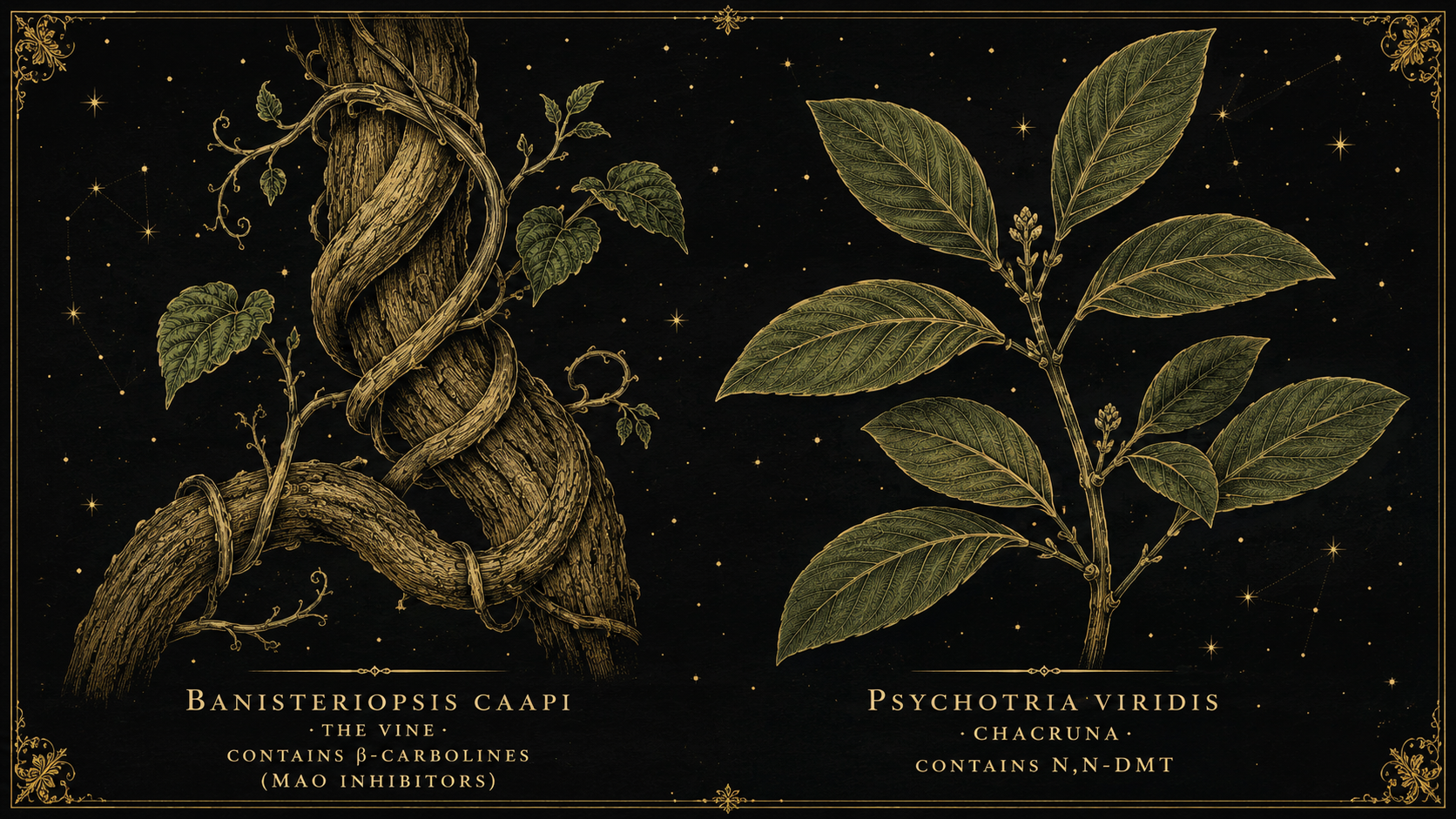
The constant: Banisteriopsis caapi. Whatever else goes into the pot, this thick, woody jungle vine is almost always present. It is the vine that gives the brew its name — ayahuasca in Quechua means roughly "vine of the soul" — and its pharmacological role is foundational. The vine contains compounds called β-carbolines — principally harmine, harmaline, and tetrahydroharmine — which temporarily disable a class of enzymes in the human gut that would otherwise destroy the active ingredient in the brew before it could do anything. Without the vine, the rest of the brew is pharmacologically inert by mouth. With it, the brew works.
The DMT-bearing plant: variable. In the most common version of the brew — particularly in Peruvian and parts of Ecuadorian tradition — the second plant is Psychotria viridis, a small shrub known by its Quechua name chacruna ("the leaves"). In other regions, especially parts of Ecuador and Colombia, the DMT-source plant is Diplopterys cabrerana — known as chaliponga or chagropanga — which contains both DMT and, in some specimens, 5-MeO-DMT. The two source plants produce subtly but recognisably different experiences. Brews made with chaliponga are sometimes described as more visual and more cosmologically expansive; brews made with chacruna as more emotionally textured and more bodily. Both descriptions are imperfect generalisations.
Beyond the two: admixtures. Many traditions add further plants — sometimes for specific medicinal targets, sometimes for cosmological reasons, sometimes both. Tobacco (Nicotiana rustica, considerably stronger than commercial cigarette tobacco) is the most frequent addition; in some traditions ayahuasca and tobacco are inseparable. Brugmansia (toé), datura, bobinsana, ayahuma, and many other plants appear in regional brews, often as guarded ethnobotanical knowledge. The presence of these admixtures means that two brews labelled "ayahuasca" can produce noticeably different experiences depending on what else is in the pot.
The preparation: itself part of the medicine. In its traditional indigenous form, brewing is a multi-day process. The vine is pounded with rocks; the leaves are sorted and counted; the mixture is boiled in stages, reduced, recombined, sometimes for twelve to twenty-four hours of attended cooking. Many traditions require the brewer to be in dieta — a period of dietary, sexual, and social restriction — for weeks or months before brewing. Many traditions involve the brewer singing icaros (medicine songs) into the pot during cooking. For indigenous practitioners, the brew is not a chemical preparation that happens to require a person to make it. It is a relationship between brewer, plants, and the spirits associated with both. The cooking is itself part of the medicine.
Whether you accept this framing as literal or interpret it as cultural metaphor, it carries a pragmatic implication: brews prepared industrially — concentrated, freeze-dried, reconstituted on the day — often differ in alkaloid ratios from traditional decoctions, in ways that produce different experiences and different risk profiles. The chemistry is part of the story. It is not the whole story.
3. The ceremony
Modern Western ayahuasca culture sometimes speaks as though "an ayahuasca ceremony" is a definite thing, like "a yoga class" or "a meditation retreat." It is more useful to think of ayahuasca ceremonies as a category of things — sharing a brew, sharing some structural features, and otherwise enormously variable.
A few near-universals across the category:
- A facilitator or curandero who has prepared the brew and guides the session
- A communal setting — most ceremonies involve a group rather than a single participant
- A long duration — four to seven hours of primary action, often with the ceremony extending beyond
- Low light or darkness, silence punctuated by singing or chanting
- The presence of nausea, vomiting, and sometimes diarrhoea, which most traditions consider therapeutic (la purga — the purging)
- Dietary and behavioural restriction in the days or weeks before
Beyond these, variation is wide. Indigenous Amazonian ceremonies are typically smaller — often family-sized — conducted in a maloca or thatched-roof gathering structure, led by a curandero singing icaros that are understood to direct the session pharmacologically and spiritually. Brazilian church traditions (Santo Daime, União do Vegetal, Barquinha) wear white uniforms, sit in geometric formations, sing hymns in Portuguese for the duration, and frame the experience in Christian-syncretic rather than shamanic terms. Modern Western retreat ceremonies — held in Costa Rica, the Netherlands, Peru-for-tourists, the Brazilian Amazon, and increasingly Europe and North America — range from sincere adaptations of indigenous practice to highly stylised commercial events.
Doses vary too. A typical indigenous ceremonial dose is around 50–100 ml of brew; the Brazilian churches typically use smaller, more dilute doses across multiple servings; some Western retreats serve a single moderate cup; others serve multiple cups across a long evening; some, in pursuit of intensity, serve much more.
An author interlude on this
I have sat in four ayahuasca ceremonies myself, across three contrasting settings, and the differences between them stayed with me as one of the more useful pieces of education the medicine has offered.
The first was a three-day retreat in Amazon forest, led by a well-known Dutch facilitator. All participants were white. The first ceremony was structured around small, intense doses — two shot-glasses of a thick, gel-like reduced brew, taken in sequence. The second worked differently: a large bin of more dilute brew, from which participants were served bowls in sequence, the protocol being to keep drinking until you began to vomit, then to keep drinking and vomiting until you could barely move. It was thorough. The facilitator seemed sincere; my read at the time was that the framework was Western, the brew was being asked to do something the setting could not quite hold, and not very much actually happened. I came away with a measured experience and some intestinal misgivings.
The second and third were with the Shuar, outside Gualaquiza in southern Ecuador. The contrast was almost everything one might expect. Smaller, quieter, much shorter on production, much longer on song. The brew had been prepared by the curandero in the days before, and the ceremony itself felt more like an evening among people who lived with the plants than an event being staged for guests.
The fourth was on a farm in Ecuador with a non-indigenous Ecuadorian facilitator — somewhere between the other two in style, neither fully ceremonial nor fully retreat-commercial.
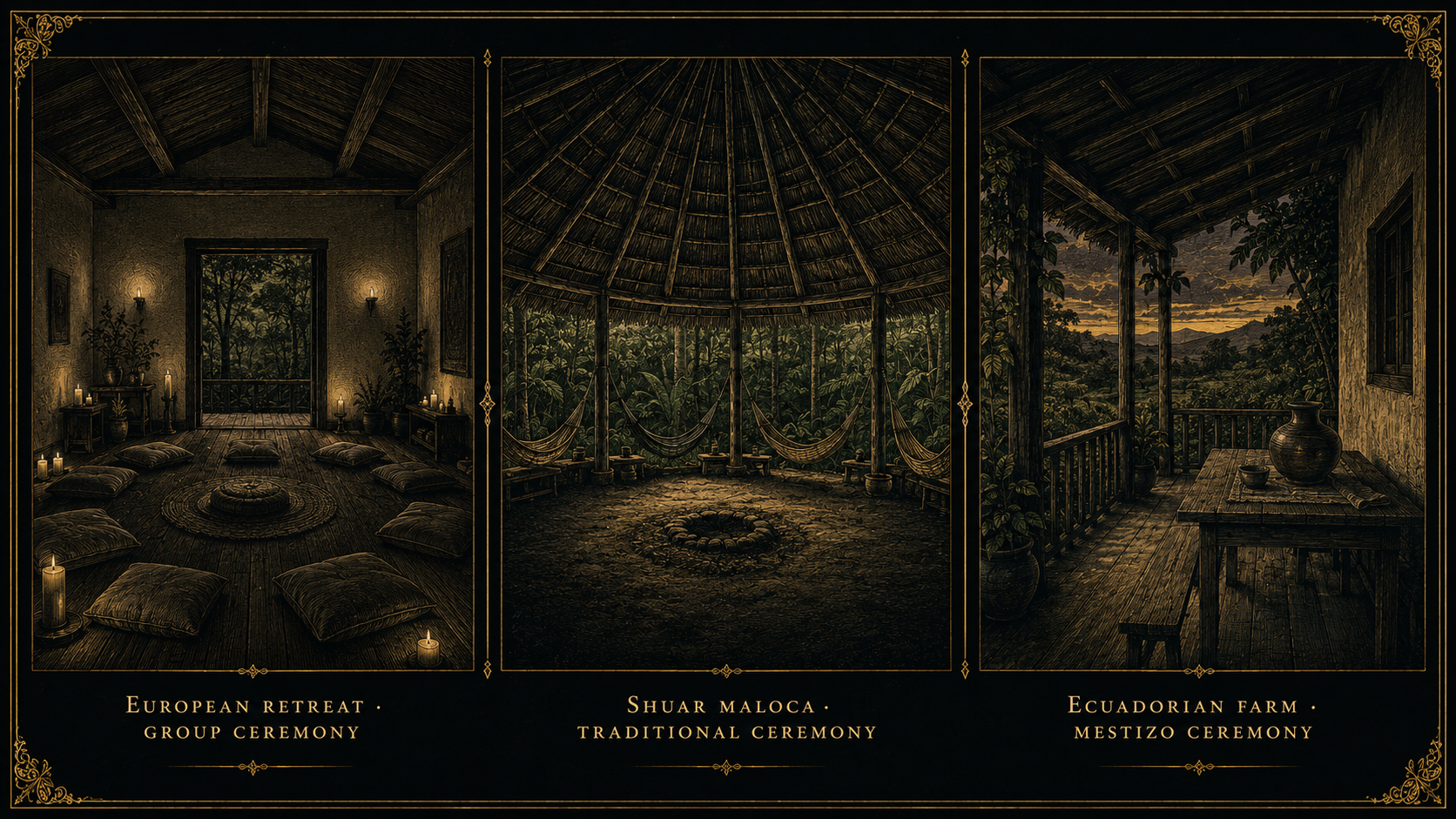
What I took from the contrast was not that one version is "real" and the others are not. It was that ayahuasca is a category of practices, that the brew is one variable among several, and that the ceremony — who is leading it, what frame they work in, who is in the room — does much of the work. The same plant materials in different hands produce different experiences. This is not a mystical claim. It is what set and setting actually means, made vivid.
4. What it does
The experience reported by ayahuasca participants varies enormously across individuals, ceremonies, and traditions. Generalising about it is risky. But certain features recur often enough across honest reports to constitute a rough composite.
Physically, effects come on within roughly thirty to sixty minutes of drinking. Nausea is common; vomiting is common; diarrhoea is reasonably common. These are not failures of the experience but, in the traditional framing, part of how the medicine works. Light sensitivity increases. Body temperature can fluctuate. A heaviness, sometimes described as gravitational, is widely reported.
The mental experience builds across the next hour or so. Visual phenomena are widely described — closed-eye geometric patterns, open-eye distortions of the visual field, vivid imagery often involving naturalistic or biological forms (vines, serpents, plants), and in many cases what participants describe as encountering presences, intelligences, or entities. Whether these encounters reflect anything beyond the brain's tendency to populate altered states with social presence is a separate epistemic question, and the Endogenous DMT essay explores it more carefully in a related context. What is empirically true is that the reports are extremely consistent across cultures, settings, and participants — including those with no prior knowledge of the tradition.
Emotionally, the experience often involves vivid autobiographical material — childhood memories, unresolved relationships, grief, fear, joy in unexpected configurations. Many participants describe the experience as therapeutic in retrospect even when the experience itself was distressing in the moment. The phrase "I would not have done it for fun, and I would not have missed it" recurs.
The experience typically peaks at two to three hours after the initial dose and tapers across the next two to three. Total active duration is four to six hours, longer if subsequent doses are administered.
A few things worth saying clearly about what the experience is not.
It is not reliably comfortable. The reverence ayahuasca has acquired in popular culture obscures the fact that very experienced participants regularly describe individual ceremonies as among the hardest experiences of their lives.
It is not, in itself, evidence of anything metaphysical. Participants commonly report encounters they describe in spiritual terms, and those reports are real reports — the experiences happened. Whether they are evidence for the external reality of what was encountered is a separate philosophical question that participants and writers have answered in every imaginable way.
It is not benign for everyone. People with certain psychiatric histories — schizophrenia, bipolar disorder, psychotic episodes — can come to durable harm. People taking certain medications, particularly SSRIs and other serotonergic drugs, face genuine pharmacological risks including the possibility of serotonin syndrome, which can be fatal. The vivid, all-night-marathon nature of the ceremony, its bodily intensity, and its sometimes confronting psychological content also make ayahuasca a poor fit for people who are not in a place to tolerate any of those things.
5. How it works
The pharmacology of ayahuasca is the pharmacology of two plants in combination.
The vine (Banisteriopsis caapi) contributes β-carbolines — harmine, harmaline, tetrahydroharmine — which are reversible inhibitors of monoamine oxidase A (MAO-A). MAO-A is one of the enzymes responsible for breaking down monoamine compounds in the body, including serotonin, dopamine, and noradrenaline, and including exogenous tryptamines such as DMT.
The DMT-bearing plant contributes N,N-dimethyltryptamine itself — covered in detail in What is DMT?. DMT taken by mouth on its own is destroyed in the gut by MAO before reaching systemic circulation, which is why no DMT-containing plant chewed or eaten plainly produces a psychoactive effect.
Combine the two, and the β-carbolines inhibit MAO long enough for the DMT to survive the gut, cross the intestinal wall, enter the bloodstream, cross the blood-brain barrier, and reach 5-HT2A receptors in the cortex — where it produces its characteristic psychedelic effects. The MAO inhibition also extends the duration: rather than the few-minute experience of smoked DMT, oral DMT in the presence of an inhibitor produces a four-to-six-hour experience.
A few additional pharmacological points worth knowing.
The β-carbolines are not pharmacologically inert. They are mildly serotonergic, mildly cardiovascular-active, and probably contribute their own subjective effects to the experience. Disentangling their contribution from DMT's is empirically difficult; experienced ayahuasca drinkers can sometimes distinguish vine-heavy brews from leaf-heavy ones by the quality of the experience alone.
Reversible MAO inhibition is meaningfully safer than the irreversible kind. The "no aged cheese, no red wine" cautions associated with the older antidepressant MAOIs (phenelzine, tranylcypromine — which are irreversible) apply only loosely to ayahuasca; serious tyramine-induced hypertensive crises are uncommon. The drug-interaction risk that does matter is with other serotonergic drugs — SSRIs, SNRIs, other MAOIs, tramadol, some opioids, MDMA — where combination can produce serotonin syndrome. This risk is real and has caused deaths.
A new strand of research examines the β-carbolines independently. Preliminary cell and animal data suggest harmine in particular has neuroplastic effects independent of any accompanying DMT. Several clinical-development companies are now investigating β-carbolines on their own as potential antidepressants. Whether this matters for human therapy is currently unresolved. A forthcoming Foundations primer on Harmine and the MAOIs will treat this strand in more depth.
6. The cultural and historical story
Ayahuasca is, by most reasonable accounts, very old. The earliest definite archaeological evidence — pottery and brewing apparatus from the upper Amazon containing residues of harmine and DMT — dates from somewhere around 1,000 BCE, though some scholars argue the practice is considerably older. Either way, ayahuasca has been continuously used by indigenous peoples of the upper Amazon for at least two and a half thousand years, possibly much longer.
The diversity of indigenous traditions using ayahuasca is enormous. Different ethnic groups — Shipibo, Asháninka, Cofán, Shuar, Achuar, Yagua, Tukano, dozens of others — have their own preparations, songs, ceremonial structures, ritual frameworks, and cosmologies built around the brew. The notion of "the indigenous ayahuasca tradition" as a singular thing is a Western simplification. There are traditions, plural, woven into the broader fabric of upper-Amazonian indigenous life over millennia.
The brew's spread beyond strictly tribal contexts began in the late 19th and early 20th centuries, during and after the rubber boom that brought outsiders into the upper Amazon in significant numbers. Mestizo communities — people of mixed indigenous and European descent — developed their own forms of ayahuasca practice, often syncretising indigenous shamanic frameworks with elements of Catholicism. The vegetalista tradition of Peruvian and Brazilian mestizo curanderos belongs to this period.
In the early 20th century, ayahuasca began appearing in the founding stories of new Brazilian religious movements. Santo Daime was founded in the 1930s by Raimundo Irineu Serra, a Brazilian who had encountered ayahuasca through working in the Amazon rubber industry; the religion is Christian-syncretic, with ayahuasca taken as a sacrament in ceremonial settings involving hymns and white uniforms. The União do Vegetal (UDV) was founded in 1961 by José Gabriel da Costa, drawing on similar sources but developing a distinct ceremonial form. The Barquinha emerged in the 1940s as a Santo Daime offshoot. These movements have grown considerably since the 1960s and now have churches in many countries.
The Western academic discovery of ayahuasca dates to the 19th century — the British botanist Richard Spruce identified Banisteriopsis caapi in the 1850s — but serious scientific engagement was sporadic until the late 20th century. Terence McKenna's writings from the 1980s onward, the spread of underground psychedelic culture, the publication of Wade Davis's One River in 1996 and Jeremy Narby's The Cosmic Serpent in 1998, and Rick Strassman's DMT: The Spirit Molecule in 2001 collectively brought ayahuasca into mainstream Western awareness in a way it had never been before.
The global tourism phenomenon followed. By the early 2000s, retreat centres were operating openly in Peru, Brazil, and Ecuador catering to international visitors. By 2010, ayahuasca tourism was a significant economic sector in parts of the upper Amazon, with considerable money flowing into local communities and considerable controversy about what was being preserved and what was being commodified.
7. The modern global story
The current state of ayahuasca, in 2026, is essentially three overlapping things: a continuing indigenous tradition, a growing religious movement, and a global commercial-therapeutic-recreational phenomenon that has outgrown anything its originators imagined.
The indigenous tradition continues. Many upper-Amazonian groups still use ayahuasca within their communities, in roughly the forms they have for many generations, with whatever degree of adaptation external pressures have forced upon them. Some communities welcome the global interest as economic opportunity and cultural validation. Others view it as appropriation and a corruption of practices that depend on community context to mean what they mean. Both views are intelligible; both are held by people with legitimate standing.
The religious traditions have grown internationally. Santo Daime, UDV, and Barquinha now have churches in dozens of countries, with legal recognition in some — Brazil, the US for specific congregations via Supreme Court ruling, the Netherlands historically — and grey-area or illegal status in many others.
The global commercial phenomenon — retreats, Western-led ceremonies in Europe and North America, underground sittings in private homes, integration therapy as a paid profession — is the part that has changed most dramatically in the last two decades, and the part most worth thinking about for a reader curious about whether and how ayahuasca might intersect with their own life.
A few things are worth saying about it candidly.
Ayahuasca tourism is real, large, and uneven. When I first started travelling in the upper Amazon in the late 1990s, encountering ayahuasca required either being introduced by someone local or making concerted local effort. By the late 2000s, retreat brochures were available in Cuenca and Quito airport hotels. By the 2010s, Western journalists were attending retreats and writing about them. By 2026, "going to do ayahuasca in Peru" is a category of holiday recognisable to the average British dinner party. The number of retreat centres operating globally now is impossible to know precisely; credible estimates put it in the high hundreds.
Some are run well. Some are run badly. Some are run by sincere practitioners working hard to honour the tradition while making it accessible to outsiders. Some are run by charlatans. Many sit somewhere in between, with sincere intentions and varying degrees of competence. The participant typically has limited ability to tell which they are walking into until they are there — and sometimes not until afterwards.
The tourism in 2026 is, in my honest view, meaningfully more risky than the tourism was in 2005. It is not that the brew has changed. It is that the volume of participants has increased dramatically, the quality control across retreat centres has not kept pace, and the marketing aesthetic — "spiritual healing journey," "deep medicine," "ancient wisdom" — produces exactly the kind of pitch that attracts people who are not adequately prepared for what an ayahuasca night actually demands of a body and a mind. The combination of more vulnerable participants and inconsistent oversight has produced a sector that I would not, on balance, describe as safe. Several high-profile deaths and a number of widely reported assault cases have made the risk profile of the tourism much more visible than it once was.
A position I am aware is contradictory. I would not, in general, recommend that someone unfamiliar with ayahuasca travel to the Amazon to do it. The risk-to-benefit ratio for most people is poor; the cultural translation is difficult; the experience is often less than the marketing implies and more than the constitution can take. And yet — if my own son were to express genuine interest, and if he had done the considerable preparatory work to understand what he was walking into, I would not stand in his way. I might, were it the right time in his life, even encourage him to go.
The two positions are not consistent. I hold them both. The asymmetry is, I think, what trust actually is — I would not generally recommend high-risk practices to strangers, even when I have personally benefited from them, because I cannot vouch for what they will bring to the encounter. With my own son, the calculus is different because I know him.
For most readers, most of the time, the right answer is probably neither. Neither ayahuasca tourism nor untreated suffering, but the work being built by an emerging field of practitioners — researchers, therapists, integration specialists, careful retreat operators — who are translating what they can of the traditional practice into accessible forms in the cultures where most readers actually live. The clinical research programme using extracted DMT in clinical settings (followed weekly in our Field Notes) is one branch of this. Psychedelic-assisted therapy as a developing legal profession is another. Integration therapy as a stand-alone discipline is a third. None of these is ayahuasca-as-the-curanderos-know-it. All of them are attempts to bring some of what ayahuasca offers within reach of people for whom the Amazon is not a realistic option. They are, I think, the right place for most of the people who are reading this article to start.
Going deeper on the molecule at the heart of all this: What is DMT?.
8. Is it legal?
Ayahuasca's legal status varies markedly by jurisdiction.
United Kingdom. Ayahuasca is treated as DMT for the purposes of the Misuse of Drugs Act 1971. The 2014 Court of Appeal decision in R v Aziz confirmed that a preparation containing DMT is itself a Class A controlled drug regardless of whether the individual constituent plants are themselves controlled (they are not). Possession is punishable by up to seven years; supply or production by up to life. There are no recognised religious or ceremonial exemptions in UK law, though prosecutions for ceremonial possession have been rare in practice.
United States. Ayahuasca contains DMT, which is federally Schedule I. The Supreme Court ruling in Gonzales v O Centro Espírita Beneficente União do Vegetal (2006) granted the UDV the right to import and use ayahuasca religiously; a subsequent ruling extended similar protection to Santo Daime. Recreational and non-religious use remains illegal.
Brazil. Ceremonial use has been legal since 1986; the brew is recognised as a cultural patrimony, and the Brazilian government regulates rather than prohibits its religious use.
Peru. Ayahuasca was declared part of Peru's cultural heritage in 2008. Indigenous and ceremonial use is protected.
Ecuador. Traditional indigenous use is protected. The brew's status for non-indigenous practitioners is more ambiguous.
Other jurisdictions. Spain, Portugal, the Netherlands, and several Latin American countries have varying degrees of tolerance, often centred on registered religious organisations. Most European countries other than the Netherlands treat ayahuasca as DMT and apply the corresponding controlled-substance regime.
A separate forthcoming pillar essay on UK psychedelic law specifically will treat the wider policy landscape in more depth.
9. What people often get wrong
Some of the popular assumptions a reader may have arrived with are worth addressing directly before closing. Some overlap with the misconceptions section of What is DMT?; ayahuasca has its own characteristic confusions on top.
"Ayahuasca is just oral DMT." No. Ayahuasca is a pharmacological system — vine plus leaves, sometimes plus admixture plants — embedded in cultural and ceremonial practices that materially shape the experience. Reducing it to "DMT in a cup" misses both the pharmacology and the practice.
"All ayahuasca ceremonies are equivalent." They are not. Indigenous shamanic ceremonies, Brazilian church ceremonies, mestizo curandero ceremonies, and Western retreat ceremonies are pharmacologically similar and contextually different in ways that materially shape outcomes.
"You need the Amazon to access 'real' ayahuasca." It depends on what you want from the encounter. If you want to participate in a living indigenous tradition in its place of origin, yes. If you want a meaningful psychedelic-therapeutic experience that ayahuasca can produce, no — the experience can also be accessed in other contexts, though it will be a different experience and what is different matters.
"Natural means safe." Plant-derived does not mean low-risk. The SSRI–ayahuasca interaction is a serious risk; serotonin syndrome from this combination has caused deaths. Pre-existing cardiac conditions also matter.
"Ayahuasca is for everyone." It is not. People with certain psychiatric histories, people on certain medications, and people not psychologically or physiologically prepared for the demands of the experience can come to real harm. Reputable practitioners screen carefully; commercial operators screen unevenly.
"One ceremony will fix me." Probably not. The therapeutic effects reported in honest participant accounts and emerging clinical trials typically come from sustained engagement — with the experience, with integration afterwards, with whatever the experience surfaced. Experienced participants more often describe ayahuasca as making things visible that then need to be worked with, rather than as resolving them in itself.
"Tourism is harmless." It is not always harmful, but neither is it harmless. The volume of inexperienced participants moving through retreat centres has produced real risks for participants, for traditional communities being commercialised, and for the broader integrity of the practice.
"The experience is inherently spiritual." The experience generates content that participants often describe in spiritual terms. Whether that is evidence of spiritual realities, or evidence of the brain producing spiritual-feeling content in altered states, is a question the experience itself cannot settle — and serious participants from across the philosophical spectrum have answered it in opposing ways.
10. What we still don't know
The honest gaps in current understanding, briefly:
How much of what ayahuasca produces is the brew and how much is the ceremony. Clinical research using extracted DMT plus MAOI in clinical settings produces meaningful effects, but the magnitude and quality are not identical to ceremonial ayahuasca experiences. The difference is presumably set and setting — but quantifying it, and disentangling the contributions, is empirically difficult.
Whether the long-term therapeutic effects often reported by participants generalise — i.e. whether ayahuasca's apparent benefits in depression, anxiety, trauma, and addiction will survive the kind of large, well-controlled, long-follow-up clinical trials the field is now beginning to run.
Whether the cultural translation question can be resolved — i.e. whether the practice retains what makes it valuable when transplanted outside its traditional context. People hold every imaginable position on this; serious answers will only emerge from generations of observation.
The pharmacology of repeated use. Most ayahuasca research has examined the effects of one or a few ceremonies. The neurobiology of people who have sat in hundreds of ceremonies over decades is largely undocumented.
What role the β-carbolines play beyond MAO inhibition — whether they are independent therapeutic agents in their own right.
The relationship between brew composition and outcome — i.e. whether differences between chacruna-based and chaliponga-based brews, or between traditional decoctions and industrial extracts, translate into meaningfully different clinical or experiential profiles.
These unresolved questions are not embarrassments to the field; they are the reason serious work continues.