Cabinet of Marginalia
When the Shit Hits the Bridge
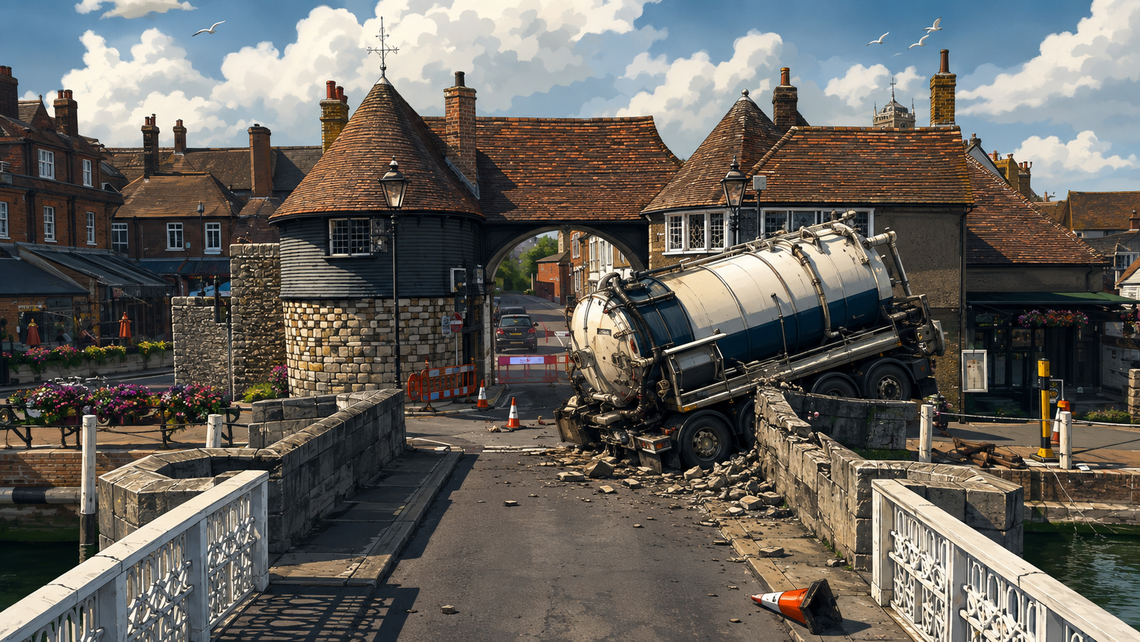
Sandwich has closed its Toll Bridge to traffic at least three times in ten years. In 2020, a council-commissioned report asked somebody to measure what happened. On 8 August 2026, a tanker working for Southern Water started the experiment again.
Nobody in Sandwich was ever going to vote to close the Toll Bridge to cars.
The paperwork, at least, appears to have understood that.
On 8 August 2026, at about half past seven in the morning, a tanker working for Southern Water struck the Toll Bridge on Ramsgate Road, and Kent County Council closed it to vehicles. Pedestrians and cyclists can still cross. This is a coincidence. It is also, to the millimetre, Focus Area 206.
First, the sewage
KCC Highways shut the crossing and sent surveyors. Cllr Dan Friend called the damage significant.
The tanker was there because Southern Water's own network had let go. Three sewage mains burst in a week. Tankers were brought in to take flows off two pumping stations in the town, a lane of the A256 was coned off, and part of The Quay car park was closed so crews could reach Bulwark Pumping Station. The Environment Agency advised against swimming at Sandwich Bay and Western Undercliff; independent testing came back showing no impact, and the advice was lifted the next day.
So the mitigation for the sewage failure broke the bridge.
Sir Roger Gale's early guess was more than two months — which takes the town to the end of October, straight through the season the pubs, cafés and market traders live on. He also pointed out that anyone living on the far side now faces a ten-minute diversion, and that if the bridge closes to pedestrians too, a constituent who normally wheels herself into town simply won't be able to.
KCC has a permit for the bridge with an initial end date of 21 August, accompanied by a clarification that this refers to the permit period and does not necessarily mean the works will be finished by then.
Southern Water says it is investigating the circumstances and is sorry for the inconvenience. It has directed affected businesses to the compensation criteria in its Street Works Policy.
This has happened before
Here is the thing that makes the current argument in the town so strange: Sandwich already knows what a closure feels like. It has been through several. What it has never had is a number.
In 2016, Sandwich Town Council commissioned the architects Rummey Design to run a consultation called Which Way for Sandwich? One of the suggestions was closing the Toll Bridge to vehicles — flexibly, KCC's principal transport planner Tim Middleton explained, with timings and exemptions to allow residents, loading and emergency vehicles through.
The town was not keen, and it had recent evidence to hand. During repairs to the Barbican, the toll bridge had been shut for about four weeks. Linton Culver of the Empire Cinema said business dropped considerably over that period and attendances were poor, and that if the closure were made permanent he would have to review whether he kept running the cinema at all. Paul Cantle of Highway Marine Service Centre worked out that he had lost a week's worth of labour sitting in traffic between Discovery Park and the White Mill roundabout. Melanie Cooper, who lives a minute's drive from the bridge and works in Margate, said the closure added an hour to her journey. There had been a further temporary closure the month before the consultation.
Read that again. In 2016 the town ran a four-week closure and produced: one lost week of labour, one hour on one commute, and a cinema owner's impression of the takings.
No proposal was selected. Ten years later, none has been.
Then the bridge started deciding for itself. It suffered hydraulic and control faults from December 2018 until temporary works in June 2019, and by that spring KCC was looking at a major overhaul — probably lifting the swing span out altogether, with vehicles diverted via the A256.
At the full council meeting on 29 April 2019, most of the discussion was damage limitation. Cllr Paul Carter wanted clear diversion signs and signs saying the shops were still open. Cllr Lynne O'Donoghue wanted extra parking north of the river for the bank holiday.
Then Cllr Michael 'MJ' Holloway asked whether this was actually an opportunity. Could the town use the closure to take some traffic measurements? A lot of people assume closing the Toll Bridge means disruption — perhaps this was the chance to test that and find out. A proper scoping exercise.
Sue Chandler, then a KCC councillor, agreed it was possible, but said it would need funding. Holloway reckoned the Town Team would jump at the chance.
That June, the bridge swung open for a boat and refused to close again.
Hold that thought.
They wrote the experiment down
In March 2020 the charity Sustrans published a walking and cycling audit of Sandwich, one of four town audits commissioned by Dover District Council. It covers everything from the Rope Walk surface to School Streets outside Manwood's.
Focus Area 206 is titled Converting Toll Bridge into Walking and Cycling Only.
Its argument is the one your neighbours have been shouting about all week, set out in flat consultancy prose. The Toll Bridge is the only Stour crossing from the town, and it doubles as a north–south shortcut for drivers dodging the A256. Keeping it open to vehicles pulls through-traffic into a medieval street grid and discourages people who live in Sandwich from travelling sustainably. Closing it wouldn't cut off Discovery Park or the industrial estate, because both stay reachable via the A256. It would cut traffic through town and make the crossing pleasanter on foot. And — read this one twice, a week after a lorry took out a listed parapet — closing the bridge to vehicles may lengthen the life of the structure.
Then the recommendation. The upcoming maintenance works, Sustrans wrote, were a unique opportunity to monitor what a closure actually does to traffic volumes and speeds in and around Sandwich. Traffic counts and monitoring for the full duration of the closure, strongly recommended. Site visits and observation to evaluate the effect on the town, on residents, on visitors and on local businesses.
That is more than a proposal. It is a study design, sitting in a public document, waiting for a closure to attach itself to.
And here is how it sits in the document. Everywhere else, the audit converts its thinking into numbered jobs — 204.1.8, a zebra crossing across St Bart's Road at the Hazelwood Meadows bus stop; 202.1.3, a pelican crossing on New Street for the station; 103.1.6, cycle priority traffic lights on the Toll Bridge itself. Dozens of them, each with a reference you could put on a spreadsheet, each scored red, amber or green for deliverability and impact in the table at the back.
Focus Area 206 has no numbered intervention. Neither does 205, the proposal for new pedestrian and cycle bridges over the railway. Neither appears in the scoring table at all. Even double-yellow-line interventions get ranked. The two ideas that would change how the town works are written up as arguments and left there.
The audit also concedes, a few pages earlier, that no detailed traffic counts were available to the people writing it.
And then the closure came
The maintenance Sustrans was pointing at was not hypothetical. It was already booked.
It had been due to start on 17 February 2020 and run for seven weeks. It was postponed — because Southern Water had suffered two bursts on the same ten-kilometre sewer main that serves the entire population of Sandwich, one directly beneath the River Stour and the other under more than five metres of built-up A256 carriageway near Discovery Park. KCC, sensibly, would not have both routes shut at once. The bridge works were at that point also part of a general tidy-up of the town before the Open at Royal St George's.
The work finally began on 21 September 2020 and ran for eleven weeks. The deck was lifted out and taken to a KCC yard to have its mechanical and electrical components replaced, and it was cleaned and repainted while it was there. River navigation was maintained throughout. The deck went back on at the end of November.
So the closure Sustrans asked to have measured arrived about six months after it asked.
Which raises a question that has an actual answer, held by somebody: did anybody take the counts?
One caveat, and it matters. In 2020 pedestrians didn't cross either. KCC laid on a complimentary shuttle bus — two minibuses, every fifteen minutes, six in the morning to midnight, from the Cattle Market by the Guildhall via Discovery Park to Ramsgate Road at Willow Bank. So those eleven weeks were not the Focus Area 206 condition. That was the town with no crossing at all.
Which means August 2026 is the first time the exact arrangement in Focus Area 206 has existed in the real world. Cars off. Walking and cycling on.
And then it disappeared
The 2020 audits weren't forgotten. In 2024 Dover District Council secured Active Travel England funding, with KCC, to turn them into a district-wide cycling and walking plan. It was decided not to revisit the four town audits but to carry their proposals straight into engagement, and residents were asked to rank the 2020 audit routes. In April 2025 the draft plan went out for consultation with all four audits attached. The council took a van to Sandwich Age Concern on 22 May to hear what people thought.
The master plan that came out of it runs to seventy-eight pages. It ranks six inter-settlement cycle routes for deliverability, impact and cost, priced to the penny — £6,167,444.62 for one, £4,089,488.56 for another.
Search its text for "toll bridge" and you get nothing. Not once, in seventy-eight pages.
Purely coincidentally
Let us be clear about what is not being alleged. Nobody is suggesting that anybody arranged for a lorry to hit a bridge. The idea is preposterous and this piece does not advance it.
It is simply worth noting the following, in order.
In 2016 the town was asked whether it wanted the Toll Bridge closed to vehicles and said no — loudly, on the record, on the strength of a four-week closure nobody had measured.
In April 2019 a councillor asked whether the next closure could be used to collect the data that would settle it. He was told it would require funding.
In March 2020 a report commissioned by Dover District Council recommended closing the bridge to vehicles, observed that this may lengthen the life of the structure, and asked that the next closure be monitored in full.
In September 2020 that closure happened. Eleven weeks.
In 2025 the proposal went back out to public consultation attached to a district plan, and then does not appear anywhere in the plan itself.
And in August 2026, for the moment, the bridge is operating almost exactly as Focus Area 206 proposed. NCN15 still crosses it; cars don't. Walking and cycling are the only ways across. The structure is being surveyed for repairs which will, presumably, be intended to extend its life.
No public vote was required. No consultation preceded it. No objection could prevent it. Mr Culver was not asked. Mr Cantle was not asked. Mrs Cooper was not asked.
There is nothing to appeal, because nothing was decided.
Who is counting?
The trial is running right now. Traffic is finding the A256 or it isn't. The market is holding up or it isn't. People are walking across or driving round. Discovery Park commuters are working out what NCN15 is for. Nobody can complain about being a guinea pig, because officially there is no experiment.
And if somebody is counting, six months from now the report could practically write itself.
During the extended closure, vehicular access to key employment sites remained possible via alternative routes.
Given the heritage sensitivity of the structure…
There may now be an opportunity to reconsider the long-term role of the bridge as a vehicular crossing.
None of those sentences has been written yet. The logic behind every one of them was written down in 2020.
Which leaves the only question worth asking, and it isn't who was driving.
It's who is counting.
Because this town has now shut that bridge to traffic three times in ten years — four weeks in 2016, on and off through 2019, eleven weeks in 2020 — and the sum total of what Sandwich knows about the consequences is a lost week of labour, an extra hour to Margate, and a cinema owner's memory of a bad month.
Everything else is what people believe.
So if the counts are being taken this month — if somebody is out on Ramsgate Road with tubes across the carriageway, logging what the A256 absorbs and what the market loses — then a study designed in March 2020 is being executed almost to specification by a burst sewage main, whether anybody intends to publish the results or not.
And if nobody is counting, then Sandwich has lost its bridge, lost its summer, and learned nothing. Again.
Two questions, then, and neither of them is rude.
Were the traffic counts taken during the eleven-week closure in autumn 2020, as the audit recommended? And why does the Toll Bridge appear nowhere in the plan that audit was feeding?
Somebody at County Hall or in the Guildhall knows both answers.
Written for shits and giggles by someone who grew up there. No allegation of intent is made or intended against Southern Water, its staff or its contractors; the collision is under investigation and this piece takes it entirely at face value as an accident. Everything factual here comes from KentOnline's reporting, KCC's own works notification for the 2020 refurbishment, Sandwich Town Council papers, the Sustrans Sandwich town audit of March 2020 and Dover District Council's 2025 cycling and walking plan — all public, all more interesting than you'd expect.