ARDMT Field Notes
UCL's UNITy Trial: Can DMT Disrupt Alcohol Memory Reconsolidation?
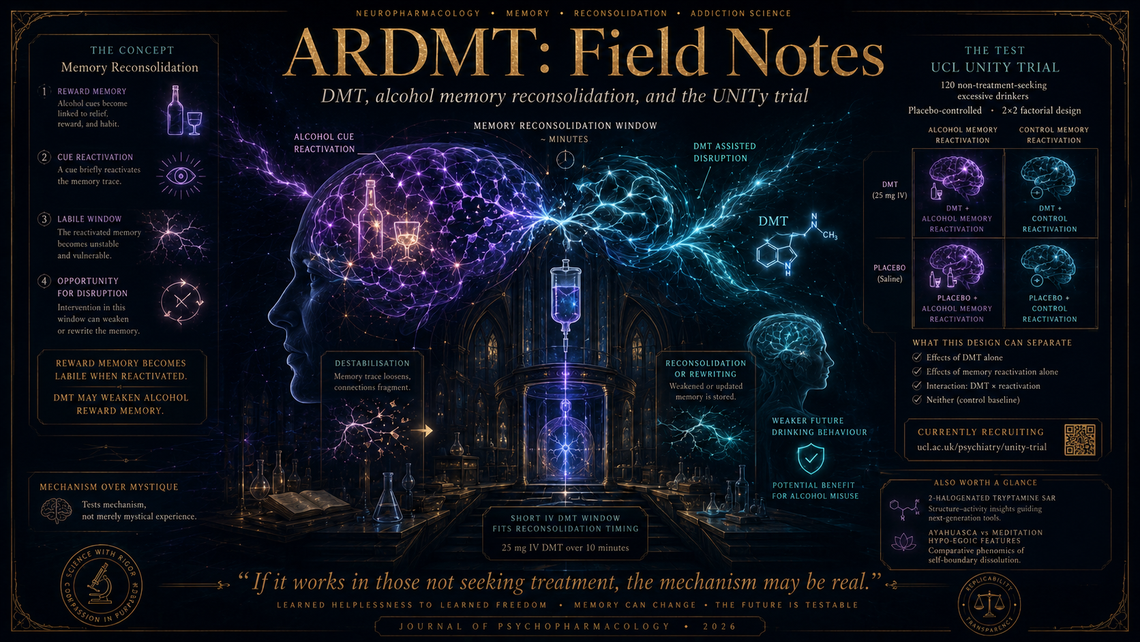
One of the more quietly radical ideas in contemporary addiction neuroscience is that a problematic drinking habit is not merely a pattern of behaviour but, in some non-trivial sense, a memory — a consolidated associative trace linking environmental cues to reward expectation, stored in synaptic architecture that can, under the right conditions, be destabilised and rewritten. The theory of memory reconsolidation holds that when such a trace is reactivated (by, say, the sight and smell of one's preferred tipple), it enters a brief labile window during which it is susceptible to disruption before being re-stored. Interfere pharmacologically during that window, and you might weaken the memory's grip on future behaviour. It is a tidy hypothesis, and it has generated some genuinely interesting work with propranolol and ketamine. Now a team at University College London wants to know whether DMT can do the same job — and whether it might do it rather better.
The UNITy trial
The study in question — ISRCTN13970288, registered August 2024 and currently recruiting — carries the backronym UNITy, for "Understanding Neuroplasticity Induced by TrYptamines," which is the sort of acronym one either admires or quietly deplores, depending on temperament. The design is a 2×2 factorial, placebo-controlled, with participants randomised to four arms: DMT plus alcohol memory reactivation, DMT plus control (non-alcohol) memory reactivation, placebo plus alcohol memory reactivation, and placebo plus control reactivation. The target sample is 120 non-treatment-seeking excessive drinkers, block-randomised to keep group sizes balanced at interim milestones of 40, 80, and 120. The active drug is 25 mg of N,N-dimethyltryptamine fumarate, delivered intravenously as a 2.5 mg/ml solution over ten minutes — a dose and route consistent with the controlled infusion paradigm that produces an immersive psychedelic state of manageable duration.
The behavioural manipulation is the critical piece. In the alcohol memory reactivation condition, participants are exposed to their preferred alcoholic drink and associated visual cues — a procedure designed to render the reward memory labile, opening the reconsolidation window. In the control condition, the same temporal structure is followed but with non-alcohol stimuli, so the reward trace should remain consolidated and, in principle, unperturbed. By crossing drug with reactivation, the trial can tease apart whether any observed reduction in subsequent drinking is attributable to DMT's neuroplastic effects during the reconsolidation window specifically, to DMT alone (perhaps via some broader motivational or insight-related mechanism), to memory reactivation alone, or to neither.
This is a genuinely important distinction, and one that the broader psychedelic-assisted therapy literature has largely failed to make. The standard model in trials of psilocybin or MDMA for addiction or PTSD pairs the drug with extensive psychotherapy, making it essentially impossible to attribute outcomes to pharmacology, to therapy, or to the interaction. UNITy, by contrast, tests a specific mechanistic hypothesis: that DMT disrupts the reconsolidation of alcohol reward memories, and that this disruption — rather than mystical experience, narrative insight, or therapeutic alliance — is what changes drinking behaviour. The factorial design is the right tool for the question.
Where it sits in the literature
The reconsolidation-interference approach to addiction has precedent. Das and colleagues at UCL — the same group, one notes — have published work suggesting that propranolol administered after alcohol memory reactivation reduced subsequent beer consumption in hazardous drinkers, and a parallel line of work by Bhatt and colleagues has explored ketamine as the interfering agent. DMT is a logical next candidate: it is a potent 5-HT2A agonist, it appears to promote structural neuroplasticity (dendritic arbourisation, spinogenesis) via TrkB and mTOR signalling pathways, and its short duration of action — roughly twenty to thirty minutes for an intravenous infusion — makes it far more practical in a laboratory setting than psilocybin's four-to-six-hour commitment. If the plasticity triggered by 5-HT2A activation is what destabilises the reactivated trace, DMT may offer a tighter temporal coupling between reactivation and disruption than longer-acting psychedelics could.
There are, naturally, questions. The sample comprises non-treatment-seeking excessive drinkers, which is epidemiologically important but means the findings may not generalise straightforwardly to people with severe alcohol use disorder. The primary outcomes are not yet detailed in the registry entry with full specificity, and one would want to see how drinking is measured — timeline followback, biomarkers, or both — and over what follow-up period. The ten-minute infusion protocol, while established, will produce marked acute subjective effects that may compromise blinding in the active drug arms — a perennial headache in psychedelic trials, and one that no amount of clever design has fully resolved. The registry entry specifies a buffer solution as placebo; whether this proves adequate for maintaining the blind will matter a great deal for the interpretability of results.
If UNITy delivers a clean interaction effect — DMT reducing drinking specifically when combined with memory reactivation — it would be a decidedly striking result, one that shifts the conversation about psychedelics and addiction away from the somewhat vague invocation of "transformative experiences" and towards a tractable, testable neuroscience. If the DMT-alone arm also shows effects independent of reactivation, the picture becomes more complicated but no less interesting. Either way, the design is unusually rigorous for this stage of the field, and the trial deserves close watching as recruitment proceeds.
Also worth a glance
A recent paper on serotonergic structure-activity relationships examines 2-halogenated tryptamines and their polypharmacology across serotonin receptor subtypes (PMID 42079221) — directly relevant for anyone tracking how small modifications to the tryptamine scaffold alter receptor binding profiles in DMT's immediate chemical neighbourhood. Separately, a study in Human Psychopharmacology compares hypo-egoic features — ego dissolution and related phenomena — between ayahuasca and meditation practitioners (PMID 42083787), finding overlapping but distinguishable phenomenologies; modest in scale but a useful data point for the experiential cartography.
Marginalia
There is something pleasingly honest about a trial that recruits people who are not seeking treatment. It sidesteps the expectancy effects and demand characteristics that haunt studies of volunteers who have already decided they want to change, and it asks whether a pharmacological intervention can shift behaviour in people who have not yet framed their drinking as a problem. If it works in that population, one suspects something genuinely mechanistic is happening beneath the level of intention. That would be worth knowing.