Ethics
The Root It Refused
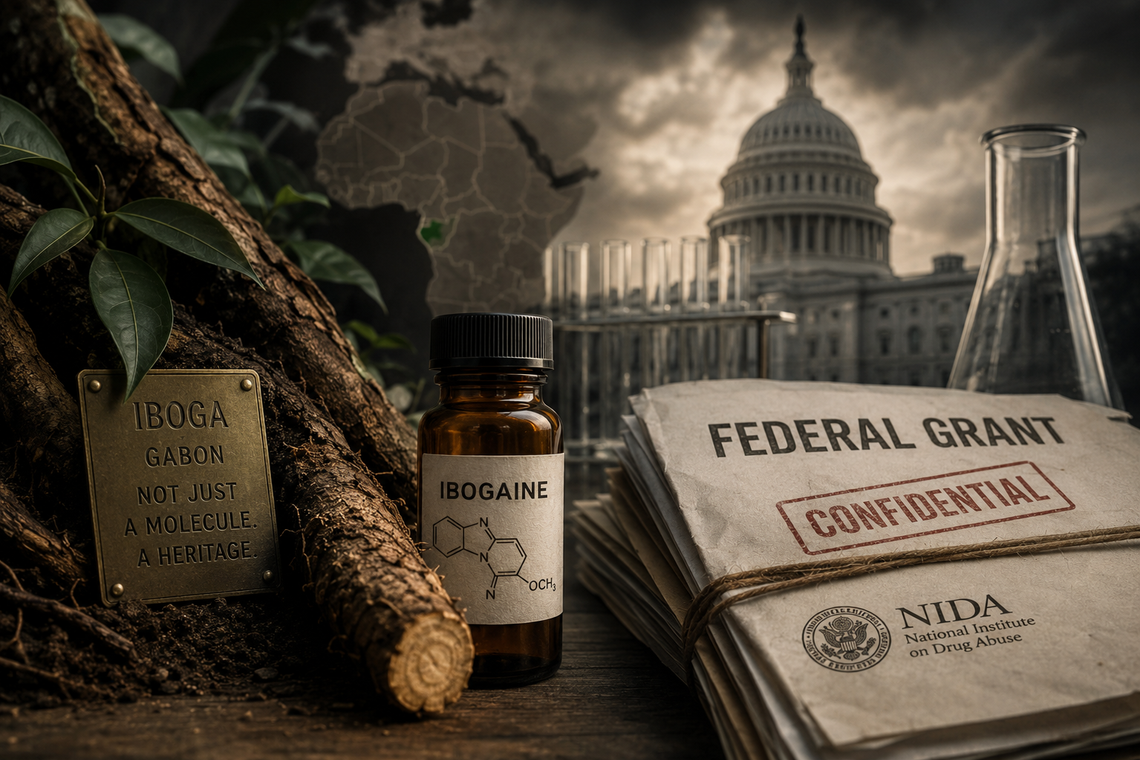
In July 2026 the United States began paying to reopen the human ibogaine programme it walked away from thirty years ago. The science is real. The cardiac risk that stalled it is real. And the plant at the centre of the grant is the protected heritage of Gabon, claimed anew this year by a treaty the United States has never joined.
The week Washington changed its mind
On 13 July 2026, five federal bodies went on the record in a single day in support of psychedelics: the FDA, the Department of Veterans Affairs, the Advanced Research Projects Agency for Health, the National Institute on Drug Abuse, and the Health Resources and Services Administration. Inside that flurry, easy to miss, was the piece of news that matters most for anyone who has followed iboga for longer than a news cycle. NIDA had funded a multi-phase project at Harvard to study ibogaine for opioid use disorder, and ARPA-H had opened a related funding call of its own.
The Harvard project is led by Joji Suzuki, who directs the Division of Addiction Psychiatry at Brigham and Women's Hospital and teaches psychiatry at Harvard Medical School. The award is a UG3/UH3 grant worth up to around eleven million dollars, with an initial tranche of roughly $2.3 million released. The structure is deliberately staged: secure an Investigational New Drug clearance from the FDA, complete a Phase I safety study, and proceed to a small Phase II in patients with opioid use disorder, only if the safety data allow it.
One detail separates this from the incremental progress the field has seen. Suzuki's team intends to seek clearance for ibogaine itself, at the higher, therapeutic doses that resemble how the drug has actually been used, rather than only its gentler metabolite. Earlier in 2026, around the signing of the psychedelics executive order, the metabolite noribogaine was cleared for domestic trials, in a protocol built around lower doses given over roughly a week. Clearance for a modern US trial of full-dose parent ibogaine has remained out of reach for roughly three decades. This grant is aimed squarely at it.
And then, folded into the announcements, a single sentence that rewards a second reading. NIDA said it had recently revived and validated data from earlier ibogaine studies, and shared that data with the FDA and with researchers.
Revived from where? That is the question the press release does not answer, and it is the whole story.
What "revived" conceals
The word implies something dormant, brought back to life. It is worth being precise about what was allowed to lie dormant, and how.
This was not a road never taken. It was a road opened and then defunded. In the early 1990s, Deborah Mash, Juan Sanchez-Ramos and W. Lee Hearn at the University of Miami held an FDA Investigational New Drug application for ibogaine, number 39680. The FDA convened an advisory committee that reviewed ibogaine for clinical safety trials in August 1993, and NIDA, through its Medications Development Division, was the federal collaborator. In other words, the regulator engaged. The system proved capable of evaluating the proposal and did evaluate it. What did not follow was the federal money to run the human development programme. NIDA declined to finance it, and by the mid-1990s the American pathway had stalled.
The research did not die. It emigrated. Mash moved the clinical work offshore, running a fee-for-service detoxification programme called Healing Visions on the island of St Kitts from 1996 to 2005, outside the American regulatory system. In published analyses of that uncontrolled cohort, which numbers in the region of 190 patients across the reports, physician-rated opioid withdrawal scores fell sharply within hours of a single oral dose, and the patients retained at follow-up reported substantial reductions in depression and craving at one month. Those are real signals, and they should be read for what they are: observations from an open-label programme with no control group, no blinding, and the selection, attrition and confounding problems that come with treating self-selected patients at a private clinic. They are a reason to run a proper trial, not a substitute for one.
So when NIDA speaks of reviving earlier data, it is describing a return to evidence the government itself declined to advance, much of it generated in exile after an FDA-authorised pathway lost its funding. This is not a criticism of the scientists now involved, who are doing careful and overdue work. It is a description of an institutional reversal, and reversals are worth naming plainly.
What changed is not the molecule. Ibogaine in 2026 is the same alkaloid it was in 1993. What changed is the surrounding weather. Worldwide, the number of people using opioids has climbed past sixty million, and opioids figure in something on the order of 600,000 deaths a year, a scale that makes almost any credible intervention worth a trial. On 18 April 2026, a presidential executive order made psychedelic research, ibogaine explicitly among the named compounds, a federal priority, allocated fifty million dollars to federal-state partnerships, and directed the FDA toward a Right to Try pathway. The scientific case for finding out was already strong three decades ago. What was missing was the institutional willingness to find out properly.
The problem that stalled it has not gone anywhere
It would be easy to read the offshoring as pure timidity, a regulator flinching from a stigmatised drug. That reading is too flattering to ibogaine and too harsh on the regulator. There was, and is, a real reason to be careful. It lives in the heart.
Ibogaine inhibits the hERG potassium channel, which governs the electrical recovery phase of each heartbeat. Block it, and the heart's QT interval lengthens. Lengthen it far enough and you open the door to torsades de pointes, a chaotic and potentially fatal arrhythmia. This is not a hazard observed only in a dish. In a monitored study of patients with opioid use disorder, a single oral dose of ibogaine prolonged the QT interval by an average of 95 milliseconds, and half of the participants crossed a QTc of 500 milliseconds, the threshold clinicians treat as a red line.
The record includes deaths. A review led by Kenneth Alper catalogued nineteen fatalities following ibogaine ingestion between 1990 and 2008; later updates brought the running total to around thirty-three. The causal role of the drug could not always be established, and the fatalities clustered where you would expect: unregulated settings, off-label clinics, self-administration, and above all in people with pre-existing cardiovascular disease or concurrent use of other central nervous system depressants. Withdrawal itself stresses the heart, which is a cruel irony for a drug whose main promise is treating withdrawal.
NIDA's own framing names this directly. The hope, the agency says, is that updated dosing and administration approaches can manage ibogaine's risks without compromising its therapeutic potential. The tools for that are visible. Co-administered intravenous magnesium, which stabilises cardiac rhythm, is a recognised risk-management measure: a Stanford-associated observational programme used it alongside ibogaine in veterans with traumatic brain injury, and clinical protocols elsewhere treat dangerous QT prolongation with magnesium infusion and, if needed, transfer to coronary care. Add rigorous cardiac screening, continuous ECG monitoring, and exclusion of the highest-risk patients, and the danger becomes something a hospital can hold. None of this is established as an antidote that neutralises the drug's cardiotoxicity.
Here is the point the headlines will skip. Monitoring and magnesium may reduce the probability that QT prolongation becomes catastrophic. They do not remove the underlying pharmacology, and they cannot by themselves establish that a therapeutically useful dose has an acceptable safety margin. That is the question the development programme must answer, and it is why the staged structure of the grant matters more than the headline figure.
There is a fork in this road, and it is worth being accurate about where the federal money stands on it. Federal money is no longer taking only one side. It has funded the reductionist route, the analogues engineered in Western laboratories to separate the therapeutic, neuroplastic effect from ibogaine's psychedelic ordeal and, ideally, from its cardiac liability: David Olson's tabernanthalog, the work at Delix Therapeutics, a reported award for a "cardiac-safe" analogue known as GM-3009, and the older 18-MC. The Suzuki award now places parent ibogaine back beside them as a competing scientific wager. Each wager is a bet about what in ibogaine is essential and what is disposable. And each lands its value in a different place, which is where the politics begins.
The plant is not America's to revive
Let us be specific, in the way this subject demands and rarely receives. Ibogaine is the principal alkaloid of Tabernanthe iboga, the root bark of a slow-growing shrub of the Central African rainforest. It is not a laboratory invention with a botanical ancestor. It is a plant medicine at the heart of Bwiti, the initiatory spiritual tradition of Gabon, carried in branches that include the Missoko and Fang rites and by peoples including the Babongo, the Mitsogo and the Fang, in which the ground root, taken under the guidance of an nganga, is understood to open a passage between the living and the dead from which the initiate returns reorganised.
But be exact about what the West actually inherited, because the romantic version of this story is easy to write and easy to refute. Bwiti did not hand Western medicine a ready-made detoxification protocol. The modern claim that iboga interrupts addiction traces to Howard Lotsof, a young American heroin user who swallowed ibogaine in 1962 and found, to his surprise, that his withdrawal was simply absent, and who then spent decades turning that accident into a treatment and a patent. His US patent 4,499,096, granted in 1985, reported the addiction syndrome interrupted in five of seven heroin-dependent subjects. The debt to Gabon is real, but it runs differently from the myth. Western addiction medicine did not receive a Gabonese cure. It extracted a molecule from a Gabonese medicine whose safety, phenomenology and transformative structure had already been mapped through generations of practice, and then found a new use for it.
Lotsof's own patent records this in passing, and the record is worth reading closely. Its historical section notes that the indigenous peoples used the plant as a ritual, ordeal or initiation potion in large doses, and as a stimulant in smaller ones. The document privatises the addiction application while quietly documenting the provenance it did not create. That is the extraction in miniature: the debt acknowledged in a background paragraph, the value claimed in the numbered claims.
And, as with any of these medicines, ibogaine is not one thing. Gabonese root bark, semi-synthetic ibogaine extracted from Ghanaian Voacanga africana, pharmaceutical-grade hydrochloride in a Phase I vial, and a single detox dose on St Kitts are different objects with different provenance, different risk profiles and different politics. This essay is about the first of them, and about how readily the others are used to avoid it.
Gabon has spent a quarter of a century preparing for exactly this moment. In 2000, under President Omar Bongo, himself a Bwiti initiate, the state declared iboga a national and strategic heritage. In 2011, Gabon became the first country in the world to ratify the Nagoya Protocol, the international instrument on access to genetic resources and the fair sharing of the benefits arising from their use, and it did so in large part to protect this one plant. In 2019, an export prohibition hardened into a zero-tolerance enforcement regime, and the Ministry of Forests began calling the unlicensed traffic in root bark by its accurate name: biopiracy.
That framework is not theoretical, and it has begun to produce the thing benefit-sharing is supposed to produce. Over more than a decade, the NGO Blessings of the Forest built a legal channel with the Ministry of Forests, and in 2023 an iboga-growing community made the first lawful export of iboga under the Nagoya Protocol: a one-kilogram pilot shipment sent for genetic analysis in Canada and Mexico, under a licence permitting up to a hundred kilograms, with revenue redistribution to the community written into the arrangement. The same programme reports tens of thousands of iboga seedlings replanted to counter the poaching that strips the wild plant, school fees and housing funded across dozens of villages, and support for associations that federate Bwiti temples so that the knowledge-holders can defend their own heritage collectively. It is early and it is small, but it is a working model: heritage valued legally, traceably and with the benefit routed home.
Then the United States raised the stakes, and Gabon answered within a fortnight. On 30 April 2026, twelve days after the American executive order named ibogaine a national priority, a Gabonese cabinet meeting presented a draft decree to regulate all activities relating to iboga, reaffirming its status as strategic heritage and, for the first time, naming not only the plant but ibogaine and its chemical derivatives. Precision matters here, because the temptation is to overstate it. This is a draft presented in cabinet, not yet a promulgated statute, and a domestic decree cannot by itself create an internationally enforceable claim over every molecule chemically related to ibogaine. But the direction is unmistakable. Gabon is watching the American money arrive and trying to extend its claim from the root to the molecule, precisely because it understands that the molecule is where the value, and the escape, now lie.
Three debts, and the seam between them
The Gabonese case is strong, but it is often argued badly, because three different claims get folded into one. They must be kept apart.
The first is control of the physical plant. Gabon owns and polices this, its export regime is real and enforced, and no one seriously disputes it. The second is benefit-sharing for traditional knowledge. This is the domain of the Nagoya Protocol: contractual, built on prior informed consent and mutually agreed terms, and enforced not by any international court but at the user-state end, through the importing country's own law. The third is the moral and historical debt for the original inspiration. That debt is real, but it is not, by itself, a legal claim.
These three do not travel together, and chemistry is what pulls them apart. A fully synthetic ibogaine produced without ever touching Gabonese material, or an analogue designed around public-domain chemistry, may fall outside conventional access-and-benefit-sharing obligations altogether. The very feature that makes the debt legally elusive is the ease with which chemistry translates a place-bound biological resource into placeless information. The foundational Lotsof method is already public domain, its patents long lapsed. The live intellectual property now clusters on analogues and cardiac-safe formulations, which is to say on precisely the versions that need no Gabonese bark at all.
The gap has not gone unnoticed by the people who write these rules. In May 2024, the World Intellectual Property Organization adopted a new treaty on intellectual property, genetic resources and associated traditional knowledge, which for the first time requires patent applicants to disclose the country of origin of the genetic resources, and the Indigenous people or community that provided the traditional knowledge, when a claimed invention is based on them. It is aimed at exactly this problem. But its reach is narrow by design. It compels disclosure, not consent and not payment: it lets a provider country see a patent, not veto or tax it. It is non-retroactive, so the existing analogue patents are untouched. Its sanctions are deliberately weak, and a patent cannot be revoked merely for a failure to disclose. As of mid-2026 it is not yet in force, with only a handful of the fifteen ratifications it needs. And the United States is not among its signatories.
Above all, its trigger is that phrase, based on, and the treaty defines it tightly: the genetic resource or knowledge must have been necessary for the invention, and the invention must depend on its specific properties. A molecule engineered to reproduce ibogaine's effect while sharing none of its regulated material is built, whether by intent or mere convenience, to land on the safe side of that line. The newest international instrument designed to catch the severance is drafted around the very seam the severance uses to escape.
So the sharpest version of the claim is also the most careful one. A federally funded programme using synthetic or previously circulating ibogaine may carry no straightforward US obligation to share benefits with Gabon, even when its entire scientific and commercial rationale remains historically inseparable from iboga. The debt does not disappear because it is unenforceable. It simply goes unpaid unless someone chooses to pay it. And the norm still has longer arms than the American exemption suggests, reaching non-parties through the friction of European markets, through provider-state law when material is sourced directly, and through the plain reputational cost of building a celebrated American cure on a foundation of documented expropriation.
What should travel with the money
The reversal is welcome on its own terms, and it is worth saying so without hedging. A compound that can flatten opioid withdrawal in a single dose, and hold craving down for a month, deserves a real trial run to a real standard, and the scale of the overdose crisis is reason enough. If Suzuki's team secures its IND and runs a clean Phase I, that is a genuine good, and a long time coming.
Two things should travel alongside the eleven million dollars, and neither is technical.
The first is honesty about the safety problem. The cardiac risk that helped send this work offshore in the 1990s has not been solved. It has become more manageable, which is a different claim, and the Phase I now being funded exists precisely to find out how much more. Anyone reporting durable remission rates without the QT interval in the same paragraph is telling half the story.
The second is memory, and its practical form. The root at the centre of an American federal grant is Gabonese heritage, protected by a treaty the United States, alone among the major players in this field, has declined to join, and claimed anew this very year by a government that saw the American interest coming and moved to meet it. There is now a working model for paying the debt, small but real, built village by village in Gabon. There is no legal compulsion to use it. Choosing to use it, when nothing forces the choice, is the whole test.
It is worth being clear about what this federal money is legitimising, because the on-shore research pipeline does not run alone. For two decades, most Western access to ibogaine has come through a second, offshore pipeline of commercial clinics and activist supply, sourcing around Gabon rather than through it. The danger of the current moment is that the first pipeline, respectable, trialled, federally funded, ends up conferring its legitimacy on the second, and that domestic legalisation arrives built for patient throughput to capitalised operators, with the plant's origin and its people stripped out at every joint. Paying the debt is the test precisely because the structure now forming is designed not to.
The door Washington is reopening is one Washington itself closed. The root it is now reaching for was never its own to refuse, and is not now its own to revive.
A note on the other pipeline
This essay looks at the research pipeline, the version of iboga that arrives on-shore, in the open, with federal money and a named investigator. There is a second pipeline running alongside it: the offshore commercial and activist route through which almost every Western recipient of ibogaine in the last two decades has actually been treated, and the Ghana-voacangine supply chain that bypasses Gabon entirely. That story, including the attempt to carry ibogaine into the Ukrainian war, is the subject of a forthcoming ARDMT investigation.
Sources
The federal announcements and the grant
- Psychedelic Alpha, "Backed by $11M NIDA Grant, Harvard Moves Forward on Ibogaine for Opioid Use Disorder Research," 14 July 2026. https://psychedelicalpha.com/news/backed-by-11m-nida-grant-harvard-moves-forward-on-ibogaine-for-opioid-use-disorder-research/
- Psychedelic Alpha, "Keeping Up with the Feds: From FDA to HRSA, Washington Backs Psychedelics," 13 July 2026. https://psychedelicalpha.com/news/keeping-up-with-the-feds-from-fda-to-hrsa-washington-backs-psychedelics/
The FDA and NIDA history
- US Food and Drug Administration, Freedom of Information Act request log, November 2024 (requests 2024-10359 to 2024-10365, concerning the 1993 NIDA Medications Development Division / FDA advisory review of ibogaine for clinical safety trials, and IND #39680 held by Deborah Mash, Juan Sanchez-Ramos and W. Lee Hearn). Primary document.
- Medscape, "Ibogaine for Psychiatric Illness: Federal Policy Push Meets Safety Concerns," 4 May 2026. https://www.medscape.com/viewarticle/ibogaine-psychiatric-illness-federal-policy-push-meets-2026a1000dvc
Cardiac safety and dosing
- Alper KR, Stajić M, Gill JR. "Fatalities Temporally Associated with the Ingestion of Ibogaine." Journal of Forensic Sciences, 2012.
- "Ibogaine: Therapeutic Potential, Cardiac Safety, and Translational Perspectives in the Treatment of Substance Use Disorders — A Scoping Review." 2025. https://pmc.ncbi.nlm.nih.gov/articles/PMC12899015/
- "Old Dog, New Tricks: Ibogaine and Its Analogs as Potential Neurotherapeutics." Journal of Medicinal Chemistry, 2025. https://pubs.acs.org/doi/10.1021/acs.jmedchem.5c02510
- ClinicalTrials.gov, NCT04313712, "Ibogaine-Magnesium Therapy in Veterans With Repeated Blast Exposure" (Stanford University). https://clinicaltrials.gov/study/NCT04313712
The Lotsof genealogy
- US Patent 4,499,096, Howard S. Lotsof, "Rapid Method for Interrupting the Narcotic Addiction Syndrome," granted 12 February 1985. Primary document.
Gabon, the Nagoya Protocol, and benefit-sharing
- Blessings of the Forest, Annual Report 2023 (implementation of the Nagoya Protocol; the first legal iboga export from Gabon; community benefit-sharing and replanting). Primary document.
- National Geographic, "The psychoactive drug ibogaine could save lives — and everyone wants to cash in," 2023. https://www.nationalgeographic.com/animals/article/ibogaine-pschedelic-drug-root-fair-trade-gabon
- Del Potter, "The Pharmacopoeia Without a People," 2026. https://delpotterphd.substack.com/p/the-pharmacopoeia-without-a-people
- Jonathan Dickinson, "Gabon to Restructure Iboga and Ibogaine Laws in Response to U.S. Interests," 18 May 2026. https://jonathandickinson.substack.com/p/gabon-to-restructure-iboga-and-ibogaine
The intellectual-property gap
- World Intellectual Property Organization, Treaty on Intellectual Property, Genetic Resources and Associated Traditional Knowledge, adopted Geneva, 24 May 2024 (see Articles 2, 3, 4, 5 and 17). Primary document.
- WIPO, Contracting Parties: signature, ratification and accession status of the above treaty (as of 2026). Primary document.