Cabinet of Marginalia
The Rocks That Are People
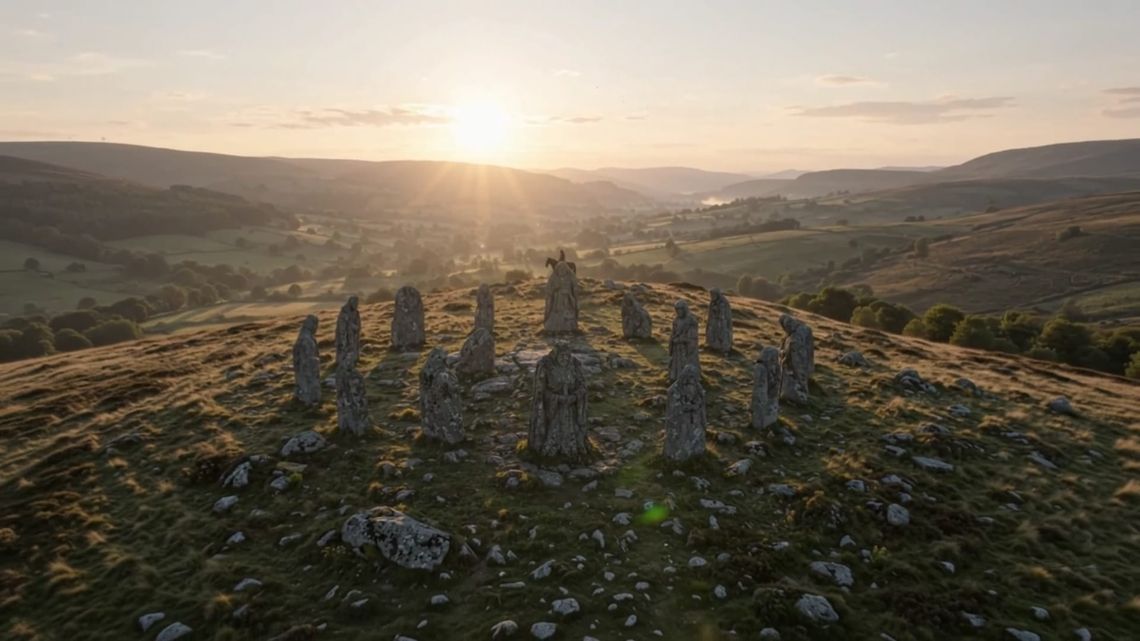
No, but some are
The English have never stopped treating some places as if they were somebody. Whether that makes those places persons is a harder question.
In the 1930s, the American anthropologist A. Irving Hallowell spent his summers with the Ojibwe at Berens River, on the east shore of Lake Winnipeg. He had a puzzle. In the Ojibwe language, nouns are marked as animate or inanimate, the way French marks them masculine or feminine. And rocks are grammatically animate.
So he asked William Berens, the Ojibwe treaty chief and his closest collaborator, the obvious question. Are all these stones around us alive? Berens thought about it for a long time and answered: no, but some are.
That answer is the key to everything that follows. Berens wasn't telling Hallowell that the Ojibwe believe rocks have souls. He was telling him that a few particular rocks are persons: beings you know, have dealings with, and owe something to. Which ones, and why, is learned through dealings with them rather than settled in advance.
Now walk onto Dartmoor. It is covered in granite, most of it nameless. But a handful of outcrops have names and stories. Vixen Tor is named for a witch who lured travellers into the mire. Bowerman's Nose is a huntsman turned to stone, and Hound Tor is his pack.
Does anyone on Dartmoor treat Vixen Tor as somebody in the way Berens meant? Probably not. But the names hint at something the word "rock" doesn't quite cover.
This piece follows that hint. It starts with how some Indigenous American peoples live among other-than-human persons. Then it asks a narrower question of the English material: when does a place we care about become a being to whom we owe something? Put more simply, who can make a claim on us?
A world full of persons
Across the Americas, many Indigenous peoples start from a different default: the world is full of persons, and only some of them are human. That is Graham Harvey's one-line summary of what anthropologists now call the "new animism". The emphasis is not on what you believe about souls. It is on who you are in relationship with, and how you ought to behave.
A caution first. There is no single "Amerindian worldview". Hundreds of peoples, languages and cosmologies run from the Arctic to Tierra del Fuego. What follows is a handful of examples that share a family resemblance, not one system.
Variation runs within communities too. Not everyone holds these relationships with the same conviction: some hold them fiercely, some loosely, some with scepticism or humour. A relationship can matter even when the people in it understand it differently.
The Ojibwe: persons by behaviour
For Berens and his people, the category "person" was never the same as "human". Hallowell coined the phrase "other-than-human persons" in 1960 to describe it. Thunderbirds were persons, and thunder was their speech. The "grandfathers" met in dreams were persons, and what they said in dreams counted as experience, not fantasy.
What made a rock a person was what it did. A stone that moved, or responded, or showed up in the stories, had stepped into a relationship. Grammar opened the door to personhood. Experience decided who walked through it.
The Haudenosaunee: the Three Sisters
The Haudenosaunee (Iroquois) grow corn, beans and squash together, and call them the Three Sisters, or Our Sustainers. In Mohawk tradition they are not crops but agents with personalities, who appear in stories as people. The corn gives the beans a pole to climb, the beans feed the soil, the squash shades out weeds. The farming is a family arrangement.
The Koyukon: etiquette with animals
In Alaska, the Koyukon hunters described in Richard Nelson's Make Prayers to the Raven follow strict rules after a kill. A beaver's body must be butchered a certain way, its bones disposed of properly, and silence or prayer observed. Break the rules and you have insulted a person, and the animals will stop giving themselves to you. Hunting is a gift economy, not a harvest.
The Amazon: everyone thinks they are human
The Brazilian anthropologist Eduardo Viveiros de Castro called it perspectivism. In many Amazonian cosmologies, every kind of being sees itself as human. Jaguars see themselves as people, and see the blood they drink as manioc beer, the chicha at the centre of every feast. Peccaries see themselves living in villages.
What differs between beings is the body, not the mind. Modern Western thought tends to assume we share a body (nature) and differ in mind (culture). Many Amazonian cosmologies, on Viveiros de Castro's reading, assume the reverse. Shamans are the people who can change perspective: put on another body, see as another being sees, and negotiate on behalf of their own.
Many Amazonian plant traditions put the obligation into the dieta. Learning from a plant teacher means weeks of restriction on food, sex and company, before drinking and after. Breaking the diet is not only a health risk. It offends the plant, and the teaching can turn against you.
The Wixárika: the door between worlds
For the Wixárika (Huichol) of Mexico, peyote is the nierika: a gateway between the world of ordinary things and the world of the ancestors. In their sacred story, the deer Kauyumari does not eat peyote. He becomes it. The mara'akame (shaman) looks through the nierika to see the ancestors, the pilgrims, and people's illnesses. And the ancestors look back through it at us.
The encounter is earned before it happens. On the pilgrimage to Wirikuta, led by the mara'akame, pilgrims make offerings at sacred sites along the route, abstain from sex, and limit food, water and sleep. Some parties begin with a public confession, though that practice, made famous by the anthropologist Barbara Myerhoff, shouldn't be assumed for every community.
The Mazatec: the holy children
In Oaxaca, the Mazatec healer María Sabina called psilocybin mushrooms niños santos, holy children. They were not a drug. They spoke through her during the velada, the night vigil, and the language they gave her was the language of healing. The oldest painted record of a mushroom ritual, in the Mixtec Codex Vindobonensis, shows mushrooms as deities carried on the heads of the gods.
Sabina's later life shows what happens when the obligations are dropped. After Gordon Wasson's 1957 magazine article, foreigners came to Huautla wanting the mushrooms for visions rather than healing. Sabina later said that from then on the saint children lost their purity and their force. On her account, breaking the relationship didn't only offend the mushrooms. It changed what they could do.
What ties these together
- Personhood is the big category. Humans are one kind of person among many, not the template.
- Relationship beats belief. The question is not "is it alive?" but "how do I behave towards it?"
- Relationships need etiquette. Gifts given and returned, permission asked, rules kept.
- Often particular. In some traditions, as with Berens's stones, personhood attaches to particular beings rather than to everything equally.
- Specialists keep the peace. Shamans and healers repair relationships when they break, which is often what illness is.
Four strands, not a ladder
Before turning to England, it helps to separate four things that are easily blurred:
- Stories about beings: the huntsman inside the rock.
- Affection for particular places: the tor you walk to every Sunday.
- Ritual relationships with obligations: the gift you owe, the permission you ask.
- Recognition of another being as a person: someone who can be addressed, offended, and make a claim on you.
These can overlap, and none is a higher grade of the others. A custom can also express one strand while the people keeping it understand themselves to be doing something else. Berens was describing the fourth. The question for the English examples is where, if anywhere, they reach the third and fourth.
How the West decided rocks were dead
The modern idea of "animism" was built to describe other people's mistakes. Edward Burnett Tylor popularised the term in Primitive Culture (1871), working mostly from reports sent back by missionaries, travellers and colonial officials. Apart from a few months in Mexico in 1856, which produced his first book, he did no fieldwork among the peoples he theorised about.
For Tylor, "primitive" peoples had looked at dreams, trances and death, and reasoned their way to a soul that could leave the body. Then they wrongly spread that soul to rivers, mountains and trees. Religion, he argued, grew out of that error: tree spirits became forest gods, many gods became one God, and eventually science would sweep the lot away.
Notice where Tylor's story starts: dreams, trances and visions. On his account, altered states are where the sense of other-than-human persons comes from. That makes psychedelics, which reliably produce exactly that sense, close to a demonstration of his mechanism. Tylor called the result an error. This piece is less interested in whether he was right than in what people do once they have had the experience.
The theory fell apart within a few decades. It assumed a ladder of cultures with Victorian England on top. It treated relationships as bad reasoning. And, as Hallowell later showed, it misdescribed what Indigenous people actually did.
But Tylor had a second idea that matters here: "survivals". These were old beliefs and customs that lingered in modern societies, like fossils. Many of his examples were European folk customs. In Tylor's scheme, an English villager pouring cider on an apple tree would count as a living relic of the primitive mind.
So while Tylor catalogued other people's animism from his study, the English countryside around him was full of it. He just filed it under superstition.
The deeper shift came earlier, with the Scientific Revolution. Descartes split the world into thinking minds and extended matter. Matter had no inside. From then on, a rock could only be an object, and treating it as anything else was a category error.
That is the inheritance Westerners carry. The interesting question is how badly it took.
The groves and the waters
Before the Romans, Britain had its own specialists in relations with the land: the druids. We know frustratingly little about them. They taught orally, and almost everything we have was written by Greek and Roman outsiders, many of them hostile. Ronald Hutton's Blood and Mistletoe is the best guide to how little is solid.
Still, the fragments point in one direction.
Sacred groves. In AD 60 the Roman governor Suetonius Paulinus crossed the Menai Strait to Anglesey. Tacitus describes druids on the shore with hands raised, calling down curses. After the slaughter, the Romans cut down the groves. The poet Lucan describes another grove, near Marseille, whose trees Roman soldiers were afraid to fell. The Celtic word for such a place, nemeton, survives in British place names: Roman Buxton was Aquae Arnemetiae.
Mistletoe and oak. Pliny the Elder describes Gaulish druids, across the Channel, in white robes cutting mistletoe from an oak with a golden sickle, then sacrificing two white bulls. The rite was tied to a particular plant, on a particular tree, at a particular phase of the moon. Pliny was writing about Gaul, not Britain. But Caesar claimed druid teaching began in Britain, so it is a fair guess, though only a guess, that something similar happened here.
Gifts to water. The archaeology is clearer than the texts. Iron Age Britons threw fine metalwork into lakes, rivers and bogs. The hoard at Llyn Cerrig Bach on Anglesey includes weapons, chariot fittings and slave chains. The Battersea Shield went into the Thames, the Witham Shield into the Witham. Whether these were gifts to the river itself, to a deity living in it, or to some other power, an offering assumes someone to receive it.
Rivers and springs with names. Under Roman rule, British waters show up as goddesses. Sulis presided over the hot spring at Bath, and Coventina over a well at Carrawburgh on Hadrian's Wall. The Severn was Sabrina. At Bath, people scratched curses onto lead sheets and threw them into the spring, asking Sulis to punish whoever stole their cloak. That is a petition to a person, not a superstition about water.
Trees that fight. Medieval Welsh poetry, written down by Christian monks but possibly carrying older material, keeps the theme alive. In Cad Goddeu, "The Battle of the Trees", the magician Gwydion raises the trees as an army, each species with its own temperament.
None of this proves the ancient Britons were animists in Harvey's sense. But it is hard to read the groves, the drowned shields and the curse tablets as anything other than a people in relationship with particular places.
When a place becomes somebody
Medieval English Christianity did not treat the land as dead. It was crowded with holy wells, saints' springs and sacred trees, many of them old sites given new patrons. The Reformation attacked that, condemning pilgrimage to wells as superstition. Then the 17th-century mechanical philosophy went further in a different direction. Robert Boyle argued that even speaking of "Nature" as an agent was a mistake: matter was passive, moved only by God's laws.
Between them, the reformers and the mechanists left no respectable way to say a spring or a tree was somebody. What carried on did so as custom and folklore. Whether any given custom is continuity, reinvention or the same instinct recurring is often impossible to tell. The Rollright witch, for instance, first appears only in the mid-19th century. Looking old is not evidence of being old.
So rather than claim an unbroken line, it is more useful to sort the English examples against the four strands set out earlier, remembering that what a custom expresses and what its keepers think they are doing can differ.
Stories: stones that walk
The Rollright Stones in Oxfordshire are a king and his army, turned to stone. On certain nights the King Stone and the Whispering Knights are said to go down the hill to drink at a stream. The King's Men cannot be counted: you get a different number every time. Dartmoor's petrified huntsman and his hounds belong here too.
These are stories about beings. On their own, they don't show anyone relating to the stones as persons now.
Conduct: the stone that went home
One Rollright story goes further. A farmer took the capstone of the Whispering Knights to bridge a brook. It took a score of horses to drag it down the hill. Every night the stone turned itself over onto the grass, and after three nights the farmer gave up and took it back. A single horse pulled it uphill with ease.
When the archaeologist Arthur Evans collected this in 1895, he found country people firmly believed it. One man said there were people still alive who had spoken to the men who moved it.
This is no longer just a story about a being. It is a story about conduct. You took something that wasn't yours, it refused, and you gave it back. In the story, the stone has a will and a place where it belongs.
Claims: rivers with appetites
An old Dartmoor rhyme says the River Dart takes a life every year. In the north, the Tees had Peg Powler and the Ribble had Peg o' Nell, spirits who demanded a drowning every few years. On the Border, a traditional rhyme has the Tweed and the Till arguing: the fast Tweed mocks the slow Till, and the Till replies that for every man the Tweed drowns, it drowns two.
These rivers have voices and appetites. They are feared, warned about and placated. That is closer to personhood than a name on a map: a river that can make a claim on you.
Permission: the Elder Mother
This is perhaps the clearest English example of all. Across England, and especially in Lincolnshire, you did not cut an elder without first asking the Old Girl or Old Lady who lived in it. The recorded formula was: Old Girl, give me some of thy wood and I will give thee some of mine when I grow into a tree. Cut without asking, and ill luck followed.
Look at what that sentence does. It addresses the tree directly. It asks permission. It promises a return gift, and the gift is your own body, after death, feeding the next elder. In form, that is a contract with a person, not just affection for a tree. Whether everyone who said it pictured an Old Girl listening is another matter; the words carry the relationship either way.
Reciprocity: wassailing the orchard
On Twelfth Night in Somerset cider country, villagers go out to the oldest apple tree. At Carhampton they soak toast in cider and lodge it in the branches for the robins, pour cider on the roots, and fire guns or bang pots to wake the tree and drive off bad spirits. The poet Robert Herrick was already telling people to wassail their trees in 1648.
The songs speak to the tree, not about it: Old apple tree, we wassail thee. You feed the tree that feeds you, so it will go on giving. That echoes the reciprocity of Koyukon hunting etiquette, where what you take you repay, without making the two traditions the same. It is also exactly what Tylor would have filed as a survival.
Obligation: telling the bees
The strongest example is the one with a duty to speak. When someone in the household died, the beekeeper went to each hive, knocked, and told the bees. Hives were draped in black, and the bees were told who their new master was. Otherwise they would take offence, leave, or die.
This is not only folklore. When Queen Elizabeth II died in September 2022, the royal beekeeper John Chapple went to the hives at Buckingham Palace and Clarence House. He tied on black ribbons, told the bees the Queen had died, and told them King Charles was their new master. A folklorist interviewed afterwards said many ordinary beekeepers had told him they still do the same.
What the custom expresses is clear: the bees are members of the household, who must be told and can take offence. What each beekeeper understands themselves to be doing is a separate question. Chapple may have been keeping faith with tradition, or with the Queen, as much as with the bees. A custom can carry personhood in its form while the people keeping it hold that lightly, from family loyalty, or with a smile.
Mostly affection: wells, processions, ships
Other customs sit closer to the affection and ritual end:
- Well dressing in Derbyshire. Tissington's wells are first recorded with garlands in 1758, and the famous petal pictures on clay boards only from 1818. Today the bishop blesses them on Ascension Day.
- Clootie wells in Cornwall and Scotland, hung with rags by people asking for healing.
- Processions such as the Abbots Bromley Horn Dance, the Padstow 'Obby 'Oss and Jack-in-the-Green.
- Everyday habits: christening ships with a bottle on the bow, calling them "she", naming cars, greeting magpies, touching wood.
Some of these may be animist habits with the belief worn off. Others may never have had it. Graham Harvey's point helps here: animism cannot be understood as a set of beliefs cut off from relationships and practice. But the reverse is also true. Practice with no sense of who you are dealing with isn't quite animism either.
What England didn't have
One thing is missing from all of this: visions. Andy Letcher's history of the magic mushroom finds accidental liberty cap poisonings in Britain from the late 18th century, but the first recorded deliberate trip only in 1970, in the underground magazine Oz. The druids-on-mushrooms story is a modern invention. So the English customs that come closest to animism, the elder, the bees and the orchard, carried obligations to other beings without any altered state to start them.
That makes a neat inversion. England kept, in fragments, the etiquette without the visions. The psychedelic renaissance has the visions, often without the etiquette.
The modern day: druids, tree-sitters and a sycamore
In the last sixty years, the English instinct has started saying its name out loud.
Modern Druidry
The druids of the 18th-century Revival, such as William Stukeley and Iolo Morganwg, were mostly antiquarians and patriots. Stukeley's druids were practically Anglican vicars. The animism came later. The Order of Bards, Ovates and Druids was founded in 1964 and has grown into the largest druid organisation in the world, with more than 25,000 members.
Modern druid practice is animist in the plain sense:
- Spirits of place are greeted at the start of ritual, and permission is asked.
- Trees are asked before wood is taken, and an offering is left in return.
- Ancestors are honoured as those of blood, of history and land, and of mythology, in the Druid Network's own wording. Ancestors of land belong to the place, not the family.
- The ancient dead are treated as persons. Emma Restall Orr founded Honouring the Ancient Dead to campaign for prehistoric remains in museums to be treated with respect, not as specimens.
Restall Orr also founded the Druid Network. In September 2010, after a four-year application, the Charity Commission registered it as a charity for the advancement of religion, the first druid group to win that status. Graham Harvey, the theorist of the new animism, wrote a report for the Commission during the process.
The decision itself shows the strain of translation. Charity law required belief in a "supreme being or entity", though the 2006 Act defined that broadly enough to include many gods, none, or a spiritual principle. The Druid Network met the test by presenting Nature as its supreme entity, with gods, ancestors and spirits of place as its manifestations, and told the Commission plainly that Druidry is animistic. The Commission accepted this, saying it would be wrong to require the entity to resemble any particular religion's god.
So the outcome was more generous than a monotheist reading. But a polytheist, animist tradition still had to describe itself through one focus to pass a test built around theism. The Network's own statement of common belief, filed with the application, even rejects the word "belief": Druidry, it says, rests on experience rather than faith.
The road protests
In the 1990s, the anti-roads campaigns at Twyford Down, Solsbury Hill and the Newbury bypass filled the woods with eco-pagans, druids and tree-sitters. Protesters lived in the trees, named them, held rituals for them and grieved when they fell. Andy Letcher, who gave the Exeter animism lecture, was an activist in those protests before turning to research, and wrote about them in "Gaia Told Me To Do It".
Sycamore Gap
In September 2023, someone cut down the sycamore in the dip of Hadrian's Wall. The country's response was grief: flowers, letters, people visiting the stump. The two men responsible were sentenced on 15 July 2025 to four years and three months each, partly for the outrage and distress they caused. At trial, one of them said he couldn't understand the fuss: it was just a tree.
Affection does not by itself make a tree a person; the earlier sections have already drawn that line. What is worth looking at is the shape of this particular attachment.
People did not mourn sycamores in general. They mourned one tree, in one dip of one wall, that had stood there for well over a century. When the National Trust grew saplings from its seed and offered 49 of them, one for each foot of its height, almost 500 groups applied. People wanted this tree's descendants, not a sycamore from a nursery.
That is a wish for continuity with one particular life, and it sits somewhere between caring and owing. The court counted the harm done to people. The question the grief kept raising, without answering, was whether harm had also been done to the tree.
Visions without etiquette
The new psychedelic culture is full of personhood language. Retreat brochures speak of Mother Ayahuasca and plant teachers. A Johns Hopkins survey of 1,606 people found that after a belief-changing psychedelic experience, the share attributing consciousness to plants rose from 26% to 61%, and to inanimate natural objects from 8% to 26%. It did not ask what anyone felt they owed.
When the question of claims has come up, it has come from the communities. In March 2020 the National Council of Native American Churches and the Indigenous Peyote Conservation Initiative asked decriminalisation campaigns to leave peyote out, citing scarcity, broken treaties and spiritual respect. Decriminalize Nature backed the request, and Santa Cruz removed peyote from its resolution. It is a small, concrete case of outsiders honouring a claim made by the people in relationship with a plant.
Rights for rivers
The law has started to borrow the language, though legal rights and relational personhood are different things. A court can give a river standing without anyone owing it a greeting, and people can owe a river a greeting without any court noticing. In February 2025, Lewes District Council approved a charter of rights for the Sussex Ouse, the first river in England to be given rights. It isn't legally binding yet. But it follows a path cut by Aotearoa New Zealand, where the Whanganui River became a legal person in 2017, and Ecuador, whose 2008 constitution gives rights to nature itself. Both of those came from Indigenous understandings of rivers and land as relatives.
Same instinct, different house
So do the English understand animism? Some of their customs carry its shape. What individual people make of those customs ranges from sincere belief to affectionate habit to a joke. That range is not peculiarly English; it exists in every community described above. The real difference is how far the relationships are publicly supported and woven into shared life.
What we share. The selectivity: not every stone, but the capstone that went home. The etiquette: permission from the elder, news for the bees, cider for the apple tree. The sense that some beings can make a claim on us.
What we lack. Not language, cosmology or specialists altogether: modern Druids have spirits of place, a worked-out account of Nature, and people who lead its rites. What is missing is a widely shared public framework for recognising these relationships. Everyday English calls a sycamore "it", where Ojibwe marks animacy in its nouns. A wassail is mostly treated as a charming custom rather than a relationship with a known being. And outside small groups, nobody is recognised as responsible for keeping things right with the river.
What we have that might bridge it. Isabelle Stengers argues that nobody is ever animist in general, only in particular places with particular beings. That is a problem for anyone hoping to import Amazonian or Mexican animism wholesale. But it is good news for the English. Our animism, such as it is, is already local: Dartmoor tors, Somerset orchards, Derbyshire wells.
Andy Letcher ends his lecture with a question. A psychedelic experience can make the whole world look alive, which he calls an animaphany. But does that lead anywhere, or does something else have to carry you from feeling the leaves look back to knowing what you owe them?
The English cases suggest where to look. An encounter can be profound, difficult and life-changing. What matters afterwards is whether it changes who you recognise as able to make a claim on you, and whether you go on honouring that claim.
That gives the psychedelic question its point. Psychedelic research mostly asks what an experience changed inside the person: mood, beliefs, meaning, even which beings seem conscious. The traditions in this piece ask something else. If the leaves did look back, what do you owe them now? No experience can answer that in the moment. The experience opens the question; what someone does afterwards, again and again, shows what became of it.
The Elder Mother formula and the bees both encode exactly that: a being with a claim, and a duty that is kept.
For what it's worth, every teacher I have met in this work has asked for reciprocity, and so, in their way, have the plants. My answer so far has been to keep studying, so I can repay it as usefully as possible: a bit like a disciple spreading the gospel.
A relationship becomes visible in what you repeatedly show up to do. In Somerset, that means going back every Twelfth Night with the toast and the cider, year after year, to the same tree.
Note on the Berens story
Hallowell's 1960 essay calls the man in this story only "an old man". A later autobiographical note, quoted in the National Academy of Sciences memoir of Hallowell, names him as William Berens and calls it an early conversation. Retellings, including the Exeter lecture, often set the exchange in a dried-up creek bed; that detail does not appear in the sources checked here.
Sources
Facts on modern events and recorded folklore were checked against these pages. Ethnographic and historical material is drawn from the works named in the text.
- Wallace, A. Irving Hallowell: A Biographical Memoir (National Academy of Sciences)
- Harvey, "If Not All Stones Are Alive" (2017)
- Wirikuta
- Harvard Divinity School: Saint Children, Psilocybin, and Epistemic Rupture
- Edward Burnett Tylor
- Boyle, A Free Enquiry into the Vulgarly Received Notion of Nature (Davis and Hunter edition)
- Psychedelic Press: Liberty Caps in late 1970s Britain
- Charity Commission: Druid Network decision (full text)
- The Druid Network: charitable status
- Order of Bards, Ovates and Druids
- Eimear Burke on OBOD
- Resilience: Andy Letcher
- Letcher, "Gaia Told Me To Do It" (2003)
- World History Encyclopedia: Legends of the Rollright Stones
- The Modern Antiquarian: Evans (1895) on the Whispering Knights
- Elder Mother
- CBC: Why the Queen's bees needed to be told about her death
- Well dressing
- AP: Sycamore Gap sentencing
- PA: Sycamore Gap trial
- National Trust: Sycamore Gap saplings planted
- Nayak and Griffiths (2022), Frontiers in Psychology
- Chacruna: Native American Statement Regarding Decriminalization of Peyote
- Good Times: Santa Cruz removes peyote from decriminalisation list
- Richard Buxton Solicitors: first river in England to gain rights