MSc Notes
Everything I'm About to Tell You Is True.
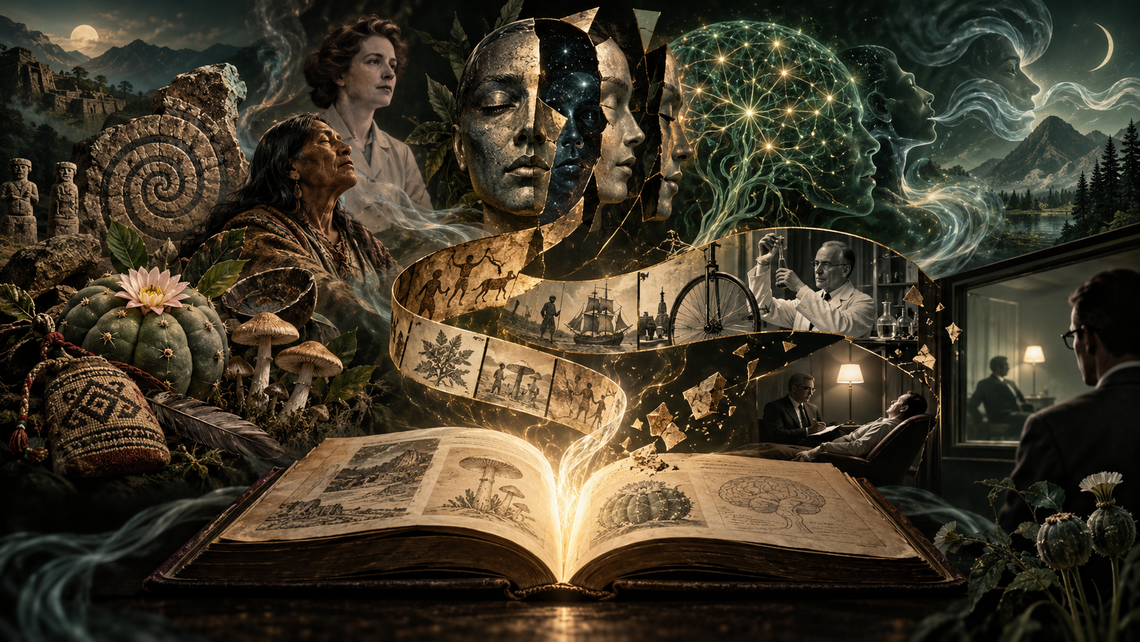
The standard history of psychedelics is accurate, complete-sounding, and quietly doing work. Week one of the Exeter MSc, worked through as an argument rather than a syllabus.
Andy Letcher opens his lecture on the history of psychedelics with a sentence that should be printed on the inside cover of every book in the field. Everything he is about to tell you, he says, is true and happened. And then he spends the rest of the lecture taking it apart.
That is the whole week in miniature. Nobody disputes that Albert Hofmann synthesised LSD, that Huxley took mescaline in a Hollywood bungalow, that Wasson sat up all night in Huautla. The facts are not in question. What is in question is the shape they have been arranged into, who is standing in the frame when the shutter goes, and what the arrangement licenses people to do now.
This piece covers the first week of Psychedelics: Therapeutic Practice and the Metaphysics of Mind — two set readings, three lectures, one hour with a psychiatrist who was in the room in the 1950s, and a set of student exercises that turn out to be sharper than they look. It is written to be read straight through, and to be raided later.
The papers, in one breath each
Letcher (2008), Mad Thoughts on Mushrooms. A Foucauldian discourse analysis of the answers people give to the question what happens to consciousness on psilocybin? Seven answers, sorted into three dominant discourses built from observing effects on other people (pathological, psychological, prohibition) and four resistive ones built by people trying to describe their own experience (recreational, psychedelic, entheogenic, animistic). Only the last one breaks a real societal boundary: to say the mushroom spirits are real, rather than symbolic or psychological, is to risk being classed as mad. Letcher thinks that is a bad reason to stop studying something.
Shortall (2014), Psychedelic Drugs and the Problem of Experience. How psychedelics travelled from wonder drug to pariah, told through the category that made the journey possible. Because the effects varied so wildly with person and setting, mid-century researchers opened a conceptual space between the chemistry and the outcome and called it the experience. That space is elastic enough to hold contradictions: the same drug as model psychosis and as cure for psychosis, as medical instrument and as countercultural sacrament. Derrida's pharmakon and supplement do the analytical work. The sting is in the last section, where the same critique gets turned on historians who made "experience" a foundational term after 1963.
Ens (2021), Silencing Indigenous Pasts. A white historian audits her own footnotes. Critical Indigenous theory — Trouillot on silencing, Tuhiwai Smith on reframing, Tuck and Yang on settler moves to innocence, Denzin and Lincoln on accountability and the myth of neutrality — applied to the subfield of psychedelic history, whose primary sources were mostly written by people who never expected to be accountable to the communities they described. Key discipline: what counts is the impact of the work, not the intention behind it.
Mangini (2021), Unseen Women in Psychedelic History. Six women whose contributions were recorded badly or not at all: Susi Ramstein, Valentina Wasson, Mary Barnard, Kay Parley, Gertrude Paltin, Mabel Luhan. Mangini's framing device is explicitly discursive — professional language and credentialing shape who is recognisable as a member of an elite group, and psychedelic studies has historically drawn that group from one class, one gender, one race.
Two of these are set reading. Two are on the extended list. The extras are where the essays are.
Two more arrived while the week was being worked through, both of them 2026, both of them doing exactly what the week trains you to do, to the field's own current vocabulary.
Ostrand, Nour, Timmermann, Rosati, Luan, Gomez-Emilsson, Bornemann, Greenway, Roseman and Carhart-Harris (2026), "Defining 'psychedelic'", Journal of Psychopharmacology, online 17 August. Goes back to Osmond's etymology and takes it literally. Psychedelic names a state in which normally latent mental content becomes manifest; Osmond's further intention was that the adjective should also name a category of drug whose principal action is to induce that state. So the paper argues the definition should be phenomenology-first rather than a receptor headcount, and then tests it: more than two hundred people who had taken all three of psilocybin, ketamine and MDMA rated a Delphi-derived set of subjective items. Factor analysis gave three or four independent dimensions, and a classifier could recover which drug someone was describing from the effect profile alone — visions and psychological insight for psilocybin, dissociation for ketamine, pro-social feeling and love for MDMA. Their conclusion is that psilocybin is the exemplar case, and that the psychedelic state is characterised by visions and insight. Worth noting Leor Roseman is a co-author and is at Exeter, which makes this one of the interviewers from the Grof video arguing for the phenomenological definition in print.
Saville-Smith and Mosurinjohn (2026), "The mystic trip: how psychedelic research fell for mysticism", Psychopharmacology, online 17 July. An archaeology and a genealogy, in that order and under those names. The archaeology re-reads the foundational texts, principally Walter Stace's philosophy of mysticism and Walter Pahnke's Good Friday work, and finds the assumptions underneath them flawed and, for sixty years, largely unexamined. The genealogy traces how a historically peculiar religious construct got attached to psychedelics and then normalised in second-generation research until it read as a plain empirical property of the experience. Their practical proposal: rebrand the Mystical Experience Questionnaire as the Psychedelic Experience Questionnaire, which they note sits comfortably with Pahnke's own later turn toward "psychedelic experience" as the operative category. It is published in the same journal that ran Griffiths and colleagues in 2006, the paper that carried mysticism into the revival.
What the lecturers are actually up to
The stated learning outcomes are modest: identify key figures and events; critique the standard history; describe the origins of the term psychedelic and how its meaning shifted.
The actual function of the week is different. It is an epistemology and methods week wearing a history costume. Its job is to destabilise "the psychedelic experience" as a stable object of study before anything else in the module gets going. By Friday you are supposed to have lost confidence in three things at once: the neutrality of the historical narrative, the neutrality of the word, and the neutrality of the category of experience itself. Everything that follows in the programme — therapy, metaphysics, measurement — lands differently once those have gone.
The tell is in the starter activity, which is a poll asking what comes to mind when you hear the word drug. The word cloud that comes back from the cohort is, without anyone intending it, a finished discourse analysis:
addiction · medicine · medication · recreation · illegal · pharmaceutical · illicit · disease · illness · industry · pain · exciting · healing · epiphany · friday night · sacred · war on drugs · prohibition · abuse · hedonism · consciousness
Every one of Letcher's categories is in there. The prohibition binary sits in the middle in the largest type: pharmaceutical / medication / medicine on one side, illegal / illicit / abuse on the other, two antithetical bins that between them obscure every pharmacological, toxicological and phenomenological difference within each bin. The resistive vocabulary is in the smaller type round the edges: epiphany, sacred, friday night, fun. The pathological discourse is there as disease and illness. The students perform the thing before it is named for them. That is good teaching, and it is worth noticing that it worked on us.
Letcher's second move is to hand over a three-question audit tool and then, at the end of the lecture, turn it on the class:
- Read widely. Never take one historian's version.
- Ask who is included and who is excluded, and why.
- Ask from what position the author writes. Are they privileging scientific research, countercultural values, hedonism, aesthetic pleasure?
And then: from what position do you stand, and what assumptions are you making? That question is not rhetorical decoration. It is the same reflexive requirement that both set readings model — Letcher declaring himself a scholar of religion, a former evolutionary biologist and a fifteen-year practitioner of myco-spirituality; Ens declaring herself a white historian who footnoted Indigenous people and intends to stop. The week models positionality twice, from opposite directions, and then asks you to do it.
Part I — The standard history, stated fairly
Before knocking it down, it is worth having the thing itself, because ILO 1 is just this: know the furniture.
The curated timeline for the module runs roughly as follows. Deep background: a Chavín stone relief from around 1200 BC showing a figure holding what looks like San Pedro cactus. 1529, Bernardino de Sahagún describing Aztec use of inebriating mushrooms in the wake of Cortés. 1799, the first recorded accidental psilocybin ingestion in Britain. 1821, Thomas de Quincey's Confessions of an English Opium-Eater. Late nineteenth century, peyote reaching European laboratories. 1912, Mabel Dodge Luhan's peyote evening in Greenwich Village. 1918, the Native American Church incorporated in response to attempts to outlaw peyote. 1919, Ernst Späth synthesises mescaline. 1924, Louis Lewin's Phantastica offers the first scientific classification of narcotic and stimulating drugs. 1926, William Ford names mycetismus cerebralis and fixes mushroom intoxication into the medical textbooks. 1930, Raimundo Irineu Serra founds Santo Daime. 1931, DMT first synthesised by the Canadian chemist Richard Manske. 1938–43, Hofmann at Sandoz, and the bicycle. 1949, LSD arrives in American laboratories. 1953, MK-ULTRA. 1954, The Doors of Perception. 1955, Gordon Wasson in Huautla de Jiménez with María Sabina. 1956, Humphry Osmond proposes psychedelic. 1957, the Life magazine article, and Valentina Wasson's account in This Week. Late 1950s, LSD at the height of its medical legitimacy. 1963, Leary and Alpert dismissed from Harvard. 1966, moral panic. 1970, the US Controlled Substances Act. 1971, Nixon's war on drugs, and LSD to Schedule 1 at the UN. Then a long quiet, broken by Strassman's DMT work around 1990, the Santo Daime and ayahuasca church cases, Imperial's Centre for Psychedelic Research in 2019, Pollan's book in 2018 making the whole thing respectable at dinner parties, thirteen thousand delegates at Psychedelic Science in Denver, Prince Harry on mushrooms, and a university in Devon running the world's first postgraduate certificate in the subject.
Cast list, for the same purpose: Hofmann, Osmond, Huxley, Gordon and Valentina Wasson, María Sabina, Sahagún, Lewin, Ford, Späth, Manske, Hoffer, Sidney Cohen, Betty Eisner, Chandler and Hartman, Walter Pahnke, Maslow and Rogers, R. D. Laing, Leary, Alpert, Kesey, Ginsberg, Watts, Carl Ruck and the entheogen committee, the Shulgins, Stan and Paul Grof, McKenna, Pinchbeck, Strassman, Pollan.
It is a good story. It has a martyr, a fall, and a resurrection. That is precisely the problem.
Part II — The people the story loses
Indigenous peoples
Ens's argument is not that psychedelic historians are hostile to Indigenous people. It is that the field's source base was built by people writing for an audience they assumed shared their view, and that inheriting those sources uncritically reproduces their assumptions with better manners.
Two examples do the work. Huxley, in The Doors of Perception, describes Native American Church peyote use at second hand, via the white researcher J. S. Slotkin, and foregrounds visions. But visions are not the point of the sacrament; the experience is communal, and attending closely to your own sensations is missing what is happening. The description is not malicious. It is simply written by someone for whom the interesting part of a drug is what it does to the inside of one head, applied to a practice organised around something else entirely.
Wasson's 1960 address to the Mycological Society is blunter. Indigenous Mexican practice appears as an anthropological curiosity to be observed with amused detachment, safely unchanging, available for future scholars at their leisure. The presentation celebrates Hofmann's chemistry while declining to explore Zapotec, Aztec or Mazatec understandings of the same plants. And it frames Mexican mushroom use as a window onto ancient Greece — which, whatever the intention, casts living people as a surviving specimen of a shared (read: white) human past, and quietly writes them out of the present and the future.
Tuck and Yang's settler moves to innocence is the sharpest tool here. Six of them; the one Ens picks out is asterisking — Indigenous people appearing in research as a data footnote, or omitted on the assumption that they are a declining population and therefore not worth the attention. In psychedelic history the move is literal: Indigenous use goes in the prologue or the footnote, and the narrative proper begins in Basel in 1943.
Concept card — settler moves to innocence. Manoeuvres by which non-Indigenous scholars relieve their own guilt and preserve settler futurity while leaving colonial structures intact. Tuck and Yang list six: settler nativism, fantasising adoption, colonial equivocation, conscientisation, at-risking/asterisking, and re-occupation. The category exists because "decolonise" had become a verb people used about their reading lists.
Concept card — reframing. From Linda Tuhiwai Smith: deciding an issue's parameters, what sits in the foreground, what sits in the background, what complexities are allowed inside the frame. Framing is not description. It is the prior act that determines what description is possible.
Concept card — reflexivity. Kim England's formulation: self-critical, sympathetic introspection, and deliberate analytical scrutiny of yourself as the researcher. Not confession. A method.
Denzin and Lincoln supply the hardest requirement: that researchers be accountable to the communities they work with, including over what gets accessed and circulated, and that settler-centric notions of neutrality and objectivity be treated as claims rather than defaults. Western historians' assertion of objectivity has generally functioned to code settler knowledge as objective and everything else as subjective Other with less evidential weight. Ens is careful to say that non-Indigenous scholars can write respectful histories, and names Mike Jay's Mescaline as one that treats settler and Indigenous use as equally serious objects of inquiry rather than foregrounding one and footnoting the other.
Women
Mangini opens on a scene: Basel, 2006, the symposium for Hofmann's hundredth birthday, more than eighty invited experts described as the elite of international consciousness research, about ten percent of them women. Three presentations out of forty-seven featured a woman speaking independently of a male supervisor, colleague or partner. The conference celebrated LSD's kinship with the sacred substances of the Americas and with the kykeon of Eleusis, and managed not to evoke the priestesses and curanderas who prepared and dispensed them. The Women's Visionary Council was founded the following year out of the conversations that followed, with a motto from the Aeneid: dux femina facti. A woman was the leader of the enterprise. The phrase exists in Virgil because it was a surprise.
The people:
Susi Ramstein was twenty-one, a laboratory assistant, and the first psychedelic guide — Hofmann asked her to cycle beside him. Two months later she took 100 µg herself, a larger dose than the 60 µg the senior men on the team had taken, becoming the first woman to take LSD and joining the long tradition of researchers testing compounds on themselves. She is absent from the standard retelling of the bicycle ride, which is otherwise reproduced in extraordinary detail.
Valentina Pavlovna Wasson was a paediatrician and the principal author of Mushrooms, Russia and History: two volumes, ninety-three plates, thirty years, 512 numbered copies, the most elaborate thing Pantheon ever produced. She wrote the preface alone, did most of the research, tracked down and rescued Jean-Henri Fabre's six hundred unpublished mushroom watercolours from a shelf in his studio, and had them reproduced by pochoir. In May 1957 she published her own account of taking mushrooms with her daughter Masha in This Week, a Sunday supplement reaching more than fourteen million households — a far larger readership than the famous Life piece. Her stated prediction was modest and correct: that these mushrooms would be useful for studying the psyche. The magazine's commentators went further, and also turned out to be right, suggesting future applications in addiction, end-of-life pain and psychiatric illness. She died of cancer the following year.
Mary Barnard, translator of Sappho, published "The God in the Flowerpot" in The American Scholar in 1963. Her argument: half a dozen of the great mythological themes — the shaman's journey, the food of immortal life, the food of occult knowledge, the fate of the disembodied soul, communication with the dead, plant-deities — converge on an actual substance, ritually consumed not as a symbol but for the experience it produces. She proposed a discipline for this and called it theo-botany, and predicted that fifty years of it would leave the then-current theories of the origins of religion looking pre-Copernican. She also identified why the evidence is thin: practitioners have reasons not to disclose, and early observers saw either satanism or stage magic depending on their own commitments.
Kay Parley worked at Weyburn Mental Hospital in Saskatchewan, where Osmond was running LSD studies, first as a patient and later as a registered psychiatric nurse. Her 1964 article "Supporting the Patient on LSD Day" contains, four decades early, essentially the full contemporary protocol: preparation and rapport-building beforehand, attention to the subject's set and to the physical setting, the sitter's sustained and undivided presence through the session, and review and integration afterwards. She is also a one-woman counterexample to the psychotomimetic model — having experienced manic psychosis, she reported that the perceptual distortions and delusional thinking under LSD were not comparable to it. Her work remains largely unread in the field.
Gertrude Paltin was a biochemist and Oscar Janiger's close research associate, co-author of a 1971 bibliography of LSD and mescaline covering everything from the earliest research to the beginning of suppression. Her own daughter did not know the extent of her role until a copy surfaced decades later, containing references most scholars had never seen.
Mabel Dodge Luhan is the one who complicates the rescue. She is a genuine pioneer: her 1912 evening in New York is an early and unusually perceptive account, attentive to the group's interpersonal dynamics rather than cataloguing her own sensations; she used the phrase expansion of consciousness some forty years before it became idiom. She is also, in Taos, a person who pressed her Taos Pueblo husband to give up peyote, opposed peyote leaders holding positions in the pueblo government, described peyote users as drug addicts, and backed a proposed federal prohibition that anthropologists and peyote users from Oklahoma to Montana successfully opposed. And the New York ceremony itself involved staging a peyote tipi in a Greenwich Village drawing room with a red shawl over a light bulb for a fire and a folded sheet for an altar.
Both things are true. Recovering a woman from the archive does not oblige you to like her, and the recovery is worth less if it requires her to be admirable. Luhan is the case that keeps the chapter honest.
Working note — the naming rule. It is very hard to write about these women without immediately relating them to a man, and Mangini's own paper does it repeatedly. Valentina Wasson is his wife, Susi Ramstein is his assistant, Kay Parley is mentored by Osmond, Gertrude Paltin is Janiger's associate. The negated version — "more than just X's wife" — is the same move with better intentions, which is precisely Ens's point about impact over intention. Lead with the work. Let the man appear later, if at all, as a subordinate clause.
The other drugs
The third exclusion is structural rather than demographic. Letcher points out that the history of psychedelics is told as though psychedelics were a natural kind, cleanly separate from opiates, stimulants, alcohol and everything else. But the trip-literature genre that Huxley writes in was invented by de Quincey, on laudanum: an intellectual making a work of introspection out of an intoxication, and reporting it as a contribution to knowledge. Huxley is walking in his footsteps. The two histories are entangled at the level of form, whatever the pharmacology says.
Hence the week's second reflection question, which is a better essay prompt than it looks: should psychedelics be studied independently of other drugs, or other forms of intoxication — and what is gained or lost? Gained: mechanistic precision, a defensible safety profile, distance from the addiction frame, and a workable regulatory argument. Lost: the ability to see that the category was assembled for reasons that were partly political, and that alcohol and caffeine sit outside it for reasons that have nothing to do with pharmacology.
Part III — The opposite failure: the ancient past
Having spent a lecture on what the standard history leaves out, Letcher spends the next one on what it puts in without warrant, which is the same discipline running in the other direction.
The claim under examination: psychedelics were used in European prehistory and antiquity. The exhibits offered are the Newgrange entrance stone with its spirals, dated to about 3200 BCE; opium poppies in Neolithic graves; the Grauballe bog body from around 300 BCE, with traces of ergot in the stomach; and cannabis cultivated in Britain and eastern Europe from the Neolithic onwards.
Each supports multiple readings. Spirals are what hands draw. Poppies in a grave could be grave goods, medicine, food, or a plant that happened to grow nearby. Ergot in a stomach is far more economically explained by contaminated rye than by intentional ingestion. Cannabis was cultivated for rope for most of its history in Europe. The point is not that the sceptical reading is correct. It is that the evidence does not discriminate.
The contrast case is what actual evidence looks like. A ritual pouch from Bolivia, dated to around a thousand years ago, analysed in 2019: a carved snuff tube, a grinder, and chemical residues of DMT, bufotenine, harmine and cocaine. Paraphernalia plus residue plus context. That is categorical. Nothing in the European record comes close.
Two further points, both of which have legs.
First, Letcher's methodological verdict: absence of evidence is not evidence of absence. It remains entirely plausible that prehistoric Europeans used psychedelics; if they did, they left nothing conclusive. The people who assert it categorically and the people who deny it categorically are standing on the same empty ground. He is waiting for the body that comes out of a melting glacier with something in its pouch.
Second, and more useful: humans have devised a great many ways into altered states that do not involve a drug at all. Candomblé in Brazil; charismatic Christianity, trance and glossolalia. So an image of an ecstatic figure is not evidence of pharmacology. This is the point at which the ancient-past lecture and the Grof interview shake hands, and I will come back to it.
The question the module actually wants answered is why anyone is so invested. The honest answer is that an ancient European lineage would convert present-day psychedelic use from a novelty into a recovery. It would make the practice ancestral rather than borrowed, which solves a problem that has been nagging at Western psychedelic culture since Wasson came back from Oaxaca: that every sacramental tradition it draws on belongs to someone else. Read alongside Tuck and Yang, that is settler nativism — the move of locating an Indigenous past in your own ancestry in order to claim standing without accountability. Eleusis is an attractive ancestor precisely because nobody is left to object.
That cross-link between the ancient-past lecture and the Ens reading is not made anywhere in the module materials, and it is one of the better essays available here.
Part IV — The name
Osmond and Huxley, 1956
The naming is a two-man competition conducted in rhyming couplets by post. Huxley offers phanerothyme, from the Greek for the manifesting of soul or spirit, in a verse about lifting the ordinary world into the sublime. Osmond counters with psychedelic, mind-manifesting, in a verse offering it as the dose for anyone wanting to reach either end of the vertical axis. Osmond wins, and puts the word into print in 1957.
What they were reaching for was a word that could hold both halves at once: the psychological effects and the religious, spiritual, metaphysical, ontological implications. Every term in the field since has failed at one half or the other.
The module asks the counterfactual directly, and it is worth taking seriously rather than treating as whimsy. Phanerothyme names the soul. Psychedelic names the mind. Had the first won, the object of study would have been something the natural sciences have no purchase on, and the compounds would have been much harder to route into a laboratory. The word psychedelic is what made a Centre for Psychedelic Research sayable. Mind is a respectable object; soul is not. The term chosen in 1956 determined which department the subject could eventually be housed in.
The third question in that set is the one to keep: if these things are literally mind-manifesting, what do we mean by mind? The module hands you a word whose second half quietly presupposes the answer to the hardest question in the second half of the programme.
The drift
The Google Ngram Letcher shows has psychedelic peaking around 1970, declining through the seventies, then climbing steadily from the early eighties back to something near its old level. The word survives; what it means does not.
Three phases:
- Clinical (1956–early 60s). Coined by a psychiatrist for other psychiatrists. Carries medical authority.
- Countercultural (mid-60s–70s). Escapes the laboratory. Becomes a genre of music, a visual style, a fashion, a politics, an attitude to the Vietnam War. Loses the medical veneer entirely and acquires a faintly ridiculous, hedonistic, tie-dyed connotation that it has never fully shed.
- Reclaimed (1990s–). Recaptured via the qualifier: classical psychedelics, defined pharmacologically. And with it, a shift in the relationship of power that Letcher flags as the punchline of the whole lecture. In phase one, psychedelics were substances that clinicians took. In phase three, they are substances we administer to other people so that we can observe the effects.
That last sentence is the thesis of the week. The resistive term has been captured by the dominant discourse, and the capture is invisible because the word did not change.
Discourse analysis, briefly and properly
Concept card — discourse. A particular way of talking about and understanding the world, or some region of it (Phillips and Jørgensen). Foucault's addition: relations of power are constituted through these differing representations. Power cannot be established, consolidated or implemented without the production and circulation of discourse.
The two functions Letcher singles out — and this is a directed-reading question, so learn them as a pair:
1. Discourses divide people into objectified subjects. Foucault's dividing practices, operating through scientific classification. You walk into a consulting room and a power relation switches on: one of you performs doctor, the other performs patient, your body is subjected to the medical gaze and sorted by its symptoms. Sane and insane. User and abuser. The division comes with a social identity and, usually, a practice of exclusion — social always, sometimes spatial. Prisons. Detention centres. Wards.
2. Discourses set boundaries on what can be said and done. Within a given worldview some actions are natural and others unthinkable. Foucault's version: discursive practice makes it virtually impossible to think outside itself, and to think outside is by definition to be mad, beyond comprehension and therefore beyond reason. Hence the risk in doing discourse analysis at all — Voase's warning that you have to be willing to ask questions that will get you thought a little mad.
The methodological move that follows is the one people find hardest. Since there is no position outside discourse, asking which account is true is not the productive question. The productive question is how truth-effects get produced and sustained. That is not relativism and it is not an invitation to believe anything; it is a redirection of attention from the content of claims to the machinery that makes some claims sayable.
The seven discourses
| Discourse | What it says a psychedelic does | Signature terms | Who has authority | What it cannot allow |
|---|---|---|---|---|
| Pathological (dominant) | Produces disease: poisoning, or temporary/permanent psychosis | intoxicant, hallucinogen, psychotomimetic, schizogen; mycetismus cerebralis; phantastica | Physicians, psychiatrists | That the content of the experience has any value except as empathy training for clinicians |
| Psychological (dominant) | Perturbs the nervous system so repressed material surfaces and can be integrated | psychoactive, psychotropic, psychedelic | Therapists; the clinic as the legitimate container | That anything encountered originates outside the patient's own psyche |
| Prohibition (dominant) | Nothing of value; matters only as a threat to health and public order | drug abuser, narcotic, war on drugs | The state | That the licit/illicit division tracks anything other than social acceptability |
| Recreational (resistive) | Gives pleasure to mind and body, plus the pleasure of transgression | party drug, getting on it | The user, and the pub and the club | That use might require justification |
| Psychedelic (resistive) | Reveals hidden dimensions of the self; a key to a part of the psyche | consciousness expansion, ego loss, psychonaut | Artists, poets, musicians, bohemians | That the psyche might not be the destination |
| Entheogenic (resistive) | Occasions religious or mystical experience; intrinsically sacramental | entheogen, sacrament, ceremony, medicine | Scholars, ceremonialists, lineage-holders | That profane, hedonistic or casual use could also be legitimate |
| Animistic (resistive, most marginal) | Adjusts rather than alters consciousness; makes perceptible other-than-human persons who are actually there | spirits, entities, myconaut, animaphany | The practitioner in relationship with the entity | Nothing, from its own side — which is exactly why everything else must exclude it |
Some detail worth keeping on each:
Pathological. Oldest and most durable. In antiquity all mushrooms were one thing with edible and pernicious varieties; a strange effect after eating one was a poisoning, and recovery was a lucky escape. Eighteenth and nineteenth centuries: emetics, cathartics, the stomach pump, occasionally leeches. 1926: William Ford names mycetismus cerebralis and the poisoning frame enters the textbooks three decades before psilocybin is isolated. 1924: Lewin's phantastica proposes a materialist neurological basis for hallucination, and in doing so brings the visions of mystics, psychotics and drug users under a single explanatory roof. The moral panic of the late sixties fixes psychosis and hallucinogens together in the public mind; the smaller British mushroom panic of the mid-seventies follows the same shape. The implicit ontology across all of it: there is a normal state, the drug produces a deviation from it, and the deviation has no content worth attending to.
Psychological. Also materialist, but the experience has therapeutic value. Lineage: de Quincey finding childhood memories tangled in his opium visions, William James on nitrous oxide, Baudelaire, Freud. Then LSD, Sandoz, and a drug originally marketed as a psychiatric tool. The key sentence for the week is the one the module puts in a box: the therapeutic setting of the clinic and the guidance of a medical authority provide the legitimate context in which these substances should be consumed. That is a claim about jurisdiction, not about pharmacology.
Prohibition. Currently dominant, in the strong sense that every other discourse has to orientate itself relative to this one. Its dividing practice is the two-bin sort: licensed pharmaceuticals produced by multinationals and dispensed by professionals on one side; plants and chemicals grown or made illicitly and self-administered for pleasure, introspection or escape on the other. The second bin is so wide that it destroys any commonality of chemical action, duration, toxicity or dependence liability, leaving only the shared property of being socially undesirable. To self-administer is to become a drug abuser, a label that marks you as deviant, forfeits some of the normal rights of citizenship, and makes you a legitimate target. Sadie Plant's point, drawing on Foucault on homosexuality, is that the addict as an identity is a late nineteenth-century invention, produced at the same moment and for the same reason as the modern imagination's need to define its own normality. Meanwhile caffeine and alcohol have been naturalised to the point where calling them drugs sounds like a joke.
Recreational. Resistance by pleasure. Alcohol supplies the template — the pub, the club, the sanctioned occasion — and MDMA, speed, cocaine, ketamine and mushrooms get slotted into it as party drugs. Note that the transgression is part of the pleasure, which means prohibition manufactures some of the appeal it is trying to suppress.
Psychedelic. The leak. If these compounds reveal hidden dimensions of the self, then the people whose identity rests on self-exploration and privileged introspection have an obvious claim on them: artists, poets, musicians. Huxley thought the intellectuals and the great and the good should have them; the psychiatrists around him, working from a Romantic construction of the artist as outsider and visionary, thought artists would benefit most, and started supplying them outside clinical settings. The leak became a flood: acid tests, happenings, a movement with its own music and politics, and a term that lost its medical authority on the way out of the door. Psychonaut arrives later — Ott credits Ernst Jünger, 1970. Letcher's judgement is sharp: psychonauts challenge the pathological and prohibition discourses while remaining entirely faithful to the psychological one. The psyche is still the destination.
Entheogenic. Coined 1973 by the classicist Carl Ruck at a committee Wasson convened to replace hallucinogen and psychedelic; published 1979. Built from the etymology of enthusiasm, and meaning roughly the generating of the god within. Wasson wanted a word unvulgarised by hippie use; Ott complained that the modern mushroom scene was a profane and hedonistic cult standing on the shoulders of Mexican tradition. Letcher's critique is the most detailed thing in the paper, and it is four moves:
- The sacrality is supposed to be intrinsic, yet cannabis is refused entheogen status precisely because of its profane contexts. Intrinsic properties do not work like that.
- It implies a deterministic relation between ingestion and theophany, which everyone in the field has known to be false since set and setting entered the vocabulary. Huxley's own formulation: chemicals do not cause religious experiences, they occasion them.
- Its criteria for "reverent" are Christian. Solemnity, seriousness, a particular kind of hush. Wasson was the son of an Episcopalian minister who had read the Bible twice before adolescence, and built his idea of entheogenic religion accordingly. Andrew Weil's response was to call him a snob and an elitist and ask who he was to decide whose use was not religious.
- Huston Smith's repair — define entheogens by practice, as mind-altering substances approached seriously and reverently — is an improvement, but it relocates the problem rather than solving it. Someone still has to adjudicate reverence.
And the structural point, which is the one to steal: the entheogen discourse resists prohibition within prohibition's own terms. It does not challenge the licit/illicit sort; it argues for a favourable classification within it. Same with the recreational discourse. Neither is a call to legalise everything.
Animistic. The entities are real. Not hallucinations, not aspects of the self, but genuine discarnate intelligences with whom a practitioner can build a relationship. Mushrooms do not alter consciousness; they adjust it, changing what it is possible to perceive rather than distorting perception. Historical sources: Huxley's reducing-valve model, borrowed from Bergson and dressed in Eastern vocabulary — the mind filters out most of Mind at Large for biological reasons, and psychedelics relax the filter, like being handed the tuning dial on a radio that was previously fixed. And Indigenous thought: María Sabina attributing her healing powers to the mushroom spirits, whom she called the little children or the saint children.
Letcher's coinage for the phenomenon is animaphany — an appearance of spirits, by analogy with theophany, an appearance of God. His informants supply the texture: a man who calls British psilocybin a Babel fish for the vegetable kingdom; a woman who took mushrooms in a pub and was subsequently visited in a dream by mushroom spirits objecting to the venue; a sceptic who noticed that everybody, regardless of setting or disposition, came away with the impression that they ought to be taking them outdoors — the mushroom, in other words, prescribing the conditions of its own consumption.
Why it is the most marginal: it resists the pathological discourse (Indigenous knowledge says mushrooms make people well, not ill), it resists prohibition (the authority to consume comes from the mushroom spirits, not the state), and crucially it resists the psychological discourse by claiming the entities are what they appear to be. To think outside a discourse is to be thought a little mad. To transgress the ontological boundary the psychological discourse polices is to be mad. Which is why both McKenna and Pinchbeck hedge: McKenna alternating between mushroom spirits and "the earth" or a higher dimension of self; Pinchbeck entertaining phalanxes of sentient entities and then allowing that it might be a delightful form of drug-induced paranoia. And it is the same boundary that made Indigenous ontologies unsayable under colonial and post-colonial discourse — which is Ens's argument arriving from a completely different direction.
Weighting, and Letcher's deliberate self-undermining
Here is the move that makes the paper more than a taxonomy, and the one to bring to a seminar.
Having argued at length that our ways of thinking about mushrooms are discursive rather than true, unmediated representations of some essential mushroom experience, Letcher says that the animistic discourse, more than any of the others, arose in response to the experience itself. He notes explicitly that this risks demolishing his own argument, and does it anyway, propping it up with two borrowed concepts: Shanon's boundedness (the ayahuasca experience constitutes a distinct cognitive domain — certain moods, sensations and vision-types are always present even as the details vary) and Partridge's weighting (psychedelic experience is heavily weighted toward certain contents without being determined). Letcher adds that different compounds have different gravitational pulls, which is why practitioners insist on qualitative differences that scientific classification flattens: mushrooms are earthier than acid, mushrooms are analogue and acid is digital. His claim is that mushrooms are weighted toward animaphany, and that weighting escapes the determinism that sinks the entheogen discourse, because not everyone meets anything. Repeated use then sets up an iterative loop: presuppositions shape the experience, the experience reshapes the presuppositions.
Call this incomplete constructivism. It is the single most useful thing in the paper for essay purposes, because it is the point where a strong discourse-analytic position admits a constraint from outside discourse and has to negotiate terms. Strong constructivism cannot explain why DMT users keep reporting the same architecture. Naive realism cannot explain why the reports are so obviously inflected by what people already believed. Weighting is an attempt to hold both, and whether it succeeds is a live question rather than a settled one.
Two discourse analyses the module asks for
"Medicine." The module notes that since 2008, peyote, ayahuasca and iboga are increasingly called medicine, and asks for an analysis. Working version:
- What it asserts: the substance has a healing telos. Its proper use repairs a deficit.
- Whom it authorises: whoever can credibly claim to heal. The term's usefulness is that it flexes — it can authorise a curandero or a consultant psychiatrist, and it lets a retreat centre borrow the authority of both.
- Whom it divides out: the hedonist, the aesthete, the curious, the person who took mushrooms on a Tuesday because Tuesday was long. It also, less obviously, pathologises the user in advance: under this discourse you are entitled to the experience in proportion to how broken you can demonstrate yourself to be.
- What it borrows: legitimacy from prohibition. A medicine is not a drug. That is the whole rhetorical engine, and it is the same engine Wasson built in 1973, running on newer fuel. Entheogen separated sacred from profane; medicine separates therapeutic from recreational. Both resist prohibition from inside prohibition's own sorting box.
- What it forecloses: that the experience might not be for anything. Also any ontological claim — a medicine works on you, which means the content of the vision is a mechanism rather than a message, which quietly rules out animaphany by definition.
- The additional charge: the word is frequently lifted from Indigenous English usage and then deployed in retreat marketing by people with no accountability to the communities it came from. That is Ens's argument with a price list attached.
"Classical psychedelic." A pharmacological designation — 5-HT2A agonists — and the module asks whether it is helpful or unnecessarily restrictive. Both, in ways worth separating. Helpful: it is a real mechanistic kind, it supports genuine prediction, and it gives the field a defensible boundary in regulatory argument. Restrictive: it exiles MDMA, ketamine, ibogaine and salvia on grounds that have nothing to do with what the experiences are like or what they are used for, and it does so under the authority of a receptor. And the deeper point, which is Letcher's: pharmacological classification is scientific classification in Foucault's sense. It is a dividing practice. It re-establishes the observer as the one who knows, and the subject as the one who is observed. The term looks like a technical convenience and functions as a restoration of jurisdiction.
That argument now has a live counterpart inside the pharmacology literature itself. Ostrand and colleagues, writing in Journal of Psychopharmacology in August 2026, go back to 1956 and read Osmond's coinage as a claim about a state — soul-illumination, in which normally latent mental content becomes manifest — which he then extended to name a class of drug whose principal action is to produce that state. On that reading, the receptor is downstream. The definitional question is phenomenological: does this compound's characteristic effect consist in making latent content manifest?
They then do the empirical version, which is the interesting part. Over two hundred people with personal experience of psilocybin, ketamine and MDMA rated a Delphi-derived item set; factor analysis returned three or four independent dimensions; a classifier could identify which drug a given effect profile belonged to. Psilocybin loaded on visions and psychological insight, ketamine on dissociation, MDMA on pro-social feeling. Their verdict is that psilocybin is the exemplar psychedelic and that the psychedelic state is the one characterised by visions and insight.
Three things to hold about this, and they pull in different directions.
First, it is a genuine attempt to put the phenomenology back in charge of the taxonomy, and it arrives from inside the institutions that built the pharmacological definition — Imperial, UCL, UCSF, McGill, Exeter. That matters. It is not an outsider critique.
Second, and less comfortably: the paper is doing a version of what Letcher warns about. Classifications do not simply report what is out there; they determine what researchers will treat as belonging together, and therefore what gets studied alongside what. A phenomenological definition is still a definition, and this one is operationalised through a rating scale, a factor structure and a classifier — which is to say through instruments that decide in advance which features of an experience count as features. The method is a dividing practice with better manners. The classifier that distinguishes psilocybin from ketamine also, quietly, decides that dissociation is not a psychedelic effect.
Third, it is retrospective self-report from people who already knew which drug they had taken and what it is supposed to do. That is not a fatal objection — the alternative designs are worse — but expectancy and recall are doing some unmeasured work, and the participants have already been trained by the culture in what psilocybin is for.
The useful thing for essay purposes is that Ostrand and Letcher agree on the premise and diverge on what follows. Both hold that categorising these compounds is an act with consequences rather than a neutral report. Letcher concludes that you should therefore expose the act. Ostrand concludes that you should therefore perform it better.
Part V — Experience, the load-bearing fudge
Shortall's paper is the harder of the two set readings and the more portable.
The argument
Psychedelics produced wildly variable effects depending on who took them and where. This was a problem for a pharmacological research paradigm built on isolating a compound's intrinsic action from external variables. The solution mid-century researchers arrived at was to open a space between the chemistry and the outcome, and to call what happens in that space the experience.
Abram Hoffer's formulation is exactly this: what mattered in therapy was not the chemical but the experience. Sidney Cohen and Betty Eisner attributed an unprecedented improvement rate to an integrative experience in which the patient accepts himself as he is. Leary framed psilocybin work with recidivists in terms of a visionary experience producing insight and behaviour change. Humanistic psychology was moving the same way — Maslow and Rogers trying to put conscious human experience back at the centre of the discipline, with Maslow singling out psychedelics as promising agents of peak-experience.
That amorphous category is what let the compounds be mobilised for opposite purposes. It is why they could be simultaneously the cause and the cure of madness.
The aporias
An aporia is an irresolvable contradiction that a discourse has to keep in play rather than settle.
Concept card — pharmakon. Derrida's term, via Plato: that which is both remedy and poison, and cannot be assigned to one side. Shortall's claim is that fifties psychedelic medicine is a textbook case. Hoffer and Osmond explained their success with alcoholics by proposing that the traumatic trip resembled delirium tremens and gave the patient a simulated rock bottom. Laing held that freaking out on LSD often signalled a breakthrough in working through repression. The therapy is not despite the terror. The therapy is the terror.
Concept card — supplement. Also Derrida. Something at once accidental and essential; an addition from outside that turns out to be necessary to complete what it was added to. Inside and outside at the same time, like any good parasite. Psychedelics are supplementary in exactly this sense: artificial additions to a natural body, and simultaneously the thing that liberates that body's supposedly authentic state.
Four aporias worth naming:
Transcendence through a chemical. If mescaline gets you to the infinite, the infinite is now parasitic on a product of Sandoz. Critics made the charge immediately: a drugstore for the soul, instant mysticism, a short cut to enlightenment by pill, when mystical experience is traditionally a gift or the fruit of long discipline. Watts's defence was that mystical insight is no more located in the chemical than biological knowledge is located in the microscope. Leary's was that the drug is a chemical key that frees the nervous system from its ordinary patterns. Both defences make the drug merely instrumental and strictly necessary in the same breath.
Communion through incommunicability. The social promise was the dissolution of the barrier between self and other, the ego as a socially fabricated fiction replaced by a felt oneness, and a better basis for social love than separate wills. But the experience grounding this promise was defined as interior and beyond language — repeatedly described as exceeding any available vocabulary. That ineffability did real work: it gave the counterculture an authority its critics could not contest, since most critics had not taken anything. And it produced exactly the opposite of universal communion, generating tight initiate cliques (Millbrook, the Pranksters) defined against straight America, an effect the criminalisation of LSD then hardened into what one historian calls an illegal nation.
Liberation through control. Leary designed a guidebook intended to produce a reproducible spiritual experience, and justified it with the reasoning that a consciousness freed by psychedelics still needs the teachings in order to be freed. Kesey shaped and ordered the Pranksters' trips and worked the audiovisual equipment at the Acid Tests to steer the group, while telling everyone to freak freely. Shortall's uncomfortable comparison is to MK-ULTRA, which also wanted a programmable, reliable trip, just with a different target state. Both men understood, tacitly, that the experience had to be controlled in order to liberate. De-conditioning inherited norms is not enough; new ones have to be supplied. And the same suggestibility that made re-imprinting possible made the Haight's teenagers available to predators.
Universality through erasure. For the psychedelic experience to be authentic and universal, it had to be located at a level deeper than race, class and gender. Ginsberg claimed it transcended every human boundary he could list. But the effect of placing those differences below the authentic level is to make them ancillary. What the rhetoric of universality then covered:
- Race. A predominantly white movement associating itself with non-white traditions to borrow authenticity against the artificiality of Western norms. Leary comparing his legalisation campaign to Southwestern tribes fighting colonial priests for their sacraments, while few Native people identified with the counterculture, and while the Native American Church's peyote ritual was an entirely distinct thing from the hippie dope churches. Eastern traditions conflated: Huxley's mescaline state fusing the Christian Beatific Vision, the Hindu Sat Chit Ananda and the Buddhist Dharma-Body into one essentialised vision; Millbrook mixing Hindu chant, Buddhist meditation and the I Ching; the Tibetan Book of the Dead, designed for transmission from master to initiate, repurposed as a mass-market trip manual.
- Gender. Diane di Prima's account of Millbrook: women cooked and looked after the children while the men experimented. Women's psychedelic writing of the period appears mainly as patient case histories, sensationalised press stories about drug-induced impropriety, or pseudonymous publication. Prominent advocates' wives participated actively and in their husbands' shadow.
- Class. The movement began inside elite institutions, because that is where the drugs were. Huxley advised Leary and Alpert to target the talented, the well-born, the intelligent rich and people in positions of influence. The subsequent split between Leary's high church psychedelic — staid, scholarly, aristocratic — and Kesey's low church — spontaneous, fun, deliberately shocking — is a class conflict inside the counterculture, and Shortall treats it as one.
The inversion trap
The finding that travels furthest. The counterculture did not dismantle the binaries that underwrote mainstream anti-drug discourse. It kept every one of them — nature over artifice, truth over illusion, essence over accident, identity over difference — and swapped the labels. Mainstream America became the unnatural, inauthentic, dangerous thing; the drug experience became the natural and true one. Derrida's phrase for the result is that the two camps shared a common metaphysics.
Which means: if you win an argument by inverting your opponent's hierarchy, you have conceded the hierarchy. Ask the obvious follow-up about the present. Is "psychedelic medicine" inverting prohibition's binary while keeping its metaphysics intact? It certainly reproduces the distinction between legitimate and illegitimate use, merely redrawing the line so that supervised therapeutic use falls on the good side and everything else stays where prohibition left it. That is not a neutral observation. It has policy consequences: legalisation by medicalisation makes access to these substances conditional on being ill, which is a strange endpoint for a movement that started by objecting to gatekeeping.
The methodological sting
The last section is the reason this paper is set in week one rather than a history week.
In 1963 — the same year Leary was dismissed from Harvard — E. P. Thompson published The Making of the English Working Class, and made experience the missing term through which structure becomes process and the subject re-enters history. Raymond Williams had already given the word a holistic sense: the fullest and most active kind of consciousness. It was, exactly like the countercultural usage, an appeal to experience as the site of authenticity and agency, resistant to the dominant culture's ideology, and grounding a communal identity.
Then the critiques arrived — that this holistic working-class experience occluded gender, race and sexuality — and made their case by appealing to the same rhetoric of experiential authenticity on behalf of rival identities. Thomas Holt on the collective Black experience as semi-autonomous from the dominant discourse of a slave society: the same structure, a different identity underneath it.
And then Joan Scott, "The Evidence of Experience" (1991). Treating the experience of women or the working class as uncontestable historical evidence naturalises the differences it is meant to explain: the evidence of experience becomes evidence for the fact of difference, rather than a way of investigating how difference gets established. And it conceals the historian's own interpretive act — the decision about what counts as experience at all, and what gets excluded by simply not being counted.
So the general principle, which is the thing to memorise: every appeal to experience is a choice about what is central and what is ancillary, and that choice can always be contested by a rival claim to experiential authenticity.
Now point it at psychedelic-assisted therapy. Mystical-type experience is proposed as the active mechanism; mystical-type experience is operationalised by an instrument; the instrument decides in advance which features of a session are the experience and which are noise. Unity, sacredness, noetic quality and ineffability are in. Boredom is out. Meeting something that talks back is out, or gets scored as unity with a straight face. Instruments encode metaphysics. A questionnaire is a discourse with a scoring key.
Saville-Smith and Mosurinjohn made precisely this argument in Psychopharmacology in July 2026, and made it historically rather than philosophically, which is why it lands harder. Their paper is built in two movements they name explicitly: an archaeology and a genealogy.
The archaeology goes back to the founding texts and asks whether they hold up. Walter Stace, a philosopher writing in 1960, produced a taxonomy of mystical experience — introvertive and extravertive, with a core set of features including unity, transcendence of time and space, noetic quality, sacredness, paradoxicality and ineffability — which presented itself as a cross-cultural distillation and was in fact a very particular product of mid-century comparative religion and its perennialist assumptions. Walter Pahnke then took Stace's categories more or less wholesale into the Good Friday experiment as the operational definition of a mystical experience, and thereby into the psychedelic literature. Saville-Smith and Mosurinjohn's point is that the underlying assumptions in both have gone essentially unexamined for sixty years while the instrument built on them kept being revised, validated and used.
The genealogy tracks what happened next: how a historically specific religious construct became attached to a class of drug, and then got naturalised in second-generation research to the point where "mystical-type experience" reads as though it were a property of the pharmacology rather than a category imported from theology. That is the exact structure of Scott's argument about experience as uncontestable evidence, running thirty-five years later on a different noun.
Their proposal is modest and, once you see it, difficult to argue with: rename the Mystical Experience Questionnaire the Psychedelic Experience Questionnaire. The items can stay. What goes is the implicit claim that what the items measure is mysticism, and with it the perennialist commitment smuggled in behind the label. They note that this is closer to where Pahnke himself ended up, having shifted in his later work toward psychedelic experience as the operative term.
Two things follow that are worth keeping.
The first is the practical one. If the MEQ measures psychedelic experience rather than mystical experience, then the finding that high scores predict good clinical outcomes stops being a claim that mysticism heals and becomes a claim that intensity of the characteristic drug state predicts response — a much more modest, much more defensible, and considerably less interesting proposition. Some of the field's most quoted results are load-bearing on the label.
The second connects straight back to Letcher, and nobody in either paper makes the link. The entheogen discourse smuggled in Christian assumptions about what counts as reverent. The MEQ smuggled in Christian-inflected perennialist assumptions about what counts as a mystical experience. Same import, sixty years apart, once via a neologism and once via a psychometric instrument. Wasson and Pahnke were doing the same thing with different tools, and in both cases the mechanism was that the assumptions were invisible to the people making them because they were simply what religion looked like from where they stood.
And the related one, which the Grof interview makes concrete: if the therapeutic effect turns out to depend on preparation, alliance, setting, expectancy and integration rather than on the molecule, then the container is the intervention, and the trial design that treats the drug as the independent variable is measuring the wrong thing. Shortall's mid-century researchers had already noticed this. It is why they invented "experience" in the first place.
Which leaves the week's hardest question, and it is a real one, not a rhetorical flourish: can you study psychedelics without talking about experience? You can study receptor occupancy, default-mode connectivity, and behavioural outcomes without ever mentioning it. What you cannot do is explain why anyone cares, or why the same molecule produces a religious conversion in one room and a nightmare in the next. The category is unusable and load-bearing at the same time. That is not a flaw in the field. That is the field.
Part VI — The witness
The week's most unusual item is an hour with Paul Grof: Czech-born psychiatrist, trained in Prague, research psychiatrist at the Psychiatric Research Institute there, later McMaster, Toronto, NIMH, the Royal Ottawa, and a long stint as a WHO expert who chaired committees on psychotropic drugs and sat on the group that evaluated MDMA. Brother of Stanislav Grof. Interviewed by Peter Sjöstedt-Hughes and Leor Roseman.
Four things worth carrying out of it.
1. The supply story is a business story. Grof's opening point is that Hofmann had considerable difficulty convincing Sandoz that LSD was good for anything. Years passed between 1943 and the compound actually reaching clinicians. By the mid-1950s it was being made available to selected clinicians in various countries, including Czechoslovakia and Hungary. Note what this does to the standard narrative: the gap between discovery and research is usually told as a gap in understanding, and it was at least as much a gap in commercial conviction. Also note that the Eastern European research tradition barely appears in the anglophone standard history at all, which is another exclusion to add to the list alongside women and Indigenous peoples — one organised by Cold War geography rather than by race or gender.
2. They gave it to the psychiatrists. This is the point the module coordinators flag as the most striking thing in the interview, and they are right. In that period, the people taking LSD in research settings were frequently the clinicians themselves, as participants, not their patients. Set beside Letcher's closing observation about the reclamation of the term — that psychedelics are now substances we administer to other people so we can observe the effects — this is the whole discourse argument made empirical. Two eras, two power arrangements, same molecule. In one, the knower and the experiencer are the same person. In the other, they are on opposite sides of a one-way mirror, and the paperwork governing their relationship is the modern research protocol.
It also throws a harsh light on the psychotomimetic paradigm, which encouraged psychiatrists to take mescaline and LSD to gain a temporary first-hand understanding of what psychosis was like. That was a kind of epistemic humility, even a kind of solidarity, however wrong the underlying model turned out to be. Kay Parley — who had been psychotic and then took LSD, and reported that the two were not comparable — is the person who could have falsified it, and she was not asked.
3. Holotropic breathwork is a control condition nobody runs. Stan Grof's method produces psychedelic-like states without a drug, and it is still in use. This matters far beyond biography. It joins directly to the ancient-past lecture's point about Candomblé and glossolalia: humans are extraordinarily good at entering altered and possession states without pharmacology. If comparable phenomenology, and possibly comparable therapeutic outcomes, can be reached without a molecule, then the object of study was never the molecule. Which is Shortall's argument arriving from the physiological direction, and a serious problem for any regulatory framework that treats the compound as the thing being controlled.
4. The philosophy was the missing half. Grof's closing observation is that in the 1960s, when these compounds were in wide use, philosophy of mind was strongly reductionist and had no appetite for the questions psychedelics raise. There was, effectively, no one to talk to. His own position is that confining yourself to either materialism or idealism is a mistake, and that consciousness looks like a collaboration between something like information fields of consciousness and the brain-body. Whether or not that is right, the historical claim is valuable: it explains why the first wave produced so much clinical data and so little philosophy, and why the second wave — with a live philosophy of mind, panpsychism respectable again, and a module like this one existing at all — might not repeat the omission.
There is also a small, good moment at the end, where Roseman describes touring Israel with Stan Grof and taking him to a rave in the desert, where Grof gave a talk and the whole thing felt like one culture rather than two. That anecdote quietly refutes the boundary that the entheogen and medicine discourses have spent fifty years policing. The famous therapist and the dancefloor feed each other. Everyone in the field knows this and the terminology is designed to prevent anyone saying it out loud.
Note to self. The transcript in the project folder is partial — opening and closing chapters only. The middle hour, which will contain the actual Prague material and the detail on how sessions were run, needs going back for. Chapter markers are on the video.
One last framing point, from the module leads: in that period there was no postgraduate certificate in psychedelics, no protocol, no literature to defer to. They invented it as they went, and you can hear it. The standard history is a story told by people with a map. The interview is the voice of someone who did not have one, which makes it a better primary source than most of the secondary literature about it.
Part VII — Where I currently stand
The week asks for a declared position, so here is the ledger of what has already gone into the forums and what came out of it.
On the timeline. I picked the 1200 BC Chavín cactus relief, MK-ULTRA, and Strassman's 1990 DMT work. The reasoning holds up: the relief matters not because we can read it but because we cannot — it may have been no more remarkable to the people who made it than sending an emoji is to us, and its value is as a reminder that the human relationship with altered states long predates both medicine and the counterculture. MK-ULTRA matters as the gap between what states say about drugs in public and what they will fund in private, and as evidence of what institutions believed these compounds could do to behaviour, which goes a long way toward explaining the intensity of the later fear about use outside institutional control. Strassman is the first firework of the modern era, though the framing I would now defend is that the background hum never actually stopped; underground, spiritual and countercultural practice continued throughout, and what resumed in 1990 was not use but permission to publish.
On what the timeline is missing. Cannabis, which is not a psychedelic in the strict sense but has occupied the same cultural rooms — festivals, music, protest, transgression — and whose absence narrows the range of social groups represented. Burnham's Social GRACES is a reasonable framework for auditing that. Eleusis and the kykeon as a speculative entry, with the Letcher caveat attached. Freud and cocaine as a case study in a substance moving between medicine, enthusiasm and disgrace. Jung and Watts importing Buddhist, Hindu and Taoist vocabularies that gave the West its first usable language for ego dissolution and interconnectedness — which is a double-edged inclusion, since Shortall's chapter on conflated eastern traditions is precisely about that import. The cultural markers: Fear and Loathing, Human Traffic, Cheech and Chong, Howard Marks, rave. And the 2008–2010 legal highs period.
That last one is the strongest and is worth promoting from a footnote to an argument. The research-chemical era is a natural experiment in the prohibition discourse. Ban a compound; chemists produce a legal analogue; a commercial market forms in the gap; a subculture forms around the market; the state bans by generic definition; the cycle repeats faster. It demonstrates, in about eighteen months and in public, that prohibition does not reduce the consumption of novel psychoactives but determines their molecular structure. If you want a compact empirical case that the licit/illicit division tracks social acceptability rather than pharmacology, that is it.
On terms. My answer in the forum was: psychedelic as an umbrella, mostly for comprehension and because of translation lag, since a new English coinage takes years to be recognised globally; medicine deliberately, as a counterweight to terms designed to pathologise; Indigenous or original plant names where possible, to name the particular plant and the people and history attached to it rather than collapsing everything into a Western scientific category; and psychonaut or noumenaut for the person. With the cautions attached: that preferring an "authentic" name risks romanticising, that there may be no single original name, that different communities name differently, and that no one community has authority to name a plant for everyone.
Two things to notice about that answer now.
The first is that it is the same argument as ARDMT's locked editorial position on ayahuasca — that ayahuasca is not one thing, and that you have to specify brew, tradition, region and practitioner. The terminological instinct and the editorial position are one position stated twice, which is a good sign.
The second is the line I wrote almost as a throwaway: mention "psychedelic" and the room sorts itself before you finish the word. That is Letcher's first function of discourse, in nine words. Dividing practices do not need an institution or a diagnosis to operate; a noun will do it. Worth keeping.
Five concepts now in circulation, carried forward from the week's argumentative architecture:
- The inversion trap — flipping a hierarchy concedes it (Shortall).
- Erasure as active mechanism — omission is something a discourse does, not something it fails to do (Ens, Mangini, Scott).
- Instruments encode metaphysics — measurement tools decide the ontology before the data arrive (Scott via Shortall; Saville-Smith and Mosurinjohn on the MEQ; and, uncomfortably, Ostrand's own factor structure).
- The container is the intervention — if set and setting do the work, the drug is not the independent variable (Shortall, Grof).
- Incomplete constructivism — where strong discourse analysis admits a constraint from outside itself, and has to negotiate (Letcher on weighting and boundedness).
Part VIII — Open threads
Things that are not resolved, listed because they are where the essays are.
Is it mad to claim DMT entities are real? The module's own question, and the closest to home. The Foucauldian answer is that the question cannot be asked neutrally — the labels available for answering it were built by the discourse the claim is transgressing. But there is a further move worth attempting. The animistic claim makes at least one prediction that is not metaphysical: intersubjective convergence. Independent reports, from people with different presuppositions, of structurally similar encounters. That is not proof of anything ontological, but it is a fact about the world that a psychological account has to explain rather than dismiss, and at present the field has no instrument that can even register it without first translating it into psychopathology. A discipline that cannot record its most consistent observation has a methods problem, not a metaphysics problem.
Letcher's animaphany versus Ens's constraint. Letcher wants the animistic discourse taken seriously as a research programme and draws on Indigenous knowledge to support it. Ens is asking non-Indigenous scholars whether they should be the ones asking. These are not obviously compatible. The tension is real and unresolved in the week's materials, and it is probably the single best essay in the pile.
If the psychotherapeutic discourse wins, what happens to everyone else? The module asks this directly. If legitimacy is granted only where there is a diagnosis and a clinician, then the aesthete, the hedonist, the magician, the Friday-nighter and the person who just wants to look at a tree properly are all re-criminalised by the very reform that was supposed to help. Medicalisation is not the opposite of prohibition. It is prohibition with an exemption scheme.
The control condition nobody runs. Breathwork, trance, glossolalia, drumming, Candomblé. If these produce comparable phenomenology and comparable outcomes, the field's object is misidentified, and the regulatory framework is regulating the wrong noun.
Settler nativism and Eleusis. The cross-link between the ancient-past lecture and Tuck and Yang. Why an ancestral European psychedelic tradition is so attractive, and what it would license.
The Eastern European gap. Prague, Budapest, and the 1950s–60s research programmes that the anglophone standard history omits. Grof is the thread to pull.
Should psychedelics be studied apart from other intoxicants? The de Quincey point. What the category's boundary is doing.
Can you define the category phenomenologically without rebuilding the problem? The two 2026 papers set this up between them without ever citing each other. Ostrand argues the definition of psychedelic should rest on the state rather than the receptor, and then operationalises the state through a scale and a factor structure. Saville-Smith and Mosurinjohn show what happened the last time the field operationalised a state through a scale and a factor structure: Stace's categories went into Pahnke's protocol, Pahnke's protocol went into the MEQ, and sixty years later a theological construct was being reported as an empirical property of psilocybin. The obvious question is whether "visions and psychological insight" is the new "unity and sacredness" — a genuine finding, or the shape of the instrument showing through. I do not think it is the same error; the Delphi process and the cross-drug classifier are real safeguards against just importing a prior category. But the structural risk is identical, and someone should say so in print before the dimensions harden into a questionnaire that nobody re-examines until 2086.
Confidence check against the outcomes
| Intended learning outcome | Confidence | What's still missing |
|---|---|---|
| Identify key figures and events in the history of psychedelics | 4 | Eastern European research programmes; the peyote/NAC legal history in detail; the Santo Daime and UDV court cases |
| Critique and evaluate the standard history | 5 | Nothing structural. Could do with more primary-source practice: read Wasson's 1960 address and Huxley on the NAC directly rather than through Ens |
| Describe the origins of psychedelic and evaluate how the meaning has changed | 5 | The Osmond–Huxley correspondence in full (Bisbee et al. 2018) rather than the couplets |
Actions: go back for the middle hour of the Grof interview. Read Jay's Mescaline as the worked example of a decolonising psychedelic history. Chase Kay Parley's 1964 article, which appears to be the earliest full statement of the modern protocol and is barely cited.
The reading list, for later
Set
- Letcher, A. (2008). Mad thoughts on mushrooms: discourse and power in the study of psychedelic consciousness. Anthropology of Consciousness 18(2), 74–97.
- Shortall, S. (2014). Psychedelic drugs and the problem of experience. Past and Present 222 (Suppl. 9), 187–206.
Extended
- Ens, A. (2021). Silencing indigenous pasts: critical Indigenous theory and the history of psychedelics. International Journal of Qualitative Studies in Education 34(10), 904–914.
- Mangini, M. (2021). Unseen women in psychedelic history. Journal of Humanistic Psychology 64(4), 635–652.
Read alongside — current, 2026
- Ostrand, A. E., Nour, M. M., Timmermann, C., Rosati, A., Luan, L. X., Gomez-Emilsson, A., Bornemann, J., Greenway, K. T., Roseman, L. & Carhart-Harris, R. (2026). Defining 'psychedelic'. Journal of Psychopharmacology, online 17 August. Preprint: doi:10.31234/osf.io/5ybhk
- Saville-Smith, R. & Mosurinjohn, S. (2026). The mystic trip: how psychedelic research fell for mysticism. Psychopharmacology, online 17 July. doi:10.1007/s00213-026-07119-3
- Prior art on the second of these, worth reading first: Mosurinjohn, S., Roseman, L. & Girn, M. (2023). Psychedelic-induced mystical experiences: an interdisciplinary discussion and critique. Frontiers in Psychiatry 14:1077311.
Cited through them, and worth going to directly
- Trouillot, M.-R. (1995). Silencing the Past. — Tuhiwai Smith, L. (1999). Decolonizing Methodologies. — Tuck, E. & Yang, K. W. (2012). Decolonization is not a metaphor. — Scott, J. W. (1991). The evidence of experience. Critical Inquiry 17(4). — Derrida, J. (1995). The rhetoric of drugs. — Jay, M. (2019). Mescaline: A Global History of the First Psychedelic. — Shanon, B. (2002). The Antipodes of the Mind. — Partridge, C. (2003). Sacred chemicals. — Harvey, G. (2005). Animism. — Letcher, A. (2006). Shroom. — Parley, K. (1964). Supporting the patient on LSD day.
Written as week one notes for the MSc in Psychedelics at the University of Exeter, and published because the argument is worth more than the assessment. Quotations from module lectures are Dr Andy Letcher's.