Research
Endogenous DMT: Not in Serotonin Terminals — Palner et al
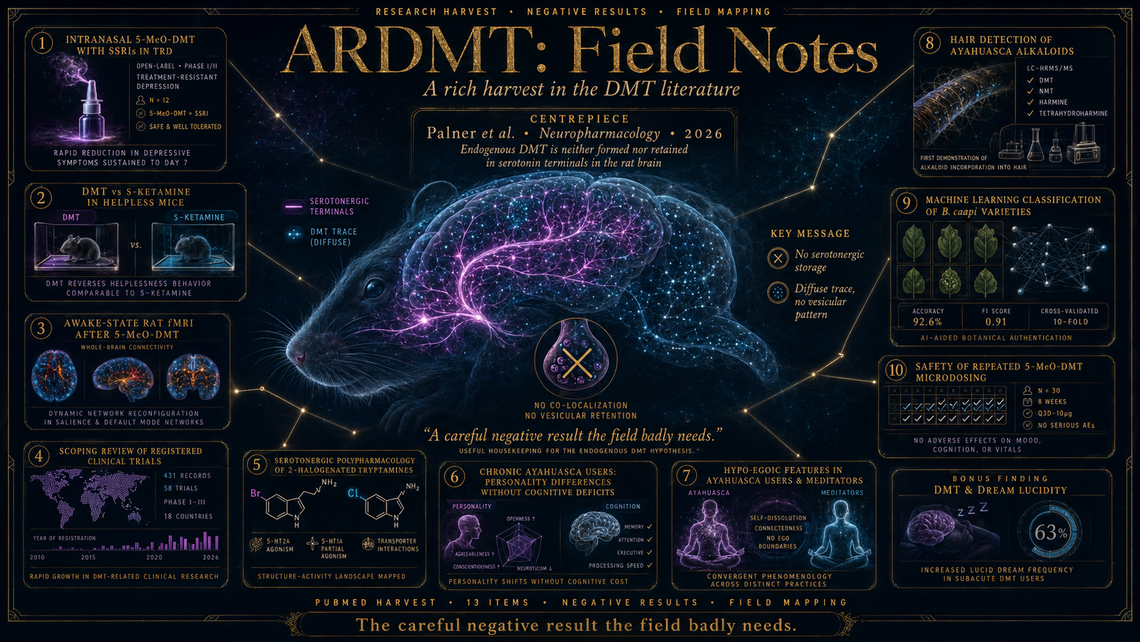
A rich harvest today, with no fewer than thirteen items from PubMed and nothing from the preprint servers — though one of the PubMed entries (Yacoub et al.) is itself a bioRxiv preprint that has been indexed in PubMed, so we shall treat it accordingly. Let us sort through the pile.
Centrepiece: DMT is neither formed nor retained in serotonin terminals in the rat brain
The paper that earns today's centre spot is Palner, Kolesnik, Baun, Poetzsch & Cumming, published in Neuropharmacology (2026; 289: 110874), which addresses a question that has been lurking at the edges of serious DMT research for decades: does the brain actually synthesise and store endogenous DMT in serotonergic neurons, as one influential strand of speculation has long maintained? The answer, at least in the rat, appears to be a rather firm no.
The experimental logic is elegant in its simplicity. If DMT were genuinely produced within serotonin terminals — and, crucially, if it were packaged into vesicles alongside 5-HT for synaptic release — then one would expect to find it enriched in exactly those brain regions densely innervated by serotonergic projections, and one would expect its concentration to respond to manipulations that affect serotonin terminal integrity. Palner and colleagues set out to test this directly, and report that DMT was neither formed in detectable quantities in serotonin-rich regions nor retained in any pattern consistent with vesicular storage. The title rather gives the game away, but the data apparently support it.
This matters because the "endogenous DMT hypothesis" — the notion that DMT is a physiologically meaningful neurotransmitter or neuromodulator, perhaps involved in dreaming, near-death experiences, or mystical states — has been extraordinarily persistent in both popular and semi-academic discourse, despite the evidence for it remaining, to put it charitably, thin. The Strassman-era speculation was always more provocative than probative, and while subsequent work (notably Dean et al., 2019) did demonstrate that rat brain tissue can produce trace amounts of DMT, the functional significance of those traces was never established. What Palner et al. appear to show is that even if the biosynthetic machinery exists in some diffuse form, the serotonin terminal is not the relevant compartment, and DMT does not behave like a co-transmitter in those neurons.
One should be cautious about reading this as a complete burial of the endogenous DMT idea — absence of evidence in one compartment is not evidence of absence in all compartments, and the enzymes INMT and AADC are expressed in places other than raphe projections. But it does substantially narrow the space in which the hypothesis can operate, and it removes one of the more neurochemically tidy versions of the story from contention. A useful piece of housekeeping.
Also in the harvest
Seynaeve et al. in CNS Drugs (2026; 40(5): 725–728) report a proof-of-concept trial of intranasal 5-MeO-DMT given concomitantly with SSRIs in treatment-resistant depression. This is notable for two reasons: first, because most psychedelic trial protocols require SSRI washout (which is clinically awkward and sometimes dangerous), and second, because the paper is only four pages long, which rather suggests the sample was very small indeed. The fact that it has already accumulated ten citations in PMC speaks to the intensity of interest in this combinatorial approach. Worth watching, but one wants to see the full dataset before reaching for superlatives.
De Sousa-Silva et al. in Neuropharmacology (2026; 292: 110947) compare DMT head-to-head with S-ketamine in a learned helplessness mouse model, reporting both antidepressant and anxiolytic effects for DMT. Head-to-head comparisons with ketamine are valuable because they begin to position tryptamine psychedelics within a pharmacological landscape that already has a licensed rapid-acting antidepressant in it. The helplessness model is a reasonable choice, though as always one should note that no mouse has ever reported mystical experience on a rating scale.
Cavallaro et al., also in Neuropharmacology (2026; 291: 110886), use awake-state functional neuroimaging in rats to map the acute effects of 5-MeO-DMT on brain connectivity, with attention to both sex differences and dose-response relationships. The awake imaging paradigm is important — anaesthesia confounds connectivity analyses something terrible — and the inclusion of sex as a biological variable is welcome, given how many preclinical psychedelic studies have used exclusively male animals as though the other half of the species were merely decorative.
Stojanović et al. in Clinical Pharmacology and Therapeutics offer a scoping review of all registered clinical trials involving ayahuasca and DMT. Scoping reviews of trial registries are useful cartographic exercises — they tell you where the field thinks it is going, and, more instructively, where it has quietly abandoned planned work. One looks forward to reading how many of the registered trials have actually been completed.
Yacoub, von Salm et al. have deposited a bioRxiv preprint (indexed in PubMed via PMC) on the serotonergic polypharmacology of 2-halogenated tryptamines. This is medicinal chemistry — structure-activity relationship work exploring what happens when you stick halogens at the 2-position of the tryptamine scaffold. Not DMT per se, but it inhabits the same chemical neighbourhood and may illuminate selectivity questions relevant to DMT analogue programmes. Being a preprint, the pharmacology data await peer review.
Bouso et al. in European Neuropsychopharmacology (2026; 106: 112782) find that chronic ayahuasca users differ from non-users on personality measures but not on cognitive performance — which is either reassuring (no cognitive deficits) or philosophically interesting (personality shifts without measurable cognitive cost), depending on one's perspective. The cross-sectional design means causality remains elusive, as ever.
Arqueros et al. in Human Psychopharmacology compare "hypo-egoic features" — states of reduced self-referential processing — in ayahuasca users and meditators. The comparison is conceptually interesting, though one suspects the phenomenological overlap may be more apparent than real. Mano-Sousa et al. in the Journal of Psychoactive Drugs contribute a systematic review on ayahuasca therapy and suicidal ideation in treatment-resistant depression. Systematic reviews of small literatures are tricky beasts; one hopes the evidence base has grown enough to support genuine synthesis rather than just narrative redescription.
In the analytical chemistry department, Santos et al. in Talanta present a dispersive liquid–liquid microextraction method for detecting ayahuasca alkaloids (DMT and β-carbolines) in human hair, which is useful for forensic and longitudinal exposure work. Vágnerová et al. in the Journal of Pharmaceutical and Biomedical Analysis characterise the metabolic profile of 25E-NBOH — a phenethylamine, not a tryptamine, but one that acts at the same 5-HT2A receptor. And Biazatti et al. in iScience do something rather charming: they train machine learning classifiers to recover indigenous folk classifications of Banisteriopsis caapi varieties from herbarium leaf morphology. This is ethnobotany meets computer vision, and while it is only tangentially related to DMT pharmacology, one cannot help but admire the interdisciplinary nerve.
The Langmuir paper (Choi et al.) on surface immobilisation of amine biomarkers is analytical chemistry infrastructure rather than DMT research, and earns a polite nod before being returned to the shelf.
A good day. The Palner paper, in particular, is the sort of careful negative result that the field badly needs.