ARDMT Field Notes
DMT for Substance Misuse: An Exeter/Imperial Meta-Analysis
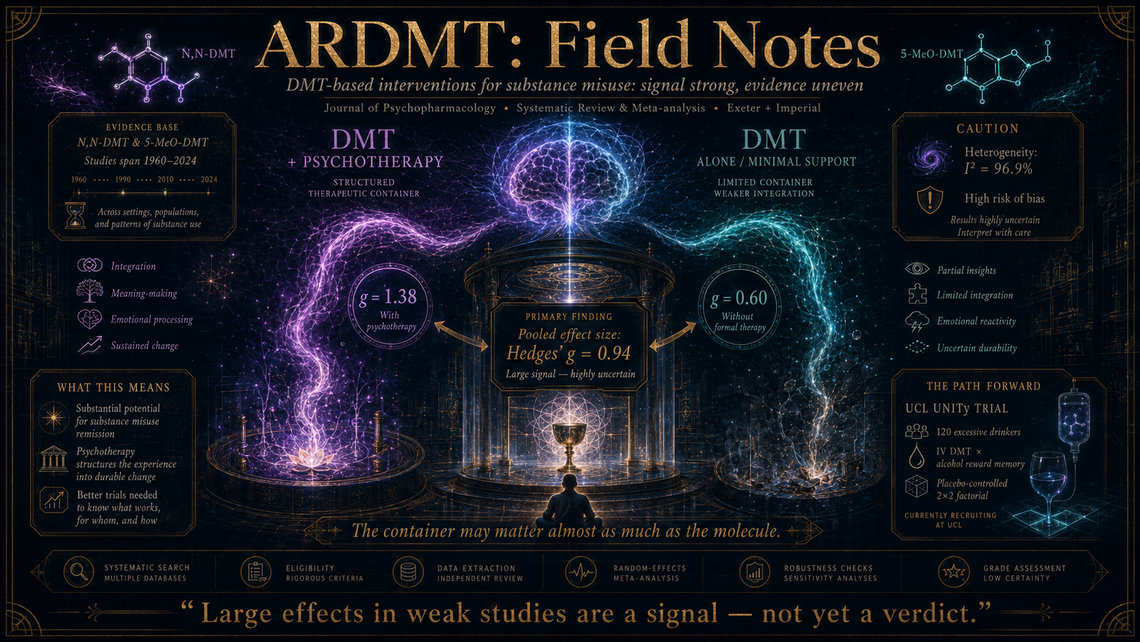
A systematic review and meta-analysis examining whether DMT-based interventions can shift the needle on substance misuse has appeared in the Journal of Psychopharmacology, authored by a team spanning the University of Exeter and Imperial College London (DOI 10.1177/02698811261430518). The paper synthesises data from studies conducted between 1960 and 2024, encompassing both N,N-dimethyltryptamine and 5-MeO-DMT as active agents, and arrives at a pooled effect size of Hedges' g = 0.94 — large by any conventional yardstick. But conventional yardsticks, as the authors are commendably quick to note, may not be the right instruments here.
What was done
The review follows standard systematic methodology — comprehensive database searching, predefined eligibility criteria, risk-of-bias assessment — and gathers a heterogeneous corpus of studies in which DMT or 5-MeO-DMT was administered to individuals with problematic substance use, with some outcome measure of use, craving, or related pathology captured at follow-up. The search window is notably wide, stretching back to the early 1960s, which means a substantial fraction of the included work predates anything resembling modern trial design: no blinding, no randomisation, sample sizes that would make a contemporary ethics committee wince. The statistical heterogeneity is, accordingly, enormous — an I² of 96.9%, the kind of figure that should make one treat the pooled estimate less as a precise summary and more as a vague gesture in a broadly favourable direction.
The psychotherapy moderation finding
Rather more interesting than the headline number is the subgroup analysis by psychotherapeutic accompaniment. Studies in which DMT administration was embedded within a structured psychotherapeutic framework yielded a pooled g of 1.38, while those without formal therapy support came in at 0.60. Both figures favour the intervention, but the gap between them is striking and, if it holds under better-controlled conditions, clinically consequential. It suggests that the pharmacological action of DMT — whatever combination of 5-HT2A agonism, sigma-1 receptor engagement, and downstream neuroplastic reshuffling one favours — may be necessary but not sufficient, and that the therapeutic container matters at least as much as the molecule inside it. This is a finding the broader psychedelic therapy field has been circling for some time, most explicitly in the psilocybin-for-depression literature, but it is useful to see it quantified in a substance-misuse context.
What is well-supported and what is not
The authors deserve credit for the transparency of their limitations section. High risk of bias pervades the included studies; most lack active placebos or adequate blinding — a perennial headache when the intervention involves a visionary experience distinguishable from a sugar pill within roughly forty-five seconds of administration. The temporal range introduces confounds of diagnostic classification, cultural context, and measurement technology that no statistical model can fully absorb. And the lumping together of N,N-DMT and 5-MeO-DMT, while understandable on grounds of limited data, elides pharmacological differences that may prove material: 5-MeO-DMT's receptor profile is not identical, and subjective phenomenology diverges in ways that could matter for therapeutic mechanism.
What one can say is that the direction of effect is consistent and the signal is not trivially small. What one cannot yet say is that DMT, in some well-specified protocol, reliably reduces substance misuse to a clinically meaningful degree. That claim awaits properly powered, randomised, placebo-controlled trials with adequate follow-up — which, conveniently, are beginning to materialise.
Pipeline context
The review's findings land at a moment when the next generation of primary data is being assembled. UCL's UNITy trial (ISRCTN13970288), a placebo-controlled 2×2 factorial study of intravenous DMT and alcohol reward memory in 120 excessive drinkers, is currently recruiting and represents precisely the kind of rigorous prospective work needed to replace the retrospective signal-spotting that this meta-analysis, by its nature, relies upon. Its factorial design — crossing DMT with a memory reactivation paradigm — may illuminate mechanism as well as efficacy. If UNITy's results echo the psychotherapy-moderated effect suggested here, particularly if the design can tease apart pharmacological from contextual contributions, the field will have moved from gesture to evidence. If they do not, the review will have served the equally useful purpose of illustrating how large effect sizes in weak studies can flatter a hypothesis that better data deflates.
Also worth a glance
A preprint profiling the structure–activity relationships of 2-halogenated tryptamines across serotonin receptor subtypes (PMID 42079221) offers the medicinal chemistry contingent a useful map of how modest substitutions on the tryptamine scaffold reshape receptor selectivity, with direct implications for analogue design in the DMT family.
Marginalia
There is something faintly vertiginous about meta-analysing studies from the early 1960s alongside work from the 2020s, as though one were averaging readings from a mercury thermometer and a digital infrared sensor and calling the result a temperature. The authors know this, and say so. One hopes the next review will have the luxury of discarding the older data entirely — not because it was worthless, but because it will have been superseded by evidence that does not require quite so much methodological charity.