ARDMT Field Notes
DMT EEG: Alpha Power Outperforms Lempel-Ziv Complexity (Timmermann)
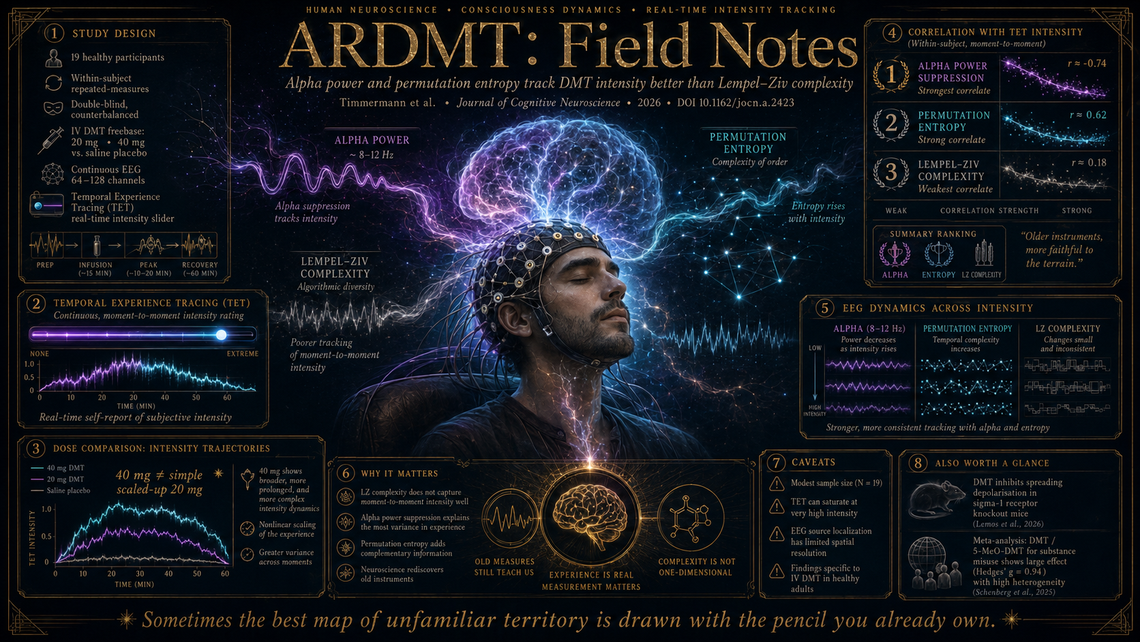
One of the more quietly consequential findings in recent psychedelic neuroscience has been the association between Lempel–Ziv complexity (LZc) and the intensity of subjective experience under psychedelics — a relationship that has been elevated, in some quarters, to something approaching a neural signature of expanded consciousness. The new paper from Timmermann and colleagues at Exeter, published in the Journal of Cognitive Neuroscience (DOI 10.1162/jocn.a.2423), does not so much demolish this claim as politely rearrange the furniture around it. The rearrangement is significant enough to merit close attention.
Design and method
The study enrolled 19 healthy participants in a repeated-measures, within-subject design comparing intravenous DMT freebase at two doses — 20 mg and 40 mg — against saline placebo, administered in counterbalanced, double-blind fashion. EEG was recorded throughout, and the investigators deployed a methodological innovation worth emphasis: Temporal Experience Tracing (TET), a technique whereby participants provide a continuous, time-resolved account of experiential intensity by manipulating a slider in real time during the session. This is not a post-hoc questionnaire, nor a single peak-intensity rating; it yields a temporal curve that can be correlated, moment by moment, with concurrent neural signals. Under DMT — a compound whose subjective arc is notoriously compressed, steep, and difficult to capture with conventional instruments — this represents a genuine methodological advance. The authors should be credited for making it work in a context where participants are, to put it mildly, otherwise occupied.
Key findings
The result that will provoke the most discussion concerns the relative explanatory power of different EEG-derived measures in tracking the moment-to-moment intensity of the DMT experience. Alpha power suppression and permutation entropy emerged as the strongest time-resolved correlates of subjective intensity at both doses. Lempel–Ziv complexity — the metric most frequently cited in the psychedelic complexity-consciousness literature — was, by the authors' analysis, the weakest correlate of the three. It still showed dose-dependent changes and was not absent from the picture, but when placed in direct competition with alpha desynchronisation and permutation entropy for explaining the temporal dynamics of experience, it came last.
This matters because LZc has been doing rather a lot of theoretical heavy lifting in recent years. It has been invoked as evidence for the entropic brain hypothesis, used to draw connections between psychedelic states and other altered states of consciousness, and cited in arguments about the relationship between neural complexity and phenomenal richness. The present findings do not refute any of these claims outright, but they suggest that the relationship between LZc and subjective experience under DMT is less tight, less temporally precise, and possibly less specific than has been assumed. Alpha power — a far older, less glamorous measure — appears to do more of the explanatory work, at least in this dataset.
The dose-dependent dimension adds further texture. Differences between 20 mg and 40 mg were apparent across multiple EEG measures and in the TET intensity curves, and the 40 mg condition produced neural changes that were not simply scaled-up versions of those at 20 mg. This is useful: most prior DMT neuroimaging work has employed a single dose, and the assumption that effects scale linearly is precisely the sort of thing that requires empirical rather than intuitive support.
Caveats and context
The sample of 19, while reasonable for a repeated-measures pharmacological EEG study, is not large enough to settle the matter. EEG source localisation is inherently limited, and the TET method, though clever, introduces its own confounds — participants must retain sufficient motor and cognitive capacity to operate a slider, which at 40 mg of DMT is no small ask. It is at least conceivable that the moments of most intense experiential alteration are precisely those least likely to be captured by any concurrent self-report measure. The authors are aware of this and discuss it frankly. One should also note that permutation entropy and LZc, while conceptually distinct, are not wholly independent; both index aspects of signal complexity, and the superiority of one over the other may partly reflect methodological choices about parameters, epoch length, and frequency bands rather than deep facts about consciousness.
Still, the study sits within a growing body of work — much of it from the same group — that is gradually building a more nuanced picture of DMT's neural pharmacodynamics than the field possessed five years ago. The TET methodology in particular deserves wider adoption. If one is going to make claims about the temporal relationship between brain states and experience, one needs temporally resolved measures of both, and this paper delivers on that front more convincingly than most.
Also worth a glance
A conference abstract from an Exeter-affiliated group (DOI 10.1093/esj/aakag023.1209) reports that DMT inhibits spreading depolarisation in brain slices from sigma-1 receptor knockout mice — a surprising result that, if confirmed, would redirect attention towards aminergic mechanisms rather than S1R-mediated neuroprotection in the DMT-for-stroke pipeline. Separately, a systematic review and meta-analysis in the Journal of Psychopharmacology (DOI 10.1177/02698811261430518) pools DMT and 5-MeO-DMT studies for substance misuse outcomes, arriving at a Hedges' g of 0.94 — a large effect, though the authors themselves flag high heterogeneity and considerable risk of bias, making this more a baseline marker than a vindication.
Marginalia
There is something rather pleasing about the possibility that alpha power — discovered by Hans Berger in 1929 and briefly fashionable before being overshadowed by nearly everything else in electrophysiology — may turn out to be a better tracker of the psychedelic state than the more theoretically modish complexity measures. Neuroscience has a habit of rediscovering old instruments. Sometimes the best map of unfamiliar territory is drawn with the pencil you already own.