ARDMT Field Notes
DMT and Ayahuasca Clinical Trials: 2026 Pipeline Scoping Review
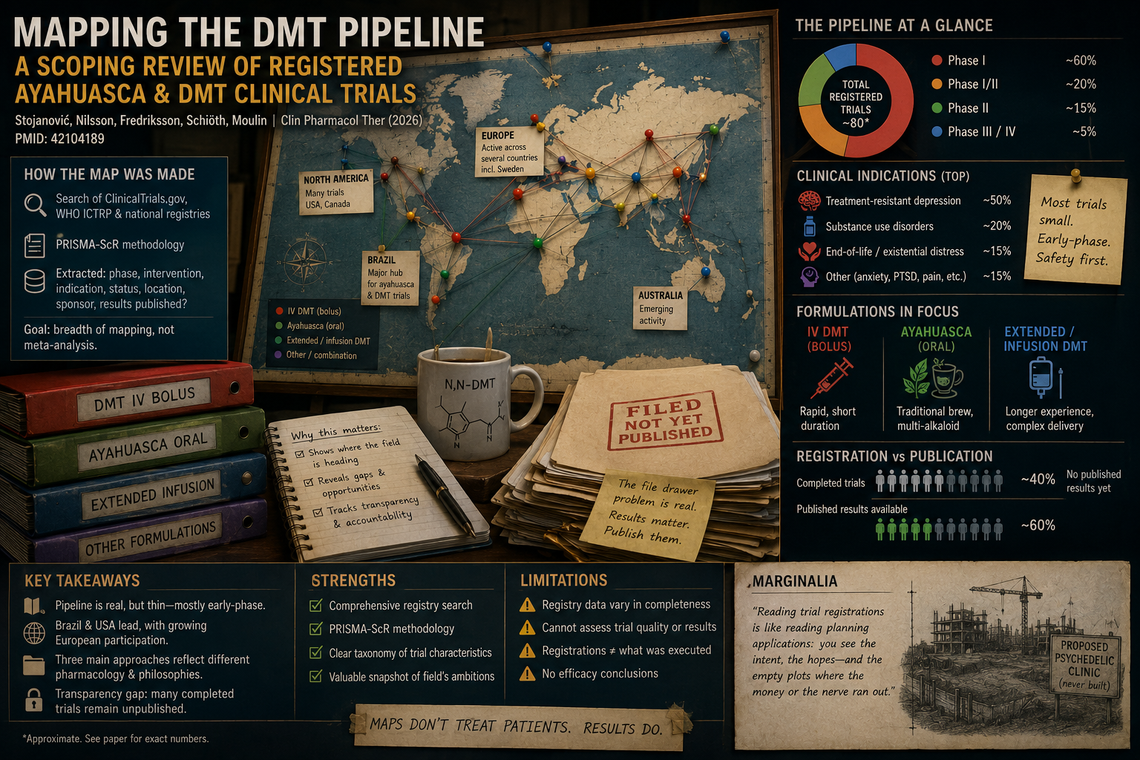
A scoping review published this week in Clinical Pharmacology & Therapeutics by Stojanović, Nilsson, Fredriksson, Schiöth, and Moulin (PMID 42104189) attempts something deceptively simple: to catalogue every registered clinical trial involving ayahuasca or N,N-dimethyltryptamine and ask what, collectively, they tell us about the state of the translational pipeline. The answer, as with most honest audits, is both encouraging and slightly sobering.
What was done
The authors conducted a systematic search of major trial registries — ClinicalTrials.gov, the WHO's International Clinical Trials Registry Platform, and associated national portals — using standardised terms for DMT, ayahuasca, and related formulations. The methodology follows PRISMA-ScR guidelines for scoping reviews, meaning the aim was breadth of mapping rather than meta-analytic synthesis. They extracted data on trial phase, intervention type, clinical indication, recruitment status, geographical location, sponsor type, and whether results had been published in any form. This is, in effect, a census of the field's ambitions as declared to regulators and the public — which is a rather different thing from its published achievements.
What emerges
The landscape appears to be dominated by early-phase work. One would expect the majority of registered trials to sit at Phase I or Phase I/II, concerned primarily with safety, tolerability, and dose-finding — the pharmacological groundwork that must precede any serious efficacy claim — and the review seems to confirm this. A smaller but apparently growing cohort of Phase II trials is reported to target treatment-resistant depression, with a handful addressing other indications such as substance use disorders and end-of-life distress. The geographical spread is notable: Brazil and the United States appear to account for a large share, but there is visible activity across Europe, with Uppsala — the senior authors' own institution — among the contributing centres.
The formulation question is worth pausing on. Pure DMT administered intravenously — the approach pioneered by Strassman in the 1990s and now being refined by several commercial programmes — appears to account for a significant tranche of the registered trials, but ayahuasca in its traditional oral preparation remains well represented, particularly in Brazilian registries. A third category, encompassing extended-release or continuous-infusion DMT protocols designed to prolong the experience beyond the famously brief intravenous flash, seems to be appearing in registry entries, though most of these are reported to remain in recruitment or pre-recruitment phases. This tripartite division — bolus IV, oral brew, and extended infusion — reflects genuine pharmacological and philosophical divergences about what kind of DMT experience might prove therapeutically useful. The field has not yet converged on an answer.
Perhaps the most instructive finding concerns the gap between registration and publication. A substantial proportion of completed trials appear not yet to have yielded peer-reviewed results. This is not unique to the psychedelic space — the so-called "file drawer problem" afflicts all of clinical research — but in a field this young, where every completed dataset is disproportionately valuable, the opacity is frustrating. Some of these may be working their way through the publication pipeline; others may represent negative or ambiguous results that sponsors are less eager to share. Either way, the review usefully names the problem and quantifies its scale.
Limitations and context
A scoping review is, by design, a map rather than a verdict. Stojanović and colleagues do not assess the quality of individual trials, nor can they tell us much about the results of those that remain unpublished — they can only flag the absence. There is also the perennial difficulty that registry entries vary enormously in completeness and accuracy; a trial's registered protocol may bear only a passing resemblance to what was ultimately conducted. Still, as a snapshot of where the DMT clinical enterprise actually stands in mid-2026 — as opposed to where conference keynotes and investor decks might wish it to stand — the review is genuinely useful. It confirms that the pipeline is real but thin, that most work remains early-phase, and that the field's publication practices could do with the same rigour it increasingly demands of its dosing protocols.
The placement in Clinical Pharmacology & Therapeutics is itself a small marker of legitimacy. This is a journal that speaks to the regulatory and translational mainstream, not to psychedelic enthusiasts, and its editors evidently judged the review worth their readers' attention. That counts for something.
Also worth a glance
Von Salm, McCorvy, Baumann, and colleagues report on the serotonergic pharmacology of 2-halogenated tryptamines (PMID 42079221), a structure–activity study directly adjacent to the DMT scaffold that maps how even small halogen substitutions at the 2-position shift receptor selectivity and functional efficacy across the serotonin receptor family — useful reading for anyone trying to understand what makes DMT DMT versus its innumerable near-cousins. Separately, a validated dispersive liquid-liquid microextraction method for detecting DMT and β-carbolines in human hair (PMID 41628561) offers a niche but potentially valuable forensic and pharmacokinetic tool for long-term exposure assessment in habitual ayahuasca users.
Marginalia
There is something quietly revealing about the act of reviewing trial registrations rather than trial results. It is the research equivalent of reading a city's planning applications instead of visiting its buildings — you learn what people intended, where they hoped to build, and, by the empty plots, where the money or the nerve ran out. The DMT field, it turns out, has quite a few empty plots.