Understanding
DMT an overview
From a forthcoming book — first chapter, free.
DMT is the molecule that has, more often than any other psychoactive compound, embarrassed the explanatory frame its encounter began with. Indigenous shamans found it long before chemists could name it, and shaped a cosmology around it that Western pharmacology still cannot fully translate. Chemists synthesised it long before anyone realised it was psychoactive. Psychiatrists administered it expecting a model of psychosis and got something that looked more like religion. Neurologists set out to discover its function in the brain and discovered they could not even agree, after sixty years, on whether it has one.
This is a book about that molecule, and about what happens at each turn when it slips the frame.
"The plant is not the medicine. The song is the medicine. The plant teaches the song."
— Shipibo onanya tradition, paraphrased
Chapter One
Prologue: The Pipes in the Cave
Inca Cueva, Jujuy Province, Argentina · circa 2130 BC.
We do not know who they were. We know roughly when they lived — the carbon in the bone gives them away to within a century or two. We know they made tools out of the long-bones of pumas, hollowing out the marrow and finishing the surfaces, and we know they used those bones to inhale a powder ground from the seeds of a tree that still grows in the dry valleys to the east. We know what was in the powder, because residue still clings to the inside of the pipes, and an analytical chemist with sufficiently good equipment can detect it almost five thousand years later. The powder contained N,N-dimethyltryptamine.
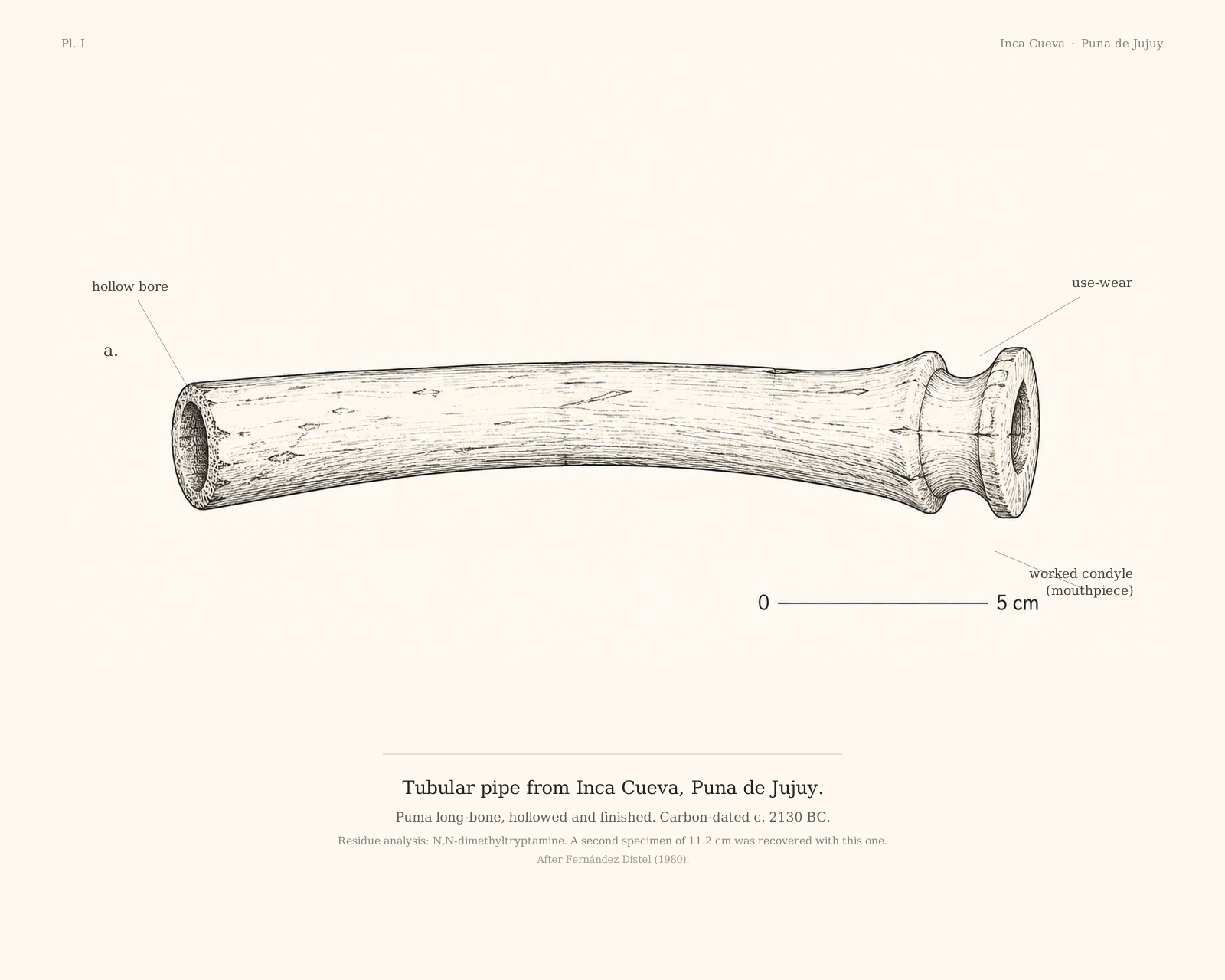
This is the earliest unambiguous physical evidence that human beings have been using DMT. It is not the earliest possible evidence; it is the earliest unambiguous evidence. The artefacts at Inca Cueva are sophisticated — not the work of a curious individual on a first attempt — and the social and ceremonial infrastructure implied by them is plainly older than the artefacts themselves. The honest reading of the archaeology is that some indigenous peoples of South America have been finding ways to introduce DMT-bearing plant material into their bloodstreams for at least four thousand years, and probably for considerably longer than that.
The pipes had been buried in a dry rock-shelter in the Humahuaca gorge, in north-western Argentina, until a team of archaeologists found them and a chemist named Constantino Manuel Torres put their residue in front of a mass spectrometer in the late 1980s. Torres had spent years quietly building a literature on what is now called the Anadenanthera snuff complex — the family of preparations made from the seeds of two closely related leguminous trees, Anadenanthera peregrina and Anadenanthera colubrina, that have been the principal pre-modern delivery system for DMT across most of South America and the Caribbean. The snuffs are known by different names in different places: yopo in the Orinoco basin; cohoba in the islands the Spanish reached first; vilca or cebil in the central Andes. They have been recovered from sites in Argentina, Brazil, Chile, Bolivia, Peru, Colombia, Costa Rica, Haiti, the Dominican Republic and Puerto Rico. The geographical reach of pre-Columbian DMT use is, in short, continental.
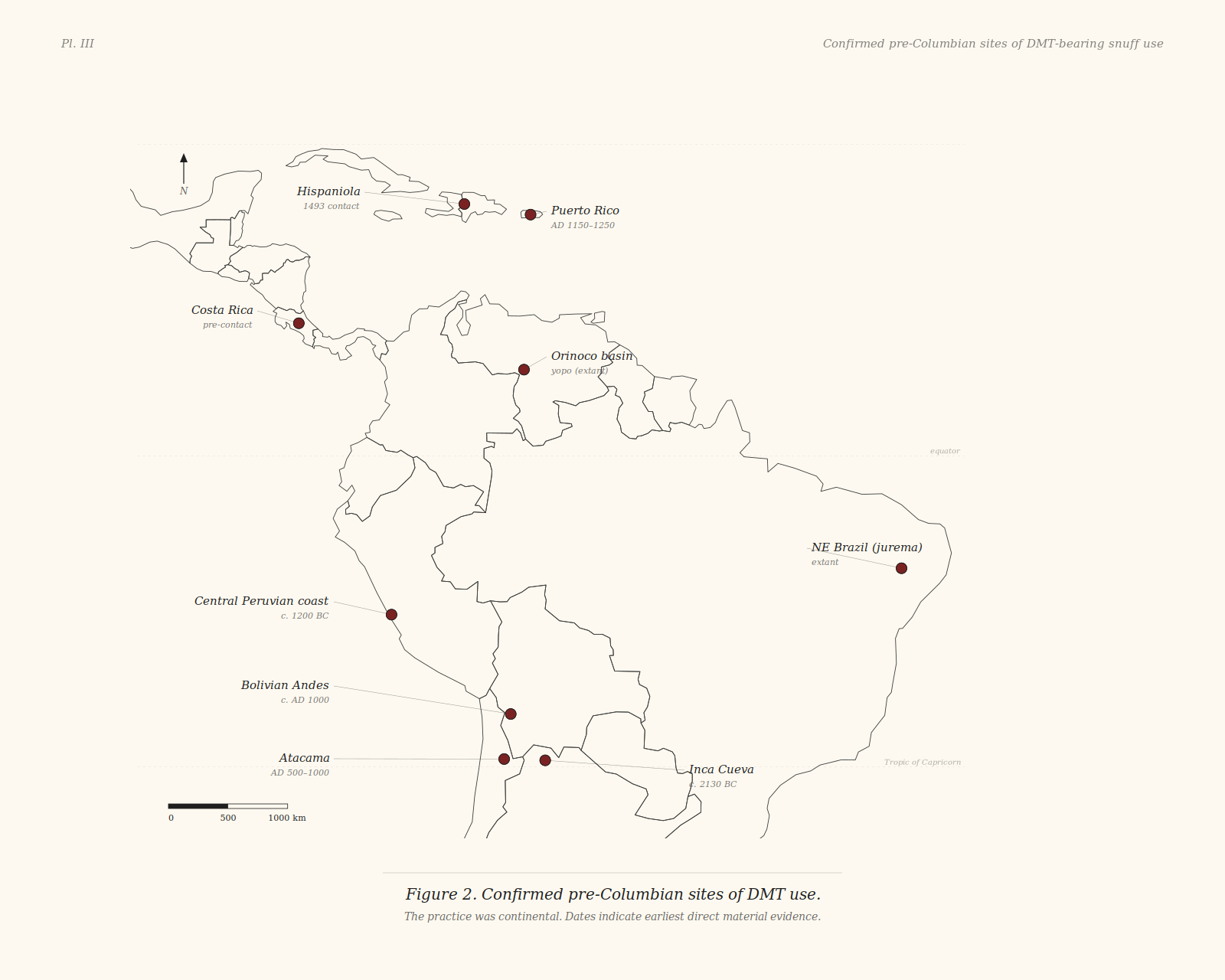
The most striking single piece of more recent archaeological evidence comes from a thousand-year-old shamanic ritual bundle recovered from the Bolivian Andes and analysed in 2019 by Melanie Miller, José Capriles and colleagues. The bundle, kept in a fox-snout pouch, contained snuff trays and tubes; mass spectrometry of the residues found DMT, bufotenine, and harmine in the same kit. Harmine is a monoamine oxidase inhibitor characteristic of the Banisteriopsis caapi vine. To find DMT and harmine in a single ritual bundle is to find evidence that, a thousand years ago, somebody in the Andes already knew that the two substances needed to be combined.
This matters, because DMT alone, taken by mouth, does almost nothing. The mammalian gut wall and liver contain an enzyme — monoamine oxidase A — that is so efficient at breaking down DMT that the molecule is, for practical purposes, orally inert in the absence of an inhibitor. Western pharmacology did not properly understand this until the second half of the twentieth century. It is the central pharmacological problem the molecule poses, and it had been solved in the Andes a thousand years before the enzyme in question had a name.
A small caution
It is tempting to read the Bolivian fox-snout bundle as evidence that the indigenous practitioners had 'discovered the pharmacology' of MAO inhibition. The temptation should be resisted — or at least examined. The framing turns the indigenous knowledge into a kind of pre-scientific approximation of what we now know more rigorously, with chemistry as the gold standard. That is one way of reading what they were doing. There are others. (Appendix B takes this question up in detail.)
What can be said with confidence, and what is the only point I want to insist on for now, is this: long before there was any pharmacology of DMT, there were people using DMT, in ritual, with considerable craft, in elaborate social and ceremonial contexts, across an entire continent. By the time European chemistry arrived to give the molecule its name, the molecule had been inside human bloodstreams, in a controlled and intentional way, for somewhere between forty and a hundred and forty centuries. Western science is not the first chapter of this book; it is, very late in the day, the second.
[Established] Indigenous use of DMT-bearing snuff preparations across South America is securely dated to at least 2130 BC by direct residue analysis of dated artefacts (Torres & Repke, 2006; Miller et al., 2019). Combined DMT/MAOI preparations are documented in the archaeological record from at least the early second millennium AD.
What's in the rest of the book
That was Chapter One of fourteen. The remaining chapters trace what happens when the molecule moves westward into laboratories, scanners, and balance sheets:
- Chapter Two — A Molecule Without a Country. Manske's accidental synthesis in a Manchester lab in 1931, and the twenty-five years it took anyone to realise what he'd made.
- Chapter Three — The Hungarian. Stephen Szára, Budapest, 1956: the first human trials, and the briefcase he carried west.
- Chapter Six — The Bureaucrat's War. How one psychiatrist at the University of New Mexico spent five years getting permission to do what Szára had done in five months.
- Chapter Seven — Reading the Molecule. The pharmacology, finally, in detail: what binds, what breaks it down, why oral DMT is inert, and why the most interesting receptor pool turns out to be inside the cell.
- Chapter Eight — The Endogenous Trap. What the body makes the molecule for — and the awkward fact that, after sixty years, no one is sure.
- Chapter Nine — Inside the Scanner. What an fMRI sees when the default-mode network breaks open.
- Chapter Twelve — The Encounter. What people actually report seeing, and what to do with the reports.
- Chapter Twelve-A — The Industry. The $3 billion biotech market built on top of a public-domain molecule, and the question of who owns a substance the body already makes.
- Chapter Thirteen — What We Know, What We Don't. An honest ledger.
Plus two appendices — on UK law, and on the colonisation problem — and ten editorial plates: the Inca Cueva pipe; the molecule and its three close relatives; a continental map of pre-Columbian DMT use; the MAO-A bottleneck; a four-thousand-year timeline; the receptor binding profile; Borjigin's dying-brain experiment; the default-mode network under DMT; the intracellular 5-HT2A discovery; and Szára's briefcase.
The full book — fourteen chapters, two appendices, ten plates — is available to paid members. [Upgrade to read on →]
If you've enjoyed this much, the rest is more of the same: prose without the romance, science without the marketing.