Ethics
Before the First Dose

The first US psilocybin trial in veterans with PTSD produced a headline number. The more interesting one is buried in the middle.
Twelve veterans with severe, treatment-resistant PTSD walked into a clinic in Ohio. Eleven weeks later, nine of them no longer met the diagnostic criteria for the condition that had, in most cases, defined a decade or more of their lives.
That is the sentence running in every outlet this week, and it is accurate. It is also the least interesting true thing about this study.
The Ohio State trial, published on 30 July in Communications Medicine, measured PTSD severity three times rather than twice. Once at baseline. Once at the end of the preparatory therapy, before any psilocybin had been administered. Once a month after the second dose. Almost nobody builds a trial that way, and almost nobody reports the middle number when they do.
Ohio State reported it. And the middle number moved.
What the trial actually was
This was the first clinical study in the United States to test psilocybin-assisted therapy specifically in military veterans with PTSD, run by the Center for Psychedelic Drug Research and Education at Ohio State, with psilocybin supplied by the Usona Institute.
Twelve veterans completed an eleven-week protocol. Roughly eight hours of preparatory therapy across four visits. Then two supervised psilocybin sessions, 15 mg followed by 25 mg, two to three weeks apart. Then six to eight hours of integration therapy across four more visits. Sixteen hours of skilled clinical contact in total, wrapped around two drug days.
Baseline severity on the clinician-administered scale averaged 39.7, which is severe. One month after the second dose, the average had fallen by 27.5 points, an effect size of 2.30. Nine of the twelve met criteria for both response and remission. Ten showed clinically meaningful improvement. There were no serious adverse events. The commonest complaints were headache, anxiety and dizziness.
Those are extraordinary numbers. They are also, as the authors themselves take pains to say, not evidence that psilocybin treats PTSD.
The number in the middle
By the fourth preparatory session, before any participant had received a milligram of psilocybin, clinician-rated PTSD severity had already fallen by 6.33 points. That is a large effect size, 0.87, on the strength of eight hours of therapy and a promise.
It gets more interesting. The amount a participant improved during preparation predicted the amount they improved a month after dosing. The people who responded to the container responded to the treatment.
Two honest caveats belong here. The pre-dosing drop appeared on the clinician-administered scale but not on the self-report measure, which moved in the same direction without reaching significance. And a portion of it will be regression to the mean, the ordinary statistical tendency of people recruited at their worst to look better when measured again. Neither caveat makes the finding disappear. It makes it a hypothesis rather than a conclusion, which is precisely what a twelve-person open-label trial is for.
What the authors do with it is the part worth watching. They do not bury it in a limitations paragraph. They read it as evidence that the therapeutic relationship is not packaging around the active ingredient. It is part of the active ingredient.
Why this is not a footnote
There is a version of this essay that treats the preparation finding as a methodological nuisance, a confound to be engineered away in the next trial. I want to argue against that reading, and I should declare an interest before I do.
I spent six months living with a Bwiti community in Gabon, completing a full iboga initiation. In that context, the question of whether the preparation is separable from the medicine is not merely unanswered. It is unaskable. The days of preparation, the specific people present, the music, the ordering of events, the relationship with the person guiding you: none of these are understood as delivery mechanisms for an alkaloid. They are understood as the treatment, of which the alkaloid is one component. Twenty years across several traditions have not given me a single example of a practice that thinks otherwise.
None of that constitutes evidence, and I am not offering it as such. Ceremonial confidence about mechanism has been wrong before and will be again, and one of the reasons this publication exists is that the field has a bad habit of treating traditional practice as a source of conclusions rather than a source of hypotheses.
But it does explain why the middle measurement in the Ohio State trial reads, from certain angles, less like an anomaly and more like a very expensive rediscovery. Clinical research has spent a decade asking what the molecule does. It is only now beginning to build studies capable of asking what everything else does. When it asks, it finds something. That should be less surprising than it is.
Sixteen days earlier
The timing here is not incidental. On 14 July 2026, sixteen days before this paper appeared, the FDA published its final guidance on clinical investigations of psychedelic drugs, closing out a draft that had been sitting since June 2023.
The guidance exists because of what happened to Lykos. In June 2024, the FDA's Psychopharmacologic Drugs Advisory Committee voted 10 to 1 against recommending approval of MDMA-assisted therapy for PTSD. In August, the agency issued a complete response letter demanding another Phase 3 trial. Within weeks, Lykos had cut roughly three quarters of its staff. Two positive Phase 3 trials and a decade of striking results had not been enough.
The committee's central objections were functional unblinding, expectancy, and the impossibility of separating drug effect from psychotherapy effect. Participants in a psychedelic trial know whether they received the drug. Knowing, they expect to improve. Expecting, they improve. The blind is not broken by accident; it is broken by the mechanism.
Leor Roseman, now at Exeter, made the sharpest observation about this in the Journal of Psychopharmacology. The FDA does not regulate psychotherapy. Yet nearly every difficulty it had in judging MDMA-assisted therapy arose from the psychotherapeutic elements of the procedure. Functional unblinding is a consequence of the intense emotional states the drug produces in a therapeutic context, and those states are not a side effect of the treatment. They are the treatment. Flagging the experience as the critical flaw amounts to wishing for less of the thing being tested.
The final guidance responds to this, in its way. It suggests alternatives to inert placebo, including lower doses of the same psychedelic and other psychoactive drugs that imitate some of the subjective experience. It recommends central raters blinded to allocation. It asks sponsors to measure expectancy directly and to demonstrate durability, including after repeat dosing.
Read against that document, the Ohio State trial stops looking like a small pilot and starts looking like a small pilot that is asking exactly the right question sixteen days too early to have been told to.
Who gets to be in the study
Every number above describes twelve people, and the process by which they became those twelve is worth stating in full.
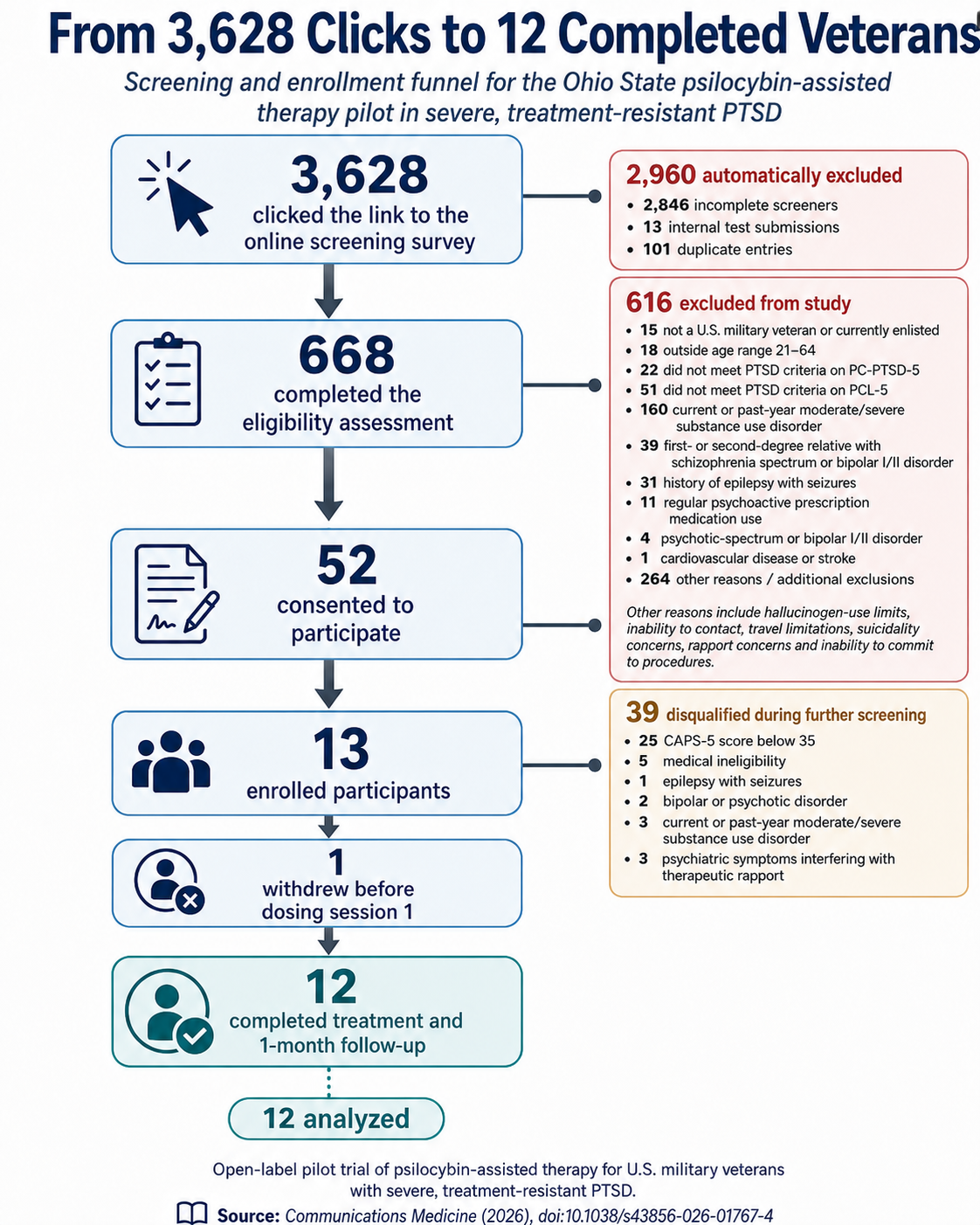
3,628 people clicked through to the screening survey. 668 completed the eligibility assessment. 52 were invited to in-person screening. Thirteen enrolled. One withdrew. The team had aimed for fifteen and ended the trial early when funding ran out.
Veterans were excluded for a significant history of suicide attempts. For cardiovascular disease. For a family history of psychosis or bipolar disorder. For moderate or severe substance use disorder in the past year. For current psychoactive medication, which meant discontinuing antidepressants for five half-lives before baseline. For psychiatric presentations judged likely to interfere with building rapport with the therapy team.
Consider the first of those for a moment. This is a trial of a treatment for PTSD, a condition whose association with suicide is the entire reason it commands the political attention it does, and it excluded people with a significant history of attempting it. The reasoning is defensible: you do not test an unproven intervention on the highest-risk population first. But the consequence is that the evidence base being assembled to justify access is being built on the subset of patients least likely to need it most urgently.
Of those who made it through, 92 percent were white, 75 percent male, 75 percent educated to degree level or beyond. 83 percent reported a combat or war-zone index trauma.
Whatever this trial measured, it measured it in a very particular twelve people.
The expectancy result, read properly
The paper reports that expectancy did not predict outcome. This sounds like reassurance. It is not.
Expectancy was captured with a single item from the Credibility/Expectancy Questionnaire. Participants rated it at 6.67 out of 9, which is to say they arrived confident. The relationship with clinician-rated outcome was in the expected direction and did not reach significance.
In an unblinded trial of twelve people, that is not evidence that expectancy did not matter. It is a study with almost no statistical power to detect it in either direction, using an instrument too blunt to find it if it were there. The authors say as much in their limitations. It is worth saying louder, because "expectancy was measured and was not a factor" is exactly the sentence that will detach from this paper and start travelling on its own.
What this trial did right
This publication spends a good deal of its time on studies that handle their methods badly, so it is worth being specific about the ones handled well here.
The trial was registered on ClinicalTrials.gov in September 2022, before recruitment opened in January 2023. The primary outcome was scored by an independent assessor with no other involvement in the study. The setting was reported against the ReSPCT consensus, the reporting standard developed precisely so that context is documented rather than assumed. The deidentified participant-level data have been published. The limitations section is candid rather than defensive, and the authors state plainly that small uncontrolled trials produce inflated effect sizes.
That combination is not universal in this field. It should be.
What the next study has to look like
If the preparation finding is real, the trial that tests it is not hard to describe. It needs a therapy-only arm, so that sixteen hours of skilled clinical contact is measured against sixteen hours of skilled clinical contact plus a drug. It needs a dose-comparison arm, since the FDA has now explicitly endorsed low-dose comparators. It needs expectancy measured properly, with a validated multi-item instrument, at multiple timepoints. It needs blinded central raters. It needs a follow-up considerably longer than one month, because PTSD is measured in decades and this study measured in weeks. And it needs a sample that includes the people currently screened out.
That trial is expensive, slow and much less newsworthy than nine out of twelve. It is also the only kind of study that can turn this result into a treatment.
The bottom line
The Ohio State trial produced a strong safety and feasibility signal, a clinical result large enough to demand a controlled trial, and one quiet finding that may outlast the headline.
Nine of twelve is not proof. It is a reason to build the study that could produce one. And the middle measurement suggests that when somebody finally builds it, the question will not be whether psilocybin works. It will be how much of the work psilocybin was doing.
Source
Armstrong, S. B., Levin, A. W., Sepeda, N. D., Shaub, H., Hunter, T., Douglas, A., Lancelotta, R., & Davis, A. K. (2026). Safety, feasibility, and preliminary clinical outcomes of psilocybin-assisted therapy for veterans with severe, treatment-resistant PTSD: an open-label pilot clinical trial. Communications Medicine, 6, 411. DOI: 10.1038/s43856-026-01767-4. Pre-registered as NCT05554094. Open access, with participant-level data.
Also referenced
FDA, Psychedelic Drugs: Considerations for Clinical Investigations, final guidance, July 2026. Docket FDA-2023-D-1987.
Roseman, L. (2025). A reflection on paradigmatic tensions within the FDA advisory committee for MDMA-assisted therapy. Journal of Psychopharmacology, 39(4), 313-315.