Research
Beckley Psytech's BPL-003: 5-MeO-DMT Without SSRI Washout
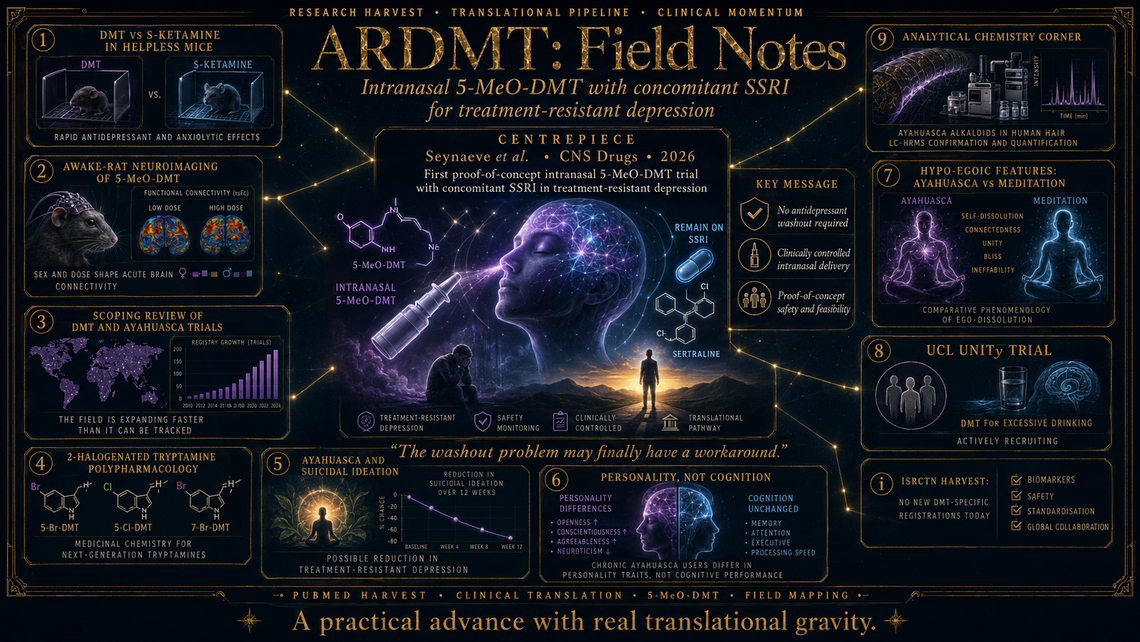
A rich harvest today, with a clear standout: a proof-of-concept clinical trial of intranasal 5-MeO-DMT given alongside an SSRI for treatment-resistant depression, published in CNS Drugs. That is the centrepiece. Below it, several other items deserve a quick note.
Centrepiece — Intranasal 5-MeO-DMT with concomitant SSRI for treatment-resistant depression
Seynaeve and colleagues, writing in CNS Drugs (PMID 41874919), report what appears to be the first published proof-of-concept trial testing intranasal 5-MeO-DMT in participants who remained on their existing SSRI — that is, without the washout period that has bedevilled so many psychedelic depression trials. The paper is short (four pages, 725–728), which suggests a brief communication or letter format, but its implications are anything but minor.
The question it addresses is eminently practical. Most psychedelic-assisted therapy protocols for depression have required participants to taper off serotonergic antidepressants before dosing, partly out of concern for serotonin syndrome and partly because SSRIs are known to blunt subjective psychedelic effects — a pharmacological interaction that is reasonably well-established for psilocybin and LSD, though rather less well characterised for the short-acting tryptamines. This washout creates a therapeutic gap that is clinically uncomfortable, ethically fraught, and a genuine barrier to scalability. If one could dose through an existing SSRI regimen, the logistics of psychedelic-assisted therapy would simplify considerably.
The route of administration is also noteworthy. Intranasal delivery of 5-MeO-DMT is a less commonly studied approach than inhalation (the route used in most 5-MeO-DMT research to date) or intravenous infusion. It offers potential advantages in terms of dose standardisation and clinical control — the variability inherent in inhaled dosing has long been a methodological headache — though bioavailability via the nasal mucosa can be its own source of variability.
As a proof-of-concept, the study was presumably small and not powered to demonstrate efficacy in any definitive sense; the publication format confirms as much. What it can do, and evidently sets out to do, is establish that concomitant SSRI use does not render the approach unsafe or pharmacologically inert. The author list includes names associated with Beckley Psytech (Seynaeve, Dunbar, Hindocha, Ermakova, Roberts), the company developing intranasal 5-MeO-DMT under the programme name BPL-003, which places this squarely in the industry-sponsored translational pipeline. The involvement of Conley, a veteran of CNS drug development, reinforces the regulatory seriousness of the effort.
Ten PMC citations already suggest the paper has landed with some force in the field. One watches with interest for the Phase 2 data that must surely follow.
Also in the harvest
DMT versus S-ketamine in helpless mice. De Sousa-Silva et al. in Neuropharmacology (PMID 41881297) present a head-to-head comparison of N,N-DMT and S-ketamine in the learned helplessness model, reporting both antidepressant and anxiolytic effects for DMT. The Natal group (Palhano-Fontes, Araújo) are among the authors — the same team behind the landmark 2019 ayahuasca-for-depression RCT — lending the preclinical work a translational credibility that purely rodent studies do not always enjoy. Comparative data against ketamine are particularly welcome, given that ketamine remains the de facto benchmark for rapid-acting antidepressants.
Awake-rat neuroimaging of 5-MeO-DMT. Cavallaro et al. in Neuropharmacology (PMID 41796937) map acute effects of 5-MeO-DMT on brain connectivity in awake rats, examining both sex and dose as variables. The Ferris lab's awake-imaging paradigm sidesteps the confound of anaesthesia, which is no small thing when your compound of interest profoundly alters consciousness. Sex-stratified analyses in psychedelic preclinical work remain uncommon, so this is a welcome contribution.
Scoping review of registered DMT and ayahuasca trials. Stojanović et al. in Clinical Pharmacology & Therapeutics (PMID 42104189) survey the landscape of registered clinical trials involving DMT and ayahuasca — a useful cartographic exercise at a moment when the field is expanding faster than anyone can comfortably track. Published in a journal with strong regulatory readership, which may amplify its policy impact.
2-Halogenated tryptamine polypharmacology. A bioRxiv preprint (PMID 42079221) from Yacoub, von Salm and colleagues explores the serotonergic pharmacology of 2-halogenated tryptamines — structural cousins of DMT with halogen substitutions at the 2-position of the indole ring. Not peer-reviewed, but the Baumann lab (NIDA) is involved, and structure-activity work on novel tryptamine scaffolds feeds directly into the medicinal chemistry of next-generation psychedelic therapeutics.
Ayahuasca and suicidal ideation — a systematic review. Mano-Sousa et al. in the Journal of Psychoactive Drugs (PMID 42023657) review the evidence for ayahuasca's effects on suicidal ideation in treatment-resistant depression. The title's cautious phrasing — "possible reduction" — is appropriate for what remains a slender evidence base.
Personality, not cognition, in chronic ayahuasca users. Bouso, Riba and colleagues in European Neuropsychopharmacology (PMID 41687467) find that personality traits — rather than cognitive performance — distinguish long-term ayahuasca and cannabis users from non-users. The Bouso–Riba collaboration has been generating observational data on chronic ayahuasca use for well over a decade now; this appears to be another chapter in that ongoing programme.
Hypo-egoic features: ayahuasca versus meditation. Arqueros et al. in Human Psychopharmacology (PMID 42083787) compare the ego-dissolution profiles of ayahuasca experience and meditation practice. A comparative phenomenology study — interesting terrain, though one notes that comparing a pharmacological intervention with a contemplative practice involves a certain methodological asymmetry that the authors will presumably have addressed.
ISRCTN — no new DMT-specific registrations. The ISRCTN harvest returns several previously tracked trials. Cybin's SPL028 (deuterated DMT fumarate) Phase 1 study (ISRCTN42293056) and their SPL026 (DMT fumarate) crossover study (ISRCTN63723571) both show as "no longer recruiting," which is consistent with their expected timelines. UCL's UNITy trial of DMT for excessive drinking (ISRCTN13970288) remains actively recruiting toward its target of 120 participants — one of the more distinctive DMT trials currently in the field, testing the compound against alcohol reward memory rather than depression. The multiple sclerosis and dental entries are, as ever, false positives on the abbreviation "DMT" (disease-modifying therapy, and a dental grant reference, respectively). Nothing new to report from this source today.
Analytical chemistry corner. Santos et al. in Talanta (PMID 41628561) develop a dispersive liquid-liquid microextraction method for detecting ayahuasca alkaloids in human hair — useful forensic and epidemiological methodology. And Vágnerová et al. in J. Pharm. Biomed. Anal. (PMID 41812548) characterise the metabolic profile of 25E-NBOH, a synthetic phenethylamine — tangential to DMT proper, but part of the broader psychedelic analytical pharmacology landscape.