Books
Bear's evening read.
Chapter One
The Boy at the Edge
The river was older than the village, and the village was older than anyone alive remembered. Tomas Aluwa knew this the way a child knows things: not as a fact to be argued but as a weight in the ground beneath his feet. He had been told it, or he had not been told it; either way it was true. The river had a name his mother used (the Sefu) and a name his grandfather had written in his book (Sefu-Nyala, with a pencilled mark above the y that no one had ever explained), and it had other names that lived only in the breath of older people and were not spoken aloud lightly. To Tomas, it was simply the river. He had no word for it that he trusted.
He was eleven that year. He was the kind of eleven that is almost twelve and not yet. He had been told, by various adults, that he was a quiet child, and he had nodded politely when told this, the way one accepts a verdict about a country one has not visited.
He counted. That morning he had counted three hundred and forty steps from the back door of the house to the marula stand — the same as the week before, the same as the week before that. He had been counting since he was seven, when his grandfather had taught him once on a path of sixty-three or sixty-four steps, and had said afterwards, Now you know not to trust your own counting. But keep counting anyway. He had tried to stop. He could not.
That morning he had walked to the river before the sun was fully up. The dust on the path was still cool. There was a smell that he had loved without naming since he was very small, the smell of the delta lands at the moment before light: a smell of mud and crushed grass and the long sleep of crocodiles. He did not yet know he loved it. He simply walked. The basket he carried was old, with a split along its rim that he had been meaning to mend with twine and had not. He carried it left-handed. His right hand stayed in the pocket of his shorts, around a flat stone he had picked up two days before and had not yet hidden anywhere.
The path from the field-station to the river was short, but it was not direct. His grandfather had cut it that way on purpose, years before Tomas was born, so that any animal that wished to come up from the river in the night would have to bend its body around two stands of marula and a low termite mound, and would, in the bending, give some warning. A straight path, Etienne had said once, only once, with his pipe in his hand and his eyes on the ground, is a hospitality I do not extend to teeth. Tomas had not understood the sentence at the time. He had remembered it anyway. There were sentences his grandfather said that lodged in him the way certain seeds lodge in cloth, the kind that one finds, weeks later, sprouted in a pocket.
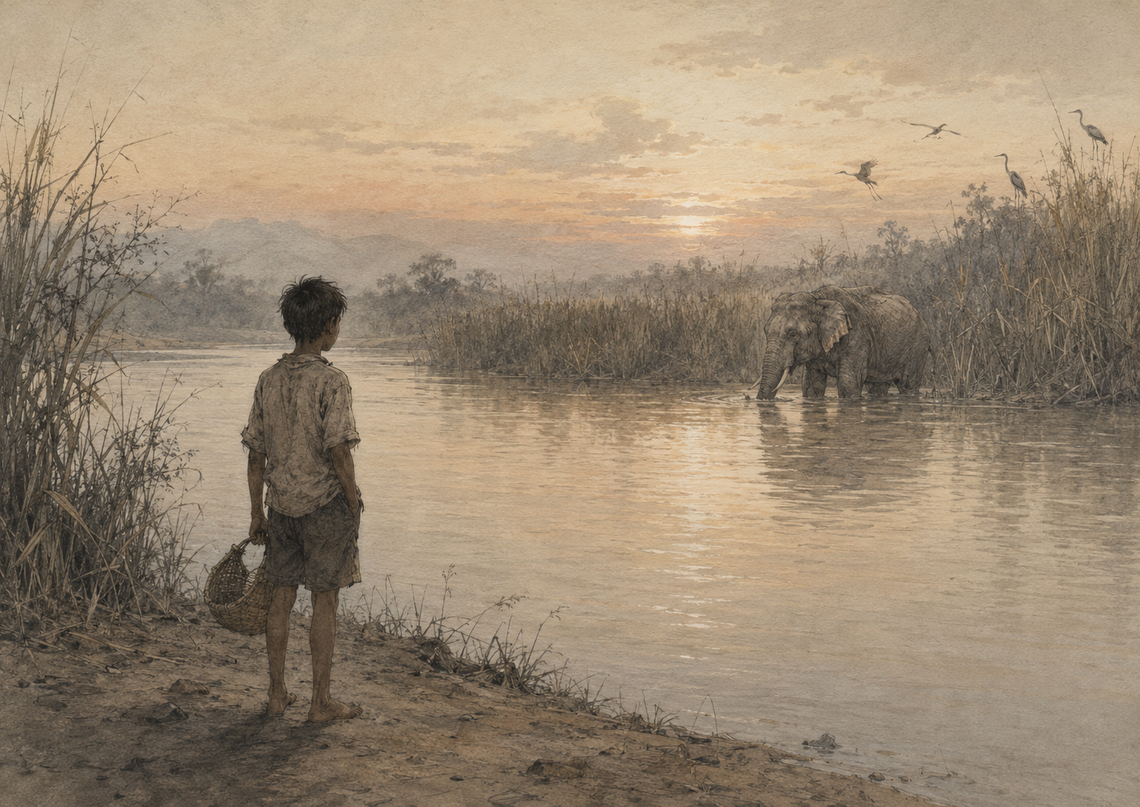
At the river he stopped where he always stopped, three paces back from the water's edge — a habit his grandfather had given him without lecture, by the simple practice of stopping there himself, every morning, every dusk, for the years of Tomas's childhood. The water was the colour of weak tea over silt. There was no wind. The reeds on the far side stood as if drawn with a single pencil. Two herons stood among them, and a third, farther out, with its neck folded in the shape of a question Tomas had not yet learned to ask.
He waited.
He did not know that he was waiting. He had intended, he believed, to gather and return. But his feet had stopped, and he had not gathered, and the basket hung at his hip with the looseness of a tool that has been forgotten by its user.
The herons did not move. The water moved without seeming to. The light came up by inches.
Then, on the far bank, behind the reeds, the world changed register.
He did not see her at first. He felt her. It was a sensation in the chest that he would later, much later, learn to call weight. The herons knew before he did. They lifted, all three at once, slow as smoke, and crossed the river in a low line, and did not return.
The reeds parted, and the matriarch came down to drink.
She came alone. He had never seen one of them alone. Always the herd, always the slow grey architecture of aunts and calves and cousins, always the sound of branches snapping like distant gunfire, always the smell — that particular smell he could not have described to anyone who had not stood downwind of it, the smell of warm leather and grass and old water. This morning the herd was not there. There was only her. She was old. She was older than old; she was the kind of old in which old has stopped accumulating and become a kind of stillness. Her head was very large and very low. Her ears were torn at the edges in a pattern Tomas, without thinking, recognised — he had seen them before, and his grandfather had said, only once, That one is not for naming. Tomas had not named her. He had not, until that morning, even thought of her as a her. She had been, in his mind, simply the elephant whose ears he had seen.
Now she walked into the water, and the water rose around her ankles and then her knees, and she lowered her trunk and drank, and the river, drinking, made the small private sound that the river made when something larger than the river drank from it, a sound Tomas had heard a thousand times and never, until that morning, recognised as a sound the river made specifically to be heard.
She did not look at him.
He understood, with a clarity that frightened him, that she was not looking at him yet. The not-looking had a weight. He stood three paces back from his bank and his bank was sixty paces from her bank, and across that distance the not-looking made a kind of pressure on the front of his skull, and he found that he had stopped breathing through his mouth and had begun to breathe through his nose, very slowly, the way one breathes when one does not wish to disturb a sleeping animal in one's own bed.
She drank for a long time. The light continued to come up. A small fish broke the water near her, and she did not register it, and the ripple spread until it died against the reeds. The third heron, the one that had been folded into a question, came back, but did not land. It crossed twice and went away. Somewhere upriver, very far, a fish-eagle gave the cry that fish-eagles give, which is not a cry of hunting but a cry of weather.
Then she lifted her head, and she looked at him.
He had been looked at by adults. He had been looked at by his mother in the particular way she looked at him when she was tired and trying not to be tired with him; he had been looked at by his grandfather in the particular way his grandfather looked at him, which was the look of a man checking, each morning, whether the boy was still there. He had been looked at, twice in his life, by the police at a checkpoint, in a way that had taught him that some looks pass through a body as if the body were a window.
This was not any of those.
This look did not pass through him. It found him, the way a hand finds, in the dark, the object it had been reaching for. It rested on him. It did not weigh him. The weighing, he understood somehow, was not now. It only rested. It lasted, by the measure of the herons, four wingbeats, and by the measure of his own breath, none — he had stopped breathing entirely, and was not aware that he had stopped — and by the measure of something else inside him, something he did not yet have a word for, it lasted longer than his life so far, and his life so far was rearranged in it the way the contents of a drawer are rearranged by an unhurried hand.
He saw, behind her eye, things he should not have been able to see.
He saw a riverbed in dry season, cracked into plates the colour of bone, and the cracks were in the shape of two loops bound at a centre, and the cracks were full of small bones, very small, the bones of catfish and frogs, and the bones were arranged not by chance. He saw a man, not his grandfather, at a fire, in a country he did not recognise, and the man was crying without sound, and his hand was on a tusk that was not yet a tusk but was still part of an animal, and the animal was breathing. He saw his own mother, much younger, at a window in a city he had never been to, and her face was the face of a person who had just been told a thing she did not yet believe. He saw all of this and none of it; he saw it the way one sees, in a dream, a room one has never entered and yet knows the layout of, every door.
Then she lowered her head, and the look ended, and Tomas was a boy at a riverbank with an empty basket, and his ears were ringing in a high, clean way, and he had wet himself, slightly, without noticing, and the herons were gone, and the matriarch was walking back through the reeds, and the reeds were closing behind her with the particular sound reeds make when they close behind something larger than themselves.
He stood three paces back from the water for a long time after she was gone. The sun rose entirely. The light became the light of an ordinary day — the brown-gold light of the delta lands at full morning, in which everything looked exactly as it had looked the morning before. A small lizard came out from under a stone and looked at him with the indifferent attention of a lizard, and went away. A truck started, faintly, at the field-station behind him. He could hear his mother's voice, faintly, calling something to Nyambe about a generator. The world was as it had been.
He did not gather the grass. He did not count the steps back.
He walked along the bent path, and his legs were not entirely his own; they did the work of walking with the willingness of legs that have been given a task to do while their owner attends to something else. His chest felt cold in a place between the ribs that he had not previously known was a place. He found, when he reached the field-station, that he could not look at his mother. He gave her the empty basket and said, in a voice that surprised him by sounding like his ordinary voice, I forgot. She said, without looking up from her notebook, Tomas, sweetheart, that's the second time this week. He nodded. He went into the house. He sat on the edge of his bed.
He did not cry. He waited for crying, the way one waits, after a fall, for the pain to arrive — but the pain that arrived was not pain, and was not for crying. It was a kind of attention. It was as if some part of him that had been asleep his whole life had opened one eye, and was now looking, from behind his face, at the same room he was looking at, and finding it strange.
He sat that way for a long time. He heard his grandfather, in the next room, cough once and turn a page. He heard his mother, outside, laugh at something Nyambe had said; the laugh was the laugh she used at work, which was not the laugh she used at home. He heard a fly. He heard the river, which was not audible from the house and yet, that morning, was.
After a while, when the sun was high enough to come through the slats of the shutters, he got up, and he went to his grandfather's room, and he stood in the doorway. His grandfather was reading. Tomas could see his grandfather's left hand, holding the book open at the spine — the small steady tremor that had been there for two years now, that Tomas had never mentioned to anyone, including the hand's owner. Grandfather, Tomas said.
His grandfather turned a page.
Grandfather, I saw — He stopped. He did not know how to finish the sentence. He did not know what he had seen. He only knew that he had seen.
His grandfather closed the book, slowly, with a finger between two pages, and looked at him. His grandfather's eyes were the colour of the river in dry season. He did not ask Tomas what he had seen. He looked at him, only, for a long moment, and Tomas understood that his grandfather was looking at him in the particular way he looked at him every morning, the look of a man checking whether the boy was still there, but that this morning the look had a different weight, the weight of a man who had checked, and found that the boy was, for the first time, not entirely there, that some part of the boy was elsewhere, was, perhaps, on the far bank of the river, was, perhaps, in a country the man himself had walked in long ago and had not spoken of in fifty years.
His grandfather opened his book again. He did not say anything. He turned the page.
Grandfather, Tomas said again, and this time his voice was small.
His grandfather, without looking up, said, Eat something, Tomas. There is bread.
Tomas ate bread. He ate it standing in the kitchen, looking out of the window at the path he had walked that morning. The path looked exactly as it had looked the morning before. The dust was warmer now. A small wind had come up. Somewhere out beyond the marula stand, the herd would be moving — he could not see them, but he knew it, the way one knows that a clock in another room is still keeping time.
He thought, for no reason he could explain, of the wooden bird his father had carved for him when he was three or four — the bird he had lost when he was six, that he had been looking for, on and off, for five years, the way one looks for a thing one does not believe one will find. He had not thought of the bird in months. It was strange he should think of it now.
The bread tasted of bread, and of something else — a faint, almost-mineral something, that he had never noticed in bread before, and would, from that day forward, never not notice again.
Outside, a fish-eagle cried, very far away. Inside, in the next room, his grandfather turned another page.