ARDMT Field Notes
Ayahuasca vs Meditation: Two Routes to Ego Dissolution?
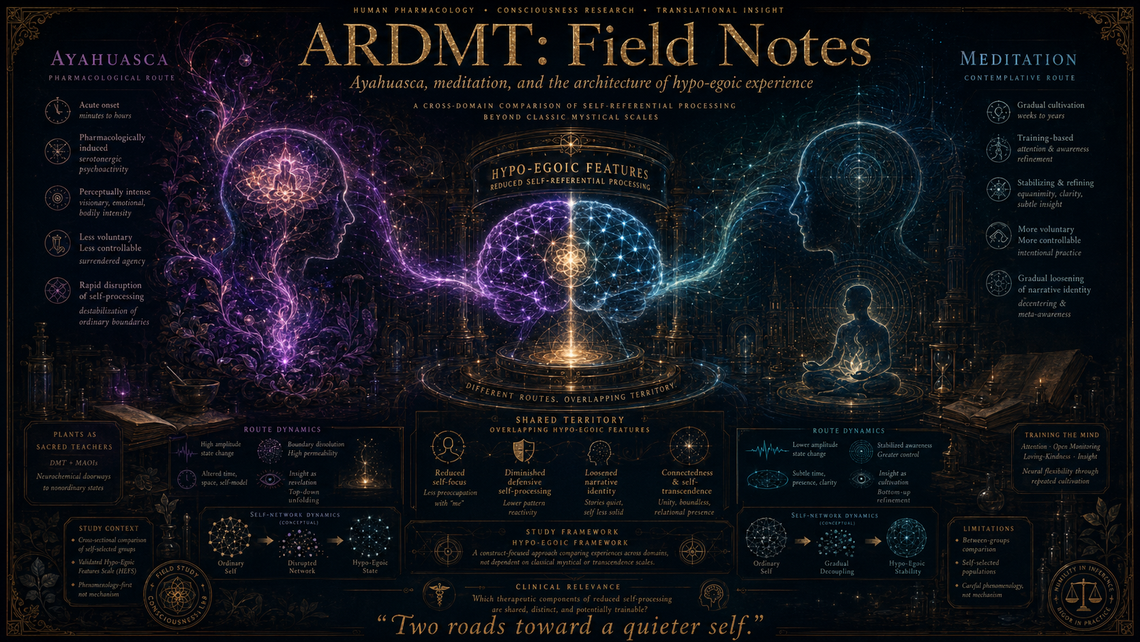
One of the more persistent questions in consciousness research — and one that psychedelic science keeps bumping into without quite resolving — is whether the dissolution of ordinary self-referential processing achieved through pharmacological means is genuinely the same phenomenon as that achieved through contemplative practice, or merely a phenomenological lookalike. The word "ego dissolution" gets deployed with cheerful imprecision across both domains, covering everything from the fleeting loss of body-boundary on a high dose of psilocybin to the hard-won equanimity of a twenty-year Vipassana practitioner. A comparative study in Human Psychopharmacology from Arqueros, Soler, Cebolla, Garcia-Campayo, Domínguez-Clavé, and Pascual (PMID 42083787; doi: 10.1002/hup.70046) attempts to bring some empirical discipline to this comparison, and the framing is rather good even where the answers remain tentative.
What was done
The study examines what the authors call "hypo-egoic features" — a construct drawn from the social-psychological work of Mark Leary and colleagues, referring to states characterised by diminished self-focused attention, reduced defensive self-processing, and a loosening of the grip that narrative identity exerts on moment-to-moment experience. The term is more specific than "ego dissolution" and arguably more useful, since it avoids the implicit claim that the self has been annihilated and instead describes a graded reduction in egoic functioning. The authors compare these features as they manifest in experienced ayahuasca users against those found in long-term meditation practitioners, with the psychedelic session and the meditation session as their respective eliciting contexts. The design is a between-groups comparison rather than a crossover, which limits causal inference but is pragmatically sensible given the populations involved. The paper is indexed for MEDLINE as of early May 2026, received in December 2025 and accepted April 2026, so it has been through the usual editorial gauntlet — though full-text detail on sample size, specific scales, and session parameters will matter considerably for evaluating the findings.
Why the framing matters
The central value of this study lies less in any single result than in the operationalisation of hypo-egoic experience as a measurable, multi-dimensional construct applicable across both pharmacological and contemplative contexts. Most prior comparative work has relied on the Mystical Experience Questionnaire or the Ego Dissolution Inventory — instruments developed primarily within the psychedelic paradigm and then awkwardly retrofit onto meditation. By grounding the comparison in Leary's hypo-egoic framework, which was not designed with either psychedelics or meditation specifically in mind, the authors sidestep some of the circularity that has plagued the field. The question becomes not "do both groups report mystical experiences?" but rather "do both groups show the same pattern of reduced self-referential processing, and if so, through which dimensions?"
What the comparison might reveal
If ayahuasca and meditation produce overlapping but distinguishable profiles of hypo-egoic experience, that would be a genuinely informative result. It would suggest that the pharmacological route — flooding serotonin 2A receptors and disrupting default mode network coherence — and the contemplative route — gradually training attentional disengagement from self-referential thought — converge on a similar phenomenological neighbourhood but arrive via different streets, and perhaps park in slightly different spots. One might expect, for instance, that ayahuasca sessions produce more acute perceptual boundary dissolution and less volitional control over the process, whilst meditation yields a more stable, meta-cognitively accessible form of reduced self-focus. Whether the data bear this out is the key empirical question, and one the abstract alone cannot settle.
Caveats and context
The between-groups design is the obvious limitation. Experienced ayahuasca users and long-term meditators differ in countless ways beyond their chosen practice — personality, motivation, cultural context, expectation — and without random assignment or a within-subject crossover, the study cannot isolate mechanism. It is, in effect, a careful phenomenological comparison of two self-selected populations, which is useful but not decisive. The study sits within the broader Barcelona–Zaragoza axis of Spanish psychedelic research; Soler, Pascual, and Garcia-Campayo have all contributed substantially to previous ayahuasca and mindfulness work. This is a group with form in the area, which lends credibility to the design choices but also means readers should watch for theoretical commitments carried over from earlier publications. One would also want to know how ayahuasca dosing was standardised, and whether the meditation sessions were of comparable duration and intensity — ecological validity and experimental control pull in opposite directions here, as they always do.
The broader relevance is clear enough. As psychedelic-assisted therapy expands, understanding precisely which components of the psychedelic experience are therapeutically active — and whether those components can be achieved, enhanced, or sustained through contemplative training — becomes a practical clinical question, not merely a philosophical one.
Also worth a glance
A study in European Neuropsychopharmacology (PMID 41687467) reports that personality traits, rather than cognitive performance, distinguish chronic ayahuasca and cannabis users from non-users — a finding that complements the centrepiece's phenomenological focus and raises the usual chicken-and-egg question about whether the substance shapes the person or the person selects the substance. Separately, a paper on the serotonergic polypharmacology of 2-halogenated tryptamines (PMID 42079221) will interest readers tracking structure-activity relationships in the tryptamine family, offering receptor-level data on compounds structurally adjacent to DMT itself.
Marginalia
There is something faintly comic about the fact that both the psychedelic community and the meditation community tend to claim ownership of ego dissolution, each regarding the other's version as either a shortcut or a slow detour. The hypo-egoic framework, by refusing to privilege either route, may be the diplomatic construct the field needs. Whether either community will accept the diplomacy is another matter entirely.