Research
5-MeO-DMT Brain Connectivity in Awake Rats: Sex and Dose Effects
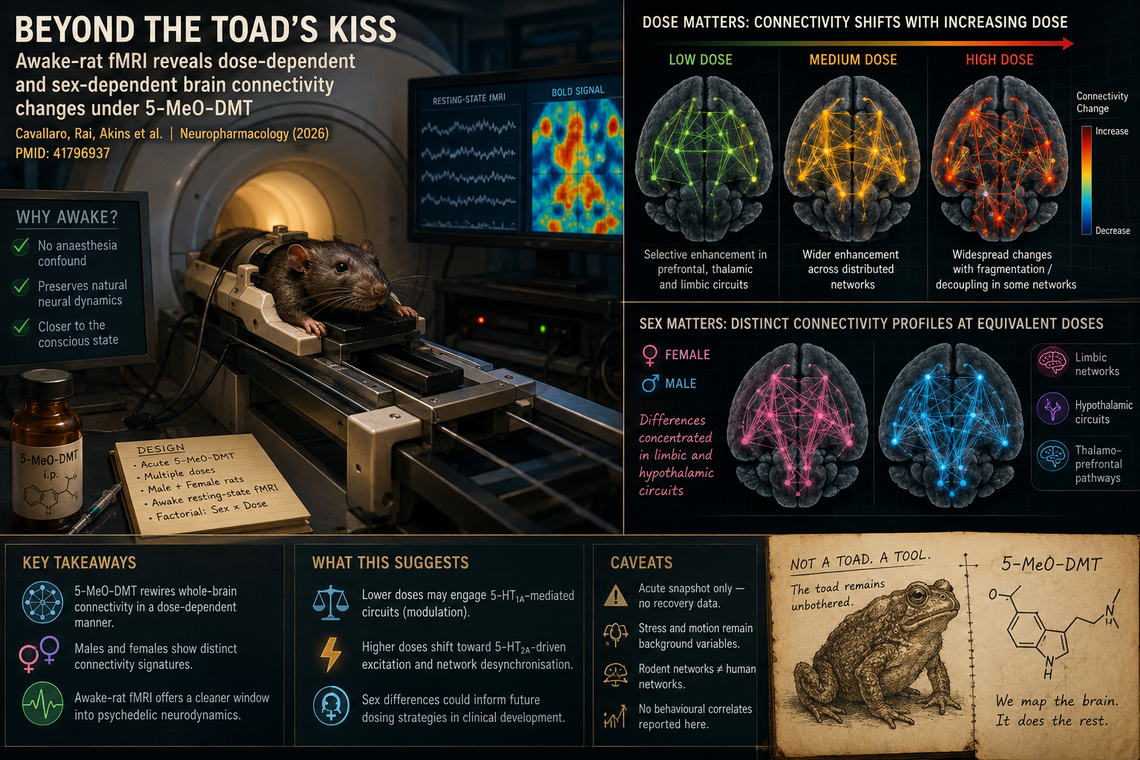
One of the more persistent irritations in preclinical psychedelic neuroimaging has been the anaesthesia problem. You wish to know what a tryptamine does to brain connectivity in a living, conscious animal; yet to keep said animal still inside a scanner, you sedate it — thereby introducing a pharmacological variable that is, to put it gently, rather a large confound when your drug of interest already modulates many of the same circuits. Craig Ferris's group at Northeastern have been refining awake-rat functional MRI for some years now, and their latest contribution, published in Neuropharmacology, applies the technique to 5-MeO-DMT with a thoroughness that merits close attention (PMID 41796937).
What was done
Cavallaro, Rai, Akins and colleagues administered acute 5-MeO-DMT at multiple dose levels to both male and female rats, then acquired resting-state functional connectivity data while the animals were fully awake and restrained — but habituated — in a purpose-built cradle. The design is factorial: sex × dose. This remains uncommon enough in tryptamine neuroscience to be worth remarking upon. By mapping voxelwise functional connectivity across the whole brain at each condition, the group aimed to characterise how 5-MeO-DMT reshapes network architecture in a dose-dependent and sex-dependent manner, free of anaesthesia confounds.
Why the method matters
The awake-imaging paradigm is not new in Ferris's hands, but its application to 5-MeO-DMT appears to be a first. The advantage is straightforward: isoflurane and other commonly used anaesthetics suppress cortical activity, alter thalamocortical gating, and interact with serotonergic signalling in ways that could either mask or mimic psychedelic-induced connectivity changes. Removing that layer means the connectivity maps are, in principle, attributable to the drug rather than to an anaesthesia–drug interaction. The cost, of course, is stress: even well-habituated rats in a restraint cradle are not entirely relaxed, and stress-related catecholamine and corticosteroid effects remain a background variable. Readers will want to scrutinise whatever supplementary detail is provided on motion artefact rejection and physiological noise regression.
Key findings
The two headline results, as signalled by the paper's title, are dose dependence and sex difference. At lower doses, 5-MeO-DMT appears to enhance functional connectivity in a relatively circumscribed set of regions, reportedly involving prefrontal, thalamic and limbic structures. At higher doses, the pattern shifts: connectivity becomes more widespread but also, in some networks, appears to fragment or decouple. This is broadly consonant with what one might expect from a potent 5-HT1A and 5-HT2A agonist, where dose escalation could move the balance from 5-HT1A-mediated inhibitory effects toward 5-HT2A-driven cortical excitation and eventual desynchronisation. But the spatial specificity of the maps matters more than the broad strokes: the group reportedly identifies particular circuits — thalamo-prefrontal, hippocampal-cortical, and elements of a default-mode-like network in the rat — where dose–response curves diverge.
The sex differences are perhaps the more novel contribution. Female rats showed a distinct connectivity profile at equivalent doses, with differences concentrated in limbic and hypothalamic circuits. This is not entirely surprising given known sex differences in serotonin receptor density and oestrogen modulation of 5-HT1A expression — but it appears to be the first demonstration at the level of whole-brain functional connectivity under 5-MeO-DMT. It matters clinically: if the compound eventually reaches the consultation room (and several groups are working toward that), dosing may need to account for sex in ways that current trial designs do not always anticipate.
Context and caveats
It is worth situating this against the N,N-DMT imaging literature, which has largely been conducted in humans or in anaesthetised rodents. 5-MeO-DMT is pharmacologically distinct from N,N-DMT — it has markedly higher 5-HT1A affinity and a different subjective phenomenology in humans (ego dissolution without the elaborate visual architecture). Whether the connectivity maps reported here reflect those pharmacological differences or merely dose and species variation is not fully answerable from a single study, but the data provide a useful comparator scaffold for future work aligning the two compounds.
Limitations are the usual suspects for awake-rodent fMRI: likely modest sample sizes per cell of the factorial design, the inherent difficulty of translating rodent connectivity networks onto human functional anatomy, and the single-timepoint acute design, which tells us nothing about how connectivity recovers or reorganises in the hours and days following exposure. The paper is indexed for MEDLINE and has undergone full peer review at a respected journal, so the methodological scrutiny has at least passed one filter. It is not, however, a human study, and no behavioural correlates of the connectivity changes appear to be reported — a gap that limits interpretive reach.
Also worth a glance
A scoping review in Clinical Pharmacology & Therapeutics catalogues registered clinical trials of ayahuasca and DMT, offering a useful if somewhat dry map of the current pipeline landscape (PMID 42104189). Separately, a preprint on the serotonergic polypharmacology of 2-halogenated tryptamines explores structure–activity relationships at multiple 5-HT receptor subtypes, with implications for understanding the receptor promiscuity that makes DMT and its analogues so pharmacologically interesting and so clinically unpredictable (PMID 42079221).
Marginalia
The paper's title — "Beyond the toad's kiss" — is, one assumes, a nod to the Bufo alvarius (now Incilius alvarius) lore that has attached itself, barnacle-like, to 5-MeO-DMT discourse. It is a small mercy that the authors resist the temptation to lean further into the amphibian metaphor. The toad, for its part, remains unbothered by our connectivity maps.