Research
5-HT1A Blockade Potentiates DMT: Zahid, Strassman et al.
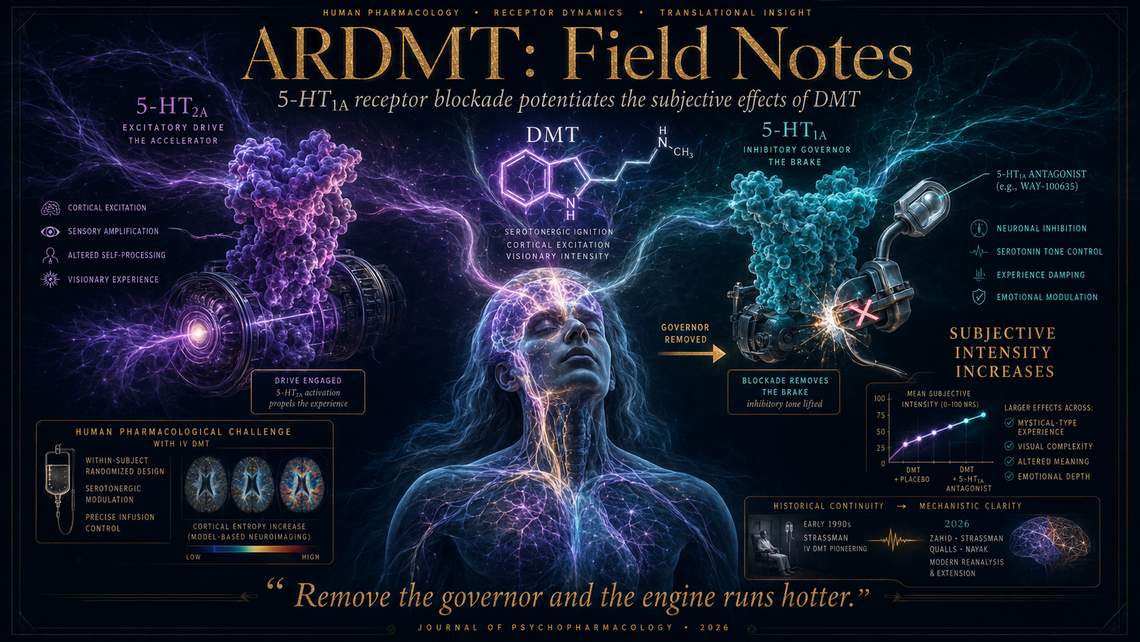
The paper that stops one mid-scroll is Zahid, Strassman, Qualls and Nayak, published in the Journal of Psychopharmacology (2026): "5-HT1A receptor blockade potentiates the subjective effects of DMT" [PMID 42068196]. The author list alone warrants attention — Strassman is, of course, Strassman — but what matters is the question, which has sat unresolved for the better part of three decades: what exactly does the 5-HT1A receptor contribute to the DMT experience?
The conventional framing since the late 1990s has placed the 5-HT2A receptor firmly at centre stage. Vollenweider's ketanserin-blocking experiments with psilocybin, and subsequent work by Preller, Madsen and others, established that antagonism at 5-HT2A substantially abolishes the subjective psychedelic state. DMT, however, has never been a single-receptor compound. It possesses meaningful affinity at 5-HT1A, 5-HT2C, sigma-1, and trace amine-associated receptors, among others. The 5-HT1A site is particularly interesting because it is inhibitory in character — somatodendritic autoreceptors in the raphe nuclei, postsynaptic receptors in hippocampus and cortex — and has long been suspected of dampening or modulating the 5-HT2A-driven psychedelic signal. There was suggestive rodent work (Krebs-Thomson and colleagues, early 2000s) showing that 5-HT1A agonism could attenuate certain 5-HT2A-mediated behavioural responses, but clean human data on this interaction, specifically for DMT, has been lacking.
Zahid and colleagues appear to have addressed this with a pharmacological challenge design in human volunteers, using a selective 5-HT1A antagonist — most likely pindolol, which has been used in this manner before, though the abstract metadata does not specify — administered prior to intravenous DMT. The logic is elegant: if 5-HT1A activation normally restrains or counterbalances the 5-HT2A-driven effects of DMT, then blocking 5-HT1A should release that brake and intensify the experience. And that, evidently, is what they found. The title is unequivocal: blockade potentiates the subjective effects.
This result matters for several reasons. First, it provides direct human evidence that the DMT experience is not simply a 5-HT2A phenomenon with pharmacological noise around it, but rather the product of a dynamic balance between excitatory and inhibitory serotonergic signalling. The 5-HT1A receptor appears to act as a physiological governor, damping the intensity of the 2A-mediated state. Remove the governor and the engine runs hotter. This is consistent with, and extends, earlier theoretical proposals — notably from Carhart-Harris and Nutt's 2017 framework suggesting that 5-HT1A engagement might partly account for the comparatively smoother or more tolerable character of some psychedelic states.
Second, it has direct implications for clinical development. Several companies are pursuing modified tryptamines with altered receptor profiles, and some are deliberately engineering enhanced or reduced 5-HT1A affinity into their compounds. If 5-HT1A activation genuinely moderates intensity, then a DMT analogue with higher 1A affinity might be better tolerated, whilst one stripped of 1A binding could be more potent per milligram but also more psychologically overwhelming. The Zahid result does not settle this — subjective intensity is not identical to therapeutic efficacy, and one can imagine scenarios where the 1A-mediated dampening is actually helpful for maintaining a workable therapeutic window — but it gives pharmacologists a concrete handle on what these receptor ratios mean for the human being on the other end of the syringe.
Third, the involvement of Strassman lends this a certain continuity with the foundational human DMT work from the University of New Mexico in the early 1990s. That programme generated the dose-response and safety data upon which virtually all subsequent DMT research has been scaffolded; it is good to see it extended with modern receptor-selective tools rather than merely cited as historical background.
Caveats are in order. Without the full text, one cannot assess sample size, the specific antagonist used, or the magnitude of the potentiation effect. A four-page paper in J Psychopharmacol may indicate a brief communication or a preliminary dataset rather than a definitive trial. And subjective effects ratings, however well-validated (the HRS, the ASC, the 5D-ASC), remain self-report instruments with all the attendant limitations. Still, the direction of the finding is clear and coherent with preclinical predictions. It is a tidy piece of translational pharmacology.
Also worth a glance
Palner, Kolesnik, Baun, Poetzsch and Cumming report in Neuropharmacology (2026) that DMT is neither synthesised nor stored in rat serotonin terminals, a finding that complicates — though does not quite bury — the perennial hypothesis that endogenous DMT might function as a vesicular co-transmitter alongside serotonin [PMID 41672133]. Madrid-Gambin, Mallaroni, Haro and colleagues present what they term "brain-body integromics" of the ayahuasca experience in Biomedicine & Pharmacotherapy (2026), an ambitious multi-omic integration from the Maastricht group under Ramaekers that attempts to link peripheral metabolomic shifts with central neuroimaging changes during acute dosing [PMID 42030660].
Marginalia
It is quietly remarkable that the 5-HT1A receptor — the first serotonin receptor to be cloned, back in 1987 — still has the capacity to surprise us in the context of psychedelic pharmacology. One sometimes forgets that the receptor map is not the territory; knowing the binding profile of a compound is not the same as understanding what happens when a human brain tries to integrate all those signals at once.