ARDMT Field Notes
2-Halogenated Tryptamines: How One Atom Reshapes DMT Pharmacology
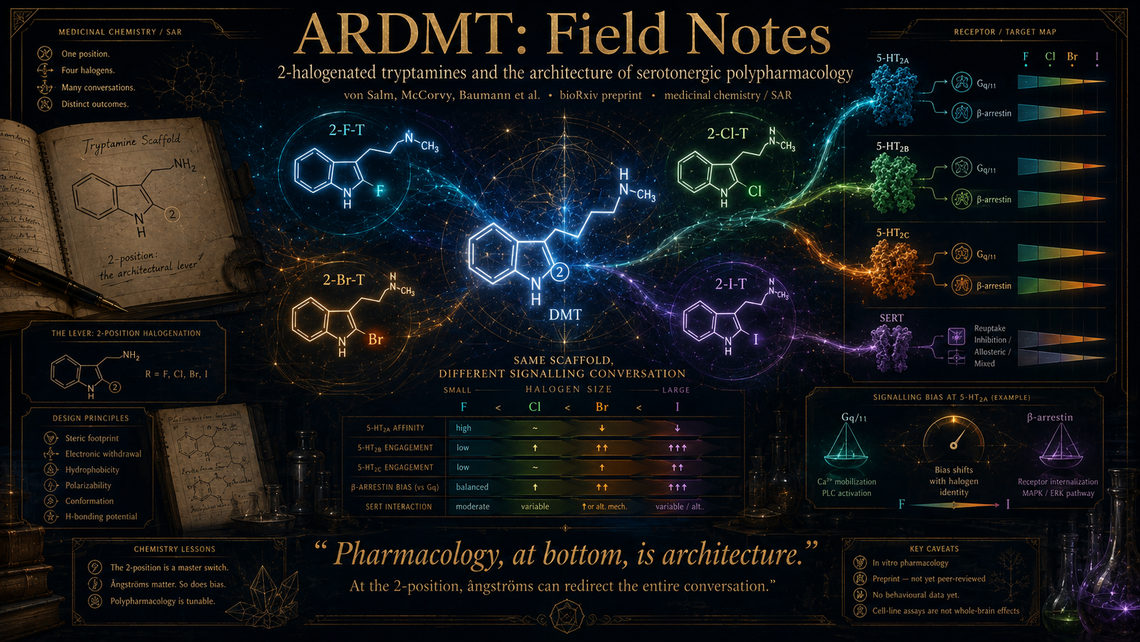
One of the quieter pleasures of medicinal chemistry is watching what happens when you swap a single atom on a familiar molecule and the pharmacology rearranges itself like furniture in a room you thought you knew. A preprint from von Salm, McCorvy, Baumann and colleagues does precisely this with the tryptamine scaffold — the very backbone of DMT — by systematically introducing halogen atoms at the 2-position and measuring what the resulting compounds do across a broad panel of serotonin receptors and transporters. The work, deposited on bioRxiv, has not yet been peer-reviewed, but the dataset appears extensive enough to warrant careful attention.
What was done
The study profiles a series of 2-halogenated tryptamines — compounds in which a fluorine, chlorine, bromine, or iodine atom is placed at the 2-position of the indole ring, which in DMT itself is unsubstituted. This is a position of some structural sensitivity: it sits adjacent to the 3-position where the ethylamine side chain attaches, meaning that even modest steric or electronic perturbations here can ripple outward into how the molecule docks at receptor binding pockets. The team evaluated these analogues using radioligand binding assays, functional assays measuring G-protein and β-arrestin signalling at multiple 5-HT receptor subtypes (including 5-HT2A, 5-HT2B, and 5-HT2C), and monoamine transporter uptake and release assays. The approach is thoroughgoing — not merely asking does it bind? but what does it do when it binds, and through which pathway?
Key findings
The headline result, insofar as one can extract a headline from a structure-activity relationship study, is that halogenation at the 2-position appears to modulate receptor selectivity and functional efficacy across the serotonergic system in ways not trivially predictable from halogen size or electronegativity alone. Smaller halogens — fluorine in particular — seem to preserve or modestly enhance 5-HT2A receptor affinity relative to the parent tryptamine, while larger halogens progressively shift the selectivity profile, in some cases reducing 5-HT2A engagement whilst altering activity at 5-HT2B and 5-HT2C subtypes. The functional data are where things become genuinely interesting: some analogues appear to show altered ratios of G-protein versus β-arrestin recruitment at the same receptor, suggesting that even conservative structural modifications at this position can re-sculpt the downstream signalling landscape.
The transporter data add another dimension. Several 2-halogenated analogues appear to retain activity at the serotonin transporter (SERT), though potency and mechanism — uptake inhibition versus substrate-type release — vary with halogen identity. This matters because DMT itself interacts with SERT, and the interplay between receptor-mediated and transporter-mediated serotonergic effects remains incompletely understood.
What this tells us about DMT
DMT is promiscuous. It does not confine itself to the 5-HT2A receptor, despite the field's occasional rhetorical habit of implying otherwise. It engages 5-HT2C, 5-HT1A, sigma-1 receptors, trace amine-associated receptors, and monoamine transporters. The value of work like this lies in its capacity to dissect that polypharmacology by showing how small perturbations to the shared scaffold redistribute activity across targets. If a fluorine atom at C-2 preserves 5-HT2A binding but shifts the signalling bias, that tells us something about the geometry of the DMT–5-HT2A interaction that a simple binding affinity number cannot. If a bromine atom reroutes the molecule toward 5-HT2C selectivity, one gains a chemical tool for asking what 5-HT2C activation contributes to — or detracts from — the DMT experience independently of 5-HT2A.
The work sits within a broader SAR tradition that includes the well-characterised 4- and 5-substituted tryptamines (psilocin, bufotenine, 5-MeO-DMT), but the 2-position has been comparatively neglected, in part because synthetic access is less straightforward. The preprint therefore fills a genuine gap in the chemical map.
Caveats
The usual ones apply, and they are not trivial. This is in vitro pharmacology. Receptor binding and functional assays in cell lines are necessary but not sufficient to predict what these compounds would do in a living brain, where expression patterns, receptor reserve, desensitisation kinetics, and metabolism all intervene. No behavioural data — head-twitch response, locomotor assays, or anything resembling a psychedelic bioassay — are reported. The preprint has not undergone peer review, and while the methods described appear robust, independent replication and expert scrutiny of the functional assay conditions would strengthen confidence in the selectivity and bias profiles reported. One should hold the specific numbers lightly whilst taking the overall pattern seriously.
It is also worth noting that 2-halogenated tryptamines are not merely academic curiosities; some have appeared in forensic contexts as novel psychoactive substances, lending the work an additional practical dimension.
Also worth a glance
A cross-sectional study in Human Psychopharmacology compares ego-dissolution features between ayahuasca use and long-term meditation practice, finding overlapping but distinguishable hypo-egoic phenomenology — a useful if methodologically constrained data point for mapping the experiential territory DMT occupies (PMID 42083787). Separately, a validated dispersive liquid-liquid microextraction method for detecting DMT and β-carbolines in human hair has been published, offering forensic and longitudinal-exposure researchers a potentially practical analytical tool (PMID 41628561).
Marginalia
There is something faintly humbling about the discovery that an atom roughly the size of hydrogen's slightly heavier cousin, slotted into one position on a molecule with only a dozen or so heavy atoms, can rearrange the entire signalling conversation between that molecule and a receptor. It reminds one that pharmacology, at bottom, is architecture — and that the architect's margin of error is measured in ångströms.