# ARDMT — Analysis + Research on DMT
> Evidence-led psychedelic research, translated. Field Notes, long-form essays on pharmacology, policy, and the cultures that grew these compounds — by Stephen Page.
Public Ghost content for AI and LLM tooling. This file includes a bounded export of public pages first, then recent public posts.
Append `.md` to any post or page URL to get the content in Markdown (for example, `/example-post.md`).
## Pages
### About ARDMT
URL: https://www.ardmt.com/about/
Last updated: 2026-05-29T12:46:11.000Z
#
**ARDMT** — the **Analytical Review of DMT** — is an independent publication devoted to rigorous, interdisciplinary analysis of **DMT research**, **DMT studies**, and the wider questions DMT raises across science, medicine, culture, law, and consciousness studies.
## Find ARDMT
[YouTube](https://www.youtube.com/@ardmtresearch?ref=ardmt.com) [Instagram](https://www.instagram.com/ardmtresearch/?ref=ardmt.com) [X](https://x.com/ARDMTresearch?ref=ardmt.com) [Substack](https://ardmt.substack.com/) [LinkedIn](https://www.linkedin.com/in/stephen-page-41206183/?ref=ardmt.com) [Facebook](https://www.facebook.com/profile.php?id=61589458778765)
It was founded on a simple conviction: that DMT is too important a subject to be handled either sensationally or superficially.
Few compounds sit at so unusual a junction of disciplines. **DMT** is at once a matter for pharmacology, psychiatry, neuroscience, anthropology, religious studies, philosophy of mind, and public policy. Yet discussion of **DMT research** is often degraded by familiar failures of method and tone: romantic inflation, reflex scepticism, cultural illiteracy, second-hand mystique, or an overly narrow clinical vocabulary that strips the subject of its wider human significance. **ARDMT** was established as a corrective to those habits.
Its purpose is to offer writing that is analytically serious, historically informed, and intellectually disciplined, while remaining fully alert to the fact that DMT is not merely a laboratory object, but part of a much larger human story.
I am **Stephen Page**, founder and editor of ARDMT.
My academic background is in law. I hold an **LLB from the University of Sheffield** and am undertaking the **MSc in Psychedelics: Mind, Medicine, and Culture** at the **University of Exeter** on a part-time basis. That trajectory reflects the dual commitments that shape this publication: close analytical method on the one hand, and sustained engagement with the broader human realities surrounding **psychedelic experience** on the other.
Legal training furnished me with habits of reading and argument that are central to ARDMT’s editorial approach: precision in language, careful treatment of evidence, sensitivity to ambiguity, and a constant concern with the difference between what is striking, what is plausible, and what is genuinely well supported. The study of psychedelics extends those concerns into an area where **psychedelic science**, lived experience, cultural inheritance, and emerging medical research frequently overlap — and frequently become confused.
But ARDMT does not arise from academic interest alone.
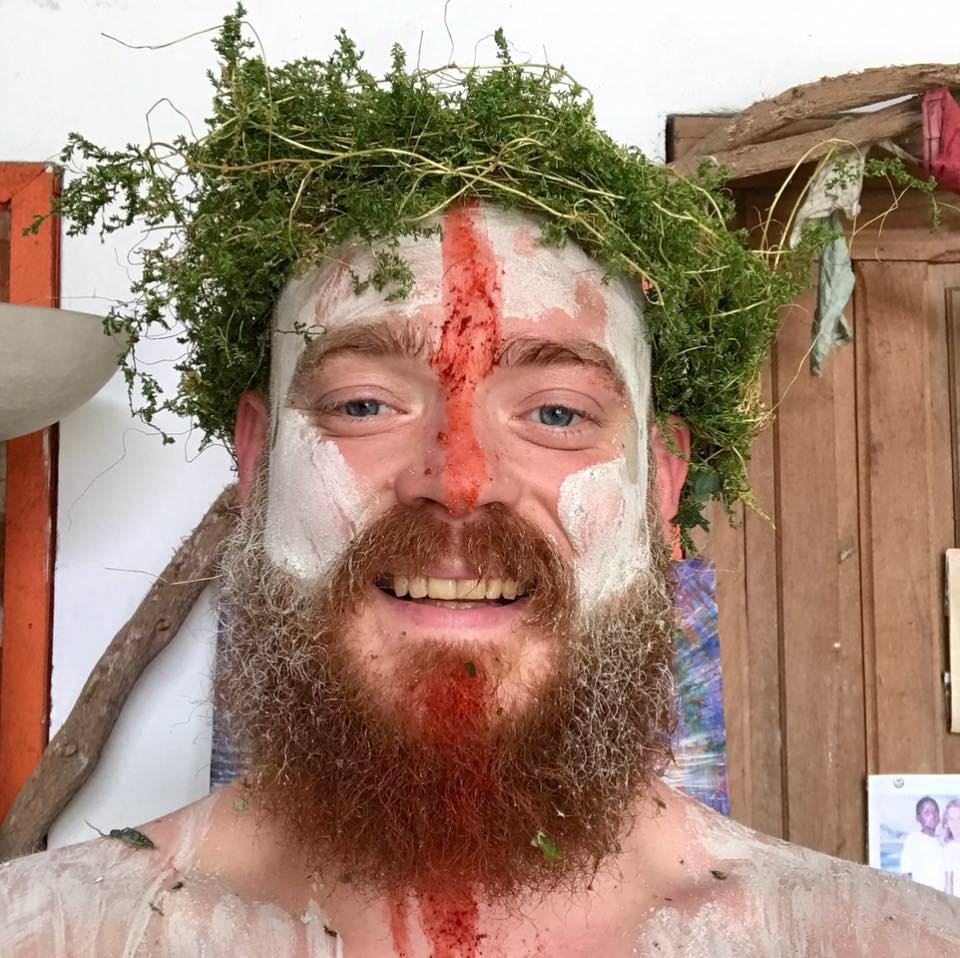
Author painted up 3 times a day for weeks before Bwiti Initiation ceremony.
It is also grounded in substantial lived experience accumulated over many years, most importantly through **deep and sustained engagement in Ecuador and Gabon**. These were not brief encounters, nor the sort of passing contact that is later inflated into authority. They involved **long-term integration with native tribal communities**, direct familiarity with ceremonial and cultural contexts, and a continuing relationship with those worlds that remains part of my life. That background includes not only observation and study, but a significant degree of actual first-hand experience.
This matters for a straightforward reason: no serious account of substances such as **DMT** can be built from **clinical trials** and laboratory findings alone, however valuable those findings may be. Nor can it be built solely from personal narrative, ceremonial reverence, or countercultural enthusiasm. The subject demands a more exacting balance than that. It requires attention to evidence, certainly, but also to context: to history, cosmology, ritual, medicine, language, legality, and the social worlds in which these substances have been understood, feared, regulated, or revered.
The perspective informing ARDMT is therefore neither narrowly clinical nor romantically experiential. It is an attempt to think seriously across those domains without collapsing one into another.
In addition to this core background, my understanding has been shaped by broader first-hand familiarity with related altered-state and plant-medicine contexts in other settings. Those experiences are relevant, but ARDMT is not intended as a vehicle for personal myth-making. Experience is valuable here not because it confers unchallengeable authority, but because it sharpens judgement: it improves one’s sense of what is being trivialised, overstated, mistranslated, commodified, or misunderstood.
That combination — **formal analytical training and long-form lived familiarity** — defines the editorial basis of this publication.
## What ARDMT covers
ARDMT is concerned with DMT in the fullest serious sense. Its coverage includes:
- emerging and completed **DMT clinical trials**
- **DMT pharmacology** and proposed mechanisms of action
- neuroscience and contemporary **consciousness research**
- historical, anthropological, and cross-cultural context
- legal, ethical, and policy developments
- the interpretation and misinterpretation of findings in public discourse
The intention is not merely to aggregate developments, but to interpret them with care.
That requires a disciplined resistance to hype. It requires equal resistance to dismissive reductionism. It requires a willingness to separate strong findings from weak claims, serious ambiguity from pseudo-depth, and genuine intellectual difficulty from fashionable obscurity. It also requires recognising that **DMT research** remains a developing field in which some of the most important questions are still open.
ARDMT is written for readers who want more than headlines, more than borrowed language, and more than the familiar polarities of clinical flattening versus mystical overstatement. It is for those seeking work that is serious without being sterile, informed without being derivative, and open to complexity without surrendering to confusion.
## Editorial position
ARDMT does not pretend to a false neutrality. The subject matters to me, and this publication is animated by that conviction. But conviction is not licence. The standard here is not enthusiasm masquerading as analysis, nor scepticism masquerading as rigour.
Where evidence is strong, that should be said plainly.
Where it is preliminary, mixed, weak, or overstated, that should also be said plainly.
Where a matter belongs to interpretation rather than settled knowledge, that distinction must be preserved.
In a field crowded with projection, simplification, and rhetorical excess, intellectual honesty is not a decorative virtue. It is a basic requirement.
## Why ARDMT exists
DMT is one of the rare subjects that compels serious thought across multiple orders of inquiry at once. It raises questions not only about therapeutic potential or receptor binding, but about **consciousness**, symbolic experience, cultural transmission, and the limits of prevailing explanatory frameworks. It is bound up with some of the most difficult issues in medicine, philosophy, and human self-understanding.
It therefore deserves a standard of writing equal to its importance.
ARDMT was created to meet that standard.
### Library
URL: https://www.ardmt.com/library/
Last updated: 2026-07-25T16:36:39.000Z
If a book is shown below, it has been read and is considered very recommended by the writer of ardmt who also has a copy on his shelf! There is likely to be a video or reel somewhere nearby that shows snippets and gives a general feel for the book.
## A library of books with cover images and affiliate links
The Library
As an Amazon Associate, ARDMT earns from qualifying purchases. Links below are affiliate links.
[  Trip Sitting Julian Vayne Goes deep on role of sitter. View on Amazon → ](https://amzn.to/4pGndru?ref=ardmt.com) [  Philosophy and Psychedelics Peter Sjostedt-Hughes, Christine hauskeller Great series of essays, edited by some of my fave lecturers. View on Amazon → ](https://amzn.to/4vKlQJT?ref=ardmt.com) [  How to Change Your Mind: The New Science of Psychedelics Michael Pollan 'A sweeping and often thrilling chronicle of the history of psychedelics, all interwoven with Pollan's adventures as a psychedelic novice. View on Amazon → ](https://amzn.to/4fSGDpE?ref=ardmt.com) [  Albion Dreaming: A Popular History of LSD in Britain Andy Roberts Andy Roberts' Albion Dreaming tells the extraordinary story of how LSD helped shape British society and culture since its introduction in the early 1950s. View on Amazon → ](https://amzn.to/45rs5Hu?ref=ardmt.com) [  In Search of Smiles: LSD, Operation Julie and Beyond Andy Roberts Smiles shifted millions of doses of LSD before being arrested in 1977 by Operation Julie—the police investigation which unearthed what was then the largest LSD manufacturing and distribution operation of its kind. View on Amazon → ](https://amzn.to/44NYsjy?ref=ardmt.com) [  Saint Peter's Snow Leo Perutz Vintage work that features what seems to be lsd and its synthesis...years before it officially happened! View on Amazon → ](https://amzn.to/4woizRm?ref=ardmt.com) [  Cobweb of Trips: A Literary History of Psychedelics Robert Dickins From spiritual reimaginings and scientific novelty, to political agitation and the counterculture of the 1960s, Cobweb of Trips is a poetic thread emerging when the psychedelic experience alighted in modern history. View on Amazon → ](https://amzn.to/4b7dLHK?ref=ardmt.com) [  Acid Dreams: The Complete Social History of LSD Martin A. Lee Acid Dreams is a complete social history of the psychedelic counter-culture that burst into full view in the Sixties. With new information obtained through the Freedom of Information Act, the authors reveal how the CIA became obsessed with LSD during the Cold War, fearing the Soviets had designs on it as well. View on Amazon → ](https://amzn.to/4pAvNI8?ref=ardmt.com) [  DMT: A molecule that will not stay where it is put Stephen M. page The Author's limited edition hardback.In DMT: A Molecule That Will Not Stay Where It Is Put, Stephen Page traces the extraordinary story of N,N-dimethyltryptamine across archaeology, chemistry, psychiatry, law, and modern brain science. From the puma-bone pipes of Inca Cueva to Cold War laboratories in Budapest; from the collapse of the schizophrenia hypothesis to the clinical renaissance of the twenty-first century; from Amazonian ritual knowledge to fMRI scanners and stroke trials, this book follows the molecule through every frame that has tried to contain it. View on Amazon → ](https://amzn.to/4pAwscA?ref=ardmt.com) [  Immortality Key, The: The Secret History of the Religion with No Name Brian Muraresku, C. A lot of fun, a great read and based in fact, long live the kykeon! A groundbreaking dive into the role psychedelics have played in the origins of Western civilization, and a real-life quest for the Holy Grail. View on Amazon → ](https://amzn.to/3RcETyj?ref=ardmt.com)
## Posts
### What If Consciousness Isn't the Fundamental Thing Either?
URL: https://www.ardmt.com/what-if-consciousness-isnt-the-fundamental-thing-either/
Last updated: 2026-09-19T10:00:57.000Z
##
For a long time the mind–body problem seemed fairly straightforward to me. Not straightforward to solve — straightforward in the sense that the menu looked short. Physicalism says consciousness arises somehow from physical matter, ultimately from brains. Idealism turns the arrow around: consciousness is fundamental, and the physical world we encounter is something closer to a representation within mind. Two options, pointing in opposite directions, and you pick the one that fits what you think you know.
Of the two, idealism always felt considerably more intuitive to me. Part of the reason is undoubtedly psychedelic experience, and that admission immediately creates a problem, because experiencing something doesn't establish that your interpretation of the experience is true.
This is worth stating plainly, because the failure mode here is so common. A DMT entity can seem more independently real than the person sitting next to you. A mystical experience can arrive with a sense of certainty that ordinary life never produces — what William James called the noetic quality, the conviction that one has encountered knowledge rather than merely had a feeling. You can experience the dissolution of the self, meet apparently autonomous intelligences, or become utterly convinced you've glimpsed the structure underlying reality. But that conviction is itself part of what the drug produces. A state that reliably generates certainty is the last state whose certainty you should take at face value. Phenomenological certainty isn't metaphysical evidence.
What interests me is that accepting this hasn't pushed me back towards physicalism. It's made the map considerably stranger.
### Maybe the question is wrong
The familiar version asks how matter produces mind, and on the evidence, matter obviously has something to do with it. We can map neural activity with increasingly ridiculous precision. We can watch anaesthetics extinguish consciousness and restore it. Psychedelics radically reshape experience by altering what's happening in the brain. Damage a small piece of tissue and an entire aspect of someone's experienced world can vanish — not their ability to talk about it, but the thing itself. Brains matter.
None of that touches the strangest question, which is why any physical process should feel like anything from the inside.
This is the point Leibniz made three hundred years ago and nobody has answered since. Imagine the brain expanded to the size of a mill, he said, so you could walk around inside it. You would see parts pushing other parts, and nowhere would you find a perception. The observation hasn't aged. We have replaced his gears with synapses and neurotransmitters and we can now watch them in extraordinary detail, but the structure of the puzzle is untouched: you can describe every mechanical relation in the system and the experience is still not among the things you have described.
The usual response is that consciousness *emerges* from all that activity. But "emergence" names the gap rather than crossing it. In every other case where we use the word, the higher-level property turns out to be a pattern of lower-level behaviour and nothing more. Liquidity just is the disposition to flow, to wet things, to take the shape of a container — explain the molecular behaviour and there is no residue left over. Explain every behaviour associated with pain and there is still, apparently, the fact that it hurts. The analogy holds only if consciousness is a behavioural property like liquidity, which is precisely the thing in dispute.
So I'd rather sit with a different possibility. Perhaps matter doesn't produce consciousness. But perhaps consciousness doesn't produce matter either. Perhaps both are manifestations of something more fundamental than either.
### The question mark underneath reality
This is roughly the territory of neutral monism, a position associated with Russell and with James before him. Rather than starting from two fundamentally different substances and then struggling to explain how they touch, it proposes that both arise from an underlying reality which is intrinsically neither — at least not in the sense we normally mean by those words.
Set out schematically, the three positions look like this:
> **Physicalism:** Matter → Consciousness
>
> **Idealism:** Consciousness → Matter
>
> **Neutral monism:** ? → Matter, ? → Consciousness
Russell's route into this is worth following, because it isn't mystical in the slightest. Physics, he pointed out, tells us only about the *structure* of the physical world: what it does, how it relates, what it's disposed to do under given conditions. It says nothing whatsoever about what matter intrinsically is. That isn't a gap in current physics that better instruments will fill. It's what a physical theory is: a formalism of relations. And we happen to be acquainted with exactly one piece of reality from the inside rather than relationally, which is our own experience. Whatever occupies that question mark, in other words, isn't an exotic addition to the world. It's the one thing the scientific description was never designed to reach.
The mind–body problem then looks different. We may be trying to explain the relation between two things that aren't separate at the level where the explanation would live.
That still leaves the question mark, and there's a further possibility lurking behind it: that creatures like us may not be equipped to conceptualise whatever belongs there.
This isn't a retreat into mysticism — it's an argument about cognitive limits, and something like it has been made carefully by Colin McGinn. Human cognition evolved in a specific environment, handling objects of a particular size, at particular speeds, over trivial stretches of cosmic time. There's no obvious reason evolution should have furnished a primate with an intuitive grasp of the fundamental architecture of reality, any more than it furnished us with an intuitive grasp of quantum mechanics, which we manage only by abandoning intuition for mathematics. Every other animal has concepts it cannot form. It would be a remarkable coincidence if we happened to be the one species whose conceptual repertoire exhausted what there is.
Asking us to comprehend it may be like asking a dog to understand constitutional law. The dog isn't stupid. Constitutional law simply isn't part of the cognitive world evolution prepared it to inhabit.
### And then there are the entities
This is where psychedelics make the philosophical problem genuinely interesting, and it's worth setting aside the obvious question to get at a better one.
Forget, for a moment, whether psychedelic entities are "real". That's precisely what we cannot settle from the experience itself. Ask something else instead: what kind of universe would have to be the case for them to be real?
Aliens, by comparison, are easy. A craft could land tomorrow carrying six-legged creatures from another solar system and physicalism would barely register the event. They're organisms. They evolved somewhere. Their nervous systems produce consciousness by whatever means ours do. An extraordinary discovery, and almost entirely mundane metaphysics.
What people report in profound psychedelic states is conceptually different. The apparent intelligences aren't typically experienced as organisms living elsewhere in our universe. "Elsewhere" often feels like the wrong category altogether. No planet, no craft, frequently no body, and sometimes not even individuality in anything resembling the human sense.
That's a much stranger proposition than extraterrestrial life: could consciousness exist in forms that aren't instantiated as biological organisms within the physical reality available to us?
I don't know. More to the point, having experienced something that felt exactly like that doesn't mean I know. But I've come to want a philosophy of consciousness that at least leaves the question open rather than ruling it out by definition before the evidence is in.
### Two questions people tend to muddle
There's a thought experiment that separates them cleanly.
Suppose we discovered conclusively tomorrow that extraterrestrial life doesn't exist — that Earth is the only planet in the observable universe on which biological consciousness ever developed. Would it follow that humans are the only conscious beings there are?
Under physicalism, something close to that conclusion does follow. Consciousness requires the right kind of physical system; no other such systems exist; the matter is closed. But under idealism, neutral monism, cosmopsychism or the more transcendent accounts, it doesn't follow at all. There could be no aliens whatsoever while reality nonetheless contains forms of consciousness entirely unlike ours. And the reverse holds just as well: the universe could be crawling with extraterrestrial civilisations while every psychedelic entity anyone has ever met is generated wholly by human brains.
They're independent questions, with independent answers, and I'd previously run them together.
### The useful lesson may be the uncertainty
Five days ago, asked which metaphysical position was closest to mine, I wrote that idealism seemed nearest — that I tended towards consciousness being fundamental rather than produced by matter.
Someone replied by asking whether experiencing something proves that it exists.
It doesn't. And annoyingly, it's a very good question, because after several more days of thinking about it I'm no longer confident about the first sentence I wrote. Consciousness might well be fundamental. But there might equally be something underneath both consciousness and matter, something for which our distinction between "mental" and "physical" is itself the wrong instrument — two categories available to creatures standing on this side of it, being asked to do work they were never shaped for.
Psychedelic experience hasn't given me an answer to the mind–body problem. Studying the philosophy properly is doing something more useful than that. It's making the question much bigger, and making me suspect that the difficulty isn't only that we lack the answer, but that we may not yet be asking in a form that could have one.
### Everything I'm About to Tell You Is True.
URL: https://www.ardmt.com/everything-im-about-to-tell-you-is-true/
Last updated: 2026-09-13T10:01:05.000Z
#
### The standard history of psychedelics is accurate, complete-sounding, and quietly doing work. Week one of the Exeter MSc, worked through as an argument rather than a syllabus.
---
Andy Letcher opens his lecture on the history of psychedelics with a sentence that should be printed on the inside cover of every book in the field. Everything he is about to tell you, he says, is true and happened. And then he spends the rest of the lecture taking it apart.
That is the whole week in miniature. Nobody disputes that Albert Hofmann synthesised LSD, that Huxley took mescaline in a Hollywood bungalow, that Wasson sat up all night in Huautla. The facts are not in question. What is in question is the shape they have been arranged into, who is standing in the frame when the shutter goes, and what the arrangement licenses people to do now.
This piece covers the first week of *Psychedelics: Therapeutic Practice and the Metaphysics of Mind* — two set readings, three lectures, one hour with a psychiatrist who was in the room in the 1950s, and a set of student exercises that turn out to be sharper than they look. It is written to be read straight through, and to be raided later.
---
## The papers, in one breath each
**Letcher (2008), *Mad Thoughts on Mushrooms*.** A Foucauldian discourse analysis of the answers people give to the question *what happens to consciousness on psilocybin?* Seven answers, sorted into three dominant discourses built from observing effects on other people (pathological, psychological, prohibition) and four resistive ones built by people trying to describe their own experience (recreational, psychedelic, entheogenic, animistic). Only the last one breaks a real societal boundary: to say the mushroom spirits are real, rather than symbolic or psychological, is to risk being classed as mad. Letcher thinks that is a bad reason to stop studying something.
**Shortall (2014), *Psychedelic Drugs and the Problem of Experience*.** How psychedelics travelled from wonder drug to pariah, told through the category that made the journey possible. Because the effects varied so wildly with person and setting, mid-century researchers opened a conceptual space between the chemistry and the outcome and called it *the experience*. That space is elastic enough to hold contradictions: the same drug as model psychosis and as cure for psychosis, as medical instrument and as countercultural sacrament. Derrida's *pharmakon* and *supplement* do the analytical work. The sting is in the last section, where the same critique gets turned on historians who made "experience" a foundational term after 1963.
**Ens (2021), *Silencing Indigenous Pasts*.** A white historian audits her own footnotes. Critical Indigenous theory — Trouillot on silencing, Tuhiwai Smith on reframing, Tuck and Yang on settler moves to innocence, Denzin and Lincoln on accountability and the myth of neutrality — applied to the subfield of psychedelic history, whose primary sources were mostly written by people who never expected to be accountable to the communities they described. Key discipline: what counts is the impact of the work, not the intention behind it.
**Mangini (2021), *Unseen Women in Psychedelic History*.** Six women whose contributions were recorded badly or not at all: Susi Ramstein, Valentina Wasson, Mary Barnard, Kay Parley, Gertrude Paltin, Mabel Luhan. Mangini's framing device is explicitly discursive — professional language and credentialing shape who is recognisable as a member of an elite group, and psychedelic studies has historically drawn that group from one class, one gender, one race.
Two of these are set reading. Two are on the extended list. The extras are where the essays are.
Two more arrived while the week was being worked through, both of them 2026, both of them doing exactly what the week trains you to do, to the field's own current vocabulary.
**Ostrand, Nour, Timmermann, Rosati, Luan, Gomez-Emilsson, Bornemann, Greenway, Roseman and Carhart-Harris (2026), "Defining 'psychedelic'", *Journal of Psychopharmacology*, online 17 August.** Goes back to Osmond's etymology and takes it literally. *Psychedelic* names a state in which normally latent mental content becomes manifest; Osmond's further intention was that the adjective should also name a category of drug whose *principal* action is to induce that state. So the paper argues the definition should be phenomenology-first rather than a receptor headcount, and then tests it: more than two hundred people who had taken all three of psilocybin, ketamine and MDMA rated a Delphi-derived set of subjective items. Factor analysis gave three or four independent dimensions, and a classifier could recover which drug someone was describing from the effect profile alone — visions and psychological insight for psilocybin, dissociation for ketamine, pro-social feeling and love for MDMA. Their conclusion is that psilocybin is the exemplar case, and that the psychedelic state is characterised by visions and insight. Worth noting Leor Roseman is a co-author and is at Exeter, which makes this one of the interviewers from the Grof video arguing for the phenomenological definition in print.
**Saville-Smith and Mosurinjohn (2026), "The mystic trip: how psychedelic research fell for mysticism", *Psychopharmacology*, online 17 July.** An archaeology and a genealogy, in that order and under those names. The archaeology re-reads the foundational texts, principally Walter Stace's philosophy of mysticism and Walter Pahnke's Good Friday work, and finds the assumptions underneath them flawed and, for sixty years, largely unexamined. The genealogy traces how a historically peculiar religious construct got attached to psychedelics and then normalised in second-generation research until it read as a plain empirical property of the experience. Their practical proposal: rebrand the Mystical Experience Questionnaire as the Psychedelic Experience Questionnaire, which they note sits comfortably with Pahnke's own later turn toward "psychedelic experience" as the operative category. It is published in the same journal that ran Griffiths and colleagues in 2006, the paper that carried mysticism into the revival.
---
## What the lecturers are actually up to
The stated learning outcomes are modest: identify key figures and events; critique the standard history; describe the origins of the term *psychedelic* and how its meaning shifted.
The actual function of the week is different. It is an epistemology and methods week wearing a history costume. Its job is to destabilise "the psychedelic experience" as a stable object of study before anything else in the module gets going. By Friday you are supposed to have lost confidence in three things at once: the neutrality of the historical narrative, the neutrality of the word, and the neutrality of the category of experience itself. Everything that follows in the programme — therapy, metaphysics, measurement — lands differently once those have gone.
The tell is in the starter activity, which is a poll asking what comes to mind when you hear the word *drug*. The word cloud that comes back from the cohort is, without anyone intending it, a finished discourse analysis:
> **addiction · medicine · medication · recreation · illegal · pharmaceutical · illicit · disease · illness · industry · pain · exciting · healing · epiphany · friday night · sacred · war on drugs · prohibition · abuse · hedonism · consciousness**
Every one of Letcher's categories is in there. The prohibition binary sits in the middle in the largest type: *pharmaceutical / medication / medicine* on one side, *illegal / illicit / abuse* on the other, two antithetical bins that between them obscure every pharmacological, toxicological and phenomenological difference within each bin. The resistive vocabulary is in the smaller type round the edges: *epiphany*, *sacred*, *friday night*, *fun*. The pathological discourse is there as *disease* and *illness*. The students perform the thing before it is named for them. That is good teaching, and it is worth noticing that it worked on us.
Letcher's second move is to hand over a three-question audit tool and then, at the end of the lecture, turn it on the class:
1. Read widely. Never take one historian's version.
2. Ask who is included and who is excluded, and why.
3. Ask from what position the author writes. Are they privileging scientific research, countercultural values, hedonism, aesthetic pleasure?
And then: from what position do *you* stand, and what assumptions are you making? That question is not rhetorical decoration. It is the same reflexive requirement that both set readings model — Letcher declaring himself a scholar of religion, a former evolutionary biologist and a fifteen-year practitioner of myco-spirituality; Ens declaring herself a white historian who footnoted Indigenous people and intends to stop. The week models positionality twice, from opposite directions, and then asks you to do it.
---
## Part I — The standard history, stated fairly
Before knocking it down, it is worth having the thing itself, because ILO 1 is just this: know the furniture.
The curated timeline for the module runs roughly as follows. Deep background: a Chavín stone relief from around 1200 BC showing a figure holding what looks like San Pedro cactus. 1529, Bernardino de Sahagún describing Aztec use of inebriating mushrooms in the wake of Cortés. 1799, the first recorded accidental psilocybin ingestion in Britain. 1821, Thomas de Quincey's *Confessions of an English Opium-Eater*. Late nineteenth century, peyote reaching European laboratories. 1912, Mabel Dodge Luhan's peyote evening in Greenwich Village. 1918, the Native American Church incorporated in response to attempts to outlaw peyote. 1919, Ernst Späth synthesises mescaline. 1924, Louis Lewin's *Phantastica* offers the first scientific classification of narcotic and stimulating drugs. 1926, William Ford names *mycetismus cerebralis* and fixes mushroom intoxication into the medical textbooks. 1930, Raimundo Irineu Serra founds Santo Daime. 1931, DMT first synthesised by the Canadian chemist Richard Manske. 1938–43, Hofmann at Sandoz, and the bicycle. 1949, LSD arrives in American laboratories. 1953, MK-ULTRA. 1954, *The Doors of Perception*. 1955, Gordon Wasson in Huautla de Jiménez with María Sabina. 1956, Humphry Osmond proposes *psychedelic*. 1957, the *Life* magazine article, and Valentina Wasson's account in *This Week*. Late 1950s, LSD at the height of its medical legitimacy. 1963, Leary and Alpert dismissed from Harvard. 1966, moral panic. 1970, the US Controlled Substances Act. 1971, Nixon's war on drugs, and LSD to Schedule 1 at the UN. Then a long quiet, broken by Strassman's DMT work around 1990, the Santo Daime and ayahuasca church cases, Imperial's Centre for Psychedelic Research in 2019, Pollan's book in 2018 making the whole thing respectable at dinner parties, thirteen thousand delegates at Psychedelic Science in Denver, Prince Harry on mushrooms, and a university in Devon running the world's first postgraduate certificate in the subject.
Cast list, for the same purpose: Hofmann, Osmond, Huxley, Gordon and Valentina Wasson, María Sabina, Sahagún, Lewin, Ford, Späth, Manske, Hoffer, Sidney Cohen, Betty Eisner, Chandler and Hartman, Walter Pahnke, Maslow and Rogers, R. D. Laing, Leary, Alpert, Kesey, Ginsberg, Watts, Carl Ruck and the entheogen committee, the Shulgins, Stan and Paul Grof, McKenna, Pinchbeck, Strassman, Pollan.
It is a good story. It has a martyr, a fall, and a resurrection. That is precisely the problem.
---
## Part II — The people the story loses
### Indigenous peoples
Ens's argument is not that psychedelic historians are hostile to Indigenous people. It is that the field's source base was built by people writing for an audience they assumed shared their view, and that inheriting those sources uncritically reproduces their assumptions with better manners.
Two examples do the work. Huxley, in *The Doors of Perception*, describes Native American Church peyote use at second hand, via the white researcher J. S. Slotkin, and foregrounds visions. But visions are not the point of the sacrament; the experience is communal, and attending closely to your own sensations is missing what is happening. The description is not malicious. It is simply written by someone for whom the interesting part of a drug is what it does to the inside of one head, applied to a practice organised around something else entirely.
Wasson's 1960 address to the Mycological Society is blunter. Indigenous Mexican practice appears as an anthropological curiosity to be observed with amused detachment, safely unchanging, available for future scholars at their leisure. The presentation celebrates Hofmann's chemistry while declining to explore Zapotec, Aztec or Mazatec understandings of the same plants. And it frames Mexican mushroom use as a window onto ancient Greece — which, whatever the intention, casts living people as a surviving specimen of a shared (read: white) human past, and quietly writes them out of the present and the future.
Tuck and Yang's *settler moves to innocence* is the sharpest tool here. Six of them; the one Ens picks out is **asterisking** — Indigenous people appearing in research as a data footnote, or omitted on the assumption that they are a declining population and therefore not worth the attention. In psychedelic history the move is literal: Indigenous use goes in the prologue or the footnote, and the narrative proper begins in Basel in 1943.
> **Concept card — settler moves to innocence.** Manoeuvres by which non-Indigenous scholars relieve their own guilt and preserve settler futurity while leaving colonial structures intact. Tuck and Yang list six: settler nativism, fantasising adoption, colonial equivocation, conscientisation, at-risking/asterisking, and re-occupation. The category exists because "decolonise" had become a verb people used about their reading lists.
> **Concept card — reframing.** From Linda Tuhiwai Smith: deciding an issue's parameters, what sits in the foreground, what sits in the background, what complexities are allowed inside the frame. Framing is not description. It is the prior act that determines what description is possible.
> **Concept card — reflexivity.** Kim England's formulation: self-critical, sympathetic introspection, and deliberate analytical scrutiny of yourself as the researcher. Not confession. A method.
Denzin and Lincoln supply the hardest requirement: that researchers be accountable to the communities they work with, including over what gets accessed and circulated, and that settler-centric notions of neutrality and objectivity be treated as claims rather than defaults. Western historians' assertion of objectivity has generally functioned to code settler knowledge as objective and everything else as subjective Other with less evidential weight. Ens is careful to say that non-Indigenous scholars can write respectful histories, and names Mike Jay's *Mescaline* as one that treats settler and Indigenous use as equally serious objects of inquiry rather than foregrounding one and footnoting the other.
### Women
Mangini opens on a scene: Basel, 2006, the symposium for Hofmann's hundredth birthday, more than eighty invited experts described as the elite of international consciousness research, about ten percent of them women. Three presentations out of forty-seven featured a woman speaking independently of a male supervisor, colleague or partner. The conference celebrated LSD's kinship with the sacred substances of the Americas and with the kykeon of Eleusis, and managed not to evoke the priestesses and curanderas who prepared and dispensed them. The Women's Visionary Council was founded the following year out of the conversations that followed, with a motto from the *Aeneid*: *dux femina facti*. A woman was the leader of the enterprise. The phrase exists in Virgil because it was a surprise.
The people:
**Susi Ramstein** was twenty-one, a laboratory assistant, and the first psychedelic guide — Hofmann asked her to cycle beside him. Two months later she took 100 µg herself, a larger dose than the 60 µg the senior men on the team had taken, becoming the first woman to take LSD and joining the long tradition of researchers testing compounds on themselves. She is absent from the standard retelling of the bicycle ride, which is otherwise reproduced in extraordinary detail.
**Valentina Pavlovna Wasson** was a paediatrician and the principal author of *Mushrooms, Russia and History*: two volumes, ninety-three plates, thirty years, 512 numbered copies, the most elaborate thing Pantheon ever produced. She wrote the preface alone, did most of the research, tracked down and rescued Jean-Henri Fabre's six hundred unpublished mushroom watercolours from a shelf in his studio, and had them reproduced by pochoir. In May 1957 she published her own account of taking mushrooms with her daughter Masha in *This Week*, a Sunday supplement reaching more than fourteen million households — a far larger readership than the famous *Life* piece. Her stated prediction was modest and correct: that these mushrooms would be useful for studying the psyche. The magazine's commentators went further, and also turned out to be right, suggesting future applications in addiction, end-of-life pain and psychiatric illness. She died of cancer the following year.
**Mary Barnard**, translator of Sappho, published "The God in the Flowerpot" in *The American Scholar* in 1963\. Her argument: half a dozen of the great mythological themes — the shaman's journey, the food of immortal life, the food of occult knowledge, the fate of the disembodied soul, communication with the dead, plant-deities — converge on an actual substance, ritually consumed not as a symbol but for the experience it produces. She proposed a discipline for this and called it theo-botany, and predicted that fifty years of it would leave the then-current theories of the origins of religion looking pre-Copernican. She also identified why the evidence is thin: practitioners have reasons not to disclose, and early observers saw either satanism or stage magic depending on their own commitments.
**Kay Parley** worked at Weyburn Mental Hospital in Saskatchewan, where Osmond was running LSD studies, first as a patient and later as a registered psychiatric nurse. Her 1964 article "Supporting the Patient on LSD Day" contains, four decades early, essentially the full contemporary protocol: preparation and rapport-building beforehand, attention to the subject's set and to the physical setting, the sitter's sustained and undivided presence through the session, and review and integration afterwards. She is also a one-woman counterexample to the psychotomimetic model — having experienced manic psychosis, she reported that the perceptual distortions and delusional thinking under LSD were not comparable to it. Her work remains largely unread in the field.
**Gertrude Paltin** was a biochemist and Oscar Janiger's close research associate, co-author of a 1971 bibliography of LSD and mescaline covering everything from the earliest research to the beginning of suppression. Her own daughter did not know the extent of her role until a copy surfaced decades later, containing references most scholars had never seen.
**Mabel Dodge Luhan** is the one who complicates the rescue. She is a genuine pioneer: her 1912 evening in New York is an early and unusually perceptive account, attentive to the group's interpersonal dynamics rather than cataloguing her own sensations; she used the phrase *expansion of consciousness* some forty years before it became idiom. She is also, in Taos, a person who pressed her Taos Pueblo husband to give up peyote, opposed peyote leaders holding positions in the pueblo government, described peyote users as drug addicts, and backed a proposed federal prohibition that anthropologists and peyote users from Oklahoma to Montana successfully opposed. And the New York ceremony itself involved staging a peyote tipi in a Greenwich Village drawing room with a red shawl over a light bulb for a fire and a folded sheet for an altar.
Both things are true. Recovering a woman from the archive does not oblige you to like her, and the recovery is worth less if it requires her to be admirable. Luhan is the case that keeps the chapter honest.
> **Working note — the naming rule.** It is very hard to write about these women without immediately relating them to a man, and Mangini's own paper does it repeatedly. Valentina Wasson is *his wife*, Susi Ramstein is *his assistant*, Kay Parley is mentored by *Osmond*, Gertrude Paltin is *Janiger's associate*. The negated version — "more than just X's wife" — is the same move with better intentions, which is precisely Ens's point about impact over intention. Lead with the work. Let the man appear later, if at all, as a subordinate clause.
### The other drugs
The third exclusion is structural rather than demographic. Letcher points out that the history of psychedelics is told as though psychedelics were a natural kind, cleanly separate from opiates, stimulants, alcohol and everything else. But the trip-literature genre that Huxley writes in was invented by de Quincey, on laudanum: an intellectual making a work of introspection out of an intoxication, and reporting it as a contribution to knowledge. Huxley is walking in his footsteps. The two histories are entangled at the level of form, whatever the pharmacology says.
Hence the week's second reflection question, which is a better essay prompt than it looks: *should psychedelics be studied independently of other drugs, or other forms of intoxication — and what is gained or lost?* Gained: mechanistic precision, a defensible safety profile, distance from the addiction frame, and a workable regulatory argument. Lost: the ability to see that the category was assembled for reasons that were partly political, and that alcohol and caffeine sit outside it for reasons that have nothing to do with pharmacology.
---
## Part III — The opposite failure: the ancient past
Having spent a lecture on what the standard history leaves out, Letcher spends the next one on what it puts in without warrant, which is the same discipline running in the other direction.
The claim under examination: psychedelics were used in European prehistory and antiquity. The exhibits offered are the Newgrange entrance stone with its spirals, dated to about 3200 BCE; opium poppies in Neolithic graves; the Grauballe bog body from around 300 BCE, with traces of ergot in the stomach; and cannabis cultivated in Britain and eastern Europe from the Neolithic onwards.
Each supports multiple readings. Spirals are what hands draw. Poppies in a grave could be grave goods, medicine, food, or a plant that happened to grow nearby. Ergot in a stomach is far more economically explained by contaminated rye than by intentional ingestion. Cannabis was cultivated for rope for most of its history in Europe. The point is not that the sceptical reading is correct. It is that the evidence does not discriminate.
The contrast case is what actual evidence looks like. A ritual pouch from Bolivia, dated to around a thousand years ago, analysed in 2019: a carved snuff tube, a grinder, and chemical residues of DMT, bufotenine, harmine and cocaine. Paraphernalia plus residue plus context. That is categorical. Nothing in the European record comes close.
Two further points, both of which have legs.
First, Letcher's methodological verdict: absence of evidence is not evidence of absence. It remains entirely plausible that prehistoric Europeans used psychedelics; if they did, they left nothing conclusive. The people who assert it categorically and the people who deny it categorically are standing on the same empty ground. He is waiting for the body that comes out of a melting glacier with something in its pouch.
Second, and more useful: humans have devised a great many ways into altered states that do not involve a drug at all. Candomblé in Brazil; charismatic Christianity, trance and glossolalia. So an image of an ecstatic figure is not evidence of pharmacology. This is the point at which the ancient-past lecture and the Grof interview shake hands, and I will come back to it.
The question the module actually wants answered is why anyone is so invested. The honest answer is that an ancient European lineage would convert present-day psychedelic use from a novelty into a recovery. It would make the practice ancestral rather than borrowed, which solves a problem that has been nagging at Western psychedelic culture since Wasson came back from Oaxaca: that every sacramental tradition it draws on belongs to someone else. Read alongside Tuck and Yang, that is **settler nativism** — the move of locating an Indigenous past in your own ancestry in order to claim standing without accountability. Eleusis is an attractive ancestor precisely because nobody is left to object.
That cross-link between the ancient-past lecture and the Ens reading is not made anywhere in the module materials, and it is one of the better essays available here.
---
## Part IV — The name
### Osmond and Huxley, 1956
The naming is a two-man competition conducted in rhyming couplets by post. Huxley offers *phanerothyme*, from the Greek for the manifesting of soul or spirit, in a verse about lifting the ordinary world into the sublime. Osmond counters with *psychedelic*, mind-manifesting, in a verse offering it as the dose for anyone wanting to reach either end of the vertical axis. Osmond wins, and puts the word into print in 1957.
What they were reaching for was a word that could hold both halves at once: the psychological effects and the religious, spiritual, metaphysical, ontological implications. Every term in the field since has failed at one half or the other.
The module asks the counterfactual directly, and it is worth taking seriously rather than treating as whimsy. *Phanerothyme* names the soul. *Psychedelic* names the mind. Had the first won, the object of study would have been something the natural sciences have no purchase on, and the compounds would have been much harder to route into a laboratory. The word *psychedelic* is what made a *Centre for Psychedelic Research* sayable. Mind is a respectable object; soul is not. The term chosen in 1956 determined which department the subject could eventually be housed in.
The third question in that set is the one to keep: if these things are literally mind-manifesting, what do we mean by *mind*? The module hands you a word whose second half quietly presupposes the answer to the hardest question in the second half of the programme.
### The drift
The Google Ngram Letcher shows has *psychedelic* peaking around 1970, declining through the seventies, then climbing steadily from the early eighties back to something near its old level. The word survives; what it means does not.
Three phases:
1. **Clinical (1956–early 60s).** Coined by a psychiatrist for other psychiatrists. Carries medical authority.
2. **Countercultural (mid-60s–70s).** Escapes the laboratory. Becomes a genre of music, a visual style, a fashion, a politics, an attitude to the Vietnam War. Loses the medical veneer entirely and acquires a faintly ridiculous, hedonistic, tie-dyed connotation that it has never fully shed.
3. **Reclaimed (1990s–).** Recaptured via the qualifier: *classical psychedelics*, defined pharmacologically. And with it, a shift in the relationship of power that Letcher flags as the punchline of the whole lecture. In phase one, psychedelics were substances that clinicians took. In phase three, they are substances we administer to other people so that we can observe the effects.
That last sentence is the thesis of the week. The resistive term has been captured by the dominant discourse, and the capture is invisible because the word did not change.
### Discourse analysis, briefly and properly
> **Concept card — discourse.** A particular way of talking about and understanding the world, or some region of it (Phillips and Jørgensen). Foucault's addition: relations of power are constituted *through* these differing representations. Power cannot be established, consolidated or implemented without the production and circulation of discourse.
The two functions Letcher singles out — and this is a directed-reading question, so learn them as a pair:
**1\. Discourses divide people into objectified subjects.** Foucault's *dividing practices*, operating through scientific classification. You walk into a consulting room and a power relation switches on: one of you performs doctor, the other performs patient, your body is subjected to the medical gaze and sorted by its symptoms. Sane and insane. User and abuser. The division comes with a social identity and, usually, a practice of exclusion — social always, sometimes spatial. Prisons. Detention centres. Wards.
**2\. Discourses set boundaries on what can be said and done.** Within a given worldview some actions are natural and others unthinkable. Foucault's version: discursive practice makes it virtually impossible to think outside itself, and to think outside is by definition to be mad, beyond comprehension and therefore beyond reason. Hence the risk in doing discourse analysis at all — Voase's warning that you have to be willing to ask questions that will get you thought a little mad.
The methodological move that follows is the one people find hardest. Since there is no position outside discourse, asking which account is *true* is not the productive question. The productive question is how truth-effects get produced and sustained. That is not relativism and it is not an invitation to believe anything; it is a redirection of attention from the content of claims to the machinery that makes some claims sayable.
### The seven discourses
| Discourse | What it says a psychedelic does | Signature terms | Who has authority | What it cannot allow |
| ------------------------------------------ | ------------------------------------------------------------------------------------------------------------- | -------------------------------------------------------------------------------------------- | -------------------------------------------------- | ------------------------------------------------------------------------------------------ |
| **Pathological** *(dominant)* | Produces disease: poisoning, or temporary/permanent psychosis | intoxicant, hallucinogen, psychotomimetic, schizogen; *mycetismus cerebralis*; *phantastica* | Physicians, psychiatrists | That the content of the experience has any value except as empathy training for clinicians |
| **Psychological** *(dominant)* | Perturbs the nervous system so repressed material surfaces and can be integrated | psychoactive, psychotropic, psychedelic | Therapists; the clinic as the legitimate container | That anything encountered originates outside the patient's own psyche |
| **Prohibition** *(dominant)* | Nothing of value; matters only as a threat to health and public order | drug abuser, narcotic, war on drugs | The state | That the licit/illicit division tracks anything other than social acceptability |
| **Recreational** *(resistive)* | Gives pleasure to mind and body, plus the pleasure of transgression | party drug, getting on it | The user, and the pub and the club | That use might require justification |
| **Psychedelic** *(resistive)* | Reveals hidden dimensions of the self; a key to a part of the psyche | consciousness expansion, ego loss, psychonaut | Artists, poets, musicians, bohemians | That the psyche might not be the destination |
| **Entheogenic** *(resistive)* | Occasions religious or mystical experience; intrinsically sacramental | entheogen, sacrament, ceremony, medicine | Scholars, ceremonialists, lineage-holders | That profane, hedonistic or casual use could also be legitimate |
| **Animistic** *(resistive, most marginal)* | *Adjusts* rather than alters consciousness; makes perceptible other-than-human persons who are actually there | spirits, entities, myconaut, animaphany | The practitioner in relationship with the entity | Nothing, from its own side — which is exactly why everything else must exclude it |
Some detail worth keeping on each:
**Pathological.** Oldest and most durable. In antiquity all mushrooms were one thing with edible and pernicious varieties; a strange effect after eating one was a poisoning, and recovery was a lucky escape. Eighteenth and nineteenth centuries: emetics, cathartics, the stomach pump, occasionally leeches. 1926: William Ford names *mycetismus cerebralis* and the poisoning frame enters the textbooks three decades before psilocybin is isolated. 1924: Lewin's *phantastica* proposes a materialist neurological basis for hallucination, and in doing so brings the visions of mystics, psychotics and drug users under a single explanatory roof. The moral panic of the late sixties fixes psychosis and hallucinogens together in the public mind; the smaller British mushroom panic of the mid-seventies follows the same shape. The implicit ontology across all of it: there is a normal state, the drug produces a deviation from it, and the deviation has no content worth attending to.
**Psychological.** Also materialist, but the experience has therapeutic value. Lineage: de Quincey finding childhood memories tangled in his opium visions, William James on nitrous oxide, Baudelaire, Freud. Then LSD, Sandoz, and a drug originally marketed as a psychiatric tool. The key sentence for the week is the one the module puts in a box: the therapeutic setting of the clinic and the guidance of a medical authority provide the legitimate context in which these substances should be consumed. That is a claim about jurisdiction, not about pharmacology.
**Prohibition.** Currently dominant, in the strong sense that every other discourse has to orientate itself relative to this one. Its dividing practice is the two-bin sort: licensed pharmaceuticals produced by multinationals and dispensed by professionals on one side; plants and chemicals grown or made illicitly and self-administered for pleasure, introspection or escape on the other. The second bin is so wide that it destroys any commonality of chemical action, duration, toxicity or dependence liability, leaving only the shared property of being socially undesirable. To self-administer is to become a *drug abuser*, a label that marks you as deviant, forfeits some of the normal rights of citizenship, and makes you a legitimate target. Sadie Plant's point, drawing on Foucault on homosexuality, is that the addict as an identity is a late nineteenth-century invention, produced at the same moment and for the same reason as the modern imagination's need to define its own normality. Meanwhile caffeine and alcohol have been naturalised to the point where calling them drugs sounds like a joke.
**Recreational.** Resistance by pleasure. Alcohol supplies the template — the pub, the club, the sanctioned occasion — and MDMA, speed, cocaine, ketamine and mushrooms get slotted into it as party drugs. Note that the transgression is part of the pleasure, which means prohibition manufactures some of the appeal it is trying to suppress.
**Psychedelic.** The leak. If these compounds reveal hidden dimensions of the self, then the people whose identity rests on self-exploration and privileged introspection have an obvious claim on them: artists, poets, musicians. Huxley thought the intellectuals and the great and the good should have them; the psychiatrists around him, working from a Romantic construction of the artist as outsider and visionary, thought artists would benefit most, and started supplying them outside clinical settings. The leak became a flood: acid tests, happenings, a movement with its own music and politics, and a term that lost its medical authority on the way out of the door. *Psychonaut* arrives later — Ott credits Ernst Jünger, 1970\. Letcher's judgement is sharp: psychonauts challenge the pathological and prohibition discourses while remaining entirely faithful to the psychological one. The psyche is still the destination.
**Entheogenic.** Coined 1973 by the classicist Carl Ruck at a committee Wasson convened to replace *hallucinogen* and *psychedelic*; published 1979\. Built from the etymology of *enthusiasm*, and meaning roughly the generating of the god within. Wasson wanted a word unvulgarised by hippie use; Ott complained that the modern mushroom scene was a profane and hedonistic cult standing on the shoulders of Mexican tradition. Letcher's critique is the most detailed thing in the paper, and it is four moves:
- *The sacrality is supposed to be intrinsic, yet cannabis is refused entheogen status precisely because of its profane contexts.* Intrinsic properties do not work like that.
- *It implies a deterministic relation between ingestion and theophany*, which everyone in the field has known to be false since set and setting entered the vocabulary. Huxley's own formulation: chemicals do not cause religious experiences, they occasion them.
- *Its criteria for "reverent" are Christian.* Solemnity, seriousness, a particular kind of hush. Wasson was the son of an Episcopalian minister who had read the Bible twice before adolescence, and built his idea of entheogenic religion accordingly. Andrew Weil's response was to call him a snob and an elitist and ask who he was to decide whose use was not religious.
- *Huston Smith's repair* — define entheogens by practice, as mind-altering substances approached seriously and reverently — is an improvement, but it relocates the problem rather than solving it. Someone still has to adjudicate reverence.
And the structural point, which is the one to steal: the entheogen discourse resists prohibition *within prohibition's own terms*. It does not challenge the licit/illicit sort; it argues for a favourable classification within it. Same with the recreational discourse. Neither is a call to legalise everything.
**Animistic.** The entities are real. Not hallucinations, not aspects of the self, but genuine discarnate intelligences with whom a practitioner can build a relationship. Mushrooms do not alter consciousness; they *adjust* it, changing what it is possible to perceive rather than distorting perception. Historical sources: Huxley's reducing-valve model, borrowed from Bergson and dressed in Eastern vocabulary — the mind filters out most of Mind at Large for biological reasons, and psychedelics relax the filter, like being handed the tuning dial on a radio that was previously fixed. And Indigenous thought: María Sabina attributing her healing powers to the mushroom spirits, whom she called the little children or the saint children.
Letcher's coinage for the phenomenon is **animaphany** — an appearance of spirits, by analogy with theophany, an appearance of God. His informants supply the texture: a man who calls British psilocybin a Babel fish for the vegetable kingdom; a woman who took mushrooms in a pub and was subsequently visited in a dream by mushroom spirits objecting to the venue; a sceptic who noticed that everybody, regardless of setting or disposition, came away with the impression that they ought to be taking them outdoors — the mushroom, in other words, prescribing the conditions of its own consumption.
Why it is the most marginal: it resists the pathological discourse (Indigenous knowledge says mushrooms make people well, not ill), it resists prohibition (the authority to consume comes from the mushroom spirits, not the state), and crucially it resists the *psychological* discourse by claiming the entities are what they appear to be. To think outside a discourse is to be thought a little mad. To transgress the ontological boundary the psychological discourse polices is to *be* mad. Which is why both McKenna and Pinchbeck hedge: McKenna alternating between mushroom spirits and "the earth" or a higher dimension of self; Pinchbeck entertaining phalanxes of sentient entities and then allowing that it might be a delightful form of drug-induced paranoia. And it is the same boundary that made Indigenous ontologies unsayable under colonial and post-colonial discourse — which is Ens's argument arriving from a completely different direction.
### Weighting, and Letcher's deliberate self-undermining
Here is the move that makes the paper more than a taxonomy, and the one to bring to a seminar.
Having argued at length that our ways of thinking about mushrooms are discursive rather than true, unmediated representations of some essential mushroom experience, Letcher says that the animistic discourse, more than any of the others, arose *in response to the experience itself*. He notes explicitly that this risks demolishing his own argument, and does it anyway, propping it up with two borrowed concepts: Shanon's **boundedness** (the ayahuasca experience constitutes a distinct cognitive domain — certain moods, sensations and vision-types are always present even as the details vary) and Partridge's **weighting** (psychedelic experience is heavily weighted toward certain contents without being determined). Letcher adds that different compounds have different gravitational pulls, which is why practitioners insist on qualitative differences that scientific classification flattens: mushrooms are earthier than acid, mushrooms are analogue and acid is digital. His claim is that mushrooms are weighted toward animaphany, and that weighting escapes the determinism that sinks the entheogen discourse, because not everyone meets anything. Repeated use then sets up an iterative loop: presuppositions shape the experience, the experience reshapes the presuppositions.
Call this **incomplete constructivism**. It is the single most useful thing in the paper for essay purposes, because it is the point where a strong discourse-analytic position admits a constraint from outside discourse and has to negotiate terms. Strong constructivism cannot explain why DMT users keep reporting the same architecture. Naive realism cannot explain why the reports are so obviously inflected by what people already believed. Weighting is an attempt to hold both, and whether it succeeds is a live question rather than a settled one.
### Two discourse analyses the module asks for
**"Medicine."** The module notes that since 2008, peyote, ayahuasca and iboga are increasingly called medicine, and asks for an analysis. Working version:
- *What it asserts*: the substance has a healing telos. Its proper use repairs a deficit.
- *Whom it authorises*: whoever can credibly claim to heal. The term's usefulness is that it flexes — it can authorise a curandero or a consultant psychiatrist, and it lets a retreat centre borrow the authority of both.
- *Whom it divides out*: the hedonist, the aesthete, the curious, the person who took mushrooms on a Tuesday because Tuesday was long. It also, less obviously, pathologises the user in advance: under this discourse you are entitled to the experience in proportion to how broken you can demonstrate yourself to be.
- *What it borrows*: legitimacy from prohibition. A medicine is not a drug. That is the whole rhetorical engine, and it is the same engine Wasson built in 1973, running on newer fuel. *Entheogen* separated sacred from profane; *medicine* separates therapeutic from recreational. Both resist prohibition from inside prohibition's own sorting box.
- *What it forecloses*: that the experience might not be *for* anything. Also any ontological claim — a medicine works on you, which means the content of the vision is a mechanism rather than a message, which quietly rules out animaphany by definition.
- *The additional charge*: the word is frequently lifted from Indigenous English usage and then deployed in retreat marketing by people with no accountability to the communities it came from. That is Ens's argument with a price list attached.
**"Classical psychedelic."** A pharmacological designation — 5-HT2A agonists — and the module asks whether it is helpful or unnecessarily restrictive. Both, in ways worth separating. Helpful: it is a real mechanistic kind, it supports genuine prediction, and it gives the field a defensible boundary in regulatory argument. Restrictive: it exiles MDMA, ketamine, ibogaine and salvia on grounds that have nothing to do with what the experiences are like or what they are used for, and it does so under the authority of a receptor. And the deeper point, which is Letcher's: pharmacological classification is *scientific classification* in Foucault's sense. It is a dividing practice. It re-establishes the observer as the one who knows, and the subject as the one who is observed. The term looks like a technical convenience and functions as a restoration of jurisdiction.
That argument now has a live counterpart inside the pharmacology literature itself. Ostrand and colleagues, writing in *Journal of Psychopharmacology* in August 2026, go back to 1956 and read Osmond's coinage as a claim about a *state* — soul-illumination, in which normally latent mental content becomes manifest — which he then extended to name a class of drug whose principal action is to produce that state. On that reading, the receptor is downstream. The definitional question is phenomenological: does this compound's characteristic effect consist in making latent content manifest?
They then do the empirical version, which is the interesting part. Over two hundred people with personal experience of psilocybin, ketamine and MDMA rated a Delphi-derived item set; factor analysis returned three or four independent dimensions; a classifier could identify which drug a given effect profile belonged to. Psilocybin loaded on visions and psychological insight, ketamine on dissociation, MDMA on pro-social feeling. Their verdict is that psilocybin is the exemplar psychedelic and that the psychedelic state is the one characterised by visions and insight.
Three things to hold about this, and they pull in different directions.
First, it is a genuine attempt to put the phenomenology back in charge of the taxonomy, and it arrives from inside the institutions that built the pharmacological definition — Imperial, UCL, UCSF, McGill, Exeter. That matters. It is not an outsider critique.
Second, and less comfortably: the paper is doing a version of what Letcher warns about. Classifications do not simply report what is out there; they determine what researchers will treat as belonging together, and therefore what gets studied alongside what. A phenomenological definition is still a definition, and this one is operationalised through a rating scale, a factor structure and a classifier — which is to say through instruments that decide in advance which features of an experience count as features. The method is a dividing practice with better manners. The classifier that distinguishes psilocybin from ketamine also, quietly, decides that dissociation is not a psychedelic effect.
Third, it is retrospective self-report from people who already knew which drug they had taken and what it is supposed to do. That is not a fatal objection — the alternative designs are worse — but expectancy and recall are doing some unmeasured work, and the participants have already been trained by the culture in what psilocybin is for.
The useful thing for essay purposes is that Ostrand and Letcher agree on the premise and diverge on what follows. Both hold that categorising these compounds is an act with consequences rather than a neutral report. Letcher concludes that you should therefore expose the act. Ostrand concludes that you should therefore perform it better.
---
## Part V — Experience, the load-bearing fudge
Shortall's paper is the harder of the two set readings and the more portable.
### The argument
Psychedelics produced wildly variable effects depending on who took them and where. This was a problem for a pharmacological research paradigm built on isolating a compound's intrinsic action from external variables. The solution mid-century researchers arrived at was to open a space between the chemistry and the outcome, and to call what happens in that space *the experience*.
Abram Hoffer's formulation is exactly this: what mattered in therapy was not the chemical but the experience. Sidney Cohen and Betty Eisner attributed an unprecedented improvement rate to an integrative experience in which the patient accepts himself as he is. Leary framed psilocybin work with recidivists in terms of a visionary experience producing insight and behaviour change. Humanistic psychology was moving the same way — Maslow and Rogers trying to put conscious human experience back at the centre of the discipline, with Maslow singling out psychedelics as promising agents of peak-experience.
That amorphous category is what let the compounds be mobilised for opposite purposes. It is why they could be simultaneously the cause and the cure of madness.
### The aporias
An *aporia* is an irresolvable contradiction that a discourse has to keep in play rather than settle.
> **Concept card — pharmakon.** Derrida's term, via Plato: that which is both remedy and poison, and cannot be assigned to one side. Shortall's claim is that fifties psychedelic medicine is a textbook case. Hoffer and Osmond explained their success with alcoholics by proposing that the traumatic trip resembled delirium tremens and gave the patient a simulated rock bottom. Laing held that freaking out on LSD often signalled a breakthrough in working through repression. The therapy is not despite the terror. The therapy *is* the terror.
> **Concept card — supplement.** Also Derrida. Something at once accidental and essential; an addition from outside that turns out to be necessary to complete what it was added to. Inside and outside at the same time, like any good parasite. Psychedelics are supplementary in exactly this sense: artificial additions to a natural body, and simultaneously the thing that liberates that body's supposedly authentic state.
Four aporias worth naming:
**Transcendence through a chemical.** If mescaline gets you to the infinite, the infinite is now parasitic on a product of Sandoz. Critics made the charge immediately: a drugstore for the soul, instant mysticism, a short cut to enlightenment by pill, when mystical experience is traditionally a gift or the fruit of long discipline. Watts's defence was that mystical insight is no more located in the chemical than biological knowledge is located in the microscope. Leary's was that the drug is a chemical key that frees the nervous system from its ordinary patterns. Both defences make the drug merely instrumental and strictly necessary in the same breath.
**Communion through incommunicability.** The social promise was the dissolution of the barrier between self and other, the ego as a socially fabricated fiction replaced by a felt oneness, and a better basis for social love than separate wills. But the experience grounding this promise was defined as interior and beyond language — repeatedly described as exceeding any available vocabulary. That ineffability did real work: it gave the counterculture an authority its critics could not contest, since most critics had not taken anything. And it produced exactly the opposite of universal communion, generating tight initiate cliques (Millbrook, the Pranksters) defined against straight America, an effect the criminalisation of LSD then hardened into what one historian calls an illegal nation.
**Liberation through control.** Leary designed a guidebook intended to produce a reproducible spiritual experience, and justified it with the reasoning that a consciousness freed by psychedelics still needs the teachings in order to be freed. Kesey shaped and ordered the Pranksters' trips and worked the audiovisual equipment at the Acid Tests to steer the group, while telling everyone to freak freely. Shortall's uncomfortable comparison is to MK-ULTRA, which also wanted a programmable, reliable trip, just with a different target state. Both men understood, tacitly, that the experience had to be controlled in order to liberate. De-conditioning inherited norms is not enough; new ones have to be supplied. And the same suggestibility that made re-imprinting possible made the Haight's teenagers available to predators.
**Universality through erasure.** For the psychedelic experience to be authentic and universal, it had to be located at a level deeper than race, class and gender. Ginsberg claimed it transcended every human boundary he could list. But the effect of placing those differences below the authentic level is to make them ancillary. What the rhetoric of universality then covered:
- *Race.* A predominantly white movement associating itself with non-white traditions to borrow authenticity against the artificiality of Western norms. Leary comparing his legalisation campaign to Southwestern tribes fighting colonial priests for their sacraments, while few Native people identified with the counterculture, and while the Native American Church's peyote ritual was an entirely distinct thing from the hippie dope churches. Eastern traditions conflated: Huxley's mescaline state fusing the Christian Beatific Vision, the Hindu Sat Chit Ananda and the Buddhist Dharma-Body into one essentialised vision; Millbrook mixing Hindu chant, Buddhist meditation and the *I Ching*; the *Tibetan Book of the Dead*, designed for transmission from master to initiate, repurposed as a mass-market trip manual.
- *Gender.* Diane di Prima's account of Millbrook: women cooked and looked after the children while the men experimented. Women's psychedelic writing of the period appears mainly as patient case histories, sensationalised press stories about drug-induced impropriety, or pseudonymous publication. Prominent advocates' wives participated actively and in their husbands' shadow.
- *Class.* The movement began inside elite institutions, because that is where the drugs were. Huxley advised Leary and Alpert to target the talented, the well-born, the intelligent rich and people in positions of influence. The subsequent split between Leary's high church psychedelic — staid, scholarly, aristocratic — and Kesey's low church — spontaneous, fun, deliberately shocking — is a class conflict inside the counterculture, and Shortall treats it as one.
### The inversion trap
The finding that travels furthest. The counterculture did not dismantle the binaries that underwrote mainstream anti-drug discourse. It kept every one of them — nature over artifice, truth over illusion, essence over accident, identity over difference — and swapped the labels. Mainstream America became the unnatural, inauthentic, dangerous thing; the drug experience became the natural and true one. Derrida's phrase for the result is that the two camps shared a common metaphysics.
Which means: *if you win an argument by inverting your opponent's hierarchy, you have conceded the hierarchy.* Ask the obvious follow-up about the present. Is "psychedelic medicine" inverting prohibition's binary while keeping its metaphysics intact? It certainly reproduces the distinction between legitimate and illegitimate use, merely redrawing the line so that supervised therapeutic use falls on the good side and everything else stays where prohibition left it. That is not a neutral observation. It has policy consequences: legalisation by medicalisation makes access to these substances conditional on being ill, which is a strange endpoint for a movement that started by objecting to gatekeeping.
### The methodological sting
The last section is the reason this paper is set in week one rather than a history week.
In 1963 — the same year Leary was dismissed from Harvard — E. P. Thompson published *The Making of the English Working Class*, and made *experience* the missing term through which structure becomes process and the subject re-enters history. Raymond Williams had already given the word a holistic sense: the fullest and most active kind of consciousness. It was, exactly like the countercultural usage, an appeal to experience as the site of authenticity and agency, resistant to the dominant culture's ideology, and grounding a communal identity.
Then the critiques arrived — that this holistic working-class experience occluded gender, race and sexuality — and made their case by appealing to the same rhetoric of experiential authenticity on behalf of rival identities. Thomas Holt on the collective Black experience as semi-autonomous from the dominant discourse of a slave society: the same structure, a different identity underneath it.
And then Joan Scott, "The Evidence of Experience" (1991). Treating the experience of women or the working class as uncontestable historical evidence naturalises the differences it is meant to explain: the evidence of experience becomes evidence for the fact of difference, rather than a way of investigating how difference gets established. And it conceals the historian's own interpretive act — the decision about what counts as experience at all, and what gets excluded by simply not being counted.
So the general principle, which is the thing to memorise: **every appeal to experience is a choice about what is central and what is ancillary, and that choice can always be contested by a rival claim to experiential authenticity.**
Now point it at psychedelic-assisted therapy. Mystical-type experience is proposed as the active mechanism; mystical-type experience is operationalised by an instrument; the instrument decides in advance which features of a session are the experience and which are noise. Unity, sacredness, noetic quality and ineffability are in. Boredom is out. Meeting something that talks back is out, or gets scored as unity with a straight face. **Instruments encode metaphysics.** A questionnaire is a discourse with a scoring key.
Saville-Smith and Mosurinjohn made precisely this argument in *Psychopharmacology* in July 2026, and made it historically rather than philosophically, which is why it lands harder. Their paper is built in two movements they name explicitly: an archaeology and a genealogy.
The archaeology goes back to the founding texts and asks whether they hold up. Walter Stace, a philosopher writing in 1960, produced a taxonomy of mystical experience — introvertive and extravertive, with a core set of features including unity, transcendence of time and space, noetic quality, sacredness, paradoxicality and ineffability — which presented itself as a cross-cultural distillation and was in fact a very particular product of mid-century comparative religion and its perennialist assumptions. Walter Pahnke then took Stace's categories more or less wholesale into the Good Friday experiment as the operational definition of a mystical experience, and thereby into the psychedelic literature. Saville-Smith and Mosurinjohn's point is that the underlying assumptions in both have gone essentially unexamined for sixty years while the instrument built on them kept being revised, validated and used.
The genealogy tracks what happened next: how a historically specific religious construct became attached to a class of drug, and then got naturalised in second-generation research to the point where "mystical-type experience" reads as though it were a property of the pharmacology rather than a category imported from theology. That is the exact structure of Scott's argument about experience as uncontestable evidence, running thirty-five years later on a different noun.
Their proposal is modest and, once you see it, difficult to argue with: rename the Mystical Experience Questionnaire the **Psychedelic Experience Questionnaire**. The items can stay. What goes is the implicit claim that what the items measure is mysticism, and with it the perennialist commitment smuggled in behind the label. They note that this is closer to where Pahnke himself ended up, having shifted in his later work toward *psychedelic experience* as the operative term.
Two things follow that are worth keeping.
The first is the practical one. If the MEQ measures psychedelic experience rather than mystical experience, then the finding that high scores predict good clinical outcomes stops being a claim that mysticism heals and becomes a claim that intensity of the characteristic drug state predicts response — a much more modest, much more defensible, and considerably less interesting proposition. Some of the field's most quoted results are load-bearing on the label.
The second connects straight back to Letcher, and nobody in either paper makes the link. The entheogen discourse smuggled in Christian assumptions about what counts as reverent. The MEQ smuggled in Christian-inflected perennialist assumptions about what counts as a mystical experience. Same import, sixty years apart, once via a neologism and once via a psychometric instrument. Wasson and Pahnke were doing the same thing with different tools, and in both cases the mechanism was that the assumptions were invisible to the people making them because they were simply what religion looked like from where they stood.
And the related one, which the Grof interview makes concrete: if the therapeutic effect turns out to depend on preparation, alliance, setting, expectancy and integration rather than on the molecule, then **the container is the intervention**, and the trial design that treats the drug as the independent variable is measuring the wrong thing. Shortall's mid-century researchers had already noticed this. It is why they invented "experience" in the first place.
Which leaves the week's hardest question, and it is a real one, not a rhetorical flourish: *can you study psychedelics without talking about experience?* You can study receptor occupancy, default-mode connectivity, and behavioural outcomes without ever mentioning it. What you cannot do is explain why anyone cares, or why the same molecule produces a religious conversion in one room and a nightmare in the next. The category is unusable and load-bearing at the same time. That is not a flaw in the field. That is the field.
---
## Part VI — The witness
The week's most unusual item is an hour with Paul Grof: Czech-born psychiatrist, trained in Prague, research psychiatrist at the Psychiatric Research Institute there, later McMaster, Toronto, NIMH, the Royal Ottawa, and a long stint as a WHO expert who chaired committees on psychotropic drugs and sat on the group that evaluated MDMA. Brother of Stanislav Grof. Interviewed by Peter Sjöstedt-Hughes and Leor Roseman.
Four things worth carrying out of it.
**1\. The supply story is a business story.** Grof's opening point is that Hofmann had considerable difficulty convincing Sandoz that LSD was good for anything. Years passed between 1943 and the compound actually reaching clinicians. By the mid-1950s it was being made available to selected clinicians in various countries, including Czechoslovakia and Hungary. Note what this does to the standard narrative: the gap between discovery and research is usually told as a gap in understanding, and it was at least as much a gap in commercial conviction. Also note that the Eastern European research tradition barely appears in the anglophone standard history at all, which is another exclusion to add to the list alongside women and Indigenous peoples — one organised by Cold War geography rather than by race or gender.
**2\. They gave it to the psychiatrists.** This is the point the module coordinators flag as the most striking thing in the interview, and they are right. In that period, the people taking LSD in research settings were frequently the clinicians themselves, as participants, not their patients. Set beside Letcher's closing observation about the reclamation of the term — that psychedelics are now substances we administer to other people so we can observe the effects — this is the whole discourse argument made empirical. Two eras, two power arrangements, same molecule. In one, the knower and the experiencer are the same person. In the other, they are on opposite sides of a one-way mirror, and the paperwork governing their relationship is the modern research protocol.
It also throws a harsh light on the psychotomimetic paradigm, which encouraged psychiatrists to take mescaline and LSD to gain a temporary first-hand understanding of what psychosis was like. That was a kind of epistemic humility, even a kind of solidarity, however wrong the underlying model turned out to be. Kay Parley — who had been psychotic and then took LSD, and reported that the two were not comparable — is the person who could have falsified it, and she was not asked.
**3\. Holotropic breathwork is a control condition nobody runs.** Stan Grof's method produces psychedelic-like states without a drug, and it is still in use. This matters far beyond biography. It joins directly to the ancient-past lecture's point about Candomblé and glossolalia: humans are extraordinarily good at entering altered and possession states without pharmacology. If comparable phenomenology, and possibly comparable therapeutic outcomes, can be reached without a molecule, then the object of study was never the molecule. Which is Shortall's argument arriving from the physiological direction, and a serious problem for any regulatory framework that treats the compound as the thing being controlled.
**4\. The philosophy was the missing half.** Grof's closing observation is that in the 1960s, when these compounds were in wide use, philosophy of mind was strongly reductionist and had no appetite for the questions psychedelics raise. There was, effectively, no one to talk to. His own position is that confining yourself to either materialism or idealism is a mistake, and that consciousness looks like a collaboration between something like information fields of consciousness and the brain-body. Whether or not that is right, the historical claim is valuable: it explains why the first wave produced so much clinical data and so little philosophy, and why the second wave — with a live philosophy of mind, panpsychism respectable again, and a module like this one existing at all — might not repeat the omission.
There is also a small, good moment at the end, where Roseman describes touring Israel with Stan Grof and taking him to a rave in the desert, where Grof gave a talk and the whole thing felt like one culture rather than two. That anecdote quietly refutes the boundary that the entheogen and medicine discourses have spent fifty years policing. The famous therapist and the dancefloor feed each other. Everyone in the field knows this and the terminology is designed to prevent anyone saying it out loud.
> **Note to self.** The transcript in the project folder is partial — opening and closing chapters only. The middle hour, which will contain the actual Prague material and the detail on how sessions were run, needs going back for. Chapter markers are on the video.
One last framing point, from the module leads: in that period there was no postgraduate certificate in psychedelics, no protocol, no literature to defer to. They invented it as they went, and you can hear it. The standard history is a story told by people with a map. The interview is the voice of someone who did not have one, which makes it a better primary source than most of the secondary literature about it.
---
## Part VII — Where I currently stand
The week asks for a declared position, so here is the ledger of what has already gone into the forums and what came out of it.
**On the timeline.** I picked the 1200 BC Chavín cactus relief, MK-ULTRA, and Strassman's 1990 DMT work. The reasoning holds up: the relief matters not because we can read it but because we cannot — it may have been no more remarkable to the people who made it than sending an emoji is to us, and its value is as a reminder that the human relationship with altered states long predates both medicine and the counterculture. MK-ULTRA matters as the gap between what states say about drugs in public and what they will fund in private, and as evidence of what institutions believed these compounds could do to behaviour, which goes a long way toward explaining the intensity of the later fear about use outside institutional control. Strassman is the first firework of the modern era, though the framing I would now defend is that the background hum never actually stopped; underground, spiritual and countercultural practice continued throughout, and what resumed in 1990 was not use but *permission to publish*.
**On what the timeline is missing.** Cannabis, which is not a psychedelic in the strict sense but has occupied the same cultural rooms — festivals, music, protest, transgression — and whose absence narrows the range of social groups represented. Burnham's Social GRACES is a reasonable framework for auditing that. Eleusis and the kykeon as a speculative entry, with the Letcher caveat attached. Freud and cocaine as a case study in a substance moving between medicine, enthusiasm and disgrace. Jung and Watts importing Buddhist, Hindu and Taoist vocabularies that gave the West its first usable language for ego dissolution and interconnectedness — which is a double-edged inclusion, since Shortall's chapter on conflated eastern traditions is precisely about that import. The cultural markers: *Fear and Loathing*, *Human Traffic*, Cheech and Chong, Howard Marks, rave. And the 2008–2010 legal highs period.
That last one is the strongest and is worth promoting from a footnote to an argument. The research-chemical era is a natural experiment in the prohibition discourse. Ban a compound; chemists produce a legal analogue; a commercial market forms in the gap; a subculture forms around the market; the state bans by generic definition; the cycle repeats faster. It demonstrates, in about eighteen months and in public, that prohibition does not reduce the consumption of novel psychoactives but determines their molecular structure. If you want a compact empirical case that the licit/illicit division tracks social acceptability rather than pharmacology, that is it.
**On terms.** My answer in the forum was: *psychedelic* as an umbrella, mostly for comprehension and because of translation lag, since a new English coinage takes years to be recognised globally; *medicine* deliberately, as a counterweight to terms designed to pathologise; Indigenous or original plant names where possible, to name the particular plant and the people and history attached to it rather than collapsing everything into a Western scientific category; and *psychonaut* or *noumenaut* for the person. With the cautions attached: that preferring an "authentic" name risks romanticising, that there may be no single original name, that different communities name differently, and that no one community has authority to name a plant for everyone.
Two things to notice about that answer now.
The first is that it is the same argument as ARDMT's locked editorial position on ayahuasca — that ayahuasca is not one thing, and that you have to specify brew, tradition, region and practitioner. The terminological instinct and the editorial position are one position stated twice, which is a good sign.
The second is the line I wrote almost as a throwaway: *mention "psychedelic" and the room sorts itself before you finish the word.* That is Letcher's first function of discourse, in nine words. Dividing practices do not need an institution or a diagnosis to operate; a noun will do it. Worth keeping.
**Five concepts now in circulation**, carried forward from the week's argumentative architecture:
1. **The inversion trap** — flipping a hierarchy concedes it (Shortall).
2. **Erasure as active mechanism** — omission is something a discourse does, not something it fails to do (Ens, Mangini, Scott).
3. **Instruments encode metaphysics** — measurement tools decide the ontology before the data arrive (Scott via Shortall; Saville-Smith and Mosurinjohn on the MEQ; and, uncomfortably, Ostrand's own factor structure).
4. **The container is the intervention** — if set and setting do the work, the drug is not the independent variable (Shortall, Grof).
5. **Incomplete constructivism** — where strong discourse analysis admits a constraint from outside itself, and has to negotiate (Letcher on weighting and boundedness).
---
## Part VIII — Open threads
Things that are not resolved, listed because they are where the essays are.
**Is it mad to claim DMT entities are real?** The module's own question, and the closest to home. The Foucauldian answer is that the question cannot be asked neutrally — the labels available for answering it were built by the discourse the claim is transgressing. But there is a further move worth attempting. The animistic claim makes at least one prediction that is not metaphysical: intersubjective convergence. Independent reports, from people with different presuppositions, of structurally similar encounters. That is not proof of anything ontological, but it is a fact about the world that a psychological account has to explain rather than dismiss, and at present the field has no instrument that can even register it without first translating it into psychopathology. A discipline that cannot record its most consistent observation has a methods problem, not a metaphysics problem.
**Letcher's animaphany versus Ens's constraint.** Letcher wants the animistic discourse taken seriously as a research programme and draws on Indigenous knowledge to support it. Ens is asking non-Indigenous scholars whether they should be the ones asking. These are not obviously compatible. The tension is real and unresolved in the week's materials, and it is probably the single best essay in the pile.
**If the psychotherapeutic discourse wins, what happens to everyone else?** The module asks this directly. If legitimacy is granted only where there is a diagnosis and a clinician, then the aesthete, the hedonist, the magician, the Friday-nighter and the person who just wants to look at a tree properly are all re-criminalised by the very reform that was supposed to help. Medicalisation is not the opposite of prohibition. It is prohibition with an exemption scheme.
**The control condition nobody runs.** Breathwork, trance, glossolalia, drumming, Candomblé. If these produce comparable phenomenology and comparable outcomes, the field's object is misidentified, and the regulatory framework is regulating the wrong noun.
**Settler nativism and Eleusis.** The cross-link between the ancient-past lecture and Tuck and Yang. Why an ancestral European psychedelic tradition is so attractive, and what it would license.
**The Eastern European gap.** Prague, Budapest, and the 1950s–60s research programmes that the anglophone standard history omits. Grof is the thread to pull.
**Should psychedelics be studied apart from other intoxicants?** The de Quincey point. What the category's boundary is doing.
**Can you define the category phenomenologically without rebuilding the problem?** The two 2026 papers set this up between them without ever citing each other. Ostrand argues the definition of *psychedelic* should rest on the state rather than the receptor, and then operationalises the state through a scale and a factor structure. Saville-Smith and Mosurinjohn show what happened the last time the field operationalised a state through a scale and a factor structure: Stace's categories went into Pahnke's protocol, Pahnke's protocol went into the MEQ, and sixty years later a theological construct was being reported as an empirical property of psilocybin. The obvious question is whether "visions and psychological insight" is the new "unity and sacredness" — a genuine finding, or the shape of the instrument showing through. I do not think it is the same error; the Delphi process and the cross-drug classifier are real safeguards against just importing a prior category. But the structural risk is identical, and someone should say so in print before the dimensions harden into a questionnaire that nobody re-examines until 2086.
---
## Confidence check against the outcomes
| Intended learning outcome | Confidence | What's still missing |
| ------------------------------------------------------------------------------ | ---------- | ------------------------------------------------------------------------------------------------------------------------------------------------- |
| Identify key figures and events in the history of psychedelics | 4 | Eastern European research programmes; the peyote/NAC legal history in detail; the Santo Daime and UDV court cases |
| Critique and evaluate the standard history | 5 | Nothing structural. Could do with more primary-source practice: read Wasson's 1960 address and Huxley on the NAC directly rather than through Ens |
| Describe the origins of *psychedelic* and evaluate how the meaning has changed | 5 | The Osmond–Huxley correspondence in full (Bisbee et al. 2018) rather than the couplets |
Actions: go back for the middle hour of the Grof interview. Read Jay's *Mescaline* as the worked example of a decolonising psychedelic history. Chase Kay Parley's 1964 article, which appears to be the earliest full statement of the modern protocol and is barely cited.
---
## The reading list, for later
**Set**
- Letcher, A. (2008). Mad thoughts on mushrooms: discourse and power in the study of psychedelic consciousness. *Anthropology of Consciousness* 18(2), 74–97.
- Shortall, S. (2014). Psychedelic drugs and the problem of experience. *Past and Present* 222 (Suppl. 9), 187–206.
**Extended**
- Ens, A. (2021). Silencing indigenous pasts: critical Indigenous theory and the history of psychedelics. *International Journal of Qualitative Studies in Education* 34(10), 904–914.
- Mangini, M. (2021). Unseen women in psychedelic history. *Journal of Humanistic Psychology* 64(4), 635–652.
**Read alongside — current, 2026**
- Ostrand, A. E., Nour, M. M., Timmermann, C., Rosati, A., Luan, L. X., Gomez-Emilsson, A., Bornemann, J., Greenway, K. T., Roseman, L. & Carhart-Harris, R. (2026). Defining 'psychedelic'. *Journal of Psychopharmacology*, online 17 August. Preprint: doi:10.31234/osf.io/5ybhk
- Saville-Smith, R. & Mosurinjohn, S. (2026). The mystic trip: how psychedelic research fell for mysticism. *Psychopharmacology*, online 17 July. doi:10.1007/s00213-026-07119-3
- Prior art on the second of these, worth reading first: Mosurinjohn, S., Roseman, L. & Girn, M. (2023). Psychedelic-induced mystical experiences: an interdisciplinary discussion and critique. *Frontiers in Psychiatry* 14:1077311.
**Cited through them, and worth going to directly**
- Trouillot, M.-R. (1995). *Silencing the Past*. — Tuhiwai Smith, L. (1999). *Decolonizing Methodologies*. — Tuck, E. & Yang, K. W. (2012). Decolonization is not a metaphor. — Scott, J. W. (1991). The evidence of experience. *Critical Inquiry* 17(4). — Derrida, J. (1995). The rhetoric of drugs. — Jay, M. (2019). *Mescaline: A Global History of the First Psychedelic*. — Shanon, B. (2002). *The Antipodes of the Mind*. — Partridge, C. (2003). Sacred chemicals. — Harvey, G. (2005). *Animism*. — Letcher, A. (2006). *Shroom*. — Parley, K. (1964). Supporting the patient on LSD day.
---
*Written as week one notes for the MSc in Psychedelics at the University of Exeter, and published because the argument is worth more than the assessment. Quotations from module lectures are Dr Andy Letcher's.*
### When the Molecule Escapes the Plant: Iboga, Gabon and Who Benefits from Psychedelic Medicine
URL: https://www.ardmt.com/when-the-molecule-escapes-the-plant-iboga-gabon-and-who-benefits-from-psychedelic-medicine/
Last updated: 2026-08-28T06:35:12.000Z
#
*Gabon has spent years trying to protect iboga from extraction. But ibogaine can already be produced from other African plants, while modern drug development can move further still — into synthetic analogues and digital information. As governments prepare for COP17, iboga exposes a basic problem for benefit-sharing: the value created from biodiversity is increasingly able to escape the species and territory from which it began. *Law asks whether an obligation survives the journey. Reciprocity asks whether the relationship should.**
In May 2026, Gabon adopted a decree regulating access to, research on, transformation and commercialisation of iboga, its derivatives and the traditional knowledge associated with it. Even the official title is unusually expansive. It places *Tabernanthe iboga*, compounds derived from it, scientific research, commercial activity and traditional knowledge within the same regulatory frame.[\[1\]](#fn1)
The measure followed years of attempts to exert greater control over the resource. In 2019, Gabon suspended exports of *T. iboga*, including raw and derived material, as part of an effort to protect and sustainably manage the plant.[\[2\]](#fn2) But controlling the plant does not necessarily control the molecule that makes the plant commercially interesting.
Ibogaine can also be produced semi-synthetically from voacangine, an alkaloid found at much higher concentrations in *Voacanga africana*. By 2020, researchers were describing *V. africana* root and stem bark as the primary sources of commercially available semi-synthetic ibogaine. A subsequent study set out an optimised route for extracting voacangine and converting it into the iboga chemical scaffold.[\[3\]](#fn3)
This matters because *V. africana* is not simply another local population of iboga. It is a different species distributed across a large part of tropical Africa.[\[4\]](#fn4) The same downstream molecule can therefore be reached through a different plant, potentially in a different country, without remaining attached to the particular species, territory or cultural history through which ibogaine acquired much of its international significance.
That is the real subject of this story.
Psychedelic drug development is usually narrated forwards: plant, compound, laboratory, mechanism, patent, company, clinical trial, medicine. Access and benefit-sharing law — ABS — forces us to read that chain backwards. Where did the biological resource come from? Who already knew something about it? Under what conditions was it accessed? What happened when research became commercially valuable? And as that value moved progressively further from the original plant, did anything meaningful travel back?
This October, governments will meet in Yerevan, Armenia, for the seventeenth Conference of the Parties to the Convention on Biological Diversity, COP17, alongside the sixth meeting of the Parties to the Nagoya Protocol.[\[5\]](#fn5)
COP17 is not a psychedelic conference. Iboga, ayahuasca, DMT and psilocybin are not being negotiated as psychedelic issues. That is precisely why it matters. The discussions concern genetic resources, associated traditional knowledge, commercialisation, digital biological information and the sharing of benefits across the wider bioeconomy. Psychedelic medicine provides an unusually clear case through which to see what happens when scientific and commercial value has a much older biological and cultural provenance.
## The psychedelic story starts too late
The modern psychedelic renaissance is very good at recording the downstream end of innovation. We know which university published a paper, which laboratory identified a mechanism, which company owns a programme, which patent covers a formulation and how much capital has been raised to move a candidate towards clinical trials.
The upstream end is more easily compressed into a few sentences of history. A plant is “discovered”. An active compound is “identified”. A traditional preparation becomes an object of pharmacology. From that point onwards, scientific provenance is meticulously maintained: papers cite papers, patents identify prior art, chemical structures have identifiers and clinical trials have registration numbers.
The knowledge and biological relationships that preceded the laboratory can become much harder to see.
International biodiversity law was partly built in response to this problem. The **Convention on Biological Diversity**, opened for signature in 1992, established that states have sovereign rights over their natural resources. Under Article 15, authority to determine access to genetic resources rests with national governments and their domestic legislation. Access can be made conditional on **prior informed consent** and **mutually agreed terms**, including arrangements for the fair and equitable sharing of resulting benefits.[\[6\]](#fn6)
The **Nagoya Protocol**, adopted in 2010 and in force since 2014, developed that framework further. It covers research and development on the genetic or biochemical composition of genetic resources, and Article 5 expressly follows benefits beyond the original material into **subsequent applications and commercialisation**.[\[7\]](#fn7)
For drug development, that phrase is crucial. The greatest economic value of a medicinal plant rarely lies in the bark, root or leaves originally collected. Value accumulates downstream through research, purification, chemistry, clinical evidence, manufacturing methods, intellectual property and market access.
Nagoya tries to stop provenance disappearing simply because the form of the resource changes.
The framework also anticipates a change in purpose. Mutually agreed terms can address intellectual property, subsequent use by third parties and a later **change of intent** — important when material or associated knowledge enters academic research and eventually contributes to a patent, spin-out company or pharmaceutical programme.[\[8\]](#fn8)
Traditional knowledge adds another layer. Nagoya deals specifically with **traditional knowledge associated with genetic resources**, including the role of Indigenous peoples and local communities, their prior informed consent or approval and involvement, and community protocols governing access.[\[9\]](#fn9) Rather than producing one universal answer for every culturally important plant, these rules make the beginning of the research chain legally relevant.
For iboga, that beginning is now colliding with a pharmaceutical chain increasingly capable of moving somewhere else.
## When the molecule escapes the plant
Gabon has an unusually close relationship with the Nagoya system. In 2011 it became the first Party to the Convention on Biological Diversity to ratify the Protocol.[\[10\]](#fn10) Its 2019 iboga export suspension therefore provides a useful experiment in what biological sovereignty can achieve.
As a conservation measure, controlling *T. iboga* at the border makes obvious sense. A threatened or heavily harvested plant is physical. It grows somewhere, somebody removes it, and material crosses a border.
Pharmaceutical value behaves differently.
Gabon can regulate:
*T. iboga → export*
while another supply chain can produce:
*V. africana → voacangine → ibogaine.*
The economically valuable molecule has escaped the plant.
There is no need to invent a story of deliberate evasion to see the problem. The alternative *Voacanga* route predates Gabon's restriction. Its significance lies in what it demonstrates.
Once the same downstream molecule can be produced through a different biological resource, the maps used by biodiversity law and pharmaceutical development begin to separate. One maps species onto territories and regulates acts of access. The other increasingly maps value onto molecules, biological functions, intellectual property and reproducible processes.
**Species-level sovereignty is structurally ill-equipped to capture molecule-level value.**
That is what makes Gabon's 2026 decree more interesting than a simple tightening of export controls. The official Gazette describes an instrument covering access, use, exploitation, research, transformation and commercialisation of iboga, its derivatives and associated traditional knowledge.[\[1:1\]](#fn1) In its account of the proposed framework immediately before promulgation, the Gabonese government explicitly connected it to Nagoya and to the newer WIPO framework on genetic resources and associated traditional knowledge. It described prior authorisation, benefit-sharing with communities holding relevant traditional knowledge, protections relating to patent applications and the creation of a sovereign iboga fund.[\[11\]](#fn11)
There remains one reporting limitation. The official online Gazette confirms the final decree's existence, date and title, but its complete article-by-article text is not currently reliably retrievable. The detailed provisions above therefore reflect the government's description immediately before promulgation rather than a clause-by-clause reading of the enacted text.
Even with that limitation, the direction of travel is clear. Gabon is attempting to govern a much longer section of the iboga value chain than an export restriction can reach.
Substitution through *Voacanga* cannot presently be identified as the cause of the 2026 decree. What it demonstrates is why a broader instrument becomes necessary if the objective is not merely to conserve *T. iboga*, but to remain connected to value generated much further downstream from iboga-related resources and knowledge.
## Then the molecule changes
Substitution through another plant is only the first problem.
Medicinal chemistry can move the value chain another step away from the original biological resource. Ibogaine's potential therapeutic effects have long attracted interest alongside serious concerns about cardiac toxicity and other risks. Researchers have therefore investigated whether aspects of its pharmacology can be retained while changing the molecule itself.
One prominent example is **tabernanthalog**, developed through what its researchers called function-oriented synthesis. Rather than extracting or simply reproducing ibogaine, they identified structural features thought to contribute to its effects and designed a simpler, non-hallucinogenic analogue that produced promising behavioural results in animal studies.[\[12\]](#fn12)
Commercial programmes are exploring similar territory. Equulus Therapeutics currently lists EQL-101 within its research pipeline as an ibogaine analogue in development for substance-use disorders and PTSD, and the programme has also been independently tracked within the psychedelic drug-development landscape.[\[13\]](#fn13)
At this stage, the legal relationship becomes heavily dependent on facts. Nagoya's definition of a derivative concerns naturally occurring biochemical compounds. A newly designed synthetic molecule is different. Whether an ABS obligation persists can depend on when and where the original material was accessed, the provider country's legislation, the mutually agreed terms, subsequent transfers and the precise relationship between the original utilisation and the later invention.
The broader transformation is easier to see. First, the same economically interesting molecule can be obtained from another plant. Then medicinal chemists can create another molecule designed to reproduce some of the properties that made the original valuable.
At each stage, provenance becomes easier to treat as historical background rather than part of the active commercial relationship.
## What if the plant becomes information?
Modern biology pushes the same problem further.
Traditional access rules were built largely around biological material. A researcher collects something in one place and studies it somewhere else. Contemporary biotechnology increasingly allows organisms to circulate as **information**.
Genetic material can be sequenced and uploaded to a database. Researchers on another continent can use that information in synthetic biology, comparative genomics, metabolic engineering, protein design and commercial research without ever handling the original specimen.
A border regime designed around physical extraction starts to lose its grip when the economically useful thing travels as data.
This is the policy problem captured by **digital sequence information on genetic resources**, usually shortened to DSI. At COP15 in 2022, CBD Parties agreed to establish a multilateral system for sharing benefits arising from the use of DSI. COP16 subsequently operationalised the mechanism around the **Cali Fund**.[\[14\]](#fn14)
This differs from classic bilateral Nagoya agreements. Rather than attempting to trace every individual sequence through an individual access contract, the mechanism seeks to capture commercial value collectively.
Pharmaceuticals are explicitly included among sectors expected to benefit directly or indirectly from DSI, alongside biotechnology, cosmetics, nutraceuticals, breeding and data-related services, including artificial-intelligence applications.[\[14:1\]](#fn14)
Under the current framework, companies meeting at least two of three indicative financial thresholds — $20 million in assets, $50 million in sales or $5 million in profit, averaged over three years — **should** contribute 1 per cent of profit or 0.1 per cent of revenue to the fund.[\[14:2\]](#fn14)
That **should** remains a significant weakness. The mechanism is not a compulsory global biodiversity levy, and its impact will depend on whether governments create effective incentives or obligations capable of turning an international expectation into actual contributions.
At least half of Cali Fund resources are intended to support the self-identified needs of Indigenous peoples and local communities.[\[14:3\]](#fn14) The sums ultimately raised will matter more than the elegance of the mechanism on paper.
Conceptually, however, DSI marks an important change. Benefit-sharing is attempting to follow biological value even after physical possession of the organism is no longer necessary.
The chain has moved from **plant**, to **substitute plant**, to **molecule**, to **analogue**, and finally to **data**.
With each transition, geography becomes easier to lose.
## When there is no single provider
Iboga demonstrates how value can move away from a relatively identifiable biological source. Ayahuasca reveals another problem: sometimes the beginning of the chain is itself difficult to map.
Ayahuasca-related practices span several Amazonian countries and many distinct Indigenous peoples and other communities. Relevant plants occur across political borders, while associated knowledge has circulated, developed and diverged across communities over long periods.
Nagoya's bilateral model works most neatly when there is an identifiable resource, provider state, user and access agreement. The Amazon does not arrange itself so conveniently.
Article 11 therefore addresses situations in which the same genetic resources occur in more than one Party, or associated traditional knowledge is shared by communities across different states. Article 10 goes further by contemplating a **global multilateral benefit-sharing mechanism** for transboundary situations and circumstances in which prior informed consent cannot readily be granted or obtained.[\[15\]](#fn15)
More than a decade after Nagoya entered into force, that Article 10 mechanism remains unfinished. The difficulty is deeper than administration: in some cases the question *who is the provider?* has no single bilateral answer.
The famous *Banisteriopsis caapi* patent controversy showed an earlier version of the problem. A US plant patent granted in 1986 for a claimed variety called “Da Vine” is still regularly described as an American patent on ayahuasca; it was actually a patent on a claimed plant variety. The controversy nevertheless became a powerful example of what can happen when biological material familiar within Indigenous traditions enters an intellectual-property system organised around novelty and invention.
A newer international agreement now tries to keep those origins visible. The **WIPO Treaty on Intellectual Property, Genetic Resources and Associated Traditional Knowledge**, adopted in 2024, creates disclosure requirements for certain patent applications based on genetic resources or associated traditional knowledge.[\[16\]](#fn16)
Disclosure is different from benefit-sharing, but the principle fits the same wider argument: transformation should not automatically erase provenance.
The treaty is not yet in force. WIPO currently records four deposited instruments — Malawi, Uganda, Albania and Peru — while fifteen are required for entry into force.[\[17\]](#fn17)
## The state is not the community
There is a danger in reducing all this to an argument between provider countries and Western pharmaceutical companies.
The CBD begins with state sovereignty over genetic resources. Nagoya also recognises the importance of Indigenous peoples and local communities in relation to associated traditional knowledge and, in relevant circumstances, resources themselves.
Those interests can align without being identical.
Gabon may protect *T. iboga*, regulate research and commercialisation and attempt to retain more value nationally. It is also unusually visible inside the CBD system itself. **Jean Bruno Mikissa of Gabon chaired the twenty-eighth meeting of the Subsidiary Body on Scientific, Technical and Technological Advice, SBSTTA-28, held in Nairobi from 27 July to 1 August 2026.** The meeting immediately preceded SBI-7 and produced scientific and technical recommendations for consideration at COP17.[\[18\]](#fn18)
There is no basis for connecting Mikissa's chairmanship causally to Gabon's domestic iboga policy. The coincidence is nevertheless revealing in another sense. In the same year that Gabon promulgated a far-reaching framework around iboga, a Gabonese official was chairing one of the CBD's principal subsidiary bodies as it prepared recommendations for Yerevan. Gabon is present at both ends of this story: as a provider state seeking greater control over a culturally significant biological resource, and as an institutionally capable actor within the international biodiversity regime.
Knowledge-holding communities do not necessarily possess comparable institutional reach.
That sharpens the harder question inside Gabon's domestic framework. Who identifies the relevant communities? Who represents them? Who negotiates? Who administers benefits? Who decides what constitutes a fair share? What happens when different communities or traditions have different relationships with the same plant?
The final text and implementation of Gabon's decree will matter here. Protecting a resource as national heritage and giving the people associated with it meaningful control are related objectives, but they are not interchangeable.
Indigenous representatives raised a similar concern during the August 2026 negotiations. The International Indigenous Forum on Biodiversity welcomed progress in establishing legal frameworks while highlighting continuing problems with implementation, community participation, community protocols and the ability to monitor what happens after genetic resources enter research and commercial value chains.[\[19\]](#fn19)
The imbalance is easy to see. A biotechnology company can employ patent lawyers, chemists, regulatory specialists and business-development teams to follow a candidate through years of transformation. A state such as Gabon can build ministries, commissions, negotiating positions and representation within the CBD itself. A community associated with the knowledge that helped make the original resource scientifically interesting may have far less capacity to follow that same journey in reverse.
That is why benefit-sharing cannot be reduced to a royalty percentage. Nagoya recognises both monetary and non-monetary benefits. Research capacity, scientific training, conservation, technology transfer, participation in study design, local processing, access to resulting treatments and long-term commercial partnerships can all form part of the answer.[\[7:1\]](#fn7)
The more revealing question is whether people at the beginning of the chain retain meaningful agency in deciding what a fair relationship looks like.
## What COP17 is really testing
The immediate backdrop to Yerevan came from two consecutive meetings in Nairobi. **SBSTTA-28 ran from 27 July to 1 August 2026**, addressing the scientific, technical and technological work feeding into COP17\. **SBI-7 followed from 4–12 August**, including the second assessment and review of the Nagoya Protocol.[\[18:1\]](#fn18)[\[20\]](#fn20)
The findings are uncomfortable for a system now more than a decade old. Countries have built ABS laws, institutions and procedures, but implementation remains uneven. Recommendations heading towards the Nagoya meeting call for clearer procedures, functioning checkpoints, better information-sharing and fuller participation by Indigenous peoples and local communities.[\[20:1\]](#fn20)
More importantly, the assessment is shifting towards outcomes. It increasingly asks how much benefit has actually been shared, who received it and whether Indigenous peoples and local communities benefited.[\[20:2\]](#fn20)
That is a more demanding test than counting legislation.
Article 10 is also moving again. The August negotiations recommended further work on the possible global multilateral mechanism, with participation from Indigenous peoples and local communities.[\[20:3\]](#fn20) Yerevan is unlikely to resolve a structural problem that has remained unfinished since Nagoya was adopted, but renewed negotiations matter because the bilateral model weakens precisely where biodiversity and knowledge become transboundary or difficult to attribute.
The Cali Fund and wider DSI mechanism will also continue developing. Work ahead of COP17 includes the financial thresholds and contribution arrangements that determine which commercial beneficiaries are expected to pay and how much.[\[21\]](#fn21)
None of those discussions is specifically about psychedelic medicine. Psychedelics are useful here because their development makes the wider problem unusually visible.
Gabon can restrict *T. iboga*, but ibogaine can be produced from *Voacanga africana*. Ibogaine can become the inspiration for synthetic analogues. Biological information can increasingly travel independently of either plant.
The further the value chain moves, the easier it becomes for each new stage to present itself as a new beginning: the laboratory that designed the analogue, the company that financed development, the patent that defined an invention, or the database that supplied information.
Each claim may be legitimate. Together, they can make everything before them disappear.
ABS is an attempt to resist that disappearance.
Its success should not ultimately be judged by the number of permits issued, agreements signed or reporting systems constructed. The harder test is whether benefits can move backwards through the chain with anything approaching the efficiency with which biological resources, knowledge and commercial value move forwards.
That is what Gabon's new iboga framework makes difficult to ignore, and it is what sits quietly behind several of the negotiations heading towards Yerevan.
The psychedelic story has usually asked whether an old medicine can become a new therapeutic. Reading the chain backwards produces the harder question: when it does, how much of what made that transformation possible is still visible at the other end?
---
### Author's note
I spent approximately six months in Gabon and underwent a full Bwiti initiation involving iboga. That experience is part of why I am interested in how scientific and commercial uses of iboga relate to the communities and traditions from which its wider significance emerged. It also gives me a personal connection to the subject that readers should know about.
---
### Notes
---
1. *Journal Officiel de la République Gabonaise*, Décret No. 0239/PR/MJSRCAVA, 22 May 2026, regulating access, use, exploitation, research, transformation and commercialisation of iboga, its derivatives and associated traditional knowledge. [Official Gazette record](https://journal-officiel.ga/738-decret/?ref=ardmt.com) [↩︎](#fnref1) [↩︎](#fnref1:1)
2. *Journal Officiel de la République Gabonaise*, **Arrêté No. 001/MFEPC/CAB-M, 4 February 2019**, suspending export of *Tabernanthe iboga* and its derivatives. [Official Gazette record](https://journal-officiel.ga/4976-001-mfepc-cab-m-/?ref=ardmt.com) [↩︎](#fnref2)
3. Felix Krengel, Jonathan Dickinson, Christopher Jenks and Ricardo Reyes-Chilpa, “Quantitative Evaluation of a Mexican and a Ghanaian *Tabernaemontana* Species as Alternatives to *Voacanga africana* for the Production of Antiaddictive Ibogan Type Alkaloids”, *Chemistry & Biodiversity* 17 (2020), which describes *V. africana* root and stem bark as the primary sources of commercially available semi-synthetic ibogaine. [PubMed record](https://pubmed.ncbi.nlm.nih.gov/32232967/?ref=ardmt.com) Bruno González et al., “Efficient Access to the Iboga Skeleton: Optimized Procedure to Obtain Voacangine from *Voacanga africana* Root Bark”, *ACS Omega* 6 (2021), 16755–16762\. [Open-access paper](https://pubs.acs.org/doi/10.1021/acsomega.1c00745?ref=ardmt.com) [↩︎](#fnref3)
4. Royal Botanic Gardens, Kew, Plants of the World Online, distribution record for *Voacanga africana*. [Kew species record](https://powo.science.kew.org/taxon/urn:lsid:ipni.org:names:82719-1?ref=ardmt.com) [↩︎](#fnref4)
5. Convention on Biological Diversity, COP17 and concurrent Protocol meetings, Yerevan, Armenia, 19–30 October 2026\. [COP17 provisional agenda](https://www.cbd.int/doc/c/8344/fbc9/280c8fa06e317bd6aafec8ad/cop-17-01-rev1-en.pdf?ref=ardmt.com) [↩︎](#fnref5)
6. Convention on Biological Diversity, Article 15, Access to Genetic Resources. [CBD Article 15](https://www.cbd.int/convention/articles/default.shtml?a=cbd-15&ref=ardmt.com) [↩︎](#fnref6)
7. Nagoya Protocol, particularly Articles 2 and 5, covering utilisation, derivatives and fair and equitable benefit-sharing from subsequent applications and commercialisation. [Nagoya Protocol text](https://www.cbd.int/abs/text/?ref=ardmt.com) [↩︎](#fnref7) [↩︎](#fnref7:1)
8. Nagoya Protocol, Articles 6 and 8, including mutually agreed terms and changes from non-commercial to commercial intent. [Nagoya Protocol text](https://www.cbd.int/abs/text/?ref=ardmt.com) [↩︎](#fnref8)
9. Nagoya Protocol, Articles 7 and 12, concerning traditional knowledge associated with genetic resources and community protocols. [Nagoya Protocol text](https://www.cbd.int/abs/text/?ref=ardmt.com) [↩︎](#fnref9)
10. Convention on Biological Diversity, announcement of Gabon's 2011 ratification of the Nagoya Protocol. [CBD announcement](https://www.cbd.int/kb/record/pressRelease/83685?RecordType=pressRelease&ref=ardmt.com) [↩︎](#fnref10)
11. Agence Gabonaise de Presse, 1 May 2026, reporting the Council of Ministers' presentation of the proposed iboga framework and its links to Nagoya, WIPO, patents, community benefit-sharing and a sovereign iboga fund. [AGP report](https://agpgabon.ga/gabon-culture-iboga-le-gabon-va-encadrer-la-filiere/?ref=ardmt.com) [↩︎](#fnref11)
12. Lindsay E. Cameron et al., “A Non-Hallucinogenic Psychedelic Analog with Therapeutic Potential”, *Nature* 589 (2021). [Nature paper](https://www.nature.com/articles/s41586-020-3008-z?ref=ardmt.com) [↩︎](#fnref12)
13. Equulus Therapeutics currently lists EQL-101 under **Research & Pipeline** on its principal site, describing it as an ibogaine analogue for substance-use disorders and PTSD. The company does not currently expose that entry as a separate stable programme page, so the link points to the relevant pipeline section of the homepage. [Equulus Research & Pipeline](https://www.equulus.com/?ref=ardmt.com#:~:text=EQL%2D101) Independent pipeline coverage also lists EQL-101 as a preclinical ibogaine analogue. [Blossom drug-development tracker](https://www.moreblossom.com/drug-developers?ref=ardmt.com) [↩︎](#fnref13)
14. Convention on Biological Diversity, Decision 16/2 on digital sequence information on genetic resources and the multilateral mechanism, including the Cali Fund. [CBD Decision 16/2](https://www.cbd.int/doc/decisions/cop-16/cop-16-dec-02-en.pdf?ref=ardmt.com) [↩︎](#fnref14) [↩︎](#fnref14:1) [↩︎](#fnref14:2) [↩︎](#fnref14:3)
15. Nagoya Protocol, Articles 10 and 11, concerning the proposed global multilateral benefit-sharing mechanism and transboundary co-operation. [Nagoya Protocol text](https://www.cbd.int/abs/text/?ref=ardmt.com) [↩︎](#fnref15)
16. WIPO Treaty on Intellectual Property, Genetic Resources and Associated Traditional Knowledge, adopted 24 May 2024\. [WIPO treaty overview](https://www.wipo.int/en/web/traditional-knowledge/wipo-treaty-on-ip-gr-and-associated-tk?ref=ardmt.com) [↩︎](#fnref16)
17. WIPO Lex, treaty status. At the time of writing it records deposited instruments from Malawi, Uganda, Albania and Peru; fifteen are required for entry into force. [WIPO treaty collection](https://www.wipo.int/wipolex/en/treaties/ShowResults?search%5Fwhat=N&treaty%5Fid=19830&ref=ardmt.com) [↩︎](#fnref17)
18. Convention on Biological Diversity, **SBSTTA-28, Nairobi, 27 July–1 August 2026**. Jean Bruno Mikissa of Gabon served as Chair. The meeting's recommendations were prepared for consideration at COP17\. [CBD report on the close of SBSTTA-28](https://www.cbd.int/article/2026-08-03-sbstta-28?ref=ardmt.com) See also the [CBD SBSTTA Bureau](https://www.cbd.int/sbstta/bureau?ref=ardmt.com). [↩︎](#fnref18) [↩︎](#fnref18:1)
19. International Indigenous Forum on Biodiversity, statement on the second assessment and review of the Nagoya Protocol at SBI-7, August 2026\. [IIFB statement](https://iifb-indigenous.org/wp-content/uploads/2026/08/iifb-sbi7-item-7-nagoya-protocol-statement.pdf?ref=ardmt.com) [↩︎](#fnref19)
20. *Earth Negotiations Bulletin*, summary of **SBI-7, Nairobi, 4–12 August 2026**, including the second assessment and review of the Nagoya Protocol, Indigenous and local community participation, benefit reporting and further work on Article 10\. [IISD summary](https://enb.iisd.org/cbd-subsidiary-body-scientific-technical-technological-advice-sbstta28-sbi7-summary?ref=ardmt.com) [↩︎](#fnref20) [↩︎](#fnref20:1) [↩︎](#fnref20:2) [↩︎](#fnref20:3)
21. Convention on Biological Diversity, preparatory work on entity thresholds and contribution rates for the DSI multilateral mechanism ahead of COP17\. [CBD review process](https://www.cbd.int/dsi-gr/16-2-peer-review?ref=ardmt.com) [↩︎](#fnref21)
### The Study That Became a Statute
URL: https://www.ardmt.com/the-study-that-became-a-statute/
Last updated: 2026-08-26T09:32:25.000Z
*How a 30-person ibogaine study moved through veteran philanthropy, Stanford, Silicon Valley biotech and US state legislatures — and why the money is only part of the story.*
In January 2024, *Nature Medicine* published an unusual study involving 30 former US Special Operations Forces veterans with histories of traumatic brain injury. They had travelled to Mexico for treatment with ibogaine, an intense and medically risky psychedelic unavailable for treatment in the United States. Stanford researchers assessed them before treatment, immediately afterwards and again one month later.
The results were remarkable enough to travel far beyond the journal.
Fifteen participants met criteria for major depressive disorder at baseline, 14 for an anxiety disorder and 23 for PTSD. One month after treatment, effect sizes on clinician-rated PTSD, depression and anxiety measures were all above 2.0\. An exploratory analysis found that the proportion registering suicidal ideation on one depression-scale item fell from 47% at baseline to zero immediately after treatment and 7% one month later.
Eighteen months later, Texas had enacted legislation around an unprecedented **$50 million state commitment to ibogaine drug development**. During debate in the Texas House, legislators explicitly invoked the Stanford study and described its veterans, remission rates and extraordinary apparent improvements. Arizona subsequently appropriated $5 million for clinical ibogaine research, conditional on at least another $5 million being raised privately; on 5 August 2026, Barrow Neurological Institute announced that it had received the state grant for a Phase 1/2 trial in traumatic brain injury.
That is a remarkable journey for a scientific finding.
But following it backwards reveals something more interesting than a straightforward story of promising research convincing policymakers.
The Stanford study emerged from an ecosystem in which veteran advocates, treatment providers, billionaire philanthropists, academics, patent holders and later biotechnology investors repeatedly overlap. The same philanthropic families appear at different points in the chain. Researchers who produced the academic evidence became connected to a company developing the treatment. A treatment provider supplied three of the paper's authors. A foundation funded both the Stanford research and, separately, the veteran organisation helping create the participant pipeline. Another donor's family foundation supported the academic study before his separate nonprofit investment vehicle committed around $15 million to the biotech company that grew from it.
None of that proves the research is unsound.
It does mean that "who funded the study?" is probably the least interesting version of the question.
The bigger question is **how an experimental treatment acquires enough scientific, financial and political momentum to become an institutionally serious idea.**
## First, what did the Stanford study actually show?
It is worth slowing down here, because the extraordinary numbers associated with the study have gradually become detached from its design.
The prespecified primary outcome was not PTSD remission, depression or suicidal ideation. It was change in functional disability, measured using the WHO Disability Assessment Schedule, from baseline to the immediate post-treatment assessment. That improvement was statistically significant, with a Cohen's *d* of **0.74** — meaningful, but not remotely the spectacular effect sizes that subsequently dominated coverage.
The enormous numbers came later in the hierarchy of outcomes.
At one month, functional disability had fallen further, producing an effect size of 2.20\. PTSD produced *d*\=2.54, depression *d*\=2.80 and anxiety *d*\=2.13\. Response rates were above 93% and remission rates above 83% among the participants included in those analyses. The suicidal-ideation result was explicitly exploratory.
Those are extraordinary signals. They are not the same thing as extraordinary proof.
The study had **no placebo group and no untreated comparison group**. Participants were self-selected veterans who had already decided to pursue an unconventional psychedelic treatment in another country. They knew what they were receiving. The treatment occurred within a wider programme that included preparation and post-treatment coaching arranged through Veterans Exploring Treatment Solutions, or VETS, along with complementary activities available at the Mexican treatment centre. The authors themselves concluded that controlled clinical trials were needed to validate the findings.
This distinction matters because something interesting happened as the result travelled.
The paper said: *very promising observational signal requiring controlled validation.*
The political story increasingly became: *Stanford showed that ibogaine produces extraordinary remission.*
During the May 2025 Texas House debate, one representative described the Stanford participants as having an approximately 88% remission rate and told legislators that their PTSD symptoms were gone. Another described meeting Nolan Williams and veterans personally and repeated figures above 85%. The official legislative record shows the study functioning not merely as background evidence, but as a central argument for committing tens of millions of public dollars.
That transition — from exploratory finding to political fact — may be one of the most important parts of this story.
## The people around the study
The funding statement in the *Nature Medicine* paper initially appears reassuringly simple.
Stanford states that it received no funding from VETS or Ambio, the Mexican treatment provider. Steve and Genevieve Jurvetson and the Sergey Brin Family Foundation independently supported the Stanford component, and the funders had no role in study design, execution, analysis or preparation of the manuscript.
All of that is true.
But "independently" should not be mistaken for "existing in completely separate worlds."
VETS facilitated recruitment for the study. Its role extended beyond simply advertising for volunteers: VETS paired participants with therapists familiar with ibogaine for structured preparation and post-treatment coaching, while participants independently travelled to Ambio in Mexico for treatment.
The Jurvetsons were separately major supporters of VETS. In its 2022 annual report, VETS placed the Jurvetson Family in its **$250,000–$499,999** category for special gifts and pledges.
So Stanford was correct that it did not take VETS money. But one philanthropic household was supporting both Stanford's assessment research and an organisation involved in facilitating the participant pathway around that research.
That is not evidence of misconduct. It is evidence of an **ecosystem**.
Private philanthropy does not necessarily need to tell researchers what answer to produce. It can finance the veteran organisation, the academic laboratory, the conferences and advocacy infrastructure around a field while each remains legally and operationally distinct.
That form of influence is more subtle than sponsorship and potentially much more consequential.
## Ambio was not outside the paper either
There is a similar complication around the treatment provider.
Stanford received no funding from Ambio, but three authors of the *Nature Medicine* paper — Jose Inzunza, Trevor Millar and Jonathan Dickinson — were affiliated with Ambio Life Sciences. According to the paper's author-contribution statement, they coordinated logistics at Ambio, supervised ibogaine treatment and monitoring, and reviewed the manuscript.
The paper disclosed their competing interests clearly. All three were shareholders in Ambio, which offers ibogaine treatment, and all three were inventors on a provisional patent involving adjunctive treatment intended to improve ibogaine safety. Dickinson was also the founder of Terragnosis, a company involved in sourcing ibogaine precursors and converting them semisynthetically into ibogaine.
Again, disclosure is precisely what scientific journals require when such relationships exist. A conflict of interest is not evidence that a result is false.
But it changes the picture.
This was not an entirely external academic team observing an unrelated clinic from afar. The treatment provider was represented within the author group, while Stanford researchers themselves were already developing intellectual property connected to magnesium-assisted ibogaine.
And that leads to Soneira.
## The company was closer to the study than it first appears
When Google co-founder Sergey Brin's involvement with ibogaine became widely reported in July 2024, the story sounded like a familiar progression.
First, the Sergey Brin Family Foundation helped fund promising Stanford research.
Then Brin's separate nonprofit investment vehicle, Catalyst4, committed approximately **$15 million of a $25 million financing round** for Soneira, a biotechnology company attempting to develop ibogaine into a regulated treatment.
That description is accurate, but the relationship between the academic study and the company is tighter than a simple "research happens, investor notices research" sequence.
Soneira now says so itself.
Its website describes Nolan Williams' Stanford ibogaine research as **the genesis of Soneira Inc., PBC**. Williams subsequently served as an adviser to the company.
More revealingly, the intellectual-property timeline begins before the *Nature Medicine* paper was published.
A US patent titled *Methods of treatment with an iboga alkaloid*, now assigned jointly to Stanford and Soneira, claims priority to a provisional application filed on **14 September 2022**, with further provisional filings in November 2022 and February 2023\. The original Stanford cohort completed baseline and post-treatment assessments between November 2021 and September 2022.
In other words, the first patent priority date falls essentially at the end of the observational treatment cohort — more than a year before the paper appeared in January 2024.
The original publication disclosed relevant patent applications involving Williams, Ian Kratter and John Coetzee. What became clearer later was the relationship with Soneira itself.
The newly published 12-month MISTIC follow-up, released on **12 August 2026**, provides a particularly useful snapshot. It states that Williams had served as a paid scientific adviser to Soneira and held equity or stock options in the company. Kratter is listed as receiving a salary from Soneira and holding equity or stock options. Williams, Kratter, Andrew Geoly and Coetzee are also named in connection with Stanford-owned magnesium-ibogaine intellectual property.
Williams died in October 2025 at the age of 43\. The significance here is historical rather than personal: the disclosure record establishes how closely academic investigation and subsequent commercial development had become connected.
Soneira's current lead programme, SON-001, is a patent-pending ibogaine formulation administered with a cardiac-protective agent, aimed primarily at disability associated with traumatic brain injury.
That is strikingly close to the therapeutic concept examined by MISTIC.
So the pathway is not:
**philanthropists → independent study → unrelated biotech notices study.**
It is closer to:
**philanthropy → veteran treatment network → Stanford observational research → academic IP → company formation → researcher/company relationships → major nonprofit investment.**
Each step can be entirely legitimate while the overall structure remains worth understanding.
## Sergey Brin is not primarily a psychedelic philanthropist
Brin's involvement also makes more sense when viewed against the scale of his neuroscience philanthropy.
The Stanford ibogaine grant is a small piece of an extraordinary biomedical funding operation. Forbes reported in 2025 that Brin had already spent roughly **$1.75 billion on Parkinson's research**, alongside major programmes in bipolar disorder and autism, with nearly $900 million in philanthropic grants during 2024 alone. His publicly reported lifetime charitable giving was then around $3.9 billion.
This is important because Brin's interest in ibogaine is sometimes presented as another example of Silicon Valley discovering psychedelics.
There is a better explanation available.
Brin has spent years constructing an infrastructure for unusually high-risk neuroscience research and translation. The central idea is not simply to fund university science and hope someone eventually commercialises it. His team has explicitly described wanting a feedback loop between basic research, clinical work, trial design, therapeutics and drug development.
Catalyst4 is built for precisely that.
It is not a conventional private foundation. It is a **501(c)(4) nonprofit**, seeded by Brin in late 2021 with hundreds of millions of dollars in Alphabet and Tesla stock. Unlike a traditional charitable foundation, that structure can own entire for-profit companies and has considerably greater latitude to engage in lobbying. By May 2025, Forbes reported that Brin had transferred at least $1.5 billion into Catalyst4 and that it had already invested more than $600 million across startups and venture funds.
There is no evidence that Catalyst4 itself lobbied Texas or Arizona specifically for ibogaine legislation, and it would be wrong to imply that it did.
But its structure matters. Brin has built an organisation capable of operating simultaneously around science, investment, drug development and public policy rather than confining his activity to conventional charitable grants.
Soneira fits unusually well inside that model.
## The Jurvetsons are doing something different
Steve and Genevieve Jurvetson have approached psychedelics much more broadly.
Genevieve has described entering the field while searching for options for family members dealing with opioid dependence and treatment-resistant depression. She subsequently became one of the most embedded philanthropic figures in the psychedelic field, serving on the board of the Psychedelic Science Funders Collaborative and chairing its Founders Circle.
Steve has described psychedelic science as a major philanthropic priority for the couple.
Their best-known public contribution remains the **$2.6 million** they gave towards MAPS' 2020 Capstone Campaign to complete the MDMA development programme for PTSD.
Trying to calculate their total psychedelic giving from public disclosures, however, creates a false precision. Some grants are disclosed, some are reported only in donor ranges, and others have no public figure at all. Bloomberg was reported in 2021 as saying that Steve Jurvetson intended to devote around half of his net worth to psychedelic science. Whether that intention ultimately translates into that scale of giving is another matter, but it makes a tally assembled from a few disclosed grants obviously misleading as an estimate of their total commitment.
What can safely be said is that **several million dollars of Jurvetson psychedelic philanthropy is publicly identifiable, and that is clearly only part of the actual picture**.
More important is where they sit institutionally.
The Jurvetsons support psychedelic research, veteran access organisations and broader movement infrastructure. Genevieve sits inside PSFC, itself designed to coordinate major donors around strategic opportunities in psychedelic science.
This terrain has already attracted critical scrutiny.
In 2025, Psymposia published its multi-part *Psychedelic Syndicate* investigation, portraying PSFC and associated donors as an elite network exercising excessive influence over the emerging psychedelic industry. A related critique subsequently appeared through Truthdig.
"Capture" is a stronger conclusion than the available evidence requires.
The more defensible observation is also the more interesting one: **the same relatively small network of donors and organisations appears repeatedly across research, veteran advocacy, policy discussions, nonprofit institutions and commercial development.**
One previously reported connection becomes particularly significant when the ibogaine story reaches Texas.
## Rick Perry was already inside the psychedelic funding network
According to Psymposia's investigation, which cites internal PSFC emails, the Jurvetsons hosted a private PSFC gathering at their Half Moon Bay home on 14–16 May 2021 to launch the collaborative's Landscape Report. Guests reportedly included former Texas governor Rick Perry and California state senator Scott Wiener.
The same material described the Jurvetsons as major supporters of VETS.
That does not establish that a private gathering in California caused legislation in Texas four years later. There were many other important actors, particularly veterans themselves and advocates including Marcus and Amber Capone.
But it establishes something more modest and useful: **the relationships predated the statute**.
By 2025, Perry had become one of the most important political advocates for the Texas ibogaine initiative. When Texas approved the $50 million programme, Bryan Hubbard of the American Ibogaine Initiative told the *Texas Tribune*, "None of this is possible without Perry."
The chain therefore stretches back further than the Stanford publication.
Veteran psychedelic organisations were building relationships with wealthy psychedelic funders and political figures years before MISTIC appeared. Stanford then provided peer-reviewed evidence that could transform powerful testimonials into something legislators could describe as scientific validation.
That combination proved potent.
## The study enters the legislature
The Texas House record is unusually revealing because it shows scientific evidence being translated into political language in real time.
During debate over Senate Bill 2308 in May 2025, Representative Cody Harris explicitly urged colleagues to "look at the Stanford study" and presented an approximately 88% veteran success figure. Representative Steve Toth Olcott described meeting veterans and speaking directly with Nolan Williams at an advocacy event.
The nuances of the original paper largely disappeared.
The modest *d*\=0.74 prespecified primary outcome was not the memorable number. Neither was the absence of a control group.
What travelled were the dramatic remission figures.
That is not necessarily unusual. Policymakers rarely debate statistical analysis plans on the floor of a legislature. But here it had material consequences.
Texas enacted SB 2308 in June 2025 and committed $50 million in public money towards FDA-oriented ibogaine development. The structure went beyond a conventional academic research grant. Prospective private partners were expected to match the state's investment, establish a Texas presence and provide the state with at least **20% of future commercial revenue** arising from a successful drug programme, with part of the state's return reserved for veterans.
Texas was effectively attempting to act not only as research funder but as a participant in pharmaceutical development.
Then reality complicated the plan.
By March 2026, state leaders said multiple drug-company proposals had failed to meet the programme's requirements. Texas announced that it intended to move ahead with its own research effort, although analysts noted that the existing legislation required a private match and industry participation, potentially creating legal and structural problems for that approach.
Even that difficulty demonstrates how far ibogaine had travelled.
A compound that US veterans had been crossing the border to obtain in private Mexican clinics was now the subject of a state-level attempt to build an FDA drug-development programme using $50 million in taxpayer capital.
## And now Arizona
Arizona has followed on a smaller but still significant scale.
Its FY2026 legislation appropriated **$5 million** for a certified clinical study of ibogaine in neurological conditions including TBI and PTSD. The recipient was required to demonstrate at least another $5 million in committed private funding.
On 5 August 2026, Barrow Neurological Institute announced that the Arizona Department of Health Services had awarded it the $5 million grant for a Phase 1/2 clinical trial of ibogaine in neurological disorders including TBI. Barrow plans to use a synthesized form of ibogaine and expects its first participant in 2027.
That is much closer to the type of controlled prospective clinical development needed to answer questions the Stanford observational study could not.
So the sequence has effectively become:
**private treatment → private veteran support → philanthropically funded observational study → spectacular secondary outcomes → peer-reviewed publication → advocacy and legislative testimony → private biotech capital → public research appropriations → formal clinical development.**
The philanthropy was the beginning, not the end.
## The Stanford cohort has now reached twelve months
There is another development that arrived only days ago.
On 12 August 2026, the Stanford group published its 12-month follow-up of the original MISTIC cohort in *Translational Psychiatry*. Twenty-five of the original 30 participants completed the one-year assessment. Improvements remained large, and among participants who had achieved remission immediately after treatment, the estimated probability of sustained remission at twelve months was 84% for PTSD, 66% for depression and 61% for anxiety.
Again, those are remarkable observations.
Again, causal interpretation is difficult.
Most participants reported using other psychedelics or pursuing additional interventions during the follow-up period. The authors explicitly warn that this complicates any attempt to attribute the long-term trajectory to the original ibogaine treatment alone and again call for randomized controlled research.
It is an almost perfect illustration of the difference between a compelling signal and a settled treatment effect.
The signal has become stronger.
The need for proper controls has not disappeared.
## Then there is the question of where the ibogaine came from
There is one final thread that changes the story again.
Ibogaine is routinely described as deriving from *Tabernanthe iboga*, the Central African plant inseparable from Bwiti traditions in Gabon and neighbouring countries.
But that is not where the ibogaine used in the Stanford cohort came from.
The *Nature Medicine* methods state that the ibogaine hydrochloride was synthesized in South Africa using **voacangine sourced from *Voacanga africana***.
That distinction matters.
*Voacanga africana* is another African plant containing iboga alkaloid precursors. Converting voacangine semisynthetically into ibogaine allows pharmaceutical production without harvesting *Tabernanthe iboga* root bark in Gabon. Fully synthetic routes can detach production from either plant still further.
From a conservation perspective, that can be an advantage. Commercial pressure on wild iboga has long generated concerns about sustainability and supply.
From an access-and-benefit-sharing perspective, however, things become more complicated rather than simply disappearing.
Using *Voacanga* instead of Gabonese *Tabernanthe iboga* may remove some direct questions about access to Gabonese biological material, but it does **not automatically remove Nagoya Protocol or wider ABS considerations**. Those depend on the actual country from which the genetic resource was obtained, domestic access legislation, the date and circumstances of access, the use of associated traditional knowledge and any mutually agreed terms.
South Africa itself is a Party to the Nagoya Protocol.
So the appropriate question is not whether synthetic or semisynthetic ibogaine magically escapes benefit sharing. It is: **which resources and knowledge entered the development pathway, under which jurisdiction, and what benefit-sharing arrangements followed them?**
There is also a broader ethical question that legal ABS rules do not completely answer.
A pharmaceutical product can become progressively detached from the African plant supply chain while continuing to derive its scientific and cultural significance from a drug whose history of human use exists because African communities preserved knowledge of iboga.
Soneira appears aware of that tension.
As a public benefit corporation, it has established a programme called *Healing Forward. Giving Back*, saying it recognises the traditional knowledge and cultural significance of iboga alkaloids and intends to support Indigenous communities and conservation. Its current charter says that once profitable it will contribute **1% of annual net profits** as direct financial assistance while continuing other partnerships.
That is more concrete than vague language about "honouring Indigenous wisdom."
It is still different from a formal Nagoya benefit-sharing agreement tied to access to a particular genetic resource or body of traditional knowledge.
And that distinction is going to become increasingly important if synthetic ibogaine becomes a valuable regulated medicine.
## The route around Gabon
This may ultimately be the strangest transformation in the entire story.
A molecule became known to Western medicine because of an African psychoactive plant and because communities in Central Africa maintained sophisticated traditions around its use.
The contemporary clinical pathway then moved through veteran networks in the United States, private treatment centres in Mexico, *Voacanga*\-derived precursor chemistry in South Africa, assessments at Stanford, patents, Silicon Valley capital and American state legislatures.
The final pharmaceutical product may eventually be entirely synthetic.
At that point, the physical supply chain could contain no Gabonese iboga at all.
Yet the historical debt has not vanished merely because chemists can now make the molecule somewhere else.
That is precisely where questions about Nagoya, ABS and reciprocity become more interesting rather than less.
## This is not a conspiracy story
There is an easy version of this article in which wealthy Silicon Valley donors secretly control psychedelic medicine.
The evidence does not justify it.
The Stanford paper disclosed funding and competing interests. Its funders were expressly excluded from study design, analysis and publication decisions. The limitations of the observational design were stated. The researchers repeatedly called for controlled trials. Soneira publicly identifies its commercial and public-benefit objectives. Texas debated and passed its programme through the normal legislative process.
There is no need to manufacture hidden control when the visible network is already interesting enough.
The better lesson is about **agenda-setting**.
Steve and Genevieve Jurvetson did not need to dictate a Stanford result to influence psychedelic science. Supporting Stanford, VETS, PSFC and other parts of the psychedelic ecosystem helps determine which neglected ideas acquire researchers, participants, institutions and credibility.
Sergey Brin did not need to turn an academic grant into a commercial instruction. His family foundation could support exploratory neuroscience while Catalyst4 separately supplied the type of risk-tolerant capital capable of turning promising research into drug development.
Veteran advocates did not need randomized trials before approaching lawmakers. They possessed compelling personal testimony, relationships, a peer-reviewed Stanford publication and a patient population with an obvious unmet need.
Politicians did not need to pretend the evidence was perfect. They could decide that the signal justified spending public money to obtain the evidence that did not yet exist.
That is how fields move.
## The philanthropy was the smallest part
Looked at narrowly, the story began with an acknowledgement section.
Steve and Genevieve Jurvetson and the Sergey Brin Family Foundation funded the Stanford component of an unusual ibogaine study.
Looked at properly, that grant sits inside something much larger.
The Jurvetsons already occupied a network connecting psychedelic philanthropy, veteran organisations, PSFC and political advocates. VETS helped create the pathway through which the Stanford cohort reached treatment. Ambio delivered that treatment and had shareholders within the paper's author list. Stanford investigators developed intellectual property during the research period. Soneira says the study became the genesis of the company. Williams later advised Soneira and held equity; Kratter now receives a salary from it. Brin's Catalyst4 then committed around $15 million to Soneira.
Meanwhile, the Stanford findings left academia.
They appeared in advocacy events. They were repeated on the floor of the Texas House. Texas committed $50 million. Arizona committed another $5 million plus a private matching requirement. Barrow has now received that grant to perform an early-stage clinical trial.
And behind all of it sits an older question.
The molecule being moved towards an FDA pharmaceutical pathway carries a history extending far beyond Stanford, Silicon Valley or the US military. The material used in the famous study already came through a semisynthetic *Voacanga* route rather than Gabonese iboga, and future products may require no African plant material whatsoever.
The scientific pathway is becoming more sophisticated.
The financial pathway is becoming larger.
The biological supply chain is becoming easier to detach from the drug's geographical origins.
Whether the system develops an equally sophisticated way of recognising where the knowledge story began remains unresolved.
The original Stanford paper was a 30-person uncontrolled observational study.
Two and a half years later, its descendants include patents, a biotechnology company, billionaire investment, follow-up neuroscience, a $50 million Texas programme, a new Arizona clinical trial and legislation explicitly built around moving ibogaine towards FDA approval.
That does not mean the study proved ibogaine works.
It means it proved something else beyond doubt:
**a sufficiently compelling scientific signal, placed inside the right network of people, money and institutions, can travel astonishingly far.**
### Nichols Named the Experiment.
URL: https://www.ardmt.com/nichols-named-the-experiment/
Last updated: 2026-08-22T07:06:02.000Z
Eight Years Later, Someone Ran It.
*A follow-up to* [*Endogenous DMT in Humans: A Critical Review of the State of the Evidence*](https://www.ardmt.com/endogenous-dmt-critical-review/)*. That piece surveys the evidential structure; this one is about two results published five days apart, and what they do to it.*
David Nichols' 2018 review in the *Journal of Psychopharmacology* is remembered as the paper that took apart the pineal-DMT hypothesis. He wrote it up from a talk he gave at Breaking Convention in Greenwich the previous year, at the suggestion of people in the audience.
The pineal demolition is not the interesting part. The interesting part is a short passage near the end, after several pages arguing that the evidence for DMT accumulating in the brain was either absent or based on flawed experiments. Nichols does not simply assert the negative. He names the experiment that would settle it: incubate radiolabelled DMT with synaptosomes taken from rats pretreated with a monoamine oxidase inhibitor, and use reserpine to block vesicular uptake. If DMT accumulates, you will see it accumulate. If it is stored in vesicles, blocking the vesicular transporter will show that too.
Then he stops. A falsifiable claim with a named test attached, which in this literature is rarer than it ought to be.
In February 2026, in *Neuropharmacology*, Mikael Palner and colleagues published something close to the in vivo version of that experiment. It is not Nichols' protocol. It is the question asked of a living animal rather than a tissue preparation, and the answer was a clean negative.
Five days earlier, in the *Journal of Neuroscience*, a group at Michigan had published a result pointing the other way.
## The test
Palner's group gave rats pargyline, an irreversible MAO-A/B inhibitor, at 50 mg/kg, and looked for endogenous DMT in frontal cortex, striatum, diencephalon and cerebellar vermis ninety minutes later. The logic is Nichols': if the brain is making DMT and monoamine oxidase is destroying it as fast as it appears, then removing monoamine oxidase should let it pile up.
They found none. Endogenous DMT sat below the assay's detection limit of 0.5 ng/g in every condition and every region, pargyline included.
The control worked. The same pargyline treatment roughly trebled brain serotonin, reaching 1775 ng/g in diencephalon. The assay worked too: when the same animals were given exogenous DMT with harmine, cortical concentrations peaked around 1000 ng/g at thirty minutes and washed out almost completely by 210 minutes. The instrument could see DMT. It just could not see any that the rat had made.
They then ran the second half of Nichols' proposal, updated. Instead of reserpine they used dihydrotetrabenazine to block VMAT2, and added escitalopram to block the serotonin transporter, testing whether exogenous DMT is taken up and held in serotonin terminals as a putative co-transmitter. Escitalopram changed nothing, in any region. Dihydrotetrabenazine did not change DMT levels either, though it raised the acidic metabolite 3-IAA by around a quarter in striatum and hippocampus: a faint hint of some small vesicular pool, and the only positive signal in the paper.
## Why this is a negative result and not just a null one
Failing to find something is cheap. What makes this worth reporting is that Palner did the arithmetic on what they could have found.
Given an assay limit on the order of 1 ng/g, they calculate they would have detected DMT accumulating after pargyline at a rate as low as 0.02 ng/g per minute. For comparison, in the classic work on trace amine turnover, phenylethylamine accumulated at 0.5 ng/g/min after pargyline and tryptamine at 2.4 ng/g/min. If DMT behaved like the trace amines it is usually grouped with (synthesised continuously, never stored, destroyed immediately by MAO) the experiment had something like two orders of magnitude of headroom to see it.
The comparison is not perfectly clean. The older tryptamine work used a much larger pargyline dose, 225 mg/kg against Palner's 50\. But the gap is wide enough that the caveat does not close it.
Palner's own conclusion is carefully worded, and the wording matters. They say their results are not consistent with the turnover of an endogenous DMT pool in the manner of the classical trace amines. That is a narrower claim than the one the coverage has been making on their behalf. It is a claim about a pool and its turnover, not a claim that no molecule of DMT exists in the rat cortex.
Which is fortunate, because five days earlier somebody had found some.
## The other paper
On 4 February 2026, Nicolas Glynos and colleagues published in the *Journal of Neuroscience* the study that had been circulating as a preprint since April 2024\. Its main business is the neurochemical and neurophysiological effects of intravenous DMT in rats, using cerebral open-flow microperfusion to sample interstitial fluid continuously from medial prefrontal and somatosensory cortex, with simultaneous high-density EEG.
The relevant part is the baseline. Before any drug was given, in drug-naïve animals, they detected cortical DMT in 70 to 80 per cent of the rats tested, at concentrations they describe as comparable to serotonin and dopamine in the same samples.
And they did it by ultra-high-performance liquid chromatography coupled to tandem mass spectrometry, with deuterated internal standards.
That last point closes an escape route. The convenient way to dismiss the 2019 Dean microdialysis result, which found extracellular DMT in rat cortex at around 1 nM against serotonin at 2.10 nM in the same dialysates, was to note that it used HPLC with fluorescence detection, which is less specific than mass spectrometry. That objection no longer works. The observation has been repeated in different cortical regions, by a different sampling method, on a mass spectrometer.
It is not a uniform signal. In twenty to thirty per cent of animals there was nothing to find, which is itself worth explaining and nobody has.
## Where the contradiction actually sits
It is tempting to line the two 2026 papers up as a straight collision: one mass-spectrometric study finds endogenous cortical DMT, another finds none. That framing is too tidy, and anyone who reads both will spot why.
They are not measuring the same quantity. Glynos sampled interstitial fluid, continuously, in awake animals. Palner extracted whole brain regions post mortem and measured tissue content. A compound present in interstitial fluid at sub-nanomolar concentrations need not produce a detectable whole-tissue pool, provided there is no pool: provided it is synthesised, released and deaminated with nothing held back. For serotonin the tissue-to-extracellular gap is two or three orders of magnitude, and the reason is vesicular storage. Take the storage away and the gap collapses. Palner's own transporter experiments found no evidence of DMT being held in serotonin terminals, which is consistent with exactly that picture.
So the two results are not, on their face, incompatible. What makes them incompatible is one specific experiment.
A compound with no storage pool, continuously synthesised and continuously destroyed by monoamine oxidase, is the textbook case of something that should accumulate when you block monoamine oxidase. That is what tryptamine does. It is what phenylethylamine does. It is the entire logic of the pargyline manipulation, and it is why Nichols proposed it.
DMT did not accumulate, at a sensitivity roughly two orders of magnitude finer than the comparable trace amines require.
The disagreement therefore narrows to something precise. Either the cortical DMT that Glynos detects is being produced too slowly to accumulate measurably across ninety minutes of MAO blockade, in which case it is present but turning over far below trace-amine rates and its functional significance is an open question; or it is not being produced at all, and something else is going on in the perfusate.
## Both papers are also about contamination
There is a thread running through this that neither result is usually reported with.
Palner's group had previously reported trace endogenous DMT in rat brain, in a 2023 study with Cumming. In this paper they withdraw that reading, attributing it to contamination of the sample tray by material from animals in the same run that had been given DMT and harmine. They took specific measures this time, cleaning the dissection workstation between each brain, and the trace disappeared.
That is a small methodological confession with large implications. Endogenous DMT in mammalian tissue has always been measured at the edge of what instruments can resolve, in laboratories that also handle exogenous DMT at doses producing tissue concentrations a thousand times higher. Palner's own animals went from undetectable to 1000 ng/g in frontal cortex within half an hour of injection. How much of the historical positive literature is carryover is not a question anyone can answer retrospectively.
It is also the reason the Glynos baseline finding needs to be read carefully rather than triumphantly. Their measurement is a pre-drug epoch in animals that would shortly receive intravenous DMT, on equipment used for both. The authors did not make endogenous DMT the central claim of the paper, and were right not to.
The live question in this field is no longer analytical specificity. Two independent groups have now seen the signal on tandem mass spectrometers. The live question is carryover, and one of the two 2026 papers is a worked example of what it costs.
## And the enzyme has gone missing
Underneath both positions is a problem that cuts against everybody, and it was created by the lab that has done most to argue for endogenous brain DMT.
Dean's 2019 paper made its case partly on colocalisation: INMT and AADC messenger RNA expressed in the same cells in rat visual cortex, hippocampus, pineal and choroid plexus, offering a plausible cellular mechanism for local synthesis. The paper explicitly named what would be needed to close the argument, which was INMT-deficient animals.
Four years later, Glynos and colleagues in the same group made them. Brain and lung tissue from INMT-knockout rats showed tryptamine-dependent methylation activity statistically indistinguishable from wild type. Whatever the products of that reaction are, they are not N-methyltryptamine and not DMT. Recombinant rat INMT showed no tryptamine-methylating activity under the conditions tested, while rabbit and human INMT were both robustly active. Rat INMT shares only 57 per cent sequence homology with the rabbit and human enzymes, which are 89 per cent homologous with each other.
The authors are careful about how far this goes. Enzyme behaviour is highly condition-dependent, and they explicitly expect that different assay conditions or a broader enzyme screen might yet turn up NMT and DMT production in rat tissue. Their conclusion is not that rats cannot make DMT. It is that if they do, INMT is not how, and their best guess for the unidentified products is β-carbolines formed by a Pictet-Spengler route.
This is genuinely to the Michigan group's credit. They asked for the decisive animal, built it, and published a result that removed the enzyme from their own mechanism, then went on to argue that an alternative INMT-independent pathway must exist. It also means that when Nichols spent several pages in 2018 on INMT kinetics, substrate affinities and product inhibition, he was arguing about an enzyme that, in the relevant species, is probably not doing the job either way. The 2025 *Neuropharmacology* review by Schimmelpfennig and Jankowiak-Siuda lands a fair hit on that section from the other direction, pointing out that the concentrations at which DMT inhibits INMT are micromolar while the concentrations at which it activates receptors are nanomolar. Both critiques survive. Neither settles anything.
## What is actually at stake
Two things are worth separating out, because they are routinely conflated.
The pineal-as-major-source hypothesis is dead, and it was not Palner who killed it. Dean's 2019 paper showed that cortical extracellular DMT was no different in pinealectomised rats, which does most of the damage to the claim Nichols went to Greenwich to attack. That result was published by people arguing for endogenous brain DMT. Dean are careful to add that it remains uncertain whether the pineal contributes anything at all, so the narrower question is not formally closed. But anyone still framing this as a fight about the third eye is seven years behind.
And the therapeutic literature is untouched. In January of this year, in the *Journal of Neurochemistry*, Caro Aponte and colleagues reported that DMT extracted from *Mimosa tenuiflora* and given to rats at 1 mg/kg after ventral root avulsion raised motoneuron survival from 22 per cent to roughly two-thirds, rising to 75 per cent when combined with surgical reimplantation, with GDNF upregulated only in the combined group. Notably, the lowest dose worked best. Whether the mammalian brain makes its own DMT has no bearing on whether administered DMT protects injured neurons. Those are separate questions with separate evidence, and a negative answer to the first costs the second nothing.
What is left is narrower and more interesting than either camp's headline. There is extracellular DMT in awake rat cortex, seen twice, by two sampling methods, most recently on a tandem mass spectrometer, in most but not all animals. There is no detectable tissue pool, no accumulation under MAO blockade, and no retention in serotonin terminals. There is no identified enzyme in the species where all of the measurements are made. And there is still no demonstration that endogenous DMT does anything at the concentrations at which it has been reported.
Nichols named an experiment. Something close to it has now been run, and on the specific question he posed, whether there is a hidden pool that MAO inhibition would expose, it came back his way. That is a real result and it deserves to be treated as one rather than absorbed as another data point on a spectrum.
But it did not come back to an empty field, and the piece of it that contradicts him was published the same week.
## The experiment that is now missing
The obvious next move is cheap and nobody has done it.
Give pargyline, and then sample interstitial fluid with mass-spectrometric detection in the same animals. Palner blocked monoamine oxidase and looked at tissue. Glynos looked at interstitial fluid without blocking monoamine oxidase. Neither has done both. If cortical DMT is real and turning over, MAO blockade should raise it in the perfusate, and the size of that rise is the number this whole argument has been missing.
Palner suggest a second one themselves. Give a centrally acting AADC inhibitor. If the endogenous 3-IAA they found in striatum comes from tryptamine, as they suspect, it should vanish.
Both are undergraduate-simple by the standards of the equipment already installed in these laboratories. Someone should do them.
---
*Disclosure noted in the source: the corresponding author of the Palner paper reports consultancy work, research collaborations with several psychedelic-sector companies, and equity in Atai and Compass Pathways. The direction of interest in a negative finding about endogenous DMT is not obvious, but ARDMT's practice is to state disclosures rather than judge them.*
## Sources
- Nichols, D.E. (2018). *N,N*\-dimethyltryptamine and the pineal gland: separating fact from myth. *Journal of Psychopharmacology* 32(1): 30–36.
- Dean, J.G. et al. (2019). Biosynthesis and extracellular concentrations of *N,N*\-dimethyltryptamine (DMT) in mammalian brain. *Scientific Reports* 9: 9333.
- Glynos, N.G. et al. (2023). Indolethylamine *N*\-methyltransferase (INMT) is not essential for endogenous tryptamine-dependent methylation activity in rats. *Scientific Reports* 13: 280.
- Schimmelpfennig, J. & Jankowiak-Siuda, K. (2025). Exploring DMT: endogenous role and therapeutic potential. *Neuropharmacology* 268: 110314.
- Caro Aponte, P.A. et al. (2026). Combined neuroprotective effects of *N,N*\-dimethyltryptamine and ventral root reimplantation following spinal root avulsion in rats. *Journal of Neurochemistry* 170: e70364.
- Glynos, N.G. et al. (2026). Neurochemical and neurophysiological effects of intravenous administration of *N,N*\-dimethyltryptamine in rats. *Journal of Neuroscience* 46(5): e0742242025.
- Palner, M. et al. (2026). *N,N*\-dimethyltryptamine (DMT) is neither formed nor retained in serotonin terminals in the rat brain. *Neuropharmacology* 289: 110874.
### 23 of 25
URL: https://www.ardmt.com/23-of-25/
Last updated: 2026-08-21T08:46:56.000Z
# A deep dive into the magnesium-ibogaine treatment.
***So What Does a 12-Month Ibogaine Study Actually Show?***
A newly peer-reviewed Stanford study asks a simple question: **“Is ibogaine treatment durable?”** On the surface, its answer is remarkable.
Thirty male US Special Operations veterans with histories of traumatic brain injury had undergone a magnesium–ibogaine treatment programme in Mexico. At twelve months, 25 completed the principal follow-up assessment. Disability, PTSD, depression and anxiety scores remained dramatically below baseline, with effect sizes of Cohen’s *d* ≥ 2.18\. Among participants who had entered remission immediately after treatment, the estimated probability of remaining in remission at twelve months was 84% for PTSD, 66% for depression and 61% for anxiety.
The journal paper appeared in *Translational Psychiatry* on 12 August 2026, although the findings themselves are not entirely new: a preprint was posted to Research Square on 17 December 2025.
Those are impressive results. But there is another number in the paper that changes what they can reasonably be taken to mean.
Of the 25 participants assessed at twelve months, **23 had used at least one other psychedelic after the one-month follow-up**. Nineteen had used 5-MeO-DMT, 18 of them in a retreat setting. Twelve had undertaken therapy or counselling. Only three reported psychotropic medication use.
That does not make the study worthless. It does, however, change the question it is capable of answering.
## The most interesting part of the design happened during the first month
The original MISTIC study, published in *Nature Medicine* in 2024, followed the same 30 veterans. Twenty-eight had histories classified as mild TBI; only two reported moderate or moderately severe injuries. At baseline, 23 met criteria for PTSD, 15 for major depressive disorder and 14 for an anxiety disorder. The average participant reported an extraordinary 38.6 previous TBIs, although that figure had enormous variation, and the most severe injury had occurred on average more than fifteen years earlier.
These were not veterans randomly recruited by Stanford and assigned to ibogaine. They had independently elected to undergo treatment at Ambio Life Sciences in Mexico, facilitated by the nonprofit Veterans Exploring Treatment Solutions, or VETS. VETS informed potential participants about the research and referred interested individuals to Stanford. VETS also funded their treatment, travel and accommodation. Stanford conducted the psychiatric and neuroimaging assessments, while Ambio conducted the treatment.
That creates obvious selection and expectancy problems. These were people who had already decided that an unconventional psychedelic intervention in Mexico was worth pursuing.
But the design also contains a feature that deserves more attention than it usually receives.
Ambio's programme ordinarily follows ibogaine several days later with **5-MeO-DMT**. For the Stanford study, participants specifically refrained from taking 5-MeO-DMT until **after the one-month assessments had been completed**.
That is important.
It means that although the original study was still open-label, uncontrolled and embedded in a complicated treatment environment, the researchers deliberately created a relatively cleaner first-month window. For that period, at least one major additional psychedelic normally included in the programme was intentionally removed.
And during that month the changes were enormous.
At one month, Cohen’s *d* was 2.20 for disability, 2.54 for PTSD, 2.80 for depression and 2.13 for anxiety.
That is arguably the most interesting signal in the entire MISTIC project.
The twelve-month follow-up then does something fundamentally different. It stops observing participants inside that deliberately constrained period and follows them back into their actual lives.
That is not researcher sloppiness. It is an unavoidable feature of naturalistic long-term follow-up.
The methodological problem arises if **persistence of improvement in the people** becomes interpreted as **persistence of a specific pharmacological effect of ibogaine**.
Those are not the same proposition.
During months one to twelve, 92% of the participants available at the final follow-up used another psychedelic. Most used 5-MeO-DMT. Many returned to retreat settings. Nearly half received therapy or counselling. The paper additionally lists psilocybin, ayahuasca and even **ibogaine itself** among the post-treatment interventions examined, although the main article does not state how many participants took ibogaine again.
So the twelve-month study does not observe a clean sequence of:
**ibogaine → nothing else → twelve-month outcome.**
It observes people who received ibogaine, improved dramatically during the first month, and then spent the following eleven months living complicated lives in which almost all of them took further psychedelics and many pursued additional therapeutic interventions.
That still tells us something. It tells us their improvement did not simply vanish.
It cannot tell us how much of that persistence belongs specifically to the original ibogaine treatment.
## The subgroup analysis does not solve this
The authors address the problem rather than hiding it. They report that long-term outcomes appeared similar among participants who did and did not pursue additional interventions and describe exploratory subgroup analyses stratified by particular intervention types.
That is worth reporting fairly.
But it is easy to give this analysis more weight than the sample can carry.
For psychotherapy or counselling, the split is reasonably intelligible: 12 participants received it and 13 did not.
For 5-MeO-DMT, however, the comparison is **19 versus 6**.
And for the broadest fact in the paper — whether somebody took *any* additional psychedelic — the descriptive split is **23 versus 2**.
The authors do not claim in the main paper to have conducted a definitive 23-versus-2 causal test, and it would be wrong to suggest otherwise. Their analyses concern specific intervention categories. But the fact remains that **only two of the 25 twelve-month completers constitute an entirely psychedelic-free comparison group**.
That makes the broad claim that subsequent psychedelic exposure did not explain the durability essentially impossible to establish from this dataset.
The authors themselves call the psychedelic use “an important limitation” and state that they did not control for specific treatments, activities or significant life events during the follow-up period. They explicitly say that future studies are needed to identify which factors interacted with the apparent durability.
That acknowledgment matters, because this is not really a dispute with the researchers over what their design can prove. **Their own abstract calls the findings preliminary and says randomized controlled trials are required to clarify the causal contributions of ibogaine, subsequent interventions and their combination.**
The danger comes when the spectacular numbers are detached from that sentence.
## A Cohen's *d* of 3.35 does not mean ibogaine caused a 3.35 effect
The statistics themselves deserve similar care.
At twelve months, Cohen’s *d* was 2.27 for disability, 2.72 for PTSD, **3.35 for depression** and 2.18 for anxiety. Every corrected *p* value was below .001.
These are enormous effect sizes.
But the paper tells us precisely what they represent: **the contrast between each follow-up time point and baseline in the same observational cohort**.
They are not ibogaine-versus-placebo effect sizes.
That distinction is critical.
A pre-post effect size measures how far the observed scores moved. In an uncontrolled study, it cannot tell us how much of that movement was caused by the treatment. The number contains everything that changed between the two measurements: the ibogaine experience, the retreat and coaching environment, expectancy, spontaneous symptom fluctuation, regression towards the mean, later psychedelics, psychotherapy, medications and ordinary life.
An enormous *d* therefore makes one conclusion very convincing:
**These people's measured symptoms changed enormously.**
It does not automatically make another conclusion convincing:
**Ibogaine caused that entire change.**
No amount of statistical significance can create the counterfactual population the study never observed.
## The missing data are strange rather than simply “five dropouts”
It is also slightly misleading to describe the study as simply losing five of its thirty participants.
Twenty-five did complete the twelve-month assessment, but the intermediate follow-ups were much patchier. At three months only ten participants supplied the psychiatric assessments and eight supplied the disability measure. At six months the figures were 21 and 17; at nine months, 17 and 15\. Participants therefore disappeared and later returned rather than simply dropping out permanently.
The researchers used linear mixed-effects models, which are designed to make use of incomplete repeated-measures datasets, and 27 of the original 30 supplied at least one longer-term assessment.
That is statistically reasonable.
It still does not make missingness irrelevant. Mixed models can use the observations that exist; they cannot reveal what unobserved measurements would have shown or guarantee that the reasons people missed assessments were unrelated to their outcomes.
With a starting sample of thirty, individual participants matter.
## One finding deserves to be stated clearly in ibogaine's favour: acute safety
A critical appraisal should not only count evidence in one direction.
Ibogaine has a genuine and well-documented cardiac risk, particularly QT prolongation and potentially fatal arrhythmia. The original MISTIC study therefore used medical screening, magnesium administration, continuous cardiac monitoring and intensive medical supervision.
Within this highly selected and carefully monitored group, **there were no serious or unexpected treatment-emergent adverse events and no clinically meaningful QT prolongation, bradycardia, tachycardia or haemodynamic instability**. All participants experienced temporary cerebellar effects such as mild ataxia or intention tremor that resolved within 24 hours; headache, nausea and smaller numbers of anxiety, hypertension and insomnia were also treated.
That is genuinely useful evidence.
It does not establish that ibogaine is generally safe, particularly because people with cardiovascular, liver and kidney problems were excluded and treatment occurred under unusually intensive monitoring. But it provides meaningful preliminary evidence that this specific magnesium–ibogaine protocol can be delivered without serious acute events in a carefully screened Special Operations veteran population.
That finding may ultimately prove more robust than some of the efficacy claims.
## What about claims that their brains were healing?
The twelve-month paper should also not be criticised for something it does not actually claim to demonstrate.
Its principal outcomes are disability and psychiatric symptoms. It does not present twelve-month imaging evidence showing that damaged brains were biologically repaired.
There are, however, separate publications from the same cohort that make the neuroscience relevant.
A 2026 functional-neuroimaging study reported changes in regional cerebral blood flow and functional connectivity through one month, including associations between changes in the left insula and anterior cingulate and improvements in disability. Importantly, those authors describe the findings as hypothesis-generating and say larger controlled neuroimaging studies are required to validate them.
Another 2026 paper analysed veterans' written descriptions of the experience and identified what it called an “embodied sense of neural repair.” That phrase describes **what participants felt**. The authors themselves explicitly warn that these experiences should primarily be understood as embodied metaphors and that the convergence with cognitive and imaging changes does not mean participants were literally feeling neurobiological repair taking place.
That distinction is worth keeping.
There are intriguing neurological findings around this cohort. There is not yet controlled evidence that ibogaine reverses traumatic brain injury.
## Who funded it, and what interests are disclosed?
There is no need to imply a financial scandal where the evidence does not support one.
VETS funded participants' ibogaine treatment, travel and accommodation. Stanford states that it received no funding from VETS or Ambio for the original study; that component was supported independently by private philanthropy.
The twelve-month paper acknowledges funding from Steve and Genevieve Jurvetson, the Effie and Wofford Cain Foundation, Eugene Jhong, the Saisei Foundation, Laura Keller, collaboration with VETS and a Canadian Institutes of Health Research fellowship. The authors state that funders had no role in study design, execution, analysis or manuscript preparation.
There are nevertheless relevant commercial interests.
Stanford owns intellectual property relating to magnesium–ibogaine. Nolan Williams, Ian Kratter, Andrew Geoly and John Coetzee are named inventors on Stanford-owned magnesium–ibogaine intellectual property. The paper also discloses Williams's advisory and equity interests and states that Kratter receives a salary from Soneira and owns Soneira equity or stock options.
Those disclosures are not evidence that results were manipulated. They are precisely why conflict-of-interest declarations exist.
They do mean that independent replication matters.
## The twelve-month paper answers a narrower question than its title suggests
There is a genuinely striking result here, and dismissing it would be as unhelpful as overselling it.
Thirty highly selected Special Operations veterans entered the programme with longstanding psychiatric and functional difficulties. Their measured symptoms fell dramatically after treatment. The one-month results occurred during a deliberately constrained period in which participants had specifically refrained from taking the 5-MeO-DMT that ordinarily followed ibogaine at the clinic. No serious acute adverse events occurred under the study's screening and monitoring protocol. Those are legitimate signals deserving serious controlled research.
A year later, most of the veterans who were assessed were still doing dramatically better.
**That is what the new study establishes.**
But between the relatively clean one-month window and the twelve-month endpoint, 23 of 25 participants took another psychedelic. Nineteen used 5-MeO-DMT. Eighteen did so in retreat settings. Twelve undertook therapy or counselling. Ibogaine itself appears among the additional interventions recorded. Five of the original thirty were absent from the final assessment, and the intermediate follow-ups contained substantial missing data. There was still no untreated, placebo or treatment-as-usual comparison group.
The interesting scientific story is therefore not that the study has shown nothing.
It is almost the opposite.
**The original one-month result may tell us considerably more about an ibogaine-containing intervention than the spectacular twelve-month numbers do.**
Once these veterans returned to ordinary life and almost universally continued experimenting with psychedelics and other forms of treatment, the follow-up became evidence about the **durability of their improvement**, not clean evidence about the **durability of ibogaine's specific effect**.
The authors largely acknowledge that distinction themselves.
And perhaps the single most important number for anyone repeating the claim that one ibogaine treatment produced twelve months of benefit is not *d* \= 3.35, *p* < .001 or 84% remission.
It is **23 out of 25**.
## Sources
**Faerman, A., Lissemore, J.I., Geoly, A.D. et al. (2026).** *Is ibogaine treatment durable? 12-month follow-up of magnesium–ibogaine therapy (MISTIC) in special operations veterans with traumatic brain injuries.* **Translational Psychiatry.** DOI: [https://doi.org/10.1038/s41398-026-04327-5](https://doi.org/10.1038/s41398-026-04327-5?ref=ardmt.com)
**Cherian, K.N., Keynan, J.N., Anker, L. et al. (2024).** *Magnesium–ibogaine therapy in veterans with traumatic brain injuries.* **Nature Medicine, 30**, 373–381\. DOI: [https://doi.org/10.1038/s41591-023-02705-w](https://doi.org/10.1038/s41591-023-02705-w?ref=ardmt.com)
**Rolle, C., Williams, N., Faerman, A. et al. (2025).** *Is ibogaine treatment durable?* Research Square preprint, posted 17 December 2025\. DOI: [https://doi.org/10.21203/rs.3.rs-6909189/v1](https://doi.org/10.21203/rs.3.rs-6909189/v1?ref=ardmt.com)
**Sridhar, M. et al. (2026).** *Neural Correlates of Ibogaine: Evidence From Functional Neuroimaging of Military Veterans.* **Biological Psychiatry: Cognitive Neuroscience and Neuroimaging, 11(6)**, 624–633\. DOI: [https://doi.org/10.1016/j.bpsc.2026.02.001](https://doi.org/10.1016/j.bpsc.2026.02.001?ref=ardmt.com)
**Olash, C., Buchanan, D.M., Brown, R. et al. (2026).** *Accelerated recovery using magnesium ibogaine: characterizing the subjective experience of its rapid healing from neuropsychiatric disorders.* **npj Mental Health Research, 5**, 8\. DOI: [https://doi.org/10.1038/s44184-026-00185-7](https://doi.org/10.1038/s44184-026-00185-7?ref=ardmt.com)
#Ibogaine #5MeODMT #PsychedelicResearch #TraumaticBrainInjury #PsychedelicScience
### “You haven't taken psychedelics, so you can't understand.”
URL: https://www.ardmt.com/you-havent-taken-psychedelics-so-you-cant-understand/
Last updated: 2026-08-21T05:28:08.000Z
There's something obviously true about that. Someone who has taken DMT knows something about the experience that someone who hasn't simply doesn't.
But how far does that authority extend?
I've been reading Sarah Shortall's *Psychedelic Drugs and the Problem of Experience* (2014), and this was the idea that stuck with me most.
Shortall traces how LSD could move from model psychosis, to therapeutic tool, to mystical sacrament, to social liberator, to dangerous drug — sometimes with the same features of the experience being used to justify opposite conclusions.
Her deeper target is **experience itself as evidence**.
If I take DMT and encounter an apparently autonomous intelligence, I'm probably the best authority on what that encounter *felt like*.
But:
**“I experienced an autonomous being”**
and
**“therefore an autonomous being exists independently of my mind”**
aren't the same claim.
There's an inference between them.
But the same scrutiny has to work in the opposite direction. A neuroscientist demonstrating the brain mechanisms accompanying that encounter hasn't thereby demonstrated:
**“therefore the being was unreal.”**
That's an inference too.
So perhaps the useful question isn't simply **who gets to explain a psychedelic experience?**
It's:
**What does each kind of evidence actually entitle us to claim?**
The experiencer, neuroscientist, psychologist, anthropologist and Indigenous practitioner may each know something the others don't. None automatically gets the final word on what ultimately happened.
That's the thought I'm taking from this one.
*Reading: Sarah Shortall (2014), “Psychedelic Drugs and the Problem of Experience”, Past & Present.*
**ARDMT Reading Notes — MSc #001**
#Psychedelics #DMT #Consciousness #PsychedelicResearch #Philosophy
### The Same Evidence, Different Bryan Johnson
URL: https://www.ardmt.com/the-same-evidence-different-bryan-johnson/
Last updated: 2026-08-20T07:42:16.000Z
**Bryan Johnson’s psychedelic claims seem to change depending on who is asking the question.**
On Theo Von’s podcast, psilocybin **“legit is a longevity therapy.”**
In Johnson’s own more formal Blueprint write-up, the same experiment is described much more carefully: a high-dose psychedelic experience appeared to move *his* biology transiently towards a low-inflammation, low-stress state that was **“theoretically favourable”** for longevity.
On All-In, when asked what the extensive brain measurements following his 5-MeO-DMT experiment had objectively demonstrated, his answer was: **“So far, nothing. I have my subjective experience to share.”**
And when Ross Douthat pressed him about the limits of extrapolating from one extensively measured human body in August 2026, Johnson said his psilocybin result **“doesn’t answer definitively,”** acknowledged that some of his interventions could conceivably shorten rather than extend his life, and concluded that **“ultimately we don’t know.”**
It is tempting to describe that as an evolution: confidence hardening through 2025 and early 2026 before Johnson became more cautious. There is some chronology to the story. But the more revealing pattern may be that the **strength of the claim changes with the setting in which it is made**.
The underlying evidence has not changed nearly as much as the language surrounding it.
Johnson’s interest in psychedelics long predates Blueprint’s recent longevity experiments. In 2021, when his neurotechnology company Kernel partnered with Cybin, the objective was to measure psychedelic states more rigorously. Kernel’s technology was being used to quantify changes in brain activity around psychedelic and ketamine experiences, with the emphasis on neuroscience, psychiatric drug development and reducing dependence on subjective self-report. Psychedelics were objects of measurement, not anti-ageing medicines.
His own relationship with 5-MeO-DMT was similarly different. Johnson has described an earlier 5-MeO experience as among the most important experiences of his life, occurring while he was rebuilding his identity after selling Braintree, leaving Mormonism and divorcing. He later described psychedelics as expanding his “map” of possible human consciousness and tattooed the 5-MeO molecule on his body. When he spoke to Louis Theroux about it, he was explicit that 5-MeO belonged to that period of his life rather than forming part of his normal longevity regimen.
The biological longevity hypothesis arrived later.
A July 2025 study in *npj Aging* reported that psilocin extended replicative lifespan in cultured human fibroblasts and that psilocybin treatment improved survival in aged female mice. It was genuinely interesting work and appears to have been pivotal in Johnson’s decision to test psilocybin through Blueprint. But its evidential boundaries matter: the human component consisted of cells growing in a dish, while the lifespan experiment involved mice. It did not show that taking psychedelic doses of psilocybin extends human lifespan.
Johnson nevertheless had an unusually powerful machine for asking what the compound might do in one human: himself. His psilocybin programme reportedly examined around **249 biomarkers**, spanning blood chemistry, metabolism, brain imaging, hormones, microbiome measures, fertility, cognition and other biological systems.
The obvious criticism is that this is an N=1 experiment. But that is not actually the strongest criticism.
N=1 experiments can be useful. Johnson’s own defence — that an intensely measured individual can generate hypotheses worth testing properly — is perfectly reasonable. Case reports and unexpected observations have started real research programmes before.
The more difficult problem is **N=1 multiplied by 249 outcomes**.
Unless outcomes are specified in advance, with a defined primary endpoint, a hierarchy of secondary outcomes and some principled approach to multiplicity, a huge biomarker panel becomes exceptionally good at producing interesting-looking results. Biological measurements fluctuate. Some regress towards the mean. Some move because of unrelated behaviour, diet, sleep, exercise, timing, assay variability or ordinary chance. Measure enough things before and after an intervention and something is likely to look remarkable.
The crucial question therefore becomes not simply **“Did a biomarker move?”** but **“Why is this biomarker being treated as the important one?”**
That matters enormously for Johnson’s glucose and inflammation claims. His glucose regulation appeared to improve markedly following psilocybin, eventually giving rise to his language about a **“metabolic reset button for the brain.”** Inflammatory measurements also moved in a direction he considered favourable.
Those observations are worth investigating. But without a pre-specified primary outcome, the interpretation is inevitably post hoc: first hundreds of things are measured, then the striking movements are identified, and only afterwards does the explanatory story emerge.
Johnson’s sperm result illustrates the same problem from the other direction.
Following his psilocybin experiments, he publicly reported deterioration in several sperm metrics. That deserves credit. It is evidence against the simplistic accusation that he only releases good news. An unfavourable result does not fit the promotional story, and he published it anyway.
But the methodological problem remains. If inflammation falls, glucose improves and sperm parameters deteriorate, what framework tells us how those results should be weighted against one another?
There is no obvious answer if none of them occupied a pre-specified position in the experiment.
The honesty of publishing discordant signals is real. The design still lacks a principled way of deciding which signals matter most.
The language around inflammation deserves similar care. Saying inflammation became **“undetectable”** sounds much more dramatic than saying a particular measured inflammatory marker fell below an assay’s detection threshold. Those are not necessarily equivalent. If a marker begins near the lower limit of an assay, crossing that limit may partly reflect measurement resolution rather than a biologically meaningful disappearance of inflammation.
Without the full analytical context — baseline values, assay characteristics, repeat measurements and limits of detection — “undetectable inflammation” should not quietly become “his inflammation disappeared.”
Johnson’s own more technical Blueprint language is noticeably better than that. There he describes a **transient** shift in his measured biology towards a state theoretically favourable for longevity. That is exactly the sort of claim his experiment can reasonably generate.
The metabolic story becomes even more interesting when the relevant animal research is examined closely, because one later study does indeed show that psilocybin can produce striking metabolic effects.
But not in anything resembling Johnson’s experiment.
Researchers studying mice with diet-induced obesity, insulin resistance and fatty liver disease used chronic **0.05 mg/kg psilocybin**, a dose deliberately chosen to be non-psychedelic. The treatment improved several metabolic outcomes.
More importantly, the proposed mechanism prominently involved **hepatic 5-HT2B signalling**.
That distinction is not a technical footnote. It changes what the study can legitimately be used to support.
The classic psychedelic effects of psilocybin are associated principally with 5-HT2A receptor activation. Johnson, by contrast, is taking large intermittent doses specifically capable of producing profound psychedelic experiences and has described his glucose finding as something resembling a **reset in the brain**.
Yet one of the strongest pieces of animal evidence for a metabolic effect comes from a dose designed **not to produce a psychedelic state**, acting through a peripheral metabolic pathway involving the liver.
That does not prove Johnson’s glucose observation is unrelated to his psychedelic dose. It does something subtler and more important: it shows that the available mechanistic evidence does **not require the psychedelic experience at all**.
Psilocybin may have metabolic effects.
That is not the same proposition as saying the psychedelic state produced a metabolic reset in Johnson’s brain.
The distinction becomes even more important with 5-MeO-DMT.
Johnson had previously regarded 5-MeO primarily as an extraordinary consciousness-altering experience. In March 2026 he brought it inside Blueprint and described the new session largely as a longevity experiment. He took 5-MeO while surrounding himself with the sort of measurement apparatus his project is famous for: EEG, structural and functional MRI, Kernel measurements and other physiological data.
Subjectively, the experience was enormous. Johnson described feeling renewed, childlike and profoundly changed.
But when the All-In hosts asked the obvious scientific question — what had all those instruments actually established? — he replied:
**“So far, nothing. I have my subjective experience to share.”**
That may be one of the most scientifically responsible things Johnson has said about the experiment.
Later, when he reported roughly a 40% increase in Lempel-Ziv complexity after 5-MeO, the result became **“my brain became 40% more child-like in 3 minutes.”**
Again, the measurement itself is interesting. Lempel-Ziv complexity is a measure of signal diversity or complexity and has legitimate applications in consciousness research.
But the instrument did not measure “child-likeness,” just as Johnson’s earlier psilocybin measurements did not detect a literal return to **“factory settings.”**
Both phrases belong in the interpretation layer.
They may describe how the experience felt or provide an intuitive metaphor for a complex signal. They should not migrate backwards into descriptions of what was physically measured.
All of this makes the way Johnson speaks in different settings unusually important.
When he is in the expansive podcast register with Theo Von, the language reaches its maximum:
**“It legit is a longevity therapy.”**
When he writes up his own biomarker data more formally, the finding becomes a transient biological state **theoretically favourable** for longevity.
When All-In asks what the objective measurements have demonstrated about 5-MeO, the answer is:
**“So far, nothing.”**
And when Ross Douthat challenges the epistemology of the entire Blueprint enterprise, Johnson describes his psilocybin experiment as hypothesis-generating rather than definitive, says the science is in its **“early, early stages”** and accepts that ultimately he does not know whether all of his interventions will make him live longer.
This does not necessarily mean Johnson is being dishonest in one setting and truthful in another.
People naturally speak differently in a written scientific-style report, an entertainment podcast and an adversarial interview. Johnson may genuinely hold all of these positions simultaneously: that he finds the result extraordinarily persuasive, that he believes psilocybin probably has longevity relevance, and that he knows the evidence is nowhere near sufficient to establish human lifespan extension.
But once someone occupies the unusual position Johnson now does — part experimental subject, part science communicator, part media personality and part founder of a commercial longevity brand — those changes in register matter.
Blueprint is not merely a research diary. It is also a business, and **“longevity therapy”** is consequential language in a longevity marketplace.
That does not mean Johnson is trying to sell psilocybin. In fact, that is an important mitigating point: psilocybin is not a conventional Blueprint supplement or consumer product from which he can simply capture the resulting demand. The commercial incentive is therefore less direct than it would be if he were announcing a dramatic result for something sold in his own store.
But attention itself has value. Associating Blueprint with provocative possibilities at the frontier of longevity research strengthens a brand built around extreme experimentation, measurement and being early to ideas that conventional medicine has not yet validated.
That context does not invalidate the experiment.
It does mean the difference between **“we observed something strange”** and **“this is a longevity therapy”** deserves more scrutiny, not less.
The fairest conclusion is therefore not that Bryan Johnson has proved psychedelics extend life, nor that his measurements are worthless.
He may have found something worth studying.
The cell and animal longevity results are real. His glucose observation is interesting. Psychedelics clearly produce measurable neurobiological effects. The peripheral metabolic work raises intriguing possibilities. His extraordinary density of self-measurement may identify effects that eventually become proper research questions.
But there is still no controlled human evidence that psilocybin extends lifespan or healthspan, and hundreds of measurements in one unusually monitored person do not become a clinical trial simply because the dataset is large.
Johnson actually seems to understand that.
What makes the story interesting is how inconsistently that understanding survives contact with the microphone.
The scientific version of the claim is that his experiment generated an unexpected signal worth testing.
The maximal media version is that psilocybin **“legit is a longevity therapy.”**
Those are not equivalent propositions.
And as of August 2026, the strongest corrective to Bryan Johnson’s psychedelic longevity claims may still be Bryan Johnson himself — provided you ask him in the right room.
### Before the Molecule
URL: https://www.ardmt.com/before-the-molecule/
Last updated: 2026-08-16T09:15:28.000Z
#
*Psychedelic research measures the dose to two decimal places and the preparation to the nearest hour. When somebody finally asked what the preparation was doing, the record could only answer in hours, and hours said nothing.*
---
## The least count
Every measuring instrument has a least count. It is the smallest division the instrument can resolve, and it is fixed before any measurement is taken.
A steel rule graduated in millimetres cannot report four tenths of a millimetre. Better light will not help. A steadier hand will not help. A more careful machinist will read the same rule and report the same millimetre. The information is not obscured, it was never captured, and no amount of later care recovers it.
This has a consequence that matters more than it sounds. Suppose you record a workshop's output with a millimetre rule for ten years, and then somebody asks whether variations of two tenths of a millimetre affected the finished parts. The answer will come back negative. It will come back negative whether or not two tenths mattered, because the archive cannot distinguish a part that differed by two tenths from one that did not. The finding will look like a fact about engineering. It is a fact about the rule.
Now open a modern psychedelic trial protocol.
The dose is specified to a precision the rest of the document does not attempt. Twenty-five milligrams of a synthetic, characterised, batch-controlled formulation. One milligram in the comparator arm. Purity stated, stability data on file, administration timed to the minute.
Then look for the preparation.
You will find a number of hours. Sometimes a number of sessions. Occasionally the name of a manual. Almost never a description sufficient for another team to reproduce what took place, or for a reader to judge whether one trial's preparation resembles another's in any respect beyond duration.
Two decimal places on one side. A round number on the other.
In 2025 somebody finally asked the archive what the preparation was doing. The archive answered in hours, and hours said nothing. That answer is now circulating as a fact about psychedelic therapy, and it is about to be load-bearing in a regulatory decision. It is a fact about the rule.

A steel rule and a micrometer beside a set of pills, suggesting two different standards of precision applied to one treatment.
---
## The number in the middle
Start with the trial that did something almost nobody does.
In July 2026 the Center for Psychedelic Drug Research and Education at Ohio State published the first American clinical study of psilocybin-assisted therapy in veterans with PTSD. Twelve participants. An eleven-week protocol. Roughly eight hours of preparatory therapy across four visits, then two supervised sessions at 15 mg and 25 mg, then six to eight hours of integration. Sixteen hours of skilled clinical contact wrapped around two drug days.
The trial measured PTSD severity three times rather than twice. At baseline. At the end of preparation, before any psilocybin. And a month after the second dose.
The middle measurement moved. By the fourth preparatory session, before a milligram of drug, clinician-rated severity had fallen 6.33 points, an effect size of 0.87\. How much a participant improved during preparation predicted how much they improved a month after dosing.
I have written about this trial in detail and will not relitigate it. Two caveats belong in any honest account. The movement appeared on the clinician-administered measure and not significantly on self-report. And some portion of it is regression to the mean, the ordinary tendency of people recruited at their worst to look better when measured again. Neither caveat makes the observation disappear. It makes it a hypothesis, which is what a twelve-person open-label trial is for.
The point here is narrower than the finding. Almost no other trial can tell us whether its own middle number moved, because almost no other trial took the measurement. Ohio State chose a finer graduation and then reported what it read.
---
## The null that is not a null
In 2025 Jennie Hultgren and colleagues at Stockholm University published the first meta-analysis to test whether the amount of therapy in psilocybin-assisted treatment predicts outcome. Sixteen studies, nineteen reports.
The treatment effects were very large: Cohen's *d* of 1.69 in the short term and 2.10 at longer follow-up.
The therapy predicted nothing. Total hours were unrelated to effect size in the short term, *b* \= −0.05, *p* \= .327, and in the long term, *b* \= −0.07, *p* \= .340\. Modelled separately, preparation came out at *b* \= −0.01, *p* \= .912.
That result has begun to circulate as evidence that the therapy in psychedelic-assisted therapy may not be doing much. It will be cited that way in the run-up to approval, because it is a convenient thing for a sponsor to be able to say.
Read what the authors say about why they found nothing.
The predictor available to them was hours. Not content. Not sequence. Not fidelity. The arithmetic sum of preparation and integration time, across a literature whose entire observed range ran from about four and a half to eighteen hours. They describe the reporting of the therapeutic component as severely insufficient, and they are specific about it: optional hours reported without uptake figures, wide ranges given without particulars, different reports of the same trial supplying different numbers. Manuals in use are loose. Fidelity to them is rarely assessed. It is not clear the interventions delivered meet established definitions of psychotherapy at all. Their recommendations are that the therapeutic component be standardised and reported with the rigour applied to the pharmacological one, and that preparation and integration be separated so their contributions can be distinguished.
They were reading a millimetre rule and being asked about tenths.
Consider what entered their dataset. Two trials each reporting eight hours of preparation enter the model as identical observations. One may have delivered manualised psychoeducation with rehearsal of difficult experiences and explicit correction of optimistic expectations. The other may have delivered three unstructured conversations whose content varied by therapist. No field in the dataset distinguishes them, because no field in the source papers does.
An underexposed region of an archive does not announce itself. It reports zero, and zero is a number, and numbers get cited.
This is the general form of the problem, and it is worth stating plainly because it will recur. A reporting standard does not merely describe research. It fixes the least count of the record, and therefore determines which questions can be asked of the record afterwards. Unrecorded variables do not stay merely unknown. They become unrecoverable, and their absence is eventually read as evidence of their unimportance.
The null on therapy hours is the first large instance of that misreading in this field. It will not be the last.
---
## What fixed the least count
I have set out elsewhere, at length, how the field's consensus reporting standard distributes its attention. Here is the compressed version.
The [ReSPCT guidelines](https://www.ardmt.com/seventeen-to-one/), published in *Nature Medicine* in June 2025, are the product of a four-round international Delphi process: eighty-nine experts, seventeen countries, 770 initial free-text nominations reduced to thirty items clearing a seventy per cent consensus threshold. They are serious, valuable work, and they are an enormous improvement on the previous standard, which was a sentence in the methods section and the reader's imagination.
The thirty items sit in four sections. Seven cover the physical environment. Ten cover the dosing session procedure. Eight cover the therapeutic framework and protocol. Five cover participants' subjective experiences.
The dosing day is graduated finely. Ambiance. Lighting. Objects and decorations. Access to nature. Bathroom privacy. The number and roles of people present. The relative positioning of bodies in the room. Whether attention is directed inward or outward. Music. Interpersonal interventions and how consent for them was obtained.
The content of everything before the dosing day is item 21, which asks for the activities performed during preparation sessions. Item 20 asks how many sessions there were and how long they ran.
That is the graduation. One item for the content of a phase that can run to eighteen hours across several weeks.
Two pieces of external evidence bracket it.
The first is compliance. A 2026 analysis in *European Neuropsychopharmacology* applied the ReSPCT framework retrospectively to thirteen registered psilocybin protocols for major depressive disorder and treatment-resistant depression, eleven Phase II and two Phase III. Procedural safeguards were well documented. Contextual domains were not. Of the thirteen, 84.6 per cent contained no information on cultural competence and safety, 92.3 per cent did not describe objects or decorations, and 84.6 per cent did not report access to nature. Those figures concern the dosing environment, the part of the checklist graduated most finely. If the best-specified section is being satisfied at those rates, an optimistic estimate of preparation reporting is not available.
The second is what one item cannot hold, which is visible wherever the underlying document is public.
The German EPIsoDE trial, published in *JAMA Psychiatry* in March 2026, released its therapist manual openly. This is rare and creditable. The manual specifies a preparatory session seven days before the first dose running about a hundred minutes to a timed checklist. Further sessions the day before each dose, including guided mindfulness and explicit discussion of difficult experiences and how to meet them. Both therapists present at every preparatory session. Sessions held in the dosing room wherever possible, so the patient becomes familiar with the space before entering an altered state in it. Everything videotaped. And communication between therapists and patient outside scheduled sessions discouraged, documented where it occurs, and routed through the study coordinator where possible.
The publication adds detail the manual does not: a mixed-sex therapist dyad in accordance with published safety guidelines, fourteen hours across eight in-person visits, eight weekly safety calls, and mandatory discontinuation of both monoaminergic medication and any ongoing psychotherapy before entry.
Almost none of that survives compression into "activities performed during the preparation sessions."
The contact prohibition is the sharpest case, because its entire content concerns the space between sessions. No item scoped to sessions will ever surface it, at any level of compliance.
The most instructive detail is the room. A team decided that patients should become familiar with the physical space before taking a strong psychedelic in it. That is a deliberate intervention on the participant's experience, plausibly more consequential than the lighting, and lighting has an item of its own.
None of this is a criticism of the ReSPCT authors. Their own limitations section says further empirical work is needed on the actual importance of variables both included and excluded. And when their panel was asked in the final round where setting begins and ends, the answers were striking: about 68 per cent said it runs from the start of recruitment to the end of follow-up, 16 per cent confined it to the treatment phase, and 10 per cent to the dosing session.
Ninety per cent of the panel located setting outside the dosing session. The instrument they built concentrates its resolution inside it.
---
## What "set" was supposed to mean
The concept that should house this question has been in the field for sixty-five years and has been losing resolution for most of them.
Ido Hartogsohn's history traces it from the Club des Hashischins through 1950s psychotomimetic work on non-drug determinants of drug response and the extra-drug techniques of the psychedelic therapists of that decade, to Timothy Leary's formulation of the pair as a unit, presented to the American Psychological Association in September 1961 under the title *Drugs, Set and Suggestibility*. Leary and his collaborators restated the hypothesis through the decade. The claim was strong: that set and setting are the principal determinants of what a psychedelic experience contains.
Note what "set" meant there. Not the mood a person happens to be in when the drug is handed over. Everything they bring: personality, expectation, preparation, intention, prior experience, and beliefs about what is about to happen. In the original framing it was largely a made thing, and making it was the therapist's job.
Two things then happened.
The concept escaped the clinic. Compressed to something like "good time, good place, good people," it became genuinely useful harm-reduction advice and correspondingly imprecise. It became a thing everyone agreed about, which in scientific practice is often indistinguishable from a thing nobody investigates.
Then, when clinical research resumed, the half that could be photographed swallowed the half that could not. You can photograph a room, a playlist, a set of eyeshades, a number of people present. You cannot photograph a mind. Minds have to be measured, and measuring them requires instruments the field did not have. So the literature accumulated increasingly detailed descriptions of couches and increasingly perfunctory descriptions of what patients believed.
This is not an inference about how researchers think. It is visible in their own consensus-building. Asked whether set and setting can be studied separately, the ReSPCT panel split almost evenly: 37 per cent agreeing or strongly agreeing, 42 per cent disagreeing or strongly disagreeing. Asked to estimate the conceptual overlap, answers spread across the whole range, averaging around 49 per cent. Sixty-eight per cent reported that their own understanding of setting had changed during the study. Patch and Smith made the same diagnosis directly in the *Journal of Psychopharmacology* in 2025, arguing that the vagueness of the terms is itself an obstacle to research and practice.
That is a field discovering, while writing down what it believes, that it lacks a shared definition of its founding construct. The candour is admirable. The ambiguity still sits upstream of every attempt to measure what preparation does.

“Set” once meant everything a person brought to the experience. As science learned to measure the room, it became much worse at measuring the mind.
One further point, from the biology rather than the concepts.
Sixty years of set-and-setting claims have never been tied convincingly to a durable biological measurement. When a Copenhagen group went looking in July 2026 for a synaptic signature that might correspond to a context effect, [the pre-registered primary outcome was null](https://www.ardmt.com/the-room-and-the-record/), the pre-registered exploratory test linking mystical-experience scores to synaptic change was also null, and the finding that reached the title was an unregistered, non-randomised comparison of five people against ten.
The relevance here is simple. There is no biomarker of context. There is no biomarker of preparation. There is unlikely to be one soon. Which means the pre-dose phase can only be measured behaviourally and procedurally, and that means it can only be measured by being written down. The absence of a biological handle raises the stakes on the reporting standard. It does not lower them.
---
## Preparation is not expectancy
Any argument about the pre-dose period runs into the expectancy literature, and the two get conflated in ways that damage the argument in both directions.
The expectancy problem is severe and well characterised. In macrodose trials, participants almost always know their arm. The figures are stark. In an LSD study reported by Holze and colleagues, one participant of twenty mistook the drug for placebo. Bogenschutz and colleagues reported ninety of ninety-five correctly identifying allocation. EPIsoDE, one of the few trials to assess this properly, found 86 per cent correctly identifying the 25 mg condition. Muthukumaraswamy, Forsyth and Lumley concluded that effect sizes in psychedelic randomised trials are likely inflated by de-blinding and response expectancy. Szigeti and Heifets have since developed the analysis of how activated expectancy propagates through such trials.
This was the substance of the FDA advisory committee's difficulty with MDMA-assisted therapy in June 2024, and it is why the agency's final guidance of July 2026 asks sponsors to measure expectancy directly, to consider low doses of the same compound as comparators, and to use central raters blinded to allocation.
Expectancy and preparation overlap. They are not the same variable. Treating them as one produces two errors.
The deflationary error runs: preparation is a mechanism for generating expectancy, so any pre-dose improvement is a confound, and the correct response is less preparation delivered more neutrally. This is roughly the direction of travel in the commercial programmes, where the preferred term is psychological support rather than psychotherapy. There is an excellent regulatory reason for that preference. The FDA does not regulate psychotherapy, and a sponsor would rather not have its drug's efficacy entangled with a co-intervention that cannot be approved.
The inflationary error runs: preparation is obviously therapeutic, so any pre-dose improvement vindicates the therapy model, and the correct response is more of it. This skips the question of which components are active.
Both errors follow from the same failure to distinguish. Expectancy is a belief about outcome. Preparation includes at least four things that are not beliefs about outcome: procedural knowledge of what will happen, rehearsed strategies for managing difficulty, a relationship with the person who will be in the room, and a set of commitments made in order to be there at all.
The state of measurement is worse than the state of theory.
Ohio State captured expectancy with a single item from the Credibility/Expectancy Questionnaire. Participants rated it 6.67 out of 9, arriving confident. The relationship with outcome ran in the expected direction and did not reach significance. In an unblinded trial of twelve people, that is a study with almost no power to detect the effect in either direction, using an instrument too blunt to find it if it were there.
EPIsoDE, with 144 patients, a manualised fourteen-hour therapeutic programme, and a sample 89 per cent of whom had never taken a psychedelic, did not measure patient expectancy at all. Its limitations include the absence of adherence and therapy-quality ratings, therapeutic alliance among them. It states plainly that the contribution of expectancy to its results cannot be determined.
Nothing in the current reporting standard would have prompted either measurement.
---
## What the evidence for preparation actually is
Set against the null on hours, the positive evidence is suggestive, indirect, and thinner than the confidence with which the field asserts that context matters. Here it is in full.
**Pre-dose clinical movement.** The Ohio State result. Uncontrolled, small, on one of two measures, partly regression to the mean, and the only recent trial to have looked.
**Therapeutic alliance.** Levin and colleagues, in a psilocybin trial for major depressive disorder, found the alliance between participants and facilitators associated with both acute effects and clinical outcomes. Murphy and colleagues traced a chain in a separate depression trial: alliance going into the first dosing session predicted pre-session rapport, which contributed to emotional breakthrough, which predicted symptom reduction at six weeks, with emotional breakthrough raising alliance going into the second session in turn. Alliance is built before dosing. This is the closest the field has to a mediational account running from the pre-dose period to outcome, and it rests on small samples and the ordinary fragilities of mediation analysis.
**Prospective naturalistic prediction.** Haijen and colleagues collected data at five time points from people who had independently planned to take a psychedelic, samples falling from 654 to 212\. Comfort in the setting, including comfort with the people present, predicted higher wellbeing two weeks later. Intentions oriented to spiritual, therapeutic or nature-connection purposes were associated with better outcomes. In the fuller model, trait factors were more predictive than the acute experience itself. Self-selected, unblinded, self-reported, using drugs of unverified content, and still one of the largest prospective datasets bearing on the question.
**A validated instrument.** Rosalind McAlpine, George Blackburne and Sunjeev Kamboj developed the Psychedelic Preparedness Scale, published in *Scientific Reports* in 2024\. Twenty items, four factors: Knowledge-Expectations, Intention-Preparation, Psychophysical-Readiness, Support-Planning. Validated in online samples of 516 and 716, then administered before and after a five to seven day psilocybin retreat with 46 participants. Reliability excellent. Participants scoring high before the experience differed from low scorers on wellbeing measures afterwards, in both prospective and retrospective versions.
This is the most important development in the area and it deserves more attention than it has had. It demonstrates that preparedness is measurable, psychometrically respectable, and carries predictive signal. Its authors are appropriately careful, describing the role of preparedness as critical but unproven and framing the scale as an enabling instrument rather than a finding.
**An intervention trial.** The same group took the obvious next step. The Digital Intervention for Psychedelic Preparation is a twenty-one day self-guided programme in four modules, tested in a randomised feasibility trial against a structurally identical music-listening control, forty healthy volunteers, a supervised 25 mg session at University College London, follow-up to nine months, with feasibility and adherence as primary outcomes.
That is the whole evidence base. One instrument, one feasibility trial, two alliance analyses, one naturalistic survey, and one small uncontrolled trial that happened to measure at the right moment.
The asymmetry between that and the meta-analysis is not what it appears. The null is well powered on a variable that cannot answer the question. The positive results are underpowered on variables that can. The correct response is not to average them. It is to run the studies that would produce a well-powered result on the right variable.
Notice also what every positive result on that list has in common. Each one came from somebody bringing a finer instrument. The PPS is a finer instrument than a count of hours. An alliance measure is a finer instrument than a therapist's name. A third measurement timepoint is a finer instrument than two. The signal appears wherever the graduation appears, which is what you would expect if the effect were real and also, admittedly, what you would expect if researchers who bothered to look were the ones who wanted to find something. That ambiguity is exactly what a properly designed trial resolves and a reporting standard cannot.
---
## Four things called preparation
The conceptual obstacle is that "preparation" names at least four kinds of activity with different mechanisms, different evidential requirements, and different regulatory statuses. Studying them as one variable guarantees uninterpretable results, and it is a large part of why the analysis of hours came back flat.
**Preparation as safety procedure.** Screening, medical clearance, medication tapering, transport arrangements, agreement on what happens if the participant becomes distressed. The purpose is risk reduction. The mechanism is logistical. Nobody expects it to be therapeutic and its absence is a protocol violation.
**Preparation as psychotherapy.** Case formulation, work on presenting problems, therapeutic relationship, sometimes explicit trauma work. A clinical intervention with its own evidence base and its own effect size independent of any drug. Also, from a sponsor's perspective, the most dangerous kind to admit to, because it invites the question the advisory committee asked about MDMA.
**Preparation as ritual.** Practices whose function is not conveyed by their content. Dietary restriction, abstinence, isolation, fasting, the marking of a threshold, a commitment made before witnesses. These carry no mechanistic story in a clinical framework and are usually removed as cultural rather than active.
**Preparation as active therapeutic intervention in its own right.** Psychoeducation, expectation calibration, intention formation, rehearsal for difficult experiences, training in specific strategies for the acute state. This is the category the literature gestures at most and defines least. It is what the PPS was built to measure and what DIPP was built to deliver.
The distinction is not academic. Suppose a dismantling trial found that removing preparation reduced effect size. Which of the four was removed? If the psychotherapy, the finding is about therapy. If the safety procedure, it may be about adverse events rather than efficacy. If the psychoeducation, it is about the component that is cheapest to scale and easiest to deliver digitally.
Those are three different conclusions with three different consequences for how psychedelic treatment gets built and paid for. No current reporting standard can tell them apart, which means no dismantling trial run against the current standard can either.
---
## The traditions, and what they are and are not evidence of
I should declare an interest. I spent six months living with a Bwiti community in Gabon and completed a full iboga initiation, and seven years in Ecuador before that.
Whatever else that provides, it provides an observation. In the traditions I know directly, whether preparation is separable from the medicine is not an unanswered question. It is an unaskable one. The days beforehand, the restrictions, the specific people present, the ordering of events, the relationship with the person guiding you: none of these are understood as delivery mechanisms for an alkaloid. They are understood as the treatment, of which the alkaloid is one component.
This is not evidence, and it is worth saying so at length, because this publication's position has been consistently against treating traditional practice as a source of conclusions rather than hypotheses.
Two cautions apply.
Ceremonial confidence about mechanism has been wrong before. A practice can be elaborated, coherent, carefully transmitted across generations, and mistaken about why it works. Bloodletting had all of those properties. A detailed indigenous theory of preparation is evidence that practitioners believe preparation is active. It is not evidence that it is.
The second caution cuts against a story the Western psychedelic world tells about itself. The elaborate pre-ceremony diet that is standard at commercial retreats is not a pan-Amazonian universal. Glenn Shepard's ethnographic work on the Matsigenka records ayahuasca used in flexible, often domestic contexts without rigid ritual or dietary preparation. In a number of Amazonian communities the brew is drunk collectively without extended preparatory restriction. The genuinely strict regime of isolation, bland food, sexual abstinence and silence is the *dieta* proper: the extended master-plant apprenticeship undertaken over weeks or months, typically by people training to heal rather than people seeking healing.
Conflating those two, the short preparatory diet and the long apprenticeship, is substantially a product of the retreat economy, and it has been exported back into Western discourse as though it were ancient and universal. This publication's standing position is that ayahuasca is not one thing, and that brew, tradition, region and lineage must be specified where recoverable. The same discipline applies here. "Indigenous preparation" is not a protocol, and anyone invoking it as a corrective to clinical practice owes the reader a lineage.
What survives both cautions is narrower and more useful. Across a range of traditions the pre-dose period is elaborated rather than minimised, and elaborated in structurally similar ways: restriction, instruction, commitment, relationship, and the marking of a boundary between ordinary time and ceremonial time. Some of that has an obvious pharmacological rationale, notably tyramine restriction where an MAO inhibitor is involved. Most does not. The convergence is a reason to generate hypotheses, not to accept them.
There is a small sign that the clinical field half-knows this. When the ReSPCT panel voted, five candidate items failed to reach whole-group consensus: odours and scents, temperature, facilitator demographics, sociocultural context, and social determinants of health. The panel included a subgroup of four people whose primary expertise was categorised as plant medicine, and that subgroup returned unanimous votes for four of the five. Four out of eighty-nine is 4.5 per cent, and a seventy per cent threshold is a blunt instrument against a minority that size.
---
## Removing components before establishing what they do
Clinical psychedelic research has, over fifteen years, built its protocols largely by subtraction from ceremonial practice. Eyeshades, curated music, the two-person dyad, the couch, the instruction to go inwards and accept what arises: these are recognisably descendants of ritual forms, retained where they seemed defensible and removed where they seemed superstitious.
The removals were not preceded by testing. There is no literature establishing that dietary restriction before psilocybin is inert. There is no literature establishing that a commitment made in front of family functions differently from a consent form signed alone. There is no literature establishing that the absence of a threshold marker changes nothing about how the day is encoded.
These components were removed because they did not fit the framework, which is an ordinary thing for a research programme to do, and is not the same as having shown they do nothing.
The asymmetry is worth naming. When a trial adds a component resembling ritual, curated music being the obvious case, that component eventually acquires its own literature and its own trials. When a trial removes one, the removal generates no literature at all. There is no graduation for absence. A field can therefore accumulate substantial evidence about what it kept while remaining permanently silent about what it discarded, and the silence will be read as absence of effect, in exactly the way the null on hours is now being read.
I do not want to overstate this. Some removed components are almost certainly inert, and some are worse than inert. Practices that increase dependence on a practitioner, or that establish obligations a participant cannot refuse, are harms rather than active ingredients, and the field is right to have left them behind.
The claim is not that traditional preparation should be reinstated. It is that "we removed it and the treatment still worked" is not a finding, because nobody measured what it would have done had it stayed.
---
## How you would actually research this
Complaining that a variable is unmeasured is worthless on its own. What follows is what to measure and how to find out.
### A functional taxonomy
The unit of analysis should not be the session or the hour. It should be the function the preparatory activity performs. Function generalises across a clinic in Ohio, a retreat in Peru and an initiation in Gabon, and function is what a dismantling design can manipulate.
What follows is a working taxonomy of eleven domains. The claim is not that these are the correct eleven. It is that a taxonomy of roughly this shape is what the field needs and lacks, and that each domain can be specified precisely enough to be reported, scored, and in principle experimentally removed.
**D1\. Procedural knowledge.** What the participant was told will physically happen: timings, dose, route, duration, who will be present, what the room contains, what they may and may not do. Reportable as content, source and repetition.
**D2\. Phenomenological priming.** What the participant was told the experience will be like, and by whom. The domain most likely to shape the acute experience and least likely to be documented. It includes vocabulary: whether the materials speak of mystical experience, emotional breakthrough, ego dissolution, or nothing at all. A trial whose framing anticipates mystical experience and whose primary mediator is a mystical experience questionnaire has a circularity problem that nobody currently has to disclose.
**D3\. Expectation calibration.** The direction and confidence of stated outcome beliefs, whether the team corrected optimistic expectations, and whether accurate base rates were communicated. Distinct from D2 in concerning outcome rather than experience.
**D4\. Intention formation.** Whether a purpose was articulated, in what form, with what specificity, whether it was recorded, and whether it was revisited.
**D5\. Difficulty rehearsal.** Explicit preparation for challenging states: instructions for what to do if frightened, agreed signals, rehearsed strategies, prior framing of difficulty as potentially therapeutic rather than as failure. EPIsoDE manualised this. Most trials do not report whether they did it at all.
**D6\. Relational preparation.** Alliance and its measurement, contact hours with the specific individuals who will be present at dosing, whether the dosing personnel are the preparing personnel, and the composition of the dyad.
**D7\. Commitment and cost signalling.** What the participant gave up, submitted to, or publicly undertook in order to be there. Dietary restriction, abstinence, travel, time, financial cost, disclosure to family, medication washout, and, as in EPIsoDE, the requirement to discontinue existing psychotherapy. This is where most traditional preparation clusters, and where clinical protocols are near-silent about function even when they impose the requirement. The hypothesis is that costly, effortful, publicly witnessed commitment does work that a consent form does not. It is testable.
**D8\. Psychophysical readiness.** Sleep, substance abstinence, medication status, washout duration, physical state, and any contemplative practice in the preparatory window. Partly captured by the PPS.
**D9\. Boundary and containment.** How the transition into the treatment period was marked, and what rules governed contact outside scheduled sessions. EPIsoDE discouraged between-session contact and documented it where it occurred, a deliberate and consequential decision that no session-scoped item can surface. The absence of a marker, and the absence of a contact rule, are themselves reportable facts.
**D10\. Support architecture.** What exists on the other side. Who knows, who will be present afterwards, what integration is scheduled and with whom, and whether the participant knew this in advance. Anticipated support is a pre-dose variable even though the support itself is not.
**D11\. Provenance and governance disclosure.** What the participant was told about where the compound came from, who owns it, who profits, and, where a plant-derived or traditionally-derived compound is involved, whether benefit-sharing obligations were addressed. This looks like an ethics item and is also a fidelity item. A participant who has been told that the molecule descends from a tradition whose holders were compensated is in a materially different state from one who has not. Whether that difference matters clinically is unknown, which is the point. It has never been measured, and it is trivially cheap to record. The same logic applies to technique. A preparatory practice adopted from a named lineage with practitioner involvement and the same practice adopted from a secondary summary are not the same intervention, and they will not be delivered the same way.
Eleven domains, each specifiable in two or three sentences, each scoreable as present, absent or partial. None of this requires a micrometer. It requires graduations where there are currently none.
### Instruments
Two exist and should be standard. The Psychedelic Preparedness Scale, administered before preparation begins and again immediately before dosing, giving a change score rather than a single value. And a validated multi-item expectancy instrument at the same two points, so that preparedness and expectancy can be modelled separately rather than confounded.
To these should be added a preparation fidelity record: a structured form completed by the preparing clinician, indicating which domains were addressed, for how long, and by whom. This is the psychedelic equivalent of the adherence checklists that are routine in psychotherapy trials and, as Hultgren and colleagues note, largely absent here.
### Designs
Four, in ascending order of cost.
**Measurement only.** Add an assessment of the primary outcome at the end of preparation, before dosing, to every trial. This is nearly free. It is what Ohio State did. If it were standard, within three years there would be a meta-analysable dataset on pre-dose movement across dozens of trials and thousands of participants. Nothing else on this list matters as much, because it costs almost nothing and no argument against it survives contact with the Ohio State result.
**Preparation dose-response.** Randomise participants to two, four or eight hours of the same manualised preparation, holding drug dose constant. This is the study Hultgren and colleagues could not assemble from the literature, because across trials the number of hours is confounded with everything the hours contained. Within a single protocol it is not. If preparation is doing work, there should be a gradient.
**Factorial dismantling.** A therapy-only arm delivering the same hours of skilled clinical contact without the drug, alongside drug-plus-therapy and drug-with-minimal-support arms. Expensive, commercially unattractive, and the study the field has avoided for a decade. The FDA's endorsement of low-dose comparators in July 2026 makes a version of it more feasible than it was.
**Component removal.** Within a fixed protocol, randomise the presence or absence of specific domains. D5 and D7 are the best candidates. Both are cleanly manipulable, both are ethically defensible to withhold, and both have clear predicted directions.
### What would falsify this
An argument should say what would sink it.
If a well-powered within-protocol dose-response trial found no gradient across two, four and eight hours; if pre-dose movement across a large pooled sample proved fully attributable to regression to the mean once modelled properly; and if PPS change scores failed to predict outcome in clinical rather than retreat populations, then the reasonable conclusion would be that preparation functions largely as a safety and consent procedure with modest expectancy effects, and that the field's current allocation of attention is roughly correct.
I do not expect that result. I would accept it.
---
## Why the timing is not academic
Compass Pathways reported a positive Phase 3 result for COMP360 in treatment-resistant depression in June 2025 and a second in February 2026, with a new drug application indicated for the fourth quarter of 2026\. If approved, psilocybin would be the first classic psychedelic authorised for a psychiatric indication.
An approval is a decision about a label. The label will determine what insurers pay for, what clinics deliver, and what the treatment becomes at scale.
There are three ways this goes wrong, and they are not symmetrical.
If preparation is doing substantial work and the label does not require it, the treatment will be delivered stripped, will underperform the trial data, and the underperformance will be attributed to the drug. That is the failure mode that ends renaissances. It is also the cheapest configuration commercially, which means market pressure selects for it. And the null on hours, read carelessly, is precisely the citation that would justify it.
If preparation is doing little and the label requires a great deal of it, access is restricted and cost inflated for no clinical return, and [the people excluded are those with the least time and money](https://www.ardmt.com/the-sensitive-period/). Equity is not a secondary consideration here.
And if the preparation component is entangled with the drug effect in a way nobody has measured, the label is written on a category error that every subsequent comparative trial inherits.
There is a fourth consideration, belonging to this publication's particular preoccupations. If preparation turns out to be substantially active, then a good deal of what the clinical model discarded as culture may turn out to have been mechanism, and [the compounds' relationship to the traditions they came from](https://www.ardmt.com/the-root-it-refused/) becomes something more than historical courtesy. That is a large conditional and I am not asserting it. I am noting that it is currently unanswerable, and that the reason it is unanswerable is a reporting standard.
---
## The rule and the part
Psychedelic research is attempting to establish that a drug causes an outcome in patients whom it deliberately alters for weeks beforehand, using a record that describes the alteration as a number of hours. It has now published a meta-analysis showing that the number of hours predicts nothing.
The second sentence will be quoted. The first is why it should not be believed.
None of this requires anyone to reopen ReSPCT, and nothing here is an argument that they should. Reporting standards handle exactly this situation with extensions, and the precedents sit in the guidelines' own reference list: CONSORT has one for social and psychological interventions, and there is an established standard for reporting implementation studies of complex interventions. The mechanism for adding graduations to one subdomain without disturbing the parent instrument already exists and is well understood.
The case for using it here does not have to be made against the ReSPCT authors either. They have made most of it themselves. Their limitations section says further empirical work is needed on the actual importance of the variables both included in and excluded from the guidelines. Ninety per cent of their expert panel located setting outside the dosing session. And a checklist built, correctly, to be parsimonious enough that people would complete it was never going to carry the preparatory phase at the resolution the phase turns out to need. The gap is the consequence of a good design decision, not the failure of one.
What an extension would require is unglamorous and specific. An audit establishing what items 20 and 21 leave unrecoverable across a defined body of registered protocols. A functional taxonomy of the preparatory phase capable of being reported without adding meaningfully to anyone's burden. Then the ordinary machinery of consensus. The first of those is a piece of work somebody could complete this year.
In the meantime there is one change that costs almost nothing. Measure the primary outcome once more, at the end of preparation, before the first dose.
---
**Sources**
Pronovost-Morgan, C., Greenway, K. T., Roseman, L., & The ReSPCT Experts. (2025). An international Delphi consensus for reporting of setting in psychedelic clinical trials. *Nature Medicine*, 31, 2186–2195\. doi:10.1038/s41591-025-03685-9
Hultgren, J., Hafsteinsson, M. H., & Gruneau Brulin, J. (2025). A dose of therapy with psilocybin: a meta-analysis of the relationship between the amount of therapy hours and treatment outcomes in psychedelic-assisted therapy. *General Hospital Psychiatry*, 96, 234–243\. doi:10.1016/j.genhosppsych.2025.07.020
Armstrong, S. B., Levin, A. W., Sepeda, N. D., et al. (2026). Safety, feasibility, and preliminary clinical outcomes of psilocybin-assisted therapy for veterans with severe, treatment-resistant PTSD: an open-label pilot clinical trial. *Communications Medicine*, 6, 411\. doi:10.1038/s43856-026-01767-4
Mertens, L. J., Koslowski, M., Betzler, F., et al. (2026). Efficacy and safety of psilocybin in treatment-resistant major depression: the EPIsoDE randomized clinical trial. *JAMA Psychiatry*, 83(5), 448–460\. doi:10.1001/jamapsychiatry.2026.0132\. With the openly published therapist manual, version 3.71.
McAlpine, R. G., Blackburne, G., & Kamboj, S. K. (2024). Development and psychometric validation of a novel scale for measuring 'psychedelic preparedness'. *Scientific Reports*, 14, 3280\. doi:10.1038/s41598-024-53829-z
Hartogsohn, I. (2017). Constructing drug effects: a history of set and setting. *Drug Science, Policy and Law*, 3, 1–17\. doi:10.1177/2050324516683325
**Also referenced**
Levin, A. W., Lancelotta, R., Sepeda, N. D., et al. (2024). The therapeutic alliance between study participants and intervention facilitators is associated with acute effects and clinical outcomes in a psilocybin-assisted therapy trial for major depressive disorder. *PLOS ONE*, 19(3), e0300501.
Haijen, E. C. H. M., Kaelen, M., Roseman, L., et al. (2018). Predicting responses to psychedelics: a prospective study. *Frontiers in Pharmacology*, 9, 897.
Muthukumaraswamy, S. D., Forsyth, A., & Lumley, T. (2021). Blinding and expectancy confounds in psychedelic randomized controlled trials. *Expert Review of Clinical Pharmacology*, 14(9), 1133–1152.
Szigeti, B., & Heifets, B. D. (2024). Expectancy effects in psychedelic trials. *Biological Psychiatry: Cognitive Neuroscience and Neuroimaging*.
Patch, K., & Smith, W. R. (2025). What are set and setting: reducing vagueness to improve research and clinical practice. *Journal of Psychopharmacology*, 39(9), 900–909.
Brennan, W., Kelman, A. R., & Belser, A. B. (2023). A systematic review of reporting practices in psychedelic clinical trials: psychological support, therapy, and psychosocial interventions. *Psychedelic Medicine*, 1(4), 218–229.
Bridging the reporting gap: application of the ReSPCT guidelines in psilocybin clinical trial protocols. (2026). *European Neuropsychopharmacology*.
Digital Intervention for Psychedelic Preparation (DIPP). ClinicalTrials.gov NCT06815653.
FDA, *Psychedelic Drugs: Considerations for Clinical Investigations*, final guidance, July 2026\. Docket FDA-2023-D-1987.
---
*Previously on ARDMT:* [*Before the First Dose*](https://www.ardmt.com/before-the-first-dose/)*, on the Ohio State veterans trial and the measurement in the middle;* [*Seventeen to One*](https://www.ardmt.com/seventeen-to-one/)*, on what a reporting standard decides can be discovered;* [*The Room and the Record*](https://www.ardmt.com/the-room-and-the-record/)*, on a null result and the title it acquired.*
### When the Shit Hits the Bridge
URL: https://www.ardmt.com/when-the-shit-hits-the-bridge/
Last updated: 2026-08-13T12:45:19.000Z
*Sandwich has closed its Toll Bridge to traffic at least three times in ten years. In 2020, a council-commissioned report asked somebody to measure what happened. On 8 August 2026, a tanker working for Southern Water started the experiment again.*
---
Nobody in Sandwich was ever going to vote to close the Toll Bridge to cars.
The paperwork, at least, appears to have understood that.
On 8 August 2026, at about half past seven in the morning, a tanker working for Southern Water struck the Toll Bridge on Ramsgate Road, and Kent County Council closed it to vehicles. Pedestrians and cyclists can still cross. This is a coincidence. It is also, to the millimetre, Focus Area 206.
## First, the sewage
KCC Highways shut the crossing and sent surveyors. Cllr Dan Friend called the damage significant.
The tanker was there because Southern Water's own network had let go. Three sewage mains burst in a week. Tankers were brought in to take flows off two pumping stations in the town, a lane of the A256 was coned off, and part of The Quay car park was closed so crews could reach Bulwark Pumping Station. The Environment Agency advised against swimming at Sandwich Bay and Western Undercliff; independent testing came back showing no impact, and the advice was lifted the next day.
So the mitigation for the sewage failure broke the bridge.
Sir Roger Gale's early guess was more than two months — which takes the town to the end of October, straight through the season the pubs, cafés and market traders live on. He also pointed out that anyone living on the far side now faces a ten-minute diversion, and that if the bridge closes to pedestrians too, a constituent who normally wheels herself into town simply won't be able to.
KCC has a permit for the bridge with an initial end date of 21 August, accompanied by a clarification that this refers to the permit period and does not necessarily mean the works will be finished by then.
Southern Water says it is investigating the circumstances and is sorry for the inconvenience. It has directed affected businesses to the compensation criteria in its Street Works Policy.
## This has happened before
Here is the thing that makes the current argument in the town so strange: Sandwich already knows what a closure feels like. It has been through several. What it has never had is a number.
In 2016, Sandwich Town Council commissioned the architects Rummey Design to run a consultation called *Which Way for Sandwich?* One of the suggestions was closing the Toll Bridge to vehicles — flexibly, KCC's principal transport planner Tim Middleton explained, with timings and exemptions to allow residents, loading and emergency vehicles through.
The town was not keen, and it had recent evidence to hand. During repairs to the Barbican, the toll bridge had been shut for about four weeks. Linton Culver of the Empire Cinema said business dropped considerably over that period and attendances were poor, and that if the closure were made permanent he would have to review whether he kept running the cinema at all. Paul Cantle of Highway Marine Service Centre worked out that he had lost a week's worth of labour sitting in traffic between Discovery Park and the White Mill roundabout. Melanie Cooper, who lives a minute's drive from the bridge and works in Margate, said the closure added an hour to her journey. There had been a further temporary closure the month before the consultation.
Read that again. In 2016 the town ran a four-week closure and produced: one lost week of labour, one hour on one commute, and a cinema owner's impression of the takings.
No proposal was selected. Ten years later, none has been.
Then the bridge started deciding for itself. It suffered hydraulic and control faults from December 2018 until temporary works in June 2019, and by that spring KCC was looking at a major overhaul — probably lifting the swing span out altogether, with vehicles diverted via the A256.
At the full council meeting on 29 April 2019, most of the discussion was damage limitation. Cllr Paul Carter wanted clear diversion signs and signs saying the shops were still open. Cllr Lynne O'Donoghue wanted extra parking north of the river for the bank holiday.
Then Cllr Michael 'MJ' Holloway asked whether this was actually an opportunity. Could the town use the closure to take some traffic measurements? A lot of people assume closing the Toll Bridge means disruption — perhaps this was the chance to test that and find out. A proper scoping exercise.
Sue Chandler, then a KCC councillor, agreed it was possible, but said it would need funding. Holloway reckoned the Town Team would jump at the chance.
That June, the bridge swung open for a boat and refused to close again.
Hold that thought.
## They wrote the experiment down
In March 2020 the charity Sustrans published a walking and cycling audit of Sandwich, one of four town audits commissioned by Dover District Council. It covers everything from the Rope Walk surface to School Streets outside Manwood's.
Focus Area 206 is titled **Converting Toll Bridge into Walking and Cycling Only.**
Its argument is the one your neighbours have been shouting about all week, set out in flat consultancy prose. The Toll Bridge is the only Stour crossing from the town, and it doubles as a north–south shortcut for drivers dodging the A256\. Keeping it open to vehicles pulls through-traffic into a medieval street grid and discourages people who live in Sandwich from travelling sustainably. Closing it wouldn't cut off Discovery Park or the industrial estate, because both stay reachable via the A256\. It would cut traffic through town and make the crossing pleasanter on foot. And — read this one twice, a week after a lorry took out a listed parapet — closing the bridge to vehicles may lengthen the life of the structure.
Then the recommendation. The upcoming maintenance works, Sustrans wrote, were a unique opportunity to monitor what a closure actually does to traffic volumes and speeds in and around Sandwich. Traffic counts and monitoring for the full duration of the closure, strongly recommended. Site visits and observation to evaluate the effect on the town, on residents, on visitors and on local businesses.
That is more than a proposal. It is a study design, sitting in a public document, waiting for a closure to attach itself to.
And here is how it sits in the document. Everywhere else, the audit converts its thinking into numbered jobs — 204.1.8, a zebra crossing across St Bart's Road at the Hazelwood Meadows bus stop; 202.1.3, a pelican crossing on New Street for the station; 103.1.6, cycle priority traffic lights on the Toll Bridge itself. Dozens of them, each with a reference you could put on a spreadsheet, each scored red, amber or green for deliverability and impact in the table at the back.
Focus Area 206 has no numbered intervention. Neither does 205, the proposal for new pedestrian and cycle bridges over the railway. Neither appears in the scoring table at all. Even double-yellow-line interventions get ranked. The two ideas that would change how the town works are written up as arguments and left there.
The audit also concedes, a few pages earlier, that no detailed traffic counts were available to the people writing it.
## And then the closure came
The maintenance Sustrans was pointing at was not hypothetical. It was already booked.
It had been due to start on 17 February 2020 and run for seven weeks. It was postponed — because Southern Water had suffered two bursts on the same ten-kilometre sewer main that serves the entire population of Sandwich, one directly beneath the River Stour and the other under more than five metres of built-up A256 carriageway near Discovery Park. KCC, sensibly, would not have both routes shut at once. The bridge works were at that point also part of a general tidy-up of the town before the Open at Royal St George's.
The work finally began on 21 September 2020 and ran for eleven weeks. The deck was lifted out and taken to a KCC yard to have its mechanical and electrical components replaced, and it was cleaned and repainted while it was there. River navigation was maintained throughout. The deck went back on at the end of November.
So the closure Sustrans asked to have measured arrived about six months after it asked.
Which raises a question that has an actual answer, held by somebody: did anybody take the counts?
One caveat, and it matters. In 2020 pedestrians didn't cross either. KCC laid on a complimentary shuttle bus — two minibuses, every fifteen minutes, six in the morning to midnight, from the Cattle Market by the Guildhall via Discovery Park to Ramsgate Road at Willow Bank. So those eleven weeks were not the Focus Area 206 condition. That was the town with no crossing at all.
Which means August 2026 is the first time the exact arrangement in Focus Area 206 has existed in the real world. Cars off. Walking and cycling on.
## And then it disappeared
The 2020 audits weren't forgotten. In 2024 Dover District Council secured Active Travel England funding, with KCC, to turn them into a district-wide cycling and walking plan. It was decided not to revisit the four town audits but to carry their proposals straight into engagement, and residents were asked to rank the 2020 audit routes. In April 2025 the draft plan went out for consultation with all four audits attached. The council took a van to Sandwich Age Concern on 22 May to hear what people thought.
The master plan that came out of it runs to seventy-eight pages. It ranks six inter-settlement cycle routes for deliverability, impact and cost, priced to the penny — £6,167,444.62 for one, £4,089,488.56 for another.
Search its text for "toll bridge" and you get nothing. Not once, in seventy-eight pages.
## Purely coincidentally
Let us be clear about what is not being alleged. Nobody is suggesting that anybody arranged for a lorry to hit a bridge. The idea is preposterous and this piece does not advance it.
It is simply worth noting the following, in order.
In 2016 the town was asked whether it wanted the Toll Bridge closed to vehicles and said no — loudly, on the record, on the strength of a four-week closure nobody had measured.
In April 2019 a councillor asked whether the next closure could be used to collect the data that would settle it. He was told it would require funding.
In March 2020 a report commissioned by Dover District Council recommended closing the bridge to vehicles, observed that this may lengthen the life of the structure, and asked that the next closure be monitored in full.
In September 2020 that closure happened. Eleven weeks.
In 2025 the proposal went back out to public consultation attached to a district plan, and then does not appear anywhere in the plan itself.
And in August 2026, for the moment, the bridge is operating almost exactly as Focus Area 206 proposed. NCN15 still crosses it; cars don't. Walking and cycling are the only ways across. The structure is being surveyed for repairs which will, presumably, be intended to extend its life.
No public vote was required. No consultation preceded it. No objection could prevent it. Mr Culver was not asked. Mr Cantle was not asked. Mrs Cooper was not asked.
There is nothing to appeal, because nothing was decided.
## Who is counting?
The trial is running right now. Traffic is finding the A256 or it isn't. The market is holding up or it isn't. People are walking across or driving round. Discovery Park commuters are working out what NCN15 is for. Nobody can complain about being a guinea pig, because officially there is no experiment.
And if somebody is counting, six months from now the report could practically write itself.
> *During the extended closure, vehicular access to key employment sites remained possible via alternative routes.*
>
> *Given the heritage sensitivity of the structure…*
>
> *There may now be an opportunity to reconsider the long-term role of the bridge as a vehicular crossing.*
None of those sentences has been written yet. The logic behind every one of them was written down in 2020.
Which leaves the only question worth asking, and it isn't who was driving.
It's who is counting.
Because this town has now shut that bridge to traffic three times in ten years — four weeks in 2016, on and off through 2019, eleven weeks in 2020 — and the sum total of what Sandwich knows about the consequences is a lost week of labour, an extra hour to Margate, and a cinema owner's memory of a bad month.
Everything else is what people believe.
So if the counts are being taken this month — if somebody is out on Ramsgate Road with tubes across the carriageway, logging what the A256 absorbs and what the market loses — then a study designed in March 2020 is being executed almost to specification by a burst sewage main, whether anybody intends to publish the results or not.
And if nobody is counting, then Sandwich has lost its bridge, lost its summer, and learned nothing. Again.
Two questions, then, and neither of them is rude.
Were the traffic counts taken during the eleven-week closure in autumn 2020, as the audit recommended? And why does the Toll Bridge appear nowhere in the plan that audit was feeding?
Somebody at County Hall or in the Guildhall knows both answers.
---
*Written for shits and giggles by someone who grew up there. No allegation of intent is made or intended against Southern Water, its staff or its contractors; the collision is under investigation and this piece takes it entirely at face value as an accident. Everything factual here comes from KentOnline's reporting, KCC's own works notification for the 2020 refurbishment, Sandwich Town Council papers, the Sustrans Sandwich town audit of March 2020 and Dover District Council's 2025 cycling and walking plan — all public, all more interesting than you'd expect.*
### The Sensitive Period
URL: https://www.ardmt.com/the-sensitive-period/
Last updated: 2026-08-12T07:30:01.000Z
*Motherhood at the edge of two worlds: where neuroplasticity, psychedelic science, ceremony and the mother–baby bond converge.*
*Two studies of psychedelics and new motherhood are underway. One raised $103 million. The other raised $3,200\. They are not asking the same question.*
---
On 31 July 2026, a research project quietly reached its funding goal on [Experiment.com](https://experiment.com/projects/psilocybin-and-the-mother-baby-dyad-a-medical-ethnography?ref=ardmt.com), a crowdfunding platform for science. Twenty-nine backers. Three thousand two hundred dollars. An average pledge of about a hundred and ten.
The project is a longitudinal medical ethnography of postpartum women and psilocybin, run by Amanda Wilde, a Harvard-trained researcher working from the Pacific Northwest. According to its own project page, it aims to produce the first qualitative dataset on postpartum psilocybin care.
Read that again: the first. Over the past decade this field has absorbed billions of dollars, run hundreds of trials and grown an entire investment ecosystem. Its largest single transaction to date, [Eli Lilly's $3.8 billion acquisition of atai Beckley](https://www.ardmt.com/tonnage-quantities/), we covered on these pages. And the systematic study of what these substances do in the one population undergoing the largest naturally occurring burst of adult neuroplasticity we know of has just been financed for the price of a used hatchback.
It is worth being precise about what has and has not been funded, because the picture is more interesting than simple neglect.
## The hundred-million-dollar version
Postpartum psychedelics do have a well-capitalised research programme. Reunion Neuroscience, backed by a [$103 million Series A](https://reunionneuro.com/2024/07/23/reunion-neuroscience-inc-announces-first-patient-dosed-in-phase-2-clinical-trial-of-re104-for-the-treatment-of-postpartum-depression/?ref=ardmt.com) co-led by MPM BioImpact and Novo Holdings, has taken RE104, a patented prodrug of 4-OH-DiPT and a close structural cousin of psilocin, through a Phase 2 trial in postpartum depression. The design logic is elegant and entirely of its world: a single subcutaneous injection producing a psychoactive experience of roughly four hours rather than six, presented as rapid relief with minimal interruption to daily life.
[The trial met its primary endpoint](https://reunionneuro.com/2025/08/18/reunion-neuroscience-announces-positive-topline-results-from-reconnect-phase-2-clinical-trial-of-re104-for-the-treatment-of-postpartum-depression-ppd/?ref=ardmt.com). Among eighty-four women with moderate to severe postpartum depression, a single 30 mg dose produced a 23 point drop on the Montgomery-Åsberg Depression Rating Scale at day seven, against 17.2 points in a low-dose active control arm (a difference of 5.8 points, p=0.0094). A pivotal Phase 3 is planned for this year.
This is genuinely good news. Postpartum depression is the most common complication of childbirth, and a fast-acting single-dose treatment would matter to a great many women. Nothing in what follows is a criticism of that programme.
But notice what the design assumes. The endpoint is a depression scale. The experience itself is treated as a cost, something to be shortened, contained and scheduled around childcare. The mother enters as a patient with a symptom burden and exits, if all goes well, with a smaller one. The question being asked, at scale and at speed, is whether her score can be reduced.
Wilde is asking a different question, and it is the difference between the two questions, rather than the difference between the two budgets, that makes her project worth your attention. The budgets merely tell you which question the field currently considers real.
## Matrescence, taken seriously
Wilde's framework is set out in [her master's thesis](https://dash.harvard.edu/handle/1/42735594?ref=ardmt.com), completed in May in the field of biology through Harvard's Division of Continuing Education, under two research advisors: Ceyda Sayalı of the Johns Hopkins Center for Psychedelic and Consciousness Research, and Daniel Roe of Harvard Medical School. It is called MINDS: Matrescent Integration via Neuroplasticity, Dyads, and Psilocybin. Its foundation is a body of neuroscience that deserves to be far better known than it is.
Matrescence, the developmental transition into motherhood, is not a metaphor. The term was coined by the anthropologist Dana Raphael in 1975 and revived in contemporary psychology by Aurélie Athan, who argues that perinatal psychiatry's illness-focused model misses most of what the transition actually involves. Pregnancy and the postpartum period produce some of the most extensive structural and functional brain changes documented in adult life: grey-matter remodelling that persists for years, white-matter reorganisation, and wholesale recalibration of the large-scale networks governing self-representation, salience, executive control and reward. Edwina Orchard and colleagues have argued that this constitutes a genuine sensitive period, a hormonally primed window of heightened plasticity comparable in kind, if not in content, to adolescence. The brain that emerges is not the brain that entered. It has been rebuilt around a new organising fact: the existence of a particular child.
(Both Athan and Orchard are thanked by name in Wilde's acknowledgments, for offering language for experiences too often left unnamed. It is an unusually honest sentence for a thesis to contain, and it tells you what kind of document this is.)
Wilde's move is to lay that literature alongside the psychedelic one and observe that the two describe strikingly parallel processes. Both involve elevated plasticity in overlapping corticolimbic territory. Both disrupt an established self-model and demand the construction of another. And both, she argues, share an experiential arc she calls exposure, expansion and integration: the dissolution of the familiar self, a widening of perception and emotion including awe, heightened empathy and existential confrontation, and then, if things go well, consolidation into a changed identity with revised values. Anyone who has sat with a psychedelic, and anyone who has sat at four in the morning with a newborn, will recognise the family resemblance she is pointing at.
From there comes the hypothesis. If the postpartum brain is already in a state of heightened plasticity, a carefully timed psilocybin session might help redirect a stalled or maladaptive matrescent trajectory, away from what she calls fragmentation and toward an integrated maternal identity and a more secure bond.
Her most consequential move, though, is not pharmacological at all. It is her insistence that the unit of treatment, and therefore the unit of measurement, is not the mother but the **mother-baby dyad**: a biologically interdependent, co-regulating system in which the mother's voice, gaze and nervous system scaffold the infant's development while the infant's cues recalibrate the mother's endocrine and neural activity in return. On this view, an intervention succeeds not when a depression score falls but when bonding, synchrony, caregiving and the mother's own sense of the "we" measurably improve. A symptom scale cannot see any of that. Which means the hundred-million-dollar programme and the three-thousand-dollar one are not competing answers to one question. They are instruments pointed at different objects.
## What the thesis does and does not claim
ARDMT readers know we hold enthusiasm to the same standard as scepticism, so let us be exact about the epistemic status of all this. To her considerable credit, Wilde is exact about it too.
MINDS is a hypothesis-generating framework, not a demonstrated therapy. No trial of psilocybin in postpartum women has ever been conducted. There is essentially no postpartum-specific data on psilocybin's pharmacokinetics, its endocrine interactions, or lactation and infant exposure, gaps her thesis states plainly alongside the insistence that any application stay within research-grade protocols until they are closed. And the central inference, that two processes remodelling overlapping brain networks might therefore benefit one another, is exactly the kind of mechanistic reasoning that sounds compelling and needs testing. The brain has a limited number of large-scale systems. Overlap is cheap. Synergy has to be shown.
There is a sharper version of the caution, and it comes from inside her own framework. Plasticity is not a synonym for improvement. It is susceptibility to change, in whatever direction the surrounding conditions push. The very feature that makes a sensitive period an opportunity is what makes it a risk: environment matters more, not less. Stacking a psychedelic window on top of a matrescent one does not double the benefit. It doubles the stakes. Wilde knows this. Her thesis gives the dark path a name, fragmentation, and describes what it looks like when heightened openness lacks support: confusion, instability and incoherence, which if they persist can undermine basic functioning, strain relationships and raise vulnerability to depression, anxiety and trauma-related symptoms rather than letting the transition consolidate.
So what determines which way it goes? Here the thesis arrives at its most important passage, in a short section on set and setting. She builds the concept twice over. There is a psychedelic set and setting: expectations, intentions, personality, prior experience of altered states, trauma and mental health history, and then the physical environment, the guides or therapists present, the interpersonal support afterwards, and the cultural frame that shapes how the whole thing is interpreted. And there is, she argues, a *matrescent* set and setting: a woman's expectations and beliefs about motherhood, her attachment history, her perceived preparedness, and then her partner and family support, financial and housing security, access to responsive healthcare, workplace policy, and the cultural attitudes she mothers inside.
Her conclusion, arriving as the bridge into the framework proper, quietly relocates the entire mechanism. In both domains, she writes, vulnerability and adaptive potential are not properties of the individual alone, but are "co-produced by set and setting."
Sit with what that entails. If context co-determines whether a doubly plastic state integrates or fragments, then context is not the decor around the intervention. It is part of the intervention. The room, the framing, the relationship, the preparation: these become active ingredients, in precisely the population where getting them wrong costs the most.
Her conclusion presses the point outward into policy, and it is the least equivocal writing in the thesis. Psilocybin, she argues, should not be used primarily to help women endure harmful conditions that go unchanged; where possible, maternal care should work on those conditions rather than around them. A system that prescribes medication into structurally hostile environments without addressing the environments will keep producing what it calls treatment-resistant mothers, when what is actually resistant is the environment. Psilocybin, she writes, is not a magic mushroom that will make motherhood easy, and it is not another generic antidepressant to be slotted into an existing prescription rotation. A single session cannot compensate for unsafe housing, racist obstetric practice, absent paid leave, or a culture that isolates new mothers.
## The question left on the table
The funded ethnography is the framework's first empirical step: postpartum women who have independently sought psilocybin, interviewed in depth before and after their sessions across the first postpartum year, with sessions described as co-created with each woman's ceremonial guide. Fieldwork is slated to run into 2027\. Its budget, all $3,200 of it, contains a line that programmes ten thousand times its size do not: honoraria for the Indigenous ceremonial guides and knowledge-holders whose participation, the page notes, keeps the work culturally grounded rather than extractive.
That line deserves a moment, because it sits directly on top of the deepest unresolved question in this field, one Wilde's own thesis states as principle without yet building as mechanism. Her ethics section is unambiguous: psilocybin's ceremonial lineages, Mazatec above all, have been appropriated and erased by biomedical and commercial development, and ethical work requires acknowledgment, genuine collaboration, and resistance to treating the mushroom as a decontextualised clinical commodity. Strong words, and the right ones. But hold them against her other claim, that set and setting co-produce integration or fragmentation, and a gap opens that neither this thesis nor, in truth, anyone in this field has closed.
Because if context is mechanism, then the accumulated knowledge of how to prepare a person for these states, what to expect and how to frame it, what to eat and what to abstain from, who should be present, what the experience even is, is not atmosphere. It is technology. And it lives, overwhelmingly, in the traditional systems the field keeps thanking in its ethics sections. Which raises the questions the honoraria line gestures at but cannot by itself answer. What does that preparatory knowledge actually contain? What survives its translation into a research protocol, and what gets stripped out? How would you test it without dissolving the thing you are testing? And when some element of it turns out to work, when it becomes part of a manual, a protocol, a product, who is owed, and how, and for how long?
A twenty-nine-backer study with an honoraria line is, at minimum, asking. The billion-dollar end of the field, for the most part, is not. Somewhere between the two sits the version of psychedelic science worth building, one that can measure a dyad, document a context, and account for where its knowledge came from. Wilde has put the first of those on the table for the price of a used car. The other two are still going cheap.
---
*This article was researched independently from the public thesis and project records.*
### Sources
- Wilde, A. M. (2026). *Matrescent Integration via Neuroplasticity, Dyads, and Psilocybin (MINDS): A Novel Framework for Maternal Health and the Mother–Baby Dyad.* Master of Liberal Arts thesis in the field of Biology, Harvard University Division of Continuing Education. [DASH record](https://dash.harvard.edu/handle/1/42735594?ref=ardmt.com).
- Wilde, A. (2026). *Psilocybin and the mother-baby dyad: A medical ethnography.* Experiment.com, DOI 10.18258/93644\. Funded 31 July 2026.
- Reunion Neuroscience (2024–2026). First patient dosed, RECONNECT Phase 2 topline results, and full ACNP data announcements. [reunionneuro.com](https://reunionneuro.com/?ref=ardmt.com).
- Raphael, D. (1975). Matrescence, becoming a mother, a "new/old" rite de passage. *Being Female*, 65–72\. https://doi.org/10.1515/9783110813128.65
- Athan, A. M. (2024). A critical need for the concept of matrescence in perinatal psychiatry. *Frontiers in Psychiatry*, 15\. https://doi.org/10.3389/fpsyt.2024.1364845
- Orchard, E. R., Rutherford, H. J. V., Holmes, A. J., & Jamadar, S. D. (2023). Matrescence: lifetime impact of motherhood on cognition and the brain. *Trends in Cognitive Sciences*, 27(3), 302–316\. https://doi.org/10.1016/j.tics.2022.12.002
- Hoekzema, E., et al. (2017). Pregnancy leads to long-lasting changes in human brain structure. *Nature Neuroscience*, 20(2), 287–296\. https://doi.org/10.1038/nn.4458
- Hartogsohn, I. (2017). Constructing drug effects: a history of set and setting. *Drug Science, Policy and Law*, 3\. https://doi.org/10.1177/2050324516683325
- ARDMT (2026). Eli Lilly and atai Beckley acquisition coverage.
###
### Seventeen to One
URL: https://www.ardmt.com/seventeen-to-one/
Last updated: 2026-08-10T07:41:52.000Z
#
*Ethics · Research*
---
*The field has begun to suspect that preparation is doing some of the work. Its consensus reporting standard gives the preparatory phase a single item.*
Last week this publication looked at a trial in Ohio that measured PTSD severity three times instead of twice, and found that the middle measurement moved. Twelve veterans, eight hours of preparatory therapy, not a milligram of psilocybin, and clinician-rated severity already down 6.33 points with an effect size of 0.87\. How much a participant improved during preparation predicted how much they improved a month after dosing.
The obvious next question is what those eight hours contained.
The answer, for that trial and for nearly every other, is that we largely cannot say. Not because the researchers were careless — the Ohio State team were unusually careful, and I will come back to what they did right — but because the field's agreed standard for describing the contexts of psychedelic treatment allocates the preparatory phase one item out of thirty.
This is a story about a checklist. It turns out to be a story about what a checklist decides can be discovered.
---
## The instrument
In June 2025, *Nature Medicine* published the Reporting of Setting in Psychedelic Clinical Trials guidelines. ReSPCT is a serious piece of work: an international Delphi consensus, eighty-nine experts across seventeen countries and fifty institutions, four iterative rounds of surveys and facilitated debate, thirty percent attrition by the final round. Round one asked each expert to name the ten setting variables they considered most important to report. That produced 770 free-text responses, synthesised into forty-nine candidate items, rated and debated and merged down to the thirty that cleared a pre-specified threshold of seventy percent.
The thirty items sit in four sections. Items one to seven cover the physical environment. Items eight to seventeen cover the dosing session procedure. Items eighteen to twenty-five cover the therapeutic framework and protocol. Items twenty-six to thirty cover participants' subjective experiences.
The dosing day is specified in detail that is genuinely impressive. Ambiance. Access to nature. Objects and decorations. Lighting. Sensory reduction devices. Bathroom accessibility and privacy. The number and roles of people present. The relative positioning of bodies in the room. Whether attention is directed inward or outward. Music. Verbal and physical interpersonal interventions, and how consent for them was obtained. How much control the participant had over their own environment. Dosing regimen. Concurrent medical procedures. What happened immediately before and after dosing. Disturbances and interruptions.
Preparation gets item twenty, which asks for the number and length of preparation, dosing and integration sessions, and item twenty-one, which asks for "activities performed during the preparation sessions." Integration gets the equivalent single item.
I want to be fair about this, because the crude version of the complaint is wrong. Other items do touch the preparatory phase obliquely. Item eighteen asks for the therapeutic approach and its manual. Item nineteen asks how the study team framed the intervention, including the short- and long-term drug effects — which is, functionally, a question about expectancy formation. Items twenty-four and twenty-five ask about personnel qualifications and cultural competence. None of these are phase-specific. None ask when the framing happened, who delivered it, in what words, or whether the participant was told anything different at screening than they were told the day before dosing. They describe the study's general character rather than the sequence a patient actually moved through.
So the honest statement of the ratio is this: seventeen items describe the room and the day inside it, at the resolution of bathroom privacy. One item describes the content of everything that happened before.
---
## What one item costs
You can watch the cost being incurred.
In 2025, Jennie Hultgren and colleagues at Stockholm University published the first meta-analysis to ask whether the amount of therapy in psilocybin-assisted treatment predicts outcome. Sixteen studies, nineteen reports, a systematic search of PubMed and PsycINFO. The overall treatment effects were very large: Cohen's d of 1.69 in the short term, 2.10 at longer follow-up.
The amount of therapy predicted nothing. Total therapy hours were unrelated to effect size in the short term, b = −0.05, p = .327, and in the long term, b = −0.07, p = .340\. When they modelled preparation and integration separately, preparation came out at b = −0.01, p = .912\. Integration, b = −0.11, p = .170.
That result has already begun to circulate as evidence that the therapy in psychedelic-assisted therapy may not be doing much. It is worth reading what the authors themselves say about why they could not find anything.
The predictor they tested was hours. Not content, not sequence, not what the hours contained — the arithmetic sum of preparation and integration time, within a range that ran from 4.5 to 18 hours across the entire literature. They describe the reporting of the therapeutic component as severely insufficient, and they mean it specifically: studies reporting optional therapy hours without recording how many participants took them up, studies reporting wide ranges without specifics, different reports of the same trial giving different numbers. They note that the manuals in use are typically loose, that fidelity and adherence to them are rarely assessed, and that it is not clear the interventions delivered meet established definitions of psychotherapy at all. Their recommendations are that the therapeutic component be standardised and reported with the rigour applied to the pharmacological one, and that preparation and integration be separated so their respective contributions can be distinguished.
A null on hours is not a finding about preparation. It is a finding about the record. The only variable the published literature could supply was a count of minutes, and a count of minutes is not a description of a practice. If two trials both report eight hours, and one spent them on psychoeducation and rapport while the other spent them on breath training and intention-setting, the meta-analytic dataset records them as identical.
---
## The manual and the publication
The clearest way to see what item twenty-one does not hold is to find a trial where the underlying document is public, and read the two side by side.
The German EPIsoDE trial published in *JAMA Psychiatry* in March 2026: two centres, triple-blind, 144 patients with treatment-resistant depression, psilocybin 25 mg against psilocybin 5 mg and nicotinamide. Its therapist manual has been released openly. This is a rare and valuable thing, and the team deserve credit for it.
The manual specifies a general preparatory session seven days before the first dose, running approximately 100 minutes, to a checklist: about ten minutes on introductions and an overview, thirty to forty-five on the topics relevant to the patient's depression, ten on previous treatments, ten to twenty-five on the patient's expectations and hopes regarding psilocybin, five on the agreements necessary for participation, ten to hand over written information about dosing sessions. Further sessions the day before each dose include a guided mindfulness exercise and discussion of what commonly happens during dosing, including difficult experiences and how to meet them. Both therapists must be present at every preparatory session. The sessions should be held in the dosing room wherever possible, explicitly so the patient becomes familiar with the room and its equipment beforehand. All of it is videotaped. And communication between therapists and patient outside scheduled sessions is discouraged; where it happens it must be documented and, if possible, routed through the study coordinator, so as not to confound the study.
The publication adds detail the manual does not. Patients were assigned two therapists, one female and one male, in accordance with published safety guidelines. The psychotherapeutic programme comprised seven two-hour sessions, fourteen hours in total, across eight in-person visits, with eight weekly therapist safety calls. Entry required discontinuation of ongoing psychotherapy as well as of monoaminergic medication, with a minimum abstinence of two weeks and five weeks for fluoxetine. Eighty-nine percent of the sample had never taken a psychedelic.
Now ask which of that is recoverable from "activities performed during the preparation sessions."
The contact prohibition is the sharpest case, because its entire content concerns the space *between* sessions. No degree of compliance with an item scoped to sessions will ever surface it. Nor will the washout, nor the requirement to stop existing psychotherapy, nor the eight safety calls, nor the mixed-sex dyad, nor the decision to hold preparation in the room where the drug would later be taken.
That last one is worth sitting with. A team decided that patients should become familiar with the physical space before entering an altered state in it. That is a considered intervention on the participant's experience, arguably a more consequential one than the lighting in the room, and lighting has its own item.
There is a second thing about EPIsoDE that belongs here. It assessed functional unblinding in patients and therapists, which its authors rightly identify as a strength rarely present in this literature. Eighty-six percent of participants correctly identified the 25 mg condition. But the trial did not measure patients' expectations at all, and lists among its limitations the absence of adherence and therapy-quality ratings, therapeutic alliance included. So a trial that manualised fourteen hours of therapeutic contact down to checklist level, in a predominantly psychedelic-naive treatment-resistant sample, cannot say what its patients expected of the treatment or how well they got on with the people preparing them. It states plainly that the contribution of expectancy to its results cannot be determined.
Nothing in ReSPCT would have prompted either measurement.
---
## The four panellists
There is a table in the ReSPCT supplementary material that I have not seen discussed anywhere, and it is the part of the study I find hardest to stop thinking about.
Five candidate items failed to reach whole-group consensus. Odours and scents, at fifty-eight percent. Temperature, fifty-eight. Facilitators' demographics and cultural backgrounds, sixty. Sociocultural context, fifty-six. Social determinants of health, sixty-eight, which is to say two percentage points short.
The published subgroup breakdown shows how those votes distributed. The panel had a subgroup whose primary expertise was categorised as plant medicine. It comprised four people out of eighty-nine. That subgroup returned four out of four — unanimous — on odours, on temperature, on sociocultural context, and on social determinants of health. It also returned four out of four on both halves of the cultural competence and safety item, which entered the debate round at whole-group ratings of fifty-two and forty-seven percent and was rescued to seventy-three after experts argued for it, becoming item twenty-five.
Precision matters here, so: the plant medicine subgroup did not endorse the facilitator demographics item, which was carried in other subgroups. Four of the five, not five of five.
Still. Four of the five variables the panel declined to include concern the sensory, embodied and socially situated features of a healing encounter — what the space smells like, what temperature the body is held at, the wider social and legal world the person came from and returns to. And the smallest expertise group on the panel voted unanimously for all four while the whole group did not.
The generous reading of this is also the correct one. The ReSPCT authors ran subgroup analyses specifically because subgroup analyses are not standard in Delphi work and they wanted to surface minority positions that would otherwise vanish into an aggregate. They then put the divergent items into a facilitated debate round rather than simply dropping them, and one of those items survived and made the final instrument. The mechanism worked. It is visible in their paper only because they built it and reported it.
But four of eighty-nine is 4.5 percent, and a seventy-percent threshold is a blunt instrument against a minority that size. The paper's own limitations say that the focus on clinical trials excluded broader, non-clinical perspectives on the variables shaping psychedelic experiences, and that further empirical work is needed on the actual importance of the variables both included and excluded.
---
## Where the panel thought setting was
One more result from the final round, which I think is the most quietly interesting number in the paper.
Asked about the temporal boundaries of setting, sixty-eight percent of the experts agreed that it runs from the start of recruitment to the end of follow-up. Sixteen percent confined it to the treatment phase. Ten percent confined it to the dosing session.
Ninety percent of the panel located setting outside the dosing session. The instrument they produced concentrates its resolution inside it.
That is not hypocrisy and it is not oversight. It is what happens when you build something parsimonious enough to be adopted. The authors state that they aimed for guidelines that were straightforward to implement, and they were right to: a sixty-item checklist that nobody completes documents nothing at all. Thirty items that get used are worth vastly more than sixty that don't, and ReSPCT is an enormous improvement on the previous standard, which was a sentence in the methods section and the reader's imagination.
The gap between stated scope and operationalised scope is simply the next piece of work. Reporting guidelines handle this with extensions — CONSORT has one for social and psychological interventions, and there is a standard for implementation studies of complex interventions. Both are cited in ReSPCT's own reference list. The mechanism for adding resolution to a subdomain without reopening the parent instrument already exists, and its authors have already told us where they think the resolution is missing.
---
## Back to Ohio
Which brings me back to the trial I started with, and to a detail I left out.
The Ohio State team reported their setting against the ReSPCT guidelines. Of all the things that trial did right — pre-registration before recruitment opened, an independent assessor scoring the primary outcome, participant-level data published, a candid limitations section stating that small uncontrolled trials produce inflated effect sizes — reporting against the consensus standard is the one most directly relevant here.
And a trial that did everything right, reporting fully against the standard, was still not obliged to say what its eight hours of preparation consisted of.
That is the shape of the problem. The one trial in the literature that measured before and after preparation, found the number moving, and reported that finding rather than burying it, could comply completely with the field's agreed reporting instrument and leave the content of the phase unrecorded. If somebody wanted to replicate that middle measurement, the published record tells them how many hours to buy and almost nothing about what to do with them.
---
## What would have to change
Not much, and it is describable.
Items specific to the phase rather than to the study in general: what the participant was told and when, whether an intention was elicited and whether it was revisited, what was rehearsed rather than merely discussed, what was restricted and for how long, who was present and whether the participant chose them, what contact was permitted between sessions, what the participant was required to give up as a condition of entry.
A separation the literature currently collapses: what was done, why the people doing it say they did it, and what an analyst hypothesises it might alter. Those are three different claims and conflating them is how this subject goes wrong in both directions — by treating a stated rationale as a mechanism, or by substituting somebody's mechanism for their account of their own practice.
Expectancy and alliance reported as data alongside the protocol that produced them, or an explicit statement that neither was measured. Validated instruments exist. A single item from a credibility questionnaire, which is what the Ohio State trial had available, cannot answer the question in either direction, and "expectancy was measured and was not a factor" is exactly the sentence that detaches from a paper and travels.
And provenance of technique, where a preparatory practice has a documented origin: where it came from, from whom, with what involvement or permission. Not as an ethical preface, but as a fidelity variable, because a practice adopted from a named lineage with practitioner involvement and the same practice adopted from a secondary summary are not the same intervention and will not be delivered the same way.
I should declare an interest. This is the subject I am about to spend a year on, and readers should discount accordingly. But the argument does not depend on my doing it. It depends only on the observation that the field has started finding signals in the preparatory phase while holding an instrument that cannot describe what the phase contains — and that when the meta-analysts went looking, the only thing the record could give them was a number of hours.
The scanner in Copenhagen altered the experience it was built to observe. A reporting standard does something quieter and more consequential. It determines which questions can later be asked of the record. Preparation currently gets one item, and one item is not enough to find anything with.
---
**Sources**
Pronovost-Morgan, C., Greenway, K. T., Roseman, L., & The ReSPCT Experts. (2025). An international Delphi consensus for reporting of setting in psychedelic clinical trials. *Nature Medicine*, 31, 2186–2195\. doi:10.1038/s41591-025-03685-9
Hultgren, J., Hafsteinsson, M. H., & Gruneau Brulin, J. (2025). A dose of therapy with psilocybin: a meta-analysis of the relationship between the amount of therapy hours and treatment outcomes in psychedelic-assisted therapy. *General Hospital Psychiatry*, 96, 234–243\. doi:10.1016/j.genhosppsych.2025.07.020
Mertens, L. J., Koslowski, M., Betzler, F., et al. (2026). Efficacy and safety of psilocybin in treatment-resistant major depression: the EPIsoDE randomized clinical trial. *JAMA Psychiatry*, 83(5), 448–460\. doi:10.1001/jamapsychiatry.2026.0132
*Therapist manual for psilocybin-assisted therapy of treatment-resistant major depression (EPIsoDE)*, version 3.71.
Armstrong, S. B., Levin, A. W., Sepeda, N. D., et al. (2026). Safety, feasibility, and preliminary clinical outcomes of psilocybin-assisted therapy for veterans with severe, treatment-resistant PTSD: an open-label pilot clinical trial. *Communications Medicine*, 6, 411\. doi:10.1038/s43856-026-01767-4
Levin, A. W., Lancelotta, R., Sepeda, N. D., et al. (2024). The therapeutic alliance between study participants and intervention facilitators is associated with acute effects and clinical outcomes in a psilocybin-assisted therapy trial for major depressive disorder. *PLOS ONE*, 19(3), e0300501.
**Also referenced**
Patch, K., & Smith, W. R. (2025). What are set and setting: reducing vagueness to improve research and clinical practice. *Journal of Psychopharmacology*, 39(9), 900–909.
Brennan, W., Kelman, A. R., & Belser, A. B. (2023). A systematic review of reporting practices in psychedelic clinical trials: psychological support, therapy, and psychosocial interventions. *Psychedelic Medicine*, 1(4), 218–229.
---
*Previously on ARDMT:* [*Before the First Dose*](https://www.ardmt.com/before-the-first-dose/)*, on the Ohio State veterans trial and the measurement in the middle;* [*The Room and the Record*](https://www.ardmt.com/the-room-and-the-record/)*, on what a Copenhagen PET study found and what it didn't.*
### Thirty-Seven Pages, Posted from Amsterdam
URL: https://www.ardmt.com/thirty-seven-pages-posted-from-amsterdam/
Last updated: 2026-08-08T08:05:26.000Z
### In 1874 a farmer in upstate New York privately printed a pamphlet about anaesthesia and circulated it himself. Almost no original copies can now be found. One of them changed William James's mind, and Harvard turns out to hold the archive where the hunt should start.
---
Start with the object, because the object is the point.
It is small. Thirty-seven pages, octavo, privately printed in Amsterdam, New York, in 1874, with no publisher named on the title page. It was not issued through an ordinary commercial publisher or bookselling network. Blood circulated it himself, including by post; James later told interested readers to write directly to Blood for a copy.
The title is *The Anæsthetic Revelation and the Gist of Philosophy*. The author was Benjamin Paul Blood, and what he was announcing, in thirty-seven pages, was that the central secret of philosophy had turned out to be available under anaesthesia.
And you cannot buy one.
---
## First, a correction to the story you may have heard
It is tempting, and I was tempted, to call this the founding document of the Western attempt to take chemically induced mystical experience seriously as evidence about the world. It isn't, and the real lineage is more interesting.
Humphry Davy was deliberately inhaling nitrous oxide at the Bristol Pneumatic Institution in 1799–1800, recording radical alterations of consciousness and something very close to metaphysical insight, and publishing the results as natural philosophy. Jacques-Joseph Moreau de Tours used hashish self-experimentation in the 1840s as a deliberate method for investigating insanity, arguing that personal drug experience could yield psychological knowledge. Fitz Hugh Ludlow's *The Hasheesh Eater* (1857) devoted hundreds of pages to drug-induced vision, religion and philosophy, and did so seventeen years before Blood printed a word on the subject.
So Blood did not open the file. What he did was something more specific and, for our purposes, more consequential:
**Blood's 1874 pamphlet is one of the hinge documents through which nineteenth-century drug self-experimentation entered William James's psychology of religion, and therefore one of the direct ancestors of the modern scientific argument over whether altered states can tell us anything true.**
That claim survives scrutiny. James took the problem from Blood explicitly, said so in print, and was still working on it the month he died. If Davy belongs to the prehistory of psychopharmacological self-experimentation, Blood is a direct ancestor of the modern psychological study of mystical experience.
---
## The man who wouldn't let it go
Blood was born in Amsterdam, New York, in November 1832, the son of a prosperous landowner, and stayed there for all eighty-six years of his life. The available descriptions read like a dare: farmer, poet, philosopher, amateur strongman, lightning mental calculator, inventor, debunker of spiritualist mediums. He wrote constantly and published almost nothing conventionally. His preferred venue was the letters column of the *Amsterdam Gazette*, the *Utica Herald*, the *Albany Times*.
That last item matters more than it looks. Blood was not a credulous man; he spent part of his life exposing the tricks of séance mediums. Whatever happened to him under anaesthesia, he did not arrive at it wanting to believe in spirits.
The standard account is that it began in 1860, with nitrous oxide administered during a dental operation. That specific story comes from later biographical material rather than from the pamphlet itself, including an account given by Blood's daughter, and it is worth knowing that. The 1874 text is vaguer and broader: it speaks of anaesthetic agents generally, and of an experience that had been usual with him for nearly fourteen years.
Either way, something opened in the moment of surfacing: not under, but *coming out*, in the seam between anaesthesia and ordinary consciousness. And then it faded. Of course it faded. That is the whole problem, and Blood was honest enough to make the fading part of the theory rather than an embarrassment to be explained away.
Here is the detail I find hardest to get past: he waited.
Fourteen years of repeated self-experimentation before publication, with nitrous oxide and, later, with ether. In his own account, he published in 1874 not to define what the illumination meant but to signal that it existed, and to show where philosophy had fallen short of it.
Fourteen years of going back to check, before saying anything in public. There are contemporary psychedelic research programmes that would struggle to match that instinct.
---
## The circulation
Because the pamphlet was distributed by hand and by post rather than through the trade, its reach is a function of Blood's address book, and his address book was extraordinary for a man who, by his own description, farmed in a way and was much idle.
By 25 April 1874 the pamphlet had reached the attention of the London press: *The Examiner* listed it that week, correctly noting the thirty-seven pages, and commented on Blood's claim in the same issue. (Whether the paper held the object itself or worked from a circulated bibliographical notice, I can't currently establish.)
Then, on 7 May 1874, Alfred Tennyson wrote back.
The Poet Laureate told Blood that he had never had any revelation through anaesthesia, but that he had experienced something adjacent since boyhood: a waking trance, brought on by silently repeating his own name to himself, in which individuality dissolved into what he called boundless being. Not a confused state, he insisted: the clearest of the clear. Then, characteristically, he apologised for the feebleness of the description, having just produced one of the most precise accounts of ego dissolution in nineteenth-century English.
Hold that letter in mind, because it comes back.
And in November 1874, in the *Atlantic Monthly*, a thirty-two-year-old Harvard instructor reviewed the pamphlet.
---
## What James did with it
William James's review is a masterpiece of hedged fascination. He is sniffy about the gas as a route: something that dulls the mind and weakens the will could hardly be the final channel for truth. He warns readers that most of them will conclude Blood is crack-brained. He complains about the prose, which is fair, and about the coinages, which is also fair.
And then, having covered himself, he advises serious students of philosophy to write to the author for the pamphlet.
That sentence is the moment this becomes a lineage rather than an incident. James did not just review it. He recruited for it.
Then he inhaled the gas himself. In 1882 he published his own account of nitrous oxide intoxication in *Mind*, opening by stating plainly that he was prompted to make the observations by reading Blood's pamphlet. His conclusion is the one everybody quotes without knowing where it came from: depth beneath depth of apparently blinding evidence, and then, as sobriety returns, nothing left but a few disjointed words. He kept the sheets he had scrawled during the experience. Sober, they were drivel. At the time, he wrote, they had been fused in the fire of infinite rationality.
That tension, overwhelming noetic conviction coupled with the difficulty of carrying its content back into ordinary consciousness, remains one of the central epistemic problems in psychedelic research. It was formulated in 1882 by a man who had been sent a pamphlet.
Blood stayed in James's work for the rest of his life. *The Varieties of Religious Experience* (1902) quotes him directly and footnotes the 1874 pamphlet by page number, with James noting that Blood's tracts were privately printed and distributed by himself at Amsterdam.
And here the circle closes beautifully. In the same discussion of mysticism, James also reproduces Tennyson's letter *to Blood*, the waking-trance passage. So the sequence runs: Blood prints the pamphlet → Tennyson replies to Blood → James, decades later, prints Tennyson's reply as evidence in the founding text of the psychology of religion. Blood's private mailing list became James's data.
James went further than footnotes. He made the trip to Amsterdam and met the man, afterwards describing him to a correspondent as a son of the soil with extraordinary power over the English tongue. When James asked a local for directions to the house, the citizen's reply was: *Yes, Paul is quite a correspondent!*
Then, in the early summer of 1910, dying, James wrote his last essay. It is called "A Pluralistic Mystic," it appeared in the *Hibbert Journal* that July, and it is about Benjamin Paul Blood. James gives the final word not to himself but to Blood: *There is no conclusion... there are no fortunes to be told, and there is no advice to be given. Farewell!*
James died a few weeks later. The closing words of the last piece he published in his lifetime were Blood's.
---
## Where the survivors are
So how many originals are left?
Nobody has counted properly, and the catalogues make counting hard. But physical copies can be identified at four institutions, each via a separate route rather than the same record appearing four times:
- **University of Michigan**: the source copy behind one widely circulated digitisation.
- **University of Wisconsin–Madison**: an entirely separate digitisation, scanned November 2007.
- **Harvard**: Widener provenance visible in the scanned material; at least one and possibly two catalogue records. (Catalogue duplication is common; I am not claiming two physical copies.)
- **National Library of Medicine**: a catalogued 1874 copy, Amsterdam, N.Y., no publisher stated.
That last one is a genuinely useful find, because it means the pamphlet entered the *medical* collecting stream as well as the philosophical one. Somebody, at some point, filed Blood under anaesthesia rather than under metaphysics, which is precisely the fault line the pamphlet sits on.
There are likely to be more. Nineteenth-century pamphlets habitually survive bound into composite volumes: six or eight unrelated tracts stitched together by a collector and catalogued, if at all, under the first item only. That is one particularly plausible hiding place, and it is invisible to every search anyone reading this could run from a laptop. Note also that the surviving digitised copies have been rebound by their libraries, so we have no reliable evidence of the original construction of the thing. What an untouched copy actually looks like is, at present, an open question.
---
## And now the strange part
There is no visible market.
Search the antiquarian trade for Blood and you will find dozens of listings dated 1874\. Inspect them and they are all print-on-demand facsimiles (2013, 2016, 2022, 2025), some bound in new leather with gilt spines, which is a genuinely surreal object: a luxury reproduction of something its author circulated privately.
Filter for first editions: nothing. Filter for signed: nothing. Search the indexed auction records: I cannot find a documented sale of an original 1874 pamphlet.
That is not proof that none has ever sold. Dealer catalogues and older auction archives are patchily indexed, small ephemera routinely change hands privately, and no amount of internet searching can establish a negative. For comparison, a first edition of Blood's posthumous *Pluriverse* (1920), conventionally published, containing the *Anaesthetic Revelation* text, inscribed by its editor Horace Kallen, has recently been on the market at around $750.
The absence of a visible market tells us more about the scarcity of appearances than about any reliable valuation. What it does not tell us is a price.
---
## The thing I missed first time: Harvard has Blood's own archive
This is the lead that changes the shape of the hunt, and I should have found it sooner.
Houghton Library holds the **Benjamin Paul Blood papers, 1860–1928 (MS Am 1452–1452.1)**. Roughly three boxes, one linear foot. The catalogue scope note describes letters, *mostly to Blood, often in response to his writings*, along with a few letters and typescripts by him, an autograph manuscript poem, and many clippings of his newspaper pieces from Amsterdam.
And one more item, which stopped me dead. The collection-level scope note (OCLC 122372633) lists **a galley proof of William James's "A Pluralistic Mystic."**
Think about what that object is. James's final published essay, in proof, about Blood, sitting in Blood's own papers. Sent to its subject, presumably, in the last summer of James's life. Blood kept it. It survived him by nine years of accumulation and then went to Harvard.
The finding aid includes a series titled **Letters to Benjamin Paul Blood**. I cannot say from the online description whether the original Tennyson letter of 7 May 1874 is in those boxes, or which James letters are, and I am not going to claim it. But that series is, by construction, the place where responses to the 1874 pamphlet would have accumulated. This is not a hypothetical archive. It exists, it is processed, it has a call number, and you can request it in the reading room.
Before anyone goes looking at Farringford or in SPR material, this is the first stop.
---
## The dream copy
Now the openly speculative part, clearly labelled as such.
Somewhere in 1874, Blood addressed an envelope to Cambridge, Massachusetts. What happened to that copy?
James was a systematic annotator. Better than that: Blood is demonstrably *inside* the system.
James marked passages and then wrote out his own indexes on the blank pages at the back of his books. One such volume survives: his copy of Emerson's *Essays: First Series* (Boston, 1869), now in the William James Collection at Houghton, call number AC85 J2376 Zz869e. On the endpapers, in James's hand, is an index of key passages. Two of the entries are **"tasteless water of souls (Blood) 60"** and **"Anaesthetic revelation, 60."** He also ruled a vertical line in the margin beside the passage on page 60 of "Self-Reliance" that prompted them.
So we can watch him doing it. Reading Emerson, James hit a line about the soul, thought of Blood, thought of the anaesthetic revelation, and filed both into his private retrieval system at the back of the book. Blood was not a passing enthusiasm; he was an index entry, a category James used to think with.
And he read the pamphlet itself closely enough to quote it accurately in 1902 and to structure an essay around its author in 1910.
Which makes the possibility tantalising. I want to be careful here, because *tantalising* is not *probable*. There is presently no evidence that James's copy survives, still less that it carries marginalia. He might have annotated it heavily. He might have barely marked it. He might have lent it, lost it, quoted from notes, or consulted a different copy in 1902\. Romantic reconstruction is not evidence, and the honest position is that we don't know.
What makes this exciting is not that the hypothesis is likely. It is that the hypothesis is **testable**.
In 2019 Ermine L. Algaier IV published *Reconstructing the Personal Library of William James*, an annotated bibliography of some 2,554 entries across roughly 2,862 volumes of James's library held at Harvard, recording for each one the call number, provenance, bookplate, accession record, autographs, inscriptions, ownership marks, indexical annotations, markings and marginalia.
So the question "did James's copy of Blood's 1874 pamphlet survive, and does it carry his hand?" is not a mystery. It is a lookup, followed if necessary by a reading-room request. Somebody with that book open and a HOLLIS search could settle it in an afternoon.
I would very much like to be that somebody.
And if the answer is no, if his copy was lent, lost, or sorted out with the ephemera, the search widens rather than ends:
- **Houghton MS Am 1452–1452.1**, first, for the incoming correspondence.
- **Tennyson.** A copy reached him before 7 May 1874\. Where did the Laureate's copy go? Farringford and the Lincoln collections are the obvious targets.
- **Emerson, Edmund Gurney, William Ramsay, James Hutchison Stirling**: all named around Blood, all with surviving papers or library records.
- **The Society for Psychical Research**, whose founding circle overlapped heavily with Blood's correspondents.
- **Composite pamphlet volumes** anywhere in the above, one of the likelier places for a copy to be sitting: uncatalogued, bound in with five other tracts, correctly shelved and completely invisible.
Sometimes this is how ephemera vanishes: not destroyed, simply filed under something else.
---
## Why it matters more than it looks
It would be easy to file this as book-collecting whimsy. It isn't.
The arguments in contemporary psychedelic research about noetic quality, about ineffability, about whether the conviction of insight carries any epistemic weight at all: a great many of them run back through James's *Varieties*, and *Varieties* runs in part back through a thirty-seven-page pamphlet its author circulated privately.
The chain is direct and documented. Blood, roughly 1860, under anaesthesia. Blood 1874, the pamphlet. James 1874, the review that told philosophers to send off for it. James 1882, the self-experiment, explicitly prompted by it. James 1902, the framework the field still uses, quoting Blood and reprinting Tennyson's reply to Blood. James 1910, the last word, given away to Blood.
We built part of a science on that chain, and one of its earliest links is, as a physical object, extremely hard to find.
There is one more thing, and I think Blood would have enjoyed it.
The thesis of the pamphlet is that the revelation cannot be held. It arrives whole, it is entirely convincing, and it will not come back across the threshold into ordinary consciousness. You are, as he put it, forever half a second too late.
The pamphlet itself has turned out to be very nearly as difficult to hold as the experience it describes. Present in the record, quoted, footnoted, decisive. As something you could put your hand on, mostly gone.
*There is no conclusion.* Farewell.
---
### What's established and what isn't
**Established:** the 1874 publication details and page count; private printing and self-circulation; Blood's dates and biography; the *Examiner* notice of 25 April 1874; Tennyson's letter to Blood of 7 May 1874; James's *Atlantic* review of November 1874 and his advice to obtain the pamphlet from the author; James's 1882 nitrous oxide account and its explicit debt to the pamphlet; the citation in *Varieties* (1902) and James's reprinting there of Tennyson's letter to Blood; James's visit to Blood in Amsterdam; "A Pluralistic Mystic" (*Hibbert Journal*, July 1910) as the last piece James published in his lifetime, closing on Blood's words; original copies at Michigan, Wisconsin–Madison, Harvard and the National Library of Medicine; the existence, call number and series structure of the Benjamin Paul Blood papers at Houghton; the two Blood-related entries in James's handwritten index at the back of his copy of Emerson's *Essays: First Series* (Houghton, AC85 J2376 Zz869e), as reported by Crane; the existence and scope of Algaier's catalogue of James's Harvard-held library.
**Not established:** the original physical construction of the pamphlet (all inspected copies are rebound); the exact printing date, and therefore the interval before the *Examiner* notice; whether the *Examiner* held a copy or worked from a notice; whether any copies were ever sold; the total number of surviving originals; the number of Harvard physical copies as opposed to catalogue records; whether James's own copy survives, and whether it carries marginalia; whether the Tennyson letter or specific James letters sit in MS Am 1452; the item-level record for the "A Pluralistic Mystic" galley proof, which is described in the collection-level scope note (OCLC 122372633) but which I have not yet confirmed against a folder-level Houghton entry (cite the exact folder before treating it as settled); whether any original has ever come to auction. "No auction record found" is not "no copy has ever sold."
**Provenance note:** the specific story of a nitrous oxide dental operation in 1860 derives from later biographical material, including an account by Blood's daughter, not from the 1874 text, which refers more generally to anaesthetic agents over nearly fourteen years.
**Open, and worth doing, in order:** (1) Houghton MS Am 1452–1452.1, Letters to Benjamin Paul Blood; (2) Algaier's bibliography and HOLLIS, for a Blood entry with James provenance; (2a) Houghton AC85 J2376 Zz869e, to see James's Blood index entries in the flesh; (3) Tennyson library and archive records; (4) SPR and Gurney material; (5) composite pamphlet volumes, for anyone with institutional access.
---
### Sources
Blood, B. P., *The Anæsthetic Revelation and the Gist of Philosophy* (Amsterdam, N.Y., 1874). James, W., review of the above, *Atlantic Monthly*, November 1874\. James, W., "Subjective Effects of Nitrous Oxide," *Mind*, 1882\. James, W., *The Varieties of Religious Experience* (1902), Lectures XVI–XVII, notes to Blood 1874, pp. 35–36, and the Tennyson letter. James, W., "A Pluralistic Mystic," *Hibbert Journal*, July 1910\. *The Letters of William James*, vol. II (James's visit to Amsterdam, N.Y.). Tennyson to Blood, 7 May 1874, as reprinted in contemporary periodical notices. *Benjamin Paul Blood papers, 1860–1928*, MS Am 1452–1452.1, Houghton Library, Harvard University (OCLC 122372633). Crane, Gregg, "Intuition: The 'Unseen Thread' Connecting Emerson and James," *Modern Intellectual History* 10:1 (April 2013), 57–86\. See n. 22 for James's index entries on Blood at the back of his copy of Emerson's *Essays: First Series*, Houghton AC85 J2376 Zz869e. Algaier, E. L. IV, *Reconstructing the Personal Library of William James: Markings and Marginalia from the Harvard Library Collection* (Lexington Books, 2019). National Library of Medicine Digital Collections, catalogue record nlm:nlmuid-9710396-bk. Moon, Kuza & Desai, "William James, Nitrous Oxide, and the Anaesthetic Revelation" (2017). Background on the earlier lineage: Davy, *Researches, Chemical and Philosophical* (1800); Moreau de Tours, *Du Hachisch et de l'Aliénation Mentale* (1845); Ludlow, *The Hasheesh Eater* (1857).
### Before the First Dose
URL: https://www.ardmt.com/before-the-first-dose/
Last updated: 2026-07-31T14:55:14.000Z
*The first US psilocybin trial in veterans with PTSD produced a headline number. The more interesting one is buried in the middle.*
---
Twelve veterans with severe, treatment-resistant PTSD walked into a clinic in Ohio. Eleven weeks later, nine of them no longer met the diagnostic criteria for the condition that had, in most cases, defined a decade or more of their lives.
That is the sentence running in every outlet this week, and it is accurate. It is also the least interesting true thing about this study.
The Ohio State trial, published on 30 July in *Communications Medicine*, measured PTSD severity three times rather than twice. Once at baseline. Once at the end of the preparatory therapy, before any psilocybin had been administered. Once a month after the second dose. Almost nobody builds a trial that way, and almost nobody reports the middle number when they do.
Ohio State reported it. And the middle number moved.
## What the trial actually was
This was the first clinical study in the United States to test psilocybin-assisted therapy specifically in military veterans with PTSD, run by the Center for Psychedelic Drug Research and Education at Ohio State, with psilocybin supplied by the Usona Institute.
Twelve veterans completed an eleven-week protocol. Roughly eight hours of preparatory therapy across four visits. Then two supervised psilocybin sessions, 15 mg followed by 25 mg, two to three weeks apart. Then six to eight hours of integration therapy across four more visits. Sixteen hours of skilled clinical contact in total, wrapped around two drug days.
Baseline severity on the clinician-administered scale averaged 39.7, which is severe. One month after the second dose, the average had fallen by 27.5 points, an effect size of 2.30\. Nine of the twelve met criteria for both response and remission. Ten showed clinically meaningful improvement. There were no serious adverse events. The commonest complaints were headache, anxiety and dizziness.
Those are extraordinary numbers. They are also, as the authors themselves take pains to say, not evidence that psilocybin treats PTSD.
## The number in the middle
By the fourth preparatory session, before any participant had received a milligram of psilocybin, clinician-rated PTSD severity had already fallen by 6.33 points. That is a large effect size, 0.87, on the strength of eight hours of therapy and a promise.
It gets more interesting. The amount a participant improved during preparation predicted the amount they improved a month after dosing. The people who responded to the container responded to the treatment.
Two honest caveats belong here. The pre-dosing drop appeared on the clinician-administered scale but not on the self-report measure, which moved in the same direction without reaching significance. And a portion of it will be regression to the mean, the ordinary statistical tendency of people recruited at their worst to look better when measured again. Neither caveat makes the finding disappear. It makes it a hypothesis rather than a conclusion, which is precisely what a twelve-person open-label trial is for.
What the authors do with it is the part worth watching. They do not bury it in a limitations paragraph. They read it as evidence that the therapeutic relationship is not packaging around the active ingredient. It is part of the active ingredient.
## Why this is not a footnote
There is a version of this essay that treats the preparation finding as a methodological nuisance, a confound to be engineered away in the next trial. I want to argue against that reading, and I should declare an interest before I do.
I spent six months living with a Bwiti community in Gabon, completing a full iboga initiation. In that context, the question of whether the preparation is separable from the medicine is not merely unanswered. It is unaskable. The days of preparation, the specific people present, the music, the ordering of events, the relationship with the person guiding you: none of these are understood as delivery mechanisms for an alkaloid. They are understood as the treatment, of which the alkaloid is one component. Twenty years across several traditions have not given me a single example of a practice that thinks otherwise.
None of that constitutes evidence, and I am not offering it as such. Ceremonial confidence about mechanism has been wrong before and will be again, and one of the reasons this publication exists is that the field has a bad habit of treating traditional practice as a source of conclusions rather than a source of hypotheses.
But it does explain why the middle measurement in the Ohio State trial reads, from certain angles, less like an anomaly and more like a very expensive rediscovery. Clinical research has spent a decade asking what the molecule does. It is only now beginning to build studies capable of asking what everything else does. When it asks, it finds something. That should be less surprising than it is.
## Sixteen days earlier
The timing here is not incidental. On 14 July 2026, sixteen days before this paper appeared, the FDA published its final guidance on clinical investigations of psychedelic drugs, closing out a draft that had been sitting since June 2023.
The guidance exists because of what happened to Lykos. In June 2024, the FDA's Psychopharmacologic Drugs Advisory Committee voted 10 to 1 against recommending approval of MDMA-assisted therapy for PTSD. In August, the agency issued a complete response letter demanding another Phase 3 trial. Within weeks, Lykos had cut roughly three quarters of its staff. Two positive Phase 3 trials and a decade of striking results had not been enough.
The committee's central objections were functional unblinding, expectancy, and the impossibility of separating drug effect from psychotherapy effect. Participants in a psychedelic trial know whether they received the drug. Knowing, they expect to improve. Expecting, they improve. The blind is not broken by accident; it is broken by the mechanism.
Leor Roseman, now at Exeter, made the sharpest observation about this in the *Journal of Psychopharmacology*. The FDA does not regulate psychotherapy. Yet nearly every difficulty it had in judging MDMA-assisted therapy arose from the psychotherapeutic elements of the procedure. Functional unblinding is a consequence of the intense emotional states the drug produces in a therapeutic context, and those states are not a side effect of the treatment. They are the treatment. Flagging the experience as the critical flaw amounts to wishing for less of the thing being tested.
The final guidance responds to this, in its way. It suggests alternatives to inert placebo, including lower doses of the same psychedelic and other psychoactive drugs that imitate some of the subjective experience. It recommends central raters blinded to allocation. It asks sponsors to measure expectancy directly and to demonstrate durability, including after repeat dosing.
Read against that document, the Ohio State trial stops looking like a small pilot and starts looking like a small pilot that is asking exactly the right question sixteen days too early to have been told to.
## Who gets to be in the study
Every number above describes twelve people, and the process by which they became those twelve is worth stating in full.
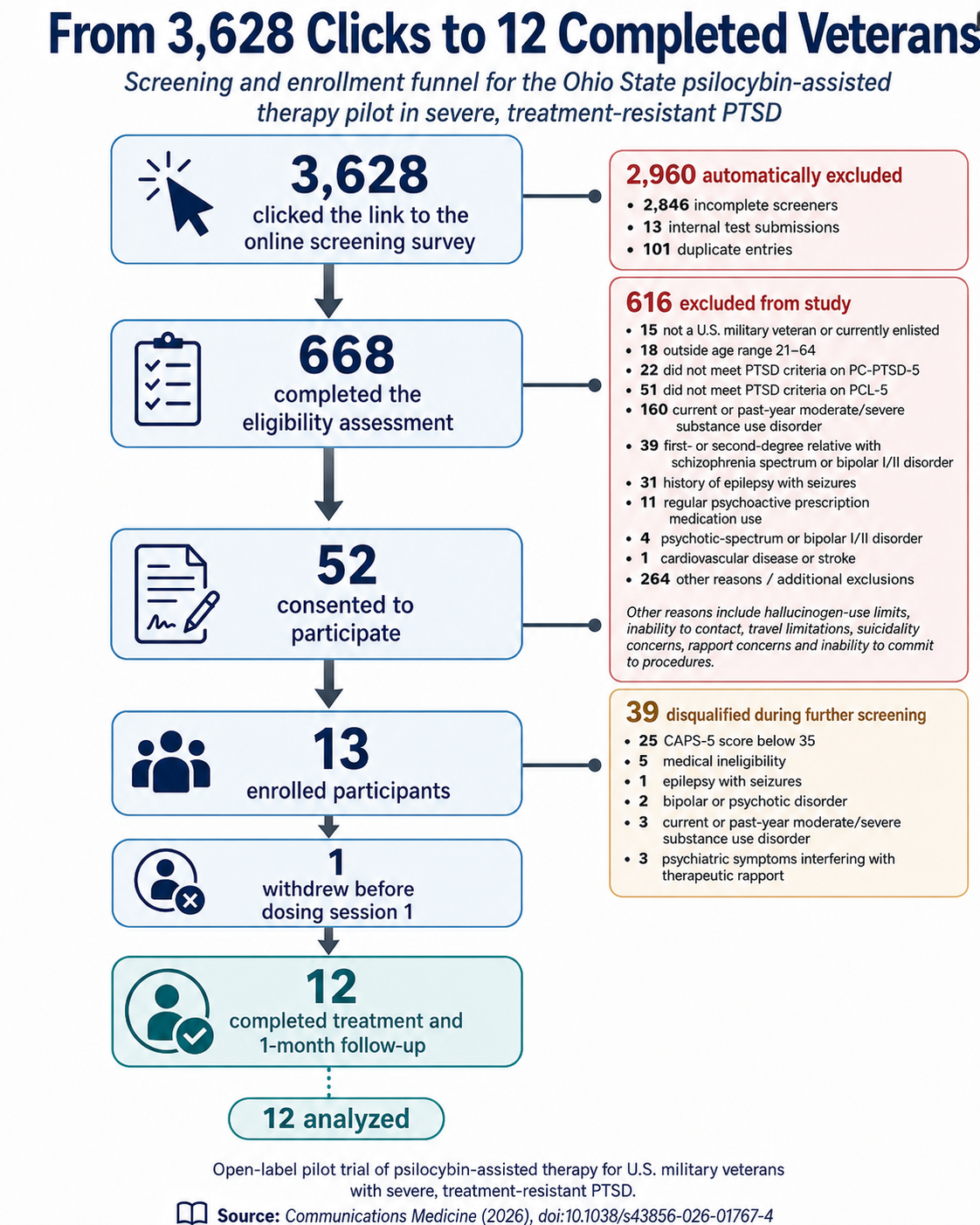
3,628 people clicked through to the screening survey. 668 completed the eligibility assessment. 52 were invited to in-person screening. Thirteen enrolled. One withdrew. The team had aimed for fifteen and ended the trial early when funding ran out.
Veterans were excluded for a significant history of suicide attempts. For cardiovascular disease. For a family history of psychosis or bipolar disorder. For moderate or severe substance use disorder in the past year. For current psychoactive medication, which meant discontinuing antidepressants for five half-lives before baseline. For psychiatric presentations judged likely to interfere with building rapport with the therapy team.
Consider the first of those for a moment. This is a trial of a treatment for PTSD, a condition whose association with suicide is the entire reason it commands the political attention it does, and it excluded people with a significant history of attempting it. The reasoning is defensible: you do not test an unproven intervention on the highest-risk population first. But the consequence is that the evidence base being assembled to justify access is being built on the subset of patients least likely to need it most urgently.
Of those who made it through, 92 percent were white, 75 percent male, 75 percent educated to degree level or beyond. 83 percent reported a combat or war-zone index trauma.
Whatever this trial measured, it measured it in a very particular twelve people.
## The expectancy result, read properly
The paper reports that expectancy did not predict outcome. This sounds like reassurance. It is not.
Expectancy was captured with a single item from the Credibility/Expectancy Questionnaire. Participants rated it at 6.67 out of 9, which is to say they arrived confident. The relationship with clinician-rated outcome was in the expected direction and did not reach significance.
In an unblinded trial of twelve people, that is not evidence that expectancy did not matter. It is a study with almost no statistical power to detect it in either direction, using an instrument too blunt to find it if it were there. The authors say as much in their limitations. It is worth saying louder, because "expectancy was measured and was not a factor" is exactly the sentence that will detach from this paper and start travelling on its own.
## What this trial did right
This publication spends a good deal of its time on studies that handle their methods badly, so it is worth being specific about the ones handled well here.
The trial was registered on ClinicalTrials.gov in September 2022, before recruitment opened in January 2023\. The primary outcome was scored by an independent assessor with no other involvement in the study. The setting was reported against the ReSPCT consensus, the reporting standard developed precisely so that context is documented rather than assumed. The deidentified participant-level data have been published. The limitations section is candid rather than defensive, and the authors state plainly that small uncontrolled trials produce inflated effect sizes.
That combination is not universal in this field. It should be.
## What the next study has to look like
If the preparation finding is real, the trial that tests it is not hard to describe. It needs a therapy-only arm, so that sixteen hours of skilled clinical contact is measured against sixteen hours of skilled clinical contact plus a drug. It needs a dose-comparison arm, since the FDA has now explicitly endorsed low-dose comparators. It needs expectancy measured properly, with a validated multi-item instrument, at multiple timepoints. It needs blinded central raters. It needs a follow-up considerably longer than one month, because PTSD is measured in decades and this study measured in weeks. And it needs a sample that includes the people currently screened out.
That trial is expensive, slow and much less newsworthy than nine out of twelve. It is also the only kind of study that can turn this result into a treatment.
## The bottom line
The Ohio State trial produced a strong safety and feasibility signal, a clinical result large enough to demand a controlled trial, and one quiet finding that may outlast the headline.
Nine of twelve is not proof. It is a reason to build the study that could produce one. And the middle measurement suggests that when somebody finally builds it, the question will not be whether psilocybin works. It will be how much of the work psilocybin was doing.
---
**Source**
Armstrong, S. B., Levin, A. W., Sepeda, N. D., Shaub, H., Hunter, T., Douglas, A., Lancelotta, R., & Davis, A. K. (2026). Safety, feasibility, and preliminary clinical outcomes of psilocybin-assisted therapy for veterans with severe, treatment-resistant PTSD: an open-label pilot clinical trial. *Communications Medicine*, 6, 411\. DOI: 10.1038/s43856-026-01767-4\. Pre-registered as NCT05554094\. Open access, with participant-level data.
**Also referenced**
FDA, *Psychedelic Drugs: Considerations for Clinical Investigations*, final guidance, July 2026\. Docket FDA-2023-D-1987.
Roseman, L. (2025). A reflection on paradigmatic tensions within the FDA advisory committee for MDMA-assisted therapy. *Journal of Psychopharmacology*, 39(4), 313-315.
### When Motherhood Feels Like a Trip: A Compelling Parallel That Hasn't Been Tested
URL: https://www.ardmt.com/when-motherhood-feels-like-a-trip-a-compelling-parallel-that-hasnt-been-tested/
Last updated: 2026-07-26T13:49:52.000Z
*A mother says psilocybin made her calmer, more patient, better at the job. A Harvard thesis says her brain and the mushroom may be working on the same territory. The parallel is real. What it means is not yet known.*
---
There is a moment Amanda Wilde keeps returning to. Her daughter Hazel had come early — twenty-eight weeks, three weeks in the NICU, the particular vigilance that follows a premature birth and doesn't switch off when the baby comes home. Wilde, thirty-seven, found herself anxious in a way that felt total, and also strangely familiar. The awe. The way time stopped behaving. The sense of being between two selves, the old one not quite gone and the new one not quite arrived. She had felt all of this before — not in a hospital, but on mushrooms, years earlier, when psilocybin was something a teenager tried and didn't think much about afterward.
The resemblance stayed with her. New motherhood, she began to think, felt like a trip. And so she did something most people wouldn't: she took the trip on purpose, to see whether the thing that had once shown her that feeling might help her live inside it. She says it worked — that psilocybin, taken occasionally and at full dose, made her calmer, more patient, more able to meet her daughter without the static of her own anxiety in the way. It became, in her telling, a piece of self-care sitting alongside the yoga and the long walks and the friends.
Then she went further than most personal stories go. Wilde enrolled in a master's in biology at Harvard, with a focus on neuroscience, and wrote her thesis on the parallel she'd felt in her own body: the correspondence between **matrescence** — the brain's transition into motherhood — and the psilocybin state. Her claim, stated plainly, is that the two reshape many of the same neural systems: the networks that hold identity, emotion, and perspective. "Psilocybin is working on the exact same parts of the brain that are undergoing changes during matrescence," she says. "The hard science shows that both postpartum and psilocybin experiences work along the same neural networks."
It's a striking claim, and the temptation is to receive it in one of two lazy ways — to wave it off as a nice story a mother tells herself, or to seize it as proof that mushrooms make better parents. Both would be wrong. The interesting thing about Wilde's parallel is that, at the level she's actually making it, it is largely *correct*. And that it still doesn't show what it appears to show.
## What matrescence actually does to a brain
Matrescence is not a metaphor, and it is not "mom brain" in the dismissive sense. The word was coined in the 1970s by the anthropologist Dana Raphael to name a developmental passage that had gone strangely unstudied: the transition into motherhood, treated with the same seriousness we grant adolescence. And like adolescence, it turns out to have a neural signature you can photograph.
When researchers scan women before conception and again after birth, they find pregnancy drives a robust remodelling of brain architecture. Grey matter volume follows a U-shaped trajectory — dipping through late pregnancy, partially recovering in the postpartum months — and the changes are not scattered randomly across the cortex. They concentrate, most pronouncedly, in the **Default Mode Network** and the frontoparietal network: the systems associated with self-referential thought, social cognition, theory of mind, the felt sense of being a continuous self. The shifts correlate with pregnancy hormones, third-trimester oestradiol chief among them. And — this is the part that matters for Wilde's argument — the magnitude of the change tracks something behavioural. Women whose brains change more show stronger maternal-fetal bonding, more responsiveness to infant cues, and the pattern predicts mother-infant attachment months later. Some of these changes persist for at least two years. Some may be permanent.
In other words, becoming a mother is, neurologically, a reorganisation of the self — routed largely through the same network that governs where you end and the world begins.
## What psilocybin actually does to a brain
Now hold that beside the psychedelic.
Psilocybin's best-characterised mechanism is not stimulation but **desynchronisation**. In a 2024 study in *Nature*, researchers found the drug's largest effect on brain connectivity fell precisely on the Default Mode Network — dissolving the ordinary distinctions between networks, flattening the correlations that hold the DMN together as a coherent unit. More strikingly, it left a mark that outlasted the trip: a persistent decoupling of the anterior hippocampus from the DMN that endured for weeks. The authors proposed this lingering change as a candidate mechanism for psilocybin's therapeutic and plasticity-promoting effects.
This is the same network, and the same vocabulary, that the psychedelic literature has circled for a decade. Reduced DMN integrity is the leading neural account of "ego dissolution" — the loosening of the boundary between self and world that people describe on high doses. The therapeutic logic runs through the same door: in depression and anxiety, the self becomes narrow, rigid, locked in rumination; psilocybin briefly dissolves the network that sustains that rigidity, and the loosening is thought to create a window in which entrenched patterns can shift.
So Wilde is right. Matrescence remodels the Default Mode Network. Psilocybin desynchronises the Default Mode Network. The two processes really do act on the same neural real estate — the machinery of identity, emotion, and perspective, exactly as she says. The parallel isn't wishful. It's anatomical.
## Why "the same network" is not the same as "the same effect"
And here is where a careful reader has to slow down, because the parallel is seductive in a specific and dangerous way. Acting on the same network is not the same as acting on it in the same *direction*, for the same *duration*, toward the same *end*.
Consider how differently the two processes are shaped. Matrescence unfolds over months. It is hormonally scaffolded — oestradiol and progesterone and oxytocin arriving in a timed cascade — and it is, by every indication, adaptive: the brain is being tuned toward caregiving, and the changes predict better bonding. Psilocybin's effect is acute, pharmacological, over in hours, with a plasticity tail measured in days to weeks. It is "therapeutic" in the narrow sense of disrupting stuck patterns, not in the sense of gently tuning a brain toward parenthood.
Two interventions can share a stage and play entirely different scenes on it. The fact that both processes converge on the DMN tells you they *might* interact — that psilocybin lands somewhere relevant to the maternal brain rather than somewhere irrelevant. It tells you nothing, on its own, about whether one improves the other. The move from "these share a network" to "therefore this one helps with that one" is a leap across open water, and it is exactly the leap a thesis can *frame* but cannot *close*. Wilde's work identifies a hypothesis worth taking seriously. It does not, and cannot by its nature, demonstrate an outcome.
## The clinical picture is moving — but not toward this claim
It would be easy to say there's simply no research here and leave it there. That's no longer quite true, and the truth is more interesting.
Psilocybin's signal in depression and anxiety is, at this point, well established across multiple trials. And a maternal-specific pipeline has begun to take shape: a psilocybin analogue, luvesilocin, received FDA breakthrough therapy status for postpartum depression in February 2026, with a Phase 3 trial recruiting two hundred participants slated to begin by the end of the year. There is real institutional momentum behind the idea that psychedelics might help mothers in genuine distress.
But notice precisely *what* those trials are built to measure: depression scores in women diagnosed with postpartum depression. That is not the same claim Wilde is making. Her account is about an otherwise-functioning parent — anxious, yes, carrying birth trauma, yes, but not describing a clinical depression — using psilocybin to become *more patient, more present, better bonded*. "Parenting stress" and "maternal connection" in a non-depressed mother are not endpoints in the luvesilocin trial or any other. The thing being tested and the thing being claimed overlap only partly. The evidence that's coming will speak to postpartum *illness*. It will be largely silent on whether a psychedelic can make an ordinary hard season of parenting go better.
## The caution the enthusiasm skips
There is one more piece of evidence, and it is the one that should give any honest advocate pause — because it is the only controlled study so far that looks directly at psilocybin in the peripartum period, and it points the wrong way.
In September 2025, a study in *Nature Communications* dosed postpartum mice under social stress with psilocybin. The drug did not rescue the stress-related behaviours the model was built to induce. Worse, weeks later, the treated mothers were *more* anxious than they had been — regardless of whether they'd been stressed at all — and the effects extended to their offspring. Animal models don't settle human questions; a stressed mouse is not a grieving new mother, and the doses and contexts don't map cleanly. But this is not nothing. It is a direct, if preliminary, signal that the peripartum brain — awash in oxytocin and prolactin at levels seen nowhere else in life — may respond to psilocybin differently, and not always benignly. The higher oxytocin of birth and lactation could plausibly amplify benefit or amplify harm. We don't yet know which, and that uncertainty is the whole point.
## Where this leaves us
None of this makes Wilde wrong, and it would be a mean reading of her story to treat it as debunked. Her parallel is intellectually serious. At the level of neural anatomy it is, as far as the current science goes, accurate — the two processes really do work the same territory. Her lived experience is real, and the recognition that started it — *I have felt this before, just never while holding my daughter* — is a genuinely arresting observation about the strangeness of becoming a parent.
But a felt parallel and a striking thesis are not a finding, and the gap between them is not a technicality — it is the entire distance that clinical science exists to cross. Same network is not same effect. A pipeline for postpartum *depression* is not evidence for better *bonding* in a well parent. And the one controlled peripartum study we have so far suggests the answer may not be the comfortable one.
Wilde herself, to her credit, lands in roughly the right place: the value of any of this, she allows, can be established only through rigorous, blinded clinical trials. Until those trials exist and report, this remains what it honestly is — a compelling hypothesis, a moving personal story, and an open question that deserves to be answered carefully rather than assumed. The mushroom and the mother may be working on the same network. Whether they are working toward the same thing is a question the science has only just begun to ask.
---
*Sources referenced in this piece include: longitudinal neuroimaging of pregnancy and the maternal brain (Hoekzema et al. and subsequent* Nature Communications *cohort studies, 2016–2025); Siegel et al., "Psilocybin desynchronizes the human brain,"* Nature *(2024); the September 2025* Nature Communications *study on psilocybin in the postpartum period; and 2026 reporting on the luvesilocin postpartum-depression trial and its FDA breakthrough therapy designation. The originating feature on Amanda Wilde was distributed by Talker News, July 2026.*
### The Cerebellum and the Cactus
URL: https://www.ardmt.com/the-cerebellum-and-the-cactus/
Last updated: 2026-07-24T09:27:41.000Z
#
## A new imaging study reports an acute cerebellar-dominant response to mescaline unlike the spatial patterns previously reported under LSD or psilocybin. The acute activation pattern may well be distinctive. The abstract is less careful about separating that result from cerebellar hyperconnectivity, which the same laboratory had already reported under both of those drugs. What began as a look at one overstated sentence turned into something more interesting: an education in how the regions of a brain get counted in the first place.
This started with a social media post. A striking summary, a good headline, a finding that sounded like it mattered. I went to check one sentence and came out the other side having learned something I had never once thought to wonder about, which is how anybody decides what counts as a region of a brain.
Some background first. Mescaline has probably remained the least-imaged classical psychedelic partly because of its Schedule I status and partly because it attracted less modern clinical and commercial investment than psilocybin or LSD. Until this year the entire human neuroimaging literature on the compound consisted of one SPECT study, Hermle and colleagues, twelve volunteers, 1992, reporting increased right frontal blood flow with decreases to the right thalamus and superior-temporal cortex.
That gap has now been partially filled, from an unexpected direction. Cavallaro and colleagues at Northeastern's Center for Translational Neuroimaging have published the first comprehensive pharmacological and resting-state fMRI characterisation of mescaline, in awake rats. Their discussion claims the compound produces "a unique cerebellar-selective activation pattern fundamentally different" from the cortical and thalamic effects reported for LSD and the cortico-striato-thalamic activation seen with psilocybin.
The observation looks real, and the acute pattern may genuinely be distinctive. What is harder to assess is how much of the packaged claim that pattern can carry, because the direct imaging comparison rests principally on three preceding studies from the same laboratory rather than on independent head-to-head datasets. Same magnet, same restraint apparatus, the same proprietary atlas family, substantially the same author list. Mescaline is the fourth compound through a single pipeline.
Reading all four changes what the mescaline paper is. To the authors' credit, their introduction is explicit that they expected the connectivity increase and located the distinctiveness elsewhere. Their abstract is not. One component was already established in the laboratory's own LSD and psilocybin papers, and was explicitly grouped with mescaline in a paper published thirteen days before this one was accepted.
That is the narrow version of the criticism, and it is the one that survives. Getting to it took four rewrites and a lot of things I had wrong along the way, including most of what I originally thought about the atlas. That part turned out to be the most interesting section in the piece, and not for the reason I expected.
---
## The programme
Four compounds, one laboratory, three years.
**Ghaw et al., 2024**, LSD, awake rats, *Brain Communications*. First awake rodent fMRI study of the compound. Funded by Ekam Imaging Inc. Atlas: 173 regions.
**Fuini et al., 2025**, psilocybin, awake rats, *Frontiers in Neuroscience*. Noah Cavallaro is an author.
**Cavallaro et al., 2026a**, 5-MeO-DMT, awake rats, *Neuropharmacology*. Accepted 17 February 2026, online 6 March 2026\. Cavallaro first author, Ferris senior.
**Cavallaro et al., 2026b**, mescaline, awake rats, *Neuroscience Bulletin*. The paper under discussion. Received 1 November 2025, accepted 19 March 2026, published online 21 May 2026\. Cites Ghaw and Fuini as its comparators. Does not cite 5-MeO-DMT.
Each is presented as a first: the first awake LSD imaging, the first awake psilocybin imaging, the first fMRI characterisation of 5-MeO-DMT in any species, the first comprehensive characterisation of mescaline. Each is, so far as I can establish, accurate on that narrow point. The programme is a real capability and the awake preparation is a genuine methodological advance over anaesthetised rodent imaging, which is the field's standing problem.
Ferris has described the approach candidly. The laboratory works systematically through compound classes, it went through a cannabis phase, he told a Northeastern press writer in July, and published a number of studies from it. That is an honest account of an imaging platform doing what such platforms are for, and a legitimate way to run a laboratory. It is worth stating in his words rather than mine, because the serial structure is the condition under which the novelty claim has to be read, and the authors do not dispute it.
A shared platform cuts both ways here, and the piece should say so plainly. It improves comparability by reducing methodological heterogeneity between compounds, which is a real strength, and a randomised head-to-head study elsewhere would be harder to fund and slower to run. But these were separate cohorts and separate experiments, with different doses, different timing schemes, different sexes analysed differently, and differing reported atlas totals. They do not amount to a randomised head-to-head comparison. A shared pipeline also permits shared systematic bias. Persistent atlas, registration or restraint-related effects could recur across the programme, even if they interact differently with each compound and cohort. The internal comparisons may still be informative, but they require independent replication before being treated as properties of the drugs rather than of this particular preparation.
---
## What the mescaline paper found
Twenty-four Sprague-Dawley rats, equal sexes, acclimated over five days to head restraint, given 50 mg/kg mescaline or vehicle while fully awake in a 7T magnet. Three protocols in sequence: pharmacological MRI across a five-minute baseline and twenty minutes post-injection, resting-state functional connectivity roughly ten minutes later, and an odour-provocation paradigm using almond as an innate reward. A separate cohort of sixteen ran prepulse inhibition.
The acute BOLD result is anatomically stark. Of 169 atlas-defined regions, 26 showed significant reductions in positive BOLD volume of activation and 33 showed significant increases in negative BOLD, and the tables are dominated by the cerebellum. First through tenth lobules. Crus 1 and Crus 2 of the ansiform lobule. Paramedian lobule, copula of the pyramis, flocculus, simple lobule, the fastigial and interposed nuclei. Around them, the vestibular nucleus, the inferior and superior colliculi, the cochlear nucleus, substantia nigra reticularis. Effect sizes are large, omega-squared above 0.5 for several regions.
The selectivity claim needs splitting by measure, and the distinction matters. The positive activation-volume effect is strongly cerebellar-selective: olfactory bulbs, prefrontal cortex, accumbens, thalamus, somatosensory and visual/auditory cortices all show no significant change. The negative activation-volume result is cerebellar-dominant but not exclusively cerebellar, significant changes extend into striatal, septal and hippocampal structures, with dorsal dentate gyrus, dorsal subiculum, lateral and medial septal nuclei and dorsal medial striatum all appearing in the tables. "Cerebellar-selective suppression" is accurate for one of the two measures. The authors do demonstrate that the positive-BOLD sparing is an absence of *difference* rather than an absence of signal: their Figure 2B shows comparable voxel counts for vehicle and mescaline at the prefrontal level, with the two conditions diverging dramatically only at the cerebellum.
The resting-state analysis then inverts the picture, and here the terminology needs care. These are thresholded functional-correlation edges, not newly grown anatomical connections. At the study's correlation threshold, numerous additional edges involving the deep cerebellar nuclei appeared under mescaline, linking them to thalamus, midbrain, somatosensory cortex and hippocampus. No hippocampal–cerebellar nuclear edges survived thresholding in the vehicle network, whereas edges involving seven of nine hippocampal subdivisions did under mescaline. The mean difference in node degree for the hippocampus was 59\. The primary analysis used absolute correlation values, so strongly correlated and strongly anti-correlated activity both counted toward degree; the authors report that supplementary analyses using signed correlations, global signal regression and a range of sparsity thresholds reproduced the same group differences.
From this they build a mechanism whose theoretical grounding is legitimate, even though its application to these data remains speculative. They invoke Devor's "Great Gate," in which the cerebellum, in concert with the inferior olivary complex, functions as a predictive filter distinguishing expected from unexpected sensory input, alongside Hull's review of cerebellar prediction signals. Both citations support the general predictive-filtering framework they invoke. Devor's account has the deep cerebellar nuclei supplying much of the inhibitory feedback that gates olivary responsiveness; Hull surveys prediction signals through granule cells, Purkinje cells and the cerebellar nuclei, including nuclei neurons that track the mismatch between expected and actual movement, and cerebellar output that shapes cortical processing downstream. When Cavallaro suggest their hypoactivation could reflect disruption of an internal model or a decoupling of cerebellar cortex from its nuclei, that is a reading their sources will bear.
The chain is hypothesis rather than measurement, and the authors say so, calling for direct testing in future work combining high-resolution fMRI with computational modelling. But the gap between the theory and the data deserves stating, because of what the theory is made of. Devor's gating mechanism is olivary glomeruli, GABA-A receptor subunit distribution and subthreshold membrane oscillations between 5 and 12 Hz, and Devor notes that settling its behavioural role would require intracellular recording in vivo, a significant technical challenge. Hull's evidence is complex spikes, calcium imaging of granule cell populations, and closed-loop optogenetic manipulation of the nuclei. None of that is visible in a thresholded count of activation volume. The proposal that mescaline transforms the cerebellum into what they call an untethered broadcaster of unfiltered information is a plausible reading of a BOLD pattern, offered on a measure several levels of description away from the machinery the model runs on.
And there is a passage in Devor that the mescaline paper's own BOLD-validity discussion does not reach for. Writing in 2002 about cerebellar functional imaging, Devor makes essentially the same measurement-level warning, in paraphrase: increases in the cerebellar magnetic resonance signal could reflect climbing fibres, parallel fibres or intrinsic cortical elements, and interpreting them requires a detailed model linking that signal to neuronal activity. That is the objection this piece has been making, in the source they cite for their mechanism, twenty-four years earlier.
Two components, then, bundled into one signature: acute cerebellar-dominant suppression, and cerebellar hyperconnectivity. They need to be separated, because the comparators treat them very differently, and because, as it turns out, the authors themselves separated them at the outset.
---
## The acute finding survives
I initially assumed the acute contrast would soften on inspection. It does not.
Ghaw's LSD paper states directly that the caudal end of the brain, brainstem, cerebellum and pons, is unresponsive to high-dose LSD. LSD's acute effects were forebrain: olfactory system, prefrontal cortex, thalamus, hippocampus. The cerebellum appears in Ghaw's high-dose positive-BOLD table only as scattered entries in both directions, the fastigial nucleus and simple lobule decreased with LSD, while the interposed nucleus increased, alongside the pontine and cochlear nuclei, these three being the named exceptions to an otherwise global positive-BOLD decrease. Those scattered findings do not resemble mescaline's broad cerebellar-dominant acute profile.
So on the acute measure, within this laboratory's own data, mescaline does differ from LSD, and Cavallaro are entitled to say so.
The qualification is that "differs from LSD" is not "unique among classical psychedelics," and the other two compounds complicate it.
Fuini's psilocybin paper breaks positive volume of activation down by region and reports a significant cerebellar effect. Critically, the low 0.03 mg/kg dose produced the lowest volume of activation, significantly less than vehicle, for whole brain, prefrontal cortex, thalamus and cerebellum. That is acute cerebellar suppression under psilocybin, at one dose, in a paper Cavallaro co-authored. It is not cerebellar-*selective*, prefrontal cortex and thalamus moved too, and it is non-monotonic, with activation returning at 3.0 mg/kg. The mescaline claim is specifically about selectivity, so it survives. But it survives as a narrower claim than the abstract makes, and it depends on mescaline having been tested at a single dose.
Then there is 5-MeO-DMT. Cavallaro's own 5-MeO-DMT paper reports that at 1–10 minutes post-injection, negative BOLD appeared across essentially the whole brain *with the exception of the posterior cerebellum*, the deep cerebellar nuclei and posterior cerebellum are circled in red in their Figure 2 to mark the regions drug did not touch. The cerebellum is not merely unaffected; it is the conspicuous exception, and the authors use precisely that regional sparing as their argument that the effect is neural rather than systemic.
Set the four side by side on the acute BOLD measure:
- **LSD**, cerebellum largely unresponsive; scattered entries in both directions.
- **Psilocybin**, cerebellar suppression at low dose, activation at high, alongside forebrain changes.
- **5-MeO-DMT**, whole-brain negative BOLD, cerebellum conspicuously spared.
- **Mescaline**, cerebellar-selective suppression in positive BOLD, cerebellar-dominant in negative BOLD.
Four acute profiles, four different cerebellar answers. These could represent genuine pharmacological differences, different drugs producing different results is what a pharmacologically sensitive measure ought to do, and treating divergence as inherently suspicious would be a mistake. The problem is narrower. Because the compounds were sampled at single or differing doses, at different positions on their pharmacokinetic curves, with different timing windows and different sex-stratification, the programme cannot yet separate drug identity from dose-and-time effects. The limitations section acknowledges the single-dose problem, but the cross-compound novelty framing does not fully incorporate it.
---
## The connectivity component was already known to be shared
Here the case is simpler, and the laboratory has already settled it in print.
Ghaw reported cerebellar hyperconnectivity under LSD, 33 of 39 nodes versus 13 of 39 in vehicle, P < 0.0001, and the abstract calls it an unexpected finding. Fuini reported a significant dose-dependent global increase in functional connectivity under psilocybin, highlighted by hyperconnectivity to the cerebellum.
Then, in March 2026, Cavallaro's 5-MeO-DMT paper reported a global *decrease* in connectivity and explained that this was at odds with previous studies from the lab on LSD, psilocybin **and mescaline** showing dose-dependent increases in global connectivity. Note what that sentence does and does not say: 5-MeO-DMT did not produce hyperconnectivity. It went the other way. What the paper does is name mescaline, alongside LSD and psilocybin, as one of three in-house compounds that had.
The timing is tight. The 5-MeO-DMT paper appeared online 6 March 2026\. The mescaline paper was accepted 19 March, thirteen days later.
**In fairness to the authors, they never claimed hyperconnectivity alone was novel.** The mescaline paper's introduction is explicit: *"Based on our previous findings with LSD and psilocybin in awake rats, we hypothesized that mescaline would produce region-specific alterations in BOLD signal, accompanied by enhanced global functional connectivity. However, we anticipated that the specific pattern of activation would distinguish mescaline from other psychedelics."* They predicted the connectivity increase as the shared, expected outcome and located the distinctiveness in the activation pattern. The discussion is consistent with this, claiming "a unique cerebellar-selective activation pattern."
The criticism is therefore subtler than a novelty grab, and it belongs to the abstract rather than the introduction. The abstract lists cerebellar-selective suppression, global hyperconnectivity, abolished olfactory reward responses and frequency-selective acoustic gating, then concludes: "These findings distinguish mescaline from LSD and psilocybin." Plural, undifferentiated. A reader of the abstract, which is all many readers and press writers will read, cannot tell that one of those four components was predicted in advance to be shared with the two comparators named in the same sentence, and had been explicitly described by these authors as shared across LSD, psilocybin and mescaline thirteen days before acceptance. The package is presented as distinguishing; only part of it plausibly does.
That is a real problem with how the result was communicated, and it is smaller than "they claimed someone else's finding as their own."
---
## Single doses, and what the dose-response papers show
The mescaline study ran one dose. The three comparators ran dose-response designs, and two found the connectivity effect non-monotonic.
Fuini reports the cerebellum showing a U-shaped connectivity profile, with the intermediate 0.3 mg/kg dose producing the lowest node degree. Cavallaro's 5-MeO-DMT global connectivity is U-shaped too: average degree falls from 58.5 at vehicle to 48.4 at 0.1 mg/kg, a 17% drop, then returns to 58.1 at 1.0 mg/kg, essentially vehicle level. Their conclusion is that the drug has a non-linear, dose-dependent effect on network connectivity.
Non-monotonic dose-response matters here. A single-dose experiment cannot establish whether a compound-specific effect persists across the dose-response curve. It can establish an effect at the dose tested; the observed profile might persist, weaken or reverse at other mescaline doses, and one dose cannot show which. The paper's own limitations section concedes that the single dose represents one point on the dose-response curve and that other doses might reveal different patterns.
The dose citation is looser than it looks. Cavallaro cite two sources for 50 mg/kg: Páleníček et al. (2008) and Olejníková-Ladislavová et al. (2024). Neither used it. Páleníček gave 10, 20 and 100 mg/kg subcutaneously to Wistar rats. Olejníková-Ladislavová, from Páleníček's own group, used the same three doses, again subcutaneously, again in adult male Wistars. So both cited sources tested 10, 20 and 100 mg/kg in one strain, and the study interpolates 50 mg/kg in another. Páleníček also reported substantial delayed mortality at 100 mg/kg and could not exclude toxicity as a contributor to the behavioural effects at that dose. That does not establish toxicity at 50 mg/kg, and it is not enough to characterise a therapeutic index in either direction. What it does establish is that formal dose-ranging and concurrent physiological monitoring would have been worth doing.
The 5-MeO-DMT study, for comparison, enrolled 48 animals across four doses in both sexes, 44 after motion exclusions, and found females responding at 0.1 mg/kg where males did not. Its authors conclude this highlights the importance of sex-stratified analyses in future studies and in clinical trials. The mescaline study ran 24 animals with equal sexes and reports no sex-stratified analysis. Same laboratory, same year, same argument for sex-stratification, not applied.
---
## What BOLD is, and the paper the citation trail passes through
Cavallaro deserve real credit for raising the BOLD-validity problem themselves, at length. They cite Epp et al. showing BOLD signal changes can oppose underlying oxygen metabolism in around 40% of cortical voxels. They concede they ran no concurrent respiratory or cardiac monitoring, and that mescaline produces autonomic effects, Klaiber's human data show dose-dependent increases in blood pressure and heart rate, which themselves alter cerebral blood flow. They state plainly that their vehicle control cannot distinguish direct 5-HT2A neural effects from central responses to peripheral physiological change from neurovascular coupling alterations.
Their defence is regional specificity: a purely systemic cardiovascular effect should produce uniform change, not a hindbrain-selective one. That is a reasonable argument. It is not a complete one, since it assumes uniform neurovascular coupling across a region whose vascular architecture and metabolic profile differ substantially from cortex. The paper's own framing, hypoactivation and hyperconnectivity in the same structure simultaneously, is the configuration in which a coupling artefact would be hardest to distinguish from a neural effect.
Two things sharpen this.
First, the Epp figure is directional, and Cavallaro cite only the aggregate. Broken down, discordant voxels account for 31% of significant positive BOLD but 66% of significant negative BOLD in the main contrast, and 68–78% of negative BOLD across Epp's control analyses. What this means needs stating carefully, because it is easy to overclaim. Epp found substantially greater sign discordance between negative BOLD and estimated oxygen-metabolism changes than for positive BOLD, in human cortical paradigms. That is not an error rate, it does not mean two-thirds of negative BOLD measurements are false, and the proportion does not transfer to rat cerebellum or to mescaline. What it does mean is that BOLD sign cannot be read straightforwardly as metabolic or neuronal sign, and that interpreting negative cerebellar BOLD as neural inhibition is particularly uncertain. A substantial part of the reported suppression profile lies in that direction: 33 regions showed increased negative BOLD, alongside the 26 showing reduced positive activation volume.
Second, Fuini's citation trail runs directly through the experiment that tests this in rat, for this drug class. Spain et al. (2015) administered psilocin intravenously to anaesthetised rats and measured local field potentials and cerebral blood flow concurrently in somatosensory cortex. Neuronal responses to whisker stimulation decreased while haemodynamic responses increased, opposite directions, same region, same animals. Responses to hypercapnia were unchanged, so this is not crude vasoreactivity; it is neurovascular coupling specifically. Their conclusion is that phMRI signal changes under psilocin reflect both neuronal activity and altered coupling, and that caution is required in inferring the former from the latter.
Spain also reports that, at 0.03 mg/kg, the only significant regional phMRI change was a small decrease in the cerebellum. That is prior evidence of a low-dose cerebellar BOLD decrease under a serotonergic psychedelic, from a different laboratory, in 2015, but it is psilocin rather than mescaline, intravenous rather than subcutaneous, anaesthetised rather than awake, a different pipeline, and a single small observation rather than mescaline's broad profile. It is not another instance of the same signature. It is a reason the signature should not have been described as unreported. Fuini cite Spain. Cavallaro's BOLD-validity discussion does not.
---
## Where the humans are
Klaiber et al. (2024) is the strongest modern human dataset on mescaline: sixteen healthy subjects, double-blind, placebo-controlled crossover, four doses from 100 to 800 mg, plus an 800 mg arm co-administered with the 5-HT2A antagonist ketanserin. Dose-dependent subjective effects above 100 mg with no clear plateau by 800 mg. Plasma half-life around 3.5 hours. Effect duration rising from 6.4 to 14 hours across the range. Ketanserin reduced the 800 mg response to roughly the level of the 100 and 200 mg doses, providing strong evidence that 5-HT2A signalling mediates most of the acute psychedelic response, as for LSD and psilocybin.
The qualitative comparison belongs to Ley et al. 2023, same group, 32 participants receiving mescaline, LSD and psilocybin at psychoactive-equivalent doses, which found acute subjective effects of 500 mg mescaline, 100 µg LSD and 20 mg psilocybin comparable across various psychometric scales, with only modest autonomic differences.
So the human phenomenology says mescaline is a classical psychedelic with unusual pharmacokinetics: slow to absorb, long to peak, hence long-acting, and commonly associated with nausea. The rat imaging says mescaline is anatomically distinctive. These are not incompatible, mechanism and phenomenology need not track, but the imaging paper's clinical speculations run ahead of where they connect. The suggestion that cerebellar targeting might have applications in movement disorders, cognitive impairments, or conditions involving sensory filtering deficits, or that frequency-selective gating might apply to auditory processing disorders, derives from a single dose in one species at one timepoint, on a measure the same paper spends two pages qualifying.
The Hermle discrepancy is left unresolved. Hyperfrontal in humans; little positive activation-volume difference in the rat forebrain. The paper offers species differences, methodological variation, or the superior resolution of awake BOLD fMRI over SPECT, three candidate explanations for one contradiction, which is not an argument for any of them.
The visual result deserves less weight than it might seem to carry. In the odour-provocation analysis, mescaline blunted BOLD responses in olfactory, somatosensory and auditory systems, while the visual system showed no significant treatment difference. In humans, visual distortion is mescaline's signature. But this was an almond-odour challenge, not a systematic test of visual processing, and the absence of a visual-region treatment difference during an olfactory task provides little direct evidence about mescaline's human visual phenomenology either way. It is worth noting that a model built to explain perceptual alteration through cerebellar sensory flooding did not produce a visual signal in the one paradigm where it was incidentally observable, and worth not building much on it.
---
## The residue of a shared spine
Two small things, individually trivial, which together indicate how closely these papers share a template.
The mescaline paper's Degree Centrality section describes importing connectivity matrices "for both psilocybin and vehicle data." This is a two-group mescaline study with no psilocybin in it.
The paragraph is shared across all four papers, and it is worth setting out what actually happened, because the obvious inference is the wrong one. Ghaw reads "for both LSD and Veh data." Fuini reads "for both PSI and vehicle data." Both correct. The 5-MeO-DMT paper, same first author, three weeks earlier, reads "for both drug and vehicle data," having generalised the phrase so that it could not break again. Then the mescaline paper reverts to a named compound and names the wrong one. Three of four are right, and the fix was already in place. This is not a lab carelessly copying itself; it is a template being maintained competently, with one instance slipping through.
The second is narrower. The mescaline paper's connectivity methods refer to computing correlations "within all three groups." That sentence appears only in Ghaw and in the mescaline paper, Fuini and the 5-MeO-DMT study do not have it, and in Ghaw it was correct, because Ghaw had three groups.
Neither makes the underlying measurements less independent. Different animals exposed to different drugs remain independent experimental observations regardless of how the methods section was assembled. What they show is inadequate proofreading and close pipeline continuity, in a section of the paper that almost nobody reads and reviewers routinely skim. The real requirement for the argument being made, this compound differs from those compounds, is not textual independence but harmonised measurement: regional definitions, doses and timing that can be matched across studies. Which raises a question about the atlas.
The commercial arrangement belongs here too, stated plainly rather than insinuated. The senior author and imaging lead hold interests in the companies supplying the equipment: Ekam Imaging for the RF electronics and restraint hardware, Ekam Solutions for the atlas and its EVA registration software. Ghaw was funded by Ekam Imaging directly. Ferris's own 2022 review discloses a financial interest in Animal Imaging Research for the RF electronics as well, and older papers cite Insight NeuroImaging Systems for the same restrainer. Published disclosures and methods sections name several related or successive suppliers without explaining the corporate relationship among them. All of the interests are disclosed, every time.
Instrumentation markets in animal neuroimaging are small, and the people who know enough to build the tools are usually the people using them. The arrangement is unremarkable. What matters is the consequence rather than the motive: tools normally get stress-tested by outside users who hit problems and complain, and a concentrated user base reduces how much of that correction is visible from outside.
The hardware, at least, is not a lock-in. The Ekam design is a quadrature transmit/receive volume coil built into a non-invasive head restrainer, and it is good engineering, but Stenroos and colleagues built a 3D-printed restraint kit compatible with standard Bruker coils in 2018, and in 2026 *eNeuro* published an open-source restraint system outright. Those authors are blunt about why awake rodent imaging has not spread: procedural complexity, absent standardised protocols, and reliance on custom hardware. Nothing technically ties the atlas to the coils either, since a parcellation is a file and will take data from any scanner. Whatever keeps them together, it is not a technical constraint.
---
## The map, and a thing that looked like a problem
Every number in this paper depends on something most readers never think about, and I had not thought about it either until I went looking.
The brain does not come with lines on it. There is no visible boundary where the thalamus ends and the next structure begins, because it is continuous tissue. So someone has to decide where the borders go, and an atlas is that decision written down: a reference brain with regions drawn on and labelled, packaged as a file. Scan an animal, warp its brain until it lines up with the reference, and every voxel inherits a label. That is how "26 of 169 regions" comes into existence. It is not a theory-free count supplied by the brain itself. It is a measurement made after continuous anatomy has been partitioned according to somebody's model of it. The regions usually have real anatomical foundations. The exact boundaries and the granularity are choices.
The atlas here is a commercial product from Ekam Solutions, the company Ferris and Kulkarni part-own. It is Paxinos-and-Watson-derived in its naming but MRI-native in its boundaries, built from 85-micron T2-weighted scans on a Bruker 7T, and the group's own methods paper says it was developed to overcome the shortcomings of existing commercial and public-domain atlases, with the reasonable argument that an MRI-based template avoids the tissue shrinkage histology introduces. Its computational framework originated in Kulkarni's doctoral work, before Ekam existed as a company.
Now look at the region counts reported across the literature that uses it:
| Year | Regions | Source |
| ---- | ------- | ---------------------- |
| 2016 | 171 | fragile X study |
| 2018 | 173 | QUTE-CE vascular paper |
| 2020 | 171 | diabetes study |
| 2023 | 174 | Ekam product page |
| 2024 | 173 | Ghaw, LSD |
| 2026 | 169 | mescaline |
I want to be careful here, because my first pass at this was wrong in a way worth describing. I had also included a 2015 concussion paper reporting 150 areas, and treated the whole sequence as a version history. It is not. That paper says plainly that the atlas has 173 annotated areas and that 150 were selected for diffusion analysis, white matter tracts excluded because they traverse several regions, along with circumventricular organs and areas without clear regional organisation. That is deliberate subset selection for a specific analysis, not a different atlas. Once you notice that one, you have to assume others in the table might be subsets too, and the papers rarely say.
So what the table actually shows is inconsistent reported totals, not a documented revision history. Some of the variation is probably genuine revision. Some is probably analytical subsetting. Some could be publication error. No paper cites a version number, so there is no way to tell which is which. Ghaw says "a 3D Rat Brain Atlas©, which included 173 segmented and annotated brain regions." The mescaline paper says the atlas "parcellates the brain into 169 discrete, annotated regions." That is the entire documentation in both cases. The current Ekam product page advertises 174.
One likely contributor to the variation is inconsistent treatment of white matter, and there is direct in-house evidence for how large that effect can be. A Northeastern doctoral thesis from this laboratory is reported to describe the atlas at the start of that work as 173 annotated regions on a high-resolution structural MRI template spanning 64 serial coronal slices, with white matter represented in a single aggregated placeholder region carrying no delineations. Its stated aim was to extend that atlas with 27 individually segmented white matter tracts, yielding a 199-region atlas. So delineating white matter moves the total by twenty-six regions in one step, and 199 is a number no published paper reports. The 2015 concussion analysis moved in the opposite direction, excluding white matter tracts outright to reach 150\. Between an aggregated placeholder, a 199-region extension and analyses that drop white matter altogether, closely related versions or analytical selections from the atlas could plausibly yield several different totals without every difference representing a substantive anatomical revision. Template geometry appears to have shifted too: the vascular paper describes 65 axial slices, the thesis 64 coronal. What the publications do not contain is enough information to reconstruct which of these accounts for which reported number.
Here is why this looked, for a while, like it might sink the whole comparison.
The mescaline finding is a claim about which cerebellar structures appear in the significant tables, set against Ghaw's LSD tables. If the difference between 173 and 169 had touched the cerebellum, splitting a lobule or merging the fastigial and interposed nuclei or dropping a vermis subdivision, then the two papers would be counting different things while presenting the comparison as like for like. The central result would be resting on a moved goalpost and no reader could tell.
So I checked the region names in both sets of tables.
| Region | Ghaw (173) | Mescaline (169) |
| ------------------ | -------------------------------- | -------------------------- |
| Paramedian lobule | "Paramedian lobule" | "Paramedian lobule" |
| Simple lobule | "Simple lobule cerebellum" | "Simple lobule cerebellum" |
| Fastigial nucleus | "Medial cerebellar n. fastigial" | "Fastigial n. cerebellum" |
| Interposed nucleus | "Interposed n." | "Interposed n. cerebellum" |
Same structures, same nomenclature, differences confined to label strings. And the mescaline paper's full cerebellar inventory, first through tenth lobules, Crus 1 and Crus 2 of the ansiform lobule, copula of the pyramis, flocculus, paramedian and simple lobules, plus the fastigial, interposed and dentate nuclei, is a complete and conventional Paxinos-derived set. Nothing appears split, merged or omitted.
What that establishes is narrower than I first wrote. The named cerebellar regions on which the acute comparison depends are represented in both papers, so the region-count difference does not appear to undermine that particular comparison. It does not prove no cerebellar label changed anywhere in the atlas, and it does not compare the underlying masks. Two regions can keep the same name while their boundaries move. Without the label files or a changelog, the geometry cannot be checked from the papers at all. What the published labels show is no obvious cerebellar split, merger or omission capable of explaining the acute contrast. That is reassuring rather than conclusive, and it is as far as an outside reader can get.
Three smaller things remain, and they are all much less dramatic than what I went looking for.
The reported totals differ, so any whole-brain proportion compared across these papers, N out of 169 against N out of 173, is not quite comparing like with like. Probably minor in numerical terms, four regions out of roughly 170, but impossible to quantify without knowing which regions changed.
No paper cites a version, so the check I just ran is the only route by which anyone outside the laboratory could establish that the cerebellar labels held. And it worked only because both papers happened to publish full region-by-region tables. Had either reported summary statistics instead, the question would have been permanently unanswerable from outside.
And the visible published use of this atlas appears heavily concentrated in work involving Ferris, Kulkarni or their centre. I found no clearly independent published validation, though a literature search cannot establish that no outside users exist, and industrial or unpublished use would not show up. Compare Waxholm Space, the main open rat atlas, distributed as NIfTI with a label file, whose version 4 documents 222 structures of which 112 are new and 57 revised, with the criteria behind the annotations set out explicitly. Versioning and changelogs are demonstrably possible. A concentrated user base reduces the visible external correction that builds up around widely adopted open tools, and the publications provide little evidence of independent validation or public version tracking.
That is the honest shape of it. A proprietary tool with inconsistent reported totals and no visible version trail, in a field where that is common rather than exceptional, which on the one question I could actually test turned out not to affect the result. Worth understanding. Not a scandal.
---
## The comparison the field has not made
Five years ago Vejmola and colleagues at the Czech National Institute of Mental Health ran a direct comparison of four psychedelics in freely moving rats, psilocin, LSD, mescaline at 100 mg/kg, and DOB, with fourteen cortical EEG electrodes and behaviour scored in parallel. Their conclusion was that all four produced global broadband desynchronisation and decreased connectivity irrespective of structural family, with only modest differences between tryptamine- and phenethylamine-derived psychedelics.
That reads as a direct contradiction of the mescaline paper, and it is not one. Vejmola's cortical montage provided no direct cerebellar recording and was poorly suited to resolving cerebellar sources. The electrodes were frontal, parietal and temporal.
The inference cuts the other way from how it is usually taken. If that montage could not have detected cerebellar involvement in mescaline, it equally could not have detected it in LSD or psilocybin. Much of the cortical EEG literature was poorly equipped to assess the cerebellum directly, and the claim that a cerebellar signature is unique to mescaline is being made against a comparison set that is one laboratory deep.
The same limitation applies to the one external result usually cited against this programme, and reading it directly complicates the picture in both directions. Reinwald and colleagues are routinely summarised, including by Fuini, as having found psilocybin decreasing connectivity in rats. What they actually report is bidirectional: a widespread cortical decrease in global brain connectivity, and alongside it a well-localised hyperconnected circuit hubbed on the dorsal raphe nucleus and the hypothalamus, both showing increased strength and participation index, with the raphe reading as a newly prominent intermediate hub between subnetworks. That is not a clean opposite of the Northeastern global-increase result. It is a different shape of answer.
Two details make the comparison harder still. Reinwald's cerebellum was not merely omitted from the analysis; it was outside the acquisition. Their gray matter mask covered 44 cerebral regions, excluding cerebellum and olfactory bulb as regions not covered by the echo-planar field of view. The coverage was physically absent, which is the blindness point stated by the authors themselves rather than inferred by me.
And they used a different atlas entirely: SIGMA, an open rat template, parcellated into 44 bihemispheric regions. Set that against a proprietary atlas reporting somewhere between 169 and 174\. Fuini attribute the disparity to anaesthesia and circadian phase, which is plausible and untested. Parcellation granularity is another methodological difference that could contribute, and belongs alongside anaesthesia, dose, timing, field of view, preprocessing and choice of connectivity metric on the list of possible explanations. None of them has been tested against the others.
One more thing worth noting, because it cuts against the mescaline study rather than for it. Reinwald recorded respiratory and cardiac signals at 100 Hz throughout, applied region-specific physiological noise correction, and found that psilocybin significantly altered both heart rate and respiration relative to saline. That is precisely the monitoring the mescaline study did not do, in the paper cited as the disagreeing result.
Fuini are notably careful in a way the mescaline paper is not, they call their own result unprecedented and at odds with much of the preclinical and clinical literature, and spend a page on restraint stress, circadian timing and species differences. The most rigorous scepticism about this programme's central finding comes from inside the programme.
One further gap: unlike Fuini's study, the mescaline experiment did not attempt pharmacokinetic confirmation of plasma or brain exposure. Fuini's attempt came with its own caveat, at the low 0.03 mg/kg dose psilocin was at or below the \~5 nM detection limit, with only one of four samples yielding a measure, so the dose carrying Fuini's cerebellar suppression is not itself exposure-validated. But the mescaline study measured nothing, in a compound whose rat pharmacokinetics are known: at 20 mg/kg subcutaneously, Páleníček found serum peaking within 30 minutes and brain concentrations reaching maximum at 60 minutes, with peak brain levels about a third of serum, the molecule being polar and crossing the blood-brain barrier poorly. The phMRI window runs five minutes of baseline then twenty minutes post-injection. The acute cerebellar suppression is measured across the ascending limb, before brain concentration maximum.
---
## What is actually on the table
Strip the framing and something worthwhile remains.
Mescaline has now been imaged whole-brain in an awake preparation, and the largest signal sits in a structure that has remained peripheral to the dominant cortical and thalamic narratives of psychedelic neuroimaging. Whether or not it proves specific to mescaline, that is a finding about where the field has been pointing its instruments. The default map, default mode network, cortical desynchronisation, thalamic gating, was drawn with priors aimed at the forebrain. Vejmola's electrodes were on the cortical surface because that is where the human EEG literature said to put them. Reinwald's field of view did not reach the cerebellum at all.
The predictive-coding story about the cerebellum as sensory gate is a decent hypothesis, properly grounded in the literature the authors cite, and they are honest that it warrants direct testing. The prepulse inhibition data are the weakest support for it. The treatment main effect did not reach significance (F = 2.97, P = 0.091), nor did the frequency effect (F = 2.48, P = 0.095); only the treatment-by-frequency interaction did (F = 3.874, P = 0.028), with ω² = 0.098, in sixteen animals across three frequencies. So the significant result is an interaction in calculated PPI, not a general enhancement of sensory gating. The abstract's headline figures, +27.6% at 4 kHz, +27.3% at 20 kHz, −16.4% at 12 kHz, are PPI percentages and should be read as the paper presents them; the separate finding that mescaline reduced startle amplitude at 4 kHz (P = 0.037) is not interchangeable with them, since PPI is calculated relative to pulse-alone response and a shifted startle baseline complicates the reading. An inverted-U across three frequencies is two intervals. It may be a real recalibration of sensory gain. It may be what three conditions look like when one of them moves.
What the study establishes is that, under this laboratory's acquisition and analysis pipeline, 50 mg/kg mescaline produced an early cerebellar-dominant alteration in thresholded BOLD activation volume in awake rats. Its positive-BOLD pattern differed clearly from the predominantly forebrain acute profile previously reported for LSD in the same preparation. The negative-BOLD result was also concentrated in cerebellum and hindbrain, though significant changes extended into septal, striatal and hippocampal regions.
What it does not establish is that every component of this profile distinguishes mescaline from classical psychedelics generally. Cerebellar hyperconnectivity had already been reported by this laboratory under LSD and psilocybin, and the laboratory's own 5-MeO-DMT paper explicitly grouped both with mescaline as compounds producing increased global connectivity, thirteen days before this paper was accepted. To the authors' credit, their introduction predicted exactly that. Their abstract does not disaggregate it. The potentially distinctive finding is narrower than the abstract implies: acute cerebellar-dominant suppression with relative positive-BOLD forebrain sparing, at this dose and this time window.
That remains an important observation. But it comes from one dose, one laboratory and one haemodynamic method, without pharmacokinetic confirmation, concurrent physiological monitoring or direct electrophysiological validation. The useful next experiment is a preregistered head-to-head comparison of mescaline, LSD and psilocybin across several doses, with harmonised timing and atlas definitions, physiological monitoring and direct neural measurement, ideally replicated on an independent imaging platform.
At present, mescaline's acute cerebellar selectivity is an intriguing result from one research programme. It is a reason to look closely, not yet a settled property of the drug.
---
## A note on how this was checked
Earlier versions of this piece were wrong in a dozen places, and every single error made the criticism sound stronger than the evidence supported. The list is worth giving in full, because the pattern in it is the point.
I said the same laboratory had reported the connectivity finding for three other compounds; two had, and the third named mescaline in a list. I said the authors presented hyperconnectivity as what made mescaline distinctive; their introduction predicts it as shared, in plain language. I had Ghaw's cerebellar effects pointing the wrong direction. I had Páleníček supplying a dose he never administered, and missed that a second cited source did not use it either. I called negative BOLD "two-thirds unreliable," which is not what Epp established. I called Spain a third independent instance of the same finding, when it is a different drug by a different route in anaesthetised animals. I said nothing had cited the paper; citations exist. I said Reinwald had simply found decreased connectivity, when the result is bidirectional. I had the atlas drift threatening the central comparison, until checking the region labels showed them stable. I had built a seven-point atlas version history containing at least one number that was never a version at all, but a deliberately selected subset for a different analysis. And I twice thought the Great Gate model had been misapplied, first in its direction and then in its emphasis, until reading Devor and Hull showed the authors' framing is properly supported by both.
What survived was the narrower communication criticism, resting on the papers' own words and dates: the abstract lists shared and potentially distinctive findings together before concluding collectively that "these findings" distinguish mescaline, the 5-MeO-DMT sentence grouping all three compounds, the thirteen-day gap, Epp's directional split, and Devor's own warning about cerebellar BOLD. That narrower case survived the subsequent checks.
The pattern is exact and it is not flattering. Everything that died was an inference I had made about what the authors were doing. Everything that lived was either a quotation or a date.
Which is the same failure mode this piece attributes to the paper under discussion: the pull toward the version of a result that reads more strongly than the data warrants. It is not a failure of honesty. It is what happens by default, to anyone, unless something forces the check. I mention it because a critique that could not survive being checked would not deserve to be read, and because the reader is entitled to know which claims here are quotations and dates and which are my characterisations.
---
### Sources
Cavallaro N, Rai P, Akins D, Soltanpour S, Nasseef MT, Ortiz RJ, Utama R, Cody CR, Mistry A, Brenhouse HC, Kulkarni PP, Ferris CF. Mescaline Alters Cerebellar Function, Global Connectivity, and Frequency-Selective Acoustic Gating: A BOLD fMRI Study in Awake Rats. *Neurosci Bull* 2026\. doi:10.1007/s12264-026-01632-3
Cavallaro N, Rai P, Akins D, Soltanpour S, Nasseef MT, Ortiz R, Madularu D, Kulkarni PP, Ferris CF. Beyond the toad's kiss: Mapping acute 5-MeO-DMT effects on brain connectivity across sex and dose using awake rat neuroimaging. *Neuropharmacology* 2026;291:110886\. doi:10.1016/j.neuropharm.2026.110886
Ghaw A, Chunduri A, Chang A, Ortiz RJ, Kozlowska M, Kulkarni PP, Ferris CF. Dose-dependent LSD effects on cortical/thalamic and cerebellar activity: brain oxygen level-dependent fMRI study in awake rats. *Brain Commun* 2024;6:fcae194\. doi:10.1093/braincomms/fcae194
Fuini E, Chang A, Ortiz RJ, Nasseef T, Edwards J, Latta M, Gonzalez E, Woodward TJ, Axe B, Maheswari A, Cavallaro N, Bradshaw HB, Kulkarni PP, Ferris CF. Dose-dependent changes in global brain activity and functional connectivity following exposure to psilocybin: a BOLD MRI study in awake rats. *Front Neurosci* 2025;19:1554049\. doi:10.3389/fnins.2025.1554049
Spain A, Howarth C, Khrapitchev AA, Sharp T, Sibson NR, Martin C. Neurovascular and neuroimaging effects of the hallucinogenic serotonin receptor agonist psilocin in the rat brain. *Neuropharmacology* 2015;99:210–220\. doi:10.1016/j.neuropharm.2015.07.018
Epp SM, Castrillón G, Yuan B, Andrews-Hanna J, Preibisch C, Riedl V. BOLD signal changes can oppose oxygen metabolism across the human cortex. *Nat Neurosci* 2025\. doi:10.1038/s41593-025-02132-9
Vejmola Č, Tylš F, Piorecká V, Koudelka V, Kadeřábek L, Novák T, Páleníček T. Psilocin, LSD, mescaline, and DOB all induce broadband desynchronization of EEG and disconnection in rats with robust translational validity. *Transl Psychiatry* 2021;11:506\. doi:10.1038/s41398-021-01603-4
Klaiber A, Schmid Y, Becker AM, Straumann I, Erne L, Jelusic A, Thomann J, Luethi D, Liechti ME. Acute dose-dependent effects of mescaline in a double-blind placebo-controlled study in healthy subjects. *Transl Psychiatry* 2024;14:395\. doi:10.1038/s41398-024-03116-2
Ley L, Holze F, Arikci D, Becker AM, Straumann I, Klaiber A, et al. Comparative acute effects of mescaline, lysergic acid diethylamide, and psilocybin in a randomized, double-blind, placebo-controlled cross-over study in healthy participants. *Neuropsychopharmacology* 2023;48:1659–67\. doi:10.1038/s41386-023-01607-2
Páleníček T, Balíková M, Bubeníková-Valešová V, Horáček J. Mescaline effects on rat behavior and its time profile in serum and brain tissue after a single subcutaneous dose. *Psychopharmacology* 2008;196:51–62.
Hermle L, Fünfgeld M, Oepen G, Botsch H, Borchardt D, Gouzoulis E, et al. Mescaline-induced psychopathological, neuropsychological, and neurometabolic effects in normal subjects. *Biol Psychiatry* 1992;32:976–991.
### Sources on the atlas and imaging platform
Ferris CF, Smerkers B, Kulkarni P, Caffrey M, Afacan O, Toddes S, Stolberg T, Febo M. Functional magnetic resonance imaging in awake animals. *Rev Neurosci* 2011;22:665–74.
Ferris CF. Applications in awake animal magnetic resonance imaging. *Front Neurosci* 2022;16:854377\. doi:10.3389/fnins.2022.854377
Gharagouzloo CA, Timms L, Qiao J, Fang Z, Nneji J, Pandya A, Kulkarni P, van de Ven AL, Ferris C, Sridhar S. Quantitative vascular neuroimaging of the rat brain using superparamagnetic nanoparticles: New insights on vascular organization and brain function. *NeuroImage* 2017;163:24–33.
Hightower R, Brengel E, Prom S, Kulkarni P, Ferris CF. Testing the Efficacy of Minocycline Treatment in an Awake, Female Rat Model of Repetitive Mild Head Injury. *J Exp Neurol* 2024;5:145–61.
Kulkarni P, Kenkel W, Finklestein SP, Barchet TM, Ren J, Davenport M, et al. Use of anisotropy, 3D segmented atlas, and computational analysis to identify gray matter subcortical lesions common to concussive injury from different sites on the cortex. *PLoS One* 2015;10:e0125748.
Kleven H, Bjerke IE, Clascá F, Groenewegen HJ, Bjaalie JG, Leergaard TB. Waxholm Space atlas of the rat brain: a 3D atlas supporting data analysis and integration. *Nat Methods* 2023;20:1822–29.
Stenroos P, Paasonen J, Salo RA, Jokivarsi K, Shatillo A, Tanila H, Gröhn O. Awake rat brain functional magnetic resonance imaging using standard radio frequency coils and a 3D printed restraint kit. *Front Neurosci* 2018;12:548.
*eNeuro*. An open-source restraint system for magnetic resonance imaging in awake rats. 2026;13(2):ENEURO.0390-25.2026.
Gharagouzloo CA, Timms L, Qiao J, Fang Z, Nneji J, Pandya A, Kulkarni P, van de Ven AL, Ferris C, Sridhar S. Dataset on a 173 region awake resting state quantitative cerebral blood volume rat brain atlas and regional changes to cerebral blood volume under isoflurane anesthetization and CO2 challenge. *Data Brief* 2018;17:393–396\. doi:10.1016/j.dib.2018.01.021
Myelin mapping: development of a preclinical imaging protocol and extension of a 173-region rat brain atlas to 199 regions including white matter tracts. Doctoral thesis, Northeastern University. Repository identifier neu:ms425z48q. https://repository.library.northeastern.edu/files/neu:ms425z48q/fulltext.pdf (indexed text consulted; full document not retrievable, see note on sourcing below)
Ekam Imaging. Rat Brain Atlas product documentation. https://ekamimaging.com/rat-brain-atlas/ (accessed July 2026).
Ekam Solutions. MRI atlases, rat brain atlases. https://ekamsolutions.com/mri-atlases/rat-brain-atlases/ (accessed July 2026).
Moulton C. One of the oldest psychedelics meets modern brain imaging. *Northeastern Global News*, 20 July 2026\. Illustration by Renee Zhang.
Olejníková-Ladislavová L, Fujáková-Lipski M, Šíchová K, Danda H, Syrová K, Horáček J, Páleníček T. Mescaline-induced behavioral alterations are mediated by 5-HT2A and 5-HT2C receptors in rats. *Pharmacol Biochem Behav* 2024;245:173903\. doi:10.1016/j.pbb.2024.173903
Reinwald JR, Schmitz CN, Skorodumov I, Kuchar M, Weber-Fahr W, Spanagel R, Meinhardt MW. Psilocybin-induced default mode network hypoconnectivity is blunted in alcohol-dependent rats. *Transl Psychiatry* 2023;13:392\. doi:10.1038/s41398-023-02690-1
Barrière DA, Magalhães R, Novais A, Marques P, Selingue E, Geffroy F, et al. The SIGMA rat brain templates and atlases for multimodal MRI data analysis and visualization. *Nat Commun* 2019;10:5699\. doi:10.1038/s41467-019-13575-7
Devor A. The great gate: control of sensory information flow to the cerebellum. *Cerebellum* 2002;1:27–34.
Hull C. Prediction signals in the cerebellum: beyond supervised motor learning. *eLife* 2020;9:e54073\. doi:10.7554/eLife.54073
Note on sourcing. Several technical details in the atlas section come from single in-house sources for which I found no independent corroboration, and readers should weight them accordingly.
The 85-micron acquisition, the 65-slice axial geometry, and the account of the atlas having been built to improve on existing commercial and public-domain atlases come from the QUTE-CE vascular paper and its companion data article.
The description of the atlas as 173 regions across 64 serial coronal slices, of white matter as a single aggregated placeholder region, and of the planned 199-region white matter extension come from the Northeastern doctoral thesis listed above. That repository blocks automated retrieval, so I have not inspected the full document; those details are as reported in the indexed text of the thesis, and I have written them as reported rather than as verified.
The 171-region figures in the table come from the fragile X and diabetes studies as cited; I have those from indexed excerpts rather than full-text inspection. The 150-region figure and its explanation as a deliberate analytical subset come from the minocycline head-injury paper, which states it directly. The 173 and 169 figures come from Ghaw and from the mescaline paper, both of which I read in full. The 174 figure is from the Ekam product page.
No atlas version numbers were available from any source, published or commercial.
### The Root It Refused
URL: https://www.ardmt.com/the-root-it-refused/
Last updated: 2026-07-21T09:42:03.000Z
*In July 2026 the United States began paying to reopen the human ibogaine programme it walked away from thirty years ago. The science is real. The cardiac risk that stalled it is real. And the plant at the centre of the grant is the protected heritage of Gabon, claimed anew this year by a treaty the United States has never joined.*
---
## The week Washington changed its mind
On 13 July 2026, five federal bodies went on the record in a single day in support of psychedelics: the FDA, the Department of Veterans Affairs, the Advanced Research Projects Agency for Health, the National Institute on Drug Abuse, and the Health Resources and Services Administration. Inside that flurry, easy to miss, was the piece of news that matters most for anyone who has followed iboga for longer than a news cycle. NIDA had funded a multi-phase project at Harvard to study ibogaine for opioid use disorder, and ARPA-H had opened a related funding call of its own.
The Harvard project is led by Joji Suzuki, who directs the Division of Addiction Psychiatry at Brigham and Women's Hospital and teaches psychiatry at Harvard Medical School. The award is a UG3/UH3 grant worth up to around eleven million dollars, with an initial tranche of roughly $2.3 million released. The structure is deliberately staged: secure an Investigational New Drug clearance from the FDA, complete a Phase I safety study, and proceed to a small Phase II in patients with opioid use disorder, only if the safety data allow it.
One detail separates this from the incremental progress the field has seen. Suzuki's team intends to seek clearance for ibogaine itself, at the higher, therapeutic doses that resemble how the drug has actually been used, rather than only its gentler metabolite. Earlier in 2026, around the signing of the psychedelics executive order, the metabolite noribogaine was cleared for domestic trials, in a protocol built around lower doses given over roughly a week. Clearance for a modern US trial of full-dose parent ibogaine has remained out of reach for roughly three decades. This grant is aimed squarely at it.
And then, folded into the announcements, a single sentence that rewards a second reading. NIDA said it had recently revived and validated data from earlier ibogaine studies, and shared that data with the FDA and with researchers.
Revived from where? That is the question the press release does not answer, and it is the whole story.
## What "revived" conceals
The word implies something dormant, brought back to life. It is worth being precise about what was allowed to lie dormant, and how.
This was not a road never taken. It was a road opened and then defunded. In the early 1990s, Deborah Mash, Juan Sanchez-Ramos and W. Lee Hearn at the University of Miami held an FDA Investigational New Drug application for ibogaine, number 39680\. The FDA convened an advisory committee that reviewed ibogaine for clinical safety trials in August 1993, and NIDA, through its Medications Development Division, was the federal collaborator. In other words, the regulator engaged. The system proved capable of evaluating the proposal and did evaluate it. What did not follow was the federal money to run the human development programme. NIDA declined to finance it, and by the mid-1990s the American pathway had stalled.
The research did not die. It emigrated. Mash moved the clinical work offshore, running a fee-for-service detoxification programme called Healing Visions on the island of St Kitts from 1996 to 2005, outside the American regulatory system. In published analyses of that uncontrolled cohort, which numbers in the region of 190 patients across the reports, physician-rated opioid withdrawal scores fell sharply within hours of a single oral dose, and the patients retained at follow-up reported substantial reductions in depression and craving at one month. Those are real signals, and they should be read for what they are: observations from an open-label programme with no control group, no blinding, and the selection, attrition and confounding problems that come with treating self-selected patients at a private clinic. They are a reason to run a proper trial, not a substitute for one.
So when NIDA speaks of reviving earlier data, it is describing a return to evidence the government itself declined to advance, much of it generated in exile after an FDA-authorised pathway lost its funding. This is not a criticism of the scientists now involved, who are doing careful and overdue work. It is a description of an institutional reversal, and reversals are worth naming plainly.
What changed is not the molecule. Ibogaine in 2026 is the same alkaloid it was in 1993\. What changed is the surrounding weather. Worldwide, the number of people using opioids has climbed past sixty million, and opioids figure in something on the order of 600,000 deaths a year, a scale that makes almost any credible intervention worth a trial. On 18 April 2026, a presidential executive order made psychedelic research, ibogaine explicitly among the named compounds, a federal priority, allocated fifty million dollars to federal-state partnerships, and directed the FDA toward a Right to Try pathway. The scientific case for finding out was already strong three decades ago. What was missing was the institutional willingness to find out properly.
## The problem that stalled it has not gone anywhere
It would be easy to read the offshoring as pure timidity, a regulator flinching from a stigmatised drug. That reading is too flattering to ibogaine and too harsh on the regulator. There was, and is, a real reason to be careful. It lives in the heart.
Ibogaine inhibits the hERG potassium channel, which governs the electrical recovery phase of each heartbeat. Block it, and the heart's QT interval lengthens. Lengthen it far enough and you open the door to torsades de pointes, a chaotic and potentially fatal arrhythmia. This is not a hazard observed only in a dish. In a monitored study of patients with opioid use disorder, a single oral dose of ibogaine prolonged the QT interval by an average of 95 milliseconds, and half of the participants crossed a QTc of 500 milliseconds, the threshold clinicians treat as a red line.
The record includes deaths. A review led by Kenneth Alper catalogued nineteen fatalities following ibogaine ingestion between 1990 and 2008; later updates brought the running total to around thirty-three. The causal role of the drug could not always be established, and the fatalities clustered where you would expect: unregulated settings, off-label clinics, self-administration, and above all in people with pre-existing cardiovascular disease or concurrent use of other central nervous system depressants. Withdrawal itself stresses the heart, which is a cruel irony for a drug whose main promise is treating withdrawal.
NIDA's own framing names this directly. The hope, the agency says, is that updated dosing and administration approaches can manage ibogaine's risks without compromising its therapeutic potential. The tools for that are visible. Co-administered intravenous magnesium, which stabilises cardiac rhythm, is a recognised risk-management measure: a Stanford-associated observational programme used it alongside ibogaine in veterans with traumatic brain injury, and clinical protocols elsewhere treat dangerous QT prolongation with magnesium infusion and, if needed, transfer to coronary care. Add rigorous cardiac screening, continuous ECG monitoring, and exclusion of the highest-risk patients, and the danger becomes something a hospital can hold. None of this is established as an antidote that neutralises the drug's cardiotoxicity.
Here is the point the headlines will skip. Monitoring and magnesium may reduce the probability that QT prolongation becomes catastrophic. They do not remove the underlying pharmacology, and they cannot by themselves establish that a therapeutically useful dose has an acceptable safety margin. That is the question the development programme must answer, and it is why the staged structure of the grant matters more than the headline figure.
There is a fork in this road, and it is worth being accurate about where the federal money stands on it. Federal money is no longer taking only one side. It has funded the reductionist route, the analogues engineered in Western laboratories to separate the therapeutic, neuroplastic effect from ibogaine's psychedelic ordeal and, ideally, from its cardiac liability: David Olson's tabernanthalog, the work at Delix Therapeutics, a reported award for a "cardiac-safe" analogue known as GM-3009, and the older 18-MC. The Suzuki award now places parent ibogaine back beside them as a competing scientific wager. Each wager is a bet about what in ibogaine is essential and what is disposable. And each lands its value in a different place, which is where the politics begins.
## The plant is not America's to revive
Let us be specific, in the way this subject demands and rarely receives. Ibogaine is the principal alkaloid of *Tabernanthe iboga*, the root bark of a slow-growing shrub of the Central African rainforest. It is not a laboratory invention with a botanical ancestor. It is a plant medicine at the heart of Bwiti, the initiatory spiritual tradition of Gabon, carried in branches that include the Missoko and Fang rites and by peoples including the Babongo, the Mitsogo and the Fang, in which the ground root, taken under the guidance of an nganga, is understood to open a passage between the living and the dead from which the initiate returns reorganised.
But be exact about what the West actually inherited, because the romantic version of this story is easy to write and easy to refute. Bwiti did not hand Western medicine a ready-made detoxification protocol. The modern claim that iboga interrupts addiction traces to Howard Lotsof, a young American heroin user who swallowed ibogaine in 1962 and found, to his surprise, that his withdrawal was simply absent, and who then spent decades turning that accident into a treatment and a patent. His US patent 4,499,096, granted in 1985, reported the addiction syndrome interrupted in five of seven heroin-dependent subjects. The debt to Gabon is real, but it runs differently from the myth. Western addiction medicine did not receive a Gabonese cure. It extracted a molecule from a Gabonese medicine whose safety, phenomenology and transformative structure had already been mapped through generations of practice, and then found a new use for it.
Lotsof's own patent records this in passing, and the record is worth reading closely. Its historical section notes that the indigenous peoples used the plant as a ritual, ordeal or initiation potion in large doses, and as a stimulant in smaller ones. The document privatises the addiction application while quietly documenting the provenance it did not create. That is the extraction in miniature: the debt acknowledged in a background paragraph, the value claimed in the numbered claims.
And, as with any of these medicines, ibogaine is not one thing. Gabonese root bark, semi-synthetic ibogaine extracted from Ghanaian *Voacanga africana*, pharmaceutical-grade hydrochloride in a Phase I vial, and a single detox dose on St Kitts are different objects with different provenance, different risk profiles and different politics. This essay is about the first of them, and about how readily the others are used to avoid it.
Gabon has spent a quarter of a century preparing for exactly this moment. In 2000, under President Omar Bongo, himself a Bwiti initiate, the state declared iboga a national and strategic heritage. In 2011, Gabon became the first country in the world to ratify the Nagoya Protocol, the international instrument on access to genetic resources and the fair sharing of the benefits arising from their use, and it did so in large part to protect this one plant. In 2019, an export prohibition hardened into a zero-tolerance enforcement regime, and the Ministry of Forests began calling the unlicensed traffic in root bark by its accurate name: biopiracy.
That framework is not theoretical, and it has begun to produce the thing benefit-sharing is supposed to produce. Over more than a decade, the NGO Blessings of the Forest built a legal channel with the Ministry of Forests, and in 2023 an iboga-growing community made the first lawful export of iboga under the Nagoya Protocol: a one-kilogram pilot shipment sent for genetic analysis in Canada and Mexico, under a licence permitting up to a hundred kilograms, with revenue redistribution to the community written into the arrangement. The same programme reports tens of thousands of iboga seedlings replanted to counter the poaching that strips the wild plant, school fees and housing funded across dozens of villages, and support for associations that federate Bwiti temples so that the knowledge-holders can defend their own heritage collectively. It is early and it is small, but it is a working model: heritage valued legally, traceably and with the benefit routed home.
Then the United States raised the stakes, and Gabon answered within a fortnight. On 30 April 2026, twelve days after the American executive order named ibogaine a national priority, a Gabonese cabinet meeting presented a draft decree to regulate all activities relating to iboga, reaffirming its status as strategic heritage and, for the first time, naming not only the plant but ibogaine and its chemical derivatives. Precision matters here, because the temptation is to overstate it. This is a draft presented in cabinet, not yet a promulgated statute, and a domestic decree cannot by itself create an internationally enforceable claim over every molecule chemically related to ibogaine. But the direction is unmistakable. Gabon is watching the American money arrive and trying to extend its claim from the root to the molecule, precisely because it understands that the molecule is where the value, and the escape, now lie.
## Three debts, and the seam between them
The Gabonese case is strong, but it is often argued badly, because three different claims get folded into one. They must be kept apart.
The first is control of the physical plant. Gabon owns and polices this, its export regime is real and enforced, and no one seriously disputes it. The second is benefit-sharing for traditional knowledge. This is the domain of the Nagoya Protocol: contractual, built on prior informed consent and mutually agreed terms, and enforced not by any international court but at the user-state end, through the importing country's own law. The third is the moral and historical debt for the original inspiration. That debt is real, but it is not, by itself, a legal claim.
These three do not travel together, and chemistry is what pulls them apart. A fully synthetic ibogaine produced without ever touching Gabonese material, or an analogue designed around public-domain chemistry, may fall outside conventional access-and-benefit-sharing obligations altogether. The very feature that makes the debt legally elusive is the ease with which chemistry translates a place-bound biological resource into placeless information. The foundational Lotsof method is already public domain, its patents long lapsed. The live intellectual property now clusters on analogues and cardiac-safe formulations, which is to say on precisely the versions that need no Gabonese bark at all.
The gap has not gone unnoticed by the people who write these rules. In May 2024, the World Intellectual Property Organization adopted a new treaty on intellectual property, genetic resources and associated traditional knowledge, which for the first time requires patent applicants to disclose the country of origin of the genetic resources, and the Indigenous people or community that provided the traditional knowledge, when a claimed invention is based on them. It is aimed at exactly this problem. But its reach is narrow by design. It compels disclosure, not consent and not payment: it lets a provider country see a patent, not veto or tax it. It is non-retroactive, so the existing analogue patents are untouched. Its sanctions are deliberately weak, and a patent cannot be revoked merely for a failure to disclose. As of mid-2026 it is not yet in force, with only a handful of the fifteen ratifications it needs. And the United States is not among its signatories.
Above all, its trigger is that phrase, based on, and the treaty defines it tightly: the genetic resource or knowledge must have been necessary for the invention, and the invention must depend on its specific properties. A molecule engineered to reproduce ibogaine's effect while sharing none of its regulated material is built, whether by intent or mere convenience, to land on the safe side of that line. The newest international instrument designed to catch the severance is drafted around the very seam the severance uses to escape.
So the sharpest version of the claim is also the most careful one. A federally funded programme using synthetic or previously circulating ibogaine may carry no straightforward US obligation to share benefits with Gabon, even when its entire scientific and commercial rationale remains historically inseparable from iboga. The debt does not disappear because it is unenforceable. It simply goes unpaid unless someone chooses to pay it. And the norm still has longer arms than the American exemption suggests, reaching non-parties through the friction of European markets, through provider-state law when material is sourced directly, and through the plain reputational cost of building a celebrated American cure on a foundation of documented expropriation.
## What should travel with the money
The reversal is welcome on its own terms, and it is worth saying so without hedging. A compound that can flatten opioid withdrawal in a single dose, and hold craving down for a month, deserves a real trial run to a real standard, and the scale of the overdose crisis is reason enough. If Suzuki's team secures its IND and runs a clean Phase I, that is a genuine good, and a long time coming.
Two things should travel alongside the eleven million dollars, and neither is technical.
The first is honesty about the safety problem. The cardiac risk that helped send this work offshore in the 1990s has not been solved. It has become more manageable, which is a different claim, and the Phase I now being funded exists precisely to find out how much more. Anyone reporting durable remission rates without the QT interval in the same paragraph is telling half the story.
The second is memory, and its practical form. The root at the centre of an American federal grant is Gabonese heritage, protected by a treaty the United States, alone among the major players in this field, has declined to join, and claimed anew this very year by a government that saw the American interest coming and moved to meet it. There is now a working model for paying the debt, small but real, built village by village in Gabon. There is no legal compulsion to use it. Choosing to use it, when nothing forces the choice, is the whole test.
It is worth being clear about what this federal money is legitimising, because the on-shore research pipeline does not run alone. For two decades, most Western access to ibogaine has come through a second, offshore pipeline of commercial clinics and activist supply, sourcing around Gabon rather than through it. The danger of the current moment is that the first pipeline, respectable, trialled, federally funded, ends up conferring its legitimacy on the second, and that domestic legalisation arrives built for patient throughput to capitalised operators, with the plant's origin and its people stripped out at every joint. Paying the debt is the test precisely because the structure now forming is designed not to.
The door Washington is reopening is one Washington itself closed. The root it is now reaching for was never its own to refuse, and is not now its own to revive.
---
## A note on the other pipeline
This essay looks at the research pipeline, the version of iboga that arrives on-shore, in the open, with federal money and a named investigator. There is a second pipeline running alongside it: the offshore commercial and activist route through which almost every Western recipient of ibogaine in the last two decades has actually been treated, and the Ghana-voacangine supply chain that bypasses Gabon entirely. That story, including the attempt to carry ibogaine into the Ukrainian war, is the subject of a forthcoming ARDMT investigation.
---
## Sources
**The federal announcements and the grant**
- Psychedelic Alpha, "Backed by $11M NIDA Grant, Harvard Moves Forward on Ibogaine for Opioid Use Disorder Research," 14 July 2026\. [https://psychedelicalpha.com/news/backed-by-11m-nida-grant-harvard-moves-forward-on-ibogaine-for-opioid-use-disorder-research/](https://psychedelicalpha.com/news/backed-by-11m-nida-grant-harvard-moves-forward-on-ibogaine-for-opioid-use-disorder-research/?ref=ardmt.com)
- Psychedelic Alpha, "Keeping Up with the Feds: From FDA to HRSA, Washington Backs Psychedelics," 13 July 2026\. [https://psychedelicalpha.com/news/keeping-up-with-the-feds-from-fda-to-hrsa-washington-backs-psychedelics/](https://psychedelicalpha.com/news/keeping-up-with-the-feds-from-fda-to-hrsa-washington-backs-psychedelics/?ref=ardmt.com)
**The FDA and NIDA history**
- US Food and Drug Administration, Freedom of Information Act request log, November 2024 (requests 2024-10359 to 2024-10365, concerning the 1993 NIDA Medications Development Division / FDA advisory review of ibogaine for clinical safety trials, and IND #39680 held by Deborah Mash, Juan Sanchez-Ramos and W. Lee Hearn). Primary document.
- Medscape, "Ibogaine for Psychiatric Illness: Federal Policy Push Meets Safety Concerns," 4 May 2026\. [https://www.medscape.com/viewarticle/ibogaine-psychiatric-illness-federal-policy-push-meets-2026a1000dvc](https://www.medscape.com/viewarticle/ibogaine-psychiatric-illness-federal-policy-push-meets-2026a1000dvc?ref=ardmt.com)
**Cardiac safety and dosing**
- Alper KR, Stajić M, Gill JR. "Fatalities Temporally Associated with the Ingestion of Ibogaine." *Journal of Forensic Sciences*, 2012.
- "Ibogaine: Therapeutic Potential, Cardiac Safety, and Translational Perspectives in the Treatment of Substance Use Disorders — A Scoping Review." 2025\. [https://pmc.ncbi.nlm.nih.gov/articles/PMC12899015/](https://pmc.ncbi.nlm.nih.gov/articles/PMC12899015/?ref=ardmt.com)
- "Old Dog, New Tricks: Ibogaine and Its Analogs as Potential Neurotherapeutics." *Journal of Medicinal Chemistry*, 2025\. [https://pubs.acs.org/doi/10.1021/acs.jmedchem.5c02510](https://pubs.acs.org/doi/10.1021/acs.jmedchem.5c02510?ref=ardmt.com)
- ClinicalTrials.gov, NCT04313712, "Ibogaine-Magnesium Therapy in Veterans With Repeated Blast Exposure" (Stanford University). [https://clinicaltrials.gov/study/NCT04313712](https://clinicaltrials.gov/study/NCT04313712?ref=ardmt.com)
**The Lotsof genealogy**
- US Patent 4,499,096, Howard S. Lotsof, "Rapid Method for Interrupting the Narcotic Addiction Syndrome," granted 12 February 1985\. Primary document.
**Gabon, the Nagoya Protocol, and benefit-sharing**
- Blessings of the Forest, *Annual Report 2023* (implementation of the Nagoya Protocol; the first legal iboga export from Gabon; community benefit-sharing and replanting). Primary document.
- National Geographic, "The psychoactive drug ibogaine could save lives — and everyone wants to cash in," 2023\. [https://www.nationalgeographic.com/animals/article/ibogaine-pschedelic-drug-root-fair-trade-gabon](https://www.nationalgeographic.com/animals/article/ibogaine-pschedelic-drug-root-fair-trade-gabon?ref=ardmt.com)
- Del Potter, "The Pharmacopoeia Without a People," 2026\.
- Jonathan Dickinson, "Gabon to Restructure Iboga and Ibogaine Laws in Response to U.S. Interests," 18 May 2026\.
**The intellectual-property gap**
- World Intellectual Property Organization, *Treaty on Intellectual Property, Genetic Resources and Associated Traditional Knowledge*, adopted Geneva, 24 May 2024 (see Articles 2, 3, 4, 5 and 17). Primary document.
- WIPO, Contracting Parties: signature, ratification and accession status of the above treaty (as of 2026). Primary document.
### Can Neural Cells Tell a Psychedelic from Its Sober Twin?
URL: https://www.ardmt.com/can-neural-cells-tell-a-psychedelic-from-its-sober-twin/
Last updated: 2026-07-20T09:14:38.000Z
### DMT, LSD and psilocin made neural cells accumulate lactate. Their non-hallucinogenic look-alikes did not. Fuel, memory signal — or emergency brake?
---
There is a version of this story that is too good to be true, and it is worth naming it first so we can set it aside.
The seductive version goes: scientists have found the chemical fingerprint of a psychedelic experience. Drop DMT onto neurons and they light up with a molecule you can measure in a dish; drop on a compound that looks almost identical but doesn't make anyone hallucinate, and the signal stays flat. A biomarker of the trip, isolated at last.
That is not what happened. There was no consciousness in the dish. Nothing tripped. But something quieter, and in some ways stranger, did occur — and it is worth understanding precisely, because the honest version of this finding is more interesting than the hyped one.
## What was actually found
Two papers from the same group are in play, and keeping them straight matters.
In **November 2025**, a team spanning Queen Mary University of London, the López-Neyra Institute in Granada and Virginia Commonwealth University posted a preprint mapping the *signalling dynamics* of psychedelics in a neural model — a phosphoproteomic survey, meaning they catalogued which proteins got switched on or off (via phosphorylation) after treatment. Out of thousands of events, they extracted a 73-site "signature" that separated hallucinogenic compounds from closely related non-hallucinogenic ones. Buried in it were proteins governing glucose handling and glycolysis, and one in particular — FOXK2, a transcription factor that ramps up aerobic glycolysis. When they ran a straightforward lactate assay to check whether this metabolic tilt was real, the hallucinogenic drugs raised extracellular lactate roughly two- to four-and-a-half-fold. Their sober structural twins did nothing.
So the raw observation — **hallucinogens make lactate, their analogues don't** — is already several months old. That is the correction worth flagging up front, because it is easy to write this as a bolt from the blue that landed three days ago. It didn't.
What *is* new is the peer-reviewed follow-up in **Molecular Psychiatry** (Taddei-Tardón and colleagues), which takes that metabolic observation and asks the next mechanistic question: *what receptor signalling is required for it?* And here the receptor-level answer is clean enough to be genuinely surprising.
The model is a mouse neural stem-cell line coaxed into becoming a mixed culture of neurons and glia — closer to real brain tissue than the engineered cell lines usually used for this work. Into it went a panel chosen for contrast:
- **Hallucinogenic:** DMT and psilocin (tryptamines), DOI (a phenethylamine), and LSD (an ergoline).
- **Non-hallucinogenic look-alikes:** Ariadne (a near-twin of DOI), plus 2-Bromo-LSD and lisuride (ergolines that hit the same receptor as LSD without producing a trip).
All were compared at a single concentration — which makes the contrasts readable but rules out any claim about relative potency or full dose–response, a limitation the authors flag directly. It's worth holding that in mind before reading any absence of effect as an intrinsic property of a molecule.
Two results sit side by side, and their asymmetry is the whole story.
**Plasticity was shared.** Dendritic branching increased across both the hallucinogenic compounds and several of the non-hallucinogenic comparators. And that structural growth required two receptors working together: the classic psychedelic target 5-HT2A, *and* TrkB, the receptor for the growth factor BDNF. Silence TrkB and the dendritic response collapsed even for ketamine and pure TrkB agonists; silence 5-HT2A and the psychedelic-driven branching fell away specifically. This dovetails with the influential 2023 claim from Moliner and colleagues that psychedelics bind TrkB directly, and with the older Ly (2018) framework of psychedelics as "psychoplastogens." Growth, in other words, is not the hallmark of a hallucinogen. The sober twins grew dendrites too.
**Lactate was not shared.** Only the hallucinogenic four raised it. Knock down the 5-HT2A receptor and the lactate response vanished. Leave the receptor intact but chemically uncouple its downstream G-protein partners — Gq/11 with one blocker, Gi/o with another — and the lactate rise was generally abolished too. Both signalling arms feed it. (One rogue exception: blocking Gi/o actually *boosted* DOI's lactate output, a quirk the authors trace to the peculiar receptor selectivity of phenethylamines.)
Crucially, this is a claim about *receptor signalling*, not about plumbing. The study does not establish where the lactate physically comes from — which cell type made it, by what metabolic route, whether neurons or glia were responsible. The authors say plainly that the biochemical pathway connecting receptor activation to glycolytic flux and lactate release remains undefined. What they have pinned down is that the response needs 5-HT2A and leans on both G-protein arms to appear.
Put those together and you get the sentence that makes this study worth an essay:
> In this system, lactate tracked whether a compound was hallucinogenic more faithfully than whether it grew dendrites.
A cellular correlate that tracked the panel's hallucinogenic classification, and a measure of structural plasticity, came apart on the bench. That doesn't cleanly sever plasticity from human phenomenology — phenomenology was never in the dish to measure — but it hands researchers a model in which the two molecular shadows no longer perfectly overlap. The property everyone wants from these drugs — rewiring — showed up regardless of hallucinogenic status. The metabolic signal showed up *with* it.
## Why lactate stopped being garbage
To feel the weight of this, you have to abandon the version of lactate you were taught. For most of the twentieth century lactate was the ash of exertion — the waste your muscles dump when oxygen runs short, the ache after a sprint. In the brain it was treated as an inconvenient by-product to be cleared.
That picture is dead. Over two decades, lactate has been recharacterised as an energy substrate neurons actively burn, a courier that carries instructions between cells, and a participant in the machinery of learning. The foundational demonstration came from Suzuki and colleagues in 2011: during memory formation, astrocytes break down their glycogen stores and hand lactate to neurons, and if you block that hand-off, long-term memory fails in rats — unless you supply lactate directly, which rescues it. Lactate is not the exhaust of thinking. On this evidence it is closer to a raw material for it.
Which is why a hallucinogen-specific lactate pulse is provocative rather than trivial. If lactate were mere waste, "psychedelics make more of it" would mean "psychedelics make cells work harder," full stop. But lactate does things. So the finding forces a question the authors are careful *not* to answer, and which the rest of this piece is about:
**Is the lactate a by-product of the trip, a mechanism of it, or a defence against it?**
There are three serious answers, and no current experiment can rule any of them out.
## Interpretation one — lactate is the receipt
The deflationary reading: 5-HT2A activation drives intense, complex cortical signalling, and that costs energy. Cells lean harder on glycolysis, and lactate spills out as the metabolic receipt for an expensive state. On this view lactate is a *correlate* — it faithfully reports that a hallucinogenic drug is doing hallucinogenic work, without being part of the work itself.
This is the null hypothesis, and it has thirty years of human data behind it. Back in 1997, Vollenweider's PET studies showed psilocybin *raising* cerebral glucose metabolism, especially across frontal regions — the brain visibly burning more fuel under a psychedelic. We have been watching altered metabolism accompany altered consciousness for a generation; we simply read it as regional "activation." The new dish work may be the cellular echo of that old scanner image, though glucose uptake on a PET scan and lactate in a culture medium are not the same measurement.
The preprint authors themselves reach for a more startling framing of the "expensive state" idea: they note that hallucinogens seem to push cells toward glycolysis in a way that echoes how the brain responds to *low oxygen* — hinting at a shared metabolic mode between the psychedelic state and physiological anoxia. That is a hypothesis, not a result, but it is a vivid one.
## Interpretation two — lactate is how the moment becomes lasting
The most elegant reading is that lactate bridges the acute experience and the durable rewiring clinicians actually care about.
The pieces are there. Lactate is required for long-term memory (Suzuki). It can switch on plasticity-related genes by potentiating NMDA-receptor signalling. Work from the Oslo group and others shows lactate raising neurotrophic factors — BDNF, GDNF — partly through a dedicated lactate receptor called HCAR1\. And BDNF's receptor, TrkB, is precisely the second receptor this new study found to be essential for psychedelic-driven dendritic growth.
So you can sketch a tidy circuit: the hallucinogenic drug hits 5-HT2A, the metabolic arm produces lactate, lactate feeds neurotrophic and plasticity-supporting programmes that converge on the same TrkB machinery driving the structural changes. The trip and the rewiring would then meet in the metabolism.
It's a lovely story, and it is unproven in two important ways. First, the study explicitly does *not* show lactate causing the plasticity — the researchers call lactate a metabolic *output associated with* hallucinogenic signalling, not a demonstrated mediator of dendrite growth. Second, the endpoints didn't move together: lactate, dendrite branching, synapse formation and immediate-early gene induction rose and fell in only partially overlapping patterns. If lactate were the master switch for plasticity, you'd expect tighter coupling. You don't see it.
There is a sobering companion result. A 2021 study (Lundquist and colleagues) found that giving neurons exogenous lactate *did* boost astrocytic neurotrophic signalling — and yet this was **not sufficient** to enhance synapse formation or change behaviour in mice. A biochemical plasticity signal is not the same thing as meaningful rewiring. That distinction should be tattooed onto the wrist of anyone writing about psychedelics, a field with a chronic habit of treating "more dendrites" as automatic evidence of healing.
## Interpretation three — lactate is the brake
Here is the reading that turns the intuition inside out, and it is my favourite because it is the least obvious.
We keep assuming lactate must be part of the *excitation* — the accelerator of an intense neural state. But lactate has a receptor, HCAR1, and when you activate it, neurons get *quieter*. In 2022, Briquet and colleagues showed this directly: activating HCAR1 reduced neuronal excitability and cut the frequency of excitatory synaptic events — not only in rodent tissue but in living human brain slices resected from epilepsy surgery, where synaptic event frequency dropped by around 40%. Lactate, acting through this receptor, is a genuine neuromodulator, and its direction of effect is *down*. The same group has floated HCAR1 as a target for calming the over-excited epileptic brain.
Now re-read the finding. A hallucinogen throws the cortex into an intense, high-complexity state — and simultaneously triggers a surge of a molecule whose own receptor damps neural activity. What if the lactate pulse is not the fuel of the runaway state but the brain's attempt to *contain* it? Negative feedback. The system, sensing it has been kicked into overdrive by a 5-HT2A agonist, releasing its own soft brake.
That would be an extraordinary inversion: **psychedelics generate the excitation; lactate helps stop it running away.** But label the leap honestly. Briquet's study shows what activating HCAR1 *can* do; it does not show that the lactate measured in this psychedelic culture reached HCAR1, activated it meaningfully, or produced any inhibition. HCAR1 wasn't in these experiments at all. The brake is a hypothesis the data permit, not one they demonstrate — and it reframes the trip as a tug-of-war rather than a one-way push.
## The DMT-shaped footnote
For a publication built around DMT, one detail deserves a spotlight. Among the hallucinogenic compounds, DMT raised lactate while, in the companion head-twitch work, evoking the *weakest* classic hallucinogenic behaviour in animals. DMT is also the shortest-acting of the bunch in the body — the molecule that, taken orally in ayahuasca, only lasts because harmala alkaloids protect it from breakdown. Work by Egger and colleagues on DMT together with harmine looked at how the harmala changes DMT's metabolism and at the resulting cerebral metabolic picture.
That does not yet show that harmalas reshape DMT-induced lactate signalling. But it makes the obvious next experiment unusually compelling: compare DMT alone, harmine alone and the combination in the same neural metabolic model, and see whether ayahuasca's pharmacology is a metabolic story as much as a pharmacokinetic one. The line has not yet been tested directly. It should be.
## What the dish can and can't say
The temptation, having assembled all this, is to declare that consciousness has a measurable metabolic fingerprint. Resist it.
The cells were not tripping — a stem-cell-derived culture has no experience to have. What the researchers found is a *molecular response that co-segregates with compounds that produce hallucinations in whole organisms.* That is real and useful: a bench readout that separates psychedelic from non-psychedelic action more cleanly than the plasticity assays do, which could matter a great deal for screening next-generation compounds. But it is a correlation in a model, built on a single drug concentration, in mouse-derived cells, with the causal chain between receptor and lactate still undefined. The authors say so themselves, repeatedly.
And the central mystery survives all that caution. Two properties of these drugs, long assumed to be one thing, pulled apart on the bench: the rewiring the therapeutic hopes ride on, and the metabolic signal that tracks the trip. The compounds that don't make you hallucinate still grew dendrites. The ones that do carried an extra metabolic shadow.
So the question is not whether scientists have bottled the trip. They haven't. The question is quieter and better:
**When a psychedelic alters a mind, is it also — necessarily, mechanically — altering the energetic economy that mind runs on? And is that metabolic shift the price of the state, the means of its lasting effect, or the brake that keeps it from consuming the system that hosts it?**
Three answers, all still standing. That is a rare and honest place for a science story to end.
---
*Sources drawn on: Taddei-Tardón et al., "Integrated 5-HT2A–TrkB and G protein signaling in serotonergic psychedelic responses," Molecular Psychiatry (2026), doi:10.1038/s41380-026-03746-6; Martin-Guerrero, Taddei-Tardón et al., "Quantitative phosphoproteomics uncovers the signalling dynamics of hallucinogenic psychedelics," bioRxiv 2025.11.24.690190 (Nov 2025); Suzuki et al., Cell 2011; Ly et al., Cell Reports 2018; Moliner et al., Nature Neuroscience 2023; Vollenweider et al., Neuropsychopharmacology 1997; Morland et al., Nature Communications 2017; Briquet et al., J. Cerebral Blood Flow & Metabolism 2022; Lundquist / Lev-Vachnish et al., 2021; Egger et al., 2023.*
### Tonnage quantities
URL: https://www.ardmt.com/tonnage-quantities/
Last updated: 2026-07-19T07:33:57.000Z
*Eli Lilly's 3.8 billion dollar move into psychedelic medicine is being described as an arrival. Its own history makes it look more like a return, and the drug it is buying carries a contested history of its own.*
---
## The acquisition
On 16 July 2026, Eli Lilly agreed to buy AtaiBeckley. The terms are 6.75 dollars a share in cash, valuing the equity at roughly 2.8 billion dollars, with contingent value rights worth up to another 2.50 dollars a share tied to future milestones, which would bring the total to about 3.8 billion. The cash offer is around a 40 per cent premium to the recent trading price, the deal is expected to close in the third quarter of 2026, and about 15 per cent of the shares are already locked in by voting agreements. Almost every account has led with that headline number, and it is a large one.
The number is the least revealing part of the announcement. Three things sit underneath it that the coverage has mostly skated past: who is doing the buying and what that buyer once did with psychedelics, who actually collects the money, and what the drug at the centre of the deal really is, both as a clinical asset and as a substance with a history of its own.
The money is quickly told. The largest single beneficiary is Christian Angermayer, the German investor who founded atai Life Sciences and is now AtaiBeckley's chairman and largest shareholder. Peter Thiel, an early and major backer of atai, is among the others, along with Angermayer's own Apeiron Investment Group and a set of healthcare-focused institutions. The billions flow substantially to the tech-finance investor class that bet on this sector early, and Angermayer has said as much in spirit, calling the deal the best path forward for patients and shareholders and noting that when he began contemplating psychedelic medicine in 2014 it looked like a crazy idea, whereas today it feels almost inevitable. That is a fair description of a successful venture bet. It is worth holding onto precisely because it is not the description the field usually reaches for, which is one of healing and vindication. Both are true at once, and the second tends to obscure the first.
Now the part the headlines skipped entirely.
## The buyer's older business
The origin of LSD is a story most readers here already know. Albert Hofmann first synthesised the compound at the Swiss firm Sandoz in 1938, and in 1943 he discovered, on himself, what it did. Sandoz is the laboratory behind LSD in the sense that matters most, and it is now part of Novartis. That is not the company buying AtaiBeckley. But a decade after Hofmann, on the other side of the Atlantic, a second company entered the story, and it is the one signing the cheque this month.
By the early 1950s American intelligence had become intensely interested in LSD as a possible instrument of interrogation and behavioural control, and it did not want to depend on a foreign supplier. Sandoz held the patent and made the drug from ergot, a fungus that grows on rye, which meant the raw material was scarce and the supply chain ran through Switzerland. So the CIA, under the MKUltra programme and as the sixth of its numbered subprojects, paid an American pharmaceutical company to develop a reliable domestic source of LSD, made by a route that did not depend on the fungus at all. In 1954 that company succeeded. Its chemist Edmund Kornfeld, working with the Harvard laureate R. B. Woodward as a consultant, achieved the first total synthesis of lysergic acid, the core of the LSD molecule, in a fifteen-step laboratory route. It was a genuine landmark in synthetic chemistry, and it freed the manufacture of LSD from the ergot bottleneck for the first time.
The company was Eli Lilly.
Precision matters here, because this is the claim most likely to be attacked, and it survives attack only if it is stated exactly. Lilly did not discover LSD, and it did not run the human experiments. What it did was solve the manufacturing problem, and having solved it, agree to supply the drug to the Agency. The National Security Archive, which in 2024 released a large scholarly collection of MKUltra documents, describes Lilly as having developed the capacity to produce LSD in "tonnage quantities." That phrase is arresting and it is also easy to misread. LSD is active in doses measured in millionths of a gram, so a literal tonne of it would represent an almost unimaginable number of active doses. What the phrase appears to describe is scalable manufacturing capacity, freed from the ergot constraint, rather than a literal stockpile of finished drug. That capacity is the point. It gave the CIA, in the Archive's account, LSD in abundance, and that expanding domestic supply underwrote the programme of covert dosing that ran through the rest of the decade. Its most notorious victim, the Army scientist Frank Olson, secretly given LSD and dead soon after from a fall from a New York hotel window, belongs to the same programme but to an earlier moment, late 1953, before Lilly's synthesis existed, so his dose was not Lilly's to answer for. The historian Stephen Kinzer, whose account is the standard one, puts the later relationship plainly: the CIA became Lilly's main customer for the drug.
A fair objection arrives here, and the piece is stronger for meeting it. No executive who authorised Lilly's purchase of AtaiBeckley had anything to do with MKUltra. The people are gone and the corporate culture has turned over many times, and a company that shares a name and a legal identity with its 1954 self is not the same moral entity. Corporate continuity is not personal guilt. But companies trade constantly on their long histories when those histories flatter them, and Lilly is no exception, reaching back to insulin and the polio vaccine and a founder who built the firm on scientific integrity. A history invoked when it is useful does not become irrelevant when it is not. The uncomfortable chapter belongs to the same ledger as the proud ones.
## Amanda Feilding and the Beckley lineage
The seller's story carries the human weight of the deal, and it needs one distinction held firmly, because the headlines blur it.
AtaiBeckley is a recent fusion of two companies with almost opposite characters. One, atai Life Sciences, is Angermayer's Berlin-founded, Thiel-backed, Nasdaq-listed psychedelics platform. The other carries one of the most storied names in the field, and to understand what is being sold you have to understand the woman behind it.
Amanda Feilding was born in 1943 at Beckley Park, a sixteenth-century moated hunting lodge in Oxfordshire, and she died there in May 2025, aged eighty-two. She has been called, with justification, the hidden hand behind the modern psychedelic renaissance, and she was also one of its most improbable figures. In December 1970, persuaded that a hole in the skull could expand consciousness, she drilled one into her own forehead with a dental drill and filmed it, keeping a spare drill to hand in case the first jammed, which it did. The act earned her decades of nicknames, from the crackpot countess to the queen of consciousness. She married an earl and became Countess of Wemyss and March, which is why the press calls her the psychedelic countess.
The eccentricity travels; the substance is what matters. In 1998 she built the Beckley Foundation into the coordinating engine of the field's scientific rehabilitation. Its collaboration with Imperial College London, with David Nutt and Robin Carhart-Harris, produced the first modern brain-imaging studies of LSD and the first contemporary trial of psilocybin for depression. She co-authored more than fifty peer-reviewed papers when the word psychedelic could still end a career. If the current legitimacy of this science has a single architect, it is plausibly her.
Here is the distinction to hold. The Beckley Foundation, the non-profit that is her research and policy legacy, is a separate entity, and it was not sold to anyone. What Lilly is buying is Beckley Psytech, the for-profit drug-development company she co-founded in 2019 with her son, Cosmo Feilding Mellen. And this forecloses the sentimental reading before it can start. Feilding did not merely permit the commercial vehicle, she built it, deliberately, on the logic that a body of academic proof-of-concept evidence could only reach patients if it was pushed through the machinery of drug development, which requires capital and regulatory expertise no non-profit possesses. The sale to Lilly is, on that view, the far end of a road she chose to walk, not a betrayal of a legacy she wanted preserved in amber. Her actual legacy, the Foundation, remains what it was.
## The eleven days
The sequence is where a certain unease sets in, and it does not fully lift even when the sentimental version is ruled out.
atai had held a stake in Beckley Psytech since 2021\. Amanda Feilding died on 22 May 2025\. Eleven days later, on 2 June, atai and Beckley announced a definitive agreement to merge, conditioned on a Phase 2b result that duly arrived a month afterwards. The merger completed in November 2025, and in the combined company control passed decisively to the atai side: Angermayer as chairman and largest shareholder, atai's Srinivas Rao as chief executive, and Cosmo Feilding Mellen with a single seat on the board rather than the helm. Eight months later the whole thing was sold to Lilly.
Two things should be said about that, in tension with each other. The first is that the dates alone tell a story that needs no embellishment: the woman who did more than almost anyone to make this science respectable died, and within a fortnight the company bearing her family's name was set on the path that ended at the maker of Prozac, with control of it leaving her family within six months. The second is a caution against reading too much into the timing. A merger of that scale is negotiated over many months, so the eleven-day gap is far more likely a matter of when a finished deal was disclosed than of a sale rushed through once she was gone. The record shows structure and dates, not motive.
Cosmo Feilding Mellen deserves his strongest case, not a caricature. His argument, made consistently, is that the science does no good sitting in academic papers, that turning early evidence into an approved medicine demands resources and regulatory competence only a large company can supply, and that Lilly's scale can advance these treatments faster than a small biotech could alone. That is a serious argument and it may well be correct. The tension is not that he is wrong, it is what the argument costs: responsibility for carrying the drug to approval now rests not with the family or the Foundation but with a pharmaceutical corporation in Indianapolis, and the value built over decades has moved with it. That is not a scandal. It is what the translation of scientific idealism into medicine looks like when it succeeds, and it is worth seeing clearly rather than sentimentally.
## What Lilly is actually buying
Set the ownership story aside, though, and there is still the matter of what, clinically, Lilly has paid for. On its own terms the asset is real, and more mixed than either the deal coverage or its critics allow.
BPL-003 is a synthetic form of 5-MeO-DMT, one of the fastest and most physically overwhelming of the classic psychedelics, formulated as a benzoate salt and delivered as a nasal spray for treatment-resistant depression. Its selling point is brevity. The acute experience is short enough that most patients are ready to leave the clinic in around ninety minutes, against the two hours of monitoring required for the esketamine nasal spray Spravato. Spravato is one of the very small number of drug products carrying a specific FDA indication for treatment-resistant depression; another is Lilly's own Symbyax, a fluoxetine combination, which is to say the company already owns a piece of this category and built it on the same molecule that made Prozac. That ninety-minute window is not a clinical nicety, it is the commercial thesis: it lets BPL-003 slot into the clinic and billing infrastructure already built around Spravato. Lilly is buying a drug shaped to fit an existing system.
The efficacy data are real and should be reported without the promotional gloss. The pivotal Phase 2b study, whose positive result in mid-2025 triggered the atai and Beckley merger, enrolled 193 patients with treatment-resistant depression across roughly forty sites in six countries, ran for eight weeks, and compared two active doses against a low 0.3 milligram comparator, with symptoms scored by centralised, blinded raters. On the primary endpoint, the twelve milligram dose produced a mean reduction of 11.1 points on the standard depression scale at day 29, against 5.8 points for the comparator, a statistically significant difference; the eight milligram dose did slightly better and is the one heading into Phase 3\. Effects appeared within a day or two and held to week eight.
Three caveats belong alongside those numbers, and the announcements omit all three. The first is the comparator, which was not an inert placebo but a low, arguably sub-perceptual dose. At eight to twelve milligrams the 5-MeO-DMT experience is intense and unmistakable, with most participants in the dose-ranging work reporting a full mystical-type experience, so patients almost certainly know which arm they are in even if the remote raters do not. The centralised blinded raters are a real and creditable mitigation against biased scoring, but they cannot touch the expectancy that operates through the patient, and the comparator arm itself improved by 5.8 points, a large placebo response, leaving a drug-versus-comparator gap of a little over five points that is genuine but modest. The second caveat concerns the eye-catching figures that circulate in the press, the remission rates near half and response rates above one in two: those come not from the controlled Phase 2b but from an earlier open-label study of roughly a dozen patients with no control group at all. The third is simply that Phase 3 has not read out, and will not until around 2029.
It is worth being exact about the therapy that surrounds the dose, because the commercial argument turns on it. In Beckley's trials the drug was given with what the company calls standardised psychological support: a trained "psychedelic monitor" met the patient for preparation beforehand, stayed present through the session, and conducted integration sessions afterwards, and the support was explicitly nondirective. This is a deliberately lighter model than the intensive, manualised psychotherapy that accompanied MDMA in its trials, and the lightness is a feature, not an oversight, because it is what makes the treatment scalable. Which sets up the real question. The short duration and the light-touch support are prized in large part because they are convenient: more patients through a clinic, less clinician time, a naturally short psychedelic formulated to sit inside the economics of interventional psychiatry. The prolonged, disruptive character of the experience was, for most of the last century, understood to be the therapeutic point. If the industry now selects for the shortest tolerable version of it, wrapped in the lightest tolerable support, the honest question is whether the altered state is being preserved, medically domesticated, or quietly designed down into an inconvenient cost to be minimised.
Then there is the question of what is ownable, because it explains the whole structure of the deal. You cannot patent 5-MeO-DMT. It is a naturally occurring molecule, described in the literature for more than half a century, and no one owns it. So the value sits in everything wrapped around it: the specific benzoate salt, on which Beckley holds granted composition-of-matter patents in the United States, United Kingdom and Europe, the intranasal formulation, the method of use, and the delivery device, a spray already approved in another product. This is how pharmaceutical value is now built around old or natural molecules, and it reframes the deal. Lilly is not buying a discovery. It is buying a patent estate, a regulatory position, a completed dataset and a market lead, assembled around a compound anyone is free to make, which is exactly why a direct rival, the Dublin-listed GH Research, is racing the same molecule to market by an inhaled route. The race is over the wrapper, not the compound.
## The molecule's own history
There is one more layer, and it is the one closest to this publication's usual concerns. Where does 5-MeO-DMT come from, before a laboratory makes it?
In nature it is produced by the only vertebrate currently known to make it, the Sonoran Desert toad, in the secretions of its glands, where the compound was identified in the mid-1960s. The story often attached to it, of ancient Indigenous ceremony, is far more recent than its mystique implies. The practice of smoking dried toad secretion traces to a self-published pamphlet from 1984, and a 2026 paper in the journal Psychedelics, pointedly titled "Fabricated Ancestrality," argues that the framing of "ancestral toad medicine" is a recent construction dressed up as antiquity to lend the practice cultural authority. The precise point matters: plant-derived 5-MeO-DMT, in the yopo snuffs of the Amazon and Caribbean, does have a long documented Indigenous history. The toad practice, specifically, does not. This should sound familiar to anyone who has followed our position on ayahuasca. A commercially convenient origin myth, retrofitted onto a substance to lend it the authority of the immemorial, is not the same thing as a documented practice, and does not become one through repetition in retreat brochures.
The consequences are not abstract. A wellness and tourism boom, amplified by celebrity endorsement, has driven the harvesting and milking of wild toads at a scale that has alarmed conservationists and drawn legal restrictions across the animal's US range, where it is listed as endangered in California and threatened in New Mexico and its collection is regulated in Arizona. Conservationists now urge users to leave the toads alone and switch to synthetic material, which is molecularly identical and free from any direct pressure on wild populations. On the conservation question the pharmaceutical version offers a clear advantage: a precisely dosed synthetic takes the pressure off a threatened animal entirely. But the provenance question does not disappear because the toad is spared. Contemporary Sonoran peoples, among them Comcaac, Tohono O'odham and Yaqui communities, have in recent decades incorporated the substance into their own practices, and some of their voices argue that the breezy instruction to simply use synthetic can erase living tradition and sidestep any question of reciprocity to the region where the surge began. So the compound Lilly is acquiring, in its synthetic and patented form, carries unresolved questions of provenance and benefit-sharing of the kind the Nagoya framework was designed to make visible, even if its formal application to a long-known, laboratory-made molecule is far from straightforward. The synthetic answers the conservation problem. It leaves the provenance one untouched.
## Prozac, and why pharma stayed away until now
There is an irony in Lilly specifically making this purchase, but it is subtler than the obvious version, and the obvious version is worth correcting.
Lilly was founded in Indianapolis in 1876 by Colonel Eli Lilly, a Civil War veteran and pharmaceutical chemist, in reaction against the quack cure-alls of his day, on a promise to make standardised medicines dispensed on a physician's advice. It went on to commercialise the first insulin, to mass-produce the polio vaccine, and in 1986 to launch Prozac, the drug that installed the daily-pill, chemical-imbalance model of depression in the public mind more firmly than any other. The tempting line is that Lilly is now buying the opposite of Prozac, a drug taken once or twice a year rather than daily, and thereby repudiating its own defining model.
That line is too clean in both directions. The chemical-imbalance story was always a marketing simplification of what SSRIs actually do, and the claim that BPL-003 rewires the brain is likewise a simplification of a mechanism that is far from settled. The sharper point is about business models, not neurochemistry. For decades Big Pharma avoided psychedelics for two structural reasons, laid out clearly by Michael Pollan among others: the molecules offered almost no intellectual property, since compounds like psilocybin are natural and the LSD patents expired long ago, and the industry's economics favour chronic conditions treated by drugs taken every day, not a dose given once. What changed is not that Lilly had a change of heart about maintenance psychiatry. What changed is that both obstacles were engineered away. The patent problem is solved by owning the salt, the formulation and the device rather than the molecule. The revenue problem is solved by the specialist-clinic model, in which an infrequent dose becomes a billable, monitored, reimbursable procedure. Seen this way, Lilly is not abandoning pharmaceutical psychiatry. It is expanding the borders of what pharmaceutical psychiatry can contain, absorbing the critique of the daily pill into a new model it can own. That is a striking departure from the approach the company became synonymous with. It is not a repudiation of it.
## The wider consolidation
None of this is happening alone. In 2025 AbbVie paid up to about 1.2 billion dollars for Gilgamesh's psychedelic compound, the first time a traditional pharmaceutical giant bought an investigational psychedelic outright. Otsuka moved on the methylone developer Transcend for a comparable sum. Johnson and Johnson was already inside the field with Spravato. The AtaiBeckley deal is simply the largest of the sequence so far, part of an unusually intense run of acquisitions and licensing deals by a Lilly flush with revenue from its metabolic-drug portfolio. A fringe science has become an asset class, and the assets are being gathered up by a small number of very large buyers.
## What has changed, and what has not
It would be dishonest to let the historical parallel run as if nothing separates 1954 from 2026\. Almost everything does. Then, LSD was administered covertly, often to people who had not consented and were not told, in the service of behavioural control, funded by an intelligence agency, and hidden. Now a psychedelic is given with informed consent, under clinical protocols and regulatory oversight, to treat a recognised illness, and the ownership is a matter of public patents and press releases. The difference between a person secretly dosed in a safehouse and a patient choosing a monitored treatment for depression is the entire moral distance the field has travelled, and it is real.
And yet the continuities are what make the story worth telling rather than merely recounting. In both eras a small number of powerful institutions control access to these compounds and decide which uses of them are legitimate. In both, the altered state is put to an external purpose defined by those institutions, whether state security then or shareholder return now. In both, knowledge and supply are concentrated rather than shared. What changes at each handover is the stated purpose and the accountability regime. What does not change is that someone powerful decides who may have it, on what terms, and to what end.
## Not a beginning, but a return
Three stories are braided together in this announcement. The first is institutional return. Lilly is not entering psychedelic medicine without a history; it is returning to a field in which it once solved a manufacturing problem for the CIA.
The second is commercial inheritance. The scientific legitimacy Amanda Feilding spent decades building, largely through a non-profit, helped produce a commercial asset now being realised principally for investors. This is not theft. It is how scientific idealism is translated into proprietary medicine when it succeeds, and it deserves to be watched with clear eyes.
The third is the transformation of psychedelics as a class. LSD and 5-MeO-DMT have different biographies, but together their histories pass through worlds that treated altered states, by turns, as weapons, contraband, spiritual technologies, research tools and medicines. Those histories now converge within an apparatus of synthetic manufacture, patents, regulatory control and institutional ownership.
The industry will read this deal as a beginning, the moment Big Pharma finally believed. That reading is not wrong so much as incomplete, because it mistakes a return for a first arrival. The buyer’s own filing cabinet shows that this field has been inside the pharmaceutical industry before. The history of the field shows what had to change before it could come back.
---
*Sources and notes for fact-lock:*
*Deal terms, beneficiaries and CVR structure: Lilly and AtaiBeckley releases of 16 July 2026, plus Bloomberg, FierceBiotech, BioPharma Dive and StockTitan. The DEA-rescheduling CVR milestone is stated in Lilly's own release; Angermayer confirmed as founder, chairman and largest shareholder.*
*Lilly and the CIA: the total synthesis of lysergic acid by Kornfeld et al., J. Am. Chem. Soc. 1954, 76, 5256, is a primary chemistry source. MKUltra Subproject 6 is identified as the Eli Lilly domestic-LSD-source project in the declassified subproject list (MORI ID 17459) and in Stephen Kinzer's* Poisoner in Chief *(2019), which is also the source for the "main customer" characterisation; the "tonnage quantities" phrase is the National Security Archive's (December 2024) and describes capacity. Frank Olson was dosed in November 1953 and died 28 November 1953, before Lilly's synthesis; he is deliberately kept separate from the Lilly supply claim.*
*BPL-003 data: atai/Beckley Phase 2b topline release, 1 July 2025 (193 patients; \~40 sites, 6 countries; quadruple-masked with centralised blinded raters; 0.3 mg comparator; 12 mg primary endpoint 11.1 vs 5.8 MADRS points at day 29; 8 mg advanced), and the Phase 2a open-label proof-of-concept study (\~12 patients, uncontrolled) for the higher remission/response figures. Psychological support (standardised, nondirective, trained "psychedelic monitor," preparation/session/integration) from the Phase 2a paper and trial-registry materials. Patents: granted US/UK/EU composition-of-matter on the benzoate salt; GH Research rivalry per trade coverage. Symbyax (olanzapine/fluoxetine), a Lilly product, FDA-approved for TRD in 2009.*
*5-MeO-DMT provenance: Ortiz Bernal AM, Raison CL, Vargas Prieto AM, Davis AK, "Fabricated ancestrality: The Sonoran Desert toad, psychedelic globalization, and the ecological politics of 5-MeO-DMT," Psychedelics 2026;3:100012\. Also Villa et al., Journal of Psychedelic Studies (2023) and Frontiers in Conservation Science (2025) on conservation; the 1984 Albert Most / Ken Nelson pamphlet (Venom Press) as the origin of the toad-smoking practice; yopo (Anadenanthera) snuff as the documented older Indigenous route to 5-MeO-DMT. Toad legal status: endangered in California, threatened in New Mexico, collection regulated in Arizona; globally IUCN Least Concern, so avoid implying a global threatened listing. "The only vertebrate currently known" and "free from any direct pressure on wild populations" are deliberate hedges.*
*Feilding biography and death (22 May 2025, Beckley Park): Telegraph and New York Times obituaries and the Beckley Foundation notice. Cosmo Feilding Mellen's rationale from the Sifted interview. Merger sequence (agreement 2 June 2025; completion 4–5 November 2025) from atai/AtaiBeckley releases and SEC filings.*
### The Room and the Record
URL: https://www.ardmt.com/the-room-and-the-record/
Last updated: 2026-07-17T15:00:43.000Z
## What a Copenhagen PET study found, what it didn't, and what the difference tells us about how psychedelic science gets written
There is a claim in psychedelic research that has been repeated for sixty years without being tied convincingly to a lasting biological measurement. It goes like this: the drug is not the whole story. The room matters. The music matters. Who is sitting with you matters. Timothy Leary gave it a name, set and setting, and the name stuck so thoroughly that it now appears in clinical trial protocols, in regulatory submissions, in the design of purpose-built dosing suites with soft furnishings and curated playlists. An entire therapeutic apparatus rests on it.
Plenty of it has been measured. Questionnaires capture the quality of the experience; trials track therapeutic alliance, expectancy, music-evoked response, and outcomes at three and six and twelve months. What has not been shown is that any of it leaves a mark on the brain that outlasts the day. The evidence for set and setting has been psychological and behavioural, supported by anecdote and by the accumulated conviction of people who have watched a great many psychedelic sessions and formed a strong sense of what helps. That is not nothing. It has also never been connected to a durable biological signal.
In July 2026, a team at Copenhagen University Hospital published something that looks, at first glance, like the missing connection.
The study is small. Fifteen healthy volunteers received a single strong dose of psilocybin, 0.3 mg/kg, roughly the dose used in the depression trials. Each had a PET scan before and one week after, using a tracer called \[¹¹C\]UCB-J that binds to a protein found in synaptic vesicles. The question was whether psilocybin leaves the brain measurably different a week later.
Five of the fifteen took the drug inside an MRI scanner, running experimental tasks. The other ten took it in a room designed for the purpose, with a music playlist built to accompany the phases of the experience. Both groups had the same psychological support: two trained facilitators, a preparation session beforehand, presence throughout, an integration session the next day.
The ten in the room reported more intense mystical-type experiences. Three months later, they reported greater lasting benefit. And their synaptic markers had moved upward by five to six percent, while the scanner group's had not.
The authors' conclusion states that this is the first evidence that synaptic plasticity may be enhanced when the intervention takes place in a setting that facilitates mystical-type experiences.
That is a genuinely interesting claim, and if it holds it is important. But the more interesting story is in how the paper arrived at it, because the study's primary result was that it detected no overall change in its pre-specified PET outcome.
---
## The null
Before any data were analysed, the team filed a pre-registration. It is public, it is numbered 93092 on the AsPredicted registry at Wharton, and it is worth reading, because it is a careful document.
It asks one question: does SV2A binding increase one week after psilocybin in healthy volunteers? It specifies the outcome measures, the two brain regions, the statistical test, the significance threshold, the rule for handling outliers, and the sample size justification. It even discloses, candidly, that data collection had already begun, and explains why the authors consider the pre-registration valid regardless: the image processing was automated and blinded to whether a scan was taken before or after the session, so nothing in the pipeline could bend toward a preferred answer.
This is good practice. It is better practice than most of the field manages.
The pre-registration also specified a stopping rule. An interim analysis at twelve participants, with a futility test: if at twelve the probability of ever reaching significance at fifteen fell below fifty percent, recruitment would stop.
It fell to twenty-four percent. Under the effect size actually observed, two percent.
The study stopped. The mean change in the frontal cortex was 0.3 mL/cm³, a 2.3 percent shift, with a one-sided p of 0.29\. The hippocampus, 3.0 percent, p of 0.33\. The alternative outcome measure, calculated for all fifteen participants, showed essentially nothing: 0.03 percent in the frontal cortex.
A single strong dose of psilocybin, in fifteen healthy people, produced no detectable change in synaptic density one week later.
That is a real finding. It was properly obtained, it was honestly reported, and it deserves to be known. Whether it is what anyone remembers about this paper is another question.
---
## What SV2A measures
Before going further, a caveat that the paper's own authors have stated in print elsewhere, and which does not appear in this one.
SV2A is a synaptic vesicle glycoprotein. It sits in the membrane of the little sacs that hold neurotransmitter at the presynaptic terminal. It is abundant, it is distributed throughout the brain, and because a PET tracer exists for it, it can be counted in a living person without opening the skull. This is a real technical achievement and the tracer is a genuinely useful instrument.
It is an indirect index of presynaptic terminals, not a literal count of individual synapses.
In their 2023 paper on escitalopram, the same lab wrote that changes in SV2A binding could have several different causes, such as the number of vesicles per synapse or differential effects on excitatory and inhibitory synapses. That sentence is doing important work. More binding might mean more synapses. It might mean the same number of synapses each holding more vesicles. It might mean a shift in the balance between excitatory and inhibitory connections, which could go either way in functional terms. The measurement cannot distinguish these.
So when a headline says psilocybin rewires the brain, or grows new connections, it has travelled a considerable distance from what the instrument reports. What the instrument reports is: more of a vesicle protein, in a region, at a timepoint.
The 2026 paper drops this caveat. It is not in the limitations section. Nothing was falsified by its absence, but a reader coming to this paper cold would not learn that the central measure is a proxy whose interpretation is genuinely uncertain.
---
## The instrument is the setting
Here is where the study becomes, unintentionally, a demonstration of its own problem.
To find out what the brain is doing during a psychedelic experience, you must put the person inside a machine that can watch. The machine is a tube. It is loud. It requires you to keep your head still for long periods. It has tasks to perform: in this study, looking at emotional faces, lying at rest, listening to music while being scanned.
The five participants who were dosed in the scanner were, by the study's own account, having a measurably different experience. Their mysticality scores were twenty-eight points lower on a hundred-point latent scale. Three months later their reported persisting benefit was thirty-three points lower.
This is the observer problem in its most literal form. The apparatus that would let you see the effect is also an apparatus that degrades the effect. You cannot watch the thing you want to watch without changing it into something else.
That is not a criticism of the Copenhagen team. It is a structural feature of the question. And to their credit, it is the thing they noticed, and the thing they built the paper around.
But notice what had to happen for them to notice it. The scanner subgroup was not a control condition. It was not an experimental manipulation. It was five people who happened to be recruited first.
---
## What the registrations do not contain
Read the pre-registration again, question four: how many and which conditions will participants be assigned to?
The answer: all participants will be assigned to one condition.
There is no setting variable. There is no mention of a scanner group and a room group. There is no plan to compare them. The document was filed in April 2022, after data collection had begun, by authors who already knew that participants one through five were being dosed inside a scanner and participants six through fifteen were not.
Setting, the finding that titles the paper and will generate every headline it earns, is the one thing the pre-registration does not anticipate.
Nor does the other one. The study sits inside a larger trial registered at ClinicalTrials.gov as NCT03289949, an umbrella project on serotonin 2A receptor modulation running since 2017\. The SV2A study is subproject 2b, and its entry reads: after baseline MRI and UCB-J PET imaging, participants receive one oral dose of psilocybin, and one week later they return for a post-intervention scan. Its registered primary outcome is the effect of psilocybin on UCB-J binding at baseline and one week. Search the whole record for setting, environment, context, or scanner-as-variable and you find nothing. Two registries, filed five years apart, and neither contains the comparison the paper is named after.
Which might read as an omission, until you look at what else is in that trial.
Subproject 2c is a study called PsiloZonic, and it is designed to test context. It registers seven separate outcome measures, each explicitly comparing psilocybin with music against psilocybin without music: challenging experiences, altered-states anxiety, subjective intensity, mystical-type experience, psychological insight, emotional breakthrough, persisting effects. Every one of them pre-specified, in advance, as a between-group contrast on a contextual manipulation.
So this lab knows exactly how to register a question about setting. They have done it, in the subproject next door, with the rigour the question deserves.
Subproject 2b is not that study. It never was. The scanner-versus-room division was not a manipulation the authors chose and declined to declare; it was a by-product of running a PET study, five people scanned during dosing because that is what the imaging required, and the difference noticed afterwards. That is a more forgivable story than concealment. It is also a more troubling one, because it means the paper's central claim arrived by accident and was promoted to the title anyway.
And the allocation was not randomised. Participants one to five got the scanner. Participants six to fifteen got the room. That is allocation by recruitment order, and the trial registry says so in its own terms: allocation non-randomised, intervention model sequential. Anything that drifted across the recruitment window is riding along with it: the season, the staff's accumulating experience, the referral pipeline, the team's own confidence in their protocol. The sex ratio differs between the groups, four men and one woman in the scanner, six and four in the room. On five versus ten, that is noise, but it is one more thing tangled up in the comparison.
There is no placebo arm at all.
So the finding is: a comparison absent from both registrations, non-randomised, unblinded, five people against ten, inside a trial that had already met its pre-specified threshold for futility.
---
## The analysis they did pre-register
Now the part that deserves more attention than it will get.
Question eight of the pre-registration, the section for secondary and exploratory analyses, anticipates exactly the hypothesis that matters. The authors write that they may want to test whether there is a positive linear association between a psilocybin-induced increase in SV2A binding and MEQ scores.
MEQ is the Mystical Experience Questionnaire. This is the operationalisation of the whole set-and-setting claim: if the experience does the therapeutic work, then a more intense experience should produce more of whatever biological change underlies the benefit. It is the right test. The authors specified it in advance. They ran it.
It found nothing.
The association between mysticality scores and SV2A change was 0.5 mL/cm³ per ten units in the frontal cortex, p of 0.16\. In the hippocampus, 0.3 mL/cm³, p of 0.28\. The paper reports these as a numerical increase and moves on. The association with positive persisting effects came out at p greater than 0.37.
So the pre-registered exploratory hypothesis, the one that tests whether the experience does the work, came back null. The paper's title and conclusion rest instead on the subgroup comparison that was never registered at all.
This is not fraud. Everything is reported. The exploratory analyses are labelled exploratory, exactly as promised. The published version adds a sentence, absent from the preprint, calling the setting difference preliminary and hypothesis-generating rather than conclusive. Someone in peer review appears to have pushed, and the authors moved. That is the system working.
But the shape of the paper is: the confirmatory test failed, the pre-registered exploratory test failed, and the finding that survives is the one nobody wrote down beforehand.
---
## The same play, twice
If this were a single paper, it would be an unremarkable story about an underpowered study reaching for something publishable. It isn't a single paper.
In 2023, the same lab published a study of escitalopram in Molecular Psychiatry. Thirty-two healthy volunteers, randomised, placebo-controlled, double-blind, adherence verified by serum assay. Same tracer. Same regions. Same kinetic model. Same software. Same primary outcome measure.
The primary hypothesis was that three to five weeks of escitalopram would raise SV2A binding relative to placebo.
It didn't. Hippocampus, p of 0.26\. Neocortex, p of 0.41.
The paper then reports a secondary analysis: within the escitalopram group, participants who had been on the drug longer had higher binding. Neocortex, p of 0.020, surviving correction at 0.039\. And the paper's abstract concludes that this is the first in vivo evidence to support the hypothesis of neuroplasticity as a mechanism of action for SSRIs in humans.
The structure is identical. Pre-registered primary hypothesis about SV2A. Null. Rescue from an analysis that wasn't the pre-specified test. Title and abstract built on the rescue.
To be clear about the difference: the escitalopram study is a good study. It is randomised, placebo-controlled, double-blind, and multiple-comparison corrected. Its secondary finding is plausible and its reasoning about it is careful. The psilocybin study has none of those design features. The point is not that the escitalopram paper is bad. The point is that the same rhetorical move gets made from a very much weaker base, and passes without comment, because a move made often enough stops looking like a move at all.
---
## Down the chain
Put the three papers in order and something becomes visible that no single paper shows.
**Raval and colleagues, 2021.** Twenty-four pigs, randomised to psilocybin or saline, six per group per timepoint. Autoradiography on brain sections after euthanasia. Hippocampal SV2A up 4.42 percent at one day, up 9.24 percent at seven days, with prefrontal cortex up 6.10 percent at seven days. Plasma psilocin below detection at both timepoints, meaning the drug was long gone while the signal persisted. A clean, controlled result.
**Johansen and colleagues, 2023.** Thirty-two humans, randomised, placebo-controlled, double-blind. Escitalopram, not psilocybin. Primary null, secondary rescue.
**Johansen and colleagues, 2026.** Fifteen humans, no placebo, no randomisation to the variable that titles the paper, no blinding. Primary null, unregistered subgroup rescue.
Every step toward the human clinical question loses a design feature. The pigs had a control group. The humans do not. The pig study could say psilocybin versus saline at matched timepoints; the human study can only say before versus after, in the same people, with nothing to compare against.
This matters more than it might seem, because the 2026 paper's most sympathetic defence depends on it. The authors note that two previous studies using this tracer found lower readings on rescan, somewhere between minus one and minus eight percent, for reasons nobody has explained. If that drift is real, a before-and-after design would understate any true effect. That is a fair point and it cuts in their favour.
But the same lab, in 2023, made the opposite argument. The escitalopram paper explicitly claims that its single-scan design eliminates issues of long-term test-retest bias which has been reported to occur with this tracer in some instances, citing the same source. Same lab, same tracer, same phenomenon: cited as a design strength when their design avoided it, cited as a reason their effect may be understated when their design didn't.
Both statements are individually defensible. Together they show a literature in which the drift is available as an argument in whichever direction the paper needs.
And the whole timing rationale, the choice of one week as the moment to look, rests on twelve pigs per timepoint, measured by a method that requires killing the animal, given 0.08 mg/kg intravenously rather than 0.3 mg/kg orally, with no allometric scaling offered. The human paper presents this as settled: aligned with our lab's previous preclinical study. It is not a scandal. It is ordinary translational practice. But it is a thin thread to hang a design on, and the paper does not say so.
---
## The homeostatic ceiling
There is one more argument in the paper that deserves to be taken seriously, because it is probably right, and because it points at where this research should go next.
Healthy brains may have nowhere to move. The authors invoke homeostatic plasticity: a healthy nervous system actively resists changes to its own synaptic set point. If psilocybin's therapeutic action involves restoring something that has been lost, then testing it in people who have lost nothing is testing it where the effect cannot appear.
There is evidence for this. Patients with major depression show lower SV2A binding, and the deficit tracks with symptom severity. If psilocybin restores synapses, that is where you would see it.
Which raises an uncomfortable question about the whole enterprise. Fifteen healthy volunteers, an invasive protocol with an arterial line in the wrist, a radioactive tracer, two 120-minute PET scans, a strong dose of a controlled compound requiring approval from the Danish Medicines Agency and a national ethics committee. And a hypothesis that the authors' eventual interpretation suggests may have been least detectable in precisely this population.
The escitalopram paper reached the same conclusion three years earlier, about the same population, using the same tracer. It, too, suggested that effects might be different in patients.
---
## What this is worth
I want to be careful not to overclaim in the other direction.
The setting finding might be true. Set and setting might be real, and might leave a biological mark, and this might be the first faint indication of it. Nothing here shows otherwise. The Copenhagen team did not do anything dishonest. They pre-registered, they disclosed, they stopped when their own rule said stop, they labelled their exploratory work as exploratory, and when peer review pushed they made the paper more cautious rather than less.
The problem is structural, and it is not theirs alone.
A null result can be published. This one was, and the abstract of the final version says so plainly. What a null struggles to become is the title, the press release, and the reason anybody outside the specialty reads the paper at all. A study called "A Single Dose of Psilocybin Did Not Change Synaptic Density in Fifteen Healthy Volunteers" would be a genuine contribution to knowledge and would be read by almost nobody. So the finding gets rescued from wherever it can be rescued from, and the rescue goes in the title, and the null goes in the fourth paragraph of the results.
That is what the room turns out to demonstrate. Not just that the MRI scanner shapes the experience it is measuring, though it does. But that the publication apparatus shapes the finding it is reporting. The scanner is one instrument that alters what it observes. The journal is another.
The most valuable thing this study produced is not the setting result. It is a properly conducted, properly reported null, arrived at by a team that specified its stopping rule in advance and honoured it. And a specification for the study that should be done next: patients rather than healthy volunteers, randomisation to setting rather than allocation by recruitment order, a placebo arm to control the drift, and enough people that a five percent effect is not a coin flip.
The pre-registration for that study has, in effect, already been written. It is question eight of AsPredicted 93092, and it is a good question. Somebody should answer it properly.
---
*Johansen, A., Plavén-Sigray, P., Madsen, M.K. et al. "Psilocybin's effect on human brain synaptic plasticity." Translational Psychiatry (2026). doi: 10.1038/s41398-026-04285-y. Published online 15 July 2026; article in press, unedited version.*
*Johansen, A., Armand, S., Plavén-Sigray, P. et al. "Effects of escitalopram on synaptic density in the healthy human brain: a randomized controlled trial." Molecular Psychiatry 28, 4272-4279 (2023). doi: 10.1038/s41380-023-02285-8.*
*Raval, N.R., Johansen, A., Donovan, L.L. et al. "A Single Dose of Psilocybin Increases Synaptic Density and Decreases 5-HT2A Receptor Density in the Pig Brain." International Journal of Molecular Sciences 22, 835 (2021).*
*Pre-registration: AsPredicted #93092, "Does psilocybin induce synaptic plasticity in the human brain?", registered 4 April 2022\. Trial registration: ClinicalTrials.gov NCT03289949, "The Neurobiological Effect of 5-HT2AR Modulation", first posted 21 September 2017, record last updated 16 December 2024\. The SV2A study is Project 2, Subproject B. The music-versus-no-music contextual study referred to above is Project 2, Subproject C (PsiloZonic).*
### Can a therapist guide you somewhere they've never been?
URL: https://www.ardmt.com/can-a-therapist-guide-you-somewhere-theyve-never-been/
Last updated: 2026-07-17T11:32:04.000Z
#
*What a psychotherapist's own MDMA session, and the trial data underneath it, suggest about the real active ingredient in psychedelic therapy.*
---
Sebastian Salicru had been a psychotherapist for over thirty years, and had spent roughly forty of them in and out of his own therapy. So when he took part in a supervised MDMA-assisted group session as part of his training, he wasn't expecting to be ambushed by his own past.
Then a memory surfaced that he was certain he'd long since resolved: himself at four years old, handed over to his grandparents, the warmth of his parents' embrace replaced by an absence he couldn't name. He'd sat with that memory for decades. Explored it, grieved it, filed it under *done*.
Under the MDMA, he realised he'd been wrong. The child was still there, still waiting — not for more analysis, but for something his years of insight had never delivered. What resolved it, by his account, wasn't the drug. It was the thing the drug made possible: turning toward that younger self with warmth instead of scrutiny, and holding him without needing to fix him.
Salicru published that account this year as a first-person case study. It's a single, subjective story, and he's careful to frame it that way. But it lands on a question the field is only beginning to take seriously — and, unusually, there's now trial data that speaks to it.
## The drug opens the door. Something else walks through it.
The intuitive story about MDMA-assisted therapy is pharmacological: the drug quiets the fear response, trust rises, and trauma becomes approachable. True enough. But it leaves the mechanism vague. *What*, specifically, is doing the healing?
One answer keeps surfacing in the data: self-compassion — and, just as importantly, the retreat of its opposite, the harsh self-judgment trauma leaves behind.
A 2024 analysis of the Phase 3 MDMA trial (van der Kolk and colleagues) found that MDMA-assisted therapy improved self-compassion far more than therapy with placebo — and that this improvement occurred *independently* of the drop in PTSD symptoms. That independence is the first real clue. It suggests self-compassion isn't just a pleasant side-effect of feeling better; it may be its own lever.
A 2025 follow-up on the same trial (Agin-Liebes, Zeifman and Mitchell) went further and tested it directly. Using the same participants, it asked whether changes in self-compassion statistically *mediated* the therapy's effect on PTSD and depression. They did — fully. In mediation terms, once you accounted for the shift in self-compassion, the direct effect of the treatment on symptoms was no longer statistically significant. Self-compassion wasn't riding alongside the improvement. It was, on this analysis, the route the improvement travelled.
Two caveats keep this honest. First, it's a secondary, exploratory analysis of a single trial, with self-compassion and symptoms measured at the same time point — so it can't fully prove that the compassion shift came *first*. Second, and more interesting: the heavier lifting was done by the *reduction in uncompassionate responding* — self-judgment, isolation, over-identification — rather than the rise in warmth. The largest effects were for *self-judgment* falling away. So the mechanism may be less "learn to love yourself" and more "stop attacking yourself." Which is almost exactly what Salicru describes: not manufacturing affection for his younger self, but letting the criticism go quiet enough for something kinder to have room.
The medicine opens the door. Self-compassion is what walks through it — and what makes the healing hold.
## The uncomfortable part
If the active ingredient is a shift the *patient* has to undergo — a felt reorientation toward their own pain — then a fair question follows. Can a therapist reliably guide someone through that terrain if they've never crossed it themselves?
Salicru clearly thinks his own session made him a better clinician. He's not alone: in one survey, 88% of psychedelic therapists reported having used a psychedelic at least once, most often for exactly this kind of personal and professional insight. A recent study of Australian psychologists found near-unanimous agreement that first-hand experience would help — one put it as *"you can only take your clients as far as you've been yourself."* The comparison they reach for is telling: not psychiatry, where no one expects a doctor to have taken the antidepressant they prescribe, but psychoanalysis and mindfulness, where undergoing the process yourself has long been treated as part of the training.
Here's the catch, and it's worth stating plainly because it cuts against the romantic version of this argument. *There is no evidence yet that a therapist's own psychedelic experience actually improves patient outcomes.* As a 2024 review by Daniel Villiger sets out, no study has ever tested it. What we have is a wall of self-report — therapists saying it helped — and the same pattern holds for therapists who've had the disorder they treat, or done their own therapy: they say it matters, patients often say they prefer it, and yet the hard outcome data stubbornly refuses to confirm it. Belief, preference, and plausibility all point one way. Proof isn't in yet.
So the honest claim isn't *"a therapist who hasn't done the work is missing something."* It's sharper and less comfortable than that: the whole field increasingly *believes* experiential knowledge matters, is building training around that belief, and doesn't yet have the evidence to justify it. That's a strange place for a medical field to stand.
## Why this should worry you
Now widen the lens, because this is where it stops being an academic debate.
Think about dog training — a field where "force-free" and "e-collar" camps sit at genuinely opposite poles, where someone can complete a weekend course, print a certificate, and legitimately call themselves a professional. It's barely regulated. To an untrained eye, every trainer looks equally qualified. Someone who knows the field can spot the difference in minutes; almost no one else can.
Psychedelic therapy is walking into exactly that landscape, with far higher stakes. The work depends heavily on the person in the room — on their capacity to hold someone through a frightening, defenceless, wide-open state. The literature is candid that a poorly attuned guide can make the experience worse, not just less good. And demand for trained therapists already outstrips supply, which is precisely the condition under which thin credentials rush in to fill the gap: a ten-hour online certificate standing in for lived depth and years of clinical judgment.
That's the real risk in the "does the therapist need experience?" question. It isn't really about whether every therapist must take the drug. It's that we're professionalising a high-stakes, low-barrier field faster than we can define what competence even means — and asking vulnerable people to tell the difference between a Salicru and a weekend-certificate operator, at the exact moment they're least equipped to.
The medicine opens the door. Whether the person sitting beside you can actually help you walk through it — and how you'd even know — is the question the field hasn't reckoned with yet.
---
*Sources: van der Kolk et al., "Effects of MDMA-assisted therapy for PTSD on self-experience," PLOS One (2024); Agin-Liebes, Zeifman & Mitchell, "Self-compassion mediates treatment effects in MDMA-assisted therapy for posttraumatic stress disorder," European Journal of Psychotraumatology (2025); Salicru, "A Healing Experience with MDMA: A Psychotherapist's Mini-Autoethnographic Case Study," Journal of Transpersonal Research (2026); Negrine et al., "'You can only take your clients as far as you've been yourself,'" Drugs: Education, Prevention and Policy (2026); Villiger, "Personal psychedelic experience of psychedelic therapists during training," International Review of Psychiatry (2024); Nielson & Guss, Journal of Psychedelic Studies (2018).*
### The Instrument and the Threshold
URL: https://www.ardmt.com/the-instrument-and-the-threshold/
Last updated: 2026-07-16T09:55:11.000Z
#
## Why psychedelic science keeps asking whether the trip matters, and why its methods cannot answer
---
There is a finding that psychedelic science has repeated for fifteen years, and it is the closest thing the field has to a mechanism.
The finding is this: people who have more intense mystical experiences during a psychedelic session get better outcomes afterwards. Roland Griffiths reported it in cancer patients. Leor Roseman reported it in treatment-resistant depression. Albert Garcia-Romeu reported it in smokers trying to quit. Michael Bogenschutz reported it in alcohol use disorder. A 2022 systematic review found that ten of twelve studies examining the relationship established a significant association of correlation, mediation, or prediction. When David Yaden and Roland Griffiths wrote, in 2021, that "the subjective effects of psychedelics are necessary for their enduring therapeutic effects," this body of correlations was the evidence they had in hand.
It is a genuinely important claim. If the experience is the mechanism, psychedelic therapy needs therapists, preparation, integration, eight-hour sessions, and everything that makes it expensive and hard to scale. If the experience is not the mechanism — if it is what David Olson has called an epiphenomenon riding on top of the neuroplasticity that does the real work — then the future is a pill you take on a Tuesday and go back to work.
The entire architecture of the field's next decade rests on which of those is true.
This essay is about a narrow and unglamorous claim: that the field's standard method for answering the question cannot answer it. Not that the answer is one thing or the other. That the instrument, as currently deployed, is incapable of returning a trustworthy signal in *either* direction. Two failures compound. The first is a power problem, which is fixable with money. The second is a measurement problem, which is not.
---
## I. What a null looks like when it arrives
Start with a recent, ordinary example — not because it is important, but because it is typical.
In June 2026, Raynara Bolcont and colleagues at the Federal University of Rio Grande do Norte published a secondary analysis in the *Journal of Psychopharmacology*, pooling wellbeing outcomes from two of their inhaled-DMT trials: a phase I dose-escalation study in healthy volunteers and a phase IIa open-label trial in treatment-resistant depression. Twenty-five healthy participants in the analysed sample. Fourteen patients. Anxiety, life satisfaction, and quality of life tracked out to twelve months in the patient group.
Buried in the results, after the headline findings, is a subsection on correlations. The team had administered the full battery of psychedelic experience measures: the Mystical Experience Questionnaire, the Five Dimensions of Altered States of Consciousness scale, the Hallucinogen Rating Scale, visual analogue scales for intensity and valence. They correlated these against every wellbeing outcome.
Nothing survived correction for multiple comparisons. Not in the healthy volunteers. Not in the patients.
The paper reports this plainly, in two sentences, and moves on. The discussion continues to lean on "the importance of subjective meaning-making and integration processes." The null is noted and then, functionally, ignored.
Now: what should a reader take from that?
The tempting reading — and I have seen versions of it circulating already — is that the trip didn't matter here. The mystical experience scores predicted nothing, so the mystical experience did nothing. That reading is wrong, and it is worth being precise about *why* it is wrong, because the precision is where the argument lives.
---
## II. The power problem: what n=14 can see
Statistical power is the probability that a study will detect an effect that is genuinely there. It is determined by the size of the effect, the size of the sample, and the significance threshold. The convention, since Cohen, is that 80% power is adequate — you want at least a four-in-five chance of finding what you are looking for.
Here is how much sample you need to detect a correlation at 80% power, two-sided, uncorrected:
| True correlation | Participants needed |
| ---------------- | ------------------- |
| r = 0.1 (small) | 783 |
| r = 0.2 | 194 |
| r = 0.3 (medium) | 85 |
| r = 0.4 | 47 |
| r = 0.5 (large) | 29 |
| r = 0.6 | 20 |
Bolcont had 25 and 14.
But the more useful way to present this — and the way I wish more papers would — is to invert it. Rather than asking "what was the power to detect a medium effect," ask: **what is the smallest correlation this study could reliably have found?** This is the minimum detectable correlation, and it is a property of the design, not of any assumption about the truth.
For these two samples, computed exactly:
| | Uncorrected | Bonferroni ÷6 | Bonferroni ÷20 |
| ------------------- | ----------- | ------------- | -------------- |
| **Healthy (n=25)** | r = 0.54 | r = 0.63 | r = 0.68 |
| **Patients (n=14)** | r = 0.69 | r = 0.78 | r = 0.82 |
Read that table slowly.
Uncorrected, the patient cohort could only reliably detect a correlation of 0.69 or larger. Bolcont ran the correction across substantially more than six comparisons — the exact count is not fully specified in the paper, which is itself a reporting failure worth noting — but at any plausible number, the patient sample was capable of detecting only correlations of roughly 0.8 and above. A correlation of 0.8 between a questionnaire administered on the day and a quality-of-life score twelve months later would be one of the strongest findings in the history of clinical psychology. It would be extraordinary. Nothing in this literature is that large. The largest reported MEQ–outcome correlations sit around 0.5 to 0.6, and most are well below.
So the patient analysis was, in a meaningful sense, designed to detect an effect that nobody believes exists. It was not testing the hypothesis. It was going through the motions of testing the hypothesis.
The healthy sample is better but not good: it could see r = 0.54 uncorrected, and roughly 0.63 to 0.68 once corrected. Its power to detect a medium correlation of 0.3 was 30.6% uncorrected, and 11.8% under a six-test correction. Under a twenty-test correction, 5.8%. At that point the test is a coin flip weighted heavily towards "no."
Here is the part that matters for how you read the paper. **A null from a design like this is not evidence that the effect is absent. But it is also not evidence that the effect is present and was missed.** It is compatible with a true correlation of zero, and equally compatible with a true correlation of 0.4\. The study cannot distinguish between those worlds. It never could have.
This is the symmetry that gets lost. It is tempting, having correctly demolished the "no correlation, therefore no mechanism" reading, to swing to "no correlation, therefore the effect was probably there and they missed it." That is the same error wearing a different hat. Low power does not make the null hypothesis false. It makes the study silent. The honest summary of Bolcont's correlation subsection is: *this analysis rules out a very large association and nothing else.*
There are tools for saying this properly. Equivalence testing — Daniel Lakens' work is the standard reference — asks not "is the effect zero" but "can we reject effects at least as large as X?" Bayes factors quantify how much the data favour the null over a specified alternative. Neither is exotic. Neither appears in this paper, or, as far as I can find, in any psychedelic trial's treatment of an experience–outcome null. The field reports nulls as though non-significance were a finding, and then either ignores them or overreads them, depending on which way the author's sympathies run.
---
## III. The mediation problem: an order of magnitude worse
The correlation is the easy version. What the field actually claims is *mediation* — not that experience and outcome travel together, but that the drug works *through* the experience. That is a stronger claim, and it needs much more data.
Three propositions get run together in this debate, and they are not the same:
1. Acute experience **correlates** with later improvement.
2. Acute experience statistically **mediates** the treatment effect.
3. Acute experience is causally **necessary** for the treatment effect.
A correlation can exist without mediation. Mediation can be estimated without being causally identified. A mediator can contribute substantially without being necessary. These are four different questions and the literature routinely uses evidence for the first as though it settled the third.
The sample sizes diverge sharply. Fritz and MacKinnon's 2007 paper in *Psychological Science* remains the canonical reference: 100,000 simulations per cell, tabulating the n required for 80% power across six mediation tests and every combination of path strengths. Using their coding (small = 0.14, medium = 0.39, large = 0.59), the requirements for the joint significance test — one of the more powerful, and among their recommended methods:
- Two small paths: **530 participants**
- Small α, medium β: **403**
- Two medium paths: **74**
- Medium α, large β: **58**
- Two large paths: **36**
The bias-corrected bootstrap, consistently the most powerful test they examined, needs **462** for the small-small case and **148** for medium-medium.
You may have seen the number 20,886 quoted in discussions of mediation power, including in an earlier draft of my own thinking on this. It is real — it is Fritz and MacKinnon's headline figure — but it deserves care. It belongs specifically to Baron and Kenny's causal-steps test in the small-small-zero condition, which is to say: the least efficient common method, under complete mediation, with two small paths. It is a demonstration of how catastrophically bad the old approach can be in the worst case, not a general benchmark for what testing mediation costs. Quoting it as though it were the price of admission is rhetorical inflation, and it invites the obvious rebuttal. The useful numbers are the ones above: **dozens to several hundred, depending on path strengths and method.**
Even so, the gap is the point. A two-arm trial detecting a large drug-versus-placebo difference needs roughly 26 per arm. Establishing what mediates that difference needs, at plausible path strengths, somewhere between 74 and 530\. Every psychedelic trial in this literature sits in the gap between those two numbers.
Fritz and MacKinnon's own literature survey found the median mediation study used 187 participants, with an upper quartile of 352 — and concluded that 75% of published mediation studies had less than 80% power to find a mediated effect involving a small path. Psychedelic trials are not at 187\. Roseman's landmark analysis had 20\. Griffiths' cancer trial had around 50\. Falchi-Carvalho's DMT phase IIa had 14.
I want to state the scope of this claim carefully, because the absolute version is not defensible. I cannot prove that no psychedelic trial has ever been powered for mediation; proving a universal negative requires a comprehensive search and trial-by-trial power calculations, and pooled or industry datasets might complicate it. What I can say is this: **I could not identify a single individual psychedelic treatment trial that was prospectively powered to test the mediation pathway it went on to report.** The trials commonly cited on both sides of this debate — the ones that constitute the evidence base for the field's central mechanistic claim — are, without exception I could find, far too small for the analysis they perform.
That applies symmetrically. Roseman's n=20 finding *that* OBN predicts outcome is subject to the same constraint as Bolcont's n=14 finding that it doesn't. A significant result from an underpowered design is not reassuring; it is, if anything, a warning, because the only effects such a design *can* detect are implausibly large ones, and the published estimate is therefore almost certainly inflated. The positive literature and the negative literature are made of the same unreliable material. This is not a case where one side has the data.
---
## IV. The fork: dose is upstream of everything
Suppose you solved the money problem. Suppose someone funds a 600-person psilocybin trial with a pre-registered mediation model. Would that settle it?
No. And this is where the argument stops being about resources.
The problem is that dose causes the mystical experience *and* dose causes the outcome. Higher doses produce higher MEQ scores — this is well established, and confirmed in post-hoc analyses across the literature. Higher doses produce better clinical outcomes. So a raw correlation between MEQ and outcome is exactly what you would observe in a world where the MEQ→outcome path is precisely zero and dose is doing all the work through some entirely non-experiential route. The correlation is a fork, not a chain.
The field knows this. Yaden and Griffiths' claim rests explicitly on the studies where "the participant-rated intensity of the overall drug effects are statistically controlled for" — Griffiths' 2016 cancer trial used partial correlation controlling for intensity, and reported that 18 of 20 self-rated outcomes still correlated with MEQ30\. That is a serious response and it should be credited.
But it is not sufficient, for a reason worth being precise about. Controlling for a single self-rated "intensity" scalar does not deconfound dose. Dose has many downstream consequences — pharmacological, physiological, contextual, and the sheer fact of a longer and more eventful day — and "how intense was it, 0 to 10" captures one thin projection of them. Adjusting for that projection leaves the rest of the fork intact.
The more careful framing: randomising *dose* does not randomise the *experience*. Randomisation buys you an unconfounded estimate of the treatment effect. It buys you nothing for the mediator, because participants are not randomly assigned to their mystical experiences — they arrive at them through a process shaped by dose, expectancy, trait absorption, prior experience, and the room. Causal mediation analysis can proceed under explicit assumptions about mediator–outcome confounding, with sensitivity analysis to probe how badly violations would hurt. That is legitimate methodology and I do not want to overstate this: mediation is not *unidentifiable* in principle. But the required assumptions are strong, largely untestable in this setting, and — crucially — **larger samples do not repair them.** You can buy your way out of the power problem. You cannot buy your way out of the identification problem.
This is why the experimental dissociation attempts matter so much more than another correlational analysis, however large.
The most direct is Lii and colleagues' 2023 trial at Stanford, published in *Nature Mental Health*: 40 adults with depression received intravenous ketamine or saline *while under general anaesthesia for unrelated surgery*, removing the conscious experience entirely. Ketamine did not beat placebo (MADRS difference −5.82, 95% CI −13.3 to 1.64, p = 0.13), and the masking held — post-hoc guessing was at chance.
It is the most informative experiment in this area and it should be read with restraint. It is a *dissociation attempt*, not a clean subtraction of experience. General anaesthesia changes physiology, inflammation, concomitant medication, perioperative context, and the patient's entire frame around the event. You cannot cleanly read it as "experience removed, drug stopped working." It is also ketamine, not a classic psychedelic, and the design does not transfer easily — the surgeries averaged over four hours, which accommodates ketamine and not psilocybin.
The psychoplastogen programme approaches from the other side: tabernanthalog, Cameron and Olson's non-hallucinogenic ibogaine analogue, produces antidepressant-like effects in rodents without the head-twitch response. Aarrestad et al. confirmed in 2025 that it works through 5-HT2A and that its spinogenesis is required for the sustained effect. It is real science and it is preclinical. As of mid-2026 the human efficacy data remain thin. The dissociation argument rests, for now, on animals.
Both programmes are trying to do the same thing: break the fork experimentally, because it cannot be broken statistically. That is the correct instinct, and it is where the field's methodological energy should be going.
---
## V. The threshold: what no sample size can fix
Now the part that I think is genuinely underappreciated, and which makes the whole correlational enterprise look shakier than either camp admits.
**Even a perfectly estimated correlation of exactly zero, from a sample of ten thousand, would not show that the experience is unnecessary.**
Consider a mechanism with a threshold. Suppose what matters therapeutically is *having* a sufficiently profound experience — crossing some line — and that once you are over the line, further intensity adds nothing. A step function, not a slope.
Now run a trial at a therapeutic dose. Nearly everyone crosses the line. Your MEQ scores cluster in the upper range, and the variance you are correlating against outcome is variance *among people who all had the experience*. In that world, the correlation between MEQ score and outcome is approximately zero — and the experience is causally necessary for every single person's improvement.
This is not a hypothetical contrivance. The field already behaves as though it believes in thresholds. Roseman's analysis defines "complete" oceanic boundlessness by a cutoff of OBN > 0.6 and analyses above and below it. The MEQ literature has, since Griffiths' earliest work, used the notion of a "complete mystical experience" — a categorical designation requiring 60% of the maximum on each of four dimensions. The field's own constructs are thresholded. Its statistics are linear. Nobody seems to find this odd.
Restriction of range compounds it, and can be quantified. Under standard range-restriction correction, if the true correlation across the full possible range of experience is 0.5, but your trial only samples the upper portion — say your observed standard deviation is 60% of what it would be across the full range — the correlation you observe drops to 0.33\. At 40% of the full SD, it drops to 0.23\. At 30%, 0.17\. A real, substantial relationship shrinks towards invisibility purely because you sampled the wrong part of the curve. And this happens *before* the power problem gets to it. In a sample of 14, an attenuated correlation of 0.17 is not merely non-significant; it is unmeasurable.
Then add measurement. The MEQ-30 is a retrospective self-report, administered after the session, asking people to rate ineffability on a Likert scale. If clinical improvement colours how meaningful the experience seems in recall — and it would be strange if it didn't — then part of the correlation runs backwards, outcome to experience. More sample does not fix reverse causation. And if the therapeutic ingredient is something the MEQ doesn't index — emotional breakthrough, psychological flexibility, a specific autobiographical insight, the quality of the relationship in the room — then you are correlating the wrong variable, precisely measured, with great statistical rigour, forever.
Put these together and the shape of the problem changes. The field has standardised on an instrument (retrospective mystical-experience self-report), a functional form (linear correlation), and a sampling regime (everyone at a therapeutic dose, in the upper range of the instrument) that between them may be incapable of detecting the mechanism they are meant to test — *in either direction*. A positive result is confounded by dose. A null result is consistent with a threshold mechanism working perfectly. And both are usually computed on samples too small to distinguish 0.0 from 0.4.
That is not a gap in the evidence. That is a research programme measuring the wrong quantity with the wrong model at the wrong sample size, and then arguing about the results.
---
## VI. What the regulator noticed
It is worth saying that this is not a fringe complaint, and the pressure is now coming from outside the field as well as inside it.
When the FDA's advisory committee met on Lykos' MDMA-assisted therapy in June 2024, it voted 9–2 that the data did not establish efficacy and 10–1 that benefits did not outweigh risks. Among the central concerns: functional unblinding. Roughly 90% of participants in the MDMA arm correctly guessed their assignment. A Complete Response Letter followed.
The final FDA guidance, *Psychedelic Drugs: Considerations for Clinical Investigations*, was published in July 2026 and speaks directly to the identification problem. It notes that functional unblinding can produce expectation bias in participants who experience perceptual disturbances *and* in those who observe them, and it recommends blinding questionnaires for subjects and raters alike, plus expectancy evaluation both pre-randomisation and at end of treatment.
The relevance here is specific: expectancy inflates the mystical-experience rating *and* the self-reported outcome. Shared method variance can manufacture the correlation from nothing. Muthukumaraswamy, Forsyth and Lumley made this argument in 2021 and noted that many trials never measured or reported expectancy at all. Szigeti's self-blinding microdose study — 191 participants — showed how completely a self-reported wellbeing effect can evaporate once expectancy is controlled.
An ACTTION systematic review of 86 psychedelic studies found that 94% were nominally blinded, but only 17% included blind assessment, and of those, only eight checked whether participants' blinding had held. When a regulator and a systematic review independently arrive at the same diagnosis as the statistics, the diagnosis is probably right.
---
## VII. What would actually settle it
I have been negative for six sections. Here is the constructive version, which is short because the remedies are not mysterious.
**For readers, including readers of this publication.** Treat any single-trial experience–outcome result — positive or null — as uninformative unless it comes with a minimum detectable effect. Not a power percentage against an assumed effect size; the MDC, which is a property of the design and requires no assumptions. If a paper reports a null and cannot tell you what it ruled out, it has told you nothing. If it reports a significant correlation from n=20, ask what the smallest detectable effect was, and note that the published estimate is necessarily near or above it.
**For trialists.** Mediation belongs at the consortium level, in the hundreds, with pre-registered paths, Monte Carlo power planning of the kind Schoemann and colleagues made freely available in 2017, and bias-corrected bootstrap or PRODCLIN indirect-effect tests. Not as a twelfth exploratory sub-analysis of a fourteen-person efficacy trial. Pre-register *one* primary experience→outcome path rather than running forty pairs and Bonferroni-correcting into guaranteed silence. Measure and report blinding integrity and expectancy, which the FDA now recommends anyway. And report nulls with equivalence bounds or Bayes factors, so that "we found nothing" carries information.
**For the mechanistic question specifically.** Test the functional form. If the field believes in thresholds enough to define "complete mystical experience" categorically, it should test threshold models against linear ones rather than assuming linearity and reporting the residue. Sample the full range of the mediator, which means dose arms low enough that some participants genuinely do not cross the line — currently avoided, because subtherapeutic arms feel like a waste of a participant. Prioritise designs that break the fork: dose-varying arms with real within-dose experience variance, anaesthesia dissociation where ethically and practically feasible, non-hallucinogenic comparators as they reach humans.
**What would change my mind, in either direction.** A pooled mediation analysis at n > 400, pre-registered, surviving adjustment for dose and expectancy, would be the first mediation-adequate evidence this field has produced, and a significant indirect effect there should move the prior towards "the experience matters." A replicated human trial showing full therapeutic effect with the acute experience genuinely absent — not one small ketamine study — would move it the other way. Until one of those exists, both positions are under-identified, and confident assertions in either direction are running ahead of the instruments.
---
## VIII.
The Bolcont paper did not show that the trip is irrelevant. It also did not show that a real relationship was present and missed. Its samples could not adjudicate the question, and the paper should have said so with an equivalence bound rather than a shrug.
But Bolcont is not the problem. It is a small, honest, unremarkable instance of something structural. The field can tell you, with reasonable confidence, that outcomes improve. It cannot yet tell you why. And the gap between those two facts is not going to be closed by another correlation, however large the sample — because the sample size is only the first of the two failures, and the second one, the one about what we are measuring and what shape we expect the relationship to take, does not respond to money.
The most consequential sentence in psychedelic science right now may be one that nobody has quite written: *we have standardised on an instrument that cannot detect the thing we built it to find.*
That is worth more attention than another paper reporting that improvements were observed.
---
*Sources: Bolcont et al., J Psychopharmacol 2026, DOI 10.1177/02698811261465005\. Fritz & MacKinnon, Psychol Sci 2007;18(3):233–239\. Yaden & Griffiths, ACS Pharmacol Transl Sci 2021;4(2):568–572\. Olson, ACS Pharmacol Transl Sci 2021;4(2):563–567\. Roseman, Nutt & Carhart-Harris, Front Pharmacol 2017;8:974\. Griffiths et al., J Psychopharmacol 2016;30(12):1181–1197\. Ko et al., Front Psychiatry 2022;13:917199\. Lii et al., Nat Ment Health 2023;1(11):876–886\. Cameron et al., Nature 2021;589:474–479\. Muthukumaraswamy, Forsyth & Lumley, Expert Rev Clin Pharmacol 2021;14(9):1133–1152\. Szigeti et al., eLife 2021;10:e62878\. Strain et al., J Clin Psychiatry 2023;84(3):22r14518\. Schoemann, Boulton & Short, Soc Psychol Personal Sci 2017;8(4):379–386\. Lakens, Scheel & Isager, Adv Methods Pract Psychol Sci 2018;1(2):259–269\. FDA, Psychedelic Drugs: Considerations for Clinical Investigations, July 2026 (Docket FDA-2023-D-1987).*
*Power and minimum-detectable-correlation figures computed by the author via Fisher z-transformation, two-sided, 80% power. Range-restriction attenuation via Thorndike Case II. Calculations available on request.*
### The Litany Against Fear
URL: https://www.ardmt.com/the-litany-against-fear/
Last updated: 2026-07-14T19:08:55.000Z
*A billionaire wants to dose the world against the twenty-first century. The idea is more interesting, and more wrong, than it first appears.*
---
In March of 2026, Christian Angermayer — biotech financier, founder and chairman of the psychedelic pharma company AtaiBeckley, largest shareholder in the same — published a short essay with a large claim. Its title was *Psychedelics: The Missing Tool for a Prosperous and Human AI Future*, and its argument, stripped to the bone, runs like this. The danger of artificial intelligence is not the machine. It is us. Specifically, it is the transition: the interval in which half the world's jobs vanish and several billion people are asked to rebuild their sense of purpose from scratch, at speed, without a manual. Humans, Angermayer notes, have a terrible record with sudden change. Last time the ground moved this fast, we produced two world wars. His proposed prophylactic is a controlled substance. An annual psychedelic session, he suggests, might one day sit in the medicine cabinet beside the statins — a preventive dose against the coming epidemic of what he calls adjustment disorder.
It is easy to laugh at this. A man who sells psychedelics has concluded that what civilisation needs is more psychedelics; the disclaimer at the foot of his own essay concedes, with disarming candour, that as founder, chairman and largest shareholder he is *naturally biased regarding its potential*. One could stop there. But that would be a mistake, because buried inside the sales pitch is a genuinely serious question, and the interesting thing about the essay is the precise point at which the serious question and the sales pitch come apart. This is a note about that seam.
## The good bones
Start with what is right, because a surprising amount of it is.
Angermayer's central move — *the problem is not the end state, it is the transition* — is not a psychedelic idea at all. It is an economic one, and the economists are arriving at the same doorstep by an entirely different road. In a 2025 paper with the cheerful title *Techno-Feudalism and the Rise of AGI*, the Newcastle economist Pascal Stiefenhofer argues that machine intelligence is historically novel precisely because it is *both a worker and an owner* — it produces value while concentrating the ownership of that value in whoever controls the infrastructure. His prescription is a renegotiated social contract: universal AI dividends, progressive taxation, decentralised governance. Note what is doing the work there. Angermayer and Stiefenhofer diagnose the same disease. One reaches for a molecule; the other reaches for the tax code. Hold that thought; we will need it.
The clinical hook is legitimate too. *Adjustment disorder* is not a coinage. It sits in the diagnostic manuals — the ICD-11 defines it as a maladaptive response to an identifiable stressor, arriving within three months of the thing that caused it — and involuntary job loss is one of its best-documented triggers. In one study of people who had lost work involuntarily, better than a quarter met the full diagnostic criteria. So the scaffolding is sound. Change frightens people; frightened people get ill; there is a name for the illness. None of that is controversial.
And the history rhymes, as Angermayer says it does. The years from 1850 to 1914 really were a technological detonation — telephone, electricity, the automobile — greeted by elites with rapture and by everyone else with dread, and it is not a wild reading to trace a line from that dread, through the search for someone to blame, to the ideologies that burned the century down. Fear, as the man quoting *Dune* correctly notes, is a mind-killer. So far, so defensible. The essay has good bones.
## Where the foot slips
Then it reaches for anthropology, and this is where it puts its foot through the floor.
To reassure us that a jobless future need not be a catastrophe, Angermayer offers a familiar consolation: our ancestors barely worked. Before agriculture, he writes — crediting Yuval Harari — hunter-gatherers spent *only a few hours per day* on subsistence, and passed the rest sleeping, socialising, telling stories round the fire. Idleness, in this telling, is our natural state; the forty-hour week is the aberration; a world of universal basic income and abundant leisure is not a fall but a homecoming.
This is one of the most seductive ideas in all of anthropology, and one of the most thoroughly dismantled. It descends from Marshall Sahlins's 1966 lecture *The Original Affluent Society*, which took Richard Lee's fieldwork among the Ju/'hoansi of the Kalahari — who appeared to secure their needs in twelve to nineteen hours a week — and spun it into a thesis: foragers are affluent not because they have much but because they want little. It went viral before virality had a name. *Time* magazine called the Kalahari an Elysian community. David Graeber suggested Sahlins deserved a Nobel.
The trouble is that the number was wrong, and it was wrong in a revealing way. Sahlins had counted the hours spent hunting and gathering — and stopped counting there. He left out the walk home. He left out the butchering, the food processing, the toolmaking, the firewood, the childcare, all the unglamorous labour that happens *back at camp*. By 1979 Lee himself had redone the sums and arrived at nearly forty hours a week. When the anthropologist Vivek Venkataraman and colleagues repeated the exercise across every well-studied foraging society, folding in the work that Sahlins had waved away, the average came out at forty to forty-five hours — which is to say, almost exactly the industrial working week the story was invented to indict. A separate meta-analysis of two hundred–odd studies put foragers at roughly six and a half hours of work a day against the farmer's and factory-worker's nearly nine: a real gap, and a meaningful one, but a country mile from *a few hours*.
And the campfire idyll quietly omits the bill. The pre-agricultural world Angermayer invokes as a lost paradise was one in which, on current estimates, only around half of children lived to fifteen; a world of high infant mortality, endemic disease, and — some seventy thousand years ago — a population bottleneck that came within a hair of ending the species outright. You may still prefer it. Venkataraman, who has actually lived among foragers, movingly argues that we have lost something real in the trade. But you cannot sell it as a low-effort Eden, because it was neither.
Why does this matter for Angermayer's argument rather than merely embarrassing one paragraph of it? Because the hunter-gatherer is not decoration. It is load-bearing. It is the move that lets him say worklessness is *natural* — and therefore that the coming unemployment is a return to something rather than a rupture, a psychological adjustment rather than a structural catastrophe. Naturalise the destination and the only remaining problem is helping people feel at ease about arriving there. Which is, conveniently, a problem a pill can solve. Kick the anthropology away and the destination stops looking like a homecoming and starts looking like what Stiefenhofer was describing — a question of who owns what — and no molecule has ever answered that.
## The leap of faith
Which brings us to the load-bearing wall itself, the beam the whole structure rests on: that psychedelics can do the job at all.
Here the essay's honest evidence and its grand claim are separated by a chasm it never acknowledges crossing. The honest evidence is real and it is narrow: AtaiBeckley and Compass Pathways have produced striking results treating *treatment-resistant depression* — a diagnosed illness, in a clinical population, under supervision. The grand claim is that an annual dose could immunise a *healthy* population against the psychological weather of civilisational upheaval. Between "this compound lifts severe depression in sick patients" and "this compound will help billions of well people metabolise the collapse of the labour market" lies an inferential leap the width of the thing itself. No trial supports the second claim, and none can yet, because preventive psychedelic dosing of the well is not an approved indication anywhere on earth — it is a hope with a market attached.
The statin analogy, doing so much quiet persuasive work, is where the sleight of hand lives. A statin corrects a measurable biochemical fault — too much of a specific lipid — in a specific individual. Angermayer's proposal treats the *human response to mass economic dispossession* as though it were the same kind of thing: a deficiency, sitting inside the person, correctable at the level of the individual nervous system. But the fear he so accurately diagnoses is not a chemical imbalance. It is, quite often, an *accurate perception of a real situation*. The person who is frightened of losing their job to a machine is not suffering a cognitive distortion in need of correction. They are reading the room. To medicate that response is not obviously to heal it. It may only be to make it quieter.
There is a name for the intellectual manoeuvre underneath all this, and a literature that names it. A 2025 discourse analysis of the tech elite calls it the *techno-supremacy doctrine* — the reflex to frame diverse social, political and economic problems as narrow technical ones with a single technical fix, a reframing that lets the harder, slower, structural work go quietly unfunded. Read through that lens, *dose the population against adjustment disorder* is a pharmacological answer to what was, a paragraph earlier, a distributional problem. If the true bottleneck is who owns the machines and how their output is shared, then optimising the serenity of the dispossessed is not a solution. It is a sedative mistaken for one. The psychedelic advocates at *Psymposia* — no enemies of the drugs themselves — have put the point more bluntly, filing Angermayer's vision under *dosing the water*.
## The steel version
It would be too easy, and slightly dishonest, to end on the sneer. So here is the strongest form of the argument, the version worth taking seriously — which is a good deal smaller than the one Angermayer is selling.
*Conditional on a just transition actually being achieved* — the dividends paid, the contract renegotiated, the ownership question answered — the residual difficulty of adapting to a radically altered world, at a pace evolution never rehearsed us for, is genuine, and there is real signal that psychedelics help human beings sit with change: loosening fixed patterns, softening fear, restoring some flexibility to a frightened mind. That is a defensible, evidence-adjacent, genuinely humane claim. It is also enormously more modest than *without psychedelics, an AI-driven future might fail*. The gap between those two sentences is exactly the gap between a working chemist and a chairman talking his own book, and the essay's rhetoric depends on our not noticing when we cross from the first to the second.
The final irony is one the essay walks right up to and fails to see. Venkataraman closes his own account of the foragers not with the campfire but with the Jevons Paradox: the nineteenth-century observation that making an engine more efficient did not reduce coal consumption but increased it, because efficiency breeds demand. Every labour-saving technology since has told the same joke on us. The smartphone did not hand back our afternoons; it filled them, and then fractured what was left. The promised leisure never comes, because the freed-up hours are immediately colonised by new work. If AI runs true to this two-hundred-year pattern, the danger is not a species drowning in idle time and needing a molecule to bear the emptiness. It is a species that automated half its jobs and somehow ended up busier, more fragmented, and more anxious than before — and was offered, by way of remedy, an annual dose to help it not mind.
*Fear is the mind-killer.* Quite so. But a fear that reads the situation correctly is not a malfunction to be dosed away. Sometimes it is the last part of the mind still doing its job.
---
*The Cabinet of Marginalia collects the speculative, the contrarian, and the not-yet-settled. Primary source: Christian Angermayer, "Psychedelics: The Missing Tool for a Prosperous and Human AI Future" (Substack, 19 March 2026). On the anthropology: Vivek V. Venkataraman, "Lessons from the foragers" (Aeon, 2023); Marshall Sahlins, "The Original Affluent Society" (1966); Ross Sackett's meta-analyses via the standard summaries. On the economics: Pascal Stiefenhofer, "Techno-Feudalism and the Rise of AGI" (2025). On the pattern: "Tracing the Techno-Supremacy Doctrine" (arXiv, 2025).*
### Be Careful Not to Colonise Hyperspace
URL: https://www.ardmt.com/be-careful-not-to-colonise-hyperspace/
Last updated: 2026-07-14T08:29:16.000Z
#
*A note from the Cabinet of Marginalia*
The phrase surfaces, briefly, on a slide. *Be careful not to colonise hyperspace.* It is meant, I think, as a caution about attitude — about arriving in the DMT state with the postures of the conqueror rather than the guest, treating the encountered world as terrain to be claimed and its inhabitants as curiosities to be catalogued. A gentle admonition. Take your shoes off. Don't touch.
But the phrase is doing more work than its authors may intend. A few slides earlier there was a diagram of a machine, and once you have seen the machine you cannot un-see what the warning is really warning against. Though — and this is the turn I want to arrive at slowly — the machine is the least of it.
## The machine
The extended-state DMT proposal — DMTx, in the field's shorthand — begins from a chemical inconvenience. Smoked or injected, DMT delivers an experience of astonishing intensity and almost comic brevity: five minutes, ten at most, and you are returned. Andrew Gallimore and Rick Strassman's answer, first modelled in a 2016 paper, was to borrow the target-controlled intravenous infusion used to hold a patient at a steady depth of anaesthesia, and repurpose it to hold a brain at a steady concentration of DMT. Not a trip, then, but a residency. Not a glimpse of the country but a tenancy in it, extendable — in principle — without limit.
The pharmacology is only half the engineering. A body left inert for hours becomes its own problem, and so the fuller vision includes a specification for keeping that body alive and unbothered while its occupant is elsewhere. Cooling to induce a hibernation-like torpor. Electrical stimulation to keep the muscles from wasting. Nutrition by drip. Oxygen delivered not through the lungs but directly into the blood. Waste plumbed away. And, to complete the severance, dry immersion — the body suspended so that it loses track of itself, all proprioception dissolved, until there is nothing to feel and nowhere obviously to be but *there*.
Read that list once as a life-support system for exploration and it is thrilling. Read it a second time with the human's consent quietly removed and it is a specification for keeping a conscious person indefinitely immobilised, fed by tube, cooled into stillness, cut off from their own body, and held inside an experience they cannot leave. The apparatus does not change between the two readings. Only the sign changes. The technology of *maximising* an experience and the technology of *imprisoning someone within one* are, at the level of hardware, indistinguishable, and what separates them lives entirely in the unengineered stuff: consent, an exit, honesty about what you believe is on the other side.
This is the version of the argument that is easy to make, and I have now made it. It is also the shallow one. It depends on a machine nobody has built, and it lets us locate the danger reassuringly in the future, in a catheter not yet threaded. I want to put the machine down now, because the more serious colonisation needs none of it. It is already underway, and it requires no pod at all.
## What colonisation actually is
We flatter ourselves that colonisation is chiefly a matter of ships and soldiers — arrival plus machinery. But the ships were only the overture. The lasting work was quieter and came after: the survey that renamed the rivers, the taxonomy that sorted the inhabitants into kinds, the ledger that decided what could be extracted and what was worthless, the report sent home that became the official account, and — beneath all of it — the seizure of the single authority that mattered most, the authority to say what the place *meant*. You do not fully own a territory when you land on it. You own it when your description of it is the one that counts, and the people who were already there find that their own account of their own home has been reclassified as folklore.
Notice that not one of those acts requires conquering anybody. You need never fire a shot to colonise an encounter. You need only own the categories. And once you hold the categories, the territory follows, because everyone — including the inhabitants — must now speak about the place in your terms or not be heard at all.
Hold that up against the science of the DMT encounter and watch how much of it is already there, in embryo, with no machine in sight.
**Classification.** The first and most consequential act. A person returns from the state insisting they met *someone* — an intelligence, a presence, a being with intentions of its own. The researcher must now decide what that report *is*, and the available boxes are: agent, hallucination, or data. Gallimore, unusually, reaches for the first; most of the field reaches for the second or third. But look at what is shared across the disagreement — the *authority to adjudicate* rests, in every case, with the person holding the clipboard, not the person who had the encounter. The verdict is theirs to render. The experiencer merely supplies the raw material on which the verdict is passed. It does not matter, for the colonial structure, which box gets ticked. What matters is who holds the pen.
**Renaming.** The encounter arrives clothed in the language of the person who had it — a spirit, an ancestor, a teacher, a machine-elf, God. It leaves the lab renamed: *entity*, then *percept*, then a code on a rating scale. Each translation is presented as neutral tidying, and each quietly strips the phenomenon of the meaning its owner gave it. To rename is not to describe more precisely. It is to assert the right to say what a thing shall be called, which is the right to say what it is.
**Extraction.** The encounter is mined for what is legible and publishable, and the rest is tailings. What can be scored, timed, correlated with a brain region, and charted is kept; the ineffable remainder — the part the experiencer would say *was the whole point* — is set aside as noise. We call this operationalisation. It is also a decision about what is valuable, made by the party who profits from the yield.
**Representation.** The experience becomes a scale. The Mystical Experience Questionnaire, the Ego-Dissolution Inventory, the taxonomies of entity type and encounter phenomenology — each a genuine attempt to make the plural legible, and each also an act of compression, folding a first-person infinity into a form a committee can read. The map is not the territory; but the map is what gets cited, funded, and believed, and in time the territory is expected to answer to the map.
**Legitimation.** And over all of it sits the institution, which decides not what happened but which *account* of what happened is admissible. A peer-reviewed interpretation is knowledge; the experiencer's own is anecdote. The community of the encounter — the one that has been meeting these presences for as long as there have been humans and plants — is admitted as colour, as provenance, as atmosphere, while final interpretive authority is reserved, quietly and completely, for the laboratory. The cosmology is borrowed for the introduction. The verdict is kept for the discussion section.
## The quieter conquest
Put those five together and the shape is unmistakable, and it is the shape ARDMT keeps finding wherever it looks. It is the same move we have objected to before, when we insisted that ayahuasca is not one thing — the compression of a living plurality into a single legible object that the West can then claim to have understood. Here it operates one level deeper, on the encounter rather than the brew: the compression of a plural, first-person, meaning-drenched phenomenon into a category, a code, a legitimate reading. Owning the categories is owning the territory. You need never conquer an entity to colonise the encounter with it.
I want to be careful, because this argument has a failure mode, and it is a colonising one. Taken a step too far, it indicts all classification as conquest and all science as theft — which is false, self-defeating, and flattens a great many careful and humble people into a single accusing category, the very sin it claims to expose. That is not the charge. Classification is not the crime; describing a place is not the same as declaring yourself its only legitimate cartographer. The crime is narrower and more specific: it is classification that claims *finality*, that treats the experiencer's testimony as ore rather than evidence, that borrows a cosmology for atmosphere while reserving the right to say what it all really meant. A science that held its categories lightly — that said *this is our current map, offered without the claim that it is the country* — would not be colonising anything. It would be keeping a guest's manners in a house it did not build.
Which is, I think, what the slide was reaching for all along. *Be careful not to colonise hyperspace* is not, in the end, a warning about the pod, though the pod makes a vivid overture. It is a warning about the pen. The machine could hold a body in that country for a hundred hours and colonise nothing, if the person chose to go and could freely come back. And a fifteen-minute session with no machine at all can colonise completely, if the only account of it that survives is the one written by the person who was never there — who took the encounter, sorted it, renamed it, scored it, and filed it under a heading of their own choosing, and called the result knowledge.
Be careful not to colonise hyperspace. And be careful, most of all, about who is holding the pen — because the map of a new world has always been drawn, in the end, not by whoever owned the ships, but by whoever was believed when they came home and said *here is what it was*.
### Holding the Door Open
URL: https://www.ardmt.com/holding-the-door-open/
Last updated: 2026-07-14T05:23:41.000Z
#
### Extended-state DMT (DMTx): how scientists learned to hold a five-minute breakthrough open — what it is, what it has actually shown, and what is being sold on top of it
---
## Start here: the whole thing in a paragraph
For seventy years, the strangest reliable experience in pharmacology has also been the shortest. Smoke or inject **DMT** and, within seconds, the ordinary world is replaced — often completely — by what people describe as another place, frequently populated by what feel like other *beings*. Then, in five to fifteen minutes, it is over. **DMTx** is the name for a set of techniques that hold that doorway open: instead of one big push of the drug, you give a smaller loading dose and then a slow, continuous drip that keeps replacing the DMT your body is frantically destroying. The result is a stable, adjustable version of the state that can last half an hour to two hours instead of a handful of minutes. That is genuinely new, and it changes what scientists can *do* inside the experience. Almost everything else you may have heard — that scientists have maintained a full breakthrough for six hours, that a clinic has proven the entities are real, that the whole thing is settled — is either exaggerated, unproven, or being sold to you.
A note on how to read this: every technical term is explained the first time it appears, and there is a full glossary at the end. Nothing here requires prior knowledge. If you only want the verdict, skip to **"A careful scorecard"** near the end. This piece walks through all of it, slowly
---
## Part I — The molecule, and why its trip is so short
### What DMT actually is
**DMT** stands for *N,N-dimethyltryptamine*. Strip away the chemistry and it is a very small, very simple molecule — small enough that it slips across the blood-brain barrier (the filter that keeps most substances *out* of the brain) with ease. It belongs to a family called the **tryptamines**, and its closest chemical relatives are two things your body makes and depends on every day: **serotonin** (a signalling chemical involved in mood, among a hundred other things) and **melatonin** (the hormone that helps run your sleep clock). DMT is, structurally, a cousin of these ordinary molecules with two small tags — two *methyl* groups — added on. That is the whole difference between a mood chemical and one of the most powerful consciousness-altering substances known.
DMT is not exotic in the sense of being rare. It is one of the most widely distributed psychedelics in nature, produced by a great many plants and animals — and, importantly, by mammals, including, in trace amounts, us. (We will come back to that startling fact in Part VII.)
It is most famous as the active ingredient in **ayahuasca**, the Amazonian brew used ceremonially for centuries. And it has been a controlled, Schedule I substance in the United States and many other countries since around 1970 — the most restrictive legal category, which has made it correspondingly hard to study.
> **Plain-English aside — "psychedelic."** The word literally means "mind-manifesting." In practice it refers to a class of drugs — DMT, LSD, psilocybin (the compound in "magic mushrooms"), mescaline — that dramatically alter perception, thought and sense of self, usually by switching on a particular receptor in the brain (below).
### What it does in the brain, briefly
A **receptor** is a docking port on the surface of a brain cell; when the right molecule slots into it, the cell changes its behaviour. DMT's headline effect comes from switching on one particular docking port called the **5-HT2A receptor** — the same port that LSD and psilocybin use. This is the shared "master switch" of the classic psychedelics. DMT also touches several other ports (with names like 5-HT1A, 5-HT2C, sigma-1, and TAAR1), which may colour the experience, but 5-HT2A is the main event.
You do not need to remember those names. The one idea worth keeping is: **DMT works by flipping a switch that is already built into your brain.** It is not introducing an alien mechanism; it is over-driving an existing one.
### Why a normal DMT trip is measured in minutes
Here is the crux of everything that follows.
Your body contains an enzyme — a molecular machine — called **monoamine oxidase**, or **MAO**. Its day job is to break down leftover signalling chemicals like serotonin so they do not pile up. MAO happens to treat DMT as garbage to be cleared, and it is *extremely* good at it. Injected or smoked DMT is torn apart and swept out of the bloodstream almost as fast as it arrives.
The numbers are stark. After an injection, DMT's level in the blood **peaks within about two to three minutes and is essentially gone within twenty to thirty**. Its "half-life" — the time for half of it to disappear — is only around five to seven minutes in the first, fastest phase of clearance. At any given moment, only a tiny fraction of an injected dose is even present in the blood. The experience mirrors this exactly: an almost instantaneous launch, a peak at two to three minutes, and a return to baseline before half an hour is out.
This is why smoked DMT earned the nickname "the businessman's lunch" in the 1960s — you could have the most extreme experience of your life and be back at your desk within the hour.
> **So how does ayahuasca last for hours?** This is the elegant part. Ayahuasca is not just a DMT-containing plant. It is a *combination*: a DMT source plus a second plant containing **MAO inhibitors** (called β-carbolines — harmine, harmaline, tetrahydroharmine). An MAO inhibitor is a molecule that jams the DMT-destroying enzyme. With MAO temporarily disabled, orally swallowed DMT survives long enough to reach the brain and stays active for four to six hours. Indigenous Amazonian practice discovered, by unknown means, a two-plant pharmacological trick that Western science only reverse-engineered in the twentieth century.
Hold on to two facts, because DMTx depends on both:
1. On its own, DMT is destroyed *fast*.
2. Ayahuasca solves the "too fast" problem by *blocking the destroyer* (the MAO inhibitor).
DMTx solves the same problem a completely different way. It does **not** block the destroyer. It simply keeps *replacing* the DMT as fast as the body removes it. That distinction matters, and it is the heart of Part II.
---
## Part II — The trick: how you hold the door open
### Bolus versus infusion — the single most important idea
Two words do all the work here.
A **bolus** is a single, all-at-once dose — one push of the syringe plunger. That is how DMT has almost always been given in research: a "hit." It produces the firework — up fast, down fast.
An **infusion** is the opposite: the drug is fed in *continuously and slowly*, through a drip, over a long stretch of time.
Now picture the level of DMT in the brain over time — this is exactly what the accompanying diagram shows:
- With a **bolus**, the line rockets up past the "breakthrough" threshold (the level at which the ordinary world gives way entirely), reaches a sharp peak, and then collapses back down as MAO clears it. A spike. Explosion, then collapse.
- With an **infusion**, you first give a modest loading dose to get up to the doorway quickly, and then a steady drip that puts DMT in *at roughly the same rate the body is taking it out*. The level rises and then holds — a plateau — for as long as you keep the drip running. Explosion, then a *held* plateau. When you switch the drip off, the level drops fast (because MAO is still doing its job), and the person returns to normal within minutes.
That plateau is DMTx. Everything else is engineering detail.
> **Why not just use an MAO inhibitor, like ayahuasca does?** You could, in principle — but then you inherit ayahuasca's problems: the MAO inhibitor affects lots of *other* brain chemicals too, it makes the state hard to switch off quickly, and it interacts dangerously with many foods and medications. DMTx deliberately keeps DMT the *only* variable. Turn the drip up, the state deepens; turn it down, it lightens; turn it off, it ends — in minutes. That controllability is the entire selling point.
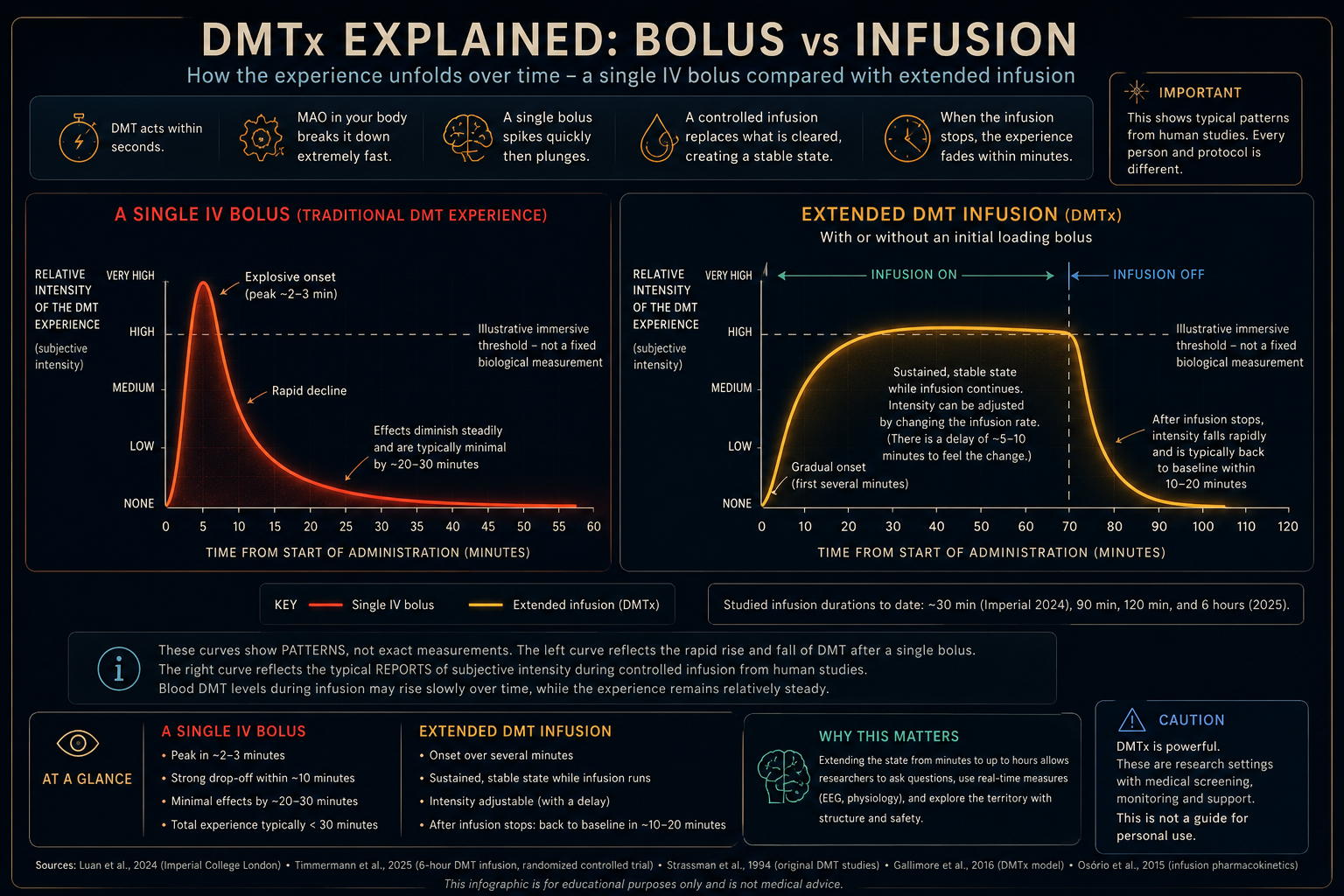
### Borrowing a machine from the operating theatre
The founding idea of DMTx was published in 2016 by **Andrew Gallimore** (a neurobiologist and pharmacologist) and **Rick Strassman** (the psychiatrist who ran the first modern human DMT studies in the 1990s). Their paper is often misdescribed as a clinical trial. It was not. It was a **modelling study** — a proof of concept done with mathematics and old blood-sample data, arguing that the trick *should* work and showing how.
Their insight was that anaesthetists already solve this exact problem every day. During surgery, a patient must be kept at a *stable* depth of anaesthesia — not too light (they wake up), not too deep (dangerous). To do this, anaesthetists use **target-controlled infusion (TCI)**: a computer-driven pump that constantly calculates how fast the body is clearing the anaesthetic and adjusts the drip to hold a chosen brain concentration steady. Gallimore and Strassman argued that DMT is almost perfectly suited to the same approach, because it ticks every box on the anaesthetist's wishlist: it dissolves in water, acts fast, wears off fast, clears quickly without building up, and — crucially — does not seem to lose its punch when repeatedly re-dosed (more on that shortly).
### The recipe, in plain English
The method they proposed is sometimes abbreviated **B.E.T.**, which stands for **Bolus, Elimination, Transfer** — the three things the pump has to account for. In ordinary language:
1. **Loading dose (the bolus).** A first, quick dose to bring the level up to the doorway fast, so the person is not left waiting.
2. **A top-up drip that starts high and then eases off.** In the first few minutes, the drug is not only being destroyed by MAO but also soaking into body tissues, so you have to feed a lot in to keep the level up. As the tissues fill and equilibrium is reached, you can throttle back to a lower, steady "maintenance" rate that simply matches ongoing destruction.
3. **The off switch.** Stop the drip and, because MAO never stopped working, the level falls away within minutes.
Gallimore and Strassman also pointed out *why an earlier attempt had gone wrong* — which turns out to matter a great deal for the safety story, so we will meet it in Part III.
---
## Part III — What actually happened when people tried it
It is one thing to model a trick on paper. Here is the real, human evidence, in order — a genuine ladder of studies, each going a little further. I have flagged what each one adds.
### The starting point: the bolus studies (Strassman, 1990s)
Rick Strassman's 1994 studies were the first modern human DMT research. He gave single IV **boluses** and confirmed the basic time-course: effects within seconds, peak around two minutes, essentially over by thirty. These studies also produced the first careful Western documentation of the entity phenomenon (Part V) and the rating scale still used to measure the DMT state. This is the "firework" baseline everything else is compared against.
### The cautionary tale: the first extended infusion (Gouzoulis-Mayfrank, 2005)
A German team ran the first genuinely *extended* DMT infusion — up to ninety minutes. But they set the drip rate by trial and error rather than by modelling the pharmacology, and the rate was too high: the DMT level kept climbing instead of holding steady. Three of fifteen volunteers dropped out because of distressing reactions. This is the failure Gallimore and Strassman later diagnosed: **without a pharmacokinetically-informed drip rate, you don't get a plateau — you get a slow overdose.** It is the single best argument for doing this carefully, and it is why later teams modelled the drip rate in advance.
### The proof it can be done cleanly: Imperial College (Luan et al., 2024)
This is the study most people mean when they say "the DMTx trial." A team at Imperial College London, with Christopher Timmermann among the authors and **Lisa Luan as first author**, gave **eleven** healthy volunteers a bolus followed by a constant-rate infusion, keeping them in the state for **thirty minutes**. What they found:
- **It worked.** Effects arrived within a minute, peaked at two, then settled into a stable plateau slightly below the peak — exactly the shape the model predicted. When the infusion stopped, everything resolved within about twenty minutes.
- **It was tolerable.** Anxiety stayed low. Heart rate spiked at the start but *habituated* — settled back toward normal — within about fifteen minutes, even while the experience continued at full strength. (One volunteer ended a higher-dose session early with anxiety and chest pain; follow-up heart tests were normal, and the team judged it psychological rather than cardiac. This is worth stating plainly rather than smoothing over: eleven carefully screened, psychedelic-experienced volunteers tolerating it is *preliminary* evidence of safety, not proof of safety for everyone.)
> **Plain-English aside — "habituation."** This just means getting used to something so your reaction to it shrinks, even though the thing itself hasn't changed. Your heart "habituates" to the DMT the way your ears stop noticing a fridge hum. Keep this word; it comes back.
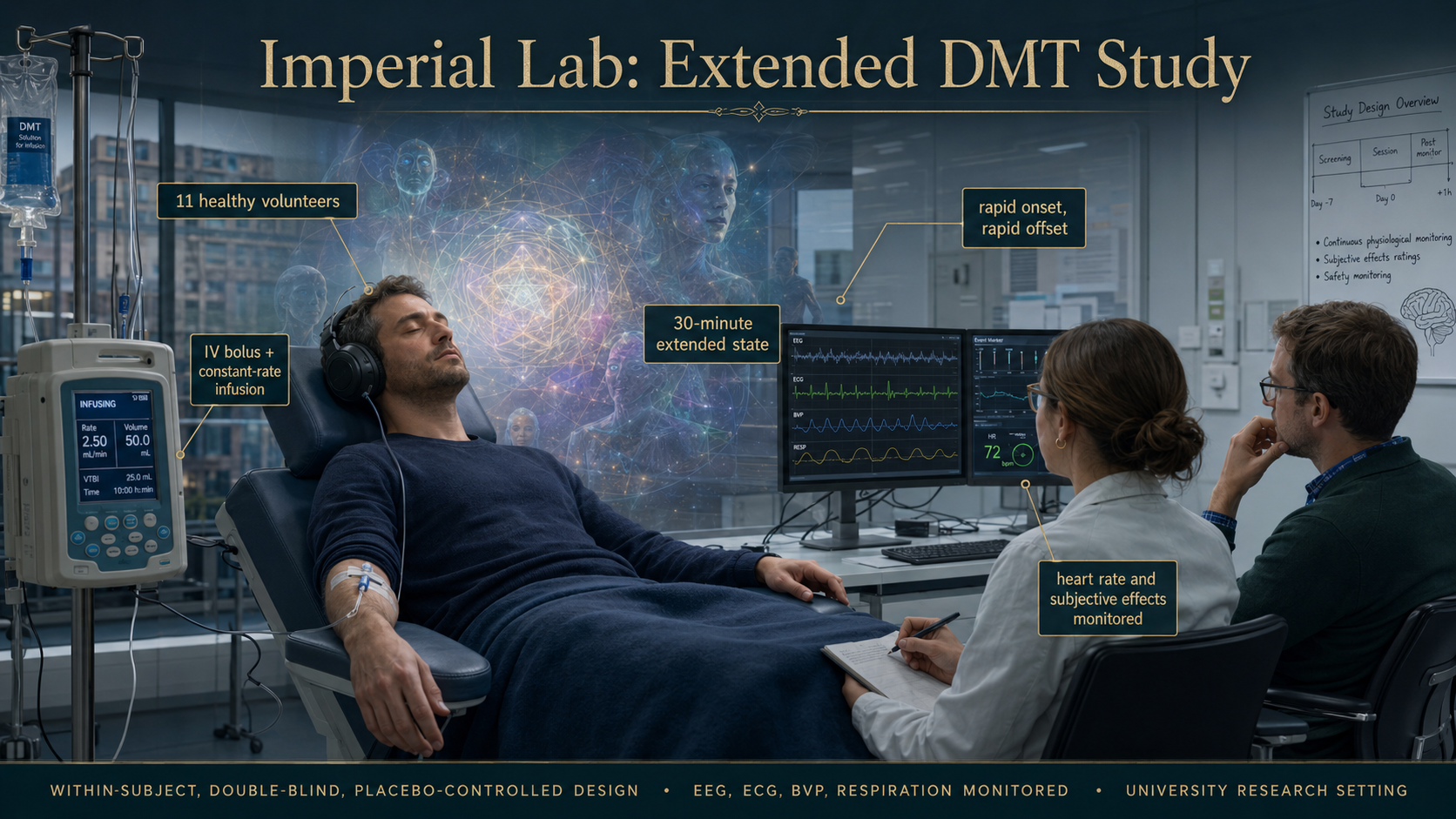
Illustrative reconstruction of an extended-DMT research session. Imperial’s study used an IV bolus followed by constant-rate infusion in eleven healthy volunteers.
### The current published ceiling: two hours, Basel (Erne, Vogt & Liechti, 2024)
A Swiss team at the University of Basel pushed the duration to **120 minutes** — two hours — in **twenty-two** volunteers, and added a genuinely novel twist. Two findings stand out, and both are important enough that the hype coverage tends to miss them:
1. **They dropped the bolus altogether — and it was *better*.** Rather than a loading hit plus a drip, they used a slow continuous infusion *with no bolus at all*. The effects climbed gradually, reached a plateau within twenty to thirty minutes, and held there for the full two hours — and this was *better tolerated* than a bolus, precisely because there was no violent launch to brace against. This is a real wrinkle in the original DMTx design: the loading "hit" may not be necessary, and leaving it out may be gentler.
2. **They let people steer.** In a final session, volunteers could *adjust their own dose* up or down at set points to reach the intensity they wanted — the first time self-titration has been formally tested with any psychedelic. People reliably chose strong-but-manageable effects, and fear was almost absent. Because DMT switches off so fast, a change to the drip rate takes effect within five to ten minutes — you can genuinely "drive" the experience.
The Basel team also nailed down the numbers: a firm ceiling where more drug stopped producing more *good* effect (and only added fear), and confirmation that DMT clears in two phases — a very fast one (about six to seven minutes) that tracks the experience, and a slower tail afterwards.
#### The published ceiling has moved — but read the small print
You may read that DMTx has been sustained for **six hours**. As of 2025 that is technically true — but it is very easy to misunderstand what was actually demonstrated, and the details matter more than the headline.
In 2025, **van der Heijden and colleagues** at the Centre for Human Drug Research in Leiden published a randomised, double-blind, placebo-controlled trial using a thirty-second IV bolus followed by a continuous **six-hour infusion** in healthy volunteers. It was safe: no serious adverse events, only mild and self-limiting side effects, and no significant abnormalities in vital signs or ECG. At the highest dose, participants showed measurable changes in attention, balance and EEG activity — but the psychedelic effects were explicitly **mild**.
That was not a disappointing result. It was the *design*. The infusion reached a maximum concentration of only about **35 ng/ml** — compare that with the 78–105 ng/ml the Basel team used to produce a *strong* psychedelic state (Part III). In other words, this study deliberately stayed at roughly a third of a breakthrough concentration. And it did so for a reason that has nothing to do with visions: the trial was funded by a pharmaceutical company (Algernon) and designed to test DMT as a possible **neuroplasticity-promoting, neuroprotective treatment for stroke** — where the goal is prolonged, *low-level* exposure to encourage the brain to rewire, not an immersive experience. The researchers were not even *trying* to produce the psychedelic state.
So the published literature now has two different kinds of "ceiling":
- **Up to 120 minutes** for a deliberately strong, adjustable psychedelic state (Basel).
- **Six hours** for prolonged *lower-intensity* administration designed to test safety, blood levels and physiological effects (van der Heijden).
"DMT has been infused for six hours" is now accurate. "Scientists have held a full DMT breakthrough open for six hours" is not. Preserving that distinction is exactly the kind of care that matters as DMTx moves from the laboratory into headlines and sales brochures.
**The ladder, at a glance:** single bolus (\~30 minutes total, Strassman in the 1990s) → first extended infusion, 90 minutes but poorly controlled (Gouzoulis-Mayfrank, 2005) → the mathematical blueprint (Gallimore & Strassman, 2016) → clean 30-minute bolus-plus-infusion (Imperial, 2024) → 90- and 120-minute continuous infusions, including self-titration without a bolus (Basel, 2023–2025) → six-hour bolus-plus-infusion at sub-psychedelic exposure, demonstrating prolonged, medically monitored administration (van der Heijden et al., 2025). The published ceiling for **administration** is now six hours; the published ceiling for a sustained, deliberately strong psychedelic state remains two.
---
## A timeline of the whole story
*A scannable spine — the dates that matter, in order.*
- **1931** — DMT is first synthesised in the lab (Richard Manske). Nobody notices what it does.
- **1956** — Stephen Szára, a Hungarian chemist and psychiatrist, injects himself and discovers DMT is powerfully psychoactive in humans. The modern story begins.
- **1970** — DMT is placed in Schedule I, the most restrictive legal category. Research nearly halts for two decades.
- **1990–1994** — Rick Strassman runs the first modern human DMT studies (New Mexico); the landmark papers appear in 1994\. This is the "firework" bolus baseline — and the first careful Western record of the entities.
- **1996** — Strassman, Qualls & Berg show that four repeated boluses produce *no* tolerance to the experience, while the body habituates: "differential tolerance."
- **2016** — Gallimore & Strassman publish the DMTx blueprint — a mathematical model, not a trial — borrowing target-controlled infusion from anaesthesia.
- **2019** — Dean and colleagues show the rat brain itself manufactures DMT, with levels surging after cardiac arrest.
- **2020** — Davis and colleagues publish the 2,561-person entity-encounter survey.
- **2022** — D'Souza and colleagues (Yale) find an early signal for DMT in treatment-resistant depression.
- **2023–2024** — Basel and Imperial run the first clean extended infusions: 30 minutes, then 90, then 120 — the last with no bolus and with self-steering.
- **2025** — Van der Heijden and colleagues publish a six-hour bolus-plus-infusion study in healthy volunteers, funded by a pharmaceutical company and aimed at stroke recovery. It reached only sub-psychedelic exposures (\~35 ng/ml) and produced mild effects — demonstrating prolonged, medically monitored *administration*, not a six-hour breakthrough.
- **2026** — Eleusis opens on Bequia selling commercial DMTx; Hoffman, Gallimore & Hermansson post *Traces of the Other*, proposing a way to test whether the entities are real.
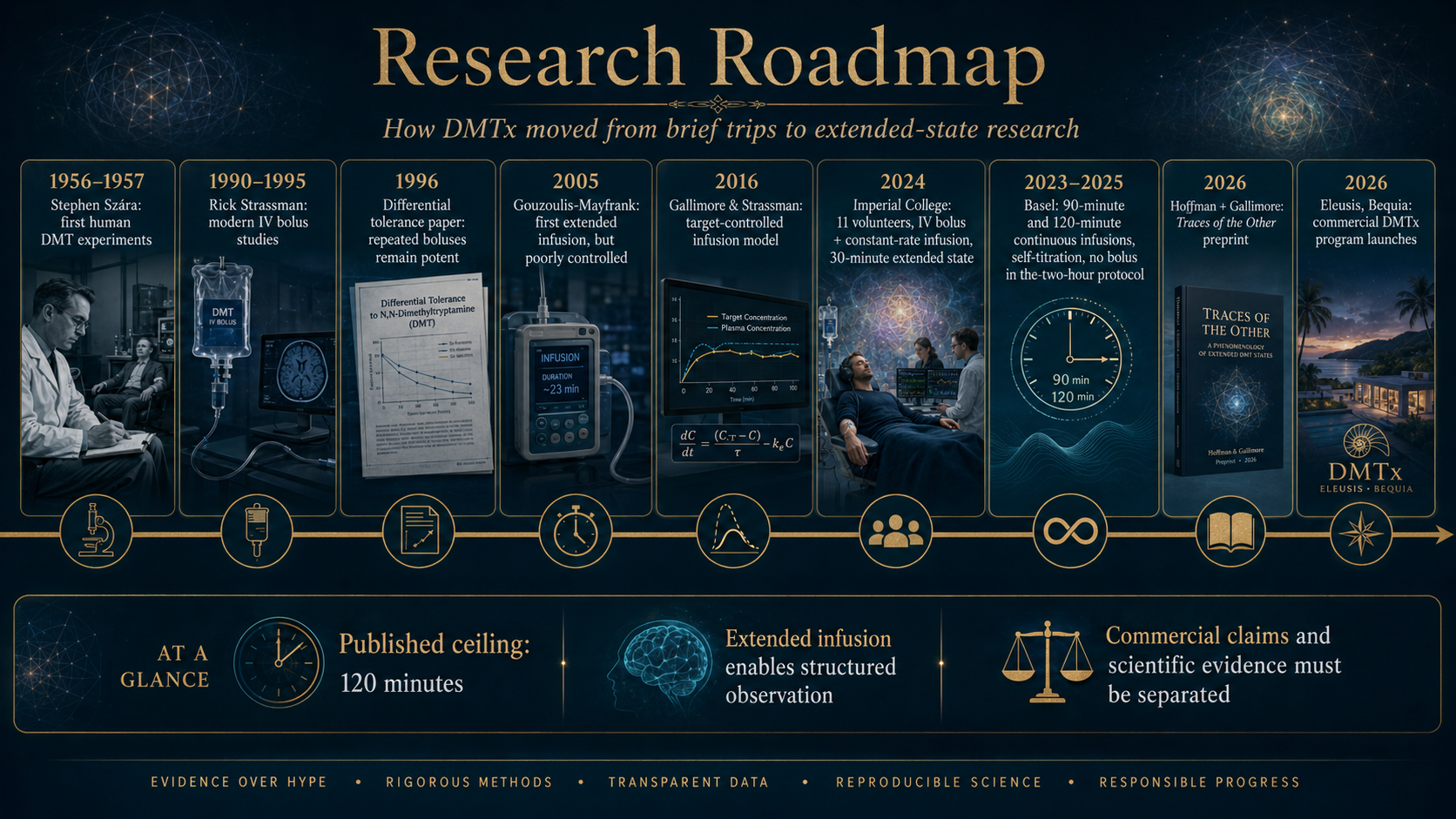
From Szára’s first human experiments to extended infusions, commercial DMTx and proposed structured entity research.
---
## Part IV — The three genuinely strange findings
Extending the state didn't just make the experience longer. It exposed three things that are scientifically odd and worth understanding, because they are where DMTx stops being mere engineering and starts being interesting.
### 1\. The mind gets used to it faster than the body clears it (acute tolerance)
Here is a genuine puzzle. During a continuous infusion, the amount of DMT in the blood keeps slowly *rising* after the first ten minutes or so. But the *intensity of the experience* does not keep rising to match — it plateaus, and can even drift down slightly. More drug, same-or-less experience. Both the Imperial and Basel teams saw this clearly.
The technical name is **acute psychological tolerance** — within a single session, the mind habituates to the state even as the chemical keeps accumulating. (Scientists spot it as a tell-tale mismatch between the drug-level curve and the effect curve.)
Now the beautiful contrast — and this is why the older paper Strassman, Qualls & Berg (1996) matters so much. In *that* study, volunteers received **four separate full boluses**, half an hour apart. And there was **no tolerance to the psychedelic experience at all** — the fourth hit was as strong as the first. This was one of the discoveries that made DMT seem unique among psychedelics, and it was part of what made DMTx seem possible in the first place.
But — and this is the elegant, easily-missed part — in that same 1996 study, the *body* did habituate. The stress-hormone surges (ACTH, prolactin, cortisol) and the heart-rate jump all shrank with each repeated dose, even though the *subjective* experience did not. Strassman called this **"differential tolerance"**: the mind and the body were running on separate clocks.
Put the studies together and a clean picture emerges:
- **Repeated, separate boluses** → the *experience* stays fully potent (no psychological tolerance), while the *body's* stress response quietens down.
- **One long, continuous infusion** → the *experience* plateaus and mildly fades (some psychological tolerance appears) as the drug steadily accumulates.
So "DMT doesn't build tolerance" — a thing you will often read — turns out to be true only for one particular pattern of dosing. Change *how* you give it, and the picture changes. That is not a contradiction in the science; it is the science being more precise than the slogan.
### 2\. The world is replaced, but you are still there (low ego dissolution)
With high doses of LSD or psilocybin, one of the hallmark experiences is **ego dissolution** — the felt boundary between "me" and "everything else" softening or vanishing, the sense of being a separate self dropping away. It is usually tied to the peak of those experiences.
DMTx produces something conspicuously different. Across the extended-state studies, people report their surroundings being *completely replaced* — intense imagery, immersion, encounters with apparent beings — while **ego dissolution stays low**. In plain terms: the world around you is swapped out for another one, but *you*, the observer, remain intact enough to watch it, remember it, and (in principle) report on it and run tasks inside it.
This needs one careful caveat, because it is easy to overstate. "Low ego dissolution" refers to one specific measure. Other, related measures *did* rise — feelings of unity, of the sacred, of transcendence, and at higher doses a "dread" of losing the self. So it is not that the self is untouched; it is that a functional, observing "you" tends to persist even while the environment is utterly transformed. And these comparisons are across different studies, not a head-to-head test of DMT against LSD in the same people — so "unlike LSD and psilocybin" is a reasonable inference, not a proven result.
Why does this matter? Because it is precisely what makes DMTx *scientifically useful*. If you were fully dissolved, you couldn't observe carefully, hold a question in mind, or perform a task. A preserved observer inside a fully replaced world is the thing that turns the DMT state from an unrepeatable flash into something you might actually *study from the inside*.
### 3\. The beings tend to show up late
In the extended sessions, people's retrospective maps of their own experience showed something intriguing: **entity encounters tended to increase in the *later* part of the infusion**, and most clearly at higher doses — not right at the explosive onset. Immersion and visual imagery roughly tracked overall intensity, but the sense of *meeting someone* built over time.
Two important cautions. First, these are **retrospective** ratings — people reconstructing the shape of the experience afterwards, which memory distorts. The researchers were careful not to over-analyse them for this reason, and neither should we. Second, the popular claim that "entities arrive at the ten-minute mark" is too precise; the honest statement is that entity encounters *rose during the later portion of the session at higher doses*. (The ten-minute figure actually belongs to a *different* fact — that's roughly when the drug level starts climbing again during an infusion.)
Still, the direction is genuinely interesting. In a normal five-minute bolus, you would be *coming down* by the time this later phase arrives. Under infusion, the experience stays available long enough to *develop* — to move from initial visual shock toward something more like sustained encounter — rather than merely exploding and vanishing. Whether that reflects the mind settling enough to *notice* the beings, or the state genuinely evolving over time, is exactly the sort of question extended sessions were built to investigate.
---
## Part V — The beings: what people actually report meeting
Any honest account of DMT has to deal with its single most consistent and most bewildering feature: at high doses, a large fraction of people report encountering what seem to be **autonomous, intelligent, non-human entities**. Not vague impressions — specific, interactive, apparently independent *others*. Rick Strassman estimated that roughly half of his high-dose volunteers reported contact with such beings. Later work puts the figure for a full "breakthrough" dose in the same range — around half.
The best single source on *what* people report is a survey by **Davis and colleagues (2020)** of **2,561** people describing their most memorable DMT entity encounter. The findings are remarkably consistent:
- **How the entity was perceived:** overwhelmingly **visual** (92%) and, strikingly, **"extrasensory" / telepathic** (85%) — a felt, wordless exchange of meaning rather than speech.
- **What people called it:** the most common labels were "being" (60%), "guide" (43%), "spirit" (39%), "alien" (39%) and "helper" (34%). More specific labels (elf, angel, plant spirit, and so on) appeared at much lower rates.
- **Who started it:** in most cases (69%) people felt the *entity* initiated the encounter — it was already there, waiting, rather than summoned.
- **The emotional tone:** despite 41% reporting fear at some point, the dominant emotions — in the person *and* attributed to the entity — were love, kindness, and joy. The single most prominent emotion reported was love.
- **What the entity seemed to be:** most rated it as conscious (96%), intelligent (96%), benevolent (78%), and sacred (70%).
And then the part that makes this more than a curiosity — the *aftermath*:
- **72%** believed the entity *continued to exist* after the encounter ended.
- **80%** said the experience altered their *fundamental conception of reality*.
- Even *after* the experience, **65%** rated it as "more real than" everyday waking life.
- Among people who identified as **atheist beforehand, the proportion more than halved afterwards** (28% → 10%); belief in a higher power, ultimate reality or universal divinity rose sharply (36% → 58%).
Researchers call this last effect **"ontological shock"** — a lasting jolt to a person's basic beliefs about what is real. And notably, DMT entity encounters closely resemble non-drug reports from utterly different contexts: religious visions, near-death experiences, and even alien-abduction accounts show overlapping features. Whatever is happening, it is tapping into something deep and cross-cultural in human experience.
> ▨ Why do the same beings keep appearing?
>
> For decades the anthropologist **Michael Winkelman** has catalogued strikingly similar entity encounters across wildly separate traditions — Amazonian ayahuasca, Siberian and Mongolian shamanism, African initiatory religions, Native American ceremony — and across non-drug states too: dreams, sleep paralysis, and near-death experiences. His argument is not that this proves spirits are real. It is almost the reverse, and more interesting: that *something in the shared architecture of the human mind* reliably produces the same categories of being — the guide, the guardian, the trickster, the healer, the teacher — whoever you are and wherever you live.
>
> That quietly reframes the whole "are they real?" debate. Because whichever side you favour — the brain *generates* them, or the brain *perceives* them — the deeper puzzle is the **consistency**. Why these beings and not others? Why the same recurring cast, across every culture that has ever looked? Any complete theory of the DMT state has to explain not merely *that* people meet entities, but why humanity keeps meeting the *same* ones.
None of this, it must be said clearly, tells us whether the beings are *real* in any external sense. It tells us that the *experience* of meeting them is vivid, consistent, emotionally profound, and life-altering. That is the phenomenon to be explained — not the answer to it.
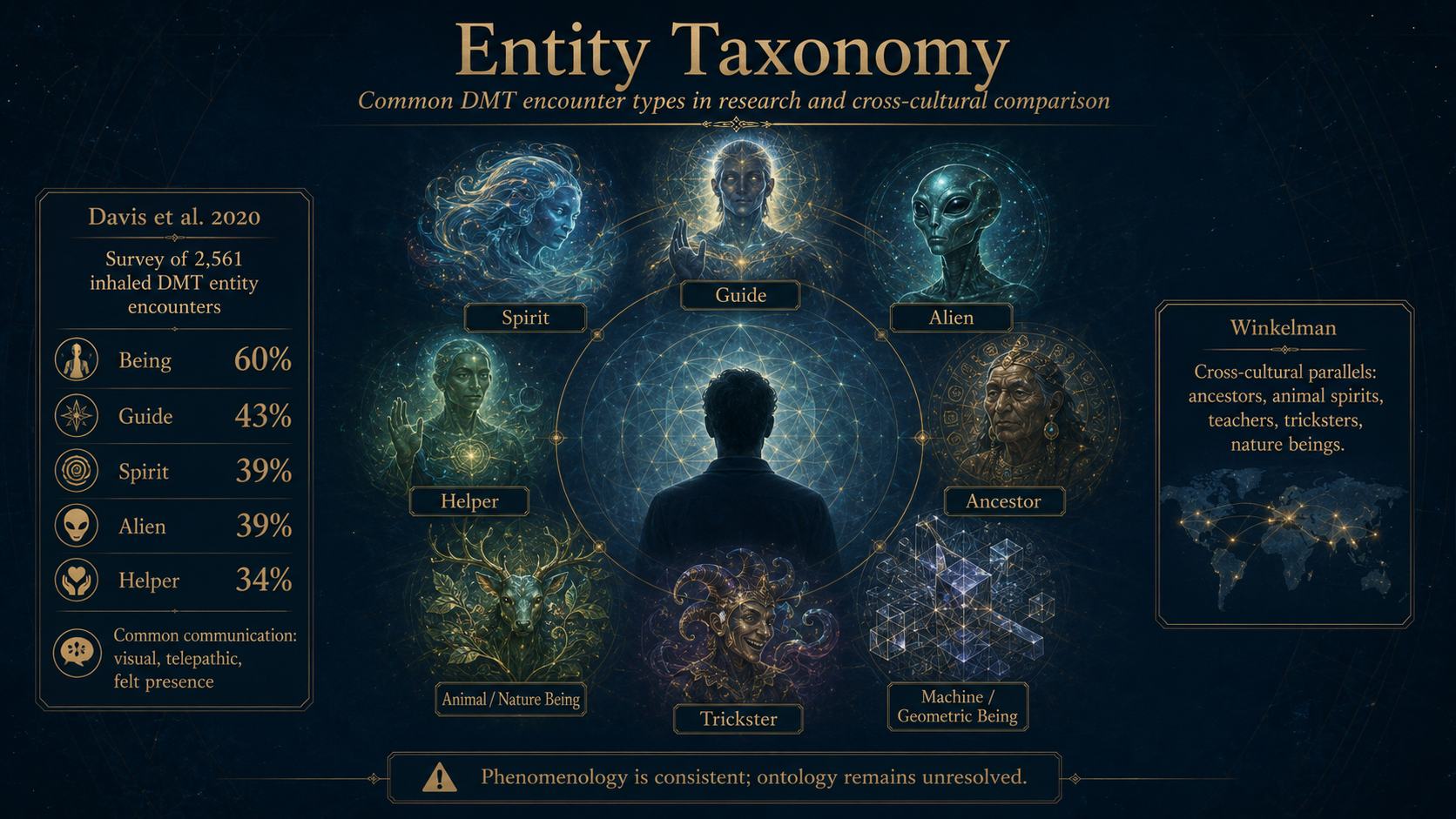
Common labels and recurring entity types drawn from the Davis et al. survey and Michael Winkelman’s cross-cultural analysis. Categories overlap and do not establish what the entities are.
---
## Part VI — The big question: are the entities "real"?
This is where DMTx collides with the deepest question in the whole field, and where you should hold on to your wallet *and* your credulity, because it is also where the marketing gets loudest.
There are, broadly, two hypotheses.
**Hypothesis A — the entities are internally generated.** They are produced by your own brain: by its social machinery (the same circuitry that models other minds), its agency-detection systems (evolved to spot predators and allies, and prone to firing even when nothing is there), its visual and emotional systems, all thrown into an extraordinary state. On this view the beings feel utterly real for the same reason dream characters feel real while you dream — because your brain is very good at generating convincing others. This is the mainstream neuroscientific default, and it is the more conservative position: it requires no new assumptions about the universe.
**Hypothesis B — the entities are, at least sometimes, perceptions of something not generated solely by you.** This is the radical option, and it has just acquired its most serious formulation.
### Conscious realism, in plain English
The cognitive scientist **Donald Hoffman** has spent years arguing a counter-intuitive idea called **conscious realism**. The easiest way in is his own metaphor: your perception of the world is like a **computer desktop**. The icons on a desktop — little folders and files — are useful, but they are not what is *really* going on inside the machine (which is voltages and logic gates you never see). Hoffman argues that space, time, and physical objects are like those icons: a **species-specific interface** evolved to keep us alive, *not* a truthful picture of ultimate reality. He backs this with a mathematical result he calls **"Fitness Beats Truth"**: evolution, he argues, actively favours perceptions that are *useful* over perceptions that are *accurate*, because the two usually come apart.
If that is right, then what is "really" out there is not matter in space but — in his framework — a vast network of interacting **conscious agents**, of which our ordinary interface shows us only a thin sliver. The rest is filtered out, not because it isn't there, but because seeing it never helped our ancestors survive.
The provocative move is obvious once you see it: **what if DMT alters the interface itself** — nudges the "desktop" so that agents normally filtered out briefly leave a mark on experience? On this view the entities would be neither hallucinations nor spirits in the traditional sense, but *traces* of parts of reality our everyday perception is built to ignore.
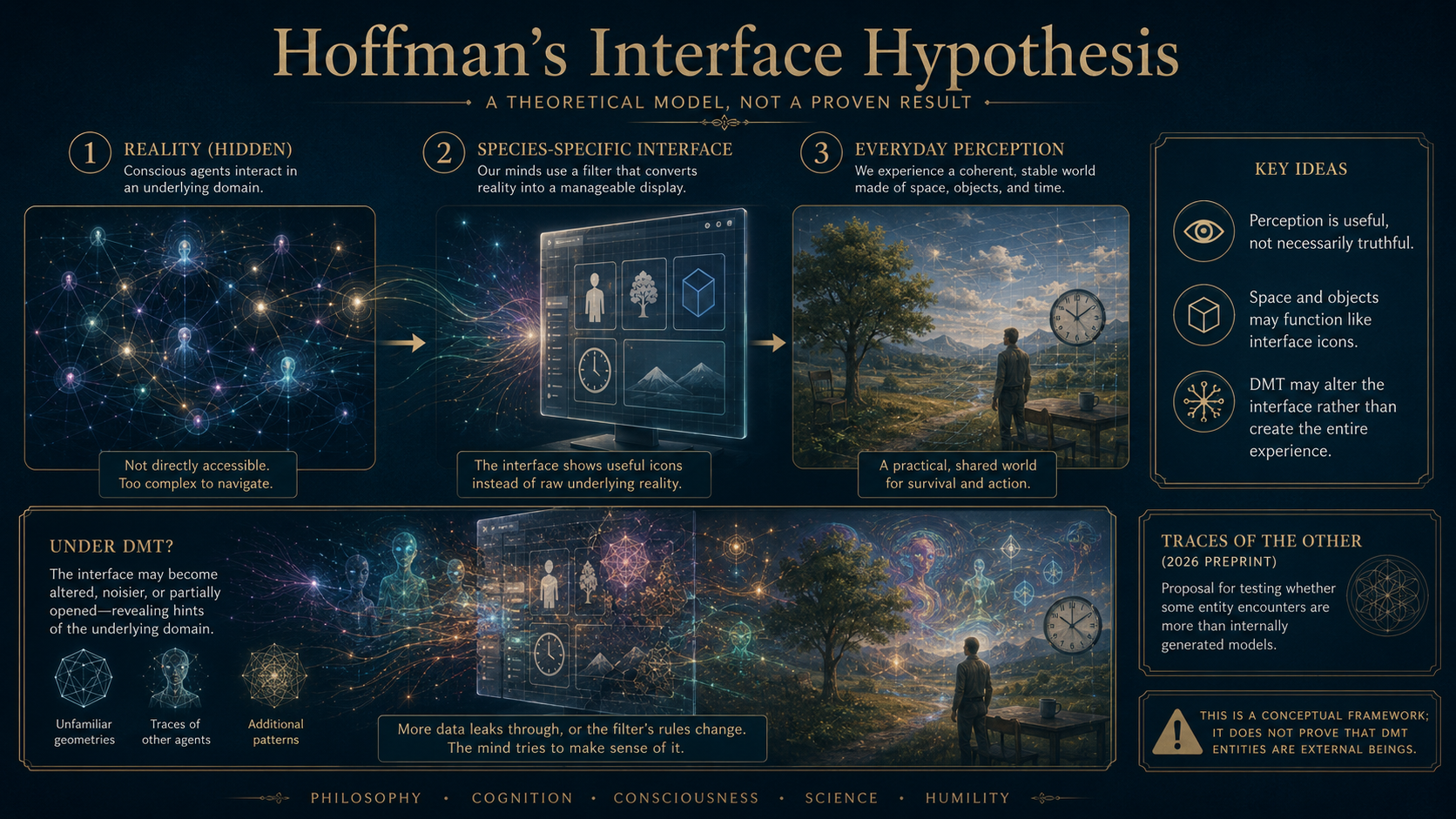
Donald Hoffman’s interface hypothesis, simplified: ordinary perception may display a survival-oriented model rather than reality as it is. Its application to DMT remains theoretical.
### "Traces of the Other" (2026) — what it is, and what it is not
In May 2026, Hoffman, Gallimore, and the mathematician Niffe Hermansson posted a preprint titled *Traces of the Other – Are DMT Entities Real?*, laying out this framework in full mathematical dress. It has drawn enormous attention, so it is worth being extremely precise about what it actually is:
- It is a **preprint** — posted online, **not yet peer-reviewed**.
- It is **theoretical**. By the authors' own statement, it reports **no experiments and no data**. It is a proposal.
- Most importantly: it **explicitly keeps the "hallucination" explanation as the default.** Its actual claim is modest and, frankly, reasonable — that the external-agent hypothesis has been *dismissed* rather than *tested*, and that it can be *reformulated so that it could, in principle, fail a test.* That is a legitimate scientific move. It is a long way from "scientists have shown the entities are real," which is how it is sometimes reported.
The two organisations involved divide the labour: **Noonautics** (Gallimore's non-profit) would supply the extended-state DMTx protocol to send trained observers into the state; the **Trace Institute** (Hoffman's) supplies the mathematics. The plan is to have skilled observers make careful, structured observations inside long DMT sessions and derive predictions that could distinguish Hypothesis A from Hypothesis B.
### How would you *ever* test such a thing?
This is the genuinely hard part, and it is worth understanding why. Simply asking people "did it feel real?" settles nothing — DMT entities already feel *more* real than reality. The felt-realness is the thing being explained, not evidence for either side.
A real test needs observations that would come out *differently* depending on which hypothesis is true. The kinds of experiments proposed (by these authors and others over the years) include:
- **Hidden-target tasks.** A computer randomly picks a symbol or number *after* the person is already in the state; nobody present knows it. The person asks the entity for the answer. Getting it right, repeatedly, above chance, would be very hard to explain by "your own brain made it up."
- **Separated-participant tests.** Two people, in isolated rooms, asked to reach the "same place" or a shared target. Mere similar imagery wouldn't count — you'd need precise, pre-specified correspondence.
- **Repeat-visit mapping.** Can a person return to the "same" location or entity across sessions, with independent judges scoring the consistency against criteria fixed in advance?
- **Perturbation.** Change some hidden external variable and see whether features of the reported world track it in a predicted way.
### The catch that won't go away
Even a perfectly repeatable, richly detailed entity encounter would *not*, by itself, prove the beings are external — because humans share a brain design. Shared wiring can produce shared experiences with no external cause: migraine sufferers who have never met report the same geometric "fortification" patterns; dreamers everywhere meet convincing people their own brains invented. This is the problem of **underdetermination** — the same evidence fitting more than one explanation.
But — and this cuts both ways — calling something a "hallucination" *names* its presumed origin without actually *explaining* it. Why are DMT worlds so densely populated? Why do the beings seem autonomous? Why do technological and "hyperdimensional" motifs recur? Why can the sense of reality *exceed* waking life? Neuroscience owes real answers here, and does not yet have them. The most defensible position today is the conservative one — internally generated — held with genuine humility about how much remains unexplained. And the one thing Gallimore and Hoffman are clearly *right* about, whatever you make of their metaphysics, is the methodological point: an idea that can be *tested and fail* is better than one argued forever through anecdote.
---
## The other side of the table — the naturalists' reply
It would be easy to leave Part VI thinking the Hoffman–Gallimore view is the only game in town. It is not, and it is ARDMT's job to say so plainly. The large majority of neuroscientists and philosophers of mind hold that DMT entities are generated *by the brain* — and they are not merely asserting it. They have detailed, well-developed frameworks that account for the phenomenology without invoking anything outside the skull. A fair reader should weigh these before being swept away.
**The "controlled hallucination" view (Anil Seth and the predictive-processing tradition).** On this now-mainstream account, ordinary perception is *always* a kind of controlled hallucination: your brain never sees the world directly, it constantly generates a best-guess model and corrects it against incoming signals. What you experience is the model, not the raw world. Psychedelics, on this view, don't open a door to elsewhere — they loosen the brain's grip on its own predictions, so the model runs unusually free. The entities are what an unconstrained world-model produces once its normal reality-checks are turned down. No new physics or metaphysics required.
**The free-energy / active-inference tradition (Karl Friston and colleagues).** A more mathematical cousin of the above: the brain is cast as a prediction machine forever trying to minimise "surprise," and its deep, high-level assumptions about reality are called *priors*. Which leads directly to —
**The entropic brain and REBUS (Robin Carhart-Harris).** Here is the delicious irony: Carhart-Harris is **one of the authors of the very Imperial extended-DMT study** at the centre of this piece. His model, developed with Friston, is called **REBUS** — "RElaxed Beliefs Under pSychedelics." The idea is that psychedelics relax the brain's highest-level priors, letting lower-level activity bubble up unchecked and raising the "entropy" (roughly, the richness and disorder) of brain activity. The DMT world, on this account, is precisely what you get when the brain's ordinary constraints are released: vivid, autonomous-seeming, more-real-than-real — and entirely home-made. In other words, one of the people who *built the tool* that makes Hoffman's experiments possible holds a thoroughly naturalistic view of what those experiments will find.
**The hard sceptic (David Nichols).** Nichols, an eminent medicinal chemist, has spent years pushing back on romantic readings of DMT — arguing, for instance, that the "the pineal gland floods you with DMT" story is myth, and that endogenous DMT levels are almost certainly far too low to do anything mystical. He is the reliable cold shower, and the field is healthier for him.
**Even the adventurous camp disagrees with itself.** This is not a tidy "Hoffman versus the mainstream." Andrés Gómez-Emilsson, at the Qualia Research Institute, offers a *different* non-standard account — that DMT drives experience into a regime of such extreme energy that the very geometry of perceived space reorganises into hyperbolic, higher-dimensional forms. Whether that supports Hoffman's conscious agents or merely rhymes with them is unresolved. The point is that "the entities are more than hallucinations" is not one idea but several competing ones.
A fair bottom line: as of this writing, **no formal, peer-reviewed rebuttal of *Traces of the Other* has appeared** — the preprint is only weeks old and, being a proposal rather than a result, there is as yet nothing empirical to rebut. But the frameworks above are how mainstream neuroscience already explains everything in Part V without ever leaving the head. The honest state of play is not "Hoffman is winning." It is this: a bold, testable proposal has been made, and a large, well-armed naturalist consensus is waiting to see whether any experiment can trouble it.
---
## Part VII — Is it already inside us?
A fact that unsettles people the first time they hear it: **your own body makes DMT.** It is one of the very few psychedelics produced *endogenously* — that is, internally — by mammals, including humans. This has fuelled decades of romantic speculation. Here is the careful version.
The manufacturing pathway is known: from the dietary amino acid tryptophan, the body makes tryptamine, and then an enzyme called **INMT** (indolethylamine-N-methyltransferase) adds the two methyl tags that turn it into DMT. That much is solid.
The strongest recent evidence comes from **Dean and colleagues (2019)**, who showed that the rat brain contains the full machinery to *make* DMT (the necessary enzymes sitting together in the right cells), and detected DMT in the living rat cortex at levels *comparable to* familiar signalling chemicals like serotonin. Most evocatively, they found DMT levels **surged in the brain after cardiac arrest** — which is catnip for anyone interested in near-death experiences.
Now the discipline. This is precisely the kind of finding that gets over-read, so:
- The "comparable to serotonin" claim is **contested**. A pointed critique (led by David Nichols, a very senior figure in the field) argues the concentrations are still far too low to produce a psychedelic effect under normal conditions, and that "we can make it" is not the same as "it does something."
- We genuinely **do not know what endogenous DMT is for**. Leading guesses involve protection of brain cells under stress (via that sigma-1 receptor mentioned earlier) or a role in early development — not necessarily anything to do with visions at all.
- The popular story that "your brain floods you with DMT as you die" is, at present, **not established.** The cardiac-arrest surge in rats is real and fascinating; the leap to explaining human near-death experiences is speculation, not fact.
The honest summary: DMT is unmistakably present in us, its purpose is unknown, and every strong claim about that purpose currently outruns the evidence. Which is itself a good reason to keep studying it — and a good reason not to believe the confident stories.
---
## Part VIII — The medical angle
Set the metaphysics aside entirely, and there is a sober, practical reason for interest in DMTx: **depression**.
The clearest human hint so far comes from **D'Souza and colleagues (2022)** at Yale, who gave IV DMT to a small group including **seven people with treatment-resistant depression** — people who had failed multiple prior treatments, ill for decades on average. The day after the higher dose, their depression scores dropped meaningfully (a medium-to-large effect). Two details make this genuinely interesting for ARDMT's purposes:
1. It was done in **a plain hospital room — no art, no curated music, minimal psychotherapy** — and still showed an effect. This speaks to a live debate in the field about how much of psychedelic therapy's benefit depends on elaborate "set and setting" versus the drug itself.
2. DMT showed **low signs of abuse potential** — after the session, people were, if anything, *less* keen to repeat it, and valued it at a token amount.
This was a small, open-label, early-stage study — a hint, not a verdict. But it points to why the *extended* state is attractive for medicine specifically. With DMTx you could, in principle, **tune** a therapeutic session in real time: ease someone in gently, deepen the state to do difficult work, create calmer "rest periods," then bring them down — all within a session that lasts a manageable half-hour to two hours rather than the six to twelve hours of psilocybin or LSD. Because DMT switches off within minutes of stopping the drip, it is, in one specific sense, *more controllable* — and therefore potentially safer and cheaper to deliver — than any other classic psychedelic. That controllability, not mysticism, is the strongest practical case for the whole enterprise.
---
## Part IX — The Bequia question: where science meets salesmanship
Everything above is research. This section is commerce, and it is where a sceptical eye earns its keep.
In early 2026, a private operation called **Eleusis** announced its debut on the island of **Bequia**, in Saint Vincent and the Grenadines, describing itself as **"the world's first legal luxury psychedelic immersion"** built around **DMTx protocols**. It is a residential, high-end, invitation-style programme with medical staff, and it lists Christopher Timmermann — one of the genuine Imperial researchers — as its research director.

Illustrative representation of a medically supervised DMTx immersion on Bequia—not a documentary image of the Eleusis facility.
There is nothing inherently wrong with a legal, medically-supervised centre. But several things deserve a clear, unsentimental eye, and this is exactly the sort of place where ARDMT's job is to separate what is *demonstrated* from what is *asserted*:
**On the science being claimed.** Eleusis's own materials describe holding a "breakthrough" state for **30 to 60 minutes** — which is squarely within what the published research supports, and notably *shorter* than the "two-hour" figure that floats around in coverage. So far, so reasonable. But the same materials also make striking claims — "sustained reductions" in treatment-resistant depression and PTSD, a "30 percent rise in executive function" at 60 days — attributed to "pilot cohorts" with **no published data behind them.** Those are marketing numbers, not findings. Testimonials and glossy outcome figures are not the same thing as peer-reviewed evidence, and the distinction should be kept bright.
**On "legal" and "licensed."** These are the operation's *own* descriptions. The interesting question — and one worth asking precisely rather than waving through — is: *legal under exactly what instrument?* A specific national licence? A research authorisation? A gap in local law? "World's first legal" is a marketing phrase until an actual legal basis is identified and can be examined. This matters because the word "legal" is doing enormous reassurance-work for a prospective participant, and reassurance is precisely what should be evidence-backed.
**On the research-versus-retreat boundary.** Describing a paid immersion as a "research immersion" blurs a line that ethics committees exist to keep sharp. In real research, participants are volunteers in an ethically-approved protocol with independent oversight; they are not customers. When guests pay for an experience *and* are described as contributing to research, it is fair to ask who owns the data, who approved the protocol, and whether marketing and science are being allowed to launder each other's credibility. (It is worth noting that public criticism along exactly these lines already exists.)
None of this is to prejudge Eleusis specifically. It is to model the *questions* any reader should bring to any commercial DMTx offering — because the gap between "a real technique with real published support" and "a luxury product wrapped in that technique's prestige" is precisely where people get misled.
---
## A careful scorecard
Pulling the whole thing together — what is solid, what is shaky, and what is genuinely new:
**Solid.**
- A normal DMT experience really is over in minutes, because the enzyme MAO destroys it almost as fast as it arrives.
- DMTx — a loading dose (or none) plus a continuous drip — really can hold the state stable for **up to two hours**, safely and tolerably, in screened healthy volunteers.
- Continuous infusion **without** a bolus appears *better* tolerated than the original bolus-based design (Basel).
- The state shows **acute psychological tolerance** during a long infusion (effects plateau as drug levels keep rising), while **repeated separate boluses** show no such tolerance to the *experience* — a real, precise, and initially confusing pair of facts that fit together once you separate "the mind" from "the body" and "one long dose" from "several separate ones."
- Entity encounters are common (around half of breakthrough experiences), consistent, emotionally profound, and frequently life-altering. The *experience* is beyond dispute.
- The body makes DMT; what for is unknown.
- There is an early, real hint that DMT may help treatment-resistant depression.
**Shaky or overstated.**
- **"Six-hour breakthrough trips":** unsupported. A six-hour infusion has now been published, but it was deliberately kept at roughly a third of a breakthrough concentration (\~35 ng/ml) for a stroke-neuroplasticity study, and produced only mild effects. The longest published deliberately-strong, sustained psychedelic sessions remain two hours.
- "Entities appear at ten minutes": too precise; they rise later in the session at higher doses, per *retrospective* (memory-based) ratings.
- "Endogenous DMT explains near-death experiences" / "is at functional levels in the brain": contested and, at best, unproven.
- Commercial claims of specific therapeutic outcomes ("30% cognitive improvement," etc.): marketing, not evidence.
- "Scientists have shown DMT entities are real": false. What exists is a *theoretical, un-peer-reviewed proposal* to make the question testable — which still treats "hallucination" as the default.
**Genuinely new — and the real story.** The headline is not that anyone has proven anything about the nature of the beings. It is quieter and more important: for the first time, extended infusion turns the DMT state from an almost un-observable flash into a **stable, adjustable, steerable environment** — one a person can remain inside, with a functioning observing self, long enough to look around, hold a question, and perform a task. That is what makes better science newly possible. It is *also* what makes it newly possible to build an attractive commercial mythology on top of findings that remain early. Both things are true at once, and telling them apart is the whole game.
---
## Coda — what actually changed
For seventy years DMT has been one of science's sharpest paradoxes: quite possibly the most extraordinary experience a human nervous system can have, and almost impossible to study — because it vanishes before careful observation can begin. You cannot map a country you are only ever flung through at speed.
Extended-state DMT changes that, and this is the thing to hold on to when the metaphysics gets loud. Whether the worlds people enter are spun entirely from their own neurons, or are glimpses of something our ordinary senses are built to screen out, or are something our present categories simply fail to capture — the decisive shift is **methodological, not metaphysical**. For the first time, a person can stay inside the experience long enough, stably enough, and clear-headed enough to ask a structured question and watch what happens, rather than stagger out clutching a fading memory.
That does not answer the mystery. It does something rarer: it turns an unanswerable mystery into an *investigable* one. The door that used to slam shut in five minutes can now be held open — and what waits on the other side is, at last, a question that experiments, and not only stories, might begin to settle.
---
## Glossary (the A-to-Z)
**5-HT2A receptor** — the main "docking port" in the brain that DMT (and LSD, and psilocybin) switches on to produce its effects.
**Acute tolerance** — getting used to a drug's effect *within a single session*, so the same amount does less. DMT shows this during a long infusion, but not across repeated separate injections.
**Ayahuasca** — an Amazonian brew combining a DMT-containing plant with a second plant that blocks the DMT-destroying enzyme (MAO), so the DMT lasts for hours when drunk.
**Blood-brain barrier** — the biological filter that keeps most substances out of the brain. DMT crosses it easily.
**Bolus** — a single, all-at-once dose. The "firework." Contrast with *infusion*.
**Breakthrough** — the point at which a high enough dose replaces the ordinary world entirely with the DMT "space."
**Conscious realism** — Donald Hoffman's theory that physical reality (space, time, objects) is a useful "interface," like desktop icons, rather than a true picture of what's really there.
**DMT** — N,N-dimethyltryptamine. A small, fast-acting, extremely powerful psychedelic molecule, chemically related to serotonin and melatonin, found throughout nature and made in trace amounts by the human body.
**DMTx** — extended-state DMT: techniques (loading dose and/or continuous infusion) that hold the DMT experience stable for far longer than the usual few minutes.
**Ego dissolution** — the felt dropping-away of the boundary between self and world. Prominent with LSD/psilocybin; conspicuously *low* in DMTx (the world is replaced but "you" remain to watch).
**Endogenous** — produced inside the body. Human beings make DMT endogenously.
**Entity encounter** — the experience, reported by roughly half of breakthrough users, of meeting apparently autonomous, intelligent, non-human beings.
**Habituation** — getting used to something so your reaction shrinks, even though the thing hasn't changed.
**Half-life** — the time for half of a drug to be cleared from the body. DMT's is very short (minutes).
**Infusion** — feeding a drug in slowly and continuously through a drip, rather than all at once. The basis of DMTx.
**MAO (monoamine oxidase)** — the enzyme that destroys DMT very rapidly. The reason a normal DMT experience is so short.
**MAO inhibitor** — a substance that jams MAO. Ayahuasca uses one; DMTx deliberately does not.
**Ontological shock** — a lasting jolt to a person's basic beliefs about what is real, frequently reported after DMT entity encounters.
**Pharmacokinetics** — the study of how a drug moves through the body over time: how fast it's absorbed, distributed, and cleared. The maths behind the DMTx drip rate.
**Preprint** — a scientific paper posted publicly *before* peer review. Not yet vetted by independent experts.
**Psychedelic** — "mind-manifesting"; a class of drugs (DMT, LSD, psilocybin, mescaline) that profoundly alter perception, thought, and sense of self.
**Receptor** — a docking port on a brain cell that changes the cell's behaviour when the right molecule slots in.
**Retrospective rating** — describing an experience *after* it's over, from memory (and therefore vulnerable to distortion).
**Serotonin** — an everyday signalling chemical in the brain, chemically a close relative of DMT.
**Target-controlled infusion (TCI)** — a computer-driven pump system, borrowed from anaesthesia, that holds a chosen drug level steady by constantly adjusting the drip. The engineering heart of DMTx.
**Tolerance** — needing more of a drug for the same effect, after repeated use. DMT's tolerance behaviour is unusual and depends on *how* it's given.
**Tryptamine** — the chemical family DMT belongs to, which also includes serotonin and melatonin.
**Underdetermination** — the situation where the same evidence is consistent with more than one explanation, so it can't decide between them. The core difficulty in the "are the entities real?" question.
---
## Sources and further reading
**The founding concept**
- Gallimore, A. R. & Strassman, R. J. (2016). A model for the application of target-controlled intravenous infusion for a prolonged immersive DMT psychedelic experience. *Frontiers in Pharmacology*, 7, 211.
**The human extended-state studies (the ladder)**
- Gouzoulis-Mayfrank, E., et al. (2005). Psychological effects of (S)-ketamine and N,N-dimethyltryptamine (DMT). *Pharmacopsychiatry*, 38, 301–311\. *(First extended infusion; the cautionary precedent.)*
- Luan, L. X., et al. (2024). Psychological and physiological effects of extended DMT. *Journal of Psychopharmacology*, 38(1), 56–67\. *(Imperial College; 30-minute bolus-plus-infusion.)*
- Vogt, S. B., et al. (2023). Acute effects of intravenous DMT in a randomized placebo-controlled study in healthy participants. *Translational Psychiatry*, 13, 172\. *(Basel; 90-minute infusions.)*
- Erne, L., Vogt, S. B., … Liechti, M. E. (2024/2025). Acute dose-dependent effects and self-guided titration of continuous N,N-dimethyltryptamine infusions. *Neuropsychopharmacology*, 50(6), 1008–1016\. *(Basel; the 120-minute study, no bolus, self-titration.)*
- van der Heijden, K. V., Zuiker, R. G. J. A., Otto, M. E., Bryan, C. S., Stewart, N., Stillwell, C., De Kam, M. L., van Leuken, M. B., van Gerven, J. M. A. & Jacobs, G. E. (2025). Safety, Pharmacokinetics, and Pharmacodynamics of a 6-h N,N-Dimethyltryptamine (DMT) Infusion in Healthy Volunteers: A Randomized, Double-Blind, Placebo-Controlled Trial. *Clinical and Translational Science*, 18(5), e70234\. *(Funded by Algernon Pharmaceuticals; designed as a stroke-neuroplasticity study, not a psychedelic one.)*
**Tolerance and the bolus baseline**
- Strassman, R. J., Qualls, C. R. & Berg, L. M. (1996). Differential tolerance to biological and subjective effects of four closely spaced doses of N,N-dimethyltryptamine in humans. *Biological Psychiatry*, 39, 784–795.
- Strassman, R. J. & Qualls, C. R. (1994). Dose-response study of N,N-dimethyltryptamine in humans, parts I & II. *Archives of General Psychiatry*, 51, 85–108.
**The entities**
- Davis, A. K., et al. (2020). Survey of entity encounter experiences occasioned by inhaled N,N-dimethyltryptamine. *Journal of Psychopharmacology*, 34(9), 1008–1020.
- Winkelman, M. J. (2018). An ontology of psychedelic entity experiences in evolutionary psychology and neurophenomenology. *Journal of Psychedelic Studies*, 2, 1–19.
**The "are they real?" question**
- Gallimore, A. R., Hermansson, N. & Hoffman, D. D. (2026). Traces of the Other – Are DMT Entities Real? DMT Phenomenology in the Framework of Conscious Realism. *PsyArXiv preprint* (awaiting peer review). DOI: 10.31234/osf.io/8qvgy\_v2.
- Hoffman, D. D. (2019). *The Case Against Reality.* (Book-length statement of conscious realism and Fitness-Beats-Truth.)
**Endogenous DMT**
- Barker, S. A. (2018). N,N-Dimethyltryptamine (DMT), an endogenous hallucinogen. *Frontiers in Neuroscience*, 12, 536.
- Dean, J. G., et al. (2019). Biosynthesis and extracellular concentrations of N,N-dimethyltryptamine (DMT) in mammalian brain. *Scientific Reports*, 9, 9333.
- Nichols, D. E. (2018). N,N-dimethyltryptamine and the pineal gland: separating fact from myth. *Journal of Psychopharmacology*, 32, 30–36\. *(The sceptical counterweight.)*
**Medicine**
- D'Souza, D. C., et al. (2022). Exploratory study of the dose-related safety, tolerability, and efficacy of dimethyltryptamine (DMT) in healthy volunteers and major depressive disorder. *Neuropsychopharmacology*, 47, 1854–1862.
**Background pharmacology**
- Cameron, L. P. & Olson, D. E. (2018). Dark Classics in Chemical Neuroscience: N,N-Dimethyltryptamine (DMT). *ACS Chemical Neuroscience*, 9, 2344–2357.
**The commercial edge (read critically)**
- Eleusis promotional materials and press releases (2026), Bequia, Saint Vincent and the Grenadines. *(Marketing, not peer-reviewed evidence — cited here as primary source material for what is being claimed, not as findings.)*
### The Trained Bystander Paradox
URL: https://www.ardmt.com/the-trained-bystander-paradox/
Last updated: 2026-07-11T07:29:54.000Z
This piece began as my final-year undergraduate law research paper at the University of Sheffield 2026, where it was awarded 80/100\. It asks whether people who voluntarily acquire specialist rescue skills should, in narrowly defined circumstances, owe a limited legal duty to act—and whether that duty should be paired with meaningful protection from liability.
*Should Voluntarily-Acquired Rescue Capability Generate a Limited Positive Duty in English Negligence Law?*
**I. Introduction**
A volunteer trained in swift-water rescue stands on the bank of a river. Her dog, certified in canine water rescue, is at her side. Fifty metres downstream, a swimmer enters difficulty. The trained bystander has the capability, the equipment, and the situational awareness to assist. English law imposes no obligation upon her to act. If she does act, she assumes a duty of care for the manner of her intervention and may face civil exposure for harm sustained during a rescue that, had she walked away, would not have been attempted. The most capable person on the riverbank is the person to whom the law speaks most ambivalently.
This essay calls this configuration the *trained bystander paradox*. Its components are settled features of English tort law: the no-duty-to-rescue rule, robustly affirmed by the Supreme Court in *Michael v Chief Constable of South Wales Police*;[\[1\]](#%5Fftn1) the doctrine that voluntary intervention triggers a duty of care; and the protective intent expressed in the Social Action, Responsibility and Heroism Act 2015, widely characterised at enactment as a Good Samaritan measure but largely symbolic.[\[2\]](#%5Fftn2) Although any intervener owes a duty of care for the manner of intervention, the trained civilian is held to a *higher* standard than the untrained passer-by, while non-intervention is treated identically across both. The asymmetric exposure is therefore an asymmetry of *standard* between actors, not between actor and non-actor; but it is real: the citizens most likely to be valuable in emergencies, the off-duty lifeguard, the volunteer water-rescue handler, the wilderness first-aider, the trained door supervisor, are precisely those most exposed when they act and least supported when they do not.
This essay argues, first, that voluntary acquisition of rescue capability is distinguishable from mere presence; second, that English tort law possesses adequate doctrinal resources to recognise a narrow capability-keyed duty without surrendering its autonomy-based foundations; and third, that the trained-civilian sector has developed only partial frameworks for off-duty intervention, a finding that reinforces the case for legal recognition.
The argument proceeds in four parts. Part II sets out the no-duty rule and the doctrinal cracks through which a capability-based exception might emerge. Part III develops the normative case for treating capability as a distinguishable category, drawing on Honoré's outcome-responsibility theory and the criminal-law literature on omissions. Part IV presents original analysis of governance frameworks operated by six trained-civilian organisations in England and Wales, identifying a structural gap between their on-duty and off-duty frameworks. Part V proposes a narrow statutory reform, drawing on the Hansard record of SARAH 2015 and on *Hetherington v Fell* \[2025\] EWHC 1487 (KB) to demonstrate the gap between Parliament's intention and the Act's operation.
**II. The No-Duty Rule and the Cracks in the Wall**
**A. The orthodox position**
The no-duty-to-rescue rule is among the most settled features of English tort law. Its modern foundations were laid in *Stovin v Wise*, where Lord Hoffmann distinguished sharply between positive conduct and omission,[\[3\]](#%5Fftn3) and confirmed in *Michael*, where the Supreme Court declined to recognise a duty of care owed by police to a 999 caller despite the deceased's express plea for assistance.[\[4\]](#%5Fftn4) *Robinson v Chief Constable of West Yorkshire Police* clarified that the orthodoxy applies to omissions specifically, leaving conventional duties of care for positive acts intact.[\[5\]](#%5Fftn5)
The rationales offered for the rule fall into three categories: *autonomy*, drawing on the corrective-justice tradition associated with Weinrib and Stevens;[\[6\]](#%5Fftn6) *line-drawing*, the question of why this rescuer rather than that one; and *practical*, the causal and identification difficulties that rescue litigation generates.[\[7\]](#%5Fftn7) Each rationale, however, is in tension with the law's actual treatment of related cases.
**B. The cracks: when duty does arise**
The orthodox rule is riddled with exceptions, each an implicit recognition that no-duty cannot be absolute. *Assumed responsibility* generates a duty even on informal undertaking: in *Barrett v Ministry of Defence* the Ministry was held liable when an officer voluntarily took charge of an unconscious sailor;[\[8\]](#%5Fftn8) *Watson v British Boxing Board of Control* extended the principle to a regulatory body that had assumed responsibility for medical provision at fights.[\[9\]](#%5Fftn9) *Special relationships* — schools, custodians, employers — generate positive duties despite the omission/commission distinction.[\[10\]](#%5Fftn10) *Control* over a third party generates duties on the *Dorset Yacht* model.[\[11\]](#%5Fftn11) *Creation of danger* triggers duties of mitigation under *Goldman v Hargrave*, with an analogous criminal-law principle in *R v Miller*.[\[12\]](#%5Fftn12)
The most important crack for present purposes is the *voluntary intervention rule*. While *East Suffolk Rivers Catchment Board v Kent* is sometimes cited for the proposition that a voluntary intervenor has no duty to complete the task, its modern reading establishes that once a defendant intervenes, they assume a duty not to make matters worse, and arguably a duty of reasonable care for the manner of their conduct.[\[13\]](#%5Fftn13)
**C. The asymmetric exposure of the trained bystander**
The trained civilian fits none of these categories cleanly. She has not assumed responsibility in any formal sense; she stands in no special relationship to the swimmer; she exercises no control over the danger; she has not created it. She is therefore subject to the orthodox no-duty rule.
But once she intervenes, even by, say, instructing the swimmer to grab a thrown line, she crosses into voluntary-intervenor territory and assumes a duty of care for the manner of her conduct. The standard against which that conduct will be measured is not a sympathetic volunteer-specific standard, but the standard of an ordinarily competent person professing the relevant skill. The unreported but instructive decision in *Cattley v St John Ambulance Brigade* confirms the point: a St John volunteer aiding a casualty was held to the standard of the First Aid Manual, volunteer status conferring no discount, although the emergency context informed what reasonable performance required.[\[14\]](#%5Fftn14) *Cattley*'s precedential weight is qualified by its unreported, first-instance status; but its reasoning is independently supported by *Wilsher*'s "post held out" principle, has been treated as authoritative by professional first-aid bodies for over three decades, and is unchallenged by contradictory authority. If her training was incomplete, her assessment flawed, or her execution clumsy, the trained civilian may face liability, and even where contributory negligence and emergency conditions would substantially reduce the quantum, exposure to litigation is itself a meaningful burden. The professional rescuer benefits from the structural limits articulated in the *Capital & Counties* line, duties contingent on assumption of responsibility, not general duties to the public; the trained civilian benefits from no equivalent.[\[15\]](#%5Fftn15)
The result is *asymmetric exposure*. The trained civilian carries all the costs of a duty without any of its protections, neither the structural limits on professional rescuers' duties, nor a meaningful Good Samaritan immunity, nor the institutional indemnity on-duty volunteers enjoy. SARAH 2015, enacted precisely to address this asymmetry, was judicially noted in only a handful of cases and produced no measurable change in the underlying legal position until almost ten years after Royal Assent.[\[16\]](#%5Fftn16)
This is the trained bystander paradox at its sharpest. The doctrinal architecture of English tort law treats voluntary capability as a source of liability rather than as a source of legitimate authority and a doctrinally recognised imperative to act. The remainder of this essay considers whether and how that architecture should change.
**III. The Case for Capability as a Duty-Trigger**
**A. Outcome responsibility and the moral significance of capability**
Tony Honoré's theory of outcome responsibility provides the most useful theoretical framework for what is missing from the orthodox no-duty position. Honoré argued that responsibility for outcomes attaches not merely to those who cause harm directly, but to those whose choices bring them within the orbit of an outcome they could have influenced.[\[17\]](#%5Fftn17) The trained civilian, by voluntarily acquiring rescue capability, has chosen to be the kind of person who can influence outcomes the untrained civilian cannot. This choice is not morally neutral.
Three features distinguish the trained civilian from the merely present. First, the training is *voluntary*: it is not imposed by the state, nor required by employment, nor incidental to some other activity. Second, it is *purposive*: training is undertaken with the express object of being able to assist in particular kinds of emergency. Third, it is *certified or otherwise demonstrable*: the trained civilian's capability is, in most cases, a matter of public record. The law's refusal to draw the moral distinction between her and the untrained bystander is, on the outcome-responsibility view, a doctrinal failure to discriminate where moral discrimination is warranted.
**B. The criminal-law parallel**
English criminal law is markedly more willing than tort to recognise capability-based duties. In *R v Adomako*, the House of Lords confirmed that gross negligence manslaughter could be founded on breach of a duty arising from the defendant's professional position.[\[18\]](#%5Fftn18) In *R v Evans*, the Court of Appeal extended the principle: a defendant who had supplied heroin to her sister and then witnessed her overdose had assumed a duty by her prior conduct, breach of which sustained a manslaughter conviction.[\[19\]](#%5Fftn19) The structural similarity to the *assumed-responsibility* category in tort is notable: both doctrines accept that voluntary acts placing a person in a position of capability or proximity can generate duties to act, even absent any antecedent transactional relationship. The criminal law has simply applied this insight more readily to non-professional defendants than tort has. Andrew Ashworth's account of omissions liability identifies the criminal-law position as resting on a substantive moral judgment: that capability and proximity together generate a stronger normative claim than the bare no-duty rule allows.[\[20\]](#%5Fftn20)
It might be objected that the divergence between criminal and tort law produces its own coherence: that non-intervention is, presently, the only legally safe course of action, and there is something to be said for a settled rule even if it is unattractive. The objection is real but ultimately mistaken. First, the present arrangement is not stably "safe": the trained civilian who stands by may avoid civil liability but, if she has voluntarily placed herself in a position of capability and proximity in circumstances foreseeably calling for intervention, she is not categorically safe from criminal scrutiny under the *Adomako/Evans* line. Second, the social value the no-duty rule purports to protect, autonomy and freedom from compelled action — is largely illusory in the trained civilian's case, given that the relevant choice (to acquire capability) has already been made. The "consistency" the present arrangement offers is consistency in the wrong direction: civil law penalises the act, criminal law potentially penalises the omission, and the trained civilian is exposed at both ends.
A more principled version holds that criminal and tort law might legitimately diverge because their remedial logics differ, the high penal threshold of criminal liability constrains the categories of duty it recognises in ways tort liability does not. The point has force, but its limits are clear: *Adomako* and *Evans* generate liability only on findings of *gross* negligence, and the gross-negligence immunity proposed in Part V tracks precisely this threshold, importing into tort the criminal-law constraint that justifies the divergence and so dissolving it.
**C. Defining capability doctrinally**
The most serious objection to a capability-based duty is that "capability" is too slippery a concept to support legal doctrine. The objection is real but answerable. English tort law has developed sophisticated tools for identifying and measuring professional capacity. *Bolam v Friern Hospital Management Committee*, modified by *Bolitho v City and Hackney Health Authority*, establishes the standard of care expected from a person holding themselves out as professionally competent: the defendant is judged against the body of competent opinion in the relevant field.[\[21\]](#%5Fftn21) *Wilsher v Essex Area Health Authority* refined the test for those who hold themselves out as competent in particular roles, including those not yet fully qualified.[\[22\]](#%5Fftn22) *Cattley* extended the same family of tests to the volunteer first-aider.
These tests provide the doctrinal building blocks for an operational definition of capability. A trained civilian within the proposed framework would be a person who: (i) holds a current and recognised qualification in a relevant rescue or first-aid discipline; (ii) has, by reason of that qualification, capability materially exceeding that of the lay bystander; and (iii) is in a physical and circumstantial position to deploy that capability without unreasonable risk to herself or others. Each limb borrows from existing doctrine: the first is supplied by the certification and revalidation infrastructure surveyed in Part IV; the second by *Wilsher* and *Cattley*; the third by the conventional safety-of-the-rescuer caveat already embedded in the voluntary-intervention case-law. The same family of standards has very recently been deployed to a volunteer organisation in *Hetherington v Fell* (discussed further in Part V.B), where Ritchie J applied the standard of "a reasonably competent and informed volunteer" — a doctrinal move that could readily be adapted to the trained civilian acting in her personal capacity.
**D. Answering the autonomy objection**
The most powerful objection comes from the autonomy tradition associated with Weinrib and Stevens. On this view, tort law's structure reflects a commitment to corrective justice between equal autonomous agents, and any duty to act for the benefit of another (absent a transactional or relational basis) is incompatible with that structure.[\[23\]](#%5Fftn23) The deeper version of the Weinrib objection is structural rather than autonomy-based: on Weinrib's view, the form of tort liability is bilateral, linking a doer of injury to a sufferer of injury through a normatively significant relation, and absent any antecedent relation between the trained civilian and the casualty there is no bilateral structure on which liability can rest.
Honoré's outcome-responsibility theory engages this challenge directly. The Honoréan claim is not that the bilateral form should be abandoned, but that the conception of when an antecedent relation arises should be expanded.[\[24\]](#%5Fftn24) Choices that bring an agent within the orbit of a foreseeable outcome, including the choice to acquire and maintain capability, can themselves constitute the relation. The prior choice to be the kind of person who can intervene places the trained civilian in a relation the bilateral structure can recognise. This is structurally analogous to the assumed-responsibility category Weinrib accepts as compatible with corrective justice; the salient difference is that capability-based responsibility is assumed in advance and at large rather than to a specific identified party.
The autonomy concern, more conventionally understood, is also weaker against capability-based duties than against general duties to rescue. It attaches most strongly to compelled action and less strongly to duties arising from voluntarily assumed positions. Moreover, the argument assumes that the alternative is meaningful liberty. In the present configuration, the alternative is asymmetric exposure: the trained civilian has neither the entitlement to act with the protections afforded to professionals nor the freedom from liability afforded to the indifferent. Taken seriously, the autonomy objection may favour a capability-based framework rather than oppose it.
**E. The floodgates objection**
The other recurrent objection is floodgates: any duty to rescue, however narrow, will produce litigation explosions, identification problems, and insurance crises. This is an empirical claim, and it can be tested. France imposes a general duty under article 223-6 of the Code Pénal; Germany under §323c StGB; Quebec, alone among Canadian provinces, imposes a civil duty under article 1471 of the Civil Code.[\[25\]](#%5Fftn25) None of these jurisdictions has experienced the predicted litigation explosion: the French duty has produced a small but stable caseload concentrated in clear cases of refusal to assist; the German duty is similarly contained.[\[26\]](#%5Fftn26) A related practical objection, that rescue scenarios are evidentially too messy to litigate, given the difficulty of establishing capability, presence, and the manner of intervention after the fact, is also weaker than it once was: routine self-recording among trained civilians, increasingly common in water-rescue and mountain-rescue contexts, supplies a contemporaneous record that substantially reduces the evidential difficulty historically cited as a reason for the no-duty rule.[\[27\]](#%5Fftn27) The narrower point on insurance is also addressable. The trained civilian's off-duty position is currently in an underwriting limbo: organisational indemnity ends at the boundary of formal duty (as the RNLI position in Part IV confirms), and individual policies may treat voluntary intervention with caution where the legal duty position is uncertain.[\[28\]](#%5Fftn28) A capability-based duty paired with a meaningful immunity (Part V) would make trained-civilian off-duty intervention more insurable, replacing the all-or-nothing voluntary-intervention rule with a duty-and-immunity structure within which underwriters could price risk predictably.
This conclusion sets up the analysis in Part IV, which examines whether the *English* trained-civilian sector has institutional frameworks of its own that would support, or in any way prefigure, a capability-based legal doctrine.
**IV. Trained-Civilian Governance Frameworks: A Mixed Picture**
This Part presents document analysis of publicly available materials from six trained-civilian organisations operating in England and Wales, selected to constitute a representative range of rescuer types across water, mountain, medical and ski domains: the Royal National Lifeboat Institution (RNLI); the Royal Life Saving Society UK (RLSS UK); Surf Life Saving Great Britain (SLSGB); Mountain Rescue England and Wales (MREW); St John Ambulance (SJA); and the British Association of Ski Patrollers (BASP).[\[29\]](#%5Fftn29) The analysis suggests that the sector has developed substantial frameworks for *formal, on-duty* member conduct, but that frameworks specifically addressing *off-duty intervention* by trained members are notably underdeveloped, a finding more useful to the argument than the simpler "informal duty framework" thesis would be: the sector's institutional architecture mirrors rather than corrects the asymmetric exposure produced by the legal position identified in Part II.
**A. Findings: a comparative summary**
The findings across the four governance dimensions most relevant to the doctrinal argument are summarised in Table 1\. The substance of the findings is set out below.
**Table 1: Trained-civilian governance frameworks — comparative summary**
| **Organisation** | **Code of conduct** | **Certification / revalidation** | **On-duty indemnity** | **Off-duty framework** |
| ---------------- | -------------------------------------------------------------------------------------------------------- | ---------------------------------------------------------------------------------------------------------------- | ------------------------------------------------------------------------------------------------------------------- | ------------------------------------------------------------------------------------------- |
| **RNLI** | Yes — Volunteer Code of Conduct (general); alcohol/drugs restrictions during volunteering. | Comprehensive role-based training; competency-managed. | Personal Injury Benefit (PIB), Life Assurance, Personal Accident Cover — limited to "operational duty or exercise". | No formal off-duty framework; off-duty action recognised in retrospect |
| **RLSS UK** | Yes — Codes of Conduct apply across staff, volunteers, coaches, instructors, etc.; six core obligations. | 160,000+ regulated qualifications and vocational awards annually; NPLQ requires 20 hrs CPD over 2-year validity. | Not specified in publicly available materials. | Not addressed in publicly available codes; off-duty intervention not formally provided for. |
| **SLSGB** | Standards housed within Safeguarding Policy; suspension for shortfalls. | Beach lifeguard and rescue qualifications (regional structure). | Not specified in publicly available materials. | Not addressed in publicly available materials. |
| **MREW** | Operates through team-level codes; national standards via MREW. | Teams operate national training standards; long induction (typically 12–18 months). | Insurance arrangements administered through MREW; not fully published. | Operational obligation triggered by formal callout; no formal off-duty framework. |
| **SJA** | Yes — St John Code of Conduct + Child Safeguarding & Wellbeing Code of Conduct. | Tiered first-aid, advanced and clinical qualifications; revalidation regime. | Not specified in publicly available materials. | Not addressed in publicly available codes; off-duty intervention not formally provided for. |
| **BASP** | Patroller-grades framework with conduct expectations; HSE-approved provider since 1992. | Tiered patroller grades; founded 1987 to standardise training; continuing-development requirements. | Not specified in publicly available materials. | Not addressed in publicly available materials. |
**Codes of conduct.** All of the established organisations reviewed publish codes of conduct or equivalent governance documents. The RNLI's Volunteer Code of Conduct sets baseline standards covering health, safety and conduct during volunteering activities, including restrictions on volunteering whilst impaired by alcohol or drugs.[\[30\]](#%5Fftn30) RLSS UK's Codes of Conduct apply across staff, volunteers, club members, coaches, instructors, trainers, assessors, administrators, club officials and event organisers, articulating six core obligations including disciplinary cooperation, conflict-of-interest declaration, and abstention from alcohol and illegal substances during participation.[\[31\]](#%5Fftn31) SLSGB's standards (housed within its Safeguarding Policy) require members to act responsibly and safely, with membership suspension for shortfalls.[\[32\]](#%5Fftn32) SJA volunteers must abide by both the St John Code of Conduct and the separate Child Safeguarding and Wellbeing Code of Conduct.[\[33\]](#%5Fftn33) What these codes do not consistently address, on the publicly available materials, is *off-duty intervention by a trained member encountering an emergency in their personal capacity*. Their visible content is concerned with conduct during organisational activity.
**Certification and revalidation.** The qualification architecture is the most developed feature of the sector and the most directly relevant to the proposal in Part III(C). RLSS UK alone certifies more than 160,000 regulated qualifications and non-regulated vocational training awards annually.[\[34\]](#%5Fftn34) The National Pool Lifeguard Qualification requires 20 hours of ongoing Continued Professional Development over each two-year validity period, with renewal extending the qualification by a further two years; equivalent revalidation requirements operate for First Aid at Work qualifications.[\[35\]](#%5Fftn35) BASP, founded in winter 1987 specifically to standardise training for ski patrollers in British ski areas, operates a tiered patroller-grades system with continuing-development requirements.[\[36\]](#%5Fftn36) The crucial structural feature is that the sector treats capability as a *maintained status*, not a one-off acquisition; a feature directly supportive of the operational definition of capability proposed in Part III(C).
**Insurance and indemnity.** This is the most significant finding, and it cuts against the assumption that trained-civilian organisations have developed comprehensive support for off-duty intervention. The RNLI's Personal Injury Benefit (PIB) scheme is explicitly limited to financial assistance for loss of earnings as a result of injury "sustained whilst volunteering on RNLI operational duty or exercise".[\[37\]](#%5Fftn37) The accompanying wellbeing arrangements similarly focus on the consequences of on-duty exposure to traumatic incidents.[\[38\]](#%5Fftn38) Equivalent on-duty/off-duty distinctions are consistent with publicly available materials from comparator organisations, although precise indemnity texts are typically not published in full. The doctrinal significance is considerable: the institutional architecture of the most developed trained-civilian organisation in the sector does not extend protection to the very off-duty scenarios this essay considers.
**Operational obligations.** MREW provides the clearest example of an organisational quasi-duty: members of its 47 volunteer mountain-rescue teams across England and Wales are expected to be on call to respond to call-outs 24 hours a day, 365 days a year, prepared to leave home or work at a moment's notice.[\[39\]](#%5Fftn39) This is the most duty-like obligation observed in the sector, but it is triggered by formal callout, not by off-duty encounter. A mountain-rescue volunteer who happens upon a casualty while out walking with family is not on a callout; the formal duty does not, in its terms, apply. *Off-duty intervention is recognised in retrospect, not provided for in advance.* The July 2025 commendation by the Metropolitan Police of Mark Pusey, an off-duty RNLI volunteer who recovered an unconscious woman from the Thames and performed CPR until she resumed breathing, is illustrative.[\[40\]](#%5Fftn40) Mr Pusey's own observation, "as volunteers we are never really off service and I felt a duty to do what I could to help", captures the gap precisely: a felt sense of duty in the absence of any institutional or legal framework giving that duty content or protection.
**B. Analysis**
The findings produce a more nuanced picture than a straightforward "informal duty framework" hypothesis would suggest. The trained-civilian sector has developed extensive frameworks for *formal* organisational activity, codes of conduct, qualification regimes, on-duty indemnity, formal callout obligations, but the *off-duty* dimension of those frameworks is markedly underdeveloped. The asymmetric exposure identified in Part II is therefore not just a feature of the legal position; it is structurally mirrored in the sector's own institutional architecture.
This has three implications. *First*, it deepens the asymmetric exposure analysis: the trained civilian who acts off-duty faces not only legal exposure but parallel institutional exposure, her own organisation's indemnity likely applying only on-duty. *Second*, it qualifies the floodgates response: the institutional architecture *necessary* to support a capability-based duty (certification, revalidation, professional standards, formal disciplinary processes) is well-developed and operational at scale; only its *off-duty* dimension is underdeveloped. The reform would therefore require organisational adaptation, not the construction of wholly new institutional frameworks. *Third*, the finding suggests a positive feedback case for reform: the current legal position discourages off-duty intervention, and the sector, plausibly in response, though direct evidence of the causal link is inferential, has not built off-duty governance frameworks. A capability-based duty paired with a meaningful immunity would change that incentive structure and provide the legal scaffolding within which sectoral development could occur. The sector is *partway* to the framework the reform would require: the certification and qualification infrastructure is in place; the off-duty governance and indemnity infrastructure is not. The reform is not asking the law to recognise something the sector has already built; it is asking the law to provide the foundation on which the sector can build it.
**V. Reform and the Failure of SARAH 2015**
**A. The legislative intention behind SARAH 2015**
The Bill that became SARAH was introduced by Chris Grayling MP, then Lord Chancellor, in 2014\. Its stated purpose was to encourage volunteering, social action, and intervention by reassuring potential rescuers that the courts would take account of their motivations and conduct.[\[41\]](#%5Fftn41) The Hansard record discloses three notable features. First, the Government's case for the Bill rested almost entirely on perception rather than on evidence of a substantive liability problem. Second, the Bill attracted unusually withering parliamentary criticism. In the Lords debates, Lord Pannick described the Bill as legislation of which, in "40 years of studying law", he could not "remember a more pointless, indeed fatuous, piece of legislation than clause 2 of this Bill, with the possible exception of clauses 3 and 4".[\[42\]](#%5Fftn42) Third, the Bill contained no operational provision: its three substantive sections directed the courts to "have regard" to social action, responsibility, and heroism, but did not modify the underlying duty or standard of care.[\[43\]](#%5Fftn43) The Bill was nevertheless presented as a meaningful intervention in the existing law.
**B. The Act's operation in practice**
The Act has produced strikingly little measurable change. For almost a decade after Royal Assent it was effectively dormant in the reported case-law.[\[44\]](#%5Fftn44) The first reported case in which the Act was *successfully* relied upon by a defendant in a civil claim was *Hetherington v Fell & Ferryhill Wheelers Cycling Club*,[\[45\]](#%5Fftn45) decided in June 2025.
The decision repays close attention. Ritchie J held that the volunteer-run cycling club owed a *Caparo*\-grounded duty of care to participants, articulated as a five-stage obligation to identify hazards, assess risk, identify mitigation, communicate the assessment to members, and review it periodically. The standard of care he applied, however, was that of "a reasonably competent and informed volunteer", not that of a sporting-events organiser, a deliberate choice importing a tailored standard sensitive to the duty-bearer's volunteer status rather than holding the club to a professional benchmark.[\[46\]](#%5Fftn46) SARAH 2015 operated alongside this analysis, reinforcing rather than producing the conclusion that the club had discharged its duty.
*Hetherington* matters in two ways. First, it confirms, as Lord Pannick predicted a decade earlier, that SARAH has not altered the underlying duty of care or provided meaningful immunity: the Act's "have regard" formula has now been deployed once, in support of an outcome the common law would have produced anyway, and that is the high-water mark of its operational effect. Second, *Hetherington* shows that English law is already producing capability-and-context-sensitive standards of care for volunteers, drawing on the *Bolam/Bolitho/Wilsher/Cattley* tradition this essay has relied upon. The proposed reform extends an emerging doctrinal pattern rather than introducing a new species of duty.
Parliament intended SARAH to encourage capable intervention but failed to enact a measure capable of achieving that effect, an intention evident on the face of the parliamentary record (the Grayling Second Reading speech in particular, n 41 above) and unobjectionable as a matter of legislative history. The reform proposed below seeks to give effect to that intention through doctrinally substantive means.
**C. The proposed reform**
The proposed reform pairs a narrow capability-based duty with a meaningful Good Samaritan immunity.
**The duty**
A person owes a duty to take such steps as are reasonable in light of their training to alleviate an emergency where —
(a) the person holds a current and recognised qualification in a relevant rescue, first-aid, or emergency-response discipline;
(b) the person is present at an emergency in which their training is materially relevant; and
(c) the person can intervene without unreasonable risk to themselves or others.
The duty is satisfied by reasonable assessment, communication of relevant information to emergency services, and (where safe) deployment of training.
**The immunity**
A person who acts in good faith in discharge of the duty, or who acts in good faith in the absence of a duty, is not liable for harm caused by her intervention provided that her conduct was not grossly negligent.[\[47\]](#%5Fftn47) The "grossly negligent" threshold is doctrinally familiar: it tracks the standard for criminal liability in *Adomako*, generates a clear factual question for the tribunal, avoids the indeterminacy of an "ordinary negligence with social-context modifiers" approach which SARAH 2015 itself has been shown to produce, and aligns with the standards adopted in comparable jurisdictions (the Quebec good-faith exception and the gross-negligence carve-outs typical in North American Good Samaritan statutes). It is as close to immunity as can reasonably be expected in a doctrinal system that retains accountability for serious failings.
**The interaction**
The duty addresses the asymmetric exposure problem identified in Part II by recognising that capability creates legitimate authority to act; the immunity addresses the perverse-incentive problem by ensuring that capable action does not generate disproportionate liability.
**The mechanism of reform: statutory, not judicial**
The proposed reform is offered as legislative, and not as judicial development. Three reasons favour this route. First, the duty and immunity operate together: only statute can deliver both in matching form, because immunities are constitutionally Parliament's business and not amenable to judicial creation. A duty developed judicially in the right test case, extending *Hetherington*'s tailored-standard reasoning from organisations to individuals, would remain incomplete without statutory immunity. Second, the reform sits in direct succession to SARAH 2015 and addresses the same problem with the operational substance SARAH lacked. Third, *Hetherington* itself supports rather than displaces the statutory route: the doctrinal materials are already in place, the courts having demonstrated the relevant doctrinal tools, but able to go only so far without statutory backing. A successor statute would codify and complete a doctrinal direction the courts have prefigured.
The structural shape of the proposed reform is reflected in the positive-obligations jurisprudence under Article 2 ECHR. *Osman v United Kingdom* established that the state has positive operational obligations to protect life where it knew or ought to have known of a real and immediate risk to identifiable individuals.[\[48\]](#%5Fftn48) *Rabone v Pennine Care NHS Foundation Trust* extended *Osman* to NHS Trusts in respect of voluntary mental-health patients, rejecting formal status (detention) as the trigger for the duty in favour of a substantive test focused on capability and knowledge[\[49\]](#%5Fftn49), precisely the move the proposed reform makes in respect of trained civilians.
The objection that Article 2 applies vertically (citizen–state) while the proposed reform applies horizontally (between private parties) narrows the analogy but does not undermine it: Osman itself concerned protection against a private third party, horizontal positive obligations under the ECHR are well-established, and the Rabone reasoning turns on capability and knowledge, not the duty-bearer's public character. That said, the Rabone duty also rests on substantive assumption of responsibility, with no direct private-law analogue for the trained civilian. The analogy is therefore diagnostic, not generative: it shows that English law is not conceptually allergic to positive obligations grounded in capability, knowledge and foreseeable need.
**D. Anticipated objections**
Three objections are likely. First, that the duty is too vague to support litigation: Part III's definition (current qualification, materially relevant capability, reasonable safety) supplies the necessary specificity, drawing on the *Bolam/Bolitho/Wilsher* tradition and reinforced by *Cattley*. Second, that the duty would chill volunteer recruitment: Part IV's analysis suggests this concern requires qualification rather than dismissal, the on-duty governance frameworks reviewed there are well-developed and would not be disturbed; what the proposal would alter is the off-duty position, where neither legal nor (for the most part) institutional protection is presently provided. The chilling-effect concern also assumes a level of legal awareness among trained civilians that may not in fact obtain; the *theoretical* risk of chilling must in any event be weighed against the present situation in which the trained civilian is exposed both legally and institutionally for any off-duty intervention. Third, that the duty is inconsistent with the autonomy foundations of negligence: the response, developed in Part III, is that the duty arises from voluntarily assumed capability rather than from compelled action, and is therefore congruent with the existing categories of assumed responsibility.
The reform is narrow. It imposes no general duty to rescue, requires nothing of non-trained citizens, and extends no liability to uninvolved third parties. One downstream consequence does warrant acknowledgement: where the duty depends on the trained civilian's qualification, certifying bodies could in principle be drawn into litigation on theories of negligent certification or inadequate training. This is a real prospect, but it is not unique to the proposed reform; the same theories are already available in the existing on-duty cases, and the gross-negligence immunity does not extend to certifying bodies' own conduct.[\[50\]](#%5Fftn50) The reform aligns negligence doctrine with the moral salience of voluntary capability, with the empirical reality that the trained-civilian sector has the institutional foundations on which the proposed duty could be built, and with the legislative intention behind SARAH 2015, and, more broadly, the Compensation Act 2006.[\[51\]](#%5Fftn51)
A more general qualification should be acknowledged. The proposed duty is *consistent with* the trajectory of English negligence law, the *Bolam/Bolitho/Wilsher/Cattley* tradition, extended to volunteers in *Hetherington*, and the capability-and-knowledge structure of positive obligations under Article 2 evident in *Rabone*, rather than doctrinally *inevitable*. The materials canvassed invite the reform; they do not compel it. The essay's claim is the moderate one: that the materials make the reform doctrinally tractable, that the perverse incentives identified in Part II provide the normative reason to accept the invitation, and that the institutional infrastructure analysed in Part IV would absorb the reform without disruption.
**E. The limits of the proposed duty**
The duty should not apply to expired qualifications, intoxicated or otherwise impaired rescuers, interventions falling outside the rescuer's certified training, situations requiring specialist professional command, or cases where emergency services have already assumed operational control. Nor should it convert every trained hobbyist into a standing public authority owing duties at large. The duty's purpose is narrower: to recognise capability only where qualification, proximity, knowledge and safe opportunity coincide. Outside that conjunction, the no-duty rule continues to operate undisturbed.
**VI. Conclusion**
This essay has argued that English law's treatment of the trained bystander is incoherent in three connected ways. First, the no-duty rule combines with the doctrine of voluntary intervention and a failed Good Samaritan immunity to produce asymmetric exposure: the trained civilian carries the costs of a duty without its protections. Second, the rule treats capability as legally insignificant despite the moral intuition (supported by Honoré's outcome-responsibility theory and reflected in the criminal law's treatment of capability-based omissions) that voluntary acquisition of rescue capability is morally distinguishable from mere presence. Third, the rule's failure is mirrored in the institutional architecture of the trained-civilian sector itself, which has developed extensive frameworks for on-duty governance but provides only limited support for the off-duty intervention the law most plainly fails to recognise.
The reform is narrow and tractable: a successor statute to SARAH 2015 enacting both a capability-based duty and a meaningful Good Samaritan immunity. It draws on doctrinal tools already in the system (the *Bolam/Bolitho/Cattley* family, the assumed-responsibility category, the capability-sensitive standard articulated in *Hetherington*) and on the qualification and revalidation infrastructure the trained-civilian sector has already built. It corrects the perverse incentive structure produced by current doctrine, and gives substantive effect to the legislative intention behind SARAH 2015, an intention which, ten years after Royal Assent, that Act has failed to deliver.
The argument is not that English law should adopt a French-style duty to rescue. It is that capability is a workable basis for limited positive duties, narrower than the continental models, more precise than SARAH 2015, and more candid than an arrangement in which the law praises trained volunteers in public statements and exposes them in court. The trained bystander paradox is doctrinally artefactual rather than foundational, and is capable of resolution through doctrinally available means.
The law's present mistake is not that it declines to compel rescue from the unwilling; it is that it declines to distinguish between mere presence in the face of need and capability deliberately acquired, maintained, and brought into contact with foreseeable harm. Closing that distinction is the work of a single Act, and is overdue.
**Bibliography — The Trained Bystander Paradox**
**CASES**
*Alexandrou v Oxford* \[1993\] 4 All ER 328 (CA)
*Barrett v Ministry of Defence* \[1995\] 1 WLR 1217 (CA)
*Bolam v Friern Hospital Management Committee* \[1957\] 1 WLR 582 (QB)
*Bolitho v City and Hackney Health Authority* \[1998\] AC 232 (HL)
*Capital & Counties plc v Hampshire County Council* \[1997\] QB 1004 (CA)
*Carmarthenshire County Council v Lewis* \[1955\] AC 549 (HL)
*Cattley v St John Ambulance Brigade* (QB, 25 November 1988, unreported)
*East Suffolk Rivers Catchment Board v Kent* \[1941\] AC 74 (HL)
*Goldman v Hargrave* \[1967\] 1 AC 645 (PC)
*Hayden v Maidstone & Tunbridge Wells NHS Trust* \[2016\] EWHC 1121 (QB)
*Hetherington (by his father and litigation friend Hetherington) v Fell & Ferryhill Wheelers Cycling Club* \[2025\] EWHC 1487 (KB)
*Home Office v Dorset Yacht Co Ltd* \[1970\] AC 1004 (HL)
*Kent v Griffiths* \[2001\] QB 36 (CA)
*Michael v Chief Constable of South Wales Police* \[2015\] UKSC 2, \[2015\] AC 1732
*OLL Ltd v Secretary of State for Transport* \[1997\] 3 All ER 897 (QB)
*Osman v United Kingdom* (1998) 29 EHRR 245
*R v Adomako* \[1995\] 1 AC 171 (HL)
*R v Evans* \[2009\] EWCA Crim 650, \[2009\] 1 WLR 1999
*R v Miller* \[1983\] 2 AC 161 (HL)
*Rabone v Pennine Care NHS Foundation Trust* \[2012\] UKSC 2, \[2012\] 2 AC 72
*Reeves v Commissioner of Police of the Metropolis* \[2000\] 1 AC 360 (HL)
*Robinson v Chief Constable of West Yorkshire Police* \[2018\] UKSC 4, \[2018\] AC 736
*Stansbie v Troman* \[1948\] 2 KB 48 (CA)
*Stovin v Wise* \[1996\] AC 923 (HL)
*Watson v British Boxing Board of Control Ltd* \[2001\] QB 1134 (CA)
*Wilsher v Essex Area Health Authority* \[1988\] AC 1074 (HL)
*Wilsons & Clyde Coal Co Ltd v English* \[1938\] AC 57 (HL)
**LEGISLATION AND TREATIES**
Civil Code of Quebec, art 1471
Code Pénal (France), art 223-6
Compensation Act 2006
European Convention on Human Rights, art 2
Social Action, Responsibility and Heroism Act 2015
Strafgesetzbuch (Germany), § 323c
**BOOKS AND EDITED COLLECTIONS**
Honoré T, *Responsibility and Fault* (Hart 1999)
Menlowe M and McCall Smith A (eds), *The Duty to Rescue: The Jurisprudence of Aid* (Dartmouth 1993)
Stevens R, *Torts and Rights* (OUP 2007)
Weinrib EJ, *The Idea of Private Law* (rev edn, OUP 2012)
**CONTRIBUTIONS TO EDITED COLLECTIONS**
Cadoppi A, 'Failure to Rescue and the Continental Criminal Law' in M Menlowe and A McCall Smith (eds), *The Duty to Rescue: The Jurisprudence of Aid* (Dartmouth 1993)
**JOURNAL ARTICLES**
Ashworth A, 'The Scope of Criminal Liability for Omissions' (1989) 105 LQR 424
Bagshaw J, 'The Duties of Care of Emergency Service Providers' \[1999\] LMCLQ 71
Goudkamp J, 'Restating the Common Law? The Social Action, Responsibility and Heroism Act 2015' (2017) 37 LS 577
Nolan D, 'The Liability of Public Authorities for Failing to Confer Benefits' (2011) 127 LQR 260
Tulkens F, 'The Paradoxical Relationship between Criminal Law and Human Rights' (2011) 9 JICJ 577
Williams G, 'Criminal Omissions – The Conventional View' (1991) 107 LQR 86
**REPORTS AND PRACTITIONER PUBLICATIONS**
Resuscitation Council UK, *CPR, AEDs and the Law* (5th edn, Resuscitation Council UK 2010)
Surf Life Saving Great Britain, *Safeguarding Guidance* (SLSGB 2023)
Todd J QC and Corkill E, 'Standards of Care During First-Aid Treatment'
**PARLIAMENTARY MATERIALS**
HC Deb 21 July 2014, vol 584 (Second Reading, Social Action, Responsibility and Heroism Bill)
HL Deb 4 November 2014, vol 756 (Second Reading)
HL Deb 15 December 2014, vol 758, col 16 (Report stage)
HC Deb 2 February 2015 (Report stage)
**ONLINE SOURCES**
British Association of Ski Patrollers, 'About Us' (BASP) accessed 9 May 2026
British Association of Ski Patrollers, 'Patroller Grades' (BASP) accessed 9 May 2026
Compliance People, 'Social Action, Responsibility and Heroism Act (SARAH)' accessed 9 May 2026
Farrar's Building, 'The First Reported Case on the Social Action, Responsibility and Heroism Act 2015' accessed 9 May 2026
Kirk O, 'The First Reported Case on the Social Action, Responsibility and Heroism Act 2015' (*Farrar's Building*, 12 November 2025) accessed 9 May 2026
Kore Wellness, 'National Pool Lifeguard Qualification (NPLQ)' accessed 9 May 2026
*Law Gazette*, 'High Court clears cycling club of liability in Part 20 proceedings brought by car driver' (19 June 2025) accessed 9 May 2026
Mountain Rescue England and Wales, 'How It Works' (MREW) accessed 9 May 2026
Royal Life Saving Society UK, 'Codes of Conduct Policy' (RLSS UK) accessed 9 May 2026
Royal Life Saving Society UK, 'Our Qualifications' (RLSS UK) accessed 9 May 2026
Royal National Lifeboat Institution, 'Alcohol and Drug Awareness Toolkit for RNLI Volunteers, Staff and Managers' (RNLI 2017) accessed 9 May 2026
Royal National Lifeboat Institution, 'Off-Duty RNLI Volunteer Receives Commendation from Met Police' (RNLI News, 21 July 2025) accessed 9 May 2026
Royal National Lifeboat Institution, 'Volunteer Code of Conduct Poster' (RNLI) accessed 9 May 2026
Royal National Lifeboat Institution, 'Volunteer Wellbeing' (RNLI) accessed 9 May 2026
St John Ambulance, 'Our Policies' (St John Ambulance) accessed 9 May 2026
WeCovr, 'Life Insurance for RNLI Volunteers UK' accessed 9 May 2026
Weightmans, 'Good News for Insurers: SARH Act Used to Defend Liability Claim' accessed 9 May 2026
#
---
[\[1\]](#%5Fftnref1)*Michael v Chief Constable of South Wales Police* \[2015\] UKSC 2, \[2015\] AC 1732.
[\[2\]](#%5Fftnref2)Social Action, Responsibility and Heroism Act 2015 ("SARAH"). For early critique, see J Goudkamp, "Restating the Common Law? The Social Action, Responsibility and Heroism Act 2015" (2017) 37 LS 577.
[\[3\]](#%5Fftnref3)*Stovin v Wise* \[1996\] AC 923 (HL) 943 (Lord Hoffmann): "It is one thing for the law to say that a person who undertakes some activity shall take reasonable care not to cause damage to others. It is another thing for the law to require that a person who is doing nothing in particular shall take steps to prevent another from suffering harm from the acts of third parties or natural causes."
[\[4\]](#%5Fftnref4)*Michael* (n 1) \[97\] (Lord Toulson): "The fact that one person is in danger does not, without more, make those in a position to help responsible for that danger."
[\[5\]](#%5Fftnref5)*Robinson v Chief Constable of West Yorkshire Police* \[2018\] UKSC 4, \[2018\] AC 736 \[34\]–\[37\] (Lord Reed). The case clarifies that the no-duty-for-omissions rule is an exception to the ordinary application of negligence principles, not a displacement of ordinary duties for positive acts.
[\[6\]](#%5Fftnref6)E Weinrib, *The Idea of Private Law* (rev edn, OUP 2012) ch 6; R Stevens, *Torts and Rights* (OUP 2007) ch 1.
[\[7\]](#%5Fftnref7)See generally J Bagshaw, "The Duties of Care of Emergency Service Providers" \[1999\] LMCLQ 71; D Nolan, "The Liability of Public Authorities for Failing to Confer Benefits" (2011) 127 LQR 260.
[\[8\]](#%5Fftnref8)*Barrett v Ministry of Defence* \[1995\] 1 WLR 1217 (CA).
[\[9\]](#%5Fftnref9)*Watson v British Boxing Board of Control Ltd* \[2001\] QB 1134 (CA).
[\[10\]](#%5Fftnref10)See e.g. *Carmarthenshire CC v Lewis* \[1955\] AC 549 (HL) (school); *Reeves v Commissioner of Police of the Metropolis* \[2000\] 1 AC 360 (HL) (custody); *Wilsons & Clyde Coal Co Ltd v English* \[1938\] AC 57 (HL) (employer).
[\[11\]](#%5Fftnref11)*Home Office v Dorset Yacht Co Ltd* \[1970\] AC 1004 (HL).
[\[12\]](#%5Fftnref12)*Goldman v Hargrave* \[1967\] 1 AC 645 (PC); *Stansbie v Troman* \[1948\] 2 KB 48 (CA); *R v Miller* \[1983\] 2 AC 161 (HL).
[\[13\]](#%5Fftnref13)*East Suffolk Rivers Catchment Board v Kent* \[1941\] AC 74 (HL); *Alexandrou v Oxford* \[1993\] 4 All ER 328 (CA). The "duty not to make matters worse" reading is endorsed in *Capital & Counties plc v Hampshire CC* \[1997\] QB 1004 (CA) 1035.
[\[14\]](#%5Fftnref14)*Cattley v St John Ambulance Brigade* (QB, 25 November 1988, unreported), discussed in Resuscitation Council UK, *CPR, AEDs and the Law* (5th edn, 2010); J Todd QC and E Corkill, "Standards of care during COVID-19" (39 Essex Chambers, 2020). The judge held that the volunteer "or any other person holding himself out as a first-aider" must meet the standard set by the First Aid Manual — i.e. the standard of an ordinarily competent first-aider, with no doctrinal discount for volunteer status. The reasoning is doctrinally orthodox (it applies *Bolam* to a non-professional holding herself out as competent), is unchallenged in the ensuing 38 years by any contradictory authority that the writer has been able to identify, and has been consistently cited by professional resuscitation and first-aid bodies in their volunteer-facing guidance (see e.g. Resuscitation Council UK, above). Its precedential force is therefore stronger than the bare procedural status (unreported QBD decision) might suggest, although the case would not by itself bind a higher court.
[\[15\]](#%5Fftnref15)*Capital & Counties plc v Hampshire CC* (n 13); *Kent v Griffiths* \[2001\] QB 36 (CA); *OLL Ltd v Secretary of State for Transport* \[1997\] 3 All ER 897 (QB). Together these cases establish that emergency services owe limited duties contingent on assumption of responsibility, not general duties to the public at large.
[\[16\]](#%5Fftnref16)For most of the decade following Royal Assent in February 2015, SARAH was effectively dormant in the reported case-law: see the discussion at nn 44–45 below. The first reported case in which a defendant successfully relied on the Act was *Hetherington v Fell & Ferryhill Wheelers Cycling Club* \[2025\] EWHC 1487 (KB), decided 16 June 2025.
[\[17\]](#%5Fftnref17)T Honoré, *Responsibility and Fault* (Hart 1999) ch 1 ("Responsibility and Luck: The Moral Basis of Strict Liability"). Honoré argues that outcomes attach to agents in virtue of the choices that bring them within the orbit of those outcomes, irrespective of culpability in any narrow sense.
[\[18\]](#%5Fftnref18)*R v Adomako* \[1995\] 1 AC 171 (HL). The duty in *Adomako* arose from the defendant's position as the anaesthetist responsible for the patient; capability and responsibility were treated as inseparable.
[\[19\]](#%5Fftnref19)*R v Evans* \[2009\] EWCA Crim 650, \[2009\] 1 WLR 1999\. The Court of Appeal accepted that prior conduct (supplying heroin) created a duty to act when the foreseeable risk materialised.
[\[20\]](#%5Fftnref20)A Ashworth, "The Scope of Criminal Liability for Omissions" (1989) 105 LQR 424; cf G Williams, "Criminal Omissions – The Conventional View" (1991) 107 LQR 86\. Ashworth's "social responsibility" thesis remains the most cogent defence of capability-based criminal duties.
[\[21\]](#%5Fftnref21)*Bolam v Friern Hospital Management Committee* \[1957\] 1 WLR 582 (QB); *Bolitho v City and Hackney Health Authority* \[1998\] AC 232 (HL).
[\[22\]](#%5Fftnref22)*Wilsher v Essex Area Health Authority* \[1987\] QB 730 (CA), affirmed \[1988\] AC 1074 (HL). The case confirms that the standard is that of the post held out, not the post actually occupied — a feature crucial to the proposed treatment of trained civilians.
[\[23\]](#%5Fftnref23)See M Menlowe and A McCall Smith (eds), *The Duty to Rescue: The Jurisprudence of Aid* (Dartmouth 1993), particularly the contributions presenting the autonomy-based critique of rescue duties.
[\[24\]](#%5Fftnref24)For the structural engagement: Honoré's outcome-responsibility theory specifically responds to the Weinrib challenge by widening the conception of when an antecedent relation between agents arises, rather than abandoning the bilateral form altogether. See T Honoré, *Responsibility and Fault* (Hart 1999) chs 1, 7; cf E Weinrib, *Corrective Justice* (OUP 2012), particularly the discussion of "doer and sufferer" as correlatively-situated parties. The fit between the two is uneasy but not strictly inconsistent: Weinrib's account constrains the *form* of liability, Honoré's theory addresses *who counts as a relevantly-situated agent for the purpose of that form*. The capability-based duty operates within Weinrib's structural constraint (it is bilateral, between trained-capable defendant and casualty-claimant) while drawing on Honoré's broader conception of how the relevant relation arises.
[\[25\]](#%5Fftnref25)Code Pénal art 223-6 (France); Strafgesetzbuch §323c (Germany); Civil Code of Quebec art 1471\. For comparative analysis, see A Cadoppi, "Failure to Rescue and the Continental Criminal Law" in Menlowe and McCall Smith (n 23) ch 4.
[\[26\]](#%5Fftnref26)Empirical assessment is necessarily limited by reporting thresholds, but commentaries on the French and German experience consistently report contained caseloads. See e.g. F Tulkens, "The Paradoxical Relationship between Criminal Law and Human Rights" (2011) 9 JICJ 577, 586–588 on prosecutorial restraint in France under art 223-6.
[\[27\]](#%5Fftnref27)The prevalence of body-worn recording during training and operations is documented in the sector's own training materials and post-incident review practices: see e.g. the routine use of body-worn cameras in swift-water rescue training described in RNLI and Mountain Rescue training reports, and the wider documentation of GoPro and similar action-camera use among water-rescue practitioners. A systematic empirical study of the prevalence and use of such recording among English trained-civilian organisations would extend the present analysis.
[\[28\]](#%5Fftnref28)The publicly available materials surveyed in Part IV, particularly the RNLI Personal Injury Benefit scheme, which is explicitly limited to on-duty injury, confirm the institutional limit. The point on individual policies is supported by industry guidance treating intervention as a coverage edge-case: see e.g. WeCovr, "Life Insurance for RNLI Volunteers UK", https://wecovr.com/guides/life-insurance-for-rnli-volunteers-uk/, summarising the on-duty limitation of RNLI cover and the consequential individual-policy exposure for off-duty action.
[\[29\]](#%5Fftnref29)All organisational materials referenced in this Part are publicly available on the relevant organisations' websites.
[\[30\]](#%5Fftnref30)RNLI, *Volunteer Code of Conduct Poster* and accompanying *Volunteer Code of Conduct* materials, available via the RNLI Volunteer Zone at https://supporttool.rnli.org/-/media/rnli/downloads/volunteer\_zone/volunteer\_code\_of\_conduct\_poster.pdf; see also RNLI, *Alcohol and Drug Awareness Toolkit for RNLI Volunteers, Staff and Managers* (RNLI 2017), https://supporttool.rnli.org/-/media/rnli/downloads/170504\_alcoholdrugsmisuse\_policytoolkit\_a4\_aw\_web.pdf.
[\[31\]](#%5Fftnref31)RLSS UK, "Codes of Conduct Policy", https://www.rlss.org.uk/codes-of-conduct-policy.
[\[32\]](#%5Fftnref32)SLSGB, *Safeguarding Guidance* (SLSGB 2023), https://www.slsgb.org.uk/wp-content/uploads/2017/02/Safeguarding-Guidance.pdf, which houses the SLSGB Code of Conduct, Equal Opportunities Policy, and Fair Play Code.
[\[33\]](#%5Fftnref33)St John Ambulance, "Our Policies", https://www.sja.org.uk/policies/.
[\[34\]](#%5Fftnref34)RLSS UK, "Our Qualifications", https://www.rlss.org.uk/Pages/Category/our-qualifications: "Every year we certify more than 160,000 regulated qualifications and non-regulated vocational training awards".
[\[35\]](#%5Fftnref35)See e.g. Kore Wellness, "National Pool Lifeguard Qualification (NPLQ)", https://www.korewellness.co.uk/courses/national-pool-lifeguard-nplq/, summarising the official NPLQ Generation 10 renewal requirements: 20 hours of CPD over the two-year validity period covering in-water rescue (≥4hrs), CPR (≥4hrs), first aid (≥4hrs), and lifeguard theory (≥4hrs), with renewal extending the qualification by a further two years.
[\[36\]](#%5Fftnref36)BASP, "About Us", https://www.basp.org.uk/about-us/, and "Patroller Grades", https://www.basp.org.uk/ski-patrol/patroller-grades/. BASP was founded in winter 1987 to standardise training for ski patrollers in British ski areas; it became an HSE-approved provider of First Aid in 1992.
[\[37\]](#%5Fftnref37)RNLI, "Get help with your wellbeing as an RNLI volunteer", https://rnli.org/support-us/volunteer/volunteer-zone/learning-wellbeing-and-benefits/wellbeing, describing the Personal Injury Benefit (PIB) scheme as "financial assistance towards a loss of earning incurred as a result of an injury sustained whilst volunteering on RNLI operational duty or exercise" (emphasis added).
[\[38\]](#%5Fftnref38)ibid; the wellbeing materials also describe Trauma Risk Management (TRiM) as a "voluntary and confidential peer-support system designed to assist any RNLI person who has been involved in or exposed to a potentially traumatic incident as part of their RNLI role" (emphasis added).
[\[39\]](#%5Fftnref39)Mountain Rescue England and Wales, "How it works", https://www.mountain.rescue.org.uk/how-it-works/. MREW supports 47 independent volunteer mountain rescue teams across England and Wales, providing a wholly voluntary 24/7 service.
[\[40\]](#%5Fftnref40)RNLI News, "Off-duty RNLI volunteer receives Commendation from Met Police" (21 July 2025), https://rnli.org/news-and-media/2025/july/21/off-duty-rnli-volunteer-receives-commendation-from-met-police. Mr Pusey, a Chiswick volunteer working as a session musician, was off-duty when he heard a pan-pan call on the radio, recovered an unconscious woman from the Thames, and performed CPR until she resumed breathing. He received an OCU Commander's Commendation at the American Embassy on 11 July 2025\. The piece is illustrative rather than evidentially central; the doctrinal point is that off-duty intervention by trained civilians does occur and is recognised individually but not provided for systemically.
[\[41\]](#%5Fftnref41)HC Deb 21 July 2014, vol 584 (Second Reading; Chris Grayling MP), available at https://hansard.parliament.uk/Commons/2014-07-21/debates/14072114000001/SocialActionResponsibilityAndHeroismBill.
[\[42\]](#%5Fftnref42)HL Deb 4 November 2014, vol 756 (Second Reading), available at https://hansard.parliament.uk/Lords/2014-11-04/debates/14110452000429/SocialActionResponsibilityAndHeroismBill; HL Deb 15 December 2014, vol 758, col 16 (Report stage), where Lord Pannick described the Bill as a "legislative proposal that has been the subject of more sustained ridicule and derision" than any he could remember (cited in HC Deb 2 February 2015, Andy Slaughter MP, Report stage). Lord Pannick's "40 years of studying law" / "fatuous" remarks at Second Reading are widely reported: see e.g. The Compliance People, "Social Action, Responsibility and Heroism Act (SARAH)", https://thecompliancepeople.co.uk/updates/news/social-action-responsibility-and-heroism-act-sarah/.
[\[43\]](#%5Fftnref43)SARAH 2015, ss 2–4.
[\[44\]](#%5Fftnref44)J Goudkamp (n 2) describes SARAH as a "public relations exercise dressed up as legislation". Searches of Westlaw and BAILII for citations of the Act in the decade following Royal Assent disclose no case in which the Act materially altered the outcome before *Hetherington* (n 45): see e.g. *Hayden v Maidstone & Tunbridge Wells NHS Trust* \[2016\] EWHC 1121 (QB) \[54\] (Act noted but did not affect analysis).
[\[45\]](#%5Fftnref45)*Hetherington (by his father and litigation friend Hetherington) v Fell & Ferryhill Wheelers Cycling Club* \[2025\] EWHC 1487 (KB) (Ritchie J, 16 June 2025). The case concerned a cyclist seriously injured in a club time trial when a motorist failed to stop at "give way" lines. The Part 20 defendant cycling club, organising the event on a voluntary basis, relied on SARAH 2015 in defending Part 20 contribution proceedings; the court held that the club had discharged its duty of care on conventional risk-assessment grounds, with SARAH operating to reinforce rather than determine that conclusion (see judgment \[60\]–\[62\]). Industry commentary describes this as the first occasion on which a defendant has successfully relied on the Act in a civil claim: Weightmans, "Good news for insurers: SARH Act used to defend liability claim", https://www.weightmans.com/media-centre/news/good-news-for-insurers-sarh-act-used-to-defend-liability-claim/; Farrar's Building, "The first reported case on the Social Action, Responsibility and Heroism Act 2015", https://www.farrarsbuilding.co.uk/the-first-reported-case-on-the-social-action-responsibility-and-heroism-act-2015/; *Law Gazette*, "High Court clears cycling club of liability in Part 20 proceedings brought by car driver" (19 June 2025), https://www.lawgazette.co.uk/news/cycling-club-cleared-of-liability-over-time-trial-crash/5123632.article. The ten-year delay between Royal Assent (February 2015) and first successful reliance (June 2025) is itself doctrinally significant.
[\[46\]](#%5Fftnref46)For the deliberate choice of "volunteer" rather than "sporting-events organiser" as the comparator class, see O Kirk, "The first reported case on the Social Action, Responsibility and Heroism Act 2015" (Farrar's Building, 12 November 2025), https://www.farrarsbuilding.co.uk/the-first-reported-case-on-the-social-action-responsibility-and-heroism-act-2015/, observing that the choice "potentially allow\[s\] for the imposition of a lower standard of care" and noting the absence of any prior precedent on the construction of SARAH 2015\. The five-stage risk-assessment duty is articulated at \[65\] of the judgment; the standard-of-care formulation at \[66\]; the SARAH 2015 / Compensation Act 2006 considerations at \[60\]–\[62\]; the dispositive dictum on volunteer activity is at \[80\].
[\[47\]](#%5Fftnref47)The "grossly negligent" standard tracks the criminal-law test in *Adomako* (n 18) and provides a workable doctrinal anchor with which English judges are already familiar. It also corresponds in substance to the "good faith" / non-gross-negligence carve-outs typical in Quebec (Civil Code of Quebec art 1471) and in North American Good Samaritan statutes. The threshold is intentionally high: it would not protect reckless conduct but would protect honest errors of judgment by qualified persons acting within their training.
[\[48\]](#%5Fftnref48)*Osman v United Kingdom* (1998) 29 EHRR 245\. The Grand Chamber held that the state has positive operational obligations under Article 2 in respect of identified threats to life arising from the criminal acts of third parties, where the authorities knew or ought to have known of "a real and immediate risk to the life of an identified individual" (at \[116\]).
[\[49\]](#%5Fftnref49)*Rabone v Pennine Care NHS Foundation Trust* \[2012\] UKSC 2, \[2012\] 2 AC 72\. The Supreme Court unanimously extended the *Osman* operational obligation to voluntary mental-health patients, expressly rejecting the Court of Appeal's view that the duty was confined to those formally detained under the Mental Health Act 1983: see esp. Lord Dyson at \[22\]–\[34\]. The decisive features were the trust's substantive assumption of responsibility for the patient's welfare, the patient's vulnerability, and the trust's knowledge of the real and immediate risk, i.e. capability and knowledge, not formal status, drove the obligation. The structural parallel with the proposed capability-based duty is suggestive rather than determinative: the duty arises from the conjunction of capability + knowledge + foreseeable need, not from any formal relational predicate.
[\[50\]](#%5Fftnref50)The potential liability of certifying bodies is, in any event, not unique to the proposed reform: bodies certifying competence already face theoretical exposure on theories of negligent certification (cf. *Watson v BBBC* (n 9) for an analogous regulatory-body case). The reform's gross-negligence immunity applies to the intervener's own conduct; it does not displace whatever duties the certifying body owes in its certifying capacity. A complete treatment of the downstream consequences for certifying bodies lies beyond the scope of this essay.
[\[51\]](#%5Fftnref51)Compensation Act 2006, s 1, a related provision, equally underused in practice, directing courts to consider whether a step required to meet a standard of care would prevent a "desirable activity" being carried out. *Hetherington* (n 45) deployed s 1 of the 2006 Act and SARAH 2015 in tandem, and although both Acts reinforced rather than determined the outcome, *Hetherington* illustrates how a substantive capability-based duty paired with a meaningful immunity could give doctrinal effect to the underlying legislative aim of both statutes.
### The Toadstool Everyone Knows
URL: https://www.ardmt.com/the-toadstool-everyone-knows/
Last updated: 2026-07-06T12:26:25.000Z
*Fly agaric is the most recognisable mushroom on Earth — Santa's colours, Alice's mushroom, Mario's power-up, the sacrament of the Vedas. Strip away the stories that aren't true and what remains is stranger than any of them: a dream-drug from the edge of the boreal world that named a receptor it barely contains, that carried real ritual for real centuries, and that is now sold as legal candy on a technicality nobody expects to last.*
---
You already know this mushroom. That is the first strange thing about it.
You have met the fly agaric — *Amanita muscaria* — a thousand times without walking into a wood. It is the red cap flecked with white that grows in the corner of every fairy-tale illustration, the toadstool a cartoon fairy sits under, the object that appears when you type 🍄 on your phone. It is the "Super Mushroom" that makes Mario grow, the mushroom Alice nibbles to change her size, the ceramic ornament nailed to a thousand garden fences, the thing the Smurfs live in. No other fungus on the planet is this famous. Most people who could pick it out of a line-up have never knowingly seen a real one.
And almost everything the culture has told you about it is wrong.
It was not what the Vikings ate to go berserk. It probably has nothing to do with Father Christmas. It is not, in any useful sense, a "magic mushroom" — it shares neither its chemistry nor its family with psilocybin. It even lent its name to a compound, and to an entire class of receptors in your own body, that turn out to have almost nothing to do with how it actually works.
This is a piece about the gap between the mushroom's fame and its facts — because that gap is where all the interesting things live. What follows is the fun stuff and the true stuff, and the surprising discovery that once you clear away the myths, the honest account is the more astonishing of the two.
A note before we start: this is a history and a natural history, not a manual. Fly agaric is genuinely toxic, its potency swings wildly from cap to cap, and the products currently sold under its name are, as we'll see, frequently something else entirely. Read it for what it is — a story about one of humanity's oldest and oddest relationships with an altered mind.

Amanita muscaria: the fairy-tale mushroom with a complicated real-world history.
## Was Santa a mushroom?
Let's begin with the myth that resurfaces every December like clockwork, because it is the most seductive and the most instructive to take apart.
The story runs like this. Long before Coca-Cola, Santa Claus was a Siberian shaman. He wore red and white because he gathered a red-and-white mushroom. He entered through the roof because Siberian dwellings were snowed shut in winter and people passed gifts through the smoke-hole. His reindeer flew because reindeer eat fly agaric and the mushroom produces sensations of flight. He left presents to dry in stockings by the fire because that is how you prepared the mushroom — hung up to dry over the hearth. The evergreen tree is there because fly agaric grows in symbiosis with conifers and birch. Every element of Christmas, the theory says, is a coded memory of a shamanic mushroom rite.
It is a beautiful piece of pattern-matching, and it has serious names attached to it. The ethnobotanist Jonathan Ott first drew the connection in 1976; the Boston University classicist Carl Ruck (who, with Wasson, coined the word *entheogen*) elaborated it; the anthropologist John Rush built it out further still. Repeated often enough, it has hardened, for a lot of people, into something they believe is history.
It isn't. And the way it falls apart is a small masterclass in how folklore gets manufactured.
Start with the red-and-white suit, the linchpin of the whole thing. Santa's modern costume is a nineteenth-century invention. The cartoonist Thomas Nast fixed the visual template in the pages of *Harper's Weekly* through the 1860s; the red and white were, in Nast's early drawings, the stars and stripes of a Civil War-era patriotic Santa, not the livery of a mushroom. The colours were popularised and standardised decades later, well into the twentieth century, by advertising. There is no thread connecting them back to a fungus.
Worse for the theory: Siberian shamanism and fly agaric were both *intensely* fashionable topics in nineteenth-century Europe. They appeared in travelogues, novels, plays and learned papers — the talk of the drawing room. And in all of that period literature, at the height of Western fascination with bemushroomed Siberian shamans, not one source connects any of it to Saint Nicholas. The chimney, the stockings and the gift-giving trace cleanly and boringly to the actual Saint Nicholas of Myra, a fourth-century bishop with his own well-documented legends. The mushroom arrives in the story late, and from outside.
The people whose culture is being borrowed reject the borrowing outright. Tim Frandy, a scholar of Nordic studies and a member of the Sámi descendant community, has called the psychedelic-Santa idea a romanticised misreading of Sámi life — an exotic fantasy projected onto a real people who never asked to be cast as elves. That objection matters. A charming theory that requires flattening a living culture into set-dressing has a cost, and honesty about the evidence and honesty about the people are, here, the same act.
So the verdict is clear: appealing, influential, and false. But here is what makes it *sticky*, and worth the trouble of debunking. Every ingredient the myth is built from is real. Siberian peoples genuinely did use this mushroom. Reindeer genuinely do seek it out and get visibly intoxicated. The mushroom genuinely can produce a sensation of flight. The myth is a real jigsaw assembled into a picture that was never on the box. Keep those genuine pieces in mind — we'll be handling each of them properly before we're done.
## The berserkers and the caterpillar
Two more famous claims, one that collapses and one that mostly holds — and together they open the door to the real question of what this mushroom does to a mind.
The berserker story is the collapse. Everyone has heard that Norse warriors ate fly agaric to work themselves into their battle-frenzy — the *berserksgangr*, the trance of rage that made them fearless and, supposedly, impervious to pain. The claim is old: it was floated by the Swedish theologian Samuel Ödmann in 1784, who had never seen a berserker or a battle and was reasoning by analogy from those same fashionable reports of Siberian shamans. It has been repeated as fact ever since.
The trouble is pharmacological. Fly agaric is, above all, a sedative. Its dominant effect is drowsiness, heaviness, a sinking toward dream and sleep. That is close to the last thing you want coursing through a man swinging an axe. If any plant lay behind the berserker rage, the better candidates are the true deliriants of the northern European flora — henbane, *Hyoscyamus niger*, chief among them, which produces genuine agitation and aggression. Modern scholarship treats the fly-agaric-berserker link as a persistent piece of romantic guesswork, not evidence.
Alice is the one that mostly survives. When Alice eats the mushroom that makes one side of her body shoot up and the other shrink away, Lewis Carroll — Charles Dodgson — was very likely drawing on a real and specific source. The Victorian mycologist Mordecai Cubitt Cooke had described exactly this effect of fly agaric in his popular books *The Seven Sisters of Sleep* (1860) and *A Plain and Easy Account of British Fungi* (1862): the way the drug makes objects loom enormous or dwindle away, a genuine perceptual disturbance clinicians call **macropsia** and **micropsia**. And, as the Sheffield naturalist Patrick Harding has pointed out, Cooke and Dodgson moved in the same circles. The size-changing mushroom of Wonderland is, on this reading, not a whimsy but a report — a novelist transcribing a pharmacology he had read about.
That is worth pausing on, because it is our first true thing about the mushroom's effect on consciousness, and it is a strange one. This is a substance that reaches into the machinery of perception and rescales the world. Not "the walls breathed" in the psilocybin sense, but a specific, uncanny warping of *size* and distance — the room grown vast, your own hand a mile away or pressed against your face. Alice's Wonderland, all wrong proportions and dream-logic and sudden transformations, turns out to be a fairly good description of the territory. Which raises the obvious question.
## What it actually does
Here is the fact that reorganises everything: fly agaric is not a classic psychedelic.
The word "psychedelic," used precisely, points to a family of drugs — psilocybin, LSD, mescaline, DMT — that work by switching on a particular serotonin receptor in the brain, the 5-HT2A. That is the mechanism behind the visionary, boundary-dissolving, meaning-saturated states people mean when they say "a trip." Fly agaric does not touch that receptor. Its chemistry works on an entirely different circuit, and the door it opens leads somewhere else.
What the mushroom actually produces is best described as *oneiric* — dreamlike. Users report a heavy, sinking sedation; waves of drowsiness that wash in and recede; a slide toward a twilight state that is neither waking nor sleep, populated by vivid, often lucid dreams. There is dissociation, a sense of the self coming loose from the body. There is the size-distortion Cooke and Carroll caught. There are the reported sensations of floating and flight that fed the Santa myth. At higher doses it tips into genuine **delirium** — confusion, disorientation, repetitive "thought loops" where the mind circles the same action or idea, and sometimes an amnesia that swallows the whole experience. Nausea is common. Many people simply find it unpleasant, and say so.
This is a fundamentally different kind of altered state from the serotonergic psychedelics — and the difference is the most interesting thing about the drug. Where psilocybin tends toward *expansion* — the world made luminous and connected, the ego thinned to transparency — fly agaric tends toward *dissolution into dream*. It is closer to the physiology of sleep and delirium than to the physiology of vision. If the classic psychedelics are a light turned up, fly agaric is a light turned strange: dimmed, doubled, the room slipping its dimensions. Humanity, it turns out, found more than one door out of ordinary consciousness, and this mushroom opens one of the oldest and least understood of them. To see why, you have to look at the chemistry — where the mushroom's single best joke is waiting.

amanita mechanism ardmt
## The molecule that named a mushroom, and lied
Three compounds do the work, and their story is a comedy of misattribution.
The first is **muscimol**. This is the star — the compound most responsible for the dreamlike, sedative core of the experience. Muscimol is a near-perfect chemical mimic of **GABA**, the brain's primary *inhibitory* neurotransmitter — the molecule your nervous system uses to say *slow down, quiet, enough*. Muscimol slots into the GABA-A receptor and turns that dial hard. That is the sedation, the twilight, the heaviness: the brain's brakes, pressed by an impostor. (The same receptor family, incidentally, is where alcohol, benzodiazepines like Valium, and sleeping pills like zolpidem all do their business — which is why the fly-agaric state reminds some people less of a psychedelic and more of a very peculiar drunkenness.)
The second is **ibotenic acid**. Where muscimol mimics the brake, ibotenic acid mimics the accelerator: it is a structural double of **glutamate**, the brain's main *excitatory* neurotransmitter, and it activates glutamate's NMDA receptors. It is the source of the more chaotic, excitable, dissociative edge of the experience — and it is also frankly neurotoxic, a compound that can damage the very neurons it overstimulates.
And here is the crucial mechanical fact, the one that turns out to explain nearly every human tradition around the mushroom. Ibotenic acid is a **prodrug**: when the mushroom is dried, or heated, or simply digested, ibotenic acid sheds a molecule of carbon dioxide — it *decarboxylates* — and converts into muscimol. Drying the mushroom, in other words, does two things at once: it burns off the harsher, more toxic, more nauseating compound and enriches the gentler, dreamier one. Every culture that used fly agaric arrived, by trial and error, at the same practice — *dry it first* — because the fresh mushroom is a rougher and more dangerous thing than the dried one. They had worked out the chemistry centuries before there was a word for it.
Which brings us to the third compound, and the joke. The mushroom is called *muscaria*, and the compound is called **muscarine**, and muscarine, when it was isolated in 1869, was confidently declared to be the active hallucinogenic agent. It gave its name to an entire class of receptors in the human body — the **muscarinic** acetylcholine receptors, a phrase every pharmacology student learns, a category woven through the workings of your heart, your gut, your glands, your brain.
Muscarine is barely in the mushroom. It is present in the merest trace — so little that it plays essentially no part in either the intoxication or the poisoning. There is far more muscarine in various drab, unglamorous *Inocybe* and *Clitocybe* mushrooms than in the famous red one that lent it its name. So the situation is this: the most iconic mushroom on Earth named a compound, and that compound named a receptor family fundamental to human physiology — and the mushroom scarcely contains the compound, and the compound has almost nothing to do with what the mushroom does. A whole branch of the pharmacology textbook is named, at two removes, after a red toadstool, on the strength of a nineteenth-century mistake.
There is one more twist worth having, because it closes the loop on the mushroom's own English name. "Fly agaric" comes from its old use as an insecticide: broken into a saucer of milk, it stupefies and kills flies. For a long time nobody knew which compound did the killing. It is ibotenic acid — the same neurotoxic accelerator that half-poisons the human who eats it fresh. The mushroom's common name, its Latin name, its most famous compound and an entire receptor class all turn out to be tangled misnomers pointing at each other. Even the science had to work hard to stop being folklore.
And yet those same compounds are, quietly, among the most useful tools in modern neuroscience. Because muscimol reliably silences a patch of neurons and ibotenic acid reliably destroys one, researchers have used them for decades to switch brain regions off — temporarily with muscimol, permanently with ibotenic acid — and watch what breaks, mapping function by controlled subtraction. A great deal of what we know about what different parts of the brain *do* was learned with two molecules first found in a fairy-tale mushroom. The toadstool everyone knows is, in the lab, everywhere.
## The real deep history: Siberia
Peel away Santa and the berserkers, and a genuine, ancient, well-documented human relationship with this mushroom remains — and it is far stranger than the myths that grew over it.
The reliable record begins with an unlucky Swede. Filip Johann von Strahlenberg was a colonel captured at the Battle of Poltava and held as a prisoner of war in Siberia for a dozen years; his account, published in the early eighteenth century and translated into English by 1736, gave Europe its first detailed description of the *mukhomor* — the Russian word for fly agaric, itself meaning roughly "fly-killer." What Strahlenberg described, and what a long line of later ethnographers confirmed, was a mushroom woven deep into the life of peoples across the Siberian north — the Koryak, the Chukchi, the Kamchadal (Itelmen), and, in scattered reports, the Sámi far to the west.
They dried the caps — performing, without knowing it, that decarboxylation that softened the toxin into the dream. They ate them alone, or soaked in the juice of berries; in some accounts women would chew the dried mushroom to soften it into a pellet for others to swallow. And they built cosmology around it. The Koryak told of *wapaq*, the fly agaric: the great deity Vahiyinin — the name means "Existence" — spat upon the earth, and where the spittle fell the mushroom grew, its white flecks the flecks of divine saliva. It was *wapaq* that gave Big Raven the strength to carry a whale home, and Big Raven who begged that the mushroom grow on earth forever so that people could learn from it. This is not set-dressing borrowed for a Christmas theory. It is a real people's real account of where knowledge comes from, with the mushroom at its centre.
Then there is the detail every account fixes on, the one that shocked eighteenth-century Europeans and still stops readers cold: they drank the urine.
It sounds like a grotesque curiosity, and it functioned as one in the retelling. But it is, in fact, a piece of applied pharmacology as elegant as anything in the mushroom's story. Recall that muscimol is the good compound and ibotenic acid the rough one. When a person eats fly agaric, the body largely metabolises the toxic ibotenic acid but excretes the muscimol substantially *intact* — passed out in the urine still active. The urine of a person who has taken the mushroom is therefore a *purified* dose: rich in the dreamy, sedative compound, stripped of much of what causes the nausea and toxicity. It is, pharmacologically, a better drug than the mushroom. The naturalist Georg von Langsdorff, whose account Wasson would later lean on heavily, described how a Koryak man could stay intoxicated for the better part of a week on only five or six mushrooms by recycling his own urine — each passing still potent, the effect handed down through the body several times over.
It carried a social logic, too. Fly agaric was scarce and valuable, and in the reports the wealthy ate the mushrooms while the poor waited to drink what they passed — an entheogen with a class structure, the sacrament trickling literally downhill. And around all of it moved the reindeer, who crave the mushroom, seek out the intoxicating urine in the snow, and grow visibly drunk — so that herders could exploit the stupefied animals, and, according to some accounts, become intoxicated in turn by eating their meat. Here at last are the real reindeer of the Santa myth: not flying, but staggering; not pulling a sleigh, but nosing through snow for a yellow stain, driven half-mad by the same compound driving the humans who kept them.
One honest caveat, because ARDMT does not sell romance as fact. Even this well-attested history has been over-told. The idea that fly agaric was the universal engine of *Siberian shamanic trance* was heavily popularised in the twentieth century — the Swedish scholar Åke Ohlmarks pushed it hard from 1939 — and later historians have pushed back. Ronald Hutton, among others, argues that Siberian shamans in fact rarely used the mushroom to reach their trances, which were more often drummed and danced and starved into being. The mushroom was real, ancient and important. It was not, on the current evidence, the single key to the shaman's mind that a century of enthusiastic writing has implied. The truth is more local, more particular, and more interesting than the grand version.
## Soma: the banker and the mushroom of immortality
If the Siberian story is the mushroom's deep past, its most ambitious claim reaches deeper still — into the founding scriptures of Hinduism, and into one of the great unsolved puzzles of religious history.
Somewhere in the second millennium BCE, the Indo-Aryan peoples who composed the *Rig Veda* worshipped a plant-god called **Soma** — and drank it. Soma is a substance and a deity at once, the pressed and filtered juice of some plant, celebrated in more than a thousand hymns as a bringer of ecstasy, insight, courage and a taste of immortality. The priests drank it and touched the divine. And then, at some point, the identity of the plant was simply *lost*. For centuries scholars have argued over what Soma actually was — one of the longest-running detective stories in the study of religion.
In 1968 an unlikely detective published his answer. Robert Gordon Wasson was not an academic; he was an American banker, a vice-president at J.P. Morgan, who had fallen in obsessive love with mushrooms and effectively invented the discipline of *ethnomycology* in his spare time. (It was Wasson who, a decade earlier, had brought the Mazatec mushroom ceremonies of Mexico — and psilocybin — to a mass Western audience through a famous 1957 magazine article, an act with consequences that echo through the whole psychedelic story.) In *Soma: Divine Mushroom of Immortality*, Wasson argued that Soma was fly agaric.
His case was genuinely clever. The Vedic hymns describe Soma as a plant without leaves, roots, blossom or seed — a description that fits a mushroom far better than any flowering herb — and locate it in the mountains, which fits fly agaric's habitat. They dwell on its ruddy, glowing colour. And, most strikingly, the *Rig Veda* contains passages in which the gods urinate Soma, and Soma passes onward still potent — which Wasson read as a direct textual echo of the Siberian urine rite. The clincher, for him, was that same startling piece of pharmacology: a sacrament that survives its own excretion is a very specific kind of drug, and he knew of only one.
The academy was not wholly convinced, and the objections were real. The Vedic scholar Daniel Ingalls argued in 1971 that the "urinating Soma" passages are far rarer and more ambiguous than Wasson's reading needs, and that Vedic priests did not, as a rule, impersonate their gods. Others pointed to the elaborate *pressing and filtering* the hymns describe — why go to such trouble with a mushroom you could simply eat? And rival candidates crowded in: ephedra, the stimulant shrub, whose remains have been read into Bronze Age ritual sites of Central Asia alongside cannabis and poppy; Syrian rue; cannabis itself; and, from Terence McKenna, the psilocybin mushroom. Soma remains, officially, unidentified.
But the fly-agaric theory has had a quiet second life, and it comes from exactly the direction you'd hope. The anthropologist Kevin Feeney — who has edited a scholarly compendium on the mushroom, and whom we are about to meet again in a very different setting — took up the strongest objection, the pointless-seeming filtering, and tested it. He and a collaborator gathered more than six hundred first-hand accounts of fly-agaric intoxication and found that the specific preparations the *Rig Veda* describes would, in fact, have reduced the mushroom's nausea and toxicity. The elaborate filtering wasn't decorative. It was purification — the same instinct that produced drying in Siberia and urine-recycling among the Koryak, dressed in Vedic ritual. It doesn't prove Wasson right. But it takes his best evidence off the "obviously flawed" pile and puts it back in play.
Whatever Soma was, Wasson's obsession did something lasting: it made the West take seriously the idea that altered consciousness sat at the root of religion itself. The banker with the mushroom fixation reframed the question. That is a large legacy for a theory that may well be wrong.
## The gummy paradox: fly agaric now
Which brings us, by a road nobody could have predicted, to the smoke shop.
Walk into a vape store or a wellness boutique across most of the United States today and you may find, on a shelf near the CBD and the delta-8, brightly packaged gummies promising a "legal mushroom" experience. A great many of them are branded, one way or another, around *Amanita muscaria*. This is the mushroom's strangest chapter yet, and it turns on a genuine paradox.
Psilocybin — the compound in the mushrooms people actually associate with "tripping" — is a Schedule I controlled substance in the United States, as illegal as heroin in the eyes of federal law. Fly agaric's compounds, muscimol and ibotenic acid, are on *no* federal schedule at all. The mushroom that fairy tales flag as the dangerous one, the storybook poison toadstool, is the one you can legally buy; the mushroom quietly used in Indigenous ceremony for generations is the felony. Part of the reason is almost comic: regulators have historically not bothered to ban fly agaric precisely *because* so many people find its effects unpleasant, which keeps its "abuse potential" low. It is legal, in part, for being a bad time.
Onto that loophole an industry has been built — and it is here that the whole essay's theme of *misattribution* reaches its sharpest, most consequential point. Because a startling proportion of these products are not what they claim.
In 2024 the problem announced itself catastrophically. A brand of mushroom edibles called Diamond Shruumz, sold nationwide, was linked to dozens of hospitalisations across the country and to several deaths. When investigators tested the products, they found a chemical mess: a synthetic psilocybin-like compound, the prescription anticonvulsant pregabalin, the sedative herb kava, and — yes — muscimol and ibotenic acid, among other things. Federal analysis concluded that the fly-agaric compounds could not even account for all the harm; the danger was in the adulterants, the undisclosed pharmacological grab-bag hiding behind a cartoon label. It was not, in the end, a fly-agaric poisoning. It was a labelling catastrophe wearing a mushroom's face.
That is the recurring finding whenever anyone tests this market rather than trusting it. In early 2025 California's public health department tested products from one of the largest brands in the space and found undisclosed synthetic psychoactives. Toxicologists studying these edibles describe mislabelling as routine — products that name fly agaric but contain other things, products that claim to be nothing but harmless "functional" mushrooms yet promise a high they could only deliver with an ingredient they aren't listing. The old lesson of the mushroom returns in a modern key: the name on the object is the least reliable thing about it.
Regulators have started to move, though slowly and unevenly. In December 2024 the U.S. Food and Drug Administration issued a formal alert declaring that fly agaric and its constituents — muscimol, ibotenic acid and muscarine — are not authorised as ingredients in ordinary food, do not meet the safety standard, and may be harmful; it advised the public to avoid them. That ruling is why so many products now carry the surreal fine print "not for human consumption," or dress themselves as "sacramental" or "botanical" items — legal costumes designed to slip past a food rule. At the state level Louisiana stands out as the clearest prohibition, both through a long-standing hallucinogenic-plants law and a 2025 statute specifically targeting muscimol and ibotenic acid products meant for human consumption. Most other states, for now, permit sale. The consensus among people who follow this closely is that the loophole is temporary — that fly agaric is living out a brief, chaotic window between fashion and regulation, much as delta-8 THC did before it.
Running underneath the retail boom is a quieter trend: microdosing. A growing number of people take very small, sub-intoxicating amounts of muscimol as a claimed aid for anxiety and sleep, and even as an alternative to benzodiazepines or alcohol — which, given that muscimol works on the same GABA system those substances target, is at least a coherent hypothesis rather than pure wishful thinking. But it is a hypothesis. The clinical evidence in humans is thin to the point of near-absence; the preclinical hints of anti-inflammatory, antioxidant or anti-anxiety effects are interesting and unproven; and none of it is happening under anything resembling medical supervision or reliable dosing. Kevin Feeney — the same anthropologist who rehabilitated Wasson's filtering argument — has put the sharpest question to the regulators from the other side: in going after the mushroom, are they even addressing the additives that were doing the real damage? The mushroom, once again, is being mistaken for the story around it.
## The honest version
Step back and a single shape emerges from all of it. The history of *Amanita muscaria* is a history of being mistaken for something else.
It was mistaken for a serotonergic psychedelic; it is a GABA-driven dream-drug that works nothing like one. It was mistaken, via muscarine, for the source of a whole receptor system it barely touches. It was mistaken for the battle-drug of the Vikings, and the origin of Santa Claus, and the secret behind the world's oldest surviving myths — sometimes by cranks, sometimes by serious scholars, and always because the real ingredients underneath were genuine enough to build a false picture on. And it is being mistaken right now, on shelves across a continent, for a safe and predictable candy, when the honest label would read *toxic, wildly variable, and frequently not even what it says it is.*
But notice what's left once you clear the mistakes away. A mushroom that grows in ring and scatter under the birch and the pine across the whole cold top of the world. A dream-chemistry that early peoples decoded by hand — drying it, filtering it, passing it through the living body to purify it — millennia before anyone could name a receptor. A genuine, particular altered state, closer to dream and delirium than to vision, that humanity has been walking into deliberately for a very long time and still barely understands. Two molecules that quietly built a corner of modern neuroscience. And a red cap flecked with white that became, across every culture that ever met it, the single most recognisable mushroom on Earth — the one children draw before they can spell, sitting at the exact seam where the natural world tips over into the enchanted.
The myths were trying to say something true and getting the details wrong. The mushroom really is a doorway; people really did use it to change their minds; it really is bound up, at the root, with how our species imagines flight, transformation and the sacred. It just never needed Santa. The facts were always the better story. You only had to strip the costume off the toadstool everyone knows.
---
*This piece is a cultural and scientific history, not a how-to. Fly agaric is a toxic mushroom of highly variable potency, easily confused with dangerous relatives, and the commercial products sold under its name are frequently adulterated or mislabelled. Nothing here is a recommendation to consume it.*
### The Net That Holds the Brake: How One Dose of Psilocybin Quiets the Brain's Drive Toward Reward
URL: https://www.ardmt.com/the-net-that-holds-the-brake-how-one-dose-of-psilocybin-quiets-the-brains-drive-toward-reward/
Last updated: 2026-07-05T14:31:32.000Z
#
*A single injection, two days of silence, and then a measurable change in how much rats wanted what they used to want most — traced down to one inhibitory cell type wrapped in structural netting in the prefrontal cortex.*
---
## Correcting the record before we start
A version of this study has already circulated widely in the wrong shape: a human brain PET scan, a headline about "the addicted brain," a mushroom in a yellow circle. None of that is what happened here. The animals in this study were not an addiction model — they were healthy, food-motivated Long Evans rats trained on a decision-making task. The tissue images are rodent immunohistochemistry, not a human scan. And the finding isn't really about addiction directly; it's about *motivation* — the value an animal assigns to a reward cue — which is one of the mechanisms addiction researchers care about, not a diagnosis of addiction itself.
That distinction matters, and it's the reason this piece exists. The underlying paper is careful, methodologically explicit, and appropriately hedged by its own authors. The version that travels on social media rarely is. What follows is the paper as it was actually built.
## The paper
**Houff, J., Williams, A., Allen, O. IV, Gisabella, B., Pantazopoulos, H., & Del Arco, A. (2026).** *Psilocybin Decreases Preference for Large Rewards Accompanied by Increased Activity of Parvalbumin Neurons With Perineuronal Nets in the Medial Prefrontal Cortex.* European Journal of Neuroscience, 63(11), e70574\. https://doi.org/10.1111/ejn.70574
The senior author, Alberto Del Arco, directs the Neurophysiology and Behavior Laboratory at the University of Mississippi. The study is basic neuroscience — rodent behavior plus post-mortem immunohistochemistry — not a clinical trial, and it doesn't claim to be one.
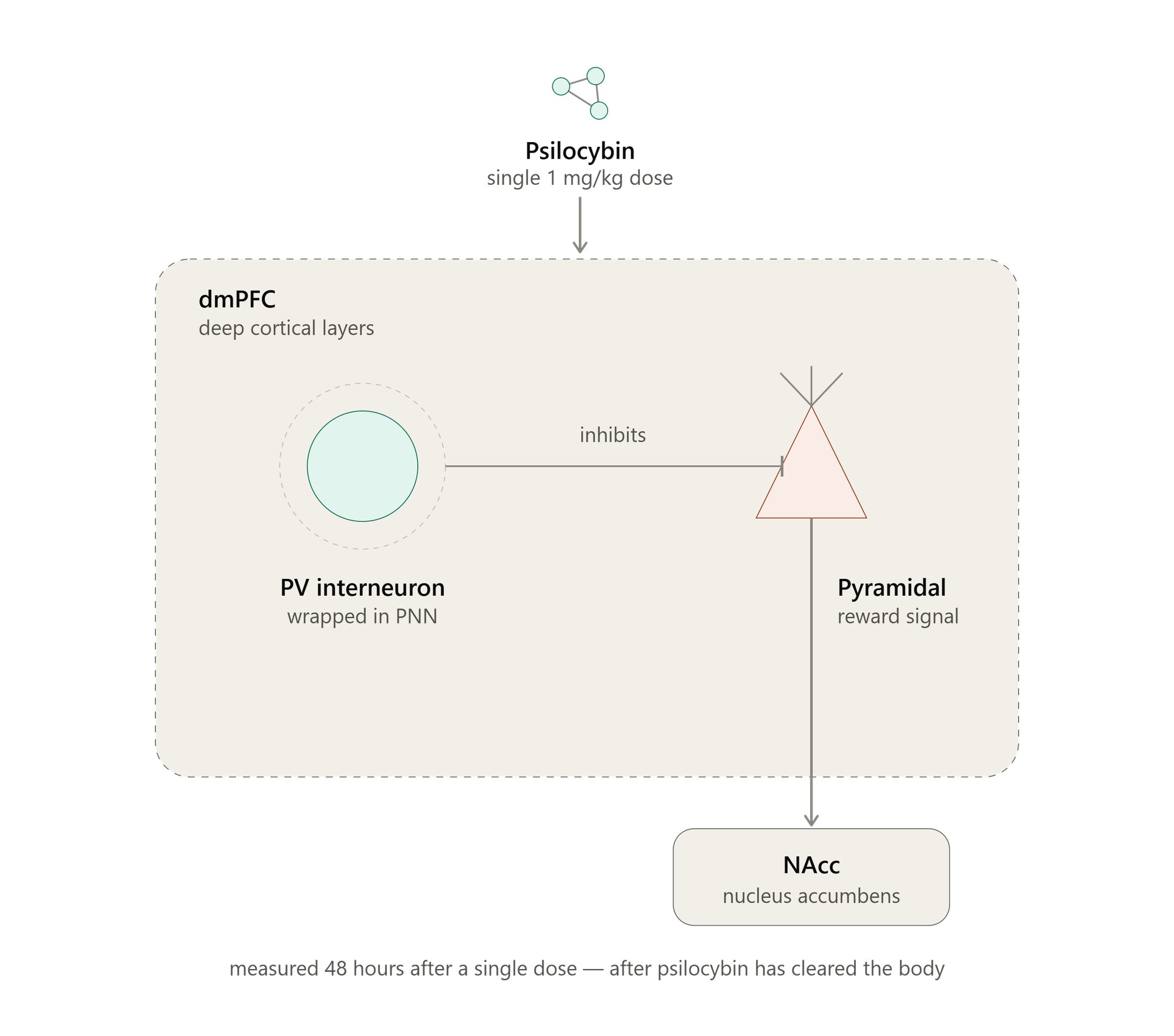
## What they actually did
Eighteen adult male Long Evans rats were trained for around two weeks on a delay-discounting task: two retractable levers, one delivering a single sugar pellet almost immediately, the other delivering three pellets after a delay of 1, 10, or 20 seconds. Once the animals showed stable, matched baseline performance, two were dropped for not performing the task reliably and two others were excluded because they hadn't been injected — leaving a final Vehicle group of eight and a Psilocybin group of six. One of those six had actually received 0.33 mg/kg rather than the intended 1 mg/kg; the authors kept the animal in the group after checking it wasn't an outlier on any outcome measure (head-twitch count, cell density, or large-reward choice), and flagged its data points for transparency in their figures.
Immediately after injection, the animals were filmed for an hour and scored for head-twitches, a well-established rodent proxy for 5-HT2A receptor activation. The psilocybin group twitched far more than controls — 5.33 ± 0.54 twitches versus 0.5 ± 0.2 in vehicle animals (t(12) = 10.14, p < 0.001) — with the effect peaking around 10 minutes post-injection and returning to baseline within the hour, confirming the drug had done what psilocybin is supposed to do at the receptor level.
Then came the part that makes this study unusual: the animals weren't tested again for a full day. They were tested at 24 hours, and again at 48 hours, specifically so the drug would already be fully metabolized and cleared from the body by the time any behavioral difference showed up. Most prior work on psilocybin and reward behavior looked at effects within the first 24 hours — this study was designed to catch what happens after the drug is gone.
Immediately after the final behavioral session, the animals were euthanized and their brains processed for three overlapping markers in the medial prefrontal cortex: parvalbumin (a protein marking a specific class of fast-firing inhibitory interneuron), Wisteria floribunda agglutinin (a lectin that binds the sugar residues on perineuronal nets), and c-Fos (a marker of recent neuronal activity).
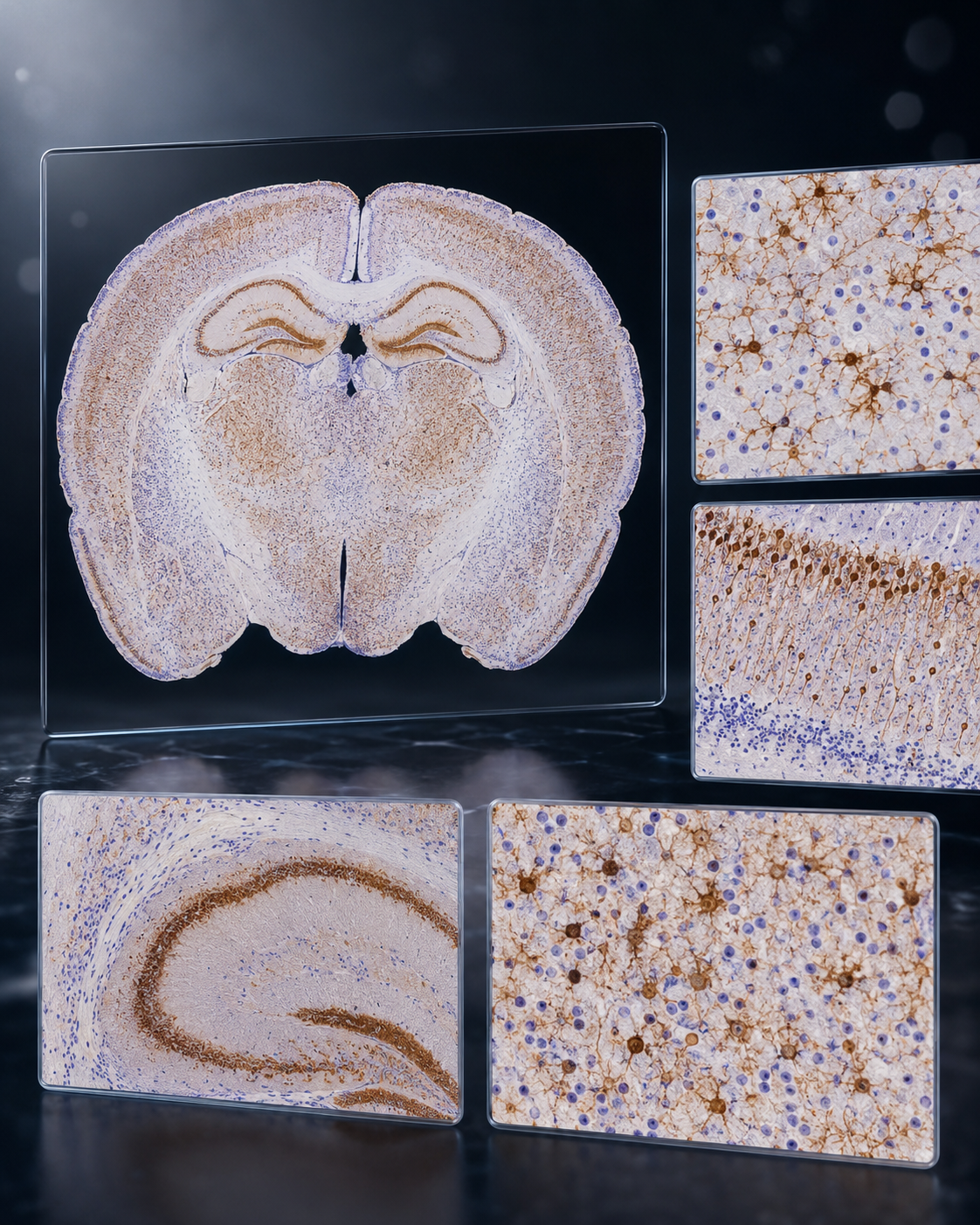
## What changed — and what didn't
At 24 hours, the two groups looked the same. At 48 hours, they didn't.
The psilocybin group pressed the large-reward lever less often — a difference that approached but didn't quite clear conventional statistical significance across all delays (p = 0.054), but reached significance specifically at the 10-second delay (p = 0.026). They also took longer to commit to the large-reward choice when they did make it, an effect that was significant at the 20-second delay (p = 0.006) and, notably, depended on which session (24h vs. 48h) they were tested in — the effect was a 48-hour phenomenon, not a 24-hour one.
Here's the detail that changes the interpretation: none of this depended on how long the delay was. If psilocybin were making the rats more impulsive or less impulsive, you'd expect the effect to grow or shrink as the wait got longer. It didn't. The rats weren't recalculating whether the wait was worth it — they simply seemed to want the large reward less, across the board. The authors are explicit about this: the effects were "not consistent with changes in choice impulsivity."
Equally important is what mostly stayed normal. Across forced-choice trials as a whole, psilocybin didn't change accuracy — the animals could still tell the levers apart and press the right one. There's one wrinkle worth naming rather than smoothing over: when the analysis accounted for both session and delay together, there was a specific drop in accuracy at the hardest condition — the 20-second delay, 48 hours post-injection (p = 0.026). The authors don't read this as a general attention or motor problem, partly because latency to press on forced-choice trials didn't budge at all (p = 0.68) — if psilocybin were slowing the animals down or fogging their attention, you'd expect that to show up there too. The number of small-reward choices didn't change, and omissions (not responding at all) didn't change either. So the overall picture still points away from sedation or confusion, but the isolated dip at the longest delay is a genuine loose end, not a fully closed one.
## The cellular story
Forty-eight hours after psilocybin, the deep layers of the dorsomedial prefrontal cortex (dmPFC, the prelimbic area) showed a higher density of neurons triple-labeled for parvalbumin, perineuronal nets, and c-Fos — meaning parvalbumin interneurons wrapped in nets that had recently been active (F = 6.30, p = 0.027). The same triple-labeling increase also showed up in the adjacent ventromedial prefrontal cortex (vmPFC, infralimbic area; F = 5.68, p = 0.034) — so the cellular change itself isn't unique to one region. What is unique to the dmPFC is what that change means behaviorally: only there did the density of these active, net-wrapped cells correlate with the drop in large-reward choices (Pearson's r = 0.61, p = 0.025). In the vmPFC, the same relationship wasn't there (r = 0.32, not significant).
The dmPFC also showed two more specific changes that sharpen the picture: an increase in PV interneurons active without their nets highlighted separately (PV+cFos, F = 5.13, p = 0.042) in the deep layers, and a decrease in the density of PV cells generally in the superficial layers (F = 5.95, p = 0.031) — a shift that, together, looks like activity concentrating specifically in the deep-layer, net-wrapped population rather than in parvalbumin cells generally. Tellingly, when the researchers ran the same correlation against PV+cFos cells without nets (r = 0.38) or PNN+cFos cells without the parvalbumin marker (r = 0.29), neither reached significance. Only the fully triple-labeled population — parvalbumin, net, and recent activity, all three together — tracked with how much the animals wanted the reward. That specificity is what makes this more than a general "psilocybin activates stuff in the cortex" finding.
Why parvalbumin cells specifically? They're fast-firing inhibitory interneurons, meaning their job is to suppress the activity of other neurons around them — in this case, the pyramidal neurons in deep cortical layers that project out to the nucleus accumbens, a hub of the brain's reward circuitry. Prior work has shown these projections help drive cue-guided reward-seeking. Turn up the inhibitory brake on that pathway, and the signal telling the animal "that cue means something worth pursuing" gets quieter.
Why perineuronal nets? These are lattice-like structures made of proteins and sugars that wrap around certain neurons — parvalbumin interneurons prominently among them — and physically stabilize how those neurons fire and how their connections can change. They're not passive packaging; they regulate the excitability of the cells they surround, and they've separately been shown to remodel after both drug exposure and psychedelic administration. This paper's own senior author previously found, in a 2024 study, that increased perineuronal nets in the medial prefrontal cortex tracked with increased choice impulsivity after repeated social stress — the same structure, pointing the opposite direction, under a different kind of pressure. The working model here is that psilocybin's known 5-HT2A receptor activity — a receptor these parvalbumin cells are rich in — drives increased activity in this already-primed, net-wrapped population, and that increased inhibitory tone is what dampens the reward-seeking signal downstream.
## What this doesn't show
Del Arco's own caveats, given directly to PsyPost, are worth repeating rather than smoothing over:
- **Basic research, not treatment evidence.** "Our study does not demonstrate that psilocybin is a good treatment for substance abuse. At this point we are just looking at potential mechanisms of action of the drug in the brain."
- **Male rats only.** Psychedelic effects are increasingly documented to vary by sex — a 2025 study on psilocybin and opioid reward extinction found sex-specific dependence on the 5-HT2A receptor. Whether this mechanism holds in female animals is untested here.
- **The task measures choice behavior more than motivation per se.** Delay discounting is built to probe impulsivity; the authors argue decreased lever presses and increased latency are still reasonable proxies for motivation, but acknowledge the task wasn't purpose-built for it.
- **Small sample, two time points.** Eight vehicle and six psilocybin animals, tested at 24 and 48 hours only. This tells you nothing about whether the effect holds — or fades, or grows — at one week or one month, and the paper is explicit that 24-hour performance could itself be shaping what shows up at 48 hours.
- **Correlation, not manipulation.** The relationship between triple-labeled cell density and behavior is a regression across animals, not a causal intervention. Nobody selectively silenced these interneurons to confirm they're necessary for the effect.
- **The nets might not even be doing the causal work.** A separate 2025 study the authors cite found that psychedelics can produce lasting behavioral and functional changes through mechanisms that don't depend on structural plastic remodeling at all — so the perineuronal-net story here is the authors' working hypothesis (illustrated as such in their own Figure 6b), not a demonstrated causal chain.
- **The circuit might not be the only explanation.** Pyramidal cells and the mediodorsal thalamic inputs that reach the dmPFC are also rich in 5-HT2A receptors, so psilocybin could be shaping this behavior indirectly through those pathways rather than by acting on the parvalbumin cells directly. Separately, human studies have found that psilocybin can alter attention, executive function, and time perception acutely — the authors can't fully rule out that some perceptual or cognitive shift, rather than a pure motivational one, contributes to the 48-hour change.
- **Effects are "significant but moderate,"** in Del Arco's own words — this is a research direction, not a settled mechanism.
## Where it sits in the wider field
This finding doesn't stand alone. Clinical trials have already shown that a single session of psilocybin-assisted therapy reduces heavy drinking days in alcohol use disorder and produces long-term smoking cessation outcomes in nicotine-dependent adults. Animal work has shown psilocybin reduces alcohol self-administration via accumbens activation, reduces heroin-seeking behavior alongside inflammatory gene changes in the prefrontal cortex and accumbens, and — in a sex-dependent manner — extinguishes opioid reward via the 5-HT2A receptor. What's been largely missing from that literature is a specific, testable answer to *how* a drug that's metabolized within hours produces behavioral change that shows up, and in this case only shows up, two days later.
This paper offers one candidate answer: not a lingering pharmacological trace, but a shift in the activity of a structurally stabilized population of inhibitory neurons — cells wrapped in a matrix that is, by design, built to hold a change in place. Whether that candidate mechanism generalizes beyond a delay-discounting task in male rats, and whether it maps onto the clinical picture in human substance use disorders, is exactly what the follow-up work Del Arco describes — a different behavioral paradigm aimed at incentive motivation specifically — is set up to test.
## The honest summary
A single dose of psilocybin, given to healthy trained rats and tested only after the drug had fully cleared their systems, reduced how much they pursued a reward they'd previously worked hard for — not because they became less patient, but because the reward itself seemed to matter less to them. That change tracked, specifically in the dorsomedial prefrontal cortex, with increased activity in a class of inhibitory neuron wrapped in a stabilizing extracellular structure. It is a mechanism, carefully caveated by the people who found it, and it is one more piece — not a proof — of how a drug that leaves the body in hours might still be doing something to behavior two days later.
---
### Sources
Houff, J., Williams, A., Allen, O. IV, Gisabella, B., Pantazopoulos, H., & Del Arco, A. (2026). Psilocybin decreases preference for large rewards accompanied by increased activity of parvalbumin neurons with perineuronal nets in the medial prefrontal cortex. *European Journal of Neuroscience*, 63(11), e70574\. https://doi.org/10.1111/ejn.70574
Houff et al. (2025, preprint). Psilocybin decreases reward-seeking behavior accompanied by increased activity of parvalbumin neurons with perineuronal nets in the medial prefrontal cortex. *bioRxiv*. https://doi.org/10.64898/2025.12.22.696123
Dolan, E. W. (2026, July 3). A single dose of psilocybin reduces reward-seeking behavior by altering inhibitory brain cells. *PsyPost*. https://www.psypost.org/a-single-dose-of-psilocybin-reduces-reward-seeking-behavior-by-altering-inhibitory-brain-cells/
Bogenschutz, M. P., et al. (2022). Percentage of heavy drinking days following psilocybin-assisted psychotherapy vs placebo in the treatment of adult patients with alcohol use disorder. *JAMA Psychiatry*, 79(10), 953–962.
Johnson, M. W., Garcia-Romeu, A., & Griffiths, R. R. (2017). Long-term follow-up of psilocybin-facilitated smoking cessation. *American Journal of Drug and Alcohol Abuse*, 43(1), 55–60.
Jeanblanc, J., Bordy, R., Fouquet, G., Jeanblanc, V., & Naassila, M. (2024). Psilocybin reduces alcohol self-administration via selective left nucleus accumbens activation in rats. *Brain*, 147(11), 3780–3788.
Floris, G., Dabrowski, K. R., Zanda, M. T., & Daws, S. E. (2025). Psilocybin reduces heroin seeking behavior and modulates inflammatory gene expression in the nucleus accumbens and prefrontal cortex of male rats. *Molecular Psychiatry*, 30, 1801–1816.
Jaster, A. M., et al. (2025). Sex-specific role of the 5-HT2A receptor in psilocybin-induced extinction of opioid reward. *Nature Communications*, 16, 10206.
Slaker, M. L., Jorgensen, E. T., Hegarty, D. M., et al. (2018). Cocaine exposure modulates perineuronal nets and synaptic excitability of fast-spiking interneurons in the medial prefrontal cortex. *eNeuro*, 5, e0221-18.2018.
Martinez, C. A., Pantazopoulos, H., Gisabella, B., Stephens, E. T., Garteiser, J., & Del Arco, A. (2024). Choice impulsivity after repeated social stress is associated with increased perineuronal nets in the medial prefrontal cortex. *Scientific Reports*, 14, 7093.
Kramer, H. M., Hibicke, M., Middleton, J., Jaster, A. M., Kristensen, J. L., & Nichols, C. D. (2025). Psychedelics produce enduring behavioral effects and functional plasticity through mechanisms independent of structural plasticity. *Neuropsychopharmacology*, 51, 641–649.
Yousefi, P., Lietz, M. P., O'Higgins, F. J., et al. (2025). Acute effects of psilocybin on attention and executive functioning in healthy volunteers: A systematic review and multilevel meta-analysis. *Psychopharmacology*, 242, 1171–1196.
Scholle, P., Wenke, S., Nekovářová, T., et al. (2026). The effects of psilocybin on time perception in humans: A comparative analysis of subjective and objective measures. *Journal of Psychopharmacology*.
### Who Owns a Molecule That Has Never Existed in Nature?
URL: https://www.ardmt.com/who-owns-a-molecule-that-has-never-existed-in-nature/
Last updated: 2026-07-04T15:30:48.000Z
*Five psychedelics, one engineered tobacco plant, and the regulatory frontier a Weizmann Institute paper just opened*
Berman et al., Science Advances 2026 · DOI 10.1126/sciadv.aeb3034
# I. THE QUESTION BEFORE THE BIOLOGY
In April 2026, a team at the Weizmann Institute of Science announced they had engineered a single, unglamorous relative of tobacco to produce five different natural psychedelics at once: psilocybin and psilocin, the mushroom compounds; DMT, the molecule at the heart of ayahuasca; and bufotenin and 5-MeO-DMT, both associated with the skin secretions of toads.[\[1\]](#%5Fftn1) That result alone made for an easy headline, and it has travelled fast across exactly the audience this publication spends most of its time talking to.
But the more interesting result is sitting quietly a few pages into the same paper, and almost nobody covering it has mentioned it. The same team also built molecules that have never existed anywhere in nature — brominated and chlorinated cousins of these five compounds, assembled using bacterial genes that have nothing whatsoever to do with psychedelics. Nobody owns those molecules yet. Nobody has fully worked out whether they are legal, whether they can be patented, or whose genetic heritage they were even built from. That is the actual story here, and it will outlast the “one plant, five drugs” version by a wide margin.
# II. FINDING THE GENES NOBODY HAD FOUND
The idea that DMT comes from tryptophan, in two simple chemical steps, has been textbook knowledge for decades. What nobody had actually done, until now, was find the real genes responsible in a real plant.
The team went looking in the species where DMT is best documented: Psychotria viridis, the shrub that supplies DMT to traditional ayahuasca brews, and several species of Australian Acacia.[\[2\]](#%5Fftn2) They sequenced RNA from different tissues of each plant, then hunted through thousands of resulting gene transcripts for two enzyme families: one to strip a carboxyl group off tryptophan and turn it into tryptamine, and a second to bolt two methyl groups onto that tryptamine, one at a time, to arrive at DMT. After testing dozens of candidates, two enzymes did the job: a tryptophan decarboxylase from P. viridis, and a methyltransferase that turned out to do both methylations on its own. Express the two together in a plant leaf, and DMT starts accumulating within days, entirely from the plant’s own internal tryptophan supply.
# III. BORROWING FROM THREE KINGDOMS
Here is the elegant part. Once you have DMT, the four other target compounds are just tryptamine wearing different accessories, in different positions on the same molecular ring — a hydroxyl group here, a phosphate there, a methoxy group somewhere else. If the newly discovered methylating enzyme could be persuaded to work on those decorated tryptamines too, the same basic machinery might build all five compounds from a common starting point. It could — the enzyme turned out to be remarkably unfussy about what it would methylate.
So the team went shopping across three kingdoms of life. A rice gene supplied the hydroxylation step that starts the bufotenin and 5-MeO-DMT branch. A previously characterized toad enzyme closed it out.[\[3\]](#%5Fftn3) Three enzymes already known from magic mushroom research were transplanted wholesale to build the psilocybin branch. An Arabidopsis gene, borrowed from general plant metabolism and never previously associated with any psychedelic at all, was pressed into service for the final methylation step toward 5-MeO-DMT. Wire all of it into the same tobacco relative, and — with some real inefficiencies discussed below — you get five psychedelics from one plant.
One detail worth being precise about, since this publication tries not to blur distinctions other coverage happily blurs: the toad enzyme came from the cane toad, Rhinella marina — an invasive, ecologically unthreatened species — not from Incilius alvarius, the Sonoran Desert toad whose secretions are the actual ceremonial and pharmacological source of bufotenin and 5-MeO-DMT, and which is under real conservation pressure from over-collection.[\[4\]](#%5Fftn4) The paper’s toad-derived component required no contact whatsoever with the animal indigenous communities in northern Mexico have traditionally worked with.
| DMT *plant* | Psilocybin *mushroom* | Psilocin *mushroom* | Bufotenin *toad* | 5-MeO-DMT *toad* |
| ----------- | --------------------- | ------------------- | ---------------- | ---------------- |
*The five natural compounds this system produces — structures verified against PubChem records, not AI-generated.*
· · ·
# IV. ASKING ALPHAFOLD WHY
The 5-MeO-DMT branch worked, technically, but barely. The borrowed Arabidopsis enzyme was sluggish with its new, unfamiliar substrate, and yields stayed stubbornly low no matter how the researchers rebalanced the pathway around it.
So they asked an AI system why. Using AlphaFold3 — the protein-structure prediction system that shared in a Nobel Prize the year before this paper was submitted — they modelled the enzyme sitting in complex with its intended substrate and cofactor, and found the problem immediately: a single amino acid side chain, sitting right where the substrate needed to fit, was sterically clashing with an extra methyl group the natural version of the molecule doesn’t have.[\[5\]](#%5Fftn5) Swap that one amino acid for glycine, the smallest possible substitute, and the clash disappears. Production of 5-MeO-DMT jumped roughly forty-fold.
That is a genuinely good example of what “AI-accelerated biology” is supposed to mean, as distinct from what the phrase usually gets used to sell: not a black box generating answers, but a structural hypothesis a human could check, understand, and act on with a single, deliberate, targeted edit.
# V. THE FIVE COMPOUNDS ARE NOT ONE THING
It is tempting, reading a headline like “one plant, five psychedelics,” to file all five under a single mental category — different flavours of the same basic trip. Resist that. It is exactly the kind of flattening this publication exists to push back against, and the chemistry itself argues against it.
DMT and psilocybin (via its active metabolite, psilocin) are the best-characterized members of this family, with reasonably predictable receptor pharmacology and most of the current clinical trial literature built around them. Bufotenin is a different animal entirely. Despite differing from a close relative by a single hydroxyl group in a different ring position, it produces pronounced peripheral effects — cardiovascular changes, flushing, nausea — and its central, subjective psychedelic effects in humans have been described across the scientific literature as inconsistent, sometimes muted, sometimes barely present at all.[\[6\]](#%5Fftn6) 5-MeO-DMT, meanwhile, is widely reported to produce a markedly different, often more formless and ego-dissolving state than classic DMT, despite the two compounds differing by a single methoxy group.
None of that changes because a lab found a way to manufacture all five in the same leaf. If anything, it is the argument for taking set and setting more seriously, not less: a large body of clinical and anecdotal evidence holds that a person’s state of mind going in, and the physical and relational context they are held in during the experience, materially shapes both the quality of a psychedelic experience and what a person is left with afterward.[\[7\]](#%5Fftn7) Cheap, reliable synthesis solves a supply problem. It does not solve, or even touch, that one.
# VI. THE MOLECULES THAT WERE NEVER REAL
The more genuinely novel result comes next, and it is where the ownership question actually starts. The team introduced three bacterial halogenase genes — enzymes bacteria normally use to make antibiotics, borrowed from species with no prior connection to psychedelics whatsoever — into the same plant system, each targeting a different position on the tryptamine ring.[\[8\]](#%5Fftn8) The result: chlorinated and brominated versions of DMT at three different ring positions, plus two new chlorinated versions of psilocybin. None of these molecules have ever been detected in any living organism, anywhere, at any point in natural history.
| 5-Cl-DMT *never existed in nature* | 7-Br-DMT *never existed in nature* |
| ---------------------------------- | ---------------------------------- |
*Two of the paper’s novel halogenated tryptamines, rendered from verified SMILES — copper marks the atoms nature never put there.*
This is not a gimmick. Related halogenated tryptamines, tested elsewhere, have shown measurably different behaviour from their natural counterparts — altered receptor binding, different potency, in some cases distinct effects entirely, like sedation where the parent compound produces stimulation.[\[9\]](#%5Fftn9) Small structural edits, on this molecular scaffold, can produce a genuinely different drug, not just a legal fiction of one.
· · ·
# VII. TWO FRONTIERS OF OWNERSHIP
That last sentence is doing more work than it looks like, because it sits at the exact centre of two separate, unresolved legal questions — one about whether these new molecules are legal to make and possess at all, and one about who, if anyone, is owed anything for the biological knowledge that made them possible.
Take the legality question first, because the intuitive answer — “make it different enough and you dodge the law” — turns out to be shakier than it sounds. In the United States, a newly synthesised compound this close to a controlled substance falls to be assessed under the Federal Analogue Act, which extends Schedule I treatment to anything “substantially similar” in structure and effect to a scheduled drug.[\[10\]](#%5Fftn10) The Act has a real history with exactly this molecular family: in a 1992 case, a federal court ruled that alpha-ethyltryptamine was not “substantially similar” to DMT, but the reasoning is instructive — the court leaned heavily on the fact that the two compounds belonged to different classes of amine entirely.[\[11\]](#%5Fftn11) The halogenated compounds in this paper share DMT’s exact amine chemistry; the only change is a single halogen atom on the ring. That is a far smaller structural step than the one that got AET off the hook, which suggests these new molecules sit closer to the Act’s reach than a “clever workaround” narrative would imply, not further from it.
The United Kingdom’s approach removes the ambiguity in the other direction entirely. The Psychoactive Substances Act 2016 does not test chemical structure at all — it bans anything capable of producing a psychoactive effect by stimulating or depressing the central nervous system, with a short, specific list of exemptions covering things like alcohol, caffeine, and medicines.[\[12\]](#%5Fftn12) A structurally novel tryptamine that plainly affects the mind would fall inside that blanket ban regardless of how far its structure had drifted from DMT. Whatever strategic value halogenation might have under a structure-based test like the American one, it has none at all under an effects-based test like the British one — worth knowing before anyone gets excited about a regulatory loophole that only exists in one of the two systems, and arguably not even there.
Patentability is a separate, calmer question again — novelty, utility, and non-obviousness, not legality — and it is worth not collapsing the two. A molecule can be perfectly patentable and still be a controlled substance; plenty of scheduled pharmaceuticals are.
The second frontier concerns the five natural compounds, not the novel ones, and it is a question I have spent a fair amount of time on in a different context. The Nagoya Protocol exists so that a country supplying a genetic resource — a plant, an animal, a microorganism — shares in whatever benefit is later built from it, through documented prior consent and agreed terms.[\[13\]](#%5Fftn13) It is the exact framework governing my own iboga cultivation between Ecuador and Gabon, where every seed I hold carries prior informed consent from the Gabonese Bwiti community I received them from, and terms of use agreed with the same people.
This paper did nothing comparable, for a structurally interesting reason that is not the same thing as a compliance failure. Nobody needed to import a cutting of the Central American shrub, a sample of Australian Acacia bark, or a scrap of toad tissue. Once the toad enzyme’s genetic sequence had been published in the literature by a separate research group, a commercial gene-synthesis company simply built the corresponding DNA from scratch, base by base, with no biological material from any country of origin ever changing hands.[\[14\]](#%5Fftn14) Whether that counts as “using a genetic resource” under the Nagoya Protocol is one of the most contested open questions in international biodiversity law, known as the digital sequence information debate, and it has been argued over for more than a decade without a clean resolution.[\[15\]](#%5Fftn15) Its first concrete institutional answer only arrived very recently — the Cali Fund, launched in February 2025, which asks large commercial users of genetic sequence data to contribute a small share of profits to a global biodiversity fund, half of it earmarked for indigenous and local communities.[\[16\]](#%5Fftn16) But the Fund is aimed at large-scale industrial users, not university labs, and it settles a funding mechanism without settling the underlying legal question of whether sequence-only use is covered by Nagoya’s core obligations at all.
Worth adding, without implying any wrongdoing whatsoever by this particular team: Israel, where the work was carried out, has never ratified the Nagoya Protocol.[\[17\]](#%5Fftn17) There was no domestic legal mechanism pushing toward this kind of accounting even if the digital sequence information question were settled tomorrow. That is not a criticism of these researchers — it is a fair illustration of how patchy the international framework still is, fifteen years after Nagoya was signed, for exactly the kind of cross-kingdom, sequence-only research this paper represents.
· · ·
# VIII. SET, SETTING, AND THE LIMITS OF A GREENHOUSE
None of this is an argument against the science. Being able to manufacture these compounds without harvesting a slow-growing Amazonian shrub, collecting stressed wild toads, or drying out mushroom farms at scale is an unambiguous good for conservation, and probably eventually for consistent, quality-controlled clinical supply.
But it is worth being honest about what a greenhouse cannot manufacture. Traditional ayahuasca is not simply “plant-based DMT” — it is specifically the combination of a DMT-bearing plant with Banisteriopsis caapi, whose beta-carbolines are the only reason the DMT survives digestion at all, refined over generations by particular people in a particular place into a particular brew.[\[18\]](#%5Fftn18) The Bwiti tradition surrounding iboga is not reducible to the alkaloid ibogaine in a bottle, either. Set and setting were never marketing language borrowed from these traditions; they are the entire container that determines whether an experience gets integrated into a life or simply endured and forgotten.
A tobacco relative that produces five psychedelics simultaneously is a genuine feat of biosynthesis, and the halogenated molecules sitting alongside them are a genuinely open legal frontier. Neither one says anything about which of these compounds a person should take, in what state of mind, in what company, prepared in what way, and for what reason. The chemistry has gotten dramatically easier. Everything the chemistry was never going to solve is exactly as hard as it always was.
Who owns a molecule that has never existed in nature is a question regulators are only just starting to catch up with. Whether that molecule deserves anything like the care its natural relatives have earned through centuries of documented human relationship is a question no regulator will ever be equipped to answer at all.
*ARDMT will keep tracking how the Analogue Act, the Psychoactive Substances Act, and the Nagoya DSI debate handle this class of molecule as it develops.*
---
[\[1\]](#%5Fftnref1)Berman P, Höfer J, Mehlman H, et al. “Complete biosynthesis of psychedelic tryptamines from three kingdoms in plants.” Science Advances 12, no. 14 (2026): eaeb3034\. https://doi.org/10.1126/sciadv.aeb3034.
[\[2\]](#%5Fftnref2)Ibid., “P. viridis and A. acuminata plants produce DMT.”
[\[3\]](#%5Fftnref3)Chen X, Li J, Yu L, et al. “A cane toad (Rhinella marina) N-methyltransferase converts primary indolethylamines to tertiary psychedelic amines.” Journal of Biological Chemistry 299 (2023): 105231.
[\[4\]](#%5Fftnref4)Weil AT, Davis W. “Bufo alvarius: a potent hallucinogen of animal origin.” Journal of Ethnopharmacology 41 (1994): 1–8; cited in Berman et al., 2026.
[\[5\]](#%5Fftnref5)Abramson J, Adler J, Dunger J, et al. “Accurate structure prediction of biomolecular interactions with AlphaFold 3.” Nature 630 (2024): 493–500; applied in Berman et al., 2026, Fig. 6C.
[\[6\]](#%5Fftnref6)See the pharmacological literature on bufotenin’s pronounced peripheral serotonergic effects and inconsistently reported central psychoactivity relative to its close structural relatives.
[\[7\]](#%5Fftnref7)See, generally, the psychedelic-assisted therapy literature on set and setting as a determinant of experience quality and post-experience outcomes.
[\[8\]](#%5Fftnref8)Berman et al., 2026, “De novo production of halogenated indolethylamines in N. benthamiana.”
[\[9\]](#%5Fftnref9)Ibid., citing prior behavioural studies of halogenated tryptamine derivatives in animal models.
[\[10\]](#%5Fftnref10)21 U.S.C. § 802(32); § 813 (Controlled Substance Analogue Enforcement Act of 1986).
[\[11\]](#%5Fftnref11)United States v. Forbes, 806 F. Supp. 232 (D. Colo. 1992).
[\[12\]](#%5Fftnref12)Psychoactive Substances Act 2016, c. 2, ss. 2–3 (UK).
[\[13\]](#%5Fftnref13)Nagoya Protocol on Access to Genetic Resources and the Fair and Equitable Sharing of Benefits Arising from Their Utilization, adopted 2010, in force 2014.
[\[14\]](#%5Fftnref14)Berman et al., 2026, Materials and Methods (gene synthesis by Twist Biosciences).
[\[15\]](#%5Fftnref15)Convention on Biological Diversity, Decisions 15/9 and 16/2, “Digital sequence information on genetic resources.”
[\[16\]](#%5Fftnref16)Cali Fund for the Fair and Equitable Sharing of Benefits from the Use of Digital Sequence Information on Genetic Resources, launched 25 February 2025, Rome.
[\[17\]](#%5Fftnref17)Secretariat of the Convention on Biological Diversity, Access and Benefit-Sharing Clearing-House: Parties to the Nagoya Protocol (Israel not listed as a Party).
[\[18\]](#%5Fftnref18)Riba J, Valle M, Urbano G, et al. “Human pharmacology of ayahuasca.” Journal of Pharmacology and Experimental Therapeutics 306 (2003): 73–83; cited in Berman et al., 2026.
### The Habit of the Universe
URL: https://www.ardmt.com/the-habit-of-the-universe/
Last updated: 2026-06-20T16:48:01.000Z
### On morphic resonance, decapitated worms, lions that remember Rome, and what we might be doing when we take psychedelics
There is a particular kind of idea that refuses to die no matter how often it is killed. Rupert Sheldrake's morphic resonance is one of them. The thesis, stripped to its bones, is this: nature has memory. Once a thing has happened, it becomes easier for it to happen again. Crystallise a brand-new compound for the first time and it is reluctant, slow, almost coy; do it in a thousand labs across a thousand months and it forms readily, as though the molecule has learned the trick. Sheldrake proposes that this is not metaphor. He proposes a real field, a morphic field, across which form and behaviour are transmitted not through space and time in the ordinary causal way but through a kind of resonance with everything of that type that has gone before. Learn a skill in London and a rat in Edinburgh finds the same skill marginally easier. The past is not gone. It is a groove, and the groove pulls.
The respectable position is that the evidence is thin and the mechanism is missing, and that is true, and it is also not the most interesting thing about the idea. The most interesting thing is that it will not lie down. Ideas that will not lie down are usually pointing at something, even when they have the wrong address for it, and the pleasure of an idea like this one is not in deciding whether it is right. It is in what it does to the walls of the room. Morphic resonance, like Donald Hoffman's headset, like the strangest things the great animals do, is an idea whose real function is to get you to think outside the box, outside the skull, outside the assumption that the obvious account of the world is the whole of it. That is a thing worth doing whether or not the idea survives. So let it pull for a while, and see where it goes.
The question underneath it is simple and large. If things really do get easier the more they exist, then what, exactly, are we doing right now with psychedelics?
## The monkey that never was
Start with the famous version, because the famous version is wrong in an instructive way. The hundredth monkey story goes like this: a troop of macaques on a Japanese island is taught to wash sweet potatoes, the habit spreads slowly from animal to animal, and then at some critical number, the hundredth monkey, the behaviour suddenly leaps the sea and appears all at once in monkeys on other islands who never saw it done. A threshold crossed. A field saturated. A tipping point in the shared mind of the species.
It didn't happen, not like that. The real observations, made by Japanese primatologists watching macaques on Koshima in the 1950s, recorded potato-washing spreading the ordinary way, young animals copying their mothers, the habit moving at a perfectly explicable pace. The miracle, the sudden jump across water, was added afterward by writers who wanted the data to mean more than it did. Lyall Watson, who put the story into wide circulation, later more or less conceded he had built the dramatic version out of inference and atmosphere.
And yet the story is more interesting once you know it's a fable, not less, because then you can see what it really is. It is not a discovery about monkeys. It is a portrait of a longing, and the longing is ours: that knowledge has weight, that enough minds holding the same understanding might change the medium that holds them, that learning is not just private hoarding but a contribution to some rising shared tide. The fable survives because the longing survives. And longings that strong usually have something real at the bottom of them, even if it isn't the thing on the label.
## What is actually getting easier
Here is the part of the intuition that needs no field at all, and is marvellous anyway. Things genuinely do get easier the more they exist.
A proof, once found, becomes almost trivial for the next person, because it is written down, taught, folded into the notation everyone now learns before breakfast. Roger Bannister's four-minute mile was broken by dozens of runners within a few years of his breaking it, and it is tempting to say a barrier in some collective field dissolved. The plainer story is that he proved it possible, and proof of possibility quietly rewires everyone's training and expectation and nerve. The first ascent of a hard route is a near-death experience; the hundredth is a pleasant afternoon with bolts in the rock. There is a real field across which all this transmits, and it has a name. The name is culture: language, instruction, infrastructure, the worn handrail of everything anyone has already said.
That is the floor of the whole thing, and it is solid. The past really is a groove, and the groove really does pull, and most of the pull is no stranger than a library. But a floor is only interesting because of what stands on it, and what stands on this one is a set of phenomena that the tidy cultural account does not quite cover, that poke through it, that keep the matter open. The honest move is not to decide in advance whether they break the floor. It is to walk out onto the thin parts and look down.
## The Beatles and the song that arrives by itself
Songs arrive in more than one head at once. The history of music is full of near-simultaneous inventions, riffs surfacing on two continents in a single season, chord shapes that everyone suddenly reaches for as if a memo went round. And it is not only music. Calculus arrived with Newton and Leibniz within a decade of each other. Natural selection arrived with Darwin and Wallace so simultaneously that they published together to avoid a brawl. Oxygen, the telephone, the precursors of relativity: the history of discovery is studded with things found by several people at the same moment, as though they had become, suddenly, findable.
The romantic reading is that the idea was in the air, circling in some collective mind, settling on whoever was tuned to catch it. The sober reading is that simultaneous discovery is exactly what you'd expect when many prepared minds work the same problem with the same materials to hand: Newton and Leibniz both stood on Fermat and Descartes, and a year's worth of songwriters are all soaked in the same records, the same gear, the same harmonic weather. Convergence isn't telepathy. It's what happens when a landscape has only a few low passes and a great many people trying to cross.
But notice what the sober reading does not touch. It does not touch the feeling. Every songwriter who has had a melody arrive whole and unbidden, as if dictated rather than composed, knows the experience from the inside, and from the inside it is reception, not invention. The sober account says the dictation is just the medium, internalised so deeply it has dropped below the waterline and come back up wearing the robes of revelation. That is probably true. It is also worth saying that "the past, internalised so completely you mistake it for a voice from outside" is itself a fairly astonishing description of what a mind is, and that the line between a deep groove pulling and a field calling is thinner, phenomenologically, than the debunk likes to admit. The song still feels like it came from somewhere. Keep that feeling in your pocket. It comes up again.
## Hoffman, and the suggestion that we have the address wrong
Donald Hoffman, the cognitive scientist, not Albert Hofmann the chemist who first tasted LSD, has spent a career on a claim that sounds insane until you sit with it and then merely sounds hard. Space and time, he argues, are not the fundamental fabric of reality. They are a species-specific user interface, an evolved headset. We see a world of objects laid out in space and unfolding in time for the same reason a computer shows folders and a little trash can: not because that is what is really there among the voltages, but because it is a compression that lets us act without drowning in the truth. The desktop is useful precisely because it hides the machine. His phrase for the task ahead is that we have to learn to think outside of space and time. The mainstream does not follow him all the way, and the leap from "our perception is not the raw truth," which is hard to argue with, to "consciousness is the ground of everything," which is an enormous bet, is his and not the field's.
But you do not have to take the whole bet to feel what even the first step does to an idea like morphic resonance. Sheldrake's perennial embarrassment was always the mechanism: how does form travel without a carrier, without crossing space the ordinary way? The objection that buries him is "there is nowhere for it to live and no way for it to move," and that objection quietly assumes spacetime is the final stage on which everything real must appear. The modest, useful thing Hoffman lets you say is just this: if spacetime may not be fundamental, then dismissing every kind of non-local strangeness purely because it does not fit ordinary spacetime might be too quick. That is a much smaller claim than "Hoffman proves Sheldrake," which he does not, and nobody should pretend the two ideas rescue each other. It does not make Sheldrake right. It makes the easiest way of being sure he is wrong a little too easy, and it cracks a window.
And it lands exactly where the psychedelic report has been sitting all along, because the one thing the high-dose tryptamine state says, again and again across traditions, is that the box came off. That space and time stopped being the container and became one option among others. People who have never heard of Hoffman come back from DMT describing his thesis as something they lived: that the everyday world is an interface, that they were briefly behind it, that the place they went was somehow more real than the room they left. This is not cosmology, and a brain on a 5-HT2A agonist is not a calibrated instrument for reading the foundations of physics. But the phenomenology and the heresy are pointing the same way, and the interesting response to that is not to explain it away. It is to notice it, and to let the noticing sit there unresolved, which is where the good ideas live.
## Levin's flatworm, and the memory that should not be where it is
Now the one that is not metaphysics at all. It is a clean experiment with a result that still resists any simple brain-only explanation, and it is, quietly, one of the strangest things in modern biology.
Michael Levin and Tal Shomrat, at Tufts, trained planarian flatworms, those small comma-shaped creatures from the bottom of ponds. The training was modest and carefully controlled: the worms learned that a particular rough-textured floor was a safe place to feed, overcoming their natural fear of open, lit, exposed ground. Ordinary associative learning, the kind flatworms have been suspected of and doubted at for a century. Then the researchers cut the worms' heads off. The planarian is the rare animal that lets you do this and then ask a follow-up question, because it grows the head back, brain and all, from the tail, in about two weeks. The headless, brainless tail built itself a complete new brain. And the worms wearing those new brains, given a single refresher, recovered the trained behaviour faster than worms that had never learned it at all.
Sit with the shape of that. The brain was thrown away. The lesson was not in the thrown-away brain, or not only there, because it came back into a brain that did not exist when the lesson was taught, built fresh from tissue that had never had a thought in its life. Levin's own careful reading, and he is careful, is that the memory was stored somewhere outside the brain, distributed through the body, very likely in the bioelectric patterns his lab has spent years showing can carry the instructions for an animal's very shape, and that this stored pattern retrained the new brain as it grew. Not a spell. Not a cosmic broadcast. A physical, in-principle-decodable signal, living in the cells of the body rather than the neurons of the head, and reaching forward in time to teach a brain that had not been born yet.
This is the thread to hold longest, because it does the one thing the tidy account cannot survive: it gives us controlled evidence that memory is not as neatly housed in the brain as we had assumed. Learned information persisted through the total destruction of the organ that is supposed to hold it, and then reassembled itself. There is an older, more disreputable cousin to this work, James McConnell's mid-century claim that you could grind up trained worms, feed them to untrained ones, and pass the memory along with the meal. It was laughed out of the room for decades, and recent molecular work has nudged it back from pure myth toward open question. The whole history here is a standing rebuke to the confidence with which we announce where a memory can and cannot live.
Now, the careful caveat, which is also Levin's: nothing in any of this leaves the animal. The memory living outside the brain is still inside the worm, in its tissues, its electrical state, its molecular machinery. The result destroys the idea that memory is just synaptic wiring; it does not, by itself, send the groove out into the cosmos. But here is the thing the caveat cannot take back. We had been treating two options as the only two: the dull truth that memory is local, in the brain, full stop, and the wild heresy that memory rides a field beyond the body. The worm says the dull truth was already wrong, and it was wrong in the direction of strangeness, in the direction of distribution, in the direction of the groove being carried in more places and more forms than anyone licensed. If a worm's lesson can live in its flank and leap forward into an unborn brain, then the smug certainty about where the edges of a memory are has just been handed a counterexample by a creature with no head. That should not make anyone a believer. It should make everyone a great deal less sure where the walls are.
## John Aspinall, and the lion that remembers the Colosseum
John Aspinall was, by every account including the ones from people who could not stand him, an extraordinary man: gambler, zoo-builder, friend to tigers, a person who walked into enclosures with gorillas as though kinship were a thing you could simply decide to claim and then live out. Howletts and Port Lympne were not ordinary zoos. They were the working-out of a conviction that the wall between us and the great animals was a failure of nerve and respect, a matter of manners, rather than a fact of nature. People who met him tended to come away marked.
And he believed something that belongs at the heart of this essay because it is the romantic reading taken to its limit and then lived without a flinch. His hunger to find or rebuild a hundred-percent pure Barbary lion was not, in his own telling, a breeder's fuss about bloodlines. It was the conviction that a species carries a collective memory, that a true Barbary lion would carry in it the inheritance of the lions of the arena, the ones loosed against men in Rome, and that this carried memory was real, weighty, a wound and a grandeur at once, something that could be honoured and perhaps in some way healed by being restored to the world intact. The shame and the magnificence of that history, in his frame, lived on in the animal as surely as morphic resonance says the past lives on in the present, and bringing back the real lion was a way of taking responsibility for what we had done.
There is no accepted mechanism for this. Genes carry the statistical residue of what helped ancestors breed, not the episodic memory of what was done to them, and no biologist will tell you the specific terror of a particular lion in a particular arena is written into a cub born two thousand years later. That is the textbook answer and it is worth knowing. But it is a mistake to think the textbook answer closes the matter, because the textbook is a map of what we have managed to explain, not a census of what is real, and the gap between those two things, where the great animals are concerned, is enormous. We are nowhere near the bottom of what these creatures are. We do not know how deep their consciousness runs, because it is not our kind of consciousness and we have no instrument calibrated for it. We cannot even agree on how an elephant does some of the things an elephant plainly does. To stand in that ocean of not-knowing and pronounce Aspinall's idea ridiculous is to mistake the edge of our current understanding for the edge of the possible, which is the exact habit of mind these ideas exist to break.
So take it seriously, and then be precise about what "carries Rome" can honestly mean, because the precise version is haunting enough without the magic. It does not mean a cub born today holds the episodic memory of a particular lion in a particular arena; there is no known route for that. It means something quieter and, in its way, heavier: that a Barbary lion carries the morphological and behavioural inheritance of a lineage shaped, in part, by ten thousand years of collision with us, with our spears and arenas and rifles and our slow theft of its world. The particular wariness in the presence of a human, the architecture of a predator that evolved alongside the one predator that hunted it back, the genetic narrowing left by our near-extermination of it: all of that is real, all of it is carried, all of it is a recording of the human-animal war written in the only ink evolution uses. Aspinall pointed at a true and heavy thing, the deep entanglement of our history with theirs and the moral weight of what we have done, and gave it the most vivid mechanism he could imagine. Maybe the vivid mechanism is wrong. Maybe it is only mostly wrong. Either way the thing he was pointing at is there, and it is closer to haunted than the careful version likes to admit.
## Elephants, crocodiles, hippos, and the minds we are at war with
Some animals are not simply clever. They are other, in a way that feels like a different category rather than a higher score on the same test, and the strangeness deepens the closer you look.
The elephant is the clearest non-human culture we know of, and it is also where the easy summaries fall apart. It is tempting to say, briskly, that an elephant matriarch is a living library and that when she dies the knowledge dies with her, and there is truth in the first half. Matriarchs hold decades of route memory, the location of water in a drought year, the social map of a whole region, and herds that lose them are measurably poorer for it. But the second half, the clean little verdict that the knowledge simply dies, is exactly the kind of confidence this subject does not earn. Elephants do things for which we have no settled account. They return to the bones of their dead and turn them over with what looks unmistakably like attention. And then there is the story that gets told whenever this subject comes up, the one about Lawrence Anthony, the South African conservationist known as the Elephant Whisperer, who in the late 1990s took in a herd of traumatised, dangerous elephants that were otherwise going to be shot, and spent weeks living beside their enclosure until they came to trust him. When he died of a heart attack in 2012, his family reported that two herds walked roughly twelve hours through the bush to reach his house, where they had not been in over a year, and stood there for two days before dispersing. His son told the press about it; his wife has said the elephants returned on the anniversary. It is an anecdote, not an experiment, and it should be held as one. How they could have known is genuinely unexplained, and "unexplained" is the honest word, not "telepathic," because there are candidate ordinary answers, infrasound, scent on the wind, behavioural cues passed between herds, routes nobody had mapped, and no way at present to test which, if any, was at work. But the right response to a story like that is neither to swallow it whole nor to wave it away. It is to sit in the size of what we do not yet understand about these animals, and to notice that "we do not know" is not a hole to be papered over with a tidy sentence about libraries. It is the actual state of the evidence, and it is far more interesting than any premature closing of it.
The crocodile and the hippopotamus are a different order of otherness again. The crocodile, if it is a consciousness at all, is one built on an architecture that split from ours before the dinosaurs, a deep-time mind, patient on a scale we cannot inhabit, lethal to us across the whole span of our existence in Africa in a way that has surely shaped where we dare to drink. The hippo is reckoned among the deadliest large animals to humans in Africa and carries none of the charm that buys an animal our sympathy. These are not cuddly minds inviting us to project ourselves into them. They are genuinely other timelines, and the relationship is not a metaphor of war but the literal daily fact of sharing a river. There is something at the heart of our bond with these animals that is older than affection and harder than fascination, and it is precisely the long, lethal, intimate entanglement, the war, that makes them feel sacred and dangerous at once.
Now bring in the psychedelic, because this is where the threads gather. People come back from high-dose DMT and from ayahuasca reporting contact with animal intelligences, serpents above all in the ayahuasca traditions, presences that feel reptilian or elephantine or insectile, vast and ancient and regarding them with attention. The Bwiti have their own version of these meetings, and anyone who has sat long enough with iboga knows the encounters do not feel like scenery; they feel like being met. The literal reading is that the molecule opens a channel and the mind of the serpent, or the elephant, comes through.
There is a humbler reading that is, if anything, stranger, because it puts the marvel inside us rather than out in the ether. The human brain is built, by deep inheritance, to model other minds, and above all the minds of the great animals we evolved beside as predator, prey, and rival. The serpent-detection circuitry, the predator-vigilance machinery, the ancient apparatus for reading the intent of a large dangerous animal, all of that is in us, graven by the very human-animal war that makes elephants and crocodiles feel sacred, and it normally runs silent and automatic beneath everything we notice. Turn down the filter, and that machinery can run free, can generate the felt presence of the very minds it was shaped to track. On this reading the serpent in the vision is not a visitor. It is the animal in you, the sediment of a hundred thousand years of hunting and being hunted, surfacing and presenting itself the way the dictated melody does: as something vast and ancient and not-you, because in the most literal sense it is. You are not meeting the elephant. You are meeting the part of yourself the elephant made.
And here is the part worth leaving genuinely open, because the humbler reading is satisfying and it may not be the whole of it. We do not know how deep animal consciousness runs. We do not know what, if anything, is shared across minds, or carried in a lineage, or transmitted by means we have not learned to measure. Everything in this essay, the worm's impossible memory, the song that arrives by itself, the lion that might carry Rome, the elephant that knows a death across miles, sits in the same wide territory of the not-yet-explained, and the territory is real even where the maps are wrong. The point of standing in it is not to plant a flag. It is to feel how much room there still is.
## The thread, pulled loose
Lay the pieces side by side and a shape appears, though it is better thought of as a rhyme than a proof. The song that arrives whole. Sheldrake's disputed compound that is said to crystallise more easily the more it has been made. The worm that keeps its lesson through the loss of its brain and hands it to a brain not yet born. The headset that turns out not to be the world. The lion that carries, in its very build, the weight of ten thousand years of us. The elephant that registers a death across an impossible distance. The serpent that rises, vast and ancient, when the filter drops.
In every case the obvious account, the local one, the one that keeps the marvel small and safe and inside the skull, explains a great deal and not quite everything. There is always a remainder, a place where the tidy story thins and something shows through, and the something is always older and deeper and less personal than the self that came looking. The romantic instinct is to throw that remainder outward, onto cosmos and field and external mind. The reductive instinct is to deny there is any remainder at all. Both are too quick. The remainder is real, and where it actually lives is the most interesting question in the room, and the honest answer, for now, is that we do not yet know, and that not-knowing is not a failure but an open door.
Which is, at last, a way of answering what we are doing right now with psychedelics. Perhaps we are not tapping a cosmic library, and perhaps we are not merely soaking in culture either, and perhaps the truth is some third thing we are not yet equipped to name. What these substances can do, at their strangest, when you line up the worm and the song and the headset and the lion and the serpent, is lift the filter that keeps the deep inheritance invisible, and let us look straight at the groove, at the accumulated, carried, graven past, biological and cultural and possibly stranger still, that we normally experience only as the plain transparent fact of being ourselves. They do not obviously show us what is outside. They show us, with the lights briefly off, the architecture of what is inside, and the architecture is so much older and deeper and less personal than the person who walked in that it reads, again and again across traditions, as contact with something vast and other.
A few questions to carry out the door, since the pleasure of this kind of thinking is in the hooks and not the verdicts. If a flatworm can carry a memory through the loss of its brain in patterns of bioelectricity, and psychedelics dramatically reorganise the brain's electrical life, are the regeneration people and the psychedelic neuroscience people perhaps describing the same deep layer from opposite ends, without yet knowing it? If spacetime really is an evolved interface, then the psychedelic dissolution of space and time is not a malfunction but the momentary lifting of an adaptation, and evolution does not build expensive filters for nothing, so what is the filter for, and what does it cost to take it off? And if the great animals carry the long human-animal war graven into their lineage, and we carry the very same war graven into ours as the deep architecture the serpent vision surfaces, then the psychedelic meeting with the animal mind is, in some real sense, the two sides of that ancient war coming face to face inside a single human skull. Aspinall wanted to heal the wound by restoring the lion. Perhaps the wound is also in us, and perhaps the nearest thing to his impossible, magnificent project is this: to be made, for a few hours, to feel exactly what we have been carrying all along.
We are not waiting for the hundredth monkey. We are the monkey, sitting with the potato, beginning at last to look at our own hands.
---
*Sources, for anyone who wants to chase the threads. The hundredth-monkey story is a documented later embellishment of genuine but unremarkable primatology on Koshima, with Lyall Watson's role in dramatising it on record. Morphic resonance is Sheldrake's, set out across* A New Science of Life *and after, and remains outside the scientific mainstream. Donald Hoffman's interface theory of perception and conscious-agent framework are seriously argued and seriously contested in equal measure. The planarian results are Shomrat and Levin, "An automated training paradigm reveals long-term memory in planarians and its persistence through head regeneration,"* Journal of Experimental Biology\* 216 (2013): 3799–3810; James McConnell's cannibal-worm memory-transfer work of the 1960s is the disreputable precursor, largely discredited at the time and lately, tentatively, revisited through RNA-interference studies. John Aspinall's collective-species-memory beliefs are his own, eccentric and unproven and, in the view of this piece, a long way from ridiculous. The claims about elephants, cetaceans, octopuses, and crocodilians gesture toward areas of the animal-cognition literature that remain contested and developing; the Lawrence Anthony episode is a family-reported anecdote, carried in the New York Times and elsewhere in 2012, and is offered as exactly that, a striking story without a tested explanation, not as evidence of anything.\*
### Notes from Haarlem
URL: https://www.ardmt.com/notes-from-haarlem/
Last updated: 2026-05-29T15:07:50.000Z
Covering ICPR 2026, 4 to 6 June
In the first week of June, the largest scientific conference on psychedelic research in Europe convenes in Haarlem. Roughly ninety talks across three days, three rooms running in parallel, six hundred researchers and clinicians and policy people in one building. The Interdisciplinary Conference on Psychedelic Research is held every two years by the OPEN Foundation in the Netherlands, and the 2026 edition is the one to pay attention to.
The reason is not the scale. It is what the scale is now being used for. The question at the centre of psychedelic research has shifted in the last few years. It used to be *do these compounds work?* That question has been answered enough to move the centre of gravity. The question now is harder, and more interesting: *how, exactly, are they to be used?* What role does the subjective experience play? Are the non-hallucinogenic alternatives now in development the future of the field or a category error? What does ethical engagement with Indigenous knowledge look like when biotech enters the picture? Who is the regulatory framework actually protecting, and from what? The ICPR 2026 programme reads as a field that has stopped justifying its existence and started doing the harder downstream work.
The thread running through everything I write about it will be the question the field is currently wrestling with most openly. Whether the subjective experience, the *trip*, is essential to psychedelic therapy, or whether the non-hallucinogenic alternatives can deliver the benefit without it. My own view, declared up front: the trip matters. But the people arguing otherwise are doing serious work, and the case against them has to be made honestly. The 2026 programme has several talks bearing directly on this question. The coverage is built to track them.
#### Who is doing this
I'm Stephen Page, and ARDMT is the long-form publication you are reading. I am finishing an LLB in law at Sheffield this year, and starting Exeter's part-time MSc in Psychedelics: Mind, Medicine and Culture this autumn. The legal background shapes a great deal of what I do here, and the Nagoya Protocol is a particular focus. It governs how genetic resources, and the traditional knowledge attached to them, move out of the countries and communities that hold them, and it sits beneath almost every commercial psychedelic medicine pipeline without often getting named.
Beyond the academic side, I was initiated into the Bwiti tradition in Gabon by Tatayo, who gave me my Bwiti name, and I stay in contact with people I met through the initiation. I keep mature iboga plants of my own in Ecuador, where I lived in Shuar territory for 7 years.
Outside all of it, there is a young son and a Landseer ect puppy. They are most of the reason I do not write more than I already do.
You can read more on the [about page](https://www.ardmt.com/about). If you want a sense of the writing before going further, the [Endogenous DMT essay](https://www.ardmt.com/endogenous-dmt) and the [Shulgin tryptamine notebooks](https://www.ardmt.com/shulgins-tryptamine-notebooks) are probably the two pieces that say most about what this publication is.
#### What the coverage will look like
Notes from Haarlem is the series. Each piece is one published view of one talk, written close to when the talk lands, with the goal of being useful to someone who was not in the room.
Each Notes from Haarlem piece will follow the same shape. A hook that someone with no background in psychedelic science can follow from the first sentence. The actual claim of the talk, in plain English. What the evidence does and does not support. The legal or ethical angle where there is one. A short reading list at the end pointing you to the underlying papers, in case you want to go deeper than the piece itself.
Some talks will get one piece and nothing more. The most consequential will get a longer reflective piece in the days that follow. One or two might earn full essays in the weeks after. The keystone question runs through all of it.
The series will be paired with short video on Instagram and TikTok, translating the same talks into a register accessible to anyone curious about the field, not only the people already reading at this level. Different formats, same source, same standards.
#### Beyond the conference
Notes from Haarlem ends when the conference's afterlife does, sometime in the fortnight following. Outside it, ARDMT carries on with what it normally does: long-form essays on the science and its surrounding questions, and the [Field Notes](https://www.ardmt.com/field-notes), a daily piece I publish to keep the writing close to the field. If Notes from Haarlem is the reason you arrived, the Field Notes are the reason to stay.
#### Where to find it
Everything in the Notes from Haarlem series will appear here on this page and in the main feed, throughout the conference and the fortnight after. The reels will go up as each talk is covered.
If you want it in your inbox rather than having to come back, the [free subscription](https://www.ardmt.com/#/portal/signup) sends every piece directly. No paywall, no upsell, no spam. Just the work, as it lands.
The conference opens on Thursday 4 June. The first Notes from Haarlem will arrive that afternoon.
### Tracking DMT's neural arc: time-resolved EEG at two doses
URL: https://www.ardmt.com/tracking-dmts-neural-arc-time-resolved-eeg-at-two-doses/
Last updated: 2026-05-29T05:20:37.000Z
**Lewis-Healey E, Pallavicini C, Cavanna F, D'Amelio T, De La Fuente LA, Copa D, Müller S, Bruno N, Tagliazucchi E & Bekinschtein T.** *Journal of Cognitive Neuroscience* 38(6): 1244–1263 (2026). [doi: 10.1162/JOCN.a.2423](https://doi.org/10.1162/JOCN.a.2423?ref=ardmt.com)
## [The claim and the context](https://www.ardmt.com/tag/research/)
Most EEG studies of [DMT](https://www.ardmt.com/what-is-dmt/) have treated the experience as a single temporal block — a before, a during, and an after. The drug is administered, the cap records, and the resulting epochs are averaged into a composite neural signature. This is not unreasonable; intravenous DMT's brevity invites it. But anyone who has spoken to a participant emerging from a DMT session — or, for that matter, read Strassman's transcripts — knows that the phenomenology is anything but uniform across the arc of the experience. There is typically a rapid onset, a peak phase often described as dissociative or entity-laden, a gradual re-emergence, and a reflective afterglow, each with its own texture. The question of whether distinct neural dynamics correspond to these experiential phases, and whether dose modulates their temporal unfolding, is one the field has been circling for some time.
Lewis-Healey, Pallavicini, Cavanna and colleagues — a collaboration spanning Cambridge and Buenos Aires, with Tagliazucchi and Bekinschtein as co-senior authors — now address this directly. Their paper offers a *time-resolved* account of both neural and subjective dynamics at two dose levels, medium and high, of DMT (the available metadata do not specify the route of administration). The key analytical move is to track how EEG signatures and phenomenological reports co-vary across the temporal grain of the experience, rather than collapsing them into a single summary measure.
## [Where this fits in the field](https://www.ardmt.com/tag/research/)
The Cambridge–Buenos Aires axis has been productive in this space. Timmermann et al. (2019) established the canonical EEG findings for intravenous DMT — broadband decreases in oscillatory power, increases in signal diversity — using Lempel–Ziv complexity and related measures. Pallavicini and Tagliazucchi have contributed work on the entropic brain framework under ayahuasca, and Bekinschtein's lab has long expertise in awareness paradigms and EEG methodology. The present paper sits at the intersection of these threads.
What has been largely missing is the temporal dimension. A handful of studies — notably the Imperial group's continuous-infusion work — have attempted to hold the DMT state steady long enough for finer temporal parsing. But the more common approach has been a bolus injection and a recording window of fifteen to twenty minutes, with the entire post-injection period treated as a single condition. If Lewis-Healey et al. have genuinely resolved the neural and experiential trajectories into meaningful temporal bins and shown dose-dependent divergence in those trajectories, that would fill a genuine gap. The twenty-page length (pp. 1244–1263) suggests a substantial dataset and, one hopes, a suitably granular analysis.
## [Why this line matters](https://www.ardmt.com/tag/research/)
The clinical relevance is not abstract. If DMT is to be used therapeutically — and several trials are now running or planned — understanding the temporal architecture of the experience becomes operationally important. Which phase correlates with the subjective features most associated with therapeutic outcomes? Does a higher dose simply amplify the same trajectory, or does it produce qualitatively distinct neural dynamics at certain timepoints? These are precisely the questions a time-resolved, dose-comparison design can begin to answer.
## [Note on access](https://www.ardmt.com/tag/research/)
The full text is not yet openly available to us. Given what the title and metadata indicate — twenty pages of time-resolved, multi-dose analysis — ARDMT will return to this paper with a proper methods-and-results treatment once we can read the figures and the statistical approach in full.
## [Also worth a glance](https://www.ardmt.com/tag/research/)
**Morales-García and colleagues** continue their preclinical programme on DMT in Parkinson's disease models, with a new paper in *Experimental Neurology* (PMID [42128256](https://pubmed.ncbi.nlm.nih.gov/42128256?ref=ardmt.com)). The Madrid group has previously reported neuroprotective effects via [sigma-1 receptor](https://www.ardmt.com/what-is-the-sigma-1-receptor/) mechanisms in 6-OHDA-lesioned rodents. Readers who have followed their earlier output should note that the present paper may represent an expanded dataset rather than an entirely new line; the group's findings have been consistent enough to warrant attention, but independent replication from another laboratory remains the missing piece.
## [Marginalia](https://www.ardmt.com/tag/cabinet/)
It is a pleasing irony that a molecule whose subjective effects are often described as timeless should prove so methodologically challenging to study *in* time. The field has spent several years establishing *what* [DMT](https://www.ardmt.com/what-is-dmt/) does to the brain; the question of *when* it does it, moment by moment, may prove rather more interesting.
### β-Carbolines and the MAO-A barrier: how ayahuasca makes oral DMT possible
URL: https://www.ardmt.com/b-carbolines-and-the-mao-a-barrier-how-ayahuasca-makes-oral-dmt-possible/
Last updated: 2026-05-28T07:47:57.000Z
In 1928, when Lewin catalogued mescaline among his *Phantastica*, he noted something curious about ayahuasca: the brew required two plants, not one. A single plant supplied the visions, but without the other, swallowed on its own, the visionary substance did precisely nothing. The chemistry behind that observation would take another three decades to unravel, and when it did, the answer turned out to be less about the brain than about the gut.
[DMT](https://www.ardmt.com/what-is-dmt/) — *N,N*\-dimethyltryptamine — is destroyed with ruthless efficiency by monoamine oxidase (MAO), particularly the MAO-A isoform lining the gastrointestinal tract and liver. Oral doses are deaminated before they ever reach systemic circulation. The indigenous preparation of ayahuasca solves this problem with *Banisteriopsis caapi*, a vine rich in β-carboline alkaloids — [harmine](https://www.ardmt.com/harmine-and-the-maois/), harmaline, and tetrahydroharmine — which are potent, reversible inhibitors of MAO-A. The combination is, in pharmacological terms, an oral delivery system of considerable elegance.
## [The work](https://www.ardmt.com/tag/research/)
The formal identification of harmine as a MAO inhibitor came relatively early. Udenfriend and colleagues at the National Institutes of Health demonstrated harmine's inhibition of MAO in vitro in 1958, working with rat liver homogenates and using serotonin as substrate. But the connection to ayahuasca's oral activity was not made explicit in Western pharmacology until the 1960s and 1970s, when ethnobotanists — most notably Richard Evans Schultes, and later Dennis McKenna — began articulating the two-component logic of the brew in biochemical terms.
The quantitative picture sharpened considerably with McKenna, Towers, and Abbott's 1984 paper in the *Journal of Ethnopharmacology*, which measured the β-carboline content of *B. caapi* and related species, reporting harmine concentrations of roughly 0.31–8.43 mg/mL in traditionally prepared decoctions. Harmaline typically appeared at lower concentrations, and tetrahydroharmine — a weaker MAO inhibitor but one present in substantial quantities — added a further pharmacological layer, as it also inhibits serotonin reuptake.
The critical human pharmacokinetic data arrived later still. Riba and colleagues in Barcelona, working through the late 1990s and early 2000s, administered freeze-dried ayahuasca capsules to volunteers at doses of 0.6 and 0.85 mg DMT/kg body weight. Plasma DMT levels peaked at approximately 1.5 hours, reaching roughly 12–17 ng/mL at the lower dose and proportionally higher concentrations at the upper dose. Without the β-carboline fraction, equivalent oral DMT doses produced no detectable plasma levels whatsoever. The monoamine oxidase barrier was, in effect, total.
## [What it changed](https://www.ardmt.com/tag/research/)
The β-carboline story did two things at once. First, it provided a pharmacological rationale for a centuries-old preparation — a rare instance in which indigenous technology preceded, and indeed predicted, the mechanistic explanation by several hundred years. Second, it opened a line of inquiry into whether the β-carbolines themselves contribute psychoactive or therapeutic effects beyond mere enzyme inhibition.
This second question remains genuinely unresolved. Harmine and harmaline have their own receptor pharmacology: affinity for imidazoline receptors, interactions at 5-HT₂A (though weak compared to DMT), and — in harmine's case — inhibition of dual-specificity tyrosine-phosphorylation-regulated kinase 1A (DYRK1A), a target of interest in neurogenesis and Down syndrome research. Tetrahydroharmine's serotonin reuptake inhibition raises the possibility that ayahuasca's subjective and neurobiological profile is not simply "oral DMT" but a polypharmacy whose components interact in ways that isolated DMT administration cannot replicate.
## [What remains](https://www.ardmt.com/tag/research/)
The current wave of clinical DMT research — intravenous infusions from programmes now under Cybin's umbrella, Algernon Pharmaceuticals' inhaled formulations, various extended-state IV protocols — deliberately bypasses the gut, rendering the β-carboline question moot for those programmes. Yet oral DMT formulations remain of interest, particularly for any future outpatient model in which intravenous access is impractical. The same MAO-A barrier that the *caapi* vine solved remains the central engineering problem.
Synthetic co-administration of harmine or pharmaceutical MAO inhibitors (iproniazid's descendants, as it were) is one approach; others have explored encapsulation technologies or prodrug strategies. Each carries its own safety calculus — reversible MAO-A inhibition with [harmine](https://www.ardmt.com/harmine-and-the-maois/) is considerably more forgiving than irreversible inhibition, but tyramine interactions and serotonergic risks still demand careful dose-ranging.
The deeper pharmacological question — whether β-carbolines are mere chaperones or active participants — has implications for how faithfully any clinical DMT programme must reproduce the ayahuasca matrix to capture its reported antidepressant effects. One suspects the answer will prove to be: rather more faithfully than the current pipeline assumes.
## [Marginalia](https://www.ardmt.com/tag/cabinet/)
It is a peculiar inversion: a molecule so fragile that the body destroys it on contact, wrapped in a chemical shield discovered empirically by cultures with no concept of enzymology. The stomach remains, for [DMT](https://www.ardmt.com/what-is-dmt/), the hardest border crossing — and the β-carbolines, the oldest known passport.
### Why 0.4 mg/kg: Strassman's dose-finding logic and its thirty-year hold
URL: https://www.ardmt.com/why-0-4-mg-kg-strassmans-dose-finding-logic-and-its-thirty-year-hold/
Last updated: 2026-05-27T05:51:47.000Z
Rick Strassman's dose-finding logic in the 1994 intravenous [DMT](https://www.ardmt.com/what-is-dmt/) protocol is one of those stories best begun with a number: 0.4 mg/kg. It is a small figure, arrived at with considerable care, and it has quietly governed the design of human DMT studies for three decades. Nearly every modern intravenous DMT trial — from Imperial College's continuous-infusion work to the Algernon Pharmaceuticals stroke programme — calibrates itself, consciously or otherwise, against this value. How Strassman settled on it is a study in the practical ethics of psychedelic dose selection, conducted under constraints that would give most contemporary IRBs palpitations.
The story begins not in 1994 but in the late 1980s, when Strassman was assembling his Drug Enforcement Administration Schedule I licence and negotiating with the University of New Mexico's Human Research Review Committee. No one had administered DMT to a human volunteer under federal approval in the United States since the early 1970s. The regulatory ground was, to put it mildly, uncharted.
## [The work](https://www.ardmt.com/tag/research/)
Strassman's dose-finding study, published in *Archives of General Psychiatry* in 1994, employed a double-blind design with four intravenous dose levels — 0.05, 0.1, 0.2, and 0.4 mg/kg of DMT fumarate — administered as bolus injections over 30 seconds. Twelve experienced hallucinogen users participated, each receiving all four doses in ascending order across separate sessions, with saline placebo interspersed. The ascending-dose structure was not arbitrary; it was a concession to safety. The committee required that no subject encounter a higher dose before tolerating a lower one without adverse event.
The pharmacological logic drew on two prior sources. The first was the Hungarian psychiatrist Stephen Szára's intramuscular work from the 1950s and 1960s, which had established a rough psychoactive threshold for DMT at approximately 0.7–1.0 mg/kg i.m. Strassman reasoned that intravenous delivery, bypassing the absorption lag of intramuscular injection, would require substantially less compound to achieve equivalent central effects. The second was the sparse animal literature on DMT's cardiovascular profile, which suggested a need for caution around blood pressure and heart rate at higher doses.
Cardiovascular monitoring was continuous: blood pressure, heart rate, and core temperature at fixed intervals. Neuroendocrine measures — β-endorphin, cortisol, prolactin, growth hormone, ACTH — were drawn via indwelling catheter. Subjective effects were captured by the Hallucinogen Rating Scale (HRS), an instrument Strassman himself developed for the study, having found existing psychometric tools inadequate to the phenomenology.
At 0.05 mg/kg, subjects reported little beyond mild somatic sensation. At 0.1 mg/kg, perceptual changes emerged but remained fragmentary. The 0.2 mg/kg dose produced reliable psychoactive effects in most subjects — visual imagery, altered time perception, affective shifts — but the full classical DMT state, with its characteristic immersive visions and sense of entering an autonomous space, emerged consistently only at 0.4 mg/kg. This dose also produced the most robust neuroendocrine signal: significant elevations in β-endorphin, corticotropin, cortisol, and growth hormone, with prolactin notably unaffected — a finding Strassman interpreted as evidence against primary dopaminergic mediation of the acute response.
Blood pressure rose at 0.4 mg/kg — mean arterial pressure increased meaningfully within two minutes of injection — but returned to baseline within fifteen minutes. No subject required intervention.
## [What it changed](https://www.ardmt.com/tag/research/)
The 0.4 mg/kg dose became, in effect, the field's reference standard for a "fully psychedelic" intravenous DMT experience. Strassman used it as the anchor dose in his subsequent extended study of sixty volunteers, and when other groups began working with intravenous DMT years later, they inherited the figure. Christopher Timmermann's continuous-infusion work at Imperial, for instance, uses a bolus-plus-infusion protocol designed to sustain plasma levels equivalent to the peak achieved by Strassman's bolus. The number 0.4 is the gravitational centre.
Equally influential was the HRS, which provided the first standardised vocabulary for quantifying the DMT state. Its six clusters — Intensity, Affect, Cognition, Perception, Somaesthesia, Volition — remain in wide use, though subsequent instruments have supplemented them.
## [What remains](https://www.ardmt.com/tag/research/)
The ascending-dose, within-subjects design made practical sense in 1994, but it confounded dose with expectation and order effects — a point Strassman acknowledged. Modern dose-finding studies, such as those in the psilocybin literature, more commonly use randomised dose-order designs with washout periods, though DMT's short duration makes the comparison imperfect. The question of whether 0.4 mg/kg is optimal or merely sufficient has never been formally re-examined; it has been accepted largely on the strength of Strassman's clinical observation that it reliably produced the full syndrome without unmanageable cardiovascular risk. Whether lower doses might serve therapeutic purposes — a question now live in the context of Algernon's stroke work and Cybin's depression programme — requires a different kind of dose-response analysis than Strassman's study was designed to provide.
## [Marginalia](https://www.ardmt.com/tag/cabinet/)
There is something faintly comic about the fact that the most consequential number in human [DMT](https://www.ardmt.com/what-is-dmt/) research was chosen, in part, because a committee in Albuquerque would not permit Strassman to start at a higher dose and work down. Regulatory caution produced a datum the field has treated as canonical ever since. One suspects the committee would be surprised.
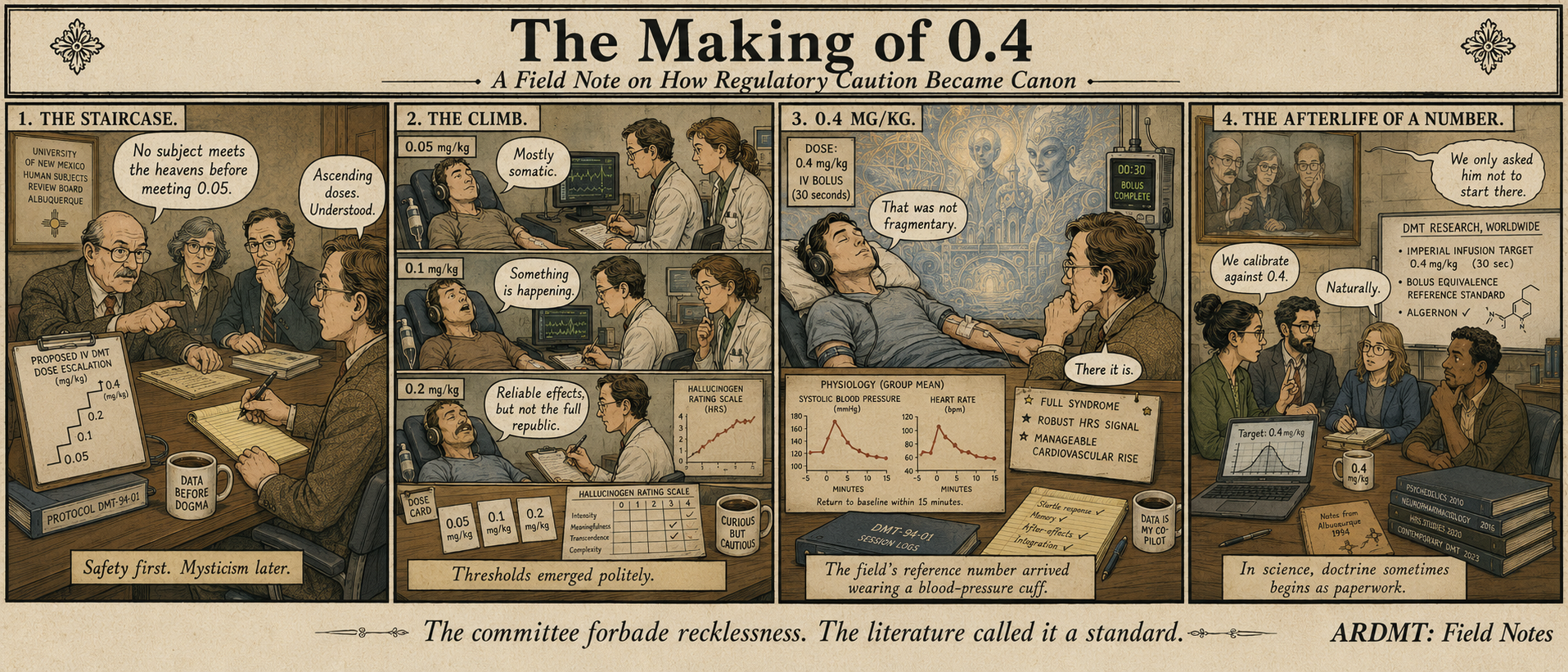
How Strassman's 1994 UNM dose-finding study made 0.4 mg/kg the canonical IV DMT dose — and quietly shaped three decades of psychedelic neuroscience.
### Deuterating DMT: how two neutrons reshape a pharmacokinetic profile
URL: https://www.ardmt.com/deuterating-dmt-how-two-neutrons-reshape-a-pharmacokinetic-profile/
Last updated: 2026-05-26T06:52:14.000Z
When Cybin Inc. filed its patent family around CYB003 — later redesignated SPL028 — the core chemical manoeuvre was, on its face, almost comically modest. The company had taken *N,N*\-dimethyltryptamine, a molecule whose basic structure had been known since Manske synthesised it in 1931, and replaced two hydrogen atoms on one of its methyl groups with deuterium. That is all. The carbon skeleton remained untouched. The pharmacophore was unchanged. The indole ring, the ethylamine chain, the two *N*\-methyl groups: all present and correct. The alteration was isotopic, not structural — a substitution visible only to a mass spectrometer. Yet this small swap, amounting to roughly two atomic mass units on a molecule weighing 188 daltons, was expected to meaningfully alter the drug's behaviour in a living body. Understanding why requires a short detour into bond physics, and from there into the particular metabolic vulnerabilities of tryptamines.
## [The work](https://www.ardmt.com/tag/research/)
Deuterium is hydrogen with an extra neutron: same electron count, same chemistry at equilibrium, but a carbon–deuterium bond vibrates at a lower frequency than a carbon–hydrogen bond and, critically, presents a higher zero-point energy barrier to cleavage. The practical consequence is that enzymes which break C–H bonds — notably the monoamine oxidases and cytochrome P450 isoforms responsible for tryptamine metabolism — find C–D bonds somewhat harder to sever. The rate reduction is not dramatic in most contexts; the primary kinetic isotope effect for C–H versus C–D cleavage is typically a factor of two to seven, depending on whether the bond-breaking step is fully rate-limiting. But for a molecule like [DMT](https://www.ardmt.com/what-is-dmt/), whose clinical pharmacology is almost entirely governed by how fast it is destroyed, even a two-fold change in metabolic rate can reshape the entire pharmacokinetic profile.
DMT's central pharmacokinetic problem has been well documented since Szára's early self-experiments in the 1950s: the molecule is an excellent substrate for monoamine oxidase A (MAO-A), which oxidatively deaminates the ethylamine side-chain, and for various cytochrome P450 enzymes that perform *N*\-demethylation. Intravenous DMT is cleared from plasma in minutes; the subjective experience, while intense, is brutally short. Oral DMT is destroyed almost entirely on first pass through the gut wall and liver, which is why ayahuasca traditions co-administer β-carboline MAO inhibitors. The molecule's therapeutic window — the range of plasma concentrations at which effects are sustained long enough to be clinically useful without provoking overwhelming perceptual disruption — is, accordingly, narrow and fleeting.
Cybin's strategy with SPL028 was to deuterate one of the *N*\-methyl groups, specifically targeting the site most susceptible to CYP-mediated *N*\-demethylation. By slowing this particular metabolic step, the aim was not to create a different drug in the pharmacodynamic sense — SPL028 should, in principle, bind 5-HT₂A receptors with essentially the same affinity as DMT, since the receptor-binding interaction involves the indole ring and the protonated amine, neither of which is altered — but to produce a molecule with a gentler pharmacokinetic curve: slower onset, longer plateau, smoother offset. The clinical hypothesis is that this profile would prove more tractable in a supervised therapeutic setting than the vertiginous bolus kinetics of intravenous DMT.
## [What it changed](https://www.ardmt.com/tag/research/)
Deuteration as a pharmaceutical strategy was not new to Cybin. Concert Pharmaceuticals (now part of Sun Pharma) had applied the approach with deutetrabenazine (Austedo), approved by the FDA in 2017 for Huntington's chorea and tardive dyskinesia — a deuterated version of tetrabenazine with improved half-life and reduced dosing frequency. That approval validated the regulatory principle that an isotopic modification could constitute a distinct drug with a distinct clinical profile, even when the pharmacophore was unchanged. Cybin's application of the same logic to a tryptamine psychedelic was, in that sense, a straightforward extension of an established platform.
What made it rather more interesting — and rather more uncertain — was the question of whether psychedelic pharmacology would respond to kinetic smoothing in the same way that a VMAT2 inhibitor did. DMT's subjective effects are notoriously non-linear with respect to plasma concentration; there is some evidence, from Strassman's dose-ranging work in the 1990s and from more recent continuous-infusion studies such as those by Timmermann and colleagues, that the quality and not merely the intensity of the experience shifts as the rate of onset changes. A slower rise might not simply produce a gentler version of the same experience; it might produce a qualitatively different one. One suspects the phenomenology will prove at least as important as the kinetics, though disentangling the two will be decidedly non-trivial.
## [What remains](https://www.ardmt.com/tag/research/)
SPL028 has moved through Phase I and into Phase II clinical trials for major depressive disorder, with Cybin reporting tolerability data that appear consistent with the intended pharmacokinetic reshaping — a longer duration of acute effect relative to intravenous DMT, without the need for MAO inhibitor co-administration. The deeper question, however, is whether kinetic profile *per se* is a therapeutically meaningful variable, or whether the critical mediator of antidepressant effect is cumulative 5-HT₂A receptor activation (an area-under-the-curve argument), peak receptor occupancy (a Cmax argument), or something else entirely — perhaps the subjective phenomenology itself acting as an active psychological ingredient. The deuteration strategy makes an implicit pharmacological bet: that duration and smoothness matter. Whether that bet is correct will require controlled comparisons not merely against placebo but against DMT itself — a head-to-head design that, to date, no trial appears to have attempted.
The broader implication is methodological. If deuteration can selectively tune tryptamine kinetics without altering receptor binding, the approach opens a combinatorial space: different sites of deuteration, different degrees of metabolic retardation, potentially a menu of DMT-derived molecules each with a distinct temporal signature. The molecule becomes, in a sense, a platform rather than a drug. Whether that space is genuinely worth exploring, or whether the differences between variants prove clinically negligible, remains an open question — but it is a genuinely interesting one.
## [Marginalia](https://www.ardmt.com/tag/cabinet/)
There is something faintly paradoxical about spending millions of dollars and several years of regulatory effort to make a molecule do what Amazonian *ayahuasqueros* accomplished centuries ago with a second plant — namely, slow down [DMT](https://www.ardmt.com/what-is-dmt/)'s metabolism long enough for it to be useful. The difference, of course, is specificity: an MAO inhibitor slows everything; a deuterium atom slows one bond. Whether that precision justifies the enterprise is a question the clinic, not the chemistry, will eventually have to answer.
### The Bell, the Clog, and the Gallows
URL: https://www.ardmt.com/the-bell-the-clog-and-the-gallows/
Last updated: 2026-05-25T10:08:24.000Z
*The Mischievous Dog from Babrius to Gibbs*
In Caxton's 1484 *Aesop* — the first Aesop ever printed in English — the fable of the Mischievous Dog closes with an image that has no obvious business being there. A thief is led through the streets to the gallows. Around his neck, the rope is made of gold rather than the ordinary hemp. He rejoices, the text tells us, that his noose is so rich and fair. The image is meant to clarify the fable's moral: only a fool celebrates the ornament of his own disgrace.
The image is not classical.
Neither Avianus, who wrote the Latin verse version of the fable around the year 400, nor Babrius, who wrote the older Greek version some two centuries earlier, gives the fable an execution scene. Both end with the elder dog's verbal rebuke and then nothing — no thief, no gallows, no rope of gold. The hanged-thief image entered the fable somewhere in its medieval transmission, and reached English print with Caxton in the 1480s. It would remain in the English tradition for the next three centuries until Thomas Bewick, in 1818, found a use for it.
The name Aesop, in any case, functions less as an author than as a transmission field. Greek, Latin, medieval French, early printed English, eighteenth-century Whig English, Victorian schoolroom English, and modern scholarly English have all claimed the fable while quietly remaking it. No single authorial Aesop is recoverable; what survives is not an origin but a tradition — a sequence of editorial choices made by successive generations about what the form must be made to do.
The Mischievous Dog, taken across its full transmission, turns out to be less a stable moral tale than a record of successive interpretive needs. Each translator alters the object around the dog's neck — bell, bronze, clog, drum, golden noose, and, in Bewick's hands, even the badge of office — in order to change what disgrace, public shame, authority, and moral correction are made to mean. What shifts across the centuries is the moral technology fastened to the dog; the dog is recognisably the same offender throughout. What follows here traces that sequence from the second-century Greek to the early twenty-first-century English, attending closely to what each version chose to keep, what it added, what it suppressed, and why. It closes with a fresh English translation produced for the present edition, drawing on what the textual archaeology has uncovered.
---
## The Greek and the Latin
The oldest version we have is Babrius 104, written in Greek choliambic verse in the second century CE (Rutherford 1883). It is the shortest, the sparest, and in several ways the strangest of the versions considered here.
> Λάθρῃ κύων ἔδακνε· τῷ δὲ χαλκεύσας ὁ δεσπότης κώδωνα καὶ προσαρτήσας πρόδηλον εἶναι μακρόθεν πεποιήκει. ὁ κύων δὲ τὸν κώδωνα δι' ἀγορῆς σείων ἠλαζονεύετ'· ἀλλὰ δὴ κύων γραίη πρὸς αὐτὸν εἶπεν "ὦ τάλαν, τί σεμνύνῃ; οὐ κόσμον ἀρετῆς τοῦτον οὐδ' ἐπιεικείης, σαυτοῦ δ' ἔλεγχον τῆς πονηρίης κρούεις."
> *A dog used to bite by stealth. His master forged a bell and tied it to him, so he might be marked from a distance. The dog paraded through the marketplace, shaking the bell, full of his own importance. But an aged bitch said to him: "Wretch, what are you so proud of? This is no ornament of virtue or decency. What you sound is the proof of your own wickedness."*
Three features of Babrius's version disappear in every later English version of the story.
First, the setting is specified. The dog parades δι' ἀγορῆς — *through the marketplace,* the *agora,* the heart of Greek civic life. The setting matters: in classical Greek thought, public self-display and arrogant injury belonged to the moral world of *hybris* — the assertion of self at others' expense, the kind of offence the Athenian city took seriously enough to legislate against (Fisher 1992; Rawlings 2011). The secret-biter who flaunts his bell is not merely foolish; he is making his offence public in the very space where communal judgement gathered, and the elder dog names it for what it is. The dog's display is staged at the centre of communal life; the bell is meant to be heard by everyone who matters. No later English version preserves this setting. The dog merely parades.
Second, the rebuker is female. The text says κύων γραίη — an aged dog, in the feminine. The grammar is explicit: κύων is a noun of common gender, taking either masculine or feminine articles and adjectives, and γραίη is unambiguously feminine in every grammatical parsing. The voice of moral correction in the oldest surviving version of the fable is an old female dog. The Latin tradition that follows masculinises her. So does every English version, from Caxton's *moost auncyent* through Croxall's "sly old poacher" to Townsend's "old hound." Two thousand years of transmission, and the female voice of the rebuke has quietly disappeared from the story.
Third, the elder's closing line contains a pun the English tradition will never recover. The Greek κρούεις means both "you strike" and "you sound" — used of bells, drums, and metaphorical proclamations alike. The line *σαυτοῦ δ' ἔλεγχον τῆς πονηρίης κρούεις* means simultaneously "you strike the proof of your own wickedness" (the dog literally hits the bell as he walks) and "you sound the proof of your own wickedness" (the bell makes audible his guilt). The bell-strike and the moral testimony are the same act. Laura Gibbs, translating from the Greek in 2002, reaches for "you are shamefully beating the drum of your own evil deeds" — a creative attempt, but the choice of "drum" is interpretive; the Greek has only the bell.
Avianus, writing in Latin elegiac couplets around the year 400 (Ellis 1887), is doing something a little different. He opens with an abstract framing — *Haud facile est prauis innatum mentibus ut se / Muneribus dignas suppliciove putent* — "It is not easy for those of wicked nature to think themselves deserving of reward rather than punishment." This couplet is missing in Babrius, and may itself be a later editorial addition to the Avianus text. After it, the story is recognisably the same: silent biter, master orders a bell, dog mistakes the bell for honour, elder rebukes him. Avianus's rebuke is more rhetorically elaborate than Babrius's — more lines, more questions, more decoration — but ends in the same place:
> *Non hoc virtutis decus ostentatur in aere,* *Nequitiae testem sed geris inde sonum.*
>
> *This is no honour of virtue displayed in the bronze; what you bear from it is the sound that testifies to your wickedness.*
And that is it. The Latin, too, ends on the rebuke. No execution. No hanged thief. No moral coda extending the image beyond the elder dog's spoken correction.
Both ancient versions, then, end on the elder's spoken rebuke. The medieval and English transmission that follows will systematically extend, transform, or compress that closing — adding visual material, adding moral images, restructuring the framing, eventually stripping the whole inheritance down to an aphorism. Before tracing that history, it is worth setting the full sequence out at a glance.
---
## A summary of the transmission
| Version | Date | Object | Rebuker | Added image | Closing | Effect |
| --------------- | ------------ | ----------------- | ----------------------- | -------------------------------------- | ------------------------------------------- | ----------------------------------------------------------------------- |
| Babrius 104 | c. 2nd c. CE | bell (κώδων) | aged female dog | none | verbal rebuke (κρούεις pun) | civic shame in the marketplace |
| Avianus VII | c. 400 | bronze / bell | elder dog | none | verbal rebuke | Latin moral abstraction |
| Caxton | 1484 | bell | ancient dog | thief led to gallows in golden noose | narrator commentary with hanged-thief image | medieval moral spectacle |
| Croxall | 1722 | clog | sly old poacher (human) | inherited from Caxton | extended prose Application | Whig social satire |
| Bewick | 1818 | clog | poacher (human) | "Wages of Cruelty" tailpiece engraving | Application plus paired engravings | punishment and public cruelty foregrounded |
| Townsend | 1867 | bell | old hound | none | single-line aphorism | schoolroom moral compression |
| Vernon Jones | 1912 | bell | old hound | none | inherited aphorism | popular nursery Aesop |
| Gibbs | 2002 | drum (figurative) | old dog | none | verbal rebuke (Greek recovered) | Greek return, but not full restoration |
| Present edition | 2026 | bell | aged bitch (κύων γραίη) | none | verbal rebuke (κρούεις partially recovered) | civic shame and feminine voice restored within the ancient animal frame |
The sequence above is not a stemma in the strict philological sense. It does not claim that every later English version descends mechanically from every earlier one. It traces instead a visible English reception history: the recurring choices by which translators, editors, and illustrators have made the fable legible to their own age.
---
## How the medieval additions entered
Caxton's 1484 *Aesop* (Jacobs 1889) is at three translational removes from Avianus's Latin. He translated it from Julien Macho's French *Esope* (Lyon, c. 1480), which was translated from Heinrich Steinhöwel's Latin-and-German *Aesop* (Ulm, 1476-77), one of the first major European printed fable collections. At any point in that chain — Steinhöwel, Macho, or Caxton — material could be added.
Caxton's text has two clear additions to the Avianus framework.
The first is a curious framing device. Caxton's master does not own one dog; he owns two. *A fader of famylle whiche had two dogges, of the whiche the one withoute ony barkyng bote the folke, and the other dyd barke and bote not.* The master, observing the malice of the silent biter, fastens the bell to *that* dog rather than the noisy one. The two-dog opening turns the fable into a small parable about hidden versus visible danger — the silent biter, not the loud one, may be the real menace. This is structural, and it has no classical precedent in either the Greek or the Latin.
The second is the hanged thief. After the elder dog's rebuke, Caxton's narrator adds a commentary in his own voice: *a moche fole were the theef whiche that men ledde for to be hanged, and that he had a cord of gold aboute his neck, yf he shold make Joye therof, how be hit that the corde were moche ryche and fayre.* A medieval image — execution as public spectacle, the doomed man parading toward the gallows — has been grafted onto a Roman fable about a dog. It sits comfortably within a medieval Christian moral logic: the soul ornamented for sin is still bound for damnation, however gilded the rope.
These additions matter because they fix the fable's English shape for three centuries. Whatever later English translators do with the story, they are reacting to Caxton's framing, not to Avianus's.
---
## The object around the neck
It is worth pausing here, before tracing the fable forward into the eighteenth century, to observe what is actually happening across the transmission. The moral burden of the story is carried less by the dog than by the object attached to him.
Babrius's bell is evidentiary: it makes secret harm publicly audible. Avianus's bronze is testimonial: the sound itself is the witness against the dog's character. Caxton's golden noose is eschatological: it turns ornament into damnation, the bell-as-shame inflated into the rope-as-judgement. Croxall's clog, when it arrives in 1722, is disciplinary: it restrains the offender while marking him as dangerous. Bewick, in 1818, will turn the same clog into something closer to an indictment of state authority — the badge of office and the badge of punishment treated as the same kind of mark. Townsend's bell, restored in 1867, is reputational: it becomes a warning against confusing notoriety with fame. Gibbs's drum, reached for through the Greek in 2002, is expressive: guilt becomes self-advertisement, the wrongdoer's own announcement of himself.
The object changes because the moral technology changes. Each generation reaches for the implement that does the moral work it needs done — auditory shame, public exposure, religious damnation, social discipline, political critique, aphoristic warning, expressive disclosure. The dog is recognisably the same offender throughout. What he has been made to wear has changed every century.
---
## Croxall and the Whig poacher
Samuel Croxall's 1722 *Fables of Aesop and Others* — written as a Whig clergyman's deliberate answer to Sir Roger L'Estrange's Tory edition of 1692 (Patterson 1991) — preserves Caxton's two-dog structure and the moral inheritance of the hanged thief, but makes a small editorial change with disproportionate consequences. The bell becomes a *clog:* a heavy wooden weight, an actual restraint device, the kind of implement used to slow a chronic biter so it could not run at people. Croxall's dog is not a discreet warning to others; it is a creature being publicly disciplined.
> *A certain man had a Dog which was so curst and mischievous, that he was forced to fasten a heavy clog about his neck, to keep him from running at, and worrying people.*
The bell-as-warning has become the clog-as-punishment. Within the line traced here, this is Croxall's decisive alteration; no earlier version preserves the clog.
The dog's antagonist also shifts, and the change is structural. He is no longer the medieval *moost auncyent* fellow-dog, nor Avianus's *senior de plebe.* He is *a sly old poacher, who was one of the gang* — a human character planted inside an animal fable, a socially disreputable outsider, a man from the criminal community delivering moral truth to a deluded social climber. This is the most consequential structural move in the fable's English history after Caxton: Croxall breaks the animal-only frame. From this point on, the rebuker in English versions will be either human (in Croxall and Bewick) or merely vestigially canine (Townsend's "old hound" delivering a one-line aphorism), but the matriarchal animal elder of the Greek will not return.
In a collection already shaped by party-political rivalry with L'Estrange, the fable's concern with false honours and public disgrace could hardly remain morally neutral. Croxall's Whig reader may be invited to recognise himself in the poacher rather than the dog — to read the fable as social satire from the perspective of the underclass moralist rather than the chastened upstart.
---
## Bewick's reactivation
With Bewick, the fable ceases to be merely translated and becomes staged on the page.
In 1818, Thomas Bewick — engraver, Tyneside dissenter, one of the most quietly political figures in English popular print — published his own *Fables of Aesop, and Others.* His text of The Mischievous Dog reproduces Croxall almost exactly: the clog, the sly poacher, the structure, all preserved. But Bewick is also doing something Croxall could not, because he is doing it visually as well as in prose. He frames the fable between two engravings of his own design.

The headpiece, set at the top of the fable on page 169, shows the dog in a rural farmyard, the heavy clog clearly visible around its neck, with other dogs nearby. Bewick has visually committed to Croxall's clog rather than Caxton's bell or the ancient sources' bronze. The disciplinary object — the wooden restraint — has become the canonical image. The dog is no longer warned about; the dog is shown wearing the marks of his own correction.
Bewick's "Application" — the prose moral attached to each fable — goes somewhere Croxall did not:
> *The only true way of estimating the value of tokens of distinction, is to reflect on what account they were conferred. Those which have been acquired for virtuous actions, will be regarded as illustrious signs of dignity; but if they have been bestowed upon the worthless and base, as the reward of vice or corruption, all the stars and garters, and collars of an illustrious order, — all the tinsel glories in which such creatures may strut about in fancied superiority, will not mask them from the sight of men of discernment, who will always consider the means by which their honours have been obtained, and truly estimate them as badges of abasement and disgrace.*
Directly beneath this Application, on page 170, Bewick has placed a tailpiece engraving. It shows a man bound at the wrists, led behind a horse-drawn cart through a jeering crowd, his back being whipped by an executioner. Above the cart, on a small banner, runs the legend **THE WAGES OF CRUELTY**. The next fable (*The Bull and the Goat*) begins on the following page with its own headpiece. The procession-to-punishment image is attached specifically to *The Mischievous Dog*, not to the volume's general visual programme.
What Bewick has done, by pairing the two engravings around Croxall's politicised text, is reactivate Caxton's medieval hanged-thief image at the precise moment in British history when capital punishment was one of the most violently contested moral questions of the day. Between 1810 and 1832, when the Punishment of Death Act began the dismantling of the so-called Bloody Code, public execution was being defended as moral pedagogy and attacked, by reformers and dissenters, as state cruelty dressed as justice (Gatrell 1994).
The visual argument is direct. The headpiece shows what is done to a dog: a wooden clog, a restraint device, a publicly displayed mark of correction. The tailpiece shows what is done to a man: a procession to public punishment, the body whipped by an executioner. Between the two engravings sits the Application about *badges of abasement and disgrace, however much they may resemble all the stars and garters, and collars of an illustrious order.* The clog the dog wears, the wounds the man receives, and the stars and garters of the powerful are placed in visual and rhetorical sequence as if they were the same kind of mark. The mischievous dog wears a clog as a sign of his viciousness; the executioner wears the badges of office of state justice. Both, Bewick may be implying, are wearing their wickedness in plain sight. The fable, in Bewick's hands, may be read as an indictment of the men who hang men.
Whether Bewick reached the hanged-thief image by deliberate reading of Caxton's 1484 *Aesop* or by some more diffuse channel of medieval moral imagery is unclear. What matters is that the image was available to him in the English tradition because Caxton had put it there three centuries before. Bewick did not invent the procession to the gallows; he recovered it, and gave it a tailpiece.
---
## Townsend's epigram
By the second half of the nineteenth century, this complex medieval-political layer has been planed away.
George Townsend's 1867 translation — the version that became the standard English-language schoolroom Aesop for the next two generations — restores the bell (the clog vanishes again), removes the human poacher (the rebuke is delivered by "an old hound"), drops Croxall's long Application entirely, and reduces the moral to a single line:
> *Notoriety is often mistaken for fame.*
It is a perfectly compressed epigram. It is also a near-total depoliticisation. The Victorian schoolroom did not need a hanged thief, a sly old poacher, or a clog-as-punishment; it needed an aphorism children could memorise. V. S. Vernon Jones's 1912 translation, illustrated by Arthur Rackham, inherits Townsend's epigram unchanged. Many popular English Aesops since have followed the same compressed moral pattern.
What is striking, two thousand years downstream from Babrius's marketplace and feminine elder, is how much has been compressed away. The marketplace setting is gone. The feminine voice is gone. The κρούεις pun is gone. The elaborated Avianus rhetoric is gone. The two-dog structure is gone. The clog is gone. The hanged thief is gone. The Whig poacher is gone. Bewick's executioner is gone. What remains: six words.
---
## The Greek recovery
Laura Gibbs's 2002 Oxford World's Classics translation, going back to the Greek of Babrius rather than working through the English tradition, recovers a quite different fable. The elder tells the foolish one, *"You are shamefully beating the drum of your own evil deeds."* The drum, not the bell. The recovery is significant — it pulls the fable out of its English medieval-Victorian lineage and reconnects it to a Greek prosodic tradition where the moral is not a subtle ornament but loud public testimony.
But Gibbs, working at the scale of nearly six hundred fables for a single edition, does not capture everything in the Greek. The marketplace appears, but the female voice does not — Gibbs gives the rebuke to "an old dog," unsexed. The κρούεις pun becomes the "drum" metaphor, which is interpretive rather than literal. What Gibbs has done is real and valuable: she has recovered the Greek tradition for modern English readers. The translation that follows here is an attempt to recover what even Gibbs left behind.
---
## What the fable tells us about fables
The Mischievous Dog helps explain why scholars disagree about Aesop's politics. Page DuBois has argued that the fables work reactionarily: by mapping human inequality onto biological hierarchies between species, they naturalise human inequities as if these too were facts of nature (DuBois 2003). Others, against this reductive reading, have argued that the fables work in both directions — read by underdogs as resistance and by the powerful as warnings against ambition, the form's political ambidexterity being precisely what has kept it in cultural use for two and a half millennia. Jeremy Lefkowitz has taken the question one step further: animal fables, he argues, are themselves self-aware about their own artifice, leaving the gap between symbolic animal and real animal deliberately open (Lefkowitz 2014).
This fable supports the latter two readings especially. Its politics are not fixed in the animal plot; they are activated by the object, the setting, the speaker, and the moral frame attached to it. Croxall pursued one reading, Bewick the opposite, and the fable accommodated both without contradiction. The form is not an argument for any one politics. It is a formal occasion for politics to happen.
---
## A new English translation
What follows is the translation of *The Mischievous Dog* produced for the present edition. The setting is the marketplace, as in Babrius — recovered after two thousand years of unspecified parading. The object around the dog's neck is the bell, as in both ancient sources and as in Townsend's restoration — not Croxall's disciplinary clog and not Gibbs's interpretive drum. The rebuker is an aged bitch — animal, female, and aged, as the Greek κύων γραίη unambiguously says she is. The fable ends on her spoken rebuke, as both Babrius and Avianus end. The medieval hanged thief and Bewick's executioner — both fascinating as commentary — have no place in a translation that aspires to the ancient form.
The decision to preserve the rebuker as an animal, rather than humanising her in the manner Croxall introduced in 1722, is a deliberate editorial position. Croxall's "sly old poacher," and Bewick's preservation of the same human voice a century later, set a pattern that has not been seriously questioned since: every later English version either humanises the rebuker in some way or empties the animal interlocutor of any matriarchal weight. But the fable form's particular power — its accessibility, its imaginative reach, its capacity to make moral questions vivid through animals talking among themselves — depends on the animal-only frame the ancient sources maintained. This edition takes the position that the moral voice should remain where Babrius placed it: with an old female dog, in the marketplace, addressing the proud young dog who refuses to hear what his own bell is sounding.
On the English term for κύων γραίη: the literal Greek is preserved here as "an aged bitch." The word has accumulated pejorative weight in modern English that the Greek κύων (in its feminine sense) did not carry, but to soften it risks repeating the very move the chapter has documented — successive generations of translators choosing comfort over accuracy and burying the female voice in the process. The LSJ entry's primary translation of κύων is, after all, "dog, bitch," without hedging. The philological workings on these two words appear in the editorial notes for this fable.
> There was a dog who used to bite people in secret. He gave no warning, but struck suddenly from below.
>
> His owner, so that the dog's pretended decency could no longer deceive the neighbours, fastened a bell at its throat. The bronze would clatter and warn anyone it came near.
>
> The dog mistook the bell for an honour. He paraded through the marketplace shaking it, head lifted, looking down on the other dogs as he passed.
>
> An aged bitch, who had been watching, came forward and spoke.
>
> *"What is it you think you're advertising? You imagine this was given to you for your goodness, your decency, your worth? It is no such thing. What you are sounding is the proof of your own wickedness — and you ring it through the marketplace for all of us. It does not take long to learn what the sound means."*
The English here aims for a register between Babrius's compression and Croxall's elaboration — modern but not slangy, deliberate but not archaic. The closing line attempts to carry as much of the Greek κρούεις pun as English will accommodate: *what you are sounding* / *you ring it through the marketplace* preserves both the bell-strike and the moral testimony as a single act, though neither rendering captures the Greek doubleness completely. The full force of the pun, like the full force of any classical text in any English, remains partly out of reach. What can be carried across has been carried across.
---
## What the dog has worn
The dog is recognisably the same offender throughout. What he wears around his neck — the bronze, the bell, the clog, the drum, the noose — has changed shape every century. So has the question of who, exactly, is meant to read it.
Babrius staged the dog in the marketplace and gave the rebuke to an old female elder. The Latin tradition lost the marketplace and quietly masculinised the rebuker. Caxton's English added the two-dog frame and the hanged thief. Croxall added the disreputable poacher and replaced the bell with a clog, breaking the animal-only frame in the process. Bewick framed the clog visually with the procession to the gallows, at the moment the gallows themselves were under political attack. Townsend buried the whole inheritance under an aphorism. Vernon Jones repeated the aphorism. Gibbs went around the English tradition altogether and came back with a Greek drum, but left the female elder behind. The version offered in this edition restores the marketplace, restores the female elder's voice, returns the bell to its ancient role, and ends where Babrius and Avianus end — on the rebuke itself, within the animal frame the ancient sources maintained.
The history of this fable in English is the history of what each century has chosen to keep, what it has added, and what it has buried — from the sparer classical witness that already contained the seed of many later readings. The hanged thief, which English readers from Caxton onward took to be part of the ancient story, was a medieval invention. Bewick's executioner, which looks like a radical political move, may in fact be the recovery of a medieval Christian one. The "old hound" who delivers Townsend's epigram was a female dog in the Greek who has been quietly masculinised through successive stages of transmission.
There is no original Aesop to recover. There are only the choices each generation has made about which version of the fable it needed — and about what, in its own age, the dog should be made to wear.
### Which Ayahuasca?
URL: https://www.ardmt.com/which-ayahuasca/
Last updated: 2026-05-25T06:13:38.000Z
_No content available._
### Shulgin's tryptamine notebooks: the cartography DMT research still navigates by
URL: https://www.ardmt.com/shulgins-tryptamine-notebooks-the-cartography-dmt-research-still-navigates-by/
Last updated: 2026-05-25T06:01:19.000Z
## [The Cartography Before the Territory](https://www.ardmt.com/tag/research/)
A good deal of contemporary [DMT](https://www.ardmt.com/what-is-dmt/) research proceeds as though the compound arrived fully formed from the pharmacological ether, a molecule of inherent fascination requiring no genealogy. This is, of course, nonsense. The systematic context in which DMT became a tractable research subject owes an enormous debt to the methodical, deeply eccentric work of Alexander Shulgin, whose tryptamine notebooks represent one of the more unusual contributions to twentieth-century pharmacology.
## [The Man and the Method](https://www.ardmt.com/tag/research/)
Shulgin's approach to psychoactive tryptamines was, in essence, that of a synthetic organic chemist who also happened to be his own principal test subject. This is an arrangement that modern ethics committees would regard with something between horror and incomprehension, but it produced a body of structure-activity relationship data that remains, in certain respects, unmatched. His laboratory notebooks — many of which informed the tryptamine half of *TiHKAL* (Tryptamines I Have Known and Loved), published in 1997 with Ann Shulgin — record the synthesis, dosing, qualitative effects, and duration data for dozens of tryptamine variants, DMT among them.
What distinguished Shulgin's work from mere psychonautic enthusiasm was its systematicity. He understood that altering a single substituent on the tryptamine scaffold — a methyl group here, a methoxy there, a shift from the 4- to the 5-position of the indole ring — produced compounds with markedly different pharmacological profiles. DMT itself (N,N-dimethyltryptamine) was one node in a vast combinatorial space that included [5-MeO-DMT](https://www.ardmt.com/what-is-5-meo-dmt/), DET, DPT, 4-HO-DMT (psilocin), and scores of less familiar analogues. Shulgin mapped these nodes with the patience of a Victorian naturalist cataloguing beetles, recording onset times, effective doses, and qualitative character with a precision that belied the subjective nature of the observations.
## [DMT in the Tryptamine Landscape](https://www.ardmt.com/tag/research/)
Before Shulgin's systematic mapping, DMT occupied a somewhat orphaned position in psychopharmacology. It had been synthesised by Richard Manske in 1931, identified as a constituent of *Anadenanthera peregrina* snuffs by Oswaldo Gonçalves de Lima in 1946, and subjected to human bioassay by Stephen Szára in 1956, after Sandoz declined to supply him with LSD on account of his being Hungarian. Szára's intramuscular injections established the basic phenomenology — rapid onset, intense visual effects, short duration — but DMT remained something of a curiosity, a tryptamine too brief and too fierce to attract the clinical interest that psilocybin and LSD enjoyed.
Shulgin's contribution was to place DMT within a rational pharmacological framework. By systematically varying the N-alkyl substituents, the ring hydroxylation and methoxylation patterns, and the side-chain length, he showed that DMT's particular character — its potency, its brevity, its apparent dependence on route of administration — was not arbitrary but a predictable consequence of its molecular structure. The rapid metabolism by monoamine oxidase, which renders DMT orally inactive unless combined with an MAO inhibitor (the basis of ayahuasca), could be understood in terms of the unsubstituted indole nitrogen and the accessibility of the dimethylamine to oxidative deamination. Compounds with bulkier N-substituents, or with ring substitutions that altered electronic density, behaved differently — sometimes more potent, sometimes less, sometimes longer-acting, sometimes inactive altogether.
## [The Legacy for Contemporary Research](https://www.ardmt.com/tag/research/)
The relevance of Shulgin's tryptamine work to present-day DMT research is not merely historical. Several active lines of enquiry trace their intellectual ancestry directly to his structure-activity observations.
First, the current interest in DMT's [sigma-1 receptor](https://www.ardmt.com/what-is-the-sigma-1-receptor/) agonism and its potential neurotrophic effects rests on a pharmacological specificity that only makes sense against Shulgin's comparative backdrop. When researchers ask why DMT appears to promote neural plasticity in ways that, say, DPT does not — or does so differently — they are implicitly working within the structure-activity framework that Shulgin established. The selectivity profile of a given tryptamine at 5-HT2A, sigma-1, and trace amine-associated receptors is, in the end, a function of the molecular features Shulgin spent decades cataloguing.
Second, the development of non-hallucinogenic tryptamine analogues — the so-called "tabernanthologs" and related compounds being pursued by David Olson's laboratory at UC Davis and others — is essentially an extension of Shulgin's programme by more sophisticated means. The question "can we retain neuroplastic effects whilst eliminating subjective psychoactivity?" is a structure-activity question, and it is answerable only because Shulgin (and, to be fair, a handful of contemporaries) mapped enough of the tryptamine space to make rational modification feasible.
Third, Shulgin's observations on route-dependent pharmacology — the stark difference between smoked, injected, and oral DMT — anticipated what is now a significant clinical consideration. Trials of intravenous DMT, such as those conducted by Rick Strassman in the 1990s and those currently underway at Imperial College London and elsewhere, must grapple with pharmacokinetic questions that Shulgin's notebooks, in their idiosyncratic way, were among the first to document carefully.
## [The Uncomfortable Methodological Question](https://www.ardmt.com/tag/research/)
There is, of course, a tension in celebrating Shulgin's work. His methods — self-experimentation, small groups of trusted colleagues rated on a subjective scale of his own devising (the "Shulgin Rating Scale," running from minus to plus-four), no blinding, no placebo control, no institutional oversight — would not survive first contact with a contemporary peer reviewer. The data in *TiHKAL* are, by modern standards, anecdotal. N-of-one observations, however carefully recorded, do not constitute evidence in the sense that a randomised controlled trial does.
And yet. The field continues to rely on Shulgin's observations as a starting point for hypothesis generation, compound selection, and dose-ranging. This is a pragmatic acknowledgement that some knowledge can only be gathered by methods we have subsequently — and rightly — deemed insufficient. The notebooks are not evidence; they are something arguably more valuable at the exploratory stage: they are maps, drawn by someone who actually visited the territory, however unsystematically by our present lights.
One does not navigate by a hand-drawn map when GPS is available. But one is grateful that someone drew the map before the satellites went up.
## [Marginalia](https://www.ardmt.com/tag/cabinet/)
It is a peculiar feature of [DMT](https://www.ardmt.com/what-is-dmt/)'s research history that its most systematic early pharmacological context was provided by a man working from a private laboratory in Lafayette, California, largely outside institutional science. That this arrangement produced work of lasting utility says something either favourable about the power of individual curiosity or slightly damning about the pace of institutional pharmacology. Quite possibly both.
### Speech biomarkers after 5-MeO-DMT: can how you talk reveal what changed?
URL: https://www.ardmt.com/speech-biomarkers-after-5-meo-dmt-can-how-you-talk-reveal-what-changed/
Last updated: 2026-05-24T06:58:10.000Z
## [The claim and the context](https://www.ardmt.com/tag/research/)
Kuc, McAlpine, Sellers, Blackburne, Lametti, and Skipper, writing in the *Journal of Psychopharmacology*, report on what they term "speech markers of psychological change" following a [5-MeO-DMT](https://www.ardmt.com/what-is-5-meo-dmt/) retreat (PMID: [42175700](https://pubmed.ncbi.nlm.nih.gov/42175700/?ref=ardmt.com); DOI: [10.1177/02698811261443690](https://doi.org/10.1177/02698811261443690?ref=ardmt.com)). The premise is straightforward, even if its execution is anything but: rather than relying solely on self-report questionnaires to capture the psychological aftermath of a psychedelic experience, the authors have turned to computational analysis of speech as an objective, or at least observer-independent, outcome measure.
The idea that how one speaks might betray how one has changed is not, of course, new. Clinical psychiatry has long noted that speech rate, prosody, semantic coherence, and lexical diversity shift with mood disorders, psychosis, and recovery. What is relatively new is the systematic application of computational linguistics to psychedelic science — a field that has, until recently, been almost wholly dependent on subjective rating scales (the Mystical Experience Questionnaire, the 5D-ASC, and their various cousins) to quantify states that participants themselves frequently describe as ineffable.
## [Where this fits in the field](https://www.ardmt.com/tag/research/)
5-MeO-[DMT](https://www.ardmt.com/what-is-dmt/) occupies a curious niche. It is the more potent, more ontologically disruptive cousin of *N,N*\-DMT, producing experiences that tend towards ego dissolution and unitive states rather than the baroque visual narratives more typical of its dimethyl relative. The naturalistic retreat setting — which this study appears to employ — has become a common research paradigm for 5-MeO-DMT, partly because the compound's legal status varies by jurisdiction and partly because the ceremonial or semi-ceremonial context is how most participants actually encounter it. Several groups have published on retreat-based 5-MeO-DMT outcomes, documenting reductions in depression and anxiety scores alongside increases in measures of well-being and life satisfaction.
The limitation of that body of work, as its own authors have acknowledged, is its reliance on self-report. Expectancy effects, demand characteristics, and the sheer social desirability of reporting a meaningful experience after an intense ritual all conspire to inflate subjective measures. Speech analysis offers a partial remedy. It is not immune to context effects — one may speak differently when one knows one is being recorded — but it captures dimensions of psychological state that are difficult to consciously manipulate. Semantic coherence, the ratio of positive to negative affect words, mean utterance length: these are features that shift with genuine changes in cognitive and emotional processing, and they are hard to fake.
Prior work in the psychedelic speech-analysis space has been sparse. A handful of studies have examined linguistic features during or after psilocybin sessions, and there is a small literature on speech disorganisation during acute psychedelic states. Applying these methods specifically to 5-MeO-[DMT](https://www.ardmt.com/what-is-dmt/), and specifically to the question of *lasting* psychological change rather than acute intoxication effects, appears to be a genuinely novel contribution.
## [Why this line matters](https://www.ardmt.com/tag/research/)
If psychedelic-assisted therapy is to move towards clinical integration — and several programmes are attempting exactly that — it will need outcome measures that go beyond asking patients whether they feel better. Speech biomarkers are attractive because they are non-invasive, scalable (a recorded interview is cheaper than an fMRI), and increasingly amenable to automated analysis. They also capture something that questionnaires miss: the *structure* of thought, not merely its self-reported content.
The question, naturally, is whether speech changes following a psychedelic retreat reflect genuine psychological reorganisation or simply a shift in narrative register — participants adopting the vocabulary and cadence of the retreat culture they have just inhabited. Disentangling these will require careful control conditions, and it will be worth seeing how the authors have addressed that problem.
## [Note on access](https://www.ardmt.com/tag/research/)
The full text of this paper is not yet openly available. ARDMT has worked from the published metadata and abstract. When the complete methods and results are accessible, we shall return with a proper analysis — sample sizes, specific speech features examined, effect sizes, and the authors' own discussion of limitations all merit close attention.
##
## [Marginalia](https://www.ardmt.com/tag/cabinet/)
There is something pleasingly recursive about using language to study what a drug does to language — particularly a drug whose users so reliably insist that language is inadequate to the task. If the speech markers hold up, they may tell us rather more about what [5-MeO-DMT](https://www.ardmt.com/what-is-5-meo-dmt/) does to the narrator than any narration could.
### Ayahuasca is not one thing
URL: https://www.ardmt.com/ayahuasca-is-not-one-thing/
Last updated: 2026-05-24T06:22:26.000Z
#
*Botany, secrecy, chemistry, and the problem of knowing what was in the cup.*
By Stephen Page · \[24/05/2026\]
---
*The popular conversation has flattened a botanical and cultural complex into a single substance. The flattening is recent, foreign, and it serves several interests at once.*
---
## [The claim, stated plainly](https://www.ardmt.com/tag/exploration/)
Much of the popular writing on [ayahuasca](https://www.ardmt.com/what-is-ayahuasca/) over the last decade — from high-profile works such as Michael Pollan's [*How to Change Your Mind*](https://michaelpollan.com/books/how-to-change-your-mind/?ref=ardmt.com) to many clinical trial press releases and wellness features — treats it as a single substance. One brew, one experience, one chemistry, one set of clinical implications. The retail mythology that has built up around the brew, particularly in its translation into European and North American therapeutic and ceremonial contexts, depends on that simplification.
This essay argues that the simplification is wrong, and that recognising why it is wrong has consequences. Ayahuasca should be understood not as a single psychoactive substance but as a variable ethnobotanical category. Variation enters through the vine, the DMT-bearing plant, regional admixtures, preparation methods, serving practices, and undisclosed practitioner choices. Once that is recognised, many public, clinical, and commercial claims about "ayahuasca" become too imprecise to stand without further specification. The [vine](https://www.ardmt.com/what-is-ayahuasca/) is the only constant across the family — and even the vine, on closer inspection, is not one thing. Recent chemistry suggests the analytical literature has been quietly misreading the brew for decades. And the layer of operational secrecy that surrounds traditional preparation does several jobs at once: some legitimate ritual and pedagogical work, some less defensible authority-protection that the export retreat economy has inherited and put to commercial use.
## [What this looks like in practice](https://www.ardmt.com/tag/exploration/)
Some context for what follows. From 2014 to 2021 I lived in southeastern Ecuador, in the Gualaquiza region — Shuar territory at the foothills of the Andes, where indigenous, mestizo *vegetalismo*, and various syncretic and modern ceremonial traditions all overlap. Over those seven years I watched perhaps twenty different individuals and groups prepare and serve ayahuasca, helped prepare brews myself, and drank in a wide range of settings — from genuinely traditional Shuar contexts to Western practitioners playing the role with varying degrees of seriousness.

Gualaquiza, southeastern Ecuador. Shuar territory at the foothills of the Andes, where the field observations in this article were made.
I can report two things from that experience that bear directly on what follows. The first is that no two preparations were the same. Different vine sources, different DMT-bearing plants where any were used at all, different admixtures, different cooking times, different concentrations, different ritual frames, different effects.
The second is that I could not tell you, in detail, what was different. The composition of the brew is shrouded on purpose. This was true across the entire spectrum of practitioners — Dutch operators, mestizo *curanderos*, Shuar shamans living traditionally in the forest. You go to gather the vine. You spend hours pounding it because there is always a large pile of it to deal with. You watch. Plants are added that you cannot identify because no one names them. You participate as a disciple, not an analyst. The structure of the practice forbids the question "what's in the cup." When the experience does very little — and for non-native participants it often did very little — the cultural frame provides the answer before you can finish asking: bad juju, you didn't do it right, you must have made a mistake, the brew was working on something else for you. The practitioner is never wrong. The brew is never weak. Any failure is yours.
I will return to that closed epistemic loop later, because it matters. For now: the variation is real, it is large, and it is deliberately obscured. The ethnobotanical literature on regional variation and undisclosed admixtures, surveyed below, is consistent with that field picture. The literature is catching up to what the practitioners have always known and selectively withheld: there is no recipe.
## [The vine that is also a category](https://www.ardmt.com/what-is-ayahuasca/)
Start with what almost every account agrees on. The active brew called ayahuasca, yagé, daime, hoasca, caapi, natema, mihi, kahí, pindé, or any of perhaps thirty other regional names contains, as its load-bearing botanical component, a woody Amazonian liana of the family Malpighiaceae. The liana provides the [β-carboline alkaloids](https://www.ardmt.com/harmine-and-the-maois/) — chiefly harmine, harmaline, and tetrahydroharmine — that inhibit gut monoamine oxidase and thereby permit orally administered [DMT](https://www.ardmt.com/what-is-dmt/) to reach the bloodstream and cross the blood-brain barrier intact. Without the vine, the rest of the brew is pharmacologically inert by the oral route. With the vine alone, no DMT-bearing admixture, the brew still has psychoactive effect through the β-carbolines themselves, particularly tetrahydroharmine, which is a serotonin reuptake inhibitor in its own right.
The liana is conventionally identified as *Banisteriopsis caapi* (Spruce ex Griseb.) C.V. Morton. That binomial, settled by Spruce in 1852 and stabilised by Morton in the early twentieth century, conceals more than it reveals. The botanist Richard Evans Schultes, who spent seventeen years from the late 1930s into the 1950s among the ayahuasca-using peoples of the northwest Amazon and remains the most thorough Western observer of these traditions ever to have lived, recorded that indigenous specialists routinely distinguished between named varieties of the vine. Schultes himself, writing in 1986, called the problem of resolving these varieties botanically "fascinating" and lamented that so little research had been dedicated to it, calling it "botanically impossible" to discern morphological differences between the varieties on the available evidence.
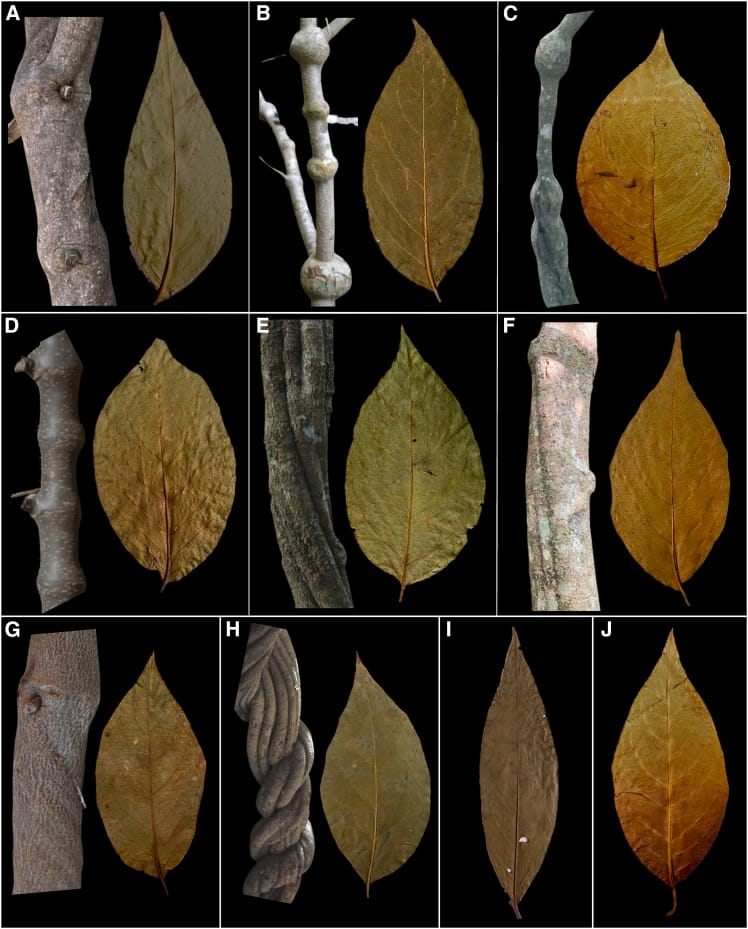
Morphological diversity of **B. caapi* and **D. cabrerana* (A–G) Stem and leaf diversity. (A) **Arara*. (B) **Caupuri*. (C) **Caupuri-de-nós-longos* (**Spruce*). (D) **Hybrid*. (E) **Ourinho*. (F) **Pajezinho*. (G) **Quebrador*. (H) **Tucunaca*. (I and J) Leaves. (I) **D. cabrerana.* (J) **Cabi*.
Seventy years after his fieldwork began, the question is no longer entirely open. Brazilian religious groups (Santo Daime, União do Vegetal, Barquinha) and the Amazonian peoples whose practices fed into them recognise at least nine named *B. caapi* folk types in routine circulation — Caupuri, Tucunaca, Arara, Pajezinho, Ourinho, Hybrid, Quebrador, Caupuri-de-nós-longos, and the contested Cabi — distinguished by stem morphology, brew taste and density, and reported effect. A recent [machine-learning study by Biazatti and colleagues](https://doi.org/10.1016/j.isci.2026.115753?ref=ardmt.com) demonstrated that these folk categories carry detectable morphological signal even in dried leaves, which the folk taxonomists themselves never used as diagnostic. The categories are tracking real biology. They are not arbitrary cultural labels.
That number — nine — is the conservative count, based on what was consistently represented in one well-documented Brazilian herbarium collection. The fuller picture is larger. Luna's work in Peruvian *vegetalismo* records additional named varieties under different regional vocabularies. Langdon (1986) documented Siona varietal classifications among the Colombian peoples that have no clean correspondence to the Brazilian set. The [Luz et al. 2023 DNA barcoding study](https://doi.org/10.1007/s10722-022-01522-3?ref=ardmt.com) identified eight distinct genetic lineages within Brazilian *Banisteriopsis* samples used for ayahuasca, and noted that the morphological evidence for whether all of them actually belong to *B. caapi sensu stricto* remains incomplete. Some of what gets called "ayahuasca vine" in practice may turn out to be different *Banisteriopsis* species — or, in places, related Malpighiaceae genera — that the folk system has correctly grouped functionally but the Western system has not yet resolved taxonomically.
Beyond *B. caapi* itself, the broader genus *Banisteriopsis* contains at least sixty species, and a non-trivial subset have been documented as occasional ayahuasca constituents in regional preparations. Friedberg (1965), cited by Dobkin de Rios in her 1970 Iquitos fieldwork, identified the vines used in Amazonian healing as *B. caapi, B. inebrians, B. quitensis,* and *B. rusbyana* — four species, not one. [Santos et al. (2020)](https://doi.org/10.3390/plants9070870?ref=ardmt.com) in their large β-carboline profiling study included samples of *B. laevifolia*, *B. megaphylla*, *B. muricata*, *B. oxyclada*, *B. variabilis*, *B. gardneriana*, and *Diplopterys pubipetala* alongside the dominant *B. caapi*, all collected from practitioners who use them for ayahuasca preparation. Erowid's compilation of source-plant records lists many more *Banisteriopsis* species reported as ayahuasca components by at least one source.
Some traditions substitute the vine entirely. *Tetrapterys mucronata*, also Malpighiaceae, was observed by Schultes among the Maku of the Brazilian Rio Tikié being used as the *sole* ingredient in an ayahuasca-like brew, because that species apparently contains both the β-carbolines and the tryptamines needed for an orally active preparation in a single plant. Schultes recorded having tried the preparation himself in the 1940s. *Lophanthera lactescens*, *Mascagnia* species, *Callaeum antifebrile* (which contains harmine in its stems and leaves), and other suspected source plants drift in and out of the literature on regional preparations.
So: even before we get to the admixtures, the "ayahuasca vine" is already a category of perhaps twenty named botanical entities used variously across the Amazon basin, of which one species in nine named cultivated varieties accounts for the majority of contemporary use. The popular framing of "ayahuasca is *B. caapi* plus *Psychotria viridis*" is a description of one particular configuration that has become dominant in the export form, not a description of what ayahuasca historically and currently is across its range.
## [The DMT plant, and its substitutes](https://www.ardmt.com/what-is-dmt/)
The second standard component, the plant providing the [DMT](https://www.ardmt.com/what-is-dmt/), shows similar variation. The dominant pairing in contemporary Brazilian, Peruvian, and Ecuadorian preparations is *Psychotria viridis* Ruiz & Pav. (Rubiaceae), known locally as chacruna — a name derived from a Quechua word meaning "mix." William S. Burroughs, who in 1953 went looking for *yagé* in Colombia and Peru and corresponded with Allen Ginsberg about it in what became *The Yage Letters*, collected the first known specimen of the plant in 1954 and sent it to Schultes for identification. Schultes initially misidentified it. He did not formally describe *P. viridis* as an ayahuasca admixture until 1967, more than a century after Spruce had named the vine. The fact that the DMT-bearing component of the dominant export brew was only formally placed in the Western botanical record in the late 1960s is worth holding onto. The plant taxonomy of the brew, even at the level of its main ingredients, is younger than most of the people drinking it.
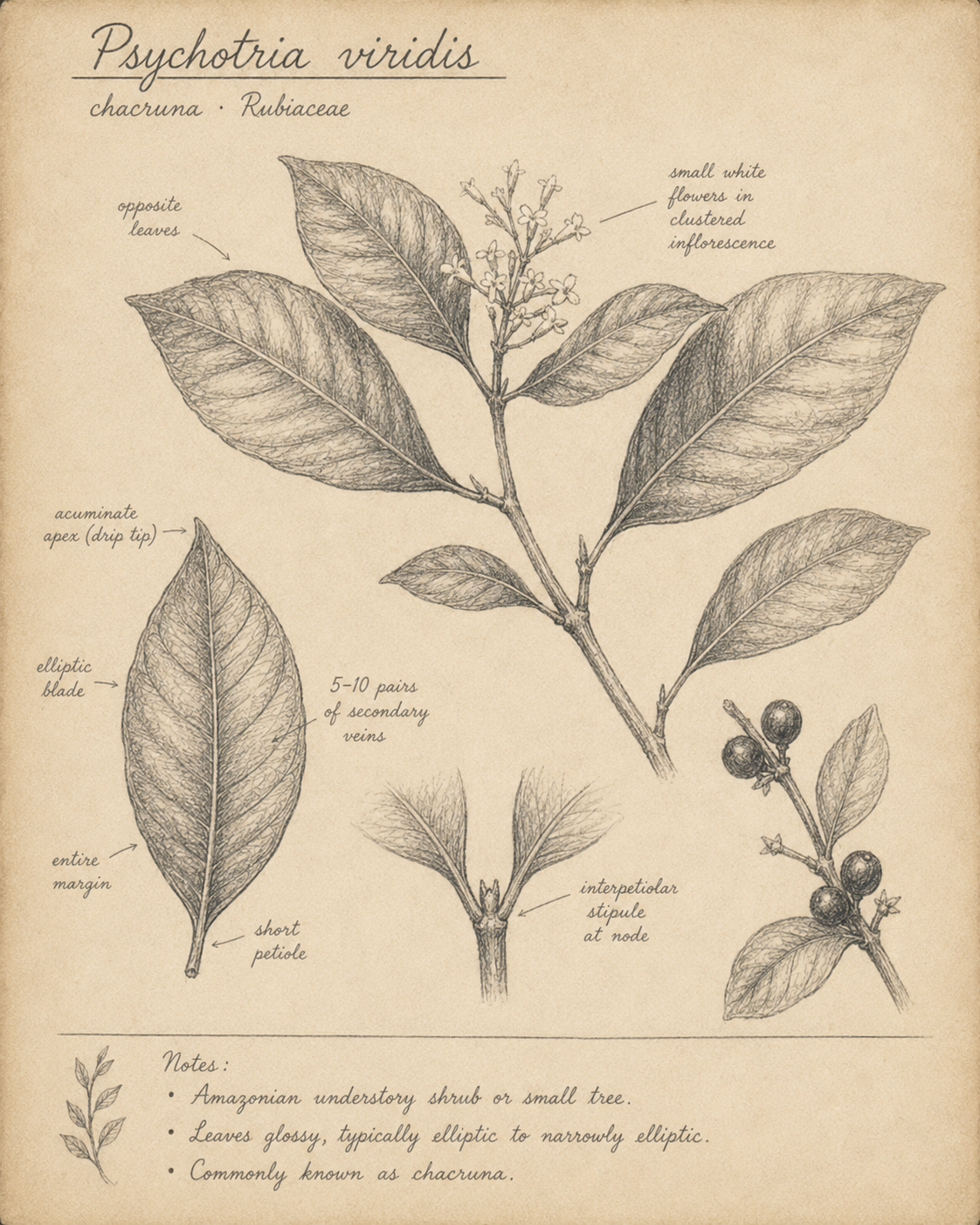
Psychotria viridis (chacruna, Rubiaceae). The dominant DMT-bearing plant in Brazilian and Peruvian ayahuasca, formally described as such only in 1967.
Outside Peru and Brazil, particularly in the northwest Amazon — Colombia, Ecuador, parts of southern Venezuela — the standard DMT plant is *Diplopterys cabrerana* (Cuatrec.) B. Gates, called chaliponga, chagropanga, or oco yagé. *Diplopterys* is, importantly, also Malpighiaceae — the same family as the vine, not Rubiaceae like *Psychotria* — and Bianchi and Samorini (1993), drawing on Poisson's 1965 analysis, report that the leaves contain DMT at around 0.64% by dry weight. Beyond DMT, *D. cabrerana* also contains 5-MeO-DMT and N-methyltetrahydro-β-carboline. The chemistry is therefore not identical to a *P. viridis* brew. Practitioners and researchers who have used both report qualitative differences in onset, character, and visual content of the experience. Colombian yagé made with *Diplopterys* is recognisably a different brew from Brazilian ayahuasca made with chacruna, even when the underlying *B. caapi* preparation is similar.
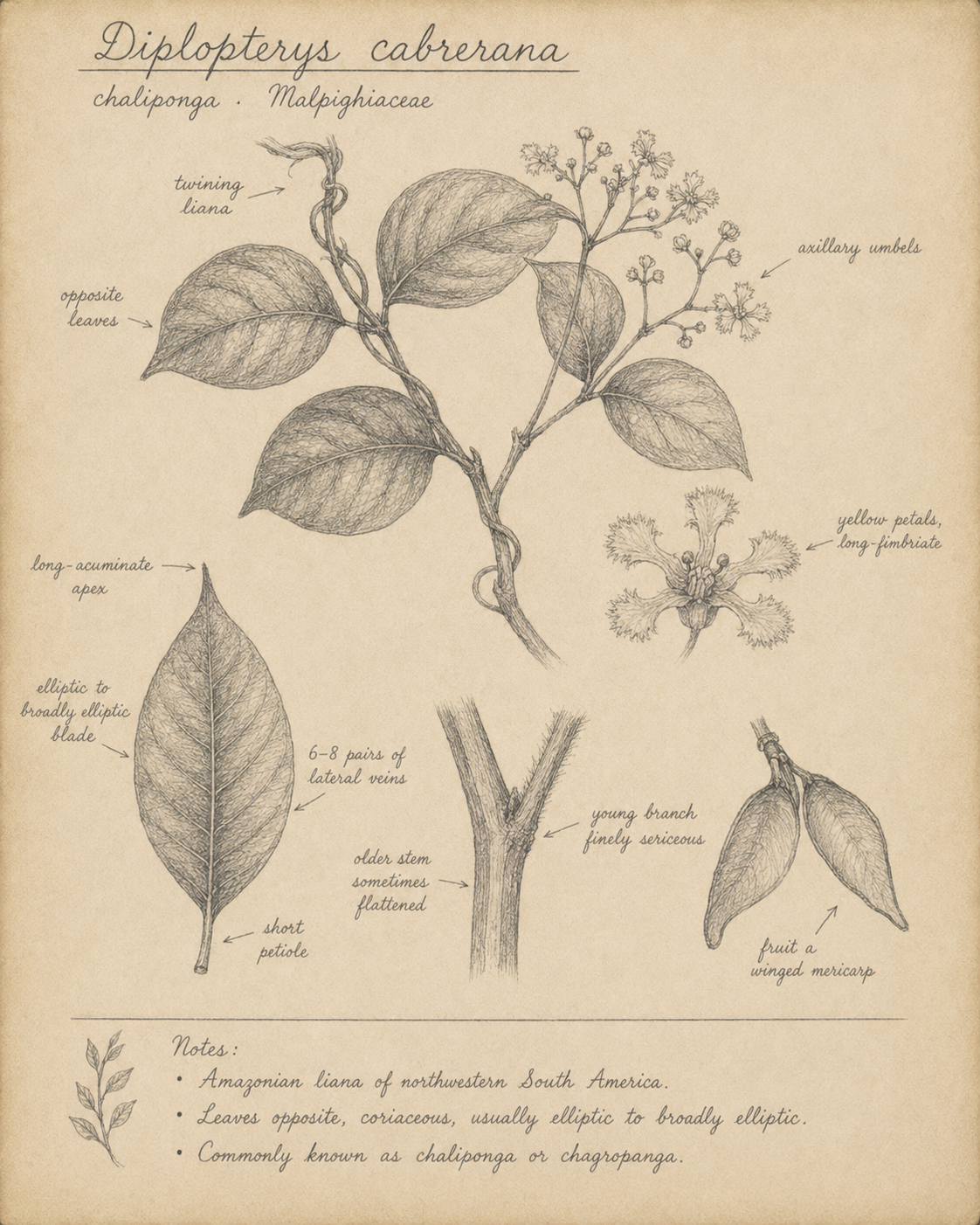
Diplopterys cabrerana (chaliponga, Malpighiaceae). Contains DMT and 5-MeO-DMT. The standard DMT plant in Colombian and Ecuadorian yagé.
*Psychotria carthaginensis*, a closely related species, substitutes for *P. viridis* in some preparations. Among the Sharanahua, *Psychotria* leaves of two different unidentified species are distinguished and used differently: *batsikawa* is added "to give the impression of coldness and produce fewer visions," while *pishikawa* (or *kawakui*) is "considered stronger." Beyond the *Psychotria* / *Diplopterys* pairing, regional brews have at various times used *Justicia pectoralis*, *Brugmansia* species, *Mimosa* species, and others as either the DMT-bearing component or as substantive admixtures with their own active chemistry. Older literature suggests *Prestonia amazonica* was used as a DMT source — Spruce reported it in 1908, Reinberg followed in 1921 — though Bianchi and Samorini consider the original analyses likely confused with *B. caapi* material itself and suggest the *Prestonia* report is unreliable.
It is worth pausing on the *Brugmansia* category. *Brugmansia suaveolens*, *B. insignis*, and other species — closely related to *Datura* and similarly tropane-alkaloid-bearing — are routinely added to ayahuasca preparations by some traditional practitioners, particularly in Peruvian *vegetalismo* and in some Colombian traditions. McKenna, Luna and Towers (1995) note that as few as two or three *Brugmansia* leaves added to ayahuasca are reported by practitioners to be sufficient to "see the witch that caused the illness." The pharmacology is not subtle. Tropane alkaloids (scopolamine, hyoscyamine, atropine) are powerful anticholinergic deliriants. A brew containing *Brugmansia* is not a "stronger version of ayahuasca"; it is a meaningfully different psychoactive preparation that happens to share two ingredients with the standard formulation. The fact that some traditions consider this enhancement and others consider it dangerous adulteration is itself part of the variation the global conversation has flattened. A participant who is not informed that *Brugmansia* has been added — and traditional practitioners as a rule do not list their additions — has not consented to the actual pharmacological intervention they have received.
## [The pharmacopoeia underneath](https://www.ardmt.com/tag/exploration/)
So variation enters at the first two levels: the vine and the DMT source. Different *Banisteriopsis* varieties produce different β-carboline profiles; different DMT plants produce different tryptamine profiles. The next level is harder still, because the admixture pharmacopoeia is much larger, far less disclosed, and conceptually structured in ways that resist Western-academic extraction.
The historical literature on Amazonian ayahuasca shamanism documents an astonishing range of "ally plants" added to brews depending on intention, region, season, patient, and ceremony. Bianchi and Samorini's 1993 catalogue compiles primary sources from Pinkley (1969), Rivier and Lindgren (1972), McKenna, Luna and Towers (1986), Luna (1984), Schultes and Raffauf (1990), and others — over seventy-five named species with associated ethnobotanical and pharmacological data. McKenna, Luna and Towers' 1995 chapter "Biodynamic Constituents in Ayahuasca Admixture Plants: An Uninvestigated Folk Pharmacopoeia" remains the most thorough single treatment and is worth lingering on, because it sets out the conceptual structure that the rest of this section depends on.
That conceptual structure is the *plantas maestras*, or plant-teachers framework. In mestizo *vegetalismo* and in the indigenous traditions it draws on, certain biodynamic plants are understood to be teachers rather than tools. Each plant has its own *madre* (mother) spirit, its own *icaro* (magic song) revealed to the apprentice under proper conditions, its own specific knowledge to transmit. The knowledge is transmitted not by an elder ayahuasquero to a junior one through verbal instruction, but directly by the plant to the apprentice through ingestion, dreaming, and dietary observance. The training period for a *vegetalista* — six months minimum, often years — consists largely of consuming these plants under a strict *dieta* (no salt, sugar, fat, alcohol, sexual abstinence) and waiting for the plant-spirits to disclose themselves. The pharmacopoeia is not a fixed inventory. Ayahuasqueros *continually expand* it by introducing new plants to the brew and observing what they teach. Bristol (1966) documented similar practice among the Sibundoy of Colombia, Chaumeil (1983) among the Yagua, Siskind (1973) among the Sharanahua. The system is generative by design.
McKenna, Luna and Towers' Table 1 catalogues approximately fifty genera used as admixtures and assigns each a brief summary of known biodynamic constituents. The headline finding from that table is methodological: for roughly half the genera listed, the chemical literature has identified active constituents (alkaloids, terpenoids, indoles, neolignans, ergolines, tropanes); for the other half, "virtually nothing is known about the pharmacologically active constituents." Thirty years on, the picture has barely moved. The "uninvestigated folk pharmacopoeia" of the title remains uninvestigated.
The plants that *have* been characterised hint at the scope of what is in these brews. *Maytenus ebenifolia* (chuchuhuasa) contains sesquiterpene and nicotinoyl alkaloids, triterpenes, maytensine, and ansa macrolides. *Brunfelsia chiricsanango* contains scopoletin and CNS depressants. *Erythrina poeppigiana* contains Erythrina alkaloids that produce narcotic effects at low doses and curare-like effects at higher doses. *Uncaria guianensis* (garabata) contains spiro-oxindoles, bis-indoles, and hetero-yohimbine alkaloids. *Virola* species contain diaryl propanoids, tryptamines, β-carbolines, and neolignans — making *Virola* a meaningful source of additional DMT and additional β-carbolines when added to a brew. *Hura crepitans* (catahua) contains tigliane diterpenes, piscicidal compounds, and lectins; Don Manuel Pacherras, an informant quoted in the McKenna chapter footnotes, describes it as "a strong and dangerous *doctore*" requiring a 30-day diet, used together with *Dieffenbachia* for destroying "lakes inhabited by dangerous animals."
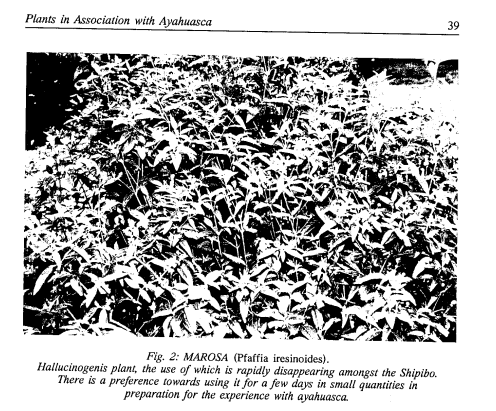
Marosa (Pfaffia iresinoides), a preparatory plant whose use is fading among younger Shipibo practitioners. From Bianchi & Samorini 1993.
There is a particularly clean example in the McKenna chapter of folk vocabulary tracking real pharmacology. Practitioners report that when ingesting *chuchuhuasa* (a *Maytenus ebenifolia* preparation with alcohol), eating peccary will produce "an intermittent high fever, similar to malaria." The explanation given is that the spirits of the plant and the animal are in conflict. The chemistry says: peccary meat is high in tyramine, *Maytenus* alkaloids may include MAO-inhibitory activity, and the combination of an MAOI with a tyramine-rich food produces hypertensive crisis presenting as fever. The shamanic explanation and the pharmacological explanation describe the same phenomenon in different vocabularies, and both are correct within their frames. The folk model encoded an accurate pharmacological observation centuries before the pharmacology was available to describe it.
Bianchi and Samorini distinguish three kinds of plant-brew association: plants cooked together with ayahuasca (the largest group, perhaps fifty in their catalogue), plants consumed during the session (mapacho tobacco being the canonical example, with *Nicotiana rustica* containing both nicotine and small amounts of β-carbolines), and plants taken before or after the session to prepare or integrate the body — the latter often emetic, often part of strict dietary observances lasting weeks or months. The Shipibo *marosa* (*Pfaffia iresinoides*) is taken for six days in small doses before ayahuasca to intensify the subsequent experience. The full inventory across all three categories is conservatively over a hundred plants. The actual inventory in current practice is unknowably larger, for reasons addressed in the next section.
## [The mystery is not incidental](https://www.ardmt.com/tag/exploration/)
The ethnobotanical literature on ayahuasca admixtures, including everything cited above, is a record of disclosed knowledge. Luna got Don Emilio Andrade and Don Manuel Pacherras to name specific plants and uses through years of relationship-building and properly committed apprenticeship. McKenna built on that relationship and added his own. Pinkley, Schultes, Chaumeil, and the others did the same. What they produced is genuinely valuable and represents some of the most careful ethnobotany ever conducted in the Amazon basin. It is also unrepresentative.
The default state of admixture knowledge across the Amazon basin is not disclosed. It is held back. The composition of the brew is a working secret of the practitioner, disclosed selectively or not at all, often *especially* withheld from disciples who are expected to learn through participation rather than instruction. You bash the vine. You watch what is added. You do not ask. You participate. The structure of the apprenticeship forbids the question.
This pattern is consistent across the entire spectrum of practitioners, from genuinely traditional indigenous shamans to mestizo *curanderos* to Western operators playing the role for retreat clients. The operational secrecy is structurally identical regardless of authenticity. That uniformity is itself informative. It suggests the secrecy is not primarily a defensive posture against outsider extraction. It is a feature of the practice, and it is doing several jobs at once.
Some of those jobs are legitimate. The unknowing of the participant is part of the ritual structure. You drink something you did not make, prepared by someone who knows what you do not, and the asymmetry is doing real work in the experience. The participant's state of receptive trust is partly produced by the practitioner's possession of withheld knowledge. Strip the mystery away — print the recipe on the cup — and you have made a different kind of event. This may be the version of the argument the more sympathetic ethnographers want to advance, and within the traditional ritual context it has some validity.
Other jobs the secrecy does are less legitimate, and the wellness industry has imported all of them. The withheld recipe protects the practitioner against feedback. If the participant does not know what was in the cup, the participant cannot evaluate whether the brew was made well, whether it contained what it should have, whether the dose was appropriate, whether anything went wrong. The participant cannot say "this was a weak brew" because the participant has no reference for what a strong brew would be. Critically, when the experience underperforms — when nothing much happens — the cultural frame is already in place to attribute the failure to the participant. Bad juju. You weren't ready. You're resisting. You must have eaten something during the *dieta*. The practitioner is not falsifiable, because the participant has no instrument with which to falsify.
This matters because the chemistry, as the next section shows, is genuinely highly variable, and a non-trivial fraction of brews administered in the global ceremonial economy contain little or no active material. Callaway (2005) found two samples in his survey of twenty-nine with no detectable DMT at all. They were administered with the same reverence as fully active samples. The participants who drank them and felt nothing visionary were told, presumably, that the brew was working on a deeper level, that they were resisting, that the medicine was teaching them something else. Within the cultural frame, those interpretations are coherent. Outside the cultural frame, they are unfalsifiable post-hoc rationalisations of a brew that didn't work because there was no DMT in it.
The export ceremonial economy has imported this structural feature wholesale, often without the legitimate ritual context that originally housed it. In the export setting the pattern typically looks like this: an operator declines to specify what is in the brew, frames any participant disappointment as the participant's own spiritual failure, and maintains an aura of withheld knowledge as part of their professional positioning. The structure of authority being deployed has its origins in genuine indigenous practice. In the export context it is increasingly hard to distinguish from straightforward commercial protection of an unaudited product. The participant pays. The participant drinks. The participant is told they have received an authentic Amazonian medicine. The participant cannot verify any of that, by design.
None of this is incompatible with the observation that the practice can be genuinely valuable, that the brew often does produce profound and lasting effects, that traditional practitioners frequently know an enormous amount about plants and people. The two claims can coexist: the practice contains real knowledge *and* the operational secrecy provides cover for inconsistency and unaccountability. Most defenders of the practice acknowledge only the first claim. The second claim is awkward and tends to get sidestepped. This article will not sidestep it.
It is also the strongest argument for taking the chemistry seriously. The participant cannot evaluate the brew; the cultural frame forbids it; the practitioner does not disclose. The only available check on the system is external analysis. Without it, the practice operates in a closed epistemic loop in which the practitioner's authority is self-reinforcing and the brew's effects, or non-effects, are always interpretable as confirmation of whatever the practitioner says they should be.
## [The chemistry of the actual brew](https://www.ardmt.com/harmine-and-the-maois/)
When the brew is analysed externally, the variation is large enough to settle the question on its own. [Callaway (2005)](https://doi.org/10.1080/02791072.2005.10399796?ref=ardmt.com) surveyed twenty-nine ayahuasca samples from four distinct traditions — União do Vegetal (UDV), Santo Daime, Barquinha, and Shuar — plus one Shuar paste preparation, and quantified harmine, harmaline, tetrahydroharmine, and DMT in each. The results are difficult to read as anything other than evidence that "ayahuasca" denotes a chemically heterogeneous category.
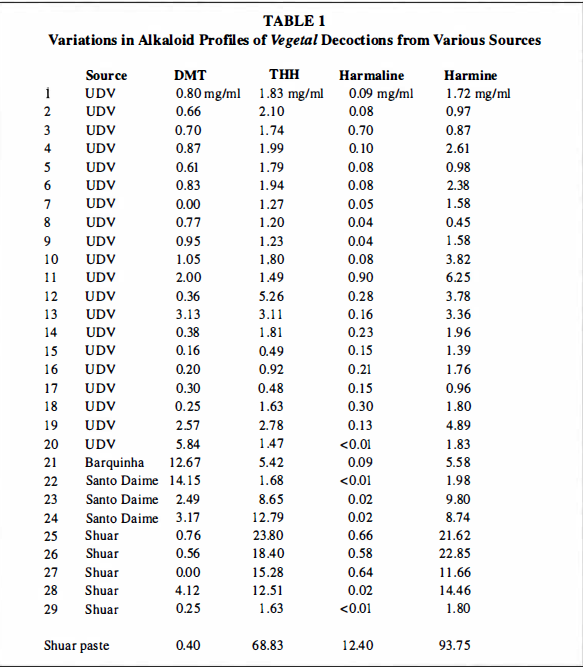
Table 1 from Callaway 2005\. DMT ranges from 0.00 to 14.15 mg/ml across traditions. Two samples contain no detectable DMT.
DMT content ranged from undetectable to 14.15 mg/ml — a range that includes zero. Tetrahydroharmine ranged from 0.45 to 23.80 mg/ml, a roughly fifty-fold range. Harmine ranged from 0.45 to 22.85 mg/ml. The Shuar paste, prepared for licking rather than drinking, sat at 68.83 mg/ml THH and 93.75 mg/ml harmine — an order of magnitude above any liquid sample. Two samples — one UDV, one Shuar — contained no detectable DMT at all. Callaway notes, in a sentence worth quoting because of how thoroughly it undercuts the standard pharmacological framing of the brew, that both DMT-free samples "were considered with the same reverence as DMT-containing samples for their utility as a sacrament."
The between-tradition averages are equally striking. UDV brews averaged 1.12 mg/ml DMT and 1.82 mg/ml THH, typically administered in doses of 100–200 ml. Shuar brews averaged 1.14 mg/ml DMT but 14.32 mg/ml THH, typically administered in doses of 20–30 ml. The total β-carboline dose delivered by a typical Shuar serving is therefore roughly comparable to a typical UDV serving despite the brews being chemically very different — concentrated and small versus dilute and large. The Santo Daime samples averaged higher DMT (6.60 mg/ml, with one outlier at 14.15 mg/ml) and very low harmaline. Different traditions are producing chemically distinct brews administered at different doses, all called ayahuasca, all producing what their practitioners describe as the same sacred experience.
Callaway also observed something the analytical literature would later have to explain. In his data, the ratio of tetrahydroharmine to harmine in finished brews averaged close to 1:1 — but the ratio in raw *B. caapi* vine material is closer to 1:5\. Callaway proposed that the apparent shift was due to chemical reduction of harmine and harmaline to THH during the acidic boiling of the brew. He sketched a mechanism in his Figure 1: harmine to harmaline to THH, driven by acidic conditions over time.
That mechanism, Rodriguez and colleagues argued seventeen years later, is chemically implausible. Harmine is fully aromatic; reducing it to THH requires borohydride or equivalent reductant, conditions not present in a boiling pot of plant material. [Rodriguez et al. (2022)](https://doi.org/10.1021/acsomega.2c00795?ref=ardmt.com), analysing ayahuasca samples by NMR and LC-MS/MS, proposed an alternative: harmine partitions into the *suspended solids* of the brew rather than fully dissolving in the liquid. Analytical protocols routinely centrifuge or filter samples before alkaloid quantification, discarding the solids. The published harmine values, on this account, have been systematically biased downward for decades — not because harmine is being chemically destroyed during preparation, but because chemists have been throwing away the part of the brew where it lives. The apparent 1:1 ratio is an artefact of analytical method. The true ratio in the brew as actually consumed is closer to the 1:5 ratio of the raw vine, because the harmine in the suspended solids is delivered to the participant when the brew is served suspended rather than settled.
This is a genuinely live scientific dispute. Callaway's mechanism implies that the brew chemistry shifts in informative ways during preparation. Rodriguez's mechanism implies that the published chemistry is wrong and the brew has always contained more harmine than reported. Both have implications for pharmacology, dose-response modelling, and clinical interpretation. Neither is fully resolved. Santos et al. (2020) reported supporting evidence for Rodriguez's interpretation in independently analysed samples. The harmine-partitioning question is the kind of methodological-foundations issue that, if Rodriguez is right, requires retrospective adjustment of a substantial body of analytical literature.
Rodriguez et al. also found that fructose is the *major* component of ayahuasca by mass. Their samples ranged from 3.07 to 33.67 grams of fructose per 50 ml of brew — meaning some preparations are roughly two-thirds sugar by weight. This had not been previously reported. The sugars probably derive from glycosides in *B. caapi* and *P. viridis*, hydrolysed during the long boiling. The dark brown colour characteristic of ayahuasca probably reflects melanoidins formed by Maillard reactions between this fructose and proteins in the brew during cooking. The high sugar content has practical implications: it may contribute to the gastrointestinal effects of the brew through osmotic mechanisms rather than purely through serotonergic action, and individuals with fructose malabsorption may experience worse gastrointestinal effects than the pharmacology of the β-carbolines alone would predict.
Rodriguez also found qualitative differences across their seven samples that correlated with social-religious context. Religious samples showed lower β-carboline-to-DMT ratios than therapeutic and neoshamanic samples. Some samples contained bufotenine (5-hydroxy-DMT), indicating that *Diplopterys cabrerana* had been used as the DMT source despite the samples not being labelled as yagé. Trace alkaloids including N-methyltryptamine, tetrahydronorharmine, harmol, and harmalol appeared variably across samples. [Kaasik et al. (2021)](https://doi.org/10.1080/02791072.2020.1815911?ref=ardmt.com), in a parallel study of European samples, found pharmaceutical adulterants in some brews represented as authentic ayahuasca — moclobemide (a synthetic MAO inhibitor), psilocin, and yuremamine. Some of what is being served in the global ceremonial economy is not what it is sold as.
Callaway's stored-sample observation is also worth noting. He left one UDV brew at room temperature for eighty days. The alkaloid composition did not change significantly. The pH dropped from 4.5 to 3.5 over the first twenty days as the brew acidified, then rose to roughly 6.7 by day sixty as natural fermentation set in. The sweet smell of ethanol in older brews, which is sometimes treated as a sign of spoilage or sacred maturation depending on the practitioner's framing, is straightforwardly fermentation. The brew is a living chemical system that continues to change in storage.
## [The regional registers](https://www.ardmt.com/tag/exploration/)
Even at the coarsest level — what plants the brew is made from, before considering varieties of those plants, the chemistry of the resulting decoction, or what was added off-record — the regional picture is more varied than the Brazilian-syncretic standardisation suggests.
*Brazilian syncretic religions* (Santo Daime, União do Vegetal, Barquinha) typically use *B. caapi* \+ *P. viridis*, often with no other admixtures, and have driven much of the standardisation visible in the global form. The brew is called *daime*, *hoasca*, or *vegetal* depending on the specific tradition. These traditions are also, partly because of their sacramental structure, more transparent than most about brew composition.
*Peruvian vegetalismo*, the mestizo shamanic tradition centred on Iquitos and the Pucallpa region, also typically uses *B. caapi* \+ *P. viridis*, but with much wider routine use of additional plants — mapacho, *Brugmansia*, ayahuma, chuchuhuasi, and the broader pharmacopoeia Bianchi and Samorini catalogue — selected by the curandero according to ceremonial intent. The brew is called *ayahuasca*. [Dobkin de Rios's 1968–69 Iquitos fieldwork](https://www.jstor.org/stable/672859?ref=ardmt.com) documented *tohé* (Datura/Brugmansia), chacruna, and narcoticised tobacco being added to brews prepared by ayahuasqueros serving the urban poor of Iquitos.
*Colombian and Ecuadorian traditions*, particularly among the Siona, Cofán, Secoya, Kofán, and northwestern Amazon peoples, more commonly use *B. caapi* \+ *Diplopterys cabrerana*. The brew is called *yagé*. The chemistry differs because of the 5-MeO-DMT content of *Diplopterys*. Burroughs, who travelled this region in 1953 looking for the brew, recorded experiences that varied enormously from one practitioner to the next — sometimes overwhelming, sometimes producing little effect, often impossible for him to interpret because he was given no information about what he had drunk. His letters to Ginsberg are an early Western record of what every subsequent foreign visitor to the practice has encountered: high variability, no disclosure, and a cultural frame that absorbs any disappointment back into the participant.

Regional registers of ayahuasca preparation across the western Amazon basin. Boundaries are approximate and overlap in practice.
*Indigenous Brazilian traditions outside the syncretic religions* show much greater variation. Some Maku groups have used *Tetrapterys mucronata* as a single-plant brew. The Sharanahua add varying *Psychotria* species, *Lygodium venustum* leaves, *Lomariopsis japurensis* stems, *Clusia* sp., *Phrygilanthus eugenioides*, and others depending on the curandero. The Tikuna incorporate *Petiveria alliacea*, *Sabicea amazonensis*, and other plants. Practices vary not only across ethnic groups but across individual practitioners within them.
*Modern analogue preparations* outside South America frequently substitute Syrian rue (*Peganum harmala*) seeds for the vine as a source of β-carbolines and *Mimosa hostilis* root bark or *Acacia* species for the DMT. These are not ayahuasca in any traditional sense — the plants are different, the cultural context is different, the ceremonial framework is absent — but they are sometimes marketed as such and increasingly contribute to the global confusion about what "ayahuasca" denotes.
## [Why this matters for the science](https://www.ardmt.com/harmine-and-the-maois/)
The clinical and pharmacological research on ayahuasca, particularly the recent wave of trials investigating its antidepressant and broader therapeutic potential, has largely treated it as a single intervention. Trial protocols typically source brew from a single supplier — often a Brazilian religious institution that prepares to consistent specifications, which is sensible from a clinical research-design standpoint but problematic from an ethnobotanical one.
The β-carboline profile work by Callaway (2005), Santos et al. (2020), and Rodriguez et al. (2022) has documented substantial variation in harmine, harmaline, and tetrahydroharmine ratios across both *B. caapi* accessions and finished brews. The Biazatti folk-taxonomy work suggests that variation is not random but tracks the named varieties practitioners distinguish. The Luz et al. DNA barcoding work indicates underlying genetic structure consistent with that pattern. The harmine-partitioning finding from Rodriguez et al. suggests that even within a single brew, the chemistry consumed depends on whether and how the suspended solids are mixed back in before serving.
The implication is straightforward and largely ignored. If the brew administered in one clinical trial has a different β-carboline ratio from the brew in another, the studies are not measuring the same thing. If the *Psychotria viridis* used in one preparation has a different DMT concentration from another, the studies are not measuring the same thing. If a trial substitutes *Diplopterys cabrerana* for *Psychotria viridis* — as some Colombian-tradition-influenced research would — the studies are definitely not measuring the same thing, because the addition of 5-MeO-DMT to the brew is a substantive pharmacological change. If the brew has been filtered or settled before administration, the harmine exposure differs from a brew served suspended. If the brew contains no detectable DMT at all — and Callaway's data show this is not a hypothetical scenario — the trial is administering a β-carboline-only intervention misclassified as ayahuasca.
Much of the clinical research published over the last fifteen years has been collapsing variation that is real, traceable, and quantifiable. The collapse is not a small methodological footnote. It is plausibly part of the explanation for why effect sizes differ across studies, why participants describe qualitatively different experiences in ostensibly similar trials, and why the dose-response relationships in published ayahuasca research are harder to characterise cleanly than for most psychoactive interventions. Some of what looks like noise in the data may be signal — signal about variation in the underlying brew composition that no one has been controlling for.
The serious version of ayahuasca clinical research over the next decade will almost certainly need to specify brew composition the way pharmaceutical research specifies API content. Which *Banisteriopsis* variety, what β-carboline profile, what DMT source, what admixtures, what preparation method, served with or without suspended solids, what storage history. The folk taxonomies — *Caupuri*, *Tucunaca*, *Arara* — may turn out to be the simplest available shorthand for distinctions the chemistry confirms.
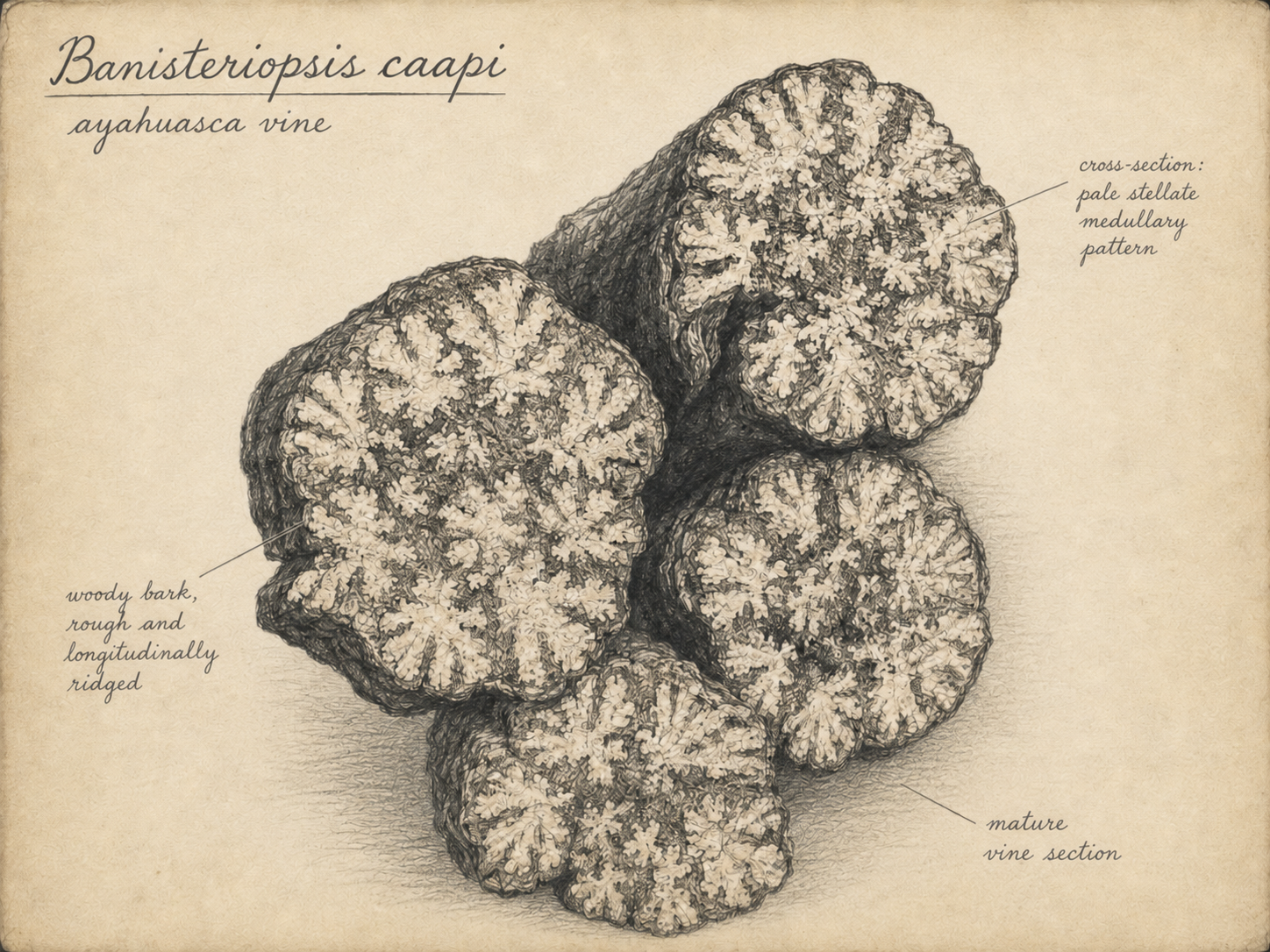
Banisteriopsis caapi, the ayahuasca vine. The stellate cross-section pattern is one of the morphological features practitioners use to distinguish folk varieties.
## [The cogitronomy angle](https://www.ardmt.com/tag/exploration/)
There is a particular kind of intellectual humility that this body of evidence demands and that the public conversation has not yet developed. The shamans, *curanderos*, *feitores*, *taitas*, and *ayahuasqueros* who have worked with these plants over centuries developed a taxonomy and a pharmacopoeia that contemporary methods — DNA barcoding, β-carboline profiling, machine-learning morphology, NMR analysis — are now finding tracks real biological structure. The traditional categories are not the picturesque cultural overlay on top of a scientifically resolved reality. They are, in this case, ahead of the scientific resolution. Western science is engaged in catching up.
The *chuchuhuasa*\-and-peccary example from McKenna, Luna and Towers is the compressed illustration: practitioners encoded an accurate observation about MAOI-tyramine pharmacology in the vocabulary of plant-spirit and animal-spirit conflict, centuries before the pharmacology was available to describe it. The folk explanation and the pharmacological explanation describe the same phenomenon. Both are correct within their frames. The pharmacological frame is younger and more precise; the folk frame is older and more comprehensive. Neither is a better description than the other of the *practice*; they are descriptions of different layers of the same reality.
This is not a unique situation. The history of ethnobotany is full of cases where indigenous knowledge encoded distinctions that Western science took decades or centuries to formalise — *Cinchona* for malaria, *Erythroxylum coca* for stimulation, *Artemisia annua* for antimalarial activity, the curare alkaloids, *Pilocarpus* for glaucoma. The pattern is consistent enough to be a methodological lesson rather than a series of accidents. When traditional practitioners distinguish things that Western taxonomy lumps together, the practitioners are usually onto something.
But the cogitronomy point cuts both ways. Taking traditional knowledge seriously also means taking it as it actually is, not as a romanticised version of itself. The operational secrecy described above is part of the traditional practice. It is doing work, some of it legitimate ritual work and some of it less defensible. The same epistemic humility that says "the shamans got there first" should also say "the shamans, like every group of human experts, have professional incentives to protect their authority, manage their reputation, and immunise their practice against feedback." Both observations are accurate. Holding only the first is romantic. Holding only the second is dismissive. Holding both is honest.
For [ayahuasca](https://www.ardmt.com/what-is-ayahuasca/) specifically, this means a few things. It means the export form of the brew, which has flattened the traditions to fit the requirements of global consumption while inheriting the operational secrecy that the traditional context originally housed, is not the most informative version. It means the practitioners who maintained the distinctions are the right consultants for any serious research programme — but research programmes need to negotiate the secrecy explicitly rather than working around it. It means the substantial pharmacopoeia of admixture plants is a research agenda waiting to be picked up by anyone willing to do the unglamorous work of characterising what is actually in the things people have been drinking for centuries. And it means, urgently, that this work needs to happen *before* the acculturation pressures Bianchi and Samorini already noted in 1993 finish doing their slow work of erasing the knowledge.
It also means — and this is the part the global wellness conversation will resist hardest — that "ayahuasca" as a term needs to be used with care. The word does not denote a substance. It denotes a *family* of substances, prepared by *different peoples*, in *different places*, with *different intentions*, served under *different terms of disclosure*, producing *different effects*. The most informative thing one can say about an ayahuasca experience is which version of ayahuasca produced it. The most useful question to ask of any research, retreat, ceremony, or claim is the same: which one. And the most awkward but necessary follow-up: how do you know?
## [What this means for ARDMT](https://www.ardmt.com/)
This deep-dive is partly an argument and partly a positioning statement for what ARDMT will and will not do. We will not treat ayahuasca as a single substance. When discussing clinical research, we will note the source and composition of the brew under study where it is recoverable. When discussing traditional use, we will be specific about which tradition, which region, which practitioner lineage. When discussing the regulatory landscape, we will resist the term "ayahuasca" as a unit of regulatory analysis where it obscures more than it clarifies. When discussing the retreat economy, we will not extend its operational secrecy the courtesy of treating it as authentic ritual practice.
This is a higher epistemic standard than the field generally maintains and it will sometimes make our coverage more cautious — and more pointed — than the surrounding conversation. That is the point. The field is expanding globally and rapidly, and that expansion benefits from precision it is not currently being given. Closing some of that gap is part of what this publication exists for.
The shamans got there first. We are catching up. And we are watching what gets imported under their authority.
---
*Filed: \[24/05/2026\]. Companion piece to the* [*Biazatti et al. machine-learning folk-taxonomy review*](https://www.ardmt.com/)*. Field observation from Gualaquiza, southeastern Ecuador, 2014–2021\. Future deep-dives in this series will cover the* [*β-carboline pharmacology*](https://www.ardmt.com/harmine-and-the-maois/) *in detail, the Diplopterys cabrerana tradition, the admixture pharmacopoeia plant-by-plant, the harmine-partitioning question and its implications for clinical trial design, and the regulatory implications of brew variation for the next generation of psychedelic research.*
---
### Selected references
Bianchi, A. & Samorini, G. (1993). Plants in Association with Ayahuasca. *Jahrbuch für Ethnomedizin und Bewußtseinsforschung / Yearbook for Ethnomedicine and the Study of Consciousness*, Issue 2, 21–42.
Biazatti, S.C., Bambil, D., Môra, R., de Alencar Figueiredo, L.F. & de Oliveira, R.C. (2026). Machine learning recovers folk classification of *Banisteriopsis caapi* from herbarium leaves of an ayahuasca liana. *iScience* 29, 115753\. [doi.org/10.1016/j.isci.2026.115753](https://doi.org/10.1016/j.isci.2026.115753?ref=ardmt.com)
Burroughs, W.S. & Ginsberg, A. (1963/2006). *The Yage Letters Redux*. San Francisco: City Lights.
Callaway, J.C. (2005). Various Alkaloid Profiles in Decoctions of *Banisteriopsis caapi*. *Journal of Psychoactive Drugs* 37(2), 151–155\. [doi.org/10.1080/02791072.2005.10399796](https://doi.org/10.1080/02791072.2005.10399796?ref=ardmt.com)
Dobkin de Rios, M. (1970). A Note on the Use of Ayahuasca among Urban Mestizo Populations in the Peruvian Amazon. *American Anthropologist* 72(6), 1419–1422\. [jstor.org/stable/672859](https://www.jstor.org/stable/672859?ref=ardmt.com)
Kaasik, H., Souza, R.C.Z., Zandonadi, F.S., Tófoli, L.F. & Sussulini, A. (2021). Chemical Composition of Traditional and Analog Ayahuasca. *Journal of Psychoactive Drugs* 53(1), 65–75\. [doi.org/10.1080/02791072.2020.1815911](https://doi.org/10.1080/02791072.2020.1815911?ref=ardmt.com)
Luna, L.E. (1986). *Vegetalismo: Shamanism among the Mestizo Population of the Peruvian Amazon*. Stockholm: Almqvist & Wiksell International.
Luz, T.Z., Cunha-Machado, A.S. & da Silva Batista, J. (2023). First DNA barcode efficiency assessment for an important ingredient in the Amazonian ayahuasca tea: mariri/jagube, *Banisteriopsis* (Malpighiaceae). *Genetic Resources and Crop Evolution* 70, 1605–1616\. [doi.org/10.1007/s10722-022-01522-3](https://doi.org/10.1007/s10722-022-01522-3?ref=ardmt.com)
McKenna, D.J., Luna, L.E. & Towers, G.H.N. (1995). Biodynamic Constituents in Ayahuasca Admixture Plants: An Uninvestigated Folk Pharmacopoeia. In R.E. Schultes & S. von Reis (eds.), *Ethnobotany: Evolution of a Discipline*. Portland: Dioscorides Press, 349–361.
Oliveira, R.C. et al. (2023). Ethnobotany and wood anatomy of *Banisteriopsis caapi* ethnotaxa and *Diplopterys cf. pubipetala*, components of ayahuasca in Brazilian rituals. *Economic Botany* 77, 18–47.
Pollan, M. (2018). *How to Change Your Mind: The New Science of Psychedelics*. New York: Penguin Press.
Rodriguez, L., López, A., Moyna, G., Seoane, G.A., Davyt, D., Vázquez, Á., Hernández, G. & Carrera, I. (2022). New Insights into the Chemical Composition of Ayahuasca. *ACS Omega* 7, 12307–12317\. [doi.org/10.1021/acsomega.2c00795](https://doi.org/10.1021/acsomega.2c00795?ref=ardmt.com)
Santos, B.W.L., Oliveira, R.C., Sonsin-Oliveira, J., Fagg, C.W., Barbosa, J.B.F. & Caldas, E.D. (2020). Biodiversity of β-carboline profiles of *Banisteriopsis caapi* and ayahuasca. *Plants* 9, 870\. [doi.org/10.3390/plants9070870](https://doi.org/10.3390/plants9070870?ref=ardmt.com)
Schultes, R.E. (1986). Recognition of variability in wild plants by Indians of the Northwest Amazon. *Journal of Ethnobiology* 6, 229–238.
Schultes, R.E. & Hofmann, A. (1992). *Plants of the Gods: Their Sacred, Healing, and Hallucinogenic Powers*. Rochester, VT: Healing Arts Press.
Schultes, R.E. & Raffauf, R.F. (1990). *The Healing Forest: Medicinal and Toxic Plants of the Northwest Amazonia*. Portland: Dioscorides Press.
Biazatti, S.C., Bambil, D., Môra, R., de Alencar Figueiredo, L.F. & de Oliveira, R.C. (2026). Machine learning recovers folk classification of *Banisteriopsis caapi* from herbarium leaves of an ayahuasca liana. *iScience* 29, 115753\. doi.org/10.1016/j.isci.2026.115753\. *Figure reproduced under CC BY 4.0.*
### Machine learning validates indigenous folk taxonomy of the ayahuasca vine
URL: https://www.ardmt.com/machine-learning-validates-indigenous-folk-taxonomy-of-the-ayahuasca-vine-2/
Last updated: 2026-05-23T05:56:33.000Z
# [When the algorithm sees what the botanist missed](https://www.ardmt.com/tag/research/)
*A machine learning study quietly validates indigenous taxonomy of* Banisteriopsis caapi *— and raises a harder question about what counts as scientific knowledge.*
---
## [The paper](https://www.ardmt.com/tag/research/)
Biazatti and colleagues, writing in *iScience* (Biazatti et al., 2026, DOI: [10.1016/j.isci.2026.115753](https://doi.org/10.1016/j.isci.2026.115753?ref=ardmt.com)), have done something that on the surface looks modest and on closer inspection is rather more interesting than the abstract lets on. They trained six machine learning classifiers on photographs of dried leaves from herbarium specimens of *Banisteriopsis caapi* — the MAO-inhibiting vine without which orally administered [DMT](https://www.ardmt.com/what-is-dmt/) is inert — and asked whether the algorithms could recover the folk taxonomic categories used by traditional [ayahuasca](https://www.ardmt.com/what-is-ayahuasca/) practitioners and the Brazilian syncretic religions.
The headline number is 70% overall classification accuracy using a support vector machine on combined adaxial and abaxial leaf images. That figure is not the story. The story is what it implies about a question that has been hanging unresolved in the ethnobotany of *B. caapi* for at least half a century.
## [The setup](https://www.ardmt.com/tag/research/)
Forty-seven vine plants from the UB Herbarium at the University of Brasília, yielding 384 leaves and 768 images after stringent quality filtering reduced an initial dataset of over 3,000\. Nine folk types of *B. caapi* — *Arara*, *Cabi*, *Caupuri*, *Caupuri-de-nós-longos*, *Hybrid*, *Ourinho*, *Pajezinho*, *Quebrador*, *Tucunaca* — plus *Diplopterys cabrerana* as a phylogenetically close outgroup. Features extracted via the authors' open-source VCodeAyahuasca pipeline covered colour spaces (RGB, HSV, CIELab), shape descriptors (Hu moments), texture measures (co-occurrence matrix, LBP, HOG), and a battery of filters (Gabor, Canny, Fourier, Scharr, Laplacian, Sobel, Prewitt). Six classifiers run under 10-fold cross-validation: local KNN, Rseslib KNN, optimised forest, random forest, SVM, and DL4J.
No classifier significantly outperformed the others (ANOVA p ≥ 0.05), which is itself worth noting: the morphological signal is robust enough to be picked up across mathematically distinct architectures, rather than being an artefact of one model's particular inductive biases. Combining both leaf surfaces consistently improved accuracy over either surface alone (p = 0.0466), with abaxial information evidently contributing complementary signal — unsurprising given the venation, trichome, and gland diversity typically expressed on the underside of angiosperm leaves.
## [What the numbers actually say](https://www.ardmt.com/tag/research/)
Per-type accuracy varied dramatically: *Hybrid* 97%, *D. cabrerana* 91%, *Arara* 88%, *Pajezinho* 84%, *Tucunaca* 76%, *Caupuri-de-nós-longos* 74%, *Ourinho* 64%, *Caupuri* 63%, *Cabi* 47%, *Quebrador* 34%. A similarity network analysis resolved two clusters: a tight grouping of *D. cabrerana*, *Hybrid*, and *Arara* with misclassifications only among themselves, and a more entangled cluster of the remaining seven folk types with strong confusions between *Ourinho*–*Caupuri*, *Cabi*–*Caupuri*, and *Quebrador*–*Tucunaca*.
The authors are appropriately honest about the limitations. Several folk types are represented by a single plant. *Cabi* and *Quebrador* lost roughly three-quarters of their initial images to quality filtering, leaving sample sizes that almost certainly constrain what the model could learn. The classifier architectures themselves are closer to 2015 than 2026 cutting edge — hand-engineered features fed into Weka, rather than a fine-tuned vision transformer. Anyone reading this as a deployable field identifier is reading it wrong.
## [Why the modest result is the interesting result](https://www.ardmt.com/tag/exploration/)
The point is not the accuracy. The point is the epistemological asymmetry the paper exposes.
Folk taxonomists do not classify *B. caapi* by its leaves. They never have. The traditional diagnostic criteria are stem morphology (swollen nodes or smooth), bark and fibre characteristics, brew taste and density, and the qualitative character of the resulting experience. Leaves were considered uninformative — which they largely are, by direct human inspection. To the eye, one *B. caapi* leaf looks much like another.
What Biazatti et al. demonstrate is that the leaves nevertheless *carry information* about which folk category the plant belongs to. The folk classification, built from organs and properties the taxonomists were actually examining, propagates into organs and properties they were not. The categories are tracking something deep enough in the plant's biology that the signal leaks out into tissues the original classifiers ignored.
That is a particular kind of validation. If the folk system were arbitrary — if *Caupuri* and *Tucunaca* were merely cultural labels attached to plants that happened to grow in different villages, or names for slightly different ritual uses of indistinguishable biological material — the leaves would be silent. The model would perform at chance. The fact that it does not means the indigenous taxonomy is carving the plant at something close to a real joint. The shamans and *feitores* are not generating folklore; they are doing botany, with a different set of instruments and a different vocabulary.
This connects to a broader and more uncomfortable point about Linnaean nomenclature. Western botany classifies all of these vines as a single species, *Banisteriopsis caapi* Spruce ex Griseb., full stop. There is no formal sub-specific taxonomy. The folk names exist only in ethnobotanical literature and ceremonial practice; they have never been elevated to varieties, subspecies, or even formally described cultivars. To refer to these distinctions in scientific writing, researchers have to borrow indigenous terms wholesale — Oliveira et al. (2023) and now Biazatti et al. simply write "*B. caapi* folk type *Caupuri*" because there is no Latin alternative. The folk taxonomy is, at present, the only taxonomy at this resolution. Western science has yet to construct its own vocabulary for distinctions it can now verify but did not discover.
## [The pharmacological tail](https://www.ardmt.com/harmine-and-the-maois/)
For [DMT](https://www.ardmt.com/what-is-dmt/) research specifically, this matters because the pharmacology of [ayahuasca](https://www.ardmt.com/what-is-ayahuasca/) is not the pharmacology of DMT alone. The [β-carboline profile](https://www.ardmt.com/harmine-and-the-maois/) of the *B. caapi* component — the harmine, harmaline, and tetrahydroharmine ratios — modulates onset, duration, and the qualitative character of the experience. Tetrahydroharmine in particular is a weak serotonin reuptake inhibitor in its own right and is not just an [MAO-A inhibitor](https://www.ardmt.com/harmine-and-the-maois/) by association.
If folk varieties correspond to morphologically distinct clusters that are stable enough to be detected by ML on leaves alone, the obvious next question is whether they also correspond to *chemotypically* distinct clusters. Santos et al. (2020), referenced in the paper, have already shown β-carboline profile variation across *B. caapi* accessions. McKenna's earlier phytochemical work suggested the same. What no one has yet done — and what is now plausibly within reach — is to run the alkaloid profiling on specimens whose folk-variety labels have been independently confirmed by a non-circular method, and ask whether the [harmine-to-tetrahydroharmine ratio](https://www.ardmt.com/harmine-and-the-maois/) tracks the classification.
If it does, "[ayahuasca](https://www.ardmt.com/what-is-ayahuasca/)" is not one preparation but a family of preparations, and a generation of clinical research treating it as a single pharmacological entity has been collapsing meaningful variation. The implications for everything from dose-response modelling to the interpretation of subjective effects in trials would be non-trivial. Trial protocols that source *B. caapi* from a single supplier without specifying folk type may have been controlling for less than they think.
## [The cogitronomy angle](https://www.ardmt.com/tag/exploration/)
There is something philosophically tidy about this study that ARDMT keeps returning to. The folk taxonomists generated reproducible distinctions over centuries using methods Western science has historically dismissed — direct experiential engagement, oral transmission, ceremonial use as a discriminating context. Biazatti and colleagues, using a method that has no cultural commitments and cannot taste the brew, recover roughly 70% of those distinctions from a body part the original taxonomists were not even looking at.
That is not a story about machine learning vindicating science over folklore. It is a story about two different epistemic systems converging on the same underlying biological signal from opposite directions. The folk system arrived first, with more sophisticated diagnostic criteria (stems, brews, effects). The computational system arrives later, with cruder data (dried leaves only) but with no skin in the game. When they agree, what we have learned is not that the algorithm is clever. We have learned that the original observers were paying attention to something real.
The honest framing the authors land on — leaf morphology alone insufficient, future work should integrate stem traits, anatomy, chemistry, genetics — is exactly right. But the methodological modesty should not obscure the size of the philosophical claim sitting under the experiment. Traditional ecological knowledge, in this case, generated empirically testable hypotheses about plant taxonomy that survive blind validation by methods developed in total ignorance of the originating tradition. That is not "complementary to" science. That is science, performed by people who would not have used the word.
## [Marginalia](https://www.ardmt.com/tag/cabinet/)
One suspects the obvious next study is already being designed. Take specimens whose folk-variety labels the SVM has confirmed at high confidence — *Arara*, *Hybrid*, *Pajezinho* — and run the phytochemistry. Quantify the [β-carbolines](https://www.ardmt.com/harmine-and-the-maois/). Ask whether the alkaloid profiles cluster the same way the leaves do. If they do, the chain of evidence is closed: folk category → leaf morphology → alkaloid chemistry → pharmacological effect, with each link independently verifiable.
The patient remaining question, of course, is what happens when this methodology gets pointed at the other plants of the [ayahuasca](https://www.ardmt.com/what-is-ayahuasca/) brew complex, and at the other ceremonial taxonomies of the Amazon. *Diplopterys cabrerana* itself has folk varieties. So does *Psychotria viridis*. So, almost certainly, do iboga, peyote, San Pedro, and every other ceremonially significant plant where traditional specialists distinguish kinds that Linnaean systematics flattens. There is a great deal of latent botany sitting in oral traditions, waiting for someone to ask the right question of it.
Also worth a glance — and ARDMT has now [covered this in a dedicated note](https://www.ardmt.com/dmt-in-a-parkinsons-model-madrid-group-returns-with-fuller-claims/) — is the Madrid group's recently formalised work on [DMT](https://www.ardmt.com/what-is-dmt/) in the 6-OHDA rat model of Parkinson's disease (PMID 42128256), reporting neuroprotective and neurorestorative effects in a unilateral lesion model.
---
### The Trouble with Supernormal Stimuli.
URL: https://www.ardmt.com/the-trouble-with-supernormal-stimuli/
Last updated: 2026-05-22T06:28:29.000Z
_No content available._
### The Case of the Vanishing Molecule
URL: https://www.ardmt.com/the-case-of-the-vanishing-molecule/
Last updated: 2026-05-22T06:24:33.000Z
_No content available._
### The Compound That Forgot to be Interesting.
URL: https://www.ardmt.com/the-compound-that-forgot-to-be-interesting/
Last updated: 2026-05-22T06:21:46.000Z
_No content available._
### Endogenous DMT from Axelrod to Borjigin: what sixty years have settled and what they have not
URL: https://www.ardmt.com/endogenous-dmt-from-axelrod-to-borjigin-what-sixty-years-have-settled-and-what-they-have-not/
Last updated: 2026-05-22T05:00:53.000Z
On days when the preprint servers and journals offer nothing sufficiently substantial to dissect, one does well to revisit the questions that underpin the entire field. Few are more persistent — or more contested — than whether *N,N*\-dimethyltryptamine is produced in the human body, and if so, what on earth it is doing there.
The story begins, as so many stories in psychedelic pharmacology do, with Julius Axelrod. In 1961, working at the National Institute of Mental Health, Axelrod demonstrated that rabbit lung tissue contained an enzyme capable of methylating tryptamine to form [DMT](https://www.ardmt.com/what-is-dmt/). The enzyme was indolethylamine *N*\-methyltransferase (INMT), and its discovery was quiet, almost incidental — a single finding in a broader programme of work on amine metabolism that would eventually contribute to Axelrod's 1970 Nobel Prize. Yet the implications were immediately provocative. If mammalian tissue could synthesise DMT, then DMT was not merely an exotic plant alkaloid but a potential endogenous compound. The transmethylation hypothesis of schizophrenia, already circulating in various forms since Osmond and Smythies's 1952 proposal, suddenly had a candidate molecule and an enzymatic pathway.
## [The transmethylation era](https://www.ardmt.com/tag/research/)
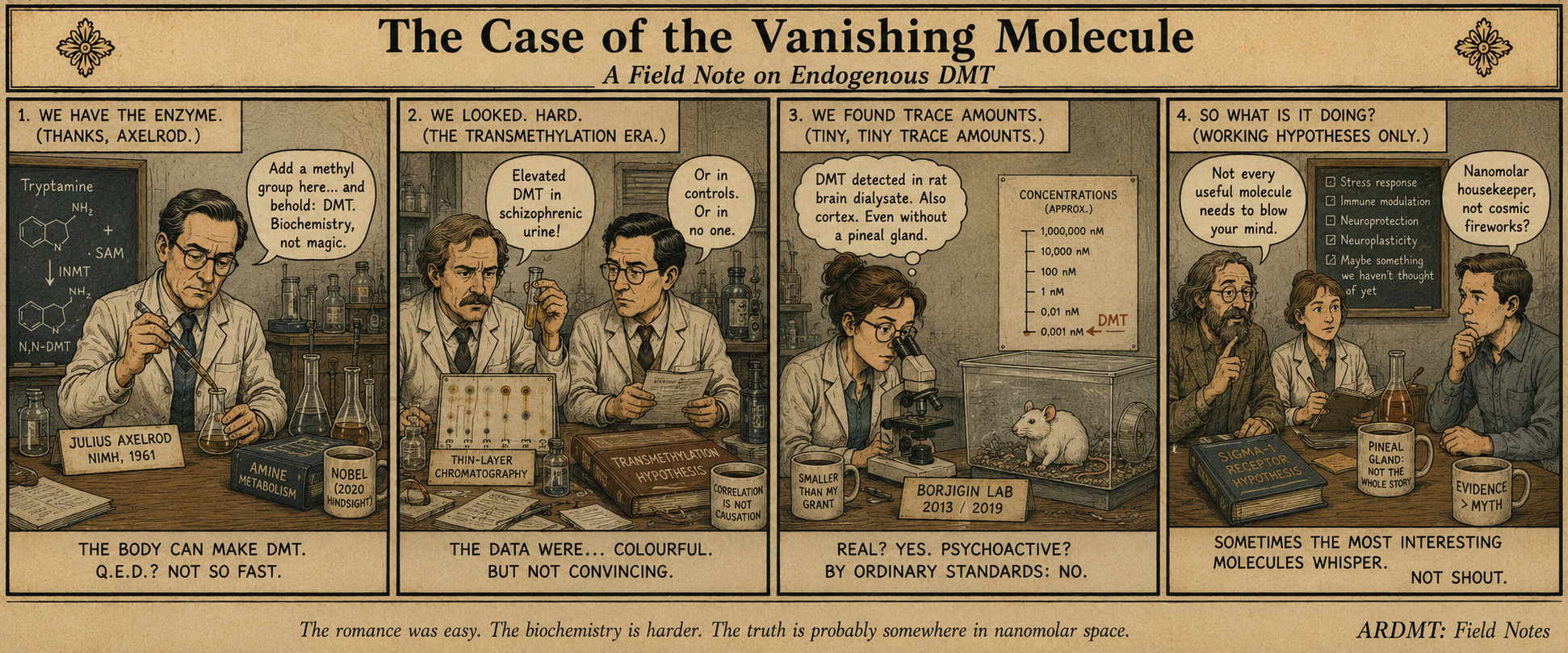
A Field Note on endogenous DMT: enzymes, trace molecules, pineal myths, and the long scientific gap between “the body can make it” and “we know what it does.
Through the 1960s and into the 1970s, the idea that aberrant methylation might produce psychotomimetic compounds in the brains of schizophrenic patients drove a small but energetic research programme. Investigators searched for DMT and its relatives — bufotenine, [5-MeO-DMT](https://www.ardmt.com/what-is-5-meo-dmt/) — in the blood and urine of psychiatric patients and controls. The results were, to put it charitably, inconsistent. Some groups reported elevated DMT in the urine of schizophrenic patients; others found it in controls as well, or failed to find it at all. Analytical methods of the period — thin-layer chromatography, early gas chromatography — were not always equal to the task of identifying trace quantities of a rapidly metabolised indolealkylamine in complex biological matrices. The transmethylation hypothesis gradually fell from favour, not so much refuted as exhausted by equivocal data and the rising dominance of the dopamine hypothesis.
## [INMT and the tissue question](https://www.ardmt.com/tag/research/)
Interest never entirely disappeared. The enzymatic machinery kept turning up. INMT was identified in human lung, liver, brain, and other tissues. The substrate requirements were characterised: tryptamine could be sequentially methylated, first to *N*\-methyltryptamine, then to DMT. The question shifted from *can* the body make DMT to *does* it, in physiologically meaningful quantities, in the right places?
Survey work through the 1970s and 1980s confirmed the enzyme's presence across a wide distribution of mammalian organs, reinforcing the notion that DMT biosynthesis was not confined to a single tissue but was, at least enzymatically, a widespread capability. What remained unclear — and remains so — was whether INMT activity *in vitro* translated to meaningful DMT production *in vivo*. Enzyme presence does not guarantee substrate availability, cofactor sufficiency, or freedom from competing metabolic pathways. The gap between demonstrating that a tissue *can* make DMT in a homogenate and showing that it *does* make DMT in a living organism is not small.
## [The modern revival](https://www.ardmt.com/tag/research/)
The endogenous DMT hypothesis received its most significant modern impetus from the work of Jimo Borjigin and colleagues at the University of Michigan. In 2013, their group reported detecting DMT in the pineal microdialysate of living rats — the first direct evidence of DMT in extracellular fluid within the brain of a living mammal. A subsequent 2019 paper extended this, demonstrating DMT in the cerebral cortex of rats, including in pinealectomised animals, which effectively ruled out the pineal gland as the sole or necessary source. INMT mRNA was detected in cortical neurons, suggesting local synthesis.
These findings revived interest but did not settle the central question: concentration. The amounts detected were vanishingly small — well below what would be needed, by conventional pharmacological reckoning, to activate 5-HT2A receptors at levels sufficient to produce psychedelic effects. Whether endogenous DMT acts at such receptors at all, or whether it operates through [sigma-1 receptors](https://www.ardmt.com/what-is-the-sigma-1-receptor/), trace amine-associated receptors, or some other mechanism entirely, remains an open problem. The [sigma-1 receptor](https://www.ardmt.com/what-is-the-sigma-1-receptor/) hypothesis is intriguing precisely because sigma-1 ligands can exert effects at low concentrations and are implicated in cellular stress responses, neuroprotection, and neuroplasticity — none of which require the molecule to induce visions.
## [What we still do not know](https://www.ardmt.com/tag/research/)
The honest summary, more than sixty years after Axelrod's initial observation, is roughly this: mammals possess the enzymatic machinery to synthesise DMT; DMT has been detected in mammalian brain tissue and extracellular fluid at trace concentrations; the physiological function of endogenous DMT, if any, is unknown. The romantic notion — popularised most energetically by Rick Strassman — that a surge of pineal DMT mediates near-death experiences or other extraordinary states of consciousness has no direct experimental support, though it has proved decidedly durable as a cultural artefact.
What current research wrestles with is less dramatic but rather more interesting: whether [endogenous DMT](https://www.ardmt.com/endogenous-dmt-critical-review/) at nanomolar concentrations participates in ordinary cellular housekeeping — stress response, immune modulation, neuroprotection — rather than in the production of extraordinary subjective states. The distinction matters. A molecule need not be psychedelic at physiological concentrations to be biologically important. Serotonin itself is a useful reminder: it is both an unremarkable gut motility regulator and, via the same receptor family, the key to some of the most profound alterations in consciousness that pharmacology can produce. Context, concentration, and compartmentalisation are everything.
The arc from Axelrod's rabbit lung homogenate to Borjigin's rat cortex microdialysate is long, uneven, and littered with false starts. It is also, in its patient accumulation of enzymatic, analytical, and now molecular-genetic evidence, a rather good example of how a field sustains a difficult question across decades without either resolving it or abandoning it. One suspects the next chapter will be written not by those searching for DMT's role in mystical experience, but by those content to ask what a trace amine does in a neuron on an ordinary Tuesday afternoon.
## [Marginalia](https://www.ardmt.com/tag/cabinet/)
Axelrod himself appears to have regarded the DMT finding as a minor observation in a larger programme on methyltransferases. The mythology that has since accrued around endogenous DMT is almost entirely a construction of later decades — the molecule's cultural significance having, for most of its history, run well ahead of its demonstrated biology. A pattern not, in fairness, unique to [DMT](https://www.ardmt.com/what-is-dmt/).
For a deeper dive into endogenous DMT check out [this link...](https://www.ardmt.com/endogenous-dmt-critical-review/)
### Extended-state DMT infusion: three decades almost-but-not-quite attempted
URL: https://www.ardmt.com/extended-state-dmt-infusion-three-decades-almost-but-not-quite-attempted/
Last updated: 2026-05-21T06:45:23.000Z
Few concepts have proved as persistently tantalising, or as stubbornly unrealised, as Rick Strassman's proposal for an extended-state DMT infusion protocol: a continuous intravenous drip designed to hold a human subject in a sustained DMT experience for hours rather than the compound's customary handful of minutes.
## [Origins: The Rapid Off-Switch as Both Feature and Limitation](https://www.ardmt.com/tag/research/)
Strassman's early clinical work at the University of New Mexico in the 1990s established what remains the canonical pharmacokinetic portrait of intravenous DMT in humans. A bolus injection of 0.4 mg/kg produced intense subjective effects within seconds; those effects peaked at roughly two minutes and were largely resolved by twenty to thirty. The brevity was, in one sense, a clinical virtue — it made DMT the most controllable of the classic psychedelics for research purposes, with none of the eight-to-twelve-hour commitment demanded by LSD or psilocybin. But it also meant that subjects were, in Strassman's own framing, launched and returned before they could do much more than register astonishment. The experience was too short for sustained introspection, therapeutic dialogue, or careful phenomenological reporting in real time.
The extended-state concept followed logically. DMT is rapidly metabolised by monoamine oxidase, principally MAO-A. If one replaced the single bolus with a carefully titrated continuous infusion — a loading dose followed by a maintenance rate adjusted to keep plasma DMT concentrations within a target window — one could, in principle, sustain the fully psychedelic state for as long as the infusion ran. Strassman discussed the idea publicly and in his 2001 book *DMT: The Spirit Molecule*, and outlined preliminary pharmacokinetic modelling suggesting it was feasible. The mathematics were not especially exotic: standard one- or two-compartment models, the sort of thing anaesthetists do routinely with propofol.
## [Why It Was Never Pursued — At Least Not by Strassman](https://www.ardmt.com/tag/research/)
The reasons the protocol did not proceed during Strassman's active research period are multiple and not entirely pharmacological. By his own account, the New Mexico work was terminated in 1995 owing to a confluence of factors: institutional friction, the absence of a therapeutic framework he felt comfortable applying, and his own growing unease about the ontological claims some subjects were making about their DMT encounters — particularly those involving contact with apparently autonomous entities. An extended-state protocol, which would presumably deepen and elaborate precisely those sorts of experiences, sat uneasily with those concerns.
There were also practical hurdles of a regulatory and ethical character. Holding a human being in a full psychedelic state for ninety minutes or several hours raises consent questions that a fifteen-minute experience does not. The capacity for real-time withdrawal of consent becomes philosophically murky when the subject is, by any conventional measure, in a profoundly altered state of consciousness. Monitoring requirements would be substantially more demanding, and the psychiatric risk profile — particularly around prolonged anxiety or psychotic-spectrum reactions — would need careful characterisation in shorter exposures first.
## [The Idea's Afterlife](https://www.ardmt.com/tag/research/)
The extended-state concept did not die with Strassman's withdrawal from active research. It has resurfaced repeatedly. Andrew Gallimore, a computational neurobiologist, collaborated with Strassman on a 2016 paper presenting a formal pharmacokinetic model for target-controlled DMT infusion, drawing explicit parallels with target-controlled infusion systems used in anaesthesiology. The Gallimore–Strassman model proposed that a target plasma concentration could be selected, a loading bolus calculated, and an exponentially decreasing infusion rate applied to maintain steady state. The paper was a theoretical exercise — no human data from an actual extended infusion were presented — but it lent the concept mathematical respectability.
More recently, the notion appears to have found a partial practical foothold. Several research groups investigating DMT's therapeutic potential — notably those exploring its application in depression — have employed intravenous infusion protocols rather than single bolus doses, though typically at sub-breakthrough doses or for relatively modest durations. These are not quite the full Gallimore–Strassman vision of a sustained, titrated, deep psychedelic immersion, but they represent steps along the same pharmacokinetic reasoning. The DMTx project, an initiative that has explicitly taken up the extended-state banner, has discussed protocols aimed at maintaining the state for longer periods, though published human data from such efforts remain sparse at the time of writing.
## [What the Field Still Wrestles With](https://www.ardmt.com/tag/research/)
Several fundamental questions remain open, and they are worth enumerating plainly.
First, **tolerance**. Strassman's own bolus studies noted that four closely spaced doses of DMT at thirty-minute intervals did not produce marked tachyphylaxis — unlike the rapid tolerance seen with LSD. This was a crucial observation, since the entire extended-state concept collapses if receptor desensitisation renders the infusion ineffective within minutes. However, the longest interval Strassman tested was two hours of repeated boluses, which is not the same as a genuinely continuous infusion. Whether 5-HT2A receptor internalisation or downstream signalling attenuation would erode the experience over longer periods remains an empirical question without a confident answer.
Second, **phenomenological stability**. Brief DMT experiences are characterised by an extraordinarily rapid sequence of perceptual and cognitive shifts. Whether extending the state would produce a stable plateau — a kind of sustained visionary environment one could explore methodically — or merely prolong the kaleidoscopic flux is unknown. Subjective reports from ayahuasca, which provides a pharmacologically distinct but conceptually adjacent model of extended DMT activity (via MAO inhibition rather than continuous infusion), suggest that something like a navigable state does emerge, but the pharmacokinetic profiles are sufficiently different that direct extrapolation is risky.
Third, **purpose**. The original Gallimore–Strassman framing leant heavily on the idea that extended immersion would permit more careful phenomenological investigation — particularly of the entity-encounter phenomenon. Whether this constitutes a scientifically productive research aim, a therapeutic one, or something else entirely depends rather heavily on one's prior commitments. The more recent clinical interest in [DMT](https://www.ardmt.com/what-is-dmt/) infusion is motivated by therapeutic pragmatism — can we deliver a psychedelic-assisted therapy session in an hour rather than a day? — which is a decidedly different question from the one Strassman was asking.
## [Marginalia](https://www.ardmt.com/tag/cabinet/)
There is something faintly poignant about the extended-state protocol's career: pharmacokinetically straightforward, clinically demanding, ethically complex, and philosophically loaded, all at once. It has spent three decades being almost-but-not-quite attempted. One suspects that when it is finally executed with proper rigour, the results will confound enthusiasts and sceptics alike in ways neither camp has adequately imagined.
### DMT in a Parkinson's model: Madrid group returns with fuller claims
URL: https://www.ardmt.com/dmt-in-a-parkinsons-model-madrid-group-returns-with-fuller-claims/
Last updated: 2026-05-20T07:52:01.000Z
## [The claim and the context](https://www.ardmt.com/tag/research/)
The Madrid group — Morales-García, López-Moreno, Calleja-Conde, and colleagues — return to *Experimental Neurology* with what appears to be their most developed account yet of [DMT](https://www.ardmt.com/what-is-dmt/)'s neuroprotective potential in a preclinical model of Parkinson's disease. The paper, published on 12 May 2026, carries a title that is notably direct: "Therapeutic properties of ayahuasca component N,N-Dimethyltryptamine in a pre-clinical model of Parkinson's disease." Not "neuroprotective effects." Not "potential role." *Therapeutic properties.* For a group whose earlier publications exercised somewhat greater caution in their framing, the shift in register is worth noting — though one should not read too much into titles, which are, after all, partly the province of editors and marketing departments.
The triage team flagged that this paper may overlap with the group's earlier work on DMT and the 6-OHDA lesion model, which ARDMT covered previously in the context of [sigma-1 receptor](https://www.ardmt.com/what-is-the-sigma-1-receptor/)\-mediated neuroprotection. There is genuine reason to suppose this is a distinct and more complete study: the journal differs, the revision history shows the manuscript was received in October 2025 and revised as recently as 7 May 2026, and the framing has shifted from mechanistic neuroprotection towards a broader therapeutic characterisation. Whether it represents new experiments, an expanded dataset, or a substantially reanalysed version of earlier work is something the full text will have to settle.
## [Where this fits in the field](https://www.ardmt.com/tag/research/)
The Madrid group has been, for several years now, the most persistent laboratory investigating DMT's effects in classical neurodegenerative disease models. Their earlier work established that DMT, administered in a 6-OHDA (6-hydroxydopamine) rodent model of Parkinson's disease, appeared to protect dopaminergic neurons in the substantia nigra — an effect they attributed principally to agonism at the sigma-1 receptor, with downstream anti-inflammatory and anti-apoptotic consequences. This placed them at the intersection of two literatures: the growing body of work on psychedelic-associated neuroplasticity (largely focused on cortical circuits and psychiatric indications) and the rather older pharmacology of sigma-1 receptor ligands as candidate neuroprotectants.
It remains a somewhat lonely intersection. Most DMT research in the preclinical space has gravitated towards models of depression, anxiety, or addiction — conditions where serotonergic mechanisms and cortical plasticity offer a plausible therapeutic narrative. Parkinson's disease, by contrast, is fundamentally a disorder of subcortical dopaminergic cell death, and the rationale for DMT's involvement rests on a different set of receptors entirely. The [sigma-1 receptor](https://www.ardmt.com/what-is-the-sigma-1-receptor/) is an intracellular chaperone protein involved in endoplasmic reticulum stress responses, calcium signalling, and mitochondrial function — all of which are implicated in the progressive neuronal loss that characterises Parkinson's. DMT's affinity for sigma-1 is well established; what remains uncertain is whether doses achievable *in vivo* produce sigma-1 occupancy sufficient for meaningful neuroprotection, and whether such protection translates to functional recovery.
## [Why this line matters](https://www.ardmt.com/tag/research/)
Parkinson's disease affects roughly 10 million people worldwide and has no disease-modifying therapy. Every approved treatment manages symptoms — typically by replacing or mimicking dopamine — without slowing the underlying neurodegeneration. The field has seen a long procession of candidate neuroprotectants that looked persuasive in rodent 6-OHDA or MPTP models and then failed in human trials. This is not a reason to dismiss preclinical work, but it is a reason to scrutinise it with particular care. The 6-OHDA model, in particular, produces acute toxin-induced cell death rather than the slow, protein-aggregation-driven degeneration seen in idiopathic Parkinson's, and results obtained in it have a decidedly chequered translational record.
If the Madrid group's work holds up — and especially if this paper extends the evidence to behavioural endpoints, dose-response relationships, or longer time courses — it would strengthen the case for DMT as a sigma-1-acting neuroprotectant worth pursuing through the arduous path towards clinical testing. But "strengthening the case" in a preclinical context is quite different from establishing therapeutic efficacy. The distance between a rodent nigral lesion and a human clinic remains, as ever, vast.
## [Note on access](https://www.ardmt.com/tag/research/)
The full text is not yet openly available. ARDMT will return to this paper with a proper methods-and-results analysis — doses, time courses, histological and behavioural endpoints, statistical treatment — once the complete manuscript is accessible. Until then, we note the publication and its place in the field without pretending to evaluate claims we cannot yet read in detail.
## [Also worth a glance](https://www.ardmt.com/tag/research/)
**Machine learning meets the liana.** A cross-disciplinary team has applied machine learning to classify varieties of *Banisteriopsis caapi* — the MAO-inhibiting vine in ayahuasca — from herbarium leaf specimens (PMID [42100741](https://pubmed.ncbi.nlm.nih.gov/42100741/?ref=ardmt.com)). The paper reports recovering indigenous folk classifications of *caapi* varieties using image analysis alone, which, if validated, would be a genuinely useful tool for ethnobotanical fieldwork. One notes, with some pleasure, that the oldest analytical technology (pressing a leaf between sheets of paper) has found a use in the newest.
## [Marginalia](https://www.ardmt.com/tag/cabinet/)
The Madrid group's persistence is itself a datum. In a funding landscape that overwhelmingly favours psychedelics-for-psychiatry, maintaining a programme on [DMT](https://www.ardmt.com/what-is-dmt/)\-for-neurodegeneration over multiple years requires either unusual conviction or unusual results — possibly both. The field will be better served when other laboratories attempt independent replication; that, more than any single publication, will determine whether this line of enquiry has legs.
### Strassman's IV DMT protocol: the dataset that still sets the dose
URL: https://www.ardmt.com/strassmans-iv-dmt-protocol-the-dataset-that-still-sets-the-dose/
Last updated: 2026-05-19T08:22:21.000Z
It is a quiet day on the research wire, which affords us the welcome excuse to look backwards — specifically, to a clinical research programme at the University of New Mexico that, between roughly 1990 and 1995, did more to shape the modern scientific conversation about N,N-dimethyltryptamine than any work before or since. Rick Strassman's [DMT](https://www.ardmt.com/what-is-dmt/) studies were not the first to administer the compound to humans; that distinction belongs to the Hungarian chemist and psychiatrist Stephen Szára, who injected himself with it in 1956\. But Strassman's programme was the first systematic attempt to apply something approaching contemporary clinical pharmacology to the experience, and its influence on the field's vocabulary, dosing conventions, and phenomenological categories remains pervasive — for better and, one might argue, for worse.
## [Context: A Twenty-Year Drought](https://www.ardmt.com/tag/research/)
By the late 1980s, human psychedelic research in the United States had been effectively dormant for two decades. The regulatory chill that followed the Controlled Substances Act of 1970 had not technically prohibited such studies, but the practical barriers — Schedule I licensing, Institutional Review Board wariness, the reputational risk to any investigator foolish enough to try — amounted to a de facto moratorium. Strassman's achievement was in part bureaucratic: obtaining FDA approval, DEA Schedule I researcher registration, and university ethics clearance for a dose-response study of intravenous DMT in healthy volunteers. The paperwork alone is reported to have taken approximately two years. One sometimes forgets that the enabling infrastructure of a study can be as consequential as the science itself.
## [Design and Dosing](https://www.ardmt.com/tag/research/)
The core protocol involved the intravenous administration of DMT fumarate to experienced hallucinogen users — a deliberate choice intended to reduce the risk of panic reactions in naïve subjects. Doses were administered across a range: 0.05, 0.1, 0.2, and 0.4 mg/kg, delivered as a bolus injection over approximately 30 seconds. A saline placebo condition was included. The intravenous route was chosen for its pharmacokinetic clarity: rapid onset (effects within seconds), short duration (peak at roughly two to five minutes, substantial resolution by 20–30 minutes), and relatively precise dose control compared to smoked or intramuscular administration. The programme is reported to have enrolled approximately 60 volunteers across its various phases, including an extended dosing sub-study examining tolerance.
Physiological monitoring included heart rate, blood pressure, rectal temperature, pupil diameter, and neuroendocrine measures — notably plasma beta-endorphin, cortisol, prolactin, growth hormone, and melatonin levels. The Hallucinogen Rating Scale (HRS), developed by Strassman and his colleagues specifically for this work, provided the primary subjective outcome measure. The HRS comprised six clusters: Somaesthesia (interoceptive and bodily effects), Affect (emotional responses), Perception (visual, auditory, and other sensory changes), Cognition (alterations in thought content and process), Volition (sense of self-control and agency), and Intensity (overall strength of the experience). This taxonomy was born of necessity — no existing psychiatric rating instrument was adequate to the phenomenology — and it has persisted in the field with little modification.
## [What Emerged](https://www.ardmt.com/tag/research/)
The dose-response data were orderly: subjective effects scaled with dose in a manner that was, by the standards of psychiatric pharmacology, unusually clean. The 0.4 mg/kg dose reliably produced full immersive experiences — the now-familiar reports of encounters with entities, passage through tunnels or geometric spaces, dissolution of self-world boundaries. The 0.05 mg/kg dose produced threshold somatic effects with minimal perceptual change. Neuroendocrine responses were similarly dose-dependent, with significant elevations in cortisol, ACTH, and beta-endorphin at higher doses. Cardiovascular effects — principally increases in systolic blood pressure and heart rate — were transient but notable, peaking within two minutes and resolving within 20.
The tolerance sub-study, in which subjects received four successive 0.3 mg/kg doses at 30-minute intervals, found no significant diminution in subjective effects across administrations — a finding that distinguished DMT from LSD and psilocybin, where acute tolerance develops rapidly. It continues to intrigue pharmacologists exploring receptor desensitisation kinetics.
## [The Taxonomy's Long Shadow](https://www.ardmt.com/tag/research/)
Strassman's phenomenological categories — the entity encounters, the "waiting room," the sense of arrival in an independently existing space — entered the cultural and scientific lexicon largely through his 2001 book *DMT: The Spirit Molecule*, which drew on the clinical data but framed it within a speculative metaphysical architecture involving the pineal gland and endogenous DMT release at birth and death. The scientific community's relationship with this framing has been, to put it diplomatically, complicated. The clinical pharmacology was sound; the pineal hypothesis was not well supported by evidence then and remains poorly supported now. Yet the two became entangled in the public imagination, and subsequent researchers have had to navigate a landscape in which Strassman's careful dose-response curves and his more adventurous theorising are often treated as a single package.
What endures most usefully is the HRS itself and the basic pharmacokinetic and dosing parameters. The 0.3–0.4 mg/kg intravenous dose range established in Albuquerque remains the reference standard for contemporary human DMT studies — including the Imperial College and University of Michigan programmes now exploring extended-state [DMT](https://www.ardmt.com/what-is-dmt/) infusion. The six-cluster phenomenological model, while debatable in its granularity, gave researchers a shared descriptive framework where none had existed. One can quarrel with the categories and still acknowledge their utility.
## [What Current Research Still Wrestles With](https://www.ardmt.com/tag/research/)
Several open questions trace directly back to gaps or ambiguities in the Strassman data. The absence of acute tolerance remains incompletely explained at the receptor level; [sigma-1 receptor](https://www.ardmt.com/what-is-the-sigma-1-receptor/) involvement, 5-HT2A receptor trafficking dynamics, and trace amine-associated receptor (TAAR) contributions have all been proposed, none conclusively. The phenomenological consistency of entity encounters across subjects — Strassman reported that roughly half of volunteers at the 0.4 mg/kg dose described contact with seemingly autonomous beings — raises questions about the neural correlates of "perceived presence" that current neuroimaging protocols are only beginning to address. And the basic safety pharmacology, while reassuring within the studied population of healthy, experienced volunteers, tells us rather less than we need to know about cardiovascular risk in the broader populations now being considered for therapeutic trials.
The Strassman protocol was, in essence, a careful first pass: proof that the compound could be studied rigorously in humans, that dose-response relationships were orderly, and that the phenomenology, however extraordinary, submitted to systematic description. That it was also the *last* pass for nearly two decades says more about the regulatory and cultural environment than about any scientific deficiency in the work itself.
## [Marginalia](https://www.ardmt.com/tag/cabinet/)
The most cited finding from Strassman's programme — the entity encounter — was never the primary endpoint. It emerged as a recurrent qualitative theme, was reported with appropriate caution, and then took on a life of its own. There is a lesson here about which findings survive contact with the public, and it has little to do with p-values.
### DMT on VTA Ih-negative neurons: sex-dependent firing changes in reward circuitry
URL: https://www.ardmt.com/dmt-on-vta-ih-negative-neurons-sex-dependent-firing-changes-in-reward-circuitry/
Last updated: 2026-05-18T14:36:36.000Z
\=
## [The claim and the context](https://www.ardmt.com/tag/research/)
A group at the University of Exeter has turned its electrodes on a rather specific neuronal population: the Ih\-negative cells of the ventral tegmental area. These neurons — sometimes called "secondary" or "tertiary" VTA cells, depending on one's preferred taxonomy — are distinct from the canonical dopaminergic projection neurons that dominate most discussions of reward circuitry. They lack the hyperpolarisation-activated cation current (Ih) that serves as a rough electrophysiological fingerprint for dopamine neurons, and their functional role remains comparatively murky. The new paper, published in the *Journal of Neurochemistry*, appears to offer the first electrophysiological characterisation of [DMT](https://www.ardmt.com/what-is-dmt/)'s acute effects on this cell type, reporting sex-dependent changes in firing rate and membrane conductance.
## [Where this fits in the field](https://www.ardmt.com/tag/research/)
Most psychedelic electrophysiology in the VTA has, understandably, concentrated on the dopamine neurons themselves — those Ih\-positive cells whose tonic and phasic firing patterns underwrite reward prediction, motivation, and much of the dysfunction observed in major depression and substance use disorders. The serotonergic pharmacology of DMT (principally 5-HT2A agonism, with meaningful affinity at 5-HT1A, sigma-1, and trace amine-associated receptors) has been studied extensively at the level of cortical pyramidal cells and dorsal raphe neurons. Its actions within mesolimbic circuitry are far less well mapped.
The Ih\-negative population adds a layer of difficulty. These cells are heterogeneous: some are GABAergic interneurons that exert local inhibitory control over dopamine cells; others may be glutamatergic. Identifying what DMT does to them — and whether it does different things depending on the sex of the animal — matters for anyone trying to build a circuit-level account of how DMT modulates reward processing. If, for instance, DMT suppresses firing in local GABAergic interneurons, the net effect could be disinhibition of dopamine neurons, with implications for both therapeutic potential and abuse liability. Conversely, if firing rates increase, the picture reverses. The sex-dependence is itself worth attention: oestrogen and progesterone modulate both serotonergic and dopaminergic signalling in the VTA, and a growing literature suggests that male and female rodents may respond to serotonergic psychedelics in meaningfully different ways at the circuit level, even when behavioural endpoints appear similar.
This line of inquiry also intersects with the broader question of whether DMT's therapeutic effects — particularly those now being explored in depression and substance use disorders — are mediated purely through cortical 5-HT2A mechanisms or also involve subcortical reward circuitry. The cortical-plasticity narrative (Olson's "psychoplastogens," Bhatt and colleagues' dendritic spine work) has dominated recent years, but it would be premature to assume the VTA is a passive bystander.
## [Why this line matters](https://www.ardmt.com/tag/research/)
Three reasons, in ascending order of ambition. First, mechanistic completeness: one cannot claim to understand a drug's pharmacology while ignoring an entire node of the circuit it acts upon. Second, sex differences in psychedelic response are chronically under-reported and under-studied; any data here are welcome, particularly as clinical trials begin to grapple with the reality that their early cohorts were often predominantly male. Third, and most speculatively, the VTA sits at the nexus of motivation and hedonic processing — precisely the domains most disrupted in anhedonic depression and compulsive drug-seeking. If DMT modulates VTA microcircuitry in a sex-dependent fashion, this has direct implications for how clinical trials should stratify their analyses and, eventually, how treatment protocols might need to be tailored.
## [Note on access](https://www.ardmt.com/tag/research/)
The full text of this paper is not yet openly available to ARDMT. The above discussion is framed around the triage summary and the broader literature; a proper methods-and-results analysis — including the specific recording protocols, doses, sample sizes, and the precise nature and direction of the reported sex differences — will follow when the paper can be read in full.
## [Also worth a glance](https://www.ardmt.com/tag/research/)
**Morales-García, Calleja-Conde and colleagues** return in *Experimental Neurology* with what appears to be an expanded treatment of their DMT-in-Parkinson's work using the 6-OHDA model ([PubMed 42128256](https://pubmed.ncbi.nlm.nih.gov/42128256/?ref=ardmt.com)). The Madrid group's sigma-1-mediated neuroprotection thesis has been noted in these pages before; this appears to be the full peer-reviewed publication rather than the preliminary data previously flagged. Worth tracking, though the sigma-1 story remains correlational until cleaner pharmacological dissection arrives.
**In a charmingly orthogonal contribution**, a team publishing in *iScience* has used machine learning on herbarium specimens to recover indigenous folk classifications of *Banisteriopsis caapi* — the ayahuasca vine — from leaf morphometrics alone ([PubMed 42100741](https://pubmed.ncbi.nlm.nih.gov/42100741/?ref=ardmt.com)). A reminder that ethnobotanical knowledge, accumulated over centuries without a single convolutional neural network, can be validated rather than merely replaced by computational methods.
## [Marginalia](https://www.ardmt.com/tag/cabinet/)
The Ih\-negative neurons of the VTA are a bit like the stagehands in a West End production: everyone knows the leading players, but the show collapses without the crew one never sees. That someone has finally pointed an electrode at these cells while [DMT](https://www.ardmt.com/what-is-dmt/) is circulating is, in its quiet way, exactly the sort of unglamorous work that moves a field from narrative to mechanism.
### Manske to Szára: DMT's twenty-five years as a compound without a question
URL: https://www.ardmt.com/manske-to-szara-dmts-twenty-five-years-as-a-compound-without-a-question/
Last updated: 2026-05-18T05:46:34.000Z
## A Compound in Search of a Purpose
On quiet days in the literature, one is permitted — encouraged, even — to look backwards. Today's subject is a small historical puzzle: how does a molecule get synthesised, catalogued, and then essentially forgotten for a quarter of a century? The molecule in question is *N,N*\-dimethyltryptamine, and the man who first prepared it in a flask was the Canadian chemist Richard Helmuth Frederick Manske.
## Manske, 1931
Manske's synthesis appeared in 1931, published in the *Canadian Journal of Research*, as part of a broader programme of work on tryptamine derivatives. The paper was not about psychoactivity. It was not about consciousness, therapeutics, or the pineal gland. It was, in the manner of interwar organic chemistry, a systematic survey: take a known scaffold, attach various substituents, characterise the products. DMT was one entry in a table. Manske prepared it, noted its properties, and moved on. There is no indication he or anyone in his circle ever administered it to a living organism, let alone a human being.
This is worth dwelling on. The compound that would later become the subject of ayahuasca tourism, machine-elf discourse, and — more recently — serious clinical investigation into treatment-resistant depression, sat in the chemical literature for over two decades as an unremarkable synthetic product. It had a melting point. It had a molecular formula. It did not yet have a story.
## The Interregnum
Why the long silence? Several factors conspired. First, Manske's interests lay in alkaloid chemistry broadly, not in pharmacology. He was a prodigious synthesist — his later career included major contributions to the chemistry of isoquinoline alkaloids — and DMT was, for him, a waypoint rather than a destination.
Second, the intellectual framework that would make DMT *interesting* did not yet exist. The serotonin hypothesis of brain function was a product of the 1950s. LSD was not synthesised until 1938, and Hofmann's accidental discovery of its psychoactive effects did not occur until 1943\. Mescaline had been known since Heffter's 1897 self-experiments, but the systematic study of psychotomimetics — the word itself tells you the prevailing clinical attitude — was still nascent. There was, in 1931, no obvious reason to wonder whether a dimethylated tryptamine might do anything peculiar to a human mind.
Third, and more prosaically: the *Canadian Journal of Research* was not where the pharmacological world looked for leads. Manske's synthesis was accessible but not prominent. It sat in the literature the way many perfectly competent pieces of chemistry sit — cited occasionally, read rarely, remembered by specialists.
## Szára and the Rediscovery
The man who gave DMT its second life was Stephen Szára, a Hungarian chemist and psychiatrist working in Budapest in the mid-1950s. The story, as Szára himself later recounted it, has an almost comic bureaucratic dimension: he had written to Sandoz requesting a supply of LSD for research purposes, and the Swiss firm, cautious about sending a controlled psychoactive substance behind the Iron Curtain, declined. Szára, undeterred, decided to synthesise his own psychedelic. He settled on DMT — findable in the literature, relatively straightforward to prepare, and structurally adjacent to compounds of known interest.
In 1956, Szára administered DMT to himself by intramuscular injection. The effects were rapid, intense, and short-lived: visual hallucinations, distortions of body image, and affective changes, resolving within roughly an hour. He subsequently conducted a small series of experiments with volunteer subjects, publishing his findings in 1957\. This was, in effect, the birth of DMT as a pharmacological entity rather than a mere chemical one.
## Why This Gap Still Matters
The twenty-five-year hiatus between Manske and Szára is not merely a curiosity for historians of chemistry. It illustrates something that remains relevant to contemporary DMT research: the compound's significance has always been context-dependent, shaped less by any intrinsic property that demands attention than by the questions investigators bring to it.
In 1931, DMT was a line in a table. In 1956, it became a psychotomimetic — a tool for modelling psychosis. In the 1970s, following the discovery of endogenous DMT in human tissues, it became a potential clue to the biochemistry of schizophrenia. Today, it is investigated as a candidate therapeutic for depression and as a probe for studying consciousness under controlled conditions. The molecule has not changed. The frameworks have.
Current researchers working on extended-state DMT infusion protocols, or on the neuroplastogenic properties of tryptamines, are — whether they always acknowledge it or not — the latest in a succession of communities that have picked up Manske's compound and decided it answers a question they happen to be asking. This is not a criticism. It is how science works. But it is a useful corrective to any narrative that treats DMT as a substance whose importance was always self-evident, merely awaiting discovery.
Manske synthesised a chemical. Szára found a use for it. The rest is ongoing.
## Marginalia
One notes that Szára's inability to obtain LSD from Sandoz was, in its way, one of the more consequential acts of pharmaceutical gatekeeping in the twentieth century. Had the paperwork gone through, he might never have turned to DMT at all. The history of psychedelic science turns, occasionally, on a rejected purchase order.
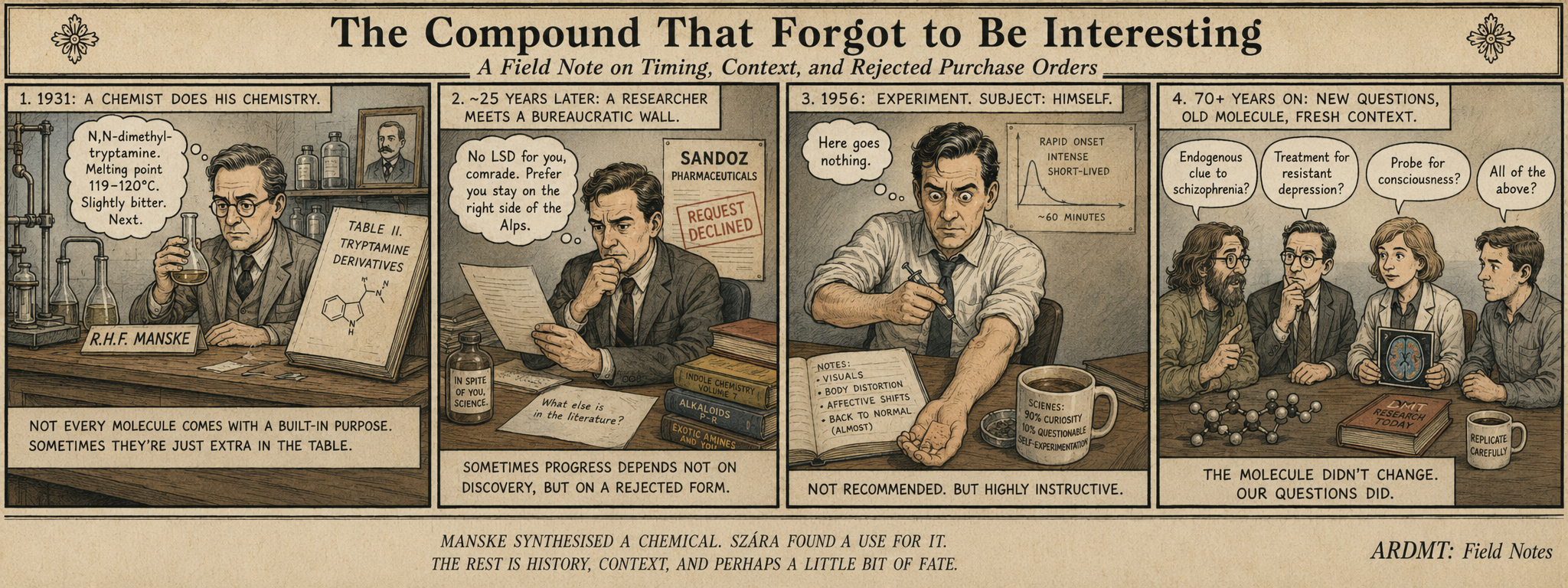
### What is the Sigma-1 Receptor?
URL: https://www.ardmt.com/what-is-the-sigma-1-receptor/
Last updated: 2026-05-17T06:56:58.000Z
A strange protein inside cells, why DMT binds to it, and the increasingly serious question of what that binding might mean
In plain English
The sigma-1 receptor is a small protein that sits inside human cells rather than on their surfaces, where most of the receptors people have heard of live. It does not look like much. For decades after its discovery it was treated as a pharmacological curiosity — a protein that bound to a wide range of drugs without anyone being sure what it was actually for. Over the last fifteen years, that has begun to change. The sigma-1 receptor now appears to be involved in cellular stress responses, neuroplasticity, and several disease processes that the broader medical field cares about. And DMT, unexpectedly, is one of the molecules reported to bind it with measurable affinity.
This essay introduces the receptor, explains why it has become quietly important, and walks through what its connection to DMT might or might not mean. It is the sixth and closing piece in the ARDMT Foundations series, and the most technically detailed of the six. The earlier primers gave you the vocabulary you need to read this one without it feeling like a wall.
## 1\. What this article is
This is the closing piece in the Foundations series. The previous five — [DMT](https://www.ardmt.com/what-is-dmt/), [Ayahuasca](https://www.ardmt.com/what-is-ayahuasca/), [5-MeO-DMT](https://www.ardmt.com/what-is-5-meo-dmt/), [Harmine and the MAOIs](https://www.ardmt.com/harmine-and-maois/), and [What is the Default Mode Network?](https://www.ardmt.com/what-is-default-mode-network/) — built up the substance pharmacology and the cognitive-neuroscience vocabulary that this site spends most of its time engaged with. This one introduces a target that gets mentioned in passing throughout that earlier material but has not been properly explained: the sigma-1 receptor.
The piece is more technical than the previous five. It deals with intracellular biology rather than substance experience, with chaperone proteins and stress responses rather than ceremony or molecular comparison. The reward for working through it is access to a strand of psychedelic-pharmacology research that the surface-receptor story (5-HT2A, 5-HT1A, the receptors covered in the earlier primers) does not capture, but that may turn out to be doing more than the surface story can account for on its own.
A short author note, in the same third-person register as the DMN essay. The writer's engagement with the sigma-1 receptor is as a reader of the literature rather than as a participant in any practice that involves it directly — though the long-term cellular effects of DMT and 5-MeO-DMT use, which the writer does have direct experience of, may well be mediated in part through this receptor. The science is open enough that this is plausible rather than established.
## 2\. The discovery
The sigma-1 receptor has one of the stranger origin stories in contemporary pharmacology. It was discovered not because anyone was looking for it, but because a class of drugs bound to *something* that was not a known receptor and someone eventually had to name the something.
In the 1970s, researchers studying opioid pharmacology noticed that certain compounds — N-allylnormetazocine and related benzomorphans — produced effects in animals that resembled some opioid effects but differed from others. The compounds bound to a protein in the brain that initially appeared to be an unusual opioid receptor subtype. The protein was provisionally named the "sigma receptor" (σ-receptor) and was, for several years, classified as a member of the opioid receptor family.
This turned out to be wrong on every count. By the late 1980s, careful pharmacology had established that the sigma receptor was not an opioid receptor at all — opioid antagonists like naloxone did not block its effects, and its tissue distribution and binding profile were inconsistent with the opioid family. The name persisted by inertia. The protein was reclassified as a "non-opioid sigma site" and remained pharmacologically mysterious for another decade.
Further confusion followed. Researchers identified what appeared to be two distinct sigma receptors — sigma-1 and sigma-2 — based on differences in their binding profiles and tissue distribution. Sigma-1 was eventually purified, sequenced, and cloned in 1996, and its structure determined in detail over the following years. Sigma-2 turned out to be a different protein entirely, finally identified molecularly only in 2017 (it is now known to be the TMEM97 protein), confirming that the two sigma subtypes were unrelated despite sharing a name.
So the sigma-1 receptor, as currently understood, is the molecular entity originally identified through 1970s opioid research, identified as non-opioid in the 1980s, structurally characterised from the 1990s onward, and now understood to be a distinct kind of protein with no significant relationship to either opioid receptors or to "sigma-2." The naming history is a mess. The biology has turned out to be considerably more interesting than the naming history suggested.
## 3\. What kind of protein it is
To understand why the sigma-1 receptor matters, it helps to start with where it lives.
Most receptors that drugs are designed to interact with are **cell-surface receptors** — proteins embedded in the outer membrane of cells, with one part facing the outside world and another part facing the cell's interior. A molecule arriving at the cell surface binds to the external-facing part of the receptor, and this binding triggers signals that propagate inward through the cell. Almost every major class of psychiatric and neurological drug — antidepressants, antipsychotics, opioids, classical psychedelics — works by binding to cell-surface receptors of one kind or another.
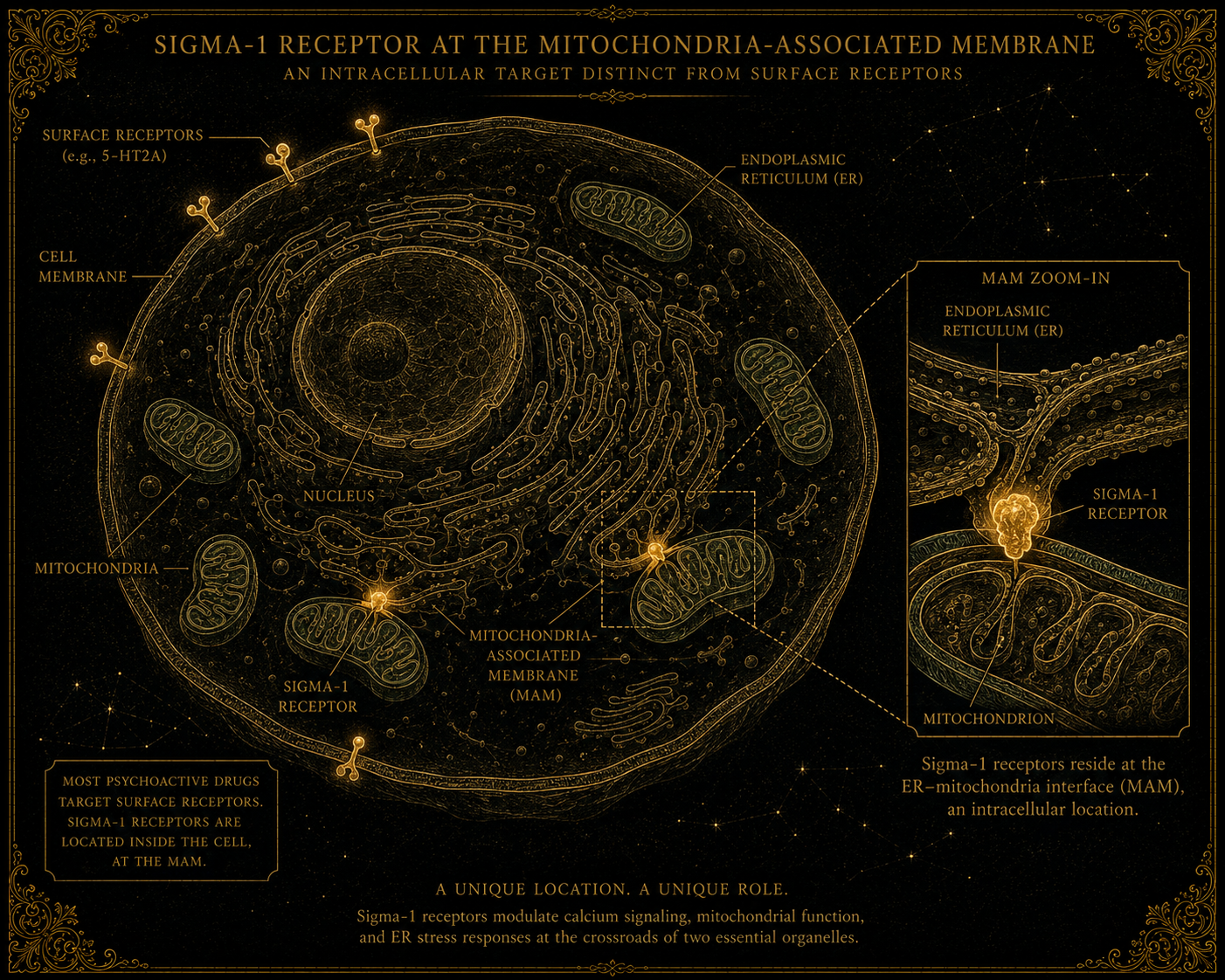
The sigma-1 receptor is different. It is not on the cell surface. It lives inside the cell, embedded in the membrane of an internal organelle called the **endoplasmic reticulum** (ER). More specifically, it sits at the junction between the endoplasmic reticulum and the mitochondria — a contact zone called the **mitochondria-associated membrane** (MAM), where these two organelles meet and exchange information.
In plain English: what are the endoplasmic reticulum and the mitochondria?
Cells contain various internal compartments, called organelles, each with a specific job. The endoplasmic reticulum is an interconnected network of membranes that handles the manufacturing and folding of proteins; it is one of the cell's main production facilities. The mitochondria are smaller organelles that produce most of the cell's energy by metabolising fuel. The two need to communicate constantly — energy demand has to match production, and the cell's stress responses have to coordinate across both compartments. The mitochondria-associated membrane is the physical zone where they meet and exchange signals. The sigma-1 receptor lives at this zone, in a position to influence what happens on both sides.
This location is unusual. Most receptors live in places that respond to signals from outside the cell. The sigma-1 receptor lives in a place that responds to signals from inside the cell — to cellular stress, to imbalances in calcium signalling, to demand on the protein-folding machinery, to disturbances in the mitochondrial energy supply.
The protein itself is small (about 223 amino acids), has a relatively simple structure (it crosses the membrane just once), and behaves more like a **chaperone** than like a conventional receptor. A chaperone protein, in cellular biology, is a protein whose job is to assist other proteins — helping them fold correctly, stabilising them under stress, sometimes shepherding them to their correct locations within the cell. The sigma-1 receptor seems to operate primarily in this chaperone-like role, modulating the behaviour of other proteins it associates with rather than driving signalling cascades of its own.
This combination — intracellular location, chaperone-like function, sensitivity to cellular stress — makes the sigma-1 receptor a different kind of pharmacological target from the surface receptors that dominate medicine. Drugs that bind to it are doing something at a different layer of the cell, with consequences that propagate through cellular processes rather than through neural signalling alone.
## 4\. What it does
The functional role of the sigma-1 receptor has emerged in stages over the last twenty years, and is still being worked out. The following is the current consensus picture, with the appropriate caveats that some of this remains contested.
**Calcium signalling regulation.** The endoplasmic reticulum stores calcium ions and releases them in regulated bursts that drive much of cellular signalling. The sigma-1 receptor associates with proteins that control calcium release from the ER and modulates their behaviour. When cells are under stress, sigma-1 activity changes in ways that protect against calcium-mediated cell damage.
**Protein-folding stress response.** When cells accumulate misfolded proteins — which happens routinely under stress, and pathologically in many neurodegenerative diseases — the ER mounts a coordinated response called the unfolded protein response (UPR). The sigma-1 receptor is involved in regulating this response, helping cells handle misfolding stress more effectively. Loss of sigma-1 function makes cells more vulnerable to protein-misfolding pathologies.
**Mitochondrial coupling.** Because the sigma-1 receptor sits at the contact zone between ER and mitochondria, it is well-positioned to influence the energy and signalling exchange between them. Sigma-1 activation has been shown to support mitochondrial function under stress, including by helping maintain the integrity of mitochondrial membranes and the efficiency of energy production.
**Cellular survival and neuroplasticity.** Several lines of evidence suggest that sigma-1 activation promotes the survival of neurons under stress and supports the growth of new synaptic connections. This effect operates on longer timescales than the acute effects of surface-receptor drugs — days and weeks rather than minutes and hours. It overlaps with some of the mechanisms now invoked to explain psychedelic neuroplasticity more broadly.
**Modulation of other receptors.** As a chaperone-like protein, the sigma-1 receptor influences the activity of various other receptors and ion channels it associates with — including some opioid receptors, some serotonin receptors, and several ion channels. This modulatory role means that activating sigma-1 can change how other neuronal signalling systems behave, even without directly stimulating those systems.
The aggregate picture is of a small protein doing several jobs at once, all of them concerned with how cells cope with stress and adapt to challenge. None of these jobs corresponds to the kind of rapid acute signalling that surface receptors handle. The sigma-1 receptor operates at a different temporal layer of cellular biology — closer to maintenance and resilience than to moment-to-moment activity.
## 5\. Why DMT?
Here is the connection that brings the sigma-1 receptor into the orbit of this site.
In 2009, a paper by Dominique Fontanilla, Arnold Ruoho, and colleagues at the University of Wisconsin reported a striking finding. N,N-dimethyltryptamine — the molecule covered in detail in [What is DMT?](https://www.ardmt.com/what-is-dmt/) — bound to the sigma-1 receptor and behaved as an agonist (an activator) at this site. The reported affinity was strong enough to raise the question of whether endogenous DMT could matter at sigma-1 under particular local or stress-related conditions, although whether such concentrations are actually achieved in living human tissues remains unresolved.
The finding mattered for three reasons.
First, it connected DMT to a target that had previously seemed unrelated to the classical psychedelic story. 5-HT2A was, and remains, the principal target for the acute psychedelic experience. Sigma-1 was something else — an intracellular protein with no obvious role in producing visual phenomena or ego dissolution. The Fontanilla paper raised the possibility that DMT might have two pharmacological stories: producing the acute experience through 5-HT2A, and doing something *else* through sigma-1, on different timescales and with different consequences.
Second, it opened a possible explanation for endogenous DMT. If the trace amounts of DMT detected in human biological fluids — discussed in detail in the [Endogenous DMT review](https://www.ardmt.com/endogenous-dmt-critical-review/) — were too small to produce psychedelic effects through 5-HT2A, they might nevertheless be sufficient to engage sigma-1 under the right conditions, where lower concentrations can still matter. This made the puzzle of endogenous DMT slightly more tractable: maybe the body's own DMT does not need to be at psychoactive concentrations to be doing something biologically meaningful, if its target is sigma-1 rather than 5-HT2A.
Third, it connected DMT to the broader sigma-1 research programme. Once DMT was identified as a sigma-1 agonist, the question of what sigma-1 activation does — for cellular stress, for neuronal survival, for protein-folding responses, for mitochondrial function — became a question about what DMT might be doing on longer timescales than the acute experience.
Subsequent work has extended the sigma-1 discussion to DMT-family compounds, including 5-MeO-DMT, especially in cellular and immunological models. The precise importance of sigma-1 binding differs by compound and remains an active research question.
Important distinction
Sigma-1 may help explain slower cellular effects of DMT-family compounds — effects on neuroplasticity, on cellular resilience, on long-timescale changes that the acute experience does not account for. It does not replace 5-HT2A as the principal explanation for the acute psychedelic state. The visual phenomena, the ego dissolution, the cognitive disinhibition that DMT produces at psychoactive doses are 5-HT2A-driven. Sigma-1 is the other story, operating in parallel, on a different timescale, with consequences that are still being mapped.
In plain English: what this might add up to
The story emerging — and it is still emerging — is that DMT might be doing two different jobs in the body at the same time. At high concentrations (the kind produced by smoking, vapourising, or drinking ayahuasca), it produces the acute psychedelic experience by activating 5-HT2A receptors on the surface of neurons in the cortex. At low concentrations (the kind the body itself might produce endogenously), it might be doing something quieter and slower through the sigma-1 receptor — supporting cellular resilience, modulating stress responses, maintaining neuronal health. Whether this is actually true, and whether the body's own DMT is performing this quieter function, is still an open question. But it is the question that makes sigma-1 worth paying attention to in the context of DMT research.
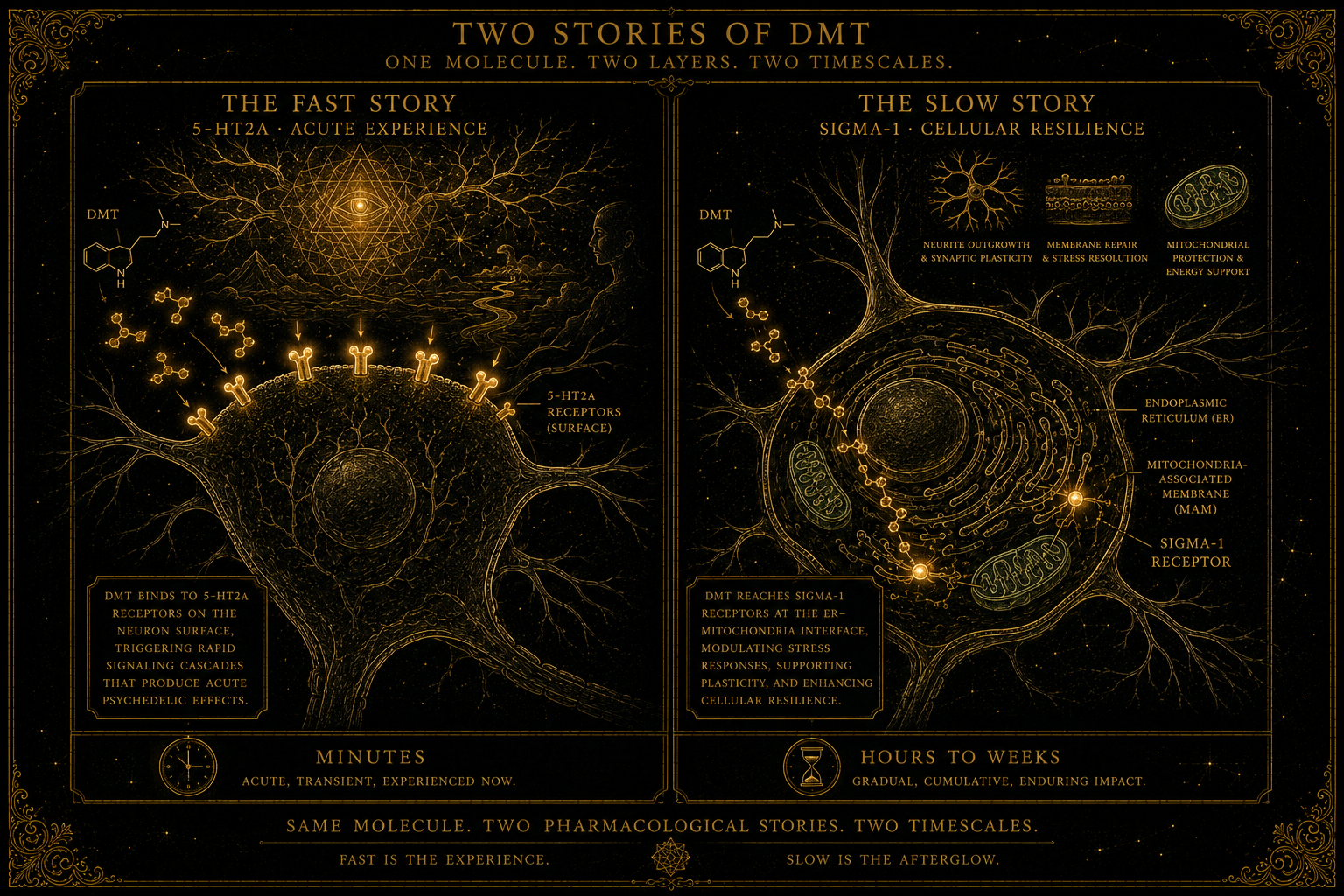
## 6\. The Parkinson's strand
The sigma-1 receptor has acquired particular research interest in one specific clinical context that ARDMT's Field Notes follow closely: Parkinson's disease.
Parkinson's is a neurodegenerative condition in which neurons in specific brain regions — particularly dopamine-producing neurons in the substantia nigra — progressively die. The cellular mechanisms of this death involve, among other things, protein-misfolding stress, mitochondrial dysfunction, and the loss of neuroplastic capacity. All three are processes that sigma-1 activity is known to influence.
Several preclinical studies, beginning in the late 2010s and accelerating through the early 2020s, have demonstrated that sigma-1 agonists can protect dopamine-producing neurons in animal models of Parkinson's disease. The protection appears to operate through multiple mechanisms — stabilising mitochondrial function, supporting the unfolded protein response, promoting neuronal survival under metabolic stress — all of which are aspects of sigma-1's normal cellular role.
This has produced interest in sigma-1 agonists as possible neuroprotective or disease-modifying agents in Parkinson's and related neurodegenerative contexts. Some sigma-1-directed compounds have entered clinical development, although the Parkinson's-specific evidence remains early and uncertain. The compounds under investigation are not DMT itself — pharmacokinetic and regulatory considerations make a controlled psychedelic difficult to develop as a chronic neurological treatment — but synthetic sigma-1 agonists designed to retain the desired cellular effects without producing acute psychedelic experiences.
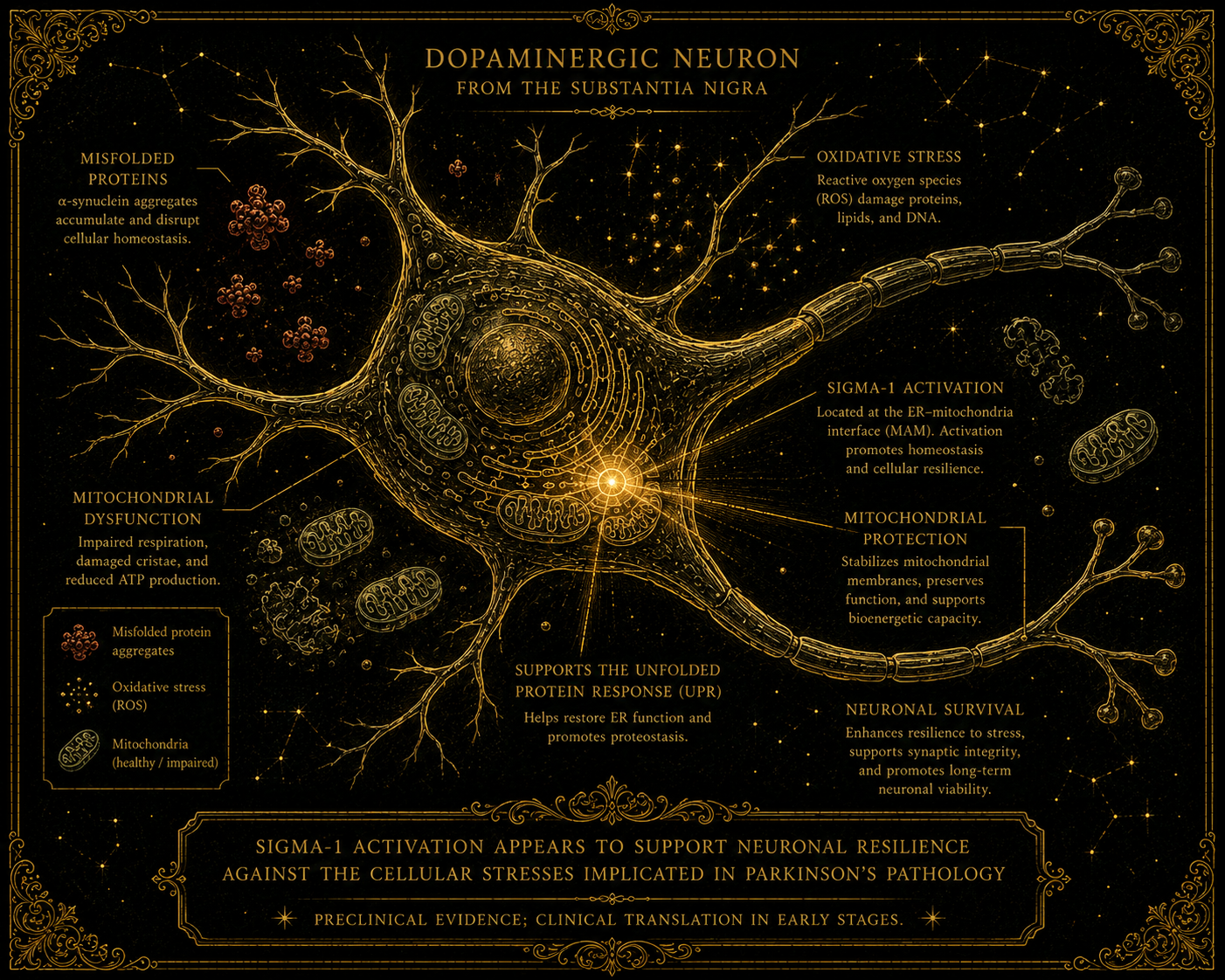
The relevance for the broader DMT story is significant. If sigma-1 activation is genuinely neuroprotective in Parkinson's, and if DMT is a sigma-1 agonist, then questions about whether DMT itself (or analogues, or related compounds) might have disease-modifying effects in Parkinson's become reasonable rather than fanciful. This is one of the more interesting strands of contemporary psychedelic-related research, partly because it bridges the worlds of psychedelic pharmacology and conventional neurology in a way that few other findings do.
It is worth emphasising that this remains preclinical and early-clinical work. The translation from animal models to human disease modification is notoriously unreliable, and the Parkinson's research landscape is littered with promising preclinical findings that did not survive larger human trials. The sigma-1 strand is interesting; it is not yet a clinical reality.
ARDMT's Field Notes track this strand actively. Search for "sigma-1" or "Parkinson's" in the archive to find specific trial coverage as it appears.
## 7\. The therapeutic horizon
Beyond Parkinson's, sigma-1 agonism has been investigated, with varying degrees of preclinical support, in a range of contexts worth noting briefly.
**Depression and mood disorders.** Several antidepressant drugs already in clinical use — including fluvoxamine (a common SSRI) — have significant sigma-1 agonist activity in addition to their primary pharmacological actions. There is active debate about how much of these drugs' antidepressant effect is attributable to sigma-1 versus their primary targets. Dedicated sigma-1 agonists are being investigated as potential antidepressants in their own right.
**Neuroplasticity and cognitive enhancement.** Sigma-1 activation supports neuroplasticity, and several lines of research are exploring whether sigma-1 agonists might be useful in conditions characterised by impaired plasticity — including some forms of cognitive decline, post-stroke recovery, and traumatic brain injury rehabilitation.
**Pain and neuropathy.** Sigma-1 modulators have been investigated for chronic pain conditions, particularly neuropathic pain that is poorly responsive to conventional analgesics. The mechanisms are not fully understood but appear to involve sigma-1's modulatory effects on other pain-signalling systems.
**Anti-cancer effects.** Some sigma-1 modulators have shown activity against cancer cell lines, apparently through effects on the cellular stress responses that cancer cells depend on for survival. This is at an early stage and not particularly the subject of clinical work yet.
**Neuroprotection more broadly.** Beyond Parkinson's, sigma-1 agonists are being investigated for their potential to protect neurons in other contexts — stroke, traumatic brain injury, some forms of dementia. The underlying logic is the same: sigma-1 supports cellular resilience, so activating it may help neurons survive insults that would otherwise kill them.
The aggregate picture, as with harmine in its own primer, is of a target whose biological importance is becoming more apparent as research accumulates, and whose therapeutic potential spans several clinical contexts. Whether any sigma-1-directed therapy reaches widespread medical use in the next decade remains to be seen.
The connection to DMT and the other psychedelic tryptamines through this target is one of the more genuinely interesting strands of contemporary psychedelic pharmacology — not because anyone seriously expects DMT itself to become a Parkinson's medicine, but because the existence of this binding suggests that the body's evolved relationship with DMT-like compounds may be operating at a deeper layer of cellular biology than the acute-experience story alone captures.
## 8\. Is there a legal dimension?
Like the Default Mode Network, the sigma-1 receptor is not a substance and cannot be controlled by drug legislation. It is a protein expressed in human cells, and possession of the protein is, of course, universal among living humans.
The substances that bind to sigma-1 vary widely in their legal status. DMT, 5-MeO-DMT, and several other psychedelic agonists are controlled. Many non-psychedelic sigma-1 ligands — including fluvoxamine, dextromethorphan (the cough-suppressant in many over-the-counter cold remedies), and various research chemicals — are either approved medications or unscheduled. Some are widely available; some are tightly controlled. The legal landscape for sigma-1 pharmacology overall is therefore patchwork, depending on which specific compound is being considered.
What is consistent across jurisdictions is that sigma-1 research itself — investigations of the receptor's biology, its function in disease, its responses to non-controlled compounds — is universally permitted under standard research ethics frameworks. The bottleneck for psychedelic-sigma-1 research is the same bottleneck affecting all psychedelic research: the legal status of the active compounds, not of the target.
## 9\. What people often get wrong
Recurring misconceptions about the sigma-1 receptor and its relationship to psychedelic pharmacology, briefly addressed:
**"DMT works by activating sigma-1."** Not principally. The acute psychedelic experience produced by DMT operates through 5-HT2A receptors on the surface of cortical neurons. Sigma-1 activation may contribute to longer-timescale effects — neuroplasticity, cellular resilience, possibly some aspects of the experience itself — but the headline psychedelic action is a 5-HT2A story. Treating sigma-1 as the explanation for what DMT does at psychoactive doses overstates what the evidence currently supports.
**"Sigma-1 is the receptor for endogenous DMT."** This is one hypothesis the field has discussed; it is not established. Endogenous DMT might engage sigma-1; it might engage other targets; it might be doing nothing biologically meaningful at the concentrations the body actually produces. The endogenous DMT question and the sigma-1 question are connected but distinct, and the connection between them remains genuinely open.
**"Activating sigma-1 produces psychedelic effects."** It does not, at least not in the conventional sense. Many sigma-1 agonists used in research and medicine — including approved drugs like fluvoxamine — do not produce psychedelic experiences. The acute psychedelic state is a 5-HT2A phenomenon; sigma-1 activation does something different.
**"Sigma-1 and sigma-2 are related receptors."** They are not. Despite the shared "sigma" name, the two were grouped together historically because of overlapping pharmacology in the early days of the field. Molecular characterisation has since established that they are entirely different proteins, encoded by unrelated genes, with different functions and tissue distributions. The naming is a historical accident.
**"DMT's binding to sigma-1 proves it's a fundamental endogenous signalling molecule."** It proves binding. It does not prove function, role, or evolutionary purpose. The interpretive leap from "DMT binds to this receptor" to "DMT therefore has a fundamental role in human biology" is much larger than the evidence supports and has been a feature of overclaim in popular psychedelic writing for years. The careful version of the claim is that DMT's binding to sigma-1 is consistent with several interesting possibilities about endogenous function; the careful version does not assert that those possibilities are established.
## 10\. What we still don't know
The genuinely open questions in sigma-1 research, briefly:
What the full set of natural endogenous ligands for the sigma-1 receptor is. DMT and related tryptamines are candidates; so are several lipid-based compounds; so are some neurosteroids. Which of these the receptor evolved to respond to, and at what concentrations, remains unresolved.
Whether the body's own DMT actually engages sigma-1 in a functionally meaningful way at the concentrations endogenous DMT actually achieves. This is the question that would, if answered affirmatively, partly vindicate the Strassman-style "DMT has a fundamental endogenous role" hypothesis; it is also the question the field has been unable to settle for fifty years.
Whether sigma-1 agonism in human Parkinson's disease will replicate the neuroprotective effects observed in animal models. The translation from preclinical to clinical results is the standard hard problem of neurology, and the sigma-1 strand is not exempt from it.
How much of the long-term effects of DMT and related psychedelics on mood, anxiety, and cognition is mediated through sigma-1 versus through other mechanisms (5-HT2A-driven neuroplasticity, downstream effects on the default mode network, indirect effects through other receptors). Disentangling these contributions empirically is difficult.
Whether sigma-1 agonism without psychedelic effects can produce some of the therapeutic benefits attributed to psychedelics — that is, whether a non-psychedelic sigma-1 agonist could substitute for psychedelic therapy in some clinical contexts. Several pharmaceutical programmes are betting that the answer is at least partly yes.
What the broader cellular biology of sigma-1 looks like — its complete set of binding partners, its full regulatory network, its role in normal physiology beyond the disease contexts that have driven most of its research attention.
These are live questions. Several of them are likely to have meaningful answers within the next decade. The sigma-1 receptor has gone from pharmacological curiosity to actively studied target in roughly twenty years, and the rate of progress has been accelerating rather than slowing.
## 11\. Closing the Foundations series
This essay closes the ARDMT Foundations series. The six primers together — [DMT](https://www.ardmt.com/what-is-dmt/), [Ayahuasca](https://www.ardmt.com/what-is-ayahuasca/), [5-MeO-DMT](https://www.ardmt.com/what-is-5-meo-dmt/), [Harmine and the MAOIs](https://www.ardmt.com/harmine-and-maois/), [the Default Mode Network](https://www.ardmt.com/what-is-default-mode-network/), and this one — were designed as a single on-ramp into the rest of the site. A reader who has worked through all six is now in a position they were not in before starting: equipped with the vocabulary, the pharmacological scaffolding, and the conceptual frameworks that the deeper essays and the daily Field Notes assume.
This is the only structured walkthrough on ARDMT. The rest of the site does not hold the reader's hand in the same way — it operates at the level the Foundations primers were preparing you for. With that in mind, a small amount of guidance about where to go next.
**If you want to go deeper on a specific molecule.** The Field Notes archive at [/tag/research/](https://www.ardmt.com/tag/research/) carries daily coverage of new research as it appears — clinical trial readouts, mechanistic studies, policy developments. Searching the archive for a specific compound name (DMT, ayahuasca, ibogaine, harmine, 5-MeO) will surface the relevant entries. These pieces are written for readers who already have the Foundations vocabulary.
**If you want depth rather than breadth.** The Pillar Essays — most prominently the [Endogenous DMT in Humans](https://www.ardmt.com/endogenous-dmt-critical-review/) review — are the long-form, fully cited deep-dive pieces. They are denser than the primers, longer (often an hour's reading or more), and assume the reader is willing to engage with the actual scientific evidence in detail. The Foundations primers are the orientation; the Pillar Essays are the work the orientation was preparing you for.
**If you want to follow the live debates.** Several strands of psychedelic research are genuinely contested in 2026 — the endogenous-DMT question, the synthetic-versus-natural-5-MeO-DMT question, the cultural-translation question around ayahuasca, the harmine-as-therapeutic question, the sigma-1-as-mediator-of-long-term-effects question. These are where the field is currently working things out. Field Notes track them as they develop; the Pillar Essays revisit them when enough has changed to warrant a fresh look.
**If you want the ethical and legal dimensions.** Forthcoming Pillar Essays on UK psychedelic policy and on the cultural-translation questions will treat these areas in detail. In the meantime, the legal sections within each Foundations primer cover the basics.
**If you want what isn't here.** ARDMT does not cover everything in the psychedelic landscape. Classical psilocybin research, MDMA-assisted therapy, ketamine clinical work, and several other strands are referenced where they intersect with the DMT/sigma-1/MAOI core but are not the site's primary focus. For sustained coverage of those, other resources exist — and the broader [Field Notes](https://www.ardmt.com/tag/research/) coverage will sometimes touch on them as relevant.
The Foundations series exists because the rest of the field is hard to read without it. Now that you have it, the rest of the field is open. The work of orienting is done. Whatever you read next is yours to choose.
---
The short version
The sigma-1 receptor is a small chaperone-like protein that lives inside cells, at the contact zone between the endoplasmic reticulum and the mitochondria. It is involved in cellular stress responses, neuroplasticity, mitochondrial function, and the regulation of other receptors. It is structurally and functionally unrelated to most receptors that drugs target, and operates at a different temporal layer of cellular biology — supporting resilience and adaptation rather than driving moment-to-moment signalling.
DMT binds to the sigma-1 receptor with high affinity and behaves as an agonist there. This connects DMT to a strand of contemporary research — encompassing Parkinson's disease, depression, neuroplasticity, and cellular resilience more broadly — that the surface-receptor story alone does not capture. Whether the body's own DMT engages this receptor in functionally meaningful ways remains open; the question is one of the more interesting in contemporary psychedelic pharmacology.
---
#### New to this topic?
- [What is DMT?](https://www.ardmt.com/what-is-dmt/)
- [What is Ayahuasca?](https://www.ardmt.com/what-is-ayahuasca/)
- [What is 5-MeO-DMT?](https://www.ardmt.com/what-is-5-meo-dmt/)
- [Harmine and the MAOIs](https://www.ardmt.com/harmine-and-maois/)
- [What is the Default Mode Network?](https://www.ardmt.com/what-is-default-mode-network/)
#### Going deeper?
- [Endogenous DMT in Humans: A Critical Review of the State of the Evidence](https://www.ardmt.com/endogenous-dmt-critical-review/)
- [DMT vs Ketamine: Equal on Depression, DMT Wins on Anxiety](https://www.ardmt.com/dmt-vs-ketamine-depression-anxiety/)
- [Field Notes — daily research updates, including ongoing sigma-1 and Parkinson's coverage](https://www.ardmt.com/tag/research/)
---
### Suggested Citation
Page, S. (2026) 'What is the Sigma-1 Receptor?', *ARDMT: Applied Research Through DMT*, 17 May 2026\. Available at: https://ardmt.com/what-is-sigma-1-receptor/.
### What is the Default Mode Network?
URL: https://www.ardmt.com/what-is-the-default-mode-network/
Last updated: 2026-05-18T19:06:34.000Z
The brain regions that hum when you are not doing anything, the self that hums with them, and what psychedelics seem to do to the whole arrangement
In plain English
The Default Mode Network — usually abbreviated DMN — is a set of brain regions that work together when you are not particularly focused on anything outside yourself. It hums along when you daydream, when you remember, when you imagine the future, when you think about other people, and when you do the thing humans spend a remarkable amount of their waking life doing: thinking about themselves.
This essay explains what the DMN is, what evidence supports the model, why it has become central to understanding what psychedelics seem to do to the brain, and what the model can and cannot explain. The previous four primers covered substances. This one covers a concept — one of the concepts that makes the psychedelic-neuroscience story legible.
It can be read on its own or as preparation for going deeper into the mechanism-focused essays and Field Notes elsewhere on the site.
## 1\. What this article is
This is the fifth piece in the Foundations series. The four previous primers ([DMT](https://www.ardmt.com/what-is-dmt/), [Ayahuasca](https://www.ardmt.com/what-is-ayahuasca/), [5-MeO-DMT](https://www.ardmt.com/what-is-5-meo-dmt/), and [Harmine and the MAOIs](https://www.ardmt.com/harmine-and-maois/)) introduced the molecules and the plant chemistry that this site spends most of its time engaged with. This one introduces a concept that none of those primers can fully avoid and that all of them, eventually, depend on: the Default Mode Network.
The DMN is, on one level, a neuroanatomical claim — a list of brain regions that show a particular pattern of coordinated activity. On another level, it has become one of the leading models for understanding the ordinary self-referential layer of consciousness: the narrative sense of being someone with a past, a future, and a continuing identity, and for why psychedelics produce the kind of experiences they produce. Both levels matter. The piece walks through them in that order.
The author note for this one is brief. Unlike the previous primers, DMN is a concept the writer encountered as a reader of the literature rather than as a participant in any practice. This essay is correspondingly third-person. The lived-experience material that justified itself in the ayahuasca primer would distort the analysis here — though where the model intersects with what experienced psychedelic participants commonly report, the connections are flagged.
## 2\. The discovery
For most of the twentieth century, brain imaging — when it existed at all — was about catching the brain in the act of *doing* something. Researchers would scan a participant while the participant performed a task. The image was interpreted as "this is what the brain looks like when it's working on this problem." The rest of the time — the slow baseline state between tasks — was treated as noise, as the inactive state of a brain waiting for something to do.
In the late 1990s and early 2000s, that picture began to break.
The development of functional magnetic resonance imaging (fMRI) had made it possible to see ongoing patterns of brain activity in real time. Researchers — most prominently Marcus Raichle at Washington University in St Louis — noticed something odd. When participants were *not* doing tasks, when they were simply lying in the scanner letting their minds wander, certain brain regions actually became *more* active than they were during attention-demanding tasks. The same set of regions. Every time. Across different participants, different studies, different scanners.
This was the opposite of what the prevailing model predicted. It implied that the brain has a *baseline state of activity* that is not the absence of work — it is a different kind of work. Raichle and colleagues called it the "default mode" of brain function. The collection of regions that participated in it became, after a few years of nomenclature shuffling, the Default Mode Network.
What were these regions doing during the supposed baseline? Subsequent research, much of it conducted through the 2000s and 2010s, accumulated evidence that the DMN's activity correlated reliably with several specific cognitive functions:
- **Self-referential thought** — thinking about oneself, one's traits, one's history, one's future
- **Autobiographical memory** — recalling personal events, especially emotionally weighted ones
- **Theory of mind** — modelling what other people are thinking and feeling
- **Mental simulation** — imagining future scenarios, alternative pasts, hypothetical situations
- **Mind-wandering** — the unfocused, spontaneous thought that occupies most of human waking life when no task is demanding attention
Across all of these functions, the same broad set of regions activated together, with consistency that was hard to dismiss. The DMN was not just a coincidence of imaging methodology. Something coherent was happening in those regions, and that something was related — in some deep way — to the ordinary self-referential aspect of being a person.
## 3\. The regions and what they do
Before naming the regions, a small piece of orientation. The DMN should not be imagined as a small glowing circuit in the brain labelled "self." It is a statistical and functional network inferred from patterns of coordinated activity across regions that fire together more reliably than chance would predict. Different papers draw its boundaries slightly differently, and some researchers divide it into subnetworks with distinct functional roles. The list below gives the standard primer-level version; the underlying anatomy is more contested at the edges than any single tidy list can convey.
The DMN is not one region but a network — several distinct cortical and subcortical areas whose activity is correlated with each other to a degree that makes them functionally one unit, at least in the relaxed-baseline state.
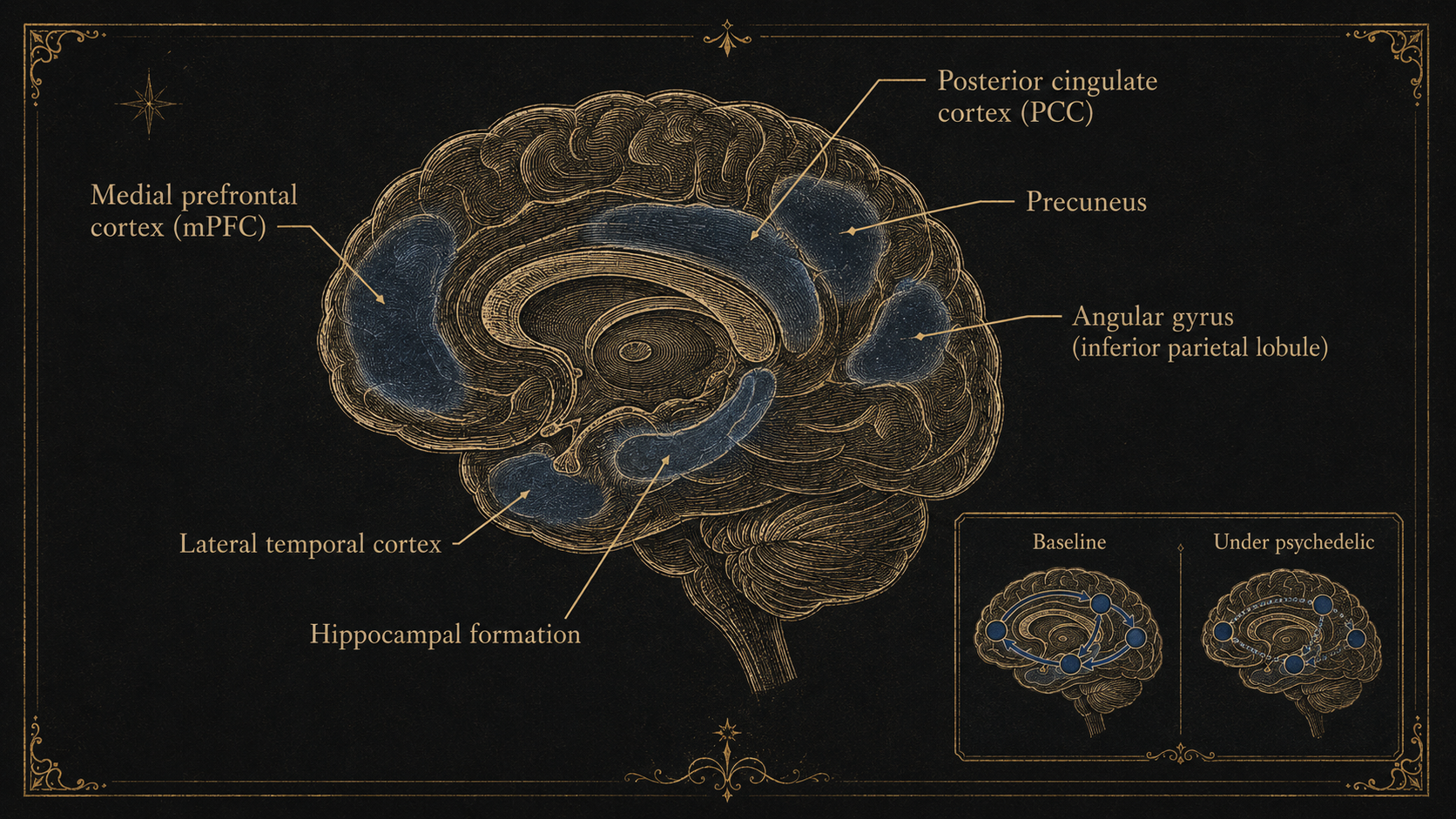
Engraved-style medial brain showing Default Mode Network regions in deep blue: mPFC, PCC, precuneus, angular gyrus, lateral temporal, hippocampus.
The principal nodes, in roughly descending order of how reliably they show up in DMN studies:
**The medial prefrontal cortex (mPFC)** — at the front of the brain on the inner wall between the two hemispheres. Strongly implicated in self-referential processing and in evaluating the personal significance of stimuli. Activity here scales with how much something matters *to you specifically*.
**The posterior cingulate cortex (PCC)** — at the back of the brain on the inner wall, behind the corpus callosum. Often described as the central hub of the DMN; it has more dense connections to other DMN nodes than any other single region. Its activity correlates particularly with mind-wandering and self-referential thought.
**The precuneus** — just above and slightly behind the PCC, on the inner wall. Involved in autobiographical memory, mental imagery, and the sense of being a self located in space and time.
**The lateral parietal cortex / angular gyrus** — on the outer surface of each hemisphere, near the temporo-parietal junction. Involved in theory of mind, in integrating information across senses, and in some aspects of self-other distinction.
**The lateral temporal cortex** — middle and inferior temporal regions, on the outer surface. Involved in conceptual knowledge about self and others.
**The hippocampal formation** — deep in the medial temporal lobe. Involved in autobiographical memory and in the construction of imagined future scenarios from past experience.
In plain English: why "network"?
These regions are anatomically distinct from each other — different locations in the brain, with different specific functions. What makes them a network is that their activity is correlated: when one is firing strongly, the others tend to be firing strongly too; when one quiets, the others quiet. They are linked by long-range white-matter tracts that allow them to communicate rapidly. The DMN behaves, in many respects, as if it were a single functional unit assembled from spatially separated parts. This is a common pattern in the brain — most cognitive functions involve multiple regions working together as networks — but the DMN was one of the earliest large-scale networks to be characterised in detail, and remains the most studied.
When the DMN is humming along at its baseline activity — when the regions are firing in their coordinated pattern — the felt experience is something like being a self. Thoughts about your own past, your own future, your own relationships, your own concerns, drift through awareness with the easy continuity that ordinary self-experience has. You are aware of being you. You have a name, a history, plans, opinions, an autobiography. The DMN, on one influential contemporary account, is doing much of the work of supporting that experience.
## 4\. The ordinary self
This is the most ambitious claim associated with the DMN, and it deserves to be set out carefully because it is the claim that makes the network interesting beyond clinical neuroscience.
The DMN model proposes that the ordinary sense of being a continuous, narrative self — the sense most people have most of the time, that there is *someone* here who has experiences, makes decisions, holds memories, and faces a future — is to a considerable extent the product of the DMN's coordinated activity. The self is not located in one region of the brain. It is constructed, moment by moment, by a distributed network that integrates self-referential thought, autobiographical memory, future simulation, and social modelling into a single coherent felt experience of being a person.
This is sometimes called the **narrative self** or the **autobiographical self**, in contrast to the more minimal **experiential self** — the bare sense of being conscious, of there being something it is like to be you, which probably depends on broader brain activity than the DMN alone. The DMN's distinctive contribution is the narrative layer: the running internal story about *who* you are.
If this model is correct — and it is one influential view in cognitive neuroscience, though by no means uncontested — then several things follow that matter for the rest of this essay.
First, the narrative self is not a fixed property of being human. It is a particular configuration of brain activity, and that configuration can be disrupted, attenuated, or transformed. Different states of consciousness — meditation, sleep, anaesthesia, psychotic episodes, near-death experiences, and (most relevantly for this site) psychedelic states — show characteristic changes in DMN activity that correspond to characteristic changes in the felt sense of being a self.
Second, the considerable mental effort the DMN expends on its self-referential work has both costs and benefits. The benefits include continuity of identity, autobiographical coherence, capacity for long-term planning, and theory of mind. The costs, in the contemporary popular literature, are often described as rumination, self-criticism, anxiety about the future, and the kind of repetitive self-focused thought that characterises depression. Several clinical conditions — depression, anxiety, post-traumatic stress disorder, obsessive-compulsive disorder — are now associated with DMN hyperactivity or with abnormal DMN connectivity patterns. Treating these conditions, on one current view, involves loosening the grip of an over-active DMN.
Third — and this is where the model becomes directly relevant to ARDMT's central subject — substances that demonstrably reduce DMN activity might be expected to produce experiences in which the ordinary sense of self is loosened, attenuated, or temporarily absent. They might also be expected to have therapeutic potential in conditions where the ordinary sense of self is the problem.
This is, more or less, what the psychedelic-DMN research programme has been investigating since about 2012.
## 5\. The psychedelic connection
In 2012, Robin Carhart-Harris and colleagues at Imperial College London published a paper in the *Proceedings of the National Academy of Sciences* (PNAS) reporting the results of an fMRI study of participants under the influence of psilocybin. The paper, titled "Neural correlates of the psychedelic state determined by fMRI studies with psilocybin," is widely regarded as the founding scientific document of contemporary psychedelic neuroscience.
The headline finding was striking. Participants on psilocybin showed *decreased* activity and *reduced functional connectivity* in the Default Mode Network. The same regions that hum together during baseline self-referential thought were quieter and less coordinated when the participants were in the psychedelic state. The reduction was greatest at the peaks of the subjective experience and correlated with self-reports of ego dissolution.
This finding had been broadly anticipated by some — the philosophical and contemplative traditions had long described psychedelic and meditative states as involving a kind of dissolution of ordinary self — but it had never been directly demonstrated at the level of brain activity before. The DMN model and the psychedelic experience appeared, in those imaging results, to fit together.
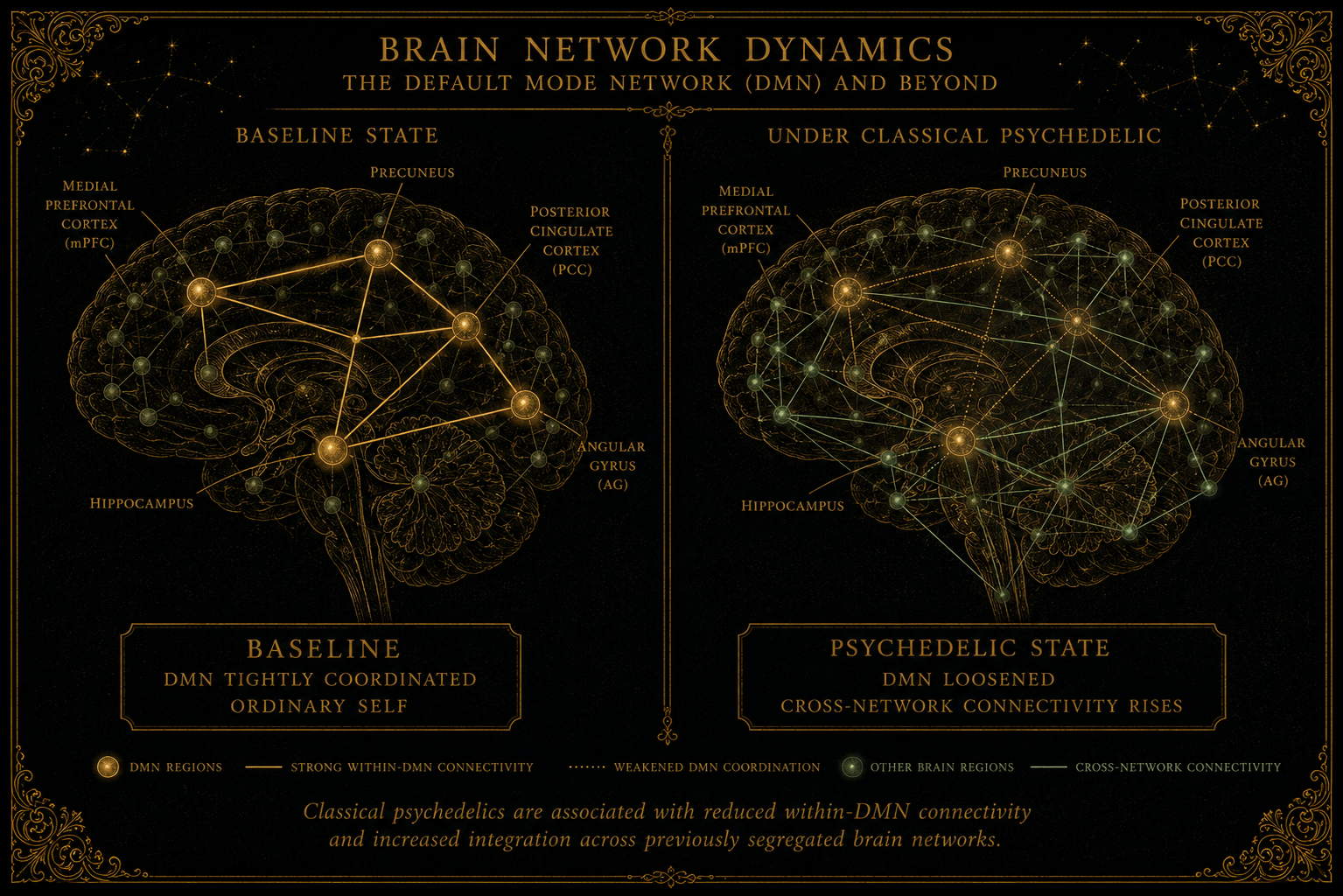
Subsequent work, much of it from Carhart-Harris's group and from collaborating laboratories at Hopkins, Maastricht, Zurich, and elsewhere, has extended and refined the picture. Some of the most important findings include:
**The effect is not unique to psilocybin.** Similar DMN attenuation has been observed with LSD, ayahuasca, DMT, and (in some studies) other psychedelics. The broad finding that psychedelics alter DMN activity and connectivity has been replicated across multiple studies, although the exact pattern varies by substance, dose, method, and analysis. The pattern appears to be a general feature of the classical psychedelic state rather than a quirk of any particular compound.
**The DMN doesn't just quiet — it desegregates.** More refined analyses suggest that what psychedelics do is not simply turn the DMN off, but disrupt its tight internal coordination. Regions that ordinarily fire in synchrony begin to communicate more loosely. At the same time, normally segregated brain networks begin to communicate more with each other. The brain under psychedelics has been described as showing increased "global functional connectivity" alongside decreased within-network connectivity. The metaphor often used is that the brain becomes temporarily *more interconnected and less hierarchical*.
**The disruption correlates with subjective effects.** The degree of DMN attenuation in individual participants tracks with their reported intensity of ego dissolution, with the vividness of the experience, with the persistence of post-session psychological changes, and (in clinical contexts) with therapeutic outcomes. This is not just an incidental finding alongside the psychedelic state; it appears to be tracking something central to what the state actually is.
**Long-term effects on DMN function follow some sessions.** Several studies have reported that participants show altered DMN connectivity weeks or months after a psychedelic session, and that these alterations correlate with improvements in mood, reductions in depressive symptoms, and other clinical changes. The model that has been proposed — and is still being actively debated — is that psychedelic experiences may produce a kind of "reset" of DMN function, loosening pathological patterns and allowing healthier configurations to consolidate.
Carhart-Harris and colleagues have developed a broader theoretical framework — the **entropic brain hypothesis**, later refined into the **REBUS** (relaxed beliefs under psychedelics) model — to interpret these findings. The basic claim is that psychedelics increase the entropy or disorder of brain activity, which corresponds to a relaxation of the strong top-down predictive models the brain ordinarily uses to construct experience. Under this relaxation, ordinarily-suppressed sensory and emotional content can break through; ordinarily-rigid beliefs and self-models can soften and reconfigure. The DMN, in this framework, is the principal seat of the top-down predictive work whose relaxation defines the psychedelic state.
This framework is influential but not universally accepted. Several alternative interpretations of the same imaging data exist, and the field's confidence in any specific neurobiological story about psychedelics should be calibrated carefully. The DMN-attenuation finding has been broadly replicated, though the specific pattern depends on substance, method, and dose. The theoretical framework that interprets it is more provisional still.
## 6\. What ego dissolution probably is
The phrase **ego dissolution** has become widely used in popular psychedelic discourse and is one of the more consistently reported features of higher-dose psychedelic experiences. It is also, as concepts go, slippery: people use it to mean somewhat different things, and the distinctions matter.
The clearest version of the term refers to a state in which the ordinary felt sense of being a discrete self — located in a body, with a personal history, a name, an inside and an outside — loosens, attenuates, or temporarily disappears. Participants describe variations on a theme: that the boundary between self and world becomes permeable; that the sense of being someone observing experience gives way to experience without an observer; that what is usually felt as "me thinking" comes to feel like "thinking happening, with no one in particular doing it"; that the personal historical self drops away and something more elemental remains.
Whether what remains is described as luminous, terrifying, divine, void, neutral, blissful, or some combination depends heavily on the individual, the substance, the dose, and the setting. The phenomenology varies enormously. The structural feature — the loosening of the ordinary self — is what the term "ego dissolution" is trying to point at.
On the contemporary neuroscientific picture sketched above, ego dissolution corresponds, at least partly, to the disruption of the DMN's coordinated activity. The brain regions that ordinarily integrate self-referential thought, autobiographical memory, and the felt sense of being a person quiet down and become less synchronised. The construction of the ordinary self loosens. What remains is awareness without its usual self-referential overlay.
This is a model. It is the best current model the field has. It is not the same thing as having explained the phenomenon — there are deep philosophical questions about consciousness and selfhood that no amount of brain imaging will settle, and the imaging itself is correlational rather than causal. But it is a model that has held up well across a substantial body of empirical work, and it is the model that makes most of the psychedelic-clinical-research story coherent.
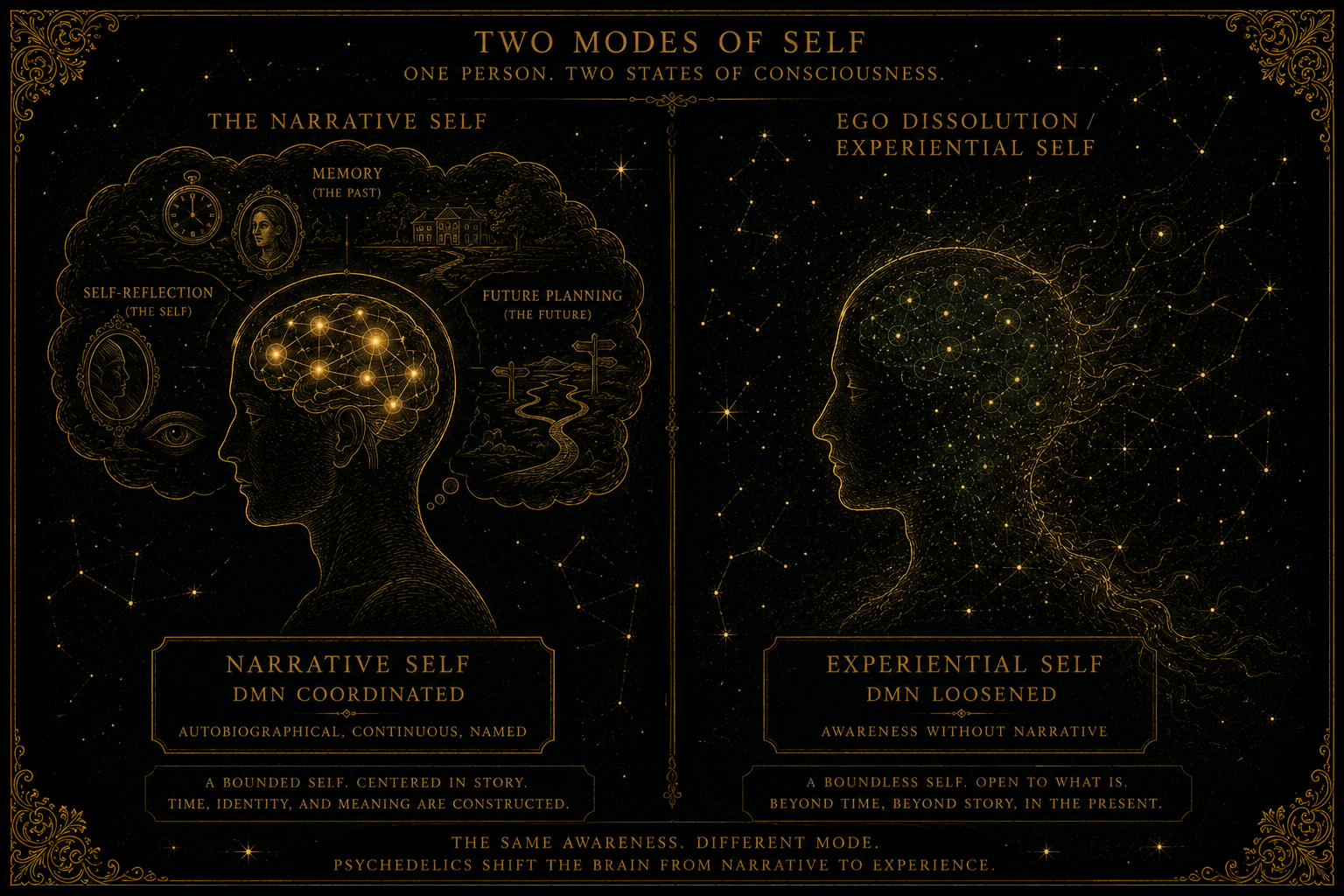
A few clarifications worth registering plainly.
Ego dissolution is not the same as ego death. The latter is a more extreme phenomenology, often used to describe the experience of the personal self appearing to *die* during a high-dose session. Both probably involve DMN attenuation, but ego death corresponds to a more profound and longer-lasting subjective absence of self than the looser ego dissolution.
Ego dissolution is not unique to psychedelics. Deep meditation, near-death experiences, certain extreme physical states, certain spontaneous spiritual experiences, and (in pathological form) some psychotic episodes can all produce phenomenologies that look related at the level of subjective report. The DMN model is consistent with this: any state that sufficiently disrupts DMN function might produce comparable experiences, regardless of how the disruption was induced.
Ego dissolution is not inherently positive or therapeutic. Some participants find these experiences profound and beneficial. Some find them terrifying. Some find them both. The reduction of the ordinary self can be experienced as liberation or as catastrophe; the difference depends on the participant, the preparation, the context, and what surfaces when the ordinary self quiets. This variability is one of the reasons reputable psychedelic therapy emphasises preparation and integration as much as the dosing session itself.
## 7\. What the model can and cannot explain
The DMN-psychedelics framework explains a lot. It also has real limits, and a primer is the right place to flag both.
The model accounts well for: the consistent reports of self-loosening in psychedelic states; the correlation between subjective ego dissolution and brain imaging; the general parallels between psychedelic states and other states known to involve DMN attenuation (meditation, dreaming, certain near-death experiences); the emerging therapeutic results in conditions characterised by excess self-focused processing (depression, OCD, end-of-life anxiety); and the broad finding that psychedelic effects across compounds share more features than their pharmacological differences would predict.
The model accounts less well for: the specific phenomenological differences between substances (why does DMT produce entity-encounter reports while 5-MeO-DMT produces dissolution into featureless awareness, if both reduce DMN activity?); the specific cultural and individual variability in psychedelic experiences (the same brain network change does not produce the same experience across people); the long-term changes in personality, worldview, and behaviour that psychedelics sometimes produce, which last far longer than any acute DMN change; and the philosophical question of what is *actually* happening during ego dissolution — what, if anything, persists when the narrative self quiets.
The model is also subject to a more general caution. fMRI is a powerful tool but a coarse one. The temporal resolution is poor (each measurement averages over several seconds), the spatial resolution is finite, and the relationship between blood flow (which is what fMRI actually measures) and neural activity is indirect. The DMN as a construct is real and well-replicated, but the specific neural mechanisms underlying its function — and underlying psychedelic effects on it — remain only partially understood.
A further consideration. The DMN model is *one* current framework for thinking about what psychedelics do. There are others. Some researchers emphasise the thalamocortical disinhibition that 5-HT2A activation produces. Some emphasise effects at intracellular receptors. Some emphasise the entropic-brain framework. Some emphasise neuroplasticity mechanisms that act on longer timescales than the acute experience. These frameworks are not necessarily incompatible — they may describe different levels or different timescales of the same underlying process — but the field has not yet converged on a single unified account, and the appropriate epistemic posture is to hold any one framework provisionally.
What is consistent across frameworks is that something coherent is happening when humans encounter classical psychedelics, that this something involves a recognisable disruption of ordinary cortical function, that it correlates with reports of self-loosening, and that the experiences it produces can have durable effects on mood, behaviour, and outlook. The DMN model is the current leading account of how these pieces fit together. It is probably partly right, probably partly incomplete, and probably destined to be refined or superseded by something more comprehensive over the coming decade.
## 8\. Is there a legal dimension?
The DMN itself has no legal status. It is a brain network, not a substance. The legal questions arise only when researchers use controlled substances to study how the network behaves under altered states. In practice, that means DMN-psychedelic research is limited not by the legality of brain imaging — which is conducted routinely under standard research ethics frameworks everywhere — but by the licensing regimes governing psilocybin, DMT, LSD, ayahuasca, and related compounds. A forthcoming pillar essay on UK psychedelic policy will treat the wider research-licensing question in more detail.
## 9\. What people often get wrong
A handful of recurring confusions about the DMN are worth addressing directly:
**"The DMN is the ego."** It contributes to the construction of the ordinary self-referential aspect of experience, but calling it "the ego" overstates what the model claims. The ego, if that concept is doing work at all, is a much broader functional pattern involving many brain regions and many mental processes. The DMN is one important part of the machinery, not the whole of it.
**"Psychedelics work by switching the DMN off."** They attenuate DMN activity and disrupt its functional connectivity. "Switching it off" implies a more complete disabling than the imaging actually shows. The DMN can be quieter, less coordinated, and less hierarchically dominant under psychedelics without being silent.
**"DMN activity is the cause of depression."** Some forms of depression involve DMN hyperactivity or abnormal connectivity patterns, and these patterns correlate with the kind of repetitive negative self-focused thought that characterises the condition. But correlation is not causation, and depression is a heterogeneous condition with many contributing factors. "The DMN causes depression" is a popular simplification of a more complicated picture.
**"Meditators have permanently reduced DMN activity."** Some long-term meditators show altered DMN patterns, but the relationship is more nuanced than simple reduction. Different meditation practices target different aspects of cognition, and the resulting DMN changes vary accordingly. The popular framing of meditation as "permanently quieting the DMN" oversimplifies the research.
**"Ego death is the goal of psychedelic therapy."** It is one experience that can occur during psychedelic therapy. It is not consistently associated with better therapeutic outcomes. Plenty of participants benefit from psychedelic-assisted treatment without experiencing ego death; some who experience it do not benefit. The goal of clinical psychedelic therapy is therapeutic improvement, which may or may not involve ego-dissolution experiences along the way.
**"The DMN model proves consciousness is brain-based."** It is consistent with the brain-based view of consciousness, but consistent-with is not the same as proves. There remain deep philosophical questions about why brain activity is accompanied by subjective experience at all — the hard problem of consciousness — that the DMN model does not address and probably cannot resolve.
## 10\. What we still don't know
The genuinely open questions in DMN research, briefly:
How the DMN is constructed at the cellular level — what specific neurons, in what specific patterns, produce the coordinated network-level activity that fMRI detects. Most current understanding is at the network level rather than at the cellular level.
Whether the DMN as currently characterised is one network or several functionally distinct subnetworks whose activity happens to correlate. Some recent work suggests the latter; the field has not converged.
How much of what the DMN does is universal across humans versus shaped by language, culture, autobiographical particulars, and developmental history. There is some evidence of cross-cultural variation in DMN function that has not been fully characterised.
How the DMN develops across the lifespan — in infancy, through childhood, in adolescence, into old age — and how individual variability in DMN function relates to variability in personality, mood, cognitive style, and vulnerability to psychiatric illness.
Whether the entropic-brain and REBUS models will turn out to be the right interpretive framework for the DMN-psychedelics data, or whether something else is needed.
What the relationship is between DMN function and consciousness in the deeper philosophical sense — between the network activity science can measure and the felt experience of being a self that the network appears to be associated with.
These are not minor technicalities. They are why DMN research remains genuinely live as a scientific field rather than a closed one.
---
The short version
The Default Mode Network is a set of brain regions — mainly medial prefrontal cortex, posterior cingulate cortex, precuneus, angular gyrus, and hippocampal formation — that hum in a coordinated pattern when you are not engaged in any specific task. Their coordinated activity correlates with self-referential thought, autobiographical memory, mind-wandering, and future simulation. One influential view in cognitive neuroscience is that this coordinated activity supports much of the ordinary felt sense of being a continuous self.
Classical psychedelics, including psilocybin, LSD, ayahuasca, and DMT, have repeatedly been shown to alter DMN activity and connectivity. This disruption corresponds to the experience of ego dissolution and is one of the leading neurobiological candidates for explaining key features of the psychedelic state. The model is influential, broadly replicated in its core findings, and almost certainly incomplete.
---
#### New to this topic?
- [What is DMT?](https://www.ardmt.com/what-is-dmt/)
- [What is Ayahuasca?](https://www.ardmt.com/what-is-ayahuasca/)
- [What is 5-MeO-DMT?](https://www.ardmt.com/what-is-5-meo-dmt/)
- [Harmine and the MAOIs](https://www.ardmt.com/harmine-and-maois/)
#### Going deeper?
- [Endogenous DMT in Humans: A Critical Review of the State of the Evidence](https://www.ardmt.com/endogenous-dmt-critical-review/)
- [DMT vs Ketamine: Equal on Depression, DMT Wins on Anxiety](https://www.ardmt.com/dmt-vs-ketamine-depression-anxiety/)
- [Field Notes — daily research updates on psychedelic neuroscience](https://www.ardmt.com/tag/research/)
---
### Suggested Citation
Page, S. (2026) 'What is the Default Mode Network?', *ARDMT: Applied Research Through DMT*, 17 May 2026\. Available at: https://ardmt.com/what-is-default-mode-network/.
### Harmine and the MAOIs
URL: https://www.ardmt.com/harmine-and-the-maois/
Last updated: 2026-05-17T05:54:21.000Z
*The plants that make ayahuasca possible, the enzymes they switch off, and a research strand that may be on the verge of becoming a medicine of its own.*
In plain English
Ayahuasca is two plants in a pot. The earlier primer on the brew explained what they are and what they do together. This essay zooms in on the half of the equation that does the pharmacological enabling: the vine, the compounds inside it (chiefly a molecule called harmine), the enzyme they switch off, and the chain of consequences that switching off produces.
If you have read the ayahuasca primer you have already met this material in its compressed form. If you have not, this essay can be read on its own — but it is in some ways the technical companion to that piece, and the two are designed to reinforce each other. The other half of the ayahuasca equation, N,N-DMT itself, is covered in its own primer.
A note: harmine is currently in the early stages of becoming a research compound in its own right, separately from its role in ayahuasca. That story is the most genuinely interesting development in the area, and it gets its own section at the end.
## 1\. What this article is
This is the fourth in the Foundations series, and the most chemically focused of the four. The first three primers ([What is DMT?](https://www.ardmt.com/what-is-dmt/), [What is Ayahuasca?](https://www.ardmt.com/what-is-ayahuasca/), and [What is 5-MeO-DMT?](https://www.ardmt.com/what-is-5-meo-dmt/)) covered substances most readers had heard of even before they arrived. This one introduces a class of compounds — the β-carbolines, with harmine as the principal representative — that most readers will not have heard of, but that they cannot understand the ayahuasca story without.
The piece walks through what the β-carbolines are, where they come from, what they do, the enzyme system they act on, why that enzyme system matters far beyond ayahuasca, the safety implications of inhibiting it, and the recent emergence of harmine as a research compound on its own merits. It assumes no biochemistry background and builds the necessary detail as it goes.
A small note on what this article is *not*. It is not a guide to combining MAO inhibitors with anything; the SSRI–MAOI–serotonergic-drug interaction risk is serious and real and outside the scope of a primer to discuss in operational detail. The pharmacology is here because the pharmacology matters; the application is not.
## 2\. What β-carbolines are
β-carbolines are a class of organic compounds defined by a particular three-ring molecular structure: an indole fused to a pyridine ring, with the nitrogen atom positioned in a way that gives the family its name. The family is large — chemists have characterised dozens of natural and synthetic β-carbolines — and its members are widespread in nature, appearing in plants, fungi, and animals.
The three β-carbolines that matter most for ayahuasca, in roughly descending order of typical concentration in the brew, are:
- **Harmine** — the most abundant β-carboline in *Banisteriopsis caapi* and the principal active inhibitor of monoamine oxidase in the brew
- **Harmaline** — closely related to harmine, slightly more sedating, mildly psychoactive at higher doses
- **Tetrahydroharmine** (THH) — structurally similar but with different activity; an inhibitor of serotonin reuptake rather than (primarily) MAO
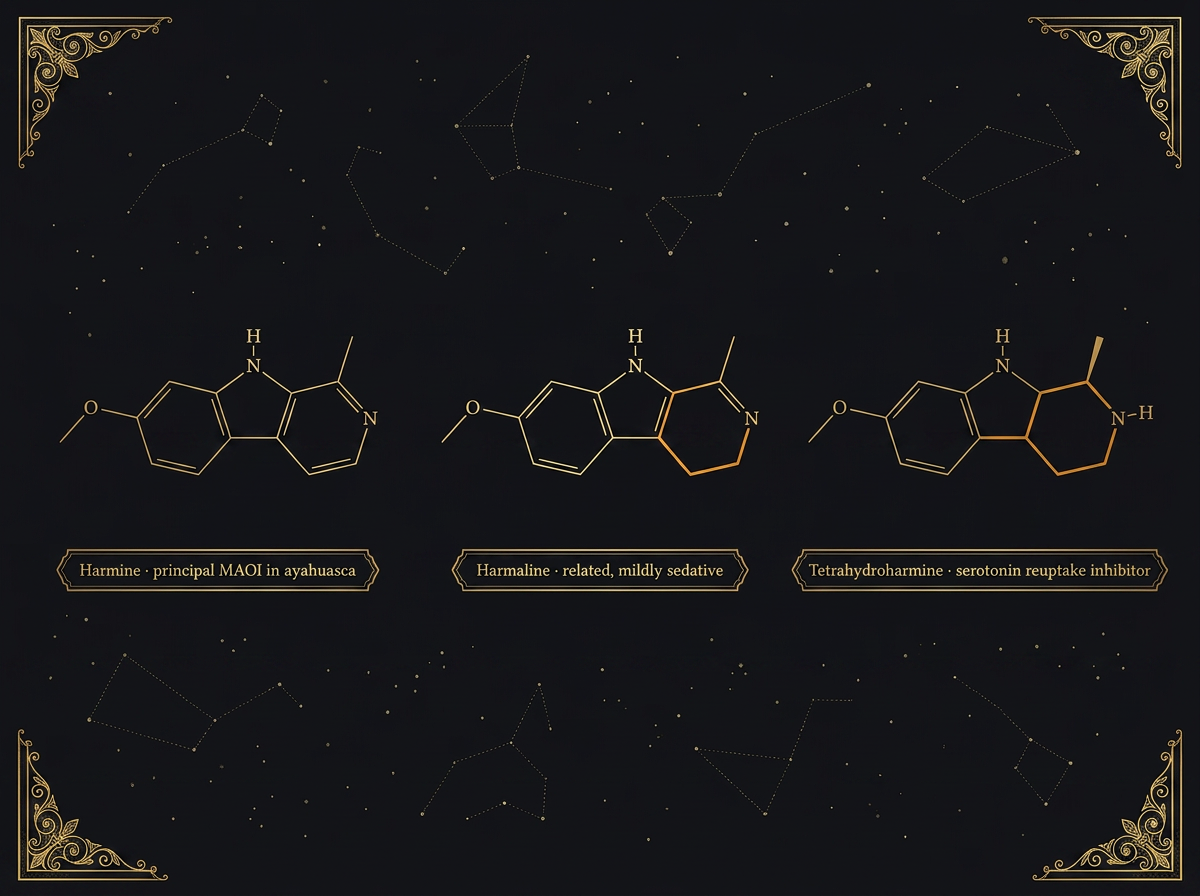
These three together account for nearly all of the pharmacologically relevant β-carboline content of a typical ayahuasca brew. Other β-carbolines exist in much smaller quantities and probably contribute marginally if at all.
In plain English: where harmine sits in the natural world
β-carbolines are not exotic compounds. They are produced in trace amounts by the human body itself, by many plants we eat and drink (coffee, tobacco, and several common foods all contain trace β-carbolines), and by the chemical reactions that occur when proteins are cooked at high temperatures. The amounts present in ayahuasca are large by these baseline standards — a typical brew contains perhaps 200–400 mg of harmine, against the milligram-per-day quantities humans encounter from ordinary diet — but the compounds themselves are not foreign to the system. The body has machinery for handling them. Ayahuasca presents that machinery with an order of magnitude more material than it usually encounters.
The β-carbolines occur in many natural sources beyond *B. caapi* — the most familiar being the seeds of *Peganum harmala* (Syrian rue), an arid-region plant native to the Mediterranean, Middle East, and parts of central Asia. Syrian rue contains harmine and harmaline in concentrations even higher than *B. caapi*, and has its own ancient ceremonial and medicinal history in those regions. Whether Syrian rue has been used historically as an MAOI to make oral DMT-containing plants psychoactive — analogous to ayahuasca's vine — is a contested ethnobotanical question. The pharmacological capacity is unambiguously there; whether it was deliberately exploited in any specific historical tradition is harder to establish.
## 3\. The enzyme they act on
To understand what harmine and its relatives do in the body, we need to spend a moment on the enzyme they switch off — because the pharmacology only makes sense once that enzyme has been properly introduced.
**Monoamine oxidase (MAO)** is a family of enzymes whose role in the body is to break down a particular class of small molecules called monoamines. The category includes some compounds the body needs to dispose of routinely (dietary amines from food), and several compounds the body uses as neurotransmitters or hormones (serotonin, dopamine, noradrenaline, adrenaline, melatonin) once they have done their work. MAO exists in two forms: **MAO-A** and **MAO-B**, each with overlapping but distinct substrate preferences, and each present in different proportions across different tissues.
MAO-A preferentially breaks down serotonin, noradrenaline, and (importantly for ayahuasca) tryptamines including DMT. MAO-B preferentially handles dopamine, phenethylamine, and some other monoamines. Both enzymes exist throughout the body but the gut and liver are particularly rich in them — which is part of why oral DMT-containing plants are pharmacologically inert without an inhibitor. The MAO in the gut wall and the liver's first-pass metabolism intercepts any tryptamine before it reaches the systemic circulation.
In plain English: why the body has MAO at all
Many of the foods humans eat contain trace tryptamines and other monoamines — fermented cheese, cured meats, fermented soybean products, red wine, and others all carry varying amounts. Without enzymes to break these down at the gut wall, eating any of these foods would produce mild but uncomfortable effects on heart rate, blood pressure, and mood. MAO is the body's filter against this background load. It is, in the ordinary state of affairs, doing useful housekeeping every time you eat. The protection it provides is also the obstacle that ayahuasca has to circumvent in order to make oral DMT work.
**Inhibiting MAO** — temporarily switching the enzyme off — therefore has two principal effects. First, it allows substrate compounds (including DMT) to survive what would otherwise be rapid destruction. Second, it raises the body's baseline levels of the neurotransmitters that MAO normally clears. Both effects matter; the second is the source of most of the clinically significant interactions and risks of MAO inhibition.
This is not a niche pharmacology. MAO inhibitors were among the first effective antidepressant medications, introduced in the late 1950s before SSRIs existed; some are still in clinical use today (phenelzine, tranylcypromine, moclobemide, selegiline) for specific psychiatric and neurological indications. The MAO inhibitors of ayahuasca and the MAO inhibitors of contemporary psychiatry are pharmacologically siblings, even if their cultural contexts could hardly be more different.
## 4\. Two kinds of MAO inhibition
A distinction worth understanding clearly, because it bears on safety questions later in the essay: not all MAO inhibitors are the same kind of MAO inhibitor.
**Irreversible MAOIs** — including the older antidepressants phenelzine and tranylcypromine — bind to MAO in a way that permanently disables the enzyme molecule they have bound. The body recovers its MAO function only by synthesising fresh enzyme over the following weeks. Effects therefore last long after the drug itself has cleared, and pharmacological interactions persist for two to four weeks after the last dose. Patients on irreversible MAOIs require strict dietary restrictions (avoiding aged cheeses, cured meats, fermented products, and other tyramine-containing foods) and equally strict drug-combination caution. These were once first-line antidepressants and are now reserved for treatment-resistant cases.
**Reversible MAOIs** — including harmine and the other β-carbolines in ayahuasca — bind to MAO in a way that can be displaced. The enzyme molecule recovers normal function once the inhibitor has cleared. Effects therefore correspond fairly closely to the drug's pharmacokinetic profile: hours rather than weeks. The dietary restrictions associated with irreversible MAOIs apply only loosely to ayahuasca; serious tyramine-induced hypertensive crises are uncommon with reversible inhibitors, although some caution about high-tyramine foods in the 24 hours before and after a ceremony remains sensible.
This distinction matters for ayahuasca specifically because the safety profile of the brew is meaningfully better than the safety profile of older irreversible MAOIs would suggest. Indigenous ceremonial practice does not require the weeks-long dietary regimen that 1960s antidepressant medicine did. In that respect, the brew is pharmacologically more forgiving than the first generation of pharmaceutical MAOIs.
What it does not change, however, is the risk of combining ayahuasca with other serotonergic drugs — which §6 will return to.
## 5\. The DMT–harmine interaction
This is the headline pharmacology, and the reason ayahuasca exists as a brew at all.
Oral N,N-DMT, taken on its own, reaches the gut wall, encounters intestinal MAO-A, and is broken down before it can be absorbed. Almost none reaches the bloodstream. The body's protection against dietary amines is, in this case, doing exactly its job. Oral DMT is pharmacologically inactive.
Combine the DMT with a sufficient quantity of harmine (and to a lesser extent harmaline and tetrahydroharmine), however, and the situation changes. The β-carbolines reach the gut wall first and inhibit the resident MAO-A. The DMT, taken alongside or shortly after, then survives intestinal transit. It is absorbed across the gut wall, enters the portal circulation, passes through the liver (where the same β-carbolines also inhibit MAO-A), reaches systemic circulation, crosses the blood-brain barrier, and reaches 5-HT2A receptors in the cortex. The active experience follows.
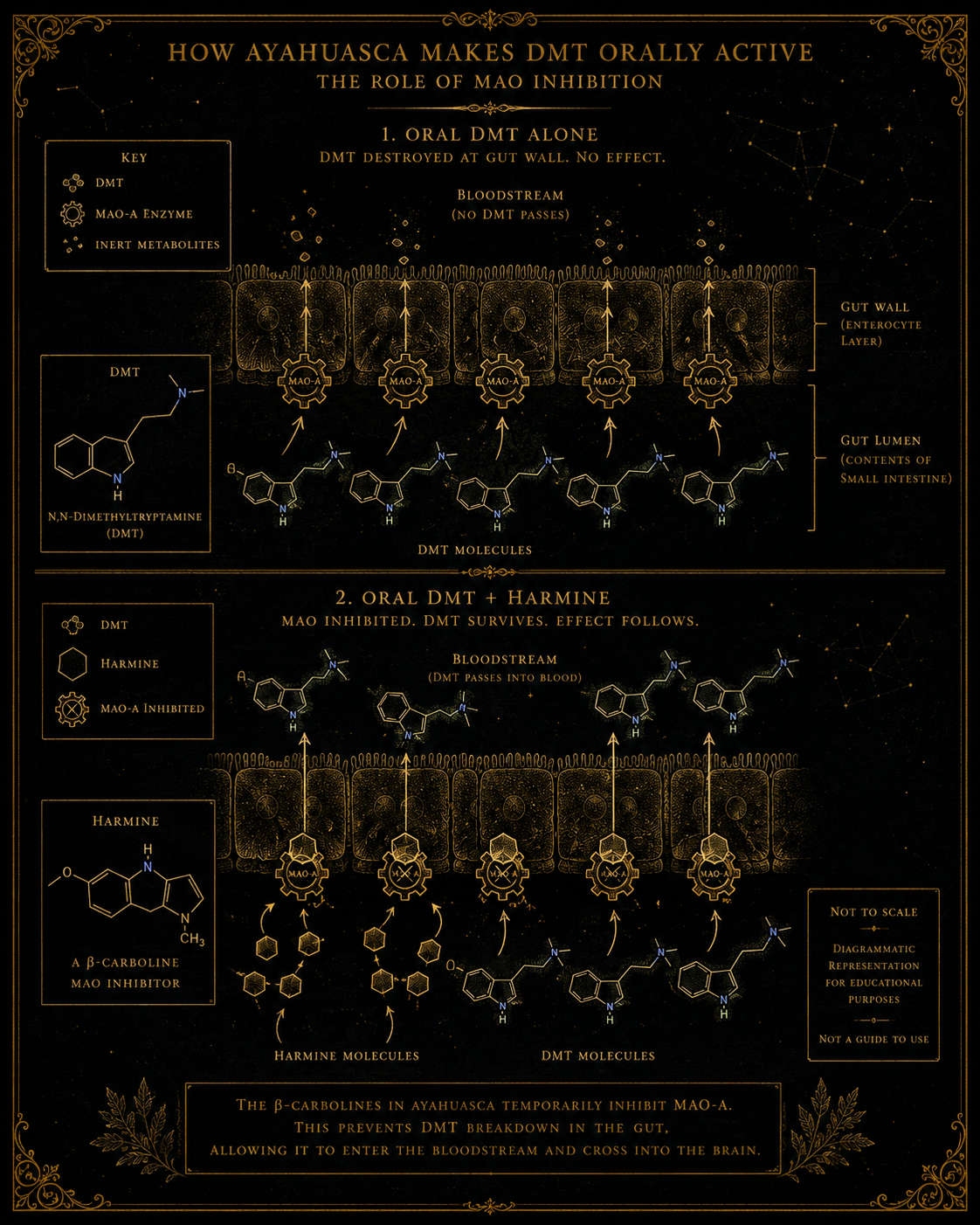
The duration is meaningfully extended by the same mechanism. Smoked DMT — which bypasses the gut entirely — reaches the brain in seconds and is cleared by the body's enzymes within minutes; the active experience lasts ten to twenty minutes. Oral DMT plus harmine takes thirty to sixty minutes to come on (because the DMT has to be absorbed first) and lasts four to six hours (because the MAO inhibition slows clearance throughout the experience). The pharmacology accounts cleanly for both differences.
There is a further subtlety worth registering. The β-carbolines are not pharmacologically inert beyond their MAO inhibition. They cross the blood-brain barrier themselves and have direct effects on serotonergic and other systems — effects that contribute, probably more than is sometimes acknowledged in popular discussion, to the overall ayahuasca experience. Experienced participants can sometimes distinguish vine-heavy brews from leaf-heavy ones by the quality of the experience alone. Whether this reflects different β-carboline:DMT ratios, the presence of admixture plants, or both is empirically debated.
## 6\. The safety question
The safety profile of MAO inhibition is the most important practical material in this essay, and it deserves to be spelled out carefully rather than waved at.
The risk that *does* matter — and that has caused multiple documented deaths in connection with ayahuasca and other MAOI use — is the combination of MAO inhibition with other drugs that elevate serotonin. The class of concern includes:
- **SSRIs** (selective serotonin reuptake inhibitors) — fluoxetine, sertraline, citalopram, escitalopram, paroxetine, others
- **SNRIs** (serotonin-noradrenaline reuptake inhibitors) — venlafaxine, duloxetine, others
- **Other MAOIs** — including over-the-counter herbal products containing MAOI activity (St John's Wort is the most prominent example)
- **Tramadol**, **pethidine**, and several other opioids with serotonergic activity
- **MDMA** and related amphetamines
- **5-HT1A and 5-HT2A agonists** more broadly — including, importantly, other psychedelics
Combination of MAOI with any of these can produce **serotonin syndrome** — a clinical emergency characterised by neuromuscular hyperactivity (tremor, hyperreflexia, clonus), autonomic instability (high temperature, blood pressure swings, sweating), and altered mental status. In severe cases it is fatal. Mild and moderate cases require prompt medical attention.
The risk is not merely theoretical. Case reports and safety reviews in the medical literature have identified serious adverse events in contexts where ayahuasca or MAOI-containing preparations were combined with serotonergic drugs. The precise causal role of any individual medication in adverse outcomes is often difficult to establish — ceremonies involve multiple variables — but the interaction risk is well enough characterised pharmacologically that reputable practitioners treat recent serotonergic medication use as a contraindication. Participants who do not disclose current medications, or who assume the combination is manageable, are taking a meaningful risk; this is not a theoretical pharmacology problem but a regularly recurring clinical concern.
Reputable practitioners require participants to discontinue serotonergic medications for an adequate washout period (typically four to six weeks for SSRIs, longer for some other classes) before a ceremony, and to remain off them for some days after. Commercial operators screen unevenly. Self-administered ayahuasca outside ceremonial settings is the highest-risk configuration, because the user is on their own to ensure that the medication-interaction problem has been adequately addressed.
The corollary worth stating clearly: anyone considering an encounter with ayahuasca (or with isolated harmine or any MAOI) who is currently taking, or who has recently taken, any of the medications above should regard this as a question that needs to be sorted out before — not during — any encounter. A primer is not the place to walk through specific medication-discontinuation protocols, which are individual to the person, the drug, the dose, and the indication.
A separate category of consideration: people with cardiovascular vulnerabilities. β-carbolines are mildly sympathomimetic — they can raise heart rate and blood pressure modestly — and the ayahuasca experience itself adds further cardiovascular load through the physical intensity of the vomiting, the sweating, and the prolonged altered state. Reputable retreat operators screen for cardiac risk factors; cardiac events at ceremonies, though rare, have occurred.
## 7\. Harmine as an emerging research compound
This is the strand that has, in the last few years, become the most interesting development in the area — and the one that may eventually justify a separate Pillar essay rather than just a primer section.
Harmine, on its own, has properties that until recently received little attention beyond its role in ayahuasca. Several converging strands of preclinical research have changed that, and they share a common mechanistic thread worth introducing before walking through the specific applications.
### DYRK1A: the target that made harmine interesting again
Much of harmine's emerging research profile traces back to one molecular target. **DYRK1A** is a kinase enzyme that, in its normal active state, holds various tissue types in their differentiated, non-proliferating condition. Inhibit DYRK1A and certain mature cell types regain a limited capacity to grow, divide, and form new connections — neurons can extend new synaptic branches, pancreatic β-cells can proliferate, and other regenerative effects become accessible. Harmine is among the best-known natural DYRK1A inhibitors, which is the unifying explanation behind several otherwise unrelated-looking research strands.
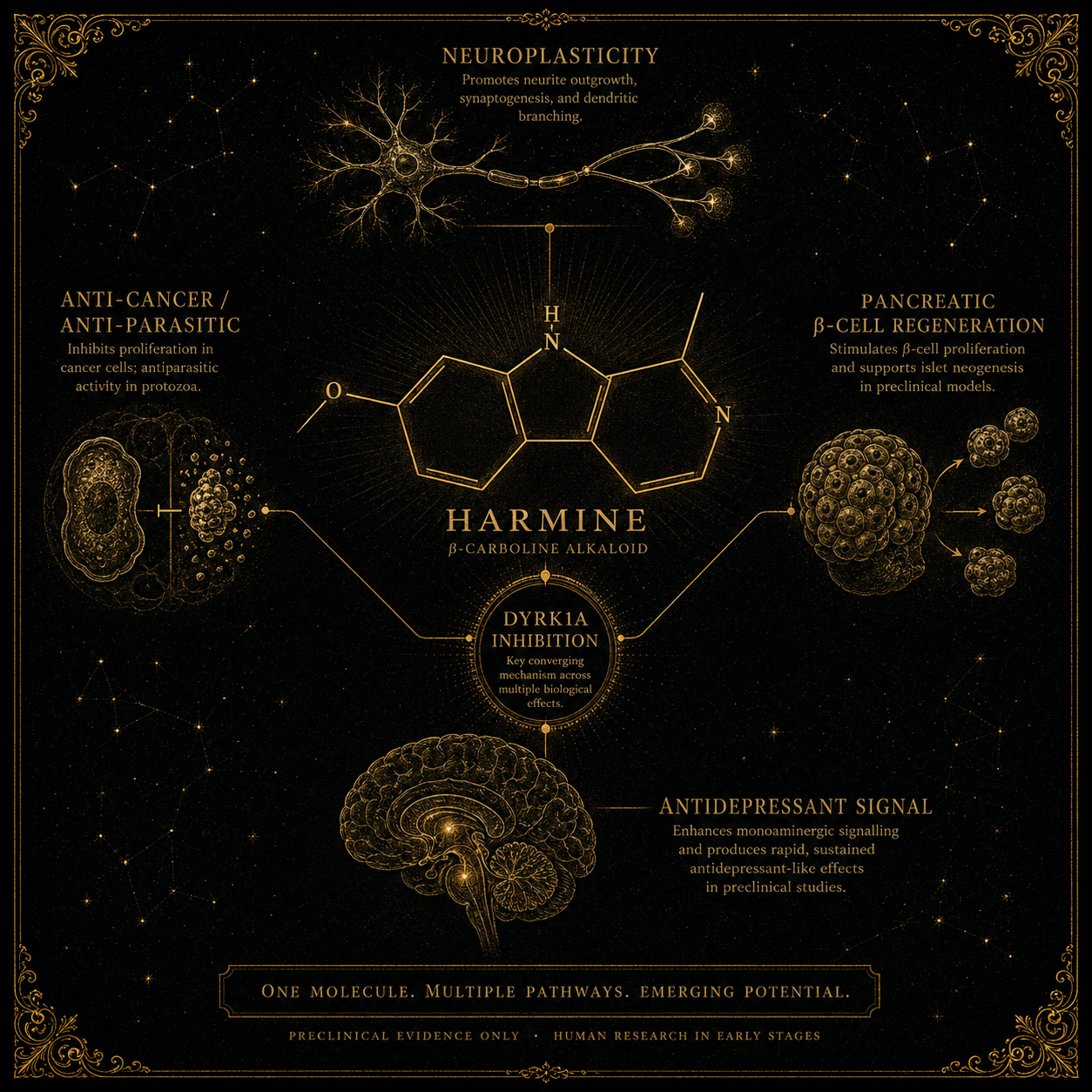
### The converging clinical strands
A series of cell-culture and animal studies, beginning around 2019 and accelerating through the early 2020s, has demonstrated that harmine appears to promote the survival, growth, and development of human neurons. The findings have driven a steady increase in attention to harmine within the broader neuroplasticity research community. A separate strand of work, partly from the Mount Sinai laboratory of Andrew Stewart, has shown that harmine drives the proliferation of human pancreatic β-cells — the insulin-producing cells whose loss underlies type 1 diabetes and contributes to type 2\. Harmine-based compounds for diabetes have entered early-stage human clinical investigation.
A third strand: multiple animal models, and a small number of early human pilot studies, suggest that harmine on its own may have antidepressant properties independent of any accompanying DMT. The mechanism is still being worked out — DYRK1A inhibition, MAO inhibition, neurogenesis-promoting effects, and direct serotonergic activity have all been proposed as contributors — but the convergent signal is genuine.
Beyond these three central strands, preclinical work has implicated harmine in possible therapeutic roles in Alzheimer's disease, certain cancers, parasitic infections, and several other contexts. Most of this remains at the bench rather than the bedside. None of it is established as clinical practice. But the aggregate picture is striking: a compound that has been known to humans for thousands of years as part of a ceremonial brew, dismissed pharmacologically for most of that time as "the MAOI in ayahuasca," is now being investigated as a potentially independent therapeutic agent in at least four distinct clinical contexts.
### Why analogues may matter more than harmine itself
There is a subtlety here that often gets missed in the popular framing of "harmine the next antidepressant." The most likely future of this research strand is not harmine becoming a medicine — it is harmine teaching researchers how to design better molecules.
Harmine carries with it the MAO-inhibitor liability that makes it clinically awkward: the drug-interaction profile, the dietary considerations, the difficulty of combining it with most existing psychiatric medications. For a research compound, that liability is manageable. For a marketed pharmaceutical, it is a significant obstacle. Several pharmaceutical companies and research groups are therefore developing harmine **analogues** — modified versions of the molecule designed to retain the desirable properties (DYRK1A inhibition, neuroplasticity-promoting effects, β-cell proliferation) while reducing or eliminating the MAO activity.
If any of these analogues reaches medicine in the next decade, the contribution of harmine to that medicine will have been conceptual rather than literal: the natural compound will have served as a chemical template, identifying which receptor-and-enzyme interactions matter, and the molecule that actually reaches patients will be a synthetic refinement designed around those insights.
It is worth holding the irony lightly. The β-carbolines have been part of human pharmacology for at least 2,500 years through ayahuasca. Their independent therapeutic potential is being discovered now. The traditions that incorporated them into ceremonial practice did not need biochemistry to find out that they did something useful. The biochemistry is catching up.
## 8\. Is it legal?
Harmine and the other β-carbolines occupy an unusual legal position compared with the substances covered in the previous primers.
**United Kingdom.** Harmine itself is **not** controlled under the *Misuse of Drugs Act 1971* in the same way DMT is. Neither is *Banisteriopsis caapi*, nor *Peganum harmala*. What is controlled is ayahuasca *as a preparation* — the brew is treated as DMT for the purposes of the Act, regardless of the legality of its constituent plants individually, per the *R v Aziz* Court of Appeal decision. This does not, however, mean that harmine sits in a regulatory void: questions of supply, importation, intended use, product presentation, and the broader Psychoactive Substances Act 2016 may all matter in practice, and the absence of harmine from one schedule does not imply blanket permissiveness across the wider regulatory landscape.
**United States.** Federally, the same pattern: harmine is not on the Controlled Substances Act schedules. Neither is the vine or the seeds. Ayahuasca-as-brew falls under DMT scheduling.
**Other jurisdictions.** Most countries that prohibit ayahuasca do so on the DMT side rather than the β-carboline side. Some include harmine and harmaline on national lists; most do not.
The practical implication: the β-carbolines are widely accessible for research purposes, which is partly why the harmine-as-independent-therapeutic strand has been able to advance even in jurisdictions where ayahuasca remains controlled. The molecule that does the enzyme-inhibiting work in the brew can be studied in laboratories that could not legally hold the brew itself.
## 9\. What people often get wrong
A handful of recurring confusions are worth addressing directly:
**"The MAOI in ayahuasca just lets the DMT through. It does not do anything else."** Partly true. The MAO inhibition is the necessary pharmacological enabling step; without it, the DMT is destroyed and the experience cannot happen. But the β-carbolines themselves cross the blood-brain barrier and have their own central effects — direct serotonergic action, mild cardiovascular effects, and probably contributions to the experiential quality of the brew that are not reducible to the DMT alone. Treating the vine as "just the carrier" understates what it does.
**"Reversible MAOIs are safe with SSRIs because they are reversible."** They are safer than irreversible MAOIs in some respects (dietary tyramine restrictions are looser; recovery is faster). They are *not* safe with SSRIs. The serotonin-syndrome risk from MAOI–SSRI combination is the issue, and it applies to reversible MAOIs as much as to irreversible ones, although the recovery window is shorter.
**"Syrian rue and ayahuasca are pharmacologically equivalent."** They share the β-carboline content, more or less, in different ratios. The DMT-containing plant they are combined with then determines the rest of the experience. Syrian rue *plus* a DMT-source plant produces a brew often called "anahuasca" or "pharmahuasca" — pharmacologically close to ayahuasca but lacking the cultural-ceremonial context. Whether the two are *experientially* equivalent depends entirely on what is being asked of the comparison.
**"Harmine is a psychedelic."** Not in the conventional sense. At doses present in ayahuasca, it is mildly psychoactive — some sedation, mild visual phenomena at the upper end — but it does not produce the classical psychedelic state. The classical psychedelic component of the ayahuasca experience is the DMT. The β-carbolines are doing other things.
**"The traditional indigenous brewers were just lucky."** Most ethnobotanists who have studied the question carefully reject this framing. The combination of MAO-inhibitor vine plus DMT-containing leaf, in the right ratios, brewed for the right duration, is a non-obvious pharmacological discovery. Whether it was reached through systematic trial and error, through plant-spirit communication (the traditional explanation), or through some combination of both, the result is more impressive than a lucky accident would account for. Treating the pharmacology as obvious or self-evident in retrospect overlooks how far ahead of contemporaneous Western pharmacology these traditions were operating.
## 10\. What we still don't know
The unresolved questions in β-carboline research, briefly:
What the optimal harmine:DMT ratio is for producing the characteristic ayahuasca experience — and whether the traditional brews approximate that ratio by accident or by sophisticated empirical refinement.
How much of harmine's emerging therapeutic effects (in depression, in diabetes, in neuroplasticity) are mediated through DYRK1A inhibition versus its other activities, and whether selective DYRK1A inhibitors (without MAO activity) would retain the benefits.
Whether the cognitive and emotional sequelae often reported by ayahuasca participants in the weeks following a ceremony are attributable to the DMT, to the β-carbolines, to the ceremony itself, or to interactions between all three.
What role tetrahydroharmine (THH) plays in the experience — it is a serotonin-reuptake inhibitor as well as a weaker MAOI, and its contributions to the brew's effects are less well-characterised than harmine's.
Whether long-term repeated use of MAO-inhibitor-containing brews has any cumulative effects on neurotransmitter systems that have so far escaped clinical attention.
How the emerging clinical pipeline for harmine-based therapeutics will navigate the obvious tension between developing a compound's medical applications and the cultural framework that has held it for thousands of years as part of a sacred preparation.
These are the live questions. The answers to several of them are likely to land within the next decade.
---
The short version
Harmine does three different jobs in this story. It makes oral DMT active by inhibiting the body's monoamine oxidase enzymes — the foundational pharmacology behind ayahuasca. It contributes its own effects to the ayahuasca experience, not merely as a passive enabler but as a centrally-active compound in its own right. And, increasingly, it is being studied as a potential therapeutic agent independent of any accompanying DMT — particularly through its inhibition of DYRK1A, with implications for neuroplasticity, β-cell regeneration, and mood disorder research that the field is only beginning to map.
The molecule has been part of human pharmacology for thousands of years through ayahuasca. The biochemistry is catching up.
---
#### New to this topic?
- [What is Ayahuasca?](https://www.ardmt.com/what-is-ayahuasca/)
- [What is DMT?](https://www.ardmt.com/what-is-dmt/)
- [What is 5-MeO-DMT?](https://www.ardmt.com/what-is-5-meo-dmt/)
#### Going deeper?
- [Endogenous DMT in Humans: A Critical Review of the State of the Evidence](https://www.ardmt.com/endogenous-dmt-critical-review/)
- [DMT vs Ketamine: Equal on Depression, DMT Wins on Anxiety](https://www.ardmt.com/dmt-vs-ketamine-depression-anxiety/)
- [Field Notes — daily research updates, including ongoing harmine and β-carboline clinical coverage](https://www.ardmt.com/tag/research/)
---
### Suggested Citation
Page, S. (2026) 'Harmine and the MAOIs: Why Ayahuasca Needs Two Plants', *ARDMT: Applied Research Through DMT*, 16 May 2026\. Available at: https://ardmt.com/harmine-and-maois/.
### Lempel–Ziv complexity is the weakest correlate: Exeter's dose-dependent DMT EEG study
URL: https://www.ardmt.com/lempel-ziv-complexity-is-the-weakest-correlate-exeters-dose-dependent-dmt-eeg-study/
Last updated: 2026-05-17T04:19:37.000Z
## The claim and the context
Lewis-Healey, Pallavicini, Cavanna and colleagues have now published, in the *Journal of Cognitive Neuroscience*, a dose-dependent EEG study of inhaled freebase DMT that carries a rather pointed conclusion: Lempel–Ziv complexity (LZc) — long treated as a reliable neural signature of psychedelic experience — turns out to be the *weakest* correlate of moment-to-moment subjective experience among the neural features they tested. Alpha oscillatory power and permutation entropy fared considerably better.
Regular readers will recall that an earlier Field Notes entry covered preliminary work from what appears to be this same research group, flagging concerns about LZc's moment-to-moment fidelity. The present publication represents the full peer-reviewed version: a repeated-measures, blinded, counterbalanced design with two doses (20 mg and 40 mg freebase DMT), nineteen participants, and a time-resolved phenomenological method — Temporal Experience Tracing — yoked to continuous EEG recording. It is a substantially more complete piece of work than its precursor, and merits fresh attention.
## Where this fits in the field
The notion that psychedelics increase neural complexity has become one of the tidiest narratives in the field. The story runs roughly thus: psychedelics dissolve the brain's habitual constraints, entropy rises, and this rise tracks — indeed *explains* — the richness of psychedelic phenomenology. LZc, borrowed from anaesthesia research where it distinguishes waking from unconscious states, was the metric that made this story quantitatively tractable. Schartner and colleagues' 2017 work, measuring LZc under psilocybin, LSD and ketamine, showed increases above normal waking baseline — a finding that launched a thousand conference slides and propelled the phrase "the entropic brain" into common circulation.
But there has always been a quiet gap between showing that LZc is *higher on average* during a psychedelic state and showing that its fluctuations *track the texture of experience as it unfolds*. The former is a between-condition comparison; the latter is a within-session, moment-to-moment question. The Exeter group's study addresses precisely this gap. By collecting continuous subjective ratings alongside continuous EEG, they could ask not merely whether DMT increases complexity overall, but whether the ebb and flow of complexity mirrors the ebb and flow of, say, visual hallucinations or emotional intensity.
The answer, at least for LZc, appears to be: not particularly. Alpha power and permutation entropy did a better job. This does not invalidate LZc as a state-level discriminator — it may still distinguish "on DMT" from "not on DMT" quite well — but it does complicate the claim that LZc captures something meaningful about the *moment-to-moment structure* of psychedelic consciousness.
## Why this line matters
The distinction is not merely methodological pedantry. If the field wishes to move from "psychedelics increase brain entropy" to "this particular change in brain dynamics supports this particular change in experience," then the neural measures chosen must be sensitive to temporal variation in phenomenology, not merely to the gross presence or absence of a drug. A metric that rises when DMT is on board and falls when it wears off tells us something about pharmacokinetics. A metric that co-varies with the waxing of visual hallucinations and the waning of emotional intensity tells us something about consciousness.
The dose-dependent element adds further texture. The 40-mg dose induced more extreme visual hallucinations and greater emotional intensity than the 20-mg dose — unsurprising, perhaps, but essential for establishing that the subjective measures are capturing real variance rather than ceiling effects. Whether the neural correlates scale correspondingly is a question the full text will illuminate more precisely.
There is also a methodological note worth flagging: the use of what the authors describe as "naturalistic conditions" rather than an intravenous infusion protocol. This contrasts with the Imperial College approach (Timmermann and colleagues) and carries its own trade-offs — less pharmacokinetic control, arguably greater ecological validity.
## Note on access
The full text is not yet openly available to us. When it is, ARDMT will return with a proper methods analysis — the dose-response curves, the specific time-series associations, and whatever the authors themselves flag as limitations deserve rather more than abstract-level treatment.
## Also worth a glance
**Morales-García, Calleja-Conde and colleagues** report on DMT's therapeutic properties in a preclinical Parkinson's model, now published in *Experimental Neurology* (PMID: [42128256](https://pubmed.ncbi.nlm.nih.gov/42128256/?ref=ardmt.com)). The Madrid group's sigma-1 receptor work has featured in these pages before; this appears to be a distinct publication, though the degree of methodological novelty over their earlier 6-OHDA findings will require inspection of the full text.
**A machine-learning study** (PMID: [42100741](https://pubmed.ncbi.nlm.nih.gov/42100741/?ref=ardmt.com)) applies image classification to herbarium specimens of *Banisteriopsis caapi*, attempting to recover indigenous folk taxonomy of ayahuasca vine varieties from leaf morphology alone. Tangential to pharmacology, but rather charming as an exercise in computational ethnobotany.
## Marginalia
One wonders whether the field's attachment to Lempel–Ziv complexity owes something to the satisfying crispness of the narrative it supports: more disorder, more consciousness, full stop. The present findings suggest consciousness may be less obliging than the metric. Alpha power — that old, somewhat unfashionable workhorse of EEG research — quietly outperforming the newer, more theoretically glamorous measure is the sort of result that ought to give pause.
### What is 5-MeO-DMT?
URL: https://www.ardmt.com/what-is-5-meo-dmt/
Last updated: 2026-05-16T17:37:27.000Z
*The close cousin: similar enough to be confused with N,N-DMT, different enough to be a different experience entirely*
In plain English
5-MeO-DMT is a close chemical relative of N,N-DMT — the molecule covered in the first essay in this series. The two differ by a single methoxy group, an alteration that on paper looks trivial but that produces a categorically different experience. If N,N-DMT is the molecule of vivid visual encounter, 5-MeO-DMT is the molecule of total dissolution. Many people who have considerable experience with the first remain wary of the second.
This is the third Foundations primer. The first looked at the molecule that defines this whole subject; the second looked at ayahuasca, the form most humans have historically met that molecule in. This one looks at 5-MeO-DMT, which has come to occupy an unusual place in the contemporary psychedelic landscape: a compound with deep antiquity in some forms, a controversial recent renaissance in another, the most advanced clinical pipeline of any DMT-family molecule in 2026, and an unusually high stakes-to-prior-knowledge ratio for anyone considering an encounter with it.
Walk through it section by section, or skim to the parts that catch your interest. The map is the same shape as the previous two; the territory it covers is recognisably related and recognisably distinct.
## 1\. What this article is
This is the third Foundations primer on ARDMT. The first two — [What is DMT?](https://www.ardmt.com/what-is-dmt/) and [What is Ayahuasca?](https://www.ardmt.com/what-is-ayahuasca/) — have together laid the groundwork: a molecule, a brew, and the cultural and pharmacological worlds each sits in. This essay continues that work by turning to the molecule's nearest important cousin.
The shorthand version of why 5-MeO-DMT warrants its own primer: it is the DMT-family compound most likely to be confused with N,N-DMT and the one most likely to surprise readers (or participants) who assume that confusion is harmless. Pharmacologically the two are recognisably related. Subjectively they are not. The clinical pipeline for 5-MeO-DMT is currently the most advanced of any DMT-family compound. The contemporary cultural scene around it is the most controversial. And the molecule has acquired, in the last fifteen years or so, a reputation that has outrun what the science actually supports.
A brief author note. I have spent the better part of two decades engaging with N,N-DMT in various forms — synthesised, smoked, grown — and the first two essays in this series drew on that direct experience where it served the writing. With 5-MeO-DMT, I have none. I have read the literature, followed the research, and listened to people who have considerable experience with the compound. The view that follows is therefore informed but external. The asymmetry is, I think, worth flagging openly: among people I respect with substantial N,N-DMT experience, 5-MeO has a reputation for being categorically different — more dissolving, more intense, less manageable — in ways that have produced some perfectly reasonable abstention. I count myself among those who have not yet found the right reason to cross that threshold. Readers will weigh the resulting essay accordingly.
This article walks through the molecule itself, where it comes from, what it appears to do, what science currently understands about its mechanism, its cultural and historical story, the contemporary controversies around its sources, the state of the clinical research, where it sits in law, and what is still being argued about. Like the previous two, it describes rather than instructs.
## 2\. The molecule
5-MeO-DMT is 5-methoxy-N,N-dimethyltryptamine. The name describes the molecule precisely: it is N,N-dimethyltryptamine (the molecule covered in detail in [What is DMT?](https://www.ardmt.com/what-is-dmt/)) with one additional chemical group — a methoxy group, a small unit of one oxygen and one carbon with three hydrogens attached — bonded at the 5-position of the indole ring. If you took N,N-DMT and added a single methoxy group at that location, you would have 5-MeO-DMT.
This is structurally a very small change. On paper it looks like a footnote. In the body it is anything but.
In plain English: where the methoxy group sits
Recall from the first essay that serotonin and N,N-DMT share an indole ring and an ethylamine tail, and differ in two places: serotonin has a hydroxyl group (–OH) at the 5-position of the indole ring, where N,N-DMT has nothing; and serotonin has a primary amine (–NH₂) where N,N-DMT has a tertiary amine (–N(CH₃)₂). 5-MeO-DMT sits between them in a particular way: it has the dimethylated nitrogen tail of N,N-DMT, but it has a group (–OCH₃) at the 5-position of the indole ring — close to where serotonin's hydroxyl group sits, but methylated. The molecule reads, structurally, as a halfway-house between the two: closer to N,N-DMT than to serotonin, but with the serotonin-like decoration of the 5-position now present, just slightly modified.
That structural detail matters because the 5-position decoration on the indole ring is one of the places where the body's receptors most sensitively distinguish between related compounds. Adding a methoxy group there changes which receptors the molecule binds to, in what proportions, and with what consequences downstream. The single substitution shifts the molecule's primary receptor preferences in ways the body experiences as a fundamentally different drug. Pharmacologists describe this kind of effect as a *substituent-position-driven receptor switch*, and 5-MeO-DMT is one of the cleanest examples in psychedelic pharmacology.
Practical consequences of the substitution: 5-MeO-DMT is roughly four to five times more potent by weight than N,N-DMT (a typical psychoactive dose of vapourised 5-MeO is in the 5–15 mg range, against 30–60 mg for vapourised N,N-DMT). The molecule is more lipid-soluble. It crosses biological barriers slightly faster. And — most importantly — it acts on a different primary target.
## 3\. Where it comes from
5-MeO-DMT occurs naturally in a wider range of sources than N,N-DMT does, and the relative significance of those sources has shifted substantially over the last forty years.
**The Sonoran Desert toad.** *Incilius alvarius*, formerly classified as *Bufo alvarius*, secretes a milky venom from glands on its skin and limbs as a defensive response to threat. The venom contains a striking concentration of 5-MeO-DMT — sometimes 15% by weight when dried — along with a smaller amount of bufotenine (5-HO-DMT, structurally close to both 5-MeO and serotonin) and various other amphibian-skin compounds. The toad does not produce the venom for human use; it produces it to deter predators. People have, nonetheless, devised methods to collect, dry, and smoke the resulting material. This is the source most popularly associated with 5-MeO-DMT in contemporary culture, and the source most worth talking about candidly, which §7 will do.
**Plants.** Several South American plants contain 5-MeO-DMT, often alongside N,N-DMT and bufotenine. The most important are *Anadenanthera peregrina* and *Anadenanthera colubrina*, whose seeds have been used for at least four thousand years as ceremonial snuffs (variously called yopo, vilca, cohoba) by indigenous peoples across the Caribbean and South America. Several *Virola* species (notably *Virola theiodora*) produce a similar snuff used by groups in the upper Amazon. Some specimens of *Diplopterys cabrerana* — the chaliponga plant used in some ayahuasca brews — contain 5-MeO-DMT alongside N,N-DMT, which may partially account for the different experiences ayahuasca made with chaliponga produces compared with chacruna-based brews.

These plant sources have considerable historical depth. The earliest archaeological evidence for *Anadenanthera* snuff use comes from sites in northern Chile dated to around 2,000 BCE. The plant material was traded across long distances; ceremonial snuff equipment has been recovered from sites a thousand kilometres from where the trees grow. By any reasonable measure, humans have been encountering 5-MeO-DMT through these plant forms for thousands of years.
**Synthetic.** 5-MeO-DMT can also be produced synthetically, and most clinical and research material is. The synthesis is well-established (it was first achieved in 1936, twenty years before Stephen Szára's self-experiments with N,N-DMT) and produces pharmaceutical-grade material of known purity. All major clinical trials currently underway use synthetic 5-MeO-DMT; almost no clinical work uses toad-derived material, for reasons of consistency, dosing precision, and ethics that §7 will return to.
**Endogenous.** Trace amounts of 5-MeO-DMT have been detected in human biological fluids, similarly to N,N-DMT. The functional significance of this is unresolved and forms part of the broader endogenous-DMT question covered in detail in [Endogenous DMT in Humans: A Critical Review](https://www.ardmt.com/endogenous-dmt-critical-review/).
## 4\. What it does
Reports of the 5-MeO-DMT experience vary across individuals, doses, and settings — as they do for any compound — but the reports cohere around a recognisable composite that is meaningfully different from the N,N-DMT composite.
Onset is rapid. Smoked or vapourised 5-MeO-DMT produces effects within seconds; the peak arrives within one to two minutes; the experience is largely over within ten to twenty. Intravenous or intranasal routes produce slightly different time-courses but similar rapidity. The compound is short-acting in absolute terms — much shorter than ayahuasca, comparable to or slightly shorter than smoked N,N-DMT.
Subjectively, the experience is described very differently from N,N-DMT. The vivid visual phenomena, the geometric architectures, the sense of encounter with entities or intelligences — features that dominate N,N-DMT reports — are largely absent. What participants describe instead is something closer to total dissolution: a vanishing of the sense of being a self with a body and a position, often replaced by what some describe as a featureless luminosity, others as a void, others as a non-dual awareness in which the distinction between observer and observed disappears entirely. The language used to describe the experience is often closer to that of advanced meditative states or near-death experiences than to that of conventional psychedelic experience.
This subjective profile produces some characteristic features that are worth knowing about candidly. The experience is often extremely physically intense: shaking, crying, screaming, full-body muscular contractions, sometimes vomiting are widely reported. Many participants describe feeling that they have died, in a way that goes beyond the more familiar "ego death" reports from high-dose classical psychedelics. Some emerge from the experience profoundly altered in ways they describe as positive; some emerge confused, frightened, or destabilised in ways that require sustained integration to resolve.
The reputation that 5-MeO-DMT has acquired in the broader psychedelic community is worth registering plainly. Among people with considerable experience across the psychedelic spectrum — including extensive familiarity with N,N-DMT — 5-MeO is often described as a different kind of compound entirely, one that demands more preparation, more careful setting, and a greater willingness to encounter material the experienced participant did not expect to encounter. Hamilton Morris, the pharmacological journalist whose work has shaped much of the contemporary popular understanding of the compound, has repeatedly observed that 5-MeO-DMT is not "DMT plus a bit"; it is its own substance, and people who treat it casually because they have handled N,N-DMT casually are taking a different risk than they realise.
This is not a piece that recommends or warns against. But the disparity between popular perception (often: "5-MeO-DMT, like DMT but stronger") and the substance's actual experiential profile is significant enough to be one of the most important pieces of orientation in this article.
## 5\. How it works in the brain
The pharmacology of 5-MeO-DMT is recognisably related to N,N-DMT's and recognisably different.
Both compounds bind to the serotonin 5-HT2A receptor — the receptor primarily responsible for the classical psychedelic effects of LSD, psilocybin, mescaline, and N,N-DMT itself. Activating 5-HT2A in the cortex disrupts the activity of large-scale brain networks (notably the default mode network, covered in a [forthcoming primer](https://www.ardmt.com/what-is-default-mode-network/)) and is the leading neurobiological candidate for what produces the psychedelic experience generally.
5-MeO-DMT, however, has a different relative affinity profile. Its principal target is the 5-HT1A receptor — a *different* serotonin receptor with different distribution in the brain and different functional consequences when activated. 5-MeO-DMT also activates 5-HT2A, but considerably less selectively than N,N-DMT does. The relative weighting of 5-HT1A versus 5-HT2A activation is currently the leading explanation for why the two compounds produce such different experiences despite their structural similarity.
In plain English: 5-HT1A versus 5-HT2A
The serotonin system has fourteen different receptor types, each doing something slightly different in the cell when activated. 5-HT2A activation, broadly, drives the classical psychedelic state: visual phenomena, cognitive disinhibition, geometric perception, sense-of-self disruption. 5-HT1A activation, broadly, has the opposite character: calming, anti-anxiety, sometimes producing what neuroscientists call "noetic" effects — a sense of clarity, insight, or directly apprehended understanding without the visual or cognitive disinhibition that 5-HT2A produces. A compound that activates both, with 5-HT1A predominating, produces an experience that is intense and altering but visually quieter, more unitary, more pure-awareness than vivid-content. This is, broadly, what 5-MeO-DMT does, and it is why the experience feels categorically different from N,N-DMT despite the molecular relatedness.
Beyond the primary serotonin-receptor activity, 5-MeO-DMT also acts at the sigma-1 receptor — the same intracellular target N,N-DMT engages — and at a small range of additional targets whose contributions to the overall experience remain incompletely characterised. The receptor model is currently the best available; like with N,N-DMT, the underlying picture is not closed, and active research continues into how psychedelics act at intracellular receptors rather than only on the surface of cells.
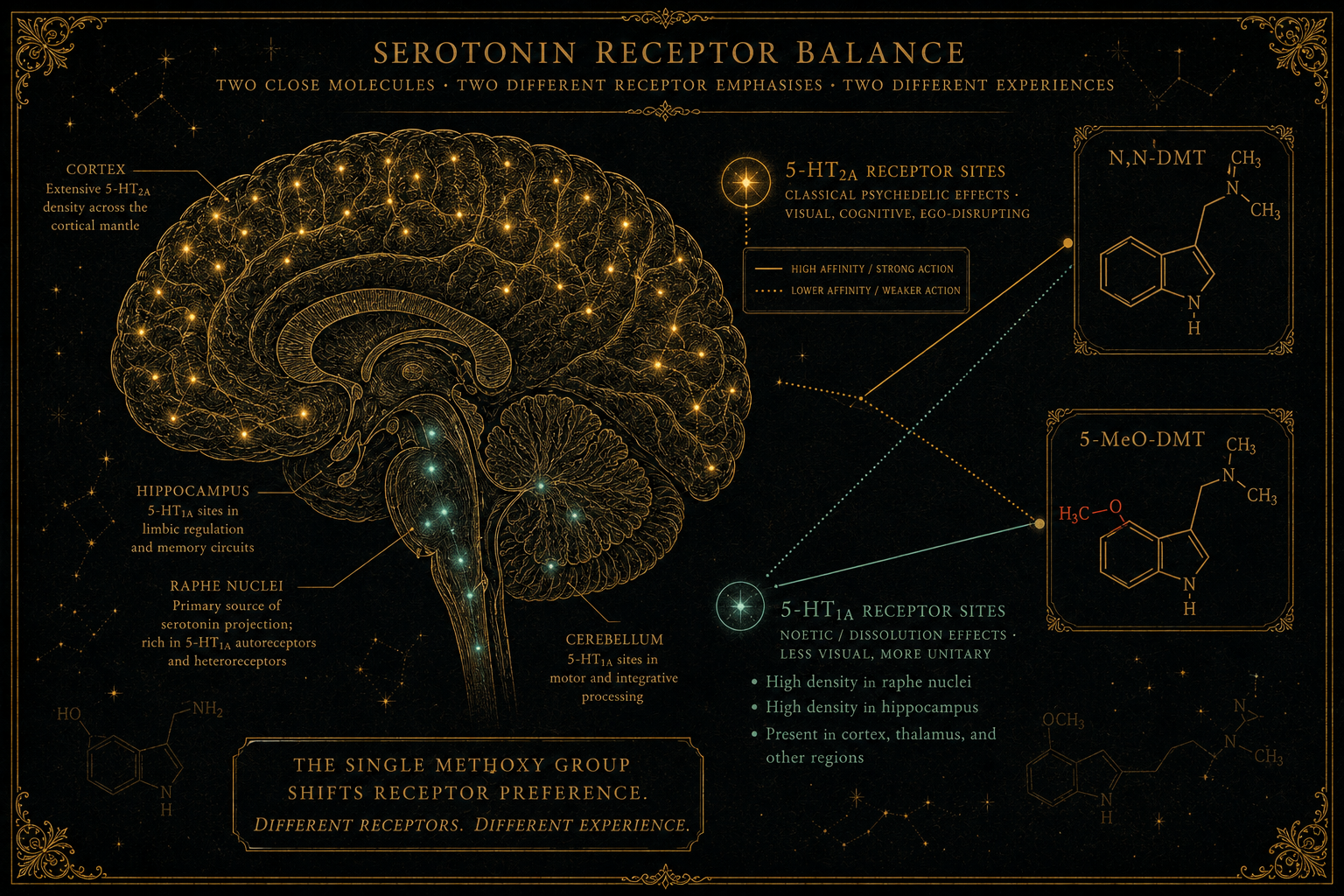
A note on metabolism. 5-MeO-DMT is broken down in the body by monoamine oxidase A (MAO-A), the same enzyme that destroys N,N-DMT. This means oral 5-MeO-DMT is largely inactive unless combined with an MAO inhibitor — the same arrangement that makes ayahuasca pharmacologically functional. Some traditional snuff preparations may have functioned via direct nasal absorption that bypassed first-pass metabolism; some contemporary preparations combine 5-MeO-DMT with MAOIs for an ayahuasca-analogue oral experience. Most current use is by routes (vapourisation, intranasal pharmaceutical, intravenous) that bypass the gut and avoid the need for MAO inhibition.
## 6\. The cultural and historical story
5-MeO-DMT has two distinct histories that are worth keeping separate, because conflating them produces some of the most common confusions in the popular discourse around the compound.
**The plant-snuff history is ancient.** *Anadenanthera* snuff use has been continuous in parts of South America for at least four thousand years, and the molecule has been part of the human ceremonial pharmacopoeia, in plant form, throughout that time. Specific indigenous groups — the Yanomami in Venezuela, the Piaroa, various Tukanoan peoples — have developed sophisticated traditions around the use of these snuffs, with ceremonial structures, dietary preparations, and cosmological frameworks comparable in depth to those that grew up around ayahuasca. The 5-MeO-DMT in these snuffs occurs alongside N,N-DMT, bufotenine, and other alkaloids, producing a complex polypharmacology rather than a pure 5-MeO experience. The traditions are real, old, and continuous.
**The toad-venom history is recent.** The use of *Incilius alvarius* toad venom as a smoked or vapourised psychoactive is, as best the historical record can establish, almost entirely a phenomenon of the last forty years. The earliest documented self-administration dates to the late 1960s; the practice did not begin to spread until the 1970s; the "Albert Most" pamphlet *Bufo Alvarius: The Psychedelic Toad of the Sonoran Desert* was published in 1984 and is generally credited with popularising the practice in counterculture circles; commercial harvesting and ceremonial use grew steadily from the 1990s and exploded after about 2010.
Several indigenous Sonoran groups have historical familiarity with the toad — the Seri (Comcaac) people of the Mexican coast have a documented relationship with the animal — but the smoked venom as a psychedelic ceremonial substance is not part of their tradition. Claims of "ancient Sonoran toad-medicine tradition" that have circulated in retreat-circuit marketing are, by the historical evidence, substantially inflated. There is no archaeological record of toad-venom psychoactive use comparable to the *Anadenanthera*\-snuff record.
This distinction matters more than it may sound. The popular framing of 5-MeO-DMT as an "ancient sacred medicine" lifts the antiquity from the plant snuffs and attaches it to a practice that is, in fact, a recent invention — largely Western or Western-adjacent in origin and dissemination. The plant traditions are deep; the toad scene is new. Both can be defensible practices; conflating them produces dishonest marketing.
## 7\. The modern story: from the toad to the clinic
The current state of 5-MeO-DMT in 2026 reflects two parallel developments that exist in considerable tension with each other: an explosion of toad-medicine retreats and ceremonial practice, and a major clinical-development pipeline using synthetic material. Both are growing. Each is, in different ways, the subject of significant controversy. They are worth thinking about together.
### The toad-medicine scene
By the early 2000s, ceremonial use of vapourised toad venom had become a recognisable category of psychedelic practice. By the 2010s, retreat centres were operating openly in Mexico, the United States, and across the international circuit catering to clients flying in for what was often presented as a transformative or sacred experience. By 2026, "doing the toad" is a known category among the same demographics that consider ayahuasca retreats — sometimes attended by the same individuals — and the global infrastructure is substantial.
Several issues with this scene are worth registering candidly, because the popular framing has generally underemphasised them.
**The ecological problem.** *Incilius alvarius* is a species with a limited range, primarily across parts of the Sonoran Desert in northern Mexico and the southwestern United States. The toads breed slowly, depend on specific seasonal conditions, and produce limited quantities of venom even when handled humanely. The growth of demand has produced a documented decline in wild populations across parts of their range. Several conservation organisations and herpetologists have called for harvesting moratoria. The Mexican government in 2020 listed the species under protective regulations. Whether the practice as currently conducted is ecologically sustainable is contested, but the burden of proof falls on those who claim it is.
**The animal-welfare problem.** Even when "milked" by practitioners who claim to handle the toads humanely, the process involves stressing the animal to provoke venom release. Critics argue that no method of repeated harvesting from wild amphibians can be honestly described as harmless to the animal. Some practitioners breed captive populations to address this; the practice remains controversial within the herpetological community.
**The authenticity problem.** As §6 discussed, the framing of toad-medicine as ancient indigenous practice is historically inaccurate. The practice is recent and largely Western in origin and continuation, regardless of what the marketing implies. Participants are entitled to make informed choices; informed choices require accurate framing.
**The safety problem.** Toad-venom material has variable composition — the alkaloid profile shifts seasonally, by individual toad, by drying method. Dosing is harder than with pharmaceutical-grade synthetic. Several deaths have been documented at toad ceremonies; the risk profile is not negligible.
### The clinical-development pipeline
In parallel with the toad-medicine scene, a substantial body of clinical research has emerged using synthetic 5-MeO-DMT. The leading programmes are Beckley Psytech's **BPL-003** — an intranasal benzoate salt formulation of 5-MeO-DMT for treatment-resistant depression — and **GH Research's GH001**, a similar intranasal preparation. Phase 2 results from BPL-003 in 2024 and 2025 showed rapid and durable antidepressant effects in treatment-resistant patients, including (notably) in patients who continued their existing SSRI medication — a result that, if it survives larger trials, would address one of the more difficult clinical translation problems for psychedelic-assisted therapy. Other programmes are at earlier stages.
The clinical pipeline uses synthetic material exclusively, for several reasons that are worth listing because they bear on the synthetic-versus-natural debate that follows. Synthetic 5-MeO-DMT can be manufactured to consistent purity, allowing reliable dosing. It contains only the target compound, without bufotenine or other amphibian-skin alkaloids, allowing the clinical effect to be attributed to 5-MeO specifically. It poses no ecological or animal-welfare issues. And it can be produced in pharmaceutical quantities sufficient for regulated medicine.
The trial designs are familiar from psychedelic-therapy research generally: a single supervised dosing session, preceded by preparatory sessions and followed by integration support. The duration of the active experience is short enough — twenty minutes or so — that the entire protocol can fit within a clinical day, which is operationally significant for the medicalisation question.
### The synthetic-versus-natural question
The relationship between these two strands — the toad-medicine scene and the clinical-development pipeline — has become one of the more interesting fault lines in contemporary psychedelic culture, and it is worth thinking through carefully.
A position commonly held within toad-medicine circles is that toad-derived 5-MeO produces a qualitatively different — often described as more "spiritual" or "complete" — experience than synthetic 5-MeO. The argument tends to combine a pharmacological claim (the bufotenine and other co-occurring compounds modulate the experience) with a metaphysical one (the animal-origin material carries a quality that the synthesised material lacks).
The pharmacological claim is empirically testable and partly defensible. Bufotenine itself is psychoactive at sufficient doses and probably contributes something to the toad-venom experience, though the amounts present in dried venom are usually small relative to the 5-MeO. Other minor amphibian alkaloids may also contribute. Whether the net effect of these admixtures is meaningfully different in clinical outcomes is unresolved; there is no head-to-head trial of synthetic versus toad-derived material.
The metaphysical claim is not empirically testable in the same way. Participants are entitled to find the experience of an animal-origin substance more meaningful than the experience of a synthesised one; that is a legitimate phenomenological position. But "more meaningful to me" and "produces a categorically different effect" are different claims, and the latter has not been demonstrated.
The reverse position — that synthetic 5-MeO is in every important respect equivalent to toad-derived material, and that the toad-medicine framing is essentially a layer of marketing — is also defensible. The pharmacological active ingredient is the same molecule. The clinical results emerging from synthetic-only trials suggest that the therapeutic effect does not require the toad. The ecological and ethical costs of toad-derived material are not zero, while the costs of synthetic are essentially negligible.
A middle position, and probably the most honest one, is that the two forms are pharmacologically similar but contextually different — and that the contextual difference (animal-origin material versus pharmaceutical, ceremonial setting versus clinical, framing of "ancient medicine" versus framing of "investigational compound") produces different experiences in practice, even when the molecule is largely the same. This is set and setting again, in a new register. Which setting a participant chooses to encounter the compound in is a legitimate personal question; whether one of those choices is provably superior to the other is, currently, unanswered.
The trajectory of the field is reasonably clear regardless. Clinical research will continue to use synthetic material, because the regulatory and operational reasons for doing so are decisive. Toad-medicine retreats will continue to use animal-derived material, because that is what their cultural framework is built around. The two will coexist, increasingly under regulatory pressure on the toad side. Whether toad-medicine survives the ecological and ethical scrutiny in its current form is, in my view, genuinely uncertain.
*Going deeper on the molecule at the heart of all this:* [*What is DMT?*](https://www.ardmt.com/what-is-dmt/)*.*
## 8\. Is it legal?
5-MeO-DMT's legal status mirrors N,N-DMT's in most jurisdictions, with some specific complications.
**United Kingdom.** 5-MeO-DMT is a Class A controlled drug under the *Misuse of Drugs Act 1971*, scheduled identically to N,N-DMT. Possession is punishable by up to seven years; supply or production by up to life. Toad venom containing 5-MeO is treated as the compound for legal purposes.
**United States.** 5-MeO-DMT was placed on Schedule I federally in 2011, having previously occupied an ambiguous unscheduled position. Possession, sale, and manufacture are felonies under federal law. State-level variation exists for related compounds but not for 5-MeO itself.
**Mexico.** 5-MeO-DMT is not specifically scheduled, but the toad species *Incilius alvarius* is now legally protected, which restricts the harvesting of venom even where the compound itself is not directly regulated. The practical effect is that toad-medicine retreats operating in Mexico do so in an ambiguous regulatory space.
**Other jurisdictions.** The Netherlands, Spain, and several other countries treat 5-MeO-DMT broadly as a controlled substance, with some variation in scheduling. The compound is not on every national controlled-substance schedule — there are jurisdictions where it remains unscheduled — but those jurisdictions are becoming rarer as international harmonisation proceeds.
A forthcoming pillar essay on UK psychedelic law will treat the wider policy landscape in more detail.
## 9\. What people often get wrong
A handful of popular assumptions about 5-MeO-DMT recur often enough across reader populations to be worth addressing directly:
**"5-MeO-DMT is just like N,N-DMT, only stronger."** No. The two compounds have meaningfully different primary receptor targets and produce categorically different subjective experiences. They are related; they are not interchangeable. Confusing them is one of the most common errors in popular discourse about the compound.
**"Toad medicine is an ancient indigenous tradition."** It is not. *Anadenanthera*\-snuff use is ancient and indigenous; toad-venom use as a smoked psychoactive is largely a phenomenon of the last forty years and is not part of any continuous indigenous tradition. The frequent conflation of the two histories is at best careless and at worst deliberate marketing.
**"Synthetic 5-MeO is less effective than toad-derived."** This is an opinion sometimes presented as fact. There is no published head-to-head comparison demonstrating a categorical difference; the clinical-trial evidence with synthetic material is consistent with the therapeutic effect being driven by the 5-MeO itself.
**"Because the experience is short, it's less intense."** The opposite, generally. The short duration is part of why 5-MeO is operationally tractable for clinical use, but the intensity within those minutes is among the highest of any known psychoactive substance. Brevity does not mean mildness.
**"If you can handle N,N-DMT, you can handle 5-MeO-DMT."** Many experienced N,N-DMT users find 5-MeO categorically different and considerably more demanding. Prior familiarity with N,N-DMT does not transfer in the way participants often assume it will.
**"The BPL-003 trials show 5-MeO is safe with SSRIs."** They show that, *in controlled clinical conditions*, the combination has been tolerated in selected patients. They do not show that combining 5-MeO with SSRIs in non-clinical settings is safe. The clinical-trial environment is not a model for individual self-medication.
**"It's the 'God Molecule'."** This is a marketing phrase, popularised by certain practitioners and contested by the broader scientific and pharmacological community. The compound does what it does. Whether what it does is "encounter with God" or "intense neuropharmacological disruption that human beings sometimes describe in theological language" is exactly the kind of question the experience itself cannot settle.
**"It's safer than other psychedelics because it's a natural compound."** The natural-versus-synthetic question is largely irrelevant to safety; both forms can produce difficult psychological material, both interact dangerously with certain medications, and the toad-derived form has additional variability that makes dosing harder rather than easier.
## 10\. What we still don't know
The questions still being actively contested in 5-MeO-DMT research, briefly:
**Whether the 5-HT1A versus 5-HT2A balance fully explains the experiential difference from N,N-DMT.** The receptor-balance hypothesis is the leading current explanation, but there is active research into other targets — particularly intracellular receptors — that may turn out to contribute more than the surface-receptor model suggests.
**Whether the synthetic-versus-natural comparison has a clinically meaningful answer.** No head-to-head trial has been done; the question is currently settled by ideology in either direction rather than by evidence.
**Whether the long-term effects of repeated use are comparable to other psychedelics.** Most participant-reported data comes from one or a few sessions; the effects of sustained or repeated exposure are less well characterised.
**Whether the clinical results from Phase 2 trials will replicate in larger, longer, more rigorously controlled Phase 3 trials.** The Phase 2 signal is genuinely interesting; the Phase 2 signal is also notoriously unreliable in psychiatric pharmacology, and the field has learned to keep its enthusiasm calibrated.
**What role bufotenine and other amphibian-skin alkaloids play in the toad-venom experience.** Their contribution is plausibly significant but quantitatively poorly characterised.
**Whether the rapid antidepressant effect — particularly the SSRI-compatible signal — survives careful replication.** If it does, the clinical implications are substantial; if it does not, the field will need to revise its expectations.
**Whether the ecological pressures on *Incilius alvarius* will reshape the contemporary toad-medicine scene in the near future.** This is more a question for policy and conservation than for pharmacology, but the answer matters for the practice's continuation.
These open questions are why 5-MeO-DMT remains intellectually live rather than a closed file.
---
#### New to this topic?
- [What is DMT?](https://www.ardmt.com/what-is-dmt/)
- [What is Ayahuasca?](https://www.ardmt.com/what-is-ayahuasca/)
- [Harmine and the MAOIs](https://www.ardmt.com/harmine-and-maois/) *(forthcoming)*
#### Going deeper?
- [Endogenous DMT in Humans: A Critical Review of the State of the Evidence](https://www.ardmt.com/endogenous-dmt-critical-review/)
- [DMT vs Ketamine: Equal on Depression, DMT Wins on Anxiety](https://www.ardmt.com/dmt-vs-ketamine-depression-anxiety/)
- [Field Notes — daily research updates, including ongoing BPL-003 and GH001 trial coverage](https://www.ardmt.com/tag/research/)
---
### Suggested Citation
Page, S. (2026) 'What is 5-MeO-DMT?', *ARDMT: Applied Research Through DMT*, 16 May 2026\. Available at: https://ardmt.com/what-is-5-meo-dmt/.
### What is Ayahuasca?
URL: https://www.ardmt.com/what-is-ayahuasca/
Last updated: 2026-05-16T12:43:20.000Z
*The brew, the ceremony, and the form most humans have actually met DMT in.*
In plain English
The previous essay on this site looked at DMT — the molecule. This one looks at ayahuasca, which is the form most human beings have actually met that molecule in, historically and still in 2026\. For most of human history, "DMT" has not been a thing. There have been plants, and there has been ayahuasca. The crystalline molecule in a glass pipe is a 20th-century invention. The brew in a wooden bowl is at least two and a half thousand years old.
This is a tour of the territory, not a manual for crossing it. It walks through what ayahuasca is, the plants it is made from, what happens in a ceremony, what science currently understands about how it works, how it became a global phenomenon, where it sits in law, and what is still being argued about. Density rises as the article goes on; stop wherever your interest does.
A brief author note: I have lived seven years in Ecuador and write from direct ceremonial experience across several traditions. Most of my plant-medicine work was actually with DMT — synthesised, smoked, and grown — rather than with ayahuasca specifically, but I have sat in the brew in enough different contexts to know that the word "ayahuasca" covers more than one thing.
## 1\. What this article is
This is the second piece in the ARDMT Foundations series. The first looked at the molecule. This one looks at the form most humans have actually met it in.
The distinction matters more than it sounds. If you went to the trouble of asking "across all of human history, how have people encountered DMT?", the answer would not be "smoked from a glass pipe" — that route was unknown until the 20th century and remains, in global terms, the experience of a small minority. The dominant historical and contemporary form is ayahuasca: a thick, bitter, vine-based brew drunk in ceremonial settings, principally in the upper Amazon and increasingly across the rest of the world. By the most reasonable estimates, the brew is at least 2,500 years old. The molecule, as an isolated chemical, is less than a century old. Ayahuasca is the route; DMT is the destination at the end of it.
This article walks you through what ayahuasca is, where it comes from, what it does, how it works, what it has become globally, where it sits in law, and what is still being argued about. What follows is description, not direction. The relationship between this brew and a human nervous system is too contextual, too variable, and too demanding to be summarised into anything a short article could responsibly call instructions.
## 2\. The plants and the brew
Ayahuasca is, fundamentally, a combination of two plants cooked together in water — though this simple statement is exactly where most popular understanding of the brew ends, and where its actual subject begins.
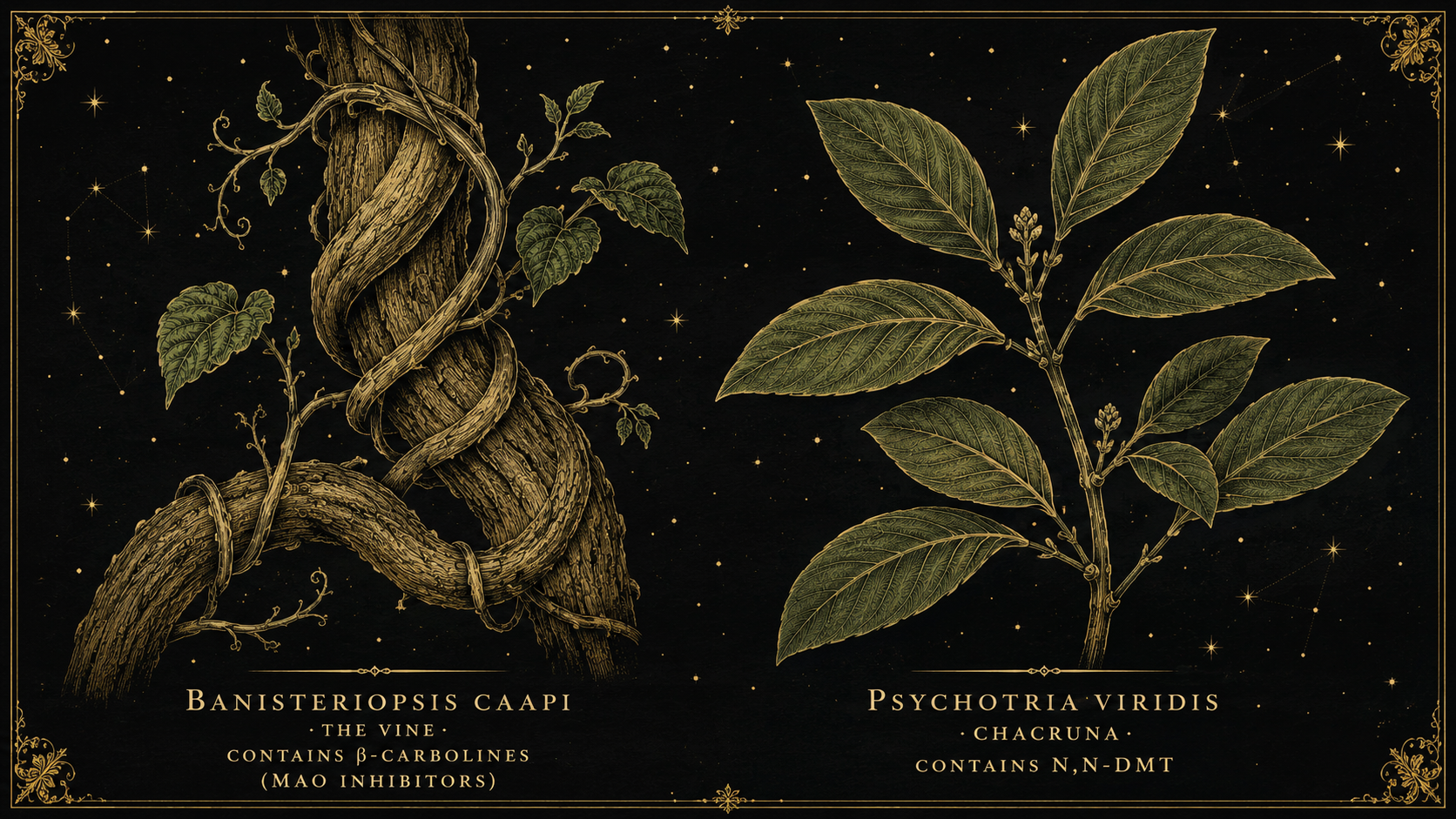
**The constant: *Banisteriopsis caapi*.** Whatever else goes into the pot, this thick, woody jungle vine is almost always present. It is the vine that gives the brew its name — *ayahuasca* in Quechua means roughly "vine of the soul" — and its pharmacological role is foundational. The vine contains compounds called β-carbolines — principally harmine, harmaline, and tetrahydroharmine — which temporarily disable a class of enzymes in the human gut that would otherwise destroy the active ingredient in the brew before it could do anything. Without the vine, the rest of the brew is pharmacologically inert by mouth. With it, the brew works.
In plain English: what are β-carbolines and why do they matter?
The body produces enzymes whose job is to break down tryptamine compounds circulating in the gut — a useful protection against the trace amines in everyday food. DMT taken orally by itself gets dismantled by these enzymes (called monoamine oxidases, or MAOs) before it can do anything. The β-carbolines in the ayahuasca vine inhibit these enzymes temporarily — they switch them off for several hours. DMT consumed alongside the inhibited enzymes survives the gut, enters the bloodstream, crosses into the brain, and produces its effects. One plant alone, by mouth, does nothing. The two plants together do quite a lot.
**The DMT-bearing plant: variable.** In the most common version of the brew — particularly in Peruvian and parts of Ecuadorian tradition — the second plant is *Psychotria viridis*, a small shrub known by its Quechua name **chacruna** ("the leaves"). In other regions, especially parts of Ecuador and Colombia, the DMT-source plant is *Diplopterys cabrerana* — known as **chaliponga** or **chagropanga** — which contains both DMT and, in some specimens, 5-MeO-DMT. The two source plants produce subtly but recognisably different experiences. Brews made with chaliponga are sometimes described as more visual and more cosmologically expansive; brews made with chacruna as more emotionally textured and more bodily. Both descriptions are imperfect generalisations.
**Beyond the two: admixtures.** Many traditions add further plants — sometimes for specific medicinal targets, sometimes for cosmological reasons, sometimes both. Tobacco (*Nicotiana rustica*, considerably stronger than commercial cigarette tobacco) is the most frequent addition; in some traditions ayahuasca and tobacco are inseparable. Brugmansia (toé), datura, bobinsana, ayahuma, and many other plants appear in regional brews, often as guarded ethnobotanical knowledge. The presence of these admixtures means that two brews labelled "ayahuasca" can produce noticeably different experiences depending on what else is in the pot.
**The preparation: itself part of the medicine.** In its traditional indigenous form, brewing is a multi-day process. The vine is pounded with rocks; the leaves are sorted and counted; the mixture is boiled in stages, reduced, recombined, sometimes for twelve to twenty-four hours of attended cooking. Many traditions require the brewer to be in *dieta* — a period of dietary, sexual, and social restriction — for weeks or months before brewing. Many traditions involve the brewer singing icaros (medicine songs) into the pot during cooking. For indigenous practitioners, the brew is not a chemical preparation that happens to require a person to make it. It is a relationship between brewer, plants, and the spirits associated with both. The cooking is itself part of the medicine.
Whether you accept this framing as literal or interpret it as cultural metaphor, it carries a pragmatic implication: brews prepared industrially — concentrated, freeze-dried, reconstituted on the day — often differ in alkaloid ratios from traditional decoctions, in ways that produce different experiences and different risk profiles. The chemistry is part of the story. It is not the whole story.
## 3\. The ceremony
Modern Western ayahuasca culture sometimes speaks as though "an ayahuasca ceremony" is a definite thing, like "a yoga class" or "a meditation retreat." It is more useful to think of ayahuasca ceremonies as a *category* of things — sharing a brew, sharing some structural features, and otherwise enormously variable.
A few near-universals across the category:
- A facilitator or curandero who has prepared the brew and guides the session
- A communal setting — most ceremonies involve a group rather than a single participant
- A long duration — four to seven hours of primary action, often with the ceremony extending beyond
- Low light or darkness, silence punctuated by singing or chanting
- The presence of nausea, vomiting, and sometimes diarrhoea, which most traditions consider therapeutic (*la purga* — the purging)
- Dietary and behavioural restriction in the days or weeks before
Beyond these, variation is wide. Indigenous Amazonian ceremonies are typically smaller — often family-sized — conducted in a maloca or thatched-roof gathering structure, led by a curandero singing icaros that are understood to direct the session pharmacologically and spiritually. Brazilian church traditions (Santo Daime, União do Vegetal, Barquinha) wear white uniforms, sit in geometric formations, sing hymns in Portuguese for the duration, and frame the experience in Christian-syncretic rather than shamanic terms. Modern Western retreat ceremonies — held in Costa Rica, the Netherlands, Peru-for-tourists, the Brazilian Amazon, and increasingly Europe and North America — range from sincere adaptations of indigenous practice to highly stylised commercial events.
Doses vary too. A typical indigenous ceremonial dose is around 50–100 ml of brew; the Brazilian churches typically use smaller, more dilute doses across multiple servings; some Western retreats serve a single moderate cup; others serve multiple cups across a long evening; some, in pursuit of intensity, serve much more.
### An author interlude on this
I have sat in four ayahuasca ceremonies myself, across three contrasting settings, and the differences between them stayed with me as one of the more useful pieces of education the medicine has offered.
The first was a three-day retreat in Amazon forest, led by a well-known Dutch facilitator. All participants were white. The first ceremony was structured around small, intense doses — two shot-glasses of a thick, gel-like reduced brew, taken in sequence. The second worked differently: a large bin of more dilute brew, from which participants were served bowls in sequence, the protocol being to keep drinking until you began to vomit, then to keep drinking and vomiting until you could barely move. It was thorough. The facilitator seemed sincere; my read at the time was that the framework was Western, the brew was being asked to do something the setting could not quite hold, and not very much actually happened. I came away with a measured experience and some intestinal misgivings.
The second and third were with the Shuar, outside Gualaquiza in southern Ecuador. The contrast was almost everything one might expect. Smaller, quieter, much shorter on production, much longer on song. The brew had been prepared by the curandero in the days before, and the ceremony itself felt more like an evening among people who lived with the plants than an event being staged for guests.
The fourth was on a farm in Ecuador with a non-indigenous Ecuadorian facilitator — somewhere between the other two in style, neither fully ceremonial nor fully retreat-commercial.

What I took from the contrast was not that one version is "real" and the others are not. It was that ayahuasca is a category of practices, that the brew is one variable among several, and that the ceremony — who is leading it, what frame they work in, who is in the room — does much of the work. The same plant materials in different hands produce different experiences. This is not a mystical claim. It is what *set and setting* actually means, made vivid.
## 4\. What it does
The experience reported by ayahuasca participants varies enormously across individuals, ceremonies, and traditions. Generalising about it is risky. But certain features recur often enough across honest reports to constitute a rough composite.
**Physically**, effects come on within roughly thirty to sixty minutes of drinking. Nausea is common; vomiting is common; diarrhoea is reasonably common. These are not failures of the experience but, in the traditional framing, part of how the medicine works. Light sensitivity increases. Body temperature can fluctuate. A heaviness, sometimes described as gravitational, is widely reported.
**The mental experience** builds across the next hour or so. Visual phenomena are widely described — closed-eye geometric patterns, open-eye distortions of the visual field, vivid imagery often involving naturalistic or biological forms (vines, serpents, plants), and in many cases what participants describe as encountering presences, intelligences, or entities. Whether these encounters reflect anything beyond the brain's tendency to populate altered states with social presence is a separate epistemic question, and the [Endogenous DMT essay](https://www.ardmt.com/endogenous-dmt-critical-review/) explores it more carefully in a related context. What is empirically true is that the reports are extremely consistent across cultures, settings, and participants — including those with no prior knowledge of the tradition.
**Emotionally**, the experience often involves vivid autobiographical material — childhood memories, unresolved relationships, grief, fear, joy in unexpected configurations. Many participants describe the experience as therapeutic in retrospect even when the experience itself was distressing in the moment. The phrase *"I would not have done it for fun, and I would not have missed it"* recurs.
The experience typically peaks at two to three hours after the initial dose and tapers across the next two to three. Total active duration is four to six hours, longer if subsequent doses are administered.
A few things worth saying clearly about what the experience is *not*.
It is not reliably comfortable. The reverence ayahuasca has acquired in popular culture obscures the fact that very experienced participants regularly describe individual ceremonies as among the hardest experiences of their lives.
It is not, in itself, evidence of anything metaphysical. Participants commonly report encounters they describe in spiritual terms, and those reports are real reports — the experiences happened. Whether they are evidence for the external reality of what was encountered is a separate philosophical question that participants and writers have answered in every imaginable way.
It is not benign for everyone. People with certain psychiatric histories — schizophrenia, bipolar disorder, psychotic episodes — can come to durable harm. People taking certain medications, particularly SSRIs and other serotonergic drugs, face genuine pharmacological risks including the possibility of serotonin syndrome, which can be fatal. The vivid, all-night-marathon nature of the ceremony, its bodily intensity, and its sometimes confronting psychological content also make ayahuasca a poor fit for people who are not in a place to tolerate any of those things.
## 5\. How it works
The pharmacology of ayahuasca is the pharmacology of two plants in combination.
The vine (*Banisteriopsis caapi*) contributes β-carbolines — harmine, harmaline, tetrahydroharmine — which are reversible inhibitors of monoamine oxidase A (MAO-A). MAO-A is one of the enzymes responsible for breaking down monoamine compounds in the body, including serotonin, dopamine, and noradrenaline, and including exogenous tryptamines such as DMT.
The DMT-bearing plant contributes N,N-dimethyltryptamine itself — covered in detail in [What is DMT?](https://www.ardmt.com/what-is-dmt/). DMT taken by mouth on its own is destroyed in the gut by MAO before reaching systemic circulation, which is why no DMT-containing plant chewed or eaten plainly produces a psychoactive effect.
Combine the two, and the β-carbolines inhibit MAO long enough for the DMT to survive the gut, cross the intestinal wall, enter the bloodstream, cross the blood-brain barrier, and reach 5-HT2A receptors in the cortex — where it produces its characteristic psychedelic effects. The MAO inhibition also extends the duration: rather than the few-minute experience of smoked DMT, oral DMT in the presence of an inhibitor produces a four-to-six-hour experience.
In plain English: why the duration is so much longer
Smoked DMT bypasses the gut entirely and reaches the brain almost immediately, but the body's normal enzymes break it down within minutes. Oral DMT with an MAO inhibitor takes longer to arrive (it has to be absorbed from the gut) and is then broken down far more slowly, because the enzymes that would clear it have been temporarily disabled. The net effect is a much longer experience that builds gradually rather than arriving instantly. This is why ayahuasca is an evening; smoked DMT is fifteen minutes.
A few additional pharmacological points worth knowing.
**The β-carbolines are not pharmacologically inert.** They are mildly serotonergic, mildly cardiovascular-active, and probably contribute their own subjective effects to the experience. Disentangling their contribution from DMT's is empirically difficult; experienced ayahuasca drinkers can sometimes distinguish vine-heavy brews from leaf-heavy ones by the quality of the experience alone.
**Reversible MAO inhibition is meaningfully safer than the irreversible kind.** The "no aged cheese, no red wine" cautions associated with the older antidepressant MAOIs (phenelzine, tranylcypromine — which are irreversible) apply only loosely to ayahuasca; serious tyramine-induced hypertensive crises are uncommon. The drug-interaction risk that *does* matter is with other serotonergic drugs — SSRIs, SNRIs, other MAOIs, tramadol, some opioids, MDMA — where combination can produce serotonin syndrome. This risk is real and has caused deaths.
**A new strand of research examines the β-carbolines independently.** Preliminary cell and animal data suggest harmine in particular has neuroplastic effects independent of any accompanying DMT. Several clinical-development companies are now investigating β-carbolines on their own as potential antidepressants. Whether this matters for human therapy is currently unresolved. A forthcoming Foundations primer on *Harmine and the MAOIs* will treat this strand in more depth.
## 6\. The cultural and historical story
Ayahuasca is, by most reasonable accounts, very old. The earliest definite archaeological evidence — pottery and brewing apparatus from the upper Amazon containing residues of harmine and DMT — dates from somewhere around 1,000 BCE, though some scholars argue the practice is considerably older. Either way, ayahuasca has been continuously used by indigenous peoples of the upper Amazon for at least two and a half thousand years, possibly much longer.
The diversity of indigenous traditions using ayahuasca is enormous. Different ethnic groups — Shipibo, Asháninka, Cofán, Shuar, Achuar, Yagua, Tukano, dozens of others — have their own preparations, songs, ceremonial structures, ritual frameworks, and cosmologies built around the brew. The notion of "the indigenous ayahuasca tradition" as a singular thing is a Western simplification. There are *traditions*, plural, woven into the broader fabric of upper-Amazonian indigenous life over millennia.
The brew's spread beyond strictly tribal contexts began in the late 19th and early 20th centuries, during and after the rubber boom that brought outsiders into the upper Amazon in significant numbers. Mestizo communities — people of mixed indigenous and European descent — developed their own forms of ayahuasca practice, often syncretising indigenous shamanic frameworks with elements of Catholicism. The vegetalista tradition of Peruvian and Brazilian mestizo curanderos belongs to this period.
In the early 20th century, ayahuasca began appearing in the founding stories of new Brazilian religious movements. **Santo Daime** was founded in the 1930s by Raimundo Irineu Serra, a Brazilian who had encountered ayahuasca through working in the Amazon rubber industry; the religion is Christian-syncretic, with ayahuasca taken as a sacrament in ceremonial settings involving hymns and white uniforms. The **União do Vegetal** (UDV) was founded in 1961 by José Gabriel da Costa, drawing on similar sources but developing a distinct ceremonial form. The **Barquinha** emerged in the 1940s as a Santo Daime offshoot. These movements have grown considerably since the 1960s and now have churches in many countries.
The Western academic discovery of ayahuasca dates to the 19th century — the British botanist Richard Spruce identified *Banisteriopsis caapi* in the 1850s — but serious scientific engagement was sporadic until the late 20th century. Terence McKenna's writings from the 1980s onward, the spread of underground psychedelic culture, the publication of Wade Davis's *One River* in 1996 and Jeremy Narby's *The Cosmic Serpent* in 1998, and Rick Strassman's *DMT: The Spirit Molecule* in 2001 collectively brought ayahuasca into mainstream Western awareness in a way it had never been before.
The global tourism phenomenon followed. By the early 2000s, retreat centres were operating openly in Peru, Brazil, and Ecuador catering to international visitors. By 2010, ayahuasca tourism was a significant economic sector in parts of the upper Amazon, with considerable money flowing into local communities and considerable controversy about what was being preserved and what was being commodified.
## 7\. The modern global story
The current state of ayahuasca, in 2026, is essentially three overlapping things: a continuing indigenous tradition, a growing religious movement, and a global commercial-therapeutic-recreational phenomenon that has outgrown anything its originators imagined.
The **indigenous tradition** continues. Many upper-Amazonian groups still use ayahuasca within their communities, in roughly the forms they have for many generations, with whatever degree of adaptation external pressures have forced upon them. Some communities welcome the global interest as economic opportunity and cultural validation. Others view it as appropriation and a corruption of practices that depend on community context to mean what they mean. Both views are intelligible; both are held by people with legitimate standing.
The **religious traditions** have grown internationally. Santo Daime, UDV, and Barquinha now have churches in dozens of countries, with legal recognition in some — Brazil, the US for specific congregations via Supreme Court ruling, the Netherlands historically — and grey-area or illegal status in many others.
The **global commercial phenomenon** — retreats, Western-led ceremonies in Europe and North America, underground sittings in private homes, integration therapy as a paid profession — is the part that has changed most dramatically in the last two decades, and the part most worth thinking about for a reader curious about whether and how ayahuasca might intersect with their own life.
A few things are worth saying about it candidly.
**Ayahuasca tourism is real, large, and uneven.** When I first started travelling in the upper Amazon in the late 1990s, encountering ayahuasca required either being introduced by someone local or making concerted local effort. By the late 2000s, retreat brochures were available in Cuenca and Quito airport hotels. By the 2010s, Western journalists were attending retreats and writing about them. By 2026, "going to do ayahuasca in Peru" is a category of holiday recognisable to the average British dinner party. The number of retreat centres operating globally now is impossible to know precisely; credible estimates put it in the high hundreds.
Some are run well. Some are run badly. Some are run by sincere practitioners working hard to honour the tradition while making it accessible to outsiders. Some are run by charlatans. Many sit somewhere in between, with sincere intentions and varying degrees of competence. The participant typically has limited ability to tell which they are walking into until they are there — and sometimes not until afterwards.
**The tourism in 2026 is, in my honest view, meaningfully more risky than the tourism was in 2005.** It is not that the brew has changed. It is that the volume of participants has increased dramatically, the quality control across retreat centres has not kept pace, and the marketing aesthetic — "spiritual healing journey," "deep medicine," "ancient wisdom" — produces exactly the kind of pitch that attracts people who are not adequately prepared for what an ayahuasca night actually demands of a body and a mind. The combination of more vulnerable participants and inconsistent oversight has produced a sector that I would not, on balance, describe as safe. Several high-profile deaths and a number of widely reported assault cases have made the risk profile of the tourism much more visible than it once was.
**A position I am aware is contradictory.** I would not, in general, recommend that someone unfamiliar with ayahuasca travel to the Amazon to do it. The risk-to-benefit ratio for most people is poor; the cultural translation is difficult; the experience is often less than the marketing implies and more than the constitution can take. And yet — if my own son were to express genuine interest, and if he had done the considerable preparatory work to understand what he was walking into, I would not stand in his way. I might, were it the right time in his life, even encourage him to go.
The two positions are not consistent. I hold them both. The asymmetry is, I think, what trust actually is — I would not generally recommend high-risk practices to strangers, even when I have personally benefited from them, because I cannot vouch for what they will bring to the encounter. With my own son, the calculus is different because I know him.
**For most readers, most of the time, the right answer is probably neither.** Neither ayahuasca tourism *nor* untreated suffering, but the work being built by an emerging field of practitioners — researchers, therapists, integration specialists, careful retreat operators — who are translating what they can of the traditional practice into accessible forms in the cultures where most readers actually live. The clinical research programme using extracted DMT in clinical settings (followed weekly in our [Field Notes](https://www.ardmt.com/tag/research/)) is one branch of this. Psychedelic-assisted therapy as a developing legal profession is another. Integration therapy as a stand-alone discipline is a third. None of these is ayahuasca-as-the-curanderos-know-it. All of them are attempts to bring some of what ayahuasca offers within reach of people for whom the Amazon is not a realistic option. They are, I think, the right place for most of the people who are reading this article to start.
*Going deeper on the molecule at the heart of all this:* [*What is DMT?*](https://www.ardmt.com/what-is-dmt/)*.*
## 8\. Is it legal?
Ayahuasca's legal status varies markedly by jurisdiction.
**United Kingdom.** Ayahuasca is treated as DMT for the purposes of the *Misuse of Drugs Act 1971*. The 2014 Court of Appeal decision in *R v Aziz* confirmed that a preparation containing DMT is itself a Class A controlled drug regardless of whether the individual constituent plants are themselves controlled (they are not). Possession is punishable by up to seven years; supply or production by up to life. There are no recognised religious or ceremonial exemptions in UK law, though prosecutions for ceremonial possession have been rare in practice.
**United States.** Ayahuasca contains DMT, which is federally Schedule I. The Supreme Court ruling in *Gonzales v O Centro Espírita Beneficente União do Vegetal* (2006) granted the UDV the right to import and use ayahuasca religiously; a subsequent ruling extended similar protection to Santo Daime. Recreational and non-religious use remains illegal.
**Brazil.** Ceremonial use has been legal since 1986; the brew is recognised as a cultural patrimony, and the Brazilian government regulates rather than prohibits its religious use.
**Peru.** Ayahuasca was declared part of Peru's cultural heritage in 2008\. Indigenous and ceremonial use is protected.
**Ecuador.** Traditional indigenous use is protected. The brew's status for non-indigenous practitioners is more ambiguous.
**Other jurisdictions.** Spain, Portugal, the Netherlands, and several Latin American countries have varying degrees of tolerance, often centred on registered religious organisations. Most European countries other than the Netherlands treat ayahuasca as DMT and apply the corresponding controlled-substance regime.
A separate forthcoming pillar essay on UK psychedelic law specifically will treat the wider policy landscape in more depth.
## 9\. What people often get wrong
Some of the popular assumptions a reader may have arrived with are worth addressing directly before closing. Some overlap with the misconceptions section of [What is DMT?](https://www.ardmt.com/what-is-dmt/); ayahuasca has its own characteristic confusions on top.
**"Ayahuasca is just oral DMT."** No. Ayahuasca is a pharmacological *system* — vine plus leaves, sometimes plus admixture plants — embedded in cultural and ceremonial practices that materially shape the experience. Reducing it to "DMT in a cup" misses both the pharmacology and the practice.
**"All ayahuasca ceremonies are equivalent."** They are not. Indigenous shamanic ceremonies, Brazilian church ceremonies, mestizo curandero ceremonies, and Western retreat ceremonies are pharmacologically similar and contextually different in ways that materially shape outcomes.
**"You need the Amazon to access 'real' ayahuasca."** It depends on what you want from the encounter. If you want to participate in a living indigenous tradition in its place of origin, yes. If you want a meaningful psychedelic-therapeutic experience that ayahuasca can produce, no — the experience can also be accessed in other contexts, though it will be a different experience and what is different matters.
**"Natural means safe."** Plant-derived does not mean low-risk. The SSRI–ayahuasca interaction is a serious risk; serotonin syndrome from this combination has caused deaths. Pre-existing cardiac conditions also matter.
**"Ayahuasca is for everyone."** It is not. People with certain psychiatric histories, people on certain medications, and people not psychologically or physiologically prepared for the demands of the experience can come to real harm. Reputable practitioners screen carefully; commercial operators screen unevenly.
**"One ceremony will fix me."** Probably not. The therapeutic effects reported in honest participant accounts and emerging clinical trials typically come from sustained engagement — with the experience, with integration afterwards, with whatever the experience surfaced. Experienced participants more often describe ayahuasca as making things visible that then need to be worked with, rather than as resolving them in itself.
**"Tourism is harmless."** It is not always harmful, but neither is it harmless. The volume of inexperienced participants moving through retreat centres has produced real risks for participants, for traditional communities being commercialised, and for the broader integrity of the practice.
**"The experience is inherently spiritual."** The experience generates content that participants often describe in spiritual terms. Whether that is evidence of spiritual realities, or evidence of the brain producing spiritual-feeling content in altered states, is a question the experience itself cannot settle — and serious participants from across the philosophical spectrum have answered it in opposing ways.
## 10\. What we still don't know
The honest gaps in current understanding, briefly:
How much of what ayahuasca produces is *the brew* and how much is *the ceremony*. Clinical research using extracted DMT plus MAOI in clinical settings produces meaningful effects, but the magnitude and quality are not identical to ceremonial ayahuasca experiences. The difference is presumably set and setting — but quantifying it, and disentangling the contributions, is empirically difficult.
Whether the long-term therapeutic effects often reported by participants generalise — i.e. whether ayahuasca's apparent benefits in depression, anxiety, trauma, and addiction will survive the kind of large, well-controlled, long-follow-up clinical trials the field is now beginning to run.
Whether the cultural translation question can be resolved — i.e. whether the practice retains what makes it valuable when transplanted outside its traditional context. People hold every imaginable position on this; serious answers will only emerge from generations of observation.
The pharmacology of repeated use. Most ayahuasca research has examined the effects of one or a few ceremonies. The neurobiology of people who have sat in hundreds of ceremonies over decades is largely undocumented.
What role the β-carbolines play beyond MAO inhibition — whether they are independent therapeutic agents in their own right.
The relationship between brew composition and outcome — i.e. whether differences between chacruna-based and chaliponga-based brews, or between traditional decoctions and industrial extracts, translate into meaningfully different clinical or experiential profiles.
These unresolved questions are not embarrassments to the field; they are the reason serious work continues.
---
#### New to this topic?
- [What is DMT?](https://www.ardmt.com/what-is-dmt/)
- [What is 5-MeO-DMT?](https://www.ardmt.com/what-is-5-meo-dmt/) *(forthcoming)*
- [Harmine and the MAOIs: Why Ayahuasca Needs Two Plants](https://www.ardmt.com/harmine-and-maois/) *(forthcoming)*
#### Going deeper?
- [Endogenous DMT in Humans: A Critical Review of the State of the Evidence](https://www.ardmt.com/endogenous-dmt-critical-review/)
- [DMT vs Ketamine: Equal on Depression, DMT Wins on Anxiety](https://www.ardmt.com/dmt-vs-ketamine-depression-anxiety/)
- [Field Notes — daily research updates](https://www.ardmt.com/tag/research/)
---
### Suggested Citation
Page, S. (2026) 'What is Ayahuasca?', *ARDMT: Applied Research Through DMT*, 16 May 2026\. Available at: https://ardmt.com/what-is-ayahuasca/.
### What is DMT?
URL: https://www.ardmt.com/what-is-dmt/
Last updated: 2026-05-16T08:42:26.000Z
*An orientation to the molecule behind ayahuasca, smoked DMT, and one of the strangest open questions in human pharmacology*
In plain English
DMT is the molecule at the heart of ayahuasca and the brief, vivid pipe experience that has fascinated psychonauts and neuroscientists for half a century. It is one of the most potent psychedelic compounds known. It is also, strangely, found in trace amounts in ordinary human blood and urine — which has led to a seventy-year argument about whether the human body makes its own.
This is an orientation, not a guide. By the end you should be able to read the rest of this site — the Field Notes, the deeper essays — without feeling that you have walked into a postgraduate seminar halfway through term. The technical detail builds as it goes; read as far as your interest carries you.
## 1\. What this article is
This article is the front door.
It assumes nothing. You may have come here because you read Michael Pollan, or because a colleague mentioned ayahuasca over dinner, or because a friend went to a retreat and came back changed, or because a news piece about psilocybin therapy made you wonder what else there was. It walks through what DMT is, where it shows up in the world, what it appears to do to people, what science currently understands about how it works, how the law treats it, and what is still being argued about.
It is not a guide to using DMT — and would not be useful as one even if I tried. The relationship between psychedelic compounds and the human nervous system is more complex than any article can responsibly summarise into instructions. What follows is map-making, not prescription.
By the end you should be able to read any Field Note on this site, or any deeper essay, without bouncing off the vocabulary.
## 2\. The molecule
DMT stands for *N,N-dimethyltryptamine*. The name describes what the molecule is: a tryptamine (a small family of compounds built around a particular ring structure) with two methyl groups attached at the nitrogen atom. It is chemically very simple. If you took serotonin — the neurotransmitter most people have heard of from antidepressant adverts — and made two small modifications to it, you would have DMT.
In plain English: what is a tryptamine?
A tryptamine is a chemical family built around a particular two-ring structure called an indole. The body uses tryptamines for ordinary purposes — serotonin (which influences mood, sleep, digestion) and melatonin (which regulates sleep) are both tryptamines. Plants and fungi also make tryptamines, sometimes in extraordinary forms. Psilocybin in magic mushrooms is a tryptamine. So is DMT. The shared chemistry is why these compounds end up acting on similar brain receptors despite being made by completely different organisms.
Of the major psychedelics, DMT is among the most chemically minimal. The molecule weighs less than half what LSD does. It is structurally close to compounds the human body produces routinely. And — this is where things become genuinely strange — small amounts of DMT itself have been detected in human blood, urine, and cerebrospinal fluid for over fifty years.
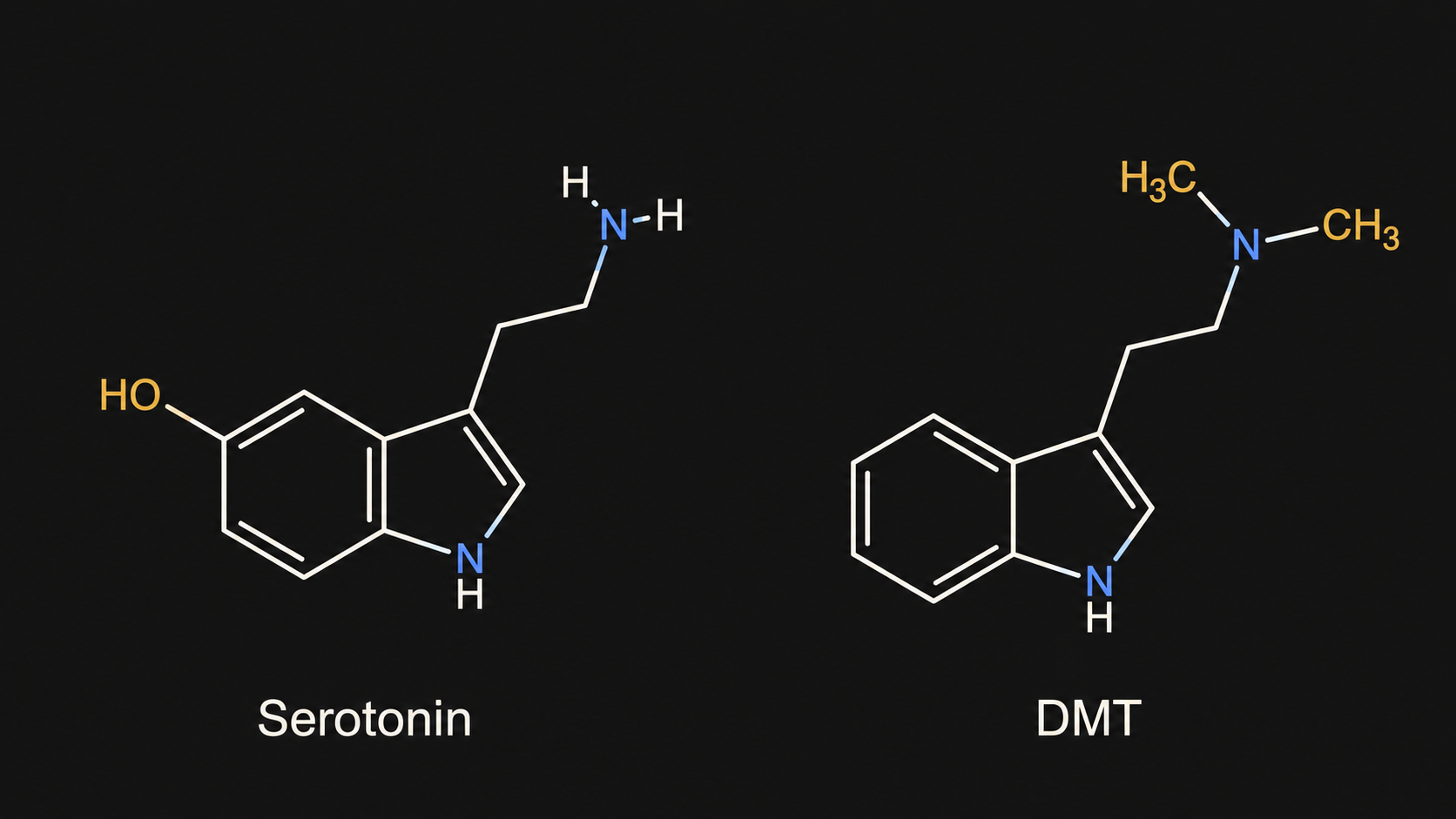
Whether the body actively *makes* DMT in functionally meaningful amounts, and whether the trace levels detected mean anything physiological, is one of the most contested questions in neuropharmacology. There is a longer essay on this site dedicated to that question alone — [*Endogenous DMT in humans: a critical review of the state of the evidence*](https://www.ardmt.com/endogenous-dmt-critical-review/) — and it is not the kind of question that lends itself to a sentence-long answer. For the purposes of this primer, the headline points are:
- DMT is structurally simple, and structurally close to serotonin
- It is found, in trace amounts, in the human body
- It is found, in much larger amounts, in many plants and at least one animal (the Sonoran Desert toad — though that's a closely related molecule, 5-MeO-DMT, which we'll come to)
- Whether the body's own DMT does anything meaningful is open
*The long-form argument on this is here:* [*Endogenous DMT in Humans: A Critical Review of the State of the Evidence*](https://www.ardmt.com/endogenous-dmt-critical-review/)*.*
## 3\. The forms DMT takes in the world
This is where most people get confused, and the confusion is worth clearing up before going further. The word "DMT" gets used to refer to several different things, and they produce different experiences.
**Smoked or vaporised N,N-DMT.** This is what people usually mean when they say "DMT" with the kind of breathless reverence that has made its way into podcast culture. A crystalline extract — typically obtained from plants like *Mimosa hostilis* or *Acacia* species, though it can also be synthesised — is heated and inhaled. The effects come on within seconds. They peak within two or three minutes. They are over within fifteen. Reports of the experience are intense and often described in language that sounds religious. We'll come to this in the next section.
**Ayahuasca.** A brew, originating in the upper Amazon, in which DMT is taken orally. There is a wrinkle: DMT taken by mouth is, by itself, broken down in the gut by an enzyme called monoamine oxidase before it can reach the bloodstream. Ayahuasca solves this problem by combining a DMT-containing plant (usually *Psychotria viridis*) with a second plant — typically the vine *Banisteriopsis caapi* — which contains compounds that temporarily disable that enzyme. The DMT then survives digestion and produces an experience lasting four to six hours.
In plain English: why ayahuasca needs two plants
The body has built-in enzymes whose job is to break down loose tryptamines circulating in the gut — useful for surviving the trace tryptamines found in ordinary food. DMT, taken orally on its own, gets dismantled by these enzymes before it can do anything. The vine in ayahuasca contains compounds called MAO inhibitors that switch those enzymes off temporarily. The DMT from the other plant then survives the journey through the gut, reaches the bloodstream, and crosses into the brain. One plant alone, by mouth, does nothing. The two plants together do quite a lot. This is one of the oldest and most striking examples in ethnopharmacology of plants being deliberately combined to achieve an effect neither could produce alone.
How the indigenous peoples of the upper Amazon discovered this combination — without any of the analytical chemistry that explains it now — is one of the genuinely unanswered questions in the history of pharmacology. The traditional answer given by ayahuasca practitioners is that the plants themselves communicated the recipe. Western scientific accounts struggle to do much better.
**5-MeO-DMT.** Strictly a different molecule — N,N-dimethyltryptamine with a methoxy group attached at the 5-position of the ring — but pharmacologically close enough that people often lump it together with DMT. It is found in a different set of plants and, famously, in the venom of the Sonoran Desert toad (*Incilius alvarius*, formerly *Bufo alvarius*). The toad does not produce 5-MeO-DMT for human use; it produces it as a defensive secretion. People have, nonetheless, found ways to collect, dry, and smoke the venom.
5-MeO-DMT produces a profoundly different experience from N,N-DMT — less visual, more dissolving — and is currently the molecule in the most advanced stages of clinical development for depression. Its own primer is forthcoming on this site.
**Endogenous DMT.** As mentioned: trace amounts of DMT have been detected in human biological fluids for half a century. Whether the body is producing it deliberately, for some functional purpose, or whether it is a low-level by-product of broader amine metabolism, is unresolved. The popular claim that endogenous DMT explains dreams, near-death experiences, and the moment of dying is much stronger than the evidence supports — but the underlying question (does it have any biological role at all?) remains genuinely open.
*Going deeper on the 5-MeO-DMT distinction specifically:* [*What is 5-MeO-DMT?*](https://www.ardmt.com/what-is-5-meo-dmt/) *(forthcoming).*
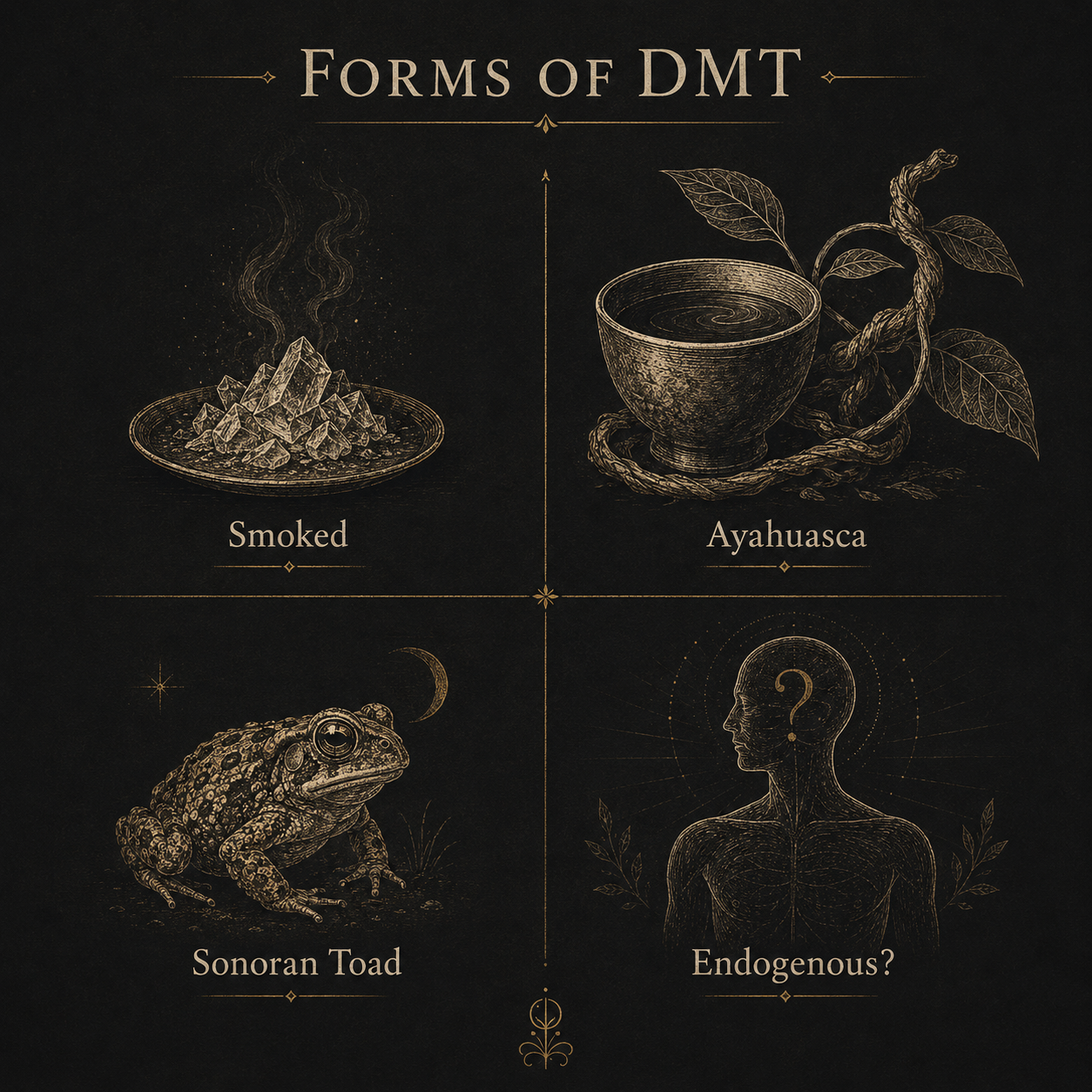
## 4\. What it does
I'll keep this section deliberately brief and unsensational, because the literature on subjective effects is voluminous and the temptation to indulge it is strong.
DMT, in its smoked form, produces what is widely described as one of the most intense altered states it is possible for a chemical to induce. People report a complete dissolution of the ordinary sense of self; vivid, often geometric, visual phenomena; and — characteristically — an experience that takes the form of contact with entities, environments, or intelligences described by participants as "more real than real." Some find this revelatory. Others find it terrifying. A substantial fraction find it both, sometimes within the same fifteen-minute experience.
The afterglow is usually mild and the cognitive sequelae minimal — unusually so for a substance this powerful. People typically return to ordinary consciousness within twenty minutes, often able to drive, talk, work, or otherwise resume daily life. This rapid offset is part of why DMT is of interest as a clinical tool: unlike psilocybin or LSD, which require all-day treatment sessions, a DMT intervention could in principle fit inside a clinical hour.
Taken orally as ayahuasca, the experience is longer, slower, more thematic, and very often involves nausea — the brew has the gut as well as the brain to contend with. It is the form most commonly used in ceremonial and therapeutic contexts, where the duration is part of the point: longer experiences allow more material to surface and be worked through.
A few cautions are worth registering.
First, what people *report* about a drug experience is shaped, often heavily, by what they expect to report, by what cultural categories are available to describe it, and by the context in which the substance is taken. This is sometimes called "set and setting" and matters enormously. A DMT experience in an indigenous ceremonial context is reported differently from a DMT experience in a friend's flat at 2am, even when the dose and the molecule are identical.
Second, the language psychonauts have developed for DMT — "entities," "hyperspace," "machine elves" — is interpretive rather than descriptive. It is what some people have settled on as a way of describing experiences that resist ordinary vocabulary. It is not what science thinks the experience *is*. Treating those terms as literal claims about what DMT reveals takes them further than they were ever meant to go.
Third, DMT is not benign for everyone. People with certain psychiatric histories — particularly schizophrenia or bipolar disorder — can come to real and durable harm. People taking certain medications, especially SSRIs and MAO inhibitors, face genuine pharmacological risks. The vivid, brief, "reset-like" experience that smoked DMT can offer should not be confused with safety. Most psychedelic risk is statistical: rare in any individual, real across a population.
## 5\. How it works in the brain
Here we leave anecdote and enter receptor pharmacology.
The brain is full of receptors — proteins on the surface of nerve cells that respond to specific chemical signals. Different drugs work by binding to different receptors, in different ways, in different parts of the brain.
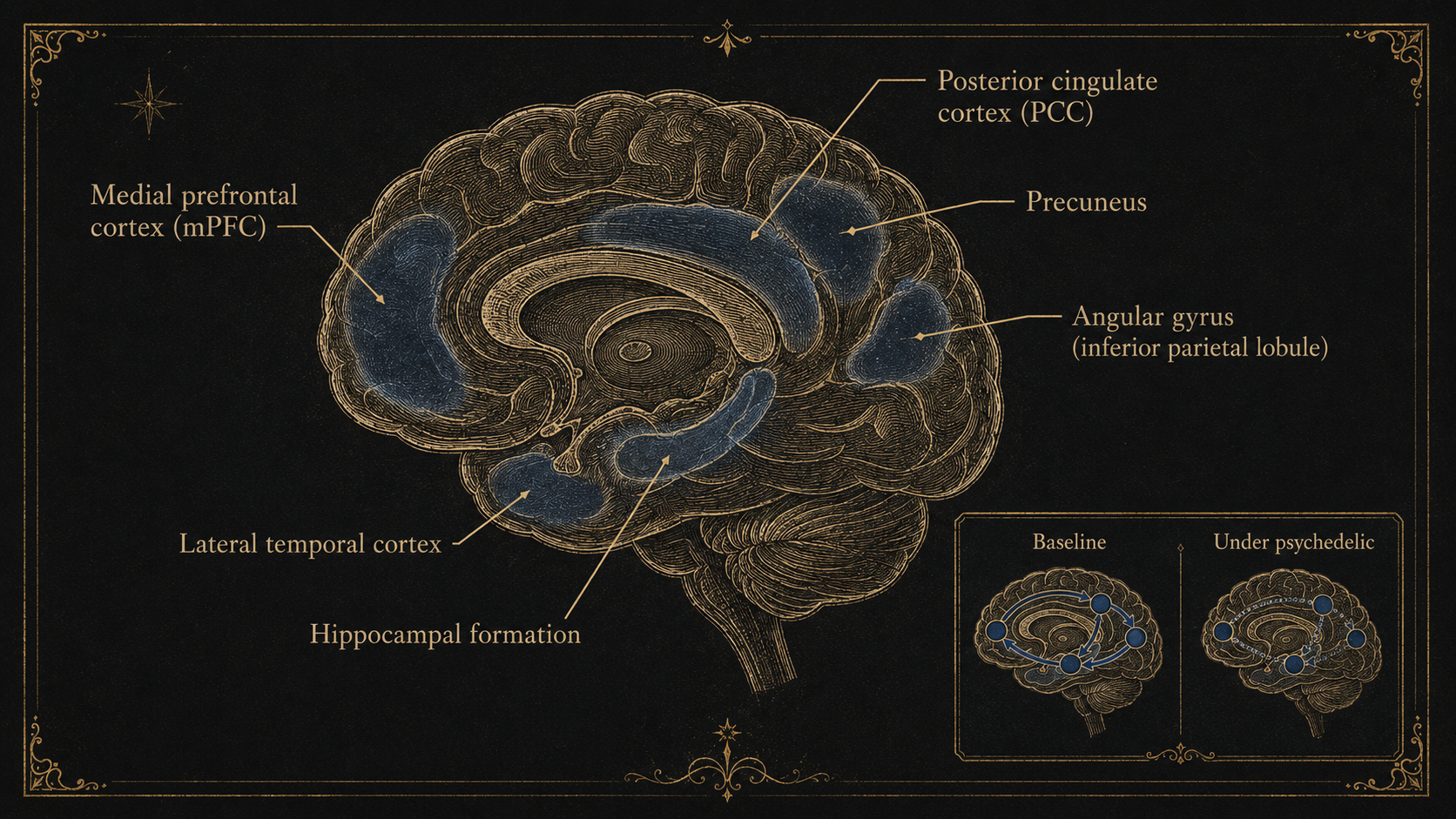
Psychedelics — DMT, psilocybin, LSD, mescaline, and others — share a primary target: a receptor in the serotonin system called the 5-HT2A receptor. They are not the only compounds that bind here, but they bind in a particular way that activates the receptor with a pattern of effects that other compounds don't reproduce. Block the 5-HT2A receptor pharmacologically (with a drug called ketanserin, for instance), and the psychedelic effect almost entirely disappears. This is one of the cleanest findings in psychedelic neuroscience.
In plain English: what is the 5-HT2A receptor?
5-HT2A is one of about fourteen different receptors in the serotonin system. Each one responds to serotonin, but each does something slightly different in the cell when activated. The 5-HT2A receptor is particularly densely concentrated in the cortex — the outer layer of the brain responsible for higher cognitive function. When it is activated unusually strongly, by a psychedelic, the activity of large-scale brain networks changes in ways that appear to underlie the psychedelic experience. Why we have 5-HT2A receptors at all, and what they normally do, is a separate and surprisingly difficult question.
DMT binds to 5-HT2A. So far, so standard. But DMT also binds to several other targets, including — interestingly — a peculiar receptor called the sigma-1 receptor, which is found inside cells rather than on their surfaces. The role of the sigma-1 receptor in DMT's effects is debated; the leading view is that it contributes to long-term effects on neurons (growth, stress protection) rather than to the acute psychedelic experience itself. There is a forthcoming primer on the sigma-1 receptor on this site for readers who want to go deeper into this strand.
What does activating 5-HT2A actually *do* at the scale of the whole brain? The most current scientific answer involves a concept called the *default mode network* — a set of interconnected brain regions that, when humans aren't doing anything in particular, hum along together in a coordinated rhythm. The default mode network seems to underpin the ordinary sense of being a self located in a body with a history and a name. Psychedelics, particularly DMT, appear to disrupt the activity of this network. This is currently the leading neurobiological candidate for what people are experiencing when they describe "ego dissolution" on these compounds.
(A primer on the default mode network is forthcoming, for readers who want to follow this strand specifically.)
The picture is not complete. There is recent and active research into how DMT acts at receptors inside cells rather than only on their surface — work that suggests psychedelics might be doing more than the 5-HT2A story alone captures. The receptor model we currently rely on is the best available, but it is not closed.
*Going deeper on the brain-network model:* [*What is the Default Mode Network?*](https://www.ardmt.com/what-is-default-mode-network/) *(forthcoming).*
## 6\. The cultural story
DMT in its plant forms has a long human history — much longer than the modern scientific story.
Ayahuasca has been used for centuries across the upper Amazon for healing, divination, and ritual. The exact age of the practice is debated; some scholars argue for several thousand years, others for centuries rather than millennia. What is not debated is that ayahuasca is central to a number of indigenous Amazonian cosmologies and to several religious movements — Santo Daime, União do Vegetal, the Barquinha — that have grown up around it in the twentieth century. Other DMT-containing plants have an even older archaeological record: *Anadenanthera* seeds used as ceremonial snuffs have been recovered from sites in northern Chile dated to at least 2,000 BCE.
The Western scientific story is much more recent. DMT was first synthesised in 1931 by a Canadian chemist, Richard Manske, who made it as a curiosity and had no idea what it would do. The molecule sat on the shelf, pharmacologically unexamined, for twenty-five years.
In 1956 the Hungarian chemist Stephen Szára, frustrated at being unable to obtain mescaline from behind the Iron Curtain, prepared DMT himself and injected it into himself. His notes, published the following year in *Experientia*, are among the founding documents of modern psychedelic science. Szára described an experience that lasted under an hour, included vivid visual phenomena and altered emotional states, and resolved cleanly without after-effects. He went on to study the compound in clinical populations through the late 1950s.
Through the 1960s and 1970s, DMT became part of a much broader interest in psychedelic compounds. The transmethylation hypothesis of schizophrenia — the idea that the disorder might be caused by the body accidentally producing hallucinogenic methylated metabolites — drove a substantial empirical programme of detecting DMT in patient fluids. The hypothesis has now largely faded, for reasons covered in the [Endogenous DMT review](https://www.ardmt.com/endogenous-dmt-critical-review/), but it generated decades of useful chemistry and analytical method along the way.
When psychedelics were criminalised across most of the Western world in the late 1960s, formal DMT research more or less stopped. Between roughly 1970 and the early 2000s, DMT became part of an underground rather than a scientific story. The molecule's modern reputation was shaped less by laboratories than by writers — Terence McKenna in particular — and later by the publication of Rick Strassman's 1994 clinical study on volunteers at the University of New Mexico, written up in his 2001 book *DMT: The Spirit Molecule*. Strassman's framing of DMT as a uniquely "spiritual" compound has been influential, contested, and is responsible — for better and worse — for much of the language ordinary readers encounter when they first come across the subject.
## 7\. The modern research renaissance
Since roughly the early 2000s, scientific study of psychedelics has been re-opening. Slowly at first; then less slowly.
Several universities now have established research programmes investigating psychedelics for psychiatric and neurological conditions: Johns Hopkins in the United States, Imperial College London and University College London in the UK, Maastricht in the Netherlands, Zurich in Switzerland. The University of Exeter, relevantly to this site, runs the UK's first dedicated master's degree in psychedelic studies.
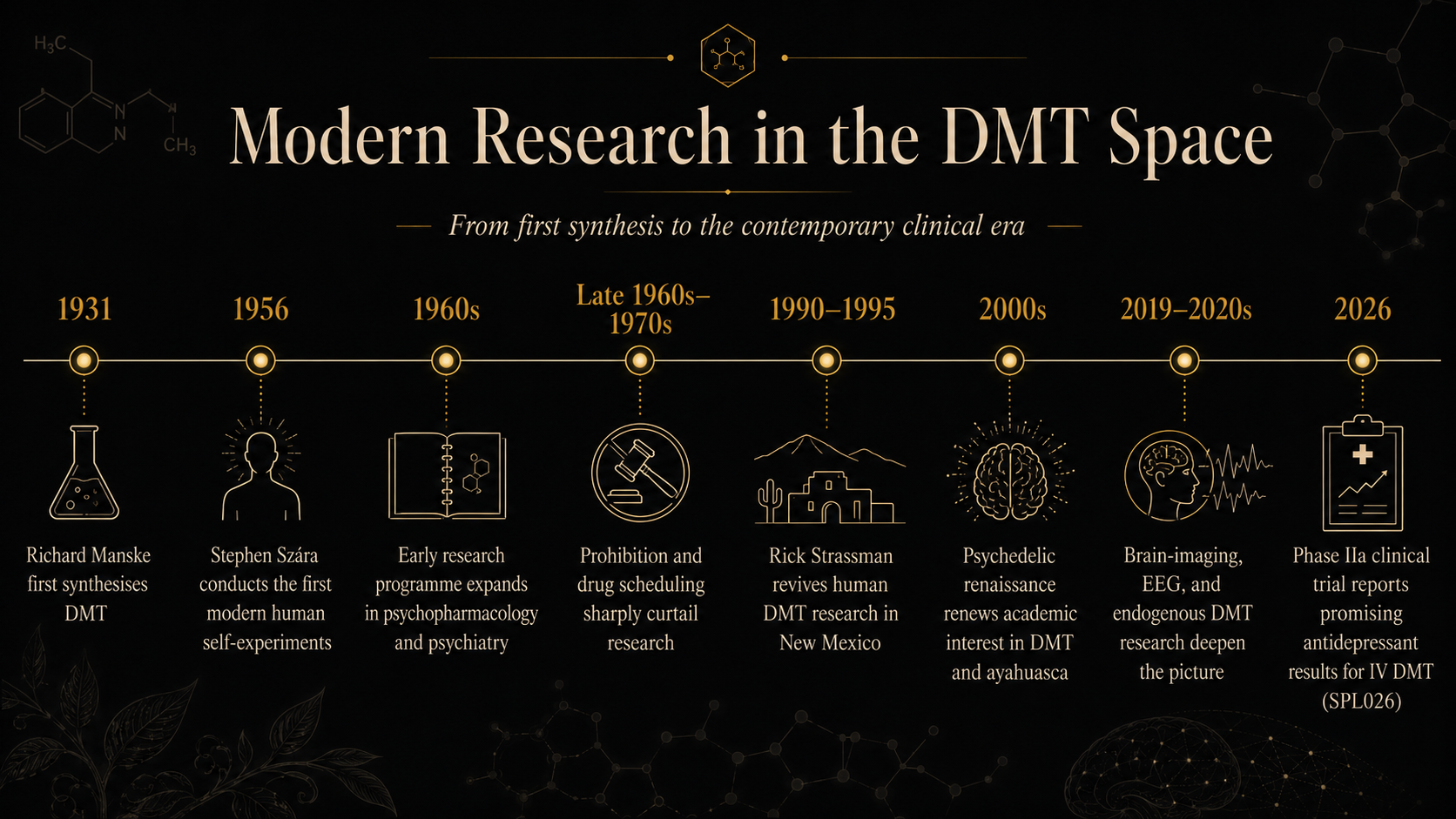
DMT specifically is the focus of several active clinical trials. The challenge that smoked DMT poses for medicine — the experience is too brief, too uncontrollable, too dependent on inhalation technique — has prompted the development of more clinically tractable delivery systems: intravenous infusions, intranasal sprays, controlled-release formulations. Imperial College's *DMTx* programme has been working on extended IV infusion protocols that allow the experience to be prolonged and titrated for therapy. Beckley Psytech's BPL-003 — strictly a 5-MeO-DMT formulation rather than N,N-DMT, but in the same family — has progressed through encouraging Phase 2 results for treatment-resistant depression, including, notably, in patients who remain on their existing SSRI medication.
What is being measured varies by trial: reductions in depression scores, anxiety scores, addictive behaviour, end-of-life distress. The early results are encouraging but provisional. Psychedelic clinical trials face real methodological challenges — blinding is famously difficult when the substance has unmistakable effects on the participant — and a degree of caution about the headline claims is well-placed. We track the active trials in detail in our [Field Notes](https://www.ardmt.com/tag/research/) section, with one post per significant publication.
The political-economic question — whether psychedelic compounds will end up routinely available as licensed medicines within the next decade — is currently more open than it was eighteen months ago. The FDA's rejection of MDMA-assisted therapy in 2024 cooled expectations across the field. DMT and 5-MeO-DMT trials have continued nonetheless, and the underlying signal in the data remains interesting.
## 8\. Is it legal?
In the United Kingdom, DMT is a Class A controlled drug under the *Misuse of Drugs Act 1971*, and sits in Schedule 1 of the *Misuse of Drugs Regulations 2001* — the most restrictive category, formally reserved for substances with no recognised medical use.
Possession is punishable by up to seven years' imprisonment and an unlimited fine. Supply or production carries a maximum of life imprisonment. Ayahuasca, as a preparation containing DMT, is treated as DMT for the purposes of the law, even though neither the brew nor either of its constituent plants is itself a controlled substance: a 2014 Court of Appeal decision (*R v Aziz*) confirmed that a DMT-containing preparation is itself a Class A drug regardless of botanical origin.
There are narrow exceptions for licensed research and for limited industrial uses, granted under Home Office licence. This is how the clinical trials currently underway are legally possible. There are no exceptions for personal, religious, or ceremonial use, although prosecutions for low-level ceremonial possession have been rare. The legal landscape in the UK has not meaningfully shifted in over fifty years, though pressure is building from the research and clinical communities for reform — including a 2023 parliamentary inquiry by the All-Party Parliamentary Group on Drug Policy Reform.
Outside the UK, the picture varies. The United States classifies DMT under Schedule I federally, with religious-use exemptions granted to two ayahuasca-using churches (the União do Vegetal and Santo Daime) following Supreme Court litigation. Brazil and Peru, where ayahuasca is part of long-standing indigenous and religious practice, treat the brew differently from the molecule, allowing ceremonial use under defined conditions. The Netherlands has historically tolerated ayahuasca use within registered religious contexts. Each jurisdiction handles the question its own way; there is no international consensus.
A pillar essay on UK psychedelic law specifically, covering Schedule 1 status, the consequences for research, and the available avenues for reform, is in preparation.
## 9\. What people often get wrong
A primer is also the right place to flag the assumptions readers may have arrived with that the literature does not support. None of these is a fringe error — all of them recur in popular writing, podcast culture, and conversation around the subject.
**"DMT is the dream chemical."** There is no good evidence for this. The claim originates principally with Rick Strassman's 2001 book and has not been replicated or confirmed in the twenty-five years since. Endogenous DMT may have some biological role — the [longer essay](https://www.ardmt.com/endogenous-dmt-critical-review/) examines the evidence in detail — but the specific dream-chemical claim is speculation, not finding.
**"Ayahuasca is just oral DMT."** No. Ayahuasca is a pharmacological *system* — DMT plus monoamine oxidase inhibitors, sometimes plus additional admixture plants — embedded in cultural and ritual contexts that materially shape the experience. Reducing it to "DMT in a cup" misses both the pharmacology and the practice.
**"5-MeO-DMT and N,N-DMT are basically the same."** They are not. Same chemical family, different molecules, different receptor preferences, profoundly different subjective effects. Treating them as interchangeable is one of the most common errors in popular psychedelic writing.
**"Iboga contains DMT."** It does not. Iboga and DMT share a distant biosynthetic ancestor in tryptophan metabolism, but the iboga-type alkaloids are structurally complex pentacyclic compounds, not tryptamines. The iboga experience is the ibogaine experience, not a DMT experience.
**"Natural means safe."** Plant-derived does not mean low-risk. Ayahuasca interacts with several common medications — SSRIs in particular — in ways that can be dangerous. Ibogaine has caused deaths through cardiac complications. The natural origin of a compound is a fact about its history, not its safety profile.
**"DMT is addictive."** There is no clinical or pharmacological evidence of physical or behavioural addiction to DMT. People who take it repeatedly often describe diminishing returns rather than craving. This does not mean the substance is risk-free, but the addiction frame is misapplied.
**"Spiritual reports prove what was experienced was real."** People genuinely report experiences they describe in spiritual or metaphysical terms, and those reports are real reports — the experiences happened. Whether the reports are evidence for the external reality of what was perceived is a separate question. Conflating "this happened to me" with "this proves the entity I encountered exists" is an epistemic move that requires considerably more support than the reports themselves provide.
## 10\. What we still don't know
A primer is not the place to settle questions; it is the place to flag which ones are still open. The honest list, briefly:
Whether the human body makes DMT in functionally meaningful amounts, and if so, for what purpose. (Covered in detail [in the Endogenous DMT essay](https://www.ardmt.com/endogenous-dmt-critical-review/).)
What, exactly, the experience of intense DMT states *is*, beyond the descriptions participants give of it — and whether the consistent entity reports across cultures reflect anything beyond the brain's tendency to populate ambiguous sensory input with social presence.
Whether DMT will prove durably useful as a psychiatric medicine, or whether early trial enthusiasm will moderate as more data arrive and follow-up periods lengthen.
How much of what we know about DMT pharmacology in rats — which is most of what we know — translates faithfully to human beings.
Whether the receptor models we currently rely on (5-HT2A, sigma-1, others) capture what is actually happening when DMT meets a human nervous system, or whether there are aspects of its action we haven't yet identified. Recent work on intracellular receptor activity suggests the picture is genuinely not closed.
What the relationship is, in any deep sense, between the chemistry of DMT and the cultural and ceremonial frameworks that humans have built around it for thousands of years.
These are not gaps to be papered over. They are why the field is worth taking seriously.
#### New to this topic?
- [What is Ayahuasca?](https://www.ardmt.com/what-is-ayahuasca/) *(forthcoming)*
- [Iboga vs Ibogaine: Two Names, Two Realities](https://www.ardmt.com/iboga-vs-ibogaine/) *(forthcoming)*
- [What is 5-MeO-DMT?](https://www.ardmt.com/what-is-5-meo-dmt/) *(forthcoming)*
#### Going deeper?
- [Endogenous DMT in Humans: A Critical Review of the State of the Evidence](https://www.ardmt.com/endogenous-dmt-critical-review/)
- [Absence of Evidence: Hair Strand Testing, DMT, and the Limits of Forensic Certainty](https://www.ardmt.com/hair-strand-testing-dmt-family-court/)
- [Field Notes — daily research updates](https://www.ardmt.com/tag/research/)
### Suggested Citation
Page, S. (2026) 'What is DMT?', *ARDMT: Applied Research Through DMT*, \[16/05/2026\]. Available at: https://ardmt.com/what-is-dmt/.
### DMT for Parkinson's: Sigma-1 Neuroprotection in a 6-OHDA Model
URL: https://www.ardmt.com/dmt-for-parkinsons-sigma-1-neuroprotection-in-a-6-ohda-model/
Last updated: 2026-05-16T04:25:54.000Z
The idea that N,N-dimethyltryptamine might do something useful for neurodegeneration has been circulating in the literature for the better part of a decade now, gathering evidence in the manner of a slow accretion rather than any single dramatic finding. The latest deposit comes from a Spanish group led by Calleja-Conde and Morales-García, whose paper in *Experimental Neurology* ([PMID 42128256](https://pubmed.ncbi.nlm.nih.gov/42128256/?ref=ardmt.com); DOI: 10.1016/j.expneurol.2026.115822) examines DMT's therapeutic properties in a preclinical model of Parkinson's disease. The work arrives in a journal with a solid reputation in the neuroscience of movement disorders, and it has the feel of a group consolidating a line of inquiry rather than firing an opening shot.
### What was done
The study employs the 6-hydroxydopamine (6-OHDA) lesion model, which remains the workhorse of preclinical Parkinson's research despite its well-known limitations — chief among them that it produces an acute, toxin-driven neuronal death rather than the slow, multifactorial degeneration one sees in human patients. The model works by injecting 6-OHDA into the nigrostriatal pathway, selectively destroying dopaminergic neurons and thereby producing motor deficits that can be quantified behaviourally. DMT is then administered — the full paper should clarify the dosing regimen, route, and timing relative to the lesion — and outcomes are assessed across behavioural, histological, and presumably molecular endpoints. The author list includes Perez-Castillo and Morales-García, both of whom have previously published on DMT's neuroprotective and neurogenic properties, including work on sigma-1 receptor mediation. The manuscript was received in October 2025, revised in May 2026, and accepted within days of revision — a timeline that suggests the reviewers' concerns were satisfactorily addressed rather than fundamentally structural.
### The sigma-1 thread
Readers of these notes will recall earlier coverage of work from overlapping investigators exploring DMT's activation of the sigma-1 receptor (σ1R), an intracellular chaperone protein resident on the endoplasmic reticulum membrane that modulates calcium signalling, mitochondrial function, and the unfolded protein response. The σ1R has become something of a darling in neuroprotection research: it is expressed abundantly in dopaminergic neurons, and its agonism has been shown, in various models, to reduce oxidative stress, attenuate neuroinflammation, and promote cell survival. DMT's affinity for σ1R is well established, and Morales-García's earlier publications have made the case that this interaction — rather than the 5-HT2A receptor agonism responsible for DMT's more famous psychedelic effects — is the relevant pharmacological axis for neurodegeneration.
The present paper, published in a different journal and with a distinct publication date from the group's earlier work, appears to represent either an expansion of the experimental scope or a more comprehensive treatment of the Parkinson's model data. *Experimental Neurology* is a peer-reviewed venue with reasonably stringent standards for preclinical motor neuroscience, which provides at least some assurance that the behavioural and histological data have been scrutinised with appropriate rigour.
### What to make of it
The honest assessment is that this is suggestive but early. The 6-OHDA model, for all its utility, does not recapitulate the proteinopathy (Lewy body pathology, α-synuclein aggregation) that characterises idiopathic Parkinson's disease in humans, nor the years-long prodromal period during which therapeutic intervention might realistically occur. Showing neuroprotection in this model is a necessary step but not a sufficient one; plenty of compounds have looked splendid against 6-OHDA and then failed to translate. The field has been burned often enough to be cautious.
That said, several features of the DMT–σ1R axis are genuinely interesting from a translational perspective. DMT has a short half-life and a reasonably well-characterised safety profile at psychedelic doses in controlled settings. If the neuroprotective mechanism is indeed σ1R-mediated rather than 5-HT2A\-mediated, it opens the possibility of sub-psychedelic dosing regimens that retain neuroprotective efficacy without the perceptual fireworks that make chronic administration impractical. Whether anyone has the appetite to fund a clinical trial of DMT for Parkinson's disease remains another matter entirely, though one notes that the regulatory landscape for psychedelic-derived therapeutics is somewhat less frigid than it was five years ago.
What would strengthen the case considerably is replication in an α-synuclein-based model (such as the preformed fibril model), dose-response data with a selective σ1R antagonist to confirm mechanism, and pharmacokinetic work establishing whether the doses used achieve plausible CNS concentrations in a sustained fashion. One hopes the full paper addresses at least some of these.
### Also worth a glance
A rather charming paper applies machine learning to herbarium specimens of *Banisteriopsis caapi* — the ayahuasca vine — attempting to recover traditional folk classifications of cultivar varieties from leaf morphology alone ([PMID 42100741](https://pubmed.ncbi.nlm.nih.gov/42100741/?ref=ardmt.com)). It is tangential to pharmacology but represents a genuinely novel intersection of ethnobotany and computational image analysis that is worth knowing about.
### Marginalia
One is struck by the quiet persistence of the Madrid group. They have been building the DMT–σ1R–neuroprotection case paper by paper, model by model, without the fanfare that tends to accompany psychedelic research in the anglophone press. It is the sort of incremental, slightly unglamorous work that actually moves a field forward — assuming the biology cooperates.
### DMT shows neuroprotective effects in a Parkinson's rat model — a Madrid group extends its σ1R hypothesis
URL: https://www.ardmt.com/dmt-shows-neuroprotective-effects-in-a-parkinsons-rat-model-a-madrid-group-extends-its-s1r-hypothesis/
Last updated: 2026-05-15T04:50:05.000Z
A paper published this week in *Experimental Neurology* asks a question that, even five years ago, would have seemed faintly outlandish: might N,N-dimethyltryptamine — the short-acting psychedelic familiar from ayahuasca and, increasingly, from clinical psychiatry trials — have therapeutic value in Parkinson's disease? The answer offered by Calleja-Conde, Morales-Garcia and colleagues is a cautious but rather striking yes, at least in rats ([PMID 42128256](https://pubmed.ncbi.nlm.nih.gov/42128256/?ref=ardmt.com)).
### What was done
The study is preclinical, using what appears to be a 6-hydroxydopamine (6-OHDA) lesion model of Parkinson's disease — the workhorse of the field, in which a neurotoxin is injected unilaterally into the rat brain to destroy dopaminergic neurones in the nigrostriatal pathway, producing a motor asymmetry that can be quantified by rotational behaviour, among other measures. The group, based largely at the Complutense University of Madrid with ties to the Instituto de Investigaciones Biomédicas, has form here: Morales-Garcia's laboratory has previously published on DMT's capacity to promote neurogenesis and modulate neuroinflammation *in vitro* and *in vivo*, notably through sigma-1 receptor (σ1R) activation and downstream effects on the Nrf2 antioxidant pathway. This paper appears to represent their most disease-relevant extension of that programme to date.
The manuscript was received in October 2025, revised in May 2026, and accepted within days — a timeline that suggests reasonably smooth peer review rather than a protracted battle, though one should never read too much into editorial calendars. Full-text access was not available at the time of writing, so what follows draws on the abstract and the group's known methodological approach.
### Key findings and claims
The central claim is that DMT administration attenuated the neurodegenerative phenotype induced by 6-OHDA lesioning. In concrete terms, one would expect the paper to report reduced dopaminergic neurone loss in the substantia nigra pars compacta (assessed by tyrosine hydroxylase immunostaining), improved motor outcomes, and likely some combination of reduced neuroinflammatory markers and enhanced neuroplasticity or neurogenesis indices. The group's previous work strongly implicates the σ1R as the principal mediator, with the anti-inflammatory transcription factor Nrf2 sitting downstream — a mechanistic story that is pharmacologically coherent, given that DMT is a known σ1R agonist at physiologically relevant concentrations, and that σ1R activation has been independently linked to neuroprotection in multiple neurodegenerative contexts.
If the neuroprotective effect is robust — and the group's earlier publications suggest they are careful quantifiers — then the result is genuinely interesting. It is not, however, entirely without precedent: σ1R agonists more broadly have been explored in Parkinson's models, and the neuroplasticity-promoting properties of psychedelics (mediated partly through 5-HT2A but also through σ1R and TrkB signalling) have been a topic of lively speculation in the neurodegeneration space for several years. What DMT brings to this table is an unusual pharmacological profile — potent σ1R agonism combined with serotonergic activity, rapid metabolism, and a growing body of human safety data from psychiatric trials — that makes it, on paper, a rather more translatable candidate than many σ1R tool compounds.
### What is well supported and what is not
The 6-OHDA model is a reasonable starting point, but it is, of course, a toxin-induced acute lesion model, not a progressive synucleinopathy. It tells us something about neuroprotection against oxidative and inflammatory insult; it tells us rather less about whether DMT would slow disease progression in human Parkinson's, where α-synuclein aggregation, mitochondrial dysfunction, and years of smouldering pathology are the operative realities. One would want to see replication in an α-synuclein-based model — the preformed fibril injection paradigm, for instance — before drawing any translational conclusions with confidence.
There is also the dose question. The doses used in rodent neuroprotection studies are often sub-psychedelic or administered chronically, raising the question of whether the therapeutic window for neuroprotection overlaps with, or can be dissociated from, the psychedelic effect. This matters enormously for any future clinical development: asking Parkinson's patients to undergo repeated psychedelic experiences is a rather different proposition from prescribing a daily sub-perceptual neuroprotectant. The group has previously suggested that the σ1R-mediated effects may be dissociable from the 5-HT2A\-mediated psychedelic phenomenology, which, if true, is both convenient and important.
Finally, one notes the title's framing — "ayahuasca component N,N-Dimethyltryptamine" — which is technically accurate but slightly loaded. DMT is endogenous to the mammalian brain; it need not be introduced via Amazonian ethnobotany. The framing may reflect the group's broader research programme or a desire to position the work within the psychedelic medicine narrative; either way, the pharmacology is the pharmacology regardless of provenance.
### Where this sits
The paper is best understood as an early but credible data point in what may become a meaningful expansion of the DMT therapeutic hypothesis beyond depression, anxiety, and addiction. The Madrid group is building a coherent mechanistic story — σ1R, Nrf2, neurogenesis, anti-inflammation — that connects DMT to cellular processes relevant across neurodegenerative disease, not just Parkinson's. Whether that story will survive contact with more complex animal models and, eventually, human trials remains entirely open. But the direction of travel is worth following.
### Also worth a glance
A rather charming interdisciplinary effort has applied machine learning to herbarium leaf specimens of *Banisteriopsis caapi* — the ayahuasca vine — recovering indigenous folk taxonomic classifications from morphological features that conventional botany had largely overlooked ([PMID 42100741](https://pubmed.ncbi.nlm.nih.gov/42100741/?ref=ardmt.com)). Separately, a corrigendum has been issued for the Palhano-Fontes group's randomised double-blind trial of vaporised DMT, correcting data in the original *European Neuropsychopharmacology* publication — no indication of substantive changes to conclusions, but readers tracking that dataset should update their files ([PMID 41966731](https://pubmed.ncbi.nlm.nih.gov/41966731/?ref=ardmt.com)).
### Marginalia
It is a peculiar feature of DMT's scientific trajectory that it was dismissed for decades as pharmacologically uninteresting — too brief, too strange, too difficult to study — and is now being investigated for conditions from treatment-resistant depression to neurodegeneration. The molecule has not changed. Our willingness to look at it has.
### Ayahuasca Alkaloids in Hair: A New Long-Window Exposure Biomarker
URL: https://www.ardmt.com/ayahuasca-alkaloids-in-hair-a-new-long-window-exposure-biomarker/
Last updated: 2026-05-14T05:25:01.000Z
There is a particular kind of analytical chemistry paper that, at first blush, looks as though it might interest only a very narrow priesthood — people who spend their days optimising extraction solvents and worrying about limits of quantification. And then you read it a second time and realise it has quietly opened a door that the rest of the field will eventually want to walk through. The paper from Santos and colleagues, now indexed in *Talanta* ([PMID 41628561](https://pubmed.ncbi.nlm.nih.gov/41628561/?ref=ardmt.com)), is one of those.
### What they did
The group, based in São Paulo under the senior authorship of Yonamine — a name familiar to anyone who has followed Brazilian forensic toxicology over the past decade — set out to develop and validate a dispersive liquid-liquid microextraction (DLLME) method for detecting *N,N*\-dimethyltryptamine and the principal β-carboline alkaloids in human hair. DLLME, for those who have not had the pleasure, is an elegantly parsimonious sample preparation technique: a ternary solvent system is injected into the aqueous sample, forming a cloudy emulsion of fine extraction-solvent droplets with an enormous surface-area-to-volume ratio, which is then separated by centrifugation. It uses vanishingly small solvent volumes, it is fast, and it is cheap — all virtues that matter rather a lot if one hopes to scale the method to population-level studies.
The analytes were quantified by liquid chromatography coupled with tandem mass spectrometry (LC-MS/MS), the current gold standard for this sort of work. The paper reports the usual validation gauntlet — linearity, precision, accuracy, matrix effects, limits of detection and quantification — in line with international bioanalytical guidelines.
### Why hair, and why it matters
Most of the existing pharmacokinetic literature on ayahuasca alkaloids relies on plasma or urine, both of which offer a comparatively narrow detection window: hours for plasma, a day or two for urine. Hair is an altogether different proposition. Drugs and their metabolites are incorporated into the growing shaft via the follicular blood supply, and once there they stay put, archived in a keratinous timeline at roughly one centimetre per month. A single strand can, in principle, provide a retrospective record of exposure spanning months or even years, with segmental analysis offering crude temporal resolution.
This matters for at least three reasons. First, epidemiology. If one wishes to study the long-term health correlates of regular ayahuasca use — and there is growing interest in doing exactly that, particularly in Brazil, where several syncretic churches administer the brew as a sacrament — then a biomarker of cumulative exposure is immensely more useful than a spot measurement of last Tuesday's ceremony. Self-report is notoriously unreliable for dosing regularity and brew composition, and the alkaloid content of ayahuasca preparations varies wildly between batches. Hair offers a way to stratify participants by actual exposure rather than recalled intention.
Second, forensic toxicology. Cases involving ayahuasca do arise, both in South America and in the widening global diaspora of ceremonial use. A validated hair method allows retrospective assessment of chronic use in contexts where only postmortem or historical sampling is possible.
Third, and rather more speculatively, the method provides a tool for studying the relationship between the tryptamine and the β-carbolines as co-administered compounds in a naturalistic setting. The β-carbolines — potent monoamine oxidase inhibitors — are pharmacologically indispensable for oral DMT activity, but the ratios in which they appear in hair may or may not mirror the ratios ingested, depending on differential incorporation kinetics. Understanding this will require further work, but having the method is the necessary first step.
### Caveats and context
One should not overstate the novelty of detecting drugs in hair; the forensic community has been doing it for decades with cocaine, opioids, and amphetamines. What is new here is the application of the DLLME approach to these particular analytes in this particular matrix, and the fact that prior methods for ayahuasca alkaloids in hair — there are very few — tended to rely on more cumbersome extraction procedures. The paper sits comfortably in a validated-method niche rather than making any clinical or pharmacological claims, and it is the better for that modesty. It was received in October 2025 and accepted in January 2026 after revision, suggesting a reasonably brisk but genuine peer-review process.
The principal limitation, as with all hair analysis, is the question of external contamination — passive exposure to smoke or liquid containing these alkaloids could, in theory, deposit them on the hair surface. Decontamination procedures are standard, but the spectre never entirely vanishes, particularly when one is dealing with compounds used in communal ceremonial settings where ambient smoke is not uncommon.
### Also worth a glance
A rather charming interdisciplinary study has used machine learning to recover indigenous folk classifications of *Banisteriopsis caapi* — the ayahuasca vine — from digitised herbarium leaf images, suggesting that traditional taxonomic distinctions correspond to morphological features recoverable by algorithm ([PMID 42100741](https://pubmed.ncbi.nlm.nih.gov/42100741/?ref=ardmt.com)). Separately, a systematic review examines ayahuasca therapy for treatment-resistant depression with a focus on suicidal ideation, though the authors' own title — "Possible Reduction" — rather candidly flags the thinness of the evidence base thus far ([PMID 42023657](https://pubmed.ncbi.nlm.nih.gov/42023657/?ref=ardmt.com)).
### Marginalia
It is a curious feature of the ayahuasca research landscape that some of the most enabling work — the kind that makes future studies *possible* — attracts the least attention, while the speculative clinical claims attract the most. Nobody will breathlessly share an LC-MS/MS validation paper on social media. But without it, the epidemiologists are flying blind, and the clinicians have no objective exposure metric to hang their outcomes on. Plumbing before poetry, as ever.
### The Committee on Extraordinary Claims. Part 1
URL: https://www.ardmt.com/the-committee-on-extraordinary-claims-part-1/
Last updated: 2026-05-13T15:56:18.000Z
_No content available._
### Szára's 1956 self-experiment: the Budapest dose that launched DMT research
URL: https://www.ardmt.com/szaras-1956-self-experiment-the-budapest-dose-that-launched-dmt-research/
Last updated: 2026-05-13T15:18:55.000Z
It is a quiet day on the wires, which suits us well enough, because it gives occasion to return to Budapest in 1956 and to a young psychiatrist doing something that, by any modern reckoning, was either admirably rigorous or mildly insane — and quite possibly both at once.
### Szára's Self-Experiments: The Dose That Opened a Field
Stephen Szára had read the literature on mescaline and LSD with the keen attention of a researcher who sensed that something important was afoot in the indolealkylamines, and who also happened to be working behind the Iron Curtain, where Sandoz was disinclined to post free samples of lysergic acid diethylamide. Unable to procure LSD, he did what a certain kind of mid-century pharmacologist considered the obvious next step: he synthesised *N,N*\-dimethyltryptamine himself, and then — finding no volunteers whose informed consent would have satisfied even the relaxed ethical norms of the era — injected it intramuscularly into his own deltoid.
The results, published in *Experientia* in 1956 and expanded upon in subsequent papers, constitute the first systematic account of DMT's psychoactive effects in humans. Szára administered doses ranging from roughly 0.7 to 1.1 mg/kg intramuscularly to himself and, eventually, to a small group of physician-volunteers. He documented onset within three to five minutes, a peak at around fifteen to thirty minutes, and near-complete resolution within an hour — a pharmacokinetic profile that remains, nearly seventy years on, essentially undisputed. He described vivid visual hallucinations, alterations in spatial perception, euphoria, and what he termed "a feeling of extraordinary significance," a phrase that anyone who has since read a trip report will recognise as a masterpiece of understatement.
What makes Szára's work more than a charming historical curiosity is the precision of his observations and the questions they implicitly raised. He noted the compound's failure to produce effects when taken orally — a finding that would later be explained by monoamine oxidase degradation in the gut and liver, and that simultaneously accounted for why ayahuasca traditions had long combined DMT-containing plants with MAO-inhibiting admixtures. He recorded dose-response relationships, onset and offset times, and qualitative phenomenological descriptions that, while necessarily subjective, were structured with clinical discipline. He was, in short, doing Phase I human pharmacology in a political context where institutional oversight was minimal and personal risk was the entry fee.
The significance of the 1956 work ripples forward in several directions. First, it established DMT as a compound of legitimate psychiatric interest rather than a mere chemical curiosity, setting the stage for the "endogenous psychotogen" hypothesis that would preoccupy researchers through the 1960s and 1970s — the notion, still not entirely settled, that DMT produced naturally in the human body might play some role in psychosis, dreaming, or near-death states. Second, Szára's intramuscular route of administration remained the standard for human DMT research until Rick Strassman's intravenous work at the University of New Mexico in the 1990s, which was explicitly modelled on, and indebted to, Szára's protocols. Third, the sheer brevity of the DMT experience that Szára documented — an intense psychedelic episode lasting less than an hour — is precisely the property that has made the molecule attractive to contemporary clinical programmes exploring DMT for treatment-resistant depression, where a short-acting compound offers practical advantages over the sprawling eight-hour commitment of a psilocybin session.
There is also something instructive, perhaps cautionary, in the fact that Szára's self-experimentation was born of geopolitical constraint. He could not get LSD, so he made DMT. Science, as ever, follows the path that circumstance permits, and the molecules we study are shaped as much by supply chains and customs regulations as by rational pharmacological priority-setting. One wonders what alternative history would have unfolded had Sandoz been rather more generous with its Eastern Bloc mailing list.
Szára went on to a long and distinguished career at the National Institute on Drug Abuse in the United States, eventually becoming chief of its biomedical research branch. He remained interested in tryptamines throughout his life and lived long enough to see the renaissance of psychedelic research that his early work had helped, in its modest way, to seed. He died in 2014, aged ninety, having outlived the Cold War, the War on Drugs, and the long prohibition-era silence that separated his experiments from their intellectual descendants.
**Marginalia.** The modern DMT clinical pipeline — extended-state infusions, EEG-monitored dosing, carefully titrated protocols — traces its genealogy to a man alone in a Budapest laboratory with a syringe and a notebook. The infrastructure has changed beyond recognition. The essential act of nerve has not.
### Endogenous DMT in Humans: A Critical Review of the State of the Evidence
URL: https://www.ardmt.com/endogenous-dmt-critical-review/
Last updated: 2026-05-16T10:48:22.000Z
*A critical review of the evidence, the inferences drawn from it, and the limits of cross-species extrapolation: detection, biosynthesis, function and psychoactive sufficiency across the rat literature, human detection studies, dreaming, near-death and birth hypotheses, sigma-1 and intracellular receptor work, and current trials*
# 1\. Framing the Question: Four Sub-Problems, Not One
The endogenous dimethyltryptamine debate is often presented as a single question – does the human brain make DMT? – but it is in fact at least four distinct questions, each with its own evidential standards and each capable of being settled, or unsettled, independently of the others. Conflation of these sub-problems is the principal source of confusion in both the scientific and popular literature.
The first sub-problem is **detection**: can DMT be measured at all in human biological materials, however briefly and however close to the limit of quantification? The second is **biosynthesis**: is DMT actively synthesised by human tissue, and through what enzymatic pathway? The third is **functional role**: whatever its quantity and provenance, does endogenous DMT do anything – does it modulate cellular physiology, signalling, immunity, development, or behaviour? The fourth, and the one that has dominated the popular imagination, is **psychoactive sufficiency**: are endogenous concentrations of DMT in human brain ever high enough to produce subjective effects of the sort exogenous DMT produces?
These four questions are not coextensive. It is entirely possible, for example, for the answer to the detection question to be affirmative while the answer to the psychoactive-sufficiency question is negative; this is, in fact, the position taken by David Nichols and colleagues. It is also possible for the answer to the functional-role question to be affirmative – through sigma-1 receptor activation or intracellular 5-HT2A signalling at low concentrations – without DMT ever reaching what would be required for a psychedelic state. The strongest version of the popular claim, that endogenous DMT explains near-death experiences, dreams and birth phenomenology, requires affirmative answers to all four questions. The weakest version, that DMT is detectable as a trace amine in human urine, has been adequately established for half a century. Most of the genuinely interesting debate lies between these two poles, in the unresolved middle ground of synthesis, function and pharmacological relevance.
A second clarifying point concerns scope. Almost all of the experimental evidence on endogenous DMT comes from rats. The direct human evidence is much thinner, consisting principally of peripheral fluid detection and mRNA expression in archived autopsy material (a state of affairs surveyed in detail in §7). Cross-species inference is therefore an unavoidable feature of this literature, and any conclusion must be qualified by the recognition that what is true of the laboratory rat may or may not be true of the conscious human being.
A third clarifying point, deeper than the four sub-problems but easily overlooked, concerns the distinction between presence and purpose. Even granting affirmative answers to detection and biosynthesis, a further question remains: is endogenous DMT a specifically selected, functionally important biological signal – an evolved component of mammalian physiology with a defined role – or is it a low-level by-product of broader amine metabolism, present because the enzymes that produce it have other substrates and other principal functions? The popular discourse tends to assume that DMT, because it is biochemically present and pharmacologically striking, must be there for something. The Glynos et al. (2023) findings that INMT is a multi-substrate enzyme with diverse cellular roles, and that DMT may not even be its principal product in rat tissue, point in the opposite direction: the enzymatic machinery responsible for DMT synthesis appears not to have been selected for DMT production specifically. This does not mean DMT plays no role; broader pharmacological promiscuity is consistent with a real, if subtle, functional contribution. But it does mean that simply demonstrating presence does not entail demonstrating purpose, and reviewers of this literature should be alert to the temptation to over-read a biochemical trace as evidence of adaptive design.
A final orientational note. The empirical literature reviewed below has, over the past decade and a half, settled into three live positions rather than the older binary of believers and sceptics. The strong experiential view, descending from Strassman, holds that endogenous DMT plays a substantive role in altered states of consciousness from dreaming through death. The strong sceptical view, descending from Nichols and reinforced by Palner, holds that endogenous DMT is at most a low-abundance trace amine – plausibly a by-product of broader amine metabolism – present in concentrations inadequate to support the experiential claims. The subtle-physiological view, developed by Frecska, Szabo, Vargas, Olson and others, holds that endogenous DMT may matter biologically through intracellular signalling and stress-protective pathways without ever reaching psychedelic concentrations. This three-position map replaces the older binary and organises much of what follows. The conclusion returns to it as the most useful framework for understanding where the field actually stands.
# 2\. Historical Genealogy: Transmethylation, Schizophrenia and the Origin of the Programme
The serious scientific study of endogenous DMT in humans did not originate from interest in psychedelic experience as such. It originated from a heterodox theory of schizophrenia. The transmethylation hypothesis, advanced by Humphry Osmond and John Smythies in 1952, proposed that endogenous N-methylated metabolites of monoamine neurotransmitters might be the chemical basis of psychotic symptoms. Their starting observation was structural: mescaline, then the best-characterised hallucinogen, is itself an N-methylated phenethylamine that the body could in principle produce from naturally occurring substrates. If a slight perturbation of normal methylation chemistry could generate a hallucinogen in vivo, then schizophrenia might be a disorder of methyl-group balance.
Through the 1960s and 1970s the hypothesis drove a substantial empirical programme. Julius Axelrod, who would later win the Nobel Prize for his work on catecholamine metabolism, demonstrated enzymatic N-methylation of serotonin and other amines *in vitro* in the early 1960s (Axelrod, 1961), and his laboratory and others gradually identified the enzyme responsible, indolethylamine N-methyltransferase (INMT), in mammalian brain tissue (Morgan and Mandell, 1969; Mandell and Morgan, 1971). At the same time, analytical chemists began searching for the actual N-methylated metabolites in patient fluids. Franzen and Gross reported tryptamine, DMT and 5-methoxy-DMT in human blood and urine in *Nature* in 1965\. Through the late 1960s and 1970s several groups, using progressively more sensitive techniques, reported detection of these compounds in urine, plasma and, by the late 1970s, cerebrospinal fluid (Corbett et al., 1978; Smythies et al., 1979). Schizophrenic patients were typically the comparison group of interest, on the hypothesis that their fluids would contain more of the suspect compounds.
The transmethylation programme collapsed for several reasons in the late 1970s and 1980s. The first was that elevated DMT levels in schizophrenic patients, even where detected, did not correlate cleanly with symptom severity, treatment response or symptom course. The second was that the analytical methods of the era – principally fluorimetry and early gas chromatography – were vulnerable to interference from structurally similar compounds, and several of the more striking reports could not be replicated with more specific mass-spectrometric techniques. The third, and decisively, was the rise of the dopamine hypothesis of schizophrenia, which provided a more tractable and pharmacologically actionable framework and absorbed the field's attention. By the mid-1980s, endogenous DMT had become a niche topic, of interest mainly to a small group of analytical chemists and clinical psychopharmacologists.
Two features of this older literature deserve emphasis because they bear on the present debate. First, the methodological problems Barker, McIlhenny and Strassman (2012) catalogued in their meta-review of sixty-nine studies were not merely technical limitations of a bygone era; they are structural problems of measuring a compound that is present in extraordinarily small quantities, has a plasma half-life of minutes, and is rapidly degraded by monoamine oxidase. The same problems shape the current debate. Second, the transmethylation programme bequeathed to its successors an important and underappreciated point: the question of endogenous DMT does not require, and never did require, a psychedelic answer. Osmond and Smythies were not interested in whether endogenous DMT made anyone trip; they were interested in whether it modulated cellular signalling in a way that produced or contributed to mental illness. The contemporary debate, particularly in its sigma-1 and intracellular-receptor forms, has in this sense returned to its origins after a four-decade detour through Strassman's Spirit Molecule.
# 3\. Biosynthesis and Metabolism
The canonical biosynthetic pathway for DMT in mammals is straightforward in outline and increasingly contested in detail. Dietary tryptophan is decarboxylated by aromatic L-amino acid decarboxylase (AADC) to produce tryptamine. Tryptamine is then twice methylated, with S-adenosyl-L-methionine (SAM) as the methyl donor, to produce first N-methyltryptamine (NMT) and then DMT. The enzyme responsible for the methylation steps was, until very recently, universally identified as INMT. Catabolism is dominated by monoamine oxidase A (MAO-A), which oxidatively deaminates DMT to indole-3-acetaldehyde and subsequently 3-indoleacetic acid; this is why exogenous DMT must be combined with a MAO inhibitor (the role of harmine and harmaline in ayahuasca) to be orally active.
INMT was cloned and characterised in human and rabbit tissues in the late 1990s and early 2000s (Thompson et al., 1999; Thompson and Weinshilboum, 1998). The human gene maps to chromosome 7p15.2–p15.3, consists of three exons, and encodes a 263-amino-acid protein. INMT mRNA is widely expressed in peripheral tissues, with particularly high expression in lung, thyroid, adrenal gland and the gastrointestinal tract, and lower-level expression in brain. Crucially for the present debate, Dean et al. (2019) used in situ hybridisation to identify INMT mRNA in both rat and human cerebral cortex, pineal gland and choroid plexus, and showed that in rat brain INMT is co-localised with AADC – meaning that the same neurons that can produce tryptamine can also methylate it. In rat peripheral tissues, by contrast, INMT and AADC are largely expressed in different cell populations. This co-localisation was the principal piece of evidence that brain itself might be a site of endogenous DMT biosynthesis, rather than merely a site of DMT uptake from peripheral sources.
The most disruptive recent finding in the biosynthesis literature, however, is that this canonical picture may be wrong. Glynos and colleagues at the University of Michigan, in a 2023 Scientific Reports paper, generated a novel INMT-knockout rat and assayed for tryptamine-dependent methylation activity. Their findings were unexpected on two counts. First, brain and lung tissues from INMT-knockout rats showed essentially the same tryptamine-methylation activity as wild-type tissues, suggesting that INMT is not necessary for tryptamine methylation in rat. Second, the products of that methylation activity were neither NMT nor DMT; the enzymatic chemistry that proceeds in INMT-null rat tissue produces some other tryptamine derivative whose identity was not pursued in the paper. Recombinant rat INMT was also unable, in this study, to produce NMT or DMT from tryptamine, in contrast to recombinant rabbit and human INMT, both of which produced detectable DMT.
These findings have two important implications. First, the biosynthetic pathway for DMT in rats may not run through INMT at all; alternative enzymatic routes – perhaps involving other N-methyltransferases, perhaps involving non-canonical chemistry – must exist. Second, the rat–rabbit–human differences are real and pharmacologically substantial. Rabbit INMT produces DMT efficiently from tryptamine; rat INMT, in Glynos's hands, does not; human INMT does, but with low affinity (apparent Km in the millimolar range, well above physiological tryptamine concentrations) (Thompson et al., 1999). The widespread cross-species generalisations that pervade the popular literature on endogenous DMT – the assumption that what is true of the rat brain is straightforwardly true of the human brain – are, in light of these findings, premature.
Tissue distribution adds further complication. Lung tissue, particularly in rabbit, has long been known to contain extremely high INMT activity – orders of magnitude higher than brain – and it has been speculated since the 1970s that lung might be a primary site of peripheral DMT biosynthesis. The lung's strategic position in the circulation (it receives the entire cardiac output) and its high INMT expression have made it the most plausible candidate for a tissue that might supply DMT to the rest of the body. Adrenal gland and the gastrointestinal tract also express INMT at high levels. The choroid plexus, identified by Dean et al. (2019) as an INMT-positive structure within the brain, is particularly suggestive because it sits at the blood–cerebrospinal-fluid barrier and would be well placed to supply DMT to the CSF.
The metabolic side of the equation is also more complex than is often acknowledged. DMT is a substrate for monoamine oxidase A, but it is also taken up by the serotonin transporter (SERT) and by the vesicular monoamine transporter 2 (VMAT2), with which it has been shown to interact (Cozzi et al., 2009). Whether endogenous DMT is stored in synaptic vesicles in the way that canonical monoamine neurotransmitters are stored has been a recurring question. Palner et al. (2026), reviewed in detail below, tested precisely this hypothesis – that DMT might co-localise with serotonin in serotonergic terminals – and found no evidence for it. If endogenous DMT is biologically relevant in mammalian brain, it does not appear to act through the classical synaptic-vesicle release machinery, and its actions are more likely to be at intracellular sites where it accumulates by diffusion or active transport.
Beyond INMT, recent work has drawn attention to the broader physiological footprint of the enzyme. INMT expression is dysregulated in several cancers, and is markedly downregulated in prostate, lung and other tumours (Liu et al., 2022; reviewed in the comprehensive 2025 INMT review by Vasconcelos and colleagues). This implies that whatever INMT does in vivo, it does something more than DMT synthesis: it has substrate specificity for a range of endogenous and exogenous amines, and its loss has consequences for cellular proliferation, apoptosis and immune signalling that are not obviously explicable in terms of DMT alone. The simplest reading of this evidence is that INMT, like many methyltransferases, is a multi-substrate enzyme whose principal physiological role is not necessarily the production of any single compound, and that DMT synthesis is one among several outputs.
# 4\. Methodological Hierarchy: What Would Count as Proof?
Before evaluating individual findings, it is useful to be explicit about the evidential hierarchy through which a claim of physiologically relevant endogenous DMT in humans would have to climb. The hierarchy below moves from the lowest evidential bar (detection) to the highest (real-time human measurement under defined physiological conditions), and is, in effect, the framework against which the rest of this essay assesses the literature.
The first rung is detection in peripheral fluids: the demonstration that DMT can be measured in human blood, plasma, urine or cerebrospinal fluid above the limit of quantification and above any plausible analytical false-positive rate. This was achieved repeatedly from 1965 onwards, although, as Barker et al. (2012) emphasised, individual older studies vary enormously in their analytical rigour. The cumulative weight of methodologically sound studies, particularly those using mass-spectrometric techniques after 1973, supports the conclusion that DMT is a real, if extremely low-abundance, constituent of human peripheral fluids.
The second rung is post-mortem detection in human tissue. Several studies have reported DMT in post-mortem human brain homogenate (reviewed in Hidalgo Jiménez and Bouso, 2022), but post-mortem sampling is confounded by the redistribution of compounds across membranes during agonal and post-agonal states, by enzymatic degradation, and by the impossibility of distinguishing endogenous brain-synthesised DMT from peripheral DMT that has crossed the blood–brain barrier ante-mortem. Post-mortem evidence is necessary but not sufficient.
The third rung is in vivo detection in animal brain by microdialysis. Barker, Borjigin, Lomnicka and Strassman (2013) did this for rat pineal gland; Dean et al. (2019) did it for rat cerebral cortex; Glynos et al. (2026) reported follow-up perfusion data; and Palner et al. (2026) attempted it in four rat brain regions with conflicting results. In vivo microdialysis in conscious animals is currently the gold standard for the question, and the disagreement between the Borjigin laboratory's and the Palner/Cumming laboratory's findings is therefore central to the present uncertainty.
The fourth rung is enzyme-expression evidence in human tissue. The demonstration that the relevant biosynthetic enzymes (INMT, AADC) are expressed, in the right cells, in the right anatomical locations, supports the inference that biosynthesis is at least possible. Dean et al. (2019) provided this for human cortex, pineal and choroid plexus, at the level of mRNA. Protein-level evidence in human brain is much sparser. Expression evidence is, however, only suggestive: an enzyme can be expressed without being kinetically active under physiological substrate concentrations, and the Glynos et al. (2023) INMT-knockout result reminds us that demonstrated enzyme expression is not the same as demonstrated function.
The fifth rung is inducibility: the demonstration that endogenous DMT levels change in response to defined physiological stimuli (stress, hypoxia, cardiac arrest, sleep stage, parturition). Dean et al. (2019) reported a rise in cortical DMT after experimental cardiac arrest in rats; Harrison (1981) reported a rise to approximately 500 nM after prolonged isolation stress, as discussed in Barker (2025). These inducibility findings are crucial because they distinguish endogenous DMT as a regulated signalling molecule from endogenous DMT as a constitutively low-abundance metabolic by-product.
The sixth rung is receptor-occupancy plausibility. Even if endogenous DMT is present and inducible, the question is whether the concentrations achieved are sufficient to produce detectable occupancy at relevant receptors – 5-HT2A, sigma-1, the trace amine-associated receptors, intracellular 5-HT2A pools – under physiologically realistic conditions. This is the central battleground of the Nichols versus Borjigin debate.
The seventh and highest rung is real-time human measurement under defined physiological conditions: continuous neurochemical sampling from a conscious or dying human brain during cardiac arrest, REM sleep, intense meditation, or parturition. To my knowledge no such study has ever been conducted. The practical and ethical obstacles are substantial. Until such measurements exist, the strongest claims in the popular endogenous-DMT literature – that DMT surges at death, that it generates dreams, that it is released at birth – remain unverified by direct human evidence and must be evaluated on the basis of inference from animal studies and from indirect human evidence.
A reader who internalises this hierarchy will find the rest of the literature considerably easier to navigate, because most disputes turn out, on inspection, to be disputes about which rung an investigator has actually reached and whether they have over-interpreted their data by claiming evidence for a higher rung than they have actually climbed.
It is also worth being explicit about what would falsify each of the major positions that follow, since a fair-minded review should define the conditions under which its own conclusions would have to be revised. The case that humans produce endogenous DMT at biologically meaningful concentrations would be substantially weakened by replication of the Palner et al. (2026) null result in a third independent laboratory using methodology pre-registered in advance, by failure to detect any DMT in plasma or cerebrospinal fluid from resuscitated cardiac-arrest survivors using validated nano-LC tandem mass spectrometry, or by demonstration that the positive findings of the Borjigin laboratory reflect analytical artefacts attributable to inadequate internal standards or insufficient chromatographic resolution. The case that endogenous DMT exerts functionally relevant intracellular effects through sigma-1 or intracellular 5-HT2A receptors would be substantially weakened by quantitative receptor-occupancy modelling showing that the picogram-to-nanogram concentrations measured in tissue produce occupancy of these targets at levels below those required for downstream signalling, or by demonstration that the in vitro neuroprotective effects of exogenous DMT do not generalise to in vivo conditions in animals with intact biosynthetic machinery, or by genetic disruption of endogenous DMT production producing no detectable cellular or behavioural phenotype. The case that rat findings on endogenous DMT generalise to humans would be substantially weakened by the demonstration that human INMT either is not active in vivo against physiological tryptamine concentrations, or that the human biosynthetic pathway differs in ways that produce qualitatively different cellular distributions or substantially lower concentrations than those reported in rat. None of these falsifying experiments has yet been conducted, and the willingness of investigators to commit to such experiments would be a useful test of the field's readiness to settle its own central questions.
# 5\. Animal Evidence: From Pineal Microdialysis to the 2026 Null Result
The animal evidence on endogenous DMT has accumulated in successive waves, each producing both confirmatory and contradictory findings. The earliest reports, from the late 1960s and the 1970s, came from post-mortem homogenate studies and from in vitro enzyme assays. Saavedra and Axelrod (1972) demonstrated formation of N-methylated tryptamines by enzymes in rat brain extracts. Christian et al. (1977) reported detection of DMT in mammalian brain and characterised it tentatively as an endogenous neuroregulatory agent. Beaton and Morris (1984) measured DMT, 5-methoxy-DMT and related compounds in developing rat brain across the first month of postnatal life using gas chromatography–mass spectrometry with isotope dilution. Their finding – that DMT levels were detectable from birth, remained low during early development, peaked transiently around postnatal days 12 and 17, and subsequently returned to low baseline – is the closest the literature has come to demonstrating a developmental role for endogenous DMT and is regularly cited in support of the hypothesis that DMT might be functionally relevant to early brain maturation. The Beaton and Morris finding has, however, not been replicated with modern methodology, and the interpretation of these transient peaks is unclear.
Harrison (1981) reported that prolonged isolation housing stress elevates DMT concentrations in rat brain to levels in the range of 500 nM, an enormous increase from the low-to-undetectable baseline of unstressed group-housed animals. Barker (2025), in his recent rodent-brain review for Progress in Neuro-Psychopharmacology and Biological Psychiatry, draws particular attention to this stress-induced spike as evidence that endogenous DMT is regulated rather than constitutive. This figure, however, warrants substantial methodological caution and is cited here only with explicit reservations. The Harrison study pre-dates modern tandem mass spectrometry, relies on chromatographic and detection methods now considered inadequate for unambiguous identification of low-abundance tryptamines in complex biological matrices, has not been independently replicated in the more than four decades since its publication, and is known to this review only through Barker's (2025) summary rather than through direct inspection of the primary publication. The 500 nM figure is therefore best understood as a historically influential but methodologically fragile data point: interesting for the inducibility hypothesis it has been used to motivate, but not a quantitative claim that can be relied upon at face value. If true, the inducibility implication is significant; whether it is true with anything like that magnitude is, on present evidence, undetermined.
The modern era of in vivo measurement began with Barker, Borjigin, Lomnicka and Strassman (2013), who used LC/MS/MS analysis of microdialysate sampled directly from the pineal gland of living rats and reported the presence of DMT, its N-monomethyl precursor and its major metabolite. This was an important methodological advance because microdialysis avoids the artefacts of post-mortem homogenisation and allows neurochemical sampling in the conscious, behaving animal. The 2013 finding was that DMT is detectable in the rat pineal at low but real concentrations.
Dean et al. (2019) extended the methodology to the cerebral cortex of pineal-intact and pinealectomised rats. Three findings of this study are central to the present debate. First, extracellular DMT concentrations in the rat visual cortex were reported to be in the same range as those of canonical monoamine neurotransmitters, particularly serotonin. Second, pinealectomy did not eliminate cortical DMT, demonstrating that the pineal is not the principal source of brain DMT (a striking deviation from Strassman's earlier hypothesis, which had centred on the pineal). Third, experimental cardiac arrest produced a substantial rise in cortical DMT, comparable in magnitude to the rise in other neurotransmitters during the same event. The Dean paper has been the most-cited piece of evidence in support of the proposition that the mammalian brain produces neurotransmitter-relevant quantities of DMT.
Glynos et al. (2026), continuing the Borjigin laboratory's programme, reported further brain-perfusion data consistent with neurotransmitter-comparable DMT concentrations in rat brain. (This paper was initially circulated as a bioRxiv preprint in April 2024, was cited in that form by Barker's 2025 review, and was peer-reviewed and formally published in Journal of Neuroscience in February 2026; readers consulting the earlier review will encounter it cited as "Glynos et al. 2024".) Barker (2025) summarises these data, reporting frontal cortex concentrations of approximately 60 nM and cerebellar concentrations of approximately 30 nM in group-housed rats. The combined picture from the Borjigin-Pal-Barker laboratories through early 2026 is therefore one of detectable, regulated endogenous DMT in rat brain at concentrations approaching those of established neurotransmitters.
Against this picture, the 2026 paper by Palner, Kolesnik, Baun, Poetzsch and Cumming stands as a direct methodological challenge. The Palner group at the University of Southern Denmark and the Cumming group at Bern University Hospital had no prior public commitment to either side of the endogenous-DMT debate. Their methodology was specifically optimised to maximise the chances of detection: they administered pargyline (a monoamine oxidase inhibitor) to block enzymatic degradation of any DMT present, and probenecid to block transport-mediated clearance of the principal acidic metabolite 3-indoleacetic acid. They sampled four brain regions – frontal cortex, striatum, diencephalon and cerebellar vermis – in adult rats. They also tested whether exogenously administered DMT, delivered with harmine to slow metabolism, was retained in serotonergic terminals by pre-treating animals with the SSRI escitalopram and the VMAT2 inhibitor dihydrotetrabenazine.
The results were unambiguous. No endogenous DMT was detected in any of the four brain regions, even with metabolic breakdown inhibited. Exogenously administered DMT was not meaningfully retained in serotonergic neurons. The authors concluded, in language calculated to settle a debate rather than continue it, that DMT is neither formed nor retained in serotonin terminals in the adult rat brain, and that any natural levels must be extremely low or regulated by mechanisms outside the brain's serotonergic system.
How the Palner 2026 and Borjigin laboratory findings are to be reconciled is now the field's central methodological problem. Several possibilities exist. First, strain differences: rats are not biologically uniform, and the Sprague-Dawley and Wistar strains used in different laboratories can differ substantially in monoaminergic biology. Second, age and stress differences: Beaton and Morris (1984) suggest that DMT in rat brain is age-dependent, and Harrison (1981) suggests it is stress-dependent; if the Palner animals were adult and housed under low-stress conditions, low-to-undetectable concentrations would be expected. Third, methodological differences in sample handling, internal standards, and chromatographic separation: deuterated DMT is itself a controlled substance, which complicates analytical work, and laboratories may differ in the quality of their internal standards. Fourth, the possibility that the Borjigin laboratory's reported concentrations reflect analytical artefacts (this is implicit in Palner's conclusion, although not stated polemically). The decisive piece of work that the field now needs is independent replication by a third laboratory, with full methodological transparency on each side. Until such replication exists, the rat literature on endogenous DMT brain concentrations cannot be considered settled.
# 6\. Assay and Measurement Limitations
The Borjigin–Palner disagreement is partly a substantive question about whether endogenous DMT exists in adult rat brain at neurotransmitter-comparable concentrations, and partly a question about how to measure it. Any reader attempting to weigh the conflicting findings needs at least a working understanding of why measuring endogenous DMT is technically difficult, why historically influential figures from older literature may be unreliable, and why two competently conducted modern studies can reach opposite conclusions about the same compound in the same species without either being plainly wrong.
The analytical problem starts with abundance. Endogenous DMT in mammalian biological materials is present at concentrations in the picogram to low-nanogram per millilitre or per gram range, often at or below the lower limit of quantification for the techniques used in older studies. This places DMT detection at the technical limit of routine mass spectrometry, and well below the working range of the fluorimetric, paper-chromatographic and early gas-chromatographic methods that dominated the literature before the introduction of mass-spectrometric techniques in the mid-1970s. The progressive evolution of analytical capability – from fluorimetry to GC–MS with single ion monitoring (Narasimhachari and Himwich, 1973), to liquid chromatography with tandem mass spectrometry (LC–MS/MS) from the late 1990s onwards, to current nano-flow LC–MS/MS – has steadily raised the methodological floor, and several findings that appeared striking under older methodology have not survived re-examination under newer methods.
A second class of problem concerns specificity. DMT is one of a family of structurally similar tryptamines, several of which are also endogenous and present at similar or higher concentrations in the same biological matrices. N-methyltryptamine (NMT, DMT's biosynthetic precursor), 5-methoxy-N,N-dimethyltryptamine (5-MeO-DMT, the other classical mammalian psychedelic tryptamine), bufotenine (5-hydroxy-DMT), and several melatonin metabolites can produce isobaric or chromatographically similar signals in mass spectrometry, and methods that do not separate them adequately can produce false positives or systematically over-estimate DMT concentrations. The choice of chromatographic column, mobile-phase composition, and mass-transition pairs used for monitoring all materially affect specificity, and the literature contains examples of methods that did not adequately resolve these structurally similar compounds.
A third class of problem concerns matrix effects. Biological samples – brain microdialysate, plasma, cerebrospinal fluid, tissue homogenate – contain large quantities of co-extracted material that can suppress or enhance ionisation in mass spectrometry, with the net effect varying across instruments, run conditions, and sample preparation methods. Robust quantification requires careful matrix-matched calibration, which is straightforward to describe in a methods section but in practice requires significant analytical experience.
A fourth and particular problem concerns internal standards. The gold standard for quantitative mass spectrometry is a stable-isotope-labelled (typically deuterated) internal standard that co-elutes with the analyte and corrects for ionisation variability and recovery losses. For DMT, this means deuterated DMT (d4-DMT or d6-DMT). Deuterated DMT is, however, itself a controlled substance in most jurisdictions – Schedule I in the United States, Class A in the United Kingdom – which complicates its synthesis, distribution and use. Different laboratories have used internal standards of differing purity, isotopic enrichment and chromatographic behaviour, and the published methodological detail in this regard is sometimes inadequate to assess reproducibility. A field-wide commitment to validated, openly accessible internal standards would substantially improve the quality of the literature.
A fifth problem is validation of methods for ultra-low-abundance analytes. Standard pharmaceutical-grade method validation (linearity, recovery, precision, accuracy, robustness) becomes substantially more difficult at concentrations close to the limit of quantification, because random noise dominates the analytical signal and small batch-to-batch variations in extraction efficiency or column performance produce proportionally large variations in reported concentrations. Inter-laboratory ring trials – in which the same blinded samples are analysed by multiple laboratories with their own methods, and the results compared – are the standard solution in clinical analytical chemistry but have not, to date, been conducted for endogenous DMT.
These considerations bear directly on the Dean–Palner disagreement. The two laboratories used different rat strains, different housing and stress conditions, different sampling techniques (microdialysate versus tissue), different chromatographic separation and mass-spectrometric conditions, and (very likely) different internal standards. Each of these factors can plausibly produce differences in reported DMT concentrations on the order of those observed. Neither study is obviously methodologically wrong; both may, in their own terms, be correctly reporting what they have measured. The substantive question of whether endogenous DMT is or is not present in adult rat cortex at neurotransmitter-comparable concentrations will not be settled by either paper alone, and is unlikely to be settled by further papers from either laboratory. What the field needs, and has not yet had, is a coordinated inter-laboratory comparison in which blinded standard samples (including authentic DMT spikes at biologically realistic concentrations, blank tissue extracts, and tissue from animals reared under defined stress and housing conditions) are analysed in parallel using each laboratory's standard methodology, with all parameters reported transparently. Until such a coordinated comparison is conducted, the rat literature on endogenous DMT brain concentrations will continue to present the appearance of substantive disagreement that may, in fact, be partly or wholly analytical.
For human studies the analytical problem is, if anything, more acute. Human plasma and cerebrospinal fluid sample volumes are typically smaller than tissue homogenate volumes from animal studies, and the analyte concentrations are lower; human brain tissue is, except in rare post-mortem or surgical contexts, simply unavailable. Any future human study purporting to measure endogenous DMT during sleep, cardiac arrest or parturition will need to be supported by analytical methodology pre-validated in synthetic matrices, pre-registered in advance, and ideally subjected to inter-laboratory replication. The history of the older transmethylation literature, which produced many reports of DMT in psychiatric patient fluids that did not survive methodological scrutiny, is a cautionary one. The field has had reason to be sceptical of striking endogenous-DMT findings from individual laboratories; that scepticism applies, in the present moment, to striking positive and striking negative results alike.
A related concern, which the methodological literature on endogenous DMT rarely makes explicit, is publication bias. The endogenous DMT debate is exactly the kind of field in which positive, surprising or culturally resonant findings travel substantially further than careful null results. A paper reporting that the mammalian brain produces a powerful psychedelic in concentrations comparable to canonical neurotransmitters attracts press coverage, popular interest, and citations across disciplines; a paper reporting that no such DMT could be detected under sensitive methodology attracts almost none of these things. The asymmetry of attention has predictable consequences for which findings enter the working literature and which remain in specialist journals. Palner et al. (2026) is important partly because it is a modern, methodologically rigorous null result, and the literature would benefit from more such results being conducted and published, including by laboratories whose prior published work has been positive. The standard countermeasures in other fields where this problem has been recognised – pre-registration of methodology, registered reports in which a study is accepted for publication on the basis of its design rather than its result, and meta-analyses that explicitly correct for small-study and publication-bias effects – have not yet been applied to the endogenous DMT literature. Until they are, any reader weighing the existing evidence should bear in mind that the published record probably overstates the case for positive findings and understates the case for nulls.
# 7\. The State of Direct Human Evidence
Because the rest of this essay draws extensively on the rat literature for inference about human physiology, it is worth pausing to make the state of the direct human evidence as explicit as possible. The contrast is sobering: the human evidence is several orders of magnitude thinner than the animal evidence, and almost every important inference about human endogenous DMT is made by cross-species extrapolation rather than from primary human data.
Direct human evidence currently exists in four categories. The first is peripheral fluid detection. As discussed in §2, this is the oldest and best-established part of the literature: DMT has been measured in human blood, plasma, urine and cerebrospinal fluid in dozens of studies since 1965, with the methodological quality of these reports varying enormously across the half-century. The Barker, McIlhenny and Strassman (2012) meta-review concluded that the preponderance of mass-spectral evidence supports endogenous detection in human peripheral fluids at trace concentrations, while emphasising that the older immunoassay and fluorimetric literature is unreliable. The concentrations reported are typically in the picogram to low-nanogram per millilitre range. What this literature does not establish is the source of the detected DMT (peripheral biosynthesis or brain release or both), its temporal dynamics, or whether it varies in any physiologically meaningful way with state or condition. The Barker review explicitly notes that the predominant sampling methodology – single time-point or 24-hour pooled urine – cannot in principle distinguish between phasic and constitutive release.
The second category is human post-mortem tissue evidence. A small number of studies, particularly from the 1970s, have reported DMT in post-mortem human brain homogenate (reviewed in Barker, 2018; Hidalgo Jiménez and Bouso, 2022). These studies are seriously confounded for three reasons. First, post-mortem redistribution of compounds across membranes can produce artefactual concentrations that do not reflect ante-mortem state. Second, agonal and post-agonal changes in tissue biochemistry (the very moments at which the dying-brain hypothesis predicts a DMT surge) may produce systematically distorted measurements that cannot be straightforwardly interpreted. Third, post-mortem tissue cannot distinguish locally synthesised brain DMT from peripherally synthesised DMT that has crossed the blood–brain barrier ante-mortem. Post-mortem evidence is therefore corroborative at best and cannot, on its own, establish endogenous brain biosynthesis in humans.
The third category is human enzyme-expression evidence. Thompson and colleagues (1999) cloned and characterised the human INMT cDNA and gene, mapped it to chromosome 7p15.2–p15.3, and reported its tissue expression by Northern blot across thirty-five tissues. The enzyme is widely expressed in human peripheral tissue, with particularly high expression in lung, thyroid and adrenal gland. Dean et al. (2019), using in situ hybridisation on archived human autopsy material, identified INMT mRNA in human cerebral cortex, pineal gland and choroid plexus. These findings establish that the enzymatic machinery for DMT biosynthesis is present at the transcript level in human brain tissue. They do not establish that the enzyme is kinetically active under physiological substrate concentrations, that it actually produces DMT in vivo, or that the cellular populations expressing INMT also express AADC at levels sufficient to supply tryptamine. Crucially, no protein-level immunohistochemical study of INMT distribution in living or recently-deceased human brain has been published; the human expression data therefore remain at the mRNA level only. The Glynos et al. (2023) finding that rat INMT is not necessary for tryptamine methylation in rat brain raises the possibility that the human enzymology may diverge from the canonical pathway in ways that mRNA-level evidence cannot detect.
The fourth category is essentially empty. There are no published studies measuring real-time concentrations of endogenous DMT in living human brain by microdialysis, by intracerebral mass-spectrometric sampling, or by any other in vivo technique. There are no PET or SPECT radiotracers for endogenous DMT. There are no published measurements of DMT concentrations in maternal or cord blood during human parturition, in cerebrospinal fluid across sleep stages in humans, in plasma from resuscitated cardiac-arrest survivors, or in any context in which the major triadic hypotheses (dreaming, death, birth) would be put to a direct test. Every claim in the popular literature about what endogenous DMT does in the living human being depends, presently, on inference from the categories above plus extrapolation from rat data.
The asymmetry between the rat and human literatures is therefore considerably greater than is generally acknowledged. We have, for rats, in vivo microdialysis data (Barker et al., 2013; Dean et al., 2019; Glynos et al., 2026), conflicting data from the same techniques (Palner et al., 2026), enzyme knockouts (Glynos et al., 2023), developmental measurements (Beaton and Morris, 1984), and stress-induction reports (Harrison, 1981, with the caveats noted in §5). For humans, we have peripheral fluid detection at trace concentrations, mRNA expression in autopsy material, and a small handful of confounded post-mortem tissue measurements. The popular discourse about human endogenous DMT has, in effect, been operating on a vastly thinner evidential base than the confident claims of that discourse suggest. This is an important constraint to keep in mind when reading the rest of this essay, and when reading anything else in the popular endogenous-DMT literature.
# 8\. Pharmacological Objections: The Nichols Critique
The most consistent critic of strong claims about endogenous DMT has been David Nichols, whose 2016 *Pharmacological Reviews* article on psychedelics is the standard reference in the pharmacology of the class. Nichols's 2018 paper *N,N-dimethyltryptamine and the pineal gland: separating fact from myth*, published in the *Journal of Psychopharmacology*, set out the central pharmacological objection in unsentimental terms. Detection is not the same as activity. The concentrations of DMT measured in any mammalian tissue to date are several orders of magnitude below those required to produce subjective effects when DMT is delivered exogenously. A behaviourally meaningful intravenous dose in humans is in the range of 0.2 to 0.4 milligrams per kilogram (Strassman and Qualls, 1994), producing peak plasma concentrations in the high nanomolar to low micromolar range. The endogenous quantities so far measured in human peripheral fluids are in the picogram to low-nanogram per millilitre range, several orders of magnitude lower. The pineal gland in particular, Nichols argued, produces about 30 micrograms of melatonin per day; the suggestion that it could produce milligram quantities of DMT, the rough threshold for psychoactivity, is biochemically implausible. The mathematics of the pineal's capacity simply does not support a psychedelic-dose endogenous release.
In a 2020 commentary in the open-access bulletin of the ALIUS research network, Charles Nichols and David Nichols extended the critique to Dean et al. (2019). This commentary, *DMT in the mammalian brain: a critical appraisal*, is peer-edited rather than journal-peer-reviewed, and is most accurately described as a substantive commentary rather than a primary research paper; the appropriate citation is Nichols and Nichols (2020) in ALIUS Bulletin, DOI 10.34700/a5hm-fs14\. Three additional objections were raised. The first concerns receptor competition: DMT is a relatively weak agonist at the 5-HT2A receptor, which is widely accepted as the principal target for its psychedelic effects. Serotonin has higher affinity at most 5-HT receptor subtypes, and any rise in extracellular DMT during cardiac arrest is paralleled by a much larger rise in serotonin. Why DMT would outcompete serotonin for receptor binding under these conditions is unclear. The second concerns measurement: the techniques used to detect endogenous DMT can be confounded by structurally similar tryptamines, and reliable internal standards are difficult to construct because deuterated DMT is itself a controlled substance in many jurisdictions. The third concerns alternative explanations for near-death phenomenology: glutamate release (producing ketamine-like dissociation through NMDA receptor antagonism downstream) and stress-induced endorphin release (producing experiences phenomenologically similar to those induced by salvinorin A through kappa-opioid agonism) are at least as plausible as a DMT mechanism, and do not require any of DMT's pharmacological hurdles to be overcome.
The Nichols critique has been influential but is not unopposed. Hidalgo Jiménez and Bouso (2022), in their wide-ranging Journal of Psychopharmacology review titled "Significance of mammalian N,N-dimethyltryptamine (DMT): a 60-year-old debate," argue that most of the standard objections to endogenous DMT's relevance are based on obsolete data or misleading assumptions. They highlight, in particular, the assumption that DMT's pharmacological activity must be measured against extracellular synaptic concentrations and against canonical 5-HT2A receptor occupancy. If, as more recent work suggests, the functionally relevant DMT is intracellular and the relevant receptors are sigma-1 and intracellular 5-HT2A pools, then the calculation changes substantially. Picogram quantities that would be inadequate to produce a psychedelic state may be more than adequate to modulate intracellular signalling at sites that more-hydrophilic endogenous compounds such as serotonin cannot reach. This is the conceptual pivot that animates much of the most interesting recent literature, and to which we now turn.
# 9\. The Intracellular Pivot: Sigma-1, Vargas 2023, and the Subtle Physiological Role
The principal way in which the pro-endogenous-DMT case has shifted over the past fifteen years has been the displacement of the question from "is endogenous DMT enough to trip you?" to "could endogenous DMT have subtler physiological roles?" The pivot began with Fontanilla et al. (2009), who demonstrated in *Science* that DMT is an endogenous agonist of the sigma-1 receptor (Sig-1R), an intracellular chaperone protein that sits at the interface between the endoplasmic reticulum and the mitochondrion. Sigma-1, which was originally and incorrectly classified as an opioid receptor in the 1970s, regulates calcium signalling between these two organelles, mediates cellular responses to endoplasmic reticulum stress, and is involved in the production of antistress and antioxidant proteins. Activation of Sig-1R produces neuroprotection in models of hypoxia, ischaemia, neurodegeneration and oxidative stress. The Fontanilla finding established, for the first time, that DMT has a high-affinity intracellular target whose physiological roles are entirely distinct from those mediated by the 5-HT2A receptor.
The implications were developed by Ede Frecska and Attila Szabo and their collaborators in a series of papers through the 2010s. Frecska et al. (2013), in *Journal of Neural Transmission*, proposed that severe physiological stress or trauma could trigger a protective endogenous release of DMT, which would drive the acute phenomenology of NDE while also contributing to neuroplastic and healing processes through Sig-1R activation. Szabo et al. (2016), in *Frontiers in Neuroscience*, tested the prediction directly in human induced pluripotent stem cell-derived cortical neurons and microglia-like immune cells. They reported that DMT robustly increases the survival of these cell types under severe hypoxia (0.5% oxygen), an effect that was abolished by Sig-1R antagonism, and that the protection was associated with decreased expression and function of hypoxia-inducible factor 1-alpha. Subsequent work from the Frecska group and collaborators extended this finding to rat models of focal cerebral ischaemia (Nardai et al., 2020) and to spreading depolarisation in the ischaemic rat cortex (Szabó et al., 2021).
If these findings are correct, they offer a coherent picture in which endogenous DMT functions not as a psychedelic neurotransmitter in the classical sense, but as a stress-protective intracellular signalling molecule that is upregulated specifically in conditions of metabolic distress. The picogram-to-nanogram concentrations measured in unstressed tissue would be irrelevant; what matters would be the inducible spike during hypoxia, ischaemia or trauma. This picture is consistent with the Borjigin laboratory's observation that DMT rises sharply at cardiac arrest, with Harrison's 1981 report of stress-induced elevation, and with the otherwise puzzling fact that the mammalian body has evolved and retained the enzymatic machinery for synthesising a compound whose only apparent function is to produce dramatic perceptual aberrations.
A second and more recent strand of the intracellular argument comes from the laboratory of David Olson at the University of California, Davis. Vargas, Dunlap, Dong et al. (2023), in *Science*, addressed the long-standing question of why some 5-HT2A agonists (psychedelics) promote dendritic spine growth and synaptic plasticity, while serotonin itself does not. Their answer is that the 5-HT2A receptor exists not only on the plasma membrane but also in intracellular compartments, particularly the Golgi apparatus, and that membrane-permeable psychedelics – including DMT – activate these intracellular receptor pools whereas the hydrophilic endogenous ligand serotonin cannot cross the membrane. They showed in a striking structure-activity series that the ability of a tryptamine to promote dendritogenesis tracks with its lipophilicity: as N-methylation increases (tryptamine → N-methyltryptamine → DMT), so does the capacity to access and activate intracellular 5-HT2A receptors. The implication is that DMT may be the natural ligand for intracellular 5-HT2A pools, with serotonin restricted to plasma-membrane receptor populations.
If this is correct, it transforms the endogenous-DMT debate in two ways. First, it provides a specific, identifiable receptor population at which endogenous DMT, even at very low concentrations, could exert physiologically relevant effects without ever producing a perceptual experience. Second, it locates these effects in the domain of structural plasticity – dendritic growth, synaptic remodelling, neuronal survival – rather than the domain of acute consciousness. Endogenous DMT might thus be best understood not as the chemical of mystical experience, but as a quietly operating endogenous neuroplastogen and stress-adapter, switched on under defined physiological conditions and acting at intracellular sites that more-conventional neurotransmitters cannot reach.
The intracellular pivot is the single most important conceptual development in the endogenous-DMT literature of the past decade, and it has substantially shifted the burden of proof. Nichols's objection that low extracellular concentrations are insufficient for 5-HT2A receptor occupancy and therefore for psychedelic effects remains essentially correct on its own terms. But the objection presupposes that psychedelic effects are the relevant endpoint. If the endpoint is instead intracellular receptor occupancy and downstream effects on cellular plasticity and stress responses, the picogram and nanogram measurements that have so far been recorded become considerably more interesting. This is why the contemporary debate cannot be neatly divided into pro and anti positions: the older pro position (Strassman's "Spirit Molecule") and the older anti position (Nichols's "insufficient concentrations") are increasingly both being superseded by a more nuanced middle picture in which endogenous DMT may matter biologically without ever mattering experientially.
It is worth noting, before leaving this section, that the receptor landscape sketched above is incomplete. DMT is a pharmacologically promiscuous molecule with documented activity well beyond the three target classes – extracellular 5-HT2A, sigma-1, and intracellular 5-HT2A – that have dominated the contemporary literature. DMT binds with measurable affinity to several other serotonin receptor subtypes including 5-HT1A, 5-HT2C, 5-HT5A, 5-HT6 and 5-HT7, has been reported to act at trace amine-associated receptor 1 (TAAR1), and has weaker activities at dopamine, adrenergic and imidazoline receptors (reviewed in Carbonaro and Gatch, 2016; Nichols, 2016; Hidalgo Jiménez and Bouso, 2022). This promiscuity cuts both ways analytically. On the one hand, it expands the range of possible biological roles for endogenous DMT, since trace concentrations that would be inadequate at any single target may produce coherent effects when summed across a portfolio of receptors. On the other hand, it makes simple one-receptor explanatory models less plausible, and any account that pins endogenous DMT's significance to a single privileged target – whether 5-HT2A, sigma-1, or intracellular 5-HT2A – is likely to be incomplete. Pharmacological promiscuity is the rule rather than the exception for trace amines, and the most defensible reading of the receptor evidence is that endogenous DMT, if it has any physiological role, probably functions as a low-affinity co-modulator across several target classes rather than as a high-affinity agent at any one of them. The contemporary three-receptor framing is therefore a convenient simplification of a more complex pharmacological reality, and a comprehensive review must at least acknowledge that the simplification is doing real work.
A second and more important qualification concerns the gap between mechanistic plausibility and physiological demonstration. The Vargas et al. (2023) experiments demonstrate that exogenously administered membrane-permeable tryptamines, at experimentally controlled concentrations, can activate intracellular 5-HT2A receptor pools and drive structural plasticity. The Frecska–Szabo experiments demonstrate that exogenously administered DMT, again at experimentally controlled concentrations, can protect cells from hypoxic and ischaemic stress through sigma-1 activation. Neither of these experimental traditions has established that endogenous DMT, at the picogram-to-low-nanogram concentrations actually measured in mammalian tissue, occupies these intracellular targets to a biologically meaningful extent under physiological conditions. The intracellular pivot, as it currently stands, is an attractive mechanistic hypothesis supported by clear pharmacology for exogenous DMT and circumstantial fit with the inducibility data, but unsupported by direct quantitative evidence that endogenous concentrations matter at the relevant intracellular sites. Mechanistic plausibility is not the same as physiological demonstration, and the field has, in some quarters, been too quick to elide that distinction. The quantitative receptor-occupancy work that would either confirm or refute the intracellular thesis at endogenous concentrations has not yet been conducted, and until it is, the new picture remains hypothesis rather than established mechanism. This caveat is not a dismissal of the intracellular framework, which is a substantial advance over the older psychedelic-signalling framing; it is a recognition that the framework has not yet been quantitatively validated for the endogenous case, and that the considerable scientific energy currently directed at the conceptual question of what endogenous DMT might do has not yet been matched by the experimental energy required to determine whether it actually does it.
# 10\. The Triad: Dreaming, Death and Birth
## 10.1 Dreaming
The hypothesis that endogenous DMT mediates dreaming is the third leg of the classical Strassman triad and the least empirically tested of the three. The version that circulates in popular discourse holds that the pineal gland releases DMT during the rapid-eye-movement (REM) phase of sleep, that this release accounts for the vivid, often bizarre and sometimes mystical content of dreams, and that dreaming is, in effect, a nightly low-dose DMT experience.
The serious version of the dreaming hypothesis was first proposed not by Strassman but by J.C. Callaway in a 1988 paper in Medical Hypotheses titled "A proposed mechanism for the visions of dream sleep." Callaway suggested that a metabolic cycle involving melatonin, serotonin, DMT and beta-carbolines in the pineal gland might cycle the brain through sleep phases, with accumulation of DMT and beta-carbolines (which would inhibit DMT degradation by MAO) triggering REM. The proposal was admittedly speculative but proposed an experimental protocol for testing it that has, in the intervening thirty-seven years, never been carried out in humans. A preliminary investigation by Strahilevitz et al. (1977) reported elevated INMT activity in human plasma during non-REM sleep, but this work was never replicated.
The empirical status of the dreaming hypothesis is therefore unambiguous: no study has directly measured DMT concentrations in the brain or cerebrospinal fluid of a sleeping human during REM, and no study has demonstrated that DMT concentrations co-vary with sleep stage. The strongest available indirect support is structural rather than measurement-based: the enzymatic machinery for DMT biosynthesis is present in brain (although, as the Glynos data complicate, not necessarily functional through the canonical INMT pathway in rats); the raphe nucleus and serotonergic neurons become almost silent during REM, removing the principal pharmacological competitor for 5-HT2A receptor occupancy; and the phenomenology of dreams has some overlap with the phenomenology of low-dose psychedelic states. Nichols (2018), in his pineal-myth paper, explicitly identifies the dreaming claim as one of the popular pineal/DMT hypotheses that the evidence does not support: the pineal cannot produce DMT in psychedelic quantities, and even if it could, the absence of any direct measurement during human REM means that any link between DMT and dreaming remains conjecture.
There is, additionally, a substantial empirical literature on the neuropharmacology of dreaming which does not implicate DMT. Acetylcholine release in the basal forebrain and brainstem is the principal driver of REM, with concurrent down-regulation of monoaminergic systems (serotonergic, noradrenergic and histaminergic). Cholinergic agents reliably promote REM sleep, and cholinergic antagonists suppress it; pharmacological perturbations of the serotonin system shift REM timing and intensity in predictable ways. The cholinergic-aminergic interaction model of REM accounts for most of the phenomenology of dreaming without invoking endogenous DMT at any point. To dislodge it would require evidence that DMT concentrations rise during REM in humans, that they correlate with dream intensity, and that pharmacological manipulation of DMT levels alters dream phenomenology in predicted ways. None of this evidence exists.
The most fair-minded conclusion on the dreaming hypothesis is that it remains an attractive but unfalsified speculation. It is consistent with the broad structural facts about pineal anatomy and tryptamine metabolism, and it is not, on present evidence, refuted; but neither is it supported by anything that would persuade a methodologically careful reader. The first study that genuinely measured DMT concentrations in human cerebrospinal fluid across sleep stages would be a major contribution to the literature; until such a study exists, the popular invocation of DMT to explain dreams should be regarded as folk pharmacology.
## 10.2 Death and the Near-Death Experience
Two distinct empirical strands underlie the popular claim that DMT is released at the moment of death, and they are frequently conflated.
The first is neurophysiological. Borjigin, Lee, Liu and colleagues published a paper in *Proceedings of the National Academy of Sciences* in 2013 showing that rats undergoing experimentally induced cardiac arrest exhibit, within thirty seconds of cessation of cerebral blood flow, a striking surge of synchronous gamma oscillations that exceeds waking-state coherence and exhibits strong cross-frequency coupling to slower rhythms. The pattern is consistent, in its electrophysiological signature, with heightened conscious processing. A 2023 follow-up paper in the same journal (Xu et al., 2023) extended this analysis to four comatose human patients withdrawn from ventilatory support. Two of the four showed a comparable post-arrest surge of gamma power and increased functional connectivity in the temporo-parieto-occipital "hot zone" associated with conscious processing. The finding has been replicated in a single case study of an 87-year-old man whose EEG was incidentally being recorded at the moment of cardiac arrest (Vicente et al., 2022). None of these studies measure DMT in humans. The leap from "gamma surge during dying" to "DMT surge during dying" is conjectural.
The second strand is phenomenological. Timmermann and colleagues at the Centre for Psychedelic Research at Imperial College London administered intravenous DMT to volunteers and applied the Greyson Near-Death Experience Scale, the standard instrument in NDE research (Timmermann et al., 2018). All participants scored above the threshold conventionally used to identify a clinical near-death experience, and their item-level responses were highly similar to those of age- and sex-matched individuals who had actually had cardiac-arrest NDEs. A subsequent EEG study by the same group (Timmermann et al., 2019) characterised the neural correlates of the DMT state, finding a distinctive rise in delta and theta band power at peak experience that, intriguingly, does not closely resemble the post-arrest gamma surge identified by Borjigin – which is itself reason for caution about a unified mechanism.
The most important update to this picture is the 2024–2025 generation of finer-grained qualitative comparison studies. Martial et al. (2024), in a quantitative within-subject comparison, found that DMT and NDE narratives shared a basic phenomenological structure – time distortion, peace, love, ineffability, the experience of floating, immersion in a novel reality, mystical effects – but diverged on more specific features. Michael, Luke and Robinson (2025), in Frontiers in Psychology, conducted the most thorough comparative thematic and content analysis yet performed between naturalistic DMT experiences and NDEs. Their key finding is that the two experiences share basic phenomenological structure but diverge sharply at the level of qualitative content. DMT experiences are characterised by kaleidoscopic, extraterrestrial, transcultural, fluctuating and overwhelming elements, by frequent entity encounters of a stereotyped and rapidly-shifting kind, and by an absence of the temporal sequencing (entry, threshold, return) typical of NDEs. Five classical NDE features were entirely absent from DMT, while DMT exhibited an even broader array of experience features absent from NDEs. The authors' conclusion is that DMT should be considered NDE-mimetic but not NDE-identical, and that the weaker qualitative comparability is consistent with endogenous DMT, if it has any role in NDE phenomenology at all, playing only a small role within a complex neural cascade.
This is a substantial update to the stronger Timmermann 2018 framing and one that the field has been slow to absorb. The newer comparative work complicates the simple "DMT explains NDEs" line without refuting a DMT contribution outright. The more defensible position, on present evidence, is that DMT and NDEs draw on partially overlapping neurobiological substrates which produce overlapping but distinguishable phenomenological structures, and that endogenous DMT – if it plays any role in dying at all – is not by itself sufficient to generate the full content of an NDE. Other mechanisms – ketamine-like glutamatergic dynamics, kappa-opioid stress signalling, transient cortical reorganisation under hypoxia, and probably much else – must be co-operative. The phenomenology question is not resolved; it is more accurately characterised as in active flux, with the strongest contemporary work supporting overlap-with-divergence rather than identity, and with the strong identity claim being weakened rather than the question being closed.
The cleanest test of the endogenous-DMT-at-death hypothesis would require continuous microdialysis or comparable real-time neurochemical sampling from a human brain through cardiac arrest. This is ethically and practically forbidding. Closer-to-feasible alternatives include peripheral plasma sampling from resuscitated cardiac-arrest survivors – although DMT's extremely rapid metabolism (a plasma half-life of minutes when administered exogenously) makes detection after even brief resuscitation delays unlikely – and incidental sampling from patients already undergoing intracerebral microdialysis for clinical reasons such as severe brain injury or refractory epilepsy. To my knowledge no such study has yet been published. A multi-year EEG study of cardiac arrest survivors led by Charlotte Martial at Liège is currently underway and may, in time, address the phenomenological side of the question more rigorously, although it is not designed to measure DMT.
## 10.3 Childbirth
The claim that women release endogenous DMT during natural vaginal birth – and, in some versions, that women delivering by caesarean section, together with their infants, are denied this neurochemical event – is widely repeated in doula, midwifery and psychedelic communities. It is worth steelmanning the claim as carefully as possible before assessing it.
The strongest pro-side argument does not rest only on Strassman-style pineal speculation. Three converging lines of indirect evidence are worth taking seriously. First, Beaton and Morris (1984) demonstrated that DMT is detectable in neonatal rat brain from birth, with measurable concentrations in the first postnatal days; this implies that the perinatal mammalian brain has both the substrate and the enzymatic capacity to produce or accumulate DMT. Second, the developmental literature has documented a transient peak in tryptamine and indolealkylamine concentrations around postnatal days 12–17 in rat (Beaton and Morris, 1984), consistent with a developmental role for endogenous DMT or related tryptamines that might be expected to be even more pronounced around the time of birth itself. Third, more recent reviews including Barker (2025) treat the developmental and perinatal evidence as one of the strands of the broader endogenous-DMT case, on the grounds that a compound which is differentially produced across the lifespan is more likely to have a regulated biological role than one which is constitutively low-abundance.
None of this, however, proves a human birth surge. The relevant evidential gap is straightforward to state. To date, no peer-reviewed study has measured DMT concentrations in maternal blood, plasma, urine, cerebrospinal fluid or neonatal cord blood during human parturition. The inferential leap from "DMT is detectable in neonatal rat brain" to "women release DMT during vaginal birth" traverses two species, several anatomical compartments, and a substantial gap in physiological context that is not licensed by any direct human data. The further claim that caesarean section deprives mother and infant of a DMT experience is doubly speculative: it requires not only that DMT be released during vaginal birth (unverified) but also that the route of delivery be the relevant variable (untested).
A weaker version of the childbirth claim is empirically secure and should not be confused with the strong version. Vaginal birth is accompanied by substantial neurochemical events, including endogenous opioid release, oxytocin surge, and shifts in catecholamine balance, all of which can produce altered and sometimes ecstatic states. Beta-endorphin levels rise across labour and peak at delivery (Bacigalupo et al., 1990). Whether DMT is among the neurochemicals so released, however, is presently unknown. Until a properly controlled measurement study is conducted – and given the relative ease of obtaining cord blood and maternal plasma samples there is no obvious technical obstacle to such a study, only an unfortunate gap in the research agenda – the strong claim should be treated as folk science. The field would benefit from such a study, not least because the cultural appeal of the claim has, in some communities, begun to influence preferences about birth modality on the basis of inference from rodent developmental data rather than from any direct human measurement.
# 11\. Myth, Legend and Cultural Amplification
A brief note on the function of this section is in order. What follows is a genealogy of claims, not evidence in itself. The purpose of the section is to disentangle three distinct historical strata of belief that tend to get conflated in popular discourse about endogenous DMT, so that the empirical assessment in the rest of this essay can be conducted on the actual scientific terrain rather than against the more inflated cultural version of the hypothesis. Cultural-genealogy sections in scientific reviews can be vulnerable to the suspicion of arguing by sociology rather than by data; the present section is offered strictly as terrain-clearing, and the evidential weight of any conclusion below rests on the empirical sections that precede and follow it, not on the genealogy itself.
The endogenous DMT debate is unusual among contemporary neuroscientific controversies in the extent to which its terms have been shaped by a layered cultural inheritance. Three distinct historical strata are worth disentangling, because conflation between them is the principal source of the gap between what the evidence supports and what the popular literature claims.
The first stratum is the older esoteric and religious symbolism of the pineal gland. The pineal's anatomically unusual position – single rather than paired, sitting on the midline at the back of the third ventricle – made it the object of speculative attention from antiquity through the early modern period. Descartes identified it as the seat of the soul, the locus where mind and body interact. Esoteric traditions, particularly those drawing on Hindu and Buddhist ideas of the ajna chakra or "third eye," associated the pineal with higher perception and spiritual awakening. None of this older symbolism was meant in any specifically biochemical sense; it was the position and morphology of the gland that attracted attention, not anything known about its secretory products.
The second stratum is Strassman's explicitly speculative modern proposal. Strassman's *DMT: The Spirit Molecule*, published in 2001, drew on the older pineal symbolism and on the still-tentative biochemical evidence available in the 1990s to advance the hypothesis that the pineal gland synthesises DMT and releases it at birth, during dreaming, and at death. Strassman was scrupulous about labelling these claims as hypotheses. The book is built around his 1990s clinical research administering DMT intravenously to volunteers at the University of New Mexico, which was the first formally approved psychedelic research in the United States in decades. Strassman's contribution was to take seriously the idea that endogenous DMT might explain altered states; his framing of the question was speculative but coherent, and it generated a productive empirical programme that includes the Borjigin laboratory's subsequent work.
The third stratum is the popular internet-era inflation of Strassman's hypothesis into something resembling pseudo-fact. In wellness, psychedelic-tourism, doula and certain New Age communities, the claim "the pineal gland releases DMT during birth, dreams, and death" is now commonly presented as established science. The hedges that Strassman included in his original formulation have been progressively stripped away in successive cultural transmissions. The pineal becomes "the DMT gland," fluoride is alleged to "calcify" it and block DMT release, and meditation is recommended on the grounds that it stimulates DMT release; none of these subsidiary claims has any empirical support. Nichols (2018) wrote his pineal-myth paper in explicit response to this inflation, arguing that the rational scientist must distinguish between the question of whether endogenous DMT exists (uncontroversially yes, at trace levels) and the question of whether the pineal gland is a substantial source of psychoactive-dose DMT release (no, on the simple mathematical grounds set out in his paper).
Disentangling these three strata is not merely a matter of intellectual hygiene; it bears directly on what counts as a fair test of the endogenous-DMT hypothesis. The strong popular claim – that the pineal floods the brain with DMT at peak life events – is a third-stratum cultural artefact, not a scientific hypothesis seriously held by Strassman, by Borjigin, by Barker or by anyone presently active in the literature. The serious contemporary scientific hypothesis is something like the second-stratum claim minus the pineal emphasis: endogenous DMT, produced primarily in cortical and other extra-pineal sites and probably through a partly non-canonical enzymatic pathway, may have a regulated and physiologically meaningful role, very possibly in intracellular signalling, neuroprotection and stress adaptation rather than in the generation of psychedelic experience. The first stratum, the older esoteric symbolism, has no scientific content and should not be weighted in the empirical assessment one way or the other.
A field-mapping review of this debate must therefore work explicitly to distinguish what is being claimed at each level. The empirical literature is much more circumscribed and much more interesting than the popular literature; equally, the popular literature has frequently overshot what the empirical literature can support. The most productive future scholarship will be that which addresses the substantive scientific questions on their own terms, without either inheriting the mystical inflation or reacting against it with the kind of categorical scepticism that the inflation tends to provoke in serious researchers.
# 12\. A Research Agenda for the Next Decade
The state of the literature suggests a specific set of experiments that would, if conducted, decisively shift our understanding of endogenous DMT in humans. The list below moves from the most tractable to the most demanding.
First, and most importantly, independent replication of the Borjigin versus Palner disagreement. A third laboratory, with no prior commitment to either side, should attempt the central in vivo microdialysis measurement of cortical DMT in adult rat brain under defined housing and stress conditions, using methodology pre-registered in advance and using internal standards prepared transparently. Until such a replication is conducted, the rat literature on endogenous DMT brain concentrations will remain unsettled.
Second, peripheral measurement in resuscitated cardiac-arrest survivors. DMT has a plasma half-life of minutes, but with careful timing of the first post-resuscitation blood draw, and using modern nano-LC tandem mass spectrometry with appropriate internal standards, detection should be feasible at least in a fraction of cases. A negative result would not rule out the dying-brain DMT hypothesis (because DMT might surge only in the brain and never reach plasma), but a positive result – particularly one that scaled with severity or duration of arrest – would be among the strongest pieces of evidence the hypothesis could acquire.
Third, measurement in maternal and cord blood during human parturition. This is the experiment that the strong childbirth claim has needed for forty years and that no one has performed. The samples are easily obtained, the analytical methodology is well established, and the question is concrete: do DMT concentrations in maternal plasma or cord blood differ between vaginal and caesarean deliveries? If so, do they correlate with subjective maternal report of altered states during labour? Such a study would cost a fraction of a single Phase II clinical trial and would either substantiate or refute one of the most widely circulated claims about endogenous DMT.
Fourth, sleep-stage measurement in humans using CSF sampling. This is harder, both technically and ethically, but is plausible in clinical populations already undergoing lumbar drainage for medical reasons (for example, in management of normal-pressure hydrocephalus or following neurosurgery). Serial CSF sampling across consolidated sleep, with concurrent polysomnography, could in principle resolve the Callaway hypothesis. To my knowledge no such study has been proposed.
Fifth, identification of the alternative biosynthetic pathway implied by the Glynos et al. (2023) INMT-knockout findings. If INMT is not the principal enzyme for DMT biosynthesis in rat – and if rat and human enzymology differ in this regard – then the field needs to identify what enzymes are responsible. Candidate methyltransferases (phenylethanolamine N-methyltransferase, nicotinamide N-methyltransferase, other Class 1 methyltransferases) should be assessed. A clean delineation of the human biosynthetic pathway is a prerequisite for serious in vivo work.
Sixth, INMT regulation and inducibility. Whatever the principal biosynthetic enzyme turns out to be, its transcriptional and post-translational regulation needs systematic study. If the Frecska-Szabo hypothesis is correct and endogenous DMT functions as a stress-induced cytoprotective signal, then the regulatory machinery upstream of the biosynthetic enzyme is where the action is, and where pharmacological interventions might be developed.
Seventh, sigma-1 and intracellular 5-HT2A receptor occupancy at physiological DMT concentrations. The Vargas et al. (2023) intracellular 5-HT2A finding and the Fontanilla et al. (2009) sigma-1 finding both invite the question: what fraction of these receptor populations is occupied at the picogram-to-nanogram DMT concentrations actually measured in tissue, and what fractional occupancy is required to produce detectable downstream effects? Quantitative receptor-occupancy modelling, using improved binding affinity and intracellular distribution data, would either substantially strengthen or substantially weaken the intracellular pivot.
Eighth, the development of validated CSF and plasma DMT assays for clinical research use. Standardisation of analytical methodology across laboratories would resolve a great deal of the noise in the current literature, and a CLIA-equivalent assay for endogenous DMT and its principal metabolites would make systematic comparison of patient populations possible for the first time. Such an assay does not currently exist.
These eight lines of work, taken together, would resolve most of the open empirical questions in the endogenous DMT literature within a decade if the field chose to pursue them. None of them is methodologically heroic. Most of them have not been attempted, less because they are impossible than because the funding priorities of psychedelic neuroscience have, so far, lain elsewhere – principally with the clinical development of exogenous psychedelics as treatments for psychiatric disorders. The endogenous question has been left, by default, to a small number of laboratories operating with limited resources. That this is a missed opportunity is one of the principal conclusions of this review.
# 13\. Conclusion
The state of the endogenous DMT debate, as of mid-2026, can be reduced to a ranked assessment of its five constituent claims. Human peripheral detection is likely real: DMT has been measured in blood, plasma, urine and cerebrospinal fluid in dozens of methodologically heterogeneous but cumulatively persuasive studies since 1965 (Barker et al., 2012). Human brain biosynthesis is plausible but unproven: INMT mRNA is present in human cortex, pineal and choroid plexus (Dean et al., 2019), but in vivo enzymatic activity at physiological substrate concentrations has not been demonstrated, and Glynos et al.'s (2023) INMT-knockout findings in rat open the possibility of non-canonical pathways that may differ across species. Subtle physiological function – through sigma-1 signalling (Fontanilla et al., 2009), intracellular 5-HT2A activation (Vargas et al., 2023), or stress-protective intracellular pathways (Frecska et al., 2013; Szabo et al., 2016) – is mechanistically plausible but empirically incomplete: the case rests on exogenous-DMT pharmacology at experimentally controlled concentrations and has not been validated at endogenous concentrations in vivo. Psychoactive sufficiency of endogenous concentrations is unsupported by any direct measurement and, on present pharmacological grounds, unlikely (Nichols, 2018; Nichols and Nichols, 2020). The three popular triadic claims – endogenous DMT in dreaming, in the phenomenology of near-death experience, and in childbirth – are culturally powerful but directly unverified in humans; the strongest indirect support, Timmermann et al.'s (2018) NDE phenomenology work, has been usefully tempered by Michael et al.'s (2025) finding that DMT is NDE-mimetic rather than NDE-identical.
As foreshadowed at the outset, the field has settled into three positions rather than two: a strong experiential view, a strong sceptical view, and a subtle-physiological view on which endogenous DMT may matter biologically without ever mattering experientially. The third position has accumulated the most empirical momentum over the past decade. None of the three has yet been demonstrated decisively, and each remains a live hypothesis. The interesting scientific work of the next decade is the work of sorting these layers properly.
The field's deepest unresolved problem is not the Borjigin–Palner dispute, important as that dispute is; it will be settled in time by methodological convergence. The deeper problem is the gap between an increasingly rich body of rat data and a still essentially undeveloped body of direct human evidence. Several productive decades of work on the rodent question have not yet produced the corresponding human studies that would tell us whether any of those findings translate. The experiments that would close that gap – peripheral measurement of DMT in resuscitated cardiac-arrest survivors, measurement of DMT in maternal and cord blood at human parturition, CSF sampling across human sleep stages, and independent third-laboratory replication of the rat-brain microdialysis disagreement – are individually modest, collectively transformative, and presently undone.
# References
Axelrod, J. (1961) 'Enzymatic formation of psychotomimetic metabolites from normally occurring compounds', *Science*, 134(3475), p. 343.
Bacigalupo, G., Riese, S., Rosendahl, H. and Saling, E. (1990) 'Quantitative relationships between pain intensities during labor and beta-endorphin and cortisol concentrations in plasma', *Journal of Perinatal Medicine*, 18(4), pp. 289–296.
Barker, S.A. (2018) 'N,N-dimethyltryptamine (DMT), an endogenous hallucinogen: past, present, and future research to determine its role and function', *Frontiers in Neuroscience*, 12, p. 536.
Barker, S.A. (2025) 'N,N-dimethyltryptamine (DMT) in rodent brain: concentrations, distribution, and recent pharmacological data', *Progress in Neuro-Psychopharmacology and Biological Psychiatry*, 137, 111259.
Barker, S.A., Borjigin, J., Lomnicka, I. and Strassman, R. (2013) 'LC/MS/MS analysis of the endogenous dimethyltryptamine hallucinogens, their precursors, and major metabolites in rat pineal gland microdialysate', *Biomedical Chromatography*, 27(12), pp. 1690–1700.
Barker, S.A., McIlhenny, E.H. and Strassman, R. (2012) 'A critical review of reports of endogenous psychedelic N,N-dimethyltryptamines in humans: 1955–2010', *Drug Testing and Analysis*, 4(7–8), pp. 617–635.
Beaton, J.M. and Morris, P.E. (1984) 'Ontogeny of N,N-dimethyltryptamine and related indolealkylamine levels in neonatal rats', *Mechanisms of Ageing and Development*, 25(3), pp. 343–347.
Borjigin, J., Lee, U., Liu, T., Pal, D., Huff, S., Klarr, D., Sloboda, J., Hernandez, J., Wang, M.M. and Mashour, G.A. (2013) 'Surge of neurophysiological coherence and connectivity in the dying brain', *Proceedings of the National Academy of Sciences*, 110(35), pp. 14432–14437.
Callaway, J.C. (1988) 'A proposed mechanism for the visions of dream sleep', *Medical Hypotheses*, 26(2), pp. 119–124.
Carbonaro, T.M. and Gatch, M.B. (2016) 'Neuropharmacology of N,N-dimethyltryptamine', *Brain Research Bulletin*, 126(Pt 1), pp. 74–88.
Christian, S.T., Harrison, R., Quayle, E., Pagel, J. and Monti, J. (1977) 'The in vitro identification of dimethyltryptamine (DMT) in mammalian brain and its characterization as a possible endogenous neuroregulatory agent', *Biochemical Medicine*, 18(2), pp. 164–183.
Corbett, L., Christian, S.T., Morin, R.D., Benington, F. and Smythies, J.R. (1978) 'Hallucinogenic N-methylated indolealkylamines in the cerebrospinal fluid of psychiatric and control populations', *British Journal of Psychiatry*, 132, pp. 139–144.
Cozzi, N.V., Gopalakrishnan, A., Anderson, L.L., Feih, J.T., Shulgin, A.T., Daley, P.F. and Ruoho, A.E. (2009) 'Dimethyltryptamine and other hallucinogenic tryptamines exhibit substrate behavior at the serotonin uptake transporter and the vesicle monoamine transporter', *Journal of Neural Transmission*, 116(12), pp. 1591–1599.
Dean, J.G., Liu, T., Huff, S., Sheler, B., Barker, S.A., Strassman, R.J., Wang, M.M. and Borjigin, J. (2019) 'Biosynthesis and extracellular concentrations of N,N-dimethyltryptamine (DMT) in mammalian brain', *Scientific Reports*, 9, 9333.
Fontanilla, D., Johannessen, M., Hajipour, A.R., Cozzi, N.V., Jackson, M.B. and Ruoho, A.E. (2009) 'The hallucinogen N,N-dimethyltryptamine (DMT) is an endogenous sigma-1 receptor regulator', *Science*, 323(5916), pp. 934–937.
Franzen, F. and Gross, H. (1965) 'Tryptamine, N,N-dimethyltryptamine, N,N-dimethyl-5-hydroxytryptamine and 5-methoxytryptamine in human blood and urine', *Nature*, 206(987), p. 1052.
Frecska, E., Szabo, A., Winkelman, M.J., Luna, L.E. and McKenna, D.J. (2013) 'A possibly sigma-1 receptor mediated role of dimethyltryptamine in tissue protection, regeneration, and immunity', *Journal of Neural Transmission*, 120(9), pp. 1295–1303.
Gallimore, A.R. and Strassman, R.J. (2016) 'A model for the application of target-controlled intravenous infusion for a prolonged immersive DMT psychedelic experience', *Frontiers in Pharmacology*, 7, p. 211.
Glynos, N.G., Carter, L., Lee, S.J., Kim, Y., Kennedy, R.T., Mashour, G.A., Wang, M.M. and Borjigin, J. (2023) 'Indolethylamine N-methyltransferase (INMT) is not essential for endogenous tryptamine-dependent methylation activity in rats', *Scientific Reports*, 13, 280.
Glynos, N.G., Huels, E.R., Groenhout, T., Raghu, A., Nelson, A., Kim, Y., Zeid, A.M., Liu, T., Mashour, G.A., Kennedy, R.T. and Pal, D. (2026) 'Neurochemical and neurophysiological effects of intravenous administration of N,N-dimethyltryptamine in rats', *Journal of Neuroscience*, 46(5), e0742242025\. \[Initially posted as a bioRxiv preprint in April 2024 and cited as "Glynos et al., 2024" by Barker (2025); peer-reviewed publication in February 2026.\]
Harrison, R. (1981) 'Effects of stress on DMT levels in rat brain' (cited in Barker, 2025).
Hidalgo Jiménez, J. and Bouso, J.C. (2022) 'Significance of mammalian N,N-dimethyltryptamine (DMT): a 60-year-old debate', *Journal of Psychopharmacology*, 36(8), pp. 905–919.
Kärkkäinen, J., Forsström, T., Tornaeus, J., Wähälä, K., Kiuru, P., Honkanen, A., Stenman, U.H., Turpeinen, U. and Hesso, A. (2005) 'Potentially hallucinogenic 5-hydroxytryptamine receptor ligands bufotenine and dimethyltryptamine in blood and tissues', *Scandinavian Journal of Clinical and Laboratory Investigation*, 65(3), pp. 189–199.
Luan, L.X., Eckernäs, E., Ashton, M., Rosas, F.E., Uthaug, M.V., Bartha, A., Jagger, S., Gascon-Perai, K., Gomes, L., Nutt, D.J., Erritzoe, D., Carhart-Harris, R.L. and Timmermann, C. (2024) 'Psychological and physiological effects of extended DMT', *Journal of Psychopharmacology*, 38(1), pp. 56–67.
Mandell, A.J. and Morgan, M. (1971) 'Indole(ethyl)amine N-methyltransferase in human brain', *Nature New Biology*, 230(11), pp. 85–87.
Martial, C., Cassol, H., Charland-Verville, V., Pallavicini, C., Sanz, C., Zamberlan, F., Vivot, R.M., Erowid, F., Erowid, E., Laureys, S., Greyson, B. and Tagliazucchi, E. (2019) 'Neurochemical models of near-death experiences: a large-scale study based on the semantic similarity of written reports', *Consciousness and Cognition*, 69, pp. 52–69.
Martial, C., Simon, J., Puttaert, N., Gosseries, O., Charland-Verville, V., Nyssen, A.S., Greyson, B., Laureys, S. and Cassol, H. (2024) 'Within-subject comparison of near-death and psychedelic experiences: acute and enduring effects', *Neuroscience of Consciousness*, 2024(1), niae033.
Michael, P., Luke, D. and Robinson, O. (2025) 'An encounter with death: a comparative thematic and content analysis of naturalistic DMT experiences and the near-death experience', *Frontiers in Psychology*, 16, 1532937.
Morgan, M. and Mandell, A.J. (1969) 'Indole(ethyl)amine N-methyltransferase in the brain', *Science*, 165(3893), pp. 492–493.
Nardai, S., László, M., Szabó, A., Alpár, A., Hanics, J., Zahola, P., Merkely, B., Frecska, E. and Nagy, Z. (2020) 'N,N-dimethyltryptamine reduces infarct size and improves functional recovery following transient focal brain ischemia in rats', *Experimental Neurology*, 327, 113245.
Narasimhachari, N. and Himwich, H.E. (1973) 'Gas chromatographic-mass spectrometric identification of N,N-dimethyltryptamine in urine samples from drug-free chronic schizophrenic patients and its quantitation by the technique of single (selective) ion monitoring', *Biochemical and Biophysical Research Communications*, 55(4), pp. 1064–1071.
Nichols, D.E. (2016) 'Psychedelics', *Pharmacological Reviews*, 68(2), pp. 264–355.
Nichols, D.E. (2018) 'N,N-dimethyltryptamine and the pineal gland: separating fact from myth', *Journal of Psychopharmacology*, 32(1), pp. 30–36.
Nichols, C.D. and Nichols, D.E. (2020) 'DMT in the mammalian brain: a critical appraisal', *ALIUS Bulletin*, 4, pp. 16–22\. DOI: 10.34700/a5hm-fs14\. \[Peer-edited commentary on Dean et al., 2019.\]
Osmond, H. and Smythies, J.R. (1952) 'Schizophrenia: a new approach', *Journal of Mental Science*, 98(411), pp. 309–315.
Palner, M., Kolesnik, E., Baun, C., Poetzsch, S.N. and Cumming, P. (2026) 'N,N-dimethyltryptamine (DMT) is neither formed nor retained in serotonin terminals in the rat brain', *Neuropharmacology*, 289, 110874.
Saavedra, J.M. and Axelrod, J. (1972) 'Psychotomimetic N-methylated tryptamines: formation in brain in vivo and in vitro', *Science*, 175(4028), pp. 1365–1366.
Smythies, J.R., Morin, R.D. and Brown, G.B. (1979) 'Identification of dimethyltryptamine and O-methyl-bufotenin in human cerebrospinal fluid by combined gas chromatography/mass spectrometry', *Biological Psychiatry*, 14(3), pp. 549–556.
Strahilevitz, M., Narasimhachari, N., Fischer, G.W., Meltzer, H.Y. and Himwich, H.E. (1977) 'Indolethylamine-N-methyltransferase activity in psychiatric patients and controls', *Biological Psychiatry*, 10(3), pp. 287–302.
Strassman, R.J. (2001) *DMT: The Spirit Molecule*. Rochester, VT: Park Street Press.
Strassman, R.J. and Qualls, C.R. (1994) 'Dose-response study of N,N-dimethyltryptamine in humans. I. Neuroendocrine, autonomic, and cardiovascular effects', *Archives of General Psychiatry*, 51(2), pp. 85–97.
Szabo, A., Kovacs, A., Riba, J., Djurovic, S., Rajnavolgyi, E. and Frecska, E. (2016) 'The endogenous hallucinogen and trace amine N,N-dimethyltryptamine (DMT) displays potent protective effects against hypoxia via sigma-1 receptor activation in human primary iPSC-derived cortical neurons and microglia-like immune cells', *Frontiers in Neuroscience*, 10, 423.
Szabó, Í., Varga, V.É., Dvorácskó, S., Farkas, A.E., Körmöczi, T., Berkecz, R., Kecskés, S., Menyhárt, Á., Frank, R., Hantosi, D., Cozzi, N.V., Frecska, E., Tömböly, C., Krizbai, I.A., Bari, F. and Farkas, E. (2021) 'N,N-dimethyltryptamine (DMT) attenuates spreading depolarization and restrains neurodegeneration by sigma-1 receptor activation in the ischemic rat brain', *Neuropharmacology*, 192, 108612.
Thompson, M.A. and Weinshilboum, R.M. (1998) 'Rabbit lung indolethylamine N-methyltransferase cDNA and gene cloning and characterization', *Journal of Biological Chemistry*, 273(51), pp. 34502–34510.
Thompson, M.A., Moon, E., Kim, U.J., Xu, J., Siciliano, M.J. and Weinshilboum, R.M. (1999) 'Human indolethylamine N-methyltransferase: cDNA cloning and expression, gene cloning, and chromosomal localization', *Genomics*, 61(3), pp. 285–297.
Timmermann, C., Roseman, L., Williams, L., Erritzoe, D., Martial, C., Cassol, H., Laureys, S., Nutt, D. and Carhart-Harris, R. (2018) 'DMT models the near-death experience', *Frontiers in Psychology*, 9, 1424.
Timmermann, C., Roseman, L., Schartner, M., Milliere, R., Williams, L.T.J., Erritzoe, D., Muthukumaraswamy, S., Ashton, M., Bendrioua, A., Kaur, O., Turton, S., Nour, M.M., Day, C.M., Leech, R., Nutt, D.J. and Carhart-Harris, R.L. (2019) 'Neural correlates of the DMT experience assessed with multivariate EEG', *Scientific Reports*, 9, 16324.
Vargas, M.V., Dunlap, L.E., Dong, C., Carter, S.J., Tombari, R.J., Jami, S.A., Cameron, L.P., Patel, S.D., Hennessey, J.J., Saeger, H.N., McCorvy, J.D., Gray, J.A., Tian, L. and Olson, D.E. (2023) 'Psychedelics promote neuroplasticity through the activation of intracellular 5-HT2A receptors', *Science*, 379(6633), pp. 700–706.
Vicente, R., Rizzuto, M., Sarica, C., Yamamoto, K., Sadr, M., Khajuria, T., Fatehi, M., Moien-Afshari, F., Haw, C.S., Llinas, R.R., Lozano, A.M., Neimat, J.S. and Zemmar, A. (2022) 'Enhanced interplay of neuronal coherence and coupling in the dying human brain', *Frontiers in Aging Neuroscience*, 14, 813531.
Xu, G., Mihaylova, T., Li, D., Tian, F., Farrehi, P.M., Parent, J.M., Mashour, G.A., Wang, M.M. and Borjigin, J. (2023) 'Surge of neurophysiological coupling and connectivity of gamma oscillations in the dying human brain', *Proceedings of the National Academy of Sciences*, 120(19), e2216268120.
### Suggested Citation
Page, S. (2026) 'Endogenous DMT in humans: a critical review of the state of the evidence', *ARDMT: Applied Research Through DMT*, 12 May 2026\. Available at: https://ardmt.com/endogenous-dmt-critical-review/.
ORCID
[0009-0000-2857-9817](https://orcid.org/0009-0000-2857-9817?ref=ardmt.com)
Published
12 May 2026
### DEEP DIVE #1 Five Hundred Million Years Apart, Touching Through the Glass: The Octopus, MDMA, and the Deep Chemistry of Social Connection
URL: https://www.ardmt.com/deep-dive-1-five-hundred-million-years-apart-touching-through-the-glass-the-octopus-mdma-and-the-deep-chemistry-of-social-connection/
Last updated: 2026-05-13T14:39:34.000Z
## Abstract
In 2018, Eric Edsinger and Gül Dölen published a short paper in *Current Biology* that posed an apparently absurd question: what happens when you give MDMA to an octopus? The answer — that the famously solitary, sometimes cannibalistic *Octopus bimaculoides* became markedly more sociable, "hugging" the cages of conspecifics with extensive ventral surface contact — captured public attention as a curiosity. Beneath the headline, however, sits a more substantial scientific claim with implications for evolutionary biology, neuropharmacology, and the philosophy of mind. Edsinger and Dölen argued that the serotonin transporter binding site responsible for MDMA's prosocial effects in humans is essentially identical in the octopus, and that the behavioural circuitry it regulates may therefore have been conserved across more than 500 million years of evolution — including across the radical reorganisation of nervous systems that produced the cephalopod brain on one branch and the mammalian cortex on the other. This article reviews the original study, the critical commentaries it received, and what its findings — and limits — mean for the broader project of understanding consciousness, social experience, and the chemistry that appears to underwrite both.
---
## Introduction
Picture a tank at the Marine Biological Laboratory in Woods Hole. A small California two-spot octopus drifts out of the central compartment of a three-chambered arena and toward the perforated plastic enclosure holding another male — a conspecific it had spent the previous trial studiously avoiding from the opposite end of the tank. It does not retreat. Instead, it drapes its arms across the barrier, presses its mouth-parts and ventral suckers against the mesh, and stays there. In the description Gül Dölen will later give to journalists, it is hugging the cage. Twenty minutes earlier, the animal had been immersed in seawater carrying a low dose of MDMA, absorbed through its gills. More than five hundred million years of evolutionary divergence separate it from the humans watching. Whatever has just happened, both species appear to recognise it as familiar.
Octopuses are, on most counts, very poor candidates for a study of prosocial behaviour. *Octopus bimaculoides* typically lives alone in a den, treats conspecifics as competitors, predators, or — in the case of males approaching females — potentially lethal threats (Cigliano, 1993; Hanlon and Messenger, 2018). Cannibalism is well-documented across the cephalopods (Ibáñez and Keyl, 2010), and during mating events that do occur, males tend to extend a specialised hectocotylus arm from the maximum distance their morphology allows (Gutnick and Kuba, 2018). Whatever a prosocial octopus might look like, it is not the species' modal phenotype.
This was precisely what made the Edsinger–Dölen experiment interesting. (±)-3,4-Methylenedioxymethamphetamine (MDMA) reliably produces feelings of warmth, connectedness, and reduced threat-perception toward conspecifics in humans (Kamilar-Britt and Bedi, 2015), and similar effects — increased adjacent lying, reduced aggression — have been characterised in rodents (Heifets and Malenka, 2016). The pharmacology is now reasonably well-understood: MDMA binds the serotonin transporter SERT (encoded by *SLC6A4*), inhibiting reuptake and producing elevated synaptic serotonin alongside downstream effects on oxytocin and dopamine signalling (Liechti, 2014; Heifets and Malenka, 2016). It is worth flagging at the outset that MDMA is properly categorised not as a classical psychedelic but as an *entactogen*: it acts by elevating synaptic serotonin via reuptake inhibition, whereas the classical psychedelics — psilocybin, LSD, DMT, mescaline — act primarily as direct 5-HT2A receptor agonists. The two classes are pharmacologically distinct, though they share enough overlapping circuitry, and are studied within enough overlapping research programmes, that casual coverage often groups them together.
The question Edsinger and Dölen posed was whether a creature whose last common ancestor with humans was a basal bilaterian living over half a billion years ago — a creature that lacks a cortex, and distributes roughly two-thirds of its half-billion neurons into its eight arms (Hochner, 2012; Godfrey-Smith, 2016) — would respond to this drug as we do.
It did. The interpretive task that follows is harder than it might appear.
---
## 1\. The Unlikely Subject
If one set out to choose an animal that had evolved intelligence by a different route to vertebrates, one could not do much better than the octopus. The molluscan lineage diverged from the chordate lineage during or just before the Cambrian, with conservative molecular-clock estimates placing the split around 550 to 600 million years ago (Albertin et al., 2015; Schwarz et al., 2024). What evolved on the molluscan branch was, neurologically speaking, a profoundly different solution to the problem of being a complex organism.
Coleoid cephalopods — octopuses, squid, and cuttlefish — possess the largest invertebrate nervous systems known, with *Octopus vulgaris* carrying approximately 500 million neurons, comparable in raw count to a dog (Hochner, 2012; Mather, 2019). Crucially, only around a third of these neurons reside in the central brain; the remainder are distributed across eight peripheral arm ganglia, each capable of substantial autonomous sensorimotor processing (Hochner, 2012; Godfrey-Smith, 2016). The arms can taste, grip, and explore without direct central oversight; the philosopher Peter Godfrey-Smith (2016) has argued that this distributed architecture demands we rethink the relationship between intelligence, embodiment, and the unity of the self.
The cephalopod central brain itself is organised on principles foreign to vertebrate neuroanatomy. There is no cortex. Instead, the supraesophageal and subesophageal masses are divided into 30 to 40 lobes, with associative regions — most notably the vertical lobe — performing functions analogous to those of mammalian cortex and hippocampus, but arrived at through convergent rather than homologous evolution (Shigeno et al., 2018; Schwarz et al., 2024). The Cambridge Declaration on Consciousness (Low et al., 2012) explicitly named cephalopods alongside mammals and birds as possessing the neurological substrates of conscious experience, an inclusion that remains striking given how fundamentally cephalopod nervous systems differ from our own.
This is the organism Edsinger and Dölen chose. Its evolutionary distance from humans is the entire point: any shared response to a psychoactive compound becomes, by virtue of that distance, a candidate for a deeply preserved mechanism rather than a recent coincidence.
---
## 2\. The Genomic Foundation
The study's first move was genomic. Building on the 2015 publication of the *Octopus bimaculoides* genome (Albertin et al., 2015), of which Edsinger had been a co-author, the researchers performed sequence alignments of the octopus orthologues of *SLC6A4*, the gene encoding SERT, against the human reference (Edsinger and Dölen, 2018).
The binding pocket of SERT is formed by a subset of twelve transmembrane domains, with transmembrane domain six (TM6), and specifically the residues spanning amino acids 333 to 336, providing an overlapping binding site for both endogenous serotonin and exogenous MDMA (Andersen et al., 2011; Edsinger and Dölen, 2018). Residue Ser336 has been implicated in the specific conformational change MDMA produces that distinguishes its effects from those of serotonin alone (Andersen et al., 2011). What Edsinger and Dölen reported was that, in both octopus orthologues of *SLC6A4*, this functionally critical region showed 100 per cent amino acid identity with the human sequence. More broadly, the binding pocket was substantially more preserved than the full-length protein, suggesting purifying selection operating specifically on the regions that matter for ligand interaction.
This is a strong claim that requires careful framing. Sequence identity does not, by itself, establish functional equivalence: identical residues can sit within nervous systems that route signals to entirely different behavioural outputs. The molecular finding therefore set up, rather than settled, the behavioural question.
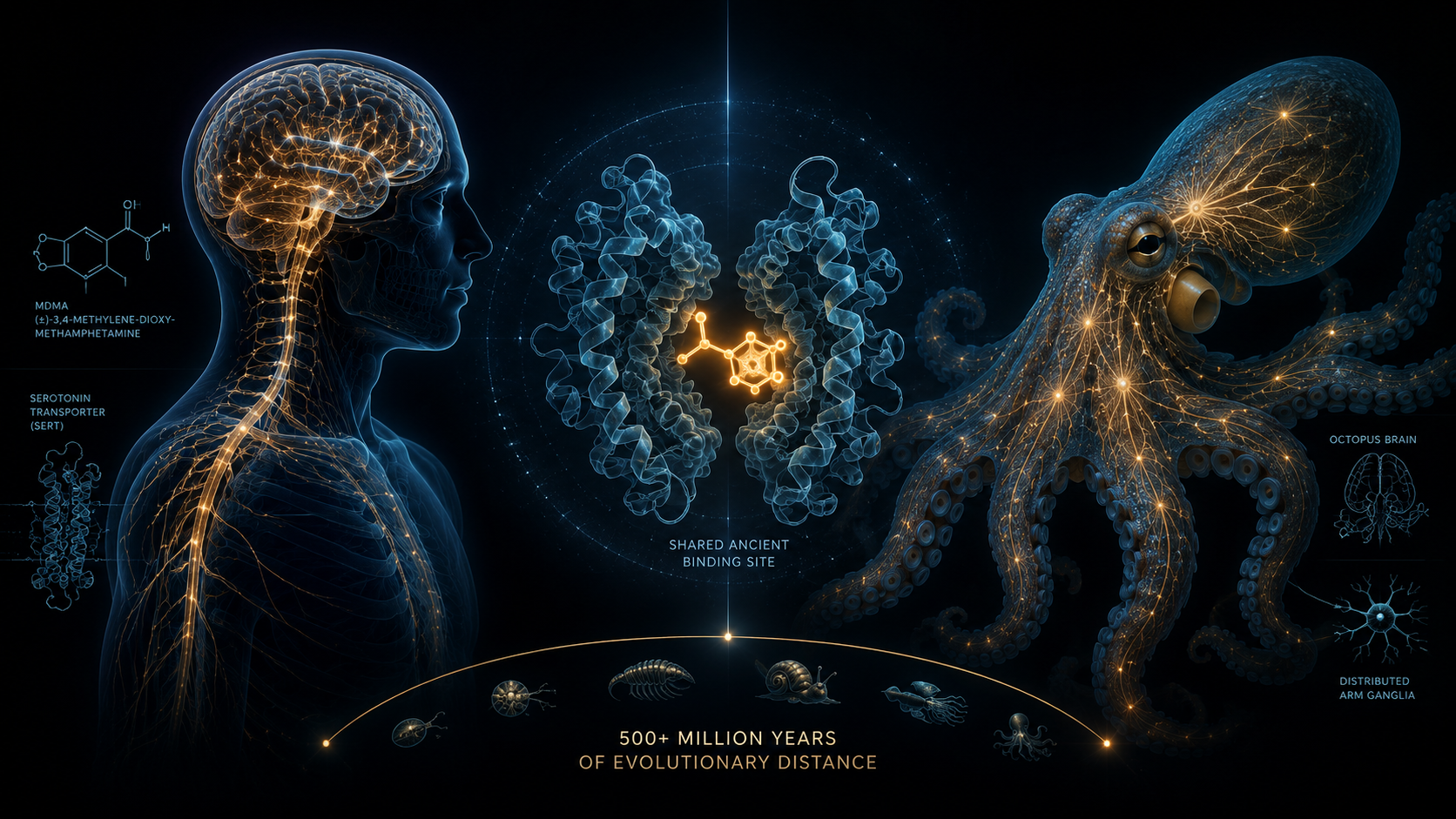
---
## 3\. Methods
Because no behavioural pharmacology protocol existed for octopuses, the researchers had to build one. Rather than injecting MDMA — invasive, stressful, and likely to confound any behavioural readout — they immersed each octopus in seawater containing the compound, allowing absorption through the highly vascularised gill epithelium (Edsinger and Dölen, 2018; Gutnick and Kuba, 2018). The effective dose corresponded approximately to the human low-to-moderate recreational range. Animals were then transferred to clean seawater and tested over a 30-minute window.
The behavioural assay was adapted from the three-chamber social approach test, a paradigm well-established in rodent neuroscience (Yang et al., 2011). A central chamber connected to two flanking chambers: one contained an unfamiliar conspecific under a perforated cage, the other a novel object — initially a *Star Wars* action figure — under an identical cage. Time spent in each chamber, and the quality of interaction, were scored from video.
Two experiments were run. The first (*n* \= 5) established baseline sex-conditioned preferences in drug-naive animals encountering both male and female caged conspecifics. The second (*n* \= 4) used a within-subjects pre-post design to test the effect of MDMA on approach toward a familiar male.
---

## 4\. Results
In the baseline condition, *O. bimaculoides* showed clearly sex-conditioned approach: drug-naive octopuses spent more time in the chamber containing a female conspecific than in the chamber containing a novel object, and conversely tended to avoid the chamber containing a male conspecific, preferring even the object chamber to a male stranger (Edsinger and Dölen, 2018, Figure 3). This pattern is consistent with the species' natural history, in which male–female contact occurs during mating but male–male encounters are typically agonistic, and corroborates earlier behavioural work in the genus (Cigliano, 1993; Hanlon and Messenger, 2018).
The MDMA condition produced a measurable shift. Following exposure, all four animals spent more time in the social chamber with the male conspecific than they had during the pre-trial baseline (Edsinger and Dölen, 2018). More striking, in the authors' qualitative description, was the character of the interaction. Where pre-trial encounters with the caged male had been brief, cautious, and typically conducted at a distance, post-MDMA interactions involved animals approaching the cage directly, draping their arms across its surface, pressing their mouth-parts and ventral suckers against the perforated barrier, and maintaining that contact across extended periods — a posture Dölen has described, in interviews accompanying the publication, as "hugging" the cage (Edsinger and Dölen, 2018, p. 3139; Johns Hopkins Medicine, 2018). The investigators drew an explicit parallel to the increased frequency of affiliative touch reported in human MDMA sessions (Kamilar-Britt and Bedi, 2015).
The combination of the genomic finding — a near-perfectly preserved SERT binding site — and the behavioural finding provided what the authors framed as the first functional evidence that the prosocial effects of serotonergic neurotransmission are conserved across the protostome–deuterostome divide (Edsinger and Dölen, 2018).
---
## 5\. What the Study Shows — and What It Does Not Show
The paper was published alongside an invited commentary by Gutnick and Kuba (2018), and a more pointed methodological critique appeared the following year from Amodio et al. (2019). Together, these responses mark the boundary between what the data plausibly support and what they do not.
### What the data support
The genomic finding is robust. The high conservation of the SERT binding site is a structural fact about two sequenced genomes and is not contingent on the behavioural experiment. There is also a real, measurable behavioural shift: drug-naive octopuses that avoided a caged male conspecific spent more time in that chamber following MDMA exposure, and the direction of the effect matches the predicted serotonergic mechanism. Whatever one thinks of the qualitative gloss, the quantitative shift in approach behaviour did occur.
### Where the data run out
Gutnick and Kuba (2018), themselves cephalopod neuroscientists, were broadly enthusiastic but flagged two issues. First, the description of octopuses as uniformly solitary and cannibalistic is itself a simplification of a behaviourally diverse clade: several species, including *Octopus tetricus* and the larger Pacific striped octopus, exhibit tolerated aggregations and non-aggressive social structures in the wild (Scheel et al., 2017; Rodaniche, 1991; Gutnick and Kuba, 2018). The contrast between "naturally asocial" and "MDMA-induced prosocial" is therefore softer than the headline framing suggests. Second, the immersion delivery method, while elegant, makes precise pharmacokinetic claims difficult; without invasive sampling it is hard to know what plasma concentration of MDMA the octopuses actually achieved.
The more substantive critique came from Amodio, Fiorito, Clayton and Ostojić (2019), writing in *Frontiers in Behavioural Neuroscience*. They raised three concerns. First, sample size: with four animals in the MDMA experiment, statistical power is necessarily low and individual variability dominates any inference. Second, they identified an issue with the way baseline data had been used: through correspondence with the original authors, they established that for three of the seven animals across the study, data from one trial were used both as the endpoint of Experiment 1 and as the baseline for Experiment 2 — a methodological detail not disclosed in the original publication and one that complicates the assumption of independent observations (Amodio et al., 2019). Third, and most damaging to the qualitative claim, they argued that "extensive ventral surface contact" with a caged stimulus is not a social-specific response in octopuses. The species routinely deploys precisely this exploratory repertoire — arm wrapping, mouth-part contact, sucker engagement — toward inanimate objects during foraging, problem-solving, and play (Fiorito et al., 1990; Kuba et al., 2003; Hanlon and Messenger, 2018). Without an MDMA-condition object chamber demonstrating that this behaviour was preferentially directed at conspecifics rather than at any salient stimulus, the qualitative argument for prosociality is, on their reading, undersupported.
> The genomic finding stands. The strong behavioural claim — that this represents the first functional demonstration of evolutionarily conserved prosocial effects — does not yet.
None of this eliminates the possibility that MDMA produces genuinely prosocial effects in *O. bimaculoides*. What the commentaries do is recalibrate confidence, and point clearly to the next experiment: larger samples, an MDMA-condition object control, and a more granular behavioural ethogram.
---
## 6\. Why It Resonated, and What It Means
Before unpacking the deeper implications, it is worth pausing on why this paper found such purchase in the public imagination. The viral life of the Edsinger–Dölen study was not merely a function of its octopuses-on-ecstasy headline. The paper sat at the intersection of three currents in contemporary scientific culture, each carrying its own accumulating momentum.
The first was a rapidly expanding popular appreciation of cephalopod intelligence, catalysed by Godfrey-Smith's *Other Minds* (2016), Sy Montgomery's *Soul of an Octopus* (2015), and a steady stream of viral natural-history footage demonstrating tool use, escape behaviour, and individual recognition. The second was a wholesale reframing of psychedelic and entactogen pharmacology from drugs-of-abuse to candidate therapeutics, exemplified by the parallel progression of MDMA-assisted psychotherapy through Phase 3 trials for PTSD (Mitchell et al., 2021). The third was a broader philosophical interest — increasingly visible in both academic and trade publishing — in whether the basic infrastructure of social and affective experience is older and more widely shared than vertebrate-centric accounts have allowed. The Edsinger and Dölen paper provided, in a single image, a point of synthesis for all three currents. That cultural salience matters: it explains why a methodologically modest study has been disproportionately influential, and it sharpens, rather than dilutes, the importance of getting the underlying claims right.
### 6.1 The shared chemistry of social regulation
Serotonin is one of the oldest signalling molecules in the eukaryotic toolkit. It is found across the animal kingdom and even in plants, where it regulates growth and stress responses (Erland et al., 2016). Its role as a neuromodulator predates the divergence of protostomes and deuterostomes; nematodes, flatworms, molluscs, arthropods and chordates all employ serotonergic signalling in roles regulating arousal, feeding, locomotion, and — as Edsinger and Dölen's work suggests — social engagement (Curran and Chalasani, 2012). The transporter machinery MDMA targets is similarly old. The pharmacological space within which psychedelic and entactogen compounds operate is not a recent vertebrate development but a series of perturbations to regulatory chemistry that has been doing roughly similar work since long before brains in the modern sense existed.
This has implications for how we think about psychedelic pharmacology more generally. Classical serotonergic psychedelics — psilocybin, LSD, DMT, mescaline — act primarily at the 5-HT2A receptor, itself a member of a widely preserved family of G-protein-coupled receptors with homologues across the bilaterian lineage (Nichols, 2016). Receptor antiquity does not, of course, guarantee that subjective experiences mediated by it are phenomenologically comparable across species. But it does undercut a certain anthropocentric framing in which psychedelic states are treated as exotic intrusions on an otherwise stable human cognitive baseline. They may instead be perturbations of regulatory systems that have been shaping the affective and social lives of organisms for a very long time.
### 6.2 The cortex is not a precondition
A persistent assumption in much philosophy of mind, and in some areas of neuroscience, is that the structures necessary for rich conscious experience — and certainly for anything resembling drug-induced affective states — are cortical, or at minimum vertebrate-pallial (Tononi et al., 2016). Cephalopods complicate this assumption considerably. They lack a cortex entirely. Their associative regions, principally the vertical lobe, are organised on different developmental and architectural principles to mammalian pallium, evolved convergently, and yet support a range of behaviours — observational learning, tool use, individual recognition, contingent play, and possibly subjective pain experience — that are difficult to account for without granting some form of integrated experience (Mather, 2019; Schwarz et al., 2024; Crook, 2021).
This argument deserves an immediate counterweight. Behavioural similarity is not subjective similarity. An octopus approaching another octopus under serotonergic modulation does not necessarily imply anything like a human experience of empathy, warmth, or interpersonal bonding. Similar behavioural outputs can emerge from radically different experiential architectures — or, in some philosophical accounts, from no experiential architecture at all (Frankish, 2016). The inference from "this organism's behaviour shifts in the direction ours does, under the same chemical" to "this organism is experiencing what we experience" requires bridging premises that the current data cannot supply. The cephalopod case does not collapse the gap between behaviour and experience; it merely shows that the gap cannot be sealed shut by appeal to neuroanatomy alone.
What the case does establish is more modest but still significant. The structural assumption that affective regulation by serotonergic perturbation requires cortex-like architecture is not safe. The cortex is plausibly sufficient for certain kinds of integrated affective states; it is increasingly difficult to argue that it is necessary. That alone has obvious bearing on how we extend ethical consideration to non-mammalian animals, and on what we should expect from psychedelic studies in invertebrate systems.
### 6.3 Implications for psychedelic research
The Edsinger and Dölen (2018) study sits within a broader and rapidly expanding programme of psychedelic and entactogen research that has moved, in the past decade, from the margins to the mainstream of neuropsychiatric investigation (Carhart-Harris and Goodwin, 2017; Mitchell et al., 2021). Within this programme, animal models have always played a contested role: critics ask, reasonably, whether rodent head-twitch responses or sociability assays can tell us anything meaningful about the subjective and therapeutic dimensions of human psychedelic experience.
The octopus work shifts this conversation in a small but interesting way. It suggests that the chemical substrate of at least one psychedelic-adjacent compound is sufficiently widely preserved that even an organism on a radically different neural plan responds in a directionally similar fashion. This is, on one hand, an argument for taking comparative pharmacology seriously: a behavioural effect appearing across this kind of evolutionary distance is unlikely to be an artefact of vertebrate-specific quirks. On the other hand, it is an argument for epistemic humility about the relationship between behaviour and experience: directional similarity at the behavioural level admits of multiple interpretations.
For the developing field of psychedelic-assisted therapy, the practical takeaway is modest but not trivial. The pharmacological systems being targeted are not idiosyncratically human; they are old regulatory machinery shared across most of the animal kingdom. Treatments that work through these systems are, in this sense, working with deep biology rather than against it.
---
## Conclusion
Edsinger and Dölen's 2018 study is a small, methodologically imperfect, evocative paper. Its sample sizes are modest, its qualitative behavioural analysis is open to the criticisms Amodio and colleagues subsequently levelled, and its dosimetry is approximate. None of this is unusual for an exploratory study opening a new experimental paradigm in a species for which no behavioural pharmacology infrastructure previously existed.
What survives the methodological scrutiny is the genomic finding and the directional behavioural shift. The serotonin transporter binding site that mediates MDMA's prosocial effects in humans is essentially identical in *Octopus bimaculoides*, and acute exposure to MDMA produces a measurable change in conspecific approach behaviour in a normally avoidant species. Across the phylogenetic gulf of more than half a billion years, across the divide between organisms with and without a cortex, across the difference between centralised and partially distributed nervous systems, the same chemical lever appears to move something recognisable. What that something is — at the level of subjective experience, at the level of conscious affect, at the level of whatever it is that makes a human on MDMA reach for another person — remains an open question.
It is, however, a question that the octopus has now made it impossible to dismiss as merely a human one.
---
## References
Albertin, C. B., Simakov, O., Mitros, T., Wang, Z. Y., Pungor, J. R., Edsinger-Gonzales, E., Brenner, S., Ragsdale, C. W. and Rokhsar, D. S. (2015) 'The octopus genome and the evolution of cephalopod neural and morphological novelties', *Nature*, 524(7564), pp. 220–224.
Amodio, P., Fiorito, G., Clayton, N. S. and Ostojić, L. (2019) 'Commentary: A conserved role for serotonergic neurotransmission in mediating social behavior in octopus', *Frontiers in Behavioral Neuroscience*, 13, p. 185.
Andersen, J., Stuhr-Hansen, N., Zachariassen, L., Toubro, S., Hansen, S. M. R., Eildal, J. N. N., Bond, A. D., Bøgesø, K. P., Bang-Andersen, B., Kristensen, A. S. and Strømgaard, K. (2011) 'Molecular determinants for selective recognition of antidepressants in the human serotonin and norepinephrine transporters', *Proceedings of the National Academy of Sciences*, 108(29), pp. 12137–12142.
Carhart-Harris, R. L. and Goodwin, G. M. (2017) 'The therapeutic potential of psychedelic drugs: past, present, and future', *Neuropsychopharmacology*, 42(11), pp. 2105–2113.
Cigliano, J. A. (1993) 'Dominance and den use in *Octopus bimaculoides*', *Animal Behaviour*, 46(4), pp. 677–684.
Crook, R. J. (2021) 'Behavioral and neurophysiological evidence suggests affective pain experience in octopus', *iScience*, 24(3), 102229.
Curran, K. P. and Chalasani, S. H. (2012) 'Serotonin circuits and anxiety: what can invertebrates teach us?', *Invertebrate Neuroscience*, 12(2), pp. 81–92.
Edsinger, E. and Dölen, G. (2018) 'A conserved role for serotonergic neurotransmission in mediating social behavior in octopus', *Current Biology*, 28(19), pp. 3136–3142.e4.
Erland, L. A. E., Turi, C. E. and Saxena, P. K. (2016) 'Serotonin: an ancient molecule and an important regulator of plant processes', *Biotechnology Advances*, 34(8), pp. 1347–1361.
Fiorito, G., von Planta, C. and Scotto, P. (1990) 'Problem solving ability of *Octopus vulgaris* Lamarck (Mollusca, Cephalopoda)', *Behavioral and Neural Biology*, 53(2), pp. 217–230.
Frankish, K. (2016) 'Illusionism as a theory of consciousness', *Journal of Consciousness Studies*, 23(11–12), pp. 11–39.
Godfrey-Smith, P. (2016) *Other Minds: The Octopus and the Evolution of Intelligent Life*. London: William Collins.
Gutnick, T. and Kuba, M. J. (2018) 'Animal behavior: socializing octopus', *Current Biology*, 28(19), pp. R1147–R1149.
Hanlon, R. T. and Messenger, J. B. (2018) *Cephalopod Behaviour*. 2nd edn. Cambridge: Cambridge University Press.
Heifets, B. D. and Malenka, R. C. (2016) 'MDMA as a probe and treatment for social behaviors', *Cell*, 166(2), pp. 269–272.
Hochner, B. (2012) 'An embodied view of octopus neurobiology', *Current Biology*, 22(20), pp. R887–R892.
Ibáñez, C. M. and Keyl, F. (2010) 'Cannibalism in cephalopods', *Reviews in Fish Biology and Fisheries*, 20(1), pp. 123–136.
Johns Hopkins Medicine (2018) *Octopuses given mood drug 'ecstasy' reveal genetic link to evolution of social behaviors in humans*. Press release, 20 September.
Kamilar-Britt, P. and Bedi, G. (2015) 'The prosocial effects of 3,4-methylenedioxymethamphetamine (MDMA): controlled studies in humans and laboratory animals', *Neuroscience and Biobehavioral Reviews*, 57, pp. 433–446.
Kuba, M., Meisel, D. V., Byrne, R. A., Griebel, U. and Mather, J. A. (2003) 'Looking at play in *Octopus vulgaris*', *Berliner Paläobiologische Abhandlungen*, 3, pp. 163–169.
Liechti, M. E. (2014) 'Effects of MDMA on body temperature in humans', *Temperature*, 1(3), pp. 192–200.
Low, P., Panksepp, J., Reiss, D., Edelman, D., Van Swinderen, B. and Koch, C. (2012) *The Cambridge Declaration on Consciousness*. Cambridge: University of Cambridge.
Mather, J. A. (2019) 'What is in an octopus's mind?', *Animal Sentience*, 4(26), p. 1.
Mitchell, J. M., Bogenschutz, M., Lilienstein, A. et al. (2021) 'MDMA-assisted therapy for severe PTSD: a randomized, double-blind, placebo-controlled phase 3 study', *Nature Medicine*, 27(6), pp. 1025–1033.
Montgomery, S. (2015) *The Soul of an Octopus: A Surprising Exploration into the Wonder of Consciousness*. New York: Atria Books.
Nichols, D. E. (2016) 'Psychedelics', *Pharmacological Reviews*, 68(2), pp. 264–355.
Rodaniche, A. F. (1991) 'Notes on the behavior of the larger Pacific striped octopus, an undescribed species of the genus *Octopus*', *Bulletin of Marine Science*, 49(1–2), p. 667.
Scheel, D., Chancellor, S., Hing, M., Lawrence, M., Linquist, S. and Godfrey-Smith, P. (2017) 'A second site occupied by *Octopus tetricus* at high densities, with notes on their ecology and behavior', *Marine and Freshwater Behaviour and Physiology*, 50(4), pp. 285–291.
Schwarz, R., Stark, G., Levin, M., Gutnick, T. and Kuba, M. J. (2024) 'Evolution of cephalopod nervous systems', *Annual Review of Neuroscience*, 47, pp. 79–98.
Shigeno, S., Andrews, P. L. R., Ponte, G. and Fiorito, G. (2018) 'Cephalopod brains: an overview of current knowledge to facilitate comparison with vertebrates', *Frontiers in Physiology*, 9, p. 952.
Tononi, G., Boly, M., Massimini, M. and Koch, C. (2016) 'Integrated information theory: from consciousness to its physical substrate', *Nature Reviews Neuroscience*, 17(7), pp. 450–461.
Yang, M., Silverman, J. L. and Crawley, J. N. (2011) 'Automated three-chambered social approach task for mice', *Current Protocols in Neuroscience*, 56(1), pp. 8.26.1–8.26.16.
### Can Halogenated DMT Analogues Be Non-Hallucinogenic? G-Protein Bias
URL: https://www.ardmt.com/can-halogenated-dmt-analogues-be-non-hallucinogenic-g-protein-bias/
Last updated: 2026-05-13T13:42:14.000Z
One of the more elegant games in medicinal chemistry is the strategic placement of a single atom and the observation of what it does to everything downstream. Today's centrepiece, a preprint from bioRxiv ([DOI 10.1101/2025.06.27.661837](https://doi.org/10.1101/2025.06.27.661837?ref=ardmt.com)), plays precisely this game with the tryptamine scaffold — the molecular backbone shared by DMT, psilocin, serotonin itself, and a great many compounds of pharmacological interest — by introducing halogen atoms at the 2-position of the indole ring and cataloguing the consequences across a panel of serotonin receptors.
### What was done
The authors synthesised a series of 2-halogenated tryptamine analogues — fluorine, chlorine, bromine, and iodine substituents at the C2 position — and profiled their activity at multiple serotonergic targets, with particular attention to 5-HT2A, 5-HT2B, 5-HT2C, and 5-HT1A receptors. The methodology appears to combine radioligand binding assays for affinity measurements with functional assays — calcium mobilisation, β-arrestin recruitment, and in some cases cAMP accumulation — to build a picture not merely of where these compounds bind but of what they do once bound. This is the right approach: binding affinity alone has long been an insufficient predictor of behavioural or therapeutic outcome, and the field has rightly moved towards characterising functional selectivity, or signalling bias, as a more informative descriptor. Several of the analogues were also assessed using head-twitch response assays in mice, the standard (if imperfect) rodent proxy for psychedelic activity mediated via 5-HT2A agonism.
### Key findings
The central observation is that 2-halogenation produces a notably orderly modulation of receptor selectivity and functional activity, tracking, at least partially, with the size and electronic character of the halogen. The smaller halogens — fluorine and chlorine — appear to have preserved or enhanced 5-HT2A binding affinity relative to unsubstituted parent compounds, while the bulkier bromine and iodine substituents introduced more pronounced shifts in selectivity, in some cases steering activity away from 5-HT2A and towards other receptor subtypes or altering the balance between G-protein and β-arrestin signalling pathways. This is precisely the sort of structure-activity relationship data that lets one begin to tease apart which features of the tryptamine scaffold are doing which pharmacological work.
Particularly worth attention is the reported observation that certain 2-chloro and 2-bromo analogues displayed significant signalling bias at 5-HT2A, favouring G-protein coupling over β-arrestin recruitment. This matters because there is an active and increasingly well-supported hypothesis — originating in part from work by Olson, Bhatt, and others — that the therapeutic effects of psychedelics may be dissociable from their hallucinogenic properties, and that signalling bias is one lever by which such dissociation might be achieved. A biased 5-HT2A agonist that promotes neuroplasticity without producing a full psychedelic experience would be, to put it mildly, of considerable clinical interest. Whether these particular analogues achieve that remains to be demonstrated in more sophisticated behavioural and neuroplasticity assays, but the SAR logic is sound.
The head-twitch data, where reported, appear broadly consistent with the in vitro pharmacology: analogues retaining strong 5-HT2A agonism produced robust head-twitch responses, while those with shifted selectivity or reduced efficacy did not. A reassuring internal consistency, though one should note that the head-twitch response captures only one dimension of a compound's psychopharmacological profile.
### What this tells us about DMT
DMT itself is, of course, unsubstituted at the 2-position. Its pharmacology is famously promiscuous — acting at not only 5-HT2A but also 5-HT2C, 5-HT1A, sigma-1, and trace amine-associated receptors, among others — and this polypharmacology is increasingly thought to be not a messy side-effect but a central feature of its action. What the present study offers is a kind of negative-space portrait of DMT's pharmacology: by showing what changes when you place a halogen at C2, it illuminates what the unsubstituted state is doing. The fact that even a fluorine — the smallest halogen, often considered a near-isosteric replacement for hydrogen — appears to produce measurable shifts in receptor selectivity suggests that the electronic environment around the 2-position is rather sensitively read by the binding pockets of serotonin receptors. This is a useful constraint for computational modelling efforts and for future medicinal chemistry campaigns aiming to dial specific receptor interactions up or down.
### Caveats
This is a preprint, not yet peer-reviewed, and the usual cautions apply. The in vivo data appear limited to the head-twitch response; there are no neuroplasticity measurements, no assessments of subjective-like states via more nuanced behavioural paradigms, and no pharmacokinetic data that would indicate whether these compounds are viable beyond the bench. The signalling bias observations, while intriguing, depend heavily on the specific assay platform and reference agonist used — quantified bias can shift meaningfully between systems, and the field has been burned by this before. Still, as a piece of systematic SAR work at the tryptamine 2-position, it is thorough, clearly presented, and fills a genuine gap.
### Also worth a glance
A validated dispersive liquid-liquid microextraction method for detecting DMT and β-carbolines in human hair ([PMID 41628561](https://pubmed.ncbi.nlm.nih.gov/41628561/?ref=ardmt.com)) — niche but genuinely useful for forensic applications and for any longitudinal study wanting to verify ayahuasca exposure without relying on participant recall. Separately, a rather charming paper ([PMID 42100741](https://pubmed.ncbi.nlm.nih.gov/42100741/?ref=ardmt.com)) demonstrates that machine learning classifiers can recover indigenous folk classifications of *Banisteriopsis caapi* varieties from digitised herbarium leaf morphology, suggesting that traditional taxonomic knowledge encodes real and measurable botanical distinctions. A small vindication for ethnobotanical epistemology.
### Marginalia
There is something philosophically pleasing about the idea that a single halogen atom, dropped onto the edge of the indole ring, can redirect a molecule's entire pharmacological conversation with the brain — a reminder that the tryptamine scaffold, for all its apparent simplicity, is an exquisitely tuned antenna. The serotonin system listens closely.
### Long-Term Ayahuasca: Personality Shifts, Cognition Intact (Bouso)
URL: https://www.ardmt.com/long-term-ayahuasca-personality-shifts-cognition-intact-bouso/
Last updated: 2026-05-13T13:40:37.000Z
José Carlos Bouso and colleagues have been quietly assembling one of the more careful pictures of what chronic ayahuasca use does — and does not do — to the human brain, and their latest contribution, now indexed in *European Neuropsychopharmacology*, lands a result that is at once unsurprising to those who have followed this thread and usefully clarifying for those who have not: long-term, ritualised ayahuasca consumption does not appear to erode cognitive function, but it does leave a detectable signature in personality ([PMID 41687467](https://pubmed.ncbi.nlm.nih.gov/41687467/?ref=ardmt.com)). The twist, and the reason the paper earns its title, is the inclusion of a chronic cannabis comparison group — a design choice that lets one ask whether any observed differences are peculiar to ayahuasca or merely artefacts of being the sort of person who regularly consumes psychoactive plants in a structured social context.
### What was done
The study is cross-sectional, which is worth stating early because it governs everything that can and cannot be concluded. Bouso's group recruited three cohorts — chronic ayahuasca users, chronic cannabis users, and non-using controls — and administered a battery of neuropsychological tests alongside standardised personality measures. The senior author is Jordi Riba, a pharmacologist whose earlier work with ayahuasca neuroimaging and acute dosing studies is well known. The collaboration with Brazilian co-authors (Rafael G. dos Santos, Jaime Hallak) situates the ayahuasca arm within the ritual-use populations — members of syncretic churches such as the Santo Daime and União do Vegetal traditions — that have been studied since the mid-1990s. This is a not-insignificant methodological advantage: these are not naïve participants dabbling in retreat-centre tourism but individuals with years, sometimes decades, of regular exposure.
### Key findings
On cognition — working memory, attention, executive function, verbal fluency, and the usual suspects of a neuropsychological screening — the three groups did not meaningfully differ. This is consistent with the accumulating evidence base, including Bouso's own earlier work and the broader reviews by dos Santos and Hallak, which have repeatedly failed to find ayahuasca-associated cognitive deficits in church-member populations. That the cannabis group also showed no clear impairment relative to controls on these measures will raise eyebrows among those familiar with the cannabis-cognition literature; one suspects that careful matching on education and socioeconomic status may account for some of the discrepancy with studies reporting cannabis-related executive function decrements.
Personality is where the groups diverge. The title promises that personality "distinguishes" both user groups from controls, and the paper appears to find that ayahuasca and cannabis users each differ from non-users on personality dimensions, though presumably along different profiles. The critical interpretive question — one the authors are certainly aware of — is whether chronic use *shifts* personality or whether pre-existing traits predispose individuals toward seeking out these substances in the first place. A cross-sectional design cannot adjudicate. It can only note the association and gesture at prospective work that might settle the matter.
### Where this sits
The safety profile of long-term ritual ayahuasca use has been examined for nearly three decades, beginning with the Hoasca Project in the mid-1990s and continuing through a series of Brazilian and Spanish studies. The general picture is decidedly benign: no evidence of neurotoxicity, no persistent psychopathology attributable to use, and — now reiterated here — no cognitive decline. This matters not merely as a curiosity of ethnopharmacology but because DMT-containing ayahuasca is being actively developed as a therapeutic intervention for depression and other conditions; regulators will want to know whether chronic exposure carries hidden costs. The personality findings, meanwhile, echo the broader psychedelic literature, where increased openness and related traits are among the most replicated psychological sequelae of serotonergic psychedelic use, whether acute or repeated.
The limitations are standard but real. Self-selection bias is the elephant. Church members who thrive under regular ayahuasca use and remain in the community for years may simply be temperamentally different from those who try it once and leave, let alone from the general population. The cannabis comparison partially mitigates this, but only partially. And cross-sectional personality data, absent a pre-use baseline, can only ever suggest rather than demonstrate causation.
### Also worth a glance
A paper on the serotonergic polypharmacology of 2-halogenated tryptamines ([PMID 42079221](https://pubmed.ncbi.nlm.nih.gov/42079221/?ref=ardmt.com)) maps functional selectivity across the tryptamine scaffold at multiple serotonin receptor subtypes — directly relevant to understanding DMT's receptor pharmacology, though the work is *in vitro* only and awaits behavioural validation. Separately, a systematic review examines ayahuasca therapy and possible reduction of suicidal ideation in treatment-resistant depression ([PMID 42023657](https://pubmed.ncbi.nlm.nih.gov/42023657/?ref=ardmt.com)), a clinically urgent question hampered by the still-modest size of the evidence base it draws upon.
### Marginalia
It is a peculiar feature of psychedelic research that we spend enormous effort asking whether these substances damage cognition and comparatively little asking whether the personality changes they appear to foster are, on balance, welcome. One can imagine a substance that leaves your IQ untouched while rendering you insufferably transcendent. Whether that counts as a side effect or a benefit probably depends on whom you ask — and, perhaps more to the point, on whom you live with.
### Ayahuasca vs Meditation: Two Routes to Ego Dissolution?
URL: https://www.ardmt.com/ayahuasca-vs-meditation-two-routes-to-ego-dissolution/
Last updated: 2026-05-13T13:39:41.000Z
One of the more persistent questions in consciousness research — and one that psychedelic science keeps bumping into without quite resolving — is whether the dissolution of ordinary self-referential processing achieved through pharmacological means is genuinely the same phenomenon as that achieved through contemplative practice, or merely a phenomenological lookalike. The word "ego dissolution" gets deployed with cheerful imprecision across both domains, covering everything from the fleeting loss of body-boundary on a high dose of psilocybin to the hard-won equanimity of a twenty-year Vipassana practitioner. A comparative study in *Human Psychopharmacology* from Arqueros, Soler, Cebolla, Garcia-Campayo, Domínguez-Clavé, and Pascual ([PMID 42083787](https://pubmed.ncbi.nlm.nih.gov/42083787/?ref=ardmt.com); doi: 10.1002/hup.70046) attempts to bring some empirical discipline to this comparison, and the framing is rather good even where the answers remain tentative.
### What was done
The study examines what the authors call "hypo-egoic features" — a construct drawn from the social-psychological work of Mark Leary and colleagues, referring to states characterised by diminished self-focused attention, reduced defensive self-processing, and a loosening of the grip that narrative identity exerts on moment-to-moment experience. The term is more specific than "ego dissolution" and arguably more useful, since it avoids the implicit claim that the self has been annihilated and instead describes a graded reduction in egoic functioning. The authors compare these features as they manifest in experienced ayahuasca users against those found in long-term meditation practitioners, with the psychedelic session and the meditation session as their respective eliciting contexts. The design is a between-groups comparison rather than a crossover, which limits causal inference but is pragmatically sensible given the populations involved. The paper is indexed for MEDLINE as of early May 2026, received in December 2025 and accepted April 2026, so it has been through the usual editorial gauntlet — though full-text detail on sample size, specific scales, and session parameters will matter considerably for evaluating the findings.
### Why the framing matters
The central value of this study lies less in any single result than in the operationalisation of hypo-egoic experience as a measurable, multi-dimensional construct applicable across both pharmacological and contemplative contexts. Most prior comparative work has relied on the Mystical Experience Questionnaire or the Ego Dissolution Inventory — instruments developed primarily within the psychedelic paradigm and then awkwardly retrofit onto meditation. By grounding the comparison in Leary's hypo-egoic framework, which was not designed with either psychedelics or meditation specifically in mind, the authors sidestep some of the circularity that has plagued the field. The question becomes not "do both groups report mystical experiences?" but rather "do both groups show the same pattern of reduced self-referential processing, and if so, through which dimensions?"
### What the comparison might reveal
If ayahuasca and meditation produce overlapping but distinguishable profiles of hypo-egoic experience, that would be a genuinely informative result. It would suggest that the pharmacological route — flooding serotonin 2A receptors and disrupting default mode network coherence — and the contemplative route — gradually training attentional disengagement from self-referential thought — converge on a similar phenomenological neighbourhood but arrive via different streets, and perhaps park in slightly different spots. One might expect, for instance, that ayahuasca sessions produce more acute perceptual boundary dissolution and less volitional control over the process, whilst meditation yields a more stable, meta-cognitively accessible form of reduced self-focus. Whether the data bear this out is the key empirical question, and one the abstract alone cannot settle.
### Caveats and context
The between-groups design is the obvious limitation. Experienced ayahuasca users and long-term meditators differ in countless ways beyond their chosen practice — personality, motivation, cultural context, expectation — and without random assignment or a within-subject crossover, the study cannot isolate mechanism. It is, in effect, a careful phenomenological comparison of two self-selected populations, which is useful but not decisive. The study sits within the broader Barcelona–Zaragoza axis of Spanish psychedelic research; Soler, Pascual, and Garcia-Campayo have all contributed substantially to previous ayahuasca and mindfulness work. This is a group with form in the area, which lends credibility to the design choices but also means readers should watch for theoretical commitments carried over from earlier publications. One would also want to know how ayahuasca dosing was standardised, and whether the meditation sessions were of comparable duration and intensity — ecological validity and experimental control pull in opposite directions here, as they always do.
The broader relevance is clear enough. As psychedelic-assisted therapy expands, understanding precisely which components of the psychedelic experience are therapeutically active — and whether those components can be achieved, enhanced, or sustained through contemplative training — becomes a practical clinical question, not merely a philosophical one.
### Also worth a glance
A study in *European Neuropsychopharmacology* ([PMID 41687467](https://pubmed.ncbi.nlm.nih.gov/41687467/?ref=ardmt.com)) reports that personality traits, rather than cognitive performance, distinguish chronic ayahuasca and cannabis users from non-users — a finding that complements the centrepiece's phenomenological focus and raises the usual chicken-and-egg question about whether the substance shapes the person or the person selects the substance. Separately, a paper on the serotonergic polypharmacology of 2-halogenated tryptamines ([PMID 42079221](https://pubmed.ncbi.nlm.nih.gov/42079221/?ref=ardmt.com)) will interest readers tracking structure-activity relationships in the tryptamine family, offering receptor-level data on compounds structurally adjacent to DMT itself.
### Marginalia
There is something faintly comic about the fact that both the psychedelic community and the meditation community tend to claim ownership of ego dissolution, each regarding the other's version as either a shortcut or a slow detour. The hypo-egoic framework, by refusing to privilege either route, may be the diplomatic construct the field needs. Whether either community will accept the diplomacy is another matter entirely.
### 2-Halogenated Tryptamines: How One Atom Reshapes DMT Pharmacology
URL: https://www.ardmt.com/2-halogenated-tryptamines-how-one-atom-reshapes-dmt-pharmacology/
Last updated: 2026-05-13T13:38:14.000Z
One of the quieter pleasures of medicinal chemistry is watching what happens when you swap a single atom on a familiar molecule and the pharmacology rearranges itself like furniture in a room you thought you knew. A preprint from von Salm, McCorvy, Baumann and colleagues does precisely this with the tryptamine scaffold — the very backbone of DMT — by systematically introducing halogen atoms at the 2-position and measuring what the resulting compounds do across a broad panel of serotonin receptors and transporters. The work, deposited on bioRxiv, has not yet been peer-reviewed, but the dataset appears extensive enough to warrant careful attention.
### What was done
The study profiles a series of 2-halogenated tryptamines — compounds in which a fluorine, chlorine, bromine, or iodine atom is placed at the 2-position of the indole ring, which in DMT itself is unsubstituted. This is a position of some structural sensitivity: it sits adjacent to the 3-position where the ethylamine side chain attaches, meaning that even modest steric or electronic perturbations here can ripple outward into how the molecule docks at receptor binding pockets. The team evaluated these analogues using radioligand binding assays, functional assays measuring G-protein and β-arrestin signalling at multiple 5-HT receptor subtypes (including 5-HT2A, 5-HT2B, and 5-HT2C), and monoamine transporter uptake and release assays. The approach is thoroughgoing — not merely asking *does it bind?* but *what does it do when it binds, and through which pathway?*
### Key findings
The headline result, insofar as one can extract a headline from a structure-activity relationship study, is that halogenation at the 2-position appears to modulate receptor selectivity and functional efficacy across the serotonergic system in ways not trivially predictable from halogen size or electronegativity alone. Smaller halogens — fluorine in particular — seem to preserve or modestly enhance 5-HT2A receptor affinity relative to the parent tryptamine, while larger halogens progressively shift the selectivity profile, in some cases reducing 5-HT2A engagement whilst altering activity at 5-HT2B and 5-HT2C subtypes. The functional data are where things become genuinely interesting: some analogues appear to show altered ratios of G-protein versus β-arrestin recruitment at the same receptor, suggesting that even conservative structural modifications at this position can re-sculpt the downstream signalling landscape.
The transporter data add another dimension. Several 2-halogenated analogues appear to retain activity at the serotonin transporter (SERT), though potency and mechanism — uptake inhibition versus substrate-type release — vary with halogen identity. This matters because DMT itself interacts with SERT, and the interplay between receptor-mediated and transporter-mediated serotonergic effects remains incompletely understood.
### What this tells us about DMT
DMT is promiscuous. It does not confine itself to the 5-HT2A receptor, despite the field's occasional rhetorical habit of implying otherwise. It engages 5-HT2C, 5-HT1A, sigma-1 receptors, trace amine-associated receptors, and monoamine transporters. The value of work like this lies in its capacity to dissect that polypharmacology by showing how small perturbations to the shared scaffold redistribute activity across targets. If a fluorine atom at C-2 preserves 5-HT2A binding but shifts the signalling bias, that tells us something about the geometry of the DMT–5-HT2A interaction that a simple binding affinity number cannot. If a bromine atom reroutes the molecule toward 5-HT2C selectivity, one gains a chemical tool for asking what 5-HT2C activation contributes to — or detracts from — the DMT experience independently of 5-HT2A.
The work sits within a broader SAR tradition that includes the well-characterised 4- and 5-substituted tryptamines (psilocin, bufotenine, 5-MeO-DMT), but the 2-position has been comparatively neglected, in part because synthetic access is less straightforward. The preprint therefore fills a genuine gap in the chemical map.
### Caveats
The usual ones apply, and they are not trivial. This is *in vitro* pharmacology. Receptor binding and functional assays in cell lines are necessary but not sufficient to predict what these compounds would do in a living brain, where expression patterns, receptor reserve, desensitisation kinetics, and metabolism all intervene. No behavioural data — head-twitch response, locomotor assays, or anything resembling a psychedelic bioassay — are reported. The preprint has not undergone peer review, and while the methods described appear robust, independent replication and expert scrutiny of the functional assay conditions would strengthen confidence in the selectivity and bias profiles reported. One should hold the specific numbers lightly whilst taking the overall pattern seriously.
It is also worth noting that 2-halogenated tryptamines are not merely academic curiosities; some have appeared in forensic contexts as novel psychoactive substances, lending the work an additional practical dimension.
### Also worth a glance
A cross-sectional study in *Human Psychopharmacology* compares ego-dissolution features between ayahuasca use and long-term meditation practice, finding overlapping but distinguishable hypo-egoic phenomenology — a useful if methodologically constrained data point for mapping the experiential territory DMT occupies ([PMID 42083787](https://pubmed.ncbi.nlm.nih.gov/42083787/?ref=ardmt.com)). Separately, a validated dispersive liquid-liquid microextraction method for detecting DMT and β-carbolines in human hair has been published, offering forensic and longitudinal-exposure researchers a potentially practical analytical tool ([PMID 41628561](https://pubmed.ncbi.nlm.nih.gov/41628561/?ref=ardmt.com)).
### Marginalia
There is something faintly humbling about the discovery that an atom roughly the size of hydrogen's slightly heavier cousin, slotted into one position on a molecule with only a dozen or so heavy atoms, can rearrange the entire signalling conversation between that molecule and a receptor. It reminds one that pharmacology, at bottom, is architecture — and that the architect's margin of error is measured in ångströms.
### UCL's UNITy Trial: Can DMT Disrupt Alcohol Memory Reconsolidation?
URL: https://www.ardmt.com/ucls-unity-trial-can-dmt-disrupt-alcohol-memory-reconsolidation/
Last updated: 2026-05-13T13:37:11.000Z
One of the more quietly radical ideas in contemporary addiction neuroscience is that a problematic drinking habit is not merely a pattern of behaviour but, in some non-trivial sense, a *memory* — a consolidated associative trace linking environmental cues to reward expectation, stored in synaptic architecture that can, under the right conditions, be destabilised and rewritten. The theory of memory reconsolidation holds that when such a trace is reactivated (by, say, the sight and smell of one's preferred tipple), it enters a brief labile window during which it is susceptible to disruption before being re-stored. Interfere pharmacologically during that window, and you might weaken the memory's grip on future behaviour. It is a tidy hypothesis, and it has generated some genuinely interesting work with propranolol and ketamine. Now a team at University College London wants to know whether DMT can do the same job — and whether it might do it rather better.
### The UNITy trial
The study in question — [ISRCTN13970288](https://www.isrctn.com/ISRCTN13970288?ref=ardmt.com), registered August 2024 and currently recruiting — carries the backronym UNITy, for "Understanding Neuroplasticity Induced by TrYptamines," which is the sort of acronym one either admires or quietly deplores, depending on temperament. The design is a 2×2 factorial, placebo-controlled, with participants randomised to four arms: DMT plus alcohol memory reactivation, DMT plus control (non-alcohol) memory reactivation, placebo plus alcohol memory reactivation, and placebo plus control reactivation. The target sample is 120 non-treatment-seeking excessive drinkers, block-randomised to keep group sizes balanced at interim milestones of 40, 80, and 120\. The active drug is 25 mg of *N,N*\-dimethyltryptamine fumarate, delivered intravenously as a 2.5 mg/ml solution over ten minutes — a dose and route consistent with the controlled infusion paradigm that produces an immersive psychedelic state of manageable duration.
The behavioural manipulation is the critical piece. In the alcohol memory reactivation condition, participants are exposed to their preferred alcoholic drink and associated visual cues — a procedure designed to render the reward memory labile, opening the reconsolidation window. In the control condition, the same temporal structure is followed but with non-alcohol stimuli, so the reward trace should remain consolidated and, in principle, unperturbed. By crossing drug with reactivation, the trial can tease apart whether any observed reduction in subsequent drinking is attributable to DMT's neuroplastic effects during the reconsolidation window specifically, to DMT alone (perhaps via some broader motivational or insight-related mechanism), to memory reactivation alone, or to neither.
This is a genuinely important distinction, and one that the broader psychedelic-assisted therapy literature has largely failed to make. The standard model in trials of psilocybin or MDMA for addiction or PTSD pairs the drug with extensive psychotherapy, making it essentially impossible to attribute outcomes to pharmacology, to therapy, or to the interaction. UNITy, by contrast, tests a *specific mechanistic hypothesis*: that DMT disrupts the reconsolidation of alcohol reward memories, and that this disruption — rather than mystical experience, narrative insight, or therapeutic alliance — is what changes drinking behaviour. The factorial design is the right tool for the question.
### Where it sits in the literature
The reconsolidation-interference approach to addiction has precedent. Das and colleagues at UCL — the same group, one notes — have published work suggesting that propranolol administered after alcohol memory reactivation reduced subsequent beer consumption in hazardous drinkers, and a parallel line of work by Bhatt and colleagues has explored ketamine as the interfering agent. DMT is a logical next candidate: it is a potent 5-HT2A agonist, it appears to promote structural neuroplasticity (dendritic arbourisation, spinogenesis) via TrkB and mTOR signalling pathways, and its short duration of action — roughly twenty to thirty minutes for an intravenous infusion — makes it far more practical in a laboratory setting than psilocybin's four-to-six-hour commitment. If the plasticity triggered by 5-HT2A activation is what destabilises the reactivated trace, DMT may offer a tighter temporal coupling between reactivation and disruption than longer-acting psychedelics could.
There are, naturally, questions. The sample comprises non-treatment-seeking excessive drinkers, which is epidemiologically important but means the findings may not generalise straightforwardly to people with severe alcohol use disorder. The primary outcomes are not yet detailed in the registry entry with full specificity, and one would want to see how drinking is measured — timeline followback, biomarkers, or both — and over what follow-up period. The ten-minute infusion protocol, while established, will produce marked acute subjective effects that may compromise blinding in the active drug arms — a perennial headache in psychedelic trials, and one that no amount of clever design has fully resolved. The registry entry specifies a buffer solution as placebo; whether this proves adequate for maintaining the blind will matter a great deal for the interpretability of results.
If UNITy delivers a clean interaction effect — DMT reducing drinking specifically when combined with memory reactivation — it would be a decidedly striking result, one that shifts the conversation about psychedelics and addiction away from the somewhat vague invocation of "transformative experiences" and towards a tractable, testable neuroscience. If the DMT-alone arm also shows effects independent of reactivation, the picture becomes more complicated but no less interesting. Either way, the design is unusually rigorous for this stage of the field, and the trial deserves close watching as recruitment proceeds.
### Also worth a glance
A recent paper on serotonergic structure-activity relationships examines 2-halogenated tryptamines and their polypharmacology across serotonin receptor subtypes ([PMID 42079221](https://pubmed.ncbi.nlm.nih.gov/42079221/?ref=ardmt.com)) — directly relevant for anyone tracking how small modifications to the tryptamine scaffold alter receptor binding profiles in DMT's immediate chemical neighbourhood. Separately, a study in *Human Psychopharmacology* compares hypo-egoic features — ego dissolution and related phenomena — between ayahuasca and meditation practitioners ([PMID 42083787](https://pubmed.ncbi.nlm.nih.gov/42083787/?ref=ardmt.com)), finding overlapping but distinguishable phenomenologies; modest in scale but a useful data point for the experiential cartography.
### Marginalia
There is something pleasingly honest about a trial that recruits people who are *not* seeking treatment. It sidesteps the expectancy effects and demand characteristics that haunt studies of volunteers who have already decided they want to change, and it asks whether a pharmacological intervention can shift behaviour in people who have not yet framed their drinking as a problem. If it works in that population, one suspects something genuinely mechanistic is happening beneath the level of intention. That would be worth knowing.
### DMT EEG: Alpha Power Outperforms Lempel-Ziv Complexity (Timmermann)
URL: https://www.ardmt.com/dmt-eeg-alpha-power-outperforms-lempel-ziv-complexity-timmermann/
Last updated: 2026-05-13T13:36:03.000Z
One of the more quietly consequential findings in recent psychedelic neuroscience has been the association between Lempel–Ziv complexity (LZc) and the intensity of subjective experience under psychedelics — a relationship that has been elevated, in some quarters, to something approaching a neural signature of expanded consciousness. The new paper from Timmermann and colleagues at Exeter, published in the *Journal of Cognitive Neuroscience* ([DOI 10.1162/jocn.a.2423](https://doi.org/10.1162/jocn.a.2423?ref=ardmt.com)), does not so much demolish this claim as politely rearrange the furniture around it. The rearrangement is significant enough to merit close attention.
### Design and method
The study enrolled 19 healthy participants in a repeated-measures, within-subject design comparing intravenous DMT freebase at two doses — 20 mg and 40 mg — against saline placebo, administered in counterbalanced, double-blind fashion. EEG was recorded throughout, and the investigators deployed a methodological innovation worth emphasis: Temporal Experience Tracing (TET), a technique whereby participants provide a continuous, time-resolved account of experiential intensity by manipulating a slider in real time during the session. This is not a post-hoc questionnaire, nor a single peak-intensity rating; it yields a temporal curve that can be correlated, moment by moment, with concurrent neural signals. Under DMT — a compound whose subjective arc is notoriously compressed, steep, and difficult to capture with conventional instruments — this represents a genuine methodological advance. The authors should be credited for making it work in a context where participants are, to put it mildly, otherwise occupied.
### Key findings
The result that will provoke the most discussion concerns the relative explanatory power of different EEG-derived measures in tracking the moment-to-moment intensity of the DMT experience. Alpha power suppression and permutation entropy emerged as the strongest time-resolved correlates of subjective intensity at both doses. Lempel–Ziv complexity — the metric most frequently cited in the psychedelic complexity-consciousness literature — was, by the authors' analysis, the weakest correlate of the three. It still showed dose-dependent changes and was not absent from the picture, but when placed in direct competition with alpha desynchronisation and permutation entropy for explaining the temporal dynamics of experience, it came last.
This matters because LZc has been doing rather a lot of theoretical heavy lifting in recent years. It has been invoked as evidence for the entropic brain hypothesis, used to draw connections between psychedelic states and other altered states of consciousness, and cited in arguments about the relationship between neural complexity and phenomenal richness. The present findings do not refute any of these claims outright, but they suggest that the relationship between LZc and subjective experience under DMT is less tight, less temporally precise, and possibly less specific than has been assumed. Alpha power — a far older, less glamorous measure — appears to do more of the explanatory work, at least in this dataset.
The dose-dependent dimension adds further texture. Differences between 20 mg and 40 mg were apparent across multiple EEG measures and in the TET intensity curves, and the 40 mg condition produced neural changes that were not simply scaled-up versions of those at 20 mg. This is useful: most prior DMT neuroimaging work has employed a single dose, and the assumption that effects scale linearly is precisely the sort of thing that requires empirical rather than intuitive support.
### Caveats and context
The sample of 19, while reasonable for a repeated-measures pharmacological EEG study, is not large enough to settle the matter. EEG source localisation is inherently limited, and the TET method, though clever, introduces its own confounds — participants must retain sufficient motor and cognitive capacity to operate a slider, which at 40 mg of DMT is no small ask. It is at least conceivable that the moments of most intense experiential alteration are precisely those least likely to be captured by any concurrent self-report measure. The authors are aware of this and discuss it frankly. One should also note that permutation entropy and LZc, while conceptually distinct, are not wholly independent; both index aspects of signal complexity, and the superiority of one over the other may partly reflect methodological choices about parameters, epoch length, and frequency bands rather than deep facts about consciousness.
Still, the study sits within a growing body of work — much of it from the same group — that is gradually building a more nuanced picture of DMT's neural pharmacodynamics than the field possessed five years ago. The TET methodology in particular deserves wider adoption. If one is going to make claims about the temporal relationship between brain states and experience, one needs temporally resolved measures of both, and this paper delivers on that front more convincingly than most.
### Also worth a glance
A conference abstract from an Exeter-affiliated group ([DOI 10.1093/esj/aakag023.1209](https://doi.org/10.1093/esj/aakag023.1209?ref=ardmt.com)) reports that DMT inhibits spreading depolarisation in brain slices from sigma-1 receptor knockout mice — a surprising result that, if confirmed, would redirect attention towards aminergic mechanisms rather than S1R-mediated neuroprotection in the DMT-for-stroke pipeline. Separately, a systematic review and meta-analysis in the *Journal of Psychopharmacology* ([DOI 10.1177/02698811261430518](https://doi.org/10.1177/02698811261430518?ref=ardmt.com)) pools DMT and 5-MeO-DMT studies for substance misuse outcomes, arriving at a Hedges' *g* of 0.94 — a large effect, though the authors themselves flag high heterogeneity and considerable risk of bias, making this more a baseline marker than a vindication.
### Marginalia
There is something rather pleasing about the possibility that alpha power — discovered by Hans Berger in 1929 and briefly fashionable before being overshadowed by nearly everything else in electrophysiology — may turn out to be a better tracker of the psychedelic state than the more theoretically modish complexity measures. Neuroscience has a habit of rediscovering old instruments. Sometimes the best map of unfamiliar territory is drawn with the pencil you already own.
### DMT and Ayahuasca Clinical Trials: 2026 Pipeline Scoping Review
URL: https://www.ardmt.com/dmt-and-ayahuasca-clinical-trials-2026-pipeline-scoping-review/
Last updated: 2026-05-13T13:33:47.000Z
A scoping review published this week in *Clinical Pharmacology & Therapeutics* by Stojanović, Nilsson, Fredriksson, Schiöth, and Moulin ([PMID 42104189](https://pubmed.ncbi.nlm.nih.gov/42104189/?ref=ardmt.com)) attempts something deceptively simple: to catalogue every registered clinical trial involving ayahuasca or N,N-dimethyltryptamine and ask what, collectively, they tell us about the state of the translational pipeline. The answer, as with most honest audits, is both encouraging and slightly sobering.
### What was done
The authors conducted a systematic search of major trial registries — ClinicalTrials.gov, the WHO's International Clinical Trials Registry Platform, and associated national portals — using standardised terms for DMT, ayahuasca, and related formulations. The methodology follows PRISMA-ScR guidelines for scoping reviews, meaning the aim was breadth of mapping rather than meta-analytic synthesis. They extracted data on trial phase, intervention type, clinical indication, recruitment status, geographical location, sponsor type, and whether results had been published in any form. This is, in effect, a census of the field's ambitions as declared to regulators and the public — which is a rather different thing from its published achievements.
### What emerges
The landscape appears to be dominated by early-phase work. One would expect the majority of registered trials to sit at Phase I or Phase I/II, concerned primarily with safety, tolerability, and dose-finding — the pharmacological groundwork that must precede any serious efficacy claim — and the review seems to confirm this. A smaller but apparently growing cohort of Phase II trials is reported to target treatment-resistant depression, with a handful addressing other indications such as substance use disorders and end-of-life distress. The geographical spread is notable: Brazil and the United States appear to account for a large share, but there is visible activity across Europe, with Uppsala — the senior authors' own institution — among the contributing centres.
The formulation question is worth pausing on. Pure DMT administered intravenously — the approach pioneered by Strassman in the 1990s and now being refined by several commercial programmes — appears to account for a significant tranche of the registered trials, but ayahuasca in its traditional oral preparation remains well represented, particularly in Brazilian registries. A third category, encompassing extended-release or continuous-infusion DMT protocols designed to prolong the experience beyond the famously brief intravenous flash, seems to be appearing in registry entries, though most of these are reported to remain in recruitment or pre-recruitment phases. This tripartite division — bolus IV, oral brew, and extended infusion — reflects genuine pharmacological and philosophical divergences about what kind of DMT experience might prove therapeutically useful. The field has not yet converged on an answer.
Perhaps the most instructive finding concerns the gap between registration and publication. A substantial proportion of completed trials appear not yet to have yielded peer-reviewed results. This is not unique to the psychedelic space — the so-called "file drawer problem" afflicts all of clinical research — but in a field this young, where every completed dataset is disproportionately valuable, the opacity is frustrating. Some of these may be working their way through the publication pipeline; others may represent negative or ambiguous results that sponsors are less eager to share. Either way, the review usefully names the problem and quantifies its scale.
### Limitations and context
A scoping review is, by design, a map rather than a verdict. Stojanović and colleagues do not assess the quality of individual trials, nor can they tell us much about the results of those that remain unpublished — they can only flag the absence. There is also the perennial difficulty that registry entries vary enormously in completeness and accuracy; a trial's registered protocol may bear only a passing resemblance to what was ultimately conducted. Still, as a snapshot of where the DMT clinical enterprise actually stands in mid-2026 — as opposed to where conference keynotes and investor decks might wish it to stand — the review is genuinely useful. It confirms that the pipeline is real but thin, that most work remains early-phase, and that the field's publication practices could do with the same rigour it increasingly demands of its dosing protocols.
The placement in *Clinical Pharmacology & Therapeutics* is itself a small marker of legitimacy. This is a journal that speaks to the regulatory and translational mainstream, not to psychedelic enthusiasts, and its editors evidently judged the review worth their readers' attention. That counts for something.
### Also worth a glance
Von Salm, McCorvy, Baumann, and colleagues report on the serotonergic pharmacology of 2-halogenated tryptamines ([PMID 42079221](https://pubmed.ncbi.nlm.nih.gov/42079221/?ref=ardmt.com)), a structure–activity study directly adjacent to the DMT scaffold that maps how even small halogen substitutions at the 2-position shift receptor selectivity and functional efficacy across the serotonin receptor family — useful reading for anyone trying to understand what makes DMT *DMT* versus its innumerable near-cousins. Separately, a validated dispersive liquid-liquid microextraction method for detecting DMT and β-carbolines in human hair ([PMID 41628561](https://pubmed.ncbi.nlm.nih.gov/41628561/?ref=ardmt.com)) offers a niche but potentially valuable forensic and pharmacokinetic tool for long-term exposure assessment in habitual ayahuasca users.
### Marginalia
There is something quietly revealing about the act of reviewing trial registrations rather than trial results. It is the research equivalent of reading a city's planning applications instead of visiting its buildings — you learn what people intended, where they hoped to build, and, by the empty plots, where the money or the nerve ran out. The DMT field, it turns out, has quite a few empty plots.
### 5-MeO-DMT Brain Connectivity in Awake Rats: Sex and Dose Effects
URL: https://www.ardmt.com/5-meo-dmt-brain-connectivity-in-awake-rats-sex-and-dose-effects/
Last updated: 2026-05-13T13:32:09.000Z
One of the more persistent irritations in preclinical psychedelic neuroimaging has been the anaesthesia problem. You wish to know what a tryptamine does to brain connectivity in a living, conscious animal; yet to keep said animal still inside a scanner, you sedate it — thereby introducing a pharmacological variable that is, to put it gently, rather a large confound when your drug of interest already modulates many of the same circuits. Craig Ferris's group at Northeastern have been refining awake-rat functional MRI for some years now, and their latest contribution, published in *Neuropharmacology*, applies the technique to 5-MeO-DMT with a thoroughness that merits close attention ([PMID 41796937](https://pubmed.ncbi.nlm.nih.gov/41796937/?ref=ardmt.com)).
### What was done
Cavallaro, Rai, Akins and colleagues administered acute 5-MeO-DMT at multiple dose levels to both male and female rats, then acquired resting-state functional connectivity data while the animals were fully awake and restrained — but habituated — in a purpose-built cradle. The design is factorial: sex × dose. This remains uncommon enough in tryptamine neuroscience to be worth remarking upon. By mapping voxelwise functional connectivity across the whole brain at each condition, the group aimed to characterise how 5-MeO-DMT reshapes network architecture in a dose-dependent and sex-dependent manner, free of anaesthesia confounds.
### Why the method matters
The awake-imaging paradigm is not new in Ferris's hands, but its application to 5-MeO-DMT appears to be a first. The advantage is straightforward: isoflurane and other commonly used anaesthetics suppress cortical activity, alter thalamocortical gating, and interact with serotonergic signalling in ways that could either mask or mimic psychedelic-induced connectivity changes. Removing that layer means the connectivity maps are, in principle, attributable to the drug rather than to an anaesthesia–drug interaction. The cost, of course, is stress: even well-habituated rats in a restraint cradle are not entirely relaxed, and stress-related catecholamine and corticosteroid effects remain a background variable. Readers will want to scrutinise whatever supplementary detail is provided on motion artefact rejection and physiological noise regression.
### Key findings
The two headline results, as signalled by the paper's title, are dose dependence and sex difference. At lower doses, 5-MeO-DMT appears to enhance functional connectivity in a relatively circumscribed set of regions, reportedly involving prefrontal, thalamic and limbic structures. At higher doses, the pattern shifts: connectivity becomes more widespread but also, in some networks, appears to fragment or decouple. This is broadly consonant with what one might expect from a potent 5-HT1A and 5-HT2A agonist, where dose escalation could move the balance from 5-HT1A\-mediated inhibitory effects toward 5-HT2A\-driven cortical excitation and eventual desynchronisation. But the spatial specificity of the maps matters more than the broad strokes: the group reportedly identifies particular circuits — thalamo-prefrontal, hippocampal-cortical, and elements of a default-mode-like network in the rat — where dose–response curves diverge.
The sex differences are perhaps the more novel contribution. Female rats showed a distinct connectivity profile at equivalent doses, with differences concentrated in limbic and hypothalamic circuits. This is not entirely surprising given known sex differences in serotonin receptor density and oestrogen modulation of 5-HT1A expression — but it appears to be the first demonstration at the level of whole-brain functional connectivity under 5-MeO-DMT. It matters clinically: if the compound eventually reaches the consultation room (and several groups are working toward that), dosing may need to account for sex in ways that current trial designs do not always anticipate.
### Context and caveats
It is worth situating this against the N,N-DMT imaging literature, which has largely been conducted in humans or in anaesthetised rodents. 5-MeO-DMT is pharmacologically distinct from N,N-DMT — it has markedly higher 5-HT1A affinity and a different subjective phenomenology in humans (ego dissolution without the elaborate visual architecture). Whether the connectivity maps reported here reflect those pharmacological differences or merely dose and species variation is not fully answerable from a single study, but the data provide a useful comparator scaffold for future work aligning the two compounds.
Limitations are the usual suspects for awake-rodent fMRI: likely modest sample sizes per cell of the factorial design, the inherent difficulty of translating rodent connectivity networks onto human functional anatomy, and the single-timepoint acute design, which tells us nothing about how connectivity recovers or reorganises in the hours and days following exposure. The paper is indexed for MEDLINE and has undergone full peer review at a respected journal, so the methodological scrutiny has at least passed one filter. It is not, however, a human study, and no behavioural correlates of the connectivity changes appear to be reported — a gap that limits interpretive reach.
### Also worth a glance
A scoping review in *Clinical Pharmacology & Therapeutics* catalogues registered clinical trials of ayahuasca and DMT, offering a useful if somewhat dry map of the current pipeline landscape ([PMID 42104189](https://pubmed.ncbi.nlm.nih.gov/42104189/?ref=ardmt.com)). Separately, a preprint on the serotonergic polypharmacology of 2-halogenated tryptamines explores structure–activity relationships at multiple 5-HT receptor subtypes, with implications for understanding the receptor promiscuity that makes DMT and its analogues so pharmacologically interesting and so clinically unpredictable ([PMID 42079221](https://pubmed.ncbi.nlm.nih.gov/42079221/?ref=ardmt.com)).
### Marginalia
The paper's title — "Beyond the toad's kiss" — is, one assumes, a nod to the *Bufo alvarius* (now *Incilius alvarius*) lore that has attached itself, barnacle-like, to 5-MeO-DMT discourse. It is a small mercy that the authors resist the temptation to lean further into the amphibian metaphor. The toad, for its part, remains unbothered by our connectivity maps.
### DMT vs Ketamine: Equal on Depression, DMT Wins on Anxiety
URL: https://www.ardmt.com/dmt-vs-ketamine-equal-on-depression-dmt-wins-on-anxiety/
Last updated: 2026-05-13T13:18:22.000Z
A Brazilian–Natal collaboration led by de Sousa-Silva and colleagues has done something that sounds deceptively simple but has, until now, been curiously absent from the literature: they sat DMT and S-ketamine side by side in the same behavioural paradigm, using the same animals, at the same timepoints, and asked which compound does what, and at what dose ([PMID 41881297](https://pubmed.ncbi.nlm.nih.gov/41881297/?ref=ardmt.com)). The paper, published in *Neuropharmacology* and indexed for MEDLINE as of April, uses a learned helplessness model in mice — still one of the more demanding preclinical depression assays, in that it requires animals to first acquire a helpless phenotype before treatment, rather than simply measuring a naïve mouse's willingness to swim.
### Design and methods
The model itself will be familiar to anyone who has spent time in a behavioural pharmacology laboratory: inescapable foot shock over several sessions produces a subset of mice that subsequently fail to escape even when escape is available. These "helpless" animals — and the authors appear to have been reasonably stringent in their selection criteria — then received intraperitoneal injections of DMT across a dose range, S-ketamine at a standard reference dose, or vehicle, before being tested in the escape paradigm and in an elevated plus maze to capture both depressive-like and anxiety-like dimensions. The study also tracked locomotor activity, which is essential housekeeping: if your antidepressant merely makes the mouse more motile, you have not demonstrated an antidepressant effect so much as a stimulant one.
The inclusion of both the escape-failure test and the elevated plus maze in the same cohort is a genuine strength. Depression and anxiety are notoriously comorbid in the clinic, and while S-ketamine has robust data for the former, its anxiolytic credentials remain debatable. Comparing the two compounds across both behavioural domains within one protocol gives us something cleaner than stitching together results from separate laboratories with different strains, handling practices, and lighting conditions.
### Key findings
DMT produced dose-dependent reductions in escape failures — the core readout of helplessness — with the higher doses approaching or matching the effect size of S-ketamine. That in itself is not a shock; DMT has shown antidepressant-like activity in forced swim and tail suspension tests before. What is more interesting is the anxiety arm: DMT increased open-arm exploration in the elevated plus maze, suggesting an anxiolytic effect that the S-ketamine comparator did not reliably produce at the dose tested. If the anxiolytic signal holds up, this would be a meaningful differentiator in a clinical landscape where ketamine's acute anxiogenic potential is a real practical concern — dissociation, after all, is not always a comfortable experience.
Locomotor activity did not appear to account for the behavioural improvements, which is reassuring, though one always wishes for a few more control conditions (an open field at a later timepoint, perhaps, or a non-serotonergic comparator) to be truly confident that what looks like reduced despair is not simply altered exploration.
### What is well supported and what is not
The head-to-head design, the use of a validated helplessness model rather than a simpler acute screening test, and the dual-domain assessment all mark this as a more rigorous preclinical comparison than most of what has been published. The dose–response curve for DMT gives useful information for anyone planning translational work. And the authorship team — which includes Palhano-Fontes and Araújo, who ran the landmark treatment-resistant depression trial with ayahuasca — brings a certain translational seriousness to the enterprise.
That said, this is a single study in male mice (one assumes male, as is regrettably still the default in much of this literature), using a single route of administration, at acute timepoints. We do not know whether the anxiolytic effect persists beyond a few hours. We do not know the receptor pharmacology driving it — is this a 5-HT2A story, a sigma-1 contribution, or something else entirely? And the learned helplessness model, for all its virtues, has a patchy record of predicting clinical efficacy in compounds that act outside conventional monoaminergic pathways. It told us very little, for instance, about the timeline of ketamine's effects in humans. One would want to see chronic dosing schedules, female cohorts, and ideally a mechanistic arm involving selective antagonists before drawing strong translational conclusions.
Still, as a first clean comparison with the current clinical gold standard, it does what it needed to do: it places DMT in the same frame and finds that the molecule is not obviously outclassed, and may in fact offer something ketamine does not.
### Also worth a glance
A team using awake-rat fMRI has mapped dose- and sex-dependent effects of 5-MeO-DMT on whole-brain connectivity, revealing striking sexual dimorphisms in thalamo-cortical coupling that should give pause to anyone designing single-sex preclinical tryptamine studies ([PMID 41796937](https://pubmed.ncbi.nlm.nih.gov/41796937/?ref=ardmt.com)). Separately, a preprint on 2-halogenated tryptamine structure–activity relationships explores how strategic halogen placement shifts receptor selectivity profiles across the serotonergic landscape — pharmacological locksmithing of the kind that may eventually let us tune tryptamine therapeutics away from hallucinogenic liability ([PMID 42079221](https://pubmed.ncbi.nlm.nih.gov/42079221/?ref=ardmt.com); preprint, not yet peer-reviewed).
### Marginalia
It is quietly remarkable that the compound Szára first injected into his own arm in a Budapest laboratory in 1956 is now being benchmarked against a drug that earned Johnson & Johnson billions. The distance between self-experiment and systematic preclinical comparison is, in one sense, enormous; in another, the field has been extraordinarily slow to walk it. One trusts the next seventy years will be more briskly paced.
### Beckley Psytech's BPL-003: 5-MeO-DMT Without SSRI Washout
URL: https://www.ardmt.com/beckley-psytechs-bpl-003-5-meo-dmt-without-ssri-washout/
Last updated: 2026-05-13T13:14:58.000Z
A rich harvest today, with a clear standout: a proof-of-concept clinical trial of intranasal 5-MeO-DMT given *alongside* an SSRI for treatment-resistant depression, published in *CNS Drugs*. That is the centrepiece. Below it, several other items deserve a quick note.
### Centrepiece — Intranasal 5-MeO-DMT with concomitant SSRI for treatment-resistant depression
Seynaeve and colleagues, writing in [*CNS Drugs*](https://doi.org/10.1007/s40263-025-01250-z?ref=ardmt.com) (PMID [41874919](https://pubmed.ncbi.nlm.nih.gov/41874919/?ref=ardmt.com)), report what appears to be the first published proof-of-concept trial testing intranasal 5-MeO-DMT in participants who remained on their existing SSRI — that is, without the washout period that has bedevilled so many psychedelic depression trials. The paper is short (four pages, 725–728), which suggests a brief communication or letter format, but its implications are anything but minor.
The question it addresses is eminently practical. Most psychedelic-assisted therapy protocols for depression have required participants to taper off serotonergic antidepressants before dosing, partly out of concern for serotonin syndrome and partly because SSRIs are known to blunt subjective psychedelic effects — a pharmacological interaction that is reasonably well-established for psilocybin and LSD, though rather less well characterised for the short-acting tryptamines. This washout creates a therapeutic gap that is clinically uncomfortable, ethically fraught, and a genuine barrier to scalability. If one could dose through an existing SSRI regimen, the logistics of psychedelic-assisted therapy would simplify considerably.
The route of administration is also noteworthy. Intranasal delivery of 5-MeO-DMT is a less commonly studied approach than inhalation (the route used in most 5-MeO-DMT research to date) or intravenous infusion. It offers potential advantages in terms of dose standardisation and clinical control — the variability inherent in inhaled dosing has long been a methodological headache — though bioavailability via the nasal mucosa can be its own source of variability.
As a proof-of-concept, the study was presumably small and not powered to demonstrate efficacy in any definitive sense; the publication format confirms as much. What it can do, and evidently sets out to do, is establish that concomitant SSRI use does not render the approach unsafe or pharmacologically inert. The author list includes names associated with Beckley Psytech (Seynaeve, Dunbar, Hindocha, Ermakova, Roberts), the company developing intranasal 5-MeO-DMT under the programme name BPL-003, which places this squarely in the industry-sponsored translational pipeline. The involvement of Conley, a veteran of CNS drug development, reinforces the regulatory seriousness of the effort.
Ten PMC citations already suggest the paper has landed with some force in the field. One watches with interest for the Phase 2 data that must surely follow.
### Also in the harvest
**DMT versus S-ketamine in helpless mice.** De Sousa-Silva *et al.* in [*Neuropharmacology*](https://doi.org/10.1016/j.neuropharm.2026.110947?ref=ardmt.com) (PMID [41881297](https://pubmed.ncbi.nlm.nih.gov/41881297/?ref=ardmt.com)) present a head-to-head comparison of N,N-DMT and S-ketamine in the learned helplessness model, reporting both antidepressant and anxiolytic effects for DMT. The Natal group (Palhano-Fontes, Araújo) are among the authors — the same team behind the landmark 2019 ayahuasca-for-depression RCT — lending the preclinical work a translational credibility that purely rodent studies do not always enjoy. Comparative data against ketamine are particularly welcome, given that ketamine remains the de facto benchmark for rapid-acting antidepressants.
**Awake-rat neuroimaging of 5-MeO-DMT.** Cavallaro *et al.* in [*Neuropharmacology*](https://doi.org/10.1016/j.neuropharm.2026.110886?ref=ardmt.com) (PMID [41796937](https://pubmed.ncbi.nlm.nih.gov/41796937/?ref=ardmt.com)) map acute effects of 5-MeO-DMT on brain connectivity in awake rats, examining both sex and dose as variables. The Ferris lab's awake-imaging paradigm sidesteps the confound of anaesthesia, which is no small thing when your compound of interest profoundly alters consciousness. Sex-stratified analyses in psychedelic preclinical work remain uncommon, so this is a welcome contribution.
**Scoping review of registered DMT and ayahuasca trials.** Stojanović *et al.* in [*Clinical Pharmacology & Therapeutics*](https://doi.org/10.1002/cpt.70311?ref=ardmt.com) (PMID [42104189](https://pubmed.ncbi.nlm.nih.gov/42104189/?ref=ardmt.com)) survey the landscape of registered clinical trials involving DMT and ayahuasca — a useful cartographic exercise at a moment when the field is expanding faster than anyone can comfortably track. Published in a journal with strong regulatory readership, which may amplify its policy impact.
**2-Halogenated tryptamine polypharmacology.** A [bioRxiv preprint](https://doi.org/10.64898/2026.04.16.718915?ref=ardmt.com) (PMID [42079221](https://pubmed.ncbi.nlm.nih.gov/42079221/?ref=ardmt.com)) from Yacoub, von Salm and colleagues explores the serotonergic pharmacology of 2-halogenated tryptamines — structural cousins of DMT with halogen substitutions at the 2-position of the indole ring. Not peer-reviewed, but the Baumann lab (NIDA) is involved, and structure-activity work on novel tryptamine scaffolds feeds directly into the medicinal chemistry of next-generation psychedelic therapeutics.
**Ayahuasca and suicidal ideation — a systematic review.** Mano-Sousa *et al.* in the [*Journal of Psychoactive Drugs*](https://doi.org/10.1080/02791072.2026.2661580?ref=ardmt.com) (PMID [42023657](https://pubmed.ncbi.nlm.nih.gov/42023657/?ref=ardmt.com)) review the evidence for ayahuasca's effects on suicidal ideation in treatment-resistant depression. The title's cautious phrasing — "possible reduction" — is appropriate for what remains a slender evidence base.
**Personality, not cognition, in chronic ayahuasca users.** Bouso, Riba and colleagues in [*European Neuropsychopharmacology*](https://doi.org/10.1016/j.euroneuro.2026.112782?ref=ardmt.com) (PMID [41687467](https://pubmed.ncbi.nlm.nih.gov/41687467/?ref=ardmt.com)) find that personality traits — rather than cognitive performance — distinguish long-term ayahuasca and cannabis users from non-users. The Bouso–Riba collaboration has been generating observational data on chronic ayahuasca use for well over a decade now; this appears to be another chapter in that ongoing programme.
**Hypo-egoic features: ayahuasca versus meditation.** Arqueros *et al.* in [*Human Psychopharmacology*](https://doi.org/10.1002/hup.70046?ref=ardmt.com) (PMID [42083787](https://pubmed.ncbi.nlm.nih.gov/42083787/?ref=ardmt.com)) compare the ego-dissolution profiles of ayahuasca experience and meditation practice. A comparative phenomenology study — interesting terrain, though one notes that comparing a pharmacological intervention with a contemplative practice involves a certain methodological asymmetry that the authors will presumably have addressed.
**ISRCTN — no new DMT-specific registrations.** The ISRCTN harvest returns several previously tracked trials. Cybin's SPL028 (deuterated DMT fumarate) Phase 1 study ([ISRCTN42293056](https://www.isrctn.com/ISRCTN42293056?ref=ardmt.com)) and their SPL026 (DMT fumarate) crossover study ([ISRCTN63723571](https://www.isrctn.com/ISRCTN63723571?ref=ardmt.com)) both show as "no longer recruiting," which is consistent with their expected timelines. UCL's UNITy trial of DMT for excessive drinking ([ISRCTN13970288](https://www.isrctn.com/ISRCTN13970288?ref=ardmt.com)) remains actively recruiting toward its target of 120 participants — one of the more distinctive DMT trials currently in the field, testing the compound against alcohol reward memory rather than depression. The multiple sclerosis and dental entries are, as ever, false positives on the abbreviation "DMT" (disease-modifying therapy, and a dental grant reference, respectively). Nothing new to report from this source today.
**Analytical chemistry corner.** Santos *et al.* in [*Talanta*](https://doi.org/10.1016/j.talanta.2026.129455?ref=ardmt.com) (PMID [41628561](https://pubmed.ncbi.nlm.nih.gov/41628561/?ref=ardmt.com)) develop a dispersive liquid-liquid microextraction method for detecting ayahuasca alkaloids in human hair — useful forensic and epidemiological methodology. And Vágnerová *et al.* in [*J. Pharm. Biomed. Anal.*](https://doi.org/10.1016/j.jpba.2026.117417?ref=ardmt.com) (PMID [41812548](https://pubmed.ncbi.nlm.nih.gov/41812548/?ref=ardmt.com)) characterise the metabolic profile of 25E-NBOH, a synthetic phenethylamine — tangential to DMT proper, but part of the broader psychedelic analytical pharmacology landscape.
### Endogenous DMT: Not in Serotonin Terminals — Palner et al
URL: https://www.ardmt.com/endogenous-dmt-not-in-serotonin-terminals-palner-et-al/
Last updated: 2026-05-13T13:12:54.000Z
A rich harvest today, with no fewer than thirteen items from PubMed and nothing from the preprint servers — though one of the PubMed entries (Yacoub *et al.*) is itself a bioRxiv preprint that has been indexed in PubMed, so we shall treat it accordingly. Let us sort through the pile.
### Centrepiece: DMT is neither formed nor retained in serotonin terminals in the rat brain
The paper that earns today's centre spot is Palner, Kolesnik, Baun, Poetzsch & Cumming, published in *Neuropharmacology* (2026; 289: 110874), which addresses a question that has been lurking at the edges of serious DMT research for decades: does the brain actually synthesise and store endogenous DMT in serotonergic neurons, as one influential strand of speculation has long maintained? The answer, at least in the rat, appears to be a rather firm no.
The experimental logic is elegant in its simplicity. If DMT were genuinely produced within serotonin terminals — and, crucially, if it were packaged into vesicles alongside 5-HT for synaptic release — then one would expect to find it enriched in exactly those brain regions densely innervated by serotonergic projections, and one would expect its concentration to respond to manipulations that affect serotonin terminal integrity. Palner and colleagues set out to test this directly, and report that DMT was neither formed in detectable quantities in serotonin-rich regions nor retained in any pattern consistent with vesicular storage. The title rather gives the game away, but the data apparently support it.
This matters because the "endogenous DMT hypothesis" — the notion that DMT is a physiologically meaningful neurotransmitter or neuromodulator, perhaps involved in dreaming, near-death experiences, or mystical states — has been extraordinarily persistent in both popular and semi-academic discourse, despite the evidence for it remaining, to put it charitably, thin. The Strassman-era speculation was always more provocative than probative, and while subsequent work (notably Dean *et al.*, 2019) did demonstrate that rat brain tissue can produce trace amounts of DMT, the functional significance of those traces was never established. What Palner *et al.* appear to show is that even if the biosynthetic machinery exists in some diffuse form, the serotonin terminal is not the relevant compartment, and DMT does not behave like a co-transmitter in those neurons.
One should be cautious about reading this as a complete burial of the endogenous DMT idea — absence of evidence in one compartment is not evidence of absence in all compartments, and the enzymes INMT and AADC are expressed in places other than raphe projections. But it does substantially narrow the space in which the hypothesis can operate, and it removes one of the more neurochemically tidy versions of the story from contention. A useful piece of housekeeping.
### Also in the harvest
**Seynaeve *et al.*** in *CNS Drugs* (2026; 40(5): 725–728) report a proof-of-concept trial of intranasal 5-MeO-DMT given *concomitantly* with SSRIs in treatment-resistant depression. This is notable for two reasons: first, because most psychedelic trial protocols require SSRI washout (which is clinically awkward and sometimes dangerous), and second, because the paper is only four pages long, which rather suggests the sample was very small indeed. The fact that it has already accumulated ten citations in PMC speaks to the intensity of interest in this combinatorial approach. Worth watching, but one wants to see the full dataset before reaching for superlatives.
**De Sousa-Silva *et al.*** in *Neuropharmacology* (2026; 292: 110947) compare DMT head-to-head with S-ketamine in a learned helplessness mouse model, reporting both antidepressant and anxiolytic effects for DMT. Head-to-head comparisons with ketamine are valuable because they begin to position tryptamine psychedelics within a pharmacological landscape that already has a licensed rapid-acting antidepressant in it. The helplessness model is a reasonable choice, though as always one should note that no mouse has ever reported mystical experience on a rating scale.
**Cavallaro *et al.***, also in *Neuropharmacology* (2026; 291: 110886), use awake-state functional neuroimaging in rats to map the acute effects of 5-MeO-DMT on brain connectivity, with attention to both sex differences and dose-response relationships. The awake imaging paradigm is important — anaesthesia confounds connectivity analyses something terrible — and the inclusion of sex as a biological variable is welcome, given how many preclinical psychedelic studies have used exclusively male animals as though the other half of the species were merely decorative.
**Stojanović *et al.*** in *Clinical Pharmacology and Therapeutics* offer a scoping review of all registered clinical trials involving ayahuasca and DMT. Scoping reviews of trial registries are useful cartographic exercises — they tell you where the field thinks it is going, and, more instructively, where it has quietly abandoned planned work. One looks forward to reading how many of the registered trials have actually been completed.
**Yacoub, von Salm *et al.*** have deposited a bioRxiv preprint (indexed in PubMed via PMC) on the serotonergic polypharmacology of 2-halogenated tryptamines. This is medicinal chemistry — structure-activity relationship work exploring what happens when you stick halogens at the 2-position of the tryptamine scaffold. Not DMT per se, but it inhabits the same chemical neighbourhood and may illuminate selectivity questions relevant to DMT analogue programmes. Being a preprint, the pharmacology data await peer review.
**Bouso *et al.*** in *European Neuropsychopharmacology* (2026; 106: 112782) find that chronic ayahuasca users differ from non-users on personality measures but not on cognitive performance — which is either reassuring (no cognitive deficits) or philosophically interesting (personality shifts without measurable cognitive cost), depending on one's perspective. The cross-sectional design means causality remains elusive, as ever.
**Arqueros *et al.*** in *Human Psychopharmacology* compare "hypo-egoic features" — states of reduced self-referential processing — in ayahuasca users and meditators. The comparison is conceptually interesting, though one suspects the phenomenological overlap may be more apparent than real. **Mano-Sousa *et al.*** in the *Journal of Psychoactive Drugs* contribute a systematic review on ayahuasca therapy and suicidal ideation in treatment-resistant depression. Systematic reviews of small literatures are tricky beasts; one hopes the evidence base has grown enough to support genuine synthesis rather than just narrative redescription.
In the analytical chemistry department, **Santos *et al.*** in *Talanta* present a dispersive liquid–liquid microextraction method for detecting ayahuasca alkaloids (DMT and β-carbolines) in human hair, which is useful for forensic and longitudinal exposure work. **Vágnerová *et al.*** in the *Journal of Pharmaceutical and Biomedical Analysis* characterise the metabolic profile of 25E-NBOH — a phenethylamine, not a tryptamine, but one that acts at the same 5-HT2A receptor. And **Biazatti *et al.*** in *iScience* do something rather charming: they train machine learning classifiers to recover indigenous folk classifications of *Banisteriopsis caapi* varieties from herbarium leaf morphology. This is ethnobotany meets computer vision, and while it is only tangentially related to DMT pharmacology, one cannot help but admire the interdisciplinary nerve.
The Langmuir paper (Choi *et al.*) on surface immobilisation of amine biomarkers is analytical chemistry infrastructure rather than DMT research, and earns a polite nod before being returned to the shelf.
A good day. The Palner paper, in particular, is the sort of careful negative result that the field badly needs.
### 5-HT1A Blockade Potentiates DMT: Zahid, Strassman et al.
URL: https://www.ardmt.com/5-ht1a-blockade-potentiates-dmt-zahid-strassman-et-al/
Last updated: 2026-05-13T13:10:18.000Z
The paper that stops one mid-scroll is Zahid, Strassman, Qualls and Nayak, published in the *Journal of Psychopharmacology* (2026): "5-HT1A receptor blockade potentiates the subjective effects of DMT" [\[PMID 42068196\]](https://pubmed.ncbi.nlm.nih.gov/42068196/?ref=ardmt.com). The author list alone warrants attention — Strassman is, of course, Strassman — but what matters is the question, which has sat unresolved for the better part of three decades: what exactly does the 5-HT1A receptor contribute to the DMT experience?
The conventional framing since the late 1990s has placed the 5-HT2A receptor firmly at centre stage. Vollenweider's ketanserin-blocking experiments with psilocybin, and subsequent work by Preller, Madsen and others, established that antagonism at 5-HT2A substantially abolishes the subjective psychedelic state. DMT, however, has never been a single-receptor compound. It possesses meaningful affinity at 5-HT1A, 5-HT2C, sigma-1, and trace amine-associated receptors, among others. The 5-HT1A site is particularly interesting because it is inhibitory in character — somatodendritic autoreceptors in the raphe nuclei, postsynaptic receptors in hippocampus and cortex — and has long been suspected of dampening or modulating the 5-HT2A\-driven psychedelic signal. There was suggestive rodent work (Krebs-Thomson and colleagues, early 2000s) showing that 5-HT1A agonism could attenuate certain 5-HT2A\-mediated behavioural responses, but clean human data on this interaction, specifically for DMT, has been lacking.
Zahid and colleagues appear to have addressed this with a pharmacological challenge design in human volunteers, using a selective 5-HT1A antagonist — most likely pindolol, which has been used in this manner before, though the abstract metadata does not specify — administered prior to intravenous DMT. The logic is elegant: if 5-HT1A activation normally restrains or counterbalances the 5-HT2A\-driven effects of DMT, then blocking 5-HT1A should release that brake and intensify the experience. And that, evidently, is what they found. The title is unequivocal: blockade *potentiates* the subjective effects.
This result matters for several reasons. First, it provides direct human evidence that the DMT experience is not simply a 5-HT2A phenomenon with pharmacological noise around it, but rather the product of a dynamic balance between excitatory and inhibitory serotonergic signalling. The 5-HT1A receptor appears to act as a physiological governor, damping the intensity of the 2A-mediated state. Remove the governor and the engine runs hotter. This is consistent with, and extends, earlier theoretical proposals — notably from Carhart-Harris and Nutt's 2017 framework suggesting that 5-HT1A engagement might partly account for the comparatively smoother or more tolerable character of some psychedelic states.
Second, it has direct implications for clinical development. Several companies are pursuing modified tryptamines with altered receptor profiles, and some are deliberately engineering enhanced or reduced 5-HT1A affinity into their compounds. If 5-HT1A activation genuinely moderates intensity, then a DMT analogue with higher 1A affinity might be better tolerated, whilst one stripped of 1A binding could be more potent per milligram but also more psychologically overwhelming. The Zahid result does not settle this — subjective intensity is not identical to therapeutic efficacy, and one can imagine scenarios where the 1A-mediated dampening is actually *helpful* for maintaining a workable therapeutic window — but it gives pharmacologists a concrete handle on what these receptor ratios mean for the human being on the other end of the syringe.
Third, the involvement of Strassman lends this a certain continuity with the foundational human DMT work from the University of New Mexico in the early 1990s. That programme generated the dose-response and safety data upon which virtually all subsequent DMT research has been scaffolded; it is good to see it extended with modern receptor-selective tools rather than merely cited as historical background.
Caveats are in order. Without the full text, one cannot assess sample size, the specific antagonist used, or the magnitude of the potentiation effect. A four-page paper in *J Psychopharmacol* may indicate a brief communication or a preliminary dataset rather than a definitive trial. And subjective effects ratings, however well-validated (the HRS, the ASC, the 5D-ASC), remain self-report instruments with all the attendant limitations. Still, the direction of the finding is clear and coherent with preclinical predictions. It is a tidy piece of translational pharmacology.
### Also worth a glance
Palner, Kolesnik, Baun, Poetzsch and Cumming report in *Neuropharmacology* (2026) that DMT is neither synthesised nor stored in rat serotonin terminals, a finding that complicates — though does not quite bury — the perennial hypothesis that endogenous DMT might function as a vesicular co-transmitter alongside serotonin [\[PMID 41672133\]](https://pubmed.ncbi.nlm.nih.gov/41672133/?ref=ardmt.com). Madrid-Gambin, Mallaroni, Haro and colleagues present what they term "brain-body integromics" of the ayahuasca experience in *Biomedicine & Pharmacotherapy* (2026), an ambitious multi-omic integration from the Maastricht group under Ramaekers that attempts to link peripheral metabolomic shifts with central neuroimaging changes during acute dosing [\[PMID 42030660\]](https://pubmed.ncbi.nlm.nih.gov/42030660/?ref=ardmt.com).
### Marginalia
It is quietly remarkable that the 5-HT1A receptor — the first serotonin receptor to be cloned, back in 1987 — still has the capacity to surprise us in the context of psychedelic pharmacology. One sometimes forgets that the receptor map is not the territory; knowing the binding profile of a compound is not the same as understanding what happens when a human brain tries to integrate all those signals at once.
### DMT for Stroke: Exeter Knockout Data Challenges Sigma-1 Story
URL: https://www.ardmt.com/dmt-for-stroke-exeter-knockout-data-challenges-sigma-1-story/
Last updated: 2026-05-13T12:58:39.000Z
There is a particular kind of experimental result that makes you put your tea down. Not the kind that confirms a hypothesis — those are gratifying but rarely instructive — but the kind that does something almost impolite: it removes the thing you thought was doing the work, and the work gets done better. That is, in essence, what a group at the University of Exeter appears to have found with DMT and spreading depolarisations, and it has implications that ripple outward rather forcefully through the mechanistic assumptions underpinning the current DMT-for-stroke translational pipeline.
### The finding, and why it is awkward
The abstract in question ([DOI 10.1093/esj/aakag023.1209](https://doi.org/10.1093/esj/aakag023.1209?ref=ardmt.com)), presented at the European Stroke Conference 2026 under the identifier ESOC2026YS125, reports that DMT inhibits spreading depolarisations (SDs) in brain slices prepared from sigma-1 receptor (S1R) knockout mice — and, critically, does so *more effectively* than in wild-type tissue. This is, to put it with characteristic British understatement, inconvenient for the prevailing narrative.
For some years now, the leading mechanistic story for DMT's putative neuroprotective effects in acute ischaemic stroke has centred on the sigma-1 receptor. The logic ran roughly thus: DMT is an endogenous agonist at S1R; S1R activation modulates calcium signalling, attenuates oxidative stress, and has demonstrated neuroprotective properties in various models; therefore DMT's capacity to limit ischaemic damage is most plausibly S1R-mediated. This was not an unreasonable chain of inference. It was, however, incomplete — and the Exeter data suggest it may have been pointing in the wrong direction entirely, or at the very least overstating the contribution of one receptor system at the expense of others.
Spreading depolarisations are massive, slow-moving waves of near-complete neuronal and glial depolarisation that propagate through injured cortex and are now understood to be a major secondary injury mechanism in stroke, traumatic brain injury, and subarachnoid haemorrhage. They are, if you like, the aftershocks following the initial earthquake — each one expanding the penumbral damage. An agent capable of suppressing SDs would have genuine translational significance. That DMT appears to do so is interesting. That it appears to do so more robustly in the absence of sigma-1 receptors is decidedly more than interesting; it is a mechanistic reorientation.
### What this likely implicates
If the effect on SDs is not running through S1R, then the obvious candidates are the aminergic receptor pathways — serotonergic (5-HT2A, 5-HT2C, 5-HT1A) and possibly trace amine-associated receptors (TAAR1), all of which DMT engages with meaningful affinity. The enhanced efficacy in knockouts is particularly suggestive: it raises the possibility that S1R activation might actually be *counteracting* or buffering some of DMT's anti-SD effects through a parallel signalling pathway, such that removing it unmasks the full potency of the aminergic contribution. This would be a rather elegant pharmacological irony — the receptor everyone assumed was the hero turns out to be, at best, a bystander and, at worst, a mild antagonist of the desired effect.
One should, of course, be measured. This is a conference abstract reporting ex vivo brain slice data. We do not have access to the full dataset, the number of slices and animals used, the concentration–response characteristics, or the precise SD induction protocol. Brain slice electrophysiology is a robust technique for studying SDs, but it removes the preparation from systemic circulation and the immune response, both of which matter enormously in stroke. The leap from slice to clinic remains vast.
### Translational consequences
Nevertheless, for those following the clinical pipeline — Algernon Pharmaceuticals' programme with DMT for stroke, and the broader interest in non-psychedelic DMT applications — this finding matters. If your regulatory strategy and dose-finding rationale are built on a sigma-1 receptor story, one would want to revisit pharmacodynamic biomarkers, animal model selection, and possibly dose optimisation logic. An aminergic mechanism would imply different structure–activity relationships for analogue development, different off-target risk profiles, and a different therapeutic window. It does not invalidate the programme. It complicates the map.
The Exeter group's involvement is worth noting. The university has been building a quiet but increasingly substantive body of work around DMT pharmacology and its intersection with cerebrovascular injury, and this latest contribution — provocative, cleanly framed, and presented at a major stroke conference rather than a psychedelics meeting — signals a seriousness of translational intent that one suspects will be rather more difficult to ignore going forward.
### Also worth a glance
A systematic review and meta-analysis from Exeter- and Imperial-affiliated authors ([DOI 10.1177/02698811261430518](https://doi.org/10.1177/02698811261430518?ref=ardmt.com)) pools DMT and 5-MeO-DMT studies for substance misuse outcomes and arrives at a large effect size (Hedges' *g* \= 0.94), though the authors themselves flag an I² of 96.9% and high risk of bias across included studies — treat it as a useful cartography of the current evidence terrain rather than a verdict. Separately, a bioRxiv preprint ([Preprint 42079221](https://doi.org/10.1101/2025.06.20.660352?ref=ardmt.com)) examines serotonergic polypharmacology of 2-halogenated tryptamines, offering structure–activity data on halogen substitutions at the 2-position that will interest anyone working on DMT analogue design and receptor selectivity tuning.
### Marginalia
One of the more underappreciated features of pharmacology as a discipline is that removing a target can teach you more than activating it ever did. The sigma-1 receptor knockout mouse was developed to prove the receptor's importance; it is a quiet comedy of science that it may end up demonstrating the opposite.
### DMT research: Top recent findings from 34 papers.
URL: https://www.ardmt.com/dmt-research-top-recent-findings-from-34-papers/
Last updated: 2026-05-09T12:23:06.000Z
# DMT research: top findings and the state of play
*A synthesis of 34 recent papers on DMT and its close analogue 5-MeO-DMT, written for a non-specialist professional audience.*
DMT is a small naturally occurring molecule, structurally similar to the neurotransmitter serotonin, that produces an intense but extremely short-lived psychedelic experience when smoked, vaporised or injected. Until a few years ago it was a fringe research topic — known mainly as the active ingredient of the Amazonian brew ayahuasca and as a recreational curiosity. The papers reviewed here, almost all published between 2019 and 2026, document a transformation: DMT is now a serious candidate medicine.
The field has moved through phase 1 safety trials and into phase 2a efficacy trials in treatment-resistant depression, with response rates that compare favourably to anything in the existing antidepressant armamentarium. In parallel, basic science has begun to explain *why* the drug might work — through structural neural plasticity, dramatic but brief disruption of large-scale brain network dynamics, and, intriguingly, through hippocampal neurogenesis. A second compound, 5-MeO-DMT, is following hard on its heels with a different therapeutic profile. There remain real open questions about blinding, expectancy, cardiovascular safety in older patients, and whether the subjective psychedelic experience is necessary for the therapeutic effect — but the trajectory of the field is unmistakably toward clinical adoption within the decade.
## What DMT is, in plain terms
DMT (N,N-dimethyltryptamine) is a tryptamine — meaning it shares its core chemical scaffold with serotonin and with psilocybin, the active component of "magic mushrooms". Three properties make it unusual and clinically interesting.
**First, it is endogenous.** Several papers, notably Dean and colleagues' 2019 work, demonstrate that the enzymes needed to synthesise DMT are co-expressed in mammalian cerebral cortex, choroid plexus and pineal gland. Crucially, baseline extracellular DMT in rat cerebral cortex sits at concentrations comparable to dopamine or serotonin, and rises sharply during experimental cardiac arrest. We do not yet know what endogenous DMT *does*, but the data make it harder to dismiss as a metabolic curiosity.
**Second, when taken by mouth DMT is destroyed by gut and liver enzymes.** The traditional ayahuasca brew gets around this by combining DMT-containing plants with monoamine-oxidase-inhibiting plants, producing a four- to six-hour experience. Modern clinical research instead administers DMT intravenously or as a vapour inhaled like a steroid asthma puff — both routes bypass first-pass metabolism and give a 10–20 minute experience, far shorter than psilocybin (4–6 hours) or LSD (8–12 hours).
**Third, DMT acts primarily as an agonist at the serotonin 5-HT2A receptor** — the same receptor that mediates the effects of all classical psychedelics. But it also binds at 5-HT1A, 5-HT2C, sigma-1, trace amine-associated receptors, and even the cardiac 5-HT4 receptor. This polypharmacology is part of what makes its mechanism interesting and not yet fully solved.
## Rapid, sustained antidepressant effects in treatment-resistant depression
This is the headline result of the past three years and the reason there is now a clinical industry around the molecule.
Three independent clinical trials, conducted in three different countries with three different formulations, all reach the same conclusion: a single dose of pure DMT, given alongside light psychological support, produces large reductions in depression scores within 24 hours, and these reductions persist for weeks to months in a majority of patients.
- **D'Souza and colleagues at Yale (2022)** ran the first dose-escalation study of intravenous DMT in major depressive disorder. Even in a small open-label sample, depression scores dropped the day after dosing and remained reduced at two weeks. The setting was deliberately stripped down — a standard hospital room, no music or "ceremonial" elements, no intensive psychotherapy. The result still held.
- **Falchi-Carvalho and colleagues in Brazil (2025)** published a phase 2a trial of vaporised DMT in 14 patients with treatment-resistant depression. By day 7, the average reduction on the Montgomery–Åsberg Depression Rating Scale was 21 points — a roughly two-thirds reduction in symptoms. Response rate was 86%, remission rate 57%, and effects were sustained at three months. Suicidal ideation dropped sharply and stayed down.
- **A randomised placebo-controlled phase 2a published in *Nature Medicine* in early 2026** confirmed these effects with a single 21.5 mg intravenous infusion in patients with moderate-to-severe major depression.
For context: conventional antidepressants take three to six weeks to work, fail to remit roughly a third of all depressed patients, and produce remission rates closer to 30%. Ketamine, the closest existing rapid-acting comparator, costs more, lasts longer per session and requires repeat dosing.
The most striking practical feature is the duration of the dosing visit itself. A psilocybin therapy session occupies most of a working day. A DMT session — preparation, dosing, integration — can plausibly fit within a 90-minute outpatient appointment. If the antidepressant effect holds up in larger trials, this matters enormously for cost, scalability and integration into existing psychiatric practice.
## An unusually clean pharmacokinetic profile
DMT now has the cleanest dose-response data of any classical psychedelic. The Basel group (Vogt, Erne, Liechti and colleagues) has run a programme of double-blind, placebo-controlled crossover studies in healthy volunteers. The 2026 Erne paper is the definitive dose-response study, testing 5, 10, 15 and 20 mg intravenous boluses in 20 participants under double-blind randomisation, and comparing this to an open-label dose-escalation design.
The key numbers: peak plasma concentration is reached in about 2 minutes, peak subjective effect occurs within 1–3 minutes, and the elimination half-life is roughly 6–7 minutes. Subjective effects subside completely within 12–30 minutes. There is a clear ceiling effect on subjective intensity at around 15 mg — pushing the dose to 20 mg or 25 mg adds anxiety and adverse subjective experience but not psychedelic depth.
A clinically important and somewhat surprising finding: the *same dose* produces a markedly less intense and more tolerable experience under open-label dose-escalation than under double-blind randomisation. In other words, expectancy and context are not minor modifiers of the DMT experience — they are major modifiers. This has obvious implications for trial design and for clinical practice.
A 2023 paper from the same group showed that infusions of DMT (as opposed to bolus injections) produce a slower, more sustained, more controllable experience with less anxiety. This matters because it means the duration and intensity of the experience can be tailored — you can give a 30-minute experience or a 90-minute one by adjusting the infusion. That degree of pharmacological control is not available with psilocybin or LSD.
## A coherent picture of brain mechanism is emerging
This is where the basic neuroscience has matured most rapidly. Fifteen years ago, what DMT does to the brain was essentially unknown. Today there is a converging multi-modal picture.
**Electrophysiology.** Timmermann and colleagues' 2019 paper, repeatedly cited across the corpus, showed that intravenous DMT markedly reduces alpha and beta band oscillatory power and dramatically increases what neuroscientists call "signal diversity" — a measure of how unpredictable, information-rich and varied the brain's electrical activity is. Increased signal diversity is now considered a robust signature of the psychedelic state and correlates with subjective intensity in real time. Animal work shows that this brain state is genuinely a *hybrid* — combining waking arousal with EEG features that resemble sleep, particularly slow-wave activity. This "vigilance state dissociation" is being proposed as a fundamental property of the psychedelic state and possibly the substrate of plasticity-promoting effects.
**Functional MRI.** Several papers converge on the same picture: DMT causes a transient flattening of the brain's functional hierarchy. Networks that normally segregate from one another — the default-mode network, the visual networks, sensory and association cortices — become globally integrated. The brain enters a "destabilised" state from which it can flexibly reach a wider range of dynamical configurations. After the drug clears, the network re-stabilises, but the reorganisation may leave traces.
**Receptor-level mechanism.** A landmark 2025 structural pharmacology paper used X-ray crystallography on the 5-HT2A receptor to show that DMT, psilocin and serotonin all bind in the same orthosteric pocket but with subtly different geometries. This work, together with the halogenated DMT analogue paper from 2026, is laying the groundwork for designing next-generation molecules that retain the therapeutic effects while reducing the hallucinogenic effects.
## Structural and functional neuroplasticity
The most plausible mechanism for *sustained* therapeutic effects after a single short dose is that the drug rewires the brain. The corpus contains strong evidence that this is, literally, what happens.
In the medial frontal cortex of mice, a single dose of 5-MeO-DMT produces a roughly 10–15% increase in dendritic spine density that emerges within one day and persists for at least one month (Jefferson and colleagues, 2023). This is the same magnitude and timecourse as has previously been shown for psilocybin and ketamine. Spine formation rate, not elimination rate, drives the effect — i.e. the drug causes neurons to grow new connections rather than preventing existing ones from being pruned.
A 2026 paper in the corpus extends this picture in a striking way: a single dose of pure DMT given to mice subjected to chronic mild stress reverses anhedonia, behavioural despair and cognitive deficits, *and* this behavioural recovery is accompanied by increased adult-born neurons in the hippocampal dentate gyrus and a normalisation of where those new neurons end up integrating. DMT performed at least as well as four weeks of fluoxetine. This is the first preclinical evidence that DMT is doing something specifically therapeutic — not merely producing a transient altered state — in a validated rodent model of depression.
The mechanism appears to involve activation of intracellular 5-HT2A receptors, induction of brain-derived neurotrophic factor, and engagement of sigma-1 receptors — a multi-pronged neuroplastic stimulus that converges with what is known about ketamine.
## Phenomenology: unusual, replicable, possibly therapeutically relevant
DMT produces an experience that even seasoned psychedelic users describe as categorically different from psilocybin or LSD. Two papers in the corpus characterise it in detail.
The Lawrence 2022 paper analysed 3,778 first-person accounts of inhaled DMT posted to Reddit over a decade. The most common features: vivid geometric and fractal visuals (32%), encounters with "entities" experienced as autonomous and conscious (45%), feelings of entering a structured "DMT world" with rooms and corridors (15%), and overlap with the phenomenology of near-death experiences. Entity encounters were predominantly perceived as benevolent, intelligent, communicative and pedagogical — encounters with "machine elves", feminine archetypes, deities or aliens. About 6% of accounts described the experience as the most personally meaningful or beautiful event of the person's life.
These themes are remarkably consistent across cultures and across decades, which has fuelled speculation that DMT may engage innate neurocognitive modules — agency detection, social-role inference, animacy attribution — that normally subserve our perception of other minds.
The Ermakova 2025 paper does the same job with phenomenological rigour for intranasal 5-MeO-DMT in 32 psychedelic-naïve healthy adults. The 5-MeO-DMT experience is shorter, less visual, more emotional and bodily, more often involves complete ego dissolution, and is more often associated with mystical-type experiences than DMT proper.
This matters clinically because mystical-type and "emotional breakthrough" experiences correlate with therapeutic outcomes in the broader psychedelic literature. There is an active ongoing debate in the field about whether the *subjective* psychedelic experience is necessary for the therapeutic effect, or whether the underlying neuroplasticity is what does the work. The non-hallucinogenic 5-Br-DMT analogue (Puigseslloses 2026) shows antidepressant-like effects in mice without the head-twitch response that proxies hallucination, suggesting the question is empirically tractable.
## Cardiovascular safety needs careful screening
Across the human studies, DMT consistently produces transient increases in blood pressure and heart rate, typically peaking 5–15 minutes after dosing and resolving within 30 minutes. The magnitude is roughly comparable to moderate exercise in healthy adults.
A 2025 paper in the corpus adds a mechanistic wrinkle: DMT and especially 5-MeO-DMT activate cardiac 5-HT4 receptors and increase the force of cardiac contraction in isolated human atrial tissue. The effect is unlikely to matter at therapeutic concentrations in healthy people, but it identifies a specific pharmacological mechanism that could become relevant in patients with cardiovascular disease, in overdose situations, or during drug-drug interactions. Tropisetron — a 5-HT antagonist used for chemotherapy-induced nausea — reverses this cardiac effect, suggesting an antidote pathway.
In the Yale trial, one participant with previously undisclosed autonomic instability had a serious adverse event (transient bradycardia and hypotension) that resolved without sequelae. This single incident has shaped how subsequent trials screen patients, with stricter cardiovascular work-up and an upper age limit of 60 or 65 years until larger safety datasets accumulate.
The broader signal is reassuring: across hundreds of dosing sessions in the corpus, no deaths, no lasting psychiatric injuries, no severe psychotic episodes, and the most common adverse events are pharyngeal irritation from the inhaled vapour, mild headache, and acute anxiety during dose onset.
## The 5-MeO-DMT branch
Several papers focus on 5-methoxy-DMT, a structurally related toad-derived molecule that is four to ten times more potent than DMT and has a higher affinity for the 5-HT1A receptor. It is being developed in parallel by a different set of companies, most prominently for treatment-resistant depression and for sub-psychedelic anxiolytic indications.
The 2025 sublingual microdose study tested 6, 9 and 12 mg of 5-MeO-DMT given weekly for four weeks in adults with moderate anxiety or depression but no formal diagnosis. Doses below 15 mg produced perceptible but sub-psychedelic effects with a clean safety profile, suggesting a possible "psychedelic-lite" outpatient model. Cardiac considerations are arguably more pertinent for 5-MeO-DMT because of its higher 5-HT4 potency, but no clinical signals of harm have emerged yet.
## The state of play, summarised
Five years ago, most of the human DMT literature consisted of Strassman's pioneering 1990s studies and a handful of ayahuasca trials. Today, the field has the following structure:
- **Clinical pipeline.** Multiple companies have DMT or 5-MeO-DMT formulations in phase 1, 2a or 2b trials, principally for treatment-resistant depression. A vaporised DMT and an intravenous DMT infusion have both completed phase 2a with positive results.
- **Mechanistic understanding.** The 5-HT2A receptor agonism that drives the acute experience is now structurally characterised. The downstream consequences — increased cortical signal diversity, transient breakdown of network segregation, dendritic spine formation, hippocampal neurogenesis, BDNF induction — are converging into a coherent story. Whether the subjective experience is necessary, useful, or incidental remains contested.
- **Safety.** Acute safety in screened, healthy or moderately ill adults is well-characterised and reassuring. Long-term safety, repeat dosing, drug-drug interactions and cardiovascular safety in higher-risk groups are the areas where data are still thin.
- **Methodological challenge.** Blinding is essentially impossible — the subjective experience is unmistakable and develops within seconds. Expectancy clearly modifies effects. The field is converging on active comparators, dose-finding designs and naturalistic comparator studies to triangulate the placebo problem.
## Open questions and outlook
For a professional in another field, the most important things to take away are these.
First, the basic claim that a single short dose of an old controlled substance can produce sustained relief from severe treatment-resistant depression has now been reproduced enough times, in enough places, that it is unlikely to be a chance result or a pure placebo effect — though some of the effect is undoubtedly placebo, set, setting and expectancy.
Second, the practical advantages of DMT specifically — short duration, intravenous or vaporised dosing, well-characterised pharmacokinetics — make it a more plausible candidate for routine clinical use than its psychedelic relatives.
Third, the mechanism is most likely a transient, dramatic disruption of large-scale brain dynamics that opens a window of plasticity, during which the brain regrows synaptic connections. The conscious experience may be epiphenomenal to this, partially necessary, or wholly necessary — and that question is the central scientific battleground of the next five years.
The unresolved concerns are not trivial. Long-term effects of repeated dosing are unknown. Effects in patients with bipolar disorder, psychotic vulnerability, severe cardiovascular disease, or older age are largely uncharacterised. The intense subjective experience — including encounters with seemingly autonomous "entities" and brief but profound ego dissolution — presents real psychological risks for vulnerable patients and real conceptual challenges for clinicians, regulators and insurers used to treating drugs as inert chemical interventions.
But the direction of travel is clear. Within a decade, vaporised or infused DMT is likely to be a regulated medicine for treatment-resistant depression in at least some jurisdictions, alongside psilocybin. The deeper scientific questions DMT raises — about endogenous psychedelics, about the nature of consciousness, about what the brain looks like when it is briefly knocked out of its usual dynamical attractors — are likely to outlive the immediate clinical application and reshape how psychiatry thinks about the brain for a generation.
## References
The following studies were reviewed in preparing this synthesis. They are grouped thematically rather than alphabetically, to make the underlying literature easier to navigate.
### Clinical trials and human dosing studies
1. D'Souza DC, Syed SA, Flynn LT, Safi-Aghdam H, Cozzi NV, Ranganathan M. *Exploratory study of the dose-related safety, tolerability, and efficacy of dimethyltryptamine (DMT) in healthy volunteers and major depressive disorder.* Neuropsychopharmacology. 2022;47:1854–1862\. doi:10.1038/s41386-022-01344-y
2. Falchi-Carvalho M, Palhano-Fontes F, Wießner I, Barros H, Bolcont R, Laborde S, et al. *Rapid and sustained antidepressant effects of vaporized N,N-dimethyltryptamine: a phase 2a clinical trial in treatment-resistant depression.* Neuropsychopharmacology. 2025;50:895–903\. doi:10.1038/s41386-025-02091-6
3. *A short-acting psychedelic intervention for major depressive disorder: a phase IIa randomized placebo-controlled trial* (SPL026 trial). Nature Medicine. 2026;32:591–598\. doi:10.1038/s41591-025-04154-z
4. Vogt SB, Ley L, Erne L, Straumann I, Becker AM, Klaiber A, et al. *Acute effects of intravenous DMT in a randomized placebo-controlled study in healthy participants.* Translational Psychiatry. 2023;13:172\. doi:10.1038/s41398-023-02477-4
5. Erne L, Mueller L, Straumann I, Ademaj B, Eckert A, Vukalovic I, et al. *Dose-dependent pharmacokinetics and acute effects of intravenous bolus N,N-dimethyltryptamine: double-blind, randomized versus open-label dose-escalation administration study in healthy participants.* Translational Psychiatry. 2026;16:213\. doi:10.1038/s41398-026-03987-7
6. Timmermann C, Zeifman RJ, Erritzoe D, Nutt DJ, Carhart-Harris RL. *Effects of DMT on mental health outcomes in healthy volunteers.* Scientific Reports. 2024;14:3097\. doi:10.1038/s41598-024-53363-y
7. Perkins D, Halman A, Urokohara A, Palumbo J, Low M, Ruffell S, et al. *Acute experiences and persisting psychological effects associated with an encapsulated DMT-harmala alkaloid combination: results of a phase 1 study.* Scientific Reports. 2025;15:41152\. doi:10.1038/s41598-025-25767-x
8. Bistue Millón MB, et al. *Safety and tolerability of multiple sublingual microdoses of 5-MeO-DMT.* Neuropsychopharmacology. 2025;50:1715–1723.
9. Ermakova AO, Dunbar F, Seynaeve M, Millière R. *Mapping the phenomenology of intranasal 5-MeO-DMT in psychedelic-naïve healthy adults.* Scientific Reports. 2025;15:38874\. doi:10.1038/s41598-025-22620-z
### Phenomenology and naturalistic use
1. Lawrence DW, Carhart-Harris R, Griffiths R, Timmermann C. *Phenomenology and content of the inhaled N,N-dimethyltryptamine (N,N-DMT) experience.* Scientific Reports. 2022;12:8562\. doi:10.1038/s41598-022-11999-8
2. Véliz-García O, Domic-Siede M. *Latin American adults who regularly use macrodoses of psychedelics: a cross-sectional study.* Scientific Reports. 2024;14.
3. Schlomberg JTT, Meling D, Grylka R, Vasella EA, Augustinovic D, Scheidegger M. *Mixed-methods analysis on psychedelic-augmented meditation experiences from a randomized controlled mindfulness retreat.* Scientific Reports. 2026;16:14236\. doi:10.1038/s41598-026-39261-5
### Brain mechanism (human neuroimaging and electrophysiology)
1. Timmermann C, Roseman L, Schartner M, Millière R, Williams LTJ, Erritzoe D, et al. *Neural correlates of the DMT experience assessed with multivariate EEG.* Scientific Reports. 2019;9:16324\. doi:10.1038/s41598-019-51974-4
2. Vohryzek J, Luppi AI, Atasoy S, Deco G, Carhart-Harris RL, Timmermann C, Kringelbach ML. *N,N-dimethyltryptamine effects on connectome harmonics, subjective experience and comparative psychedelic experiences.* Neuropsychopharmacology. 2025;50:1768–1776\. doi:10.1038/s41386-025-02190-4
3. Singleton SP, Timmermann C, Luppi AI, Eckernäs E, Roseman L, Carhart-Harris RL, Kuceyeski A. *Network control energy reductions under DMT relate to serotonin receptors, signal diversity, and subjective experience.* Communications Biology. 2025;8:631\. doi:10.1038/s42003-025-08078-9
4. Piccinini JI, Sanz Perl Y, Pallavicini C, Deco G, Kringelbach M, Nutt D, et al. *Transient destabilization of whole brain dynamics induced by N,N-Dimethyltryptamine (DMT).* Communications Biology. 2025;8:409\. doi:10.1038/s42003-025-07576-0
5. Lima G, Soares C, Teixeira M, Pais M, Cabral C, Rijo P, Castelo-Branco M. *Inhaled N,N-dimethyltryptamine diminishes connectivity between the ventral tegmental area and the nucleus accumbens: relevance to pathologies of mesolimbic and mesocortical pathways.* Scientific Reports. 2026;16:1744\. doi:10.1038/s41598-025-31431-1
6. Girn M, Doss MK, Roseman L, Preller KH, Palhano-Fontes F, Pasquini L, et al. *An international mega-analysis of psychedelic drug effects on brain circuit function.* Nature Medicine. 2026;32:1543–1554\. doi:10.1038/s41591-026-04287-9
### Preclinical neuroscience (rodents and non-human primates)
1. Jefferson SJ, Gregg I, Dibbs M, Liao C, Wu H, Davoudian PA, et al. *5-MeO-DMT modifies innate behaviors and promotes structural neural plasticity in mice.* Neuropsychopharmacology. 2023;48:1257–1266.
2. Lima da Cruz RV, de Miranda Costa RBG, de Queiroz GM, Stojanovic T, Moulin TC, Leão RN. *Single-dose DMT reverses anhedonia and cognitive deficits via restoration of neurogenesis in a stress-induced depression model.* Translational Psychiatry. 2026;16:101\. doi:10.1038/s41398-026-03852-7
3. Nogueira M, Ferreira Golbert DC, Menezes R, de Almeida RN, Galvão-Coelho NL, Siroky AN, et al. *Serotonergic psychedelic 5-MeO-DMT alters plasticity-related gene expression and generates anxiolytic effects in stressed mice.* Molecular Psychiatry. 2025;30:50–60\. doi:10.1038/s41380-024-02655-w
4. Souza AC, Souza BC, França A, Moradi M, Souza NC, Leão KE, et al. *5-MeO-DMT induces sleep-like LFP spectral signatures in the hippocampus and prefrontal cortex of awake rats.* Scientific Reports. 2024;14:11281\. doi:10.1038/s41598-024-61474-9
5. Bréant BJB, Prius Mengual J, Andrews A, Hoerder-Suabedissen A, Patel J, Bannerman DM, Sharp T, Vyazovskiy VV. *Vigilance state dissociation induced by 5-MeO-DMT in mice.* Communications Biology. 2026;9:163\. doi:10.1038/s42003-025-09412-x
6. Morales-Garcia JA, Calleja-Conde J, Lopez-Moreno JA, Alonso-Gil S, Sanz-SanCristobal M, Riba J, Perez-Castillo A. *N,N-dimethyltryptamine compound found in the hallucinogenic tea ayahuasca regulates adult neurogenesis in vitro and in vivo.* Translational Psychiatry. 2020;10:331.
7. Masthay JC, Kwan AC, Chang SWC. *Psychedelic studies in nonhuman primates: past and future.* Molecular Psychiatry. 2026;31:514–525\. doi:10.1038/s41380-025-03240-5
### Receptor-level pharmacology and structural biology
1. Gumpper RH, Jain MK, Kim K, Sun R, Sun N, Xu Z, et al. *The structural diversity of psychedelic drug actions revealed.* Nature Communications. 2025;16:2734\. doi:10.1038/s41467-025-57956-7
2. Warren AL, Lankri D, Cunningham MJ, Serrano IC, Parise LF, Kruegel AC, et al. *Structural pharmacology and therapeutic potential of 5-methoxytryptamines.* Nature. 2024;630:237–246\. doi:10.1038/s41586-024-07403-2
3. Puigseslloses P, Nadal-Gratacós N, Ketsela G, Weiss N, Berzosa X, Estrada-Tejedor R, et al. *Structure-activity relationships of serotonergic 5-MeO-DMT derivatives: insights into psychoactive and thermoregulatory properties.* Molecular Psychiatry. 2024;29:2346–2358\. doi:10.1038/s41380-024-02506-8
4. Puigseslloses P, et al. *Neuropharmacology of halogenated DMT analogs: psychoplastogenic and antidepressant pro-psychedelic.* Molecular Psychiatry. 2026;31:1733–1745.
5. Neumann J, Dietrich T, Azatsian K, Hofmann B, Gergs U. *Cardiac effects of two hallucinogenic natural products, N,N-dimethyl-tryptamine and 5-methoxy-N,N-dimethyl-tryptamine.* Scientific Reports. 2025;15:6715\. doi:10.1038/s41598-025-91400-6
### Endogenous DMT biology
1. Dean JG, Liu T, Huff S, Sheler B, Barker SA, Strassman RJ, Wang MM, Borjigin J. *Biosynthesis and extracellular concentrations of N,N-dimethyltryptamine (DMT) in mammalian brain.* Scientific Reports. 2019;9:9333\. doi:10.1038/s41598-019-45812-w
### Forensic detection and computational chemistry
1. Alharby TN, Alanazi M, Alanazi J. *Doped C₂₀ fullerenes as a new generation of efficient nanosorbents and nanosensors for rapid detection of dimethyltryptamine in drug detection.* Scientific Reports. 2026;16:1228\. doi:10.1038/s41598-025-30816-6
2. Alshahrani SM. *Computational evaluation of aluminum and zinc doped C₂₀ fullerenes as advanced sensors for the detection of the narcotic dimethyltryptamine.* Scientific Reports. 2026;16:12688\. doi:10.1038/s41598-026-41537-9
### Notes on the source set
The set comprises 33 distinct studies on N,N-dimethyltryptamine and its close analogue 5-methoxy-N,N-dimethyltryptamine. Two additional files in the source folder are worth flagging: the D'Souza 2022 exploratory study above (reference 1) was supplied as two separate PDFs that turned out to contain the same paper, and a 2016 paper on a bacterial *drug/metabolite transporter* superfamily protein (Tsuchiya et al., *Nature* 2016;534:417–420) shares the "DMT" acronym but is unrelated to the psychedelic molecule and was excluded from the synthesis.
### DMT for Substance Misuse: An Exeter/Imperial Meta-Analysis
URL: https://www.ardmt.com/dmt-substance-misuse-meta-analysis/
Last updated: 2026-05-13T12:55:31.000Z
A systematic review and meta-analysis examining whether DMT-based interventions can shift the needle on substance misuse has appeared in the *Journal of Psychopharmacology*, authored by a team spanning the University of Exeter and Imperial College London ([DOI 10.1177/02698811261430518](https://doi.org/10.1177/02698811261430518?ref=ardmt.com)). The paper synthesises data from studies conducted between 1960 and 2024, encompassing both *N,N*\-dimethyltryptamine and 5-MeO-DMT as active agents, and arrives at a pooled effect size of Hedges' *g* \= 0.94 — large by any conventional yardstick. But conventional yardsticks, as the authors are commendably quick to note, may not be the right instruments here.
### What was done
The review follows standard systematic methodology — comprehensive database searching, predefined eligibility criteria, risk-of-bias assessment — and gathers a heterogeneous corpus of studies in which DMT or 5-MeO-DMT was administered to individuals with problematic substance use, with some outcome measure of use, craving, or related pathology captured at follow-up. The search window is notably wide, stretching back to the early 1960s, which means a substantial fraction of the included work predates anything resembling modern trial design: no blinding, no randomisation, sample sizes that would make a contemporary ethics committee wince. The statistical heterogeneity is, accordingly, enormous — an *I*² of 96.9%, the kind of figure that should make one treat the pooled estimate less as a precise summary and more as a vague gesture in a broadly favourable direction.
### The psychotherapy moderation finding
Rather more interesting than the headline number is the subgroup analysis by psychotherapeutic accompaniment. Studies in which DMT administration was embedded within a structured psychotherapeutic framework yielded a pooled *g* of 1.38, while those without formal therapy support came in at 0.60\. Both figures favour the intervention, but the gap between them is striking and, if it holds under better-controlled conditions, clinically consequential. It suggests that the pharmacological action of DMT — whatever combination of 5-HT2A agonism, sigma-1 receptor engagement, and downstream neuroplastic reshuffling one favours — may be necessary but not sufficient, and that the therapeutic container matters at least as much as the molecule inside it. This is a finding the broader psychedelic therapy field has been circling for some time, most explicitly in the psilocybin-for-depression literature, but it is useful to see it quantified in a substance-misuse context.
### What is well-supported and what is not
The authors deserve credit for the transparency of their limitations section. High risk of bias pervades the included studies; most lack active placebos or adequate blinding — a perennial headache when the intervention involves a visionary experience distinguishable from a sugar pill within roughly forty-five seconds of administration. The temporal range introduces confounds of diagnostic classification, cultural context, and measurement technology that no statistical model can fully absorb. And the lumping together of *N,N*\-DMT and 5-MeO-DMT, while understandable on grounds of limited data, elides pharmacological differences that may prove material: 5-MeO-DMT's receptor profile is not identical, and subjective phenomenology diverges in ways that could matter for therapeutic mechanism.
What one can say is that the direction of effect is consistent and the signal is not trivially small. What one cannot yet say is that DMT, in some well-specified protocol, reliably reduces substance misuse to a clinically meaningful degree. That claim awaits properly powered, randomised, placebo-controlled trials with adequate follow-up — which, conveniently, are beginning to materialise.
### Pipeline context
The review's findings land at a moment when the next generation of primary data is being assembled. UCL's UNITy trial ([ISRCTN13970288](https://www.isrctn.com/ISRCTN13970288?ref=ardmt.com)), a placebo-controlled 2×2 factorial study of intravenous DMT and alcohol reward memory in 120 excessive drinkers, is currently recruiting and represents precisely the kind of rigorous prospective work needed to replace the retrospective signal-spotting that this meta-analysis, by its nature, relies upon. Its factorial design — crossing DMT with a memory reactivation paradigm — may illuminate mechanism as well as efficacy. If UNITy's results echo the psychotherapy-moderated effect suggested here, particularly if the design can tease apart pharmacological from contextual contributions, the field will have moved from gesture to evidence. If they do not, the review will have served the equally useful purpose of illustrating how large effect sizes in weak studies can flatter a hypothesis that better data deflates.
### Also worth a glance
A preprint profiling the structure–activity relationships of 2-halogenated tryptamines across serotonin receptor subtypes ([PMID 42079221](https://pubmed.ncbi.nlm.nih.gov/42079221/?ref=ardmt.com)) offers the medicinal chemistry contingent a useful map of how modest substitutions on the tryptamine scaffold reshape receptor selectivity, with direct implications for analogue design in the DMT family.
### Marginalia
There is something faintly vertiginous about meta-analysing studies from the early 1960s alongside work from the 2020s, as though one were averaging readings from a mercury thermometer and a digital infrared sensor and calling the result a temperature. The authors know this, and say so. One hopes the next review will have the luxury of discarding the older data entirely — not because it was worthless, but because it will have been superseded by evidence that does not require quite so much methodological charity.
### Bear's evening read.
URL: https://www.ardmt.com/bears-evening-read/
Last updated: 2026-05-07T20:59:18.000Z
### Chapter One
#### *The Boy at the Edge*
The river was older than the village, and the village was older than anyone alive remembered. Tomas Aluwa knew this the way a child knows things: not as a fact to be argued but as a weight in the ground beneath his feet. He had been told it, or he had not been told it; either way it was true. The river had a name his mother used (the Sefu) and a name his grandfather had written in his book (*Sefu-Nyala*, with a pencilled mark above the *y* that no one had ever explained), and it had other names that lived only in the breath of older people and were not spoken aloud lightly. To Tomas, it was simply the river. He had no word for it that he trusted.
He was eleven that year. He was the kind of eleven that is almost twelve and not yet. He had been told, by various adults, that he was a quiet child, and he had nodded politely when told this, the way one accepts a verdict about a country one has not visited.
He counted. That morning he had counted three hundred and forty steps from the back door of the house to the marula stand — the same as the week before, the same as the week before that. He had been counting since he was seven, when his grandfather had taught him once on a path of sixty-three or sixty-four steps, and had said afterwards, *Now you know not to trust your own counting. But keep counting anyway.* He had tried to stop. He could not.
That morning he had walked to the river before the sun was fully up. The dust on the path was still cool. There was a smell that he had loved without naming since he was very small, the smell of the delta lands at the moment before light: a smell of mud and crushed grass and the long sleep of crocodiles. He did not yet know he loved it. He simply walked. The basket he carried was old, with a split along its rim that he had been meaning to mend with twine and had not. He carried it left-handed. His right hand stayed in the pocket of his shorts, around a flat stone he had picked up two days before and had not yet hidden anywhere.
The path from the field-station to the river was short, but it was not direct. His grandfather had cut it that way on purpose, years before Tomas was born, so that any animal that wished to come up from the river in the night would have to bend its body around two stands of marula and a low termite mound, and would, in the bending, give some warning. *A straight path*, Etienne had said once, only once, with his pipe in his hand and his eyes on the ground, *is a hospitality I do not extend to teeth.* Tomas had not understood the sentence at the time. He had remembered it anyway. There were sentences his grandfather said that lodged in him the way certain seeds lodge in cloth, the kind that one finds, weeks later, sprouted in a pocket.
At the river he stopped where he always stopped, three paces back from the water's edge — a habit his grandfather had given him without lecture, by the simple practice of stopping there himself, every morning, every dusk, for the years of Tomas's childhood. The water was the colour of weak tea over silt. There was no wind. The reeds on the far side stood as if drawn with a single pencil. Two herons stood among them, and a third, farther out, with its neck folded in the shape of a question Tomas had not yet learned to ask.
He waited.
He did not know that he was waiting. He had intended, he believed, to gather and return. But his feet had stopped, and he had not gathered, and the basket hung at his hip with the looseness of a tool that has been forgotten by its user.
The herons did not move. The water moved without seeming to. The light came up by inches.
Then, on the far bank, behind the reeds, the world changed register.
He did not see her at first. He felt her. It was a sensation in the chest that he would later, much later, learn to call *weight*. The herons knew before he did. They lifted, all three at once, slow as smoke, and crossed the river in a low line, and did not return.
The reeds parted, and the matriarch came down to drink.
She came alone. He had never seen one of them alone. Always the herd, always the slow grey architecture of aunts and calves and cousins, always the sound of branches snapping like distant gunfire, always the smell — that particular smell he could not have described to anyone who had not stood downwind of it, the smell of warm leather and grass and old water. This morning the herd was not there. There was only her. She was old. She was older than old; she was the kind of old in which old has stopped accumulating and become a kind of stillness. Her head was very large and very low. Her ears were torn at the edges in a pattern Tomas, without thinking, recognised — he had seen them before, and his grandfather had said, only once, *That one is not for naming.* Tomas had not named her. He had not, until that morning, even thought of her as a *her*. She had been, in his mind, simply the elephant whose ears he had seen.
Now she walked into the water, and the water rose around her ankles and then her knees, and she lowered her trunk and drank, and the river, drinking, made the small private sound that the river made when something larger than the river drank from it, a sound Tomas had heard a thousand times and never, until that morning, recognised as a sound the river made specifically to be heard.
She did not look at him.
He understood, with a clarity that frightened him, that she was not looking at him *yet*. The not-looking had a weight. He stood three paces back from his bank and his bank was sixty paces from her bank, and across that distance the not-looking made a kind of pressure on the front of his skull, and he found that he had stopped breathing through his mouth and had begun to breathe through his nose, very slowly, the way one breathes when one does not wish to disturb a sleeping animal in one's own bed.
She drank for a long time. The light continued to come up. A small fish broke the water near her, and she did not register it, and the ripple spread until it died against the reeds. The third heron, the one that had been folded into a question, came back, but did not land. It crossed twice and went away. Somewhere upriver, very far, a fish-eagle gave the cry that fish-eagles give, which is not a cry of hunting but a cry of weather.
Then she lifted her head, and she looked at him.
He had been looked at by adults. He had been looked at by his mother in the particular way she looked at him when she was tired and trying not to be tired with him; he had been looked at by his grandfather in the particular way his grandfather looked at him, which was the look of a man checking, each morning, whether the boy was still there. He had been looked at, twice in his life, by the police at a checkpoint, in a way that had taught him that some looks pass through a body as if the body were a window.
This was not any of those.
This look did not pass through him. It found him, the way a hand finds, in the dark, the object it had been reaching for. It rested on him. It did not weigh him. The weighing, he understood somehow, was not now. It only rested. It lasted, by the measure of the herons, four wingbeats, and by the measure of his own breath, none — he had stopped breathing entirely, and was not aware that he had stopped — and by the measure of something else inside him, something he did not yet have a word for, it lasted longer than his life so far, and his life so far was rearranged in it the way the contents of a drawer are rearranged by an unhurried hand.
He saw, behind her eye, things he should not have been able to see.
He saw a riverbed in dry season, cracked into plates the colour of bone, and the cracks were in the shape of two loops bound at a centre, and the cracks were full of small bones, very small, the bones of catfish and frogs, and the bones were arranged not by chance. He saw a man, not his grandfather, at a fire, in a country he did not recognise, and the man was crying without sound, and his hand was on a tusk that was not yet a tusk but was still part of an animal, and the animal was breathing. He saw his own mother, much younger, at a window in a city he had never been to, and her face was the face of a person who had just been told a thing she did not yet believe. He saw all of this and none of it; he saw it the way one sees, in a dream, a room one has never entered and yet knows the layout of, every door.
Then she lowered her head, and the look ended, and Tomas was a boy at a riverbank with an empty basket, and his ears were ringing in a high, clean way, and he had wet himself, slightly, without noticing, and the herons were gone, and the matriarch was walking back through the reeds, and the reeds were closing behind her with the particular sound reeds make when they close behind something larger than themselves.
He stood three paces back from the water for a long time after she was gone. The sun rose entirely. The light became the light of an ordinary day — the brown-gold light of the delta lands at full morning, in which everything looked exactly as it had looked the morning before. A small lizard came out from under a stone and looked at him with the indifferent attention of a lizard, and went away. A truck started, faintly, at the field-station behind him. He could hear his mother's voice, faintly, calling something to Nyambe about a generator. The world was as it had been.
He did not gather the grass. He did not count the steps back.
He walked along the bent path, and his legs were not entirely his own; they did the work of walking with the willingness of legs that have been given a task to do while their owner attends to something else. His chest felt cold in a place between the ribs that he had not previously known was a place. He found, when he reached the field-station, that he could not look at his mother. He gave her the empty basket and said, in a voice that surprised him by sounding like his ordinary voice, *I forgot.* She said, without looking up from her notebook, *Tomas, sweetheart, that's the second time this week.* He nodded. He went into the house. He sat on the edge of his bed.
He did not cry. He waited for crying, the way one waits, after a fall, for the pain to arrive — but the pain that arrived was not pain, and was not for crying. It was a kind of attention. It was as if some part of him that had been asleep his whole life had opened one eye, and was now looking, from behind his face, at the same room he was looking at, and finding it strange.
He sat that way for a long time. He heard his grandfather, in the next room, cough once and turn a page. He heard his mother, outside, laugh at something Nyambe had said; the laugh was the laugh she used at work, which was not the laugh she used at home. He heard a fly. He heard the river, which was not audible from the house and yet, that morning, was.
After a while, when the sun was high enough to come through the slats of the shutters, he got up, and he went to his grandfather's room, and he stood in the doorway. His grandfather was reading. Tomas could see his grandfather's left hand, holding the book open at the spine — the small steady tremor that had been there for two years now, that Tomas had never mentioned to anyone, including the hand's owner. *Grandfather*, Tomas said.
His grandfather turned a page.
*Grandfather, I saw —* He stopped. He did not know how to finish the sentence. He did not know what he had seen. He only knew that he had seen.
His grandfather closed the book, slowly, with a finger between two pages, and looked at him. His grandfather's eyes were the colour of the river in dry season. He did not ask Tomas what he had seen. He looked at him, only, for a long moment, and Tomas understood that his grandfather was looking at him in the particular way he looked at him every morning, the look of a man checking whether the boy was still there, but that this morning the look had a different weight, the weight of a man who had checked, and found that the boy was, for the first time, *not entirely there*, that some part of the boy was elsewhere, was, perhaps, on the far bank of the river, was, perhaps, in a country the man himself had walked in long ago and had not spoken of in fifty years.
His grandfather opened his book again. He did not say anything. He turned the page.
*Grandfather*, Tomas said again, and this time his voice was small.
His grandfather, without looking up, said, *Eat something, Tomas. There is bread.*
Tomas ate bread. He ate it standing in the kitchen, looking out of the window at the path he had walked that morning. The path looked exactly as it had looked the morning before. The dust was warmer now. A small wind had come up. Somewhere out beyond the marula stand, the herd would be moving — he could not see them, but he knew it, the way one knows that a clock in another room is still keeping time.
He thought, for no reason he could explain, of the wooden bird his father had carved for him when he was three or four — the bird he had lost when he was six, that he had been looking for, on and off, for five years, the way one looks for a thing one does not believe one will find. He had not thought of the bird in months. It was strange he should think of it now.
The bread tasted of bread, and of something else — a faint, almost-mineral something, that he had never noticed in bread before, and would, from that day forward, never not notice again.
Outside, a fish-eagle cried, very far away. Inside, in the next room, his grandfather turned another page.
### DMT an overview
URL: https://www.ardmt.com/dmt-an-overview/
Last updated: 2026-05-07T18:22:00.000Z
*From a forthcoming book — first chapter, free.*
---
DMT is the molecule that has, more often than any other psychoactive compound, embarrassed the explanatory frame its encounter began with. Indigenous shamans found it long before chemists could name it, and shaped a cosmology around it that Western pharmacology still cannot fully translate. Chemists synthesised it long before anyone realised it was psychoactive. Psychiatrists administered it expecting a model of psychosis and got something that looked more like religion. Neurologists set out to discover its function in the brain and discovered they could not even agree, after sixty years, on whether it has one.
This is a book about that molecule, and about what happens at each turn when it slips the frame.
> *"The plant is not the medicine.* *The song is the medicine.* *The plant teaches the song."*
>
> — Shipibo onanya tradition, paraphrased
---
## Chapter One
### Prologue: The Pipes in the Cave
*Inca Cueva, Jujuy Province, Argentina · circa 2130 BC.*
We do not know who they were. We know roughly when they lived — the carbon in the bone gives them away to within a century or two. We know they made tools out of the long-bones of pumas, hollowing out the marrow and finishing the surfaces, and we know they used those bones to inhale a powder ground from the seeds of a tree that still grows in the dry valleys to the east. We know what was in the powder, because residue still clings to the inside of the pipes, and an analytical chemist with sufficiently good equipment can detect it almost five thousand years later. The powder contained N,N-dimethyltryptamine.

This is the earliest unambiguous physical evidence that human beings have been using DMT. It is not the earliest possible evidence; it is the earliest unambiguous evidence. The artefacts at Inca Cueva are sophisticated — not the work of a curious individual on a first attempt — and the social and ceremonial infrastructure implied by them is plainly older than the artefacts themselves. The honest reading of the archaeology is that some indigenous peoples of South America have been finding ways to introduce DMT-bearing plant material into their bloodstreams for at least four thousand years, and probably for considerably longer than that.
The pipes had been buried in a dry rock-shelter in the Humahuaca gorge, in north-western Argentina, until a team of archaeologists found them and a chemist named Constantino Manuel Torres put their residue in front of a mass spectrometer in the late 1980s. Torres had spent years quietly building a literature on what is now called the *Anadenanthera* snuff complex — the family of preparations made from the seeds of two closely related leguminous trees, *Anadenanthera peregrina* and *Anadenanthera colubrina*, that have been the principal pre-modern delivery system for DMT across most of South America and the Caribbean. The snuffs are known by different names in different places: *yopo* in the Orinoco basin; *cohoba* in the islands the Spanish reached first; *vilca* or *cebil* in the central Andes. They have been recovered from sites in Argentina, Brazil, Chile, Bolivia, Peru, Colombia, Costa Rica, Haiti, the Dominican Republic and Puerto Rico. The geographical reach of pre-Columbian DMT use is, in short, continental.
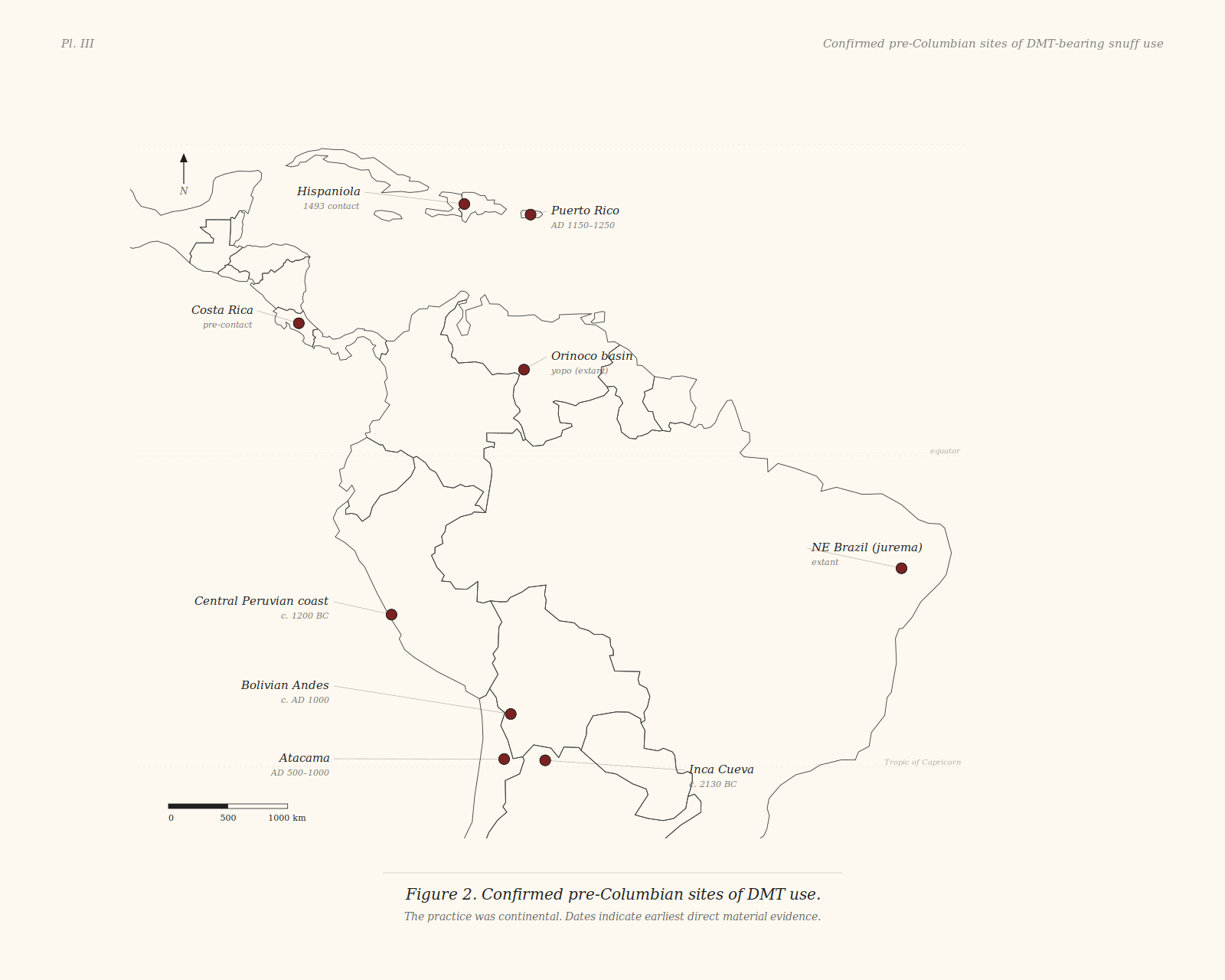
The most striking single piece of more recent archaeological evidence comes from a thousand-year-old shamanic ritual bundle recovered from the Bolivian Andes and analysed in 2019 by Melanie Miller, José Capriles and colleagues. The bundle, kept in a fox-snout pouch, contained snuff trays and tubes; mass spectrometry of the residues found DMT, bufotenine, and harmine in the same kit. Harmine is a monoamine oxidase inhibitor characteristic of the *Banisteriopsis caapi* vine. To find DMT and harmine in a single ritual bundle is to find evidence that, a thousand years ago, somebody in the Andes already knew that the two substances needed to be combined.
This matters, because DMT alone, taken by mouth, does almost nothing. The mammalian gut wall and liver contain an enzyme — monoamine oxidase A — that is so efficient at breaking down DMT that the molecule is, for practical purposes, orally inert in the absence of an inhibitor. Western pharmacology did not properly understand this until the second half of the twentieth century. It is the central pharmacological problem the molecule poses, and it had been solved in the Andes a thousand years before the enzyme in question had a name.
#### A small caution
It is tempting to read the Bolivian fox-snout bundle as evidence that the indigenous practitioners had 'discovered the pharmacology' of MAO inhibition. The temptation should be resisted — or at least examined. The framing turns the indigenous knowledge into a kind of pre-scientific approximation of what we now know more rigorously, with chemistry as the gold standard. That is one way of reading what they were doing. There are others. *(Appendix B takes this question up in detail.)*
What can be said with confidence, and what is the only point I want to insist on for now, is this: long before there was any pharmacology of DMT, there were people using DMT, in ritual, with considerable craft, in elaborate social and ceremonial contexts, across an entire continent. By the time European chemistry arrived to give the molecule its name, the molecule had been inside human bloodstreams, in a controlled and intentional way, for somewhere between forty and a hundred and forty centuries. Western science is not the first chapter of this book; it is, very late in the day, the second.
> **\[Established\]** Indigenous use of DMT-bearing snuff preparations across South America is securely dated to at least 2130 BC by direct residue analysis of dated artefacts (Torres & Repke, 2006; Miller et al., 2019). Combined DMT/MAOI preparations are documented in the archaeological record from at least the early second millennium AD.
---
### What's in the rest of the book
That was Chapter One of fourteen. The remaining chapters trace what happens when the molecule moves westward into laboratories, scanners, and balance sheets:
- **Chapter Two — A Molecule Without a Country.** Manske's accidental synthesis in a Manchester lab in 1931, and the twenty-five years it took anyone to realise what he'd made.
- **Chapter Three — The Hungarian.** Stephen Szára, Budapest, 1956: the first human trials, and the briefcase he carried west.
- **Chapter Six — The Bureaucrat's War.** How one psychiatrist at the University of New Mexico spent five years getting permission to do what Szára had done in five months.
- **Chapter Seven — Reading the Molecule.** The pharmacology, finally, in detail: what binds, what breaks it down, why oral DMT is inert, and why the most interesting receptor pool turns out to be inside the cell.
- **Chapter Eight — The Endogenous Trap.** What the body makes the molecule for — and the awkward fact that, after sixty years, no one is sure.
- **Chapter Nine — Inside the Scanner.** What an fMRI sees when the default-mode network breaks open.
- **Chapter Twelve — The Encounter.** What people actually report seeing, and what to do with the reports.
- **Chapter Twelve-A — The Industry.** The $3 billion biotech market built on top of a public-domain molecule, and the question of who owns a substance the body already makes.
- **Chapter Thirteen — What We Know, What We Don't.** An honest ledger.
Plus two appendices — on UK law, and on the colonisation problem — and ten editorial plates: the Inca Cueva pipe; the molecule and its three close relatives; a continental map of pre-Columbian DMT use; the MAO-A bottleneck; a four-thousand-year timeline; the receptor binding profile; Borjigin's dying-brain experiment; the default-mode network under DMT; the intracellular 5-HT2A discovery; and Szára's briefcase.
---
**The full book — fourteen chapters, two appendices, ten plates — is available to paid members.** \[Upgrade to read on →\]
*If you've enjoyed this much, the rest is more of the same: prose without the romance, science without the marketing.*
### SPL028 Cybin 2024
URL: https://www.ardmt.com/spl028-cybin-2024/
Last updated: 2026-05-07T07:49:58.000Z
# Three Findings From Cybin's DMT Trial That Didn't Make the Press Release
*What a careful read of the SPL028 Phase 1 synopsis tells us about deuteration, dose-response weirdness, and the placebo problem hiding inside every psychedelic trial.*
---
In December 2024, a Phase 1 trial synopsis was quietly filed to the ISRCTN registry. It described twelve months of healthy-volunteer dosing in Manchester of a molecule called SPL028 — a chemically engineered version of DMT that the sponsor, Small Pharma (now Cybin), believes could become the first commercially viable short-acting psychedelic medicine.
The press-release version of this story is short and clean. SPL028 was well tolerated. The pharmacokinetics worked. Higher doses produced complete mystical experiences. Onward to Phase 2.
The synopsis tells a more interesting story. Three of them, actually.
In the short-form pieces I've been making about this trial, I've pulled each thread separately. This is where they come together — with the context, the caveats, and the bits that don't fit into a 60-second reel.
## What SPL028 actually is, and why this trial matters
DMT — N,N-dimethyltryptamine — is the most pharmacologically intense psychedelic ever studied in humans. Administered intravenously, it produces a complete, immersive psychedelic state within about two minutes and resolves within fifteen to thirty. That short duration is part of what makes it scientifically interesting: a clinician can observe the entire pharmacological window in a single afternoon.
It's also what makes it commercially difficult. Most psychedelic therapy models, from psilocybin onward, rely on a long enough drug experience to build a structured therapy session around. A fifteen-minute experience doesn't fit that model.
Small Pharma's bet was to fix this with chemistry rather than dose. They modified the DMT molecule by replacing two hydrogen atoms at the alpha-carbon with deuterium — a stable, heavier isotope of hydrogen. Deuterium forms slightly stronger bonds with carbon than ordinary hydrogen does, and those bonds are harder for liver enzymes to break. The drug is functionally the same; it just survives metabolism for longer.
The deuteration trick: two H atoms at the alpha-carbon are swapped for deuterium, slowing metabolism and roughly tripling the IV half-life.
This is not a new pharmaceutical strategy. Deutetrabenazine, sold as Austedo, is a deuterated version of tetrabenazine used to treat the chorea of Huntington's disease. The deuteration roughly doubled the half-life and allowed the drug to be dosed less frequently, which earned it a fresh patent and FDA approval in 2017\. The technique is well-established. What SPL028 does is apply it to a psychedelic.
If it works, you don't get a different drug. You get DMT that lasts long enough to do therapy with.
The Phase 1 trial reported in this synopsis is the first human safety data on whether the technique held up.
## Finding one: the deuteration story actually worked
Buried in the conclusions section of the synopsis is this sentence: *“SPL028 IV half-life was approximately 3-times longer than IV DMT, demonstrating a robust kinetic isotope effect via deuteration of the DMT α-carbon.”*
This is the technical confirmation that the chemistry achieved its goal. SPL028, given intravenously, persists in plasma roughly three times as long as ordinary IV DMT. The deuterium did its job.
Two practical consequences follow.
The first is that the dosing window changes. The synopsis describes participants spending the duration of the experience in a calm, prepared room, with eye shades and headphones, encouraged to focus inward. That's a setting designed for a therapeutic experience, not a brief pharmacological flash. A fifteen-minute drug doesn't really need this kind of preparation infrastructure. A forty-five minute one does, and crucially, can be built around it.
The second is that the intramuscular route becomes meaningful. This trial tested both IV infusion and IM injection — and the IM injection produced a delayed Tmax of ten to twenty minutes compared to the IV route, with a mean residence time approximately 1.5 times longer than the IV infusion. That difference matters commercially. IV dosing requires cannulation, infusion pumps, and trained staff. IM injection is something that can be done in a treatment chair with no special equipment. If SPL028 IM proves out in Phase 2, the deployment model is much more like a primary-care injection than a hospital infusion. This is the most commercially significant finding in the trial that isn't being talked about anywhere I've seen.
The MEQ data supports the broader case. The Mystical Experience Questionnaire is a thirty-item instrument scored on a percentage scale, and a score of sixty percent or above is treated in the literature as a "complete mystical experience" — a threshold that correlates, in psilocybin research, with later antidepressant response. In this trial, the 17 mg IV, 20 mg IM, and 30 mg IM cohorts all crossed that threshold. So did the 9 mg IV cohort, which is interesting for reasons we're about to come to.
If you're willing to take the MEQ as a meaningful surrogate endpoint — and that's a real *if*, which I'll come back to — then SPL028 produces, in healthy volunteers, the kind of subjective experience that has been associated with therapeutic benefit elsewhere. The pharmacology works. The chemistry works. The clinical setup works.
That's the easy story.
## Finding two: the 11 mg dose anomaly
Now it gets weirder.
The trial dosed five active groups across the IV and IM routes: 9 mg IV, 11 mg IV, 17 mg IV, 7.5 mg IM, 15 mg IM, 20 mg IM, and 30 mg IM. Cohorts 1 and 2 received both an IV dose and an IM dose across two treatment periods. Cohorts 3, 4, and 5 received only one route.
A normal dose-response curve for a psychedelic looks like: more drug, higher peak plasma concentration, stronger subjective effects, more participants crossing the mystical experience threshold. Within reason and within the safety window, this is what you expect.
The 11 mg IV dose did not behave that way.
According to the synopsis, the 11 mg IV dose produced a *lower* mean Cmax, AUC-last, and AUC-inf than the 9 mg dose. On the subjective measures, Cohort 2 (11 mg IV) scored below Cohort 1 (9 mg IV) on the MEQ, the EDI (ego dissolution), the EBI (emotional breakthrough), the CEQ (challenging experiences), the IRVAS (intensity rating), and the VAS items. On essentially every measure that mattered, a higher dose produced a weaker effect.
The synopsis itself flags this as "surprising" and offers three candidate explanations: small sample sizes, individual variability in physiology and blood flow, and timing differences in PK sampling. None of these are conclusive. The honest reading is that the trial doesn't know why this happened.
It's worth dwelling on what a Phase 1 cohort actually is, because this is where the limitations of the data become important. Each cohort in this trial was six participants. A finding based on six people, even with careful sampling, is fragile. The 11 mg vs 9 mg comparison may be a real signal — perhaps a metabolic quirk specific to that batch of participants, perhaps a sampling artefact, perhaps something about the formulation or the infusion. Or it may be statistical noise that disappears with larger numbers.
What it is *not* is an indictment of the drug. The 17 mg IV dose performed as expected, with the highest dose-normalised Cmax and the highest MEQ scores. The dose-response works at the higher end. The 11 mg point is an anomaly in the curve, not evidence the curve doesn't exist.
But it does illustrate something important about how Phase 1 trials work, and how their results get reported. The press-release version of this trial will describe a clean dose-response relationship. The synopsis describes a messy one with a question mark in the middle of the IV range. Both are technically true depending on what you choose to mention.
This is the kind of detail that matters for understanding where the field actually is. Psychedelic trials are still small, still early, still producing the kind of data where individual outliers can swing a cohort mean. Anyone treating Phase 1 mystical experience scores as established efficacy is reading more confidence into the numbers than the numbers can carry.
## Finding three: the placebo paradox
This is the one I want to spend the most time on, because it's the most interesting finding in the synopsis and it's the one almost no coverage will pick up.
The trial design for Cohorts 1 and 2 had two treatment periods separated by a washout of three to six weeks. Some participants in each cohort received SPL028 in TP1 and placebo in TP2, or vice versa, in a double-blind crossover. Cohorts 3, 4, and 5 each had only one treatment period.
This created two different placebo populations whose responses can be compared.
Group A had received SPL028 weeks earlier; Group B had not. On placebo, Group A's response was stronger — and on some measures stronger than the cohort receiving the active 17 mg IV dose.
**Group A** — participants in Cohorts 1 and 2 who received placebo. By the time they got that placebo dose, they had already received an active dose of SPL028 a few weeks earlier in TP1\. They had felt the drug.
**Group B** — participants in Cohort 4 who received placebo. They had never received SPL028\. The placebo was their only dose.
The comparison the synopsis makes between these two groups is buried in the PD Results section, but it's striking.
On the Emotional Breakthrough Inventory, Group A scored higher than Group B. The synopsis explicitly notes this: the previously-dosed placebo group experienced a stronger placebo effect than the never-dosed placebo group.
On the IRVAS — the Intensity Rating Visual Analogue Scale — Group A again scored higher than Group B.
On the VAS items, Group A's scores tended to be higher than Group B's.
And on some of these subjective measures, Group A — placebo, but with prior active drug exposure — scored higher than Cohort 4 receiving the active 17 mg IV dose.
Read that again. People who received saline, but who had previously received the actual drug a few weeks earlier, reported subjective experiences in some respects more intense than people receiving the highest IV dose for the first time.
The synopsis's framing is cautious — *“suggesting that the psychedelic-experienced cohort experienced a stronger placebo effect”* — but the implication is significant. Prior exposure to a psychedelic state appears to amplify the response to a subsequent placebo. The brain, having once gone there, can be more easily induced to revisit something resembling the territory.
This is not a new idea in the literature. Expectancy effects in psychedelic trials are a known and growing concern. Researchers including Balázs Szigeti and Boris Heifets have argued that the placebo response in psychedelic studies is large, modifiable, and partly a function of participants' prior exposure and beliefs. What this synopsis does is provide one more data point in that argument — and a particularly clean one, because the comparison is within a single trial, with the same drug, the same protocol, and the same setting.
Two implications follow.
The first is methodological. Crossover designs in psychedelic trials, where the same participant receives both active drug and placebo, may systematically inflate placebo responses in the second period. If you're trying to measure drug-versus-placebo difference, a participant who has already had the drug isn't a clean placebo control. The field has known this in principle. This data shows it in practice.
The second is more philosophical. If a substantial portion of the subjective psychedelic experience can be reproduced — at least in some participants, on some measures — by an inert injection in a prepared setting after prior exposure, then the question of what is actually doing the therapeutic work becomes harder to answer. Is it the drug? Is it the state the drug induces? Is it the conditioning of having entered that state once? Is it the setting, the preparation, the integration session?
These are not new questions, but the SPL028 data sharpens them.
I want to be careful not to overclaim here. Six participants in each cohort. One trial. Healthy volunteers, not patients. The finding is signal, not proof. But it's signal that aligns with a growing body of methodological concern in the field, and it deserves more attention than the press cycle is going to give it.
## What the redactions tell us
The version of this synopsis that's publicly available has several passages blacked out. The redactions appear to cluster around specific PK parameters — half-life values, plasma concentration ranges, and details about the volume of distribution. There's also redaction in the safety narrative around Cohort 4, the 17 mg IV group.
There are a few likely reasons for redactions of this kind. The most common is commercial sensitivity: PK parameters are competitively useful information for other companies developing similar drugs, and sponsors will often redact them in pre-publication releases. Some redactions may relate to ongoing patent or intellectual property considerations. Some may be safety-related, in the sense that specific values are still under regulatory review.
What you can read from the pattern is that Cybin has chosen to release the structure of the trial and the directional findings — half-life roughly tripled, doses tested, mystical experience thresholds crossed — while withholding the specific numerical values that a competitor would need to replicate the work. That's a normal commercial choice. It's worth knowing it's happening, because it means the public version of the trial is, by design, less informative than the version regulators see.
## What this trial actually tells us
To pull the threads together.
SPL028's deuteration strategy works. The half-life is meaningfully extended. The drug is well tolerated within the dose range tested, with the caveats that the 17 mg IV cohort had two participants whose infusions were stopped early due to side effects, and that one participant had a severe psychomotor hyperactivity event. The dose ceiling is being probed and is real.
The dose-response curve is roughly as expected at the top end but has an unexplained dip at 11 mg IV that the trial itself can't account for. This is a Phase 1 reality, not a deal-breaker, but it's a flag.
Higher doses across both routes produced complete mystical experiences as measured by the MEQ — but the placebo data should make us cautious about how much of that response is being driven by the drug versus by expectation, conditioning, and setting.
The IM route works. Onset is delayed by ten to twenty minutes versus IV but the experience occurs and the safety profile is comparable. The path to a real-world clinic deployment, if SPL028 IM proves out in Phase 2, looks dramatically more practical than for IV-only protocols.
What this trial does *not* tell us is whether SPL028 treats depression, or any other psychiatric condition. This was a Phase 1 healthy-volunteer trial. The MEQ scores are a predictor researchers associate with antidepressant response in other compounds. They are not, in themselves, a measure of efficacy. Phase 2 trials in patient populations will start to answer that question. Part B of this same protocol — the open-label patient cohort — is where that data will come from.
## What to watch next
For DMT and DMT-adjacent compounds specifically, the next twelve to eighteen months are going to be busy.
Cybin is expected to move SPL028 into Phase 2 work in major depressive disorder. The Part B data, when it appears, will be the first real efficacy signal from this molecule.
Beckley Psytech's BPL-003 — an intranasal formulation of 5-MeO-DMT, a related but pharmacologically distinct molecule — has Phase 2b data emerging in treatment-resistant depression. This is currently the most advanced near-term DMT-family compound and the readout is one to watch closely.
GH Research's GH001, an inhaled 5-MeO-DMT, is also in Phase 2 work in treatment-resistant depression with results expected over the next year.
For ibogaine, the ongoing observational work at Ambio Life Sciences and the Stanford ibogaine for traumatic brain injury research are the two most credible threads. Ibogaine is a different beast pharmacologically — a long-duration, cardiotoxic experience with very different scheduling and regulatory considerations — and worth tracking on its own track.
I'll be covering each of these as they develop. The short-form versions appear on the social channels. The long-form analysis — the version where I can actually pull the threads together — lives here.
## A note on how I read these documents
One thing worth flagging, partly as transparency and partly because it's useful for anyone who wants to read trial documents themselves.
Phase 1 synopses use a specific vocabulary that signals where the interesting parts are. Words like *surprising*, *unexpected*, *in contrast*, *however*, and *despite* almost always mark a finding that the authors themselves consider anomalous. A keyword search for those terms across any synopsis is one of the fastest ways to surface the buried findings. The 11 mg anomaly and the placebo finding both came from sentences containing those flag words.
Equally, the structure of these documents matters. The conclusions section is usually a sanitised summary. The PK Results and PD Results sections are where the actual findings live, often in dry language that doesn't flag itself as important. The interesting bits sit several pages into the document, written in the same neutral tone as everything around them, easy to skim past.
Reading carefully takes longer than reading the press release. It's also where everything actually is.
---
*Source: Clinical Study Report CT028\_001, MAC Number: MAC 150, Final Version 1.0, 02 December 2024\. ISRCTN registry: ISRCTN42293056\. Sponsor: Small Pharma Ltd (now Cybin Inc.).*
*Next breakdown: \[name the next compound or trial here\]. Subscribe to get it in your inbox.*